



Abstract
The past 15 years has seen the rise of businesses that seek to sell community as a service. Relational Models Theory provides a compelling theoretical framework that suggests the prospect of selling or buying community may be prone to evoking cognitive, affective, and behavioral aversion among both sides in the exchange. This paper considers the coworking industry—a paradigmatic example of a business that promises to sell community—through the lens of Relational Models Theory. We use our personal experience as coworking space owners and community managers to explore challenges and conflicts that we, other community managers, and our members have encountered that may be inherent to trying to buy and sell community. Finally, we suggest tentative solutions to those challenges.
The past 15 years has seen remarkable growth in businesses that seek to package and sell community as part of their core product or service, what we call community businesses. Although there are several business types that sometimes fall into this domain, this article focuses on individual-purposed coworking spaces (Orel & Bennis, 2021a), which are the best example of a community business we know. Individual- purposed coworking spaces differ from other serviced offices—including group-purposed or start-up-purposed coworking spaces—in both their target market and in the kind of service they promise. They target individual white-collar workers: freelancers, remote workers, and solo-entrepreneurs, rather than startups or teams from existing organizations. Most importantly, a core feature of their promised service is to facilitate a sense of community among those unaffiliated, individual workers who might otherwise work from home, from cafés, or alone in a private office (Akhavan, 2021; Blagoev et al., 2019; Garrett et al., 2014; Hunt, 2009; Merkel, 2015; Orel & Bennis, 2021a, 2021b; Rus & Orel, 2015; Spinuzzi et al., 2019; Spreitzer et al., 2017; Sundsted et al., 2009; Waters-Lynch et al., 2016). The primary workspaces are open-plan; the spaces employ community managers whose job it is to facilitate community, and they organize activities intended to increase the sense of belonging, common purpose, and depth of relationships that often corresponds to a sense of community (Cabral & Winden, 2016; Merkel, 2015; Orel & Dvouletý, 2020).
As with any major shift in how people work—which we believe coworking and other community businesses are a part of—there are many associated challenges. The current article focuses on the challenges directly related to buying and selling community as a core feature of a paid product or service. Community is a kind of abstract good that has not traditionally been exchanged for money, and the prospect of doing so presents certain—perhaps inherent—challenges. Although the issue is more nuanced, it is a useful heuristic to use an established model to help provide insight. In the case of buying and selling community, relational models theory (Fiske, 1992) provides a compelling theoretical framework that helps explains why trying to buy and sell community may provoke internal and interpersonal conflict among those involved in the exchange, what Fiske and his colleague Philip Tetlock (Fiske & Tetlock, 1997) call taboo trade-offs.
We focus on individual-purposed coworking spaces for several reasons. First, we believe they are a paradigmatic example of a community business. Second, coworking's phenomenal recent growth makes it a relevant example for readers. Third, it is useful to stick to a single business domain for the sake of coherence and simplicity at this early stage of theoretical consideration. As far as we are aware, this is the first article to point to the contemporary rise of businesses that seek to sell community as an explicit part of their product or service, or to apply either Fiske's relational models theory or the problem of taboo trade-offs to businesses that try to sell goods that resist market pricing.
We believe the discussion has wide relevance beyond the coworking industry and beyond community businesses. As white-collar workers become increasingly likely to work remotely and to work on a freelance, project-specific basis—we expect the loss of a sense of community and the demand for community businesses to increase and their role in global business to be increasingly relevant. More importantly, we believe the challenges highlighted in this essay point to issues that have become increasingly relevant in daily life in contemporary Western society; they are not unique to community businesses, they are just more pronounced and easier to identify.
The essay follows from our first-hand experience with individual-purposed coworking spaces and from our specialized training in cultural psychology and organizational sociology, respectively. Together, we have more than 15 years of experience both as founders and as community managers of individual-purposed coworking spaces 1 and more than 10 years of experience as scholars studying the coworking domain. We have trained and worked with over a dozen community managers, organized conferences, and published several peer-reviewed articles about the industry. We have been following that industry closely since its early days of development, starting in 2007 when there were fewer than 100 global coworking spaces (Emergent Research & GCUC, 2017; Foertsch, 2015). All this to say, we have extensive breadth and depth in this domain.
A few notes on style are in order. Claims made about the coworking industry without citations can be assumed to report personal experience, although we make an effort to back up empirical claims with citations when additional evidence is available. We sometimes make generalizations about the nature of the coworking industry or the people in it, including internal mental states. These are based on conversations, survey or interview data (when cited), our interpretation of specific situations, or our synthesis of cumulative experiences. In all these cases, we refrain from making such generalizations unless we feel confident that our observations are correct. At the same time, we are both trained social scientists, well aware of the impact of subjective bias in the kind of first-person, observational data we are reporting. Rather than repeatedly inserting, “we believe,” throughout the article, we emphasize here that these statements are our assessments of the situation and could be wrong. That said, they are beliefs informed by extensive experience in the domain and by a commitment to getting the story right rather than to telling a particular story.
The remainder of the article is divided into four sections. The first section provides a theoretical overview of relational models theory and taboo trade-offs. It includes a discussion of how we conceptualize community for this paper, which corresponds to the communal sharing relational model. The second section provides historical background on the rise of individual-purposed coworking spaces and their emphasis on community as a core feature of what they are selling, and connecting that to the problem of taboo trade-offs. The third section uses our experience in the coworking industry as source material for a discussion of three specific challenges associated with the elicitation of taboo trade-offs when coworking space managers and members seek to exchange community for money. The fourth section considers potential solutions to these challenges.
Relational Models Theory and the Problem of Taboo Trade-Offs
The ideas of community and business are often associated with two distinct mental models of how people relate to one another. Business tends to be associated distinctly with more individualistic, autonomous relationships where exchanges that involve buying and selling are commonplace, and the people involved in the transactions need not know one another. Community, however, tends to be associated with strong social ties, and with concern for the good of the group more than the good of individual members. Communal relationships resist tracking what individual participants give or take, and they are especially resistant to the kinds of precise valuations associated with buying and selling. This conflict is usefully understood through the lens of relational models theory (Fiske, 1992) and the corresponding idea of taboo trade-offs (Fiske & Tetlock, 1997; McGraw & Tetlock, 2005; Tetlock et al., 2000).
Four Elementary Forms of Social Relationship
Based on his own field work and a synthesis of existing anthropological literature, Fiske proposes that four qualitatively distinct mental models govern how people build and manage social relationships across cultures: communal sharing (CS), authority ranking (AR), equality matching (EM), and market pricing (MP). This section summarizes the four models, with a particular emphasis on communal sharing and market pricing. They are the two mental models primarily activated by community businesses and are the focus of this article.
Communal Sharing
The CS mental model corresponds closely to an ideal of community that we believe is often sought and expected in the individual-purposed coworking industry. It is what we mean by community when referring to the elicitation of taboo trade-offs in community businesses, despite the fact that the word community is used in a variety of ways among coworking-space members and proprietors. It conceives of people as equal and undifferentiated parts of a greater whole. CS actors give freely when they have the resources, take freely when in need, expect others to do the same, and do not keep explicit track of how much is given or taken. CS relies on strong in-group bonds such that the group may seem a more relevant unit of concern than the individuals who make it up. As such, giving or taking from the individual parts need not ever balance out. Giving in these relationships looks the most like authentic altruism, with individuals contributing to the group without much—if any—thought for what they will get in return. A parent cooking Thanksgiving dinner for the family, a child helping their elderly grandparent into the house, or a soldier jumping on a live hand-grenade to save members of their platoon are examples. It is worth noting that—unlike the other three relational models—terms like transaction or exchange do not make sense with CS relationships. Those terms imply an expectation of a back and forth that is absent from CS. It is fine to give and fine to take, but what or how much one gives or takes is not part of what is being evaluated in CS relationships except to the extent the actors are not properly fulfilling their expected roles.
At least two established social scientific conceptions of community have been applied to the study of coworking that overlap with Fiske's conception of CS relationships. Rus and Orel (2015) used McMillan and Chavis's (1986) influential model of community which proposes that a sense of community is characterized by a perception of belonging, mutual concern, and collective engagement among its members. Spinuzzi et al. (2019) used Adler and Heckscher's (2006) typology of communities derived from Ferdinand Tonnies's (1887/2017) distinction between Gemeinschaft (community) and Gesellschaft (society). Gemeinschaft is based on more traditional small-scale societal relationships that depend on familial ties, on geographic proximity, and on friendship. That corresponds well to Fiske's conception and with what we mean by community. Gesellschaft is based on more superficial relationships characterized by living alongside one another peacefully and the sense of shared identity that develops from that. According to Tonnies, in alignment with Fiske, only with that latter sense are goods considered to be separate with discrete ownership and the possibility to buy and sell them. We rely on Fiske's conception of communal sharing to describe what we mean by community because relational models theory is the framework used in this article and because, in our experience, something akin to it is sought by many proprietors and members of individual-purposed coworking spaces. This is the conception of community that provokes taboo trade-offs when attempts are made to buy or sell it. 2
Authority Ranking
This mental model orders people hierarchically from lower to higher. These relationships are asymmetric, recognizing different expectations depending on one's order in the hierarchy. AR guides relationships between a parent and a child, a teacher and a student, a boss and their subordinate, or higher and lower ranking member of the military. Higher-ranked individuals are given greater respect and priority but are also expected to take on the caretaker and mentor-teacher roles with lower-ranked individuals. What the exchange expectations are varies widely across cultures and depends on the specific AR domain. AR plays an important role in business relationships, including the coworking industry, both between managers and subordinate employees and between service providers and clients, and some of the conflicts discussed in this article will have AR elements. That said, this article focuses on the conflict between CS and Market Pricing that arises from trying to buy and sell community, so AR relationships receive limited attention.
Equality Matching
This mental model seeks balance and overall equality in social exchanges, using equal weighting (“one for one”) across different exchanges. An example on the positive side is the metaphor “you scratch my back and I’ll scratch yours.” An example of the negative side is “an eye for an eye.” Real-world cultural examples might be roommates trading household chores (you do the dishes and I’ll take out the trash) or work colleagues trading responsibilities: “If you work for me this Monday, I’ll work for you next Friday.” Again, as the example just provided illustrates, EM plays a role in business relationships. That said, it is not common in coworking client–service-provider relationships and it is not a focus of this article.
Market Pricing
This mental model seeks more precise value in social exchanges, assigning positive and negative values to all exchanges according to a common currency or other quantitative assignment of value, such that any MP good can have a specific value calculated to fractional amounts and exchanges are expected to be equivalent within that system of exchange. MP is useful for transactions across different goods, across more distant social relationships, and with more concrete, secular goods: things that can be bought and sold, where money itself is often the currency of exchange. It is worth noting that while the terms transaction or exchange make sense in all relational models other than CS, buying and selling only make sense in MP exchanges.
Whereas CS relationships play a diminished role in Western, Educated, Industrialized, Rich, Democratic (WEIRD) societies (Henrich, 2020; Henrich et al., 2010), MP relationships are ubiquitous. Indeed, part of the value of MP relationships is that cultural scripts required to engage in them do not require as much culture-specific local knowledge as CS, AR, and EM relationships. As such, MP makes exchanges easier between unfamiliar, culturally diverse strangers. These are just the people most likely to be lacking communal ties. Since WEIRD people are (a) most lacking communal relationships and (b) most ready to apply MP unilaterally, they may provide fertile conditions for the community business.
Fiske recognizes broad cultural differences with respect to which relational models are used in which contexts and he emphasizes that they can be combined in distinct ways to create complex cultural scripts for precise situations. In line with that, specific valued goods exchanged within a relational domain do not necessarily belong to a single relational model even within the same culture. Fiske and Tetlock use the example of dinner to show how the same good can fall into each of the four relational models within a single culture: Thanksgiving dinner with family (communal sharing), dinner at a restaurant (market pricing), dinner at a friend's house (equality matching), and dinner at the White House with the U.S. President (authority ranking). Each case has distinct scripts and expectations (or nonexpectations) of exchange depending on the domain it falls into.
Fiske argues that the four relational models can be ordered with respect to their evolutionary, cultural, and ontogenetic development (Figure 1). CS relationships came earlier in our biological evolutionary history, were more prevalent in earlier stages of our cultural evolutionary past (i.e., more common among early hunter-gatherers), and occurred earlier in child development. MP relationships are hard to observe at all in predecessors to Homo sapiens, are more common in the most contemporary examples of our cultural evolutionary life (i.e., urban, industrialized settings), and develop last in child development. In consequence, not only does the business of selling community cross two distinct relational domains (where the good of community falls most naturally in the CS domain, but the mode of buying and selling belongs firmly to the MP domain), but the two domains are also the most distant.

Hypothesized developmental stages of relational models over evolutionary, cultural, and ontogenetic time.
Taboo Trade-Offs
An important aspect of relational models theory is that different relational models have different culturally defined scripts. The dinner example earlier makes this point. Offering to pay one's parents for Thanksgiving dinner (or, alternatively, parents demanding their child pay for it), if serious, would be acts of psychological aggression from the family members offering or demanding payment. Inviting the King over for tea after being invited to Buckingham Palace would seem at best to demonstrate a lack of understanding of context and culture, and at worse to be a rude gesture of disrespect. It certainly would not be appropriate to respond to the dumbfounded King, “Okay, how many teas at my house would it take to make up for this?” or, “What if I throw in a million pounds?” equality matching or market pricing does not belong in an authority ranking exchange.
Fiske and Tetlock propose—and, along with their colleague Peter McGraw among others, compelling experimental evidence—that a person using a script from a culturally inappropriate relational model will tend to elicit cognitive, affective, and behavioral aversion, corresponding to anthropological conceptions of a cultural taboo (Fiske & Tetlock, 1997; McGraw et al., 2003; McGraw & Tetlock, 2005). That is, people mixing these domains (e.g., parents asking their children for money for the family Thanksgiving dinner) will elicit an automatic, negative emotional response (affective aversion), will readily frame that negative affect with attributions to explain the affective response (cognitive aversion), and will avoid making the trade-off in a way that might be likened to a fight-or-flight response (behavioral aversion).
They contrast their conception of taboo trade-offs—where exchanges across relational models is seen as inappropriate and aversive—with the dominant economic model of rational choice theory, utility theory. Utility theory proposes that all goods can be evaluated and exchanged using a common metric of subjective value, and from that perspective, parents should be happy to be offered money from their children, as long as the price is right. Utility theory is firmly rooted in MP mental models, and applying that relational model to domains that call for AR, EM, or CS is taboo according to relational models theory.
Exchanges across culturally coded relational models are not equally taboo, however. Fiske and Tetlock hypothesize three factors that influence how taboo a trade-off is, all related to the relational domain's developmental order (see Figure 1). First, exchanges across relational models are more taboo if they involve earlier models. Exchanges between CS and AR, for example, are more taboo than those between EM and MP, even though each exchange is just one step away.
Second, the direction of exchange is asymmetric. Using a later mental model in a cultural context that calls for an earlier one is more taboo than using an earlier mental model in a context calling for a later one. Contexts that call for earlier relational models are more highly valued and more likely to be moralized and considered sacred than contexts that call for later relational models, and so it is more upsetting if one applies a non-CS behavioral script to a more sacred CS good, for example, than to apply a CS behavioral script to a less-sacred non-CS good, which might not be taboo at all (see also Tetlock, 2003). As Fiske and Tetlock point out, the Beatles may have been right that “money can’t buy you love,” but it is fine to give money to the ones you love.
Third, the more highly valued some good is within a particular culturally scripted relational model, the more taboo it is to apply the wrong relational model to it. A parent seriously asking their children to pay for Thanksgiving dinner is not equally taboo as a parent seriously offering to sell their children into slavery. Both family Thanksgiving dinner and children's freedom from slavery may elicit a communal sharing mental model, but they are not equally sacred, and applying the wrong relational model to them (in this example, MP) presumably feels far more taboo in the latter case.
Linking Taboo Trade-Offs to Community Businesses
Despite the warranted emphasis on cultural variability with respect to which mental models are elicited and when some goods more readily elicit one relational model than another even across cultures. While it is beyond the scope of this article to examine cross-cultural patterns concerning which goods more often belong to one relational domain or another, it would seem to be the case that the idea of community itself—conceptualized here with respect to its correspondence to CS relationships—more readily falls into the CS domain. On the other hand, goods that can readily be bought and sold—and money itself—more readily fall into the MP domain. As such, the act of buying and selling community may readily evoke both MP and CS mental models. With that in mind, community businesses often fit at least two of the three above criteria for what makes cross-domain trade-offs more taboo. First, they mix the two most distant relational models. Second, the direction of the relationship is often asymmetric in the more problematic direction, applying an MP mode (paying money) to obtain a good that demands a CS mental model (community).
But does coworking really concern itself with the community in a way relevant to CS and relational models theory? In our experience, yes. The next section discusses individual-purposed coworking spaces and the central role the ideal of community has played in its development and in what it seeks to offer to clients. That is followed by concrete examples where problematic trade-offs associated with giving or accepting money in exchange for community evoked in us—or seemed to evoke in others—an aversive response akin to Fiske and Tetlock's description of taboo trade-offs.
Coworking and the Community Business
The Centrality of Community to Coworking
Traditionally, society forces us to choose between working at home for ourselves or working at an office for a company. If we work at a traditional 9 to 5 company job, we get community and structure, but lose freedom and the ability to control our own lives. If we work for ourselves at home, we gain independence but suffer loneliness and bad habits from not being surrounded by a work community. Coworking is a solution to this problem. In coworking, independent writers, programmers, and creators come together in community… (Neuberg, 2005, from the blog post widely credited as the first public use of the term coworking in the sense originally used by the coworking industry).
An emphasis on community was central since the early development of the coworking concept which was pioneered by a small handful of thought leaders in the open-source software movement and in online-community development (Hunt, 2009; Neuberg, undated; Spinuzzi, 2012; Sundsted et al., 2009; Waters-Lynch et al., 2016). Curious readers are willing to invest the time can access the history of shared communication in a Google Group as it grew from just a handful of founding members (including Neuberg) to more than 5,000 and from just one coworking space to hundreds and eventually thousands (https://groups.google.com/g/coworking). The community played a central theme throughout. It was encoded as part of a set of five core values of the coworking movement in 2010 and remains featured on the coworking.com website today (Core Values—Coworking, n.d.). The website itself was co-purchased as part of a community effort by members of that Google Group (including one of the authors of this article). The emphasis on community remains central to individual-purposed coworking spaces today (Blagoev et al., 2019; Garrett et al., 2014; Orel & Bennis, 2021a, 2021b; Spinuzzi et al., 2019; Waters-Lynch et al., 2016), and in a way that may be unique in the service industry (see Spinuzzi et al., 2019 for a useful review). What little empirical data exists suggests that a meaningful sense of community is sought by a significant proportion of coworking space members as well (Rus & Orel, 2015; Spinuzzi et al., 2019).
The Ambiguity of Community in Coworking
The fact that community plays a central role in the coworking industry as compared to most other businesses is not meant to imply homogeneity in what the concept of community means in that industry, even when limited to individual-purposed coworking spaces. The meaning of the concept among users and proprietors of coworking spaces is diverse, despite widespread recognition that community is central to coworking (Spinuzzi et al., 2019). Similarly, whether members are seeking community and what kind has rarely been measured empirically (for exceptions, see Rus & Orel, 2015; Spinuzzi et al., 2019). Indeed, although the exception rather than the rule, each of us has had many interactions with members for whom our emphasis on community was an unwanted distraction. A larger group of coworking-space fits somewhere in the middle between those not seeking community at all and those seeking the kind of community that characterizes CS relationships. That might be called community light: a low-investment, opt-in, short-term form of casual social relationship. Community light does not entail reciprocal expectations from the payer, other than the need to pay, and it might be the most plausible form of community that can be bought and sold, but it does not provide the kind of meaningful communal connection that we believe many of those same members long for.
This ambiguity in meaning has become more pronounced as the industry has grown and diversified (King, 2018; Orel & Bennis, 2021a, 2021b; Spinuzzi et al., 2019). As the coworking concept gained traction and media attention, especially with the dramatic early success of WeWork, many serviced-office providers began to rebrand as coworking spaces and to use the term community as a keyword without necessarily making a meaningful shift toward promoting it. That has not been as problematic as might be expected, since the clientele of these larger group-purposed coworking spaces are more likely to be teams from the same organization working together and many of those teams were not seeking community in the first place (Orel & Bennis, 2021a, 2021b; Spinuzzi et al., 2019). But the ambiguity remains problematic for coworking spaces seeking to create authentic community because it promotes mixed messages about what the terms community and coworking mean and what people looking for either one can expect when joining a coworking space. This has fed back on the expectations of clientele of individual-purposed coworking spaces and even of founders and community managers of such spaces.
While this ambiguity has contributed to the conflicts this article highlights, we are primarily concerned with cases that involve the expectation of community in the sense described by the CS mental model and which we believe is common from at least one side in coworking-for-money exchange relationships. Creating that kind of community was central to our own aims as founders and community managers, to the aims of many other coworking space founders we know, and to the hopes of many of our members.
Other Community Businesses and Generalizations Beyond Them
There are several examples of community businesses besides coworking spaces. Hackerspaces and makerspaces provide tools and materials for making things and are sometimes considered a sub-type of coworking (Davies, 2017; Niaros et al., 2017; Orel & Bennis, 2021a). Coliving or cohousing businesses rent or sell housing to unaffiliated individuals or families who want to be connected to a larger community for the short- or long-term (Davies, 2015; McCamant & Durrett, 2011; Williams, 2005). They often include a shared kitchen, coworking space, and other communal areas, as well as an explicit requirement for members to participate in activities that benefit the larger group, such as cleaning, cooking meals, or teaching. Organizations like Remote Year and Hacker Paradise mix co-living with coworking as part of community-focused group travel (Lee et al., 2019; Orel, 2020). We have no doubt there are other good examples.
While the community businesses we are aware of are an innovation of the early 21st century, there are other examples of businesses that we would not consider community businesses but that nonetheless share some commonalities. These businesses mix profit-seeking with intentional community building, but they do not include community so explicitly as part of what they promise and they use the term more superficially. For example, group-purposed coworking spaces, health clubs, hotels, and apartment complexes often seek to build a sense of community among their clientelle and in their physical spaces, promise to provide that community in their marketing material, and offer activities to bring their clients together. We would not call these businesses community businesses, however, since they are rarely explicit in the promising community as part of the fee they are charging and the commitment to community building tends to be superficial. It is incomparable to the widespread emphasis on community building among individual-purposed coworking space managers and members that we see on a regular basis and would consider the norm rather than the exception. We nonetheless expect that these businesses must sometimes deal with conflicts associated with the promise to provide community for a price. In turn, we expect there to be examples from this article that help identify challenges within these and other borderline cases in interesting ways and that point to problems faced by all businesses when they mix close interpersonal relationships with profit-seeking.
Why Now?
Why are community-oriented coworking spaces and other community businesses a relatively modern phenomenon? We suspect that the large-scale market penetration of the Internet and mobile technology in the 1990s—facilitated by a large and growing variety of complementary technology, infrastructure, and social norms that have allowed people to effectively work and collaborate remotely (Friedman, 2005; Spinuzzi, 2015)—explains why community businesses started to take off independently in multiple locations and modalities. It is during this marked cultural shift to more remote, virtual, short-term work that community is most in demand and that businesses that sell community have come into being. Although it is too soon to judge with confidence, there is good reason to expect the long-term impact of COVID-19 will be to increase the trend toward both greater workplace autonomy and a greater need for community, as suggested by evidence for the sustained increase in remote work (Bick et al., 2021; Brynjolfsson et al., 2020) and the corresponding impact of remote work on perceived social isolation (Charalampous et al., 2019; Van Zoonen & Sivunen, 2022).
Buying and Selling Community Promotes Taboo Trade-Offs
As a reminder, buying and selling community creates a particularly strong conflict across relational models, first, because CS and MP are the two most distal relational domains and, second because applying a more secular relational model (where MP is the most secular) to a more sacred one (where CS is the most sacred) is more taboo inducing than vice versa. This is exacerbated by the ambiguity in the meanings of both community and coworking in practice, such that there often appear to be conflicting expectations regarding which relational domain is appropriate, even within individual actors from one time to another.
If trying to buy and sell community is taboo in the sense that it promotes conflict and is aversive, then why are people and organizations in WEIRD cultures so ready to do it? Fiske and Tetlock point out that taboo trade-offs are relatively rare. Within a homogenous and long-standing community, cultures develop shared implementation rules that avoid them. They suggest six reasons as to when taboo trade-offs are particularly likely to occur (1997, p. 284), all of which point to novel situations where shared conceptions of proper implementation rules are unavailable or contradictory, whether from environmental or cultural change or from novel cross-cultural interactions. Table 1 summarizes these six reasons and their relevance to the coworking industry, along with providing a seventh reason we find compelling but not mentioned by them. As that table makes clear, all seven reasons readily apply to the coworking industry, a novel institution resulting largely from new technologies that have facilitated a radical shift in how and where people work and collaborate; an institution that brings people together from diverse cultural backgrounds with distinct values and conflicting expectations about relational domains and appropriate behavioral scripts.
Antecedents of Taboo Trade-Offs and Their Relationship to Coworking.
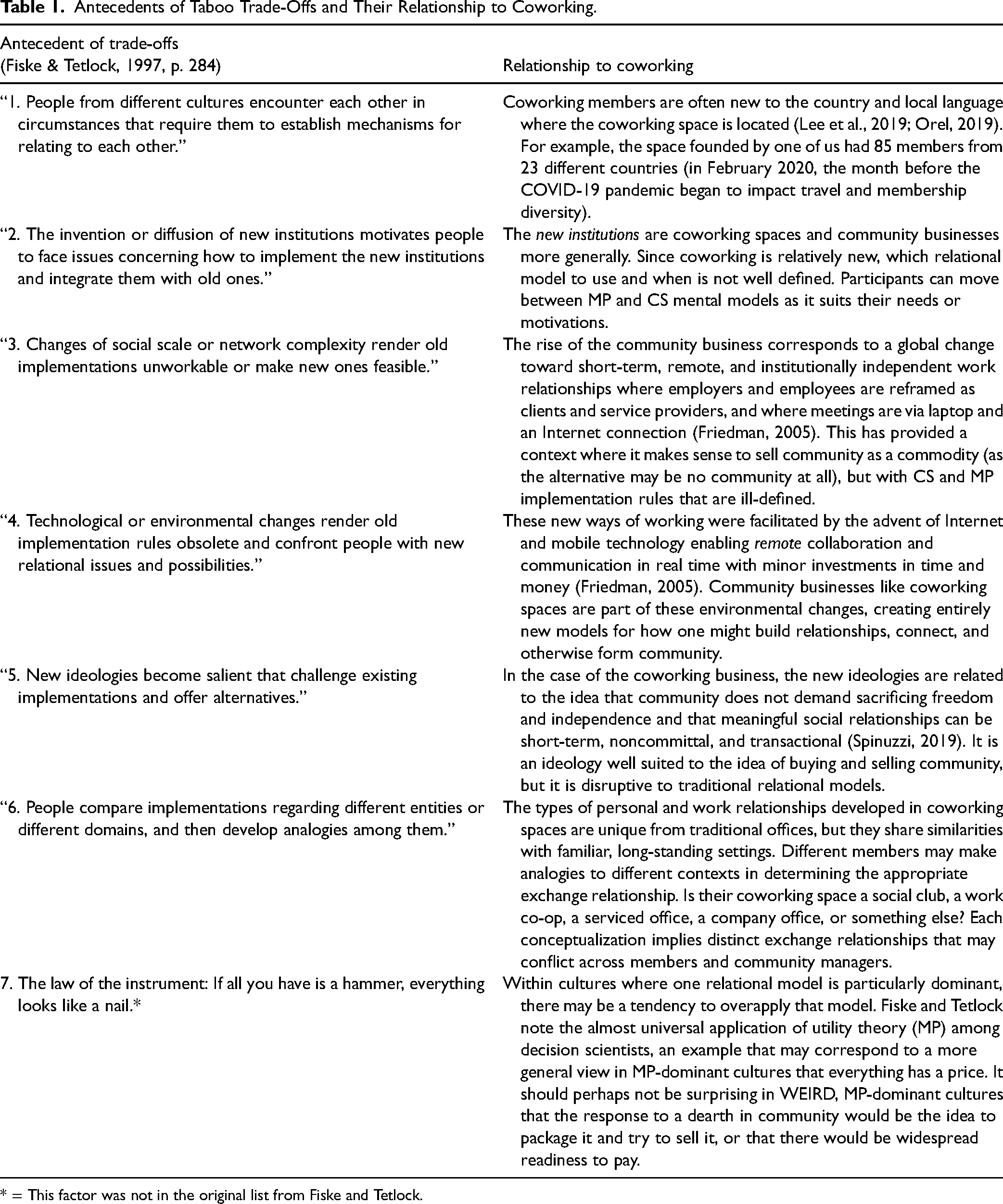
* = This factor was not in the original list from Fiske and Tetlock.
While there was and remains a great deal of idealism among founders of individual-purposed coworking spaces and many of their users, the premise of this essay is that—like trying to buy or sell love—trying to buy or sell community is prone to conflict and is, perhaps, inherently problematic. People may feel the need for the community to such a strong extent that they are willing to pay for it, but the widespread readiness to do so may be a symptom of a wider problem, not just for the coworking industry, but for WEIRD societies more generally, where the need for community is high and the prospect of buying and selling it seems to many like an acceptable solution. Yes, many proponents of community-oriented coworking spaces—including us—have been motivated by idealism, but this essay is largely about why that idealism has been so difficult to realize in practice, as the challenges discussed in the next section seek to exemplify.
Challenges
The community business, by nature of its novelty and cross-relational-domain framing, is rife with taboo trade-offs. This section describes concrete examples where the lack of clear scripts for whether to apply a CS or MP mental model makes management in the community business particularly difficult. While the nature of the challenges described here was experienced independently by each of us, the specific examples and contexts have been changed or made more general to ensure anonymity. Three challenges will be highlighted: (1) How to resolve role ambiguity for community managers and members, with respect to whether they should conceive of themselves or the people they are relating to as community members (CS) or as service providers/clients (MP); (2) how to motivate community-orientated behavior among members, a necessary condition for the coworking space to be able to provide the promised community; and (3) how to minimize generosity burnout among community-oriented managers and members.
Challenges aside, we should emphasize that owning and managing a coworking space was an overwhelmingly positive experience for each of us, in large part because of the valuable relationships and shared experiences with our members. Despite the conflicts associated with navigating mismatched expectations and occasional discomfort surrounding taboo trade-offs, the vast majority of interactions have been positive and rewarding.
Challenge 1: Role Ambiguity for Community Managers and Members
In community-oriented coworking businesses, expectations about who should be communal sharers and who should be market-pricing utility maximizers often conflict. To the extent that business (buying and selling) elicits an MP mental model, community managers and coworking-space members may seek to minimize their contribution while maximizing what they get in return. To the extent that community elicits a CS mental model, they may instead expect an environment where people give when possible and take as needed without keeping track. Often this ambiguity is within individuals, with both community managers and members shifting between relational models since there are not clear rules for which model applies when.
This role ambiguity promotes frequent conflict and confusion. Both community managers and members often convey ambiguity about the extent to which their relationships are authentic or are instrumental. If community managers later need to put on a market-pricing hat and confront members who are not paying their monthly fees, who are using resources that are not part of what they paid for, or who are being disruptive to the rest of the community, they may feel strong discomfort or face angry recrimination from members who expected a CS approach. Alternatively, if a community manager tries to stick to a more CS mode, other members—or their bosses—may become angry that the manager is not doing their MP job of making sure members pay for what they get and get what they paid for. Other members may seek to take advantage of the community managers’ evident ambivalence, pointing to the CS relationship to avoid following rules or paying for products or services. A hard truth among many long-term community managers is that most interpersonal relationships outside—and sometimes including—romantic relationships and family are with coworking-space members, making this ambiguity in evaluating CS versus MP relationships especially difficult.
Consider the case of a member talking too loudly or too often in a shared, open-plan workspace. In a pure MP business, it is unambiguously the role of the company and the people who work there to regulate problematic customer behavior and it might seem absurd and even upsetting if a bank or supermarket manager, for example, asked a customer to please talk to another, unaffiliated customer who was cutting in line, making too much noise, or using resources that they did not pay for. In community businesses, however, the opposite is often the norm. If one member has a problem with another member's behavior and complains about it to a community manager, a common response is to first suggest that the offended member speak directly to the offending member.
Indeed, each of us has asked members to discuss problems among themselves first, suggesting they would likely get better results. As active participants in coworking management discussion groups, we have found that response—first ask the community to discuss it among themselves—to be standard to the point of being a cliché. In cases where we have deemed it appropriate to intervene and confront an offending member ourselves, it is common to receive an angry objection about why the offended member did not just talk to them directly, as peers. In CS relationships, finding consensus and contributing one's own efforts for the common good of the group is a standard expectation (Fiske, 1992).
At the same time, we have both also experienced very different responses from members who expect the space to operate in an MP mode. In one case the largest client with several paid memberships abruptly quit the coworking space, ending their contract early in response to the suggestion that they should try to speak directly with another member who was talking too often and too loudly in the shared workspace. Since they were paying for a certain level of service, it seemed to them inexcusably inappropriate to suggest that they should address the member themselves. That is the crux of the challenge with respect to role ambiguity in the community business. It is true that clients are paying for a certain quality of workspace and should expect to receive that service in exchange for their payment. But it is also true that part of the service being paid for is community, and community depends on mutual concern for the common good and intention to resolve conflicts collaboratively and with consensus. 3
Challenge 2: Motivating Community-Oriented Behavior Among Members
Members themselves tend to be the most important ingredient for facilitating community in coworking spaces. As such, successfully encouraging and facilitating a CS commitment from paying customers is one of the major challenges of community managers. Coworking spaces with members who give more than just their membership dues alleviate the workload of the overburdened community manager, and they are central to promoting the sense of community that other members seek (even those unwilling to give back themselves) and that coworking spaces claim to sell. Indeed, other members are far better suited to create communal sharing relationships than are community managers, since everyone is aware that members do not receive payment for their contributions, and so any giving among members falls less ambiguously into the CS—or at minimum EM—domain.
Consider the following activities from coworking space members that might or might not be common: a nonmember client comes to meet with a member and another member offers them a cup of coffee and phones the missing member to see when they will arrive; a package is delivered for one member who is away from the space that needs a signature or even a cash payment and another member signs for it, pays the delivery fee, then sends an email letting the other member know; a member cleans their own dirty dish and follows that by cleaning a few other dishes left in the sink by someone else; a member organizes after-work laser tag, early morning yoga, or a speaker series for members of the space. Coworking space members are paying customers and they may explicitly see answering the door, cleaning dishes (even their own), organizing events, or anything else that takes time from their own work and helps make the space nicer for others as outside their scope of responsibility and part of what the service should provide. But to the extent that members are looking for CS relationships and the organization is trying to facilitate those relationships, the expectation that they will do those things when they can afford the time is often shared by both the organization and the members, with the recognition that it is part of the role of being a good CS and without it there would not be a sense of community.
More than that, both sides gain when members pitch in as needed, but only if enough other members do their part. Everyone in the space is better off if—when someone delivers mail, a client stops by, or another member fails to clean a dish—members pitch in to help create a nicer office environment for everyone else. But these environments open themselves up to the Tragedy of the Commons (Hardin, 1968) to the extent that free riders—those who take without giving back—get the best deal of all, despite the fact that it may diminish the sense of community over time, making everyone worse off. As such, a central challenge for the community manager—and for members seeking community—is to encourage cooperation and minimize free riding. We have seen coworking spaces where this sense of community thrives and others where even a nod and hello among members who do not already know each other is rare. Creating that kind of CS culture in a community-business context can be extremely difficult, in large part because the payment of money suggests CS-relational expectations do not apply.
Challenge 3: Generosity Burnout
In a Harvard Business Review article, Adam Grant and Reb Rebele (2017) point to the problem of generosity burnout among people who give without expectation of return. They note how important these kinds of givers are to build a strong company culture and that, when done well, giving also rewards the giver. But they warn that unchecked generosity often leads to burnout. This burnout depends on the traits of both the givers and the receivers. Givers who fail to set boundaries about when, how much, and to whom to give are more prone to burnout. Free-riding receivers (labeled takers), accept generosity without any inclination to give back. When generosity goes unchecked or when receivers tend to be takers, the giver's generosity often leads to burnout and a corresponding unwillingness to give, a net loss for others, for the giver, and for the broader community.
Grant and Rebele's work is not about community businesses. They focus on giving relationships among employees within the same organization, a context where there is not an explicit expectation for colleagues to give without expectation of reciprocity. 4 This section will discuss why we believe generosity burnout is particularly problematic in community businesses, specifically because of common asymmetries in which the relational model is more commonly expected of community managers and of members.
The main group at risk of generosity burnout are community managers. To better understand this problem, it is useful to consider the historical development of the community manager role in coworking. Coworking spaces that opened their doors in the first decade of the 2000s tended to focus on building supportive relationships that allowed their self-employed and freelancing users to find a caring and encouraging environment (Orel & Dvouletý, 2020). For that, early coworking spaces established the community-managers’ position. These employees were frequently cofounders, general managers, and operators at the same time. They used a personal approach to help develop member relationships and build cooperation among members, much in the spirit of CS. The small group of members in those early spaces often knew the founder, the community manager, and other members before they joined the space, and they joined with a much CS orientation to the space.
As the coworking industry expanded from a handful of marginally profitable spaces to thousands of investment-grade corporate-owned group-purposed coworking spaces, the community-manager role—at least in name—became an integral part of the coworking model. At the same time, as membership size increased from a few dozen, to a few hundred, to sometimes networks of thousands of members comprising separate office spaces for distinct organizations, the relationships between founders, community managers, and members became more distant and individual-purposed coworking spaces became less prominent. In this context, even in smaller, individual-purposed spaces, the earlier sense of meaningful community has often been lost.
That changing nature of the coworking industry has promoted generosity burnout among community managers in individual-purposed coworking spaces from two directions. First, community managers are less able to set realistic boundaries or to choose when, how, or to whom to give, since—on the one hand—CS-type giving is part of their paid job description, but—on the other hand—the larger number of members produces greater demands on their time. Second, members are more ready to become takers rather than reciprocal givers or just altruistic givers themselves, since expectations for members to contribute more to the space than their membership dues have diminished.
Of course, community managers could just adjust their approach to an MP relational model, and many community managers take that approach, limiting their effort to the number of hours they are being paid to work. In our experience, however, the community managers most effective at promoting a sense of community in the space are the ones who have a CS orientation. They are the ones who give without expectation of reciprocation and who are most apt to overextend themselves and burn-out. Mechanisms have not been developed to minimize the obligation of those most effective community managers or to set expectations for a CS-approach among paying members so that their own commitment to give might become a norm rather than an exception.
Solutions
This article is the first that we are aware of that calls direct attention to the challenges faced by coworking spaces and other community businesses by virtue of their novelty and their mixing of the two most distal relational models as framed by Fiske (1992). As such, the solutions suggested below are preliminary and incomplete. That said, based on our own experience with what has worked, and on theoretical and empirical insights from relational models theory and related domains, we propose the following three solutions: (1) be patient: cultural innovation will resolve much of the ambiguity on its own; (2) look to similar industries that have a longer history; and (3) recognize the problem, then formalize and communicate expectations.
Be Patient: Cultural Innovation Will Resolve Much of the Ambiguity on Its Own
Community businesses represent a new relational domain, and the challenges remain clearer than the solutions. It may be that a standardized exchange between CS and MP domains develops, where one side pays and activates an MP mental model, seeking to get as much as they can, and the other side gives and activates a CS mental model, doing what they can to give the buyer a feeling of meaningful community. We doubt this will work since part of what promotes community is mutual commitment, and part of being the receiver in a CS relationship is a sense that the giver authentically cares. But the fact that we do not see an easy solution to what at first seems to involve an inherent taboo trade-off may simply reflect our own failure to be as creative as cultures often are in finding effective solutions to navigate complicated social problems.
It might turn out that community businesses move increasingly into the MP domain, something inherently different from communal sharing that has distinctive characteristics specific to people from WEIRD cultures where putting a price tag on human life has become a norm, though is still taboo (Baron & Spranca, 1997; Ritov & Kahneman, 1997). We have already seen this shift in the coworking industry, corresponding to community light. This may be a plausible alternative and has arguably already become the norm. With that approach, community managers might increasingly take on the role of concierge or tour guide, there to help organize and facilitate these interactions but also recognized as fulfilling a paid position with minimal expectations for authentic caring or giving. This is not necessarily bad and certainly serves a widespread need, but we suspect it will fail to solve the underlying societal problem that led to the demand for community businesses in the first place: the need for more meaningful, less contractual human relationships in line with Fiske's CS cognitive model.
Alternatively, we expect there to be a corresponding push in the opposite direction, toward stronger CS relationships. It is abundantly clear that many coworking-space members and community managers care deeply about the community side of the business. As noted earlier, there is an increasing need for community in the CS sense that Fiske describes as society becomes increasingly individualistic and socially disconnected. We believe that need is in part driving the demand and growth of community businesses. Co-owned, nonprofit, cooperative-style coworking spaces where members share operating costs and management duties might be an example. As with more MP coworking models, such coworking spaces already exist in many locations in North America and Europe.
We expect a big part of the solution will come with cultural adaptation as community businesses define and better communicate their expectations about which relational models are appropriate. The seven causes of taboo trade-offs summarized earlier have in common that they all depend on some form of novelty. As the community business and the forces that have led to it begin to age and lose that novelty, we imagine that cultural scripts regarding which domains are activated and when—and in turn what kinds of relational behaviors are seen as acceptable or unacceptable—will become more clearly defined and the negative cognitive, affective, and behavioral conflicts entailed by taboo trade-offs will diminish.
Look to Similar Industries That Have a Longer History
Even if businesses that explicitly sell community are relatively new, there are other businesses with longer histories that the coworking industry might be able to learn from. Below are a few domains we believe could provide insights because they have had more time to adapt and discover effective solutions. The first example is community development in the traditional workplace. The idea that a strong corporate culture is important to business success predates the community business by more than a generation and in part emphasizes community development (Goffee & Jones, 1996; Ouchi, 1980). Since employees are being paid for their services rather than paying for services, there is no obvious source of taboo trade-offs. That said, there are enough similarities between coworking-space work environments and traditional office work environments that we imagine a lot could be learned about community building in coworking spaces from studying effective community building in organizations.
Private, tuition-based universities are another example that might provide insight into how to create community relevant to the coworking industry. Although their scope is much broader than coworking and they arguably fall outside the business domain altogether, universities provide a potentially powerful example of organizations that have sometimes been able to facilitate community among paying clients (both student and parents), and where part of what those clients are evaluating when deciding whether to pay (or stay) is the quality of the student-body community itself separate from the classroom education or other services being offered. Building a sense of community among the student body is central, if sometimes unspoken, aim of universities (Schlossberg, 1989), and we would be surprised if challenges associated with taboo trade-offs between CS and MP orientations did not play an important role in student–university conflict. We expect there is much to learn from universities’ successes and failures in building community that would be relevant for community businesses and for the coworking industry in particular.
Finally, much of the theory and practice surrounding how to manage boundaries between business (MP) and interpersonal relationships among students and teachers, doctors and patients, and therapists and clients highlight clear conflicts between MP and other relational models (in these cases more akin to AR than CS). Although the challenges of navigating deeply interpersonal, one-on-one power-relationships are vastly different from the taboo trade-offs in community businesses, we imagine the mere fact of having to confront taboo trade-offs and develop techniques for resolving them will have lessons for community businesses, including the coworking industry. Explicit and strict moral codes recognizing the potential impact of power relationships in those industries, for example, might point to the value of establishing similar strong norms in the coworking industry. Many of the lessons from these domains may transfer and warrant further exploration.
Recognize the Problem, Then Formalize, and Communicate Expectations
Simply being aware of the inherent challenges associated with trying to sell a commodity that traditionally is not a commodity at all is an important first step. Recognizing the problem encourages organizations to address it openly; for example, by clarifying—in their public documentation and training manuals—what they mean by community and what the respective role expectations are for community managers and members. This can help differentiate coworking spaces to better match the needs and expectations of members and of community managers. And it can help prepare and train community managers to manage their own roles and to communicate role expectations among members. Coworking spaces will likely fail at facilitating meaningful community if they attract members who are self-selected free riders, for example. To the extent that different community businesses target different audiences who seek different kinds of community, being clear and direct about roles and expectations should help get community managers and members who match up well, activating shared mental models and resulting in healthier relationships, reduced conflict, and more satisfied customers.
Community businesses might use lessons from Grant and Rebele's work (2017) to develop training protocols for community managers to help minimize generosity burnout and maximize the rewards that can come from authentic giving relationships. They note, for example, that reactive giving, whereby one tends to give in response to requests from others, is far more likely to result in generosity burnout than proactive giving, whereby one gives of their own accord without someone else first asking for the help. Their prescriptions primarily target relationships that fall outside the MP domain, however, where coworkers opt into giving. In the community business, giving is part of the job description of the community manager and what members are paying for, so solutions that involve choosing when, to whom, and with what to help are more problematic.
Unfortunately, these types of top-down institutionalized approaches might ultimately have the opposite impact from the one intended. For example, they might introduce AR demand characteristics common to hierarchical institutions that lack the kind of communal, shared commitment that strong communities often have (for a theoretical exploration of this issue, see Gallus et al., 2021). This should not be taken as a claim that clear communication or training protocols are harmful to community building, but it should be noted that the processes that work best may be surprising and will likely require trial and error and may be most effective if they are derived more collaboratively and bottom up. One promising direction is to explore theoretical and empirical work on relational models theory itself. Gallus et al. (2021), for example, explore in thoughtful detail how incentives, demand characteristics, and behavioral interventions can intentionally, or inadvertently, change which relational model is called forth over time. For example, bringing a birthday cake to share with other members of the coworking space might help facilitate a communal sharing attitude among members of the space. Alternatively, a member insisting on paying for the piece of cake they ate despite protestations from the community manager might shift the relationship in the MP direction. Alternatively bringing a pie the next day in thanks for the cake might contribute to a change from a CS relationship to an EM one. Actively thinking about which kinds of responses or initiating actions are likely to elicit which types of relational models may be a particularly effective way to build a sense of community despite the inherently transactional nature of paid coworking space memberships.
Conclusion
The last 15+ years has seen a dramatic rise in businesses that sell community, with the coworking industry serving as perhaps the best example. Its success reflects the growing need for communal relationships in work cultures that have become increasingly individualistic and autonomous. But the domains of business and community elicit two largely nonfungible forms of social relationship, market pricing and communal sharing, respectively. Research and theory suggest that trade-offs between these relational domains, particularly when applying an MP modality to a CS good—such as when trying to buy and sell community—involves a taboo trade-off, resulting in affective, cognitive, and behavioral aversion.
This article highlighted three challenges amplified when businesses mix these two relational domains by trying to buy and sell community: (1) the problem of role ambiguity among community managers and their paying clients, (2) the problem of how to motivate members to be the primary community catalysts, and (3) the problem of generosity burnout among community managers. It suggested three partial solutions for these challenges, while recognizing that the novelty of the problem makes identifying effective solutions difficult and uncertain. These include (1) being patient, since trade-offs across relational domains tend to occur primarily in novel domains and cultures often organically and effectively define norms and scripts that make clear which relational model is appropriate, (2) looking to other examples with longer histories but similar cross-relational-domain conflicts for solutions, and (3) recognizing the problem and then formalizing and communicating solutions.
Businesses that sell community face inherent challenges and there is no easy or immediate solution, but the prospect of providing meaningful community for people increasingly faced with its loss makes these challenges worth confronting. At the same time, it should be recognized that taboo trade-offs across CS and MP relational models extend far beyond the community business, perhaps to the very first example of a human MP exchange, which may mark a more existential shift away from CS relationships toward more anonymous, impersonal, and temporary ones that often describe contemporary industrialized society, along with the myriad of social-cultural costs and benefits that shift entails.
Footnotes
Acknowledgments
The authors would like to thank Alan Fiske, Sarah Polcz, Lea Bennis, Douglas Medin, Hal Movius, and two anonymous reviewers for their helpful comments on earlier versions of this document.
Declaration of Conflicting Interest
The author(s) declare that there is no conflict of interest. While both authors founded and managed coworking spaces, neither author has had personal involvement or financial interest in these organizations for more than a year prior to the preparation of this article.
Funding
The author(s) disclosed receipt of the following financial support for the research, authorship, and/or publication of this article. This work was supported by the Czech Science Foundation (GACR) (grant number 20-06716S) and Excellent Teams (grant number 336041 [CWER]).
