




Abstract
In this Dialog, seven scholars consider the theoretical implications and research opportunities a changing environment presents for the Attention-Based View (ABV). With its roots in the 1950s Carnegie School, ABV is expanding and evolving in ways that accommodate the changes in the corporate context characterized by distributed, porous structures of organizational networks such as ecosystems and platforms. The authors emphasize a shift toward a more dynamic orientation of this research, one that addresses the challenges of sustaining coherent attention and sensemaking, a shift from quantity to quality of attention, and how corporate communications ranging from formalized strategy presentations to less formal social media communications can spin attention in ways that lead to intended as well as unintended outcomes. Emerging organizational trends open up radically different perspectives on attention: today's superstar firms draw new kinds of attention and many new business models are based upon the attraction and selling of customer attention.
Introduction
We are in a moment of general theoretical challenge. Organization Theory drawn from the mid-20th century is no longer a reliable guide in our contemporary, post-Chandlerian world. The old world was defined by Alfred Chandler’s (1962) traditional big businesses: diversified, vertically integrated corporations governed by multidivisional corporate hierarchies and operating in relatively slow-moving markets. Today's world is characterized by fast-moving, entrepreneurial high-tech enterprises, with highly innovative business models. As the world changes, Organization Theory must change too.
For the Attention-Based View of the firm, with its roots in the 1950s Carnegie School (Gavetti et al., 2007), a changing environment presents both theoretical challenges and new research opportunities. This Dialog brings together seven Organization Theory scholars to consider the implications of the new conditions. As the original theorist of the Attention-Based View, Willie Ocasio sets the agenda by pointing to how his perspective originally assumed traditional Chandlerian firms were very different from the likes of today's big corporations such as Amazon or Apple. He then highlights the research opportunities for the Attention-Based View raised by the role of new information technologies, by the shift from vertical integration, and by the increased importance of culture rather than structure for organizational coordination.
Following this scene-setting, Tomi Laamanen goes on to demonstrate the continued growth in research by taking an Attention-Based View approach. He particularly notices a shift toward a more dynamic orientation in this research, responding to the changes in the corporate world. The two following contributions concern themselves with, among other things, the problem of maintaining coherence within the more distributed structures of this new corporate world. Claus Rerup raises the challenges of coherent attention and sensemaking when actors, particularly middle managers, are to a large degree situated in different social realities in and around organizations. Richard Whittington continues by arguing for a shift in research interest from the quantity of attention to quality of attention, highlighting issues of attentional stability, vividness, and coherence.
The next two contributions take an external perspective. First, Basak Yakis-Douglas points out how the sheer novelty of many of today's business models raises problems of external attention, as stakeholders from outside deal with information asymmetry and conflict with norms of a legitimate organization. Taking a communications approach, Eero Vaara is sensitive to external attention too, calling for research on both how organizations can use the media, especially social media, to spin attention within their new networked environments and how the external media in turn can force organizational attention on selective issues not necessarily of their own choosing.
Dylan Boynton and Willie Ocasio conclude the Dialog by integrating key themes from the preceding contributions and reminding us of some further challenges for research. The nature of the post-Chandlerian firm is by no means resolved and that in itself demands close and continuing investigation. But Boynton and Ocasio do suggest that emerging organizational trends open up some radically different perspectives on attention: today's superstar firms (such as Facebook and Google) draw new kinds of attention to themselves and many new business models are based upon the attraction and selling of customer attention. In short, the contributions here confirm that the Attention-Based View is changing—and growing—absolutely in line with changes in the corporate context.
William Ocasio
It's now been almost 25 years since the initial publication of the Attention-Based View of the firm (Ocasio, 1997). The multidivisional, vertically integrated corporation—the Chandlerian firm (1962, 1977)—was still the prototypical example that guided most research and teaching in corporate strategy and strategy process. It certainly was the implicit model behind ABV, with its networks of established attentional channels for strategy and operations (Joseph & Ocasio, 2012; Ocasio & Joseph, 2005).
Yet by the 1990s, the corporate world was beginning to change, driven in large part by continuously transforming digital technologies and disruptive business models—models that were still in their infancy (e.g., Amazon, Google) or not yet conceived (e.g., Facebook, Apple's iPhone). The traditional Chandlerian firm, with its hierarchical attentional channels, integrated at the level of corporate headquarters, and decomposable into well-defined channels focusing on individual business units, was ill-designed for leading the digital transformation, as illustrated by Motorola's inability to beat Apple in implementing its corporate strategy for linking computing and communications across multiple mobile platforms (Ocasio & Joseph, 2018), or for Nokia to effectively attend to the competitive threats posed by Apple (Vuori & Huy, 2016). Both Motorola and Nokia suffered attentional failures, as their Chandlerian attentional channels did not allow for the attentional coherence required for strategic integration across business units or levels of the corporate hierarchy.
While Chandlerian organizational structures still exist, increased dynamism in technological and competitive environments, coupled with eroding industry boundaries, is leading to an increasing prevalence of post-Chandlerian strategies and structures to implement new forms of business model innovation (Boynton & Ocasio, 2019). Attentional channels have become less hierarchical and decomposable with communication flows more frequently cascading upwards and not only downwards, greater integration of communications between organizational subunits, and greater dynamism in the formal and informal attentional channels by which strategies are generated, implemented, and reconstituted.
In more recent developments of the Attention-Based View (Ocasio et al., 2018), we have highlighted how communicative practices within and across communication channels are themselves more dynamic, less determined by hierarchy, and more influenced by rhetorical strategies and practices, of channel participants, independent of rank. In a post-Chandlerian world of high frequency and high variability of technological and environmental change, strategies may be better understood now as prevailing narratives for corporate action, rather than as well-defined plans for strategy implementation.
There is much research and theoretical developments that remain to be done to better understand attentional structures, processes, and practices in post-Chandlerian corporations. Here, I will highlight a few speculative observations that may serve to guide our research and understanding.
First, whether and how changes in information, communication, and computational technologies are altering attentional structures and processes that change the nature of hierarchy and decomposability in contemporary organizations. Relatedly, in the age of Zoom, the effects of the COVID-19 pandemic is accelerating the changes in attention and communications in ways that we have barely begun to comprehend.
Second, with changing nature of vertical integration in post-Chandlerian firms, the issue is less of how organizations make build or buy decisions, but how changes in information and communication technologies, as well as decreased arms-length relationships, create new attentional channels and communicative practices that cross firm boundaries and which are critical for strategic action.
Third, the increasing role of formalized culture as an alternative to hierarchy as a mechanism for attentional coherence and control (cf. Rerup, 2009). Organizations generate officially promulgated corporate cultures as a metanarrative to guide communicative interactions within and across strategic and operational attentional channels (c.f. Vaara & Tienari, 2011). Culture serves as toolkits to develop, communicate, or block strategic initiatives as well as rules that determine what activities and communications may be appropriate or inappropriate.
The dynamics of attention in the corporate world now are not the same as they were in 1997. We often do theory and research in strategy as if historical changes in technology, competition, or the broader socio-political environment did not need to alter our prevailing conceptualizations. Cognitive limits on attention are biological constraints that transcend history, culture, and technology, but the way humans transcend these constraints through technology and organization are historically contingent. The concept of strategy itself is historically contingent, both in theory and how the theory itself informs practice. This call for examining attention in post-Chandlerian organizations is part of a broader call for understanding historical change in strategic organizations (Ocasio & Joseph, 2008; Whittington, 2019).
Tomi Laamanen
Since the pioneering work by Ocasio (1997) on the Attention-Based View of the firm (ABV), there has been a major growth in research extending, refining, and testing the ABV (Ocasio, 2011; Ocasio & Joseph, 2018). As the ABV was coined in the context of traditional Chandlerian corporations, the focus of the pioneering investigations on the ABV was on how attention is distributed and enacted in the communication channels and structures of large multi-business corporations (e.g., Joseph & Ocasio, 2012; Ocasio & Joseph, 2006; Ocasio & Joseph, 2008).
Over the past two decades, however, the corporate world has changed with the emergence of new types of “post-Chandlerian” corporations where the attention is more fluid and dynamic and less bound by the existing channels and structures as “pipes and prisms” of attention (Ocasio et al., 2018). When the ABV was originally conceptualized in 1997, the most valuable firms in the world were General Electric, Royal Dutch Shell, Microsoft, Exxon Mobil, Coca Cola, Intel, NTT, Merck, Toyota, and Novartis. Today, the corresponding list is Saudi Aramco, Apple, Microsoft, Amazon, Alphabet, Facebook, Alibaba, Tencent, Berkshire Hathaway, and Johnson & Johnson. Many of these firms have decentralized structures that resemble more dynamically evolving ecosystems than traditional, hierarchical Chandlerian corporations. Moreover, it is not clearly distinguishable where the boundaries of these companies are, since the companies are so closely interacting with their different external partners in the business ecosystems that they orchestrate (Jacobides et al., 2018).
In such post-Chandlerian corporations, the focus of attention in an organization can change fast. The attention does not have to follow the formal top-down or bottom-up communication channels but can spread fast through social media both inside and outside the organization and across different organizational entities. Earlier the CEO could be viewed as the primary distributor of attention, a gardener who walks around and directs attention across the organization to strategic areas that require development or change. Jack Welch, the Chairman and CEO of GE, famously coined his role as follows: “The day you become a leader, it becomes about them. Your job is to walk around with a can of water in one hand and a can of fertilizer in the other hand. Think of your team as seeds and try to build a garden. It's about building these people. Only you will know the team” (Joss, 2007).
In post-Chandlerian corporate world, the role of the CEO has become the role of an attention-shaper, an opinion-shaper, and “tribal” leader. The CEO shapes the direction of the company by shaping the dynamic flow and focus of the attention through the corporation. She or he can reinforce some of the themes emerging from within the organization or select some key themes from the external environment for the organization to emphasize. While the dynamic view of attention can be seen to democratize and further open up strategy development, it also increases the propensity for internal and external organizational actors and entities to contest the attention (Ocasio et al., 2018). As a consequence, power and politics play an increasingly important role in shaping the organizational attention, making the focus of attention harder to control.
While the dynamic way to view attention could be viewed as distinct from the classical ABV and coined as the new ABV 2.0 for post-Chandlerian corporations, it can also be seen as a natural evolution of the research on the ABV. When looking at the growth of the articles published on the ABV, an increasing number of articles have started adopting a dynamic view of organizational attention. Figure 1 shows visually the growth of the research on the ABV and the growing proportion of papers that have adopted a distinctly dynamic conception of attention (Ocasio & Joseph, 2005; Ocasio et al., 2018; Rerup, 2009; Vuori & Huy, 2016).
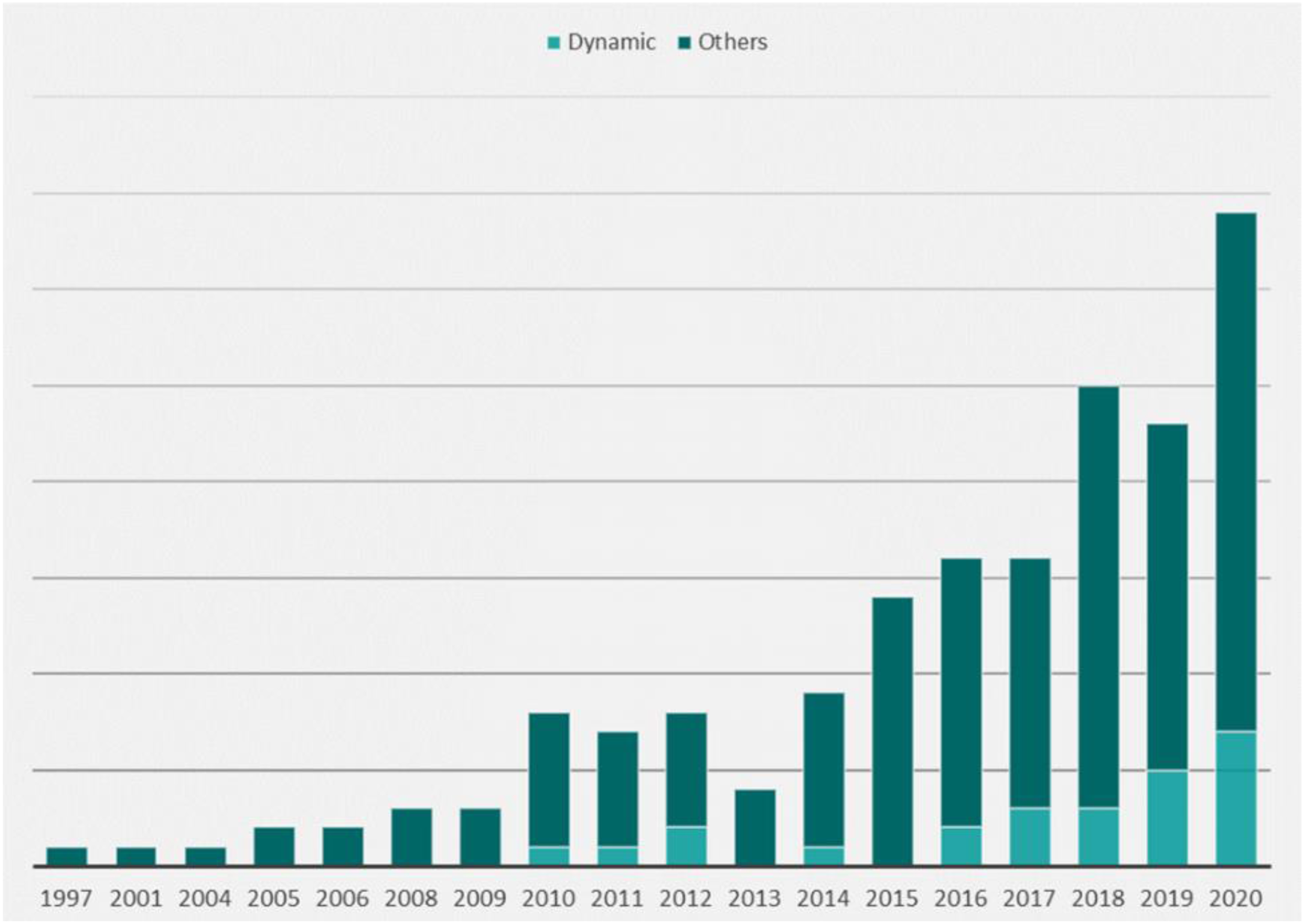
Growth of the research on the dynamics of attention in the ABV.
In addition to the growing interest in the dynamics of attention in the extant research on the ABV, the roots of the dynamic view could be seen to go even further to research that has viewed organizations as internal ecologies of strategy-making, where the top-down and bottom-up influences merge to jointly influence the attention foci of the organization (e.g., Burgelman, 1991; Lovas & Ghoshal, 2000). Moreover, the dynamic view of attention can also be seen to build on some of the intellectual heritage that the prior research on strategic issue management has accumulated, both in terms of the dynamically shifting focus of the top management (e.g., Dutton, 1993; Dutton & Jackson, 1987; Thomas & McDaniel, 1990) and the ecological dynamics associated with the selling of strategic issues by middle management to gain the attention of the those at the top (e.g., Dutton & Ashford, 1993; Dutton et al., 1997). Such ecological dynamics could be seen to extend also outside the company boundaries to ecosystem structures (Adner, 2017) to include the influence attempts of different business ecosystem partners to continuously shape the attention, and thereby also the strategic direction, of the entire ecosystem.
Claus Rerup
In the “Visible Hand,” Chandler (1977) argues that the managerial hierarchy can often coordinate economic activity more efficiently than the market can. This work influenced Ocasio’s (1997) pioneering thinking on the ABV. Nonetheless, while Chandler's understanding of the managerial hierarchy included middle managers, Ocasio (1997, p. 197) emphasizes that the “most critical players in attention regulation are typically the CEO and the top management group.” In shaping the ABV research agenda, this focus might have marginalized the distributed nature of attention. For instance, Ocasio notes in his literature review that a “focus on the distributed nature of organizational attention, an explicit principle of ABV, is less common [in existing research]” (Ocasio, 2011, p. 1294). In contrast, although the CEO's attentional engagement is still regarded as important (Nicolini & Korica, 2021), the field is increasingly interested in attention dynamics and the distributed nature of organizational attention (Ocasio et al., 2018; Vuori & Huy, 2016).
Yet to analyze distributed attention dynamics across time and space, we must examine how different participants within a social structure notice cues and then consider how they make sense of divergent cues. The disparity in attention to cues and issues across the membership of social groups is well established. What is less established is how diverse members of networks, movements, organizations, institutions, and platforms coherently attend to the same cues and issues despite their different goals, motivational biases, and structural positions. Generally, there is value in combining research on the ABV with research into the processes and practices of less centralized, more porous structures of organizational networks, ecosystems, and platforms structures (Jacobides et al., 2018). Unpacking how these differences influence coherent attention would make conflict, contestation, and politics central to the ABV research agenda (Ganz, 2018; Levinthal & Rerup, 2021; Rerup & Zbaracki, 2021), and push the field to further explore the role of attention dynamics and the distributed nature of organizational attention.
To understand how goals, motivational biases, and structural positions influenced distributed attention dynamics across Novo Nordisk's hierarchy, Rerup (2009, p. 876) longitudinally traced how attention to issues developed across positions, levels, units, and people. In particular, Rerup developed the notion of attention coherence to consider how distributed people come to attend to and thus make sense of the “same” cues within flows of cues.
In any social structure, it is necessary to pay sustained attention to specific issues to observe changes in customer preferences or industry regulations. Similarly, for a system to notice emerging or peripheral cues, participants must develop new categories for conceptualizing weak cues into specific threats and opportunities (Weick, 1995). In the Chandlerian corporation, addressing these challenges is straightforward. The upper echelon develops systems and procedures so different members can attend to distinct cues in different social realities. It then makes sense of these cues and aggregates them (Ocasio, 1997, p. 2011).
The implications of post-Chandlerian structures for attention and sensemaking, however, remain unclear. How is coherent attention to issues among situated actors developed? How similar are attention dynamics in the Chandlerian corporation vis-a-vis post-Chandlerian structures? Does attention to emerging or weak cues flow from the bottom to the top of a hierarchy? In post-Chandlerian structures, actors are to a large degree situated in different social realities in and around organizations. If actors pay attention to different cues and/or view the same ones differently, our conventional views (in ABV and sensemaking) might be inadequate for capturing this multiplicity. For instance, accomplishing coherent attention is different due to the difficulty of the upper echelon to seamlessly aggregate across different social realities. Further, attention and sensemaking processes may create bubbles for sets of actors so that they are unaware of each other's views or the different premises or implications of these perspectives (Rerup & Zbaracki, 2021). Although these differences call for developing better theoretical and empirical bridges between attention and sensemaking processes (Eberhard et al., 2013) “there is very little research that examines their relationship” (Maitlis & Christianson, 2014, p. 108).
One way to explore attention and sensemaking bubbles within post-Chandlerian structures is to consider how actors with varying goals and agendas trade off the criteria of validity and reliability (Maslach et al., 2018; Rerup & Zbaracki, 2021). Validity captures the extent to which attention and sensemaking processes can be used for understanding, predicting, and controlling. Reliability captures the extent to which attention and sensemaking processes are public, stable, and shared. Neither reliability nor validity is, however, assured within or across groups (March et al., 1991, p. 6). Because different actors approach situations with different motivations, beliefs, and expectations, shared understandings cannot be assumed. By the same token, validity in attention and sensemaking cannot be assumed.
Potential differences in attention and sensemaking can be consequential. Past research has often linked the accuracy of common understandings to performance; there are fewer studies of how groups of people update their attentional and sensemaking practices (Christianson, 2019; Strike & Rerup, 2016). In fact, most prior work has focused on how groups of people fail to update (Cornelissen et al., 2014; Christianson, 2019). And, if updating takes place, it is often a response to salient cues and events rather than subtle cues and events (Nigam & Ocasio, 2010; Sandberg & Tsoukas, 2020).
In distributed post-Chandlerian structures, there are often varying groups of actors with distinct knowledge. Further, because of motivational biases, these groups do not always attend to the same knowledge; they might deliberately attend to subtle cues and events, and/or actively produce invalid information. Some of them can also make followers or subscribers attend to subtle and/or invalid information that then becomes public, stable, and shared (e.g., reliable). These features can significantly influence distributed attention and sensemaking dynamics. To theorize the nature of distributed attention and sensemaking dynamics within a post-Chandlerian environment, scholars working within the ABV must develop theoretical and empirical scaffoldings to study attention and sensemaking bubbles as well as processes of subtle and salient updating that showcase how common understandings develop, coalesce, and dissipate (Rerup et al., 2022).
Richard Whittington
The rise of the post-Chandlerian corporation implies two shifts in focus for the Attention-Based View. First, the scope of attention extends: it becomes continuous and interactive rather than periodic and unilateral (Ocasio et al., 2018). Second, the attributes of attention change: attentional quality comes to matter more than attentional quantity (Weick & Sutcliffe, 2006).
For mid-20th-century Organization Theory, the Chandlerian multidivisional firm was a solution to one of the great challenges of contemporary big business, how the bounded nature of attention could cope with the new volume of information. As Herbert Simon (1973, p. 270) put it: “the scarce resource is not information; it is processing capacity to attend to information. Attention is the chief bottleneck in organizational activity, and the bottleneck becomes narrower and narrower as we move to the tops of organizations…”. In particular, Simon warned that the daily noise of internal operations could crowd out attention to the strategically critical external environment. Chandler’s (1962) multidivisional structure provided a quantitative solution to the problem of attention: simply reducing the volume of information reaching the top. Everyday internal operational decisions were delegated to discrete divisions, allowing the corporate center to monitor performance remotely through periodic financial reports. Freed of operational detail, top managers now had the “time, information and … psychological commitment” required to attend properly to strategy (Chandler, 1962, p. 111). For Williamson (1975), the multidivisional overcame attentional overload by separating out the high-frequency decision making of operations from the low-frequency decision making of strategy. Strategy was the episodic concern of the hierarchical elite; day-to-day operations were for everyone else.
This quantitative fix to the challenge of limited top management attention may have worked half a century ago but is much less apt today. The hierarchical rationing of attention is now a problem because in our post-Chandlerian world strategically valuable information does not come simply from the environment, as Simon (1973) largely assumed, but increasingly from inside the organization. Post-Chandlerian corporations are commonly knowledge-based organizations (Davenport, 2005; Turco, 2016). Valuable knowledge lies deep inside the organization, understood best by those developing and using it in their day-to-day operations. Successful strategies in a post-Chandlerian world are unlikely to come through the unilateral rationing of attention from the top, therefore. On their own, top management do not know where to look or how to understand whatever they may find. More important now is the quality of attention, developed by continuous and interactive “engagement” between all those with strategy insights, from the top to the bottom (Ocasio et al., 2018; Vaara et al., 2019). Instead of abstract and periodic financial information, attentional quality demands information that is contextualized and real time. It is this growing importance of rich and dynamic information from below that drives many recent moves toward more participative forms of “open strategy” (Whittington, 2019). Attentional quality requires strategic engagement at all hierarchical levels.
Combining attentional quality and interactive engagement raises challenges that include information volume, but go much further. One approach for analyzing these challenges is to extend Rerup’s (2009) three dimensions of attentional quality in crises—stability, vividness, and coherence—to the ongoing strategic interactions within corporations. The three dimensions have implications for every hierarchical level, of which the following highlights just some.
The first dimension of quality is attentional stability, the capacity to sustain focus over time. The challenge here is sharpest for knowledge workers at the bottom of organizations; they are naturally prone to the same operational overload from which the multidivisional was supposed to liberate top managers. The implied research agenda is to explore how those with operational responsibilities can also be given the time, information, and psychological commitment to attend more continuously to strategy. Psychological commitment may involve developing new “strategist” identities among those previously excluded (Mantere & Whittington, 2021). The time for attentional stability might include enrolment in dedicated taskforces or the extension of the principle of “ten/twenty percent time for innovation” (Walker, 2011) to strategy more generally.
Second of Rerup’s (2009) dimensions is attentional vividness, the capacity to combine both richness of detail with breadth of view. This too is challenging for those far removed from the top (Whittington & Yakis-Douglas, 2020). Lower echelons must relate the opportunities and threats that seem urgent at their level to the more detached corporate-level concerns of top management. To prevent top managers from being overloaded with detail, local issues need strategic framing. Again, there is a research agenda here, particularly in exploring how lower-level employees develop capacities for attentional vividness, for example, through engagement in regular strategy communications and discussion fora or through more direct initiatives in strategy education.
Rerup’s (2009) third dimension of attentional coherence implies the ability to draw on and coordinate diverse information and to synthesize it into a meaningful whole. Rerup picks up this theme in his own contribution to this conversation, but particularly important here, both for managers at the top and for issue-sellers below, is the capacity for coherent sensemaking and sensegiving in strategy (Lusiani & Langley, 2019). Stakeholder influence requires economical and plausible messaging. By excluding the superfluous and integrating the conflictual, coherence both economizes on information and enhances plausibility. The construction of narrative coherence in strategy is therefore one important route forwards for research (Vaara et al., 2016).
In sum, for the post-Chandlerian corporation, the principal constraint is more the quality of attention than the quantity. Here old hierarchical principles of attention are especially misleading for strategy. Attentional quality comes not from separating strategy and operations but from sustained interactions between managers at the top and employees below. Attentional quality involves rich and dynamic information, supported by stability, vividness, and coherence at diverse levels of the organization. Attentional quality is everybody's job. The research challenge now is understanding the specifics of attentional quality at different hierarchical levels.
Basak Yakis-Douglas
Chandler viewed strategy-making as an activity reserved for corporate elites and the multidivisional, vertically integrated corporation (Chandler, 1962, p. 1977) as a design intended to serve the purpose of achieving objectivity and control by these elites. However, in post-Chandlerian corporations, the strategy-making function has been expanded to include a plethora of actors with distinct knowledge and motivational biases (Rerup, this article) and corporate structures have moved away from the traditional and fairly stable business models that channel strategy as top-down to more innovative business models. These transformations have given rise to a multitude of stakeholders hungry for information and advent of institutional constituents potentially critical about the perceived misalignment of novel business models and institutional practices. The challenges that accompany organizational transformations have presented organizational actors of post-Chandlerian corporations with the need to overcome information asymmetry between their stakeholders and the firm and gain institutional legitimacy.
One of the main characteristics of post-Chandlerian corporations is the displacement of strategy from the realm of chief executives and owners, where it sits unarticulated and safe from challenge to a wider audience involving shareholders and regulators, consumers and suppliers that increasingly have both the means and the expectation to be informed and even consulted about the strategies of organizations (Whittington, 2019). In contrast with Jack Welch's metaphor of the CEO as the gardener who plants seeds and provides nourishment to the organization by directing attention toward strategic issues, within post-Chandlerian firms, “a key CEO role is to sell the strategy and shape how analysts and shareholders look at the company” (Porter et al., 2004: p. 8). At the heart of this newly defined CEO role is an attempt to avoid potential problems associated with information asymmetry (Vaara et al., 2016). If investors are uninformed about strategy, a discrepancy arises between what investors (as outsiders) and managers (as insiders) know about prospective performance (Cohen & Dean, 2005; Zenger, 2013). This in turn leads to evaluative uncertainty (Graffin & Ward, 2010), with negative impacts on stock prices and the cost of capital (Glosten & Milgrom, 1985; Leuz & Verrecchia, 2000).
This information asymmetry and the required effort to convince stakeholders is even greater when analysts and investors are confronted with untested business models based on new digital platforms, ecosystems, and networks. The combined effects of digital technologies such as IoT, 5G, cloud computing, blockchain, big data, artificial intelligence, and others are dramatically altering post-Chandlerian organizational forms and strategies (Sia et al., 2016). In turn, analysts and investors must evaluate these transformations and decipher the value of organizations in new ways.
Untested business models can create high levels of uncertainty for investors, thereby placing publicly traded companies that implement novel strategies at a significant disadvantage (Yakis-Douglas et al., 2017; Zenger, 2013). For example, Uber's IPO was widely anticipated to be the highest profile event of 2019. Despite the hype, the company's market capitalization was nearly 40% lower than estimated. Analysts who followed the ridesharing company described Uber's IPO experience as “catastrophic,” suggesting that the cold reception from investors was due to skepticism regarding the company's paradigm-breaking business model (Financial Times, 2019, May 11). More recently, in March 2021, Deliveroo was accused of undergoing “the worst IPO in London's history” by specialist media, for reasons similar to those directed at Uber (Financial Times, 2021, March 31). The main culprit for Deliveroo's record heavy losses was the lack of articulation around strategy: although the company's growth was turbocharged during the Covid-19 pandemic due to increasing demand for delivery orders, investors were given little or no information to ease their uncertainty about whether online food delivery would continue to thrive after lockdowns were lifted and how Deliveroo intended to cover the rising cost of regulation on the gig economy.
These events highlight the importance of communicating strategy to investors and analysts, especially for organizations implementing innovative and untested business models. Indeed, unique strategies and new business models—a dominant feature of post-Chandlerian companies—can be beneficial for competition, but carry significant risks to market performance. A dynamic view of ABV can help us gain an understanding of how organizations can help overcome evaluative uncertainty by focusing on strategy communications. Seeking responses to the following questions can be potential first steps: How can organizations convey strategic competence and signal credibility to external stakeholders? What do stakeholders and constituents pay attention to? and How can organizations build congruence between the strategic issues they prioritize and those of their constituents through voluntary communications and other forms of impression management?
In addition to problems associated with information asymmetry, post-Chandlerian firms, and especially those that employ innovative business models face the challenge of establishing institutional legitimacy. This is because digital transformation brings along with it not only unique business models but also novel organizational practices, values, and beliefs that are likely to change, threaten, replace or complement existing rules of the game within industries (Hinings et al., 2018; Krimpmann, 2015; Loebbecke & Picot, 2015; Mangematin et al., 2014). New entrants and organizations engaged in innovation are significantly constrained by social expectations and a need for social approval from institutional actors (Deephouse & Suchman, 2008; Greenwood et al., 2017; Meyer & Rowan, 1977). For the majority of post-Chandlerian organizations, the most critical actors include regulators, professional associations, and the media (Vaara, this article), which collectively comprise the institutional infrastructure that ensures compliance with the rules of the game (Hinings et al., 2018).
However, many components of the institutional infrastructure—particularly the regulatory and policy environment, which continues to operate with time horizons spanning up to a decade—are designed to respond to the speed of change in Chandlerian corporations. They cannot keep pace with dynamics in the post-Chandlerian environment, in which digital innovations take place at dizzying speed and the diffusion of technologies can be highly varied. The time lag between the advent of new technologies and their legitimation through policy and regulation is highly pronounced, creating a “gray” space in which post-Chandlerian firms must strive to survive through influencing policymakers to make institutional changes that are beneficial to them (Hinings et al., 2018). As part of these efforts, firms with business models based on digital innovations engage in a number of nonmarket strategies (Ozcan & Yakis-Douglas, 2020), including external communications to influence regulators and other institutional actors to legitimate their technologies. Constructing interpretations of what serves public interest is the primary nonmarket tactic for gaining entry into markets for innovators. Over-the-top technologies such as Netflix and VOIP technologies like Skype are examples of conventionalization of new technologies through successful implementation of public interest frames, attributable to their emphasis on broad public appeal, efficiency, democracy, and technological advancement, and present and future benefits to the public (Gurses et al., 2021).
Therefore, in addition to understanding how post-Chandlerian firms can overcome potentially detrimental outcomes associated with information asymmetry, applying a dynamic view of ABV to external communications is critical to understanding how these firms respond to social expectations and prescriptions of legitimate behavior in their institutional contexts. New digital technologies themselves are not the sole contributors to institutional change. Rather, institutional outcomes associated with the introduction of innovative digital technologies are shaped by skillful communication of public interest frames and regulators’ reactions to those frames.
Especially for firms that employ novel strategies and untested business models, information asymmetry between investors and management regarding strategy is liable to be costly for firms. Furthermore, the novelty of business practices that accompany these new business models are potentially perceived to be misaligned with existing institutional practices, presenting these firms with the challenge of gaining institutional legitimacy. A dynamic view of ABV focused on external communications can inform our understanding on how organizational leaders “sell” strategy to analysts and shareholders and the role of these communications in potentially influencing the speed and direction of regulatory change in the post-Chandlerian world (Cornelissen et al., 2015).
Eero Vaara
Although not initially in the front and center of the ABV, communication has become one of the most exciting issues when developing our theoretical understanding of attentional processes in and around corporate and other organizations. Thus, calls have been made to move from traditional views of communication channels as “pipes and prisms” toward a more comprehensive understanding of the processes and practices in how actors can attend to and engage with organizational and environmental issues thereby shaping the strategic agendas of corporate and other organizations (Ocasio et al., 2018). However, without focusing more attention on the role of the media—including the mass and the social media but also the various technologies used in communication—our understanding of ABV remains incomplete. This is because we live in a mediatized world, and this also reflected in many if not most of the phenomena we are studying. This is especially the case with strategy work and strategic change in post-Chandlerian corporations, which no longer follow the M-form are better characterized by networks with fluid boundaries. Thus, there is a need to incorporate media into our theorizations and applications of ABV—generating a number of research opportunities and questions for future research.
Theoretically, mediatization can be looked at from two distinctively different angles. The first one is to follow Podolny’s (2001) classic perspective on the pipes and prisms focusing on structural holes—or attentional holes. In this view, mediatization as a spread of information beyond conventional pipes and prisms may have a revolutionary impact in that it bridges structural and attentional holes with major implications, for instance, in terms of reduction of ambiguity and uncertainty. The other contrasting angle is to argue that mediatization may actually lead to increased structural ambiguity if people will be increasingly following specific media and creating their own realities or “bubbles”—as what we may be witnessing in politics and society at large. The effects will probably be a mixture of both, and finding out how mediatization shapes attentional processes and practices is one of the key theoretical and empirical questions for strategy scholars.
The relationship between corporations and media is a two-way street. First, corporations—or managers and organizational members in and around corporations—use the media to generate, deflect or manage attention. This is not always deliberate, but something that has become ingrained in the very processes and practices of contemporary organizations. In fact, it may be that our theories are lagging behind what is already taken for granted especially among the younger generations of managers whose private as well as working lives revolve around social media. For instance, strategy work is no longer what it used to be. New forms such as open strategy—implying increasing transparency and inclusion—are gaining ground, and they rely on new media platforms and applications (Dobusch & Kapeller, 2018; Whittington et al., 2016). Another example is how managers deal with strategic change. It has for a long time been understood that managing media attention is the key to be able to legitimate strategic decisions or actions such as new investments or mergers and acquisitions (Vaara & Monin, 2010; Vaara & Tienari, 2011). This involves corporate communications helping to create the narratives and arguments to be spread but also coping with resistance and counterarguments. But here, too, the world is changing. The attention mechanisms not only operate via formal corporate channels or the mass media, but the new opportunities created by social media make it much more complex—allowing for new kinds of spins and constructions of alternative facts and realities by both the proponents and those who may resist strategic change. Moreover, the narratives that are told with investors in mind are perhaps the most interesting examples of attention creation in and around post-Chandlerian corporations. Just think what Elon Musk is able to do with Tweets or how spin is created about new startups.
Second, it also goes the other way around. The media can be very influential in focusing attention on specific issues and phenomena. In fact, this effect is probably much more important than we think. We already know that the media can focus attention on particular issues—positively or negatively—and hence have a huge impact on the strategic agendas of corporate and other organizations. This is the case for instance when putting pressure on corporate strategists to take environmental issues, corporate social responsibility or diversity seriously, or when highlighting problems with controversial decisions or actions. Whether seen as a watchdog or agenda setter, the media can also help activists, provide channels for those who resist specific projects, give voice to marginalized actors, etc. This, however, is changing too, with the complex webs of social media platforms where power does not lie in the hands of journalists or media professionals. The implication may well be increasing ambiguity and politicization of attention and the construction of alternative realities especially in and around bigger corporations—with dramatic effects on how corporate strategies are made sense of or on how strategic change can be promoted or resisted.
Thus, understanding what these new processes and practices are and how they work in mediatized post-Chandlerian corporations should be placed high on our research agendas. There are major opportunities to develop a more dynamic understanding of ABV and to specifically update our understanding of the media. This is not a trivial theoretical issue but a major step in moving from a “pipes and prisms” view of communication (Ocasio et al., 2018) towards an understanding of communication as a set of interlinked processes in a mediatized environment. This is not only important per se, but also crucial to understand how strategy work may be conducted in contemporary organizations or the ways in which new forms of communication are used to promote or resist strategic change. In particular, the new technologies, platforms, genres, and modes of communication deserve special attention. Finally, such a view of ABV resonates very well with recent developments in media and communication studies, and this offers new opportunities for us as strategy scholars to contribute to these broader discussions about attention in contemporary society.
Dylan Boynton and William Ocasio
Research and theory building on the Attention-Based View of the firm has gone beyond its origins in the Carnegie School tradition and the still dominant model of Chandlerian firms. In many ways, ABV was originally a structural approach to organizational attention, with a particular focus on top management. Our dialogue here suggests not that organizational structure is no longer relevant to attention in organizations, but that attention structures are more fluid and varied, less hierarchical, and more open to stakeholder influences outside the hierarchy. This leads to a more dynamic nature of strategic processes and practices shaping organizational attention. In these final closing comments, we would like to highlight the following:
The changing influences on attention: The shift away from the Chandlerian organization is driven by broader technological, economic, and social changes, such as continued revolutions in information technology as well as increased global trade and market liberalization. These changes have profound implications for the study of attention. Richard Whittington emphasizes the increasing importance of transparent, knowledge-based world of organizations, which creates a need for “open strategy”. Basak Yakis-Douglas argues that the democratization of strategy making fueled by advances in digital technologies, changes the attention to and communications with investors, while Eero Vaara highlights the increasing importance of communications technology and the media as a coordinator of attention. Firms must both manage narratives and media attention and be aware of how media itself focuses broader attention toward particular issues. Continued shifts in technology and new political and economic trends may continue to present novel empirical settings and dimensions of attention that are relevant to organizations. A move toward more dynamic organizational structures: The multidivisional and vertical integrated structure of the Chandlerian firm represents a paradigmatic template of organizational structure which was the basis for the Attention-Based View. A theme that occurs across several of the authors' arguments highlights the loosening of this structure and the need to better understand the dynamic and continual movement of attention within organizations. Claus Rerup develops this theme, calling for a deeper understanding of not only the flow of information and communication shaping attention within the firm, but also the political process and potential conflicts which go into shaping common understandings. Tomi Laamanen underscores the challenge for leaders, who must shift from distributing attention through established channels of communication to shaping the attention of internal and external parties. Similarly, Richard Whittington notes that the shift away from the standard Chandlerian model creates a new dynamism and fluidity of where the formation of strategy is no longer reserved for the executive suite but is influenced by the distribution and quality of attention inside and outside the firm. The changing of the corporate guard: The concept of post-Chandlerian organizations does not reflect the demise of large corporations, but as Tomi Laamanen notes, recognizes that a new crop of firms has rapidly emerged as the world's most valuable. Moreover, like the objects of Chandler's research, these new so-called “superstar” firms are part of a trend of increasing market concentrations and rising concerns about monopoly power (Autor et al., 2020; Philippon, 2019). This has several implications for attention. First, these prominent public firms are themselves objects of extensive attention from competitors, regulators, and the broader public. This has implications for how firms imitate strategies, the priorities of regulators—such as market concentration—and the public perception of firms. Second, as Eero Vaara suggests, these firms actively seek to manipulate and shape the attention of internal and external shareholders. Finally, several of the largest and most prominent firms today—such as Facebook or Google—rely on capturing the attention of customers as part of their business model (Wu, 2017). In this way, not only has managerial attention become a critical firm resource, but consumer attention has as well.
While the authors collected here share the conviction that there has been a shift away from the dominant Chandlerian structure, there is still a question of what design and structure firms are moving toward, and whether there is a similarly common template now and for the future. From an organizational perspective, there has been a continued shift away from mass production toward more flexible and customizable production processes (Adler et al., 1999; Sturgeon, 2002), and the increased importance of harnessing new knowledge and technologies for firm performance and productivity (Brynjolfsson et al., 2021; Grant, 1996). Moreover, important research has highlighted the increasingly porous boundaries of the firm (Podolny & Page, 1998), and there has been growing recognition of the role of external actors in explaining new and less centralized organizational forms. For example, the importance of external sources of innovation and ideas has steadily grown, as firms draw distributed knowledge to address more complex challenges (Chesbrough & Bogers, 2014). The emerging literature on ecosystems emphasizes the importance of thinking beyond solitary firms and understanding how value is created at the systemic level as firms identify distinct complementarities between one another (Adner, 2017; Jacobides et al., 2018). Similarly, a key capability for platform-based firms is their capacity to form strong connections between parties (Zhu & Iansiti, 2012). These streams of research all suggest new opportunities and potential pitfalls as firms become more porous and entwined with their environment.
Attention presents an important and useful lens to understand these changes, emphasizing the flow of information and communication and the distribution of individuals throughout the organization. These changes suggest attention is an increasingly precious resource, as firms face new possibilities for organizational design as well as a greater need to be aware of partners, suppliers, and customers. Patterns of attention may reflect meaningful elements of internal firm structure and processes as well as external coordination and connection between firms that are difficult to observe but critical in more dynamic and less hierarchical organizations. Our post-Chandlerian world is an exciting time for further developing the Attention-Based View of the firm and its effects on strategic processes, practices, and decision making.
Footnotes
Declaration of Conflicting Interests
The author(s) declared no potential conflicts of interest with respect to the research, authorship, and/or publication of this article.
Funding
The author(s) received no financial support for the research, authorship, and/or publication of this article.
