




Abstract
Rapid growth, acquisitions, and diversification are examples of major changes that often result in the need to redefine the distinctive characteristics of the organization in question thereafter. However, a sudden identity presentation that significantly differs from the past lacks credibility among both the organizational members and the organization’s external constituents. We contribute to previous research by showing the previously neglected potential that lies in the flexible selection, valuation, and spatio-temporal positioning of referents, and how this enables the construction of an identity that is simultaneously sufficiently congruent with the organization’s present activities and continuous with its previous identity. Moreover, we also reveal how this use of referents changes across the phases of organizational evolution. Empirically, our findings are grounded on an intensive case study of an organization over a 20-year time frame that evolved from a minor spin-off to a prominent and eventually to a major diversified company.
Keywords
Introduction
Contemporary organizations cannot avoid going through discontinuous changes in the form of, for example, rapid growth, acquisitions, or diversification. Many of these changes also challenge organizational members’ understanding of the identity of their organization—namely, of who they are and about what they stand for as an organization (Albert & Whetten, 1985; Gioia et al., 2013). This is because identity distinguishes a particular organization from others not only in a particular moment but also over the long term (Clegg et al., 2007). Therefore, although organizational identity is inherently enduring, or at least continuous, it has also been shown to be malleable (e.g., Corley, 2004; Gioia et al., 2010; Gioia & Thomas, 1996). In situations of change, organizational members may use this malleability by redefining and sharing their understandings of the present identity of their organization (Cannon & Kreutzer, 2018; Kreiner et al., 2015). However, while this identity reconstruction aims at an identity that is congruent with the organization’s concurrent activities, it is partly bounded by what the organization has previously been known for. Hence, this requirement for a continuous identity (Gioia et al., 2000) applies even when the organization is faced with new circumstances (Howard-Grenville et al., 2013); thus, a balance needs to be struck between these two contradictory demands. For example, to convincingly claim that it is currently an established major company, a former start-up firm must maintain at least some interpretive connection to its earlier non-bureaucratic practices or to some other feature that it was previously famous for.
To provide a new understanding of how the simultaneous demands for a continuous and congruent identity can be solved, this study pays particular attention to referents (e.g., Corley & Gioia, 2004; Labianca et al., 2001). Briefly stated, identity referents consist of those attributes that are most consistently and repeatedly used to describe what is characteristic of an organization (Whetten, 2006). Keeping in mind that the most-often used referents may change over time, this implies that, in addition to adjectives, identity referents may also include social actors or categories that are used to differentiate an organization in the context in which it operates (Navis & Glynn, 2010, p. 440). Eventually, the set of referents that is used clarifies the extent to which an organization is similar to and different from all other organizations, thus delineating its unique social space (Corley et al., 2006, p. 93; Gioia et al., 2010, p. 5). More generally, it is also possible to see referents as elements through which organizations and their members can construct more general frames of reference, which then enable them to make sense of their experiences and choose between different courses of action (Balogun et al., 2015). Simultaneously, we also recognize that new referents may emerge based on the prevailing frames of reference.
Yet, there are numerous ways in which referents can be used in identity construction. This is partly because by selecting some attributes from the extensive array of available concrete or abstract attributes (Gioia & Thomas, 1996; Glynn & Navis, 2013) and defining their organization’s identity with those instead of others (Festinger, 1954; Hogg & Terry, 2000), organizations and their members obtain significant leeway in terms of identity construction. Nevertheless, previous research has not sufficiently clarified why specific types of referents are used instead of others. This especially relates to individual organizations because studies of industry emergence have already shown that the emphasis on referent use turns from markets to competitors as the industry obtains a legitimate position (Navis & Glynn, 2010). Even more importantly, extant studies have also largely omitted the inherent flexibility of the identity referents used with respect to their valuation and spatio-temporal positioning. This implies, for example, that it is possible to claim that an organization at present is more or less like itself or some of its respected or despised competitors in the more or less distant past or future. Consequently, this study focuses on how the use of referents in the construction of organizational identity changes over time along these dimensions.
In empirical terms, we examine the selection, valuation, and spatio-temporal positioning of referents in identity construction through an inductive longitudinal case study of “Sunnyco,” which was founded as a consequence of a spin-off from “Stableco.” Our particular aim is to show how the use of referents in identity construction has evolved over time in general and across the company’s main evolutionary phases in particular. Hence, our analysis starts from an organizational subtraction situation that has been shown to pose a demanding challenge for identity reconstruction (Albert, 1977; Corley & Gioia, 2004). However, based on our extensive dataset on Sunnyco, we advance these studies by following how the flexible selection and representation of referents have enabled the members of an organization separated from its former parent to initially construct a new identity and then to maintain continuity and congruence of this identity across its two later major evolutionary phases.
Referents in the Construction of Organizational Identity
The Diversity of Identity Referents
Since Albert and Whetten’s (1985) seminal work, the proliferation of research on organizational identity has not undermined the significance of referents. This is largely because all the main theoretical perspectives on organizational identity—namely, the social constructionist (Carlsen, 2006; Gioia et al., 2000), social actor (Whetten & Mackey, 2002), and institutional (Glynn & Abzug, 2002; Zuckerman, 1999) perspectives—regard identity as a self-referential concept that defines the distinctive nature of an organization among other organizations (Gioia et al., 2013). Hence, the attributes that are most systematically and repeatedly used by organizations and their members turn into identity referents, which enable the recognition of what the organization can and cannot do without acting out of character (cf. Whetten, 2006). This implies that while referents provide organizational members with some kind of understanding of what is especially distinguishing for the organization that they work for during the respective period, they also convince the organization’s external constituents and collaborators that it successfully meets the demands posed toward organizations similar to itself (Foreman et al., 2012).
We need to keep in mind that there is no absolute limit to the types of characteristics that can be used as referents. This is partly because, in addition to the characteristics of the organization itself, those of others can also be used as building blocks in identity construction. In addition to the organization’s scale, the form of ownership, line of business, and geographical locality, the former group of referents also includes its mission and purpose, which typically become defined by its founders and leaders (Rodrigues & Child, 2008; Scott & Lane, 2000). With respect to the latter, any visible and well-known actor or event may be used as a referent if it is possible to build a clear connection between it and the organization in question (Kulik & Ambrose, 1992; Shipp & Jansen, 2011). Then, the extent to which the characteristics of other actors are claimed to also be emblematic of the organization in question defines its identity (Zuckerman et al., 2003). Taken together, the referents that an organization uses are elementary in identity construction because, in addition to defining what the organization is, they also define what it is not, and thus they restrict the organization’s opportunities for new openings (Clegg et al., 2007; Gioia et al., 2010). Nevertheless, organizational members have significant leeway when choosing which referential categories to use in identity construction. For example, they may concentrate either on those organizations that have been defined as their closest competitors by outsiders or on those organizations that they affiliate themselves with (Higgins & Gulati, 2003).
The Use of Referents in the Construction and Maintenance of Organizational Identity
The referents that are selected do not make organizational identity totally stable, partly because besides the already mentioned concrete characteristics of an organization and its peers, many referents may also be at least partly abstract and blurry (Alexander, 1996; Howard-Grenville et al., 2013). As an example of the latter, the employees of a restaurant that promises fine dining without attributing any particular epitomes to itself in this regard may have only a faint idea of what is actually expected from them. This ambiguity is further enhanced because the meanings attached to these—as well as many other—referents can also change over time (Corley & Gioia, 2004; Tripsas, 2009).
The inherent vagueness of organizational identity thus enables identity reconstruction under changing circumstances. For example, when a company enters a new line of business or exits a previous one, it loses a credible connection to some referents that it previously used to describe itself with (Pratt & Kraatz, 2009). Although new referents also appear in these situations such as memberships to social categories and connections with various new actors (Pratt & Foreman, 2000), it is critical that many of the referents that the organization in question was most famous for are redefined. For example, while foreign expansion to new countries enables business firms to use these countries in their self-descriptions, it may be even more critical to modify the meanings of the other attributes that these firms continue to use for the same purpose. Such modifications are also enabled by a purposeful re-interpretation of the organization’s past undertakings, which is convenient especially for organizations with long independent histories (Schultz & Hernes, 2013). For example, after the Second World War, the French aeronautics firm Snecma no longer mentioned its previous intensive collaboration with Germany in its internal communications (Anteby & Molnár, 2012). Correspondingly, Cadbury Corporation’s museum omitted slavery, which had been a feature of the company’s early operations (Rowlinson, 2002).
Toward an Enriched View of the Use of Referents in Identity Construction and Maintenance
In our view, the existing literature on the use of referents in the construction and maintenance of organizational identity is lacking in three main ways. First, the leeway that organizations and their members have in the selection of referents that they use when describing themselves has been underestimated. That is, although organizations are restrained by externally defined social categories (Hsu & Hannan, 2005; Porac et al., 1999; Zuckerman, 1999), they may adjust how external audiences use these categories when comparing the organization in question with others. As an elementary part of this adjustment, for example, a business firm might define which of its many competitors are the most important. Such interpretive leeway is especially useful for newly established organizations that face the least clear identity expectations (Corley & Gioia, 2004; Czarniawska & Wolff, 1998). Therefore, for example, despite having been formally established as an independent company that competes with others in the same business, the representatives of a spin-off might continue to express how it has much in common with its former parent (cf. Harquail & King, 2010). Analogously, Alexander (1996) found that museums and their managers used multivocal activities to appeal to several audiences at the same time, thus helping them to escape tight categorical role expectations and obtain more resources. Such identity plasticity (Fox-Wolfgramm et al., 1998) enables the focal organization to, for example, move between business niches without losing its credibility. However, this should not lead us to forget that organizations also need to let each of their identity redefinitions to stabilize at least momentarily.
Second, there is further unrecognized potential relating to how the same referents can be used on different occasions. That is, in addition to self-enhancement through giving these referents different meanings at different times (Gioia et al., 2000; Whetten, 2006), these adjusted meanings may also serve in terms of equity and self-degradation—an aspect that is often overlooked (Kulik & Ambrose, 1992). For example, a company that has acquired its previous competitor can be claimed to have been weakened as a result by criticizing the acquisition target. Moreover, on occasions of radical organizational change, instead of replacing previously central referents with new ones (Fiol, 2002), their meanings may be modified. For instance, a previously applauded referent that is no longer claimed to characterize the focal organization can still be mentioned, though now in a negative light. Analogously, when closing its nuclear power plants after having used them for several decades, Germany emphasized that they represented neither durable nor sustainable energy provision.
Third, the role that space and time play in the use of referents in identity construction has not been allocated sufficient attention. This is warranted, not least because, as already stated, an organization may use spatially more or less close others when defining its identity. Simultaneously, although identity construction always happens in the present, the referents used in this construction can be discussed in terms of different temporal dimensions (Albert, 1977; Shipp & Jansen, 2011). This implies that when organizational members use themselves or other actors as referents in their identity construction, it is possible to concentrate on the accomplishments or other features of these other actors in the present, in the more or less close past, or in an anticipated future. For example, Gioia and Thomas (1996) found that the top managers of universities only imitated those of their peers whose symbolic and other characteristics were in line with the managers’ desired identities. It is also possible for a company to claim that its now successful close competitor will fail before long. Alternatively, organizations may select some specific events or individuals from their past and use them in identity construction in tendentious ways (Nissley & Casey, 2002; Rowlinson et al., 2010).
When combined, further attention being paid to these three different, previously neglected aspects of referent use offers substantial new potential to understand the diversity of ways in which organizational identity may be constructed and maintained under different circumstances. For instance, organizational members might represent their organization as, to some degree, being similar to or different from a group of other organizations operating in the same or a more or less distant business area in the past, present, or future. While it has already been found that organizational members may promise not only equal but also greater future accomplishments than those that their present higher status peers have already achieved (Labianca et al., 2001), here we also presume that as organizational members construct their organization’s present identity, they may only concentrate on a part of its past or anticipated future. As such, by providing reminders of an organization’s past successes or its involvement in those of its competitors, promises of similar, future success can be warranted (cf. Howard-Grenville et al., 2013). From these conceptual starting points, this study aims to extend the previous understanding on how the flexible use of referents enables an organization to ceaselessly construct and maintain an identity that is simultaneously congruent with its present activities and continuous with its previous identity.
Method
Research Setting
Our case organization, Sunnyco, is a former cleaning business unit of the diversified family firm Stableco. It was founded in 1991 as a consequence of a spin-off in which one member of the family behind the parent company, Emma Turner, started to run it as an independent company. After the spin-off, Sunnyco adopted its new name and a set of related symbols with which to differentiate itself from both its former parent and competitors. After the first few years following the separation, Sunnyco first reached a prominent position in its business area. Since then, Sunnyco has multiplied its annual turnover and its personnel as well as expanded and diversified its activities both nationally and internationally. Since the turn of the millennium, Ms. Turner’s children have gradually taken responsibility for heading the company.
There are several reasons that make Sunnyco the most suitable case (cf. Siggelkow, 2007) for investigating the differences in the use of referents in the construction of organizational identity over time. First, the identity that Sunnyco constructed at its advent has, in many senses, prevailed, despite the company’s significant later evolution, first in the form of rapid growth, and later, diversification. This implies that the company’s increases in its annual turnover and in its number of personnel have not prevented Sunnyco from preserving many of the distinctive identity characteristics created at the time of the spin-off. Second, Sunnyco has succeeded in its identity maintenance—which has been simultaneously reasonably continuous with its previously expressed identity and congruent with both its concurrent activities—via a flexible and situationally tailored use of referents. For example, several of the company-specific symbols and organizational practices formed when Sunnyco was established have remained in the company’s self-presentation, but the meanings assigned to them have been modified over time. In addition, the organizational identity constructed during Sunnyco’s later evolutionary phases has included new referents to replace previous ones, and similar referents have been positioned differently along both the spatial and temporal dimensions. Third, as researchers, we have enjoyed open research access to Sunnyco throughout the entire 20-year time span under study. In our view, this often-appreciated opportunity (e.g., Eisenhardt & Graebner, 2007) originally resulted from Sunnyco being newly founded, which forced its management to actively seek public attention, thus opening up an avenue for us to contact the company. Furthermore, this extensive use of publicity at the outset created a need to maintain the identity that was already formed, and this also encouraged Sunnyco’s management to grant us research access later in the process.
Data Collection
We initially contacted Sunnyco one year after its establishment as an independent company in 1993. At that point, the company mainly operated in the cleaning business, with a moderate market share among its competitors, some of which were significantly larger than itself. The second period of fieldwork took place 10 years later when Sunnyco had already turned into a prominent cleaning company and had also made some acquisitions in related businesses. The third and final fieldwork period occurred, again, almost 10 years later, when Sunnyco had become a large company operating in various service-related businesses. Combining the timing of our fieldwork relative to Sunnyco’s development, we formed the following three analytically distinct phases: separation (1992–1995), prominence (1996–2004), and diversification (2005–2013). These phases enabled an intra-organizational comparative research design (Figure 1), in which we, based on our entire dataset, would first focus on the phase-specific features of referent use, and thereafter interpret the observed differences from the perspective of challenges that each phase posed for the construction of both a continuous and congruent identity.
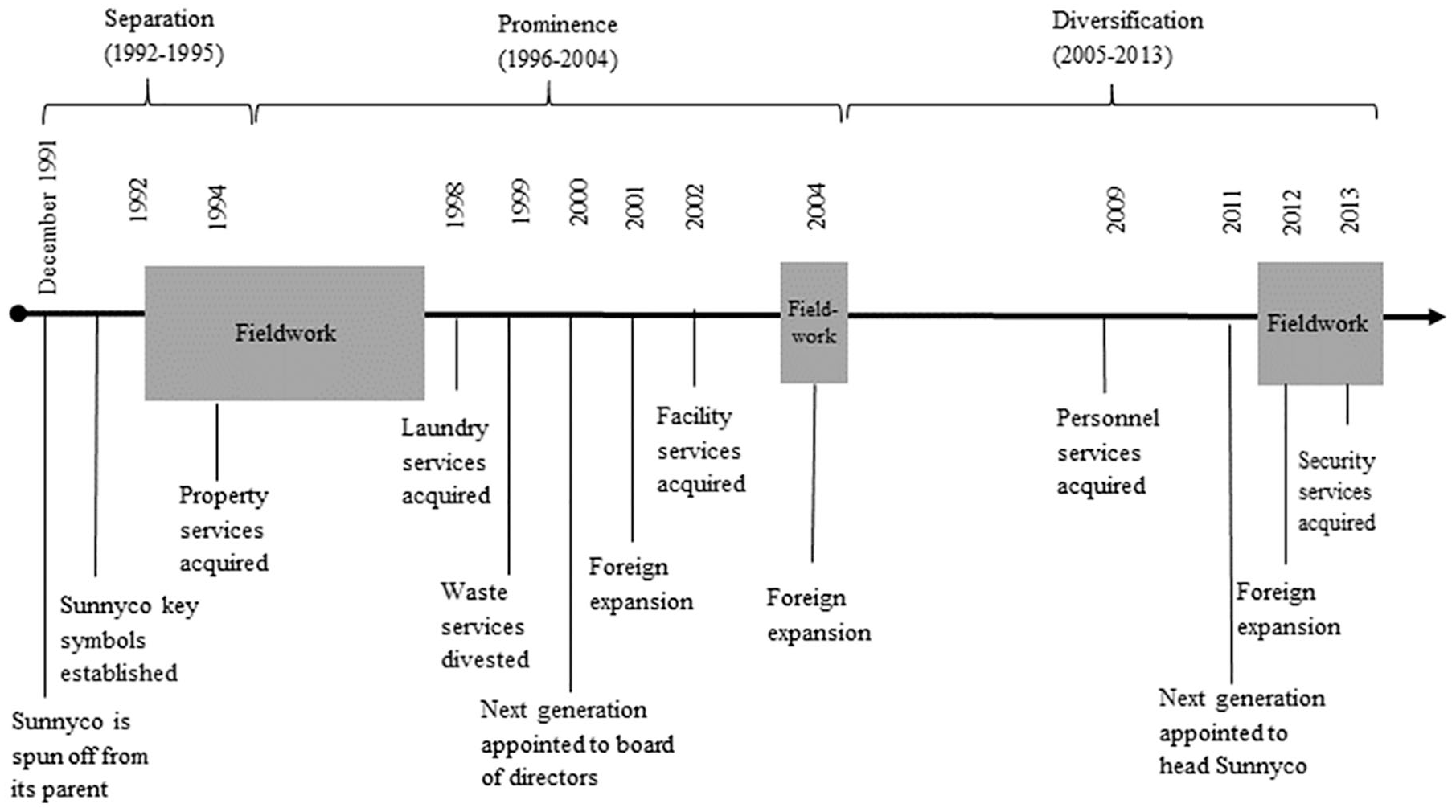
Fieldwork Timeline Relative to Sunnyco’s Evolutionary Phases.
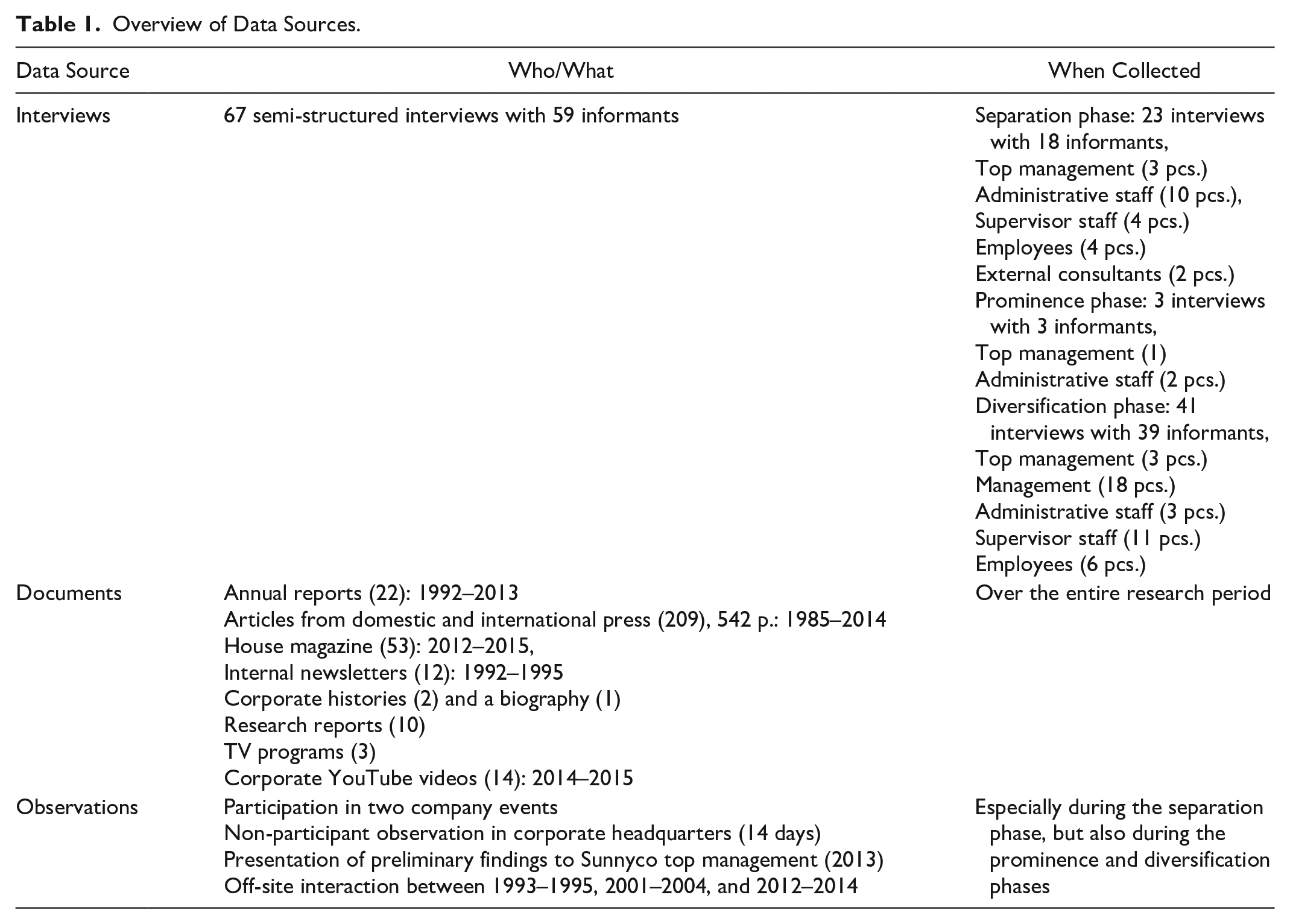
In line with several previous organizational identity studies (e.g., Corley & Gioia, 2004; Tripsas, 2009), our dataset consists of interviews, documents, and field observations (Table 1). During the three fieldwork periods, we conducted 67 open-ended interviews with 59 informants, including both members of Sunnyco’s top management team and supervisory staff and employees. Overall, in each period, we took the initiative for the interviews and negotiated over the eventual group of informants. Then we tape-recorded and transcribed, verbatim, the semi-structured and open-ended interviews, through which we encouraged the informants to share their views on what they found to be characteristic of Sunnyco as an organization. The supplementary documents, including annual reports, newsletters, and press articles that we collected throughout the research period, were important partly because we conducted considerably fewer interviews during the prominence phase than we did during the separation and diversification phases. We also made direct on-site observations, especially during the separation phase, but also during the other phases, which provided us with additional information that supplemented the data obtained from the other sources.
Overview of Data Sources.
Data Analysis
The abductive nature of our analysis implies successive iterations between our theoretical understanding of the phenomenon at hand and the empirical observations arising from the data (Mantere & Ketokivi, 2013; Van Maanen et al., 2007). Prior to starting the fieldwork during the diversification phase, the material collected earlier already indicated differences in the construction of Sunnyco’s organizational identity between the separation and prominence phases. However, it was not until we had collected all of our data that we became convinced about the significant role that referents and their flexible use had played in this process. To produce an elaborated account of how this happened, we proceeded in three successive analytical steps.
First, we began our analysis by open coding (Strauss & Corbin, 1990), in which we focused particularly on the organizations, events, or other attributes our informants or the documentary material had referred to when describing what was characteristic of Sunnyco. Here, we took into account that, instead of only recognizing the referents used during each phase, our interviews and documents included claims that Sunnyco was different from or similar to these referents, described them in both positive and negative terms, and positioned them spatially and temporally more or less closely to the company itself. Therefore, instead of simply describing the interpretations of individual referents, our first-order codes combine aspects of referent use across them. For example, our first-order code “Sunnyco as a company of the future” encompasses several expressions in which Sunnyco was compared with its former parent, present peers, and the projected demands of the business that it was involved with. As we conducted this analysis separately in each evolutionary phase, we ended up with 33 first-order codes that together represented the overall characteristics of referent use in each of the three phases. This implies that instead of focusing on the frequency with which individual referents and the constructed codes were used, we considered the most important objective of this phase of analysis such that nothing of this empirical richness would be lost from the overall phase-specific pattern.
Whereas these first-order codes were formed by open coding, we started the second step of our analysis by using axial coding to find thematic connections between these first-order codes (cf. Corley & Gioia, 2004). This allowed for the first-order codes to be turned into eight theory-related second-order themes that expressed the main characteristics of referent use during each phase in a much more condensed form. At this point, to recognize the key differences between the phases in this regard, we needed to find a common denominator for the phase-specific group of second-order themes. Consequently, after going back and forth several times, we came up with aggregate categories expressing the key distinctive feature of referent use during that phase. Figure 2 illustrates the final data structure, including all first-order codes, second-order themes, and aggregate categories.
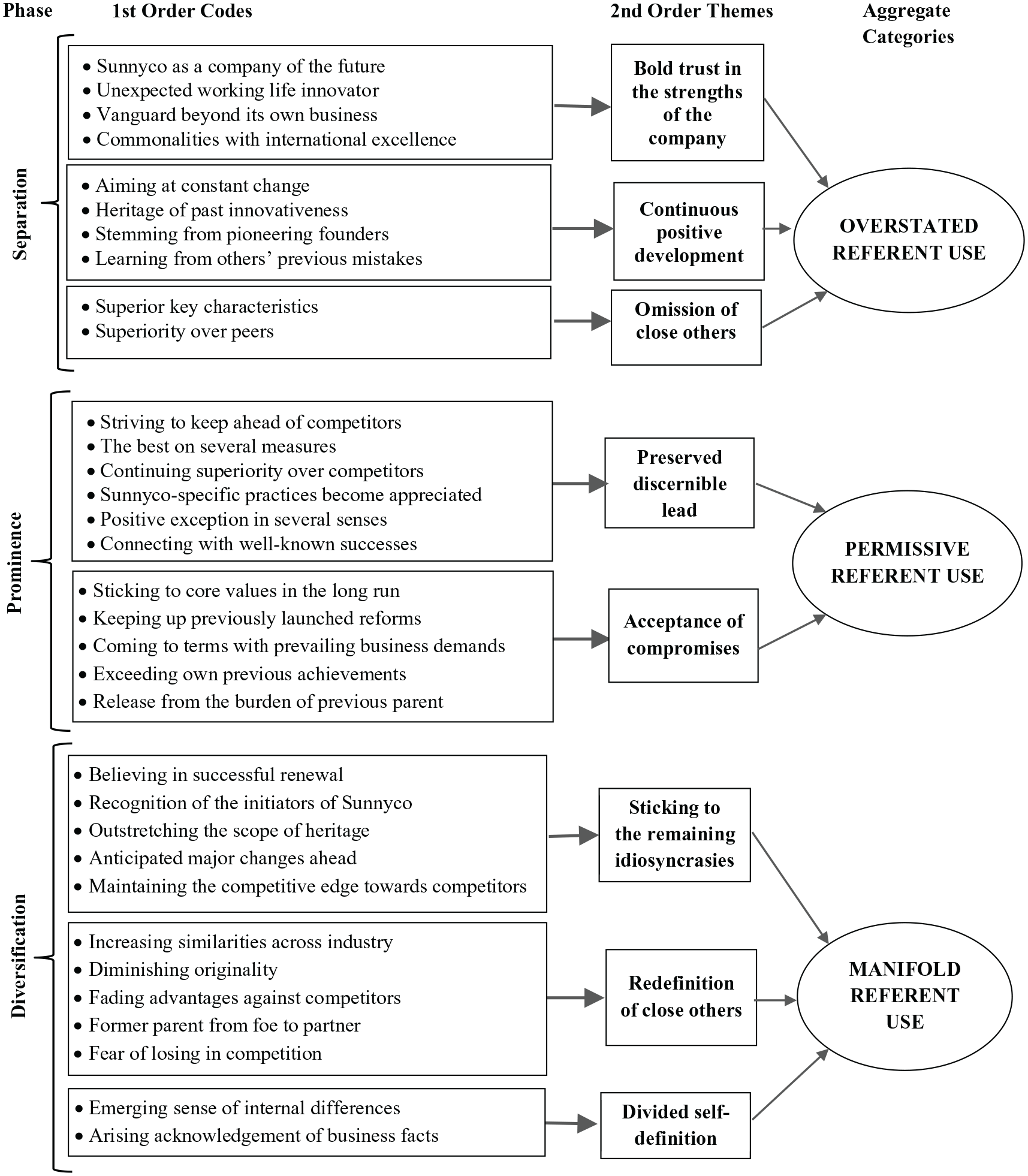
Data Structure.
As the use of referents in identity construction generally reflects the anticipated external expectations of the actors involved (e.g., Hogg & Terry, 2000), in the third step of our analysis, we aimed to form a convincing interpretation for the observed phase-specific differences in referent use from the perspective of the respective challenges posed by maintaining a continuous and congruent organizational identity. More concretely, we examined how the Sunnyco managers and employees used referents in their interviews and documents when responding about what could be expected from a company that had been separated from its former parent, a company that had thereafter first become prominent in its business, and that had eventually turned into a diversified company involved with several partly related businesses. By paying simultaneous attention to these aspects, we were able to form a more general insight into how referents were used in the construction and maintenance of a continuous and congruent organizational identity over time. Before presenting this insight, we first report on how referents were used in identity construction across Sunnyco’s three main evolutionary phases.
Phase-Specific Use of Referents in the Construction of Identity at Sunnyco
In this section, we analyze the flexible use of referents in the construction and maintenance of organizational identity at Sunnyco. We first examine this use for each of the company’s evolutionary phases, starting from the separation, then moving on to prominence, and ending with diversification. All of these sub-sections open with a short description of the challenge that the phase-in question posed for the construction of a continuous and congruent organizational identity. The entire section ends with a sub-section that addresses the main features and outcomes of referent use for each of Sunnyco’s evolutionary phases.
Overstated Referent Use During Separation
After separating from its former parent, Stableco, in the early 1990s, Sunnyco’s operations in many ways stayed the same as before, but the company needed to rename itself, and thereafter to become known under this new name. However, the challenge was that many of the referents that it had previously used to describe itself were no longer credible. For example, to be congruent with its current activities, Sunnyco’s self-descriptions needed to acknowledge its formal independence from any other company as well as its relatively minor size and lack of conspicuousness when compared to most of its competitors. Simultaneously, however, the company also had difficulties in maintaining an impression of continuity with its past because the renamed unit of Stableco was no longer a part of a large multidivisional company with a long independent history; instead, it was a new unit whose name no one knew at the outset. This made it challenging for the members of Sunnyco to determine what was actually characteristic of it and still represent the company in a positive light. As Sunnyco CEO Ruth Harris described the situation (Interview #8), “It felt as if we were in some kind of a hole or a gap and the walls around us would start to stagger . . . and then that overall uncertainty over everything.” In this situation, Sunnyco’s organizational members used referents in the construction of the company identity in three main ways.
Bold Trust in the Strengths of the Company
First, Sunnyco’s managers and employees shamelessly praised their company’s present strengths. For example, the former created several new and ambiguous Sunnyco-specific referents that could be used to justify its superiority, especially in relation to its closest competitors. These self-enhancing referents included the new company name, logo, colors, and office premises, which had no univocal connection to either the company’s or its former parent’s activities or to its owners and key managers. As one interviewee put it (Interview #3), “At that time [of the spin-off], we were a group of people given the freedom to do whatever we wanted. To start something new . . . And we all wanted to do something completely different.”
Of the new colors, yellow and red, yellow was especially systematically highlighted and presented, not only as an inseparable part of the new company name, but also as a more general indicator of a new “happy” way of working and a positive “sunny” service orientation. In addition to decorating its office premises and clothing its personnel with these colors, Sunnyco’s managers advertised these and other organizational practices as if they were genuine and elementary characteristics of the new company. They also called more attention to the company by underscoring that many things were accomplished in an extraordinary way. For instance, it was emphasized that Sunnyco’s new headquarters was a former warehouse now converted into a modern office space. One informant explained the inventive company philosophy as follows: We have freedom in our workspace and freedom in our working hours. We all have our personal goals to meet. We have freedom from status symbols. No one has secretaries to make coffee, buy pastries for others, or order services for the copy machines. Everyone is supposed to participate in those tasks. (Interview #2)
The fact that Sunnyco’s founder, Ms. Emma Turner, was a female entrepreneur with creative ideas in a traditional business, brought to her, as a person and to the company she headed, a large amount of public, national, and even international attention. For example, individual news stories appeared, entitled as follows: “The Company Where Everything Is Different,” “The Revolution of Dreams,” “Positive Anarchy,” and “Can Work Really Be Done in This Way, Too?”
Continuous Positive Development
Second, in addition to projecting strength in regard to the company’s present shape, Sunnyco members claimed their company was progressing into the future. Most essentially, the currently independent Sunnyco was presented as being capable of doing things its predecessor was prevented from doing. At the same time, the potential interpretation of Sunnyco becoming in some way inferior to its closest competitors as a result of the spin-off could be avoided, which implied that all that could no longer be interpreted as an elementary part of Sunnyco, such as its former parent, Stableco, was either ignored or represented in a negative light. Instead of losing a parent and becoming an orphan, the new company had now been unshackled. For example, in the words of Sunnyco’s top managers, before the separation, the former cleaning subdivision of Stableco had been “in the shadow of the rest of the company” without “a clear profile in the whole group” and it was not “respected by others.” At the time of separation, Sunnyco CEO Harris also became convinced that most of her direct subordinates wanted a clear differentiation from the former parent company. As she stated to us: When we had reached an agreement over the spin-off from Stableco, I made phone calls to inform our managers, and there was a clear move toward striving for independence and an aspiration to prove that this [cleaning] business of ours really was something worthwhile. (Interview #8)
To support the same purpose, new connections to foreign celebrity firms were established. For example, Sunnyco founder Turner publicly announced (Article, 1994, p. 40),
To further emphasize Sunnyco’s ongoing improvement, it was particularly effective to build an interpretive connection to its most inaccessible past. This explains the attention given to the connection between the present Sunnyco and the relative innovativeness of the former parent Stableco in the remote, rather than recent, past. For example, both Sunnyco managers and employees mentioned the founding generations of Stableco as important predecessors for the new company. In a way, they depicted Stableco as a platform from which its cleaning subsidiary could then turn into the sovereign and successful company now named Sunnyco. For instance, we were reminded that Sunnyco’s present innovative work practices, such as personnel training programs and remote work arrangements, had already been launched in that particular unit several years before the separation.
Omission of Close Others
Third, while the interviewees often mentioned the achievements of companies that operated in business areas other than cleaning, the company’s closest competitors in its own area were barely mentioned. There are two further intriguing aspects to their use as referents. First, whereas Sunnyco and its distant competitors were discussed in all temporal dimensions, its close competitors were only discussed in the present. By keeping silent about the latter’s past and future and only emphasizing its own, Sunnyco appeared stronger in relation to them. Further, even in the present, its close competitors were mostly discussed in imprecise terms and were represented in a negative light. As one Sunnyco manager stated: We are, profit-wise, the best company in the country at the moment, as even they [a competitor] reported losses. We are the only profitable [company] among the big ones, or the most profitable, actually. We are in a class by ourselves with relative results. (Interview #11)
Naturally, becoming primarily compared to its competitors’ standards could have been too demanding for a newly established company. Therefore, instead, Sunnyco had reason to allocate attention to a diverse array of other aspects. For example, in Ms. Turner’s words, the management in the “other companies” still lived in their “ivory towers” and maintained status symbols that Sunnyco had already left behind. She also asserted that conventional 12-month planning horizons were too long for Sunnyco because the business in which the company operated demanded quick responses.
Second, discussing the future in much less detail than the present and the past enabled the informants to claim that Sunnyco’s current business would experience revolutionary developments in the long run. For instance, it was claimed that “creativity is [currently] limited by collective labor agreements . . . In the future this will no longer be the case, Sunnyco founder foresees” (Article, 1992, pp. 30–31). Furthermore, it was claimed that the “yellow revolution of working life” now taking place at Sunnyco would also create new avenues in the future. Some interviewees considered “all the future [to lie] ahead of us” or that “everything is open [to us], and everything is possible.” As one Sunnyco employee said (Interview #19), “Now, when we question all kinds of things, it is also possible to create all kinds of new opportunities.”
Permissive Referent Use during Prominence
During our second fieldwork period, Sunnyco had already operated independently for more than a decade, grown steadily, and reached a prominent position in its main business area. This implies that there was neither a need to construct an entirely new identity nor an opportunity to stick to the one already created when the company had started its independent journey. The latter was because the identity claims formed during the separation phase already partially contradicted Sunnyco’s present activities and limited its opportunities for new openings in the future. For example, the claims that Sunnyco was per se revolutionary and innovative in its operations were not in line with its largely stabilized activities and long-term customer relationships. As a result, in the prominence phase, many of the previous identity referents needed to be replaced or adjusted to be useful in the construction of an identity congruent with the way in which the company operated and with its competitive position. At the same time, to be credible, the reconstructed identity needed to be at least reasonably continuous with the one that the company had previously been known for. This reconstruction was further complicated by the decreasing amount of ambiguity and interpretive leeway in relation to the nature of Sunnyco’s activities and its close competitors. As a response, Sunnyco’s organizational members started to use referents in identity construction in two new ways.
Preserved Discernible Lead
First, Sunnyco’s managers and employees no longer claimed their company to be one-of-a-kind, but instead concentrated on representing it in only certain notable ways as being ahead of its closest competitors. This was understandable because many of the self-related attributes that they had advertised during the separation phase no longer differentiated Sunnyco from its competitors or from other organizations in general. For example, the innovatively designed headquarters became increasingly less visible to the general public, not only because the public had grown accustomed to it, but also other companies had launched similar experiments. In describing their company, Sunnyco managers could also affiliate their company with companies in other businesses much less freely because Sunnyco was already a clearly distinguishable cleaning services company. This also encouraged Sunnyco managers to replace most of the previous abstract future promises with more specified ones and to give its close competitors much more credit than before. With this aim in mind, discussing them no longer solely in the present but in the past and future as well increased their importance as Sunnyco’s identity referents. In fact, Sunnyco managers even needed to admit that some of these competitors were better in at least some sense, either in the present or potentially in the near future. Simultaneously, these competing companies were treated more tolerantly, and the claim for Sunnyco’s cutting-edge qualities compared to theirs was more elaborate than before. As our informants stated: The competition is getting harder, and we have to be better as well. Our competitors are making progress, so now we really need to develop our practices. (Interview #24) Currently, we are so established and well known that we get invitations for tenders from customers in the same way as other companies. . . . We are trying to develop extended services in line with other cleaning companies. But we are trying to do it really fast. (Interview #21)
Concurrently, it was as though some of Sunnyco’s idiosyncratic features had already turned into constraints that might differentiate the company unfavorably from its close peers. At least some of the personnel wanted to abandon such features. One manager described this as follows (Interview #23): “The problem is that the customers may often even ask whether everything is okay if [a Sunnyco employee] does not dress in yellow all the time. In that sense, we are prisoners of the yellow [color] in a way.”
Acceptance of Compromises
Second, the Sunnyco managers and employees no longer depicted their company in only positive terms. That is, although Sunnyco was still considered unique in many ways, this distinction had been significantly diluted compared to the separation phase, partly because Sunnyco’s personnel and some managers were no longer inspired by many of the company-specific symbols and practices. For example, initially, each employee had been expected to make a personal presentation at the annual Sunnyco gatherings, but after a couple of years, partly because of its growth, the company only used joint presentations. Company mottos and slogans were also more rarely expressed at meetings and on other social occasions. The lost glamor of the original Sunnyco idiosyncrasies was expressed as: “Then, at first, it was as if there was a kind of Sunnyco ecstasy, but now, after we’ve been operating for three or four years, it feels like it is becoming more and more distant and unfamiliar” (Interview #18).
In this situation, some informants contended that Sunnyco’s present strengths, such as its key managers, would continue into the near future, and the successful expansion that had characterized Sunnyco since its founding would also keep the company prosperous in the distant future, though in an altered form. Thus, the experiences already gained in the past justified positive future expectations, and, at the same time, by not making major adjustments, the company would avoid returning to what it had originally sought to escape. Sunnyco’s management understandably concentrated on interpreting the continuity between the characteristics of the separation and prominence phases as an indicator of the company’s enduring vitality among its peers. Therefore, the managers gave up many of their previous idiosyncratic identity referents and highlighted those that remained, which still made the company original, but to a lesser degree than before. As one interviewee put it (Interview #23), “At Sunnyco conventions, we still shout “Sunnyco!” out loud, but otherwise not. We’ve come back down to earth; we’ve grown up.”
Manifold Referent Use during Diversification
During our final fieldwork period, Sunnyco had operated as an independent company for more than two decades and had turned into a diversified service business company. Although Sunnyco had, to some extent, already diversified during the prominence phase, it was not before this point that these old and new subdivisions were turned into more independent business units, which enhanced their need to differentiate themselves among their respective groups of competitors. More importantly, it was no longer clear within which businesses and with which companies Sunnyco was actually competing and what was characteristic of the company with respect to others in these businesses. In addition to these new challenges for the construction of a continuous and congruent identity, the group of actors trying to respond to these challenges was less unified than before. At this point, for example, Sunnyco personnel had its roots in over thirty countries. Moreover, there was much diversity with respect to the personnel’s age, amount of work experience, orientation toward work, and the ability to deal with other people. Under these circumstances, Sunnyco members’ use of referents in identity construction had three main features.
Sticking to the Remaining Idiosyncrasies
First, as a whole, Sunnyco’s management increasingly focused on the company itself rather than on its competitors when representing the company to different audiences. This was partly because of Sunnyco’s already lengthy experience as an independent company from which it could pick up aspects that indicated its abiding viability. For instance, as it could no longer be claimed that Sunnyco enjoyed a significant advantage over its competitors in the present or near future, attention was concentrated on its past heritage. Sunnyco’s management also used previous company idiosyncrasies for self-enhancement, either blatantly by repeating company slogans such as “Sunnyco never abandons its customers,” or by recalling its original features (e.g., company colors, office interiors) or one-of-a-kind practices (e.g., soup day on Thursdays) that Sunnyco had maintained since becoming independent. As a company, Sunnyco also required that the company-specific symbols be used by all of its subdivisions. Analogously, they interpreted the changes undertaken at Sunnyco to indicate responsiveness to the need to remain up to date, which also compelled the company to internationalize in line with many of its long-term customers. As our informants explained: As the company has grown and the number of employees has doubled . . . [it has become necessary] to draw lines and establish [formal] rules. (Interview #59) In 20 years, a lot has happened. . . . If we take our major international clients [as an example], they have a purchase director somewhere in Zurich who presides over deals . . . [and] monitors the price and promised quality. (Interview #63)
Redefinition of Close Others
Second, the management of Sunnyco also modified the group of others that it considered appropriate baselines for the company itself. Consequently, instead of the companies that operated in Sunnyco’s previous main business, they defined those domestic companies that had also diversified into many, if not all, of the same areas as Sunnyco as the company’s closest competitors. The selection of a new market category and using it as an identity referent here implies that Sunnyco is now, in its own words, a noteworthy, diversified service company. As one manager stated, “[I believe that] we are considered a prominent actor, reliable and renowned” (Interview #35), and the company CEO publicly announced: Sunnyco is a notable actor in all activities related to cleaning and property maintenance services. We provide our customers with cleaning, property and laundry services . . . [these also include] repair of damage to property, rebuilding of property, and cleaning of ventilation ducts. (Sunnyco House Magazine)
Furthermore, it was possible to use this new market category and the respective group of close competitors in it in an increasingly concrete, reflective, and self-critical manner. For example, it was possible to say that some competitors were comparable or even superior to Sunnyco in certain ways, as in the following: Some competitors who used to be behind us have caught up and may have even made their products better than ours. (Interview #58) I have said that we are only one company among several others. . . . Some companies are much better than us at the moment.. . . For example, KNV [a close competitor] has better possibilities [than us] to deliver multiple customer services. (Interview #66)
While self-degradation in the described manner on its behalf increased the credibility of Sunnyco’s identity claims, there were also other means for it to reach the same target. That is, because Sunnyco’s former parent, Stableco, continued to be a successful diversified corporation, calling to mind Sunnyco’s previous connection to Stableco increased Sunnyco’s credibility in this group. Accordingly, company members started to describe Stableco positively. For example, one of the subdivision heads (Interview #58) acknowledged that “earlier, there were some [mutual] difficulties related to management philosophies”; she immediately added that “today, we are business partners with Stableco and cooperate extremely well.” Another expression of this new interpretation was that “Stableco is like a business partner that, like us, concentrates on its own business areas. . . . So, it is neither better nor worse than us” (Interview #57). In this way, Sunnyco was now described as equal to its parent, from which it had separated two decades earlier.
Divided Self-Definition
Third, the claims concerning what was characteristic of Sunnyco became increasingly diverse. This diversity became apparent when the representatives of the new business areas denied that the company-specific identity referents and claims would fully apply to their specific units, thus blocking a potential threat against acquiring a strong status within their particular peer groups. For instance, those working in business areas other than cleaning might condemn the matriarchal interference in “everything and nothing” that had characterized both Sunnyco founder and Chairman Ms. Turner and her closest colleague and CEO, Ms. Harris, while praising a more professionally oriented and collegial management style combined with the mobility of individual managers across company boundaries. The heads of these other business areas could also further underline their message by downplaying the company symbols, for example, in the outfits of their employees. In part, they were forced to do this because the new employees were disturbed by the previous outfits. As one supervisor described: “Nearly all of the new guys in our business area [facility management] would like to pick a black or blue outfit. No one for sure would grab the yellow ones” (Interview #51).
In addition to criticizing others, the representatives of Sunnyco’s individual business areas might also praise their own unit when defining themselves, as the next quotation indicates: “At our laundry services, we are in a better position with our much lower turnover rate [and] higher work satisfaction measures than those of many others [subdivisions]” (Interview #65). Even more generally, the expression of Sunnyco’s identity became increasingly polyphonic because of the growing diversity of both the referents used in these expressions and their presenters. For instance, whereas Sunnyco as a whole used other diversified companies when describing its distinctive characteristics, its subdivisions mostly concentrated on the closest competitors in their specific business areas. As a manifestation of this, one subdivision supervisor stated:: “I am individually happy about being a Sunnyco person without work experience from other property maintenance service firms” (Interview #51). In addition, while continuity between the past, present, and future provided emotional security for some Sunnyco managers and employees, for others, it indicated that the company had become stuck in the past and might have difficulty meeting the demands of the present and the future. In other words, whereas for some of them, orthodox heritage represented an ideal state they hoped would return, for others, it was an appalling relic. One employee explained the latter sentiment as follows: You can’t be a forerunner a hundred years ago and today, too. If you want to, you need to have a quite different brand and idea. However, this entire branch is in upheaval, and lots of changes are underway all the time, and if you want to be a forerunner, then now would be the window of opportunity for that. . . . To take the challenge further instead of just saying that we have been forerunners. (Interview #48)
These conflicting interpretations of the relative importance of the past, present, and future also materialized in an ambiguous view of what was characteristic of Sunnyco, both as a whole and in its parts. This ambiguity arose because some of those who had been with Sunnyco since the separation phase also had trouble avoiding the conclusion that their company had shifted toward the mainstream and lost the innovativeness it had at its outset. Though Sunnyco’s identity had originally implied breaking away from the limitations that characterized both its former parent and organizations in general, it now implied abandoning many of its unique characteristics and becoming merely an ordinary large company. As one manager stated: “The market has changed, and that poses challenges. Often, we get reviews that all of us big actors in the field are all the same” (Interview #28).
The Use of Referents in the Construction and Maintenance of a Congruent and Continuous Organizational Identity Across Sunnyco’s Evolutionary Phases
The analysis above reveals significant differences in the use of referents in the construction of Sunnyco’s organizational identity across its three evolutionary phases. By and large, the main referents obtaining the most attention fluctuated between the company itself, its former parent, and its competitors in the present or in the closer or more distant past or future. Simultaneously, the expressed degree of similarity between Sunnyco and these referents, together with how positively they were described, also varied. More importantly, these phase-specific features of Sunnyco’s referent use aptly responded to the challenges that the company faced in each period to construct a continuous and congruent identity. Hence, the flexible selection, valuation, and spatio-temporal positioning of referents at first distinguished Sunnyco from its closest competitors and former parent, after which the company could be positioned in its main business area and finally as one of the diversified service companies. Table 2 presents the main changes in the valuation and temporal positioning of central referents across Sunnyco’s evolutionary phases in a concise form.
Main Changes in the Valuation and Temporal Positioning of Central Referents across Sunnyco’s Evolutionary Phases.
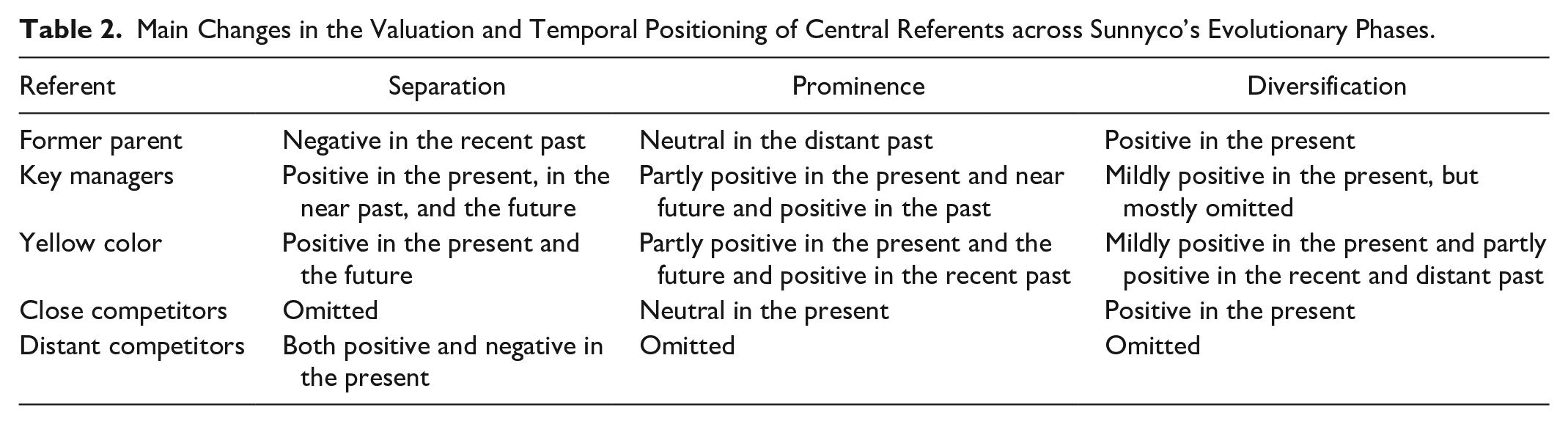
To further elaborate how the phase-specific use of referents responded to this twofold identity challenge, we first note that, in the separation phase, Sunnyco was capable of expressing its identity congruent with its current activities by moving the attention away from its relatively minor size and lack of conspicuousness when compared to most of its competitors, and by concentrating on its current independence and affiliations with temporally and spatially distant others. This implied affiliation with, and the simultaneous depiction of, its former parent Stableco in its early days, which was as similarly innovative as Sunnyco was itself at present. By contrast, at the time of the spin-off, the same parent was claimed to have lacked both innovativeness and most, if not all, other positive characteristics. Additionally, Sunnyco itself was described with abstract but assertive attributes, as: “Yellow is the color that ended up as the main color . . . [it is] the sun and, in some ways, a very astonishing color, when the yellow army marches on” (Interview #1).
Additionally, instead of mentioning its close competitors, Sunnyco’s top managers highlighted the distinct similarities that they found between their company and world-renowned celebrity firms operating in quite disconnected business areas. In addition, to avoid an apparent threat against identity congruence, by combining these claims with the projections toward its promising future, the company could also create an impression of continuity between its previous and present identity. As the company communication officer told us (Field notes, February 20, 1995), “We conducted an excursion to Disney Corporation. It seems we have a lot in common as companies.” Then, in the prominence phase, presenting Sunnyco’s identity congruent with its now significantly expanded activities required that the company-specific symbols introduced earlier needed to be given new meanings and that the company’s now unequivocally closest competitors could no longer be omitted. Consequently, Sunnyco’s representatives described their company’s idiosyncratic characteristics much less definitely and the company in its entirety as only mildly different from its peers. For example, Sunnyco was now claimed to be only slightly revolutionary in its operations that were also in line with the demands posed by the new business and geographical areas that the company had already entered. Concurrently, however, to be reasonably continuous with the previous identity, Sunnyco representatives noted how their company remained innovative and, in this way, loyal to the past company principles that were also anticipated to yield positive outcomes in the future. As one of our informants put it: And I have become ever more convinced that because we have our office space designed this way, and the yellowness and the values that especially include the joy of work, freedom, responsibility, objectives, and so forth . . . and when I talk about objectives, they are even more present there. (Interview #24)
Finally, in the diversification phase, to maintain a congruent identity, Sunnyco could no longer represent itself without acknowledging that, as a whole, it no longer competed with other single-business companies, but instead it needed to differentiate itself in relation to this new group of diversified peers. What is more, at the same time, the Sunnyco subdivisions needed to do the same among their respective peer groups. At both levels, the overall solution to this congruence challenge was reached by distinguishing Sunnyco based on its somewhat genuine characteristics. Concurrently, by constantly repeating these characteristics and, for example, redefining the relationship between Sunnyco and its former parent Stableco, the company’s identity could also appear continuous. The latter aspect comes out in the following statement: “Our relationship with Stableco used to be stiff. But nowadays, we are partners in business; we have really good cooperation with them” (Interview #58).
Discussion
Our study reveals how the flexible use of referents enables the construction of a continuous and congruent organizational identity over time. This implies that although it is not possible to maintain an even moderately constant organizational identity without repeating at least some of the previously used referents, substantial leeway to modify this identity emerges by adjusting how these referents are evaluated and positioned along the spatial and temporal dimensions. Our empirical analysis of Sunnyco showed how this flexible use of referents first enabled a separated company to become recognized as an independent and viable entity, then to dilute this overly excessive originality for a prominent company to a reasonable level, and finally to represent the diversified company and its individual subdivisions in sufficiently tailored ways to the respective audiences. Thus, it is as if an organization created a long time ago had carried on living in a constantly evolving form, yet all the while retaining at least some of how it used to describe itself at the outset. In general terms, this means that, in addition to the successive depiction of the organization as legitimate despite significant changes in its activities, the flexible use of identity referents also maintained a connection between each edition of its identity (King & Whetten, 2008; Howard-Grenville et al., 2013). In its entirety, our study provides two main contributions, which we will elaborate on next.
Unrecognized Flexibility in the Use of Referents in the Construction of Organizational Identity
The existing literature has already noted the elementary role of referents in the construction of organizational identity (e.g., Pratt & Kraatz, 2009; Whetten, 2006) and that referents can be found in various social arenas and can be discussed in past, present, or future terms (Chreim, 2005; Gioia et al., 2002). Organizational identity can thus be regarded as a bricolage of different items, including those that can be found among the artifacts and cultural categories with which the organization is involved (Glynn & Navis, 2013; Pedersen & Dobbin, 2006; Zuckerman et al., 2003). However, until now, the referents’ dynamic role in the construction of a continuous and congruent identity on an ongoing basis has been omitted. This is particularly surprising because for a long time it has been recognized that even minor modifications in the referents used may yield significant responses among respective audiences (Padgett & Ansell, 1993). Analogously, by holding on to visible rituals or items (Birnholtz et al., 2007) or even specific combinations of textual and visual signs (Zamparini & Lurati, 2017), the identity of an organization may appear constant despite changes in its other characteristics. The contribution that our empirical study on Sunnyco brought to this extant understanding consists of two main components.
First, our study suggests that the process through which organizational members aim to replace the referents they have previously used with new ones is much less predictable than has been previously understood (Sillince & Brown, 2009). This is partly because, in some situations, such as spin-offs, mergers, and acquisitions, even referents without clear and univocal links to the organization in question can be used in identity construction, as they are quite open to interpretation in a suitable manner. For a business firm such as Sunnyco, becoming separated from Stableco enabled it to build new affiliations outside its previous market and cultural category (Glynn & Abzug, 2002; Kennedy, 2008; Rindova et al., 2011). Hence, while situations of subtractive change (Albert, 1992) call for more immediate measures to find new identity referents than those of additive change, they also offer more opportunities in this regard (Corley & Gioia, 2004; Golant et al., 2015). Simultaneously, this study also significantly refines the previous understanding of how these referents may be represented to respective audiences. We already know that the meanings given to different identity labels are at least partly mutable (Gioia et al., 2000). Most often, however, it has been presumed that organizations seek self-enhancement from presenting themselves as similar to some desirable referent group (Gioia et al., 2013, p. 169; Whetten, 2006), and little attention has been given to the degree of this similarity or dissimilarity (cf. Ashforth & Mael, 1989; Shipp & Jansen, 2011). In our analyses above, changes in this regard materialized in how Sunnyco managers and employees depicted the selected referents to different audiences and how this depiction changed over time. Relatedly, although it has been acknowledged that new referents cannot be adopted without a linguistic introduction (Goodrick & Reay, 2010), there are few examples of how negating the value of individual referents may influence identity construction more generally (Albert, 1977; Fiol, 2002). Above, we show how Sunnyco informants initially described the former parent, Stableco, as a burden they were happy to be rid of but eventually considered both companies more or less equal. Hence, self-enhancement can be sought by either granting or denying value to a referent in different ways over time, which may be useful, for example, when alterations occur in the market category in which an organization is involved (Hsu & Hannan, 2005; Zuckerman, 1999).
Second, in addition to referent replacements and changes in the depiction of referents in general, our study also highlights how the use of identity referents inevitably encompasses presenting them as more or less closely related to the focal organization along both the spatial and temporal dimensions at the same time. This extends previous studies that have regarded these two dimensions of identity construction as analytically separate (Carlsen, 2006; Chreim, 2005). Generally speaking, this implies that whenever organizational members compare their organization to another actor, they have interpretive flexibility with respect to how spatially close they contend the latter to be. Simultaneously, however, they inevitably make this comparison with respect to this other in its present form or in the form that it had in the more or less close or distant past or anticipated future. In this way, it is possible to either modify or conserve the previous identity of an organization according to its current needs. As an example of this, especially during the separation phase, Sunnyco members compared their company to many of its close competitors in the present but omitted these competitors’ previous or anticipated future accomplishments. Concurrently, however, the same members used well-known companies in totally different business areas as prototypes for Sunnyco’s forthcoming future. Taken together, this suggests that organizations in uncertain situations tend to use temporally distant referents in their identity construction (cf. Kaplan & Orlikowski, 2013).
Our conception of the spatio-temporal flexibility of referent use contrasts with expectations that increasing the amount of experience as such would make temporality more significant in identity construction (Kulik & Ambrose, 1992; Rowlinson & Hassard, 1993). As our empirical analysis shows, becoming more mature does not undermine temporal comparisons because they can be sought interpretatively regardless of the point in time when the organization was founded. Therefore, we recommend that researchers of organizational identity allocate attention to temporality in all phases of organizational evolution. This conception also confronts Chreim’s (2007) claim that, after an organization has stabilized its operations and become known under a particular name with certain characteristics, its members would depict the present as a successful continuation of the past. Consequently, we encourage careful consideration of the different ways in which prominent organizations and their members address and interpret their past and the potential explanations for these differences. Finally, whereas entrepreneurial organizations have been found to be especially dependent on positive future visions in the construction of their identities (Navis & Glynn, 2011), we showed how Sunnyco’s gradually accrued experience after the separation phase did not prevent its representatives from using both the past and the present in identity construction. In part, this was because of the continuously emerging new affiliations that they then continued to compare their company with along the temporal dimension.
Use of Referent Flexibility in the Construction of Identity across an Organization’s Evolutionary Phases
As its second main contribution, in addition to the use of referents in identity construction in general, our longitudinal study on Sunnyco also offers new insights for their use across an organization’s evolutionary phases. First, while the literature shows how organizational identity is continuously reconstructed through a re-interpretation of its ongoing, earlier, and forthcoming activities (Cunliffe et al., 2004; Schultz & Hernes, 2013; Suddaby et al., 2010), it does not explicate how this use of referents might change as the organization evolves. Our analysis emphasizes that all phases of organizational evolution from founding to maturity raise challenges for identity construction and that the use of the referents that are selected then reflects these challenges. Along these lines, we showed how the newly separated Sunnyco that was in a weak position in a non-appreciated line of business rarely referred to its close competitors and instead allocated most attention to the new company-specific symbols and coincidental similarities with noticeable actors in other businesses, thereby hoping to avoid appearing unfavorable to relevant audiences (cf. Tripsas, 2009). This conforms with the idea that close peers pose a threat to the recognition of organizations in secondary positions as independent and self-sufficient (Ashforth & Mael, 1989). Simultaneously, we also suggest that the sparse use of close peers as referents may not only apply to emerging organizational fields (e.g., Gioia et al., 2010). This is partly because the use of ambiguous and imprecise referents is typical in situations of organizational change, as such referents provide wider operational leeway (Fiol, 2002). Correspondingly, after Sunnyco’s idiosyncratic and largely abstract identity was formed during the separation phase, its top managers, in particular, began to disseminate it among company employees and the public at large (cf. Kjaergaard et al., 2011).
Second, our longitudinal study also advances the discussion on how the diversity of the group of actors making identity claims within an organization affects the use of referents in identity construction. Above, we showed how the diversification of Sunnyco further blurred the identity that had been formed at the time of the company’s founding and gradually increased identity multiplicity within it (Pratt & Foreman, 2000). In general terms, this blurring was because new intra-organizational subdivisions and their managers became potential referents for other units in their depictions of themselves or the organization as a whole. Previous studies show, for instance, that a large, subdivided organization might announce an individual subunit as a prototype of the entire organization (cf. Glynn & Navis, 2013). At Sunnyco, we found that identity multiplicity arose from the individual subunits’ representatives’ use of their parent organization or other subdivisions for self-enhancement (cf. Kulik & Ambrose, 1992) and from the comparison of themselves to those they found relevant in their respective areas of business (cf. Labianca et al., 2001). This finding underscores that the construction of a consistent organizational identity in a diversified or hybrid organization is both difficult (e.g., Voss et al., 2000) and never under the control of any one actor (Ybema, 2010). Moreover, a spin-off may, after several additive changes, eventually return to the state of identity ambiguity that characterized it at the outset (Corley & Gioia, 2004). However, as our study shows, this ambiguity can be at least partly diminished by the flexible use of referents.
Conclusion
Our study has shown how the flexible use of referents enables the construction and maintenance of a continuous and congruent identity that an organization needs in order to distinguish itself from others across its evolutionary phases. In its entirety, our study points to at least three areas that call for more research. First, this study especially concentrated on capturing the major changes in the use of referents in relation to the evolutionary phases of an individual organization. Therefore, we recognize that there is much room for more openly defined future research on the dynamics of referent use along various dimensions over time. Second, an area that deserves further attention but which was beyond the scope of this article is how the patterns of referent use at one point influence the evolutionary steps that the organization in question takes thereafter. That is, while we have now explored how modifications in the use of referents enable responding to identity challenges posed by organizational changes, such as rapid growth or diversification, we have not paid attention to the extent to which the referents used in these situations might influence the organization’s later development. Such a focus would be warranted merely because the referents an organization once used turn into imperatives for its subsequent actions (cf. Whetten, 2006). Third, further extensions of longitudinal analyses of referent use from one to several organizations (cf. e.g., Navis & Glynn, 2010) would make it possible to find out how much leeway an individual organization has in the selection, valuation, and spatio-temporal positioning of its identity referents. We presume, for example, that such studies might reveal various ways in which even close competitors may use each other and various shared industry characteristics in the construction of their identities. In this way, it would also be possible to generate important new insights into the use of identity referents as a cross-organizational phenomenon.
At the same time, it is clear that our study has its limitations. Most importantly, our concentration on the changes in the construction of organizational identity in one specific organization raises the question of the generalizability of our findings (Eisenhardt & Graebner, 2007). Naturally, on this occasion, we would like to remind our readers of Siggelkow’s (2007) notion that the particular strength of studies conducted in specific contexts is their ability to produce rich theoretical insights. Furthermore, in the spirit of abductive research, our intention has always been to achieve plausible findings that can also be expected to appear elsewhere (Mantere & Ketokivi, 2013). This is possible especially if the researchers are simultaneously allowed an unusually high level of access to data (cf. e.g., Dutton & Dukerich, 1991), which has been the case here. Then, as far as the commonalities between the empirical phenomena examined in the specific research setting of Sunnyco and elsewhere are concerned, without denying that there may have been some idiosyncratic characteristics in Sunnyco’s separation from its former parent, we might well say that no organization can survive without forming and continuously reformulating identity claims through which it distinguishes itself from other organizations (Corley et al., 2006; Whetten, 2006). This encourages us to believe that the insights provided here can promote further study on the role of flexible referent use in the construction of organizational identity also in other domains.
Footnotes
Acknowledgements
We are grateful to Kevin Corley, Peter Foreman, Tor Hernes, Jennifer Howard-Grenville, Markku Jokisaari, Brayden King, and Davide Ravasi for their invaluable feedback and helpful comments on earlier versions of this article. We thank the management of Sunnyco for granting us the research access and for commenting on our presentations of the empirical research findings. We also acknowledge the significant input of our editor Sabina Siebert and the three anonymous reviewers during the review process. In 2017, this research received a grant from the Finnish Foundation for Economic Education.
Declaration of Conflicting Interests
The author(s) declared no potential conflicts of interest with respect to the research, authorship, and/or publication of this article.
Funding
The author(s) received no financial support for the research, authorship, and/or publication of this article.
