




Abstract
Critical scholars of Corporate Responsibility (CR) argue that one way to make CR good for society would be to demand its full realization in subversive interventions, in line with the critical performativity objective of subversion of managerial discourses and practices. This paper studies CR-oriented performative documentary films, in which the main protagonists problematize business impacts on society through various interventions aimed to have effects on: (1) themselves; (2) the corporations they target; (3) the surrounding society; and (4) the viewers of the films. 23 documentary films that target corporate responsibilities through a range of interventions are studied, and eight different kinds of effects they have are analyzed. The documentaries are found to be enactments of critical performativity that resignify CR, through subversive interventions involving: (1) staged embodiments of subject positions; (2) the staging of felicitous conditions; (3) effective roles, genres and tropes; and (4) the use of ‘enlightened failed performatives’.
Introduction
While the transformative promise of Corporate Responsibility (CR) 1 has not been found to lead to demonstrable positive macro-effects on the economy, the environment or society (CSR Impact Project, 2013), there is a great deal of evidence that CR has contributed to re-legitimizing big business in face of critique (e.g., De Roeck & Delobbe, 2012; Golob et al., 2013; Scherer et al., 2013). A key insight from critical studies of CR is that this discursively produced legitimacy effect on business is the main important impact that CR can be claimed to have (e.g., Banerjee, 2008; 2010; Fleming & Jones, 2013). In the recent debate on critical performativity, some key contributions have focused on how CR can be made transformative of business (Christensen et al., 2013; Kazmi et al., 2016; Marti & Gond, 2018; Wickert & Schaefer, 2015) while others have been more skeptical (Fleming & Banerjee, 2016). Where Wickert and Schaefer (2015) believe that it is possible to make CR transformative through Critical Management Studies (CMS) researchers activating a form of ‘progressive performativity’, Fleming and Banerjee (2016) point out that many of the performatives attached to CR are likely to fail, suggesting that a more radical approach is needed to deliver the subversive effects (Spicer et al., 2009) promised by critical performativity.
Fleming and Jones (2013, p. 103) suggest that one way to make CR transformative could be to “[take CR] too seriously”, that is, rather than dismissing it as greenwash or propaganda, instead over-identifying with it and thereby “demanding its total realization” (Fleming & Jones, 2013, p. 104) through a variety of interventions targeting particular companies. A number of activists and watchdog organizations can be seen to have at least partially based their strategy on such deliberate over-identification with the CR policies or rhetorics of companies (see e.g., Corporate Watch, 2006), mimicking and leveraging corporate discourse in a logic of détournement (see Fleming & Jones, 2013). Among the activists who have been employing this strategy most, a number of documentary filmmakers/authors – including famous or semi-famous figures like Naomi Klein, Michael Moore, Morgan Spurlock and the Yes Men – have targeted specific companies, explicitly problematizing their corporate irresponsibility and often over-identifying with CR discourse in order to demonstrate to the companies (and to their audience) how their behaviour should change if they were to be taken at their word. A type of documentary that seems to have been particularly good at delivering such over-identification is what I shall call ‘CR-oriented performative documentaries’: documentary films in which the main initiators of the project (usually the director/authors) are visible protagonists who, through various embodied interventions that have various effects, problematize and stage the corporate responsibility of at least one identifiable company. Many such documentaries are well known in the Anglo world (e.g., some of Michael Moore’s films, starting with Roger and me; Super size me by Morgan Spurlock; the Yes Men trilogy) and/or elsewhere (in China, Under the dome by Chai Jing; in Scandinavia, Sweatshop: Deadly fashion by Joakim Kleven; in France, Thanks boss! by François Ruffin; or, in the German speaking world, The green lie by Werner Boote).
In this paper, I set out to study 23 films that I have identified as CR-oriented performative documentaries, focusing on the interventions that are taking corporate responsibility too seriously. I examine how the documentary protagonists stage their attempts to make companies take responsibilities for their negative impacts on society. The way interventions are staged, and the role of various forms of staged embodiment therein, is what I assume can lead to additional effects of the documentaries, going beyond the mere ‘locutionary’ acts (i.e., only saying or describing something; see Gond et al., 2016) of films that do not involve visible protagonists seeking to make things happen through their staged performances. I see performative documentaries as ‘film acts’ – in a similar way as Austin (1962) writes about ‘speech acts’ – which can be ‘illocutionary’ (enacting particular intentions), or ‘perlocutionary’ (having demonstrable effects) (Austin, 1962; Gond et al., 2016).
Thus, the two research questions of this study are: (1) How do staged interventions in CR-oriented performative documentaries lead to a range of effects? And (2) What effects do these interventions lead to on (a) the protagonists themselves, (b) the targeted corporations, (c) the surrounding world or society, and (d) the viewers? The analysis finds eight different kinds of effects, two each per predominant target (protagonists, corporations, surrounding society, viewers). Four main characteristics of critical performativity are discussed to illuminate how the effects of the documentaries contribute to resignifying CR through ways of staging that often border on ‘imposture’: (1) staged embodiment for viewer vicarious experience; (2) the staging of felicitous conditions for performativity; (3) the performance of effective roles, genres and tropes; and (4) the use of ‘enlightened failed performatives’. I argue that this marks a way forward in the critical performativity debate on CR. Here CR is not understood as a managerial function that allows progressive CMS researchers to have an impact on corporations through ‘deliberative’ practices (Spicer et al., 2009, 2016) or to ally with internal agents of change in developing ‘microemancipatory practices’ that will make corporate behaviour incrementally more responsible (as in Wickert & Schaefer, 2015). Rather, the subversive promise of critical performativity (Spicer et al., 2009) is in focus, and the documentaries are found to subvert CR – and, to use Butler’s (1997) term, to resignify it.
The next section reviews previous research on critical performativity engaging with CR, and calls for more explicit attempts to subvert CR. It is followed by a section connecting the critical performativity debate with the notion of performative documentary films. The method is then presented, followed by the analysis of the effects of the performative documentaries. The discussion expands on the study’s contribution to the critical performativity debate, by discussing how the films subvert CR. The brief conclusion section describes how CR is resignified through the films.
Subverting CR through critical performativity
A great deal of research on Corporate Responsibility (CR) has been devoted to the legitimacy effects of various CR initiatives (e.g., De Roeck & Delobbe, 2012; Golob et al., 2013; Scherer et al., 2013). Thus, one impact of CR that has been demonstrated in the literature is that CR has helped re-legitimize business in the face of critique related to sustainability challenges. For many critical scholars of CR, this is precisely where the problem lies: the main impact of CR seems to have been a positive impact on business, not on society (e.g., Banerjee, 2008, 2010; Fleming & Banerjee, 2016; Fleming & Jones, 2013; Fougère & Solitander, 2009). That is why, in some of this work, CR has been described as “an ideological movement designed to consolidate the power of large corporations” (Banerjee, 2008: 59). However, such ideological movement is difficult to resist not least because of people’s “enlightened false consciousness” (e.g., Fleming & Spicer, 2003, p. 164; Murtola, 2012, p. 330). Enlightened false consciousness, a notion initially coined by Sloterdijk (1984) and further discussed by Žižek (1989) and his followers, means that even though we think we are not fooled by ideology (we are not victims of false consciousness), we still act as if we are (Fleming & Spicer, 2003 Seeck et al., 2020).Taking into account the problem of enlightened false consciousness, Fleming and Jones (2013, p. 104) argue that CR can potentially be made transformative of business through more subversive tactics of ‘over-identification’: Critics of corporate domination (and the hypocrisy contained in its various tactics of legitimation) have long understood the power of over-identification. Taking an ideology too seriously and short-circuiting its inbuilt cynical distance by demanding its fullest enactment can have radically unsettling consequences. . .the political subversion of [CR] might not be achieved by dismissing it as mere propaganda, but by identifying with it too much, and demanding its total realization.
In this understanding, a subversive approach to CR ideology, rather than exposing the lie that CR might be, would instead take CR ‘too seriously’ and engage in over-identification with CR statements of corporations in order to make CR transformative by unsettling the neoliberal hegemony that CR can be seen to serve (Hanlon & Fleming, 2009; Shamir, 2008). One way to do this is through what watchdog organizations have been doing all along: checking whether companies actually ‘walk the talk’ by for example examining how their commitments to ILO conventions translate into the labour conditions at their suppliers’ in developing countries. Of course, much of this work does not end up subverting the dominant order and the improvements that might be realized are incremental at best. More spectacular actions of ‘détournement’ (Fleming & Jones 2013, p. 104) have had much more radical effects and have come a long way in exposing how CR sustains the neoliberal economic order. Thus, when one of the ‘Yes Men’ (studied in the present paper; Bichlbaum et al., 2009) posed as the spokesman for Dow Chemical and, using CR rhetoric, announced on BBC World, on the day of the 20-year commemoration of the Bhopal disaster, that “for the first time, Dow is accepting full responsibility for the Bhopal catastrophy” (BBC World on December 3, 2004, as featured in Bichlbaum et al., 2009), the immediate response of financial markets showed very clearly that responsibility does not always ‘pay’ (as discussed in more detail in the analysis section).
Theoretical perspectives drawing on performativity are becoming increasingly common in management and organization studies (e.g., Jones, 2018; Naar & Clegg, 2018; Pattinson et al., 2018). In particular, the notion of critical performativity has given rise to a lively recent discussion (Alvesson & Spicer, 2012; Cabantous et al., 2016; Fleming & Banerjee, 2016; Gond et al., 2016; Spicer et al., 2009, 2016; Wickert & Schaefer, 2015). Critical performativity has been characterized as relying on “active and subversive intervention into managerial discourses and practices” (Spicer et al., 2009, p. 538). One of the key foci of the critical performativity debate has been CR, with a focus on how CR can be (made) transformative of business, in three main streams. A first stream relates to the Communicative Constitution of Organization (CCO) perspective, where the performative nature of CR communication is in focus and studies “ascribe to communication a constitutive role in creating, maintaining, and transforming [CR] practices” (Schoeneborn et al., 2020, p. 5). Positive effects of CR as aspirational talk (Christensen et al., 2013) and the role of irony in CR marketing communication (Glozer & Morsing, 2020) have notably been studied, and the neglected ‘dark side’ of the constitutive potential of CR communication has also been expanded upon (Morsing & Spence, 2019). In a second stream, it is CR arrangements and CR beliefs that are seen as performative. Gond and Nyberg (2017) study how CR agencements involving various ratings, metrics and tools have various power effects. In this stream, CR has also been argued to be shaping the newest spirit of capitalism (Kazmi et al., 2016), and beliefs in the link between Corporate Social Performance (CSP) and Corporate Financial Performance (CFP), supposedly taught in many influential business schools, have been argued to be potentially becoming self-fulfilling through feedback loops, whereby managerial beliefs in the CSP-CFP link gradually make it more of a reality (Marti & Gond, 2018). Finally, a third stream, the most centrally connected to the critical performativity debate, tends to use CR processes as an illustration of how CMS scholars can contribute to making business practice more responsible. One inspiration for this is ‘political CSR’ and its suggested creation of ‘deliberative’ spaces (Spicer et al., 2009, 2016) where different actors can “engage in meaningful and affirmative dialogue that challenge and unsettle the views of the other participants” (Spicer & Alvesson, 2009, p. 550). In a contribution that is deliberately not framed in radical terms, Wickert and Schaefer (2015) complement the critical performativity discussion with their introduction of ‘progressive performativity’. Their suggestion is that researchers can contribute to make CR a force for positive change in firms, through allying with CR managers to develop ‘microemancipatory practices’ with them, with the aim to make corporate behaviour incrementally more responsible. These deliberative and progressive approaches to performativity have been criticized on the ground that they are “overly optimistic” in assuming that the power of language can significantly change institutionalized practices of corporate capitalism, and that CMS researchers could somehow succeed in coordinating this process (Fleming & Banerjee, 2016, p. 258). Fleming and Banerjee (2016) argue that attempts to talk into existence more responsible practices are likely to be ‘failed performatives’ given the institutionalized dominance of economic rationality in typical business contexts. Thus, in the debate on critical performativity, several commentaries have expressed skepticism on the potential of CMS scholars to make a difference in business organizations through direct deliberative and progressive engagement (Cabantous et al., 2016; Fleming & Banerjee, 2016; Gond et al., 2016).
My approach here is similar to this latter stream, and engages in its debate, since it looks into the role of human agents seeking to achieve a transformation of CR. However, most of the agents I am interested in here are not primarily academics, but activist filmmakers. I would argue that their position makes it possible for them to be more ‘subversive’ (Spicer & Alvesson, 2009, 2016) than researchers can be in relation to companies that grant them access for research. And in order to understand what could be meant by ‘subversive’ effects in relation to performativity, it is useful to refer to Butler’s (1990, 1997) conceptualization of performativity. In Gender Trouble, Butler (1990) calls for subversive appropriation and redeployment of hegemonic norms – noting, for example, that hegemonic heterosexuality can be ‘resignified’ through ‘plays’ on gender. This injunction to ‘resignify’ hegemonic norms is further developed in Excitable Speech, where Butler (1997) draws on Derrida’s (1988) critique of Austin (1962). Following Derrida, she suggests that the very breaking of the performative utterance from the established felicitous contexts in which it is supposed to work constitutes the insurrectionary ‘force’ of the utterance. Thus, what is subversive is to use the conventional performative utterances or actions in non-conventional ways and unexpected contexts, creating situations where there is no sure way of “distinguishing between the imposter and the real authority” (Butler, 1997, p. 146). For example, when Rosa Parks refused to move away from her seat near the front of the bus, she thereby challenged existing forms of legitimacy, “breaking open the possibility of future forms” (Butler, 1997, p. 147). As both Butler and Derrida note, performatives are dependent on being conventional and citable; this is also what makes them repeatable by people coming from the margins. Thus: That performative utterances can go wrong, be misapplied or misinvoked, is essential to their “proper” functioning: such instances exemplify a more general citationality that can always go awry, and which is exploited by the “imposture” performed by the mimetic arts. (Butler, 1997, p. 151)
The figure of ‘the imposter’ – for example, someone playing the role of a person of power without having formal authority – thus provides possibilities for the subversion of hegemonic norms. It is a figure that is particularly present in CR-oriented performative documentaries.
CR-oriented performative documentary films
While Spicer et al. (2009, 2016) discuss critical performativity predominantly as a path for CMS scholars to make a more impactful difference in managerial discourses and practices, the concept of critical performativity can of course also be seen as an invitation for actors in other subject positions than academic (e.g., activist, artist, comedian, journalist, watchdog, or a hybrid of them) to make subversive interventions meant to transform business practices in a more progressive direction. In her article reporting on her interview with Joel Bakan about his documentary film The Corporation, Emma Bell (2016) suggests that critical performativity can be enhanced through working across disciplines (critical legal studies and CMS, for example) and through making documentary films which have the potential not only to “expose unethical organizational practices and [highlight] the failure of corporations to exercise social responsibility” but also to “generate social change” (Bell, 2016, p. 344). The value of films and TV shows in illuminating various key issues in management and organization studies has been demonstrated many times, perhaps most notably in Journal of Management Inquiry (e.g., Bell, 2016; Buchanan and Huczynski, 2004; Champoux, 1999; Goodman, 2004; Panayiotou and Kafiris, 2011; Rhodes, 2001; Zundel et al., 2013).
The specific transformative potential of documentaries lies not only in the possibility of disseminating research insights to larger audiences, but also in film as a medium that can “stage events recorded by the camera” (Bell, 2016, p. 344, emphasis added). This possibility to stage events as embodied interventions targeting particular businesses is what I focus on in this paper. I concentrate on a specific kind of documentary film in which the main initiators of the project (usually the director/authors) are visible protagonists 2 who, through various interventions that have various effects, problematize and stage the corporate responsibility of at least one identifiable company – in various ways, they play roles (which typically involves over-identifying with one or several roles, and staging embodiments of these roles) in order to ‘make things happen’ in relation to corporate responsibility. I believe the label ‘performative documentaries’ is well suited to these films, but since this label has been broadly used with an overlapping but slightly different meaning, I specify below what makes these documentaries performative.
First, the meaning of performative documentaries I refer to overlaps with Nichols’s (2001) influential characterization of performative documentaries as setting out “to demonstrate how embodied knowledge provides entry into an understanding of the more general processes at work in society” (Nichols, 2001, p. 131) whereby “the filmmaker’s responsiveness seeks to animate our own” for example through “a series of declarations, reenactments. . .and staged performances” (Nichols, 2001, p. 132). Similarly to this characterization, the main protagonists (usually the directors) in the documentary films I study here provide viewers with various possibilities for a vicarious experience through their embodied staging of various situations and interventions. However, I also need to note here that my characterization differs from Nichols’s. Many of the documentaries I include here would be characterized by Nichols as ‘participatory’ (those documentaries that give us “a sense of what it is like for the filmmaker to be in a given situation and how that situation alters as a result”, Nichols, 2001: 116). In fact, most of the documentaries at hand are also meant to ‘expose’ a particular (often hidden) truth related to corporate irresponsibility, and in that respect they do have ‘expository’ elements. Nichols’s typology is one of 6 ideal types, and many documentaries can certainly be seen as ‘hybrids’ of various types (in this case performative and participatory, with expository elements).
Second, the documentaries I am interested in here are performative in that they rely on over-identification and act out roles in what can be called a ‘performance’. This brings my understanding closer to Bruzzi’s (2006, p. 186) characterization of performative documentaries – based on her reading of Austin (1970) and Butler (1990) – as “utterances that simultaneously both describe and perform an action”. Performative documentaries, defined this way, rely on self-conscious performances by their directors or some of their protagonists, and their meaning is given “by the interaction between performance and reality” (Bruzzi, 2006, p. 186). This performance can be, for example, about acting as if corporate responsibility was taken seriously, and looking at what would happen if so, i.e., performing ‘counterfactuals’ (as done in Bichlbaum et al., 2009; see Waisanen, 2018). I may add here that these documentaries are explicitly subversive, they are meant to challenge hegemonic norms of corporate (ir)responsibility. Many of them involve ‘imposters’ or at least role-playing and particular ways of ‘staging’ situations in the films. There are for example many (often unsuccessful) attempts in these films to get CEOs or corporate representatives to step out of their ‘inhuman’ managerial self – which, as Cabantous et al. (2016) note, is performatively constituted – and to take on subject positions allowing for discussions of ethics. Thus, a number of the protagonists buy shares in order to interpellate the CEO at a corporation’s annual meeting, some act as friendly admirers in order to have a ‘softer’ conversation with the CEO, and others decide to design pranks where they act as corporate representatives themselves. Beyond these more obvious cases of partial or complete imposture, in all these documentaries the role of the protagonist(s) is staged in certain ways, with a certain role given to the body. Thus, the embodied interventions are not about ‘embodiment’ in the Butlerian sense – since that would entail not fully conscious or controllable bodily expressions of the subject. Instead, they involve ‘staged embodiments’, which are either about (1) ostensibly acting out the role of someone completely different (an imposture of sorts), or about (2) acting ‘one’s own role’ (or a subject position thereof) as, for example, an entitled consumer, a relentless activist or a leftist with a strong working class habitus.
Third, deriving the meaning from Austin’s (1962) How to do things with words, I set out to examine how the authors-protagonists of the documentaries ‘do things with films’. Thus, each performative documentary can be seen as a particular ‘film act’. Similar to Austin’s ‘speech acts’, film acts might be ‘locutionary’ (they merely say or describe something), ‘illocutionary’ (by saying something they are intended to deliver something, for example, act as a warning), or ‘perlocutionary’ (they do things, have demonstrable effects) (Austin, 1962; Gond et al., 2016). The performative documentaries I study can all be seen as at least illocutionary film acts, and a number of them clearly qualify as perlocutionary film acts. In addition, many of them engage in what can be called ‘failed performatives’ (Fleming & Banerjee, 2016), i.e., they perform an action that would be perlocutionary if the context was ‘felicitous’ (see e.g., Cabantous et al., 2016). Interestingly, the protagonists engage in those failed performatives knowing, most of the time, that they are likely to fail – if I may again refer to the Yes Men and their announcement that “Dow is accepting full responsibility for the Bhopal catastrophy” (Bichlbaum et al., 2009), they know that posing as a company representative and saying this will not per se affect the real policy of Dow Chemical, although they might have a slight hope that this could happen. In this sense, these interventions can be called, in a way that resonates with the problem of enlightened false consciousness, ‘enlightened failed performatives’. In many of these cases, the staging of the failed performatives is that which makes them useful, by over-identifying with ideals of social justice or social responsibility. Again, what the documentaries attempt to show then is ‘what should we do, and what would happen, if we took those principles seriously?’
Method
I have been watching documentaries dealing with corporate responsibility for a long time, whether on regular release in movie theaters, on TV, via online platforms or at documentary festivals, often with the intent of finding interesting material for my courses on business, society and politics. Thus, when I identified CR-oriented performative documentaries as an interesting type of documentaries to study, I had many in mind already, and I had many ideas on what might turn out to be findings based on the two research questions. Below I describe (1) the sampling process and final selection of films and (2) the data collection and analysis process.
Sampling process and final selection of films
The most obviously performative documentaries, to me, were those of the Yes Men (Bichlbaum et al., 2003, 2009, 2015) who famously purported to ‘fix the world’ through their 2009 film – and probably I owe to them the idea of looking into documentaries as film acts, as acts you can do things with (resonating with Austin, 1962). As I started working on this study, in 2019, other obvious cases included Michael Moore’s (1989, 1997, 2009) Roger & me, The Big One and Capitalism: A love story, Morgan Spurlock’s (2004) Super size me, Rob VanAlkemade’s (2007) What would Jesus buy? (co-authored with its central protagonist Reverend Billy), Josh Fox’s (2010, 2013) Gasland and Gasland 2, and François Ruffin’s (2016a) Thanks boss!. I then went through my collection (and recollections) of documentary films to determine which documentary films should be included in my study.
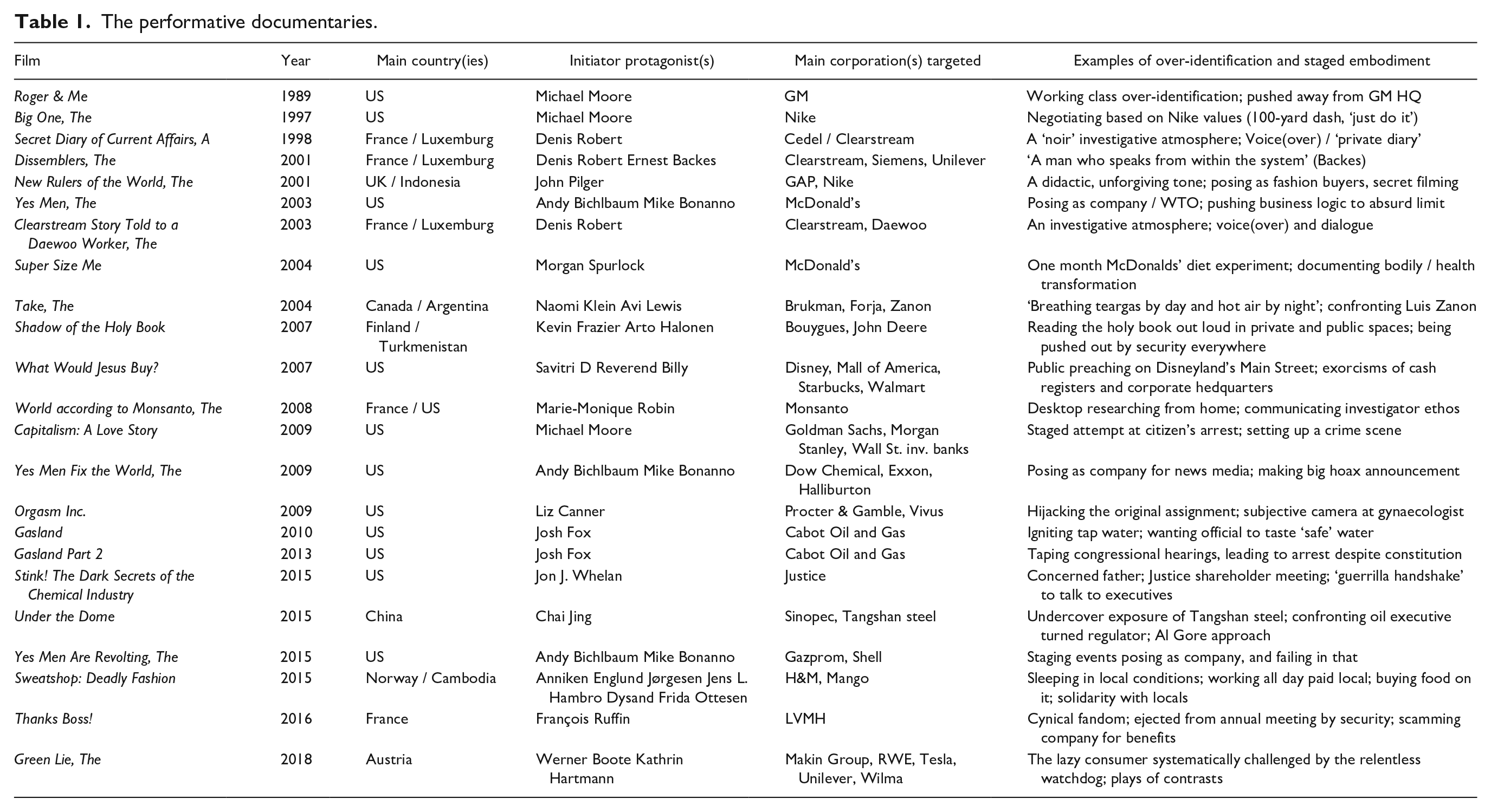
To me, performative documentaries can be seen as film acts which can be ‘illocutionary’ (enacting particular intentions), or ‘perlocutionary’ (having demonstrable effects) (Austin, 1962; Gond et al., 2016). As criteria for sampling, I decided that (1) the main initiators of the project (in almost all cases the director and/or some of the authors) should be visible protagonists (implying some visible embodiment) who, (2) through various interventions that have various effects (making the documentary a film act), (3) problematize and stage the corporate responsibility of at least one identifiable company (making the film or part of the film about targeted corporate responsibilities). These criteria led to the inclusion of 12 additional films, 5 of which I had already seen and remembered well (A secret diary of current affairs, The green lie, Shadow of the holy book, The take, and The world according to Monsanto), while the other 7 (The Clearstream story told to a Daewoo worker, The dissemblers, The new rulers of the world, Orgasm inc., Stink! The dark secrets of the chemical industry, Sweatshop: Deadly fashion and Under the dome) were discovered subsequently, after discussions with other documentary enthusiasts among colleagues and friends, access to new streaming platforms, and targeted research on particular documentary filmmakers such as John Pilger. Table 1 includes the full list of 23 films, the names of their initiator protagonists (16 men and 8 women), their countries of origin and main focus, and examples of their approach to staged embodiment and over-identification. While this list of 23 films is surely not comprehensive, my objective in selecting the documentaries, consistent with norms in film studies, was to “identify and bring to academic attention a corpus of films that are bound by a [particular] unity” (Bruns, 2009, p. 32) and at the same time do justice to a degree of diversity within that thematic unity.
The performative documentaries.
These sampling criteria also led to many powerful documentaries being left out. Films like Attention danger travail, The Corporation, Enron: The smartest guys in the room, Fed up, Inside job, Iraq for sale, McLibel: Two people who wouldn’t say sorry, Out of balance, Outfoxed, Terra Fame: The land of mine and Walmart: The high cost of low price, could not be included because they are all mainly ‘expository’ of those corporate responsibilities and cases of corporate irresponsibility they describe, with some participatory elements in the form of interviews where the interviewer is not visible. A number of other films (notably by the three provocateurs Sasha Baron Cohen, Mads Brügger and Pierre Carles) that were considered were performative documentaries going far in their staged embodiment but not enough engaging with corporate responsibility per se. Finally, there is the case of Super size me 2: Holy chicken!, with its intriguing starting point of “becoming a part of the problem” – starting one’s own chicken farm and fast food restaurant – in order to “find the truth and solve the problem” (Spurlock, quoted in DeShong, 2019) of the chicken and fast food industry. It would no doubt have been included if it had been made accessible to viewers in Europe at the time of the analysis. The final list of films is surely not comprehensive (there are inevitably other films which I am not aware of that would qualify), but all those films meeting the sampling criteria that I was aware of and managed to get access to by the time of the analysis were included.
Data collection and analysis process
I see the process of analysing the documentaries as “an ethico-political process of co-constituting knowledge” (Bell & Willmott, 2020, p. 1366). Thus, I subscribed to Mills’s (1959) idea of ‘intellectual craftsmanship’ in designing the data collection and analysis not by following pre-set methodological protocols but instead by being my “own methodologist” (Mills, 1959, p. 135) in relation to films many of which I knew from before. In a first stage, I (re-)watched all 23 films, paying attention to how staged embodiments of their main protagonists were used to target particular responsibilities of particular companies. I took extensive notes of the relevant scenes, documenting where exactly to find them and, in some of the most striking interventions, transcribing their dialogues verbatim. I used open coding (e.g., Holton, 2007) to characterize, in an emergent way, (1) in what way each film draws on over-identification and staged embodiment, and (2) the effects of the films. I soon realized that the various effects can be seen as aimed at four main targets: (1) the protagonists themselves; (2) the corporations; (3) the surrounding world / society; and (4) the viewers. In the excel file I used for coding, I inductively characterized each film in terms of over-identification (what roles the protagonists are over-identifying with, ostensibly or not), staged embodiment (how the protagonists’ bodies are staged in order to enact particular effects), and their intended or demonstrable effects on each of the four targets.
The emergent identification of effects generated 8 main effects (here ordered and formulated based on their final characterizations): (1) embodying the negative impacts of business through sacrificial experiments; (2) confronting regulatory capture, collusion and lies; (3) exposing corporate capitalism’s heart of darkness; (4) fixing business irresponsibility through powerful symbolic interventions; (5) demonstrating business incentives to exploit; (6) exploiting exploitative business; (7) reducing consumer moral distance; and (8) challenging enlightened false consciousness.
I then characterized all 8 effects as predominantly targeted to the protagonists themselves (effects 1 and 2), the corporations (effects 3 and 4), the surrounding world / society (effects 5 and 6), and the viewers (effects 7 and 8), respectively. It needs to be noted here that many of the effects apply to several (if not all) targets; for example, embodying the negative impacts of business (as in Morgan Spurlock ‘super sizing’ himself) has direct effects on the protagonists’ bodies, but at the same time it serves to problematize the corporations’ activities, demonstrate effects on society, and influence the viewers in their consumption choices. However, I found that illustrating two main effects per predominant target could be a way to organize the presentation of the findings insightfully, as well as to showcase the many varied ways that different films seek to achieve particular effects. Thus, I also started thinking of which films could be particularly representative of each of the effects, and selected at least three films (later reduced to two in the interest of reasonable length) as possible illustrations for each of the 8 effects.
After going back to literature and further anchoring the study in critical performativity, I watched all the films again seeking to systematically check all for the 8 main effects and, where applicable, change my choices of illustrations for each of the effects. While watching the films a second time, I also sought to spell out how the insights gained provide important contributions to the critical performativity debate, and I found that what makes the films subversive has to do with how they stage various things. Thus, the themes that now structure the discussion relate to the staging of: (1) embodiments for viewer vicarious experience; (2) felicitous contexts for performativity; (3) effective roles, genres and tropes; and (4) enlightened failed performatives.
Effects of the performative documentaries
The different effects are structured according to which targets they primarily operate on, looking in turn into the predominantly (1) protagonist-oriented effects, (2) corporation-oriented effects, (3) surrounding world/society-oriented effects, and (4) viewer-oriented effects.
Predominantly protagonist-oriented effects
Embodying the negative impacts of business through sacrificial experiments
Documentary protagonists can go very far in the way they attempt to directly embody negative impacts of business, subjecting their bodies to staged experiments in the films. Super size me (Spurlock, 2004) is a systematic experiment conducted by director Morgan Spurlock, eating only McDonald’s food at every meal (three meals per day) for 30 days straight, and then documenting the effects on his body. In Spurlock’s (4:22) own words, his film is about finding out “where. . . personal responsibility stop[s] and corporate responsibility begin[s]”. The carefully designed rules of his experiment include a ‘super size’ specification: he can eat ‘super size’ only when the staff suggests it to him – and very often, they do. About two thirds into the experiment, he suffers from hyperuricemia, with possible dire consequences for his kidneys and liver, leading a doctor to say “the results for your liver are obscene beyond anything I would have thought” (1:19:50) and to advise him to stop the experiment. He continues to the end despite this, and concludes (1:31:10) with all the symptoms he suffered from during his diet (massive headaches, mood swings, feeling depressed and exhausted, massive cravings, with no sex drive) and some numbers on how his health deteriorated (gained over 10 kg, his cholesterol shot up by over a third, with a fat liver and twice as high risks for heart disease and heart failure).
This is a spectacularly perlocutionary film act, on two levels. First, the dangerous effects on the health of the main protagonist, Spurlock himself, are visible, documented and confirmed through the comments of health professionals after thorough check-ups. Second, Spurlock also documents the impact of the film after its first screening: Six weeks after this movie premiered at the Sundance Film Festival, McDonald’s announced they were eliminating Supersized options. . . In May, they introduced the “Go Active! Adult Happy Meal”. . . They said these decisions had nothing to do with this film whatsoever. (1:36:10)
This tongue in cheek conclusion suggests of course the opposite, that McDonald’s’s decisions had everything to do with this film, which many people around the world saw and was undeniably impactful, not only on its director’s health, but also (together with other films and books around the same period, but arguably more strongly than them) on its targeted corporation, consumers, and even on fast food regulation in various parts of the world.
Another film which is made of a long sacrificial experiment is the reality-TV-styled Sweatshop: Deadly fashion (Kleven, 2015), originally a Norwegian TV show later made into a film. In it, three teenage fashion bloggers (Anniken, Frida and Jens) fly to Cambodia and experience the tough conditions in which cheap fashion is produced there. All three sleep on the floor in a small room in the house of a sweatshop worker, work for one full day in the repetitive and exhausting conditions of a (comparatively gentle) sweatshop, and attempt to cook a meal for a whole family based on the meagre salary they receive from the employer. Their embodied reactions are particularly compelling, as the sleeping, working and eating conditions lead them, within a few days, to mental and physical exhaustion. After two hours of work, Frida confides that she is “hungry and. . .tired and [her] back aches” (22:16). Just after their lunch break, they all look exhausted, in need of sleep. In the afternoon, Jens acknowledges that he is “so tired [he is] shaking” (26:54), that he counts on “working until [he] faint[s]” (27:23), and that he is about to be “sewing [his] own fingers in a minute” (28:14). Their exhaustion is emphasized in the editing, and later, when they realize that workers do this every day for many years, both Anniken and Frida collapse into tears, and during several minutes Anniken, who was the one who most rationalized the way it works earlier, comments on how unacceptable these conditions are while crying (from 46:24). Thus, the sacrificial experiment leads to plenty of compelling vicarious experience for the viewer, especially if the latter is sensitive to reality-TV effects.
Sacrificial experiments are not the core principle of the other films, but they feature in various ways. For example, in Gasland (Fox, 2010), Josh Fox himself makes the experiment of igniting the tap water in a house near a fracking site (23:50), in a way that spectacularly demonstrates the dangerous impacts of fracking on local communities. Besides these staged experiments, a sacrificial dimension is arguably present in almost all documentaries, since protagonists typically take risks. Health consequences for them are often mentioned. For example, John Pilger (2001), while describing the grim reality of “the backyard of the global economy. . .a labour camp [in Indonesia] that’s home to workers who make the clothes we buy in high streets and shopping malls” (5:33), narrates how “while [he] was filming here, [he] caught dengue fever carried by the mosquitoes which infest these slums” (6:35). Most damaging among all selected films, as a result of powerful retaliation following his whistleblowing activities revealed in and through the films A private diary of current affairs (Robert and Harel, 1998) and The dissemblers (Robert and Backes, 2001), Edward Backes was put under massive pressure, including a 20,000 euro tax adjustment in Luxemburg, contributing to him having to experience a fivefold coronary artery bypass surgery (documented in Robert, 2003).
Confronting regulatory capture, collusion and lies
Similar to what many expository documentaries would do, CR-oriented performative documentaries reveal new information to the viewers. But here, staged embodiments and over-identification are intended to confront the problem of regulatory capture and public-private collusion in ways that demonstrate either (1) the joint hypocrisy of corporate and regulatory actors or (2) the deliberately business-friendly regulatory arrangements that threaten nature and society. In Gasland, for example, Josh Fox (2010) brings water from an area affected by fracking and challenges John Hanger, the Secretary of Pennsylvania’s Department of Environmental Protection (DEP), to taste this water since it has been deemed drinkable by his agency, in order not to have to compensate the inhabitants for the alleged contamination impacts of fracking. It is implied that his refusal to drink the water is an admission of a partial corruption of regulation and the monitoring agency – although Fox does not make a personal accusation against Hanger, but notes that just a few months after this interview, the Pennsylvania DEP suffered its worst budget cuts in history, “amounting to over 350 full-time positions being eliminated and 25 % of their total budget cut” (1:26:30).
There is a sacrificial dimension in confronting power in this way too, of course. In the end of Gasland Part 2, Josh Fox (2013), considering that “the constitution guarantee[s] the rights to tape the congressional hearings” around fracking impacts, refuses to stop recording the hearings and gets arrested; as we see him handcuffed and being taken into custody, in voiceover he concludes that “certain elements within congress and the gas industry [have] gotten used to treating the constitution just as they had treated the fossil fuels they extracted: as a relic left behind from the past, that they had every right to burn” (1:58:00). Thus, his speaking truth to power and documenting the results of movements against fracking functions, through the very real ‘performance’ of his arrest, as embodied evidence of a dysfunctional justice system that acts unconstitutionally. Similarly, in many of the films protagonists get pushed out of company headquarters and/or annual meetings (e.g., Bichlbaum et al., 2015; Halonen & Frazier, 2007; Moore, 1989, 2009; Ruffin, 2016a), arrested (e.g., Fox, 2013; VanAlkemade, 2007) and/or sued, with ensuing court cases that turn out to be very damaging for them (e.g., Bichlbaum et al., 2009; Robert & Backes, 2001; VanAlkemade, 2007).
In another investigative film that speaks truth to power, Stink! The Dark Secrets of the Chemical Industry, director-protagonist John J. Whelan (2015), after his requests for interviews have been turned down by various key industry informants, decides to over-identify as a shareholder of a large retailer called Justice (he buys one share) and attends the shareholders’ meeting. There, he coaxes Michael Rayden (CEO of Tween brands and Justice) with a friendly joke: “[the reason behind my investment into Justice was] pretty simple, I brought my two daughters into a Justice store, and within 30 seconds I dropped about 300 dollars [laughter]” (37:30). Then, he gets to talk to him one on one, and asks him “can we get you to commit to take all the toxic chemicals out of kids’ products?” (37:45). In the dialogue that ensues, when told his company is not disclosing all the chemicals in their products, Rayden replies with the question “well who is?” (38:35), showing that this is a broader, structural industry problem, hinting at regulatory capture.
In this and a later case confronting Cal Dooley, the CEO of the American Chemistry Council (ACC), Whelan ostentatiously shakes hands with his interlocutor, in a comical gesture which seems partially friendly and partially hostile – as in, preventing the person from fleeing and forcing him to answer his questions. A comical walk through corridors with Dooley (starting 1:21:22) ensues, as Whelan continues bombarding Dooley with questions while the latter attempts to escape by keeping on walking – fast enough to try and get rid of the interviewer, yet slow enough not to make it look like the desperate escape that it is. This is an effective embodied way to confront those in power and expose that something is wrong.
Predominantly corporation-oriented effects
Exposing corporate capitalism’s heart of darkness
Investigative documentaries on corporations sometimes present their targeted companies as at the heart of much that is wrong in the world (e.g., Enron: The smartest guys in the room, Walmart: The high cost of low price). When their protagonists over-identify with this objective, the sense that they are exposing a heart of darkness of contemporary business activities can be heightened. In A Secret Diary of Current Affairs (Robert & Harel, 1998) and subsequent films The Dissemblers (Robert & Backes, 2001) and The Clearstream Story Told to a Daewoo Worker (Robert, 2003), Denis Robert and his main informant, whistleblower Ernest Backes (co-protagonist in The Dissemblers and co-author of the investigative book Révélation$), expose how a Luxembourger finance multinational company (of which Backes used to be an executive) called Cedel and later Clearstream can be seen as at the heart of darkness of capitalism, because of the service of financial secrecy it offers to the most powerful organizations in the world: What’s the connection between the great financial scandals of the 80s and 90s, suspect deaths in the Vatican, the freeing of US hostages in Tehran, subsidies from the IMF hijacked by Russian mafia? This connection, it’s a very discrete company specialized in international transfer of funds and assets, based at the heart of the financial planet, in Luxemburg. This connection between such diverse issues, a man will establish it, a man who speaks from within the system. (Robert & Backes, 2001, 1:40)
In his Diary film, Robert adopts almost a film noir genre, describing in voiceover his reflections on ongoing investigations he gets involved in (not only in relation to Clearstream), with a dark ambiance – enhanced by an impressive Dead can dance-like score – conducive to viewer paranoia towards the elites and their financial crimes. In partial contrast, his two subsequent films are mainly focused on documenting what has happened since his and Ernest Backes’s revelations, the lawsuit and mounting pressure they have been subjected to since then, and further investigations on Clearstream. In this process, we see how the financial establishment in Luxembourg consider Backes’s health problems as a fair outcome – in the words of Lucien Thiel, Director of the Luxemburg Bankers Association ABBL: I’ve just bumped into him, he doesn’t look well. . . He’s ill. Yes yes I’ve just bumped into him [laughter]. He doesn’t look in good shape. By the way, he’s already. . . his trial had to be postponed twice due to his disease yes. But he was really asking for it [laughter], that’s rather his problem. . . (Robert, 2003, 46:20)
Through this, we understand how taking on the all-powerful finance establishment does not come without long-term consequences for the investigators – to be precise, Robert was finally declared innocent in the libel case started by Clearstream in 2001. . . exactly 10 years later, in 2011. Under too much pressure, he had to stop investigating Clearstream in 2008. But the trilogy of films between 1998 and 2003, as well as several books, allowed him to document the mental and physical toll of being harassed by powerful elite interests to silence the truth.
But despite these challenges, documentaries looking into the dark reality of the most exploitative practices are not all built as cautionary tales – in fact, they often attempt to inspire similar investigative impulses in viewers. In another embodied investigative film, Marie-Monique Robin (2008) exposes all that is wrong in Monsanto’s way of seeing and exploiting the world, ostentatiously performing her investigation from home, through internet searches that are staged throughout the documentary. This choice of staging the embodiment of a watchdog identity (one that the director experiences in her own life too) may be particularly good at showing that everyone and anyone can become an investigator or a watchdog of corporate responsibility.
Fixing business irresponsibility through powerful symbolic interventions
Performative documentaries have this advantage that they can aim to do things, to make things happen, and some filmmakers over-identify with these possibilities, aiming (or pretending to aim) to fix business through various types of performances. No example is more striking than that of the Yes Men, who purport to ‘fix the world’ as per the title of their second film (Bichlbaum et al., 2009). In all three of their films, they pose as representatives of companies or other powerful organizations and get invited to various events or TV programs. Arguably their most impactful attempt to fix what is wrong is their intervention introduced in the beginning of The Yes Men fix the world as follows: Andy is about to go on live television in front of 300 million people. They’re gonna think that he represents one of the largest companies in the world – which he doesn’t. And that’s why he looks so nervous. . .Andy’s about to tell a really big lie, which unfortunately is gonna wipe 2 billion dollars off one company’s stock price. (9:46)
What is interesting in this introduction is that it does not foreground the ‘fun’ element of the hoax but instead shows how Andy experiences the situation backstage before the intervention, looking physically drained and terrified of what he is about to do. This real-world experiment with a huge impact comes at a cost, and we see some of that cost embodied in Andy’s anguished face, posture, and nervous tics. When he is invited to speak on BBC World as Jude Finisterra, spokesman of Dow Chemical, on the 20th anniversary of the Bhopal disaster (a gas leak that killed 18000 people caused by a factory of Union Carbide, which was later bought by Dow), he goes straight to the following unexpected statement: Today is a great day for all of us at Dow and I think for millions of people around the world as well. It’s 20 years since the disaster, and today I am very, very happy to announce that for the first time, Dow is accepting full responsibility for the Bhopal catastrophy. We have a 12 billion dollar plan to finally, at long last, fully compensate the victims, including the 120 000 who may need medical care for their entire lives, and to fully and swiftly remediate the Bhopal plant site. . .This is the first time in history that a publicly owned company of anything near the size of Dow has performed an action that is significantly against its bottomline simply because it’s the right thing to do, and our shareholders may take a bit of a hit, Steve, but I think that, if they’re anything like me, they will be ecstatic to be part of such a historic occasion, of doing right by those that we’ve wronged. (29:55)
Later, while talking on the phone with actual people from Dow, Andy argues “well I wouldn’t say it’s a hoax, it’s an honest representation of what Dow should be doing” (33:56). Of course, this did not ‘fix’ Dow, who quickly released a statement that “there was no basis whatsoever for this report” (34:18), nor did it bring more compensation to victims in Bhopal. But, by suggesting that shareholders, if they are human at all, should be ‘ecstatic’ about such a historic moment, a certain vision of a better world was voiced, pointing at what might be the key obstacle preventing this vision from being implementable – which will take us to effect (5) below, that of demonstrating business incentives to exploit.
Other symbolic ways of fixing business include Reverend Billy’s various religious interventions targeting large corporations such as Disney, Starbucks and Walmart, and other famous ‘temples of consumption’ such as the Mall of America, in What would Jesus buy? (VanAlkemade, 2007). With his Church of Stop Shopping, Reverend Billy preaches for people to stop shopping on Disneyland’s main street, performs exorcisms of cash registers at Starbucks, and organizes the funeral of Small Town America in a graveyard near Walmart’s home office, where he proceeds to exorcise the company as a whole: [in emphatic preaching mode] Let’s go to that Walmart sign now! Let’s take the evil into our bodies now! Let the anger come up! We started this country with anger! There is a time for anger! There is a time to ex-or-cise with millions of Americans in our bodies! [ritual exorcism ensues, with Reverend Billy standing, arms in the air to remove the evil from the Walmart sign, while his followers, on their knees, raise their arms in a communal way] (1:04:04)
These interventions are often complemented by performances by the Church’s singing choir, perhaps most spectacularly on an improvised stage in the Mall of America. Consumers who see these live performances often look a mix of amused and fascinated, and many are happy to reflect on what indeed, Jesus would buy if he was living among us today, thereby vocally problematizing consumerism.
Yet another approach to fix business irresponsibility through symbolic interventions can be seen in Michael Moore’s (2009) Capitalism: A Love Story. Moore goes to the headquarters of the main investment banks of Wall Street, which he holds responsible for the 2008 financial crisis. There, he starts handing the bouncers bags meant for the banks to give US citizens ‘their money back’. In the headquarters of the different banks, he tells frontline employees he is here to “make a citizen’s arrest of the entire board of directors and the executives” (1:25:16), asking support from policemen when there are some in the area. In this process, he stages comically how some of the doors refuse to open for him, and how he is pushed away. Finally, in the end of the film, he unfolds long “Crime scene Do not cross” tapes around the huge headquarter buildings of Wall Street (1:47:07). These are examples of symbolic interventions that over-identify with treating extreme cases of business irresponsibility the way the protagonist argues they should be treated – in this case, as crimes that have destroyed many people’s lives.
Predominantly world/society-oriented effects
Demonstrating business incentives to exploit
Expository documentaries can show that negative impacts are not only down to individual corporate irresponsibility but often related to incentive structures in which businesses (particularly publicly listed corporations) evolve, and probably the best example of such expository documentaries is Joel Bakan’s The Corporation (discussed, for example, in Bell, 2016). Going beyond this expository approach, an embodied, performative approach can demonstrate these incentives much more spectacularly, notably through impacts in the ‘real world’. Going back to the Bhopal intervention in The Yes Men Fix the World (Bichlbaum et al., 2009), as a real-world experiment it took its full significance when the reaction of financial markets to the announcement was enacted. Thus, the experiment suggests that compensating the Bhopal population is overwhelmingly bad news for investors. Most shareholders, sadly, were not ‘ecstatic’ at the news of a 12 billion dollar Bhopal compensation package, as Andy, in his role as Jude Finisterra, pretended to believe they would be. The announcement knocked Dow’s share price by 3 % – although it recovered quite quickly once Dow exposed it as a hoax. Be that as it may, the initial impact on the share price demonstrates that, because of incentive structures on financial markets, taking appropriate responsibility when it is costly cannot be the way to go for publicly listed corporations.
In The Big One, Michael Moore (1997) meets Nike CEO and chairman Phil Knight and, acting in his customary friendly, easygoing manner, brings as a gift flight tickets to Indonesia, so that the two may visit Nike’s Indonesian factories. Knight refuses the offer (“Oh no, not a chance!”, 1:18:15) while Moore creates rapport through chatting in a half-joking way, with both men laughing. Knight claims that Americans do not want to make shoes anymore, and Moore replies “if I could find 500 people in Flint, Michigan who want to make shoes, would you open a factory there?” (1:20:17). Knight responds that if Moore can demonstrate that these 500 people would really want such jobs, he will explore the possibility with sincerity. Moore then goes to Flint, invites all the people who would want to work in a Nike factory to come and stand in front of City Hall, and once they are all gathered there, records a collective video message to Phil Knight, with a number of individuals explaining how they love Nike shoes, how they would definitely want to produce Nike shoes, and how they have been, for many generations, a proud, hard-working factory community in the automobile industry. When shown the video, Knight, however, says that “a lot of people that don’t have jobs will take any job, but that given choice, Americans really don’t want to work in shoe factories” (1:22:32). Then comes Moore’s suggestion: I’ll tell you what, how about this: why don’t you and I have a race. . .How about this, we do a 100-yard dash, you and me, right, and if you win, I’ll always wear these Nikes [shoes Knight just gave him], wherever I go, on every TV show, whatever; if I win, you have to build the shoe factory in Flint, Michigan. [Knight’s laughter] (1:23:06)
Here, Moore plays with the audience’s imagination of the very low risk that such a race would seemingly entail for Knight, who looks rather fit in comparison with Moore’s heavier body type. Yet of course – and despite his corporate motto ‘Just Do It’ – Knight refuses the offer, as he refuses a later challenge of arm wrestling, saying to Moore “arm wrestling, you would win THAT one! [laughter]” (1:23:28), which shows he knows he would win the footrace. Staging this funny challenge met by a no-nonsense business decision is a way for Moore to demonstrate how decisions about production sites in large, market-leading publicly listed corporations like Nike, have to be made in ways that prioritize shareholder value concerns over any other stakeholder concerns, without thinking twice about it – it is seen as a matter of course. The final outcome of this absurd negotiation process is a philanthropic contribution of Nike to the schools of Flint, Michigan, which Knight accepts to do only once Moore himself, as a private citizen, vows to contribute 10000 dollars, asking Knight to match him. Moore’s concluding words are “Your stock went up 3 billion dollars last year, I got ten grand out of you!” (1:24:11), underlining how negligible the donation is in comparison with Nike’s business.
The film Shadow of the Holy Book, (Halonen & Frazier, 2007) introduces us to the totalitarian regime of Saparmurat Niyazov – also known as Türkmenbaşy (Head of the Turkmen) – which, at the time of filming, was considered by the UN Commission on Human Rights as one of the three worst regimes in the world with Myanmar and North Korea (UN, 2003). Many large corporations from all over the Western world (and elsewhere too) have shown strong support for the regime in order to benefit from lucrative contracts in this energy-rich country where many of the grandiose infrastructure developments celebrate the glory of the autocrat or are instrumental in spying on Turkmen citizens. More specifically, it so happens that these large corporations (such as Bouygues, Çalik Holding, Caterpillar, Daimler-Chrysler, John Deere, and Siemens) have been granted business deals by Niyazov’s regime in exchange for translating into their home language his revisionist autobiography, Ruhnama, considered during his dictatorship a holy book on par with the Quran and a key basis for the education system of the country. Protagonists Kevin Frazier and Arto Halonen attempt to hold large corporations accountable for their actions, by requesting for company representatives to give a statement about their translation of the book. None of the larger corporations agree to give a statement, which in itself is a finding and demonstrates that when businesses from all large ‘liberal’ countries benefit, there will not be strong political will to oppose a regime with horrendous human rights violations (unlike in Myanmar and North Korea).
The film also demonstrates how incentives of large publicly listed corporations work: with no perception of reputational risk or risk of sanctions, withdrawing from Turkmenistan would make no sense from a shareholder value perspective. In the film, this is nicely contrasted with the case of Ensto, a Finnish electricity family firm which was the only company that decided to withdraw its planned investment after having translated the book. When Kevin Frazier reads to him the Ensto statement of support for the political regime of Turkmenistan that accompanied their translation of the Ruhnama, Ensto chairman Timo Miettinen says: When reading this I feel very confused. . .and it is not according to my way of thinking – and not according to our ethical principles. . .The suggestion to translate the book came from the Turkmenistan government. . .we didn’t do our homework very properly. We didn’t consider the whole context of the country’s situation. . .Our company’s ethical values finally were more important than the business opportunity, because the fact is also that after abandoning this translation and the book, also the business opportunity was lost. . .Ensto is apologizing for what we did, even though we abandoned our project. (1:20:33)
It is possible that Ensto felt under some more pressure than other firms when they learnt that a documentary was being filmed about this in Finland – and thus, their withdrawal might be an effect of the documentary itself – but even more importantly, by showing that it is actually possible for a family firm to withdraw despite a very appealing business opportunity, the contrast with the incentive structures that lead to the ‘psychopathic behaviour’ of publicly listed corporations (Bell, 2016) is made salient.
Exploiting exploitative business
Robin Hood stories, where the heroes steal from the rich to give to the poor, have an exhilarating character that makes them memorable. Some performative documentaries have been staged ostensibly with this purpose. This is the case of François Ruffin’s (2016a) Thanks Boss!, which has the subtitle ‘A class struggle version of The Sting’, referring to the 1973 George Roy Hill film involving Paul Newman and Robert Redford as master con-men. Ruffin, a French leftist journalist (notably through his newspaper Fakir) now turned member of parliament, chose to use film as a new mode of expression that would effectively problematize the negative externalities caused by the world-leading luxury company LVMH (Louis Vuitton Moët Hennessy), and by its chairman and CEO, the richest person in France, Bernard Arnault. Facing a difficult time in his life, Ruffin aimed for the film to be funny in tone, while dealing with serious issues – thus, the film also was meant to appeal to a large audience and have a real impact. The original idea was for the film to be a crusade that would culminate in direct questions to Bernard Arnault about various cases of factory closures and outsourcing production abroad, at LVMH’s annual meeting – the idea was to buy one share to get access there. But as Ruffin says it himself, “actually Bernard Arnault wrote the script, I hope he won’t ask me for royalties” (Ruffin interview in DVD extras, 1:16).
In the end, the film is indeed a sort of crusade, but more in a Robin Hood style, as it focuses disproportionately on the fate of the Klur family (Jocelyne and Serge, the fiftysomething parents, and Jérémie, their adult son), who lost their jobs at a factory producing Kenzo and Givenchy suits for LVMH when production was moved to Poland and later Bulgaria. Since then, the parents have not managed to find real jobs, and they are now in dire financial trouble. In the film, Ruffin helps them to write a letter to Bernard Arnault to require the full settlement of their debts (about 36000 euros) as well as proper jobs. If Arnault refuses to comply, they threaten an intervention involving French radical labour union CGT, the Fakir newspaper, and others, “to reveal to the press the hidden side of LVMH and make your ‘Special Days’ [an open house day for LVMH to feature their products to a larger audience] very special days indeed” (Ruffin, 2016b, p. 9). Many twists and turns ensue, involving Ruffin pretending to be Jérémie and writing several more letters, and the head of LVMH security coming to the parents’ house to plan a settlement with them (filmed by a hidden camera); and in the end, LVMH, who are scared about bad publicity, make sure the debts are settled and Serge Klur gets a full-time permanent job (well protected by French labour law) in a local Carrefour hypermarket (Arnault is majority shareholder of Carrefour). The head of security then calls Jérémie (in fact Ruffin) to announce the good news to him, leading to this playful, hilarious dialogue:
What makes this film more oriented towards society than a particular business is that it is focused on working class struggles, getting people a job, and Ruffin’s over-identification with working class ways of speaking, dressing, and taste (his witty suggestion of celebrating with LVMH, them bringing Champagne and the Klur family offering beer) is particularly salient to the viewer when he acts as Jérémie. This is done strategically, as what Ruffin (2016a; interview in DVD extras) is interested in is for working class people to like the movie, and for the movie to work primarily through affect rather than intellect. As heterodox economist Frédéric Lordon, one of the key leaders of the French leftist Nuit debout movement puts it: What characterizes direct action films is that they spread their effects much later than their last image. From this one, we end up charged like a power plant and with the will to overthrow everything – since, for the first time, it is a will that appears to us as realist. . .Out of this potential political event, we have to make a real event. (Lordon and Ruffin, 2016, p. 11)
During the Nuit debout movement, the film was screened many nights on République square in Paris, in front of thousands of people. Even though Ruffin is skeptical that this approach might have brought on the radical effects that Lordon claims, he explains that his aim is to “erase May 68, with students on one side and workers on the other, glaring at each other, with mistrust [and instead] build an alliance” (Lordon and Ruffin, 2016, pp. 20-21). The film, which appealed equally to people from urban middle classes and marginalized working classes, seems to have gone some way in this direction. Ruffin, who became much more famous in France thanks to this film, has since become a successful politician, elected a Member of Parliament for the far-left party La France insoumise.
The Take (Lewis & Klein, 2004) is another story of underdogs defying the odds, as groups of workers in Buenos Aires (auto parts factory and textile factory) and Neuquén Province in Southern Argentina (ceramic tile factory) reclaim control of their closed plants and turn them into worker cooperatives – the now famous Argentine fábricas recuperadas. Avi Lewis and Naomi Klein accompany the workers taking over the plants, who share their vision of creating a new world against opportunistic multinationals, through cooperatives. One of the main villains in this story is Luis Zanon, the former owner of the ceramic tile factory Zanon (now called FaSinPat, Fábrica Sin Patrones). In the film, he claims to be confident that the Argentine government, which always supported him under Carlos Menem, will help him to reclaim the factory. While protagonist interventions are limited in this film (the real protagonists are the factory workers), there are some brave moves by the activist directors, as when Naomi Klein asks for Luis Zanon’s opinion about the Zanon factory now being, according to popular local chants, “del pueblo” (of the people). The rich ex-owner, comfortably seated in what looks like a bling-bling house, laughs in a mocking, superior tone: “it’s not true, it’s not of the people, the investment was mine, all the work was mine, [pointing to his head, implying the brains were his too] I put in everything” (21:44). While Lewis and Klein do not intervene on screen as much as the initiator protagonists of other performative documentaries, it is worth noting that the film led to the creation of a non-profit microcredit aimed at cooperatives, the foundation The Working World (in the US), active in Argentina under the name La Base.
Another interesting case of reversed exploitation is the film Orgasm Inc. Director Liz Canner (2009) was asked by the company Vivus to deliver a different sort of ‘performative’ film: her mission was to edit together a selection of pre-existing porn scenes so as to ‘motivate’ women to test an ‘orgasm-helping’ drug. However, she thought she should first investigate what kind of drug this was meant to be. She soon discovered that essentially the development of this drug was premised on creating a new ‘disease’ (female sexual dysfunction, FSD), and that in order to tackle FSD, Vivus was merely recycling a drug that was meant to address male erectile dysfunction. From then on, she used the access that Vivus provided her to subvert the whole project of Vivus and make an investigative documentary about the problematic market logic behind the development of these types of drugs, as well as the highly dubious effects of these drugs on women. The film culminates in an FDA hearing, where various scientific experts explain why some of the commercial drugs that have been developed adding testosterone to estrogen are extremely problematic, and unlikely to bring about the alleged effects of getting women to have orgasms.
Predominantly viewer-oriented effects
Reducing consumer moral distance
Giving visibility and voice to remote workers who are usually invisible and voiceless in global political economy – because of both their lack of power and the commodity fetishism that characterizes affluent consumption societies – can be done through expository documentaries too. But various modes of staged embodiment and over-identification contribute to more embodied knowledge which may help in reducing the moral distance between consumers and remote workers, as in the example of Sweatshop: Deadly Fashion (Kleven, 2015). The film plays on the contrast between the initial naivety of the well-off Norwegian fashion bloggers and what lessons they learn through having to experience the working and living conditions of the locals. After working for some time, Frida laments that “you just sit here and sew the same seam over and over and over again” (23:03), and both Anniken and Jens also complain about how tough it is to do the same thing over and over again. However, after the first half of the working day, Anniken relativizes and rationalizes how these conditions are acceptable: This is something they do every day, they probably get into a kind of rhythm. . .it is different for me than it is for them. . .I’m not used to it, the others do this every day. It is tougher for our body than theirs, because they are used to it. (25:41)
As discussed above (in relation to effect 1), Anniken later becomes fully convinced that these labour conditions are unacceptable, crying profusely (from 46:24). Thus, her own personal evolution through this experiment – emphasized through the reality-TV editing style for maximum effect – is staged as a performance of reduction of moral distance. This is very effective since some of the people most prone to extreme commodity fetishism – young fashion bloggers who buy clothes very often – undeniably get their moral distance to the workers immensely reduced, and vicariously we (viewers) also get to empathize much more with the predicament of the sweatshop workers who produce our clothes. The reality-TV format allows for maximum identification from similar fashion consumers.
John Pilger’s (2001) The New Rulers of the World also makes an explicit connection between famous fashion brands and sweatshop labour in developing, authoritarian countries like Indonesia (at least at the time of filming). In his familiar clear and articulate style, Pilger gives voice to people who work in the ‘backyard of the global economy’. It is also in order to give voice to the impoverished producers of brand products found in the affluent West that Reverend Billy, Savitri D and other followers of the Church of Stop Shopping featured in What would Jesus buy? place tape recorders behind products on display in shops and play testimonies of sweatshop workers for US consumers to hear (VanAlkemade, 2007).
Challenging enlightened false consciousness
Enlightened false consciousness can be seen as staged in many of the performative documentaries – their directors seem to have at least an implicit understanding that cynicism about business impacts on society is part of the problem they need to grapple with. In this sense, it is not enough to expose negative environmental and social impacts of business, some strategy for challenging enlightened false consciousness itself is important. The Green Lie (Boote and Hartmann, 2018) has the most efficient (if rather simple) approach to challenge enlightened false consciousness. Werner Boote and Kathrin Hartmann use a sort of “good cop bad cop method” (in Boote’s words, in voiceover; 4:42), whereby Boote is sympathetic to large corporations and pretends to believe in their sustainability excellence, while Hartmann systematically exposes corporate greenwash. . . and Boote’s hypocrisy. We see the two of them shopping in a supermarket, with an alternance of dialogue on location and voiceover:
This scene in the supermarket is an opportunity for Kathrin to introduce the palm oil problem, as she explains to Werner that every second product in the supermarket has palm oil in it, and that buying these products indirectly contributes to deforestation in rainforest areas. This then leads the two of them to travel to Indonesia. As they are in the desolate landscape of a burnt forest area, in Jambi province, we witness the following conversation, involving the two main protagonists and an Indonesian activist, Feri:
Later in the film, Kathrin formulates the kind of ideological fantasy that is at the heart of consumerism:
No one actually believes in the green superman, instead many of us pretend (to varying degrees) to believe that Elon Musk and other Silicon Valley entrepreneurs will save the world because we do not want to face the need for a much more radical change in consumption patterns.
In Thanks Boss!, Ruffin (2016a) pretends to be a fan of Bernard Arnault in the beginning of the film, wearing an ‘I love Bernard Arnault’ t-shirt. In an early scene, he meets a union representative who still laments the closure of the former pride of her life, the Boussac-Saint-Frères factory, 30 years ago, when the Boussac group was bought by Bernard Arnault. In his Arnault-fan role, he tells her: “but, with 30 years’ worth of perspective, don’t you think [Bernard Arnault] is a great man?” (7:32), driving her to anger. Later, at the annual meeting of LVMH shareholders, because his way of attracting attention with the t-shirt is interpreted as a provocation, he gets literally carried out of the room by security, while gesticulating comically (25:08). This episode is referred to in the latter parts of the film by the head of security of LVMH talking to the Klur family, including Ruffin himself disguised as Jérémie. Referring to people from Ruffin’s newspaper Fakir, he says: “they came to our annual meeting to attempt to disrupt it. . .I’m not always nice, by the way, one of them, I grabbed by the trousers and ejected him” (58:29). Saying this, he does not realize he is sitting next to the very person he is talking about, posing as innocent Jérémie.
This same scene becomes even more surreal when the head of security, thinking he is talking to Jérémie who supposedly did not know what he was doing when sending letters, claims that, among the threatened recipients of the letters – some much more famous media outlets and leading French politicians, including French President François Hollande –, Fakir was potentially the most damaging one for LVMH.
In this scene, we get a feeling we have come full circle; while the film started with Ruffin’s ostentatious, cynical fandom of Bernard Arnault, it now is at a point where a representative of LVMH unwittingly tells Ruffin – to the latter’s disbelief – that the small-scale Robin Hood interventions of his tiny activist group are actually what scares a corporate giant like LVMH, because essentially all the supposedly influential actors are already too status quo oriented to achieve any change. Much like Ruffin, the viewer is in disbelief. Are the corporate elites of this world really scared of the small-scale interventions of minorités agissantes?
Discussion: Subversion lies in the staging
There is a degree of methodological novelty in this paper, as I am not aware of previous articles in management studies attempting to conduct a similar systematic research study on a genre of documentaries. This study is meant to show that documentaries are not only useful as educational tools but also that performative documentaries, through their interventions, seek to achieve something that is worth studying in its own right. Thus, the main contribution of this paper lies in showing how CR-oriented performative documentaries can achieve something that is much more difficult to achieve for CMS researchers directly engaging with corporations: that is, subversion. One key additional asset that documentary protagonists have in comparison with critical management scholars, is that they can stage situations and interventions, often bordering on imposture – and sometimes crossing that border. Thus, their practice resonates with Butler’s (1997) notion that ‘misapplying’ or ‘misinvoking’ performatives can be a way for artists and/or activists to draw on various forms of ‘imposture’ in order to resignify hegemonic norms.
This subversive dimension in the documentaries comes from how the interventions are staged. By staging I mean ways to take advantage of the ‘citationality’ that performatives rely on (Butler, 1997) – invoking embodiments, felicitous contexts, roles, tropes, but in a ‘staged’ way, which makes all documentaries at least ‘semi-impostures’ – and ways to represent the interventions themselves as performatives. Below I focus in turn on the staging of: (1) embodiments for viewer vicarious experience, (2) felicitous conditions for performativity, (3) effective roles, genres and tropes, and (4) ‘enlightened failed performatives’.
Staging embodiments for viewer vicarious experience
As a selection criterion, all the documentaries included in this study involve visible bodily action of the protagonists. The extent of bodily impacts documented varies, from Morgan Spurlock seriously endangering his health by adopting a full McDonalds diet over one month to Avi Lewis and Naomi Klein (2004, 8:42) briefly referring to “breathing teargas by day and hot air by night” while participating in activist demonstrations. The illocutionary dimension of protagonist staged embodiment lies in intending to get the viewer to vicariously experience some bodily resonance. Having one or several main protagonists driving the film itself is assumed to enhance the identification of the viewer with what the protagonists experience.
There are two main ways in which embodiments are staged in the films. First, a number of bodies of protagonists whom the viewers are meant to identify with (‘regular’ people who in some broad way might resemble the target audience) are subjected to unusual conditions in experiments. This is the case, for example, of Morgan Spurlock or of the Norwegian teenage fashion bloggers, who play their role as stereotypical young fashion enthusiasts from rich countries and are all the more shocked and physically drained when they experience for a few days the living and working conditions for Cambodian sweatshop workers. Here, what is aimed for is a vicarious experience of the negative impacts of business on society through identification with the protagonists experiencing them first-hand. Such vicarious experience should make it obvious to the viewer that CR should be resignified.
Second, there are many staged embodiments of protagonists ‘in their own roles’, focusing on a staged, exaggerated subject position that is useful for the documentary. Thus, Werner Boote and Kathrin Hartmann (2018) play their own exaggerated roles in their permanent debate between entitled consumer and activist, with an explicit claim that ‘this is who they are’ – and this staged habitus looks credible on screen because they obviously are in their comfort zone. Similarly, Michael Moore (1989, 1997, 2009) or Francois Ruffin (2016a) overplay their working class characteristics. And Marie-Monique Robin (2008) stages her posture in front of the computer to impersonate the watchdog habitus that she is expected to experience. These stagings serve as much to enhance the vicarious experience of viewers as to inspire them to take on new roles, as for example a watchdog activist. We can see here an injunction for the viewer to contribute to resignifying CR through activism.
Staging felicitous conditions for performativity
For performativity to operate at all, we are told, conditions need to be ‘felicitous’ (e.g., Fleming & Banerjee, 2016; Gond et al., 2016). In the documentaries, the protagonists stage their attempts to intervene in contexts where such felicitous conditions should be found. Some of them buy a share of their targeted corporation and attend the annual shareholders meeting to try to make something happen there (e.g., Boote & Hartmann, 2018; Ruffin, 2016a; Whelan, 2015). On many occasions, interventions also target company headquarters (e.g., Halonen & Frazier, 2007; Moore, 1989, 1997, 2009; VanAlkemade, 2007). Many films feature or report on court cases and other legal proceedings such as public hearings (e.g., Canner, 2009; Fox, 2010, 2013; Robert, 2003; Robert & Backes, 2001). The power of speech acts in dominant media and high-profile public conferences is leveraged, notably by the Yes men posing as official corporate representatives (Bichlbaum et al., 2003, 2009, 2015). The church’s spiritual enactive power through rituals is of course also strongly invoked by Reverend Billy and his followers (VanAlkemade, 2007).
All of this reminds us that for the interventions to be subversive, they also need to either (1) look sufficiently credible for them to be believed, if only for some time, by the media (which demonstrates that imagining a different world is possible, as in the Yes Men’s example), or (2) refer to established norms – the ‘citationality’ that is key to performative subversion for Derrida (1988) and Butler (1997) – for them to be at least symbolically powerful for the audience of the documentary. Dow Chemical’s share price drop, for example, would not have happened without a credible performance by Andy Bichlbaum acting the role of Dow spokesperson Jude Finisterra. While it is challenging to achieve sufficient credibility and while many protagonists seem to opt for harmless ironic performance – as when Moore talks about a citizen’s arrest or Ruffin gesticulates at the LVMH annual meeting for comical effect –, it remains that some of the most ironic jokers are among the most publicly influential of the protagonists – Moore and Ruffin being cases in point. Thus, it seems the less credible and more humoristic approaches might be good at capturing the viewers’ imagination and creating longer-term possibilities for effects, beyond the individual documentaries. Their impact on resignifying CR should not be dismissed as ‘silly’ since it is often memorable for the viewers.
Staging effective roles, genres and tropes
Any consideration of felicitous conditions within the medium of film also needs to take into account what types of repeatable and citable norms can be played with through films. The films studied here play with particular societal roles, cinematographic genres, and tropes that emerge as specific to CR-oriented performative documentaries. The roles include the lone investigator (e.g., Denis Robert, Marie-Monique Robin), the activist (e.g., Josh Fox, Kathrin Hartmann, Naomi Klein), the preacher (Reverend Billy, obviously, but also, in a different style, Chai Jing), the corporate representative (Andy Bichlbaum of the Yes men), the regular consumer who becomes concerned (e.g., Werner Boote, Anniken Englund Jørgensen, Frida Ottesen, Morgan Spurlock, John J. Whelan); and a contemporary Robin Hood (François Ruffin). There is a dimension of investigative documentary in all the films, but besides this many of the films are in a satirical comedy genre (e.g., Bichlbaum et al., 2003, 2009, 2015; Moore, 1989, 1997, 2009). Many of the films alternate between light, funny moments and depictions of extremely grim realities (e.g., Boote & Hartmann, 2018; Halonen & Frazier, 2007: VanAlkemade, 2007), while others are dark throughout (Robert’s films; Robin, 2008), sometimes flirting with the film noir genre (Robert & Harel, 1998). Other films are clearly meant to be empowering and exhilarating, as in Capraesque tales of underdogs (e.g., Lewis & Klein, 2004; Ruffin, 2016a). And those films with the most systematic experiments resonate strongly with the reality-TV genre (Kleven, 2015; Spurlock, 2004) 3 .
Arguably however, the tropes that emerge as specific to the genre of CR-oriented performative documentaries might be more insightful about the effects of the films, especially when these tropes correspond to patterns of reactions from the targeted corporations. A particularly recurring staged trope is that of the protagonists being ejected from corporate spaces (e.g., Bichlbaum et al., 2015; Halonen & Frazier, 2007; Moore, 1989, 2009; Ruffin, 2016a), and sometimes arrested and/or sued (e.g., Bichlbaum et al., 2009; Fox, 2013; VanAlkemade, 2007). This repeated pattern is of course revealing of the boundaries of corporate accountability. In many of these cases, not only the companies refuse to provide an account to the investigating protagonists as stakeholders, they also call the police on them or push them away through their own security employees. A particularly revealing case, which relates to delayed effects of interventions staged in the documentaries, is that of Reverend Billy’s court case with Starbucks, following his intrusions and exorcism rituals in various Starbucks coffee shops around the US.
The City Attorney’s case, and her closing argument in particular, reveal the ways in which the state (in collusion with and compelled by the Starbucks Corporation) recognizes the interruptive power of performance as threatening what she characterized as the ‘‘sacredness’’ of the flow of capital; in her sanctification of the flow of capital, the City Attorney reveals the ways in which Reverend Billy’s performance was not only criminal but also a sacrilege against market fundamentalism. (Perucci, 2008, p. 316)
What is particularly striking in this court ruling is that, far from defeating Reverend Billy’s movement, it instead vindicates his approach founded on an intuition that consumerism is a matter of the sacralization of beliefs in the market. When a court of law says it as literally as the above, it is the fantasy that can be found to have been defeated. As Žižek (2008[1997]) argues, if the establishment institutions have to state the rules out loud and identify too literally with the dominant ideological fantasy, that will work against this fantasy, which sustains the establishment. Herein lies a powerful subversion.
Another traditional trope found in investigative documentaries is that of expert interviews. In CR-oriented performative documentaries, these types of interviews are complemented by interviews of powerful executives (e.g., CEOs) and officials (e.g., in charge of regulatory agencies), often with the objective of unsettling them. While many requests for such interviews are rejected – as is documented in most of the 23 documentaries – there are also many memorable scenes featuring powerful decision-makers being challenged by the protagonists. Depending on the objectives of the protagonists, the tone of these interviews varies from friendly (e.g., Boote & Hartmann, 2018; Moore, 1997) to merely polite (e.g., Lewis & Klein, 2004; Robert, 2003) to more aggressive (e.g., Chai, 2015; Fox, 2010; Whelan, 2015). Yet even in the friendliest of these discussions, the protagonists are seeking to unsettle their interlocutor and/or to leverage what the latter tells them for particular effects. Boote and Hartmann (2018) get Chris Ichsan from the Makin group to tell them that they should go to Jambi province to see for themselves that his company is not involved in any deforestation; following this, in Jambi they uncover a case of forest clearing through fire perpetrated by a Makin subsidiary, which makes the contrast between corporate talk and what happens in the field particularly compelling. With a different objective, Moore (1997) seemingly sympathizes with Phil Knight, but throughout their interaction he tries to get something out of him. Knight is caught in a trap, as he strives to come across as humane while giving away absolutely nothing of consequence, and in the end this makes him (the ‘Just Do It’ guy) look bad for not taking even the easiest of challenges, a foot race against Moore.
The third trope that, while present in many other kinds of documentaries, is featured with a twist in CR-oriented performative documentaries is that of events with an audience where a charismatic speaker expresses her/himself with superior authority. Chai Jing (2015) performs this trope through mimesis of Al Gore’s Inconvenient truth, which seemingly has helped her to make a splash with her film in China. The main other exponents of this trope rely on different kinds of authority: the Yes men pretend to be WTO representatives (Bichlbaum et al., 2003) or spokespeople for large corporations (Bichlbaum et al., 2003, 2009, 2015), while Reverend Billy (VanAlkemade, 2007) uses the particular power of religious preaching in the US context. Broadly accepted symbolic authority can make many viewers more aware of the need to resignify CR.
Staging enlightened failed performatives
As Fleming and Banerjee (2016) note, it is likely that interventions with transformational objectives inspired by critical performativity (Spicer et al., 2009) will fail more often than not. When such interventions are staged and documented in documentaries, however, their failure as a literal intervention meant to change corporations can still be useful as a way to demonstrate the limits of what can be done given the entrenched hegemonic interests of capitalism. Thus, many of the protagonists know that their interventions are likely to fail, but they engage in them anyway, and often hit a hard rock. The hard rock may be characterized, for example, as the incentives in financial markets (Bichlbaum et al., 2009), the alleged lack of ‘competitiveness’ of the United States for basic industrial production (Moore, 1997), or the legally sanctioned “sacredness of the flow of capital” (Perucci, 2008, p. 316, referring to Reverend Billy and VanAlkemade, 2007). Getting evidence for these hard rocks (through something as powerful as a US court ruling or a global scale real-world experiment on financial markets) as such is strongly subversive. CR is hereby resignified as anything but a smooth process.
Court cases are often in focus in other CR-oriented documentaries (as in e.g., McLibel which was outside the selection criteria here) but in the performative documentaries a number of court cases were started as a result of the film acts: the most spectacular examples relate to lawsuits against Reverend Billy (VanAlkemade, 2007), the Yes men (Bichlbaum et al., 2009), and Robert and Backes (2001; Robert, 2003). In relation to the latter case, the symbolic condemnation of Clearstream in the first documentary (Robert & Harel, 1998) contributed, together with an investigative book, to a French parliamentary investigation of Clearstream, which led nowhere due to Luxembourg pressure. Meanwhile, the full Luxembourg backlash had to be borne by Robert and Backes, who were sued and persecuted for years, until a final appeal that vindicated their investigation in 2011. Thus, what was initially a failed performative led to a series of court cases, which were documented over several subsequent documentaries, and eventually led to a ruling in favour of the protagonists. This shows that initially failed performatives might lead to powerful legal rulings eventually.
Conclusion: Corporate responsibility resignified?
The studied performative documentaries demand that corporations acknowledge their responsibility for impacts of their activities on society – which is, as per current institutional definitions of CR 4 , what it should be all about. The documentaries, each in their own way, aim to show (1) that the targeted corporations do not acknowledge their responsibility for various negative externalities and (2) what society should legitimately demand of them. This is where CR is subverted and resignified: CR should not be framed primarily as a business case that can be aligned with goals of quarterly earnings in publicly listed corporations, without any friction. Instead, if taken seriously, CR should entail costly remediation for corporations responsible for negative externalities, as in the Bhopal disaster (Bichlbaum et al., 2009), LVMH closing factories without addressing the social consequences (Ruffin, 2016a), or fashion brands failing to guarantee a living wage to workers who make their products (Kleven, 2015). Needless to say, publicly listed corporations will not voluntarily drive this understanding of responsibility. Many of the documentaries problematize the incentives that are specific to publicly listed corporations as bound to lead to negative externalities if the regulatory framework does not strongly prevent that. Thus, what is implicitly or explicitly argued for is a much more demanding regulatory system that would not be captured by industry at all (Fox, 2010, 2013; Whelan, 2015) and that would have a strong enforcement mandate from society. Another implication in some of the documentaries is that alternative corporate ownership and governance options provide much more room for an alignment between a viable business activity and an active avoidance of negative externalities – as in the workers’ cooperatives in Argentina (Lewis & Klein, 2004) or the Finnish family firm who managed to resist the temptation of making a killing in Turkmenistan at the cost of its conscience (Halonen & Frazier, 2007).
Could CMS academics similarly resignify CR by engaging with their case companies in a critical performativity spirit? Since voluntary CR can only achieve so much in publicly listed corporations, one can be skeptical about the prospects of a subversive resignification that would be achieved only through academic engagement with such corporations. Much like what happens in most business-NGO partnerships, it is unlikely that change through deliberative collaboration will alone lead to radical change in corporations, although there might be a ‘progressive’ value in these activities, and incremental microemancipatory changes might be possible (Wickert & Schaefer, 2015). For a potentially more subversive impact on CR, CMS academics can engage with CR in a variety of ways. I believe one such way is to study subversive activism and/or art, such as the performative documentaries studied here, for what they do and not only for what students can learn from them. But beyond this, directly engaging with various organizations or movements that challenge the business status quo in different ways could also contribute to its subversion. Finally, as Bell (2016) suggests, academics could make films themselves where the rules for their experiments might allow a little more for the planning and documentation of (semi-)imposture interventions than a ‘usual’ approach to research ethics would allow.
Footnotes
Declaration of Conflicting Interests
The author declared no potential conflicts of interest with respect to the research, authorship, and/or publication of this article.
Funding
The author received no financial support for the research, authorship, and/or publication of this article.
