




Abstract
As entrepreneurship education spreads and aims to transform mindsets, its theories and methods need to be attuned to the first-person perspective of the learner. We provide a map for entrepreneurship education that bridges the subjective, inter-subjective, and objective as distinct varieties of knowledge and turns the classroom into a space for practical reasoning. It focuses on the world as it could be, brought alive in the first-person sense of possibility and shaped by new ways of seeing and doing.
Introduction
The spread of entrepreneurship education (EE) prompts critical reflection on its nature, focus, and outcomes, raising important questions about our role as educators and inviting us to engage with taken-for-granted assumptions (e.g. Fayolle et al., 2016; Johannisson, 2016). Ultimately, there are questions of relevance and impact—why is EE important and to what end?—and these form the basis of scholarship of teaching. The relevance and impact of EE are mediated by those on the receiving end of it—students and learners—whose behaviors ultimately count. Thus, while EE can be seen from the perspective of the teacher and education policy-makers, the experience of the learner is of prime importance—it is within that experience that relevance resonates and impact originates.
Focusing on experience changes how we describe education: from pedagogy as the transmission of knowledge through andragogy as facilitation of self-directed learning in real-life environments to heutagogy as self-determined learning (Neck & Corbett, 2018). This shift gradually places the learning subject in the center, whereby the object of learning moves from being defined by the teacher, through being co-defined by teacher and learner, to being entirely defined by the learner. We move from facts about entrepreneurship, through practicing entrepreneurial skills, to becoming entrepreneurs. But what is it like to be an entrepreneur?
The key challenge for entrepreneurship is that there is no uniform purpose that entrepreneurs pursue; indeed, it is the very ability to define purpose and diverge from existing social practices that define entrepreneurs as such. We could say they are creating new economic or social value, but the vast diversity of contexts and mechanisms make value creation as open a goal as any can be. This invites deeper reflection into the nature of the experience we as educators wish to enable. When we consider overall learning objectives such as “release your inner entrepreneur; transform your mindset, bring your ideas to life,” it is clear that they refer to personal meaning and personal impact on the individual learner.
A First-person Ontology
When we describe someone as “entrepreneur,” we refer to the meaning of the person’s activity within a wider social context. Our descriptions of entrepreneurship refer to the mental states (beliefs, desires, and intentions) of action: for example, “entrepreneurial action refers to behavior in response to a judgmental decision under uncertainty about a possible opportunity for profit” (McMullen & Shepherd, 2006, p. 134). At the same, a high-tech entrepreneur from Silicon Valley and a street-retail entrepreneur in Bhutan may have no shared meaning of their entrepreneurial experiences. What they do share is a distinct, first-person ontology—as an emergent property, their intentionality may be associated with distinct neuro-physiological states (causal reduction), but it cannot be reduced to such states in an ontological sense (Searle, 1994).
As scientists, we share a norm of objectivity that impels us to examine phenomena from a detached, third-person perspective and reach inter-subjective agreement on what they are. This quest for objectification leads us to ask third-person questions about intentions, as exemplified by the (economic) notion of “agent” as an a-personal decision-maker. The resulting conception of intentions may be different from what may be given from a first-person point of view. For Searle (1994), this means losing sight of the first-person ontology, that is, the fact that any desire, belief, or intention is always someone’s desire, belief, or intention. In this sense, a first-person ontology is not reducible to a third-person ontology, that is, “a mode of existence that is independent of any experiencing agent.”
The distinction between third- and first-person perspectives point to a dual conception of entrepreneurship. It is “just” a phenomenon in the sense that it can be described through facts about individuals and societies, and associated (causal) relationships. This represents a third-person stance. At the same time, entrepreneurship is also a distinct scholarly domain in the sense that the broader science of individuals and societies cannot describe the worldview of entrepreneurs—their individual, first-person ontology—or help them decide what to do. The spark of entrepreneurial agency, the ability to see in the status quo not what is but what it could be, creates a gateway to the constant evolution of our societies. This gateway exists only in the first-person sense of those who aim to change the world, those who “see” opportunities.
To the extent that we aim for education to generate a first-person transformation, its theories and methods need to be recast accordingly. Engaging with the first-person ontology of those whom we study and wish to educate would enable us to differentiate generic behavioral descriptions such as communication, negotiation, and planning as serving qualitatively distinct entrepreneurial purposes, articulated as entrepreneurial opportunities.
Education for the First-person
To the extent that one is not interested simply in learning about entrepreneurship—in the way we learn about animals or airplanes, that is, as something outside of us, of which we are spectators—one is interested in learning for entrepreneurship, that is, to embark on their own entrepreneurial endeavor, whatever form it might take. This is learning in a first-person rather than third-person sense. Thus, one looks to ingrain the new knowledge into their own first-person ontology, seeking references that are personally meaningful, and practical.
For example, when a guest-speaker talks about being fearful, nervous or lucky, this immediately resonates with the audience even though such experience can be deemed too subjective (and thus unreliable) from the point of view of a third-person epistemology. While the first-person experience entails bodily or mental states that cannot be verbalized or compared, finding a good language description of them is a form of knowledge that can make them accessible and meaningful to others, and thus make action more intelligible.
Different viewpoints into experience give rise to distinct varieties of knowledge—subjective (first-person), intersubjective (second-person), and objective (third-person)—each involving a distinct mode of access to the same reality (Davidson, 2001). They form a tripod, not reducible to each other: “if any leg were lost, no part would stand” (Davidson, 2001, p. 220). To express our thoughts we need a language, to have a language we need to know other minds, and to know other minds we need a shared external world against which to triangulate meaning.
The immediate implication of this distinction is that first-person entrepreneurial transformation requires a new (conceptual) language that can help one define new behaviors and organize their activities. In other words, it is language and its concepts that expand and refine our experience, enabling its differentiation. To develop such language, one needs to know the minds of other fellow entrepreneurs—whether in the classroom or outside. And in order to calibrate the language they use, there need to be external reference points for their communication, namely the basic concepts of business, management, people, and society.
What this implies for the relationship between educator and learner is a mutual need to remain sensitive to the first-person ontology of entrepreneurial action, which is concerned with deciding what to do (Dimov et al., 2020). While we generally see the classroom as a space for reasoning, it is helpful to bring in Korsgaard’s (1996) distinction between theoretical and practical employments of reason: “We view ourselves as phenomena when we take on the theoretical task of describing and explaining our behavior; we view ourselves as noumena when our practical task is one of deciding what to do. The two standpoints cannot be mixed because these two enterprises—explanation and decision—are mutually exclusive” (p. 204). In other words, the (causal) laws of the phenomenal world are about entrepreneurs—they describe and explain what they do. In contrast, the laws of the noumenal world are addressed to them (for them)—they govern what they do. Thus, there is no standpoint from which both the theoretical and practical conceptions apply: “For freedom is a concept with a practical employment, used in the choice and justification of action, not in explanation or prediction; while causality is a concept of theory, used to explain and predict actions but not to justify them” (Korsgaard, 1996, p. 204).
In other words, there are two different languages of entrepreneurship that can be deployed in the classroom: one emphasizes theoretical reason, in which entrepreneurs are objects, and the other practical reason, in which entrepreneurs are subjects. Therefore, faced within a choice of treating the aspiring entrepreneurs in the classroom as subjects versus objects, we should lean towards the former, acknowledging them as moral and rational agents, and hold them responsible for the ends they choose and the actions they undertake. The classroom thereby becomes a space of giving and asking for reasons, rather than providing explanations. In this sense, as entrepreneurship educators committed to heutagogy and first-person transformation, we must augment the traditional viewpoint of the social scientists—of entrepreneurial action as a phenomenon to be described and explained—with a focus on practical reasoning. Rather than only talking about them, we also address learners as decision makers, as “fellow inhabitants of the standpoint of practical reason” (Korsgaard, 1996, xi).
As prospective entrepreneurial practitioners, students need new concepts and the models or theories that hold them together. They provide new ways of thinking about the goals they pursue and the situations they face, articulating the meaning of what they do. And the concepts and theories we provide need practical grounding in the choice and justification of action. In a pragmatic sense, the validity of the concepts we communicate lies not in the method of their derivation but in their usefulness for coping with the entrepreneurial reality.
As educators, we must assume a mediating, second-person perspective. It would enable entrepreneurs to reflect on their experience and the tacit nature of their intuition and expertise, directing attention to how they think and deliberate actions and enabling them to express these in a coherent framework. Thus, our role is to develop tools that facilitate self-reflection on what entrepreneurs see and what they do. In the latter sense, we can populate the abstract categories of scientific theories with the specific business and social practices in which entrepreneurs participate. This can help aspiring entrepreneurs understand themselves within their external, social world and thereby triangulate the meaning of what they do.
What makes the concepts we offer useful? When students can use them to make sense of their (indeterminate) situations and to formulate courses of action. As there are multiple ways to describe a given experience, the question is not whether they are right or wrong, but whether some of them may be more useful than others. This places EE in the realm of design rather than natural science (Dimov, 2016), focused on the world as it could be rather than as it is (Simon, [1969]1996).
In this quest, we also need to acknowledge that in the social world (of entrepreneurship), words have causal power. Entrepreneurship entails an art of communicating visions with clarity and evocation. This brings attention to the way students communicate and use concepts in the articulation of reasons and elicitation of commitments from others. A description or a tool that moves or energizes us has causal power. Entrepreneurship theory—as a tool to be used in the classroom—thus becomes a (poetic) quest for finding a better description of the entrepreneurial experience and the actions that comprise it. A description is better when it stirs a creative tension in the first-person ontology of the learner, in the same way that we are moved by a novel and identify with its characters.
Implications
We have argued so far that entrepreneurial experience has an irreducible first-person ontology, that is, it cannot be represented independent of an experiencing agent. As a consequence, to enable a first-person transformation in the classroom, one needs to engage all three elements of the knowledge tripod, including the second- and third-person perspectives. This not only provides conceptual categories but also enables a dialogue or self-reflection through these concepts that can become useful in practical situations. As a result, the first-person becomes versed in a new language that enables them to see and do new things.
The mechanisms behind such transformation create implications for the design of EE. This involves transforming the “third person” understanding of received entrepreneurship theory into suitable “first person” learning journeys for students. Our role as educators is to assist students in bridging both (first- and third-person) experiences in a course, understand the distinct roles these experiences play in informing entrepreneurial action, and create a dialogue-oriented, second-person platform to help them to navigate this learning journey. This broad idea is illustrated in Figure 1. In the next sections, we will unpack its implications for the design of and thinking about EE.
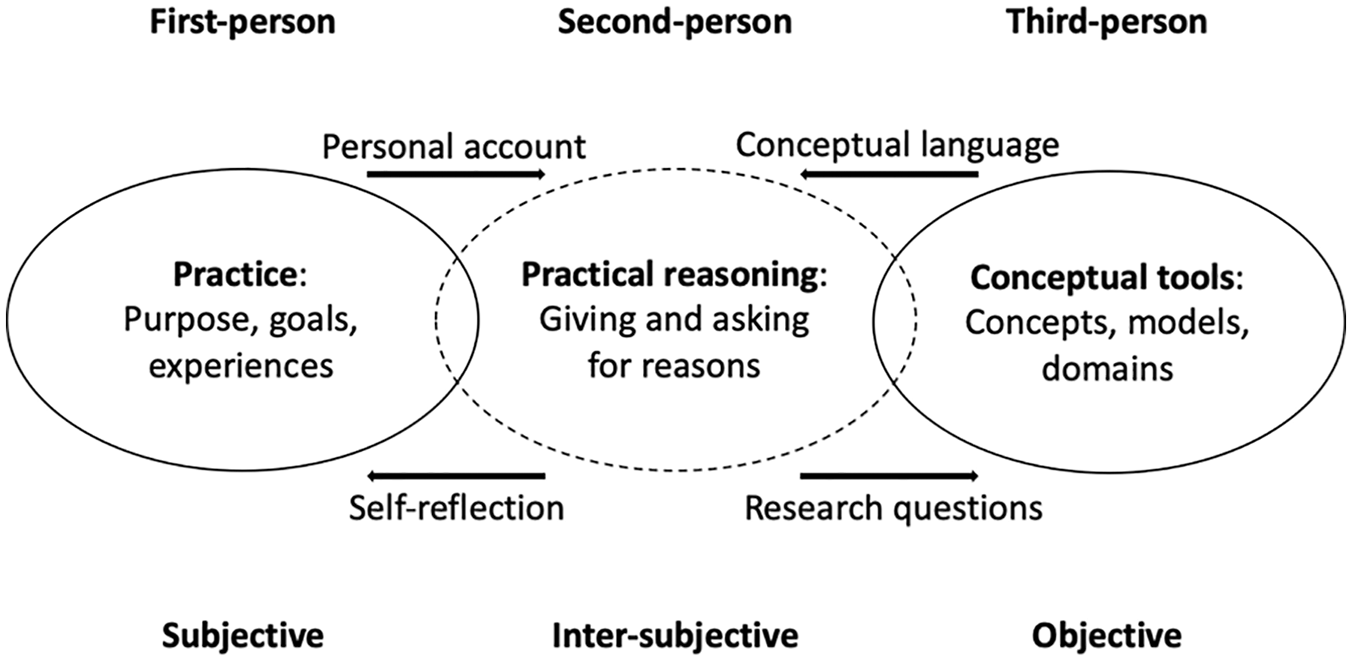
A map for entrepreneurship education.
How to design EE
EE will require a fundamental re-think in terms of what is to be learned, how it could (or should) be learned, and why it should be learned—connecting learning outcomes and learning goals. In a practical sense, the goal of educational design is to (a) synthesize the conceptual tools that learners can use (third person), (b) create a space for practical reasoning in and around the classroom (second person), and (c) enable the personal practice of the learners (first person) into a coherent, interconnected whole. These design goals re-frame the learning agenda and have the potential to assist educators to better select and purpose content, integrate a more dynamic learning journey that spans methodological boundaries, and serve an increasingly diverse set of aspiring entrepreneurs. Some key design considerations follow further.
Conceptual tools
Educators need to identify, vet, select, and integrate materials that can deliver specific objective knowledge “about” the practice of entrepreneurship. These help map out the ontology of the entrepreneurship space, that is, the set of objects relevant to an entrepreneurial practitioner, in the same way that a computer programmer defines the basic objects from which a program is built. The goal here is to provide a basic language about social (including business and management) practices of communication, production, and exchange, and to frame entrepreneurship as a change or transformation of their underlying configurations.
Intertwined in this ontology are different domains to enable one to understand individuals (as potential partners or customers), societies (as space where new values can be created), economic activities (as space where new economic value can be created), and social practices (as catalysts for change). Within each of these domains, there are relevant frameworks or models in which these concepts are organized. These provide the basic conceptual toolbox for EE. As the arrows in Figure 1 suggest, this toolbox helps structure classroom conversation and, at the same time, raises new research questions for its refinement and further development in response to classroom experiences. The latter represents a scholarly feedback system that fosters continuous advancement in the EE scholarship of teaching and research.
Practical reasoning
The classroom becomes a space for the exercise of practical reasoning—giving and asking for reasons for articulated visions and intended actions. The learners—as aspiring entrepreneurs—calibrate the meaning of what they aim to do via the adopted conceptual toolbox and the creative imagination through which they use these concepts to frame the perceptions of others. In this process, the meanings of terms such as value, product, customer, market, and industry become refined and facilitate consensus. As an arena for practical reasoning, the classroom facilitates “here-and-now” experiences that generate inter-subjective knowledge prospects and empower learners (and scholars) to cultivate the potential learnings (subjective and objective) these experiences generate. Through this process, participants identify, harvest, and codify a bespoke practice language that helps all stakeholders build bridges between scholarship and practice.
Practice
EE needs to delineate distinct subjective knowledge (experiences) from diverse individuals as key input, and to help learners grasp and explore the nuances and depths of such experiences. These experiences need to be shared via dialogue and practical reasoning. From the point of view of an individual learner, the exercise of practical reasoning helps align their experience and language with the minds of other entrepreneurs and, at the same time, provide a loop for self-reflection that can create new, differentiated experience.
In many instances, the aforementioned principles suggest a deliberate re-evaluation of existing curricula and course syllabi to evaluate, categorize and (re)purpose legacy content and methods using the tripod framework. Additionally, this will require the identification of gaps, and measures to close them, in order to ensure all three legs of the tripod are in place and supported by good educational design principles. Finally, while existing EE frameworks already include experiential learning methods, it is necessary to return to experiential learning principles (e.g. Dewey, 1934; Kolb, 1984) with an eye toward first-person learning outcomes.
How to Think About EE Differently
The framework presented here suggests a reconceptualization of EE as a dynamic knowledge tripod rather than simply a collective of teachers and learners standing outside of a knowledge domain. It recognizes three different knowledge types that are complementary and not reducible to each other, each based on a different mode of experience and access to the reality of entrepreneurship. Highlighting the ways in which the three knowledge types interact and enhance each other suggests different levers through which the first-person impact of EE can be achieved. As scholars and educators, we must strive to set up the entrepreneurial classroom as a fluid, vibrant interplay of first-, second-, and third-person perspectives.
Footnotes
Declaration of Conflicting Interests
The author(s) declared no potential conflicts of interest with respect to the research, authorship, and/or publication of this article.
Funding
The author(s) received no financial support for the research, authorship, and/or publication of this article.