



Abstract
Background
People with disabilities do not always successfully transition to and from postsecondary education. Although technology has the potential to play a role in supporting these transitions, there has been very little in-depth exploration of how exactly technologies can be incorporated into transition-support programs and the impact this has on transition outcomes.
Objective
This paper aims to provide an in-depth analysis regarding how transition support programs for students with disabilities might effectively incorporate technology.
Methods
A comprehensive and critical review of research was conducted.
Results
Just six technology-enriched transition programs have been developed and evaluated between 2000 and 2023. Within these programs technology has been employed or integrated in four main ways. All the transition programs were able to report a positive influence on at least one of their chosen primary outcomes, although these were not always statistically significant. The outcomes of these ‘proof of concept’ technology-enriched transition support programs have had a limited impact on the postsecondary education community.
Conclusions
In order to overcome concerns regarding unequivocal results, cost, feasibility and relevance further debate and research is required involving all relevant stakeholders including those responsible for resourcing and delivering student support systems within postsecondary education.
Introduction
The focus of this article is the role that technology-enriched transition programmes might play in supporting students with disabilities to successfully transition from secondary education to postsecondary education and/or from postsecondary education to employment. We define persons with disabilities in accordance with the UN Convention on the Rights of Persons with Disabilities [Ref. 1, article 1] as ‘those who have long-term physical, mental, intellectual or sensory impairments which in interaction with various barriers may hinder their full and effective participation in society on an equal basis with others’. This includes people with physical, sensory, mobility, and cognitive disabilities, but we also acknowledge that disability does not define a single homogeneous group. In the context of this paper, postsecondary education (also known as higher education or post-compulsory education) is defined as encompassing education provided through colleges and universities.
Access to and success completion of postsecondary education (PSE) is critical to enabling people with disabilities to enter the jobs market and gain meaningful employment. However, despite significant strides toward inclusivity and equal opportunities, people with disabilities are still experiencing significant inequalities when entering and exiting PSE that affect their employment outcomes. For example, compared to students without disabilities, fewer students with disabilities successfully complete secondary education, which is typically a pre-requisite for entering PSE. 2 As a consequence, PSE enrolment rates are persistently lower for students with disabilities.3–5 However, we also know that if students with disabilities successfully complete their postsecondary education, they have a stronger chance of transitioning to the workplace.6–8
It is widely acknowledged that technology could potentially play an important role in supporting the successful transition of people with disabilities. Despite this, there has been a lack of in-depth analysis regarding how transition support programs for students with disabilities might effectively incorporate technology. Therefore, currently, very little is known about whether and how transition support programs with a core technology focus have been designed and implemented and if they have, the extent to which they help overcome barriers to successful transition. In this paper we will analyse research literature that describes and evaluates technology-enriched transition programs that aim to support disabled learners to transition to and from PSE.
Background
Access to and success completion of PSE is critical to enabling people with disabilities to enter the jobs market and gain meaningful employment. People with disabilities experience significant and persistent inequalities in relation to entering and succeeding PSE, which has a negative impact on their ability to enter the workplace.
Postsecondary education inequalities for students with disabilities
Educational outcomes.
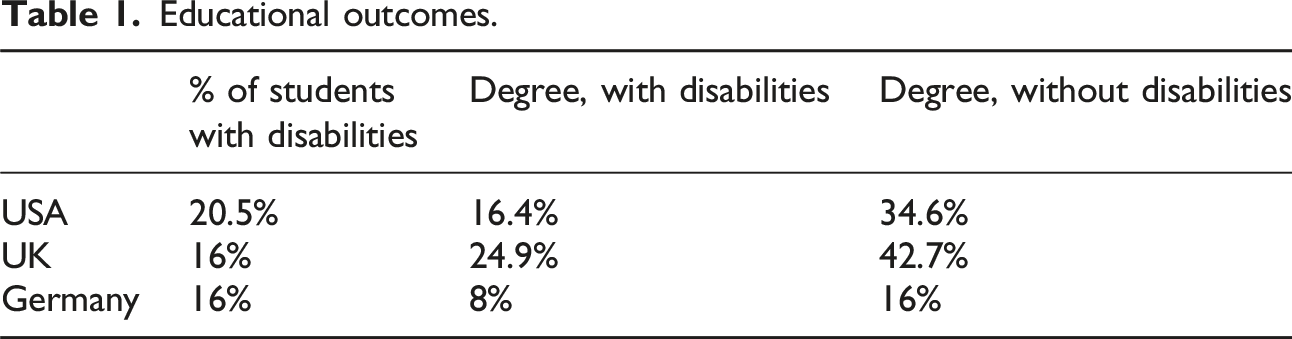
As a result, people with a disability are less likely to have completed a bachelor degree (or higher). It is difficult to compare these numbers between countries, but the within-country comparisons reveal significant inequalities. In the US, approximately 34.6% of all people without a disability have a bachelor degree compared to only 16.4% of all people with a disability. 18 In the UK, 24.9% of all people with a disability have a degree as their higher qualification, compared to 42.7% of people without a disability. 19 While in Germany about 16% of all people without a disability have a PSE degree, only 8% of all people with a disability have one. 11
Employment inequalities
Employment outcomes for people with a higher education degree, both with and without a disability.
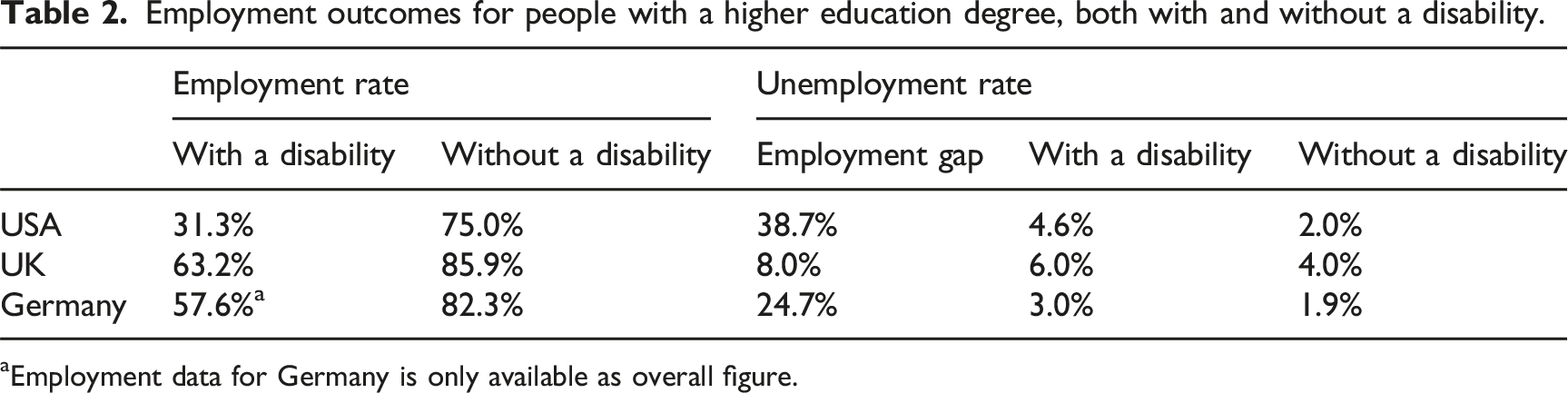
aEmployment data for Germany is only available as overall figure.
While the employment rate of people with a disability is generally lower compared to people without a disability, the unemployment rate is generally 1.5 to 2.3 times higher even with a PSE degree. In the US, 4.6% of all people with a disability and a PSE degree are unemployed compared to 2.0% of people without a disability. 20 In the UK, 6.0% of all people with a disability and a PSE degree are unemployed 12 and in Germany, 3.0% are unemployed. 23
Transition support for students with disabilities
The existence of significant and persistent PSE and employment inequalities has led to arguments that students with disabilities need support to transition into and out of PSE.24,25 In some countries, particularly the US, transition programmes have been developed to offer such support. By providing guidance and support, transition programs help students align their personal and educational goals with career aspirations. Additionally, they offer mentoring and networking opportunities, fostering connections that can be invaluable in navigating the complexities of the job market. Overall, these programs aim to enhance students’ confidence and readiness, ensuring a smoother transition into adulthood and their professional lives.2,5,8,26
The potential role of technology in supporting successful transition for students with disabilities
Technology supporting transition for students with disabilities includes but is not limited to assistive technology (AT). While the majority of literature in the field focuses on AT in the context of transition, we argue that there are additional types of technology that can support the transition for students with disabilities. For example, communication and collaboration tools can help students stay connected with peers and other support personnel. Or learning management systems can provide access to learning materials useful during transition.
We argue that there are three main reasons why a considerable amount of attention has been paid to the potential role that AT might play in supporting the transitions of people with disabilities. Firstly, AT can contribute to improved secondary education and PSE academic outcomes by increasing accessibility of the curriculum (content and activities) and assessments.3,8,27–29 Secondly, losing the ability to use AT in the transition from secondary to PSE can have a detrimental effect on academic performance. 30 Thirdly, AT can support productivity and efficiency in the workplace by facilitating access to work-based computers and IT systems and enabling people with disabilities to fulfil job tasks that involve the use of computers and IT systems. Lack of AT therefore represents a barrier to workplace participation.3,7,25,31,32
Despite the recognized potential of AT, there are significant student-related and service-related barriers to students with disabilities accessing the AT that might support positive transition outcomes. With regards to service-related barriers, evidence indicates that both PSE institutions and employers are not routinely or consistently providing access to AT for students with disabilities. There are a range of reasons for this including limited knowledge about AT and the range of the devices and software programs that can positively impact the performance and success of students with disabilities 33 ; preference for a ‘minimalist’ approach to support 4 ; reluctance due to the perceived high cost of acquiring or implementing the AT 29 ; and lack of awareness that the AT used by the student in their current setting will not automatically transfer to the new setting. 29
Four main student-related barriers to accessing AT are self-advocacy; AT knowledge; AT skills; and self-determination. It is argued that students with disabilities don’t have the skills to advocate for their AT.34,35 Two key elements to self-advocacy are knowing what AT is available and knowing which AT would best suits one’s needs. 35 This is problematic in that many students with disabilities lack such awareness. For example, a survey of 990 students with disabilities at seven PSE institutions throughout the US revealed that PSE students with disabilities have limited knowledge of the types of AT and accommodations that are needed in the workplace. 36 In addition, students don’t know how to use AT.30,33 In the context of transition and AT, self-determination involves being able to direct or have some control over the transition. This might involve being aware of personal strengths and weaknesses and the role that AT might play in supporting these; setting transition goals that AT can contribute to; making independent AT choices; and problem-solving around AT acquisition and use. It is argued that students with disabilities lack these skills which limits their ability to play an active role in the transition planning process.29,37
Whilst the majority of literature focuses on the role of AT in supporting the transition of students with disabilities into PSE or employment, there is a small but growing body of literature that argues for a different role for technology. This literature argues that in order to succeed in PSE and employment students need to be able to use a range of learning technologies and office-based technologies. They therefore would benefit from raising their level of technological competencies.2,37,38
Current knowledge regarding technology-enriched transition support programs for students with disabilities
From the evidence presented in the previous sections, we know that people with disabilities do not always successfully transition to PSE or employment. In addition we know that technology can play a role in successful transition. This has led to arguments that transition support interventions/programs should have a core technology component. 33 Although not focused specifically on technology, two literature reviews that sought to examine the types of strategies and processes that are adopted in schools and PSE institutions to facilitate transition offer some insights into potential key design characteristics of technology-enriched transition programs. A systematic review of 18 studies sought to identify best practice and components of postsecondary transition programs for youth with disabilities. This review identified two programs that were delivered online and one which provided access to accessible technology. 5 Whist this review summarized the outcomes of these programs, little attention was paid to their design other than to state that ‘additional research is also needed to explore whether different delivery formats impact outcomes’ (p. 12). 4 Another study conducted a scoping review of existing literature focusing on environmental interventions identified within the International Classification of Functioning, Disability and Health (ICF), which encompass various factors such as products and technology, support and relationships, attitudes, and services, systems, and policies, to support transition age autistic youth preparing for employment. 39 Of the 35 studies included in the review, six reported on the use of technologies such as virtual reality and online/ app-based video modelling to improve interview skills; one reported on the use of personal digital assistants to develop organizational and task management skills and one reported on a ‘more sophisticated’ online programme that sought to improve self-determination and career exploration. Apart from a brief, unexplained distinction between sophisticated and unsophisticated programs the review makes no other comment on the design of the programs or on any potential relationship between the design of the programs and their outcomes.
The lack of in-depth analysis regarding effective designs for technology-enriched transition programs for students with disabilities means that we know very little about whether and how transition support programs with a core technology focus have been designed and implemented and if they have, the extent to which they address the barriers that have been identified. In this paper, we will comprehensively analyse research literature that describes and evaluates technology-enriched transition programs that aim to support disabled learners to transition to and from PSE. In particular we will use our review to address the following research questions: 1) What technology-enriched transition programs exist that support students with disabilities to transition from secondary education to PSE or from PSE to employment? 2) What are the key characteristics of technology-enriched transition programs that support students with disabilities to transition from secondary education to PSE or from PSE to employment? 3) What is the underpinning design rationale for the design of technology-enriched transition programs that support students with disabilities to transition from secondary education to PSE or from PSE to employment? 4) What evidence is there that technology-enriched transition programs that support students with disabilities to transition from secondary education to PSE or from PSE to employment have a positive impact on the transition of students with disabilities? 5) To what extent are technology-enriched programs sustained and embedded within PSE institutions?
In addressing these questions, this paper makes an original contribution to knowledge by documenting program practices, assessing program outcomes, and stimulating debate about what constitutes best practice.
Method
In order to identify technology-enriched transition programs that have been described and evaluated in the literature we adopted a three-stage literature review strategy. The lead author conducted the first stage and both authors conducted stages two and three.
Search strategy
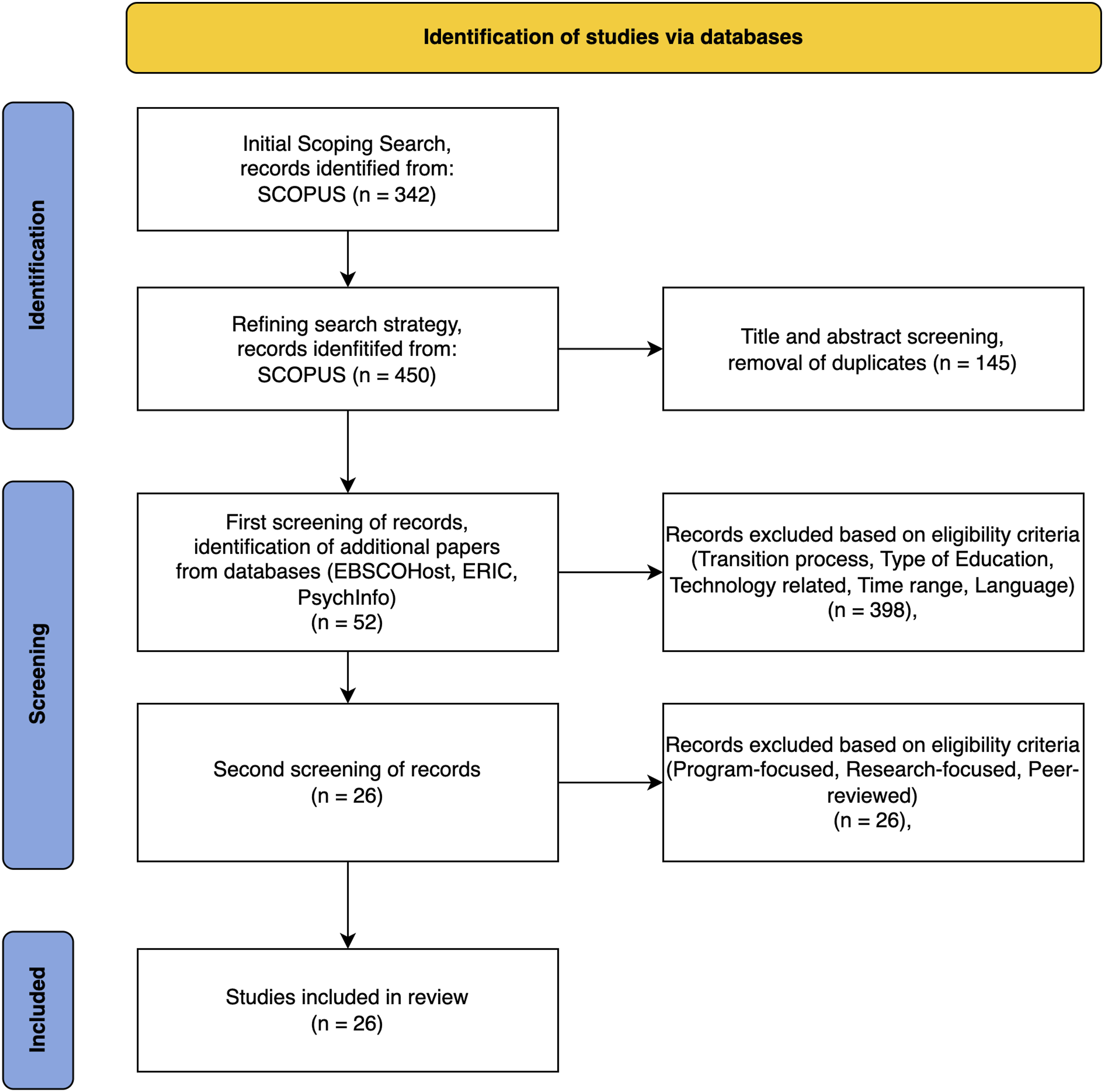
Our review began with an initial ‘naivé’ scoping search designed to map the existing literature and identify the scope of research available. Our five research questions guided this process. To ensure the comprehensiveness of the initial search, we employed various combinations of the search terms “disability,” “technology,” “transition and employment,” and “higher education,” in our queries within the SCOPUS database. This initial search resulted in 342 papers.
To further refine the search strategy and achieve better results, we used the package litsearchr
40
for an automated search term selection. To do so, litsearchr builds a co-occurrence network based on potential search terms identified through the initial search input. We then set a cutoff to discern the important from the unimportant search terms and build a more precise search strategy by grouping the search terms into concepts. Based on the results from our initial search, this approach resulted in in a total of 110 selected terms, which were then grouped into one of the four concepts (1) disability, (2) technology, (3) transition and employment, and (4) higher education. Examples of search terms for the key concepts are: • Disability: 22 search terms, for example, “people with disabilities” OR “persons with disabilities” OR “students with disabilities” OR disabled OR disabilit* • Technology: 9 search terms, for example, “assistive technology” OR “digital technology” OR “information system” OR “information technology” OR “technology services” OR technology OR technol* • Transition and Employment: 16 search terms, for example, “transition services” OR “employment outcomes” OR “rehabilitation service” OR “labor force” OR “labour force” OR “career readiness” OR “career-readiness” OR transition* • Higher Education: 16 search terms, for example, “higher education” OR “postsecondary education” OR “post-secondary education” OR universit* OR college OR “post-compulsory education” OR “post-compulsory”).
This additional search resulted in a total of 450 papers from the SCOPUS database. Upon meticulous review and removal of duplicate entries, the number of relevant papers was reduced to 305.
Screening strategy and critical reading
Recognizing the necessity of refining our dataset to ensure relevance and quality, our initial screening strategy employed five key criteria to determine the eligibility for our literature review: 1) Transition processes: We have limited the scope of our review to papers on transition from secondary education to PSE and/or from PSE to employment. We have excluded papers focused on solely on transition directly from secondary education to employment. 2) Type of Education: Eligible papers must focus on PSE and not on technical schools or vocational education. 3) Technology related: Eligible papers had to have a substantial focus on technology 4) Time range: papers had to be published between 2000 and 2023. We started at 2000 because this is around the time that significant legislation relating to reducing inequalities for students with disabilities began to be enacted. 5) Language: Eligible papers had to be written in either German (first language of primary author) or English (first language of secondary author).
Additional papers were identified using EBSCOhost, ERIC, and PsycINFO databases, and the same essential selection criteria were applied. Applying these eligibility criteria reduced the number of relevant papers further down to 52 total. In a second phase of screening, both researchers read the full text of all 52 papers in detail in order to screen out papers that did not meet the following criteria: • Program focused: the paper had to be describing and evaluating one or more specifically named technology-enriched transition programme as opposed to discussing the general value or principles of technology-enriched transition programmes. • Research-focused: papers to be included in the final dataset had to either present empirical research, such as quantitative or qualitative or be a summative discussion paper. • Peer reviewed: papers had to be peer-reviewed to ensure research quality.
In addition, for those papers that described and evaluated one or more specifically named technology-enriched transition programme, the reference list was screened in order to follow-up any previously published papers related to the programme that might have been missed in the first stage. Applying this process and criteria resulted in a final dataset of 26 papers.
Analysis
The full text of all 26 papers was coded by both authors using NVivo 12.
41
Informed by our research questions, four main coding categories were applied (Figure 1): • Type of transition: transition to PSE; transition to PSE or employment; transition to and from PSE; and transition to employment from PSE (Research Question 1). • Role of technology: accommodation; skills-focused; and medium of delivery (Research Question 2). • Design Rationale: informed by research evidence or theory (Research Question 3). • Success Outcomes (Research Question 4). Flow diagram illustrating the identification, screening, and inclusion process of eligible studies.
Results
In the following sections we will present the results of our analysis of the 26 papers identified through our screening and critical reading strategy and outline the extent to which the papers provide answers to our five research questions.
What technology-enriched transition programs exist that support students with disabilities to transition to or from postsecondary education?
Overview of six transition programs for students with disabilities that incorporate technology.
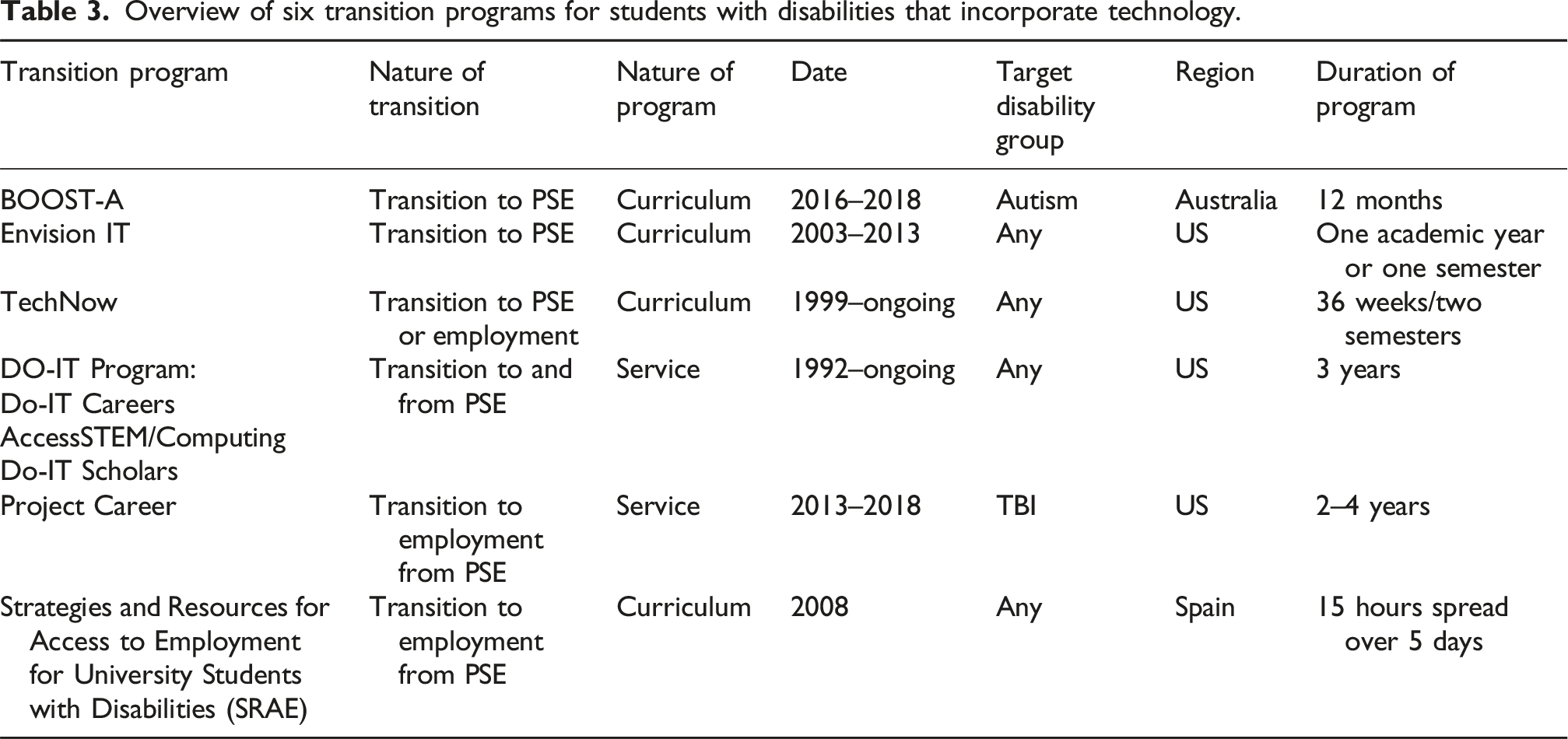
While BOOST-A, Envision-IT, and TechNow focused on supporting transition from secondary education to either PSE or employment, Project Career and SRAE focused on supporting transition from PSE to employment. Just one program, DO-IT, focused on both transition to PSE from secondary education and transition from PSE to employment.
While BOOST-A concentrated on autism and Project Career on traumatic brain injury (TBI), the other four programs were not designed for a specific disability group. The majority of the programs were US-based, although we acknowledge that this may be a consequence of excluding papers from the review that were not written in English or German. Four of the programs (BOOST-A, Envision-IT, TechNow, and SRAE) focused primarily on providing a curriculum (learning content and activities), while the others (DO-IT, Project Career) focused on providing a ‘service’ that included assessment, mentoring, counselling and facilitation of work experience opportunities such as internships. The duration of the programs varied from 5 days (SRAE) to 4 years (Project Career).
Technology-enriched programs that focus on supporting transition from secondary education to postsecondary education
BOOST-IT was developed in Australia between 2016 and 2018 and was an online four-module program intended to support adolescents on the autism spectrum (without learning disabilities) to transition from secondary school into PSE and employment.42,43 The first module comprises six activities designed to facilitate the exploration of personal strengths and career awareness. The second module involves guidance on identifying suitable individuals to support transition planning and providing strategies for becoming an active member of the transition planning team. The third module entails guidance on developing strengths-based goals and encouraging engagement in real-life experiences, with input from the adolescent, parent and wider team members. The fourth module supports the adolescent, parent and wider team members to review and reflect on progress.
EnvisionIT is an online curriculum developed for students with and without disabilities in the US.44–46 The experimental piloting of the program commenced in 2003 in general and special education classrooms in Ohio and subsequently in Connecticut. EnvisionIT comprises twelve units, with the content centred on career readiness and exploration. Other topics are reading, writing, financial literacy and IT/digital literacy. The technology content of the curriculum focuses on teaching IT/digital literacy skills and supporting students to use the Internet to explore careers, complete transition assessments, develop transition plans and complete online college or job applications.
TechNow was originally developed in 1999 and is a high school curriculum funded by The Oklahoma Department of Rehabilitation Services and The Oklahoma Department of Career and Technology Education.47,48 The program is free to schools in Oklahoma and available for a fee to schools outside Oklahoma. TechNow positions itself as providing work-readiness skills training that prepares students with disabilities for PSE and employment. The TechNow curriculum focuses on science, technology, engineering and mathematics. Throughout the yearlong course, students use technologies to complete a range of projects. These technologies are primarily the Internet and computer applications such as word-processors, spreadsheets, graphic design, and animation programs.
Technology-enriched programs that focus on supporting transition to and from postsecondary education
The DO-IT Center based at the University of Washington was founded in 1992. Its programmes are supported by federal, state, corporate and private funds. The overarching goal of the DO-IT Center is to increase the success of people with disabilities in PSE and employment. Research literature documents an early transition-focused DO-IT program called DO-IT CAREER. 49 Later on, the transition work focused on two programs: ACCESS-STEM and ACCESS-COMPUTING. 50 In addition, a program called DO-IT Scholar is described in the literature. This began as part of the ACCESS-STEM program and then developed into a stand-alone program. 51 The overall goal of all of these programs is to increase the success of individuals with disabilities in PSE & careers, using technology as an empowering tool.
DO-IT CAREER was a 3-year program delivered in collaboration with community partners to provide pre-college and college students with disabilities exposure to successful role models through engagement in a range of events, panels, and email communications. In addition, the program provided information to employers, educators, and service providers about the legal rights, capabilities, and needs of students with disabilities.
ACCESS-STEM aims to increase the participation of people with disabilities in science, technology, engineering, and mathematics. It began with funding from the US National Science Foundation. The programs offer a range of opportunities such as summer academic enrichment programs; mentoring, peer support; academic support, careers advice; networking (e.g. conference attendance); skills-building programs (e.g. ICT use, study skills); work-based learning (e.g. Internships); and research experiences. In a similar vein, for the ACCESS-COMPUTING program, college and graduate students with disabilities can connect with mentors and professionals to learn about internships and other opportunities in computing fields. In both programs, participants use electronic communications and personal meetings to connect with peers and adult mentors, most of whom have disabilities themselves.
Participants in the DO-IT Scholars program have a wide range of disabilities and begin as second year high school students and continue through to college, employment and beyond. DO-IT goals for the Scholars include development of self-determination skills (including self-advocacy), social skills, academic skills for pursuing postsecondary studies, and career/employment skills. Use of computers and the Internet plays a key role in reaching these goals. There are three primary interventions: (a) technology-enriched summer study, (b) year-round computer and Internet activities, and (c) work experiences.
Technology-enriched programs that focus on supporting transition to employment from postsecondary education
Project Career was a 5-year (2013–2018), collaborative development project between Kent State University, Boston University, JBS International, Inc., and West Virginia University, funded by the National Institute on Disability, Independent Living and Rehabilitation Research. The goal of Project Career was to develop, implement, and test a technology-driven, long-term, and resource-rich individualized support program that combined Cognitive Support Technologies (CSTs) and vocational rehabilitation practices to improve the career readiness and employment outcomes of civilian and veteran undergraduate students with Traumatic Brain Injury who are enrolled in 2- and 4-year colleges and universities.52,53 Project participants were assigned a Technology and Employment Co-ordinator (TEC) who conducted baseline career and technology assessments. Results of these assessments were used to develop a customized, technology-driven intervention for the student centred around the use of a cognitive support technology device (e.g. iPad) for providing individualized cognitive, psychosocial, and educational supports alongside sequenced vocational rehabilitation services.
Course of Strategies and Resources for Access to Employment for University Students with Disabilities (SRAE) was a training program designed and delivered by the University of Granada in Spain which aimed to develop the employment seeking skills of students with disabilities. 54 Although this English language article is published in 2016, citations to Spanish language publications within the article suggest the program was actually designed and delivered as early as 2008. The program included one virtual module (delivered on CD) and five in-person modules. Content included: setting career goals, tools for searching for work, conducting job searches on the Internet and resources for social inclusion. The virtual module contained exercises for the students to complete. To be eligible to participate in the program students had to have a disability, be enrolled in the penultimate or final year of the degrees in Psychology, Pedagogy, Psycho-pedagogy or Teaching and identified as having difficulties in performing employment search techniques and strategies, as well as in using new technologies.
How is technology used to enrich transition programs that support students with disabilities to transition to or from postsecondary education?
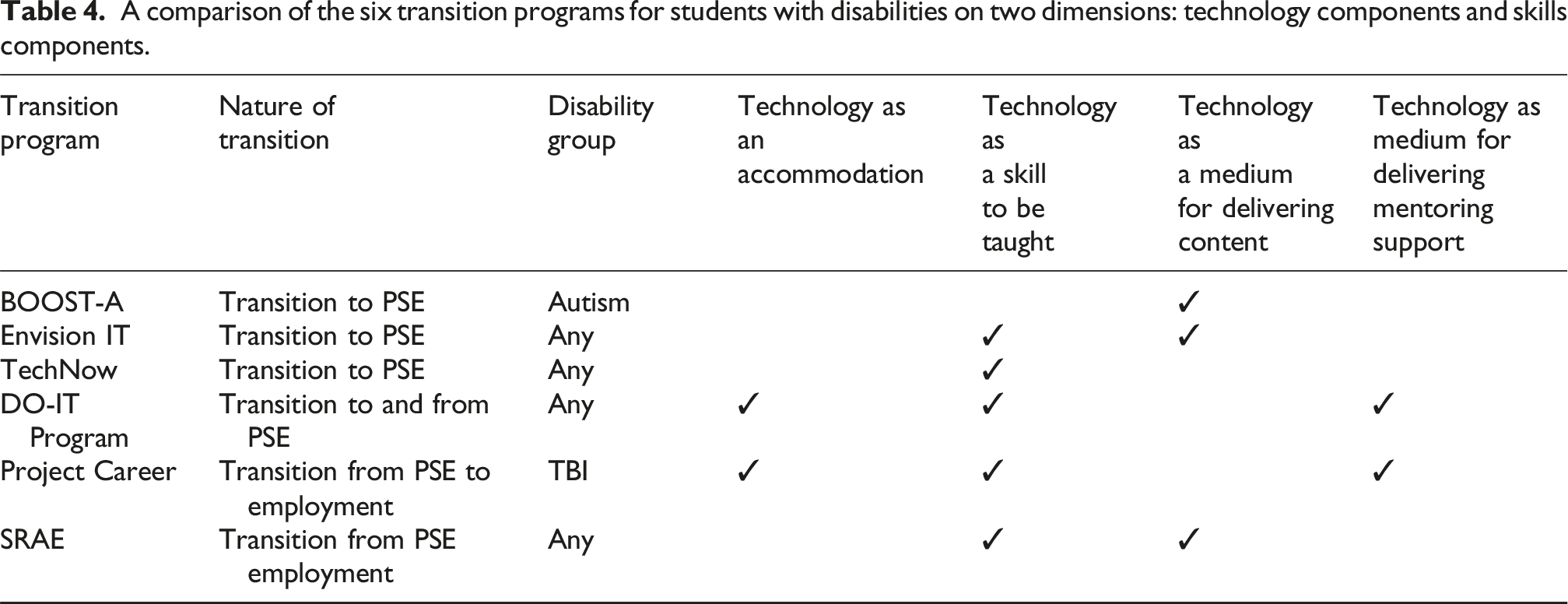
In addressing our second and third research questions, we examined the different ways in which technology was integrated into the transition programs and the rationales provided for how technology is used to enrich the transition programs. We identified four ways in which technology is used to enrich the six transition programs (see Table 4). 1) Technology as an accommodation: helping students with disabilities to access educational content and participate fully in academic and employment activities. 2) Technology as a skill to be taught: helping students with disabilities to acquire digital literacy and technical skills essential for academic success, career readings and employability. 3) Technology as a medium for delivering content: using digital tools and platforms, such as online courses, videos, and interactive software, to present and share educational materials effectively with students with disabilities. 4) Technology as a medium for delivering mentoring support: using digital tools such as video and messaging apps to facilitate communication between students with disabilities and mentors. A comparison of the six transition programs for students with disabilities on two dimensions: technology components and skills components.
Technology as an accommodation
The DO-IT Program provides students with AT and raises awareness about the supportive role of AT. Examples include speech output systems and alternative keyboards. 51 DO-IT technology specialists help students configure their computers and AT to meet their specific needs. The program is also committed to increasing awareness among education and employment professionals about the benefits of AT for students with disabilities. DO-IT uses two arguments to justify providing AT as accommodation. Firstly, existing transition programs often overlook the unique needs of students with disabilities, 49 and secondly, students will be able to use AT in STEM careers due to the increasing use of electronic and information technologies. 55
Project Career provided students with TBI with CSTs such as iPads and related apps, to aid their transition by improving memory, attention, concentration and planning.53,56 Students were assessed continuously using the Matching Person with Technology (MPT) tool to identify appropriate apps for their needs. The programme justifies the provision of technology by citing best practice in AT and vocational rehabilitation.53,56,57 They point out that most people with TBI who return to work without AT in place lose their jobs within 90 days 58 and that students with TBI prefer high-tech aids such as electronic calendars and automatic reminders. 59 However, the latter finding is based on data from only eight students.
Both the DO-IT and Project Career programs support students with disabilities in advocating for their AT needs. Project Career offers a model that includes self-advocacy training, job-seeking skills, structured work experiences, accommodations consultation, and support from career services, along with job placement and follow-up services. 57 The DO-IT Scholars program allows participants to practice self-advocacy and develop technical skills by working with a technology specialist to configure their systems. 51 In the Access-STEM program, student leadership panels and mentors help students learn to advocate for reasonable accommodations in academia, internships, and jobs. 50
Technology as a skill to be taught
The DO-IT Program 51 and Project Career Program 52 both prioritize the development of AT skills, with technology specialists and coordinators providing personalized training. Envision-IT and Tech-Now, on the other hand, focus primarily on IT literacy. Envision-IT, in particular, equips students with disabilities with essential ‘21st-century skills’ for career readiness and employability. It encourages Internet use for career exploration, transition assessments, and online applications. 60 Vreeburg et al. 44 argue that students with disabilities are not accessing and using technologies in secondary education 61 though an increasing number of occupations and employers require IT skills. 62 In justifying the specific design of the Envision IT curriculum, the designers argue that the curriculum addresses important policy initiatives in the US such as Every Students Succeeds Act (ESSA) 2015 and the Workforce Innovation and Opportunity Act 2014. 60 In particular, Lombardi et al. 60 illustrate in some detail how the curriculum maps onto definitions of digital and blended learning contained within ESSA. They also argue that Envision IT is aligned to both national and state standards for Technology and Career-Tech 21st Century Skills. 63
TechNow encourages students to use computer applications to solve real-life problems, aiming to teach transition and employability skills through IT. 47 The program claims that evidence from three studies64–66 supports its focus on technology, stating that using project-based learning (PBL) with technology has been successful for students with disabilities. However, this is misleading, as the cited studies only focus on PBL and do not reference the combining of PBL with technology.
The SRAE program encourages participants to conduct online job searches. 54 Program designers cite two studies from Spain67,68 that highlight challenges faced by university students with disabilities in finding employment. They argue that students need more guidance from universities on job-seeking strategies and technology use.
Technology as a medium for delivering content
The BOOST-A transition program was delivered through a website. 42 Each module featured interactive cartoon videos explaining the purpose of transition planning and each module’s aim. Hatfield et al. 43 justify the online format using autism-specific research, citing that individuals on the autism spectrum prefer technology, 69 and technology-based training has been effective in other contexts. 70 However, it is interesting to note that when Hatfield et al. 71 surveyed adolescents, parents, and professionals about factors for successful transition planning; technology was not mentioned as a positive influence.
EnvisionIT was delivered online via a learning management system with embedded multimedia content. 60 Lombardi et al. 60 justify this online approach by citing the Every Student Succeeds Act (ESSA) of 2015, which prioritizes digital and blended learning. The SRAE program included one virtual module (on CD) and five in-person modules, with exercises for students to complete, but no specific rationale was provided for the virtual component. 54
Technology as a medium for delivering online mentoring
The DO-IT program uses email and moderated online discussion groups to offer peer and mentor support to students with disabilities. This approach aims to enhance self-sufficiency and provide support from otherwise inaccessible peers and adults.50,55 Burgstahler justifies using technology for mentoring in the DO-IT Access-STEM program by citing a study that identifies student support and career awareness as predictors of successful academic and employment transitions. 72 She argues that ICT can help provide this support and increase career awareness. 73 Similarly, Kim-Rupnow et al. 51 reference the ‘Connecting to Success’ project at the University of Minnesota, which used electronic communication to aid the transition of students with disabilities.
For Project Career, TECs and others used iPads to deliver vocational support services, including electronic mentoring.52,57 Rumrill et al. 52 cite Wehman 74 to support the claim that regular electronic contact with a counsellor can improve employment outcomes for people with disabilities, although the specific evidence from Wehman is not clearly detailed.
What evidence is there for the success of technology-enriched transition programs that support students with disabilities to transition to or from postsecondary education?
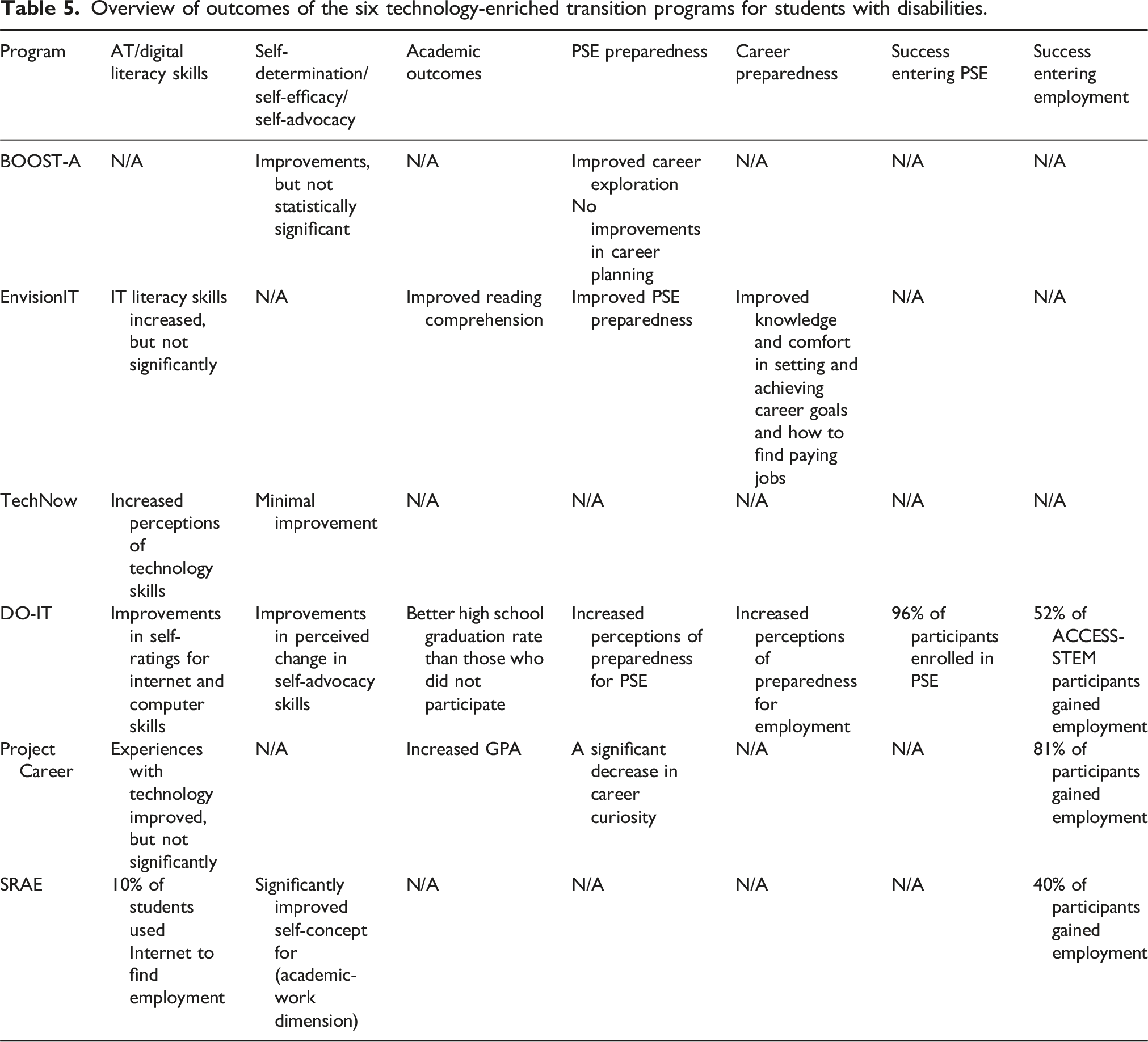
Overview of outcomes of the six technology-enriched transition programs for students with disabilities.
Improved AT access and use
Both of the programs that provided AT as an accommodation report a range of outcomes that provide evidence for i) improved access to AT; ii) increased frequency of AT use; or iii) improved proficiency or confidence in using AT.
Data analysis from the AccessSTEM and AccessComputing DO-IT programs indicates that while most of the 472 respondents had pre-existing access to computers and the Internet, access to adaptive software or hardware increased significantly, from 31% to 64%, comparing baseline to post-program. 76 However, differentiating between improvements in specific AT skills and broader IT/digital literacy skills is challenging. For instance, in the DO-IT Career program, a survey of 55 participants revealed an average score of 3.66 (on a scale of 1 = much less to 5 = much more) for increased ability to use computers, the Internet, and other technologies. 49 This score was lower than those for career motivation and understanding of success skills, possibly due to the lack of direct skill application in many work-based placements. In the DO-IT Scholar Program, an evaluation study showed that 75 participants self-rated their Internet and computer skills at three program stages: baseline, during, and after. 51 The average perceived improvements for internet skills and for computer skills indicate significant skill enhancements from baseline to post-program.
Two key goals of Project Career were to improve students’ perceptions of technology and to increase their use of it. Rumrill et al. evaluated 37 participants at baseline, 6 months, and 12 months, asking them to rate their technology experiences on a scale from 5 to 15, with lower scores indicating more positive experiences. 57 The average scores were 7.54 at baseline, 6.71 at 6 months, and 6.64 at 12 months, showing a general improvement in experiences, although the differences were not statistically significant. It’s worth noting that most students had prior experience with computers, smartphones, and tablets, making the iPad and apps easy for them to use. 53 Minton et al. analysed data from 105 participants, finding more positive experiences with technology at 12 months compared to baseline. On average, students used Project Career-purchased apps for 2.01 hours daily and reported using a specific app outside their homes 63.7% of the time.
Improved digital literacy skills
The EnvisionIT program used the Information Technology Literacy Survey to assess skills in three areas: understanding Internet organization and usage, searching for and citing online information, and searching career databases. 44 Pre- and post-test data were analysed for 287 students randomly assigned to either a control group or the EnvisionIT intervention. Students with disabilities in the intervention group had a higher mean score than those in the control group, although this difference was not statistically significant. Lombardi et al. 45 suggest these findings indicate that targeted IT literacy instruction can better prepare students with disabilities for college and careers. A student satisfaction survey with 19 Likert-scale items was also used to measure student perceptions of curriculum usefulness, covering skills such as (a) Internet use, (b) reading, test-taking, and writing strategies, (c) careers of interest, PSE and training options, (e) setting goals and making plans, and (f) preparing for a job. 45 While students reported improvement in all areas, the smallest gains were seen in Internet use.
The TechNow program developed the Technology Acquisition Survey (TAS) to assess growth in transition knowledge, self-determination, and perceptions of technology use. 47 The TAS measures how students apply technology in their studies, with questions about the frequency of technology use for tasks like learning basic skills, problem-solving, and simplifying schoolwork. Students are also asked to rate their competence with eight technology systems, including (1) word processing, (2) presentation software, (4) databases, (5) multimedia (music, video), (6) Internet browser, (7) email, and (8) graphics/photo editing, on a 6-point Likert scale ranging from ‘I do not know what this is’ to ‘I am an expert and help others’. A comparison of 148 students with disabilities in the TechNow program and 106 students who were not involved revealed that the intervention group scored significantly higher in technology skill acquisition. 47
In contrast to the evaluation approach adopted by EnvisionIT and TechNow, the SRAE program examined the strategies that students used to find employment before and after engaging in the program. None of the 10 participants in the experimental group used the Internet before the program. Post-intervention, just one student reported using the Internet to find employment. 54
Improved self-determination, self-efficacy, or self-advocacy
Self-determination, an indicator of post-school success, refers to a person’s ability to make choices and manage their life. The primary outcome for BOOST-A was self-determination, measured using the AIR Self-Determination Scale. 42 This scale assesses two main components: a student’s knowledge, abilities, and perceptions related to self-determination and their opportunities to apply these skills. It provides scores in four sub-domains: Autonomy, Self-Regulation, Psychological Empowerment, and Self-Realization, as well as an overall score. A quasi-randomized controlled trial was conducted with 94 adolescents on the autism spectrum. Participants were allocated to either a control group (n = 45) or an intervention group (n = 49) and were blinded to the trial hypothesis. The AIR Self-Determination Scale has four versions (educator, parent, student, researcher), but only parent and student data were collected for the BOOST-A evaluation. Results showed positive impacts in three areas: opportunities for self-determination at home (reported by parents), career exploration (reported by both parents and adolescents), and transition-specific self-determination (reported by parents). However, no significant differences in overall self-determination were found between groups. Hatfield et al. 42 concluded that BOOST-A shows preliminary evidence of enhancing some career-readiness outcomes. They suggested that the lack of significant self-determination outcomes could be due to the absence of face-to-face training, leading to over-reliance on parents for student engagement. A 2018 process evaluation supported this, identifying that a major barrier to program success was the lack of a guide to help students set goals and take action. 77
The TechNow transition program was evaluated using two self-determination measures: The Air Self-determination Scale and the Transition Assessment and Goal Generator (TAGG). TAGG provides a performance statement, strengths and needs lists, and suggested annual transition goals. A 3-year study of 253 students (131 in the intervention group, 122 in the control group) showed minimal improvement in both TAGG and AIR scores between the groups. 47 This minimal growth could be due to students gaining a more accurate self-perception as they learn about their desired careers and the steps to achieve them. Additionally, the intervention group had a higher percentage of participants with severe/profound disabilities (17%) than the control group (2%).
Project Career utilized the standardized MPT tool to evaluate changes in students’ attitudes towards technology at baseline, 6, and 12 months. The data showed improved autonomy and self-determination in students (n = 105) after 6 months. Furthermore, 34.9% of students found their CST devices and support apps beneficial in achieving their goals. This improvement is potentially supported by Leopold et al., 56 who observed various self-initiated actions or changes by students participating in the program. These actions, noted by students (N = 353), varied from modifying their class schedule to disclosing their TBI and seeking disability support.
The SRAE program, instead of focusing on self-determination, uses self-concept as an outcome measure. 54 This is based on the idea that negative self-perception can hinder job-seeking due to anticipated unfavourable treatment. The Five Factor Self Concept Questionnaire (AF5), a validated Spanish tool, was used to assess self-concept across five dimensions, including academic or work performance. Post-SRAE, the 10 experimental group students showed increased self-concept in all dimensions, with a significant rise in the academic-work dimension (p .005). An evaluation study involving 75 DO-IT Scholar participants showed a significant improvement in self-advocacy skills over time. 51
Improved academic outcomes
Transition programs measure improved academic outcomes using various indicators, such as reading comprehension scores, high school graduation rates, university grade point average (GPA), and university graduation. EnvisionIT focused on reading comprehension, arguing it is critical for career-readiness and employment. 60 The AIMSweb Maze Reading Assessment was used in a quasi-experimental pre- and post-test study. This test requires students to read passages and choose the correct word from multiple options to complete sentences. Among 338 secondary school students, both with and without disabilities, multi-level linear modelling showed that while both intervention and control groups improved in reading, the intervention group made significantly larger gains, demonstrating a large effect size. 60
The DO-IT program conducted a longitudinal study tracking the college and career pathways of students with disabilities who participated in its transition programs. Participants were surveyed about their educational and career outcomes and asked to rate the value of the activities they engaged in. Where possible, this data was compared to the National Longitudinal Study (NLTS) data of high school students planning to transition to postsecondary education. In 2010, analysis showed that 88% of DO-IT participants completed high school, which increased to 90% in 2016.76,78 These rates compare favourably to NLTS figures of 54% in 1987 and 70% in 2003. 78
At enrolment in Project Career, 146 students reported a mean GPA of 2.87. After 12 months, this increased to 3.02. 57 Students who graduated or withdrew after at least 12 months in the program had a mean GPA of 3.18. Of these students, 41 graduated, 21 withdrew, and 84 continued their studies. Additionally, 75.5% of participants said that using apps on their iPads improved their academic performance moderately or significantly.53,57
Improved preparedness for postsecondary education
EnvisionIT used the Ohio State University Career Survey (OSU-CS) to assess participants’ perceived comfort and knowledge of key transition skills, such as job searching, college applications, and setting career goals. In a pre-test-post-test study involving 287 students, including 119 with disabilities, participants rated their knowledge about finding college information. Paired t-test analysis showed that students with disabilities in the experimental group had significantly greater knowledge gains compared to those in the control group. 44 An evaluation study of 75 DO-IT Scholar participants showed an average perceived increase in college preparedness of 2.15, which was higher than perceived improvements in internet skills (1.90) and self-advocacy skills (1.49). 51
Improved preparedness for employment
A secondary outcome of BOOST-A was career planning and exploration, measured using subscales from the Career Development Inventory – Australia – Short Form. The Career Planning subscale assessed discussing plans with adults, selecting relevant subjects, career choices, and life after current studies. The Career Exploration subscale focused on seeking advice. In a quasi-randomized controlled trial (control group: n = 45; intervention group: n = 49), 42 BOOST-A significantly improved career exploration awareness among adolescents. Hatfield et al. 42 concluded that BOOST-A might increase the likelihood of postsecondary education and employment for adolescents on the autism spectrum. However, no significant improvements were found in career planning, possibly due to incomplete completion of the goal-setting module. 68
In a pre-test–post-test study involving 287 students, including 119 with disabilities, EnvisionIT participants rated their knowledge of setting career goals, creating step-by-step career plans, and believing in their ability to achieve these goals. Students with disabilities in the intervention group improved in knowledge and comfort with goal-setting, unlike those in the control group. 44 Participants also rated their knowledge of finding paying jobs, with significant gains observed in the intervention group compared to the control group, for both students with and without disabilities.
In a quasi-experimental study involving 816 students with and without disabilities, EnvisionIT’s impact on employment preparedness was evaluated using the Student Career Construction Inventory (SCCI) and the Vocational Skills Self-Efficacy (VSSE) scale. 46 Analysis of pre- and post-test scores revealed that students receiving the EnvisionIT intervention had significantly higher self-reported career readiness scores than those who did not. The largest gains were observed when more of the curriculum was taught, and these effects were significant for both students with and without disabilities across various disability types.
An evaluation of 75 DO-IT Scholar participants showed an average perceived increase in employment preparedness of 1.78. 51 This increase was smaller than for college preparedness (2.15) and internet skills (1.90), but larger than for self-advocacy skills (1.49).
The Project Career assessment used the Career Maturity Inventory, which includes subscales for Concern, Curiosity, Confidence, and Consultation. In the first year, only the Curiosity subscale showed significant change, with a slight decrease, suggesting students’ career plans became more concrete. 57
Succeeding in entering postsecondary education or employment
Kim-Rupnow et al. report that 90% of DO-IT Scholar Program participants graduated high school and pursued postsecondary education, motivated by the desire for financial security through employment. 51 Data from 253 participants show that 219 of 229 high school graduates enrolled in postsecondary institutions, with 36% graduating and 52% still enrolled. 78
The 2010 DO-IT Longitudinal Transition Study found that 70% of post-college participants involved in extracurricular STEM activities were employed, compared to 44% of those who were not. 50 A 2016 update revealed that 52% of participants no longer in college were employed (n = 100), having completed more internships than their 84 unemployed counterparts (2.4 vs 1.4). Among those still enrolled in college (n = 218), the 44 employed students also had more internships than their non-employed peers. 76 Of the 105 students in the Project Career program, 27 graduated in 2017, with 62% employed (17 full-time, 4 part-time). 53 By 2019, 80.5% of the 41 graduates were employed, including 27 full-time and 6 part-time. 57 In contrast, the SRAE program had a lower success rate, with only 4 out of 10 students securing their first job. 54
In summary, looking across all the different outcome measures, it is difficult to determine if one type of technology-enriched transition program is more effective than another due to several factors. First, varying evaluation methods and outcome measurement tools make comparisons challenging. Second, most program integrated technology in more than one particular way, which makes it difficult to isolate the impact of a particular use of technology. Lastly, many programs included additional elements such as internships, mentoring, or project-based learning, which complicates our ability to isolate the impact of technology on outcomes.
To what extent are technology-enriched transition support programs for students with disabilities sustained and embedded within PSE institutions?
Sustainability and adoption of the technology-enriched transition programs.
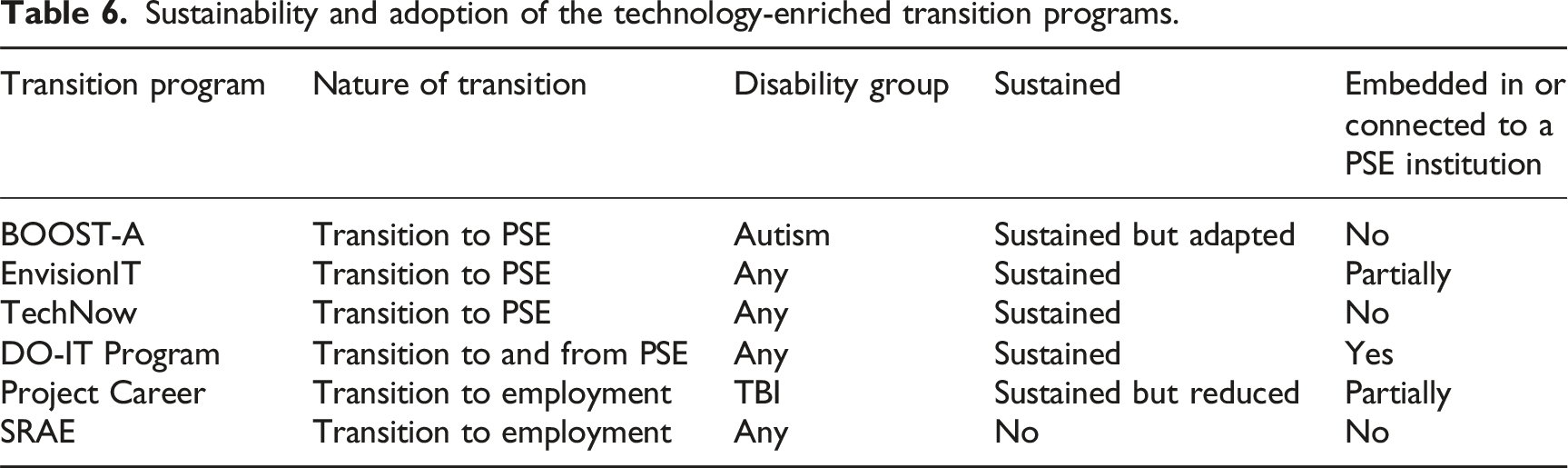
BOOST-A was a 12-month quasi-randomized controlled trial led by Hatfield as part of her doctoral research. It now exists as part of myWAY Employability, an online platform co-designed by individuals with autism, 79 which has no explicit ties to any postsecondary institution.
EnvisionIT was developed over a 10-year research program and is still offered for free by Ohio State University (OSU). 80 Funded by the US Department of Education and the Office of Special Education Programs, it is considered a public domain product. While OSU disseminates the program to others, it does not employ the program within its own support services.
TechNow was founded in 1999 by high school teacher. The program is still in existence and is run by a not-for-profit organization.81,82 The only connection to PSE that the program appears to have made is that between 2011 and 2014 academics from Oklahoma University conducted a 3-year evaluation study 47 On completion of this study, university involvement appears to have ceased.
Since its inception in 1992, the DO-IT Program has operated at the University of Washington (UW), relying on external grants to support students both at the university and other institutions. Some components, like the DO-IT Scholars Program, have been adopted into UW’s practices. Additionally, DO-IT aims to help others replicate its model, offering guidelines for creating college and career transition programs, including online mentoring communities, on its website. 83
Project Career was a 5-year externally funded initiative. With the end of the funding period, these services have been discontinued within the participating PSE institutions. A lasting outcome of the project is the STAR Portal, a resource website hosted by West Virginia University. 84 Although the participating universities are committed to disseminating the project’s findings to the broader postsecondary community, they have not maintained the Technology and Employment Coordinator roles that were integral to the program’s design.
SRAE was developed and evaluated as part of Polo Sánchez’s doctoral research, published in 2008. 85 The program, which involved ten participants from the University of Granada, did not continue beyond the pilot phase, possibly due to its limited scale and modest results.
Discussion
Our review identified just six technology-enriched transition programs that have been described and evaluated in the literature between 2000 and 2023 (Table 3). Within these programs technology was employed or integrated in a number of different ways (Table 4). Two of the programs employed technology as an accommodation; five programs positioned technology as a skill to be taught; three used technology as a medium for delivering content and two used technology as a medium for delivering mentoring support. Two of the six programs involved delivering a service that included assessing PSE students for their technology needs and recommending suitable technologies. All the transition programs were able to report a positive influence on at least one of their chosen primary outcomes, although these were not always statistically significant. Although five out of the six identified transition programs still exist in some format, just three of these five have some existing connection to a postsecondary institution, suggesting a limited impact on the postsecondary education community as a whole (see Table 6). In this section we will discuss why there are so few sustained technology-enriched transition support programs and the implications this has for future research and practice.
Why are there so few technology-enriched transition programs for students with disabilities?
It is rather surprising that only six technology-enriched transition programs have been described and evaluated in the research literature over the last 20 years and in particular that there have been no new programs since 2018 (see Table 3). In this section we offer four potential explanations.
Our first potential explanation is that PSE institutions may be unwilling to commit to what they perceive as expensive, resource intensive programs. For example, the DO-IT and Project Career transition programs are large programs which are going beyond simply providing a curriculum to providing a service (see Table 3). As such they require specialized staff and equipment which may cause PSE institutions to hesitate or refuse to commit to adopting the same or similar resource-intensive programs. Lack of funding for AT has long been identified as a barrier to successful transition for students with disabilities.4,27,33
Our second potential explanation relates to a perceived lack of feasibility. For example, PSE institutions with relatively small percentages of students with autism and TBI may consider that the BOOST-A and Project Career models of technology-enriched transition support are too niche to warrant funding. In contrast, the TechNow program is delivered to students with and without disabilities, which may explain in some part why it is still in existence (see Table 6). In addition, Project Career positioned itself strongly in the rehabilitation field, drawing heavily on vocational rehabilitation, occupational therapy and AT literature. There is a risk that this might cause some PSE institutions to avoid taking responsibility for implementing the Project Career model, preferring instead to argue that education institutions are not best placed to implement a rehabilitation model of support.
Range of transition stakeholder involved in the design and implementation of technology-enriched transition programs.
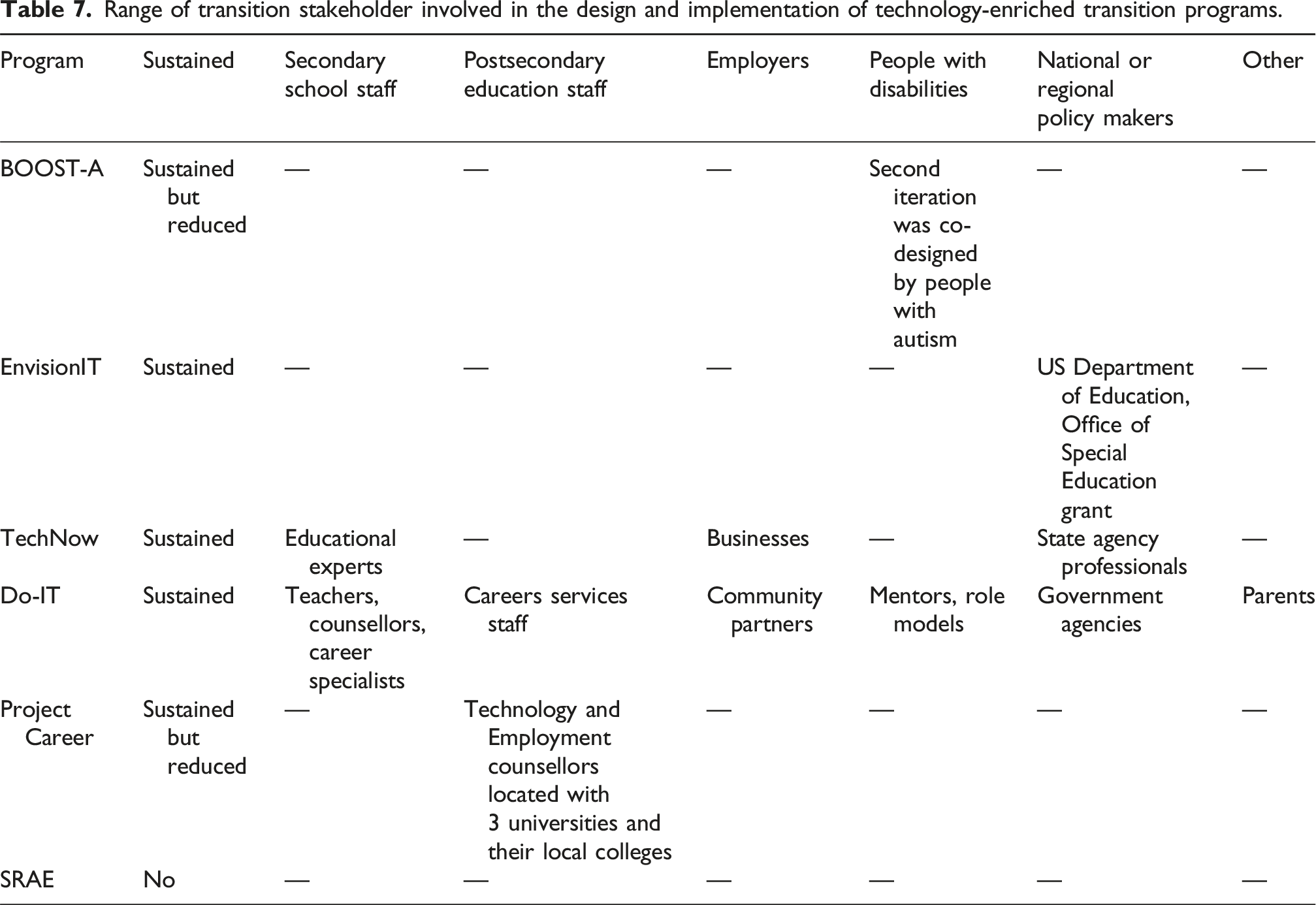
Our final explanation relates to perceptions regarding the nature and quality of evaluation evidence. It is possible that some transition stakeholders have not been convinced by the nature and quality of the evaluation evidence provided by the six technology-enriched transition programs, resulting in a lack of investment in developing existing or new programs. There are two main reasons why stakeholders may not be persuaded by the evaluation evidence. Firstly, two of the programs (BOOST-A and SRAE) were the result of small-scale doctoral research (n = 94 and n = 20, respectively) and as such were not able to produce evidence of unequivocal success. Whilst BOOST-A could evidence improvements in career readiness, it could not statistically prove evidence of enhanced self-determination. Whilst SRAE could evidence improvements in self-efficacy, only 40% of participants were able to gain employment after the program.
The second reason why stakeholders may not be persuaded by the evaluation evidence is that in the US, where most of the programs were trialled, there tends to be preference for evidence produced by randomized controlled trials in the belief that it is important to verify causal relationships between components of the program and positive academic and employment outcomes. Project Career provides a perfect example of this. In the Project Career publications, the authors explicitly position the work as an attempt to provide ‘proof of concept’ or to demonstrate potential and indicate that their next goal is to secure funding for a ‘control group research project’.53,56 So far, the researchers have been unable to secure this funding, resulting in stalled development progress. Although four of the programs did provide evidence drawn from quasi-experimental pre-test/post-test studies with experimental and control groups (BOOST-A; EnvisionIT; TechNow and SRAE), not all of the improvements reported, were statistically significant.
Limitations and implications for future practice and research
Despite its methodologically rigorous approach, every systematic literature review is subject to several limitations that warrant acknowledgment. The search strategy, while comprehensive and intentionally broad, encompassed four databases. However, the inclusion of additional databases might have yielded further relevant studies. We acknowledge that limiting our review to English-language publications and peer-reviewed literature may have excluded relevant programs reported in other languages or grey literature. This could particularly impact our understanding of technology-enriched transition programs in non-English speaking countries. While our review covered a substantial period (2000–2023), the rapid evolution of technology means that some newer transition support technologies may be in development or early implementation stages and, thus, not yet documented in the academic literature. We identified only a small number of programs (n = 6), so our findings are not generalizable. Additionally, the included studies varied in methodological rigour, making it challenging to draw definitive conclusions about best practices. Future research will have to consider these limitations and reflect the always-evolving ways that technology is used to support the participation of people with disabilities.
In order to address concerns regarding cost, feasibility and relevance the design of future transition programs may benefit from drawing on the more recent transition related research of Pacheco et al.,38,86,87 who used the results of qualitative interviews to highlight how university students with disabilities are relying less on specialist technologies and more on everyday technologies to manage key transition points. In addition, they are also drawing more on the support from peers than those in formal support roles suggesting that students may not need to rely solely on support from specialized PSE personnel. In particular we would argue that by focusing less on technology as a disability accommodation that requires specialist services and staff to be employed, there is a real potential to empower students with disabilities to develop the skills and confidence to identify their own personal technologies and design ways in which these technologies can meet their transition related needs. This hypothesis needs wider discussion through extensive, sustained collaboration with all the relevant stakeholders.
One possible way to address potential concerns regarding the nature and quality of the evaluation evidence provided by existing transition programs is to conduct further research using more rigorous research designs. This might involve exploring what types of programs and interventions work best for people with various forms of disability5,45; trying to isolate the impact of technology from other covariates such as summer programs and work-based learning34,51,56 and trying to improve the quality of outcome data to enable easier comparison of programs. In addition to this, we would argue that it would be helpful to conduct research into the replicability of the practices described in each of the six technology-enriched transition support programs. In order to understand what constitutes ‘best practice’ it is important for us to understand the factors that might enable or hinder the replication of these practices in different contexts and circumstances. For example, can the large-scale DO-IT model be replicated in other postsecondary education institutions in other countries or is it so unique to US, Seattle and/or the University of Washington that it would be impossible to replicate? This would certainly address the concerns of some researchers in the field who highlight the regional emphasis in their research and the need for studies that move beyond the highly contextual results.5,30,86
Conclusion
Despite strong convictions expressed in the research and practice literature regarding the potentially valuable role that technology might play in supporting students with disabilities to transition to and from PSE, remarkably few technology-enriched transition support programs have been developed and evaluated.
Whilst some positive evaluation results from these small numbers of programs have been reported, they are not of sufficient detail or quality to enable confident comparisons across the programs or to allow the impact of technology to be isolated from other variables. The lack of unequivocal results combined with concerns over cost, feasibility and relevance may lead transition stakeholders to conclude that the case for developing and implementing technology-enriched transition programs is not strong enough. Further debate and research is required involving all relevant stakeholders including those responsible for resourcing and delivering student support systems within PSE.
Footnotes
Acknowledgements
The authors wish to acknowledge the contribution of Deborah Hendricks, who provided valuable information and orientation regarding disability and transition programs in the US context.

Author contributions
CONCEPTION: Björn Fisseler and Jane Seale.
PERFORMANCE OF WORK: Björn Fisseler and Jane Seale.
INTERPRETATION OR ANALYSIS OF DATA: Jane Seale and Björn Fisseler.
PREPARATION OF THE MANUSCRIPT: Jane Seale and Björn Fisseler.
REVISION FOR IMPORTANT INTELLECTUAL CONTENT: Jane Seale and Björn Fisseler.
SUPERVISION: Björn Fisseler and Jane Seale. Both authors conceived of the focus of the paper. The first author conducted the initial literature search. Both authors critically reviewed and analysed the literature. Both authors prepared and revised the manuscript.
Funding
The authors received no financial support for the research, authorship, and/or publication of this article.
Conflicting interest
The authors declared no potential conflicts of interest with respect to the research, authorship, and/or publication of this article.