




Abstract
Solid organ transplant (SOT) recipients now have widespread access to telehealth, but the factors influencing their satisfaction still need to be understood. This cross-sectional study explored potential contributors to telehealth satisfaction among SOT recipients, including liver, kidney, and simultaneous liver–kidney recipients. A total of 136 adult SOT recipients completed an online survey. The survey assessed telehealth satisfaction, previous telehealth experiences, including confidence levels and the need for assistance from others, electronic health literacy (eHealth literacy), perceived physical and mental health status, and cognitive function, along with demographic and clinical characteristics. The multivariate regression backward selection method was used to identify potential factors contributing to telehealth satisfaction. Participants had a mean age of 60.1 years (standard deviation [SD] = 10.5) and were, on average, 92 months post-transplant (SD = 99.9). The mean telehealth satisfaction score was 5.3 out of 7 (SD = 1.2), indicating positive satisfaction with telehealth. However, lower telehealth satisfaction was associated with poor confidence in communicating with providers via telehealth, lower eHealth literacy, better perceived cognitive function, and a prolonged time since SOT (adjusted R2 = 0.49). SOT recipients who perceive vulnerability in online technology, report better perceived cognitive function, and are farther out from their SOT may exhibit lower satisfaction with telehealth. When considering telehealth for transplant care, clinicians should prioritize addressing the specific concerns and challenges of SOT recipients who may perceive telehealth unfavorably.
Introduction
Solid organ transplant (SOT) recipients, including liver, kidney, and simultaneous liver–kidney recipients, require lifelong care that involves regular and sometimes frequent follow-ups to ensure the optimal functioning of their transplants. However, these frequent in-person visits can impose a significant burden on SOT recipients, such as travel expenses and time away from work (Ko et al., 2023). Telehealth, which became widely available due to the COVID-19 pandemic, appears to effectively alleviate some of these burdens. For many SOT recipients, telehealth has emerged as an acceptable alternative to traditional in-person visits (Huuskes et al., 2021; Le et al., 2019; Raina et al., 2023). Telehealth use significantly increased during the pandemic era (Forbes et al., 2021), and this trend is expected to continue as SOT recipients have expressed their willingness to continue using telehealth (Holderried et al., 2021; Ko et al., 2023). While some SOT recipients are satisfied with telehealth for their post-transplant care, not everyone may favor telehealth over in-person clinic visits (Huuskes et al., 2021; Ko et al., 2023).
Identifying SOT recipients who may prefer in-person care to telehealth could inform patient-centered telehealth use. However, there is limited knowledge regarding the factors contributing to telehealth satisfaction in this population. Existing studies have primarily focused on examining the effectiveness of telehealth in improving patient outcomes and its acceptability and satisfaction within the SOT population (Huuskes et al., 2021; Jiang et al., 2016; Le et al., 2019; Lee et al., 2019; Wickerson et al., 2021). Satisfaction with telehealth could be influenced by numerous factors. They include previous telehealth experiences, such as the level of confidence and assistance needed to complete telehealth visits, electronic health literacy (eHealth literacy), which refers to the perceived ability to comprehend information from online sources, health status, demographics, and clinical characteristics (Jiang et al., 2016; Maroney et al., 2021; Venkatesh et al., 2003). Existing qualitative studies in the SOT population have suggested the influence of these factors on telehealth satisfaction (Huuskes et al., 2021; Ko et al., 2023); however, a quantitative investigation is lacking. Thus, this study aimed to explore factors explaining telehealth satisfaction. Specifically, we explored which factors among previous telehealth experiences, eHealth literacy, perceived physical status, perceived mental health status, perceived cognitive function, demographics, and clinical characteristics are associated with telehealth satisfaction.
Materials and Methods
A cross-sectional study design was used. This study was approved by Northeastern University Institutional Review Board.
Participants
Online purchased advertisements on Facebook were used between May and August 2021 for a 15-week period to recruit geographically diverse potential participants. The advertisements were publicly posted, targeted transplant-specific pages, and included information on remuneration, with a chance for participants to win one of four $25 gift cards. Potential participants were asked to self-evaluate their eligibility to participate in the study based on the following criteria at Research Electronic Data Capture (REDCap) (Harris et al., 2009, 2019): (1) were aged 18 years old or greater; (2) had received a liver, kidney, or simultaneous liver–kidney transplant; and (3) were currently receiving care for their transplants at a transplant center located in the United States. We limited our study to liver and kidney transplant recipients as they have more comparable post-transplant trajectories than thoracic transplant recipients, such as heart or lung. Thoracic transplants generally require more complex post-transplant care, which could affect telehealth satisfaction differently. All participants provided informed consent and completed the survey at REDCap. To prevent fraudulent entries, we monitored survey completion times and found no instances of unusually rapid completion.
Measures
Participants were asked if they had previously used telehealth for their transplant care. Those who had used telehealth completed the self-report questionnaires on the following variables.
Telehealth Satisfaction
Telehealth satisfaction was the primary outcome of this study. Participants were asked to evaluate their satisfaction with the telehealth services they received for transplant care using the Telehealth Usability Questionnaire (TUQ) (Parmanto et al., 2016). This 21-item questionnaire measures telehealth satisfaction in the domains of usefulness, ease of use, effectiveness, reliability, and satisfaction on a 7-point Likert scale from 1 (strongly disagree) to 7 (strongly agree). Higher scores indicate higher satisfaction with telehealth. Several items were revised to limit the scope of telehealth services provided for transplant care. Cronbach’s α coefficients of the scores in this study were good (Ko et al., 2023).
Previous Telehealth Experiences
A series of questions were asked about types of telehealth, devices used for telehealth, confidence in communicating with providers via telehealth, and the level of assistance needed to complete telehealth visits.
eHealth Literacy
The eHealth Literacy Scale (eHEALS) assesses an individual’s perceived ability to seek and evaluate health information from online sources and apply it to make health decisions (Norman & Skinner, 2006). Participants rated their competency from 1 (Strongly disagree) to 5 (Strongly agree). Higher scores indicate better perceived eHealth literacy. Cronbach’s alpha of the eHEALS was 0.94 in this study.
Perceived Physical and Mental Health Status and Cognitive Function
The 10-item Patient Reported Outcomes Measurement Information System (PROMIS) Global Health v1.1 assesses perceived physical and mental health status. Participants rated their physical and mental health in the past 7 days on a Likert scale from 1 to 5, with 5 indicating the best health. Pain in the past 7 days was rated from 0 (No pain) to 10 (Worst pain imaginable) and was recorded on a 5-point scale following the scoring manual. Perceived cognitive function was assessed by the 8-item PROMIS Cognitive Function v2.0 which assesses perceived concerns in cognitive abilities. Participants rated their perceived concerns in the past 7 days on a Likert scale from 1 (Never) to 5 (Very often). Raw scores of both PROMIS measures were converted to T-scores where a T-score of 50 is the average for the United States general population with a standard deviation (SD) of 10. Higher T-scores indicate better physical health, mental health, or cognitive function (Hays et al., 2017).
Demographics and Clinical Characteristics
Finally, participants self-reported demographics and clinical characteristics, including types of organ transplant and time since transplant.
Data Analysis
Descriptive statistics of continuous variables and frequency distribution of categorical variables were calculated. To determine which variables were independently associated with TUQ scores, we performed one-way analysis of variance (ANOVA) tests for categorical variables and univariate regression analysis for continuous variables. Post hoc comparisons using Tukey’s test were conducted for statistically significant ANOVA test results (Supplementary Table 1). To investigate the factors that potentially best describe telehealth satisfaction, we performed multivariate regression analysis with the backward selection method. Specifically, we investigated the best-fit model predicting the relationship between potential predictors (previous telehealth experiences, the eHEALS, the PROMIS physical and mental health, cognitive function scores, age, gender, education, race, residence, organ type, miles traveled to visit the transplant center, income, insurance, the number of comorbidities, and time since transplant) and our outcome variable, the TUQ scores. R2, adjusted R2, lowest Bayesian information criterion, and Akaike information criterion were used to determine the best-fit model and guide the selection of variables for the final model. A p-value of <.05 demonstrated statistical significance. Individuals with missing data were excluded from analysis for a complete case data analysis. Analyses were performed using SAS version 9.4.
Results
Participant Characteristics
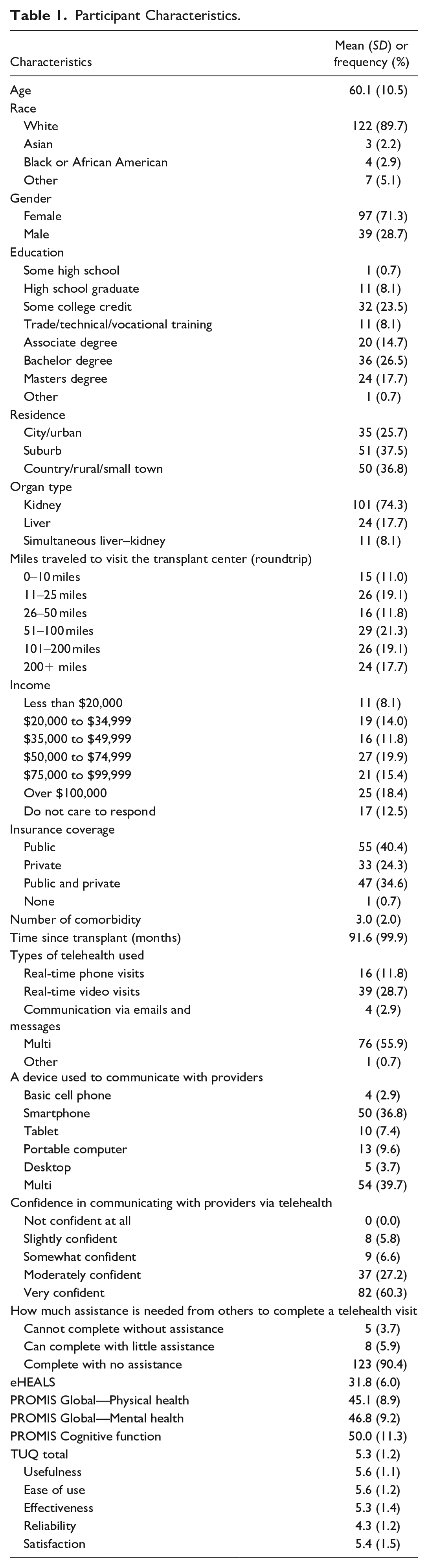
Among 876 individuals who clicked on the advertisements, 653 met the eligibility criteria, and 252 completed the survey. Of them, 136 reported that they had previously used telehealth for their transplant care and were included in this study’s analysis. The majority were white (89.7%), female (71.3%), and kidney transplant recipients (74.3%). Their mean age was 60.1 years (SD = 10.5) and the mean time elapsed since receiving their transplant was 91.6 months (SD = 99.9, Table 1). The characteristics of participants without missing data included in this study were similar to those of all participants who reported using telehealth (Ko et al., 2023).
Participant Characteristics.
Telehealth Experiences and Satisfaction
Recipients demonstrated flexibility in their utilization of telehealth, incorporating a variety of telehealth types (55.8%) and diverse devices (39.7%). Most users reported confidence in communicating with their providers via telehealth (60.3%) and do not need assistance from others (90.4%, Table 1). The mean TUQ score was 5.3 out of 7 (SD = 1.2), indicating a generally positive evaluation of telehealth.
eHealth Literacy and Perceived Physical Health Status, Mental Health Status, and Cognitive Function
The mean eHEALS score was 31.8 (SD = 6.0), indicating SOT recipients had relatively high eHealth literacy (Richtering et al., 2017). Recipients had slightly lower perceived physical (mean T-score = 45.1, SD = 8.9) and mental health (mean T-score = 46.8, SD = 9.2) than the average of the general population, while their perceived cognitive function was at the average (mean T-score = 50.0, SD = 11.3).
Predictors for TUQ
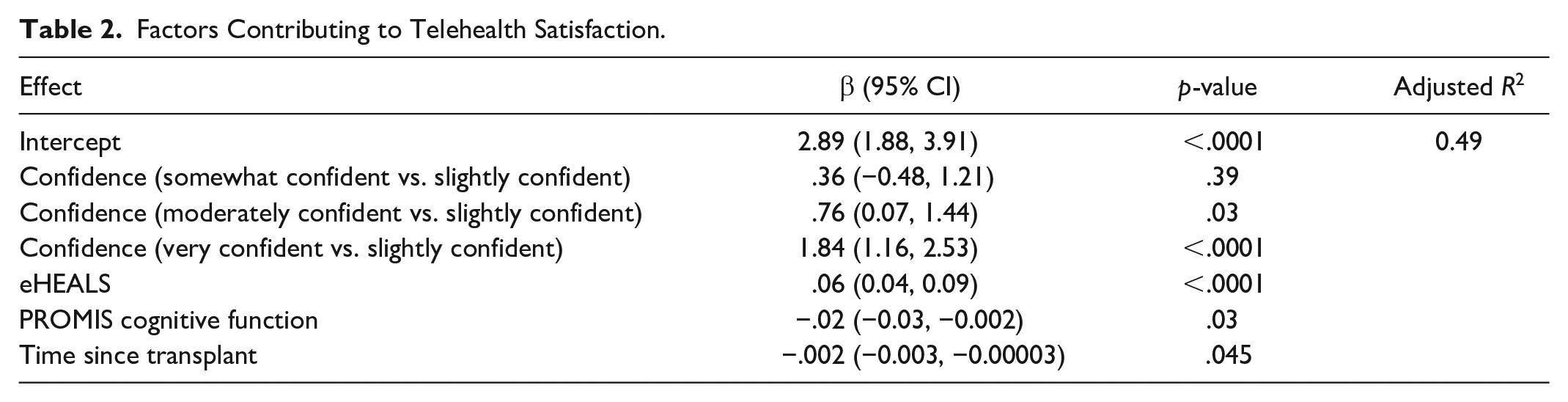
Four variables were found to potentially describe the total TUQ score: confidence in communicating with providers via telehealth, the eHEALS score, the PROMIS cognitive function T-score, and time since transplant (Table 2). Recipients who were moderately or very confident in using telehealth had significantly higher total TUQ scores than those who were slightly confident (β = 0.76, 95% confidence interval, CI [0.07, 1.44] and β = 1.84, 95% CI [1.16, 2.53], respectively). Furthermore, higher total eHEALS scores were significantly associated with higher total TUQ scores (β = 0.06, 95% CI [0.04, 0.09]). Higher PROMIS cognitive function T-score, indicating better perceived cognitive function, and prolonged time since transplant were associated with lower total TUQ scores (β = –0.02, 95% CI [–0.03, –0.002] and β = –0.002, 95% CI [–0.003, –0.00003], respectively).
Factors Contributing to Telehealth Satisfaction.
Discussion
To the best of our knowledge, this cross-sectional study is the first to explore potential factors describing telehealth satisfaction among SOT recipients. While most SOT recipients in this study expressed satisfaction with telehealth, a subset may not find it preferable. Our study considered a range of factors, including previous telehealth experiences, eHealth literacy, perceived health status, demographics, and clinical characteristics. Notably, greater telehealth satisfaction was associated with higher confidence in communicating with providers via telehealth and higher eHealth literacy. Lower telehealth satisfaction was associated with better perceived cognitive function and an extended time since transplant.
This study highlighted the significance of perceived vulnerability in online technology as a potential factor that reduces telehealth satisfaction. Limited ability to effectively use and navigate online technology, coupled with challenges in comprehending provided health information, may heighten anxiety among SOT recipients when using telehealth devices and programs (Madanian et al., 2023). This anxiety may stem from challenges in understanding information delivered through telehealth and concerns about not knowing how to navigate or act upon the provided information (Madanian et al., 2023). Our findings align with previous qualitative studies in which SOT recipients expressed concerns about telehealth, emphasizing the importance of possessing the capacity to use telehealth and employ online communication skills (Huuskes et al., 2021; Ko et al., 2023). This underscores the need to address and enhance eHealth and technology literacy to ensure a positive and effective telehealth experience for SOT recipients.
Our study found that recipients with a prolonged history of living with an SOT tended to experience lower levels of telehealth satisfaction. While further investigations are warranted to fully understand the relationship between time since SOT and telehealth satisfaction, one potential explanation could be a weakening sense of connectedness between SOT recipients and healthcare providers facilitated by the use of telehealth (Ko et al., 2023). For individuals who underwent SOT long ago and have established enduring relationships with their providers through in-person interactions, the introduction of telehealth may disrupt the sense of connectedness (Andreadis et al., 2023; Huuskes et al., 2021). Although existing literature suggests that established relationships facilitate the adoption of telehealth (Almathami et al., 2020), extended use of telehealth might erode the connectedness (Ko et al., 2023), thereby potentially reducing overall satisfaction.
Perceived physical and mental health of SOT recipients were not significantly associated with telehealth satisfaction. This finding was unexpected, as prior qualitative research has identified health status as a potential factor influencing preferences for in-person visits, driven by the concerns about telehealth’s limitation in conducting physical assessments and providing timely care in urgent situations (Ko et al., 2023; Magriço et al., 2023; Nguyen et al., 2022). This result may be attributed to the lack of specificity in the PROMIS Global Health questionnaire, which was designed primarily to assess generic physical and mental health rather than transplant-related issues. Interestingly, although we anticipated that better perceived cognitive function might be associated with higher telehealth satisfaction (Antonio et al., 2023), we found that better perceived cognitive function was linked to lower telehealth satisfaction. One possible explanation is that individuals with better perceived cognitive function may be more likely to recognize potential limitations of telehealth, although we lack data to support this hypothesis. These findings suggest the need for further research to better understand the complex relationship between health status and telehealth satisfaction within the context of SOT recipients.
Several potential limitations should be acknowledged in this study. The small sample size, which primarily includes kidney transplant recipients and the exclusion of individuals with missing data may limit the full representation of the broader SOT population. The use of online recruitment could introduce sampling bias, potentially overrepresenting more educated, less diverse individuals, and those who are more familiar with or have better access to the internet (Benedict et al., 2019; Leach et al., 2017; Maslovskaya & Lugtig, 2022). This bias could limit the generalizability of the findings, as the sample may not fully reflect the demographic and socioeconomic diversity of the entire SOT population. It is important to note that our findings do not indicate cause and effect due to the cross-sectional nature of the study. While we explored various factors that could influence telehealth satisfaction, there could be additional variables, such as specific health conditions related to SOT, that were not accounted for in our analysis.
In conclusion, the perceived vulnerability in online technology, along with better perceived cognitive health and a prolonged time since SOT may contribute to lower telehealth satisfaction. Our study suggests the development of tailored strategies that address specific concerns and challenges of SOT recipients, ultimately enhancing the overall telehealth experience for SOT recipients.
Supplemental Material
sj-docx-1-cnr-10.1177_10547738241309703 – Supplemental material for Factors Influencing Telehealth Satisfaction Among Liver and Kidney Transplant Recipients
Supplemental material, sj-docx-1-cnr-10.1177_10547738241309703 for Factors Influencing Telehealth Satisfaction Among Liver and Kidney Transplant Recipients by Dami Ko, Neha Singh and Jane Saczynski in Clinical Nursing Research
Footnotes
Acknowledgements
The authors thank all study participants for their valuable contributions. Study data were collected and managed using REDCap electronic data capture tools hosted at Vanderbilt University (Harris et al., 2009,  ).
).
Author Contributions
Dami Ko: Concept/design, data collection, data analysis and interpretation, drafting article, critical revision of article, approval of article. Neha Singh: Data analysis and interpretation, approval of article. Jane Saczynski: Data interpretation, critical revision of the article, and approval of the article.
Declaration of Conflicting Interests
The author(s) declared no potential conflicts of interest with respect to the research, authorship, and/or publication of this article.
Funding
The author(s) disclosed receipt of the following financial support for the research, authorship, and/or publication of this article: This study was supported by Northeastern University to DK.
Ethical Approval
This study was approved by Northeastern University Institutional Review Board (20-09-25).
Supplemental Material
Supplemental material for this article is available online.
Author Biographies
References
Supplementary Material
Please find the following supplemental material available below.
For Open Access articles published under a Creative Commons License, all supplemental material carries the same license as the article it is associated with.
For non-Open Access articles published, all supplemental material carries a non-exclusive license, and permission requests for re-use of supplemental material or any part of supplemental material shall be sent directly to the copyright owner as specified in the copyright notice associated with the article.
