




Abstract
Individual identity as a function of human development significantly intersects with and is necessarily influenced by the social world. To describe this intersection and its effects, the term sociolocation was proposed, initially in the context of adolescent development, and defined as “self-identification and recognition of social integration through relationships.” Almost a decade later, it is apparent that the processes of sociolocation may continue and repeat through the rest of the lifespan. The purpose of this, therefore, paper is to present an expanded definitional and conceptual analysis of sociolocation using the techniques described by Chinn, Kramer, and Sitzman. Such an analysis is important across nursing science, practice, and education, since in all three domains the nurse may encounter individuals engaged in sociolocation. Understanding what this process is and when and how it may occur can be helpful in care planning, learning, and research endeavors.
The processes associated with human development throughout the lifespan are complex and as individually diversified as humans. There are, however, aspects of development that specifically prompt adaptation and response from the individual—often through interaction with the physical and social environments. Humans may be particularly attuned to the latter, given the unique ways in which social influences can define daily life. Individual identity as a function of human development thus significantly intersects with and is necessarily influenced by the social world.
To describe this intersection and its effects, the term sociolocation was initially proposed in the context of adolescent development, and it was defined as “self-identification and recognition of social integration through relationships” (Burton et al., 2013, p. 804). Almost a decade later, it is apparent that the processes of sociolocation are not confined to adolescence but can continue through the rest of the lifespan as well. The purpose of this paper is to present a definitional and conceptual analysis of sociolocation using techniques initially described by Chinn and Kramer (2017) and subsequently refined (Chinn et al., 2022).
Background and Significance
Traditionally, human lifespan development has been thought of as proceeding from growth and change, and more recently to be influenced—if not wholly prompted by—crisis and the individual’s responses thereto (Ardelt & Grunwald, 2018; Fassbender et al., 2021). Developmental processes have often been explored with a focus on children and adolescents, as these life stages represent significant periods of physical as well as psychosocial change. More recently, however, research has begun to suggest that some developmental processes continue throughout adulthood (Oh et al., 2019). In many cases, where these processes occur in later adolescence and adulthood, there is an initial external stimulus. Among these are psychosocial changes and the experience of crisis in a variety of contexts (Mullan Harris et al., 2013; Osher et al., 2020).
These are critically important as they may alter what Bourdieu described as habitus, or the interaction of an individual with existing structures (physical or social) from which the individual subsequently structures a personal understanding of the environment and how to interact therewith (Lizardo, 2004). Importantly, Bourdieu’s work intersects significantly with that of Piaget, who specifically described how developmental changes such as the adolescent transition result in the assimilation of new information that must be accommodated to continue to interact with the environment (Piaget, 1969). Subsequently, Hacking (2013) applied a historical context to diagnostic psychiatry, and in “Making Up People” described the malleability of person–environment interaction across the dual dimensions of what identity is labeled or assigned and what is autonomously determined in a given individual. In this case, diagnostic labeling is viewed as an assigned marker, which may or may not accord with or be assimilated into the self-concept of the patient. It is from the work of these theorists that the idea of sociolocation proceeds and is derived.
Psychosocial Activities
During infancy, childhood, and adolescence, periods of intense and rapid physical growth prompt myriad cycles of adaptation for the developing individual (Carson et al., 2016). Physical changes are accompanied by psychological and psychosocial growth, with the latter becoming especially important in adolescence as social relationships take on greater importance (Kennedy et al., 2018; Orben et al., 2020). Even as physical growth slows in adulthood, the psychoneurological growth associated with brain plasticity and neurogenesis may continue (Toda & Gage, 2018). Importantly, social interaction has been identified as a strong stimulus for these in populations ranging from adolescents to older adults (Ekman et al., 2022; Quialheiro et al., 2021).
With age and overall maturation, social interactions typically become more complex as the individual assumes age-appropriate roles: professional, parent, caregiver, and more. These roles are largely defined by the social interactions of the individual with those around them, particularly as each imputes specific social tasks. At the same time, socially defined roles may become a critical element of an individual’s identity either because they carry a particular status or because they provide a valued connection to others. In either case, interactions with others remain influential. This may be in part the result of interaction between abstract thought and empathy—through which the individual understands that other people perceive them and that those perceptions can be differentially positive or negative—combined with what may be a uniquely human drive to seek and maintain particular kinds of social affiliations throughout the lifespan (Helm et al., 2020; Oh et al., 2019; Zayas & Sakman, 2020).
Crisis Encounters
The crisis also has a fundamental role in developmental processes, both where the character of the crisis is developmental and where it is external—indeed, these may occur simultaneously. Particularly in situations where there is a significant change for the individual, the crisis can lead to shifts in psychosocial self-perception, self-esteem, self-efficacy, and other socially interactive aspects of individual identity. A study of early-life, midlife, and later-life adults who self-identified as experiencing a major life crisis found that those experiencing crisis also generally exhibited more openness to learning and self-understanding—but that different age groups ultimately operationalized these differently (Robinson et al., 2016). This illustrates how crisis can stimulate developmental engagement with identity as well as prompt consideration of how that identity is shaped in the social world.
Clearly, both psychosocial activities and crises thus have the potential to affect identity from a developmental perspective. Since both are also enmeshed in the social world, it is helpful to consider how social forces and relationships may contribute to a defined identity. The process of perceiving the self while engaging with and qualifying how the self is perceived by others is necessarily bidirectional: self-perception can be influenced by other-perception, and other-perception may be responsive to how self-perception is enacted. This is what is meant by sociolocation: the process by which social interactions, relationships, and influences can delineate some elements of identity and contribute to self-identification. The following sections provide a theoretical analysis of this novel conceptualization.
Methods
According to Chinn, Kramer, and Sitzman (2022), conceptualization involves systematically clarifying the meaning of an idea or experience. The optimal methods for accomplishing this clarification are dependent upon the level of abstraction inherent in the concept. In this case, because an entirely new term has been proposed, the level of abstraction is assumed to be relatively high. This means that sociolocation cannot be directly observed or measured and that its meaning may be influenced by the context in which it is described. As an example, the sociolocation processes of an adolescent engaged in primary identity development will differ from those of an adult whose identity has been affected by a crisis situation.
Important in this meaning-making process is the process of identifying evidence that supports the proposed conceptual meaning. In this case, the level of abstraction inherent in the concept means that the evidence creates a basis for understanding rather than empirical demonstration. Since there is very limited use of the term in nursing or otherwise, no denotative meaning other than that cited in the Introduction is available and there are no alternative uses of the term to explore. The evidence in this case is thus drawn from existing literature on identity development and social interactions across the lifespan.
Evidence
The term sociolocation combines the words “social” and “location” into a single neologism. These two words indicate, respectively, interaction among people and the position of someone or something in time and/or space (Oxford Languages, 2022). These are important elements of the concept, insofar as they specify some of the criteria for its definition: people, interaction, and position are involved. It is, however, different from “navigation,” which also involves people, interaction, and position. In this case, using “socio-” as a prefix adds an additional dimension by specifically involving the relationship to society. Society differs from simple interaction in that it further indicates a community or aggregate of people who share some set of organizing principles—language, values, customs, or other elements. This brings the definition somewhat closer to “place in society” but sociolocation has been described as involving actions on the part of the individual (self-identification and social integration) (Diño, 2021; Hancock et al., 2017). A step further might therefore be “placing the self within society.” This linguistic differentiation thus provides the foundation for establishing the conceptualization of sociolocation.
To further develop this concept, literature from across scholarly disciplines was examined. Searches using Google Scholar provided initial direction, with subsequent expansion to databases including CINAHL, PubMed, JSTOR, and PsychInfo. Search terms were developed from an initial search of “sociolocation,” and included “socio-location,” “socioplace,” “sociolocate,” and “sociolocal.” The last of these was dropped from analysis when it became clear that it appeared only in translation to languages other than English. Results of the search processes were then reviewed to determine which of the terms appeared in the citation along with its usage. In many cases, the identified term was used to reference how a building or place was socially contextualized or how it was used by a community—these included meeting places, sacred spaces, and public buildings. Other uses included reference to historical and political contexts, as well as references to the original work identifying sociolocation as it is analyzed here. There were no limitations to the search in terms of publication date or discipline and searches were carried out from February to July of 2022, with regular updates throughout 2023. The following exemplars reflect the operationalization of tentative criteria developed from the commonalities among the reviewed literature.
Results/Exemplars
Although the literature applicable to this conceptual analysis of sociolocation was scant, there were some common threads. These included sociolocation as a function of identity development, the impact of the crisis on sociolocation processes, and the interaction of sociolocation with self-esteem and/or self-concept. Based on these results, sociolocation is not a limited process, and it can occur throughout the lifespan—particularly in times of significant change in the individual and/or their environment(s). The exemplars below were developed to identify experiences and circumstances that suggest how the process of sociolocation occurs.
Developmental Exemplar: Adolescent Social Standing
The original construction of sociolocation emerged from a need to describe the importance of relational actions and interactions during adolescent development. The importance of relationships during the adolescent period—whether with family, friends, romantic partners, or others—has been well documented (dos Santos et al., 2021; Flynn et al., 2017; Orben et al., 2020; Verhoeven et al., 2019). The relationships that adolescents value are critical to developing self-image insofar as these can impart or influence social status, social mobility, self-efficacy, and perceived self-worth (Burton et al., 2011; Verhoeven et al., 2019). In part, this is due to one of the most fundamental developmental benchmarks: the initiation of abstract thought. The capacity to perceive the world and society independently from self, abstract thought allows individuals to recognize the actions of others as reflective of more than the immediate interaction (McLaren & Sillars, 2020). During adolescence, this may translate to concern with how others do or do not want to interact with the self, which informs self-perception and valuation: if people wish to interact or have relationships with me, I am good/nice/popular/valuable; if no one wants to interact with me (or if the people I want to interact with do not), I am bad/worthless/unimportant (Price et al., 2019). Furthermore, interactions sought and received may indicate where in a social ordering the self falls—positive interactions with others who are seen as valuable can boost social standing, while negative interactions with the same groups may reduce it. These movements along the continuum of social standing influence self-identification and perception, both of which are highly dynamic processes for many adolescents (Orben et al., 2020).
The combination of the external stimuli from interactions with valued others along with internal processes of identity development thus yields what may be the initial act of sociolocation: the adolescent begins to understand how society values or devalues their characteristics. Awareness of these received valuations may lead to self-conceptualization within socially delineated boundaries as understood by the adolescent, which may then influence self-esteem as well as perceived self-worth. In this way, an external influence shapes the perception of self in the social context and ultimately becomes integrated into internal development processes. This integration may have either positive or negative effects on adolescent development, but the overall external to internal-influence pathway is a defining feature of sociolocation.
Crisis Exemplar: Relationships, Status, and Identity in the COVID-19 Pandemic
The recent COVID-19 pandemic disrupted many organizational and social structures as well as activities of individuals’ daily lives. During initial pandemic responses, efforts to reduce the spread of the virus led to the closure of schools and workplaces, altering familiar patterns and locales of social interaction (Best et al., 2021; Long et al., 2022; Orben et al., 2020). Coupled with the constant threat posed by the virus itself, particularly prior to vaccine development, these alterations fostered significant uncertainty and anxiety for many people (Paredes et al., 2021). Moreover, among those who contracted COVID, changes to physical health and overall wellness resulted from both the acute infection and the effects of long COVID or post-acute sequelae of COVID-19 illness (PASC) (Burton et al., 2022; Frontera et al., 2022; World Health Organization, 2021). Many affected by these conditions have described changes in capacity for both physical and mental activities; “brain fog” or cognitive impairment is among the most reported symptoms of PASC (Callan et al., 2021; Ceban et al., 2021).
These effects forced many to change or abandon occupations (Lambert et al., 2022), reduce physical exertion and/or exercise (Kersten et al., 2022), and even seek out non-independent living situations (Ziauddeen et al., 2022). Not only did these changes create challenges for those immediately affected, but they often had far-reaching effects on workplaces, education, and parenting. Furthermore, for those experiencing PASC, lack of understanding of symptoms, scant intervention options, and the stigma of having both COVID-19 and subsequent PASC led to experiences that have been definitively identified as traumatic (Burton et al., 2022).
Clearly, the combination of changes in both physical and social environments related to the COVID-19 pandemic created a situation likely to engender revisions in sociolocation. Through these and other alterations to daily life, both relationships and role performance in the larger social environment were forced into new patterns—which, in turn, changed how individuals interacted with one another as well as how they performed and interacted with elements of the social context that contribute to identity. These included jobs, hobbies, family responsibilities, financial status, physical appearance, exercise habits, and more. The boundaries of identity imparted by professions, social activities, and other kinds of group memberships became both more porous and less clearly relevant as social environments shifted to the virtual world or were restricted to minimal geographies and communities. As boundaries changed, many individuals revised their own valuation of these identity-shaping elements—among the population of healthcare providers for example, significant numbers of personnel left or began to consider leaving their positions and even professions due to physical and mental health issues, moral injury, or other stressors (Burton et al., 2023; Lake et al., 2022; Liu et al., 2021; Vanhaecht et al., 2021; Wang et al., 2022). In these cases, the social and personal constructions of a professional identity became less valuable than beliefs about appropriate conduct (moral injury), individual physical and mental health, and other considerations.
Healthcare providers, patients experiencing PASC, and other socially constructed groups affected by the pandemic thus were and may continue to be engaged in the revision of their sociolocation. This includes changing self-to-other identifiers such as profession, or by modifying or adding self-referential identifiers such as PASC patient. These revisions in sociolocation accommodate new or changed elements of identity and the accompanying, necessary new ways of interacting with others as a result of pandemic-related personal and environmental crises.
Social Assignment Exemplar: Marginalized Groups
In marginalized and vulnerable populations—such as racial and ethnic minorities, the LGBTQIA+ community, persons of low socioeconomic status, those unhoused, and those who are undocumented—the process of sociolocation may have higher stakes than it does in either of the previously described cases. It should be noted, however, that identities are often overlapping and that these groups are in no way mutually exclusive. It is nonetheless vital to recognize how sociolocation functions among less privileged and often less socially valued populations. Among marginalized populations, sociolocation processes may occur differently insofar as some of the same social constructs that result in marginalization—race, socioeconomic status, etc.—can confer identity as well as carry added experiences of received stigma (Yashadhana et al., 2022).
For characteristics that are less or entirely unmodifiable—less modifiable might be the level of education, which can depend on access as well as socioeconomic standing; unmodifiable characteristics include race and sexual orientation—there may be multidirectional influences on sociolocation. While an individual may have positive experiences in being a part of a smaller cultural or affiliative community related to a particular characteristic, outside that community the same characteristic may garner experiences of bias and discrimination. This is distinct from sociolocation which is mainly based on either the relational interactions of an individual with others or that based in the identity and self-referential indicators that an individual selects and may present about themselves. This expands the scope of sociolocation and its impact from either of these in singular to a processual construct in which both act to shape an individual’s understanding of personal location within a given social framework—even if they act in opposition. This is resonant with the praxis and application of intersectionality, within which social value and the organization of personal power are “understood as being shaped not by a single axis of social division,. . . but by many axes that work together and influence each other” (Collins & Bilge, 2016, p. 2).
Important to the understanding of sociolocation in the context of marginalized populations is thus the additional layer of influence imparted by broader external constructions of identity. For example, in a study of how women of color on a college campus considered reporting intimate partner violence (IPV) and sexual assault (SA), Burton and Guidry (2021) found that participants specifically understood the ramifications of reporting in terms of social forces that would label them even before they disclosed an assault. Participants in the study described observing how both “innocence” and “deviance” were assigned to different racial groups in regard to IPV and SA, and how this assignment caused them to be cautious about what they would report and to whom. Here, sociolocation appears to be multifocal in that the women saw importance and value in their identities but also perceived a need to navigate the environment with attention to how others might dismiss or denigrate them on the same basis.
Final Criteria
Applying the strategies described by Chinn et al. (2022) for creating conceptual meaning, the abstraction of sociolocation can be reduced somewhat by the identification of specific criteria that delineate its occurrence. As demonstrated by the preceding exemplars, the impetus for sociolocation can be development, crisis, and/or social assignment. Since all of these must affect the individual for the sociolocation process to occur, it follows that both an individual and a surrounding social context are antecedents to sociolocation. Furthermore, the individual must possess some indicators of their position within the social context such as relationships, health status, profession, race, and more.
At the same time, a defining attribute of sociolocation is that it occurs in the presence of change or alteration. As illustrated by the exemplars, this may be an expected or typical change such as in human development, an unanticipated or sudden change related to crisis, or a changed internal or external perception that results from experiencing discrimination or bias. The change itself can be internal or external, and the outcome of sociolocation is necessarily one of the individual rather than society or a social milieu.
Relatedly, an additional criterion is the presence of social power and privilege structures that direct the outcomes of sociolocation. Part of sociolocation is the identification of where an individual fits within a social context, and how this identification changes in response to social interactions and influences. Without an apparent structure or gradient within which to place the self, the relational processes inherent in sociolocation become meaningless—that is, if people are all the same, equal, and without difference or potential for difference, there are no potential alterations in social standing or position that can direct the outcome of sociolocation. Some form of categorization, even if not a specific hierarchy, within a social context is thus another antecedent of sociolocation.
It is also important to disambiguate sociolocation from other types of social and personal interactions and processes. The conceptualization of structural violence, as an example, also includes the antecedents of people, existing or perpetuated social structures, and hierarchies within those structures. Unlike sociolocation, however, structural violence is always the result of external influences and is by definition harmful to the individual (Burton et al., 2020). While both sociolocation and structural violence experiences can be sources of stress, sociolocation can yield either positive or negative alterations and those alterations always occur within the individual rather than affecting an entire group or population. The exemplar of marginalized populations described above demonstrates how socially constructed labels such as race and gender may be structurally violent toward a particular group, but that even in such a context, affected individuals engage in sociolocation in response to or rejection of those labels.
Lastly, sociolocation is specifically a dynamic, iterative process of evaluation and re-evaluation of social placement and identity through time and in response to change. Unlike received social phenomena such as structural violence or cultural mores, sociolocation is a process that begins internally and requires comparison and relationship to others. It is imminently malleable depending upon how the individual evaluates and/or finds themselves in relation to others, rather than being consistently either detrimental or efficacious.
Figure 1 illustrates how the criteria for sociolocation, including its antecedents and attributes, fit into the conceptual definition. At the left of the figure, an individual is seen to exhibit a particular fit with their usual social environments. There is then a change, and the individual no longer fits into the same spot in the social environment. Through a process of sociolocation, the individual then identifies or locates the self differently in the social environment. This position may overlap with the social space originally occupied by the self or it may not, depending on what the change is and how far-reaching it goes in the social environment. Importantly, the change may prompt an expansion of the social environment to accommodate the individual’s altered experiences of self and/or social environs. The process can also be iterative, as illustrated by the top and bottom arrows.
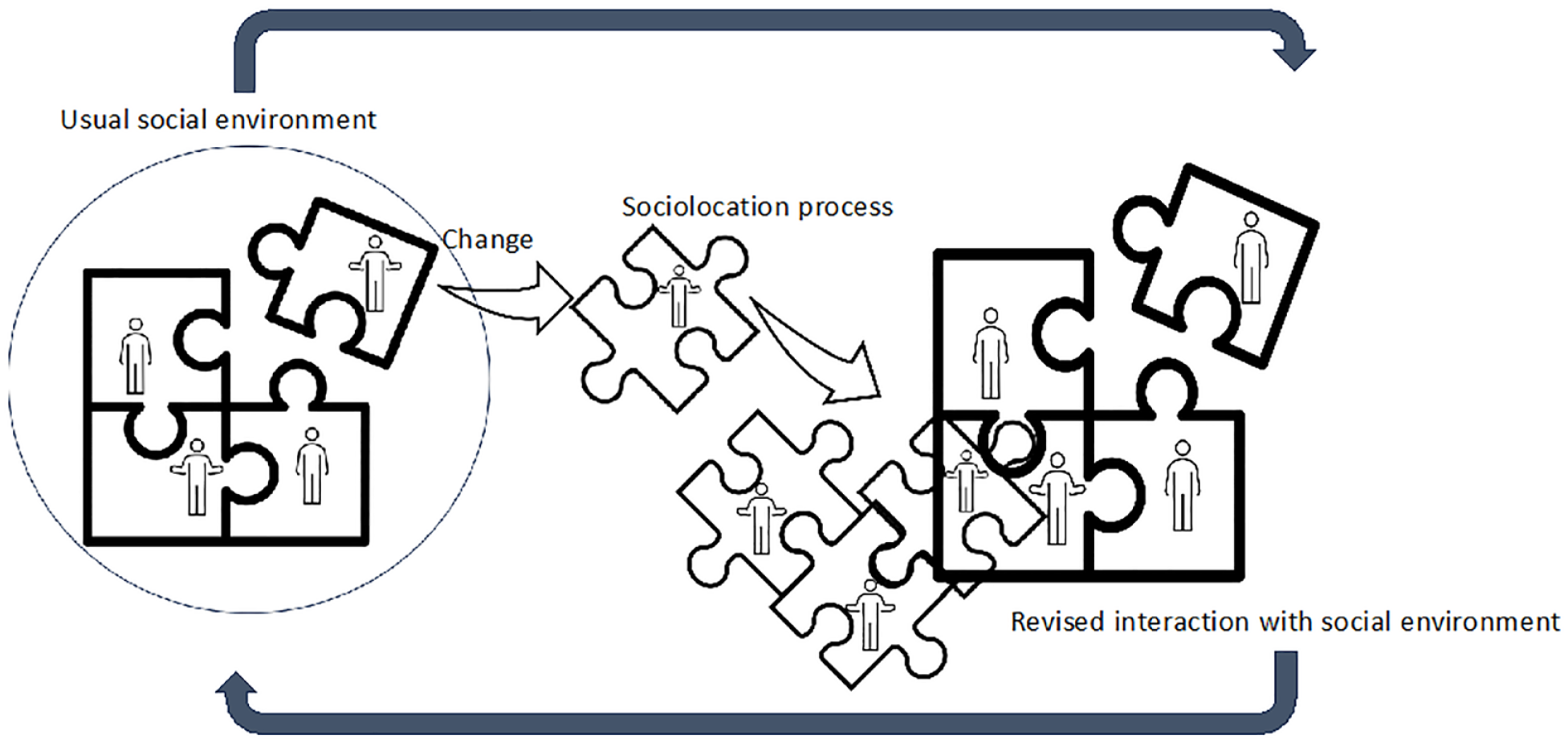
Sociolocation diagram.
Discussion
The conceptualization of sociolocation is simultaneously abstract, insofar as the process necessarily occurs in a nonphysical paradigm, and concrete in that it is readily identifiable by the individual in whom it occurs. Changes in role performance, social interactions, and self-identification can be both prompted by and result from sociolocation, and these are important considerations for the provision of nursing care to a variety of populations. Conditions that bring individuals into contact with nurses—whether physical illness, developmental changes, or impacts of what are commonly considered the social determinants of health (SDoH)—have significant potential to co-occur with sociolocation, and so should be considered to do so. Given that these conditions may also be in some ways traumatic, it is reasonable to consider sociolocation from a trauma-informed perspective, such that any care “involves a universal precautions approach in which one expects the presence of trauma in the lives of individuals being served,” and responds accordingly and with the effort not to compound the trauma (Substance Abuse and Mental Health Services Administration, 2014, p. 10). This is important across nursing science, practice, and education since in all three domains the nurse may encounter individuals engaged in sociolocation but may also experience changes in personal sociolocation resulting from interaction and learning processes.
Fundamentally, sociolocation is about change, and it is therefore a critical tool in planning care for those who have experienced changes in the ways they interact with the social environment. Persons experiencing new diagnoses or new sequelae of known illnesses must—in Piaget’s terms—accommodate these in activities of daily life, so too must adolescents become accustomed to relationships that change with age, and marginalized persons are forced to navigate the social structures that cause external labeling and potentially bias and/or stigma. These could all be considered stimuli for growth and development, although they may occur at wildly different points in the lifespan. This is why sociolocation cannot be limited to a single or even a few stages in development. Indeed, unexpected crises such as the COVID-19 pandemic can prompt entire populations to engage in sociolocation all at the same time, regardless of age or other demographics.
From the perspectives of nursing education, practice, and science, recognition of sociolocation processes can support more appropriate and effective care strategies by allowing more therapeutic interaction with patients and students and providing novel avenues for nursing research on change, growth, and development. Among the latter is consideration of the SDoH, and how it intersects with both individuals and populations to foster or impede change. The SDoH are indicators of when and how the social environment operates to place people on continuums of health and health risk over time, but as with traumatic experiences are often not considered in care planning (Davidson et al., 2020; Subica & Link, 2022; Van Den Hurk et al., 2022). It is possible that by identifying points at which change is likely to occur—particularly if it may initiate sociolocation, nurses and other healthcare providers may be better able to identify and address both the SDoH and potential risk factors for other physical and mental health problems such as depression (Frontera et al., 2022; Graham et al., 2021), disordered sleep (Burton & Guidry, 2021), substance use (Stamatis et al., 2022), and more.
Conclusion
Providing care intended to support individual health is one of the fundamental functions of the nursing profession, but it is also one of its greatest challenges. Much attention to holistic approaches to care has been paid in recent decades, but it is at best difficult to identify what must be included for truly “holistic” care. The conceptualization of human internal thought and perception processes such as sociolocation may contribute to a greater and more holistic understanding of the impact that experiences of illness, developmental changes, and marginalization have on individuals. This can support improvements in nursing practice and education, as well as offer significant potential for the development of novel approaches to nursing research and science.
Footnotes
Declaration of Conflicting Interests
The author declared no potential conflicts of interest with respect to the research, authorship, and/or publication of this article.
Funding
The author received no financial support for the research, authorship, and/or publication of this article.
