




Abstract
The experiences and meanings assigned to pregnancy loss are deeply influenced and shaped by the socio-cultural context of affected women. However, very limited studies have examined the influence of cultural norms and beliefs on how Black women make sense of pregnancy loss from a Canadian context. This study explored ways cultural norms and beliefs influenced Black Canadian women's journey after pregnancy loss. An exploratory qualitative design was used as part of a larger study exploring the experiences of Black Canadian women following a pregnancy loss. We used purposive and snowball sampling to recruit 32 Black Canadian women with lived experiences of pregnancy loss. Semi-structured interviews were conducted, and thematic analysis was used to organize the data into meaningful themes. Five themes shedding light on the experiences of Black Canadian women were identified: (i) living with the stigma, (ii) grappling with the silence, (iii) enduring the shame, (iv) dealing with the stereotype, and (v) calling for awareness. These experiences impeded emotional healing, access to community support, and reintegration into family and community. Participants also called for greater awareness to address the cultural myths and misconceptions surrounding pregnancy loss. The findings underscore the need to create a culturally sensitive awareness campaign to foster greater understanding about the causes of pregnancy loss, reduce the stigma associated with the experience, and facilitate open dialogue. Such actions will contribute to normalizing the experiences of pregnancy loss and increase access to community and social support.
Introduction
Globally, pregnancy loss affects millions of women with about 23 million pregnancies ending in miscarriage (Quenby et al., 2021; The Lancet, 2021) and approximately 2 million stillbirths occur in a year (Hug et al., 2021; United Nation Children's Fund (UNICEF), 2023). Black women have a t higher risk of experiencing pregnancy loss when compared to their white counterparts (Quenby et al., 2021). Pregnancy loss, an emotional and profound experience, continues to carry a stigma that interferes with the healing process of affected women. Despite the prevalence rate of miscarriage and stillbirth around the world, it remains a neglected and an overlooked tragedy around the world (UNICEF, 2020; World Health Organization (WHO), 2024; WHO, n.d.). In a recent report by the WHO (2024), mourning and grief around pregnancy loss has been overshadowed by cultural norms, practices, and beliefs making it challenging for affected women to heal and move forward. Deeply rooted- cultural norms and beliefs contributes to e stigma surrounding pregnancy loss and creates barrier to help-seeking among affected women (Boakye et al., 2025a; Freeman et al., 2021; March of Dimes, 2024; WHO, 2024). Moreover, the management of pregnancy loss is highly medicalized with emphasis placed on alleviating risk and preventing complications to the complete disregard of the culturally harmful narratives associated with the experience of pregnancy loss (Boakye at al., 2025a; Diamond & Diamond, 2016; Galeotti et al., 2022; Persson et al., 2023). This lack of attention has led to a global call to address the cultural norms and beliefs and normalize the experience of pregnancy loss (Persson et al., 2023; The Lancet, 2021; UNICEF, 2023; WHO, n.d.). Despite this call, progress toward normalizing pregnancy loss is lacking in some countries including Canada.
Pregnancy loss does not impact everyone equally due to differences in societal norms and expectations surrounding women's reproduction. Research shows that transnational practices and beliefs about pregnancy and childbirth continue to influence and shape perceptions of people in their new country of settlement (Winn et al., 2017). In many African and Caribbean communities shaped by dominant patriarchal beliefs, the value of a woman is closely link to her reproductive capabilities—ability to bear and rear children (Asiimwe et al., 2022; Dimka & Dein, 2013; Freeman, 2023). Thus, women from these communities who are unable to fulfill this culturally scripted reproductive role or experience a pregnancy loss are deemed to be of lesser value and often times stigmatized (WHO, 2024). Stigma, defined as “an attribute that is deeply discrediting” (Goffman, 1963, p. 3), contributes to a person being labelled differently for not conforming to the norms and expectations of a given society. Individuals who fail to meet or conform to societal expectations in the situation of pregnancy loss are perceived to carry a spoiled identity (Goffman, 1963). When individuals are labelled with a spoiled identity, they are deemed to be “lesser in some way” (Goffman, 1963, p. 3). It has been widely reported that stigma related to pregnancy loss contributes to devaluation and discriminatory attitude toward affected women, making it challenging to reintegrate into their family and community (WHO, 2024).
In expanding on Goffman's work, Link and Phelan (2001) characterized stigma as the co-occurrence of labelling, stereotyping, separation, loss of status, and discrimination in the context of power relations. Labelling of people who are deemed to be carrying an undesirable attribute create conditions by which they are “othered,” stereotyped, and discriminated against (Link & Phelan, 2001). Across many countries, the labelling of women who experience pregnancy loss leads to othering and sets the basis for devaluing and ostracizing them (UNICEF 2023; WHO, 2024). This in turn impacts a person social status, contributing to families and communities blaming and shaming them (Boakye et al., 2025a; Ayebare et al., 2021; Omar et al., 2019). Within the context of stigma, “shame becomes a central possibility, arising from the individual's perception of one of his own attributes as being a defiling thing to possess” (Goffman, 1963, p. 18). Women often e internalized these beliefs and this in turn leads to feelings of shame and self imposed isolation.
Cultural stigma around pregnancy loss is reinforced and sustained by religious and cultural norms (Boakye et al., 2025a; Ayebare et al., 2021; Omar et al., 2019; WHO, 2024; WHO, n.d.). In some contexts, pregnancy loss is viewed as a moral failure, a form of retribution for a perceived transgression, a taboo, and a sign of bad omen (Boakye et al., 2025a; Omar et al., 2019; WHO, n.d.). These beliefs not only lead to stereotyping of women who experience a loss but it also reinforces the myths about nonmedical causes of pregnancy loss (Boakyer et al., 2025a). Myths about pregnancy loss are pervasive due to a lack of awareness, education, and understanding about the causes of loss (Boakye et al., 2025a; Pollock et al., 2020b; WHO, 2024). According to Goffman, “stigmatized individual tends to hold the same beliefs about the identity that we [others] do” (Goffman, 1963, p. 7), thus, the internalization of broader myths and misconceptions about pregnancy loss contributes to self-imposed stigma, blame and judgment.
Additionally, these harmful myths also influence how affected women communicate and openly share their experiences of loss (Boakye et al., 2025a, 2025b; Bailey et al., 2019; Bellhouse et al., 2018; Omar et al., 2019). In some context, women are prohibited from talking about their experience openly (Boakye et al., 2025a; Omar et al., 2019; WHO, 2024), forcing many into silence. A culture of silence leads to a lack of acknowledgement and validation of the loss, ultimately contributing to disenfranchised grief and challenges regaining normalcy (Boakye et al., 2025a; Omar et al., 2019; Van Tuyl, 2024).Additionally, silence not only contributes to fear of disclosure, profound sense of isolation, and lack of support, it also creates barriers to help-seeking and acceptance among women who experience pregnancy loss, leaving many entrapped in a cycle of complicated grief and trauma (Boakye et al., 2025b; Bellhouse et al., 2018; Van Tuyl, 2024).
Although having medical reasons may contribute to reducing the stigma associated with pregnancy loss, it is often overshadowed by a pervasive culture of myths and misconceptions (Boakye et al., 2025a, 2025b; Freeman et al., 2021). Much of the challenges women endure after pregnancy loss including stigma occurs outside the confines of the hospital. Thus, prioritizing the diagnosis and management of women who experience pregnancy loss through the use of standardized guidelines and algorithms including surgical, medical, and expectant management (Mehra et al., 2024), may lead to the neglect of the stigma that some women endure integrating back into their communities. Adhering to guidelines may also result in the lack of culturally sensitive care and support for affected women further contrubiting to dehumanizing and minimizing the whole experience of affected women. Further, such experiences may contribute to difficulty communicating their experiences and seeking for help, resulting in unmet needs and feelings of abandonment. . Evidence from the United Kingdom have shown that the availability of an integrated health and social intervention with a strong supportive and follow-up care for women who experience pregnancy loss has contributed to positive psychosocial wellbeing (Anderson et al., 2024).
Although there are several studies that have explored the experiences of Black women following a pregnancy loss in other countries (Antilla & Johnson, 2024; Evans et al., 2023; Jones et al., 2021; Paisley-Cleveland, 2013), very few studies have explored the influence of cultural norms and beliefs surrounding pregnancy loss from a Canadian perspective. A recent study examining the prevalence of stigma of pregnancy loss in developed countries including Canada, with a predominantly White sample (91%), found that 54% had experienced stigma (Pollock et al., 2020a). Additionally, a study in British Columbia, Canada reported that women encounter stigma and lack of follow-up care after pregnancy loss however, given that the background of the participants was not described, it is unclear if Black Canadian women were included in the study (Van Tuyl, 2024). While these prior Canadian studies may provide some insight, there is limited understanding about how cultural norms and beliefs impact on Black Canadian womens’ journey. Moreover, pregnancy loss may also intersect with racial tropes such as the strong Black woman to complicate the grief and stigma (Hill, 2019; Paisley-Cleveland, 2013). Therefore, the purpose of this study was to explore ways cultural norms and beliefs influenced Black Canadian women's journey after pregnancy loss. This understanding is critically needed to inform the development of targeted and culturally concordant programs and interventions to address the cultural barriers hindering Black Canadian women's ability to process and recover from pregnancy loss.
Methodology
This qualitative research is grounded in the belief that Black peoples understanding of “realities are shaped by fluctuating and diverse notions of time, space, place and transcendence” (Jean-Pierre et al., 2024, p. 523). Therefore, this qualitative research challenges the dominant ways of knowing and offers a medium for understanding Black Canadian women experiences. The data for this study was drawn from a larger exploratory qualitative study (Boakyer et al., 2025a) conducted with 32 Black women who have experienced pregnancy loss in Canada. Participants were purposely recruited via Black community associations and pregnancy loss support groups on social media. We also used snowball sampling by asking participants to share the recruitment flier to other Black women they know have experienced pregnancy loss. Interviews were conducted using structured and unstructured questions to allow for in-depth exploration of the lived experience of pregnancy loss. Guided by a story-telling approach (Hayman et al., 2012), we asked participants at the beginning of the interview, to share their experiences of pregnancy loss after which the interviewers (PB and NP) followed up with probing questions to clarify and elucidate the meaning they assign to their experiences. Considering the distress associated with going through a pregnancy loss, using a story-telling approach, enabled participants to sensitively share their experiences in a storied form (Hayman et al., 2012). The interviews lasted between 30 and 60 minutes. Details of our interview guide questions have been published elsewhere (Boakye et al., 2025a). Data was collected between January and May 2024. A CAD $50 online gift card was provided to each participant to thank them for their time. All interviews were audio recorded and transcribed by OA and DM and subsequently exported to NVivo R1/2020 for coding and organization of the themes.
Data Analysis
Thematic analysis approach was used to generate meaning from the individual and shared experience of participants (Braun & Clarke, 2021). This approach to analysis enable researchers to capture a rich and contextualize understanding of participants’ experiences and perceptions about a social issue (Braun & Clarke, 2021). Through the process of thematic analysis, we were able to illuminate the individual and shared experiences of the participants to generate a deeper understanding of the cultural nuances surrounding pregnancy loss. We initially engaged with the data by carefully listening to the audios after each interview to inform our subsequent interviews. The audio recordings were transcribed, and each transcript was read multiple times to gain an initial impression and to identify key ideas threading across the data set. We generated and assigned codes to key statements, actions, and practices that reflect wider socio-cultural norms and beliefs surrounding pregnancy loss. We grouped the codes into broader themes based on their relationship and collective meaning. This also enabled us to make explicit connections between individual participants’ experiences and the broader social context to generate a deeper understanding. The themes were reviewed and refined by the research team to ensure that it stayed close to the data. We further reviewed the themes for their relevance by revisiting the initial processes, the data, and research aims to ensure that our interpretations accurately represented the experiences of the participants. Each theme was defined and assigned a name to show their interconnections as it relates to the purpose of this research. We generated a compelling report of our interpretations supported with direct quotes from the data to provide a contextualized understanding. All four authors were involved in the data coding and deriving of the themes from the data.
We recognized how our identities as Black women scholars,our lived experiences, and commitment to advancing health equity might shape this research process including data collection and analysis. This understanding provided us with the opportunity to gain insight into the realities of Black women following a pregnancy loss and enhanced our commitment to center their voices, suffering, and grief that often goes unacknowledged and minimized within healthcare spaces, community and family interactions. During the data collection and analysis, we assessed the ways our assumptions and preconception about pregnancy loss as nurses and Black scholars may have influence how we conducted the interviews and analysis. Additionallly, we also acknowledged how our own privileges and positions of power as Black scholars thus, we differed to Black women as the expert of their own experiences. We maintained an active reflexive stance by journaling our preconceptions and debriefing with our colleagues to ensure that our findings were closely tied to the data.
Ethics Approval and Consent to Participate
The study was approved by the Toronto Metropolitan University Research Ethics Board (REB 2023-374). Written informed consent was provided by the participants. Participants were informed via the consent form that the location they choose to sit for the interview should have an aural privacy. We enabled the waiting room feature on Zoom to ensure only participants invited for the virtual interview had access. The audio recordings were deleted after transcription was completed and de-identified. Each transcript was labelled with an alpha-numeric key and stored on an institutionally licensed repository managed by the Toronto Metropolitan University. The alpha-numeric keys were retained for this publication.
Findings
Details of the participants’ characteristics have been published elsewhere (Boakye et al., 2025a). A summary of the descriptive characteristics of the participants are presented as follows. Twenty-six (81.2%) were between ages of 24 and 34 years and the remaining 6 (18.1%) were between the ages of 35 and 44years. A total of 25 participants (78%) indicated their relationship status as married, 2 (6.3%) were single, 2 (6.3) were divorced, and 3 (9.4%) were common law. More than half 17 (53.1%) of the participants had a miscarriage, 13 (40.6) experienced stillbirth, and 2 (6.3%) had a neonatal death.
The figure below presents an overview of our themes. Five themes were discovered from our analytic processes: (i) living with the stigma, (ii) grappling with the silence, (iii) enduring the shame, (iv) dealing with the stereotype, and (v) calling for awareness. The first four themes are not mutually exclusive but work together in an interconnected way to reproduce and reinforce each other (Figure 1).
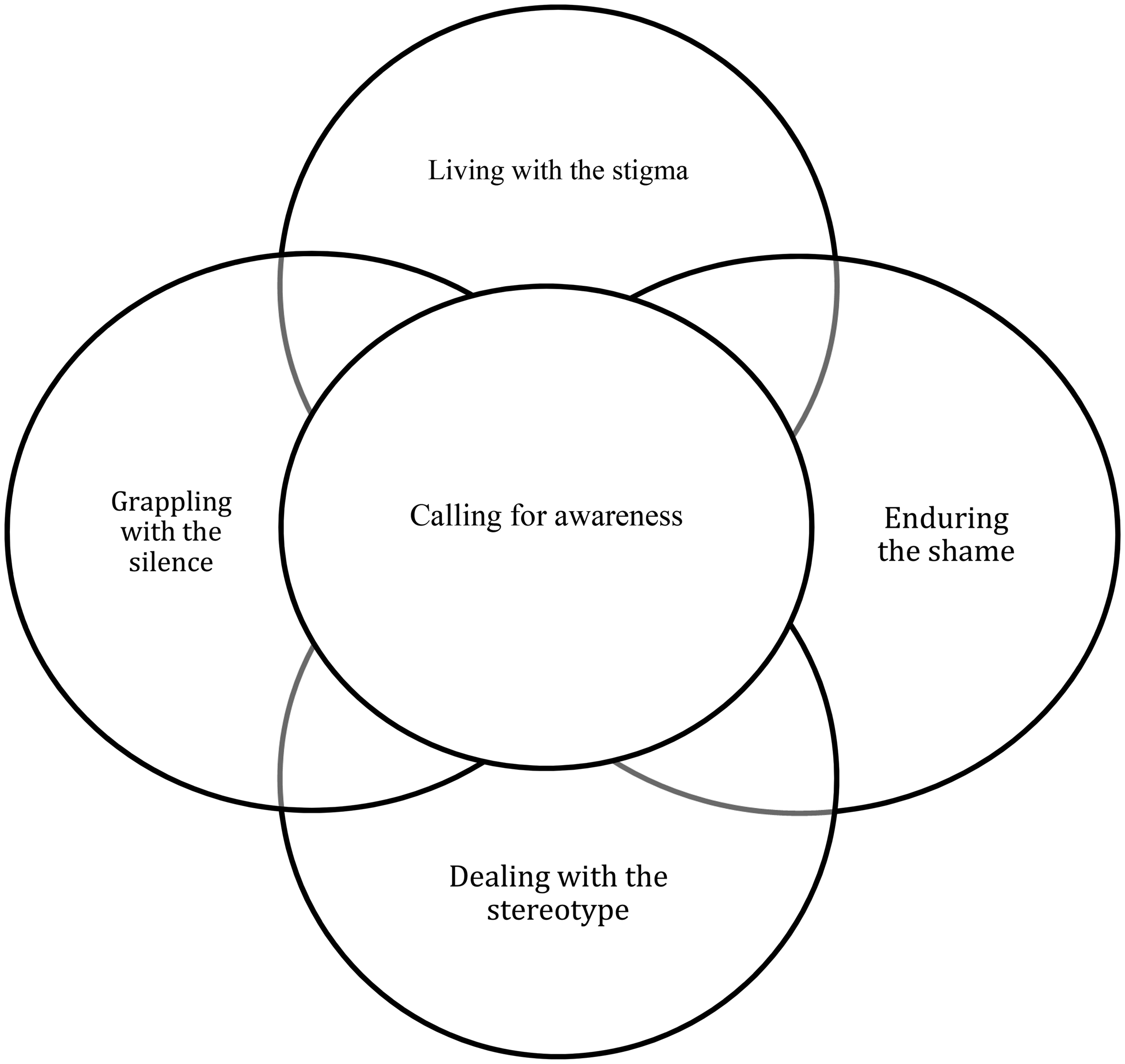
Thematic representation. Copyright reserved by authors.
Living With the Stigma
Pregnancy loss is surrounded by stigma. Participants attributed the stigma to misunderstanding and misconception that are shaped by deeply ingrained cultural norms and beliefs and the lack of awareness about the causes of pregnancy loss. Stigma complicated the grief of many participants and made it difficult for them to cope, reintegrate, and access the needed support. The perception that carrying a pregnancy to term is within a person's control often results in society apportioning blame to women who experience pregnancy loss. Participants felt this misconception reinforced the assumption that they were culpable. I can say as a Black person, stigmatization results from those myths and those beliefs that we normally have in our community about pregnancy and people who lose their pregnancy. If you lose your pregnancy people tend to think that it just happened because it is your fault, they start to ask questions …they stigmatize and start to isolate you because they just see you as the problem. (Participant 28)
Some participants shared that stigma related to pregnancy loss was deemed to be an act of divine retribution for perceived moral wrongdoing. The narrative of the participants revealed that perceptions surrounding pregnancy loss were rooted in superstition and the belief that it happens because of one's sinful endeavors committed in the past. In recounting her experience of miscarriage and stillbirth one participant said, “when I experienced stillbirth and miscarriage some people were saying that it was spiritual, like a curse and that I should seek spiritual help” (Participant 10). Pregnancy loss was deemed as a form of spiritual curse and those who experienced it were expected to seek spiritual cleansing and intervention. Another aspect of this stigmatizing narrative shared by one participant was the perception that “it's something that's happening to you because you deserve it…you’re being punished for something that you’ve done” (Participant 10). The misconception that pregnancy loss occurred because of participants past moral failings or perceived wrongful choices led many to accept the blame or feel the need to take responsibility for the loss.
Some participants also shared instances when family members attributed their pregnancy loss to superstitious influences as highlighted in one woman's excerpt: “my mother in-law actually told me I need to do some cleansing. It's actually an abomination for me to lose a child the way it happened, and I need to do some cleansing so that it doesn't happen again” (Participant13). For several of the participants, the perception was that pregnancy loss is an abomination or forbidden experience that required supernatural cleansing to avert future occurrences. Such attribution of pregnancy loss to superstition contributed to labelling and feelings of inadequacy. I felt stigmatized because that was the second baby that I am losing. People in my community that know that I had a miscarriage in 2021 and 2023 were like this kind of person, it's like she carries bad luck. I experienced low self esteem…l had a loss of self-esteem. (Participant 27)
Grappling With the Silence
Some participants spoke about a widely held l belief that experiencing pregnancy loss challenges the ideal notion of motherhood, thus a taboo subject to openly speak about or be associated with. In recounting a view shared by several other women, one participant stated: “we carry an identity of a grieving parent which is not an expectation in our society…how do you then navigate this sort of identity especially knowing that there is this kind of a taboo” (Participant 24). For some participants, this perception resulted not only in their struggle to embrace and navigate their identity as grieving parents but it also shaped how they talked about their experience and grief. When it comes to talking about baby loss it just feels like it's not allowed. It's not something that people want to talk about. I think it feels like your grief is gonna be contagious. Like if you talk about it, that somebody else is gonna lose their baby too. So, it's even more isolating. (Participant 24)
Several participants re-echoed similar sentiments of not being able to openly discuss their experience. The belief that pregnancy loss and all associated experiences are perceived to be ‘contagious’ resulted in participants staying silent and further isolating themselves. Another participant also recounted how the narrative of contagion reinforced the perception that women who experience pregnancy loss are likely to transfer their misfortune said: “there was this time a family came around with her child, the child sat beside me, and she held the child closer like though she was trying to let the child leave where I was seated” (Participant 20). Some participants indicated that talking about a pregnancy that was associated with a loss was considered forbidden orinappropriate to bring up in conversation with others. One participant said: When people talk about their pregnancies you know, and I try to say something like I am bringing darkness into the conversation. I wanted to talk about and share with other people about my pregnancy and my experience, but it's not something that you can bring up. (Participant 24) I think just like other people's awkwardness made it difficult and then me navigating that… So it is an awkward experience telling somebody I experienced loss… and they never really like to come back and say anything. So, I feel like there's that awkwardness or sometimes people don’t know what to say or they just don’t say anything and that's even worse. I almost think it's better for people to say like the good old I’m sorry for your loss, because at least then there's some acknowledgement. (Participant 14)
Enduring the Shame
Gendered expectations about pregnancy and motherhood left participants to bear the brunt of shame after experiencing pregnancy loss. Participants described these expectations were fueled by the value society places on women's capacity to bear children. This was captured by one participant's excerpt when she said: “in the Black community, we always prioritize getting married, having kids” (Participant 2). For those who are unable to meet these expectations of successfully carrying a pregnancy to term,experienced a heightened sense of failure and inadequacy First, I felt I was not a woman enough, I was not strong like every other person. I had people condemning me with words or saying things to me, that made me feel that way. I just hear from most of my friends who say, it does not show your sense of being a woman. (Participant 22) So, most times, I feel very ashamed. Like it's a kind of disgrace trying to walk with others or stay in their midst. Like people saw me with a child and next thing going to the hospital and coming back without a child. So, I really, really feel ashamed. It is like a disgrace, that's how I felt at that moment. (Participant 6) For some months, I couldn’t go out and continue with my daily activities. I was inside the house; I didn’t socialize with people…because I felt I was ashamed of being pregnant and losing the baby. So that made me isolate myself from people. (Participant 23) I just felt like my in-laws needed a grandchild, I was not able to give. So, I just felt that I was judged. Even though they didn’t show it, I had that remorseful feeling that they judged me that I can’t give them a grandchild. (Participant 3) It was a disgrace. I had this kind of stigma like someone throwing poop on your face. I don’t know how I’ll explain it. But it was some kind of heaviness like something is covering me or I am kind of carrying some dirt. Like, I can't just leave my home because I don’t know how to explain to people that I lost a baby. (Participant 6) The society is so judgmental and at some point, they blame the woman for certain things. I would say society did not help me with getting up or having the courage. At times, society is very judgmental, and I was afraid of getting out and socializing with people… Anytime you come across people, they think that you are the problem. I don’t think society is so open to accepting pregnancy loss. (Participant 17)
Dealing With the Stereotype
Stereotypical assumptions rooted in the strong Black woman trope influence how participants were expected to mourn and grieve their loss. The pressure to conform to these expectations of portraying strength in the face of pregnancy loss resulted in some participants attempting to suppress their grief. One participant recounted how the expectation to appear strong shaped how she processed the grief and expressed her emotions. I think it's just this notion that Black women we are strong makes most people hide their pain and grief and we’re not able to fully express how we are feeling or what we're going through. And it just continues to affect us emotionally because we’re not grieving fully or not able to go through the whole situation fully. So, it leaves you with unhealed traumas or experiences that take more time to heal. So, it just makes the grieving and healing complicated. (Participant 16) I believe people make us grieve privately and in silence. And I think that's the worst way to grieve because you won’t get help, people will feel like you’re okay, when you’re literally dying inside. You won't have the necessary facilities to be able to come out of that grief. (Participant 12) We all have emotions and if we hurt, then it hurts. There are not things like oh she's Black so she's going to be able to handle it better, or she's Black so the amount of pain is going to be less. So regardless of the skin color and everything pain is pain, there is no better way to carry it, all you have to do is be vulnerable. You have to be free to be vulnerable. So, you can heal. So as Black women, when it's painful it's painful, when it's hurt it hurts. (Participant 20)
Calling for Awareness
Participants felt empowering women to openly speak about their experiences without being stigmatized was critical to reduce the stigmas and stereotypes associated with pregnancy loss. Fostering a culture that encourages open dialogue about pregnancy loss within families and communities will create the understanding that experiencing loss is an inherent part of women's reproductive journey. One participant emphasized how creating such open conversation can normalize the experience. People need to start sharing those things to help normalize the experiences. I think that we need to create spaces that allow people to voice it…I really feel if we can create a community championed by the older women who have gone through these experiences to help recognize and normalize the loss…Like intergenerational, open sharing of support around the experiences of loss that as Black women we can relate. (Participant 1) I think that there should be support for people who have lost babies and some opportunity to encourage people to share their stories, because without doing that, then we really are living in silence…hearing those stories can help normalize the loss… It starts from a place of support and within those smaller networks to empower people to share a story like that so we can start normalizing it. (Participant 24) I think the first thing we should do is eradicate those myths in our society…Educate the community that this is not about you or your practices, it can happen to anyone…Creating awareness in the community about the causes and factors related to miscarriage or pregnancy loss. I am very sure most people don't know what really causes pregnancy loss. If we educate people and create awareness it would help. (Participant 28) There needs to be education and awareness about miscarriage and stillbirth and its causes…the community needs to be enlightened about pregnancy loss…knowledge is power and when people have this knowledge, they would be able to know how to support people in these situations. (Participant 10)
Discussion
This study highlight ways cultural norms and beliefs influenced Black Canadian women's journey after a pregnancy loss. Our findings revealed that cultural norms and beliefs influenced and shaped how pregnancy loss was experience and perceived by Black women and their community. These deeply rooted norms and beliefs contributed to stigma, silence, and shame and these in turn, impacted on access to support and acceptance by family and community.
In this study, we found that stigmatization of Black Canadian women who experience pregnancy loss was pervasive and widespread within Black communities. Stigma surrounding pregnancy loss is deeply rooted in the socio-cultural norms about women's reproductive capability thus, womanhood status and identity are closely linked to childbirth (Asiimwe et al., 2022; Boakye et al., 2025a; Ayebare et al., 2021; Chaney, 2011; Dimka & Dein, 2013; Omar et al., 2019). Within Black communities, a woman's fertility is intricately intertwined with her womanhood—an attribute that is linked to their ability to successfully carry a pregnancy to term and bear children (Asiimwe et al., 2022; Chaney, 2011; Freeman et al., 2021). These deeply ingrained cultural narratives about the role and value of women's reproductive capabilities set the standard by which the outcome of the participants’ pregnancy was measured against. Black women in our study who internalized these cultural script percieved that they have failed in fulfilling their role. This embodied sense of failure triggered feelings of guilt, disappointment and undermined their self worth.
In the context of our participant lives, pregnancy loss was viewed as a deviation from the norm. For example, dominant stigmatizing narratives about causes of pregnancy loss are associated with women's action/inaction, lifestyle, and moral shortcomings (Boakye et al., 2025a; Omar et al., 2019; WHO, 2024). These narratives are often linked to and reinforced by sociocultural and religious beliefs that associate pregnancy loss to an act of moral or divine retribution, a defect in one's family bloodline, and a curse or punishment. As a result, affected women are perceived to have a spoiled identity and this in turn, amplifies the stigma (Brierley-Jones et al., 2014; Minton et al., 2023). Link and Phelan (2001) argued that labelling people with an undesirable attribute creates the basis for devaluing, rejecting, and alienating them. Similarly, our study revealed that some participants experienced loss of status and this in turn, contributed to family and communities avoiding them. Such experiences intensified feelings of isolation and impacted on Black Canadian women's emotional healing and family reintegration. Internalizing these stigmatizing narratives about pregnancy loss have also been found to create and intensify feelings of shame, guilt, blame, and self-criticism (Boakye et al., 2025a; Browne, 2025/2024; Fairchild & Arrington, 2023).
Stigma of pregnancy loss also limited Black Canadian women's ability to openly discuss their experiences. Participants noted that the topic of pregnancy loss was considered a taboo and therefore, forbidden in discussions or conversations. Broader societal misconceptions haved perpetuated the notion that pregnancy loss can be contagious, therefore, telling others about one's experience is prohibited to avoid passing it on to others (Boakye et al., 2025a; Ayebare et al., 2021). From the narratives of the participants, there was a general expectation to remain silent and avoid sharing about their loss with others and those attempting to do so were made to feel such conversation was not welcome. Denying women the opportunity to talk about their experience led to lack of acknowledgement and invalidation, compelling participants into self-imposed silence. Such experience can alienate affected women and limit access to family and community support.
The expectation of strong and resilient attributes that are consistent with the strong Black woman trope contributed to women in our study not being able to fully express their grief and loss. It is widely reported that unresolved grief complicates the grieving process and increases the risk of poor mental health outcomes for those who experience loss (Boakye et al., 2025b; Burden et al., 2016). Grieving from the context of our participants’ narrative was perceived to be a sign of weakness and this in turn led them to suppress and minimize their grief. Link and Phelan (2001) have noted that stigma occurs in the context of power that enables dominant societal belief to associate certain negative stereotypes or attributes with certain people. The need to remain emotionally strong and resilientmay compound the stigma and silence surrounding pregnancy loss thereby, making it difficult for affected women to acknowledge the need for professional help-seeking. Boakye et al. (2025b) have reported that neglecting the mental health needs of Black women who experienced pregnancy loss combined with limited access to racially concordant grief support undermined Black womens ability to the seek care needed to facilitate their healing and recovery.
One key finding shared by the participants in our study was the need for intergenerational dialogue to destigmatize and normalize the experience of pregnancy loss. It has been reported that generational differences undermine women's willingness to share about their experiences (Van Tuyl, 2024). Younger women who may have different perspectives about womanhood and pregnancy loss might feel the need to express their grief and challenge assumptions behind harmful myths and stigma circulating in their communities than older women. Promoting an intergenerational dialogue will facilitate opportunities to confront harmful narratives and foster greater understanding about the natural causes of pregnancy loss.
Participants highlighted the need for greater awareness about the causes of pregnancy loss and the associated psychosocial consequences within the Black community to dispel the negative beliefs and misconceptions that contribute to reproducing and reinforcing the cultural stigma. This will also promote better understanding and help generate collective empathy among families and communities. As noted by the participants, creating awareness about the causes of pregnancy loss will provide families and communities with the needed knowledge to engage affected women sensitively and foster empowering spaces to normalize discussions about pregnancy loss. Normalizing pregnancy loss requires collective effort from families, community, and society at large to foster a supportive environment where affected women feel supported in their journey towards healing.
Recommendations
The misconceptions and myths about pregnancy loss are pervasive within Black communities and remains unaddressed in Canada. Our study calls for action to raise awareness and address the stigma of pregnancy loss to facilitate women's journey towards healing and recovery. This requires grassroots engagement with community leaders and organizations, maternal and mental health advocates, women groups, and faith-based leaders and institutions to promote awareness and understanding about the causes of pregnancy loss. Normalizing conversations around pregnancy loss validates the emotional experience of those affected and encourages open communication. It also creates a shared understanding about pregnancy loss, which alleviates the feelings of shame, blame, and loneliness face by Black Canadian women and promotes help-seeking.
A holistic and integrated approach that promotes access to culturally appropriate and affordable mental health therapy is urgently needed to support Black Canadian women cope with the grief and emotional toll which is often exacerbated by stigma. Nurses and healthcare providers need to take a comprehensive approach when assessing Black Canadian women's family situations during follow-up visits to ensure they have the necessary support. Understanding these perspectives will ensure that nurses and healthcare providers offer the most appropriate emotional and cultural support needed by Black Canadian women and their families.
There is a need to establish safe spaces and support networks for Black Canadian women to share their experiences and coping strategies. These networks will hold space for women who have experienced pregnancy loss to heal and those who are currently grappling with the grief associated with pregnancy loss. Such peer-based support networks willll add to normalize the conversations about pregnancy loss and encourage Black Canadian women to socialize and seek additional professional support as needed. Lastly, further research is needed to co-develop culturally responsive programs to reduce the stigma and normalize the experience of pregnancy loss.
Strengths and Limitations
To the best of our knowledge, this article is the first to shed light on how cultural norms and beliefs influence Black Canadian women's experiences following a pregnancy loss and the challenges they face reintegrating back into their family and community. Our study is based on small sample size which may affect the generalizability of the findings however, it can be transferable to similar context. Nonetheless, the findings has contributed to amplifying the voices of Black Canadian women, and it is anticipated this study would contribute to creating change on a largely ignored and invisible aspect of pregnancy loss to facilitate healing and recovery.
Conclusion
Cultural norms and beliefs influence and shape the experiences and perceptions of pregnancy loss within Black communities in Canada. Normalizing pregnancy loss is crucial to breaking the cultural stigma that compromises Black Canadian women's healing and recovery. Developing targeted campaigns to dispel harmful beliefs and myths and reframing pregnancy loss as a common but unexpected part of women's reproductive journey is crucial for their emotional recovery. This would also contribute to fostering greater awareness, empathy, and sensitivity toward women who experience pregnancy loss—conditions necessary for seeking support and regaining normalcy.
Footnotes
Acknowledgments
The authors would like to thank the participants who contributed to the research by sharing their stories.
Data Availability Statement
The data for this study will not be shared due to its sensitive nature and participants did not provide their consent for the data to be shared.
Declaration of Conflicting Interests
The authors declared no potential conflicts of interest with respect to the research, authorship, and/or publication of this article.
Funding
The authors received funding from the Offce of the Dean, Faculty of Community Services, Toronto Metropolitan University for the research, authorship, and publication of this article.
