



Abstract
The COVID-19 pandemic forced many mental health service providers to switch to virtual methods of service provision. Grief and bereavement supports are no exception, with both peer and professional supports being offered online. A goal of this study was to examine grievers experiences with online peer or professional support. Grounded in social support theory, this research implemented a qualitative design involving semistructured interviews with 25 participants who received professional and/or peer grief support in Midwestern Ontario, Canada. Ten participants received professional support, seven received peer support, eight received both support types, and all experienced virtual support. Analysis methods included a hybrid of inductive and deductive thematic analysis. Participants highlighted advantages and disadvantages of virtual support, including advantages of support at home and disadvantages of no in-person environment to facilitate bonding. Implications for this project include informing the social support sector of strengths and limitations within virtual support services for grief.
Grieving is due to the experience of bereavement, which can be defined as the loss of a loved one caused by death (Osterweis et al., 1984). Grief is a normal human experience that occurs as a result of a loss (Rabins, 2019). Grief experiences are influenced by biological and cultural influences (Rabins, 2019). Grief in itself is not pathological as it is a normal response to the life event of losing a loved one (Penman et al., 2014). There are several support options available to grieving individuals. Peer support is support provided from peers to peers (Cyr et al., 2016). Professional support can be defined as social support provided by public or professional services (Shiba et al., 2016). However, there is a lack of awareness among the population of grievers regarding what resources are available or most adapted to their needs and preferences to assist them and their families in coping with grief (Ho, 2017). In addition, there is little dissemination of knowledge regarding the types and diversity of online grief support (Beaunoyer et al., 2020). If bereaved individuals are unable to seek support for their grief, it may lead them to experience more complex grief symptoms (i.e., intense yearning or longing for a lost loved one, emotional pain, and the inability to accept the loss). Those feelings can persist through time (Shear, 2015).
Research that currently contributes to conversations surrounding online grief support is primarily focused on online discussion boards (Coker & Riforgiate, 2023; Holmgren, 2022), professional support services (Békés & Doorn, 2020; Morris & Ryan, 2021), or more general experiences not about grief (Békés & Doorn, 2020; Ioane et al., 2021; Smith et al., 2021). The impact of the COVID-19 pandemic on grief service offerings, through transitioning to online services amid high death rates highlights the need for research on multiple modalities of grief support. This research aimed to address a gap in the literature surrounding the perspectives and experiences of online support for grief and bereavement in both a peer and professional support context. The current study occurred during the COVID-19 pandemic, during which many services were offered online because of lockdown safety procedures. As a result, this research was able to investigate the impact and potential benefits perceived to be associated with online support for grief and bereavement. These results are embedded within a larger project which investigated the perceived benefits of peer and professional support for grief and bereavement. Participants in this project attended peer and professional support through online video platforms (e.g., Zoom, Jane, etc.).
Literature Review
Currently, there is a scarcity of research that examines the perceived effects of online social support for grief and bereavement. However, some research focuses on the experiences of grief support through an online discussion board or “chat room” (Coker & Riforgiate, 2023; Holmgren, 2022). Research conducted by Coker and Riforgiate (2023) that investigated online discussion boards for pet loss found that the discussion board allowed participants to make sense of their loss while experiencing disenfranchized grief. Disenfranchized grief is a form of grief in which the griever feels that their loss has not been acknowledged, validated, or mourned (Albuquerque et al., 2021). Holmgren (2022) found that most participants in their study investigating peer support in widowhood considered an online discussion board helpful, as they could connect with those in a similar circumstance.
The impact of the COVID-19 pandemic on the grieving community was significant, as there was an intersection between COVID-19 and how people were grieving due to the lockdowns and gathering restrictions. Such restrictions aimed to minimize the spread of the virus, however, placed people in a position to grieve without support from cultural, social, and religious rituals (Cordero, 2021). As a result, there was a higher risk for grievers to experience problems with their grief without these supports (Cordero, 2021). The lack of ability to experience formal and traditional grief rituals and supports (i.e., funerals, celebrations of life, in-person visits with family, etc.) is directly related to experiencing disenfranchized grief. Due to gathering limits related to COVID-19, many grievers were forced to attend funerary rites virtually, which negates the therapeutic functions of these rites, as a griever is unable to experience physical connection or share in their pain with others (Albuquerque et al., 2021). Sheppard et al. (2023) found that the COVID-related public health restrictions placed on grieving rituals contributed to additional feelings of sadness, despair, and loss because of the inability to connect with others.Additionally, research indicates that through the preparation for, and application of restrictions during the pandemic to ensure funerary rights followed guidelines, grievers’ time to mourn was also limited by focusing on abiding by these laws (Sheppard et al., 2023).
Albuquerque et al. (2021) highlight the need for evidence-based psychological interventions to combat experiences of disenfranchized grief. Scholars have emphasized the use of professional psychological support for more complicated experiences of grief, such as prolonged and disenfranchized grief as a result of COVID-19 (Albuquerque et al., 2021; Zhai and Du, 2020). However, this research allowed consideration for the potential help that peer support could provide in this context. Peer support may help contribute to a psychological sense of community to grievers, which would be beneficial given the heightened feelings of isolation that many experienced during the pandemic (Albuquerque et al., 2021; Hupcey, 1998). A systematic review conducted by Robinson and Pond (2019) found mixed results regarding the impact of online peer support services on reducing symptoms of grieving. Some of their quantitative results indicated a reduction of symptoms of grief, while others reported no influence on symptoms after participating in online peer support groups for grief.
Although traditional grief supports were limited during the pandemic, peer, and professional grief support remained available online and over the phone. One study, conducted by Morris and Ryan (2021), found the transition to offer grief online support groups facilitated by clinicians to be effective. Participants were able to relate to others about how isolation associated with the pandemic magnified their feelings of loneliness resulting from their grief. A concern surrounding accessing support services over the phone or vocally online is the lack of privacy and the risk of other household members overhearing conversations (Ioane et al., 2021). Additionally, it is important to consider what communities the online format is accessible to. Those with medium to high socioeconomic status are going to have easier access to these online services than marginalized clients (e.g., low-income, and elderly populations, as well as people who identify with having a disability) who are at higher risk of not having a dedicated space or technology to participate in online therapy (Ioane et al., 2021). Thus, social support services being transitioned to an online context can create a digital divide between individuals experiencing poverty and oppression, which may contribute to further marginalizing these communities (Ioane et al., 2021). In a systematic review of online peer support groups for grief, Robinson and Pond (2019) found consistency regarding participant experiences of technical issues and miscommunications through the online support format in a general population. However, overall, their research indicates that participants do feel supported within online peer support groups for grief despite some challenges with online service provision.
Although the transition to online support during the pandemic led to some challenges in accessing support, there were also benefits associated with this transition. This transition helped services to be more accessible to remote individuals, reduced travel costs and time, and decreased the amount of “no-shows” for appointments (Békés & Doorn, 2020; Smith et al., 2021). In the wake of the COVID-19 pandemic, mental health service organizations are widening their range of service provision to permanently include virtual services in hopes of providing more client-centred care options (Smith et al., 2021). Bereavement support providers are anticipating a hybrid mode of virtual and in-person services to extend the reach of virtual services (Morris & Ryan, 2021). As mental health and bereavement service providers continue to offer virtual services, this research aimed to further understand the experiences of grievers receiving peer or professional support through virtual formats.
Theoretical Framework
The theoretical framework guiding this research was social support theory. In the context of this research, social support is defined as one's perception that they are cared for, belong to a network of communication, and receive/exchange resources with other individuals (Hupcey, 1998). There are multiple dimensions to social support: emotional support (i.e., access to an environment that fosters concern, listening, trust, and esteem), instrumental support (i.e., receiving assistance with concrete needs such as financial support or labor), informational support (i.e., receiving advice or information), and companionship (i.e., being present to partake in various activities) (Östberg & Lennartsson, 2007). In the current research project, access to informational support, emotional support, and companionship can be considered part of experiences receiving peer and/or professional support services.
Social support can be provided from informal (i.e., peer) or formal (i.e., professional) service providers (Aoun et al., 2018). Peer support has been broadly defined as social and emotional support provided by people with shared experiences through mutual connectedness (Cook et al., 2017). Often, to facilitate meaning within a loss, a bereaved individual will pursue continued support from those who have experienced a similar loss (Neimeyer et al., 2010). Peer support provides an environment in which grievers can connect with those enduring a loss (Shiba et al., 2016). Alternatively, professional support is social support from public or professional services (e.g., doctors, social workers, counselors, or psychotherapists; Shiba et al., 2016). This research focused on psychological professional support (e.g., provided by a psychologist, counselor, social worker, or psychotherapist). Professional social support follows the provider-recipient model of social support, where the provider meets the recipient's needs with no reciprocity (Hupcey, 1998).
Investigating peer and professional support within the provision of online support groups for grief contributes to the literature surrounding ways social support could be most impactful within the service provision itself. Through this study, there is potential to better understand the way service provision can be enhanced to maximize social support benefits in various formats.
The research question explored in this study was: what were bereaved individuals’ experiences with online peer or professional support services during the COVID-19 pandemic and afterwards (including its more recent resolution, etc.)?
Methodology
Participants
Participants were expected to have been receiving or received either peer or professional virtual support for a minimum of three to six consecutive months, or the entire duration of an 8-week peer support program. Additionally, if participants had stopped seeking support, the expectation was that they only stopped support for 1 month between when their support stopped and when their interview took place. These restrictions reduced the size of the eligible population but ensured that participants had longer-term exposure to virtual support and could speak to those experiences in detail in their interview. Additionally, these criteria were included to ensure that when recalling their experiences there was not a significant amount of time elapsed which may impact the ability to recall specific details of their experience.
All participants were required to be adults (age 18+) and fluent in English to participate. As grief is a lifelong journey, there were no limitations put on participants regarding the type of loss experienced or the length of time since the occurrence of the loss. There were also no restrictions on the form of peer support group participants had attended. As a result, participants spanned across several types of groups offered at a partner community organization that services a community in Midwestern Ontario, Canada (e.g., 8-week consecutive group programs, or drop-in grief support groups).
Recruitment for participants who received peer support was done through the partner community organization. Recruitment for professional support was completed online through Facebook by posting in targeted grief-focused Facebook pages. Participants for professional support were also recruited within Midwestern Ontario and the surrounding area to ensure that there were no regional biases that may impact experiences of support and to maintain consistency within the recruitment for peer support.
This study used quota sampling in recruitment, as equal numbers of participants who had received peer support, professional counseling, and both support types were desired. In quota sampling, all interview participants’ characteristics are monitored to ensure the minimum requirements for participation are met (Robinson, 2014). Further, research participants were sampled until the data had reached saturation of themes in the analysis, and no new themes emerged from the data (Hennink & Kaiser, 2022). Therefore, numbers were adjusted based on achieved saturation as the study continued. The final participant quota based on these adjustments was 10 participants for professional support, seven for peer support, and eight who had received both peer and professional support to reflect a total sample of 25 participants.
Data Collection and Instrument
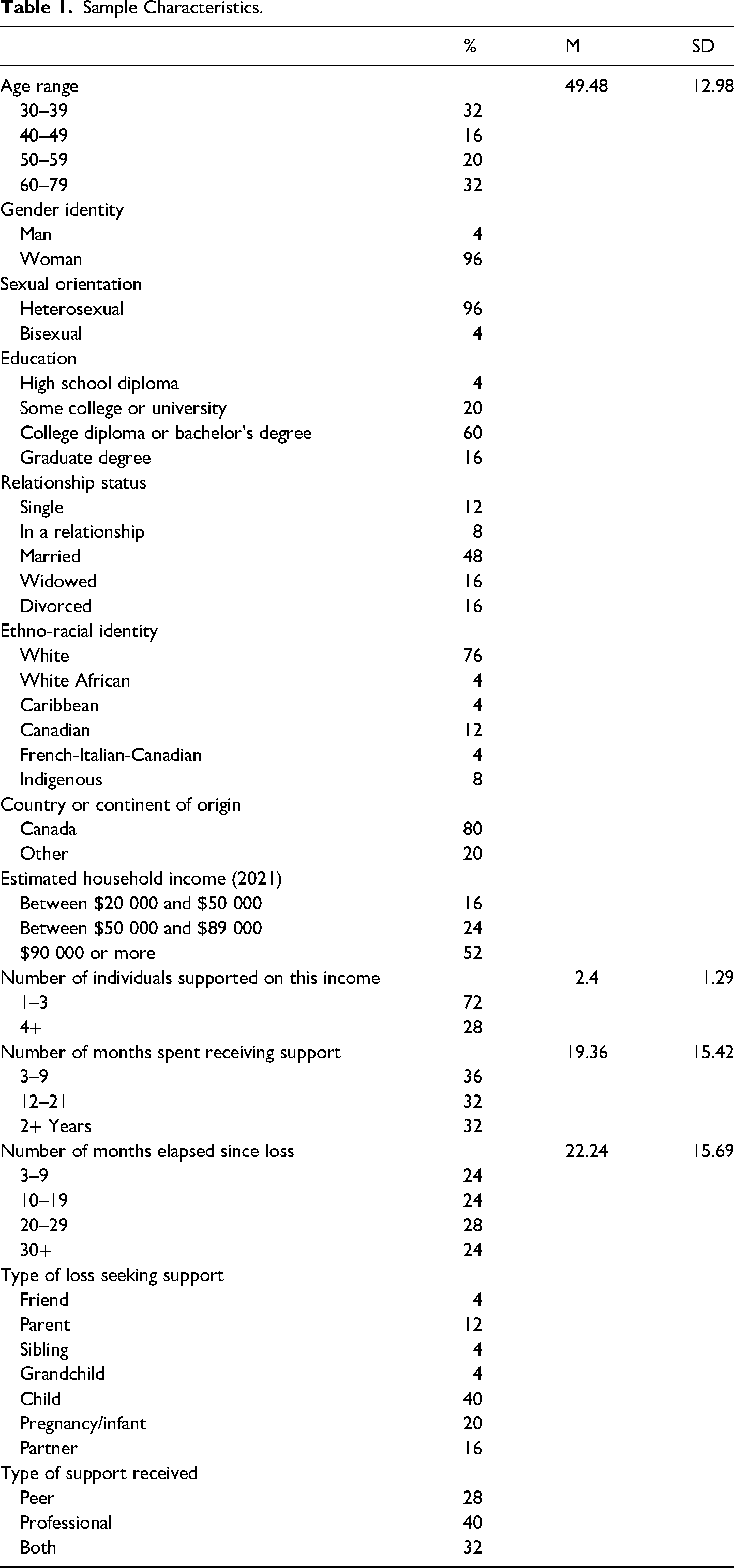
Data were collected through 25 30 to 60-min semistructured interviews during February to April 2022. A brief, interviewer-administered demographics survey was completed during the interview to collect demographic information (Table 1). Interviews were conducted using Zoom Video Conferencing, and participants attended via video call. Interviews were recorded and transcribed using the auto-transcription feature embedded within Zoom. An interview of this format was selected to collect rich and meaningful data while fostering a safe and comfortable environment for the participants to discuss difficult topics related to grief with a stranger (Dempsey et al., 2016).
Sample Characteristics.
Data Analysis
All interviews were audio recorded, transcribed, verified, and then coded using thematic analysis (Braun & Clarke, 2006). The analysis involved the six steps of thematic analysis presented by Braun and Clarke (2006): (1) familiarizing yourself with the data, (2) generating initial codes, (3) searching for themes, (4) reviewing themes, (5) defining and naming themes, and (6) producing the report. The analysis was conducted using both an inductive and deductive analysis approach similar to approaches that previous research has taken (Fereday & Muir-Cochrane, 2006).
There was a specific theoretical interest in support regarding grief and bereavement that was explicitly analyst-driven (Braun & Clarke, 2006). Therefore, it was essential that a deductive analysis component was implemented to ensure the analyst was particularly attentive to themes of interest: experiences of online support during COVID-19. As part of a deductive approach, a factor in the research project was prior engagement of the analysis with relevant literature as a means to enhance knowledge on more subtle features of the data and topic and be aware of them during analysis (Braun & Clarke, 2006). Simultaneously, this deductive approach was complemented by an inductive approach, where there was an opportunity to identify themes that may not have been expected (Braun & Clarke, 2006). The initial coding framework was deductively derived, and as analysis progressed, additional themes and subthemes that were inductively found were incorporated into the coding framework. The use of inductive analysis allowed for all of participants’ experiences of receiving support to be captured and discussed, as there were no limitations by predetermined themes in advance of the analysis (Fereday & Muir-Cochrane, 2006).
Ethical Considerations
Skinner Cook and Bosley (1995) investigated the experiences of grievers participating in bereavement research. They found many of their participants felt their involvement in bereavement research to be emotional, with experiences of intense emotions during the interview. However, many participants reported benefits to their participation, such as allowing them to share their feelings and further help others through their participation (Skinner Cook & Bosley, 1995). Regardless of any benefits, some participants reported the experience to be stressful. Bereavement researchers must do what they can to alleviate possible stress experienced due to involvement in the research (Skinner Cook & Bosley, 1995). In this study, safety measures were put in place to increase comfort for participants including: the ability to take breaks at any point during the interview, and the option to stop the interview at any time. In addition, when working with sensitive information in research, safety measures must be in place to ensure confidentiality and a lack of invasion of privacy (Dempsey et al., 2016). Interviews were recorded and transcribed for analysis, however, to maintain anonymity, there were no identifying features in how interviews were stored. Interview recordings were deleted upon transcription, and the transcripts were verified.
Approval from the Wilfrid Laurier University Research Ethics Board was obtained before the start of the study and before any changes were made to the project. Furthermore, participants signed an informed consent form before participating, listing the details of the research and the risks of participating. Upon completion of the interview, participants were sent contact information for local and online mental health resources that they could refer to, to help address any distressing emotions that may have arisen during the interview.
Results
Participants Characteristics
There were 25 participants in this study whose ages ranged from 32 to 74 years of age, with a mean age of 49. Among the sample, 96% participants identified as women, and 4% identified as a man. When asked about sexuality, 96% participants identified their sexuality as heterosexual, and 4% identified as bisexual. Participant education levels varied, with 76% of participants having received a postsecondary education degree (e.g., College diploma or University degree) and the remaining participants (24%) having completed a high school diploma or attended some college or university level education. Most participants (76%) identified their ethno-racial identity as white, with the remaining reporting to be 4% White/African, 4% Caribbean, 12% Canadian, 4% French-Italian-Canadian, and 8% Indigenous. All participants were Canadian citizens with the majority (80%) being born in Canada. Of the sample, 48% best estimated their household income over the last calendar year (2021) to be $100, 000 or more, 28% making between $50 000 and $100 000, and 16% making below $50 000 a year. Participants in this study supported one to five people on their household income, with a mean of 2.4 people.
Participants had been receiving support for their loss within three to 61 months, with a mean of 19.32 months. The time elapsed since the loss occurred was three to 72 months, with a mean of 22.24 months. Types of loss that participants were seeking support for included: friend (4%), parent (12%), sibling (4%), grandchild (4%), child (40%), pregnancy/infant (20%), and partner (46%). As displayed below, Table 1 demonstrates these demographic and participant characteristics in more detail.
Results
Several themes emerged from the interview data related to participants’ experience of receiving virtual support during the pandemic, specifically, the benefits and challenges associated with, and overall appreciation of, virtual support.
Benefits of Virtual Support
Convenient Access to Support at Home
One of the benefits of online support that participants highlighted was the fact that they did not need to travel to receive support. Some participants explained that when they were deep in their grieving process, they did not want to leave the house. Therefore, being able to receive support from the comfort of their home was helpful: “I would actually hope they continue to do online support, because I don't know if I'd have the energy or the wherewithal to get up and drive somewhere to meet with people” (P23-PEER).1 Another participant explained: I think there were also times where I may have been tempted to cancel appointments just because of the extra effort that would have been required to leave home. When I really should be receiving support in the first place so that also wasn't a barrier and I think that's really positive. (P13-PROF)
Participants emphasized that they feel safe when receiving support at home because they can remain in a comfortable space. One component of this safety was the ability to turn the camera off and not be seen if a participant felt emotional or uncomfortable in the peer support group. The ability to turn cameras on and off allowed for a sense of control for how exposed at various levels of vulnerabilities participants may be, which contributed to enhanced feelings of safety.
Scheduling
Another benefit that participants highlighted regarding online support was that it was easier to fit into their schedules. Participants explained that with children, work, and pets, it was easier to fit the support in their schedule virtually as it eliminated travel time. Additionally, participants with children explained that they did not need to arrange for child supervision as they were still able to be home. Another participant explained that they travel, and virtual support allowed for them to continue to access support from any location.
Challenges of Virtual Support
Despite many benefits of virtual support, there were also many challenges that participants found within virtual support. The following section will discuss the subthemes pertaining to these challenges, which includes large groups within peer support, challenges bonding with others virtually, and struggles finding privacy at home.
Large Groups
All participants from peer support groups were able to discuss their experiences of receiving support in a peer group virtually, as since the onset of the pandemic no in-person peer support groups were being offered by the community partner. One challenge of online support that was frequently brought up among peer support participants was that virtual support was difficult when multiple people were trying to engage in conversation within larger groups. The overlapping voices on the microphone and background noise from individuals who did not mute their microphone posed problems when trying to listen and speak within the peer group. For example, a participant explained the challenges they faced with participating in a virtual peer group: “I think online, it can be very, very difficult, especially when you've got a group of people that all have something to say, and they over talk each other, or background noise” (P20-BOTH). Another participant explained that a method to combat this challenge was to have one person speak at a time. However, this solution also presented another difficulty because “your communication is limited online with the Zoom call. You're feeling a little rushed in your answers because there's time limits” (P16-PEER).
Bonding
A challenge that participants discussed in both peer and professional support was that the online format made bonding with peers and professional supporters difficult. As the ability to read body language was inhibited, participants and supporters could not directly support someone if they noticed someone needed it: “That's one of the limitations of online support, is that nobody can hand you a Kleenex, or, you know, put their hand on your shoulder or anything like that while you’re having a meltdown on online” (P23-PEER). Further, the ability to engage in camaraderie with other peer support group members on breaks and after group was limited. Participants explained that the social aspect is lost within online peer support, because “when you’re in a room full of people [it is] easier to bond with people” (P24-PEER). The ability to bond through conversations outside the support group contributes to individuals’ comfort level with engaging in vulnerable conversations within the group. It was discussed that this comfort is lost when the group is conducted virtually. Participants also touched on this challenge within professional support explaining they prefer in person sessions because: “I really don't like online or Zoom, or you know, things like this because it's not personable, so I just don't like it” (P19-PROF). This participant is missing the personal component that comes with being in person with your supporter. Another participant explained that the ability to read body language contributes to their experience of therapy, and that this component is lost virtually.
Privacy
A final challenge of virtual support that was identified related to problems finding privacy at home to receive support without risking other household members overhearing. A participant explained that there were times they wanted to be raw in their emotions and say how they feel but “for both of them [peer and professional support], it's just trying to find that quiet space where no one else can hear you” (P3-BOTH). It was explained that this challenge was more prevalent in evenings when other household members were more often home than during the day.
Overall Thoughts on Virtual Support
Despite challenges, participants explained having peer or professional support conducted in a virtual format was not a barrier to them receiving support. Some participants who shared this perspective already had pre-established in-person relationships with their professional supporter before therapy transitioned online, and therefore, the support “feels the same” (P9-PROF). Other participants acknowledged they are comfortable with technology, and therefore, the virtual support “doesn't feel like a barrier to getting help” (P2-BOTH). Another participant expanded on this perspective to say: “Recognizing the fact that people have different levels of comfort with technology. I'm pretty technically able and I'm in Zoom like multiple times a day so I can navigate the virtual side of things pretty easily” (P4-BOTH). A participant explained that within the limitations of virtual support, they are still “able to talk and cry, and hear other people's feelings” (P17-PEER) and therefore the support is still helpful.
Discussion
A goal of this research was to understand the impact that the transition to virtual support during the COVID-19 pandemic had on those seeking grief support. Previous literature surrounding virtual support has indicated that some groups (e.g., people of low socio-economic status, Indigenous, migrant, and elderly populations, as well as people who identify with having a disability) will have more difficulty accessing virtual support (Ioane et al., 2021). Based on demographics, a few of the current study's participants would be part of such groups, but none of them highlighted difficulties in accessing support based on the virtual format. However, this research is limited with regards to the fact that the majority of the current study participants were not members of such groups, and the sample size was small, and therefore, more research should be conducted to understand the accessibility of virtual support services regarding marginalized populations experiencing grief.
There were additional limitations regarding virtual support mentioned by participants, including a difficulty within larger support groups to facilitate discussion, and an elimination of varying components that offered a bonding experience. Responses of these participants regarding larger groups in peer support indicate there are additional problems when trying to conduct a virtual support group with a large amount of people, as there are difficulties with hearing the group and participants feel rushed in their responses. These complaints were found minimally within professional support, which suggests that in a peer support circumstance where there are large groups of people speaking, and the purpose of the group is to bond with others of similar circumstances, virtual support may not be as optimal. When considering this result in relation to social support theory, the dimension of companionship as discussed by Östberg and Lennartsson (2007) is limited as there are barriers to being able to fully participate and be present in a virtual group setting. Despite limitations, based on participant responses regarding their overall thoughts on virtual support, it is evident that pre-established in-person relationships with their supporter, and technological comfort influenced perspectives regarding virtual support. Participants were also aware that peer and professional supports were doing the best they could amid a pandemic to provide support, and ultimately found it to be helpful.
Overall, participants appreciated the virtual support format, and many acknowledged they hope virtual support continues to be available. This finding is consistent with recommendations by the Centre for Addiction and Mental Health (2020) and Smith et al. (2021), who suggest that support providers continue to permanently implement virtual support within their services to maintain client-centred care, and to provide clients options as to what type of support (virtual or in-person) is best for them. Previous literature has identified that a challenge in virtual support is finding an appropriate location to attend support while maintaining privacy (Ioane et al., 2021). The current research found evidence to support this issue, and, for example, one participant explained that having their partner overhear their support session was an additional stressor they experienced while accessing the support. However, most participants explained the virtual support format was enjoyable for them, as they did not need to travel, could remain in their own home, and that virtual support was easier to fit into their schedule. This result is consistent with that of Békés and Doorn (2020), who found that virtual support for grief was helpful in reducing travel costs and time.
Limitations
Although the results of this research contribute to an understanding of the application of peer and professional support virtually to assist with coping with grief, there are a few limitations to this study. First, there was a lack of diversity among participants in terms of gender identity, race/ethnicity, and sexual orientation. The lack of diversity in the sample relating to socio-economic status may explain why no similar results were found in relation to Ioane et al. (2021) who suggested marginalized individuals may experience challenges accessing virtual support. More research should be conducted to further explore this digital divide to understand its impact on marginalized communities. Another limitation of this research is that although all participants received virtual support, the peer support was in a group setting, and in professional support, the setting was one-to-one. Although grief support services differed in these formats, several common themes were found across service types regarding virtual support, such as the ease of support at home and scheduling. Based on these similarities, it can be interpreted that the challenges experienced within peer support large group dynamics online can be applied to other group settings, such as online group support facilitated by a professional supporter. However, more research should be done to further explore online support experiences in group settings. A final limitation is that the sample for both peer and professional support was recruited within one community, and therefore, results may not be generalizable to other communities. The authors made this decision to eliminate regional confounding factors based on the community partner servicing Midwestern Ontario. Therefore, all professional support service users were also located in this area. However, we did not ask participants where their professional support provider was specifically located.
Conclusion
This research aimed to address a gap in the literature by exploring the experiences of those accessing grief support, whether it be peer, professional, or both. In addition, this research, conducted in the context of the COVID-19 pandemic, provided the opportunity to understand experiences with virtual grief support. The findings suggest that virtual support has many benefits (e.g., staying at home, easier to fit into a schedule), and challenges (e.g., the reduction of bonding experiences among both support formats). This research study also partnered with a community partner who can use the results to enhance their programs and services through understanding their service user perspectives of virtual support. Furthermore, this research can inform the broader sector of social support services for grief and bereavement about the impact, strengths, and limitations of online support services in a group or one-to-one setting.
Footnotes
Declaration of Conflicting Interests
The authors declared no potential conflicts of interest with respect to the research, authorship, and/or publication of this article.
Ethics Approval and Consent to Participate
Ethical approval for the project was obtained from Wilfrid Laurier University’s Research Ethics Board (REB #7069) prior to completion of the project. Written informed consent was obtained by all participants in advance of participation.
Funding
The authors received no financial support for the research, authorship, and/or publication of this article.
