




Abstract
People with dementia (PwD) often face symptoms that influence their memories and capabilities to express themselves meaningfully. These symptoms make it particularly challenging for qualitative researchers to capture and demonstrate PwD's complex experiences with the traditional reliance on textual outputs. This paper offers a novel approach through performative portraiture to demonstrate and argue that the use of this approach is needed as an alternative academic output that diverges from textual reliance. The paper begins with an overview of the research, which aimed to improve understanding of the initiation and revision process of advance care planning with and for PwD and was used as a baseline to create ‘Dave’ as a young PwD based on the verbatim interview transcripts of 13 PwD. The methodological process is outlined, and findings are then chronologically discussed. The paper concludes with the strengths and limitations of this approach as well as its future implications.
Introduction
Dementia is an umbrella term for several neurological conditions that affect individuals’ memories as well as capabilities to think, read, and write (NHS, 2021). People with dementia (PwD) often face challenges in expressing their experiences, especially with their dementia symptoms that affect the writing, reading comprehension and speaking skills along with their fluctuating mental, anxiety and forgetfulness (Abendstern et al., 2019; Phenwan et al., 2023a,b; Webb et al., 2020). These inherent symptoms of dementia are also particularly problematic for qualitative researchers, given that the approach aims to explore and understand the complex experiences of participants (Denzin & Lincoln, 2017; Webb et al., 2020). Furthermore, these symptoms are exacerbated by the traditional reliance on textual outputs in research, which might not fully capture the nuance of such experiences, particularly for PwD. As such, alternative approaches that are not fully dependent on textual outputs and can capture and express the nuances of participants’ experiences are still needed.
There has been an increasing number of qualitative outputs that utilise creative methods; all indicate the need to meaningfully present qualitative data in a more nuanced way. Examples include the use of emotional maps (Goldman et al., 2022), poetry (Parsons & Pinkerton, 2022), and textile making (Andrä, 2022), amongst others. To contribute to this movement, this methodological paper demonstrates and argues the use of performative portraiture approach as an alternative academic output that diverges from textual-reliant outputs (Rodríguez-Dorans & Jacobs, 2020).
Narrative inquiry has a long history in the social sciences as an approach that allows researchers to explore an ‘important connection between life as lived and life as told in personal narratives’ (Goodson & Gill, 2011, p.5). A narrative inquiry approach is essential for a deep understanding of lived experience, especially in cases where individuals’ voices are not often heard and their perspectives are neglected (Goodson et al.). As PwD's cognitive functions change and the individual with dementia is perceived as losing the capacity to articulate their stories, the need for a methodological approach that responds to this is both an academic requirement and humanitarian endeavour.
Since narrative inquiry relies on the capacity of the individual to articulate their experience through language (Murray, 2000; Wong & Breheny, 2018), combining narrative with performative inquiry has been a move towards expanding beyond word-centred methods that pose limitations for the exploration of phenomena that need multidimensional representation. Performative inquiry emerges in the field of arts and education to invite researchers to explore and share their learning through performative writing and other creative representations (Fels, 2012). The focus on performance highlights the importance of co-creation between people involved in research, which can lead to innovative productions through embodied engagement, listening to the voices of all involved, recognising their agency, and challenging preconceptions around who has the capacity to create stories (Fels, 2012).
Thus, ‘performative portraits’ (Rodríguez-Dorans, 2023) constitute a methodological approach that combines narrative and performative inquiry as data sources that are complementary of each other. The narrative element draws attention to the verbal content of people's stories and how these need to be represented in their own words (Rodríguez-Dorans, 2023). The performative element highlights that the stories are not disembodied, abstract products but are embodied and articulated by physical beings, and therefore, a corporeal element needs to be included in the process and product.
With its base on narrative, the performative portrait presented in this paper utilises verbatim transcripts of the participants’ interviews to create a script that is used to be re-enacted by a performer who gives actual voice and body to the script. This allows researchers to visualise and experience their findings in a different light, aiding the data analysis (Rodríguez-Dorans, 2023; Rodríguez-Dorans & Jacobs, 2020). The result is a performative piece that can be presented to external audiences to allow them to interpret the participants’ narratives of what it is like to live with dementia beyond the researcher's argument alone. The researcher works collaboratively with the participants, listening deeply to what they say and how their body aids them significantly in the delivery of the story. Then the researcher works with a performer who uses their body, voice, spaces, and personal interactions to reenact the stories of participants to an audience who, in turn, have the opportunity to engage with the findings on a relational, affective level. Thus, a performative portrait can be used to bring research findings to life, to the here and now, in an embodied way.
The paper begins with an overview of the research that was used as a baseline to create this creative outlet. It then outlines and discusses the process of creating a new persona of young PwD ‘Dave’ based on the performative portraiture approach. Next, the findings are chronologically discussed. The paper concludes with the strengths and limitations of this approach as well as its future implications.
Methods
Research Overview
The narratives that constitute the basis for the performative portrait presented in this article are based on the datasets from the first author's doctoral study. The thesis aimed to improve understanding of the initiation and revision process of Advance Care Planning (ACP) with and for PwD to contribute to opportunities for actioning in their future at the appropriate time and shared with the appropriate people. In the context of the thesis and this article, ACP is defined as ‘a process that supports adults at any age or stage of health in understanding and sharing their personal values, life goals, and preferences regarding future medical care’ (Sudore et al., 2017, p 286).
Theoretical Framework of the Empirical Studies
Bronfenbrenner's bioecological theory was utilised as the empirical studies’ theoretical framework (Koller et al., 2019; Rosa & Tudge, 2013). Findings from these two studies are not central to this methodological paper and are presented elsewhere (Phenwan et al., 2023a, 2024b).
Bronfenbrenner posits that individuals (in this instance, PwD) are nested under several interrelated environment systems. This includes their immediate setting (family, friends) to the more remote and abstract environment (cultural influences, societal values and policies) which will influence each other over time (Rosa & Tudge, 2013).
In the context of the first author's doctoral study, the microsystem is PwD and their interactions with carers and friends. The mesosystem includes influences from HCPs and extended families whereas the exosystem relates to the quality of care that PwD received based on the coordination of care in their area. Each system's influence over each other over time is captured under the chronosystem. The macro-influence of dementia policies over the ACP process for PwD is explained under the macrosystem (see Figure 1). A social constructionist approach was adapted to understand the multiple realities around PwD (Denzin & Lincoln, 2017; Scotland, 2012). With this approach, the first author explored and co-constructed the experience around ACPs with and for PwD.
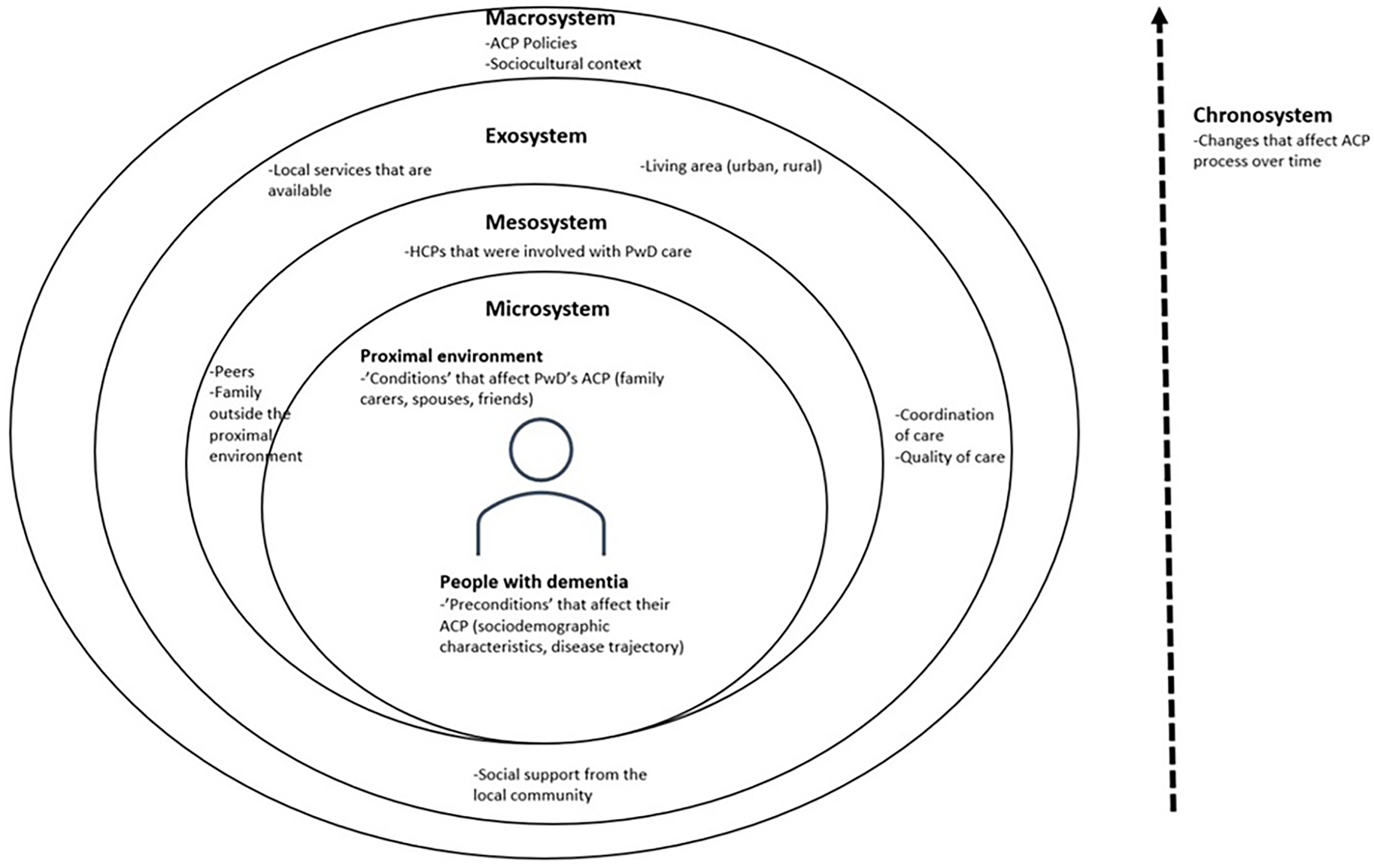
Theoretical framework.
Ethics
An ethical approval was obtained (first author's university/ethical approval number/first author's family name). The narrative was created in accordance with the existing ethical approval. An extensive support and distress protocol was created, based on a rapid review published prior which included strategies to mitigate practical, technical and ethical considerations to virtually conduct potentially sensitive subject interviews with PwD (Phenwan et al., 2021). Four pilot interviews were conducted; the protocol was subsequently revised based on participants’ feedback. The support and distress protocol was subsequently applied before, during and after the interviews. Flexible informed consent process was utilised; PwD could provide their consent to join the study in either a written or recorded verbal format. Participants could choose to join the interviews either with Microsoft Teams or a telephone call. These strategies offered more flexibility for PwD to join the study with the method they felt comfortable with (Phenwan et al., 2023b).
During the interviews, the first author observed any signs of potential distress to ensure their well-being. Participants could withdraw from the interview or have a break from the interviews at any time without any negative consequences. Immediately after each interview, the first author provided a verbal debrief to participants to ensure that they understood the purpose of the study and how their data would be used. A written debrief form was also sent to all participants via email afterwards. Participants’ interviews were transcribed verbatim and anonymised to protect their identities and confidentiality, including this performative portrait.
Participants Characteristics
Thirteen PwD who lived in Scotland were recruited from the Join Dementia Research platform as a part of the doctoral study. The platform was chosen to enhance inclusivity and empower PwD to have more flexibility and control over whether they want to join research or not (Karagiannidou et al., 2022; Phenwan et al., 2024a). This decision aimed to mitigate the common barrier in dementia research; that is, PwD tended to be hard-to-reach due to several gatekeepers restricting access to PwD without their knowledge (Karagiannidou et al., 2022; Phenwan et al., 2021, 2023b).
The narrative interviews with participants took place from October 2020 to March 2021. Eight PwD joined the online interviews via Microsoft Teams, four joined telephone interviews and one PwD opted for email interviews. The age range was from 51 to 87 years old with the mean of 68.7. Of which, eight PwD were male and five were female. The most common diagnosis was Alzheimer's disease (N = 8), followed by vascular dementia (n = 3).
The Creation of Performative Portraiture
A performative portrait is created through the researcher's close attention to what the participants say, how they say it, and how they use their bodies to convey their meanings (Rodriguez-Dorans, 2023). The researcher relies on these sources of information to understand the phenomenon they are exploring and communicate the findings through a performative outlet that will allow them to evoke the findings as they were witnessed during the research encounter. This format allows the researcher to represent the findings through the narrated and embodied experiences of the research participants. This embodied representation recognises the role of the body in the production of knowledge.
One of the most important benefits of creating a performative portrait is that it communicates findings in an accessible way to audiences, enhancing knowledge exchange. As audiences listen to the stories and witness a performer deliver them using the words of the participants, the participants’ experiences prevail over abstract theoretical/scientific language that can distance the public from what the participants have gone through.
In the work of communicating complex and sensitive material, performative portraits can produce a compelling case when the role of the body is central to understanding how dementia is experienced, and attention needs to be brought to embodied forms of communication beyond verbal language (Rodríguez-Dorans & Jacobs, 2020).
As PwD experience difficulties in articulating ideas and communicate with others as their verbal capacity is compromised, they might gradually be further overlooked or dismissed in everyday interactions as individuals who are unable to communicate. Limitations might be perceived as inability. Thus, given the gradual social withdrawal of the PwD's right to communicate, this research aimed to avoid the ‘epistemic dispossession’ (Pillow, 2020) of the individual and put the person at the centre of the knowledge-creation process.
In this performative portrait process, knowledge is created with the participants at the centre of the process of inquiry. The first author interviewed participants in an act of recognition of their capacity to make sense of their lives, even in the struggle that it represents to articulate and ‘connect the words’. The interviews and their centredness of words, make the research process paradoxical and poignant, given that it is the verbal capacity that is compromised. Still, with the struggles and the limitations, participants found the words and made sense of their experiences.
Words were not the only medium used to communicate. Participants stuttered, used prolonged pauses, gestures, stopped to think and made visual contact and other nonverbal cues to communicate with the researcher. This means participants used their bodies to convey the layers of experience in the interviews in a way that the verbal component of the conversation was not the only source from which meanings were drawn (Cooperrider & Goldin-Meadow, 2017). The researcher entered a process of witnessing and experiencing the participants as embodied beings. The interview then became more than a source of narrative material, but also a source of embodied material with an additional focus on embodied happenings.
Thus, the interview transcription process focusing on words alone was no longer enough as a way to convey the complexity of experience. The body became an essential component of the process of inquiry and in tackling ‘potential epistemic violence that can be reproduced through practices – such as anonymisation and language-centred methodologies – that protect but also regulate the visibility of certain subjectivities, certain bodies, certain ways of communication, and certain individuals. By focusing exclusively on the words and what is said, the research process might ignore what the body shows without saying a word, it might neglect forms of communication that lie beyond the realms of linguistic capital.’ (Rodríguez-Dorans, 2023, p. 78–79).
First, the first author created a transcript based on 13 PwD's collective verbatim quotes that aimed to address three key aspects: i) PwDs’ everyday life and struggles; ii) affective moments as sources of data and (iii) how and when PwD plan their ACPs along with their lingering uncertainty towards the discussed future.
The first author examined the verbatim quotes from participants and paid attention to these three aspects from each interview. Illustrative quotes that meaningfully captured the collective narratives of 13 PwD in relation to each aspect were subsequently utilised. The chosen quotes demonstrate PwD's struggles for words in each moment, along with the actor's performance.
Second, additional notes were given to the performer, a professional actor who was contacted for the portrayal of this narrative. These notes provided contextual information regarding dementia as well as the newly created persona called ‘Dave’ which consists of all PwD's background (see Figure 2). The actor was briefed about the context of the study and the significance of performing the narratives of real-life experience with dignity and respect. As the first author had firsthand experience of the research interviews, the actor benefited from a discussion with him in which details of behaviour and emotional content were shared with the aim of presenting the performance in close proximity to the research encounters. The PwD's collective first-person narrative is then represented by an actor in a short video format to bring the affective embodied elements of the experiences to the fore whilst protecting participants’ anonymity (Phenwan, 2021).
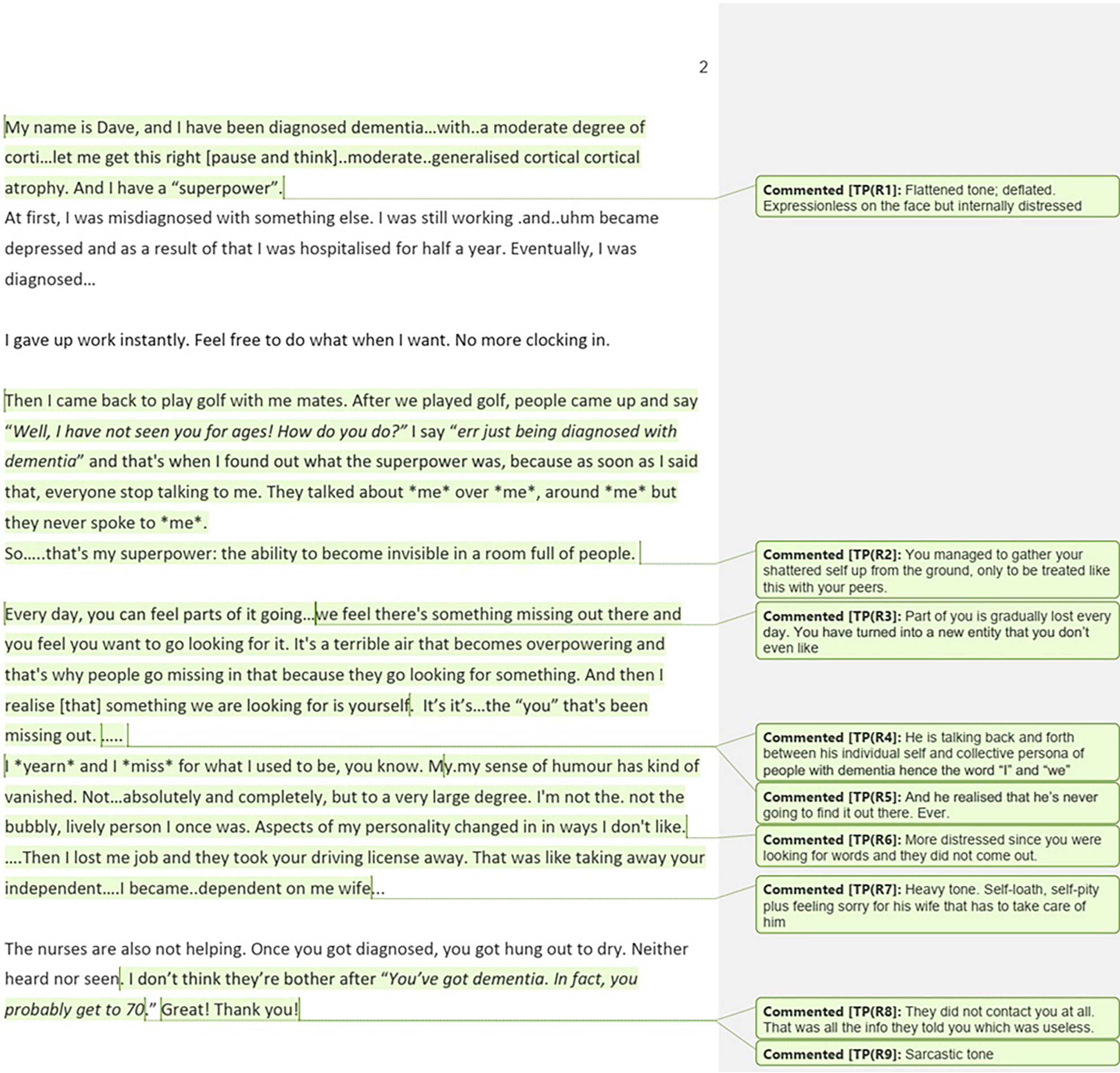
Narrative portrait of Dave.
Findings
‘Narrative Portrait of Dave’
Losses
The narrative begins with Dave's recount of his multiple losses: loss of social identities (‘my superpower’), loss of personhood (‘the “you” that has been missing out’) and loss of independence due to dementia symptoms (‘I became dependent on me wife’).
For Dave, loss becomes a lifelong process, as he faces the gradual disappearance of his personhood and seems to become an absent presence. He narrates how people start talking about, over, and around him, but not speaking to or with him. The disclosure of a diagnosis seems to activate a response in people in which they change their approach to him, until they no longer speak to him. His narrative suggests that the diagnosis of dementia brings, not only the medical implications of his condition, but also a new stigmatised social identity that takes away his previous social identities as people do not respond to who he is. The gradual development of his dementia contrasts with the abrupt aloneness in which he finds himself in, bringing into question whether Dave is still the same person to his peers. The awkward responses from people who used to be close and friendly to him leave Dave wondering who he is to them. ‘Realising that something you’re looking for is yourself’ becomes an impactful phrase in which Dave connects with the loss of who he is. That is, Dave realises of his changing personhood and identities, which he finds challenging to accept (‘my personality changed in ways I don’t like’). This loss of personhood is further compounded by his social loss. That is, his ‘ability to become invisible in a room full of people’) is a phrase that illustrates the social loss that Dave experiences in relation to the disclosure of his diagnosis. The impossibility of engaging in social interaction with others in the light of dementia becomes apparent in the narrative. The question ‘Who am I to you’ is a crucial one, in which the loss of social relations – friends who used to play golf with him and engage in ordinary aspects of life – no longer engage in the ways they used to. What characteristics does one need to have to be counted as a person?
Finally, his loss of independence was not mitigated when the information he received from his nurse was perceived as not useful (‘…you probably get to [live until] 70’), thus exacerbating his multiple losses.
Trigger Point for ACP
The performance further illustrates the reasoning behind Dave's ACP, as well as when, how and with whom he discussed his ACP.
The current recommendation to discuss an ACP with and for PwD is to engage with them as early possible, particularly before the PwD start to lose their mental capacity (Harrison Dening et al., 2019; Mattos et al., 2023; Phenwan et al., 2023a). Contrastingly, Dave discussed his ACP much later on after his diagnosis of dementia. For Dave, he felt the need to have an ACP when he met other PwD who had discussed their ACPs (‘they put everything in place’). This experience made him realise the necessity of ACP for both himself and his family (‘you never know your minutes’ and ‘get it [ACP] in place to save heartaches and confusion…’). At this moment in time, Dave challenges the current recommendation of an early ACP with and for PwD since he has discussed his much later in his dementia journey.
He further recounted the person (s) who was involved with the ACP process which included his wife (‘me wife and I’) and possibly another healthcare professional who supported the ACP process, indicating that an appropriate support is needed for Dave and his wife.
Dave further narrated his struggles to discuss ACP with his family due to his dementia symptoms (‘I struggled to connect the words’) that impede his reading comprehension skill (‘they make no sense to me’). The documentation process was also perceived as another challenge due to the amount of paperwork he had to go through at once (‘they gave you that much paperwork and none of it made sense’), contributing to his struggle to discuss and document his ACP. This experience from Dave resonated with the literature which suggests that the ACP process should be iterative and be discussed over time along with appropriate support (Mattos et al., 2023; Phenwan et al, 2023a).
Uncertain Future
The narrative concludes with his lingering uncertainty towards his planned future. That is, to the best of his ability, Dave had discussed his ACP along with his wife (‘we have planned our lives down to the last detail’). Yet, Dave still felt the lingering uncertainty towards his planned future. This feeling of uncertainty stems from two reasons: i) he was not sure if his planned future would be adhered to (‘whether we’ll be able to do it, I don’t know’) and ii) there were certain aspects in the future that he could not be explicitly planned e.g., moving into a care home, his declining future self that might not recognise others (‘will I recognise them?’) and how others will treat him in the future (‘how are they going to be with me…’). This was further suggested when Dave's conversations started to become less coherent towards the end, indicating his stress as well as fluctuating mental capacity.
This part of the performance indicates the unique challenges of PwD to engage with their ACP. That is, ACP is a complex process that requires an individual (e.g., their current self) to conceptualise their future preferences (e.g., their future self) (Perry, 2022; Wendrich-van Dael et al., 2020). This complex conceptualisation of ideas contrasts to PwD's main coping strategy to engage with their present self and maintain their established routines as well as current normality that that can control (Han et al., 2015). This might explain why Dave still expressed his lingering uncertainty towards the discussed future even though he had thoroughly discussed and documented his ACP.
Discussion
This section respectively discusses the strengths and limitations of this novel approach of performative portraiture and offers future implications for other researchers.
We have created this performative portrait and aim to help researchers, clinicians, carers and the public have a better understanding of what it is like to live a life with dementia. The creation of a composite narrative is intended to encompass a series of narrated experiences that were shared by participants across different interviews. This presents a condensed version of experience that would otherwise take significantly more time to present in the form of individual cases. While we acknowledge that a composite narrative might be seen as a fictionalisation of individuals’ experiences, the intention is to stay as close as possible to the multiple difficulties and realities participants expressed and share them with a wider audience as an educational resource that helps people get a sense of what it is like to live with dementia from firsthand narrations.
The embodied performance of Dave can be seen as a direct illustration of stigma as a social issue that accompanies the diagnosis of dementia (Bhatt et al., 2023). This portrait can be seen as an activist methodology that affirms the expertise of PwD in narrating their own lives with the cognitive changes experienced due to the condition.
Conceptualising communication beyond verbal language helps to shed light on concealed aspects of experience, such as the multiple losses that are exacerbated not by the diagnosis of dementia but by people's responses to it (Bhatt et al., 2023). Seeing Dave convey his story – which represents the stories of many people with a similar experience – is intended to be a claim for the recognition of the importance of interconnectedness for PwD (Abbott, 2020; Benbow et al., 2019). That is, Dave still wants to connect with people, as much as or more than before his diagnosis, but the way he is perceived by others is different. Consequently, Dave's story should be seen as a call for others to recognise PwD's relational needs. The intention of this performative portrait is to provide a more nuanced understanding of intrapersonal and social issues associated with dementia and highlight the voices and experiences of individuals who live with this condition.
The performative portrait offers a novel and creative research output of qualitative research. This is particularly useful for this work given that the actor could portrait Dave in a more nuanced way which the textual outputs alone cannot capture (Burn et al., 2001).
Finally, upon team reflection, we found that the performance shows the voice of the most underrepresented of the underrepresented group (in this instance, a male person living with early onset dementia). The dominant narrative, assumptions and stigma around dementia tend to focus around older people (older than 65 years) who have been diagnosed with Alzheimer's disease (Herrmann et al., 2018; Kim et al., 2021; Stites et al., 2018; Werner & Kim, 2021). However, such assumptions do not fully capture other conditions under the umbrella of dementia such as vascular dementia or Posterior Cortical Atrophy. The visibility of people living with early onset dementia is also often neglected. As such, this performance puts Dave to the fore thus making this underrepresented group more visible.
Future Implications
We found this approach can be utilised in three ways:
First, the narrative portraiture approach can be used as an alternative way to disseminate research outputs to wider audiences. That is, the performance is based on empirical evidence yet is made more accessible to wider audiences. This is indicated when the first author contacted several PwD and asked for their opinions of the video; all felt that the video has meaningfully captured their lives. Family carers of PwD also expressed similar opinions. Second, the narrative portraiture approach can be used as an evidence-informed teaching material. Both authors use this video as teaching material in their sessions on communication skills, counselling skills, and how to discuss an ACP with PwD, indicating the usefulness of this approach. Finally, the narrative portraiture approach can be a useful strategy for creating a more interdisciplinary collaboration. This is evident from the video given that the first author comes from a medical background (a family doctor and gerontologist) while the second author is from an art and psychology background. Yet our creation manages to challenge traditional research practices and amplify marginalised voices that can engage with even more diverse audiences.
As demonstrated by Dave's narrative, the difficulties he experienced with social isolation emerged from how the people around him gradually withdrew their social connections. Thus, performative portraiture can contribute to the growing approaches which provide activist methodologies (see Burn et al., 2001; Geregová & Frišaufová, 2020; Yeboah, 2020) by extending participants’ epistemic power, validating their experiences, and demonstrating the harms of stigma around dementia. This would help bridge the distance between research and advocacy, highlighting systemic oppression, and pursuing social justice.
Limitations and Conclusions
This work poses few limitations:
When creating a performative portrait of a PwD, an epistemological limitation presents in the difficulty of articulating an unintelligible experience that is grounded on the body. Conveying this clarity while accounting for the challenges of the participants in putting their thoughts into words presented us with the limitation of representing the experience truthfully and succinctly. Although the difficulty in articulating what it is like to live with dementia and plan for the future represents a limitation, it also represents a strength of the methodological approach as it emphasises the need to incorporate the perspectives of PwD as ‘experts by experience’ (Happell et al., 2020) to understand from their perspective what is otherwise difficult to grasp. The foregrounding of the participants’ perspectives through the performative portrait expands their epistemic power and helps to bridge the distance between the healthcare professionals, carers, and PwD, as the portrait provides a truthful account of their lived experience. This is also congruent with the social constructionist approach underpinning this study, a conceptual understanding of performative portraiture relies on narrative identity explained as autobiography (Ricœur, 1984), where participants provide accounts of their life stories, bringing an embodied component to complement the narrative, in which gestures, cues, intonations, pauses, laughter, tears, and other non-verbal content occurring during the interviews convey a richness of emotional content that participants experienced during the interview and cannot be transcribed or even described. This challenge in incorporating an embodied component to the performative portrait was mitigated by an engagement with a process of reviewing the recordings for embodied data and then seeking to convey that to the actor to reenact an impression of the participants’ embodied experience through the lens of the researcher.
A potential limitation of this paper could be the different backgrounds that both authors have in relation to the topic, which could be seen as partial knowledge. The first author has expertise in the subject area of the paper, namely the medical aspects of dementia. The second author has expertise in the methodological aspect of the paper, the creation of performative portraiture. This potential difficulty was mitigated by the interdisciplinary work in which both authors and the actor collaborated in getting a deeper understanding of the qualities required for this performative portrait by discussing in depth the experiences of interviewing the participants and how these experiences could be conveyed through performance.
Finally, the composite narrative of Dave presents the advantage of condensing significant experience into a short narrative. However, this brings the limitation of losing the opportunity to represent a wider range of experiences that were narrated by all participants. This limitation could be mitigated by future outputs, such as a multi-actor performance that engages with a number of participants’ narrated experiences and allows to observe their distinctive experiences.
In conclusion, this methodological paper discusses the benefits of a narrative portraiture approach and how to create a portrait based on one study of experiences of PwD. We argue that this approach offers an alternative, creative output for qualitative research that tends to be dominated by textual outputs and should be further utilised.
Footnotes
Declaration of Conflicting Interests
The authors declared no potential conflicts of interest with respect to the research, authorship, and/or publication of this article.
Funding
The authors received no financial support for the research, authorship, and/or publication of this article.

Author Biographies
Appendix 1.
Dave's background and dementia background.