



Abstract
Meaning-making is a crucial coping strategy for parents following a traumatic loss of their child and has been associated with better adjustment for parents dealing with such losses. However, meaning-making is often underexplored. The present study investigates the use of meaning-making coping among parents who experienced the traumatic death of a child. The study involved 117 participants (n = 108 female, n = 5 male, and n = 4 who did not disclose their gender). Overall, 117 parents responded to open-ended questions using the LimeSurvey tool and 17 parents participated in telephone interviews. Through a thematic analysis of the collected data, five key themes emerged: religion as a source of personal strength and support, tragic optimism, finding meaning through supporting others and the meaning of the parent-child bond. This study holds significant importance in advancing our understanding of parental grief in the context of traumatic loss. The findings emphasize the critical need to provide support for parents and assist them in the process of meaning-making, which can play a pivotal role in reducing the risk of negative consequences that often follow the traumatic death of a child.
Introduction
The death of a child can cause severe and long-lasting grief in parents (Hussin et al., 2018). Bereaved parents often experience an interplay between trauma and grief (Raphael, 2006). The effects of their loss can be more intense in parents who have lost their child due to traumatic deaths such as suicide, homicide, violence, or accidental death which can increase the risk of post-traumatic stress reactions and a higher risk of suicide in parents (Murphy, 1997). The grief of the traumatic loss is also severe due to the nature of deaths that are unexpected, sudden, preventable, and occur due to intentional harm and mutilation (Stamm, 1999).
The fundamental beliefs of parents about themselves and the larger world are shattered after the traumatic loss of their child, and parents question the reasons for the traumatic loss. Parents who have experienced traumatic loss evaluate or assign a specific meaning to their experiences by determining the degree of threat and control they experience, attributing cause, and determining the significance of the loss (Park, 2010). Parents’ responses to their loss are determined by the evaluated meaning they give to the loss, and according to Brown et al. (2019), traumatic events typically have long-lasting detrimental repercussions on survivors and their futures, which are seen as unjust, unpredictable, and uncontrollable. The disjunction between the appraised meaning and their global meaning creates distress that requires meaning-making efforts. These efforts may also involve generating meaning, and people employ a wide range of additional active and passive coping mechanisms to reduce their pain (Park et al., 2021). Meaning-focused coping is also known as appraisal-based coping because it involves using one's values (such as “mattering”), beliefs (such as religious or spiritual), and existential objectives (such as one's purpose in life) to preserve coping and mental health while going through a difficult situation. A key factor in adaptive adjustment is the ability to frame unfavorable situations in a positive light, and meaning-making coping enables parents to do precisely that.
Meaning-making coping is found to be an important factor that determines a positive grief experience in bereaved individuals who have lost their loved ones to suicide (Dransart, 2013). Bereaved individuals who can find meaning after their loss can live with a deeper and more coherent understanding of the event. The capacity to find meaning after loss is associated with positive changes in one's identity in the aftermath of adversity, experienced as posttraumatic growth (Tedeschi & Calhoun, 1996). However, making sense of the traumatic loss can be very challenging for parents, and a failure to find meaning in their loss results in a risk of poor adjustment (Lehman et al., 1987) and complicated grief (Holland et al., 2006).
To date, research on meaning-making coping after the death of a child has been limited (Ahmadi & Zandi, 2021; Lichtenthal et al., 2010; Pelacho-Rios & Bernabe-Valero, 2022), and consequently, there is a limited understanding of meaning-making coping, specifically in the context of traumatic loss. Most of the existing literature has focused on parents after the death of a child due to illness (e.g., Barrera et al., 2009; Uren & Wastell, 2002; Wu et al., 2008; Wheeler, 2001). Acknowledging the distinctive challenges encountered by bereaved parents following the traumatic death of a child (Cerel et al., 2008), a generalized application of the understanding of meaning-making across all modes of death may yield inaccurate conclusions. Existing frameworks addressing loss and trauma may inadequately encompass the unique implications of grief after a traumatic death (Green, 2005). For example, suicide introduces challenges in coping and meaning-making that may not align with linear stage theories of grief (Begley & Quayle, 2007). Furthermore, while the literature on meaning-making has predominantly employed quantitative methods to quantify the experiences of bereaved individuals, such approaches may not fully capture the thematic content intricately associated with the grieving process (Jordan, 2001). Consequently, a nuanced approach is imperative to accommodate the diverse experiences of bereaved parents.
Studying meaning-making coping in parents after a traumatic loss is vital to enhance their efforts to cope with the psychological consequences and other impacts of traumatic loss. Meaning-making is one of the coping strategies that can be employed by parents to psychologically cope with traumatic loss and can help people who face challenging circumstances find meaning and overcome the negative consequences of their circumstances (Pakenham & Rinaldis, 2001). Hence, the objective of this qualitative study is to explore the meaning-making among parents following the traumatic death of their child. This research holds significance in providing support to parents who have undergone the traumatic loss of a child.
Methods
Research Design
A descriptive qualitative design was utilized to describe details of a phenomenon from those with experience in the phenomenon (Bradshaw et al., 2017). This qualitative descriptive study explores the experience of parents in meaning-making following the traumatic death of a child.
Participants
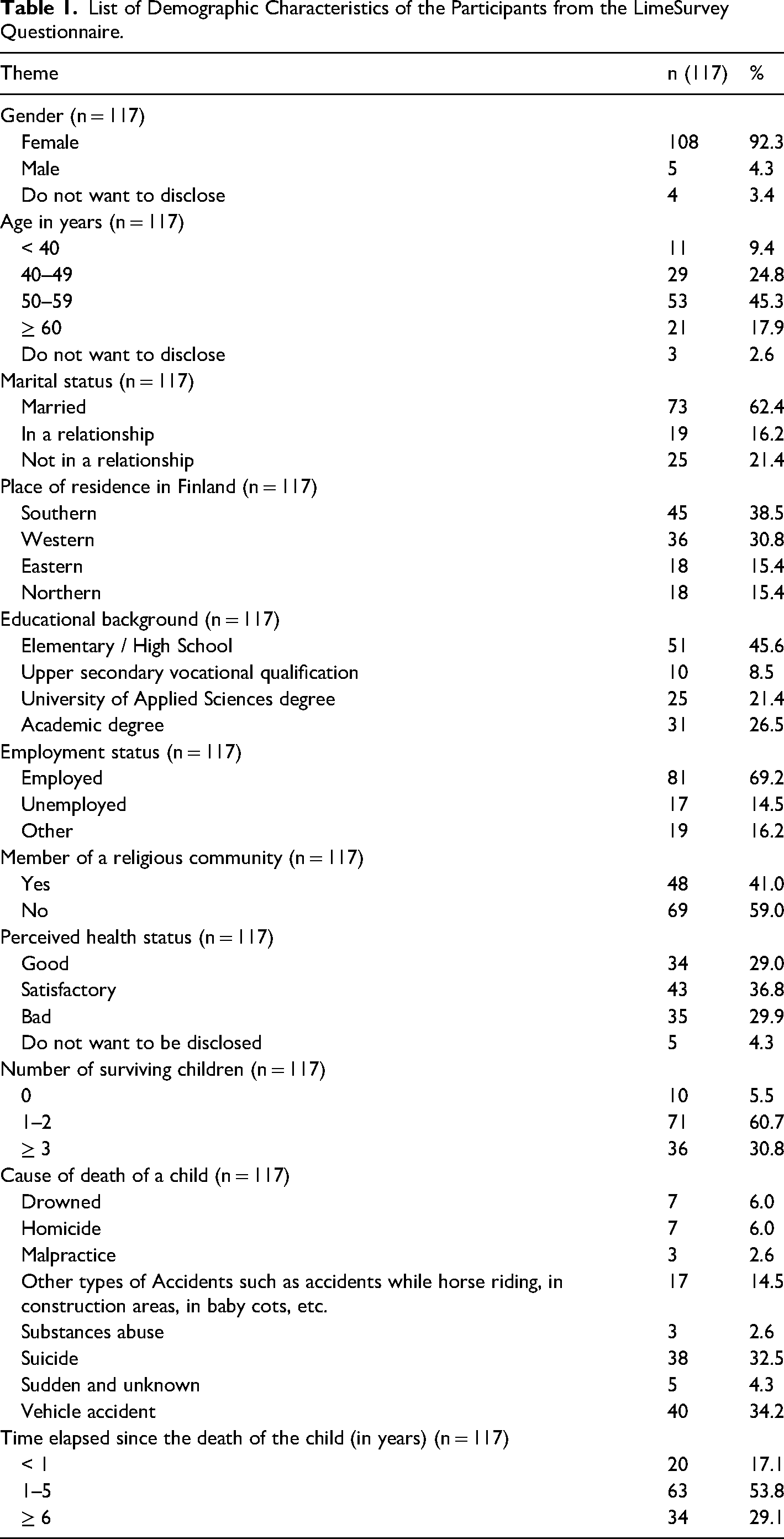
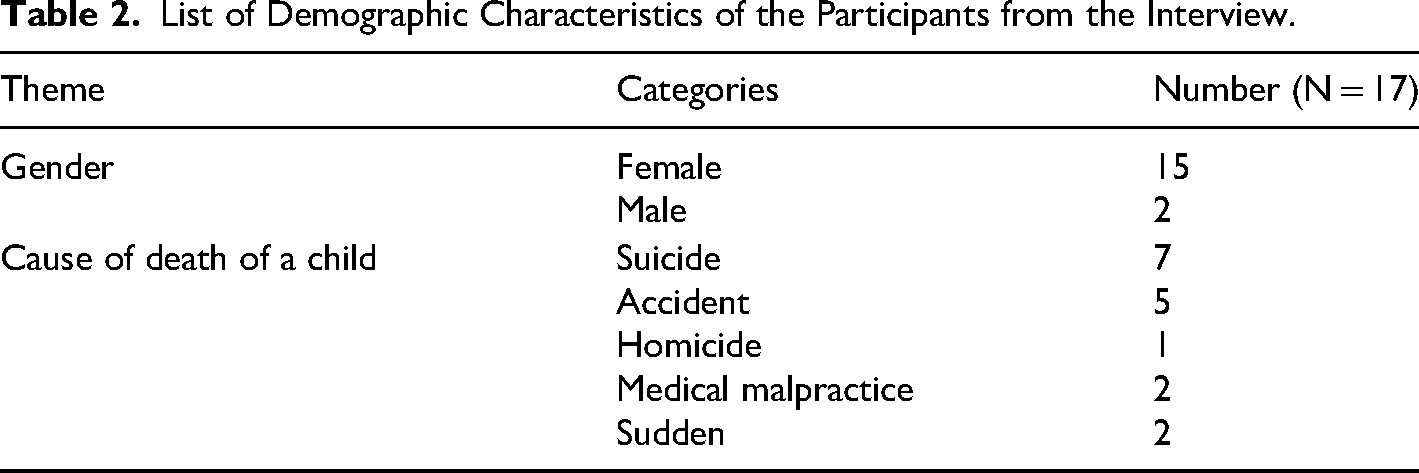
Participants for this study were identified through a purposive sampling of those who have experienced the traumatic death of a child. Traumatic deaths are defined as deaths that are unexpected, sudden, preventable, and occur due to intentional harm and mutilation (Stamm, 1999). This study extends this definition to include deaths caused by medical negligence, substance abuse-related deaths, various types of accidents, and unexpected and sudden deaths as traumatic deaths. There were no restrictions on the age of the deceased child or the number of years after the loss. The list of demographic characteristics of the participants from the LimeSurvey Questionnaire is presented in Table 1. The list of demographic characteristics of the participants from the interview is presented in Table 2.
List of Demographic Characteristics of the Participants from the LimeSurvey Questionnaire.
List of Demographic Characteristics of the Participants from the Interview.
Procedure
The study's online advertisement was disseminated through the websites of Finnish bereavement organizations, member mailing lists, and closed discussion groups. The online advertisement included information regarding the objectives and purposes of the study, contact information, and a link to access the electronic questionnaire using the LimeSurvey tool. A cover letter was also distributed along with the survey to participants. Participants who met the inclusion criteria for this study were invited to participate.
The LimeSurvey tool was utilized to create an electronic questionnaire, which is accessible in both Finnish and English languages. In the electronic questionnaire, questions are asked regarding demographic background variables such as age, gender, cause of death, duration since loss, number of surviving children, perceived health status, and consent. Additionally, there are open-ended questions concerning how parents make sense of their loss, their current life, and their understanding of loss and adaptation to it.
Upon completing the electronic questionnaire, participants were given the choice to indicate their interest in a telephone interview. Those who expressed interest and agreed to participate in the telephone interview provided their contact information. Subsequently, researchers initiated contact with participants, either through email or text messages, to coordinate a suitable interview time.
The telephone interviews consisted of the same set of open-ended questions as the electronic questionnaire. The purpose of these interviews was to allow participants to expand upon their responses from the electronic questionnaire, which they had completed before the interview. The telephone interviews were recorded after obtaining consent from the participants. The interviews were conducted in Finnish. Upon concluding the interview, the interviewer switched off the recording device and engaged in an informal conversation with the parents. During these discussions, the interviewer inquired about the participants’ well-being and their reflections on the interview experience. Furthermore, the interviewer provided supportive guidance to the parents, should they require it, and encouraged them to promptly reach out if they felt any need for assistance. The interviews lasted from 45 min to 1.5 h.
As a result, 117 participants submitted their answers via electronic questionnaires, and 17 participated in telephone interviews. Materials were collected between November 2022 and March 2023.
Trustworthiness
Trustworthiness is important to guarantee the credibility of qualitative research (Morrow, 2005). There are four general types of trustworthiness in qualitative research: credibility (accuracy of findings), transferability, dependability (consistency of findings), and confirmability (Lincoln & Guba, 1985). To increase the credibility of the findings, two data sources were used in this study – participants’ responses through the online questionnaire, and data received through recorded telephone interviews. The researcher explained the rationale of the study and shared stories about self-experience to promote a comfortable and trustful relationship between the participants and the researcher. The data collection was planned and implemented according to the established research objectives and following a pre-determined interview guideline to ensure consistency. Dependability was achieved through a detailed description of the research procedure, process, and analysis to establish inter-subjectivity. Finally, to establish confirmability, discussions and reflection with the other researchers who had read all the interviews (NAMH & ALA) were conducted.
Ethical Approval
This study received approval from the Tampere University ethics committee (76/2022). Prior to participating in the study, all participants were thoroughly informed about its purpose and were required to provide their consent both online and verbally. This consent process was completed before they proceeded to answer the online questionnaire and participate in interviews. All participants were granted their consent before becoming part of the study. It is important to note that the study was conducted anonymously and in strict confidentiality. Demographic data will be securely stored on an encrypted platform, LimeSurvey. Furthermore, all collected data will be promptly and securely destroyed upon the conclusion of this study.
Data Analysis
The interviews were transcribed verbatim and translated into English by a professional translator from Finnish to English. Similarly, participants’ written responses in LimeSurvey were also translated into English by a professional translator from Finnish. According to Braun and Clarke (2012), thematic analysis involves a six-step process. These steps include familiarization, coding, generating themes from the codes, reviewing themes, defining and naming themes, and writing up. Both researchers were involved in the data analysis process. ATLAS ti. computer-based analysis was used during the data analysis process. The analysis involved multiple readings of the transcripts to achieve familiarity with the data. The meaningful units were identified, categorized, and labeled as codes. The codes were sorted into groups that shared similar content. Codes and groups were constantly compared and cross-referenced among transcripts. The interpretations of the data were regularly discussed by both researchers.
Results
The themes that emerged from the data analysis were religion as a source of personal strength and support, tragic optimism, finding meaning through supporting others and the meaning of the parent-child bond.
Religion as a Source of Strength and Support
Faith is one of the prevalent themes that is important to parents as they find meaning and make sense of their loss. Parents also stated that although there were uncertainties about the reason for their traumatic losses, the Wisdom of God helped them to find meaning. The belief in God is attributed to a coping mechanism for parents by believing that the deceased is now in heaven. One 32-year-old mother who experienced the death of her child due to an accident commented,
I think that God is almighty and for some reason, our child's life was meant to be so short. I cannot understand the reason, but God knows. It is comforting that you can believe that the child is all right in heaven.
Death haunted me because it was so final. What will happen after that, my thoughts are still conflicted because I don't know what will happen. However, my faith is strong, I pray daily and often several times.
I yelled at God because he didn't stop my son's act. At the same time, however, I looked to Him for strength help, and support. The congregation had a prayer circle where we prayed.
Tragic Optimism
Although the death of the child is a traumatic experience for parents, being optimistic is also possible. Despite longing for the deceased, parents shared their frequent thoughts of the deceased child. Being aware of their loss is described as one way for parents to make sense of the loss, and some described it as a strength for coping with the loss. A 51-year-old mother who experienced the death of her child due to a fall said:
I'm still going through grief work, and the hardest part is hearing how other people's children go on exchange visits or study because I wonder what my child would do or would be like now. Sometimes I watch schoolchildren climb on stage and sing with a bold smile, while simultaneously swallowing tears because I think about how my child would perform at school, for example, and others don't know what I'm going through in my mind. I have experienced being different and an outsider, which I now see as a strength.
The importance of the well-being of one's own children is great. Understanding the Power of Positive Thinking. The importance of experiencing moments of happiness. Recognizing and strengthening your own strength.
That [optimism], yes, I have gained strength of my own through that… Or strength is not strength at all, but it has been a means of survival. I try to convince my spouse to be optimistic but he does not want to. Therefore, I cannot force him.
I think positively in general. I always see good things, no matter how bad it is. I know that life gets easier and I kind of get to live.
I can't handle my child's death without trauma, and I don't know how I've coped with this trauma. You have to have a strong emotional character to be able to go through this kind of process.
Finding Meaning Through Supporting Others
Following a child's traumatic death, parents perceive that supporting other people (professionally and unprofessionally) helps them to cope with their loss. Focusing on finding meaningful activities leads parents to be more open to helping others. A 51-year-old mother who experienced the death of her child due to an accident shared:
Since this has happened, I want it [the event] to become more meaningful. I think we need to take advantage of this by supporting others, participating in research, and training professional helpers.
I seek meaning in my life by helping others, I volunteer by helping and supporting young people, and I am a personal assistant for the visually impaired. When my child died, I realized that I had two options: to let grief completely take over my life and isolate myself from society, or to continue working and seek things in my life that bring meaning to it. I chose the latter option.
I have survived the worst and I work as a peer supporter in Huoma (a grief support organization for homicide). I am the second leader in Huoma's peer support group in my own town and I am an experienced expert. Now it's my turn to support those who need help, I always get something to take with me into everyday life.
Helps others who have lost their child due to medical malpractice. Gives hope to those who have lost their first child.
The Meaning of the Parent-Child Bond
Parents’ experiences of being mothers provide them with a unique understanding of the life and death of their child. The ability to give birth and have their own kids helps parents to make sense of the traumatic death from their own perspectives. A mother who lost her 25-year-old son to suicide recalled:
I've realized that I can give birth. I can be a mother. I can have a baby.
The most important thing for me was the child and being a mother. In a way, the bottom fell out of everything and I'm rebuilding the meaning. My [remaining] daughter has always been really important and still is. But one of my children is missing.
Visiting the grave has now been about twice a week. I am no longer the same person I was before my child died. I collect the shards and they go in a different order than before. I don't even want to become the same person. I want my child to live in me, and I can freely miss, cry, talk, be silent, and yearn.
He is still a natural part of our family, but not present – and no, we live as a changed family, but we all live our own lives, and I would say a pretty good life. This is just one part of our lives.
The credibility of losing a child is still sometimes unreal. I think the first year has gone by in shock, the second year more in sadness, and by the third already starting to accept the loss, and in its place come memories, as well as longing and deep longing. There were also small feelings of happiness that I got to own a child even for a moment. All the world's emotional scales come and go every year… always with a slightly different weight.
Discussion
This study aims to explore the use of meaning-making coping among parents who have experienced the traumatic death of their child. Meaning-making is the process of trying to make an occurrence correspond to one's overall beliefs and objectives, either by altering those goals or beliefs or by altering one's view of the circumstance (George & Park, 2022).
With the traumatic death of a child, parents are faced with various biopsychosocial problems (Denhup, 2017; Hussin et al., 2018; Murphy, 1997; Murphy & Johnson, 2003). It is plausible to state that the complexities of navigating the grief following a traumatic death of a child would predispose parents to extraordinary stress. Religion offers a way for parents to be more resilient after their traumatic loss by believing in reuniting in the afterlife. In the current study, religion can be seen to help parents cope with their traumatic loss in two ways. The first is by understanding that only God knows the reason for their loss. Such religious meaning-making seemed to stem from parents’ strong beliefs in God, and that God was said to be in control over everything, thereby taking some of the burden off the parents’ shoulders and allowing them to hope for a reunion with their deceased child. Secondly, as reported in previous literature, performing religious activities such as prayer mitigated the impact of mental health challenges on parents through sharing their feelings, experiences, and burdens with God (Easterling et al., 2000). Therefore, meaning-making through religious coping helps parents cope with loss in more meaningful ways (Higgins, 2002; Hussin et al., 2018) by providing parents with another perspective through which to maintain a positive relationship with the deceased child in spiritual ways.
Moreover, parents also reported utilizing tragic optimism to make sense of and cope with their traumatic loss. Tragic optimism asserts that despite loss, sadness and suffering, there is still hope and meaning to be found in life (Frankl, 1985). After the traumatic loss, parents still can be optimistic about their future. This way of coping allows parents to make sense of the loss by seeing it as an opportunity to recognize their strength in dealing with the traumatic loss. Parents refer to the ability to make sense of loss by maintaining their optimism, which they also refer to as the “Power of Positive Thinking”. For parents, tragic optimism allows them to balance their loss, their current situation, and their future. Rather than focusing on the negative impacts of their loss, being optimistic allows parents to make sense of their loss by feeling gratitude for the happiness that they have gained through being with the deceased child and for the parents of this current study, this also enabled them to feel more comfortable with moving on with their lives. As discussed in the literature, optimism avoids helplessness explanatory models and permits one to engage in and maintain healthy habits since it is believed that we can change our circumstances, which is seen as proof that optimism promotes better health outcomes (Baumeister, 1991). Nevertheless, additional research should be undertaken in the future to comprehend tragic optimism better. This entails conducting further investigations into the factors and sources contributing to tragic optimism.
Helping other people was another novel strategy found to have been used by parents in the current study. Being optimistic allows parents to gain more social support and engage in more social interactions instead of retreating and isolating themselves (Baumeister, 1991). While coping with their traumatic losses, parents may find themselves confronted with fundamental questions about the meaning of life (Moura et al., 2020). Helping other people, such as those with disabilities or those experiencing the same grief can help parents to see life in more meaningful ways. As discussed by most of the parents in the current study, achieving a meaningful life is the foundation for coping with their traumatic loss. A study on volunteerism (Wilson et al., 2005) reported that volunteering can promote positivity and enhance well-being, as well as improve volunteers’ sense of self-worth. Similar to the parents in the current study, giving hope to other people is also seen as a way for parents to gain spiritual growth after their traumatic loss. The parents purposefully contribute to a greater cause outside of themselves through self-transcendence in serving a higher purpose, which on one hand shifts the emphasis from their painful experience to helpful deeds, and on the other allows for discoveries and developments of personal meaning and strengths.
Furthermore, this current study also highlighted another aspect of meaning-making coping that is vital to parents, which is the continuing bond between them and their deceased child. Parents make sense of their loss as a part of their lives. Therefore, the parent-child relationship is seen as a sacred relationship that will not end with death. Parents reported to appreciate the moment when they became parents, and this response is very common to mothers, especially when they are the ones who go through the phases of pregnancy, childbearing, and loss. Rather than seeing the loss as a separate experience in their lives, parents perceived the death of their child as a continuation of their lives. Therefore, parents reported that in this way, they are free to show their grief. This is consistent with literature on parental grief following suicide that denotes that grief cannot be separated from the parent-child relationship since grieving after the death of a child is a part of parents’ love for their child (Oka, 2013). Thus, as a part of their ongoing love for the deceased child, parents establish a new way of maintaining a parent-child relationship with their deceased child. As a result, continuing bonds were found to be an effective coping mechanism through which to reduce the stress of bereavement (Attig, 2000).
Limitations of the Study
The calls for participation in this study were posted on peer-support websites in Finland. Consequently, parents who did not have access to these websites may have been unable to participate in the study. However, utilizing an online platform to advertise the study allowed for broader participation among interested parents, regardless of their geographical location. Furthermore, this study utilized the LimeSurvey platform as a data collection tool, so parents without access to the internet may have faced challenges in participating. To address this limitation, telephone interviews were conducted with interested parents which helped to reduce the potential for exclusion and ensure a more inclusive participation process.
Future studies should expand their scope to consider parents coping with different types of loss, not just traumatic death. This should include an assessment of the support systems that influence parents’ ability to find meaning after the death of their child. Broadening this research can help gain a deeper understanding of the dynamics of meaning-making coping. The findings can then be used to enhance existing support systems, improving parents’ capacity for meaning-making and overall coping ability.
Clinical Implications
Professionals working with bereaved individuals should acknowledge the importance of meaning-making coping strategies in the grieving process. Appropriate interventions are crucial to support these individuals throughout their journey. Interventions should consider the bereaved individual's social and cultural context. For instance, in societies that value helping others, such activities can empower their meaning-making coping strategies. Therefore, integrating helping activities into grief intervention can empower bereaved individuals to effectively cope with their grief.
Conclusion
In conclusion, the concept of meaning-making is central to understanding how parents cope with the traumatic loss of a child. Through religious meaning, tragic optimism, the act of supporting others, and the enduring significance of the parent-child bond, these parents find ways to make sense of their loss, navigate their grief, and ultimately find meaning and purpose in the aftermath of profound tragedy. Their experiences serve as a testament to the human capacity for resilience, and also the ability to find light even in the darkest of moments. Building on this research, future multidisciplinary studies are recommended to gain a comprehensive understanding of coping strategies in parents after a traumatic loss.
Footnotes
Acknowledgment
We would like to thank the European Union for supporting this project with the title Fostering Participation in Action Research to Develop an Online Bereavement Support Application to Support Bereaved Parents after the Traumatic Death of Their Child. We also would like to thank the bereaved parents who participated in this study.
Declaration of Conflicting Interests
The authors declared no potential conflicts of interest with respect to the research, authorship, and/or publication of this article
Ethical Considerations
This study received approval from the Tampere University ethics committee (76/2022).
Funding
Funded by the European Union. Views and opinions expressed are however those of the author(s) only and do not necessarily reflect those of the European Union or the European Research Executive Agency. Neither the European Union nor the granting authority can be held responsible for them.
