




Abstract
The scarcity of organs for transplant and significant rates of organ transplantation failure mean it is important to identify factors relating to transplant success and failure. Experiencing psychosis or mania is often seen as a contraindication for transplant, and many transplant teams have been cautious at transplanting people with significant mental health difficulties. In this paper we explore whether there is any evidence to support this attitude towards psychiatric diagnosis and transplantation; consider modifiable risks to transplantation; and ask what is needed to provide equitable care for individuals with experience of psychosis. To place context to our discussion, we present the experience of a person who had a history of psychotic experience and who was assessed for double lung transplant.
Keywords
Psychotic Disorders
With scarcity of organs for transplant and significant rates of transplant failure, there is an inevitable eagerness to help transplant teams predict those who are likely to do well. As clinical psychologists working in lung and kidney transplant we are often asked about a potential recipient with a history of mental health problems such as a diagnosis of psychosis. There is an assumption that the condition may have implications on an individual's ability to cope with the process or look after themselves and manage care following the transplant, as well as impact on their engagement with clinicians (Butler et al., 2017; Kofman et al., 2018) and a recent study in cystic fibrosis found both cystic fibrosis centres and transplant centres felt that that mental health was a very important factor in transplant outcomes (Dave et al., 2021). However, there are currently no clear guidelines regarding whether a diagnosis of psychosis should be considered an important factor.
In this narrative review, we will examine the evidence and literature relating to psychosis and transplant. We will discuss typical referrals for the pre-transplant psychological assessment of an individual with a diagnosis of psychosis and the impact that had on the individual. Whilst there are many DSM-5 diagnostic labels associated with psychosis, such diagnoses are contentious and a person's experiences of psychosis can often be understood when contextualised.
Over the past twenty years our understanding of psychosis/schizophrenia and associated symptoms such as hallucinations and paranoia has shifted inexorably. Whilst previously the experience of paranoid thoughts, delusions or hearing voices no-one else can hear have been diagnosed as symptoms of psychosis, we now understand that many people have these experiences but do not come into contact with mental health services since they cause no distress (Meddings et al., 2010; Read & Ross, 2003). The Hearing Voices Movement (McCarthy-Jones, 2012) has redefined auditory hallucinations as a meaningful variation of human experience and not a sign of mental illness (Escher & Romme, 2012). In many cultures hearing voices is considered positively, providing spiritual or moral guidance (Luhrmann et al., 2015).
There is little evidence that one episode of psychosis can determine long term outcomes. Over a period of 10 years, Morgan et al. (2014) studied over 500 individuals based in the UK with a first episode of psychosis. Around 12% of this sample recovered and did not need any further input from services. Only a small proportion (6%) required frequent hospital admissions defined as more than 10 over this period of time. The authors of this paper describe this as ‘a positive finding that goes against the still common view that non-affective psychotic disorders, especially schizophrenia, are chronic and deteriorating’. Despite this, a significant number were unemployed at follow-up suggesting the marked impact of an episode of psychosis on social inclusion. Morgan et al. have suggested that impact of psychosis on social outcomes may be linked to physicians’ beliefs about the condition and ‘psychiatrists who hold an overly pessimistic view of the outcome of psychosis can transmit this view to their patients, thereby rendering it a self-fulfilling prophecy’.
In more recent years we have begun to understand psychosis in a context of trauma, victimisation and racism. A history of childhood trauma is significantly associated with the onset of psychotic experiences in adolescence and adulthood (Schafer & Fisher, 2011). The psychosis can be understood in relation to the person's life experiences and psychological therapy can help the person make sense of their psychotic experience and reduce the negative impact it has on their psychological wellbeing and functioning (Lonergan, 2017). Psychosis can often be understood and managed by asking ‘what has happened to you?’ and not ‘what is wrong with you?’ (Sweeney et al., 2018).
Studies into adverse childhood events (ACEs) have identified the significant role childhood trauma and neglect can have on adult's psychological and physical health. Individuals with ACEs are significantly more at risk of many poor health outcomes, such as Type 2 diabetes, lung disease and heart disease, even after controlling for unhealthy behaviours (Bellis et al., 2014). The experience of childhood adversity is strongly associated with a later diagnosis of psychosis (Varese et al., 2012). This means that those with experiences of ACEs are both more likely to be diagnosed with psychosis and more likely to develop health conditions which require interventions such as transplantation. As an example, people with a diagnosis of schizophrenia are significantly more at risk of chronic kidney disease even after controlling for demographic, behavioural and medical risk factors (Tzur Bitan et al., 2019).
To summarise this body of evidence, many people who have experienced what would traditionally be considered psychotic symptoms are not distressed and do not seek support from mental health services. A significant number of people who have experienced a psychotic episode do not have another. People with a diagnosis of psychosis have more socio-economic disadvantages and a higher likelihood of trauma in childhood. Their psychosis can usually be understood when contextualised.
Method
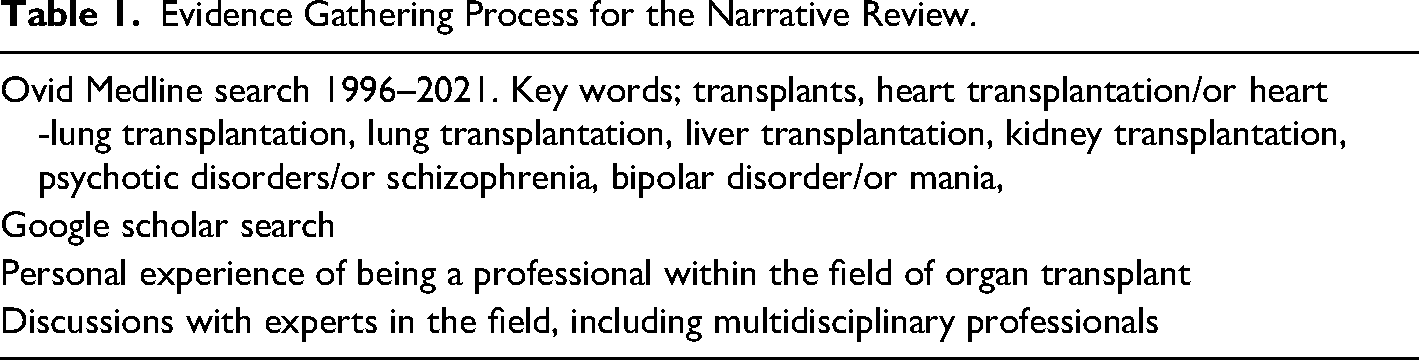
As recommended by Green (2006), information used to write this narrative review was collected from the sources listed in Table 1.
Evidence Gathering Process for the Narrative Review.
Outcomes in Transplant
Data on the post-transplant outcomes for patients with a pre-existing mental health condition are limited. Research looking into surgical outcomes in general for people with a diagnosis of schizophrenia in Taiwan (Liao et al., 2013) suggested that post-operative complications and mortality were significantly greater in those with the diagnosis compared to those without. The authors identify several causes for this relating to the overall medical care of patients with a diagnosis of schizophrenia, including delays in treatment, low quality care and a poor understanding of patients’ needs. The authors suggest that poor outcomes could be addressed by improved communication, greater awareness of the risks of drug interactions and correcting medication dosing, psychiatric involvement, improved support, better pain management and making homogeneous, high quality care mandatory.
There is limited data available on transplant outcomes for people with psychosis. Coffman and Crone (2002) surveyed post-transplant individuals with a diagnosis of psychosis from 12 transplant centres across the US, Canada and Australia. In total, only 35 patients were identified over a two year period. Noncompliance resulting in rejection was reported in 15% of individuals and was linked with living alone and homelessness. Suicide attempts were reported in a third of individuals who had had a psychotic episode in the year prior to transplant. This suggests that socioeconomic status and stability of symptoms may be more important factors to consider than the diagnosis itself.
Zimbrean and Emre (2015) described the clinical course and outcomes of 38 potential transplant candidates with a diagnosis of psychotic disorder from a single transplant centre. Of these, just over half were listed for transplant with 10 individuals going on to have a transplant. The centre operates a multidisciplinary (MDT) approach and all patients with a psychiatric diagnosis are assessed by a social worker and transplant psychiatrist. As part of the psychiatric evaluation, patients were listed for transplant if their symptoms did not interfere with medical care and they demonstrated good prior adherence and ability to manage their condition. They were reassessed by the transplant psychiatrist whilst on the waiting list and followed up closely by the MDT post-transplant. Reported outcomes were good; of those patients transplanted around five patients had no psychotic episodes during the follow-up period with only one patient having more than three episodes. There were no reported problems with adherence and no evidence of adverse medical outcomes. This suggests that transplant outcomes can be excellent where there is psychosocial evaluation and an MDT approach.
As an illustration of this, Bouhlel (2014) reported the case of a 41-year-old man with a long-standing diagnosis of psychosis and kidney failure requiring renal replacement therapy. The individual had good adherence to his medication and dietary restrictions. Despite experiencing psychotic exacerbations post-transplant, this was managed successfully with antipsychotic medication and close liaison between psychiatric staff, the individual's family and the nephrology team. Three years post-transplant, renal function was good. Similarly, Ramírez-Giraldo and Restrepo (2018) present a case example of a 34 year old lady with a diagnosis of bipolar disorder who received a heart transplant. The authors report no worsening of psychiatric symptoms post-transplant, despite the need to cease psychiatric medication (lithium and aripiprazole) post-transplant.
In a larger scale study (Molnar et al., 2018) of 3,680 US veterans who underwent kidney transplantation, the outcomes of those with a pre-transplant diagnosis of psychosis or mania were compared to those without such a diagnosis. Both psychosis and mania are more prevalent in veterans than the general population. Patients with a history of psychosis or mania had similar survival rate, graft loss and rejection risk to those without a diagnosis. The authors conclude that a diagnosis of psychosis is not associated with adverse outcomes in kidney transplantation. However, this study only examined individuals listed for transplant. As it is unclear how many were found not suitable for transplant, there may have been a selection bias in the assessment process with only individuals considered to do well proceeding to transplant. Their findings are similar to the findings of a study which looked outcomes of 3,000 renal transplants over the course of nearly three decades (Butler et al., 2017). The authors found few numbers of people with a diagnosis of schizophrenia or bipolar affective disorder (N = 21) but that there were no significant differences in outcomes for these individuals and those without a diagnosis. Kofman et al. (2018) compared the outcomes of 47 people who had a diagnosis of bipolar disorder or psychotic disorder and compared their outcomes to matched controls. There was no significant difference in death rate or rejection of transplant.
Ithman et al. (2018) have identified that a barrier to successful post-transplant management is the lack of guidance on medication management for people with mental health difficulties, highlighting the potential for drug interactions and neuro-toxicity. They report on a case study of a lady with a history of mania who developed mania and psychosis post kidney transplant. Despite her tacrolimus levels being within therapeutic range, her symptoms improved as soon as tacrolimus was tapered and cyclosporine initiated. This highlights the importance of appropriate medication management post-transplant and the need for further guidance on this.
Overall, there is limited evidence to suggest poorer outcomes after transplant in individuals with a diagnosis of schizophrenia or psychosis if people receive appropriate post-transplant care. There is also evidence of modifiable factors in reducing the risk of poor outcomes in the general medical care of people with experiences of psychosis.
Post-transplant Psychosis and PTSD
ICU delirium (previously described as ICU psychosis) is widespread neurological confusion affecting up to 80% of mechanically ventilated patients during admission with around a quarter experiencing post-traumatic symptoms following discharge (Cavallazzi et al., 2012). Symptoms of ICU delirium commonly include hallucinations and paranoid delusions. It is also worth noting that delirium is common in all inpatient acute hospital settings (Ryan et al., 2013) and therefore patients requiring organ transplantation will have a high chance of having experienced delirium prior to transplantation.
The prevalence of post-ICU PTSD in solid organ transplant patients is high. In a study of 157 general ICU patients (Davydow et al., 2008) the use of benzodiazepines and antipsychotics during ICU admission were risk factors for the development of PTSD following discharge. It is likely that those patients needed such treatments for more severe ICU delirium rather than the medication being causal. Other risk factors included sleep deprivation, difficulty breathing, pain and inability to communicate.
There is also evidence suggesting that immunosuppressant medication may increase the risk of psychotic symptoms post-transplant (Corruble et al., 2006; Ithman et al., 2018). Individuals with a diagnosis of psychosis, who are on antipsychotic and immunosuppressant medication may be at a greater risk of ICU delirium and post-ICU trauma. However a systematic review of PTSD in ICU survivors (Wade et al., 2012) found that whilst a previous history of psychopathology was a risk factor for the development of post-ICU PTSD, this was most likely to be depression or anxiety as opposed to psychosis. The authors suggest that an individual with a history of depression and anxiety is more likely to experience ICU delirium and subsequent PTSD. There was no evidence that a pre-existing diagnosis of psychosis increased the risk of ICU delirium or PTSD.
Case Example: Jayne
The person's name and identifiable features have been changed to preserve anonymity.
Jayne was referred for a double lung transplant due to end stage respiratory failure relating to pulmonary fibrosis. Her predicted FEV1 was 21% and she was on one litre of overnight oxygen. The alternative therapy to double lung transplant was symptom management and end of life care.
At the time of referral, Jayne was in her late forties, had a long history of psychological difficulties and had engaged with mental health services. She had a history of psychotic experiences including occasional, regular experiences of visual hallucinations. These were more common when she was feeling stressed. Jayne had ‘learned to live alongside’ her hallucinations. She also had a history of self-harm but had not engaged in any such behaviours in the twelve months prior to referral. Her scores on psychometric questionnaires indicated that she was experiencing mild levels of anxiety and depression.
Jayne had a history of trauma; she was a survivor of childhood sexual abuse and also experienced significant domestic violence in adulthood. She experienced memory flash backs when exposed to arguments or sudden loud noises.
Jayne had a past history of substance misuse, including amphetamines and cocaine, but had not taken any recreational drugs for over a decade before the referral.
Jayne always managed her respiratory symptoms well and had been consistently adherent with her treatments and remained so even when experiencing acute psychological distress.
Her support network was good and she felt well supported by family and friends. She described herself as ‘strong willed’ and able to recognise when she was having a bad day and say to herself ‘pick yourself up, it's a down day today but it's not always going to be’.
Jayne was very motivated to have a lung transplant. She had several assessment discussions with her respiratory Clinical Psychologist, where specific risks relating to her psychotic experiences were raised. As the experience of having a lung transplant is invasive and potentially traumatic with a high risk of delusion when recovering in ICU this was explored with Jayne. She was able to consider the risks of having previous memories triggered by the experience. Jayne felt that these risks were outweighed by the potential life extending benefits that transplant could have.
Jayne attended two assessment appointments at the transplant centrespread over several months. She was acutely aware that she had limited time and that her historic and current experiences may have an impact on decisions about her suitability for transplant. In addition, her life experiences meant that she questioned her self-worth.
The transplant referral process was challenging for Jayne. She experienced the assessment as a judgement of her worth and this triggered feelings of anxiety and stress, and a concern at how she would be viewed by the transplant team. Questions about her past behaviours triggered feelings of shame. She felt a pressure to ‘perform’ well and became increasingly anxious about what questions to ask, how to respond to questions and how she should dress.
Sadly, Jayne died of type two respiratory failure whilst awaiting the outcome of her transplant assessment.
Discussion
Traumatic experience in childhood is a significant risk factor for both receiving a diagnosis of severe and enduring mental illness and for developing a wide range of physical illnesses (Bellis et al., 2014). This suggests the prevalence of mania and psychotic symptoms will be disproportionately higher in those needing an organ transplant, as supported by research into the prevalence of kidney disease in those with a diagnosis of schizophrenia (Tzur Bitan et al., 2019). Despite this, research indicates that the number of people with a history of mania or psychosis who receive an organ transplant is low (Butler et al., 2017).
There is evidence of global inequality of healthcare provision for people with a psychiatric diagnosis (Williams et al., 2019). This is compounded by diagnostic overshadowing or under recognition of physical health conditions in this population. Such inequality contributes to poorer overall health and reduced life expectancy (Baxter et al., 2016). Cahn-Fuller and Parent (2017) describe a need for a ‘call to justice’ in addressing decisions about patients’ suitability for organ transplant which have been based on unfounded beliefs about the impact psychiatric diagnosis may have outcome. Molnar et al. (2018) has also suggested that though most organ transplant societies consider psychosis to be a relative contraindication due to concerns about relapse of symptoms, adherence issues, poor social support, cognitive difficulties and potential drug interactions between psychotropic and immunosuppressant medications, these concerns are unfounded.
People living with a history of psychosis have often experienced significant trauma in childhood, which is linked to subsequent feelings of shame. Attempts to cope with trauma often include behaviours such as drug and alcohol misuse (Khoury et al., 2010) and engaging in abusive relationships (Alexander, 2009) resulting in negative judgement by society and further feelings of shame. This shame is likely to continue even when these coping approaches are no longer in use. Both trauma and mental health difficulties have negative impact on an individual's socio-economic status, educational attainment and overall medical care. It seems likely all these factors will play a role in how patients interact with health professionals.
We can see the challenges faced by people with experience of psychosis in our case study, where psychiatric status was considered as a potential factor in the individual's suitability for transplant and where Jayne felt the onus was on her to prove she was worthy and capable of a transplant, resulting in feelings of shame and lack of self-worth. For Jayne, a pre-transplant assessment was a significant source of stress as she was highly motivated to be listed for transplant. Furthermore, Jayne experienced the transplant assessment as an assessment of her worth, not of her suitability, serving as a reminder that we need to be clear and careful in how we explain healthcare assessment and decision making to those that we serve. It is our responsibility as HCP to ensure that we support individuals through the transplant assessment process and that the assessment is facilitated in a way that does not cause unnecessary psychological distress. Regardless of assessment outcome, individuals should feel valued and cared for by their healthcare professionals.
In summary, there is little evidence to suggest psychosis is a contraindication despite it often being considered one by transplant teams. Good outcomes are instead dependent on other factors such as stability of symptoms, social support and motivation. However, it is worth acknowledging that transplant is itself a highly stressful experience. The experience may trigger trauma memories. It is important that we recognise the increased need for psychosocial assessment and support, rather than seeing it as purely a contraindication for treatment. Further research into the resiliencies of people who have experienced childhood trauma and or significant mental distress is also required. It is possible, that for some people, their experiences have enabled them to develop coping strategies that will also help them to cope with the demands of transplant and its associated ITU and delirium experiences.
It is the responsibility of teams to put in place support to ensure person focused medical care. As part of a pre-transplant assessment we should be asking ourselves how to support an individual to cope with the pre and post demands of transplant. Listing for a transplant may be deferred whilst such support mechanisms are put into place rather than seeing difficulties as a contraindication. Assessment should be facilitated in a supportive and psychologically informed way.
Failure to do this, indicates a failure to deliver equitable care and could be seen as an act of injustice against an often marginalised and traumatised section of society.
Take home points
Limited research suggests that with the correct support, patients with a diagnosis of psychotic disorder have similar outcomes to those without any diagnosis after organ transplant Many factors that leave a person with a diagnosis of psychotic disorder at risk of poor transplant outcome are modifiable and need to be addressed prior to transplant Individuals with a diagnosis of psychotic disorder face are at increased risk of physical illness and experience inequity of care We must ensure we provide equitable care to a marginalised section of society
Footnotes
Declaration of Conflicting Interests
The author(s) declared no potential conflicts of interest with respect to the research, authorship, and/or publication of this article.
Funding
The author(s) received no financial support for the research, authorship, and/or publication of this article.
