



Abstract
Background: This study investigates how radically self-directed, democratic learning environments may relate to long-term development through autonomy and participation.
Significance of the Research
This study shows that graduates of Sudbury schools described carrying forward adaptability, initiative, and civic responsibility that they associated with their experiences of democratic participation and learner autonomy. These findings suggest that education systems can be reimagined to support lifelong learning and social engagement beyond the limits of formal instruction and standardized progression.
Autonomy, Participation, and Lifelong Learning: Graduates’ Reflections from Sudbury Schools
A central challenge for education today is preparing learners not only to acquire knowledge but also to sustain motivation, adapt to uncertainty, and participate effectively in diverse communities across the lifespan. The structures of mass schooling, shaped historically by processes of bureaucratization and global convergence (Boli et al., 1985; Meyer et al., 1992), established systems organized around standardized curricula and external control. While these arrangements achieved efficiency and comparability, their legacy continues in many contemporary contexts, where prescriptive instruction and external rewards have been argued to constrain autonomy (Deci et al., 2001) and limit opportunities for meaningful participation—capacities increasingly recognized as essential for today's dynamic and unpredictable world (Moravec, 2024). Such approaches have been critiqued for potentially limiting opportunities to cultivate developmental capacities that matter for lifelong growth: initiative, self-regulation, civic responsibility, and the ability to find purpose in unstructured situations.
Against this backdrop, alternative educational traditions have emphasized learning through autonomy, responsibility, and active participation. Sudbury schools provide a particularly distinctive model. Organized around complete learner autonomy, democratic governance, and mixed-age community life, they operate without imposed curricula, classes, or assessments (Greenberg, 1987; Traxler, 2015). Everyday participation in decision-making, self-chosen activity, and community responsibility is treated as both the medium and the content of education. Although conceptually significant, these schools have received relatively little empirical attention compared with other alternative models and systematic research on their long-term developmental impact remains especially limited.
This study addresses that gap by examining graduates’ reflections from Sudbury schools in the Netherlands, Israel, and the United States. Through reflexive thematic analysis of interviews with 14 graduates, it explores how graduates perceived autonomy and participation as influencing their enduring personal, social, and professional capacities. Framed by experiential education scholarship and informed by psychological and evolutionary perspectives, the findings extend current understandings of how radically learner-driven environments foster lifelong adaptability, resilience, and civic engagement.
Theoretical Foundations: Experiential, Motivational, and Evolutionary Perspectives
Experiential education traditions emphasize that learning develops through direct engagement in meaningful activity and reflection on that activity. Dewey (1997) argued that education should be rooted in authentic experiences, while Kolb (1984) conceptualized learning as a cyclical process of action and reflection that produces transferable capacities. From this perspective, participation and responsibility are not peripheral but central to education, in contrast to systems that rely on external control.
Self-determination theory (SDT) adds a complementary motivational perspective by explaining how autonomy, competence, and relatedness operate as universal psychological needs that support optimal functioning and learning (Deci & Ryan, 2000; Ryan & Deci, 2017). Autonomy refers to experiencing a sense of choice and volition in one's actions, competence to feeling effective and capable in one's pursuits, and relatedness to feeling connected to and valued by others. When these needs are fulfilled through genuine choice, opportunities for mastery, and supportive relationships, individuals may develop intrinsic motivation, persistence, and self-regulation (Niemiec & Ryan, 2009; Reeve & Assor, 2011). Conversely, when educational contexts rely on external control, surveillance, or rigid instruction, these needs are thwarted, resulting in disengagement, compliance, or superficial learning (Deci et al., 2001; Deci & Ryan, 2000). From an experiential education standpoint, SDT clarifies why environments that minimize external pressures and cultivate learner autonomy, competence, and social connection have been associated with promoting deeper and more enduring engagement with learning.
Evolutionary Developmental Psychology complements both traditions by situating self-directed and participatory learning in the broader arc of human evolution. Research suggests that children evolved to learn through observation, play, and participation in community life rather than through extended formal instruction (Gray, 2015; Lancy, 2016; Rogoff, 2003). In small-scale, egalitarian societies, children develop skills by engaging in real tasks within their communities, supported by mixed-age interactions and voluntary cooperation (Gaskins & Paradise, 2010; MacDonald, 2010; Rogoff, 2015). From an evolutionary developmental perspective, modern educational ecologies that emphasize autonomy, responsibility, and participation align more closely with our species’ developmental heritage. This view resonates with Lave and Wenger's (1991) theory of situated learning, in which knowledge is acquired through legitimate participation in shared social practices rather than through decontextualized instruction. The four-phase model of interest development (Hidi & Renninger, 2006) adds a complementary insight by highlighting how repeated engagement supports the deepening of learners’ interests and knowledge over time.
Debates on Structured Instruction and Self-Directed Education
A long-standing debate concerns whether highly autonomous environments can adequately support the development of advanced knowledge and skills. One line of argument holds that complex, biologically secondary domains such as literacy and mathematics do not emerge naturally and therefore require systematic, explicit teaching; without such instruction, learners risk being unprepared for the demands of modern societies (Geary, 2005, 2008; Sweller, 2008). Others question this assumption, pointing to evidence that learners can acquire sophisticated abilities when they are motivated and when the knowledge becomes meaningful in context. From this perspective, learning is best supported through autonomy, engagement, and participation in authentic practices, rather than through uniform instructional routines (Ellis, 2008; Gray, 2016; Lancy, 2016).
Debates about the role of adults in self-directed environments are related but somewhat distinct. Here, the disagreement is less about whether learners should direct their own education and more about how much support adults should provide along the way. Some emphasize guided participation, in which adults scaffold learning within shared activity (Matusov, 2023; Matusov & Rogoff, 2002). Others, including Sudbury educators, minimize adult interventions to preserve full learner autonomy (Ackoff & Greenberg, 2008; Traxler, 2015). Comparable tensions are also evident in outdoor and experiential education, where facilitators must balance the provision of safety and structure with the developmental value of autonomy and risk-taking (Arvanitis et al., 2024; Stan, 2009).
Self-directed learning has been a central concept in adult education since Knowles’ (1975) influential definition of learners taking initiative in diagnosing needs, setting goals, and evaluating outcomes. Later theorists elaborated self-directed learning as both a learner disposition and a structured process, typically exercised within teacher-designed curricula and tied to external standards (Brookfield, 1985; Garrison, 1997). Adaptations of self-directed learning in schools often overlap with constructs such as self-regulated learning (Bolhuis, 2003; Zimmerman, 2002). In the light of this debate, it is important to distinguish self-directed learning from the broader notion of Self-Directed Education, as articulated by Gray (2023). Whereas self-directed learning generally refers to learner initiative exercised within externally defined learning frameworks, Self-Directed Education, as practiced in Sudbury schools and other democratic education settings, entails autonomy at the level of what, how, and even whether to engage in formal study. While both emphasize initiative, Self-Directed Education represents a more radical commitment to trusting learners’ capacity to shape their own development.
Sudbury Schools as Radical Experiential Contexts
Founded with Sudbury Valley School in Massachusetts in the late 1960s and now established internationally, Sudbury schools are defined by three core features: (1) complete learner autonomy, where students decide individually how to use their time without imposed curricula, classes, or assessments; (2) democratic governance, where students and staff participate equally in the school governance; and (3) mixed-age community life, enabling informal mentorship, collaboration, and peer modeling (Gray et al., 2021; Gray & Chanoff, 1986; Greenberg, 1987). Sudbury schools emphasize age-mixing (Gray & Feldman, 2004), which goes beyond the “multiage” arrangements described in the broader literature (Kolstad & McFadden, 1998; Pratt, 1986), by encompassing interaction across the entire K–12 span together with adults in a shared community. In this sense, Sudbury schools represent radical instantiations of experiential education: everyday participation in self-chosen activities, governance, and community life becomes the curriculum itself. Authentic responsibilities and real consequences align with SDT's emphasis on autonomy and relatedness while also reflecting the evolutionary dynamics of learning through participation described in social theories of learning (Lave & Wenger, 1991; Rogoff, 2003).
Although conceptually significant, Sudbury schools have received limited empirical attention compared with other alternative models (Traxler, 2015). Existing studies have provided insights into governance, motivation, and student agency (e.g., Berg & Corpus, 2013; Gray et al., 2021; Von Duyke, 2013), but systematic, cross-site, and long-term perspectives remain scarce.
This study builds on that limited body of work by drawing on graduates from eight Sudbury schools in three countries. Focusing on Sudbury as a shared organizational model allows us to examine how common experiences of autonomy, responsibility, and community participation are taken up across different cultural settings. While the local implementation of democratic practices and community norms inevitably varies, the underlying principles of Sudbury schooling provide a coherent basis for cross-site comparison. By foregrounding graduates’ reflections, the study contributes a broader empirical basis for understanding how radically participatory schooling shapes personal, social, and professional development over time.
Method
Design
This study addressed the overarching research question: How do graduates make sense of their experiences of Sudbury schooling in relation to their adult lives? Reflecting the scope of this manuscript within the larger project, the present article reports on the subset of findings relating specifically to in-school learning processes and their developmental significance; these analytic boundaries shaped the thematic structure presented in the Results. The study design followed reflexive thematic analysis as outlined by Braun and Clarke (2006, 2021), which emphasizes the researcher's active role in meaning-making and transparency throughout the analytic process. Reflexive thematic analysis was well suited to this inquiry, as the goal was to capture diverse graduate perspectives and illuminate shared patterns of experience across cultural contexts.
Researcher Positionality and Reflexivity
The study is grounded in a constructivist epistemology, viewing knowledge as co-constructed through dialogical interaction. The first author entered the research as a former Sudbury staff member with professional experience in democratic education and prior familiarity with four participants (one a relative, three former students). These connections facilitated rapport and richer narratives but also required careful attention to avoid over-interpretation and to anchor analysis in participants’ own words. To support this reflexive process, the author arranged a formal consultation with an expert in qualitative research, in addition to engaging in regular critical-peer discussions. Reflexive journaling, discussions with critical peers, and iterative feedback loops supported the integrity of the process. Participants were treated as experts on their own experiences, and the author's commitments and prior knowledge were continually examined as part of the analytic process.
Participants
Fourteen adult graduates from eight Sudbury schools in three counties participated. The sample consisted of two schools in the Netherlands, two in Israel, and four in the United States; of the four U.S. schools, two contributed only one participant each. The term graduates here refers to those who completed their Sudbury schooling before transitioning to adult life or higher education, regardless of whether they received a formal diploma. Although not all schools identified formally as Sudbury, they shared core features of the model: absence of a prescribed curriculum, fully mixed-age communities, and similarity in democratic governance. Focusing on schools with a shared organizational structure allowed exploration of common experiences across diverse cultural contexts while preserving comparability.
Schools were selected from an initial pool of 55 across 13 countries, with eligibility based on organizational comparability, language accessibility, and a minimum of 10 years of operation. Eight schools met these criteria and agreed to participate.
To support diversity within the sample, each school was asked to nominate two graduates who varied in gender, level of engagement, and post-school trajectories. Participants were generally required to have attended for at least 5 years and to have a minimum of 5 years of post-school experience. Two exceptions were included: one participant had attended only 2 years beginning at age 16, and another had extensive school experience but had graduated only a year before the interview.
In total, nine participants identified with she/her pronouns and five with he/him pronouns. Ages ranged from the early twenties to over forty and included both lifers who attended from early childhood through graduation and shorter term students. All participants were assigned pseudonyms, and identifying details were aggregated to protect confidentiality given the small and close-knit nature of Sudbury school communities. A summary of the sample is provided in Table 1.
Overview of Participant Sample (Aggregated Summary).
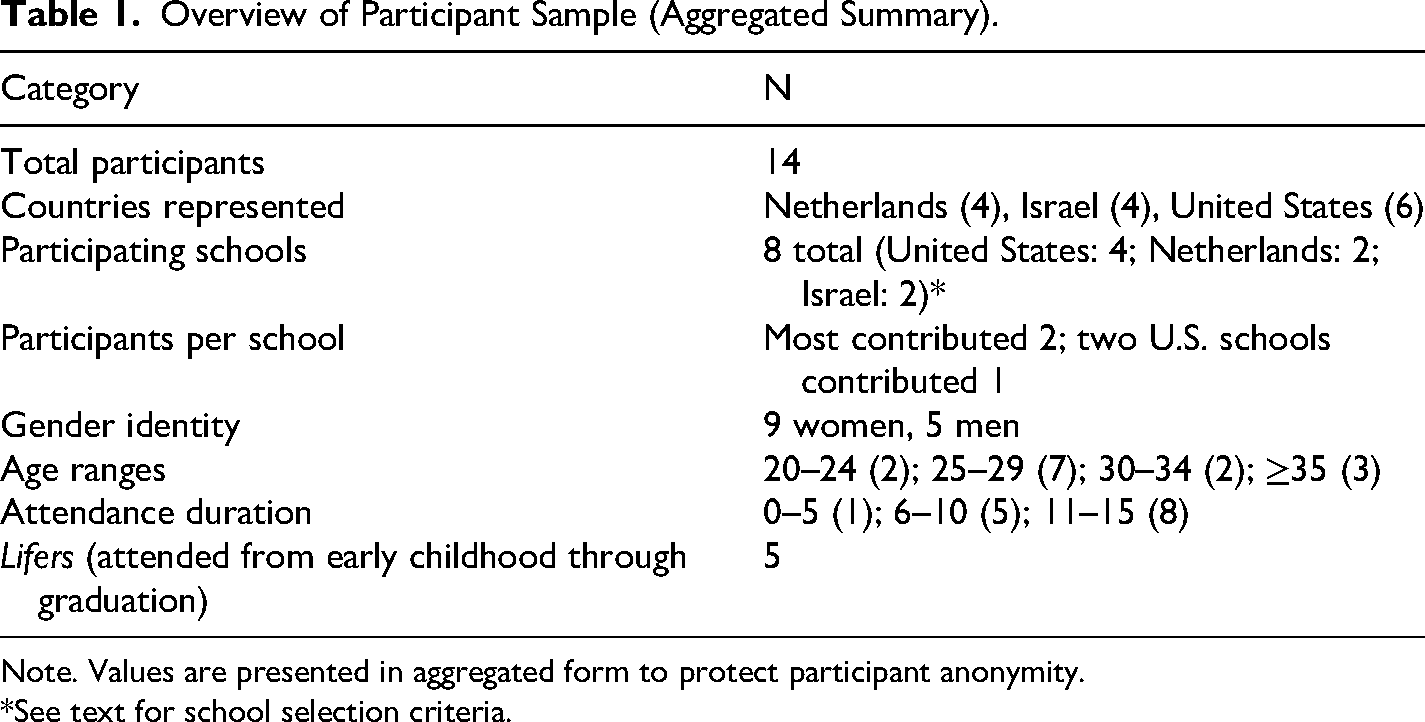
Note. Values are presented in aggregated form to protect participant anonymity.
*See text for school selection criteria.
Materials
Data were collected using a semi-structured interview guide. The guide included open-ended questions covering five domains: (1) current life context, (2) entry into the school, (3) in-school experiences, (4) post-school transitions, and (5) overall reflections. Prompts were designed to elicit narrative accounts rather than fixed responses (Kvale, 2007).
Procedure
Interviews were conducted virtually via Microsoft Teams in 2021, lasting 60–90 min. All interviews were audio-recorded, transcribed verbatim, and anonymized. Pseudonyms were assigned, and transcripts were returned to graduates for member-checking (Mero-Jaffe, 2011). Informed consent was obtained prior to participation. Ethical approval was granted by the University Research Ethics Committee. All interviews, transcriptions, and subsequent analytic work were conducted by the first author.
Analytic Strategy
Analysis followed Braun and Clarke's (2021) reflexive, iterative approach. All coding, memo-writing, and development of the conceptual model were carried out by the first author, in line with reflexive thematic analysis's emphasis on a single, actively interpreting analyst rather than interchangeable coders. Coding was conducted in Atlas.ti, beginning with inductive codes developed through close reading of transcripts (Charmaz, 2006). Initial codes were closely tied to participants’ phrasing and were treated as provisional. As analysis progressed, codes were revised through iterative comparison within and across cases. Codes were revised through iterative comparison, and related codes were grouped thematically. Thematic grouping involved clustering related codes into higher order conceptual categories that connected participants’ experiences of school structures, processes, and culture with the meanings they constructed about their later-life trajectories. To ensure that reported themes reflected cross-contextual patterns rather than isolated accounts, each theme was represented by quotations from at least three different participants, drawn from at least three schools in at least two countries. Any mention of how many participants contributed to a theme is intended only to illustrate the diversity of accounts supporting it, rather than to imply the strength, weight, or statistical importance of a theme, in keeping with the principles of reflexive thematic analysis.
Rigor was ensured through transparency, reflexive engagement, and sustained analytic attention rather than inter-coder reliability statistics. The first author maintained a detailed audit trail in ATLAS.ti, including code comments, analytic memos, co-occurrence notes, and evolving code lists that documented shifts in analytic thinking over time. Developing codes and early thematic patterns were discussed with critical peers and the supervisor, who provided conceptual feedback and posed reflexive questions that helped interrogate assumptions and alternative readings. Talking through the analytic process and demonstrating coding decisions supported clarity, coherence, and defensibility of the interpretations within a reflexive thematic analysis framework. Themes were retained if they spanned multiple schools, appeared in at least three interviews, and represented more than one national context. This combination of transparency, reflexive engagement, and critical dialogue provided a robustness check on the analytic decisions.
Dutch quotations were translated with attention to tone and nuance (Temple & Young, 2004). Illustrative quotes were lightly edited for readability. All Dutch–English translations were produced by the first author, who is fluent in both languages; when wording was ambiguous, translations were reviewed against the original in consultation with bilingual colleagues to preserve participants’ intended meaning.
Results
This section presents findings from interviews with fourteen Sudbury school graduates; all participant names used are pseudonyms. The results are organized into an overview of participant trajectories, followed by three major thematic sections that illustrate how self-directed participation in school life shaped learning, personal development, and interpersonal capacities.
Participant Overview
Graduates in this study pursued a wide variety of post-school pathways, often entering higher education or the labor market through alternative, non-diploma-based routes. Of the 14 participants, five accessed university-level study through preparatory years, entrance exams, or portfolio-based admissions. Another three enrolled in higher vocational or professional training programs. The remaining six transitioned directly into work, typically combining self-directed learning, short specialist courses, or informal apprenticeships with on-the-job experience.
Across these trajectories, four participants built careers in technology and computing—most commonly in IT and cybersecurity. One entered this field through university study, while the others did so through a mix of self-directed learning, short professional courses, and direct workplace opportunities. Three participants moved into health, psychology, and care professions, accessing these pathways through vocational entrance tests, applied training programs, and, in one case, through college followed by university study. Two participants pursued law and public service, entering university either through a preparatory year or via entry examinations, sometimes following substantial prior work experience; one of these participants later undertook a second university degree in history purely out of personal interest. Creative fields also featured prominently: three participants developed careers in arts, media, and design—two through self-training, internships, and short courses, and one through attendance at a vocational school—often combining these pathways with freelance work. Finally, two participants established careers in business, retail, and financial administration, one drawing on family enterprise experience and the other on international work experience to advance professionally.
Taken together, these trajectories highlight the diverse ways in which participants carried forward competencies shaped during everyday participation in school life, a process explored in the themes that follow.
Learning by Doing: How Daily Experiences Forge Lifelong Skills
Learning Through Daily Activity: A Continuous Process
Across the interviews, all participants emphasized that learning was a constant, largely unconscious process embedded in everyday experience. Claire described how “learning actually happens all the time in the background,” while Helen reflected that “you don’t always realize that you are learning something at that moment.” For Leo, “every experience you have in school is a learning experience,” and Andrew summarized: “For me, it's learning by doing. I think that is what still continues to be true for me in my life.”
Participants noted that skills often emerged through activities that felt meaningful rather than through explicit instruction. Rachel explained, “I didn’t really take classes… I was in pursuit of things that were satisfying to me, and the process of getting to those things meant learning a lot,” describing how skills emerged through meaningful activity rather than explicit instruction.
Six participants who had started their schooling at a young age recalled developing literacy and numeracy informally, through reading, writing school paperwork, or engaging in hobbies. Jessica said she “picked up grammar and sentence structure… just from reading a lot,” while Philip described learning “to write and read, to deal with all the paperwork the school has.” Andrew recalled that “things like arithmetic have always come incredibly naturally to me,” while Helen and Marcia described how everyday activities like cooking or being outdoors helped them learn basic skills, including math.
Among participants for whom English was not a first language, this language was often learned independently, driven by personal interests. Suzanne shared how she improved her English by watching films and reading the same book in two languages and Phillip learned it from playing games. Two others pursued Spanish, Korean or German out of cultural curiosity or necessity. These accounts echo SDT's emphasis on autonomy and intrinsic motivation, where skills develop as byproducts of meaningful pursuits rather than imposed tasks.
Student-Led Projects and Hands-on Learning
All 14 participants recalled voluntary projects—camping trips, theater productions, or fundraising efforts—that required initiative, planning, and collaboration. These were not assignments but student-led undertakings. Leo explained, “I liked to take charge of stuff… producing the school plays, making a pamphlet, and raising money with ads.” Alumni from different schools described camping and hiking trips as opportunities to practice budgeting, organizing, and fundraising. Marcia recalled helping plan 5-day camping trips, Andrew recalled how “There was a lot of planning and fundraising that went into those trips.” Also, Beth recounted budgeting organizing a museum visit, “I did all the research myself… how much money to ask from the school.”
Graduates also highlighted how these projects fostered collaboration and shared leadership. Rachel described writing policies and training procedures in committees, while Ella reflected on producing a play without adult oversight: “We did all of it: choosing roles, rehearsing, building the set, making costumes, doing makeup, and invitations.” Suzanne recalled, “cooking with everyone, building a restaurant for people from outside.”
In sum, alumni accounts reveal that voluntary projects served as a nexus where basic academic skills, organizational competence, and civic dispositions were cultivated simultaneously. Far from being peripheral, participants’ accounts illustrated how they experienced these challenges as meaningful contexts for learning, which exemplify how experiential challenges in community settings may function as rich pedagogical contexts that advance both individual agency and collective responsibility.
Governance Roles and Community Responsibility
Ten participants described taking on governance roles—clerks, chairs, committee members—as formative experiences. The judicial committee, a peer-run body for discipline and conflict resolution, and the School Meeting, where staff and students voted on rules and policies, served as the primary platforms for participation, alongside a range of other committees. Although these tasks were undertaken voluntarily, they were not casual commitments and often demanded sustained daily effort.
Ella was elected chair of the School Meeting at the age of 12, a position she held for 2 years, while Leo chaired meetings at 16 and recalled the responsibility of “sit[ting] still for two hours and lead[ing] a meeting.” Helen described chairing the Judicial Committee, noting that sessions could last anywhere from 15 min to several hours.
For many, these roles were both demanding and rewarding. Beth and Andrew emphasized enjoying the judicial committee process, while Claire highlighted learning responsibility for collective decisions: “It was important to take responsibility for things you don’t necessarily like, not for yourself, but for the greater good.” Andrew reflected that he especially enjoyed refining rules to ensure fairness and consistency.
Others likened governance to running a real organization: Suzanne described balancing the school's budget, Leo and Suzanne recalled participating in staff hiring and review, and Ted highlighted the difficulty of balancing individual freedom with community needs. As Lillian said that they regularly discussed, “What do we value more: the individual or the community?”
Participants described governance roles as supporting their sense of civic responsibility but also their organizational literacy and moral reasoning, often through the demanding, sometimes long hours of collective work in judicial committee that students like Helen recalled.
Broadening Perspectives Through Age-Diverse Interactions
Four participants emphasized how mixed-age interactions shaped their learning. Leo recalled conversations across age groups that challenged him to hear new viewpoints. Helen and Suzanne valued listening to younger children, while Andrew explained that he learned to “argue in a legalese manner” by observing peers, developing structured reasoning and an ability to separate arguments from personal relationships.
The school culture of dialogue reinforced respect for differing perspectives. Suzanne recalled, “We also had very deep and sensible and philosophical discussions on an almost daily basis, and everyone came from a different background, everyone just respected each other's point of view.”
Alongside perspective-taking, participants emphasized how these experiences sharpened their thinking. Leo spoke of “trying to look at things in a different way, trying to think out of the box,” while Suzanne noted, “The greater your ability to see different perspectives, the more opportunities you have to solve problems in different ways.” Helen contrasted her learning to rote schooling: “Maybe she can learn and cram very well, but maybe I have learned to think,” and Andrew added, “I would never have to cram for tests… That was never part of my world.”
These reflections suggest that democratic dialogue not only broadened perspectives but also cultivated metacognitive awareness and flexible reasoning.
Collective Voice and Empowerment
Eight participants described empowerment through co-creating school structures and having a genuine voice within them. Ella explained, “We were part of creating it. It never felt arbitrarily restrictive because we helped build the system.” Stephen recalled realizing his agency through influencing rules, while Marcia described the “power to protect things I believe in.” Andrew emphasized, “there were a lot of things that we got to be a part of, which was very exciting.” Three participants explicitly traced these experiences into adulthood. Helen linked her confidence in voicing opinions later in life to her school experiences, while Jessica noted that having the same voice as a staff member from a young age “carried over into my life beyond school.”
Taken together, these accounts suggest that their schooling offered more than symbolic participation. Participants experienced themselves as co-authors of their institutional world, giving them practice in negotiating rules, voicing perspectives, and taking responsibility for collective outcomes. For some, this became a foundation for confidence and agency in later life, indicating how early, authentic participation can leave a lasting imprint on civic identity and the sense of one's own voice as legitimate in wider society.
Personal Skills in Adult Life
General Preparedness for Adult Life
Five participants spoke in very general terms about feeling well prepared for adult life. Rachel noted, “None of it was particularly difficult for me. I pretty much feel normal,” while Ella asserted, she was “no less prepared… and in many ways much better.” Lillian emphasized financial independence and happiness as markers of readiness, while others reflected that no schooling could fully prepare one for adulthood's unpredictability.
Together, these reflections suggest that participants understood preparedness less as mastery of specific skills than as a general sense of resilience, confidence, and orientation toward adulthood.
Independent Learning and Adaptability
Eight participants emphasized learning how to learn as one of the most valuable outcomes. Helen explained, “You have to make your own schedule, learn for yourself and see for yourself how you get the right information.” Andrew highlighted his practice of “self-learning” (independent study without formal instruction) as especially useful in college, while Ted described it as “probably one of the single most important skills.”
Taken together, these accounts suggest that participants saw adaptability and the capacity to direct their own learning as enduring strengths, equipping them to navigate new environments and challenges beyond school.
Preparation for Further Education and Work
Eight participants felt on par with mainstream peers. Helen remarked, “I am not behind others who have completed [a mainstream] school,” while Ella said, “I went to university, and I was fine.” Ted reflected, “Even though I didn’t have any formal classes… that didn’t affect me negatively.” Philip, who entered a 1-year prep program, described condensing 12 years of learning into 1 year as “quite easy.” Andrew emphasized being more prepared to apply theory in practice than peers trained to memorize definitions.
Five did face transitional challenges. Jessica recalled, “I definitely did not schedule myself that tightly when I was at [my school],” while Philip admitted, “Was I prepared for it? Honestly, no. It hit me hard… I didn’t know how to study.” Yet these struggles were temporary, and none reported long-term disadvantages.
Overall, participants’ accounts indicated that while the transition to further education or work sometimes involved short-term adjustment, their schooling ultimately left them well equipped to succeed alongside—and at times ahead of—their mainstream peers.
Initiative, Time Management and Self-Discipline
Seven participants emphasized that their schooling cultivated initiative and responsibility by requiring them to act without constant direction. Andrew recalled that not being “babied and told exactly what to do” prepared him to handle college independently, while Claire noted she had been “trained to figure out what I have to do,” a quality she later found valued in the workplace. Helen similarly described being praised for noticing and completing tasks without supervision.
Time management was seen as integral to this independence. Beth explained how freedoms such as leaving campus were balanced with accountability to return for duties, which helped her learn to organize her time effectively. Stephen linked the Judicial Committee's consequences for neglected chores to learning self-discipline, while Ted reflected that even unstructured leisure, such as gaming, sharpened his sense of how to allocate time wisely.
Together, these accounts suggest that initiative and self-discipline were not simply taught but embedded in daily routines through freedom, responsibility, and accountability. Participants connected these experiences to later success in education and work, where anticipating tasks, managing competing demands, and following through on commitments were seen as defining strengths.
Navigating Bureaucracies and Meetings
Seven participants described how Sudbury governance prepared them to engage with bureaucratic and decision-making systems in adult life. Leo recalled that governance roles taught him “what strings to pull” in navigating procedures, while Ella explained that familiarity with rules made rigid institutions less intimidating. Lillian observed that her Sudbury school “can be very bureaucratic in a way, but it's also very flexible,” a dynamic she later recognized in the corporate world, where “everything is actually a lot more flexible if you are just able to work with people and kind of push for what you want.” Not all reflections were unambiguously positive. Philip noted that the egalitarian culture left him resistant to near-peer authority, making it difficult at times to accept hierarchical structures. His account suggests that Sudbury schools can foster not only adaptability but also skepticism toward imposed authority.
Three participants also pointed to how school meetings, often run with formal procedures such as Robert's Rules of Order, provided enduring reference points for collective decision-making. Claire contrasted the clarity and efficiency of school meetings with the lengthy and unfocused ones she later encountered at work, while Ted recalled feeling at ease in adult meetings that used similar procedures. Lillian added that exposure to recurring rhetorical strategies and factions gave her confidence to participate critically. These reflections suggest that regular practice with structured debate contributed to a familiarity with meeting dynamics that graduates carried into adult life.
Together, participants described their Sudbury schools as environments in which they developed transferable capacities for navigating bureaucracies and collective processes—combining procedural fluency, expectations of efficiency, and critical awareness—while also shaping how graduates evaluated and, at times, resisted authority.
Interpersonal Skills in Adult Life
Communication and Dialogue
Seven participants described how the school's participatory environment shaped both listening and speaking. Helen noted that learning to hear different views taught her to justify advice in her professional work, so people follow “not because I say so, but [because of] the why.” Suzanne stressed that she had learned to “really listen,” while Marcia said she continued to talk to people as equals. Together, these reflections point to how practices of listening, explaining clearly, and speaking respectfully became communicative skills that participants saw as directly useful in their working lives.
Others highlighted adaptability and rapport-building. Jessica described using skills of reading people and adjusting her communication in both leadership and customer service roles. Ted felt the school helped him move beyond shyness toward “more meaningful interactions,” while Lillian linked her comfort with strangers to its culture of acceptance. Beth pointed to staff and judicial committees as models of respectful dialogue that still shape her communication. Collectively, participants saw habits of listening, adapting, and engaging as equals as central to their adult effectiveness in social and professional life.
Egalitarian Relationships
Six participants described how seeing adults as equals in school gave them confidence across hierarchies. Andrew recalled that staff were “members of the community,” which shaped how he later related to professors and colleagues. Helen said she could approach anyone, “just another human being,” while Suzanne felt at ease with older peers in training as long as she was judged “as a person.”
Others stressed how this outlook benefited education and work. Jessica found professors approachable and took initiative where peers waited passively, and later improved rapport with bosses by treating them “as people.” Leo recalled gaining confidence to contact organizational leaders, while Lillian linked her ease in disagreeing with her boss to seeing adults simply as people. Together, participants highlighted egalitarian relationships as preparation for engaging confidently with authority in adult life.
Collaboration Across Differences
Five participants emphasized learning to work with people of different ages, backgrounds, and personalities in the school's age-mixed community. Rachel explained that “they weren’t people I chose… and I had to work with them,” which she saw as preparation for adult life where “you interact with all kinds of people, and you don’t choose who they are.” Ted similarly noted that being “forced to interact with a variety of different people, a variety of different ages, a variety of different backgrounds and knowledge” helped him overcome shyness and prepared him for later life. Leo compared this directly to the workplace, where one must cooperate even with those “you don’t like.”
Others highlighted how the age-mixed environment informed their professional practice. Marcia described learning to support others’ visions in organizations while still holding to her own ideas. Helen and Rachel both connected their experiences of respecting difference at school to their current health and welfare work, where adapting to families’ varied values and circumstances requires sensitivity and compassion. Collectively, participants saw collaboration in a diverse, age-mixed community as preparation for adult environments where difference and interdependence are inescapable.
Expressive Confidence and Respect
Nine participants emphasized that their school experience gave them confidence to voice opinions and navigate disagreements. Andrew explained, “I always feel empowered to speak up and share my feelings and opinion,” while Leo highlighted the importance of “talking respectfully and getting your point through, even though you disagree … understanding to disagree.” Others echoed that the school's debate culture normalized respectful disagreement, strengthened their rhetoric, and helped them develop a confident voice.
Seven participants also reflected that being treated as capable individuals shaped their expectations of mutual respect in later life. Suzanne recalled that adult conversations often felt more meaningful than peer interactions, and Jessica and Beth noted being seen as unusually mature by outsiders. Beth attributed her ease with adults to the school, saying she could “get along with adults so well,” while Leo recalled that colleagues respected him because they “didn’t treat me like a kid.” Not all experiences were seamless, however: Claire described frustration when, after having a normal conversation, others began treating her as less competent once they discovered her age—a sharp contrast to the respect she had grown used to at school.
Taken together, these accounts suggest that the school's culture of open debate and mutual respect fostered expressive confidence and shaped enduring expectations of being taken seriously, even if such expectations were not always met beyond the school.
Discussion
This study explored how graduates of Sudbury schools perceived the long-term impact of their self-directed education. Fourteen graduates from eight schools in the Netherlands, Israel, and the United States described how their schooling shaped learning, identity, and participation in adult life. Across accounts, learning, personal development, and social functioning were not separate domains but part of a holistic ecology of participation: skills, dispositions, and values co-emerged through immersion in a democratic community. The findings are interpreted here through the lenses of experiential education, Evolutionary Developmental Psychology, SDT, and sociocultural perspectives.
Situated and Informal Learning Processes
Participants consistently described learning as an embedded, often unconscious process — “learning by doing” (Andrew) through projects, daily activities, and dialogue. This echoes theories of experiential (Kolb, 1984), situated (Lave & Wenger, 1991), and sociocultural learning (Rogoff, 2003). Their accounts resonate with evolutionary developmental perspectives suggesting that human cognition develops in ecologically valid contexts of shared activity (Bjorklund & Ellis, 2014; Lancy et al., 2010). In this sense, Sudbury schools did not simply permit informal learning—they institutionalized it, treating daily life and governance as the curriculum. Crucially, participants’ understood such everyday, self-directed experiences as supporting not only intrinsic motivation but also agency, leadership, and a sense of responsibility for the collective, echoing evolutionary developmental, situated and sociocultural assertions that civic and social skills emerge naturally from meaningful participation.
Autonomy, Self-Direction, and Agency
The absence of imposed curricula required students to manage their own time, develop initiative, and learn how to learn. Participants emphasized that these habits later supported adaptability and confidence in unfamiliar tasks. From an SDT perspective, their accounts illustrate how autonomy-supportive contexts foster intrinsic motivation and internalized responsibility (Ryan & Deci, 2017). Although some described transitional struggles when adapting to conventional routines, these were experienced as temporary rather than long-term disadvantages. Overall, participants described initiative, self-regulation, and reflective learning strategies as enduring strengths and linked the autonomy of their schooling to later adaptability.
Governance as Pedagogy
Participation in governance—budgeting, conflict resolution, hiring, chairing meetings—was described as formative rather than symbolic. Students saw these roles as demanding, rewarding, and educational, supporting Greenberg's (2016) claim that democracy constitutes education itself. From an evolutionary perspective, such responsibilities echo ancestral contexts where children contributed to real community tasks (Gaskins & Paradise, 2010; Rogoff, 2003). Graduates emphasized that these activities cultivated civic literacy, moral reasoning, and organizational competence, while also sharpening awareness of bureaucratic systems. Participants described governance as an important context for their learning in which they learned to lead, negotiate, and participate responsibly in collective life.
Balancing Freedom and Collective Responsibility
Beyond governance, participants reflected on the broader tension between individual autonomy and community obligations. Some celebrated how responsibility emerged naturally within freedom; others noted inefficiencies or frustrations. Philip's resistance to hierarchical authority illustrates how democratic schooling can foster both adaptability and skepticism toward imposed structures. These reflections align with SDT's view that autonomy flourishes within supportive, interdependent relationships (Deci & Ryan, 2000) and with evolutionary developmental perspectives highlighting cooperation as an adaptive skill in small communities (Tomasello, 2019). Rather than resolving this tension, Sudbury schools functioned as micro-societies where it was continuously lived and negotiated. In this sense, freedom and responsibility were not oppositional but mutually constitutive, which participants experienced as contexts in which they developed the dispositions needed to navigate complex adult environments.
Complex Knowledge and Pathways of Learning
Participants reported acquiring literacy, numeracy, and languages through self-motivated activities, and most transitioned into higher education or professional fields without lasting difficulty. What stands out in their narratives about their life-paths is not only the diversity of pathways but also the resourcefulness with which participants accessed opportunities. Almost none graduated in the traditional manner based on a diploma earned through curricular final exams. Instead, entrance exams, preparatory years, portfolio-based admissions, vocational tests, and work experience often substituted for conventional school-leaving qualifications. Many emphasized the role of self-study, passion, and flexibility in shaping their trajectories. Collectively, their accounts demonstrated how meaningful professional specialization and sustained careers can develop through non-traditional routes into higher education and employment. While some initially struggled with academic routines, none felt permanently disadvantaged.
The four-phase model of interest development (Hidi & Renninger, 2006) offers a useful complement to these accounts. Their framework emphasizes how interest and knowledge deepen when learners have opportunities for repeated engagement and growing familiarity with meaningful tasks. Participants’ descriptions of spending extended periods on self-chosen activities, following lines of curiosity, and developing expertise through practice align with the kinds of environmental supports that facilitate the transition from situational to more sustained forms of interest. Taken together, the model reinforces the broader idea evident in graduate narratives: that deepening knowledge and engagement can emerge organically when learners are free to pursue domains they find meaningful.
The participants’ reflections question the assumption that formal instruction is the only pathway to complex knowledge and align with evidence that self-directed educational contexts can support robust outcomes (Gray & Chanoff, 1986; Gray & Riley, 2015; Morrison, 2022). This finding connects to an ongoing debate about how learners engage with complex domains: some argue that such knowledge must be mastered through explicit teaching because it does not arise naturally and is essential for participation in modern societies (Geary, 2008; Sweller, 2008). Others highlight the role of motivation, emotion, and meaningful engagement, suggesting that learners pursue complex knowledge effectively when it becomes relevant in their lives (Ellis, 2008; Gray, 2016; Lancy, 2016). Ellis's critique of Geary is especially relevant here: rather than viewing formal instruction as necessary to override folk modules, he emphasizes that learning develops adaptively through cultural context and intrinsic motivation. Graduate accounts lend weight to this latter perspective, showing how they perceived informal, self-motivated pathways as adequate preparation for their later engagement with complex academic and work demands.
The Role of Adults
Although staff were not acting as teachers, participants emphasized that adults mattered—as models of respect, anchors of culture, and co-participants in governance. Their role aligns with Rogoff's (2003) notion of guided participation: adults did not impose, but they shaped the cultural ecology in which learning unfolded. This highlights that this type of education is not about the absence of adults, but about the quality of their involvement. Distinguishing between self-directed learning and Self-Directed Education clarifies this point. Self-directed learning often takes place within teacher-designed curricula, while Self-Directed Education, as in Sudbury schools, grants self-governance over what, how, and even whether to engage in formal study (Gray, 2023). Graduates accounts underscore that this self-directedness was not isolation, but interdependence within an egalitarian culture of respect.
Limitations of the Present Study
This qualitative inquiry relied on a small, self-selected sample of fourteen graduates and retrospective accounts of their schooling. Participants who chose to take part may have held particularly positive or reflective attitudes toward their Sudbury experiences, which could have shaped the tone and content of their narratives. The first author also had prior relationships with four participants (one a relative and three former students); although reflexive practices were used to attend to potential influence, this familiarity may have shaped participation and therefore represents an additional limitation in terms of sample bias.
The study's intent, however, was not to assess the relative effectiveness of Sudbury schools but to identify common developmental processes emerging within this model. The research could not systematically account for differences in family background, socioeconomic status, or length of attendance, all of which likely influenced participants’ trajectories. In addition, participants were drawn from three Western, Educated, Industrialized, Rich, and Democratic contexts (the Netherlands, Israel, and the United States); although no marked cultural differences emerged, the design was not optimized to examine cultural variability. These factors limit the transferability rather than the credibility of the findings.
Implications for Education
Taken together, these findings suggest that Sudbury schools create developmental conditions where autonomy, participation, and community responsibility intertwine. Graduates described carrying forward dispositions of initiative, civic engagement, and relational maturity. The consistency across Dutch, Israeli, and U.S. participants hints that these dynamics may extend beyond specific national contexts, possibly reflecting the universality of SDT's basic psychological needs (Ryan & Deci, 2017). By showing how governance, autonomy, and age-mixed interaction serve as enduring developmental contexts, this study contributes to rethinking educational pathways beyond formal instruction and standardized progression.
Future Research
Future investigations could extend these findings through longitudinal designs that trace developmental outcomes over time, include more culturally diverse sites, and incorporate family or peer perspectives. Comparative work with other learner-directed or democratic models would clarify which elements of autonomy and participation most strongly support lifelong learning and civic engagement.
Footnotes
Ethical Approval
The study was approved by the University Research Ethics Committee, under approval number U202103682.
Consent to Participate and Publish
All participants provided written informed consent to participate in the study and for the publication of anonymized data. Personal identifiers were removed to protect confidentiality.
Funding
The authors disclosed receipt of the following financial support for the research, authorship, and/or publication of this article: This research was supported by an unrestricted grant from the IONA Stichting (2021–2024), awarded to the first author.
Declaration of Conflicting Interests
The first author is employed at a school that operates under an educational model similar to those examined in this study. The first author also had prior familiarity with four participants: one a relative and three former students encountered in professional contexts. These connections were carefully considered and addressed through reflexive practices. Measures were taken throughout to ensure that no personal or external interests influenced the study’s design, data collection, analysis, or reporting. The second author declares no competing interests.
Disclosure Statement
The first author is employed at a school that operates under an educational model similar to those examined in this study. The first author also had prior familiarity with four participants: one a relative and three former students encountered in professional contexts. These connections were carefully considered and addressed through reflexive practices. Measures were taken throughout to ensure that no personal or external interests influenced the study's design, data collection, analysis, or reporting. The second author declares no competing interests.
Data Availability Statement
Anonymized interview transcripts supporting the findings of this study are not publicly available due to confidentiality agreements but may be obtained from the corresponding author upon reasonable request.
