



Abstract
Introduction
Science, technology, engineering, and mathematics (STEM) are the pillars of exploration and technological advancement. A diverse and proficient STEM workforce is essential for sparking creativity, propelling future innovations, and bolstering the economy (Committee on STEM Education, 2018). The U.S. Bureau of Labor Statistics (2023) projects growth in U.S. STEM jobs from 10.36 million in 2022 to 11.49 million by 2032, a 10.8% increase, outstripping the growth rates for all occupations (2.8%) and non-STEM occupations (2.3%). With a median wage of $97,980 for STEM jobs and $44,670 for non-STEM jobs, it underscores the high demand and remuneration for STEM workers (Krutsch & Roderick, 2022; U.S. Bureau of Labor Statistics, 2023). Despite these incentives, STEM fields are grappling with a significant shortage of workers. By 2025, the United States is expected to have 3.5 million STEM jobs, but a labor shortfall exceeding 2 million workers is also forecasted, signifying a substantial disparity between the supply and demand of STEM professionals (Birney & McNamara, 2021; Roehrig et al., 2021). Tackling these challenges is vital for sustained growth and innovation in STEM fields.
To stimulate innovation and ensure equal opportunities for all students to pursue STEM careers, U.S. policymakers advocate for increasing both the quantity and diversity of students seeking postsecondary STEM degrees (Allen-Ramdial & Campbell, 2014). STEM education at the elementary and secondary levels forms the foundation for students pursuing STEM majors and diverse careers in higher education. High school experiences play a significant role in shaping future STEM outcomes in higher education and the workforce (Rosenzweig & Chen, 2023; Wang, 2013). Specifically, students reporting high confidence in their mathematics and science abilities during high school are more likely to choose STEM majors in college. Data from the High School Longitudinal Study of 2009 (HSLS:09; National Center for Education Statistics, 2020) supports this idea that success in high school STEM courses lays a robust foundation for STEM-related higher education and careers. The HSLS:09 was a comprehensive national longitudinal study that tracked more than 23,000 ninth graders from 944 schools beginning in 2009, with a first follow-up in 2012 and a second follow-up in 2016. Reinforcing these results, the Indicators 2020 report on elementary and secondary mathematics and science education (Rotermund & White, 2019) revealed that students who enroll in specific STEM-related career and technical education (CTE) courses tend to secure higher-paying skilled technical jobs immediately after high school. All these nationwide, long-term, and professional data highlight the importance and urgency of guiding students toward STEM in high school.
An internship, a type of experiential education program (Kolb, 2014), plays an important role in providing practical experience in a specific field, thereby enhancing students’ skills and knowledge under professional guidance. Originating in the late nineteenth century in the United States for medical graduates, internships expanded into other sectors in the 1930s. Higher education institutions have significantly contributed to their growth, viewing internships as experiential learning opportunities that complement classroom education and boost career prospects (Perlin, 2013; Sides & Mrvica, 2017; Wentz & Ford, 1984). After almost a century of practice, institutions that offer internships have identified the benefits of internships for both students and employers. Internships offer students valuable real-world experience that is often missing in academic settings. For employers, internships serve as an effective recruitment tool, allowing them to groom potential employees with minimal risk due to the short-term nature of internships (Fell, 2022; Indeed Editorial Team, 2023). Surveys conducted by the National Association of Colleges and Employers (NACE) indicate that students who participated in internships were 20% more likely to secure full-time job offers and also received noticeably higher starting salaries compared to those who did not (Gray & Collins, 2023; NACE Staff, 2016; O’Keefe & Posner, 2020).
Extant studies on science internships consistently highlight their positive influence on high school students’ learning outcomes and attitudes. These internships afford students genuine exposure to scientific practices, encompassing collaboration with scientists, hands-on experimentation, data analysis, and results presentation (Hsu, 2020; Hsu et al., 2010; McMiller et al., 2006; Roth et al., 2009). In particular, science internships can serve as a productive learning environment where students with a genuine interest in science explore those interests and learn authentic science practices with scientists (Hsu et al., 2009). The cumulative impacts include enhanced comprehension of the nature of science, refinement of scientific skills, and heightened interest and motivation in scientific pursuits (Cantu, 2011; Hayes, 2017; Hsu & Roth, 2010). Additionally, science internships play a pivotal role in introducing students to diverse career possibilities, influencing their choice of college majors, and aiding in the establishment of professional networks and identities (Papadimitriou, 2014).
However, despite the recognized significance of high school science internships, the current body of research is notably deficient in exploring internships’ specific influence on directing students toward STEM fields. This research gap is underscored by the scarcity of studies on high school internships, as indicated by Rice (2018). One possible explanation for this dearth of research is evident in the Progress Report on the Implementation of the Federal STEM Education Strategic Plan (Office of Science and Technology Policy, 2021), which notes a predominant focus on undergraduate and graduate programs. Consequently, there is an evident oversight regarding the models and barriers associated with work-based learning, particularly within high school programs.
Recognizing the critical juncture of high school education and the pivotal role that internships play in steering students toward science-related paths, there is an urgent need for further research. A comprehensive understanding is needed of how science internships impact high school students’ decisions to pursue STEM fields. Addressing this research gap is essential for informing educational policies and practices which ensure that high school science internships are maximally effective in guiding students toward meaningful engagement with science and, subsequently, STEM career pathways. The focus of this study is to address the identified research gap by applying social cognitive career theory to explore the specific influence of high school science internships on guiding students toward STEM majors and career choices. Through an in-depth examination of the experiences and perceptions of high school students engaged in science internships, this study aims to contribute valuable insights to educational policies and practices, fostering a more informed approach to encouraging students toward STEM career paths. Thus, the research question guiding this study is: How might science internships shape high school students’ career choices?
Theoretical Framework: Social Cognitive Career Theory
Introduced in 1994 by Robert William Lent, Steven Brown, and Gail Hackett, social cognitive career theory (SCCT) is a robust theoretical model that primarily stems from Bandura's (1986) general social cognitive theory (SCT). SCCT explores the complex interplay of psychological and social factors that influence personal interests and guide decisions in educational and career paths. Over time, the theory has been refined and enhanced. In its initial stages, SCCT concentrated on the development of career-related interests, the decision-making process in selecting academic and career paths, and students’ persistence in achieving educational and professional goals (Lent et al., 1994). As the theory evolved, its scope broadened to include other vital aspects of career and educational development, such as factors that contribute to satisfaction (Lent & Brown, 2006) and well-being (Lent & Brown, 2008) in academic and work environments. It also examined the complex dynamics of self-management (Lent & Brown, 2013) in the realms of education and career. In essence, SCCT has evolved into a dynamic framework that not only explicates the formation of interests and decision-making but also delves into the broader landscape of personal fulfillment and effective self-management in the intricate tapestry of educational and career journeys.
For our study, SCCT serves as an ideal framework for investigating the influence of high school science internships on students’ decisions to pursue STEM fields. SCCT has been widely validated as a model for encouraging diverse groups to seek education and careers in STEM fields (Byars-Winston et al., 2010; Cardoso et al., 2013; Dutta et al., 2019; Sheu et al., 2016). SCCT has emerged as a leading framework for explaining recruitment and retention processes in STEM careers, particularly in clarifying the academic and professional interests and goals of secondary students (Casas & Blanco-Blanco, 2017; Mueller et al., 2015; Wang, 2013). Moreover, the utility of SCCT extends to elucidating the processes and outcomes that shape academic and career choices, providing valuable insights into the career planning and transition of middle and high school students (Byars-Winston & Rogers, 2019; Rogers & Creed, 2011; Rogers et al., 2008; Wendling & Sagas, 2020). Although SCCT is a career theory, it initially considers children and adolescents. The model of how basic career interests develop over time highlights cognitive and behavioral influences during childhood and adolescence (Lent et al., 1994). Furthermore, SCCT's focus on self-efficacy and career expectations, which are known to increase with enrollment in STEM-related programs, aligns with key motivational factors. This alignment aids in the establishment of a STEM pipeline from secondary to postsecondary levels (Sevilla & Snodgrass Rangel, 2023).
According to SCCT, two important social cognitive mechanisms that are particularly significant in the context of career development are self-efficacy expectation and outcome expectations (Lent et al., 1994). Self-efficacy expectations are defined as people's beliefs in their capabilities to perform behaviors that lead to success in various activity domains (Brown & Lent, 2023). These beliefs are influenced by four major sources of information: (a) mastery experiences, (b) vicarious experiences, (c) verbal persuasion, and (d) physiological and affective states (Bandura, 1986, 1997). Mastery experiences refer to one's own first-hand experiences of performing a given task by themselves. If people performed well on a task previously, they will likely feel competent and perform well on a similar task (e.g., “I can do it because I have done a great job of it by myself before”). Vicarious experiences refer to the experience of observing other people's task performance and transferring those competencies by comparing with others (e.g., “I can do it because I have seen others do it before”). Verbal persuasion refers to others’ social persuasion on ones’ capabilities. If people receive compliments and votes of confidence from others, they may develop a sense of self-confidence (e.g., “I can do it because my teacher has trust in me”). Physiological and affective states refer to one's bodily sensations or emotions while they perform certain tasks. If people enjoy doing a task, they may generate positive views about their ability to complete that task (e.g., “I can do it because I enjoyed doing it before”).
Outcome expectations, on the other hand, refer to personal beliefs about probable response outcomes (Lent et al., 1994). They focus on the perceived consequences of engaging in activities across different performance domains (Brown & Lent, 2023), including the anticipation of material outcomes, social outcomes, and self-evaluative outcomes (Bandura, 1986; Bandura et al., 2001). Material outcomes refer to the possible physical or material outcomes, such as money, degrees, or certificates. If people perceive that a certain career might bring them physical or material rewards, they may be motivated to pursue it (e.g., I want to choose this career because I will get a great salary for it). Social outcomes refer to possible outcomes of social or societal approval, status, or consequence. If people perceive that a certain career might bring them others’ approval or recognition, they may choose it to win this social recognition (e.g., I want to choose this career because my parents will be proud of me). Self-evaluative outcomes refer to possible outcomes of self-evaluation or self-recognition. If people perceive that certain careers might help them realize their potential, they may be motived to fulfill their aspirations or values (e.g., I want to choose this career because I will feel pride in helping others).
Research Context and Method
The Context of the Science Internships
The Work With A Scientist Program was housed at a university in the southwestern United States and was sponsored by a federal agency. During the funding period, the internship program hosted three cohorts of science internships for 108 high school students. For each cohort, four university scientists and their research teams, specializing in various scientific fields, were recruited to participate in a 7-month science internship for high school students. During the program, each scientist had autonomy in designing internship activities, and the program provided a syllabus to be shared among all participants outlining the timeline and expected milestones. Each cohort also recruited 36 junior high school students from three Title I high schools (each Title 1 school has at least 40% of students coming from low-income households) and each student underwent a selection process based on applications, teacher recommendations, and admission interviews. These 36 students were divided into four groups and each group worked with a lead scientist and their team for 7 months, engaging in scientific practices addressing authentic science questions. The project teams also incorporated project-based learning, community of practice, and cogenerative dialogues to create a constructivist internship learning environment for students (Hsu, 2020; Hsu & Espinoza, 2018, Hsu & Venegas, 2018). In particular, participants’ experiential descriptions for the internship can be found in Hsu (2019). Throughout the three cohorts, in total, 10 scientists, their teams, and 108 high school students participated in science internships, produced 46 scientific projects addressing different scientific questions, and presented their results to the public.
Data Collection and Data Analysis
This study was approved by the Institutional Review Board (IRB) at the university and the school district. Both written consent forms and assent forms were collected from participants and pseudonyms are used throughout the paper to protect participants’ confidentiality. The data for this study was gathered as part of a broader project utilizing a mixed-methods approach, including both quantitative and qualitative data. For this particular study, we focused on data obtained from 88 follow-up interviews, where high school students were interviewed 6–8 months after their internship graduation. Since not every recruited high school student completed the internship and not every student was available for interviews, we conducted individual interviews with 88 available students (some students did not complete the internship at the end). One major purpose of these follow-up interviews was to understand how their science internship experience might shape their career choices. Thus, we asked questions about their internship experience and how it had shaped their career choices. We video-recorded the 88 individual interviews and transcribed them verbatim for data analysis. Each interview is about 30–80 min long depending on each students’ responses.
This study focuses specifically on understanding the role of science internships in shaping high school students’ career choices, derived from the broader data set collected in this study. To achieve this, we analyzed each participant's complete response to a targeted interview question: “Did the internship change the way you make decisions about your future academic goals/career choices? If yes, in what ways? If no, why not?” By applying a single, most descriptive code to each full response, we emphasized the primary theme relevant to their career decision-making process. This selective approach enables us to concentrate on the core impact of the internship experience while laying a foundation for further exploration of nuanced insights from the broader dataset in future research.
Drawing on the SCCT framework, particularly the theoretical constructs of self-efficacy expectations and outcome expectations, and on thematic analysis (Braun & Clarke, 2021), we scrutinized these interviews to identify recurring patterns, trends, and themes within the responses. The analysis aimed to delve into the rich qualitative data gathered during these follow-up interviews, seeking to unveil insights into how high school science internships shape students’ decisions to pursue STEM fields. To authenticate the data analysis, two researchers independently coded the data, aiming to achieve a high level of intercoder reliability, or agreement between two separate raters categorizing the same data (Cheung & Tai, 2023; Feng, 2015). The process of achieving this reliability was unfolded in three stages (Campbell et al., 2013): (a) creating and revising a coding scheme grounded by data, (b) discussing and resolving coding disagreements, and (c) applying the agreed coding scheme to all transcripts. Depending on the size of the data set, a typical 10–25% of data units would be used for this calculation (MacPhail et al., 2016; O’Connor & Joffe, 2020). To ensure the quality of our data analysis, we use 25% of data units to calculate agreement. That is, 22 random transcripts out of 88 follow-up interviews were chosen for each independent coding by both researchers.
Two sets of coding schemes were created and improved iteratively for this study, including the first coding scheme for “high school students’ career choices shaped by their science internships” and the second coding scheme for “students’ reasoning of how the science internships shaped their career choices.” We calculated Cohen's Kappa to confirm the reliability, with seven coding rounds for the first coding scheme (from agreements of 24.1%, 34.9%, 34.7%, 65%, 59.4%, 66.1%, to 87.9%) and four coding rounds (from agreements of 52.9%, 28.6%, 61.8%, 81.6%) for the second coding scheme. Each round of coding includes examining interview data in terms of the most current scheme independently by both researchers, calculating Cohen's Kappa value for the coding and improving the coding scheme by addressing coding disagreements. Normally, an agreement above 80% is consider nearly perfect agreement (Campbell et al., 2013; MacPhail et al., 2016). Thus, our 87.9% and 81.6% agreement levels for the two coding schemes respectively can be deemed as a valid agreement between two researchers. This rigorous process ensures the validity of our data analysis and contributes to the credibility of the research findings.
Results: The Role of Science Internships in Shaping High School Students’ Career Choices
To examine the role of science internships in shaping high school students’ career choices, we conducted two types of analysis on the 88 individual follow-up interviews. First, we analyzed what career choice changes were made by the high school students following the science internships. Second, we analyzed high school students’ reasons for these changes.
How the Science Internships Shaped the High School Students’ Career Choices
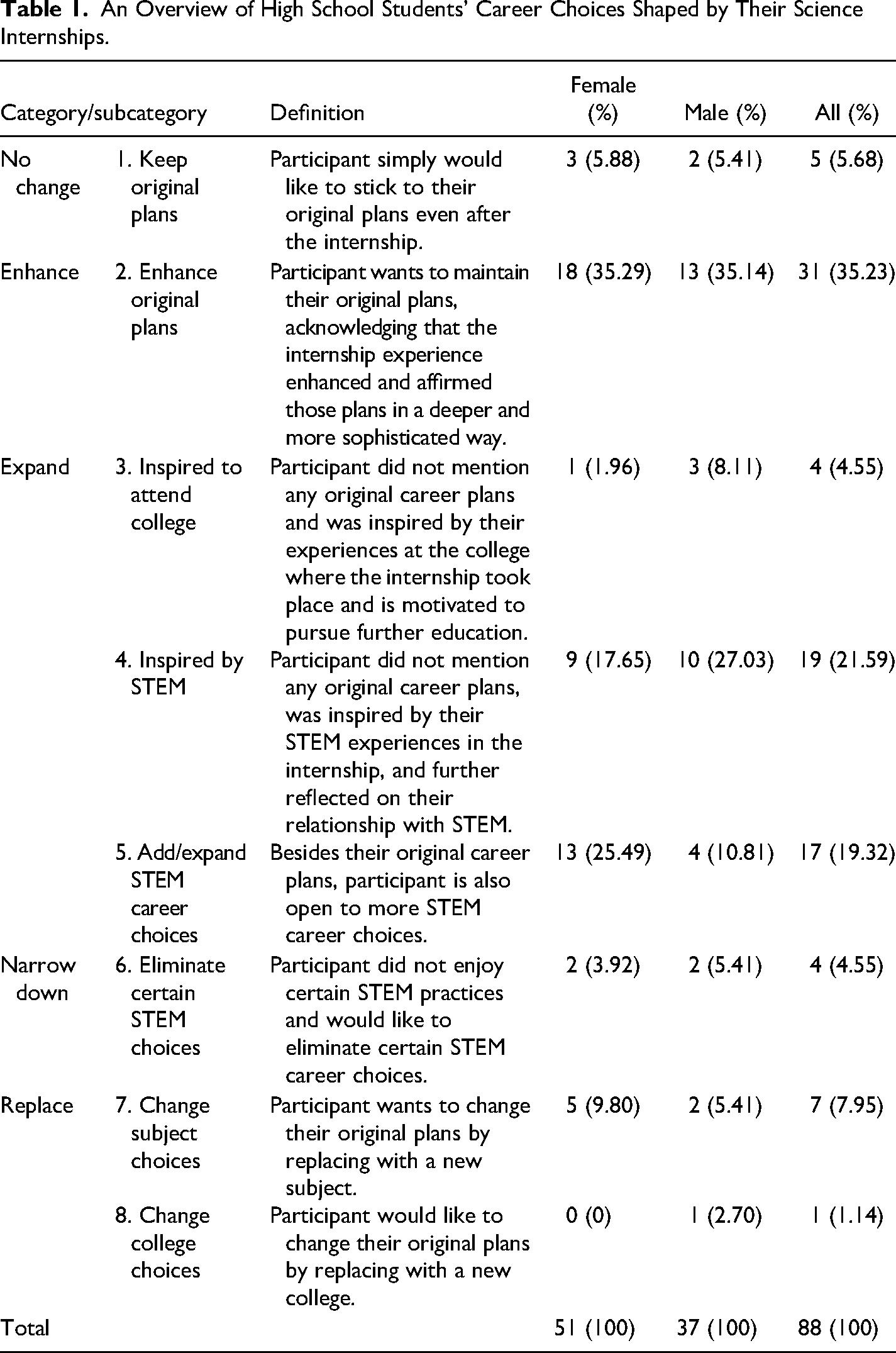
The analysis of high school students’ career choice changes shaped by the science internships revealed five major categories of changes: (a) no change, (b) enhance, (c) expand, (d) narrow down, and (e) replace. Based on the data, we also identified eight subcategories within the categories “expand” and “replace.” An overview of these career choices shaped by the science internships can be found in Table 1. We explain each category/subcategory with examples of direct quotes from students’ interviews as outlined in the subsequent sections.
An Overview of High School Students’ Career Choices Shaped by Their Science Internships.
Keep Original Plans
Some of the high school students (N = 5) expressed a desire to adhere to their original career plans following the science internship. This inclination appears to be primarily driven by a strong personal interest in their original aspirations (N = 4) and, in some cases, by familial considerations (N = 1), underscoring the resilience of their initial goals and ambitions. I like engineering, and it [the science internship experience] just didn’t call to me as much as, like, the interest for being a doctor did. (Eli) I think I would be more interested in computers or engineering in general rather than going into the science field [as I experienced in the science internship]. (Norman) It was not the program. It was more of my grandma. I just wanted to provide for her and I think it's just my grandma motivated me. (Diana)
Enhance Choosing Original Plans
After the science internships, a number of high school students (N = 31) wanted to maintain their original plans, acknowledging that the internship experience had enhanced and reinforced their aspirations in a deeper and more sophisticated manner. Because of the science internships, they were motivated to pursue higher degrees beyond an associate level (N = 10) or planned to integrate the knowledge gained from their science internships into their original plans, thus enhancing the plans’ overall effectiveness (N = 15). I did wanna just go for my master's. And with this [science internship] program, it made me wanna push myself to do better and go for my PhD. (Aaron) It [the science internship] is influencing a lot of what I want to work on in the future. And I want to be able to mix that and computer science in some way. (Regina) It [the science internship] pushed me in the same direction. Yeah. Just more that way. (Aurelia)
Inspired to Attend College
A few of the high school students (N = 4) who had not specified their original career plans were inspired by their internship experience to pursue higher education in college. The science internships, conducted in a college setting, familiarized these high school students with college life. This exposure inspired some students to pursue higher education (N = 2) or, in particular, to attend the college where their internship took place (N = 2). [After the science internship] … I wanna go to college because I’m ready for it, I know I can handle it, and I know what I wanna do. (Edith) It [the science internship] gets me more involved with the college and the school.… I know I need it, so I need to go there. (Jefferson)
Inspired by STEM
A number of the high school students (N = 19) who initially did not have specific career plans found inspiration from their internship experiences to consider STEM fields in their career choices and further reflected on their personal connection with STEM. The science internships facilitated a realization among most of this group of students (N = 12) that they “want” to pursue STEM because they find it “fun” or “interesting.” It [the science internship] helped me actually pick a career that I really like and that I’ll actually wanna go into instead of just, like, guessing. (Salma) After the internship, I would say I’ve grown basic more understanding of science, so, actually, like, wanna be a science major. (Eamon) Of course, like it opened up, you know, that other road that I could go down, for starters, you know. It [the science internship] gave me that option. (Jared)
Add or Expand STEM Career Choices
Some of the high school students (N = 17) demonstrated an openness to exploring more STEM-related fields in addition to their initial career plans. Among these students, those whose original career plans were not related to STEM (N = 9) expressed interest in integrating STEM elements into their original career paths, which included fields such as art, accounting, and social work. On the other hand, students whose initial career plans were already in STEM fields (N = 8) showed a desire to broaden their career choices to include the subjects they encountered during their science internships. I’ve always wanted to pursue art actually.… It's not like totally impossible and I’ll definitely say I was open to that [for both art and science]. (Daphne) I wanna become a civil engineer.… So now that's another option, going to 3D printing. (Cameron)
Eliminate Certain STEM Career Choices
A few of the high school students (N = 4) found certain STEM practices they encountered during their science internships unappealing, which led them to reconsider certain STEM career paths. The reasons varied, such as being deterred by the lab environment (N = 1), feeling intimidated by the complexity of STEM (N = 1), and having personal preferences (N = 2) that led them to eliminate certain STEM careers. I didn’t like being in the lab, I’m not going to think about working somewhere in a lab. So I’d think more somewhere I was comfortable. (Albert) This is really interesting. But—and I still don’t think I’d be good at engineering. I feel like there's too many, it's too complicated. (Anika) Because it's just, I didn’t, like, completely dislike it. I’m not—it's not my first choice, to be a scientist. (Russell)
Change Subject Choices
Some of the high school students (N = 7) expressed a desire to modify their original plans due to their science internship, opting to replace their initial focus with a new subject within the realms of science, technology, engineering, or mathematics. [Interviewer: After this internship you decided to go to forensics] Yeah. ‘Cause I wanted to be a teacher in math. (Iris) It [the science internship] actually kinda changed my opinion. I wanted to be a biomedical engineer, but then I came here and I was like, well, immunology's a pretty cool field. (Liana)
Change College Choices
One of the high school students (N = 1) wanted to change his original college plans by replacing them with the institution where the science internship took place. Before the internship, I wanted to go to a school like North University…. Because of the program, and that kind of like, pushed me more to the school [University of Texas at El Paso] here. (Roger)
Students’ Reasoning of How the Science Internship Shaped Their Career Choices
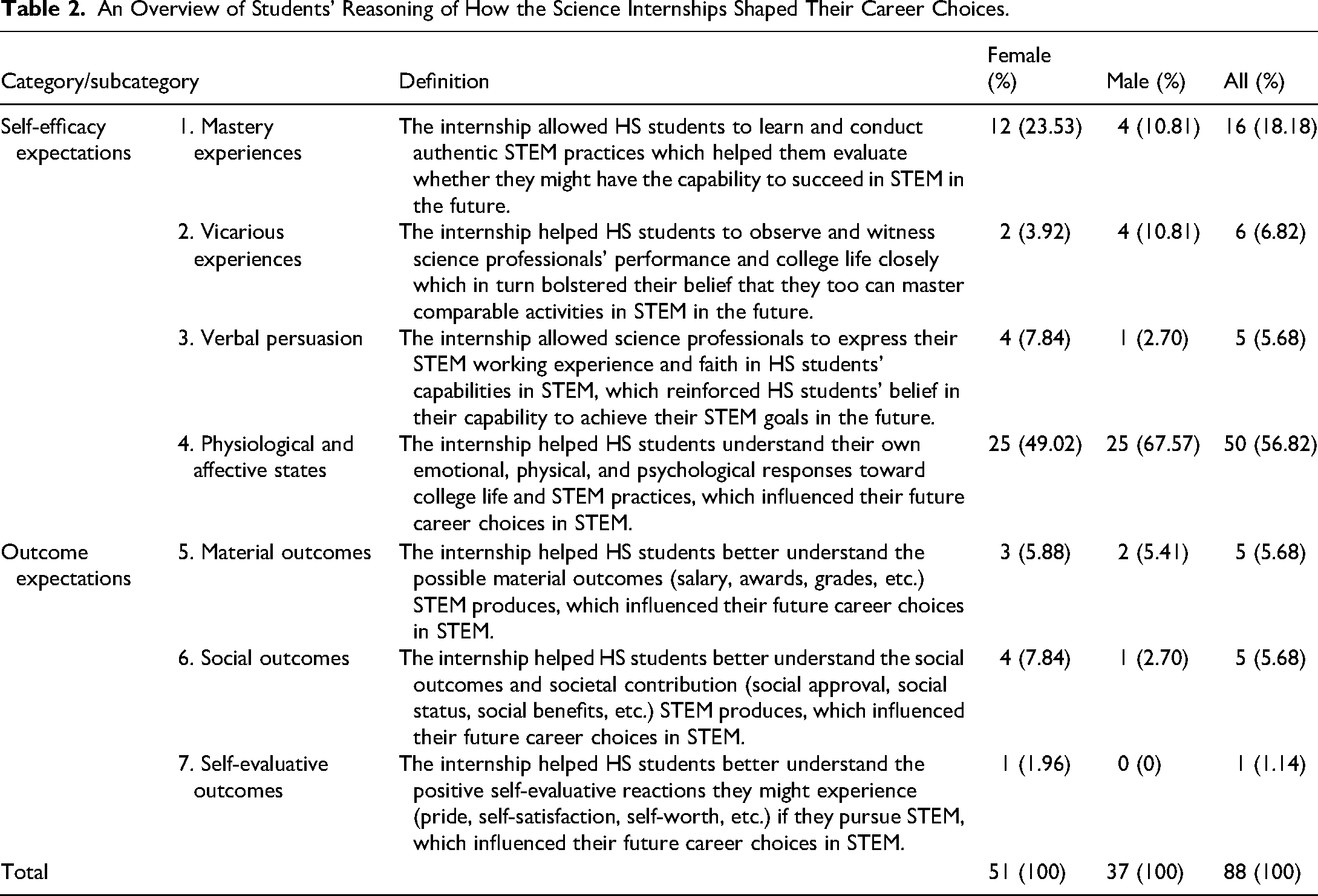
The analysis of high school students’ reasoning regarding their career choice changes as shaped by the science internship revealed two major types of reasoning and seven subcategories. Informed by SCCT, the two major categories include (a) self-efficacy expectations, and (b) outcome expectations. The two categories have four and three subcategories respectively. An overview of this reasoning around career choice changes can be found in Table 2. We explain each category/subcategory with examples as outlined in the subsequent sections.
An Overview of Students’ Reasoning of How the Science Internships Shaped Their Career Choices.
Self-Efficacy Expectations
Self-efficacy expectations denote the confidence individuals have in their ability to perform actions that lead to success in various areas of activity and are responsive to four major sources of information: mastery experiences, vicarious experiences, verbal persuasion, or physiological and affective states (Bandura, 1997; Brown & Lent, 2023). These four sources together contribute to shaping an individual's self-efficacy expectations, thereby influencing their behavior and decision-making processes.
I finished it, it was rewarding, it was good, I learned a lot.… I like to do different chemical testing and see how they react and that was fun. (Nadine) Going into the lab and seeing that I can do this.… [Interviewer: What you did was at the sophomore level in college science] Really? It was sophomore? Then I can do it. (Laila) I think it did because it showed me exactly what I’m capable of.… So it kind of changed my perspective on my future, like, that if I wanna do something, that I don’t have to be afraid to try it. (Almira)
I really liked what they [scientists and RAs] do, so it kinda made me think like maybe that's kinda what I wanna do one day. (Emmett) I kind of got what the RAs were doing. Now I know what I’d be doing if I did this, and I wouldn’t mind doing it. (Jared) Working with Dr. Vasquez definitely was so interesting, it made me consider like, maybe I could look into the fields that Dr. Vasquez was working on. (George)
And so everything he [Dr. Rays] would talk to me, he’ll kind of like just make me want to go to school more and more, so I could get a doctors degree like him. (Yusef) So I talked to Dr. Morris a little bit more about it, and I’m gonna be doing microbiology, so yeah, I guess it can—I can say that it impacted my career goals and decisions. (Jada)
But I was—but they can’t get me put up, so I’m gonna stick with teaching. (Cassidy) It [the science internship] helped me realize that I don’t want to do chemistry, I don’t think it's for me. (Dorothy) I’d never really wanted to do college.… I was just like kind of wowed, like by the environment … it did impact me. I really want to do school. (Richard) Because of the program I was in love with the idea of living a life of working in a lab. (Ignacio)
Outcome Expectations
The outcomes that individuals anticipate their actions will yield also influence their motivations and behavior. Outcome expectations, the second main construct in social cognition, concentrate on the expected results of participating in various performance areas. These expectations can be categorized into three primary types: material outcomes, social outcomes, and self-evaluative outcomes (Bandura, 1997; Brown & Lent, 2023). Together, these diverse factors mold an individual's outcome expectations, which, in turn, play a pivotal role in shaping their career motivations and choices.
College was always the main focus, because it gives you, um, like you say you can get a master's or bachelor's degree. There are a lot more job opportunities that pay more that require that. (Cassidy) Because you have a higher education, you have a degree, and when you apply for jobs then, I mean, that's what they want to look for, a person that um has a degree. (Bina) When I’m in the navy I won’t do college because, like, I get better jobs. (Jeremy)
It is something that I see that it contributes so much to society, that, um, I want to be part of that contribution. (Gloria) Basically, I want to be an inventor. I want to be a civil engineer. I want to make the world a better place, make the environment cleaner, just like create things to help people. (Matilda) I could see myself doing that with um, like Doctors Without Borders, or the American Red Cross, or even like the military. I could see myself doing research and then going on like aid trips to go like help people. And that's what I would like to do. (Alana)
I developed that self-independence [in the internship program] that made me like decide, like make a decision on my own where it's like I had to just be really careful and really, really sure of what I want, what I want to do. (Ian)
Discussion and Conclusion
This study investigates how high school students’ career choices might be shaped by science internships. Through thematic analysis of data gathered from 88 follow-up interviews with students, we identified five primary categories and eight subcategories of changes in career choice. To delve deeper into the reasons behind these changes, we employed social cognitive career theory (SCCT) as our theoretical framework for analyzing students’ reasoning regarding these career choice changes.
Science internships were found to greatly shape the career choices of high school students. An impressive 94.32% (83 out of 88) of high school students reported that their career choices had been influenced by these internships, while only 5.68% (5 out of 88) adhered to their original plans. The changes the students experienced were diverse, including enhancement (35.23%, 31 out of 88), expansion (45.45%, 40 out of 88), narrowing down (4.55%, 4 out of 88), or replacement (9.09%, 8 out of 88) of their (initial) career choices.
Adolescence, particularly the high school years, offers a golden opportunity to guide a student's path. This is a critical period when students are actively considering their career options, gaining a deeper understanding of STEM careers, and making important decisions about their interest in STEM fields (Constan & Spicer, 2015; Rosenzweig & Chen, 2023). Our research findings align with several relevant studies regarding STEM career interests (Chen et al., 2014; Houser et al., 2015). These studies found that participation in a science program in general is associated with a boost in motivation for and elevated interest in pursuing a career in science. Our research further identified how high school students’ career choices might be shaped by science internships specifically. However, our findings contrast with certain studies where participation led to negligible shifts in science career aspirations and even found that many students decided not to become scientists after their participation in a science program (Bhattacharyya et al., 2011). This discrepancy underscores the complexity of the factors, program design influencing career aspirations, and the need for further research in this area. Given that the majority of students’ career choices in our study were shaped by the science internships, it is clear that these science internships play an important role in steering students toward STEM fields. This finding has significant implications for educators and policy makers. Integrating such internships into science education could be a powerful strategy to steer more students toward STEM fields, thereby meeting the growing demand for STEM professionals. As we continue to face a growing demand for STEM professionals, it is imperative that we leverage the power of science internships to inspire and guide the next generation of STEM professionals.
In this study, self-efficacy expectations emerged as the decisive factor influencing high school students’ career choices. Data analysis from the research revealed a predominant association between students’ career shifts and self-efficacy expectations (87.5%, 77 out of 88), contrasting with the influence of outcome expectations (12.5%, 11 out of 88). Notably, physiological and affective states (56.82%, 50 out of 88), one of the four major sources of self-efficacy expectations, were greatly impacted by the science internships. These immersive experiences provided students with valuable insights into their emotional and physical responses, fostering a deeper understanding of the STEM domain. Self-efficacy is an important concept in the realm of psychological determinants of behavior, which is one of five major categories in social cognitive theory (SCT) alongside concepts such as outcome expectations and collective efficacy (Bandura, 1977; McAlister et al., 2015). In research on social cognitive career choice, self-efficacy expectations is one of three essential constructs that form the foundational elements of all SCCT models, alongside concepts such as outcome expectations and goals (Brown & Lent, 2023; Lent et al., 1994). Our research contributes to the growing body of evidence supporting the critical role of self-efficacy expectations in shaping students’ career paths, particularly in the STEM fields. Specifically, our analysis shows that students develop their self-efficacy mainly from their physiological and affective states (56.82%, 50 out of 88). This study underscores the importance of science internships in helping students understand their physiological and affective responses toward STEM fields. It suggests that future science internships could be designed to enhance other dimensions of self-efficacy expectations (i.e., mastery experiences, vicarious experiences, verbal persuasion), thereby guiding students toward STEM fields.
Interestingly, a gender disparity was observed in both the ways and reasons behind how science internships might shape the career choices of high school students. In this study, more male students (N = 3) than female students (N = 1) were inspired to pursue higher education in college. Conversely, more female students (N = 13) than male students (N = 4) were encouraged to add to or expand their STEM career options. In terms of the reasons behind their changes in career choice, more female students (N = 12) than male students (N = 4) altered their choices due to the mastery experiences they gained during their science internship. Additionally, more female students (N = 4) than male students (N = 1) changed their choices due to the verbal persuasion they experienced during their internship, and more female students (N = 4) than male students (N = 1) modified their choices because of the social outcomes stimulated by their science internship. Previous research has highlighted the importance of mentoring and role modeling in shaping girls’ participation and identities in STEM (González-Pérez et al., 2020; Millar et al., 2022). These studies also identified verbal persuasion and vicarious experiences as critical sources of self-efficacy beliefs for female students and mastery experiences as a critical source for male students (Rittmayer & Beier, 2008; Zeldin & Pajares, 2000). Our research partially aligns with these findings but also reveals that, comparatively, female students’ self-efficacy is most influenced by physiological and affective states (58.14%, 25 out of 43), followed by mastery experiences (27.91%, 12 out of 43), verbal persuasion (9.30%, 4 out of 43), and finally, vicarious experiences (4.65%, 2 out of 43). In contrast, male students’ self-efficacy is most influenced by physiological and affective states (73.53%, 25 out of 34), equally by mastery experiences and vicarious experiences (11.76%, 4 out of 34 each), and lastly, by verbal persuasion (2.94%, 1 out of 34). However, given the size of our sample, no conclusive results were found. Future research could increase the sample size to include more high school students and allow quantitative analysis. This might provide a better understanding of the differences between female and male students, thereby enabling us to better guide both groups toward STEM fields.
This study highlights the impact of science internships on high school students’ career choices. Through thematic analysis and the application of social cognitive career theory, it identified diverse changes in students’ career choices. The study also identified a gender disparity in both how and why these career choice changes occurred, emphasizing nuanced differences in the sources of self-efficacy beliefs between male and female students. Overall, this study underscores the critical role of science internships in guiding students toward STEM fields. It calls for further research to better understand and address the complex factors influencing career aspirations among high school students. By leveraging the power of science internships and addressing gender disparities, educators and policymakers can foster a more diverse and inclusive STEM workforce to meet the growing demands of the future.
Footnotes
Declaration of Conflicting Interests
The authors declared no potential conflicts of interest with respect to the research, authorship, and/or publication of this article.
Funding
The authors disclosed receipt of the following financial support for the research, authorship, and/or publication of this article: This work was supported by the National Science Foundation under Grant No. DRL 1322600. Any opinions, findings, and conclusions or recommendations expressed in this material are those of the authors and do not necessarily reflect the views of the National Science Foundation.
