



Abstract
Introduction
Agricultural and natural resource organizations are particularly susceptible to negative impacts from weather-related disasters including drought, fires, flooding, freezes, tornadoes, and hurricanes. Climate change is causing these severe weather events to occur in increasing frequency (Dooley & Roberts, 2020). Colleges of agriculture and related sciences are tasked with preparing students to enter the workforce in these organizations and research has verified the importance of these students having leadership skills. Consequently, tomorrow's graduates need to be prepared to deal with weather-related disasters and demonstrate leadership skills. However, as a precursor, faculty need the knowledge and skills themselves to be prepared to teach their students. This paper examines the outcomes of one such faculty development program through a lens of experiential learning.
One of the main benefits of reflective practice is enhanced personal growth (Gorman, 2019; Hiemstra, 2001; Moore et al., 2010). However, is it true that this is also the case for higher education faculty who delve deeply into a professional development project to increase their competencies in teaching? This study explored the transformative experiences of faculty through a year-long professional development program that included online learning about leadership frames, a field experience contextually focused on the impact of natural disasters throughout various stakeholders within communities, and the development of a case study to be implemented with their students.
Theoretical Framework
Contemporary views of learning are often situated in some variation of constructivism (Fosnot, 2013). A central tenet to constructivism is that the learner builds their understanding of a phenomenon through their experiences with that phenomenon (Fosnot, 2013). Thus, planned instructional activities are merely a coordinated set of learning experiences designed for an intended outcome (Egan, 1978). One way to view learning experiences is through a lens of the experiential learning theory (Dewey, 1938; Kolb, 1984; Roberts, 2006). Experiential learning theory presents learning as a cyclical process where the learner has an experience; reflects on that experience; transforms or generalizes that experience into meaning; and then has subsequent experiences to apply their new meaning (Dewey, 1938; Kolb, 1984; Roberts, 2006). The most effective learning experiences are characterized by: (a) learners who are actively engaged in the experience; (b) learners critically reflect on the experience; (c) learners are moved out of their comfort zone; (d) experiences focus on real-world problems; and (e) knowledge is positioned in time and place (Morris, 2019). Learning experiences are often situated within a specific social and physical context so the learner can co-construct their understandings with other learners (Bandura, 1978; Lave & Wenger, 1991). The most effective learning experiences have the potential to transform how learners see the world around them (Mezirow, 1998).
Experiential learning is rooted in Dewey's (1938) foundational experiential learning theory. Kolb's (1984) experiential learning cycle posits that “learning is the process whereby knowledge is created through the transformation of experience” (p. 38). This theory positions learning as a process of human adaptation driven by the resolution between action/reflection and experience/abstraction (Kolb & Kolb, 2012). To transform an experience into learning, individuals begin with a concrete experience, reflect on their observations of the experience, comprehend the experience through abstract conceptualization, and then actively experiment with concepts generated by the experience (Kolb, 1984; Lutterman-Aguilar & Gingerich, 2002).
Scholars have contributed their thoughts on the development and conceptualization of reflection. In its most basic form, reflection references a “turning back” (Mezirow, 1998) on a certain experience, taking something into consideration, or “letting one's thoughts wander over something” (Mezirow, 1998, p. 185). Jordi (2011) defined, and subsequently critiqued, reflection as “the rational analytical process through which human beings extract knowledge from their experience” (p. 182). Reflection, as expressed by Ixer (2016), occurs when individuals remain in a state of uncertainty, suspending one's “quest for answers and certainty to allow a period of uncertainty in the construction of new questions” (p. 816). These questions can inquire about why something has happened, why the individual feels a certain way in a situation, why they feel various emotions, and what one should do to resolve these various, and sometimes conflicting, thoughts and feelings. The process of “searching and constructing [these] questions,” as one does while reflecting, “allows a constant dialogue between what the inner self says to the external self” (Ixer, 2016, p. 816). All components of reflection are influenced by culture, social norms, and the context in which the reflective process occurs.
Review of Literature
Constructivism, experiential learning, and transformative learning provide a great lens for understanding the development of teaching skills. As early as 2004, scholars proposed experiential learning as a viable framework for faculty development (Estepp et al., 2012; Myers & Roberts, 2004). A systematic review published in 2016 (Steinert et al., 2016) reviewed 10 years of faculty development literature and concluded that key features of effective faculty development include experiential learning and intentional reflection. Despite the laurels bestowed on experiential learning, only a handful of studies overtly used experiential learning to deliver faculty development, with examples coming in the agricultural sciences (Gouldthorpe et al., 2012; Urban et al., 2017) and the medical sciences (Farrell et al., 2021; Hall & Zierler, 2015; Kleinheksel et al., 2023). Previous studies examining experiential learning and faculty development have largely focused on the role of reflection in learning (Cordie et al., 2020; Gouldthorpe et al., 2012; Kleinheksel et al., 2023). Before we fully understand how the complexities of experiential learning theory apply to faculty development, many unexplored facets need examination.
Beyond the scope of experiential learning, faculty development for teaching in higher education has received considerably more attention. Many universities have teaching centers to support faculty, with much of those efforts focused on new faculty (Austin & Sorcinelli, 2013). Many universities also offer “future faculty” training programs to graduate students (Frey et al., 2020). We do know that the needs of faculty related to teaching change over time (Mortensen, 1983), often based on their approach to teaching (Kugel, 1993; Lane, 2018). As a result, faculty development efforts in higher education are continually evolving (Austin & Sorcinelli, 2013; Lewis, 1996). Much of the research on faculty development is: (a) focused on disciplinary efforts, like medicine (Cruess et al., 2018; Steinert et al., 2016), agriculture (Blickenstaff et al., 2015; Hur et al., 2023), and liberal arts (Baker et al., 2018) or (b) focused on specific educational challenges, such as online learning (Horvitz et al., 2015; King & Boyatt, 2015), student diversity (Austin & Sorcinelli, 2013; Van Lankveld et al., 2017), or artificial intelligence (Zawacki-Richter et al., 2019). Research generally shows the value of learning communities and personal networks in faculty development (Ascione et al., 2022; Hur et al., 2023).
Purpose and Research Question
As previously noted, experiential learning has been proposed as a viable model for faculty development, but little research has tested this assertion. This study seeks to address this gap and is guided by a single research objective: Explore the lived experiences of faculty participants in a year-long professional development program to determine growth in using case study approaches in the context of natural disasters.
Methods
This study was grounded in Moustakas’ (1994) phenomenological approach, delving into the lived experiences of higher education faculty teaching, conducting research and outreach in degree programs in food, agricultural, natural, and human sciences. The essence of the shared experience was a year-long faculty development program (Academy) that included field experiences in geographical regions impacted by natural disasters and self-directed online learning. Academy participants completed an online training program in which they learned about the impact of disasters to the broad fields of agriculture, natural, and human sciences. These modules also introduced leadership concepts that would serve as a guide for the field experience and design of a contextually rich case study regarding natural disasters. Participants were taught how to create case studies to teach students about disasters, keeping their areas of expertise central to the work. Upon completion of the academy, faculty participated in field experiences in Texas (fire and climate change disasters), Southwest Florida (hurricane disasters), and Florida Panhandle (hurricane and oil spill disasters). Each field experience was organized by local faculty and collaborators, providing participants with opportunities to connect with local government, producers, agriculture and environmental specialists, local residents, and support organizations to get a unique view of the impact of the disasters. Faculty learned general information about the context and impact while also gathering expertise specific information to complete their case studies. Upon completion of the field experiences, faculty were asked to incorporate their experiences into their case studies that would then be taught in one of their classes.
Sample
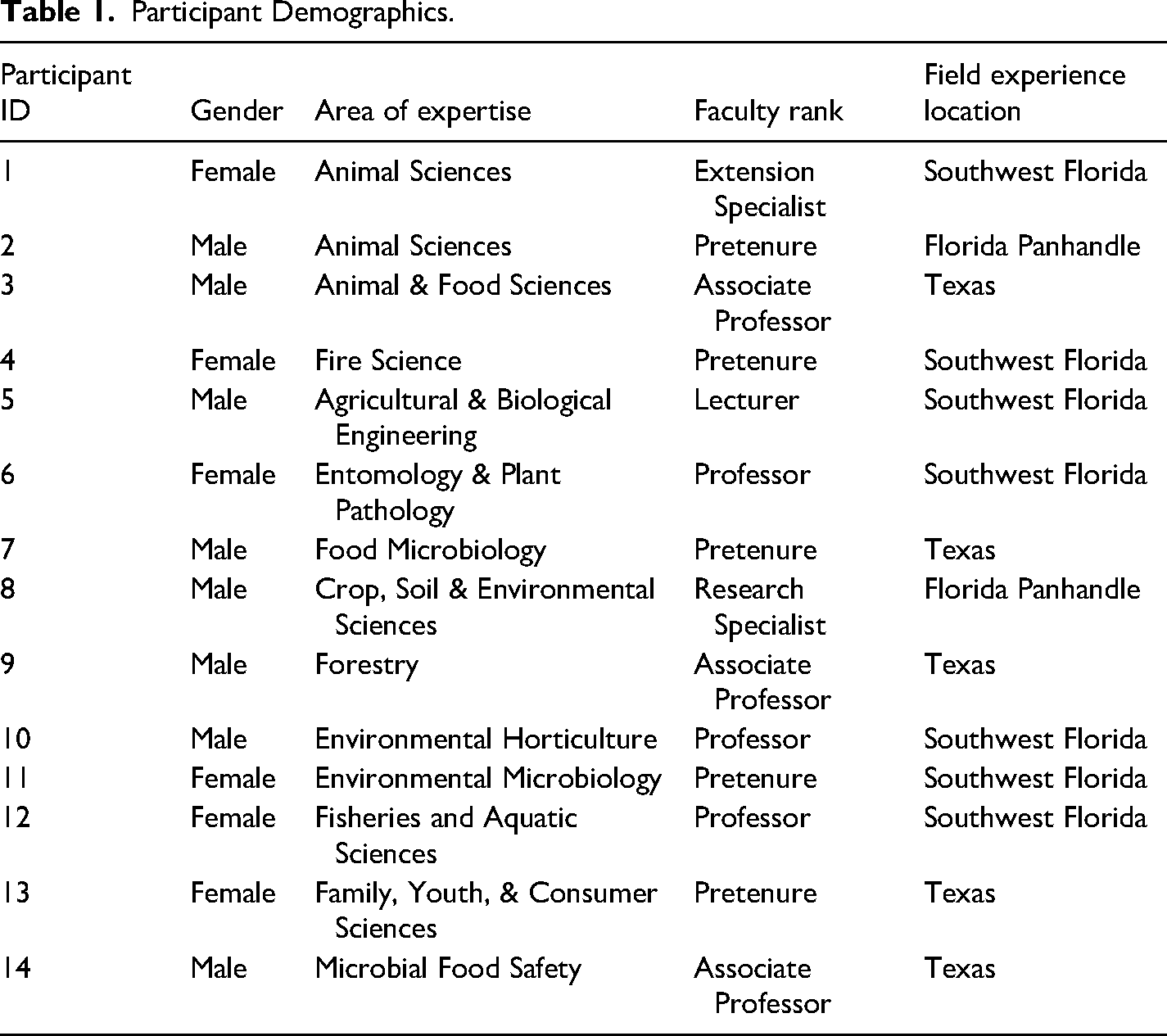
Program leaders used a marketing email through the Academic Program Section of the Association of Public and Land-Grant Universities to recruit a total of 49 total participants into the program. For our study, we purposely sampled participants who (a) completed the academy, (b) attended a field experience, and (c) submitted a case study (n = 23). All 23 were contacted via email communication for the interview and 14 agreed to participate in the study. We were able to reach data saturation with 14 respondents. There were seven different universities represented in the Southern region of the U.S. Eight participants were male and six were female professors. Each faculty member had a distinct area of expertise over the broad field of agriculture and life sciences and represented early career faculty through seasoned full professorial ranks providing appropriate deviant variation (Lincoln & Guba, 1985). See Table 1 below for more information on participants.
Participant Demographics.
Data Collection
This phenomenological study used personal interviews with faculty as the primary source of data. An IRB was approved, open-ended interviews were recorded to ensure referential adequacy, and identities remained confidential (Erlandson et al., 1993; Lincoln & Guba, 1985). Two researchers who conducted the interviews were involved in the overall program but did not directly attend the field experience with the faculty to ensure neutrality. The interviews were conducted over Zoom, with permission to record the sessions for referential adequacy.
Data Analysis and Rigor
Interview transcripts were analyzed through open coding, axial coding, and theoretical triangulation from Kolb's (1984) experiential learning model. The two researchers who collected the interview data conducted separate analyses on the interview transcripts during the open coding process to develop initial themes. These initial themes focused primarily on details of participant experiences (i.e., program expectations, leadership frame, interacting with broad stakeholders, creating case studies, online learning, field experience, reflections, and critiques). However, when the researchers conducted a peer debriefing, they conferred that a major theme throughout was the impact experiential learning had on faculty professional development. We then reanalyzed the data for axial coding using theoretical triangulation with Kolb's (1984) model of experiential learning to communicate the essence of the process and products of faculty development within the cycle. This phenomenological reduction and imaginative variation provided the primary narrative analysis for the findings. Finally, we developed a synthesis of composite textural and composite structural descriptions using direct quotes from the interviews to give a rich description and voice to the faculty participants about their experience to enhance transferability (Creswell & Poth, 2018; Moustakas, 1994).
The epoché phase employed bracketing to set aside any preconceived notions, assumptions, and experiences that may have influenced our interpretation (Moustakas, 1994). We created categories of the open codes, known as horizontalization, and negotiated horizons to reduce the data through the phenomenological reduction phase (Moustakas, 1994). After data were reduced, we entered the imaginative variation phase for theoretical triangulation through a synthesis of descriptions and Kolb's (1984) experiential learning model. Another peer debriefing was conducted with the project principal investigator to ensure the truth value of the analysis for emergent themes with further theoretical triangulation to Kolb's experiential learning model. The relevant Institutional Review Boards at [3 universities] reviewed the research protocol and approved this study.
Findings/Results
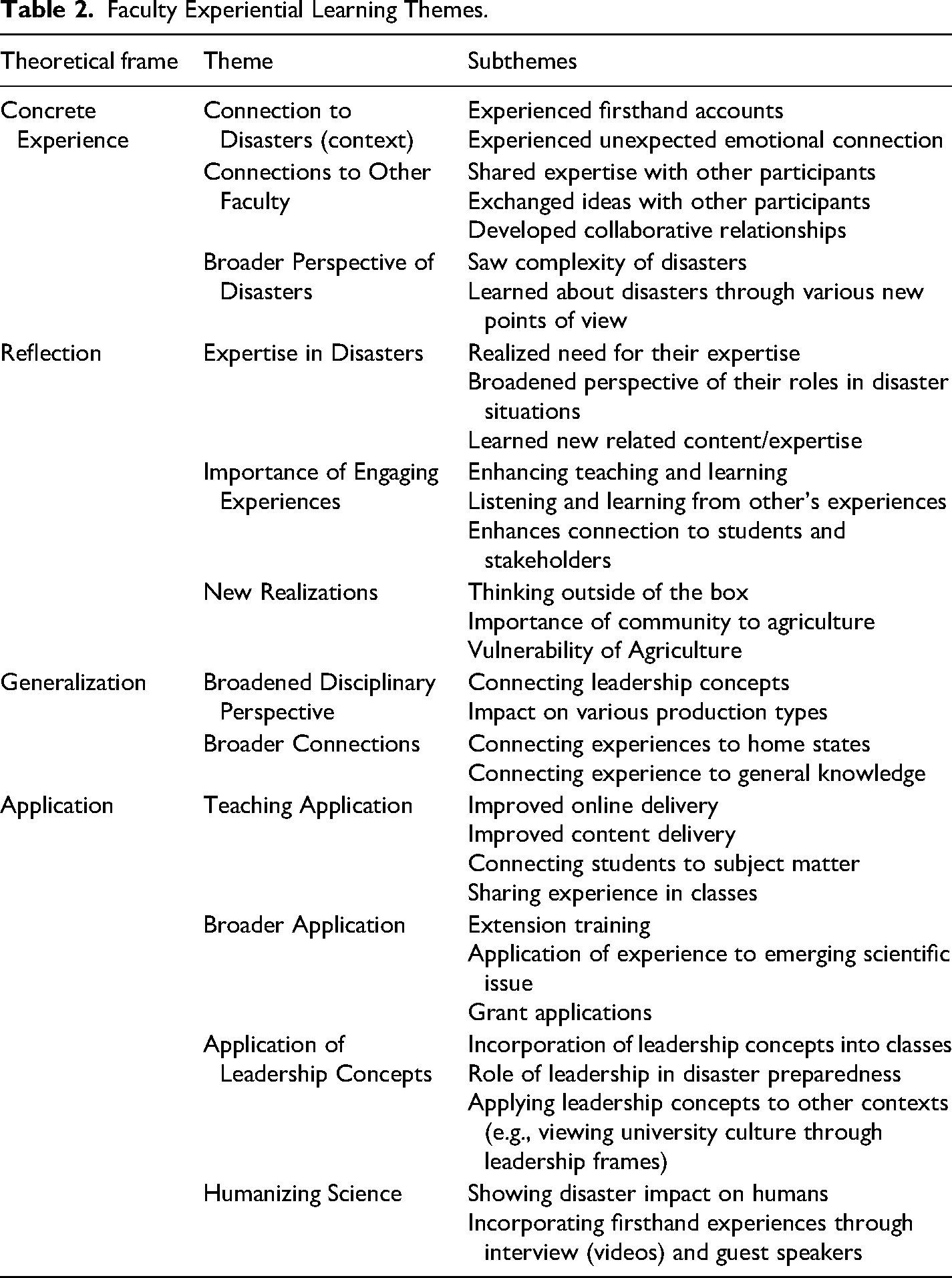
Analysis of participant interviews allowed us to learn more about how the experiential learning model played a significant role in the program and overall participant experiences. Participant interviews yielded 32 codes that were categorized into 12 themes and theoretically triangulated into the four components of Kolb's (1984) experiential learning model: Concrete Experience, Reflective Observations, Abstract Conceptualization, and Active Experimentation. For simplification, we use Experience, Reflection, Generalization, and Application for the theme titles. The list of themes and subthemes is presented in Table 2.
Faculty Experiential Learning Themes.
Experience
During the faculty professional development experience, participants felt connected to the context of disasters and other faculty, and experienced a broader perspective of disasters than they had before the experience.
Connection to Disasters
Participants mentioned how they learned more about disasters from the firsthand accounts of the local people on the trip. “…We learn quite a bit and we learn from basically the horse's mouth and other than from reading and like hearing from someone else” (Participant 3). Similarly, Participant 6 mentioned seeing statistics gives you one perspective but that they don’t capture the impact on the people themselves. A few participants also felt like they experienced an unexpected emotional connection. Participant 2 said “I guess what was most shocking was kind of how emotional some of the experience was. I wasn’t really prepared for that…”
Connections to Other Participants (Faculty)
Various participants noted that the experience allowed them to connect with the other participants in numerous ways. During the experience, participants felt they were able to connect with various new areas of expertise. Participant 4 mentioned: …I'm not sure if I would have met some of those folks otherwise because we came from very different backgrounds… It was nice to meet other faculty to listen to their perspectives, you know the sort of questions that they were asking you know from their angle from their expertise often is applicable, you know what I do, and to what other people do, which I think you know added a lot of depth to the experience also…I learned from the other people, you know, on the trip, which was really beneficial.
Similarly, Participant 3 said “[the experience] helped me, in terms of making connections with other faculty members who participated…”. During the experience, faculty also exchanged ideas about teaching. Participant 9 said “I learned a lot actually about teaching methods by just talking to all the different people about what they do in their classes…”
Finally, several participants developed collaborative relationships on the trip that yielded grants, publications, and overall collaborations. Participant 4 said that due to their participation on the trip, they built collaborations with diverse faculty that they were not sure they would have “met some of those folks otherwise because they came from very different backgrounds.” Similarly, Participant 12 said “… probably the most valuable parts of [the experience] were just being with a group of people getting to know them, and you know later collaborating on things totally unrelated but because I got to know them…we’re now collaborating on other proposals and projects and so on.”
Broader Perspective of Disasters
Participants felt that the experience gave them a much broader view of disasters than they had had before the faculty development experience. Participant 5 expressed that after reading the newspaper and getting a particular point of view of the disaster, they were able to get an enlightening perspective about the disaster and overall response. Every experience incorporated various stops to learn various perspectives of the disaster. Participant 8 said “I was impressed by how broad the breadth of [the experience] was, like how many different dimensions…were kind of captured and so many different like actors and different types of institutions and stuff like that.” Similarly, Participant 1 felt that they gained a much broader perspective from their fellow participants: …Just listening to their questions that they asked of the people at each stop. We have people from different backgrounds… they were professors, they were Extension specialists like me, just all kinds of different levels and academia. And it helped a lot to see what they were interested in and what questions they were asking. And I would sit there and say ‘wow I never thought about that’…I wouldn't think about that you know that's just outside of my wheelhouse so it's really neat to hear all of that.
Reflection
In reflecting upon the experience, participants noted that they learned more about their expertise as it related to disasters, the importance of engaging in these types of experiences, and that they had new realizations.
Expertise and Disasters
Participants reflected upon the experience and found a need for their expertise in times of disasters that perhaps were previously unrealized. Participant 2 said: “I guess it brought to my understanding of what my capacity and my field could be. I didn’t know that this is the kind of relief work that gets done by educators…it really brought in my perspective of how we get to step in as educators…”. Participant 3 also mentioned that through several conversations, they saw how to apply their area of expertise “… [the experience] helped me to think about other things that I can do to help the local community here, as well as the health department.” Furthermore, another participant spoke about their expertise; although not directly affected by the disaster of focus for the experience, they were able to see how their expertise would be necessary to address side effects from the disaster. They admitted “I honestly didn't think, and this is really sad to say, and I’ve changed my perspective since, but I don’t think I realized that I was going to learn so much from a different perspective… I mean I talked to fire practitioners all the time, but I asked different questions and from a different angle, and I really learned a lot from that” (Participant 4). They also added the importance of sharing knowledge with others: “I think it helped me realize that we need to share our experiences. We need to come together to provide guidance to people that are going through similar experiences.”
Engaging in Experiences
Several participants mentioned the importance of experiences like this program. Participant 2 recognized how this experience would translate to their teaching: It just actualizes [the concepts], you know it's just that I can now speak from a perspective of not what I’ve been through, but what I’ve actually seen. So, you know I can say that this was an effect, I heard it right out of the horse's mouth and it transfers better when it's … that real experience. Even without firsthand knowledge, I am closer to the subject and can teach and present about it.
Participant 3 related the experience to their “ah-ha” moment: “And after that, it was an Ah-ha moment and then that helped me quite a bit to actually relate what I have experienced there and to connect that with my area of research and my area of teaching, so I would say that the experience was great.” A few participants mentioned having learned important lessons from the experience. Participant 4 said “I think, honestly, the biggest thing that I’ve taken away from this [experience] that I’ve passed on to my students is just to listen and learn from the experiences of others and I’ve tried to do that more and more over time.”
Finally, participants mentioned that an experience like this helps them relate better to students and stakeholders. “I wanted to be able to use [the experience], for the sake of connecting with my students more intimately…in terms of some of them would have lived through [a disaster]” (Participant 7). Participant 9 said “You can just have a better conversation because of the field trips because I’ve seen all this…I understand what you went through whatever hurricane or storm ran through our area.” Similarly, Participant 1 said “I pull more out of [an experience], so I think just in general, it puts it in front of you, and says look, this is what happened, and you know these are the steps we went through so just being there in person helped a lot for me.”
New Realizations
Several faculty participants expressed how this trip brought them insights they may not have had otherwise. Participant 1 stated “…it allowed me to think outside of the little box I live in that is animal science… this was a whole different side of science for me.” They also mentioned that hearing from the many stakeholders and with the breadth of faculty expertise on the trip broadened their point of view: “… I would sit there and say ‘wow, I never thought about that’… that's just so outside of my wheelhouse … it's really neat to hear all of that.” For another participant, not only did it bring them a new perspective but it also pushed them to take action for their local constituents: …I don’t think I realized that I was going to learn so much, like, from a different perspective… I asked different questions and from a different angle. I really learned a lot form that and I think even, you know, thinking about the different constraints and considerations [led me to] approach some [other] practitioners and said ‘hey, do you want to help me write this paper’ because I really think we need a publication that helps other land managers who maybe haven’t had to burn after a hurricane… (Participant 4)
Several participants also mentioned the realization that a disaster connected the community in a unique way. Participant 8 said it best: “I guess what this trip kind of taught me is there's these other actors that are maybe in government or in a charity…that that aren't actually even very closely theoretically connected to agriculture, but… after disaster it's all Community and it's all these people just that don't normally interact, maybe coming together and helping each other.”
Generalization
After the experience, participants began to connect their reflections to previous knowledge and to other familiar contexts and other experiences. They expressed having a broadened disciplinary experience and creating broader connections beyond the context of disasters.
Broadened Disciplinary Experience
During the experience, participants learned about organizational leadership frames as they applied to disasters. Several participants noted that upon reflection, they were able to connect leadership concepts. “… I never looked at leadership from that kind of perspective before talking about the different lenses…” (Participant 5). Similarly, Participant 6 said “[the experience] certainly helped in terms of thinking how leadership comes into the whole natural disaster picture and how [they are] very important ideas.” Participant 11 also said “Again I learned more than I knew because of all the different frameworks and …I just learned more than I knew, because this is not…my area.” Participants also said they learned more about the broader impact of disasters on their discipline. “It was great to get the perspectives of the people who actually work there, as well as like different kinds of hierarchies of people…” (Participant 12).
They were also able to see the impact across multiple agricultural operations: “It was interesting to see the impact of the disasters on the different types of operations…For example, how it affected an agricultural production and vegetable production; how it affected an orchid production” (Participant 10).
Broader Connections
Participants also began to generalize the experiences to familiar contexts. For example, Participant 1 said: …and it made me think you know here in Tennessee we don’t have lots of natural disasters. I hope we never do, but it helped me kind of think about what I might need to look at in terms of our extension programming… might need to touch on disaster management. So, it helped me think about ‘oh man, what if all their fences got knocked down what would we do you know that type of thing.’ So, it made me think about things that could happen.
Finally, one participant said that the experience really highlighted how important, yet vulnerable agriculture is in a natural disaster: “But you know, we’re just one big windstorm away from going under at any point in time. I think that's a kind of a critical lesson in and of itself that goes beyond what I was aiming for” (Participant 5).
Application
Once back home, the participants then had the chance to apply what they had learned from the experience. They did this through improving their teaching, directly incorporating knowledge into their lessons, bringing their experience to other contexts, applying their new knowledge of leadership, and finally humanizing disasters.
Teaching Application
Participants mentioned that they took away more than context from the experience. They learned new teaching techniques and how to incorporate the concepts into their teaching. One participant mentioned that they “took away some teaching techniques for creating online material which I thought was interesting…” (Participant 4) which they have since used in their classes. Similarly, Participant 3 said that “the experience that I had with the project academic team [came in] very handy [while transitioning to online learning during COVID]. There was an unanticipated benefit that I got by participating [in this experience] because, like, I was at the receiving end of the instruction, and it was very eye opening that how everything was very well structured.”
Additionally, several participants mentioned that because of the experience, they have a different ability to teach about disasters. Participant 2 said that they are “closer to the subject and can [better] teach and present about it.” Another said: “It has helped me talk to my students… more about, you know, what would you do if this disaster happened, you know what would happen, who would be in charge, how would you respond to that…” (Participant 1). “[I now encourage] my students, you know, to think about all of the different aspects and components about, you know, land management after a natural disaster” (Participant 4). Participant 5 said that they would, from now on, incorporate disaster preparedness into many of their classes: “we always have to do less with more, but we also have to be, we have to brace ourselves for these likely increasing catastrophic events.”
Broader Application
Several participants expressed having directly applied their learning from the experience to extension/stakeholder programming and emerging issues. Participant 1 said that they planned to “work in [disaster preparedness into] some of the training that we offer for our small ruminant producers across the state and kind of get them to think about ‘oh I need to think about this if I ever had a disaster hit,’ and you know, and maybe even some leadership training for our extension agents.” Participant 3 worked directly with an essential stakeholder “My learning I shared with the health department here… [the area] is prone to cyclones and other issues and natural disasters, so I am now working with them to help them prepare better for their response in terms of food safety.” Furthermore, Participant 6 said that since the experience, “one of the pathogens that they did talk about actually, has made its way to Tennessee in the past two years,” allowing them to directly apply what they learned to an emerging issue in their home state.
Finally, a few participants mentioned how this program was the impetus for a grant application. Participant 3 had this to say about their grantsmanship success: This helped me significantly to think outside of the box and now, after that I was able to use a similar approach on different teaching grants, and I was able to get several rounds of funding… I was able to use the things that I learned from this experience to…come up with the outside of the box project, and I have received two projects, one is as a PI one is a co-PI grant close to $1.5 million. So, I’m very happy that probably most of the credit goes to my experience and because of that I was able to get that funding.
Application of Leadership Concepts
After the experience, participants expressed that they were already incorporating leadership concepts into their courses. For example, Participant 10 said: “[my courses] didn’t have the leadership skills and [incorporating them] created an excellent case study for the students.” Another stated that the leadership lens had helped them bring broader points of view to their students that added to their scientific training.
Faculty also recognized the importance of leadership in disaster preparedness and implemented this knowledge into their classes even though this was not their area of expertise “incorporating leadership created a very good case study for the students” (Participant 10). Furthermore, some faculty were able to apply leadership concepts to other contexts. One participant stated that they were able to “make connections with different things that were going on in [their home] department or even in the college from what I have learned from [the experience's] theoretical knowledge” (Participant 3).
Humanizing Science
Through the experience, faculty were able to enhance their ability to show the impact of disasters on the people and communities. Many of the participants were bench scientists and confessed that they majorly focused on teaching their subject matter and often missed opportunities to humanize science. Participant 6 mentioned the importance of bringing the human perspective into science: “In the professional development that we try to give in my department, we talked about how important human beings are in the whole picture of everything we do, and then that is the most important resource we have.” Another participant mentioned “[incorporating what I learned] is a mechanism by which I can kind of humanize the class, some more so than what I'm typically able to do” (Participant 7). Finally, Participant 12 said that due to the experience they were committed to showing students that “natural disasters and climate change and things like that don’t just impact the resources, they impact the people on a very personal level.”
Finally, faculty also mentioned their incorporation of firsthand experiences through interviews (videos) and guest speakers. This participant said that they changed the way they taught by incorporating videos and other guest speakers to bring the human perspective to the students: “….and I feel that, like instead of me sharing certain things and just telling them that they need to be better prepared food safety wise, when they heard from someone else who really lived that experience, I think it made [a] much better impression on the student and they understood that this is what they need to do to survive this type of situation” (Participant 3). Furthermore, one participant felt that bringing in these perspectives helped “to convey food safety in a new setting and it helped with critical thinking” (Participant 14).
Discussion
Transformative learning expands the level of consciousness as participants begin to question their own feelings, beliefs, assumptions, and perspectives (Mezirow, 1991). As each participant shared their experiences, growth in their own expertise and in transdisciplinary ways was evident. They also used new teaching techniques in the classroom based upon these experiences to better prepare students for environmental, agricultural, and food security impacts due to natural disasters.
Several inferences become apparent in the holistic interpretation of these findings (refer to Table 2) as they relate to transformative learning theory (Mezirow, 1991) and experiential learning theory (Kolb, 1984). First, experiential learning as implemented in this research provided a transformative learning experience for faculty participants (Mezirow, 1991). The context for this development program was agricultural and environmental perspectives on community impacts when stricken with natural disasters, which gave faculty an opportunity to challenge their existing perspectives with a disorienting dilemma. Faculty showed evidence of critical reflection and critical review as they reconceptualized how their disciplinary expertise connected with broader problems and issues (Mezirow, 1991). Our findings revealed that faculty transformed their understanding that expertise in food, agriculture, and natural resources alone cannot appropriately address the complex issues which arise in natural disasters. Faculty found a way to humanize science and bring the local experiences into their classroom through digital media. In other words, faculty aspired to create new learning experiences for their students, thus extending the impacts of their own experiential learning (Kolb, 1984) with a goal of creating transformative learning experiences for their students (Mezirow, 1991).
Kolb's (1984) theory was very evident in the outcomes of this program. Having a concrete experience provided a more personal story to share (more emotional connection to the context) as well as a broader perspective on the complexities of impacts within communities. Faculty also connected with other faculty across regions, disciplines, and research interests to formulate new ideas and approaches to teaching and other forms of scholarship, similar to what Hur et al. (2023) found. Their reflections resulted in seeing how their expertise was needed and provided a deeper connection to stakeholders with a sense of obligation to their students to share authentic, contextualized examples in their teaching cases. Faculty shared evidence of reflecting-in-action and reflecting-on-action (Schön, 1983). The generalization stage broadened connection to leadership concepts with connections to their home states and content expertise. Lastly, application was evident by faculty who discussed improvements in content delivery, connecting students to the subject matter, and expanding their experience beyond the classroom with broader audiences, including other faculty in their discipline and beyond (Hur et al., 2023). An added benefit was the sustainability of this program with faculty seeking additional grant funding with other faculty who shared the experience.
Experiential learning is not just for students; faculty can greatly benefit from an immersive experience (as demonstrated with how much they learned about a subject, how they saw the importance of their subject matter areas as they related to disasters, etc.). This affirms the assertion made by Estepp et al. (2012) and Myers and Roberts (2004). Professional development is often provided to enhance faculty knowledge and skills of their subject and pedagogy, but the nature of experiential learning broadens impacts and new insights for faculty (Mezirow, 1991).
Limitations
Results of this study are limited to the faculty who elected to participate in this research, who were a subset of the broader group of faculty who began this professional development program. This subset included faculty who participated in the experiential learning field trip and created a case study to be used in their college classes. Not all faculty selected for participation completed the Academy. The lived experiences of faculty who did not complete the program are unknown. Further research could compare those who did not complete to determine differences in experiences. We began our investigation with an evaluative lens for program improvement and after open coding, the lens of experiential education became an axial frame for theoretical triangulation (Lincoln & Guba, 1985). Our results are further limited by the disciplinary areas of faculty participants (agricultural and life sciences). It is unknown if our results would also apply to other disciplines. Finally, data were collected shortly after the end of the COVID-19 pandemic, which was a disruptive experience for nearly everyone and likely impacted the ways in which participants reflected on their experiences in this program.
Conclusions and Recommendations
This phenomenological study explored the lived experiences of faculty participants in a year-long professional development program to determine growth in using case study approaches in the context of natural disasters. Professional development for faculty improved teaching capacity for students to solve complex problems of social, economic, and health concerns within communities. The experiential learning cycle resulted in the creation of case studies as an additional method to reach college students in interdisciplinary areas of agricultural and natural resource systems. In many ways, this demonstrates the on-going cyclical nature of experiential learning whereby learners (faculty in this case) have subsequent experiences as they apply and test their new knowledge (teaching others), and then provide learning experiences for their own students (Kolb, 1984; Roberts, 2006).
This study adds to the existing literature about how university faculty professional development using experiential learning impacts teaching about natural disasters in agricultural and life sciences, and perhaps other transferable disciplines (Cordie et al., 2020; Farrell et al., 2021; Gouldthorpe et al., 2012; Hall & Zierler, 2015; Kleinheksel et al., 2023; Urban et al., 2017). This program focused on natural disasters; however, other faculty experiences can focus on applicable social issues pertinent to their disciplines and stakeholders. These field experiences allowed faculty to step away from their usual work for a few days to engage with stakeholders and other peers, a rare opportunity outside of cross disciplinary research/teaching/outreach. This helped faculty broaden perspectives and return to the classroom with a greater understanding of their own areas of expertise, as well as the importance of others in transformative ways (Mezirow, 1991). Faculty learned more about how their subject and, in this context, disasters, impact individuals, and their communities.
We recommend that universities consider the benefits of experiential learning for faculty development beyond the typical sabbatical through a lens of Kolb's (1984) theory. The time to reflect, generalize, and apply their learning helps them to explore how their subject impacts complex issues, such as climate-related natural disasters that are increasing in frequency and intensity. As evidenced by our work, it can also lead to grant connections and development as well as bringing new perspectives to their teaching and outreach.
We recommend future research on other faculty development opportunities across disciplines that include concrete experiences in the form of field experiences. We believe these studies will provide further evidence of experiential (Kolb, 1984) and transformative learning (Mezirow, 1991) for faculty to gain new competencies to help guide university students to solve the complex problems of the future.
Footnotes
Declaration of Conflicting Interests
The author(s) declared no potential conflicts of interest with respect to the research, authorship, and/or publication of this article.
Funding
The author(s) disclosed receipt of the following financial support for the research, authorship, and/or publication of this article: This work was supported by the National Institute of Food and Agriculture.
