




Abstract
Background
Formal reflection assignments help students process and learn from engagement experiences more fully. Guided reflection can help students engage more deeply with out-of-the-classroom learning experiences and record personal learning. However, it is unknown if students perceive such assignments as valuable.
Purpose
This study examined undergraduate students’ attitudes toward journaling assignments during a one-week study-away experience within an academic course.
Methodology/Approach
The engagement experience comprised firsthand learning about sustainability and energy practices and related policies in Colorado. Qualitative data were collected from nine participants via pre- and post-travel surveys. Thematic analysis was used.
Findings/Conclusions
Four themes emerged: prompts helped to elicit quality reflections; journaling enabled integration of learning, emotions, and plans; journaling served as a retrospective resource and reinforces learning; and students felt constrained by the time commitment and public nature of journaling assignments.
Implications
Findings suggest that journaling can help reinforce learning and help students monitor their learning, feelings, and plans.
There are many reasons to choose journaling as a form of assessment. The practice of journaling contributes to the cultivation of metacognitive thinking by students, as it serves as a guiding mechanism that facilitates the processing and articulation of their experiences and associated thoughts (Osteneck, 2020). Guided reflection can help students engage more deeply with out-of-the-classroom learning experiences and can record personal learning (Donnelly-Smith, 2009; Martin & Ertzberger, 2016; Page & Benander, 2011). However, the extent to which students perceive journaling assignments as valuable remains uncertain. Consequently, surveying students embarking on a short-term embedded travel program would provide insights into their attitudes toward graded journaling. Therefore, the research question we seek to address is: How do undergraduate students perceive guided journaling within the context of experiential learning while they are in a study-away program?
Journaling is an effective assessment tool, linking students’ experiential learning and instructors’ evaluation strategies. Grounded in metacognition and critical thinking, journaling invites students to engage introspectively with their learning experiences, incorporating theoretical insights and real-world applications (Lutterman-Aguilar & Gingerich, 2002; Radović et al., 2021; Ramadhanti et al., 2020). By encouraging ownership of learning and greater engagement, journaling as a personalized endeavor gives students agency and fosters deeper understanding (Connor-Greene, 2000; Coulson & Harvey, 2013). Journaling displays progress in both intellect and emotional growth in addition to demonstrating subject knowledge (Black et al., 2000; Harper, 2018).
Instructors who opt to integrate reflective practices embrace journaling to understand cognitive growth and adapt their pedagogy (Chan et al., 2021; Rogers, 2001). However, there are some factors influencing the integration of journals as reflective practices, such as grading and the public nature of journals. As for grading, some (e.g., Chan et al., 2021) argue that assessments of reflective nature need to be adapted without grading, while some (e.g., Dyment & O’Connell, 2011) acknowledge the value of grading in terms of motivating students. Similarly, the public nature of journaling, such as journals visible to peers, elicits different views. For example, Foster (2015) argued that journals that are not open to peers encourage students to share more personal and emotional experiences than what they might share with a peer audience. Conversely, Chen et al. (2009) argued that peer assessment increases the quality of reflective practices. Therefore, grading and the public (or nonpublic) nature of journals have a role in students’ journaling practices.
Noteworthily, the connection between assessment and pedagogy emphasizes the value of journaling for developing thoughtful, self-directed learners while honing instructional and assessment strategies. Therefore, the perspectives gleaned from student evaluations, as illuminated through their reflections in this study, are critical and needed (Brew, 2008; Carbone et al., 2015). Student evaluations serve to understand student perceptions about their engagement in journaling as an assessment tool in the learning process. In the broader context, student evaluations of a course or a part of a course are important feedback because (a) they encapsulate the interaction between students and chosen instructional strategies and (b) may prompt adaption and modification of the course to attract students and address the preferences and needs of students (Chen & Hoshower, 2003; Cohen, 2005; Fisher & Miller, 2008; Koufakou et al., 2016).
Metacognitively Reflected and Prompted Experiential Learning
Our conceptual framework is based on experiential learning (e.g., Heinrich et al., 2015; Kolb, 2015; Zeivots, 2018), scaffolding (e.g., Belland et al., 2013; Coulson & Harvey, 2013; Radović et al., 2021) and metacognition (e.g., Flavell, 1979; Liuolienė & Metiūniene, 2009; Tanner, 2012). Within this framework, we embarked on an examination of students’ perspectives on journaling. During a study-away program focused on sustainability topics and issues, students produced journal entries, each of which was graded, in response to sustainability problems. Furthermore, journals were scaffolded with prompts to support metacognitive reflection on the engagement experience. In contrast to the prevailing body of literature on experiential education, which centers on students’ journal entries, we examined participants’ reflections on and attitudes toward the process of journaling via surveying about the perceptions of journaling in a study-away program. Surveys were administered near the end of the course and before the travel component had started and after the travel component had concluded, when students could look back at their experiences and the journaling assignments they had been asked to complete.
Experiential Learning
Within the framework, experiential learning is the acquisition of firsthand experiences and knowledge outside of a traditional classroom setting, accompanied by the reflective work that encompasses those experiences (Kolb, 2015; Lutterman-Aguilar & Gingerich, 2002; Roberts et al., 2013). Experience alone does not suffice to qualify as experiential education. Rather, the process of reflection reshapes experience into experiential education (Lutterman-Aguilar & Gingerich, 2002).
Initiating thoughtful work before an engagement experience can help students focus and reflect on their motivation for travel. These preparatory activities facilitate the establishment of connections between prior knowledge and forthcoming engagement while encouraging anticipation of personal growth. Similarly, allocating time for valuable reflective work following the engagement experience is essential, ideally building upon the pre-travel work (Roberts et al., 2013). Engaging in posttravel reflection allows students to consider, holistically, their personal involvement and observations in relation to the engagement experience (Kortegast & Boisfontaine, 2015). Reflections conducted during travel present many advantages, such as improving writing and communication skills due to the existence of readers, be they instructors or noninstructor audiences accessing publicly available entries, sustaining student enthusiasm over time, and assessing achievements and growth in real-time (Douthit et al., 2015).
During the engagement experience, a combination of firsthand involvement paired with reflective practices, such as journaling, has the potential to foster deep learning, unveil insights, and cultivate an appreciation for myriad facets of travel, engagement, personal growth, and a thorough comprehension of people, systems, and perspectives. This approach is at the center of Kolb's model of experiential learning, and, as Yancey aptly underscores, “articulating what we’ve learned for ourselves is a key process in … learning” (Yancey, 1998, p. 7).
Scaffolding
One cannot expect students to engage naturally in critical and reflective thinking about the value of their learning experiences. Without effective scaffolding incorporated into journal assignments, students tend to describe mundane daily events, such as where they went and what they did (Page & Benander, 2011). Therefore, scaffolding becomes crucial in promoting students’ motivation and engagement and is particularly effective to prompt quality reflective writing that is focused on critical thinking, the articulation and synthesis of prior knowledge and new experiences, and the incorporation of emotion.
Scaffolding involves offering students assistance to effectively complete learning activities that they may not initially be able to undertake on their own (van del Pol et al., 2010; Wood et al., 1976). According to Belland et al. (2013), scaffolds should promote motivation and engagement and integrate and combine motivation and cognition. Scaffolding prompts for learning have been praised for bolstering in-depth learning; encouraging the articulation, elaboration, and reflection of what was experienced; and promoting active participation in the learning process (Belland et al., 2013; Ge & Land, 2004; Hmelo & Guzdial, 1996). By offering support and guidance, prompts help learners align their reflections with their learning objectives and effectively integrate their knowledge (Belland, 2014; Davis & Linn, 2000). Therefore, prompting is a significant part of scaffolding throughout the learning process.
According to Radović et al. (2021), incorporating scaffolded prompts into experiential learning can enhance levels of reflection and improve academic writing skills. Building upon this perspective, the act of reifying participation in experiential learning, which in this case is giving form to the experience by producing a tangible object such as a journal, is a way in which scaffolded prompts as part of a structured assignment can aid in a better reflection (Kortegast & Boisfontaine, 2015; Wenger, 1998). Since prompts encourage learners to cogitate and reflect on their experiences and relate them to the learning objectives, they are particularly effective in capturing and assessing learning, and reflection prompts enable students to think about what they have learned and how they link it with what they already know (Papadopoulos et al., 2011; Pretorius & Ford, 2016). Because students might lack sufficient practice in metacognition and the agency needed for effective reflection on their experiences, learners who are new to experiential learning may benefit most from scaffolded prompts for reflection. Providing guiding prompts for reflection on their experiences enables students to articulate and synthesize their experiences, incorporating their emotions (Coulson & Harvey, 2013).
The number of prompts, which is the extent of scaffolding provided through prompting, is another aspect. For example, some (e.g., van der Pol et al., 2010) state that scaffolding inherently includes fading as the learning process advances, while some (e.g., Belland et al., 2017; Puntambekar & Hubscher, 2005) indicate that the change might also be through adding, none (i.e., no change), or both adding and fading customizations. Fading refers to “gradual withdrawal of the scaffolding” in the process of learning (van der Pol et al., 2010, p. 275). Within the same mindset, adding, constant, and adding/fading can be embraced by the scaffolder based on the scaffoldees’ needs. In cases where a student needs more assistance, the approach for scaffolding can be adding, for instance, adding new prompts. In this study, we adopted no-change scaffolding customization, refraining from adding or fading prompting.
Metacognition
Metacognition, simply put, refers to the act of thinking about one's own learning. Although often associated with self-regulated behaviors that enable students to gain control of their learning (Hart & Sezgin-Memnun, 2015; Rhodes, 2019), metacognition also serves to solidify and articulate thoughts about a learning experience and critically observe any relevant changes in attitudes, ideas, and perspectives (Chick et al., 2009; Lumpkin, 2020; Wiezbicki-Stevens, 2009). Metacognition is important in enabling students to effectively leverage their experiential education and determine what they have gained from their experience. Also, in partaking in metacognition, students consider the perceived value, or perceived lack of value, of journaling as related to formulating comprehensive thoughts about their own learning. Additionally, metacognition enables students to track their progress and identify areas in need of improvement. Students can use this information to adjust their learning strategies, optimize their learning experience, and cultivate a lifelong learning mindset (Flavell, 1979; Higgins et al., 2021; Veenman et al., 2006; Yanqun, 2019).
Further, considering the role of metacognition in journaling, its potential as a catalyst for critical thinking becomes evident. This is significant in experiential education, as metacognition can empower students to engage in thoughtful analysis and evaluation of their experiences. By cultivating the ability to approach their encounters critically, students can improve their problem-solving skills and develop a capacity for making sound decisions (Dyment & O’Connell, 2010; Liuolienė & Metiūnienė, 2009). Through reflecting on learning experiences while journaling, students may be able to identify potential underlying assumptions and biases that might influence their thinking and decision-making processes (Liuolienė & Metiūnienė, 2009; Sezgin-Memnun, 2013; Tanner, 2012). This self-awareness can serve as a valuable tool in aiding students to overcome challenges and make informed decisions. Therefore, the metacognitive processes during journaling may foster critical thinking and also equip students with the ability to control their educational journey with better discernment and confidence.
Method
Design
A qualitative case study (Johnson & Christensen, 2010) was adopted as the design in this study. The qualitative case study design offers a thorough knowledge of a given situation (Baxter & Jack, 2008). Researchers may fully understand the nuances and complexity of a phenomenon they are studying by immersing themselves in the situation and gathering rich data from cases. Researchers can find patterns, themes, and theoretical ideas that can add to the body of knowledge by investigating specific examples and the particular elements impacting them (Yin, 2003).
Participants and Context
Nine participants from a public university in the United States took part in this study. Three semester-long college course segments focused on applied sustainability topics were supplemented with an immersive 8-day study-away experience. This experience provided firsthand knowledge about sustainability and energy practices and policies in Colorado. The participants had opportunities to explore various aspects of sustainability, including urban and rural food production, solar photovoltaics, anaerobic digestion, microhydroelectricity, and sustainable brewing practices. The study protocol was reviewed by the Institutional Review Board of The Pennsylvania State University and determined to be exempt under Study ID STUDY00019974.
Materials
Scaffolding Prompts
Before their travel, students were asked to write two journal entries: a pre-trip introduction and an entry exploring their views on their professional development. These preliminary entries were designed to aid students in thinking and writing about their motivations for traveling and their expectations for the trip. The Pre-Trip Introduction prompts included 12 guiding prompts, allowing students the flexibility to address any combination of these prompts to contemplate their feelings about the forthcoming travel. The Professional Development prompts included a set of questions to guide students to consider their career goals, as well as the adjacent skills and ethical behaviors vital for success in their desired professions.
Scaffolding was employed, in this experiential learning experience, to offer support to students while they engaged in reflective work through journaling to capture their learning. Instead of inviting students to reflect on each day's experience by freewriting, numerous prompts (see Table 1), divided into the following categories, were instead provided to help students shape their thoughts and reflections: professional development, social justice activism and awareness, ethical reasoning, civic responsibility, and systems thinking. Students were also asked to write an introductory journal entry, engage in freewriting on the fifth day of the travel experience, and provide a posttravel reflective summary of their experiences upon returning from the summer trip.
Sample Prompts Provided in the Process of Experiential Learning.
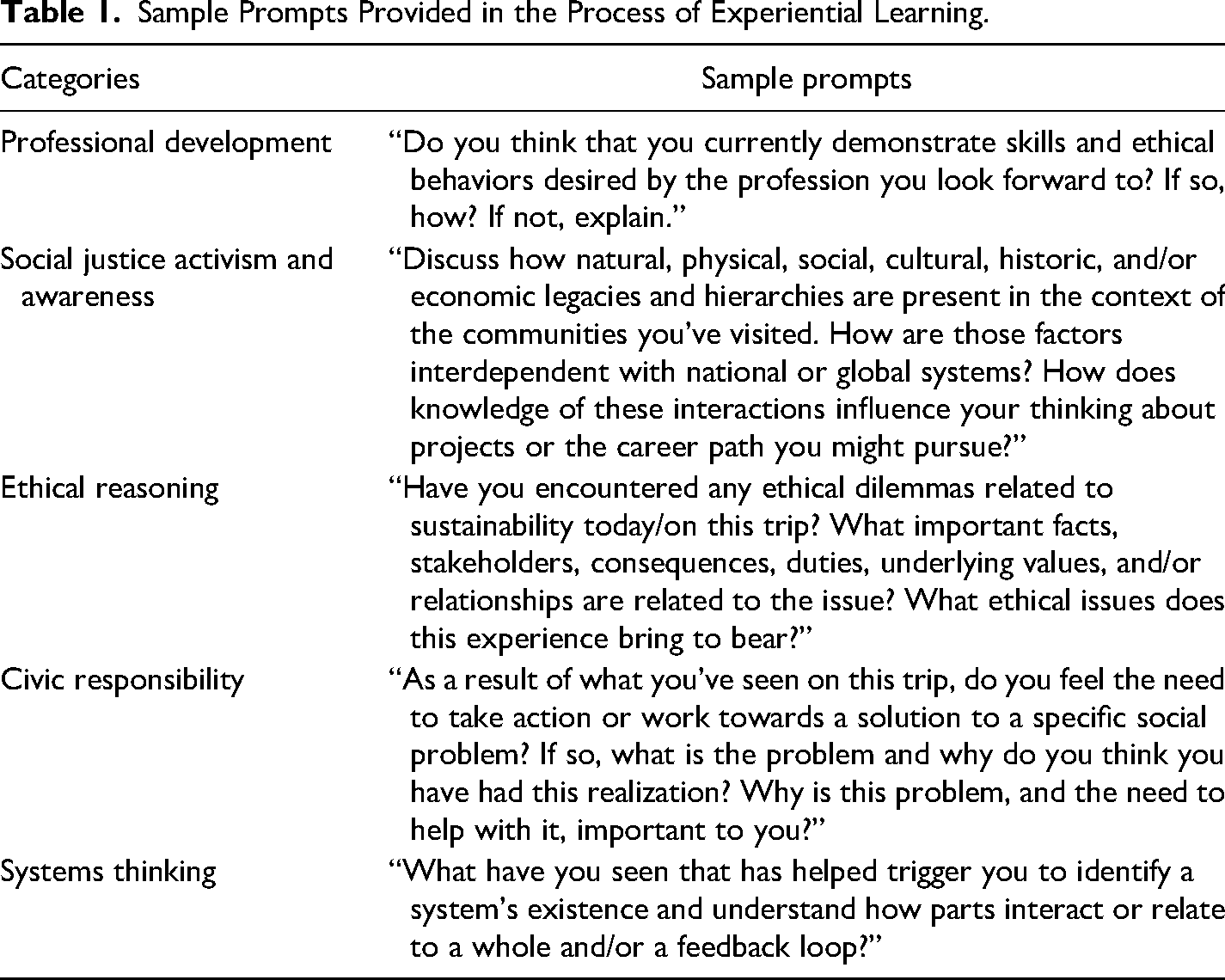
On any given day during the study-away experience, save for one freewriting day, students had the freedom to decide how their personal experience could frame that day as well as possible. Each student could choose the prompt category and questions that resonated with what they saw and experienced that day. Available prompts allowed for student agency that empowered students to be meaningfully engaged in decision-making about their learning.
Following the study-away experience, students were asked to reflect on the trip, whether their values or interests had shifted, and to elaborate on their own learning and growth.
Survey
Surveys were conducted before and after the process of experiential education. Surveys included Likert-type and open-ended questions. The context of the questions centered on the idea of using journals to gauge and record learning, process new experiences, grow personally, and gain insight. Also, the questions invited students to respond to the difficulties involved in journaling and whether other evaluation methods would be more useful. Sample questions were, Do you think reflective journaling is a good way to measure your learning? Please explain your answer and How did reflective journaling assignments help or not help you identify and examine new ideas?
Data Analysis
We constructed a coding scheme informed by the studies on experiential education, scaffolding, and metacognition. The project team discussed the coding scheme items and coded data iteratively. The coding scheme covered, for example, reification as a way of giving form to experience and emotional experience shared in participants’ reflections. The coding scheme takes into account a wide array of elements, including reification (Kortegast & Boisfontaine, 2015), student agency (Coulson & Harvey, 2013; Yancey, 1998), triangulation of individual truth (Yancey, 1998), articulation of meaning (Page & Benander, 2011), the effect of a ‘real audience' (Douthit et al., 2015), emotional experience (Page & Benander, 2011; Zeivots, 2018), and challenges and limitations (Dyment & O’Connell, 2010; O’Connell & Dyment, 2011). The scheme intended to give a holistic and efficient strategy to analyze participants’ answers to the pre- and post-survey questions for their experiential education by taking these elements into account.
After completing the coding process, we examined the coded data to find relations, similarities, and dissimilarities in coded data based on qualitative data collected. Through the adopted thematic analysis, we paid equal attention to the data from each case. Four emergent themes were based on all data coded rather than specific sample data, and we contrasted each theme by checking the coded data (Braun & Clarke, 2006). The themes emerged based on an iterative examination of the coded data and cycles of discussions among project team members (Cormack et al., 2018).
Findings
Prompts Were Found to be Helpful in Reflecting on Participants’ Experiences Differently, Encouraging Critical Thinking and an Appreciation for the Trip's Previously Undesirable Parts
Prompts encouraged students to reflect on their experiences from viewpoints they had not previously considered, which not only promoted critical thinking but also helped them develop an appreciation for parts of the trip they had first disliked. Journaling prompts were shown to be useful in helping participants reflect on their experiences. The prompts encouraged participants to think critically, let them see the trip's overlooked aspects, and helped them grasp how academic knowledge and real-world experiences are related. The efficacy of prompts to guide and improve the reflection process was shown by the participants’ resounding preference for them.
In order to build a better link between their academic courses and the practical parts of the trip, participants emphasized the importance of journaling. They were able to appreciate even the less delightful parts of the trip by thinking back on what they experienced and learned. An illustrative response was: I think the journaling assignments helped me connect the Spring class and the 240 Class better to what I did in Colorado. It [journaling] also helped me appreciate the things I didn’t enjoy about the trip more because I got to sit back and reflect on what worked well and what I learned to answer the prompt. I had to think about how I used to do think [sic] and what I used to “know” and rectify that with the new knowledge that we gained. Journaling allowed me to expand on how I used to view the world and work it into a new view. Especially seeing so much poverty in the city made me re-evaluate what I see as sustainable. Journaling allowed me to work what I saw while in Colorado into a new understanding and viewpoint I don’t think I would have if not forced to really think deep about the sites we visited and how they connected with our prompts. I really enjoyed the journaling assignments during our visit to Colorado and would definitely encourage that it continue for future classes. I definitely think that guided prompts are better than free writing from a personal standpoint. I think because we had prompts, it [the prompts] really guides us to think about how our experiences fit into those prompts and encouraged us to maybe think about those experiences differently then [sic] if we did not do the journaling. I sometimes had a hard time trying to figure out how the visits of the day fit into different prompts, but I believe the[y] encouraged me to think critical[ly] and wasn’t necessarily a bad thing.
Journaling Enabled Participants to Integrate Their Learning, Emotions, and Plans in a Holistic way by Facilitating the Meaningful Synthesis of Past and Present Experiences
Participants were able to integrate their knowledge, emotions, and plans by using journaling. Journaling enabled students to synthesize prior knowledge with the real-life problems they faced during the trip, bridging the gap between their past and current experiences. Participants noted that they grew personally, were more aware of their emotions, realized how they were changing, and improved their conceptual knowledge and application.
Journaling was valuable because it linked knowledge to situations and practices that occur in real life, according to the participants. They were able to recognize important ideas from prior learning and obtain a better understanding of their experiences by carefully digesting each day in their journals. It was a transforming process to go beyond academic understanding and reflect on the experiences and ideas from the actual world. A participant noted: The journaling assignments helped me connect concepts from prior learning to real life situations and practices. I was able to thoughtfully process each day and presenter and go through my notes and identify key concepts that I had learned about previously and truly understand what was involved in implementing them in the real world as opposed to learning about the concept on paper.
Examining their opinions before and after experiencing various situations was enjoyable for the participants, as well, and journaling allowed a greater grasp of their own thoughts and feelings as well as insights into the reasons for their changing emotions. Participants were able to obtain insight and comprehend their own emotional reactions by reflecting on their experiences. A participant's response was, “I enjoyed looking at topics previous to experience and after experiencing as my views changed. It [journaling] helps understand why I am feeling the way I am.”
One benefit of journaling was to evaluate personal growth. Participants admitted that they might not have realized the degree of their progress before and after the trip without journaling. The journaling also gave them a chance to ask themselves how their prior knowledge related to their experiences on the trip. Some participants learned via contemplation that some components, such as urban labor for the homeless, did not align with their passion. A participant noted: It [journaling] was useful because I would not have examined my personal growth before I came on the trip vs after. I also would not have asked questions about what previous learning applies to the trip we took. Such as I realized that urban work for the homeless did not spark passion for me.
Some participants observed that journaling revealed insights that would have been unnoticed otherwise. Journaling required them to express their ideas and feelings, allowing them to see things from a new perspective and pose insightful queries. A participant noted: I think that for people that don’t normally journal, we’d realize somethings that we otherwise wouldn’t have noticed unless we were forced to put our thoughts into words and sometimes even consider and ask ourselves why we feel the way that we do.
Writing a Journal Was Viewed as a Retrospective Resource and a Learning Reinforcement Strategy
The participants highlighted the benefits of writing journals as a resource for reflection and a tactic for reinforcing learning. They indicated its function in preserving experiences and solidifying ideas. They discovered a way to consolidate their knowledge and keep a record of their experiences through journaling.
While some participants felt that writing a journal was an effective learning approach, they did not see it as a gauge of their learning success. They acknowledged the value of using previous journal entries as a resource for assignments or other needs, showing that the journals acted as a database of information. A participant stated: I think journaling is a good learning strategy, but I don’t think it is a good way to measure my learning. I would probably never go back and read my journal entries just to see how much I’ve learned from them. It is useful to have past entries to use for future assignments and whatnot.
Writing journals was regarded as a means to process and put the day's events into perspective. It worked as a tool for recalling various details of the day or speeches that might not have instantly come to mind. Participants enjoyed writing journal entries and found it useful for structuring their ideas and developing a deeper understanding of their experiences. A participant stated, “I love how it [writing journal entries] helps to digest the day and put it in perspective and maybe even recall parts of a visit or speech that aren’t at the forefront of consciousness.”
Another participant underlined that writing journals gave them a chance to give their views and ideas some careful thinking by stating, “It provides an opportunity to process events and takeaways.” They felt that by putting their observations into writing, they were able to engage more fully with their experiences and reinforce the concepts they were learning. A participant noted, “I think it [writing journals] is a great way to look back and thoughtfully consider your thoughts on what you’re writing. It [writing journals] helps to reinforce concepts.”
Similarly, other participants stressed the value of keeping a tangible record of their experiences. No matter how excellent their memory was, they realized that having a written record gave a reassuring source to return to and remember how they felt at particular times. They found it to be a very helpful tool for memory. A participant noted: I think that no matter how good anyone's memorizing capabilities are, it's always more comforting to know that the experience in the moment is written in stone somewhere so we have somewhere we can go back and look back at how we felt in the moment. I’ve found that to be an extremely useful source to remember.
Time Constraints and the Public Nature of Journals Arose as Major Obstacles
During the trip, students had trouble managing their time for journaling, and they worried that their journals’ poor authenticity was a result of the journals’ public nature. The participants noted that one of the main difficulties was the small amount of time they had to finish their journals. The challenge of fitting in time while traveling and interacting with the group was mentioned by a participant, “Just finding the time to get them all done while traveling and socializing with the group.” It was difficult to set aside adequate time for journaling because of the trip schedule and filled days. Another participant shared a similar issue with time management, frequently wanting to unwind but unable to do so owing to the journal writing, “Time management was an issue. [S]ometimes I really just wanted to go to bed but could not because I had to journal.”
Participants frequently expressed concern about not having enough time for journaling. One participant expressed the desire for additional time set out specifically for journaling because they frequently stayed up late to finish their entries, “I wish there had been more time allotted for journaling rather than having to stay up late to complete it.” The chance for deeper reflection and sincere engagement with the writing was hampered by the stress of deadlines and the requirement to complete the journaling process in a short time period.
The difficulty of maintaining a journaling routine in a busy schedule was mentioned by another participant, “I found it challenging to keep up with the journaling as the days were jam-packed. By the time you got in for the night you’d want to relax but had to stay up late to finish your journals.” Even though it was tempting to unwind and relax after a full day, they had to remain up late to finish the journal entries. A consistent challenge was balancing the need for rest, socialization, and the commitment to journaling.
Some participants pointed out the public nature of the journals as a key barrier in addition to time constraints. Writing was affected by the fact that they were aware that their journal entries might be seen and evaluated by the entire class. One participant noted below that they had written more for the grade and the criteria than for the sake of expressing her ideas or actually enjoying the writing process. The authenticity and depth of their journal entries were constrained by this self-censorship. My biggest challenge was that I knew my journal was for a grade and would possibly be read by the entire class, so I didn’t put a lot of personal opinion in it [journal]. I followed the prompt and I wrote for the grade, not for the love of writing or the experience.
Discussion
Because students who are new to experiential learning may lack the metacognitive skills and agency needed to reflect on their experiences effectively, they may find great benefit in scaffolding prompts. In this study, a fixed set of prompts was used to help students throughout the study-away experience, meaning that prompts were provided from pre- through posttravel to scaffold the journaling process. Ideally, students engaged in reflective work should eventually be able to journal effectively within a system of fading scaffolding, which is designed to reduce intensity over time. We recommend that instructors work toward a system of fading scaffolding, increasing the onus on learners to take responsibility for their own reflective work.
Participants found it helpful to utilize prompts when writing because it helped them to think about their experiences differently. The prompts encouraged participants to think critically, better understand the trip's less pleasant parts, and approach their experiences from fresh angles. The participants’ responses underscored the usefulness of prompts in strengthening the overall learning and reflecting process. This finding supports and underscores the significance of scaffolded prompts in literature (Belland et al., 2013; Ge & Land, 2004; Radović et al., 2021). This also allows one to gain self-control in learning by allowing critical articulation and observation of relevant changes in attitudes, ideas, and perspectives (Chick et al., 2009; Hart & Sezgin-Memnun, 2015; Lumpkin, 2020; Rhodes, 2019).
Writing a journal encourages blending plans, feelings, and learning. It allows for greater connections, better understanding, and well-informed decisions for both personal and professional development by combining previous and present experiences. It promotes self-reflection, improves comprehension, and supports deliberate progress. Reflections enable students to consider their personal experiences as experiential education (Kortegast & Boisfontaine, 2015; Lutterman-Aguilar & Gingerich, 2002). Therefore, this finding elaborates the role of journaling as a practice of experiential learning since the consideration of understanding, decisions, connections, and personal and professional developments are at the center of Kolb's model of experiential learning due to the articulation of learning oneself as a key in learning (Dyment & O’Connell, 2010; Liuolienė & Metiūnienė, 2009; Papadopoulos et al., 2011; Yancey, 1998).
Participants noted writing journals as more than just a way to gauge their progress in learning. They acknowledged its retrospective significance in aiding reflection, remembrance, digestion, and reinforcement of their experiences and ideas. Participants were able to get a greater understanding of their experiences by using journaling as a tool to reinforce their learning. This finding is aligned with the significance of journaling as a reflection practice (Kortegast & Boisfontaine, 2015; Roberts et al., 2013; Wenger, 1998) and adds to its role by indicating it as a retrospective resource and learning reinforcement.
Participants identified time constraints as their top concern. Time is a significant factor that influences reflection and journaling quality (Dyment & O’Connell, 2010). However, the short amount of time allotted for journaling had an effect on the quality of reflection and made it difficult for participants to fully immerse themselves in the writing process. The participants’ writing was also impacted by the journals’ public nature since some participants placed more importance on adhering to the guidelines, grading, and winning over peers and the instructor than expressing their true feelings. Contrary to the studies in the literature (e.g., Chen et al., 2009; Douthit et al., 2015), indicating that the public nature of journaling provides advantages such as increasing the quality of reflection, bolstering enthusiasm, and improving writing and communication, participants in this study noted the public nature of journaling as a challenge. As Foster (2015) noted that private journals encourage personal and emotional experience, and the nonpublic nature of journaling during experiential learning would serve to make the most out of the experiences during study-away programs. Considering arguments for grading as a motivator (Dyment & O’Connell, 2011) or reflections without the emphasis on grading (Chan et al., 2021), grading criteria can be alleviated for journaling assessments. This could also improve the quality of journals while reflecting on experiences. Further research is needed for the influence of grading on journaling assessment in experiential learning. These challenges highlight the need for improved time management strategies and for taking into account the private and intimate aspects of reflective writing in a public setting.
Conclusion
Prompts were useful for comprehending and expressing experiences, encouraging critical thinking, and developing a fresh appreciation for parts of the trip that were previously regarded as undesirable. Through a holistic approach, participants could smoothly combine their knowledge, feelings, and plans, creating a meaningful synthesis of past and present experiences. Journaling was seen as a method for reinforcing learning as well as a resource for looking back on previous experiences. However, issues like time constraints and concerns about the public nature of the journals came to light as major challenges in the process. Some students also indicated that the grading was also a factor affecting their journaling process.
Implications
Prompts can be a useful tool for fostering critical thinking and assisting people in seeing their experiences from different angles. To deepen understanding and encourage a more nuanced appreciation of diverse features, educators might use prompts in a variety of learning or self-reflection activities.
Writing in a journal is useful for holistically integrating learning, feelings, and plans. This implies that people might gain by engaging in reflective activities that enable them to link their intellectual and emotional experiences (Coulson & Harvey, 2013; Kortegast & Boisfontaine, 2015), thus enabling a deeper and more meaningful synthesis of knowledge and personal development. Writing a journal was seen as a retrospective tool that allowed students to reflect on what they experienced and solidify their learning. Journaling can help to reinforce newly learned information, improving long-term retention and application.
This study highlighted two main barriers: time constraints and public nature. This suggests that actions should be taken to allay these worries. A more open and sincere process of reflection may be encouraged by giving people enough time to reflect or embracing a fading scaffolding strategy (Dyment & O’Connell, 2010) and by providing a safe and confidential space in which they can communicate their ideas and feelings. In addition, based on the conflicting arguments in the literature on grading reflective practices, such as journaling, instructors and learning designers are recommended to consider grading student journals carefully for the quality reflections and perceived value of journaling as an assessment.
Limitations and Future Research
Although the number of participants was sufficient to examine participants’ perceptions of journaling, we exclusively relied on the respondents’ answers to the open-ended questions in the surveys. However, data triangulation remained unaffected by this limitation due to the contextual information, numerous open-ended questions, and participants’ comprehensive responses. Also, we did not analyze participants’ journals in this study; rather, we focused only on their reflections on the journals. We believe that analyzing journals along with the reflections on them would provide more detailed findings, supporting and elaborating the findings of this study. This practice could also help us examine participants’ metacognitive practices. Drawing upon the findings of this study, we will employ a fading scaffolding strategy for the next round of experiential learning and allocate sufficient time for journaling during the trip.
Footnotes
Declaration of Conflicting Interests
The authors declared no potential conflicts of interest with respect to the research, authorship, and/or publication of this article.
Funding
The authors received no financial support for the research, authorship, and/or publication of this article.
