




Abstract
Keywords
Introduction
The role and use of mobile technologies and social media within contemporary residential OAE practice remains contested. From the early work of Cuthbertson et al. (2004) to the more recent writing from van Kraalingen (2021), the use of technology in broader outdoor education environments often settles on a double-edged sword. This double-edged sword presents a for-and-against argument on the incorporation of technology in outdoor education and has offered little in the way of a critical pedagogical foundation.
As outdoor education has paused over its quandary on technology in practice, contemporary society has increasingly become characterized by and dependent on our technological infrastructures (Lindgren, 2022). The notion of technology as infrastructure is important here given Plantin and Punathambekar (2019) acknowledge how culture, politics, and economy are now situated and sustained within some of the largest digital platforms. In recent times, even the word “digital” has come under scrutiny through the lens of the postdigital (Jandrić et al., 2018; Reed, 2022). The postdigital takes as a given that “(t)he digital is integrated and imbricated with our everyday actions and interactions” to an extent that distinguishing between so-called digital and non-digital spaces becomes impossible (Feenberg, 2019, p. 8). As Brubaker (2020) describes, “(d)igital hyperconnectivity is a defining fact of our time” (p. 771) and that participation in society has extended far beyond proximal, in-person, engagement. In essence, being a socially connected citizen requires interaction with designed online spaces that are never off, and which facilitate, by way of example, the ways we socialize and consume.
However, examining some of the literature which outlines the traditional foundations of OAE and, perhaps, outdoor education and leisure more broadly, we see that the outdoors has often been a place to escape the fast-paced, always-on, nature of our everyday societies. Over 25 years ago, Strong (1995) suggested that technology stands in the way of the “good life,” and that it erodes our abilities to listen, consider, and experience. Meanwhile, Conover and Conover (1995) suggested that technology in the outdoors develops a sense of efficiency, which can disconnect users from the landscape. This nods toward McRae's (1985, 1986) outlining of an environmental ethic for learners in outdoor education which seeks to recognize humans and nature as one community; a collective where individual community member interests are outweighed by the good of the entire community. This speaks to the works of Sobel (1996) and Louv (2005) on “ecophobia” and “nature deficit disorder” respectively, which seek to demonstrate how technology is developing an increasing disconnect between humans and nature. As the study from Waage et al. (2012) describes, outdoor education has been considered well positioned to challenge this disconnect and generate ethics of environmental stewardship in learners.
The present study took the dichotomizing context outlined above, that the notion of the “digital” and “non-digital” are increasingly indistinguishable and that technology disconnects populations from nature, and sought to answer this research question: How do instructional staff perceive mobile technologies and social media use by young people during residential experiences at The Outward Bound Trust?
The Outward Bound Trust was established in the United Kingdom in 1941 and draws on the core values of its founder Kurt Hahn which have centered on compassion, craftspersonship, self-discipline, and physical fitness (Goldenberg et al., 2005). Presently, core outcomes from the Trust encapsulate developing young people's resilience, confidence, understanding of the natural environment, emotional wellbeing, and relationships (The Outward Bound Trust, 2022a). Two primary findings are presented in this paper and center on instructors considering phone-free experiences to be more impactful for learners and that social media interfaces are fake with participation in residential OAE necessitating “real” interaction. The study therefore provides insight from residential OAE instructor perspectives at The Outward Bound Trust on the consistent “technology or no technology” dilemma in practice.
The Present Literature: A Dichotomy in Theory and Practice
Following the work of Cuthbertson et al. (2004), an array of literature has followed which has consolidated the dichotomy I described above. This section explores the post-Cuthbertson et al. (2004) literature and examines how the double-edged sword of technology use in outdoor education has been shaped within and beyond the residential setting. I do not intend to examine the literature here in a chronological fashion, but instead present literature which relates to the research question, and which has come to shape the discussion on technology in OAE over the course of nearly two decades. In this section, I follow the for-and-against argument as a structure to demonstrate current positions on technology in the outdoor education literature more broadly and begin with work considering the removal of technology.
Removing Mobile Technologies in Outdoor Education
Beginning with literature which focusses on removing digital technologies in outdoor education, we see the ways in which “technology-free” outdoor education has been shaped. For instance, in a study with American summer camp workers from Povilaitis et al. (2021), their data indicated that workers reported a sense of liminality in their employment, meaning that they were disconnected socially, psychologically, physically, and technologically from their day-to-day lives. The lack of technology meant that summer camp employees could “live in the moment and be present” (Povilaitis et al., 2021, p. 12). The removal of technology developing a sense of presence in learners was also reported by DeHudy et al. (2021). Once again in the summer camp setting, a dominant theme centered on camp leaders and personnel considering technology to reduce awareness of the natural world and hamper social engagement. In many ways, this aligns with Pyle's (1993) outlining of the extinction of experience which puts forward that humans have a disaffecting and increasingly disconnected relationship with nature. The Swedish-based study of Isgren Karlsson et al. (2022) picks up on this through the perspectives of physical education teachers’ perceptions of technology in outdoor education. They demonstrated how some teachers felt that outdoor education is about (re)connecting with nature and that technology restricted learners’ abilities to do this.
Meanwhile, some of the literature considers outdoor education to be the antidote to technologically centered lives. For instance, Walter (2013) stated that adult outdoor education “can be an antidote and complement to the digital world” (p. 156). Radtke and Harper (2018) extend on this in Outward Bound Canada's Journal of Education, suggesting that Outward Bound programmes are well-placed to address narratives of mobile phone addiction in young people. They draw on the concept of “NoMoPhobia” (no mobile phone phobia) where “[t]he effects of device use have been seen to parallel substance abuse symptoms” and how “the need to maintain student focus on activities and social relations is disrupted by device use” (p. 16). Young people's mediatized lives and high levels of screentime were also discussed by Mutz et al. (2019) who found how a 10-day outdoor programme with limited mobile signal positively influenced young people’s levels of stress as well as hedonic balance and life satisfaction. Addiction was also touched upon by Hills and Thomas (2021) who, discussing the work of Smith et al. (2018), draw on work concerning addiction to mobile technologies (e.g., Eyal, 2014). Indeed, it has been suggested that disconnecting young people from technology in outdoor education removes “the persistent distraction of notifications and the compulsion to ‘check in’ using social media” (Smith et al., 2018, p. 11). Alongside purposeful disconnection, taking young people outdoors to address technology addiction is outlined in a therapeutic sense by McKain (2019), who demonstrates how getting young people outside and phone-free may encourage better relationships with mobile technologies. Of course, this links back to my earlier citing of Sobel (1996) and Louv (2005) and reinforces narratives of outdoor education being a form of antidote to increasingly technologically reliant childhoods.
It is here that introducing the three key texts from Doris Bolliger and colleagues (Bolliger & Shepherd, 2017; Bolliger & Shepherd, 2018; Bolliger et al., 2021) is helpful. In particular, the 2017 paper examined instructor and student perceptions of using apps on iPads to enhance learning during a residential OAE programme in the United States. Instructors were seen to encourage programme participants to use social media to stay in touch with each other and with instructors after the programme. The 2018 paper meanwhile holds resonance in relation to the perspectives of instructors, who stated how “social media turned groups of park visitors into mobs” (p. 85). The study goes further by incorporating the voices of programme participants, presenting a general tension as participants “desired Internet access to peruse wilderness resources and stay connected with friends, family and work” (p. 85). Finally, the study reported in the 2021 paper surveyed 151 instructor perceptions on smartphone use in their practice in the United States. The study reported that 80.1% of instructors did not want young people using social media when on a programme, with just two instructors actively using social media in their practice.
Incorporating Mobile Technologies in Outdoor Education
The above indicates some of the evidence in the literature which argues against the use of technology in outdoor education. However, to demonstrate the for-and-against argument of technology in practice, there is also a body of literature which outlines how technology may be employed. By way of example, Garden's (2022) study assessed the use of iPads at Forest Schools in the United Kingdom and concluded that their incorporation can enhance young people's learning experiences in the outdoors. The use of augmented reality games to generate a connection to nature for young people was also discussed by Livingston (2022) who, through Pokémon GO, discussed how engaging young people with technology that is familiar to them can develop lifelong connections to place. Alongside recognitions that technology may enhance place connection, Thomas and Palmer (2021) also presented the use of augmented reality for outdoor education at an English Natural Heritage site in Cornwall on the south coast of the United Kingdom. They suggest how “it is acknowledged that the use of tech may be an unstoppable force in our daily lives, so embrace and enjoy the ride!” (Thomas & Palmer, 2021, p. 1).
The use of mobile technologies for taking photographs and storing memories of outdoor education has also been discussed as a benefit. For instance, in a study drawing on photo-elicitation with 14 university students, Loeffler (2004) discovered how photographs can help develop spiritual connections to the outdoors as well as enhance post-programme reflection through triggering memory. Ardoin et al. (2014) also positioned photography in outdoor education as an important factor which can demonstrate learners’ situational interest, as well as positioning photographs as an effective evaluation tool. The use of photographs as an evaluation tool is an important consideration for outdoor educators and was discussed in the study conducted by Smith et al. (2010). They gave a group of secondary-school students in New Zealand 27 disposable cameras during a residential school camp and used these photographs to elicit outcomes from the programme. The photos revealed a profound sense of enjoyment and that the residential experience offered an alternative social experience. Away from outdoor education more recently, Özkul and Humphreys (2015) further demonstrated how mobile technologies affect how the past is remembered and offers people novel and innovative ways of documenting the present.
Matters of inclusion and access have also been raised as a potential benefit of utilizing mobile technologies outdoors. In a study of underrepresented fifth-grade students in southern America, Boyce et al. (2014) demonstrated how mobile technologies were used as a source of reference, to collect data, and as a tool which maintained learner engagement. Hougham et al. (2018) built on this, presenting data from the “Engaging At-Risk Populations Outdoors, Digitally” programme. Learners reported increased confidence in using technology and an enhanced interest in observing plants. Critically, the research team stated that the “incorporation of digital technology in an experiential, outdoor lesson plan did not detract from students’ learning experiences; in fact, it may have contributed to their reported increase in confidence and interest in digital tool use” (Hougham et al., 2018, p. 165).
Where to Now? Challenging the Binary in Postdigital Society
The above sections demonstrate a distinct and historically situated dichotomy on the use of technology in outdoor education. From narratives of technology disconnecting learners from nature (e.g., Isgren Karlsson et al., 2022) to technology enhancing reflection and memory (e.g., Loeffler, 2004), the position of technology in outdoor education remains a contested topic. However, recent work on the role of the postdigital in outdoor education extends and, perhaps, collapses this dichotomy (Reed, 2022). Given the prevalence of mobile technology and social media in society, and its salience in the lives of young people (Ofcom, 2022), narratives of choice to embrace or not to embrace technology may become an oversimplification of reality. As outlined in a paper following an international webinar, “no matter how hard we try, outdoor education experiences may be considered as bookended by the technological architectures that shape society” (van Kraalingen et al., 2022, p. 9). This bookending of outdoor education experiences by both social media and broader sociotechnical infrastructures now represents a pressing question which centers on the effectiveness of technology removal in outdoor education and whether such experiences resonate with learners’ networked realities.
In essence, this gives the present study its purpose, to evaluate in contemporary practice how residential OAE instructors at The Outward Bound Trust perceive the use of mobile technologies and social media in their practice. The following section outlines the approach to the study before the study's findings are presented.
Method
This section outlines the design of the study, the recruitment of participants, and the data generation and analysis procedure. This article reports on data from instructors as part of a larger study exploring mobile technologies and networked spaces at The Outward Bound Trust.
Study Design
In order to achieve a situated and comprehensive overview of the relationships and complexities between mobile technologies, instructors, and The Outward Bound Trust, three of Outward Bound's centers were selected for the study with one center in Wales, England, and Scotland. Each center represented a single case study and, broadly following the work of Stake (2006), a multiple case study was designed. Following Flyvbjerg (2006) and Simons (2009), each case is an in-depth, bounded environment where the uniqueness and complexities present within each center could be explored. Aligning with Stake (1978), each center represented a bounded system and offered the study a defined set of parameters for the generation and analysis of data. The study received ethical approval from the institutional ethics review board at The University of Edinburgh and The Outward Bound Trust part-funded the research alongside the Economic and Social Research Council.
Participant Recruitment
Instructors were initially selected using a convenience sampling approach which facilitated instructor recruitment (Patton, 2015; Schreier, 2018). Criteria for inclusion were as follows:
Instructors had to be full-time employees with The Outward Bound Trust. Instructors had to be directly involved in the delivery of adventurous activities with young people.
Each instructor was initially approached by the Head of Impact Evaluation at The Outward Bound Trust by email, providing a participant information sheet and asking them to contact me if they wished to participate. This recruited just four instructors and, as a result, I moved to a snowball sampling approach to recruitment (Noy, 2008). I therefore interviewed the few instructors who had agreed to participate and asked them to spread the word about the study to colleagues and friends.
Ultimately, a total of seven instructors, 10 senior instructors, and three learning and adventure managers took part from across the three centers. Of these, nine of the instructors were women and a breadth of experience levels and age ranges were present in the sample. This included instructors who were just beginning their career in the outdoors, through to those who had been at The Outward Bound Trust for over two decades.
Generating Data
Following a pilot interview (Malmqvist et al., 2019) in December 2021 with an instructor not employed by The Outward Bound Trust, the interviews took place between January and April 2022. Following the work of Rabionet (2011), all interviews were semi-structured which afforded a sense of flexibility and flow during each interview. Throughout this process, questions were refined and adjusted to reflect my interpretation and construction of instructor realities.
Given the Covid-19 restrictions in the United Kingdom at the time, all interviews were conducted on Zoom. While the restrictions imposed by the pandemic were initially cause for concern, the benefits I encountered from this approach are reflected by Oliffe et al. (2021). Specifically, interviewing instructors in their home environment afforded both comfort and convenience, and contributed to the richness of the conversations we were having. Finally, interviews with instructors took place across the three centers concurrently. This facilitated a reciprocal process whereby themes from instructors within separate centers (or cases) further facilitated the refinement of interview questions for other instructors.
Data Analysis
The analysis process broadly followed Braun and Clarke's (2006) step-by-step guide to thematic analysis, and I also employed Braun and Clarke's (2022) later reflexive thematic approach. Immediately after each interview, I “took the data for a walk” which consisted of a preset route with the interview playing back to me through headphones. This data familiarization process underpinned my own interactional constructions of instructor realities (Miller & Glassner, 2016; Nikander, 2012) and offered me time and space to reflect on the content of each interview. Each interview was then transcribed verbatim (McLellan et al., 2003) and each transcript was taken through two coding cycles. First, each transcript was coded using Saldaña's (2021) outlining of an in vivo “splitter” approach which split transcripts into much smaller chunks. This generated a significant number of codes and so code consolidation was undertaken by looking across each instructor's splitter codes (within each case), and I constructed a hand-written narrative which described and emphasized the codes I felt were important for answering the research question.
The second coding cycle took the codes I consolidated within coding cycle one and clustered codes together to generate patterns present in the data from each case. This approach, loosely described as a “lumper” approach by Saldaña (2021), created “categories by chunking together groups of [the] previously coded data” (Chenail, 2008, p. 72). From these patterns, candidate themes were consolidated which focussed on instructor consensus and I synthesized the candidate themes (of which there was very often crossover) using a series of flashcards. These flashcards housed the overarching themes present in the data from within each case and were displayed in a series of thematic maps. A cross-case comparison of these thematic maps concluded the analysis process. By evaluating instructor consensus present across the cases, overarching cross-case themes were constructed, and it is these which are presented in this paper.
Trustworthiness and Limitations
This study presents data from 20 instructors at The Outward Bound Trust in the United Kingdom. Following Maxwell and Chmiel (2014)), the transferability of these findings should be treated with caution, and my explicit intention is that the data may be transferred internally within The Outward Bound Trust. This does not generate a study that is void but does offer the reader a level of caution if attempting to universally apply these findings to other settings that did not feature in the research. I have also taken the position of “researcher-as-instrument” (Yoon & Uliassi, 2022) and so fully acknowledge that the findings and associated discussion are filtered and constructed by me. The reflexive approach taken in the analysis (Braun & Clarke, 2022) helped me document my influence as the researcher, but, as with most qualitative research, my voice and my interpretations underpin the findings. Finally, each interviewee member checked their interview transcript, and an internal working group was set up at The Outward Bound Trust where my constructions of findings have been shared as the analysis process has been ongoing. These factors have ensured that I remained close to the data as I navigated the construction and interpretation of themes.
Findings
The two overarching themes constructed from the cross-case comparison of instructor findings are presented here as two statements (Figure 1). All instructors chose their own pseudonyms, and every effort has been taken to obscure the identity of participants. To further enhance participant anonymity, each case is now referred to as an avian-based pseudonym and are called Starling, Smew, and Skylark. The two themes are:
Phone-free outdoor experiences are more impactful for young people in contemporary society. Social media is fake, outdoor adventurous education necessitates in-person and in-place interaction.
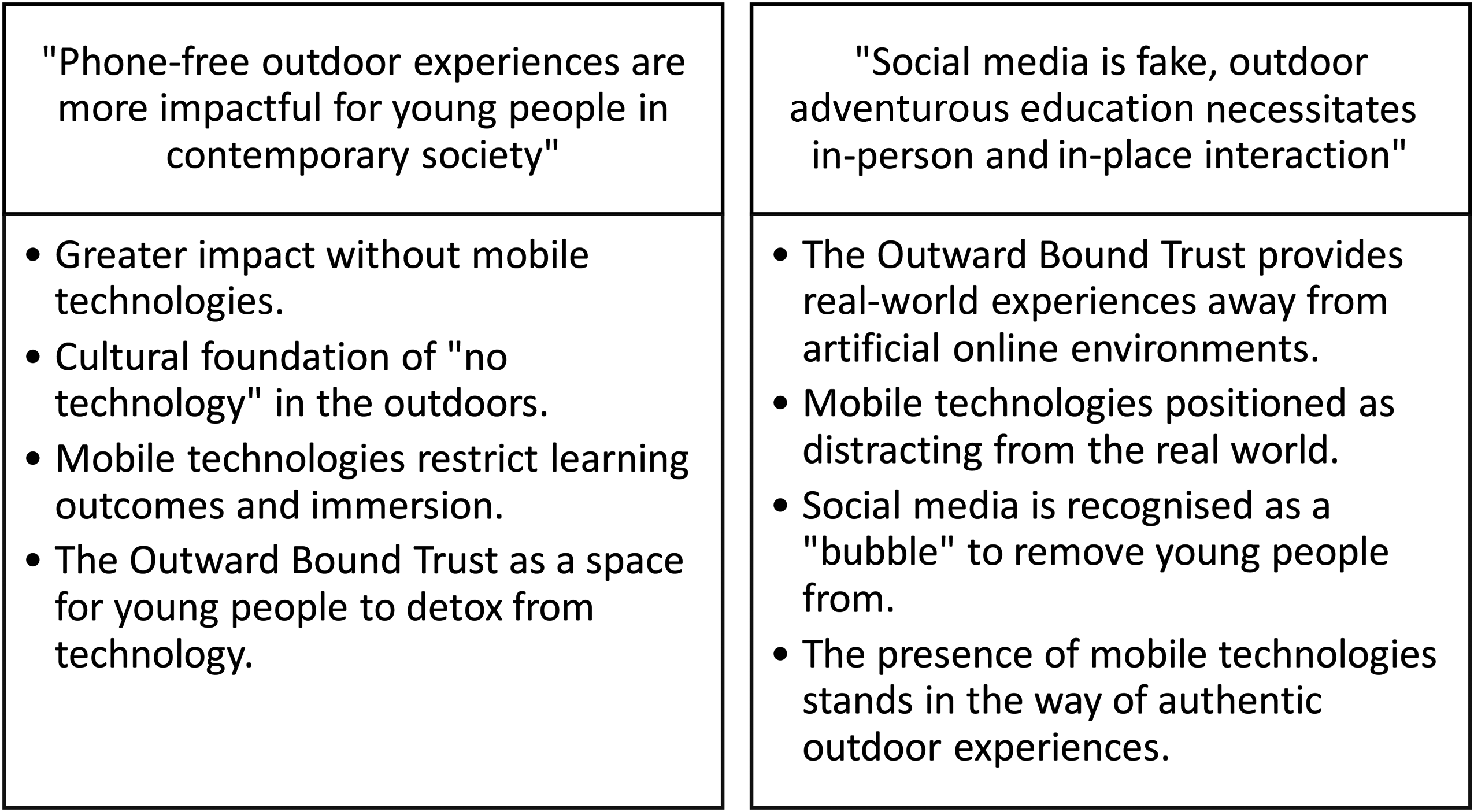
The composition of the two themes.
Phone-Free Outdoor Experiences are More Impactful for Young People in Contemporary Society
Phone-free experiences for young people in wild and remote adventurous spaces were consistently described as highly impactful for young people who have known little else other than a society characterized by technology. For Callum (Starling centre), phone-free experiences are “a good challenge … because all of these young people have grown up not knowing anything else.” Meanwhile, Liam (Skylark centre) indicated that phone-free preferences from instructors are situated within “a little bit of a culture at Outward Bound of ‘no, it's the good old outdoors, you go out with nothing’.”
Embracing phone-free time was also discussed by Louise (Skylark centre) who noted how “if the kids can embrace it … embrace not having a phone or not being with it, they can overcome it, and they actually enjoy being able to have conversations again with each other.” By acknowledging that the impact of The Outward Bound Trust is increased by removing phones it is put forward that “you're showing them [young people] that they can exist without their phones” (Smew centre).
Immersion in Outward Bound Trust programmes was also thought to be limited by the presence of phones, a limitation which is thought to affect the likelihood of meaningful learning taking place. This was discussed by Charles (Smew centre) who stated “for us [The Outward Bound Trust] to truly deliver on our mission, then the phone does become a genuine disconnect to our outcomes.” In many ways, this lack of immersion through the presence of phones was discussed by instructors as the primary distracting factor in their practice.
Building on the distraction narrative, Naomi (Smew centre) discussed how the presence of a phone “distracts from being there, doesn't it? Our minds often race forward or race backwards, and the whole idea of kind of … just being there in the moment and appreciating rain and wind and weather.” This intentional putting down of mobile technologies and demonstrating other ways of engaging with peers and the environment sometimes resulted in instructors considering participation at The Outward Bound Trust as a detoxing experience for young people. Straying into narratives of mobile phone addiction, Helen's (Starling centre) approach to phones on a programme centered on feeling “like it's that detox, and I think it's really good for them [to not have their phones].” Extending further, “for me, I just think, it's just a detox, get rid of it. ‘You’re here for five days and you’re kids, what the hell do you need that phone for?’” (Helen, Starling centre).
What was developed throughout the generation and analysis of instructor data was a profound sense that OAE in general is considered well-positioned to positively affect how young people use their phones.
Social Media Is Fake, Outdoor Adventurous Education Necessitates In-Person and In-Place Interaction
Alongside phone-free preferences, instructors often considered the social media young people use to be fake or as a space for non-real engagement. The Outward Bound Trust was positioned as a space which challenges narratives of online “fakeness” and facilitates learning environments that are real, and which have consequences.
For Lauren (Starling centre), social media “is not true, and it is not real, it is digital. And people only share their best bits, you know, you don’t see anybody sharing their walk in their pyjamas, do you?.” Once again, narratives of distraction also emerged, with Lauren (Starling centre) suggesting that phones provide “the distraction from connecting to the real world” and Liam (Skylark centre) describing how “that to fully experience something, you can't experience it through a screen … if you could … there's no point doing Outward Bound." Communication by phone was also considered artificial and that “real-world” communication is a primary focus in instructor practices.
Greg (Skylark centre) extended on this sense of The Outward Bound Trust facilitating “real” experiences away from phones by sharing a story of when young people had phone signal during a session he facilitated. The young people were all “chatting about what the other groups are doing and what they've posted” and how it felt “like they hadn't really left the school playground and they hadn't really engaged with where they were. So, they're still in that bubble.”
Instructors also considered young people's uses of social media to be inauthentic in the outdoors. For instance, Liam (Skylark centre) said how he felt “the experience that you have out and about, whilst we're out in the mountains, needs to be genuinely experienced rather than by through the medium of the phone.” Oliver (Skylark centre) also discussed this, suggesting that successful residential OAE is where “you've got that connection with place, you can't do that over a phone.” Oliver built on the idea that participating in an Outward Bound Trust programme is about in-person and in-place interaction and that this cannot be emulated or experienced through a phone: Now with outdoor ed, if you go out into the outdoors, you've got it there, you're on a hilltop, that's it, there's no games to play, there's no “well, this is what you could have won,” you are there, you have that direct interaction with that [nature] at face value (Oliver, Skylark centre).
Discussion
With instructors focussing on the power of phone-free activities and acknowledging that social media and online spaces are not real, the construction of instructor perceptions centers on a state of ambivalence toward mobile technologies and social media in practice. This section places the findings within the contextual fabric of the present literature.
Phone-Free Outdoor Adventurous Education: Instructor Perspectives at One End of the Technology Dichotomy
The instructors in the present study generally align with one side of the previously mentioned dichotomy surrounding technology and OAE. Instructor perspectives reflected that of Sobel (1996) and Louv (2005) and often centered on The Outward Bound Trust facilitating direct connection to nature in a manner which challenged the technologically centered lives of young people. However, while the findings align with McKain's (2019) documentation of phone-free experiences developing better relationships with technology, the instructors explicitly linked their phone-free preferences to the role technology has in restricting the outcomes of Outward Bound Trust programmes. For instance, the comment that “the phone does become a genuine disconnect to our outcomes” from Charles (Smew centre) demonstrates the level of intentionality present in the instructor's decision-making. This purposeful limiting of mobile technology in practice aligns with Bolliger and Shepherd's (2018) work, which demonstrated the level of hesitation outdoor professionals had toward incorporating technology in their instruction.
While the findings from the interviews align with previous empirical work, the reasoning behind instructor preferences may be found in the philosophical approach which underpins The Outward Bound Trust's work. As Mees and Collins (2022) describe, The Outward Bound Trust is underpinned by a Hahnian approach to development which recognizes “that people are capable of more than they know, and by pushing beyond perceived limits and reflecting on that, they can be brought to realize it” (p. 2). It is reasonable to put forward here that this Hahnian philosophical approach may be extended to now include considerations around mobile technologies and how they are considered to generate “fake” spaces for interaction and engagement. For some instructors, the Hahnian philosophy of “pushing beyond perceived limits” not only describes the underpinning adventurous elements of an Outward Bound Trust programme, but it also includes young people putting down their mobile phones in order to connect with the outdoors in authentic ways that are “real.”
This is reflected in a recent Tweet from The Outward Bound Trust (2022b) in relation to #OutdoorClassroomDay where “young people from across the UK are taking time away from textbooks, technology and TikTok to test themselves with activities like gorge scrambling, rock climbing, rowing and canoeing at our centres.” Aligning with the perspectives of instructors, The Outward Bound Trust appears to advocate for phone-free experiences in the outdoors to achieve its outcomes. In many ways, this aligns with the NoMoPhobia paper from Radtke and Harper (2018) at Outward Bound Canada and further reinforces the narrative put forward by Helen (Starling centre) that The Outward Bound Trust can provide a “detox” to the mediatized, technology-centered, lives of young people. The findings here intersect with those of the paper from Selwyn and Aagaard (2021), which called for more critical engagement surrounding the purposes of removing mobile technologies in schools to address cyberbullying, addiction, and distraction. Importantly, they note how banning technology in educational settings must extend beyond for-and-against arguments and instead embrace the messy and fluid realities of learners; doing so develops opportunities for more nuanced student understandings on the role technologies play in their own lives.
What the data has presented is an argument for removing mobile technologies and social media in order to achieve the desired outcomes of The Outward Bound Trust (The Outward Bound Trust, 2022a). While greater critical awareness of the role mobile technologies have in the lives of young people does not feature as an explicit theme in the data, it is clear that the interviewed instructors recognised phone-free experiences as a primary underpinning factor in the success of a programme. These dialogues will likely require further scrutiny at the policymaking, facilitation, and personal development levels to ensure phone-free experiences offer learners impactful and supportive learning environments.
Considerations Around Mobile Technologies and Social Media Negatively Affecting Proximal, Authentic Engagement With the Outdoors
Throughout the interviews, instructors often considered social media to be “fake” and that the incorporation of mobile technologies negatively affected both proximal and authentic engagement with outdoor spaces and places. Positioning social media as fake naturally links to narratives of “fake news” (e.g., Rhodes, 2022) and the construction of the “perfect self” (e.g., Freitas, 2017) on social media. However, this appears to also link to romanticized narratives of outdoor adventure. This links to work such as Payne and Wattchow (2008) who, drawing on Beck (1995), outline how going “into nature” offers a method of escape from the fast and fluid realities of our contemporary sociotechnical assemblages. For instructors such as Oliver (Skylark centre) and Immy (Smew centre), the presence of mobile technologies restricts young people's ability to authentically connect with the places in which they deliver residential OAE.
Looking to Haskin (1999), we see the emergence of philosophical concerns which center on “the potential detachment from direct experience with nature that these technologies may present” (p. 63). It is this philosophical perspective which features in the data. For the instructors, this centers on mobile technologies and social media generating an additional layer between the learner and the place in which they are learning and links back to Pyle's (1993) outlining of our increasingly isolating relationship with nature. As Charles (Smew centre) summarized, “you need to be aware of, and appreciate, what's happening now” and instructors frequently positioned mobile technologies as the primary barrier to young people generating a sense of connection to place in the present time and present moment. What remains to be considered in practice is whether young people share the sentiment that their uses of social media are fake. Looking to work such as that from MacIsaac et al. (2018) suggests that narratives of fakeness may overlook the embodied realities of young people, as well as the importance of these online assemblages in contemporary youth cultures. Further research is required that may seek to evaluate young people's perspectives on social media and what authentic engagements with the outdoors look like to them.
Instructor Perspectives and Postdigital Entanglements: A Comment
Examining texts which consider postdigital characterizations of society, instructor preferences for technology-free, authentic, residential OAE settings are brought into question. For instance, Adams and Jansson (2023) consider a “postdigital return to place” and assess 2023 the emergence of a desire to escape and distance oneself from the realities of our digitally sustained sociality. In many ways, this yearning for a “return to place” adequately describes the findings presented here, especially in relation to the standardizing and coercive nature of digital architectures that instructors sought to challenge. However, Adams and Jansson (2023) suggest that “any such romantic return to a predigital, bounded place seems futile given the entangling force of today's ever-expanding networks of digital communications” (p. 658). Future questions of effectiveness are therefore generated, and may include considerations on whether it is possible for instructors to disconnect learners from the realities of their digitally sustained lives. This may seem increasingly unlikely given considerations on technology as a societal infrastructure and that it is not possible to simply turn technology on or off.
What may therefore be required is a shift in perspective that looks beyond “digital disconnection” and explores the efficacy of “digital disentanglement” in order to achieve the instructor’s hope of returning learners to nature. This shift in discourse reflects the work of Traxler et al. (2022), which places greater emphasis on technological disentanglement instead of simply attempting to disconnect learners from technology. This is an important distinction and offers outdoor educators a postdigital lens through which to acknowledge the always-on, connected realities of the young people who participate in contemporary residential OAE. This also raises important practice-based hurdles that place emphasis on learners’ messy and fluid realities, as well as extending beyond the double-edged sword characterization that has often shaped the field (Cuthbertson et al. (2004). The data presented here provides evidence of a clear motivation for outdoor instructors at The Outward Bound Trust which centers on delivering stripped-back, technology-free, and authentic outdoor experiences. Future research may seek to explore whether such perspectives hold up to the scrutiny presented here from authors such as Traxler et al. (2022) and Adams and Jansson (2023).
Concluding Thoughts: Consequences of Postdigital Realities
This study has presented data that links back to the idealized constructions of adventure as described by Strong (1995) and Conover and Conover (1995). However, it remains unclear whether these constructions remain achievable in societies increasingly characterized and dependent upon technology and broader platform infrastructures. It is clear that through positioning social media as fake and through attempting to provide outdoor experiences that are phone-free and authentic, instructors at The Outward Bound Trust intentionally seek to challenge the increasing dominance and necessity of hyperconnectivity. This perspective falls on one side of the double-edged sword put forward by Cuthbertson et al. (2004) and positions residential OAE as a possible antidote to narratives of phone addiction and the acknowledgement that technology is driving a fast-paced society and economy which actively overlook and exploit natural recourses. Future research may seek to explore this further, asking how and in what ways OAE may provide learners with critical and alternative ways of being in an age of hypermobility and immediate connection.
While the data has been applied to the present literature, offering insight into the perspectives and motivations of instructors relating to mobile technologies in practice, the efficacy of these attempts to disconnect learners remains unclear. Reflecting on the writing of Traxler et al. (2022) and Adams and Jansson (2023), the pervasive dominance of technology across the social, cultural, and economic domains of society may require a shift in perspective. Indeed, seeking to “disconnect” learners may overlook the situated and entangled nature of technology in the lives of participants. Key questions are therefore raised for residential OAE more broadly that center on whether technology-free experiences generate the necessary learning outcomes that are relevant in the day-to-day lives of learners. With this in mind, it is recommended that, when intentionally seeking to encourage learners to engage with the outdoors without their technologies, instructors and policy makers remain critically attentive to the ways in which technology may or may not be disentangled from the technology-centered realities of young people. This could be positioned as a primary recommendation for both practice and theory development in outdoor education more broadly. A recommendation that may offer a platform to explore beyond the well-established “yes technology, no technology” dichotomy.
Of course, the data presented here is from a small subsection of residential OAE instructors within The Outward Bound Trust in The United Kingdom. The study is limited in that it cannot claim universal applicability, but it does provide a much-required snapshot into the perspectives of instructors who are making decisions on what to do with technology daily in their practice. Alongside this, the lack of perspective from young people in this paper must be acknowledged. It may also be that the findings here cannot be mapped to other residential OAE providers in the United Kingdom and beyond, but my hope is that at the very least the data may provide the sector with a baseline from which best practices may be compared and developed. All the while being mindful that the development of a postdigital entanglement advises us against characterizing residential OAE as a space for technology disconnection. It is important to note that the study presented here is part one of a larger study that is seeking to answer two additional research questions. These will center on how the presence and/or non-presence of mobile technologies affect young people's experiences at The Outward Bound Trust and how online media and gaming platforms frame how young people engage with outdoor spaces.
Footnotes
Declaration of Conflicting Interests
The author declared no potential conflicts of interest with respect to the research, authorship, and/or publication of this article.
Funding
The author disclosed receipt of the following financial support for the research, authorship, and/or publication of this article: This work was supported financially by The Outward Bound Trust and The Economic and Social Research Council.
