




Abstract
Younger siblings of autistic children are at a high likelihood (HL) of autism, language, and/or cognitive delays. Vocal complexity, a continuous measure of the developmental maturity of vocal communication, is facilitated by parent-child interaction and predicts language outcomes. This study examined whether parents’ intervention fidelity to Project ImPACT, a 12-week, parent-mediated, naturalistic developmental behavioral intervention (NDBI), mediated the effect of Project ImPACT on parents’ verbal responsiveness (post-intervention) and children’s vocal complexity (3 months post-intervention). Participants were 54 12- to 24-month-old HL child-parent dyads who received 12 weeks of Project ImPACT (n = 28) or business-as-usual (n = 26) . Project ImPACT indirectly improved both parents’ verbal responsiveness and children’s vocal complexity by improving parents’ use of the intervention techniques. The efficacy of Project ImPACT in supporting early social communication might be attributed to how Project ImPACT helps parents improve the quality and frequency of their use of the intervention strategies across children’s everyday settings.
Later-born siblings of autistic children are at higher likelihood (HL) not only for autism (7%–19%; Grønborg et al., 2013) but also for language or cognitive delays (14%–20%; Messinger et al., 2013). Many HL children display delays in expressive vocabulary by 18 months (Edmunds et al., 2016; Iverson et al., 2017), which endure through the preschool and early school-age period (Brignell et al., 2018). Expressive language delays have substantial consequences for children’s everyday functioning and well-being. For example, the acquisition of “useful speech” (e.g., ability to communicate needs) by school age predicts better long-term social and adaptive outcomes in autistic children than for those who do not acquire useful speech (Anderson et al., 2007; Kasari et al., 2010).
Parent-child interactions, specifically the quality of parents’ responsiveness to their children’s communication, are likely a powerful support for HL children’s early vocal communication development, given their delay in spoken word use. While “parent” is used throughout this manuscript, we mean “parent” to refer to all primary caregivers (e.g., grandparents, guardians). In the transactional theory of speech sound development (e.g., Sameroff & Chandler, 1975), parents’ contingent verbal responses to their children should influence child vocal development (Woynaroski et al., 2017; Yoder & Warren, 1999). For example, parents are more likely to respond to their 6-month- to 3-year-olds’ “speech-like” or “vocally complex” vocalizations than to less vocally complex sounds (Gros-Louis et al., 2006; Papousek, 1993; Reeve et al., 1992; Warlaumont et al., 2014). Both autistic and non-autistic children tend to produce more subsequent vocalizations when their previous vocalizations were met with parental responses (Warlaumont et al., 2014). For autistic 2- to 4-year-olds, parents who respond more to children’s communication, including their vocal communication, have children who use more unique consonants in their vocal communication (Woynaroski et al., 2016). There is strong evidence that parents can learn to make more frequent responses to their toddlers’ communication (Green et al., 2015, 2017).
Vocal complexity is a measure of the quality of young children’s preverbal and verbal speech. It is often operationalized as the presence of canonical syllables (CS) and the number of different consonants (consonant inventory [CI]), which are traditional phonological constructs in early vocal development research and are highly correlated (McCathren et al., 1999; Stoel-Gammon, 2011; Woynaroski et al., 2017). There is a clear relation between young children’s phonological abilities, or their ability to make sounds, and their lexical abilities, or their ability to use words (Lewis, 1936; McCathren et al., 1999). Phonological development progresses predictably in typically developing infants and toddlers: By 6–9 months, infants begin producing canonical babble–sets of fully formed consonants and vowels vocalized together (Oller, 2000). The second year is a period of great transition from phonological to lexical ability, and yet research suggests that the continuity between children’s preverbal and verbal production could benefit from being measured continuously.
HL infants have less vocally complex communication in the first year than non-HL children (Paul et al., 2010), as do 9- to 18-month-old HL children later diagnosed with autism (Patten et al., 2014). Increased parent verbal responses to infants’ and toddlers’ vocalizations also predict greater vocal complexity (Goldstein & Schwade, 2008; Gros-Louis et al., 2006) and better expressive language outcomes (Baldwin, 1995; Bottema-Beutel et al., 2014; McDuffie & Yoder, 2010; Oller et al., 2010; Siller & Sigman, 2008; Stoel-Gammon, 2011; Tamis-LeMonda et al., 2001; Yoder et al., 1998). This transactional relationship between parental verbal responsiveness and child vocal production, which holds for autistic children, may have cascading implications for HL children.
Strategies for improving language and social communication skills are likely more effective when delivered earlier in development, when the pivotal skills of language and social communication are emerging (Dawson et al., 2012; Dawson, 2008). A pivotal skill is a behavior that, when acquired, presents the learner with a wide range of opportunities to learn skills across developmental domains (Koegel et al., 1999). Vocal complexity may be a pivotal skill for young HL children because such vocal communications might elicit broad language-facilitating responses (e.g., Gros-Louis et al., 2006; Warlaumont et al., 2014). Although not yet tested in HL or autistic children, it has been demonstrated that children’s vocal communication with consonants can be improved through strategies used by Project ImPACT (Ingersoll & Dvortcsak, 2010), a parent-mediated, naturalistic developmental behavioral intervention (NDBI; Schreibman et al., 2015), in children with Down syndrome (Yoder, Woynaroski, et al., 2015). However, it is unknown whether vocal communication in young HL children would be malleable, or responsive to intervention.
Early Interventions for Social Communication in Children at HL of Autism and Communication Delays
There is a rich literature that demonstrates that parental responsiveness relates to better child language outcomes (see Madigan et al., 2019, for a review) and that interventions on parenting improve child language (see Jeong et al., 2021, for a review). Previous attempts to intervene on the language and social communication of HL children have produced mixed results. There have been 13 total unique studies examining the efficacy of early interventions for HL children: seven for developmentally-oriented interventions (all randomized control trials [RCTs]), and six for NDBIs (four RCTs, two quasi-experimental designs) (Hampton & Rodriguez, 2022). Meta-analysis revealed a non-significant direct effect of intervention on HL child outcomes. Of the 10 studies assessing parent behaviors of some sort, only three (two developmental, one NDBI) found that their intervention improved parent responsiveness, while two (both NDBI, both Project ImPACT) found that their intervention (Project ImPACT) improved parent fidelity (Stahmer et al., 2020; Yoder et al., 2021b). These individual effects drove a significant overall effect, such that interventions for HL children improve parent behaviors (Hampton & Rodriguez, 2022). Only six studies measured parent fidelity specifically; future work should specifically measure parent fidelity in addition to other parent behaviors of interest.
Somewhat surprisingly, almost all currently published studies that examine early interventions for HL children (as opposed to those already diagnosed) used a parent-mediated rather than a clinician-delivered format (Hampton & Rodriguez, 2022). This is likely the case for two reasons. First, high parent involvement is developmentally appropriate in the second year of life, when most children’s play still heavily involves parents and before children reach formal schooling and even, in some cases, day care. Second, parent-mediated supports for HL children may be a way to reduce the cost of early intensive social communication supports without reducing the benefit (National Research Council, 2001); compared to a larger amount of time with therapists (who are costly and not available in every community), a smaller amount of time with parents (following a relatively more cost-effective training) may still lead to better generalization of treatment gains. In addition, very few studies have examined moderators and mediators of early interventions for HL children (for a review, see Hampton & Rodriguez, 2022). This work will help us understand for whom and, more importantly for implementing streamlined interventions in the community, how interventions work.
The Current Study
This study examined vocal complexity in the context of an RCT of a parent-implemented social communication intervention, Project ImPACT, for young HL children (Yoder et al., 2021a; Yoder et al., 2021b).
Project ImPACT is a 12-week, NDBI that has been found to improve social communication and language in young autistic children (Ingersoll & Wainer, 2013). Project ImPACT has been found to improve social communication for HL children (Yoder et al., 2021b). The intervention is likely useful for HL toddlers as a whole (Yoder et al., 2021a), and the processes by which it improves social communication and language may hold across all children. An important component of Project ImPACT is its focus on facilitating opportunities for parent-child interactions and increasing parents’ linguistic input. Project ImPACT teaches both more naturalistic strategies common in early communication interventions such as following the child’s lead, imitating the child, modeling language, and increasing their animations, as well as more directive strategies such as playful obstruction, balanced turns, communicative temptations, and explicit teaching of language and play skills (Ingersoll & Dvortcsak, 2010). Project ImPACT teaches parents to expand upon children’s vocalizations and language and to respond contingently to children’s vocalizations. For example, in certain phases, parents are taught to consider any vocalization their child makes as meaningful and to respond with a slightly more advanced type of communication. In essence, Project ImPACT teaches parents to amplify their pre-existing role as powerful influencers of their children’s language ability to that of intentional communication teachers.
For parent-mediated interventions, parent fidelity is justifiably thought to be an essential mediator to child social communication outcomes; if parents use the strategies well and frequently, children should improve more rapidly. However, only one study to our knowledge has examined and found this relation (Yoder et al., 2021b). It is important to examine whether child gains are truly occurring indirectly through parents’ increased use of intervention strategies, as these findings will bolster the funding and time needed to support efforts to improve fidelity and quality assurance in the community implementation of these complex programs.
The overall goal of this study was to conduct a secondary analysis on the Project ImPACT RCT for HL children (Yoder et al., 2021a; Yoder et al., 2021b), examining whether Project ImPACT could improve both parents’ verbal responsiveness and HL children’s vocal complexity compared to business-as-usual (BAU), and to assess whether these treatment group effects were mediated by improved parent Project ImPACT strategy use (i.e., fidelity). This analysis specifically adds to the extant literature by determining the role of parent intervention fidelity as a mediator of Project ImPACT on the growth in parent-child vocal communication, knowledge of which will critically inform future community implementation practices.
The specific aims of this study were to:
Method
Participants
Fifty-four diads of 12- to 18-month-old HL children and their primary caregivers were the participants, recruited for the Project ImPACT randomized controlled trial at Vanderbilt University and the University of Washington. HL children (n = 28), who were randomly assigned to Project ImPACT, are referred to as “ImPACT” children. HL children (n = 26) who were randomly assigned to the “business-as-usual” group are referred to as “BAU” children. Inclusion criteria were having at least one older sibling with a verified autism diagnosis, living within 30 miles of a site, having no genetic or neurological conditions, and having >50% English spoken at home. Participants were excluded if the child was premature (<32 weeks), had a feeding tube, or if the parent had previously received similar autism-specialized parent-implemented intervention training (Table 1).
Participant Characteristics.
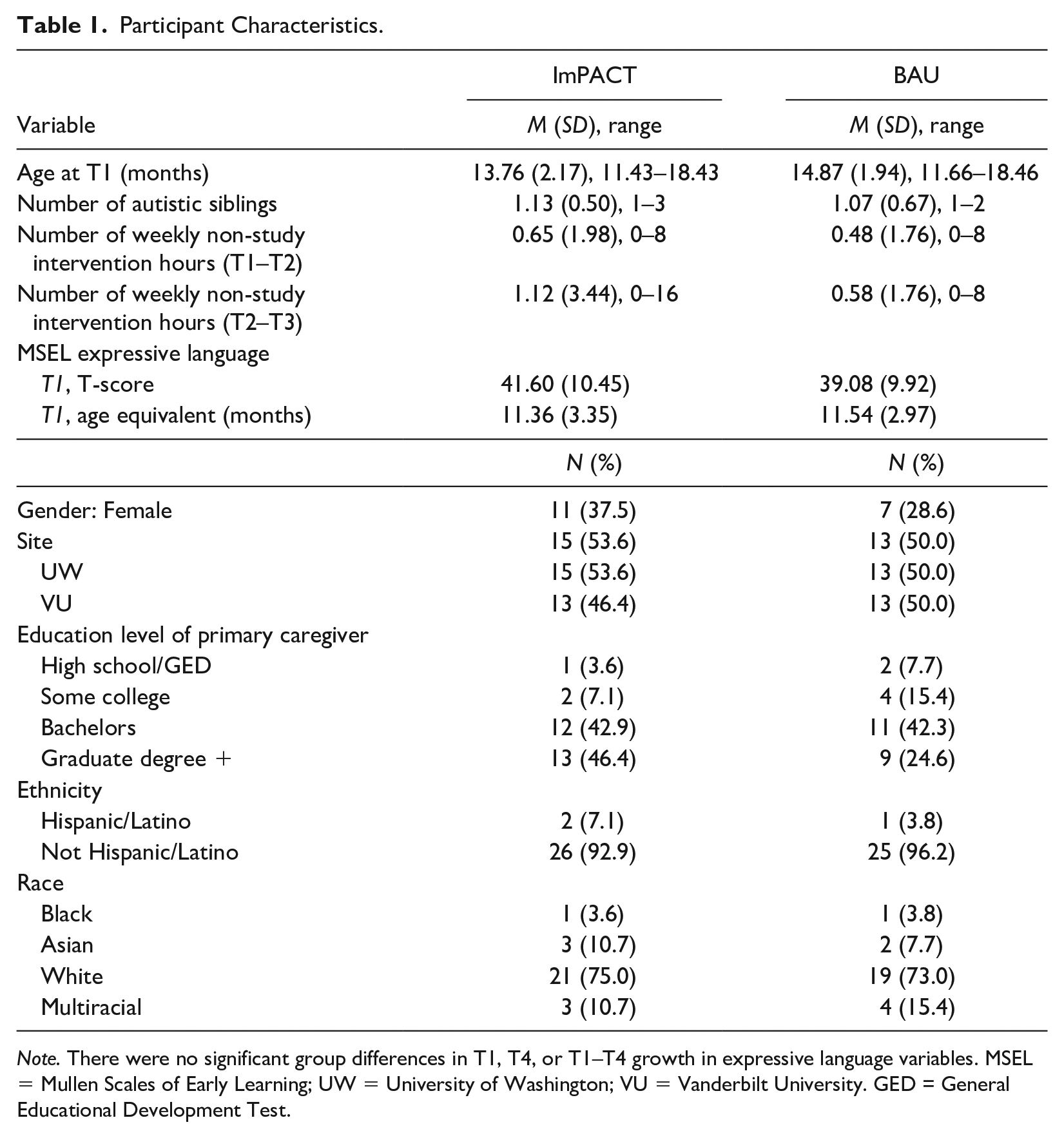
Note. There were no significant group differences in T1, T4, or T1–T4 growth in expressive language variables. MSEL = Mullen Scales of Early Learning; UW = University of Washington; VU = Vanderbilt University. GED = General Educational Development Test.
Procedures
BAU and ImPACT children were eligible to enroll between 11.5 and 18.5 months of age. Families visited the labs at four time points: Time 1 (T1; baseline; 12–18 months); Time 2 (T2; immediately after 3 months of Project ImPACT sessions; 15–21 months); Time 3 (T3; 3 months after ImPACT completion; 18–24 months). Children also visited the lab at Time 4 as part of the overall RCT (T4; 6 months after ImPACT; 21–27 months). Children in the ImPACT group were about 1 month younger at each time point than children in the BAU condition, .04 < ps < .06 (Table 1). The ImPACT group received 12 weeks of parent coaching in Project ImPACT strategies from T1 to T2 (post-ImPACT). Fidelity of parents’ ImPACT strategy use and PVR were then measured at T2. Vocal complexity was measured at T3 (Table 2). See “Measures” for more details.
Descriptive Characteristics and Group Differences for Component Variables of Constructs of Interest.
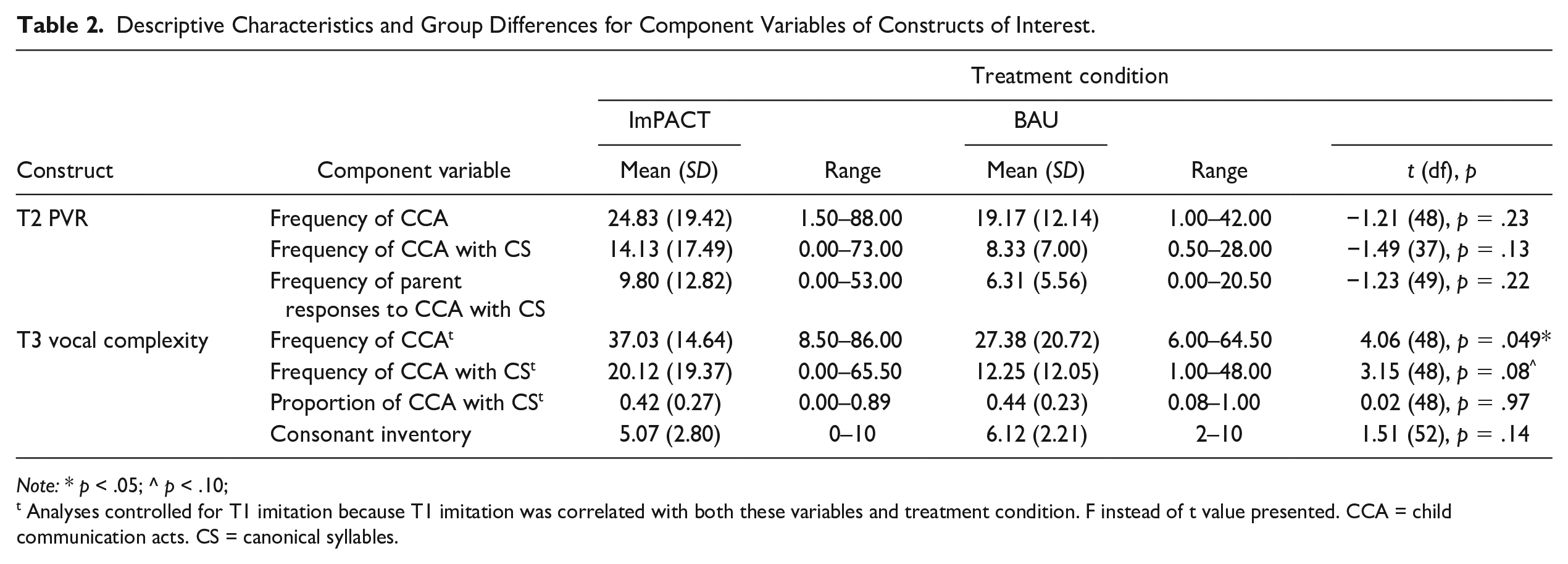
Note: * p < .05; ^ p < .10;
t Analyses controlled for T1 imitation because T1 imitation was correlated with both these variables and treatment condition. F instead of t value presented. CCA = child communication acts. CS = canonical syllables.
Treatment Groups
After Time 1 assessments in lab, families were randomly assigned within site to the BAU or the ImPACT group using a computer program. All available variables within the larger trial were assessed for T1 differences, including parents’ use of ImPACT strategies (i.e., fidelity), motor imitation, play, expressive and receptive language, intentional communication (a combination of gesture use, vocalizations, and words used with communicative intent), global cognitive ability, and social communication. The only variable that differed at T1 was motor imitation, suggesting that on the whole, randomization successfully created equal groups (see Yoder et al., 2021b). Imitation was included as a covariate in all later analyses.
Business-As-Usual
Children in the BAU group received assessments and developmental monitoring at all four study time points. They were not restricted from receiving services outside of the study, and information on their non-study service activity was collected at T1, T2, and T3 through qualitative interviews. There were no significant differences between treatment conditions in the number of hours of outside services received at any time point; .48 < ps < .83 (Table 1). Overall, while some outside services that families received focused on social communication, they did not have a direct caregiver teaching component as Project ImPACT does.
Project ImPACT (ImPACT)
Parents in the ImPACT group received 2 one-on-one, 1-hr, in-home coaching sessions per week for 12 weeks (between T1 and T2) from bachelors’- and masters’-level clinicians who received training from the developer of Project ImPACT (Ingersoll & Dvortcsak, 2010). Caregiver attendance for the full Project ImPACT program was 86%, and clinician adherence (using self-administered, session-specific checklists) was 91%. Outside of coaching sessions, parents were asked to use ImPACT strategies with their child 1 hr per day for 5 days per week. Before beginning parent coaching sessions, interventionists were trained to 80% fidelity on both Project ImPACT content and coaching strategies. We used a rating scale for randomly selected sessions as a quality control measure of coaching fidelity to indicate when retraining was necessary, which occurred rarely.
Measures
Measurement Contexts
Fidelity of ImPACT Strategy Use
Parent fidelity was measured at Time 2, immediately after the 3-month intervention period. Parent fidelity was coded from two study procedures: the Parent Child Free Play (PCFP; e.g., Yoder et al., 2021b) and Parent Child Snack (PCS; Yoder et al., 2021b). The PCFP (15 minutes) and the PCS (10 minutes) are semi-structured parent-child interactions in which parents are told to interact with their children as they would at home. In the PCFP, parents are given a standardized set of toys and asked to play with their child. In the PCS, parents are given snacks and asked to elicit their child’s snack preferences. We measured parent fidelity in a generalized as opposed to a context-bound manner (different setting, materials, and instructions from Project ImPACT training sessions; but same partner).
Parent Verbal Responsiveness
PVR was coded with ELAN behavioral coding software (http://tla.mpi.nl/tools/tla-tools/elan/; Lausberg & Sloetjes, 2009) at T2 from the PCFP and the PCS.
Vocal Complexity
Vocal complexity was coded with ELAN at T3 during two communication procedures, the Communication and Symbolic Behavior Scales–Developmental Profile Behavior Sample (CSBS-DP; Wetherby & Prizant, 2003) and the Brief Observation of Social Communication Change (BOSCC; Grzadzinski et al., 2016). The CSBS-DP (20–30 minutes) and the BOSCC (10–15 minutes) are semi-structured examiner-child interactions in which examiners present children with communicative presses using standardized toys.
Coding Procedures
Fidelity of ImPACT Strategy Use
Fidelity was coded from the PCFP and PCS using three methods and then combined into a composite variable (see Yoder et al., 2021b for more detail). Parent linguistic mapping was coded in 5-second intervals from the PCFP and the PCS. Direct teaching techniques were coded as frequency (i.e., timed-event sampling) from the PCS. The remaining Project ImPACT strategies that were possible to code from the PCFP and PCS were rated on a 5-point Likert-type scale using definitions from the Naturalistic Developmental Behavioral Intervention-Fidelity measure (NDBI-Fi) (Frost et al., 2020) (e.g., face-to-face, following the child’s lead, positive affect and animation, response to child communication, and use of communicative temptations).
Parent Verbal Responsiveness
To code parent verbal responses, we first used a timed-event coding scheme to identify all instances of child communication acts within the PCS and PFCP. The following combinations of child behaviors were considered to comprise communication acts, in line with prior work (e.g., Woynaroski et al., 2017; Yoder, Watson et al., 2015): (a) a non-imitative sign, word, or word approximation with appropriate referential context; or (b) a non-word vocalization with evidence of attention to an object or event (i.e., referential context) as well as an adult (i.e., intention to communicate) within 3 seconds of the vocalization. While gestures can also be a type of child communicative act, we omitted gestures for this study as we were interested in parent-child vocal communication. Word approximations are needed to appropriately approximate at least one syllable of the word (Vihman et al., 1985). Non-word vocalizations needed to be voiced and non-fixed (i.e., not crying or laughing; Oller, 2000). A word or word approximation has referential context when it is used in close proximity to its referent. For example, if a toddler said “frog,” this word would have referential context if he or she had just looked at a frog toy or frog picture. Evidence of attention was noted in several ways, including toddlers’ eye gaze, moving toward the object or adult, giving of objects to the adult, and answering adults’ questions.
Our aim was to code only PVR that occurred in response to more vocally complex child communication acts. Therefore, we narrowed our scope to only the identified child communication acts that contained at least one CS. See the following sections for a definition of CS. We then marked all instances of parent vocalization that occurred within 3 seconds or less (Gros-Louis et al., 2014; Northrup & Iverson, 2015) of a child communication act with CS. Parental responses were coded as responsive to their child’s speech if they said something that was contingent (either in content or context) to their child’s communication act and that added semantic or phonological information to the interaction. Three different types of PVR were considered during coding: linguistic mapping (verbally interpreting the child’s communicative act), repeating (repeating what the child said), and expanding (verbally expanding on what the child said). However, reliability checks were not conducted for these sub-categories; therefore, all three types of PVR were combined into one variable: the proportion of toddlers’ communication acts that contained CS to which parents responded with a verbal response that added semantic or phonological information relevant to the child’s context (Table 3).
Descriptive Characteristics for Constructs of Interest.
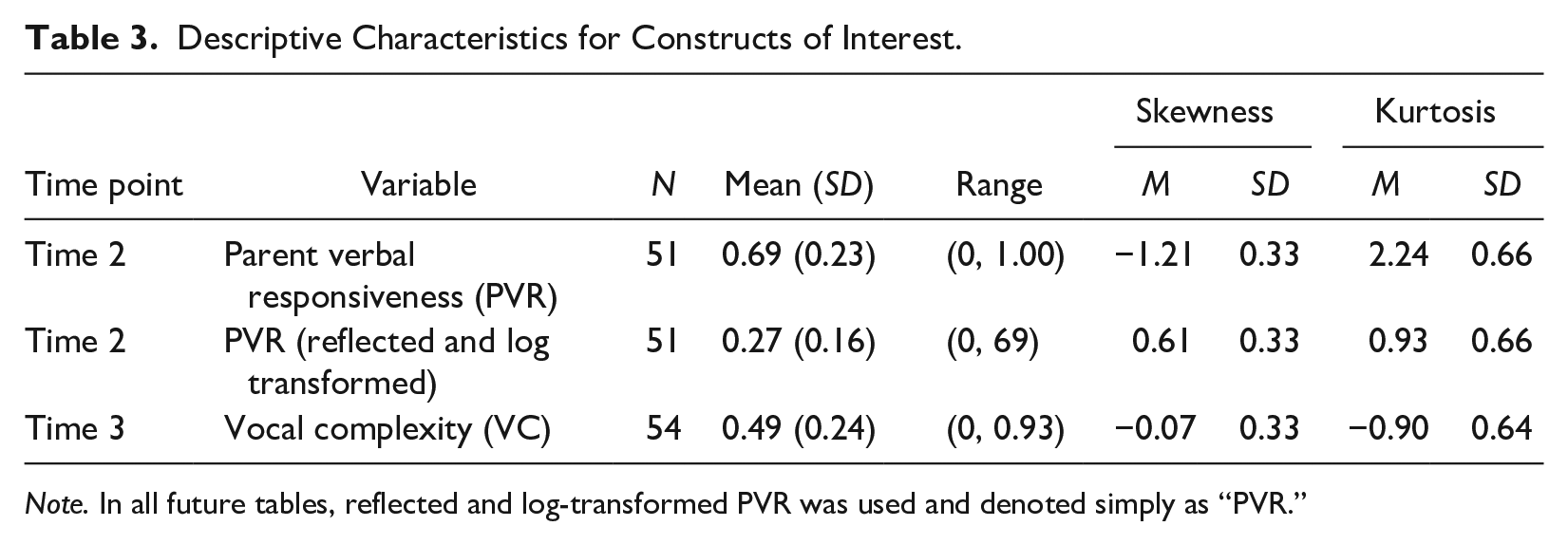
Note. In all future tables, reflected and log-transformed PVR was used and denoted simply as “PVR.”
Vocal Complexity
To code vocal complexity, we first used an interval coding scheme to identify all instances of child communication acts within the BOSCC and the CSBS, using the same definition as mentioned earlier. Then, intervals containing child communicative acts were coded for (a) the presence of CS and (b) the number of different consonants present (i.e., CI). Finally, intervals that contain a communicative act and a CS were identified as either containing words or not containing words.
CS was defined as a vocalization that has a consonantal sound, a vowel, and a smooth transition between the consonant and vowel (Oller, 2000). For example, the classic “ba” sound, pronounced clearly and triumphantly by an infant, would likely be considered a CS. CI was defined as the number of unique consonants that toddlers said within communication acts, within the entirety of the CSBS and BOSCC. The consonants that were coded for inclusion in each toddlers’ CI were the CSBS-DP manual’s True Consonant Inventory List (Wetherby & Prizant, 2003; Wetherby et al., 2007), which is a subset of 10 possible consonants that either emerge earliest or are said frequently by young children and are more reliable to code. Some consonants within the subset appear relatively later in development and were included to reduce the possibility of ceiling effects when studying older toddlers. The coding of vocal complexity produced in this manner allowed a variable with greater range (and thus potentially greater sensitivity to individual differences) than a CSBS-specific metric, and this metric of vocal complexity has established validity for autistic children (McDaniel et al., 2019). In previous studies, CS and CI were highly correlated (r = .84), supporting the feasibility of our planned aggregation of CS and CI in line with prior work (Woynaroski et al., 2017).
Reliability of Coded Measures
To establish reliability on all measures, trained undergraduate coders who were blind to treatment condition and hypotheses were trained to at least 80% reliability on three training videos in a row. For each variable, 20% of the sample was double-coded, and interrater reliability was assessed on that sample. If coders were <80% reliable on any one of the reliability sample files, they had to “regain” reliability by coding three more consecutive files at 80%. Any discrepancies were resolved via discussion. Sample-level interobserver reliability was assessed for 20% of the total sample using intraclass coefficients (ICCs) with a two-way random model using absolute agreement. The ICC for all variables were >.80.
Analytic Plan
A Priori Power Analysis
Simulation modeling by Fritz and MacKinnon (2007) found that a sample size of 34–54 participants would be needed to detect an a path with a large effect size and a b path with a medium to large effect size using bias-corrected bootstrapping. Given the sample size of n = 54, we were powered to detect an indirect of this size and expected to find large direct effects given effect sizes on similar variables in prior work (e.g., Carter et al., 2011; Gros-Louis et al., 2014).
Metric Formation
All variables were z-score transformed using the mean and standard deviation of each variable. Then, if multiple variables comprised each construct and were sufficiently correlated at r = .40 or higher (Cohen & Cohen, 1984; Yoder et al., 2018), they were averaged to form a unit-weighted aggregate. For vocal complexity, the metrics of canonical syllabus (CS) and consonant inventory (CI), averaged across the CSBS and the BOSCC, were highly correlated, r = .73, p < .001. Therefore, they were z-score transformed using the mean and standard deviation of each variable and then averaged to form a unit-weighted aggregate for T3 vocal complexity. In addition to z-score transformation, PVR was reflected and log transformed to meet assumptions of normality within a multiple regression framework (Table 3). As such, the direction of the relation between PVR and other variables will be reversed for interpretation.
Model Building Principles
Ordinary least squares (OLS) multiple linear regression models were used to assess each aim in IBM SPSS Version 28.0.1.0. Models were fitted using a systematic model-building process: First, the hypothesized a priori models were tested. Each multiple regression model was examined to determine whether it met the assumptions of multivariate regression, including (a) a linear relationship between the independent variables and the dependent variable; (b) no perfect multicollinearity; (c) multivariate normality, i.e., the model residuals are normally distributed without the undue influence of outliers; and (d) homoscedasticity, i.e., the variance of the residuals is similar across values of the independent variables. Multivariate normality was assessed by examining the skewness, kurtosis, and Q-Q plots of the residuals for each model. Any outliers identified using Cook’s distance were also identified and assessed. Homoscedasticity was examined by plotting the predicted values against the residuals for each model. Indirect effects were estimated with OLS regression using the PROCESS macro (Hayes, 2013). Ninety-five-percent confidence intervals for each of the indirect effects were calculated using bias-corrected bootstrapping. Bias-corrected bootstrapping is regarded as the most powerful method of computing confidence intervals around the indirect effect (e.g., Fritz & MacKinnon, 2007; Preacher et al., 2007).
Results
Preliminary Analyses
Descriptive statistics for variables of interest can be found in Tables 2 and 3. Model fit was appropriate, and no model assumptions (e.g., normality of residuals) were violated.
Assessment of Necessary Covariates
Randomization to treatment condition should in theory produce groups with baseline equivalence on variables of interest and auxiliary variables. However, random assignment does not always create baseline equivalence, especially in relatively small samples. Any auxiliary variable that (a) differed by treatment condition at Time 1 (pre-intervention) and (b) significantly predicted outcome variables of interest could have impeded the causal inferences that could be made about the effect of the ImPACT intervention on parent and child behaviors of interest because it could serve as an alternate explanation of the treatment effect. A variety of auxiliary T1 covariates were available from the overarching RCT for use. A complete analysis of potential covariates was conducted, and the following variables were assessed: child imitation, play, cognitive ability, intentional communication, expressive language, child age, and parent linguistic modeling (Yoder et al., 2021b). One T1 covariate that significantly differed by treatment condition and also predicted an outcome variable of interest was children’s T1 motor imitation ability (see Yoder et al., 2021b). Imitation was therefore included as a covariate in all models in which treatment condition was a predictor and T3 vocal complexity was the outcome variable.
Missing Data and Attrition
Three children (5% of the sample) were missing data for T2 PVR due to video recording error (2 BAU; 1 ImPACT); these participants were included in the current sample, but listwise deletion occurred for analyses that involved T2 PVR. Missingness for each variable was not correlated with variables of interest, .27 < ps < .97. All analyses were repeated using a generalized linear model framework with maximum likelihood estimation to create model estimates that accounted for missing data; model estimates and fit were not substantially different from those obtained using OLS regression. Differential attrition rates for all analyses were within liberal boundaries for determining whether a study has low overall attrition (Institute for Education Sciences, 2017).
Main Analyses
Aim 1
The goal of Aim 1 was to investigate the total effect of Project ImPACT on T2 PVR and T3 vocal complexity using linear regression. Treatment group did not significantly predict T2 PVR, β = −.03, p = .86, such that at Time 2, parents of children in the ImPACT and BAU groups responded similarly to their children’s communication acts that contained CS. Treatment group did not significantly predict T3 vocal complexity, β = −.05, p = .74, such that there was no significant difference in vocal complexity for children in the ImPACT group compared to the BAU group at Time 3, three months after ImPACT coaching ended. Parents in the ImPACT group had greater ImPACT strategy use (fidelity) than parents in the BAU group, Cohen’s d = 1.09 (previously reported in Yoder et al., 2021b).
Treatment group differences were also examined for the component child behaviors that comprised the vocal complexity aggregate (Table 2). Toddlers in the ImPACT group made significantly more communication acts. They also produced more words with CS than toddlers in the BAU group and trended to making more word and non-word communication acts with CS than the BAU group, p = .08. However, ImPACT children did not have a higher proportion of communication acts with CS than BAU children or display a larger CI. Overall, while ImPACT may have increased children’s overall frequency of communication acts compared to BAU, it did not significantly increase the vocal complexity of children’s communication (i.e., when operationalized as a unit-weighted aggregate of z-score transformed CI and communication acts with CS).
Aim 2
The goal of Aim 2 was to examine whether receiving Project ImPACT improved T2 PVR and T3 vocal complexity indirectly through parents’ ImPACT strategy use (fidelity). For each of the indirect effects, 95% confidence intervals were calculated using bias-corrected bootstrapping in the PROCESS macro (Cole & Maxwell, 2003; Fritz & MacKinnon, 2007; Hayes, 2013; Preacher et al., 2007). Both models produced significant indirect effects; the relation between treatment group assignment and T2 parents’ verbal responsiveness was mediated by use of the ImPACT strategies (Model 1), such that increased strategy use predicted increased PVR. Similarly, the relation between treatment group and children’s T3 vocal complexity was mediated by parents’ T2 ImPACT fidelity (Model 2), such that increased strategy use predicted increased vocal complexity. See Table 4 and Figure 1.
Indirect Effect Models: Parent Fidelity as a Mediator of Intervention Effects on PVR and Vocal Complexity.
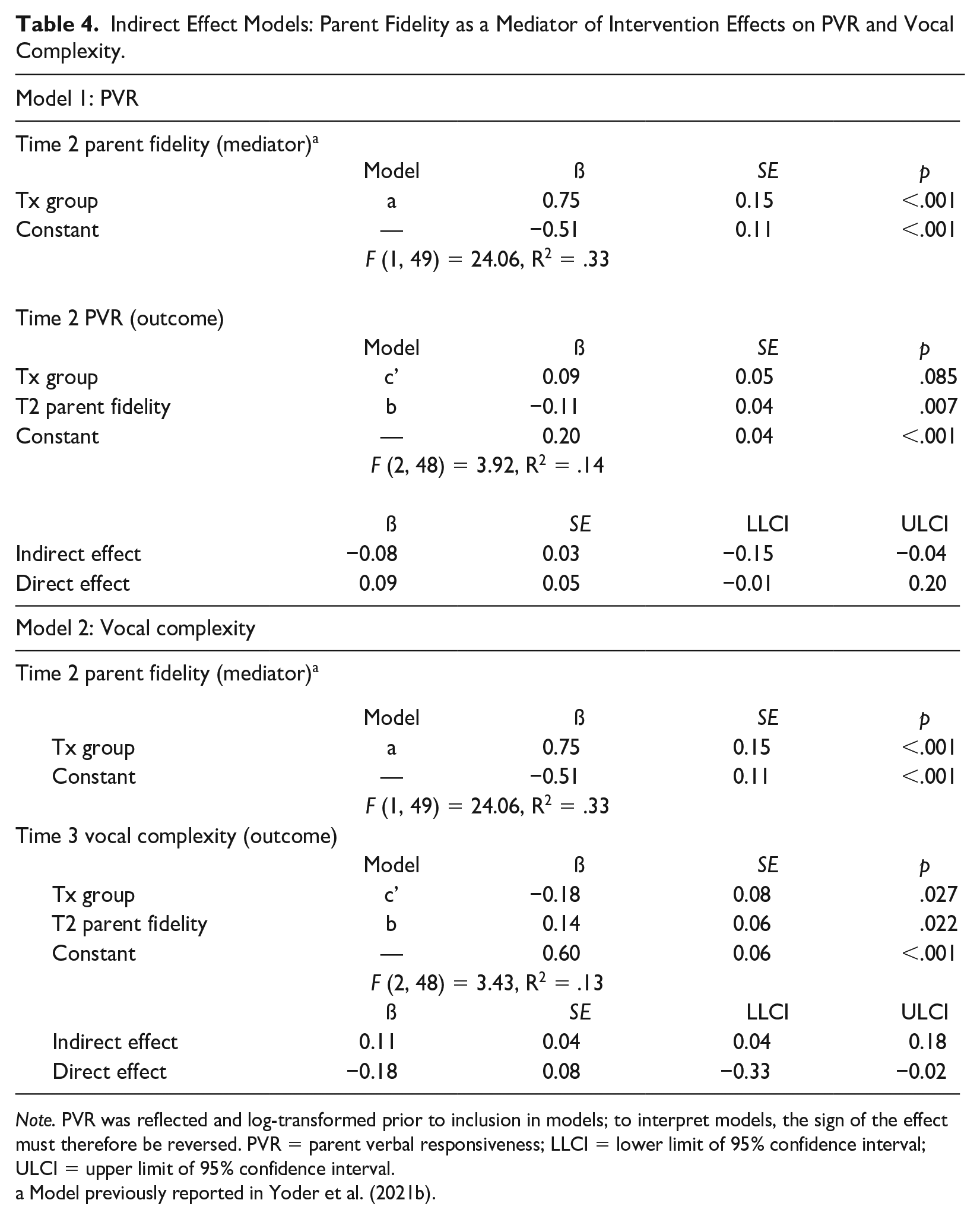
Note. PVR was reflected and log-transformed prior to inclusion in models; to interpret models, the sign of the effect must therefore be reversed. PVR = parent verbal responsiveness; LLCI = lower limit of 95% confidence interval; ULCI = upper limit of 95% confidence interval.
a Model previously reported in Yoder et al. (2021b).
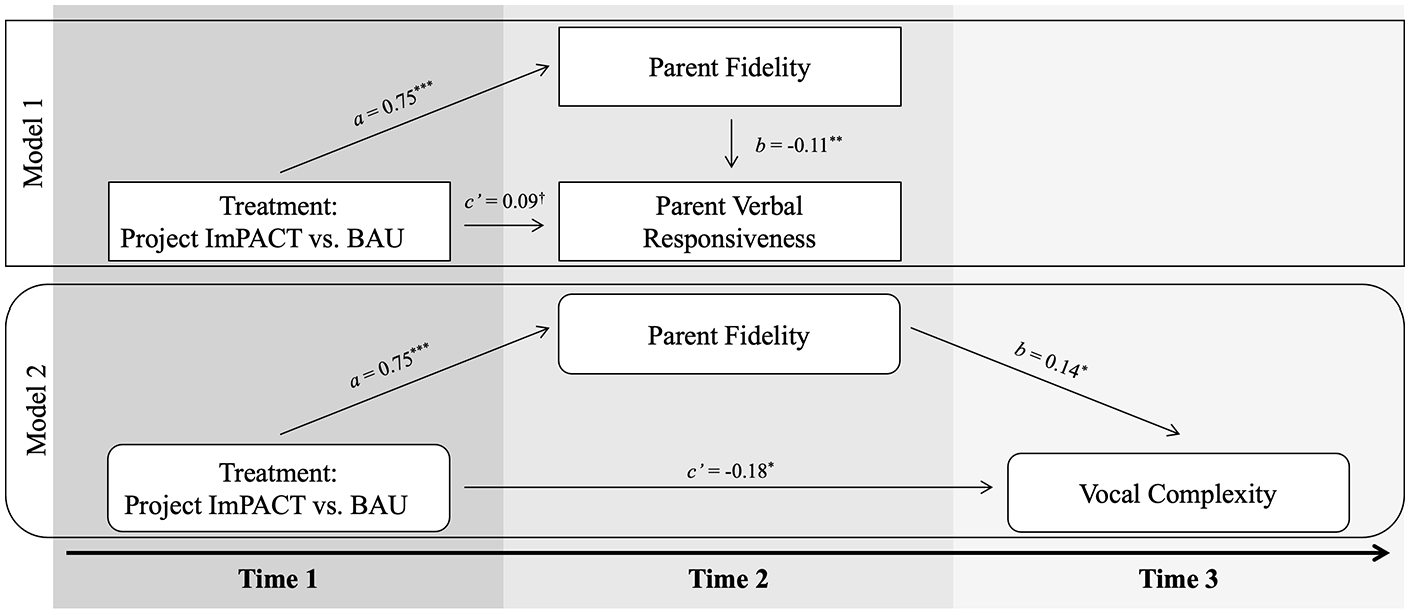
Parents’ Project ImPACT Strategy Use Mediates the Effect of ImPACT Group Assignment on Parent Verbal Responsiveness (Model 1) and Child Vocal Complexity (Model 2).
Discussion
Project ImPACT training indirectly improved both parents’ verbal responsiveness (PVR) and children’s vocal complexity by improving parents’ use of Project ImPACT strategies. While Project ImPACT vs. BAU did not directly improve children’s vocal complexity, receiving Project ImPACT did increase the frequency of children’s intentional communication acts and the frequency of word-specific communication acts that were vocally complex.
Increasing the Amount vs. the Maturity of Vocal Communication
To our knowledge, this was the first study to assess whether parent coaching strategies can increase parents’ sensitivity to their children’s vocally complex communication acts, as well as whether parent coaching strategies can increase the vocal complexity of children’s communication acts. While receiving Project ImPACT improved the frequency of high likelihood (HL) children’s words with canonical syllables (CS), it was only indirectly, through increasing parent ImPACT strategy use, that receiving Project ImPACT increased parents’ verbal responsiveness and the vocal complexity of children’s communication acts (i.e., both containing CS and a variety of consonants). Through a transactional language-development lens, this indirect effect is promising. Parents tend to respond more to children’s vocally complex and speech-like non-word vocalizations (Gros-Louis et al., 2006; Papousek, 1993; Reeve et al., 1992; Warlaumont et al., 2014), and children are more likely to vocalize if their previous vocalization was attended to (Warlaumont et al., 2014). It is also promising that we found an indirect effect of Project ImPACT on vocal complexity because vocal complexity is a distal outcome of Project ImPACT (i.e., not an outcome that was explicitly prompted or differentially reinforced).
Although the Project ImPACT therapists encouraged parents to be responsive to their children’s more complex communication acts, they did not specifically coach parents to respond differentially to more complex non-word communication acts, such as canonical syllabic babbling, than to less complex non-word communication acts, such as vowel-only vocalizations. It therefore may be that parent use of the broader set of strategies taught within Project ImPACT (e.g., face-to-face, positive affect and animation, imitation, communicative temptations, and direct teaching) is more powerful in facilitating vocal complexity development than PVR alone.
Prior Work on NDBIs for HL Children: Do Parent Behaviors Mediate Child Social Communication Outcomes?
We found that parents’ use of Project ImPACT strategies (i.e., fidelity) mediates the relation between Project ImPACT group assignment and increased PVR as well as later child vocal complexity. Our mediation findings shed light on the history of mixed effects of early intervention for HL children. Hampton and Rodriguez (2022) found that, as a whole, there was not a significant direct effect of early intervention on HL child outcomes. However, our work contributes to a small but growing body of literature examining whether NDBIs and related interventions actually do have effects on child social communication, but only as mediated by parent behaviors, either in the months after the intervention (Watson et al., 2017; Yoder et al., 2021b) or in subsequent years (Green et al., 2015, 2017). Green et al. (2015, 2017) and Yoder et al. (2021b) were also the only samples to include children at high familial likelihood for ASD regardless of whether or not they met criteria for HL for ASD on a screening tool (e.g., the Modified Checklist for Autism in Todders, Revised with Follow-Up, M-CHAT R/F). It may be that intervention effects on social and communication skills (e.g., children’s vocalizations) early in development only produce gains in the more distal, clinically significant social communication or expressive language ability after children are able to practice these basic skills in interaction with parents and caregivers over time. These kinds of findings imply that intervention trials for early social communication skills and autism should collect data on and evaluate gains longitudinally, over a period of at least a year or two after intervention, to better capture the way that social communication develops transactionally over time. In addition, future work should continue to assess fidelity of intervention delivery as a mediator of child outcomes. While recent work has found that therapist fidelity to NDBIs predicts child growth (Zitter et al., 2021), evidence for the importance of therapist fidelity to psychosocial intervention in general is mixed (Collyer et al., 2018; Webb et al., 2010).
Measuring Parent Behaviors as Potential Mechanisms of NDBI Efficacy and Effectiveness
This study measured both PVR and parent fidelity to Project ImPACT strategies. While receiving Project ImPACT directly improved parent fidelity, it only improved PVR to children’s vocally complex communication acts indirectly through parent fidelity. Both parent variables are often measured in early intervention studies for autism and social communication (Hampton & Rodriguez, 2022). However, parent “fidelity,” or use of the entire set of an NDBI’s strategies, is more complex and likely more powerful than a single parent construct, such as PVR or parent synchrony (e.g., Green et al., 2015, 2017). To our knowledge, only one other study has examined parent fidelity at a separate time point from child behaviors and investigated it as a mediator of NDBI outcomes (Yoder et al., 2021b; from the same sample as the current study). Beyond this, only one additional study has examined a parent behavior (responsiveness) specifically as a mediator of child outcomes (Watson et al., 2017), but this operationalization of responsiveness was not specific to the context of the vocal interaction. The way that parent responsiveness is operationalized may affect whether or not it is a potential mechanism for child social communication development (Edmunds et al., 2019). It is critical that research continues to examine the role of parent behaviors in the context of NDBI effectiveness because parents are often the most frequent and consistent source of language input.
Special considerations need to be made when examining parent-mediated interventions for children at HL, but not diagnosed with, autism. These interventions could be creating additional stress for all parents, and especially for the 60%–80% of parents of HL children whose children will continue to develop typically. For example, caregiver feedback from a community-based implementation study involving a much simpler parent-implemented NDBI than Project ImPACT, Reciprocal Imitation Teaching (RIT; Ingersoll, 2012) suggests that parents feel exhausted and stressed trying to use RIT with their children (Stone & Ibanez, 2018). This stress may be even more of a barrier to implementing more comprehensive NDBIs. Researchers and intervention developers must be respectful of parents’ time and expectations when developing interventions for HL children (Lord, 2015; Singh & Zeliadt, 2015).
Limitations and Future Directions
This study has several limitations. First, Project ImPACT training did not have total effects on PVR or on child vocal complexity. Instead, Project ImPACT training had indirect effects on these two dependent variables through parents’ use of ImPACT strategies. This suggests that some parents who received Project ImPACT training either did not learn the strategies to fidelity, or may not have generalized their use of ImPACT strategies to periods outside visits to the lab, when research staff were observing. Second, as PVR and vocal complexity were coded (and analyses were conducted) post hoc, replication of these findings in the context of a confirmatory study is necessary. Third, baseline measurement of many variables was unavailable. Particularly when sample sizes are small, random assignment does not always produce groups that are equivalent on all relevant variables at baseline. However, we assessed for the baseline equivalence of many other variables in the primary RCT (redacted for blind review) and found little evidence of group differences, which suggests that randomization was generally successful. Fourth, parent ImPACT fidelity and PVR were measured concurrently, at T2, which weakens our ability to infer direction of effects. However, the experimental manipulation of parent strategies included in the fidelity variable suggests that it is more likely that learning ImPACT strategies is a more likely mediator of the effects of Project ImPACT on PVR than the reverse. Future work should examine facilitators of parents’ generalized use of Project ImPACT strategies. In addition, future work should examine the degree to which parents’ verbal responsiveness and children’s vocal complexity are related in this sample and whether receiving Project ImPACT affected the frequency or quality of this parent-child dynamic.
Additional research is also needed to assess the effectiveness of Project ImPACT and other NDBIs with more diverse samples. While efforts have been made to evaluate Project ImPACT in an international sample (Sengupta et al., 2020), a systematic evaluation of the cultural and linguistic responsiveness of Project ImPACT is needed. The input of stakeholders—including autistic adults, parents of autistic children, and service providers for autistic children—on the core components of Project ImPACT would strengthen future community implementation efforts. In addition, while a few studies have examined whether specific child and parent characteristics moderate the effectiveness of NDBIs (Watson et al., 2017; Yoder et al., 2021b), future work should examine whether NDBIs work better or less well for children and families with certain demographic characteristics, marginalizing experiences, or baseline differences in autism, cognition, or language abilities.
Our findings may not be generalizable to families without an older autistic sibling. It is possible that parents with HL children are more attuned to their child’s development even before training, compared to families who do not have an older autistic child. Project ImPACT should also be evaluated for its efficacy for children who are at HL for autism as assessed by a screening tool, rather than by familial context. Furthermore, if Project ImPACT is efficacious for HL-by-screener children, a different mechanism could be at play compared to that for our familial HL sample.
In addition, there may be selection bias in our sample; like many other NDBIs, Project ImPACT requires a significant amount of training (12 weeks, 2 sessions per week), and sessions occurred in the home. Despite asking parents to practice at least 1 hr per day, we could not measure the amount of parent ImPACT strategy use at home. Indeed, at-home use of NDBI strategies is difficult to measure, as the presence of an observer at home could bias parents’ at-home behavior, and parent recall would be subject to a desirability bias. Finally, we did not collect information on whether parents of HL children found ImPACT feasible, appropriate, or socially valid. Future work should attempt to measure the quality and frequency of parent NDBI strategy use in home and other naturalistic settings, which will be important in assessing the success of future efforts to implement NDBIs in community settings.
Conclusion
Studies that have investigated the effects of early intervention on social communication and language ability in HL children do so in an attempt to understand (a) what contexts and fundamental skills are most important for children’s language learning, given they are at HL for autism; (b) whether those contexts and skills are malleable with intervention; and (c) whether gains acquired through intervention facilitate continued development in social communication and language throughout early childhood. This study builds upon the extant literature by finding that parents’ ongoing strategy use (i.e., fidelity) is a mediator by which Project ImPACT, an NDBI, (a) improves parents’ responsiveness to their children at HL for autism and (b) increases the developmental complexity of their children’s vocal communication. Helping children communicate their wants and needs to others as early as possible in development will foster improved quality of life for both them and their families in the years to come.
Footnotes
Declaration of Conflicting Interests
The author(s) declared no potential conflicts of interest with respect to the research, authorship, and/or publication of this article.
Funding
The author(s) disclosed receipt of the following financial support for the research, authorship, and/or publication of this article: This work was supported by a grant to S.E. from NIDCD (F31DC015696) and grants to P.Y. from NIDCD (R01DC013767) and NICHD (P30HD15052).
