




Abstract
One of the main challenges in co-teaching is implementing co-planning, and teams often struggle with fragmented planning and a lack of consistency. To address these issues, a co-planning tool developed in collaboration with general and special education teachers at the secondary level in Quebec, Canada, is presented in this article. This tool proposes a schematization of co-planning based on three dimensions: (1) instructional and assessment; (2) teaching strategies and learning support; and (3) organizational. Each dimension is first defined, followed by a set of practical guidelines. A vignette illustrates the co-planning process within each dimension. This tool can contribute to developing concrete solutions to improve the co-planning process.
Keywords
According to Friend and Cook (2017), co-teaching is a service delivery option designed to provide specialized support to students with disabilities or other special needs while they remain in general education classrooms. It involves two or more professionals with clearly distinct areas of expertise who work collaboratively to deliver core or supplemental instruction to a diverse group of learners, most often within a single shared instructional setting. This delivery model is particularly valuable in inclusive classrooms, which include a significant presence of students with learning disabilities (Dubé et al., 2020; Tremblay, 2023). Co-teaching offers the possibility of providing specialized services to a larger number of students at the same time, which improves learning conditions (Vembye et al., 2024; Zimmerman et al., 2023). Particularly, co-teaching offers significant benefits for students with learning difficulties, including greater skill gains in core content areas, and enhanced instructional differentiation (Tremblay, 2023). Although general and special education teachers increasingly implement co-teaching in general education classrooms, schools have not yet widely adopted this service delivery model (Boily et al., 2024; Ruberto & Beaulieu, in press; Ruberto et al., in press). This article introduces a tool developed to support co-teaching practices, with a particular emphasis on co-planning between general and special education teachers in secondary schools.
The implementation of co-teaching requires adequate planning between the special education teacher and the general education teacher. However, the implementation of this co-planning represents one of the most significant challenges for co-teachers (Alsarawi, 2019; Pratt et al., 2017; Strogilos et al., 2023). In fact, various studies highlighted that the lack of time devoted to co-planning remains a central obstacle (Boily, Ouellet, & Thériault, 2023; Ruberto, Beaulieu, et al., 2025; Ruberto & Boily, 2026), likely due to excessive workloads for both general and special education teachers (Bettini et al., 2017), which would explain why they find it difficult to meet for co-planning. Insufficient time for co-planning also has a negative impact on the quality of co-teaching (Strogilos et al., 2023). Several researchers have mentioned that co-planning is necessary to avoid random teaching (Murawski, 2012; Pratt et al., 2017). Moreover, tensions related to the sharing of responsibilities and role clarity complicate co-planning (Boily, Boily, & Ruberto, 2023). Special education teachers in co-teaching contexts may feel ineffective or relegated to subordinate positions and their specific expertise is not always fully mobilized (Lyon et al., 2021; Nápoles, 2024).
These findings related to co-planning seem even more true at the secondary level, given that the work context differs from that at the primary level. Some authors refer to a fragmented structure in secondary schools (Brady, 2008). The division of learning areas into separate departments (e.g., English, mathematics) leads to a natural separation between members of the school team, in addition to the separation that already exists between teaching cycles. This fragmented structure encourages certain teachers to create subgroups for collaboration and intervention based on their subject areas (Leithwood, 2008). However, these subject-based groupings may limit collaboration between teachers who do not share the same specialty (Leithwood, 2008). Since students interact with teachers from a variety of disciplinary fields, collaboration and intervention between teachers from different areas of learning can only be beneficial in improving the consistency of interventions, specifically for students with learning disabilities. In elementary school, teachers are generally trained to teach all subjects in the curriculum, while in secondary school, teachers have a disciplinary specialty (e.g., English, social studies). These circumstances can make it difficult for special education teachers to be experts in all subjects, as their initial training is more similar to that of elementary school teachers than to the subject-specific training of secondary school teachers (Ruberto & Beaulieu, in press; Ruberto, Beaulieu, et al., 2025).
In addition to these differences in disciplinary preparation, teacher education programs—both general and special education—typically offer limited formal training in co-teaching models or evidence-based co-planning processes. Prior research highlighted that many teachers enter co-teaching arrangements without shared methodological guidelines, explicit protocols, or opportunities to practice collaborative planning during their preparation (e.g., Scruggs et al., 2007). The lack of specific training and protocols to support co-planning often leaves co-teachers without the tools to overcome these difficulties, which can reduce pedagogical consistency and lead to fragmented planning (Pettit, 2017). Although several authors pointed out that co-planning represents a significant challenge in the implementation of co-teaching (Bettini et al., 2017), few studies have focused on finding concrete solutions to improve the co-planning process (Alsarawi, 2019). Therefore, further research is necessary to develop collaborative tools to enrich and structure the co-planning process (Dubé et al., 2020; Pettit, 2017).
Development of a Tool to Support the Co-Planning Process
To create a tool supporting the implementation of co-planning, collaborative research was conducted with a school service center in Quebec, Canada, involving two dyads composed of a general education teacher and a special education teacher (Ruberto & Boily, 2026; Ruberto, Boily, et al., 2025). The objective of this research was to identify the dimensions to consider in the co-planning process at the secondary school level. These dimensions are based on theoretical proposals by Tremblay (2023) and Granger and Moreau (2020), which structured the reflection in the research project.
Building on this theoretical grounding, participants engaged in a structured reflective activity aimed at examining how the different phases of co-planning intersect in practice. This reflection consisted of collaboratively producing conceptual representations on large sheets of paper, illustrating their understanding of the phases proposed by Tremblay (2023) and Granger and Moreau (2020) and how these phases unfold in their own co-teaching experiences. The research team collected and analyzed these representations to generate a new schematization illustrating the interrelationships between concepts and sub-concepts in an explicit and coherent manner. Based on these insights, and with the aim of leveraging the complementary expertise of general and special education teachers, a new tool was developed to provide explicit guidance for co-planning. Figure 1 shows this schematization which contains three sections: the instructional and assessment dimension, the teaching strategies and learning support dimension, and the organizational dimension. The term “dimension” was selected over terms such as “steps” or “phases,” which imply a certain sequentiality. The use of the term “dimensions” seems more appropriate to illustrate the co-planning process, which is perceived as an iterative and dynamic approach. The following sections describe these different dimensions in order to identify guidelines to facilitate the implementation of the co-planning process. For each dimension, a vignette featuring general education teacher Ms. Taylor and special education teacher Ms. Morgan is presented to illustrate the co-planning process.
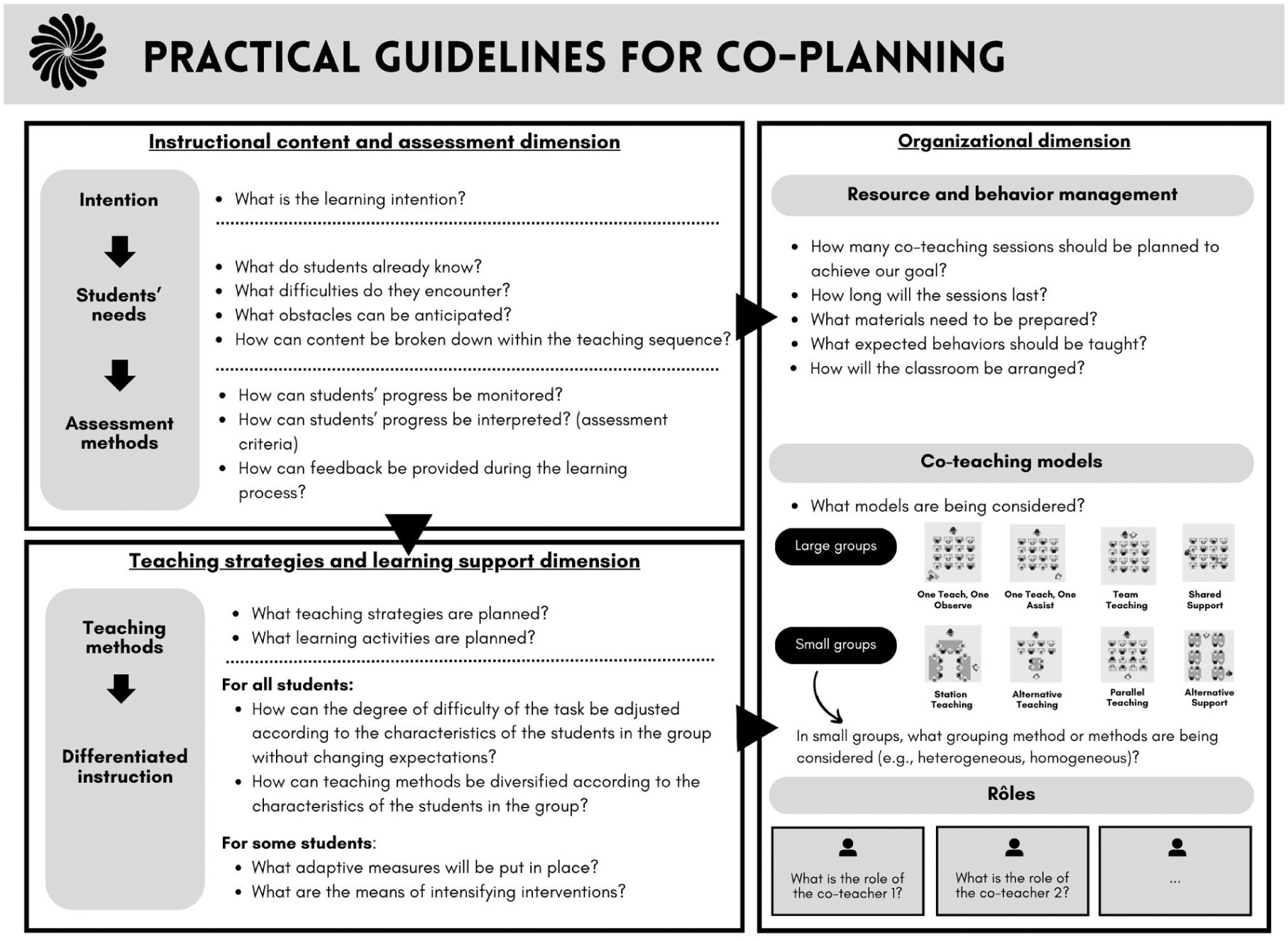
Guidelines for co-planning between teachers and special education teachers in secondary education.
Instructional and Assessment Dimension
The instructional and assessment dimension brings together the aspects that co-teachers need to consider in terms of learning objectives and assessment methods that enable them to measure the achievement of these objectives. In the literature, the instructional and assessment aspects are generally addressed separately (Granger & Moreau, 2020; Tremblay, 2023). However, the terms instructional and assessment are considered jointly to highlight the interdependence between these two ideas and to illustrate the co-planning process in a more concrete and operational way. This idea of combining these two aspects ensures greater consistency between the learning intention and the methods used to assess if that intention is achieved. Strengthening the connection between these two dimensions could help address the inconsistencies and fragmented planning often observed in co-teaching contexts (Pettit, 2017). In the following section, the steps of the co-planning process are outlined in alignment with the instructional and assessment dimensions.
Step 1: Consider the Learning Intention
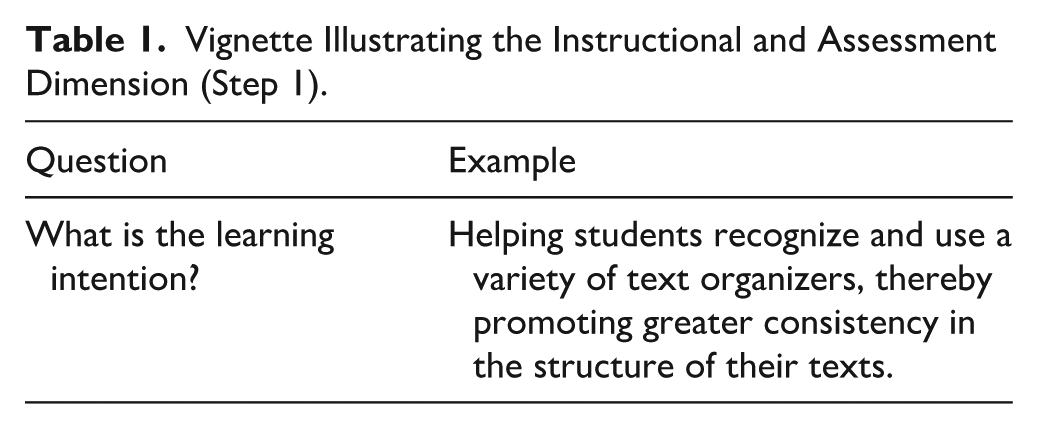
Co-teachers must first consider their learning intentions (see Table 1). These intentions are particularly important because they allow co-teachers and students to know where to direct their efforts. To determine this learning intention, co-teachers draw on their knowledge of the curriculum and their expertise in learning, as presented in the vignette below: Ms. Taylor, a secondary school English teacher, decides to contact her colleague, Ms. Morgan, a special education teacher, to discuss what they could do to support their students in writing. Ms. Taylor raises curriculum cosniderations, and Ms. Morgan shares observations and ideas about students with learning disabilities. Following the discussion, they formulate a learning intention. (See Note).
Vignette Illustrating the Instructional and Assessment Dimension (Step 1).
Step 2: Consider the Students’ Needs
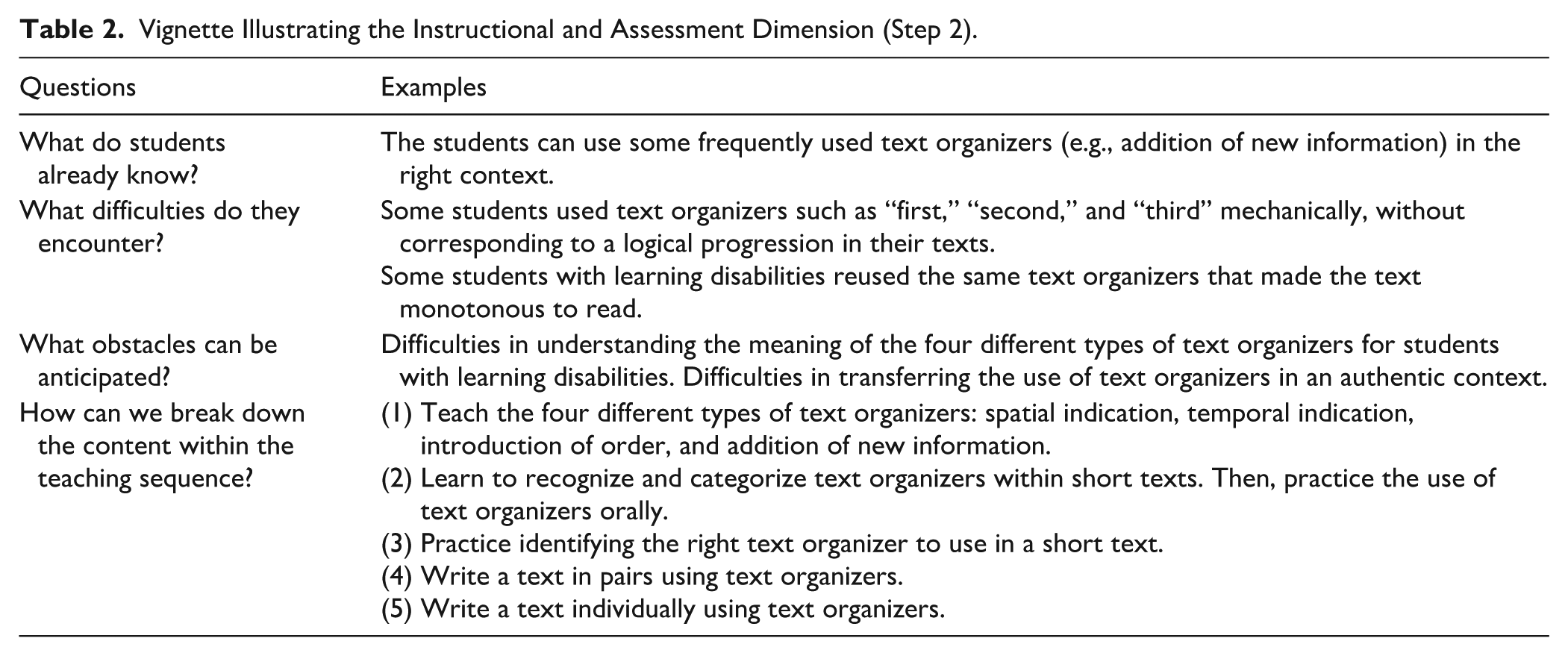
Once co-teachers have determined the intention, it is important to consider the students’ needs to carefully select the content and how to grade within a teaching sequence (see Table 2). This breakdown of content can require consideration of various factors, including students’ prior knowledge, the difficulties they experience, and potential didactic obstacles that may cause misunderstandings (Tremblay, 2023):
Ms. Taylor recently asked the students to write a text describing a day in the life of their hero. She then asked Ms. Morgan to help her analyze the students’ texts in detail. As a special education teacher, Ms. Morgan can conduct fine-grained analyses to identify students’ needs. The data analysis enabled them to identify the main difficulties and, consequently, to break down the learning intention in a way that supports step-by-step learning. Ms. Taylor’s in-depth knowledge of disciplinary content, combined with Ms. Morgan’s skill to segment instructional content into finely micro-graduated steps, significantly enriches the co-planning process.
Vignette Illustrating the Instructional and Assessment Dimension (Step 2).
Step 3: Identify Assessment Methods
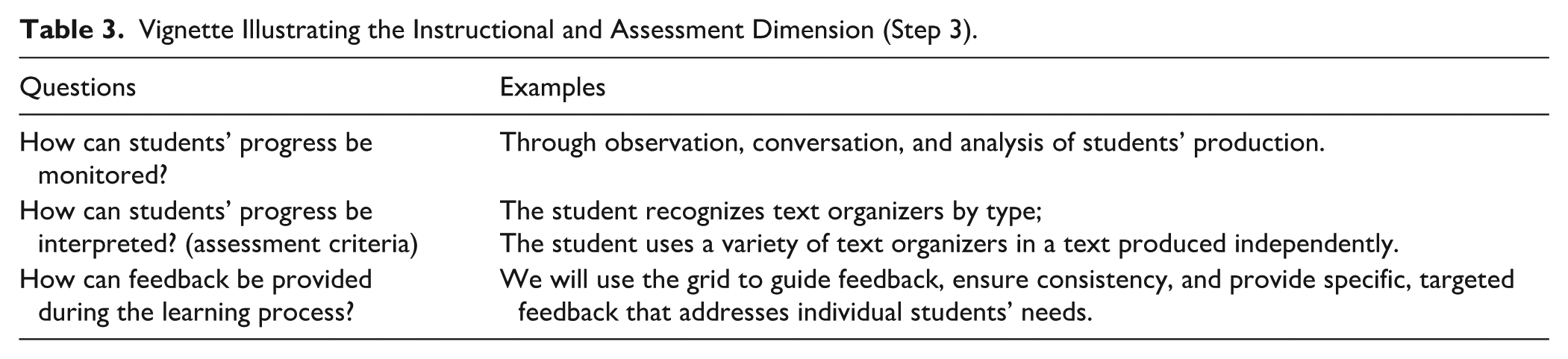
Co-teachers identify assessment methods by targeting ways to monitor students’ progress (see Table 3). They also determine assessment criteria to guide the interpretation of the collected data. In addition, co-teachers must address feedback during learning to monitor and support students’ progress toward the targeted learning intention. This feedback aims to provide students with information at different points in the teaching sequence to support their learning and autonomy:
After identifying the learning intentions and students’ needs, Ms. Taylor and Ms. Morgan turn their attention to assessment methods. Ms. Taylor draws on her expertise in disciplinary content to define specific criteria to evaluate students’ progress, while Ms. Morgan leverages her knowledge of progress monitoring to design a descriptive assessment grid.
Vignette Illustrating the Instructional and Assessment Dimension (Step 3).
Teaching Strategies and Learning Support Dimension
The teaching strategies and learning support dimension concerns the choice of teaching methods that help the learning of all students, as well as students with learning disabilities (Tremblay, 2023). The literature shows that teaching strategies and learning support are generally treated separately. However, combining these ideas seems to facilitate early consideration of diversity, which aligns with the principles of inclusive education. The Conseil supérieur de l’éducation (CSÉ, 2017) recommended that co-teachers adopt a holistic view of student diversity to design learning situations that address all students’ needs, regardless of abilities or challenges. For these reasons, combining the teaching strategies and learning support dimension seems essential to ensure inclusive and equitable learning conditions while optimizing the co-planning process.
Step 1: Select Teaching Methods
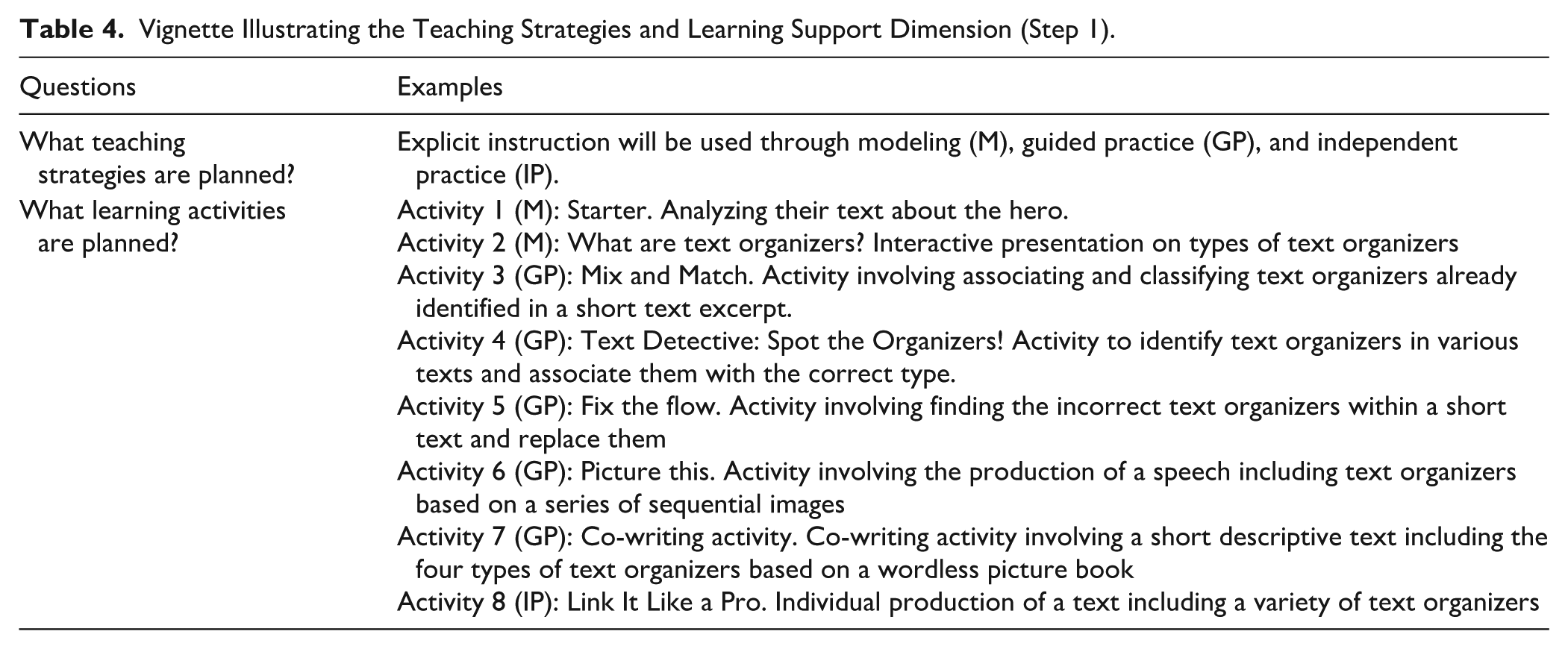
To reflect the teaching strategies and learning support dimension, co-teachers must first consider the teaching methods they wish to use (see Table 4). More specifically, this involves reflecting on the teaching strategies and learning activities that co-teachers plan to implement:
Ms. Taylor and Ms. Morgan start by identifying the teaching strategies they intend to implement. They select explicit instruction as the most appropriate approach. To support this, they design a progressive teaching sequence that includes modeling, guided practice, and independent work. Both co-teachers collaborated oncollaboratively carried out this planning exercise, leveraging their interdependent expertise.
Vignette Illustrating the Teaching Strategies and Learning Support Dimension (Step 1).
Step 2: Plan Differentiated Instruction
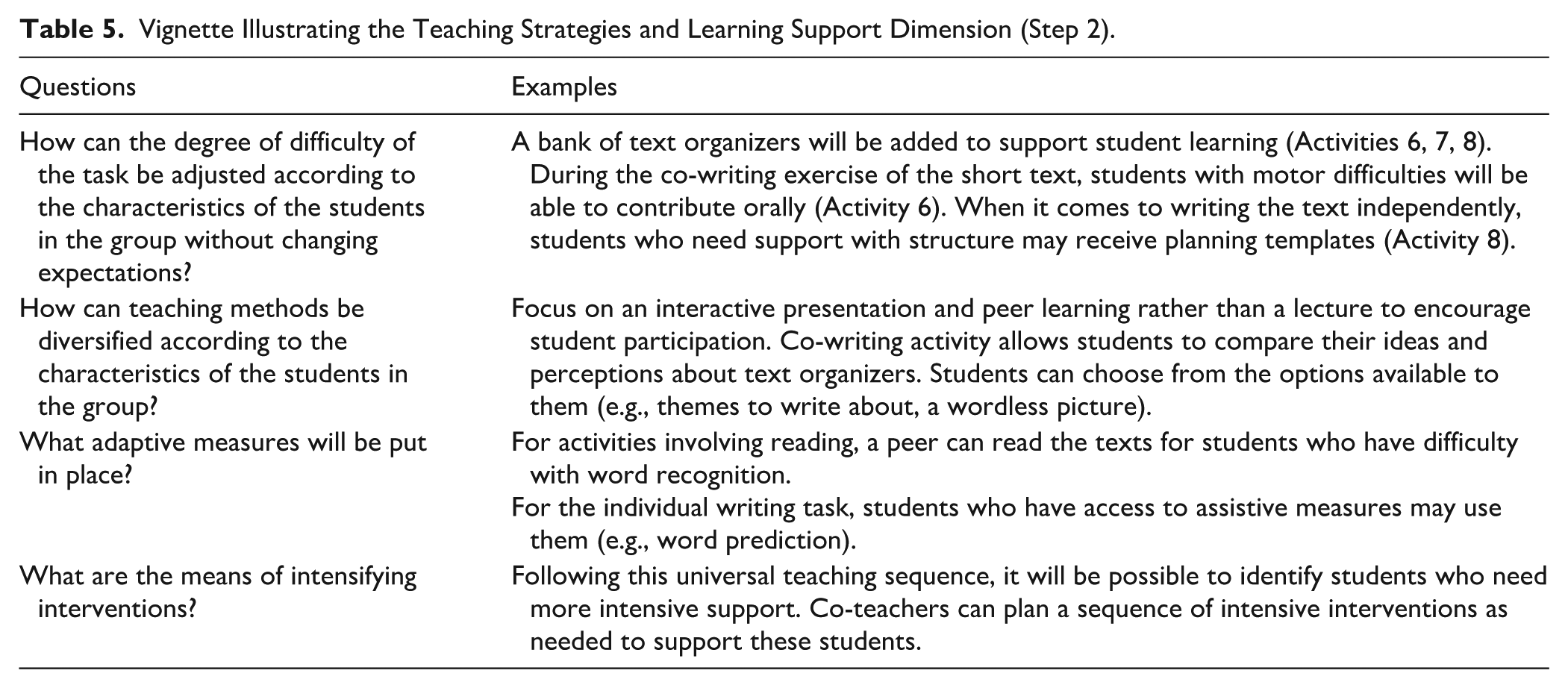
Co-planning teaching strategies and learning support also allows consideration of differentiated instruction (see Table 5). To do this, co-teachers consider the needs of all students to identify ways to adjust the level of task difficulty. They can also consider diversifying the teaching methods used by differentiating learning environments, content, processes, and products (Tomlinson, 2017). Co-teachers must also work together to determine the adaptative measures that students with more persistent difficulties need, as well as strategies to intensify the interventions they provide to these students:
To meet the different needs of the students in the group, Ms. Taylor and Ms. Morgan considered diversifying the teaching methods they could use. The co-teachers wanted to ensure that students would use different modes of representation and expression (e.g., visual, oral, written) throughout the sequence. Also, Ms. Morgan, given her expertise in special education and differentiated instruction, suggests adaptive measures for students with learning disabilities or for some students who still need additional support.
Vignette Illustrating the Teaching Strategies and Learning Support Dimension (Step 2).
Organizational Dimension
The organizational dimension includes resource and behavior management, the choice of co-teaching models, and the distribution of roles among co-teachers. According to Tremblay (2023), the structural phase addresses the choice of co-teaching models. However, certain aspects of classroom management and the distribution of roles are closely linked to the implementation of co-teaching models. As such, it was deemed relevant to integrate these different aspects into a single dimension, referred to here as organizational.
We use the following co-teaching models: (1) One teaching, one observing; (2) One teaching, one assisting; (3) Parallel teaching; (4) Teaming; (5) Alternative teaching; (6) Station teaching; (7) Teaming support; (8) Alternative support (Dubé et al., 2019; Friend & Cook, 2017; Tremblay, 2023). Table 6 presents these models.
Co-Teaching Models.
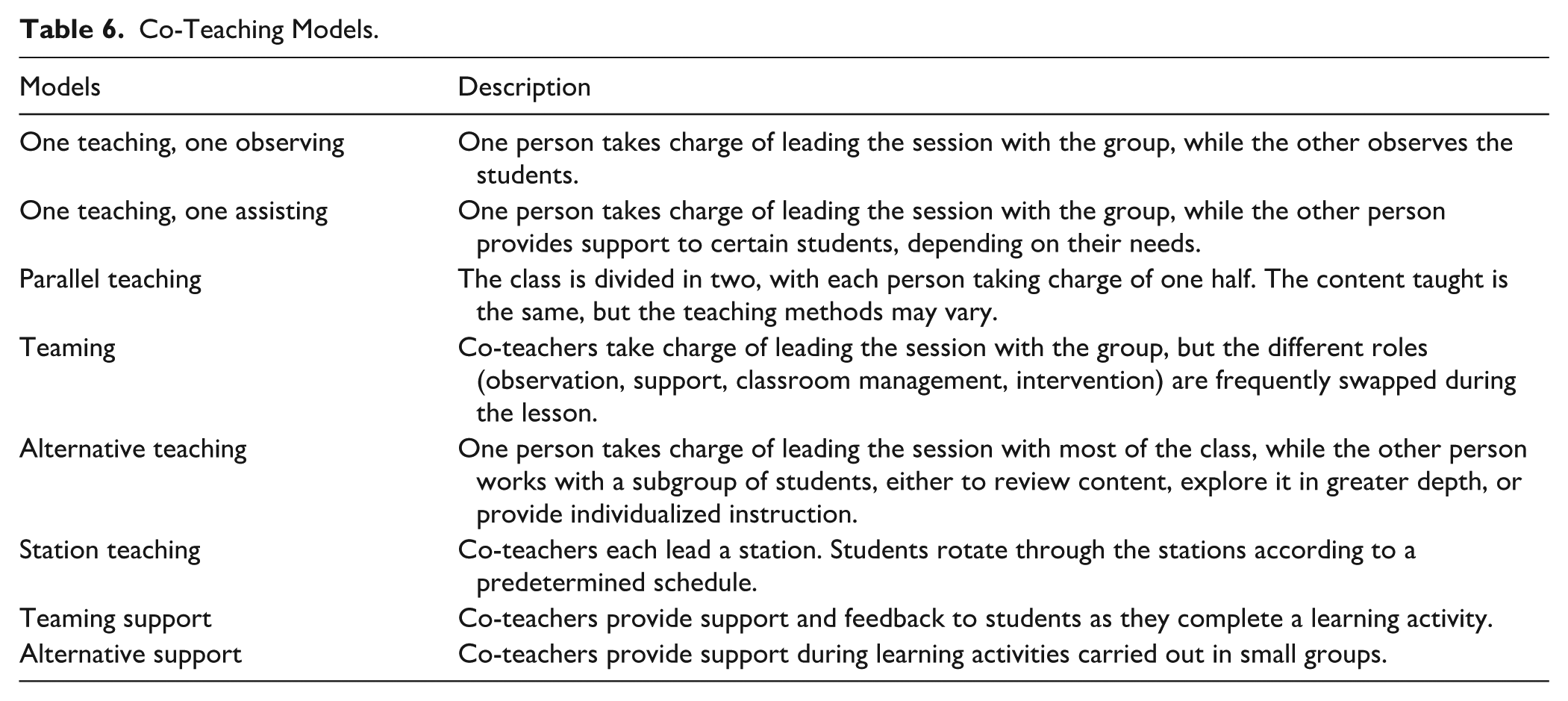
Currently, the predominant model is one teaching, one assisting (Strogilos et al., 2023). However, this approach may not be the most effective for leveraging the specific and complementary expertise of both teachers (Vembye et al., 2024). Other models, such as station teaching or parallel teaching, would be more effective in promoting individualized teaching that offers multiple opportunities for practice and feedback (Friend & Cook, 2017; Lyon et al., 2021). However, these models require a clear division of work, since each person is responsible for planning and teaching a portion of the content (Friend & Cook, 2017; Tremblay, 2023). In addition, implementing these models requires changes in resource and behavior management (e.g., classroom layout). To facilitate the introduction of these models, co-teachers would therefore benefit from considering all these aspects during the co-planning process.
Step 1: Consider Resources and Behavior Management
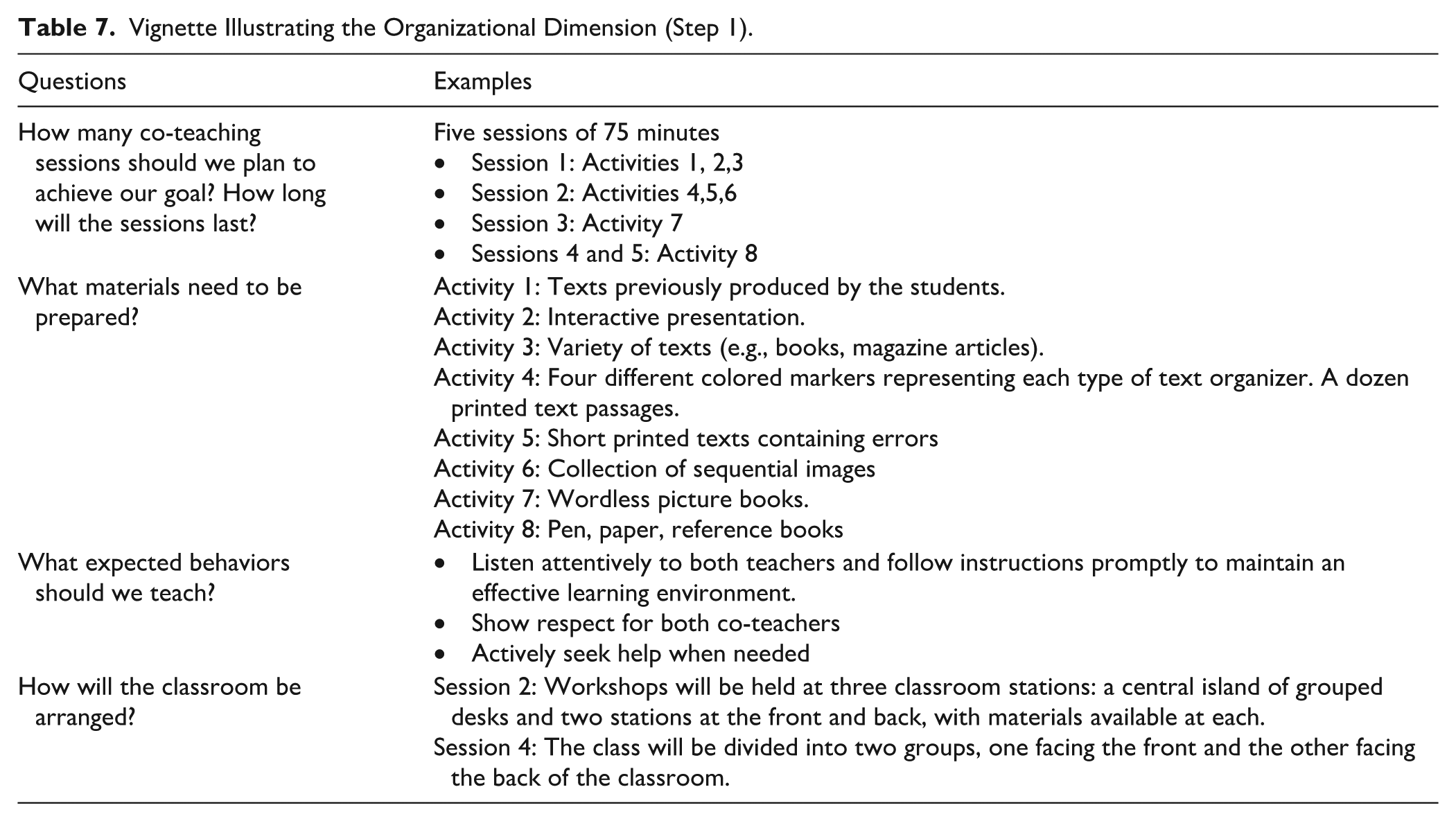
As for the operationalization of this dimension, co-teachers must first consider resource and behavior management (see Table 7). More specifically, this is when co-teachers determine the number and duration of co-teaching sessions required to achieve the learning intentions, as well as the material resources required for their implementation:
Ms. Taylor and Ms. Morgan must also consider the organizational dimension of the sequence. In total, Ms. Taylor and Ms. Morgan planned five 75-minute sessions. They select the materials that need to be prepared for each activity.
Vignette Illustrating the Organizational Dimension (Step 1).
Step 2: Choose the Co-Teaching Models
At the same time, co-teachers must consider the preferred co-teaching models (see Table 8). For example, during a station teaching session, it is important that co-teachers specify the order in which they will conduct the stations, the required materials, the instructions for carrying out the activity, etc. If co-teachers choose a model such as parallel teaching, they can, for example, stand back-to-back in the center of the classroom or face each other at opposite ends of the classroom, depending on their educational objectives. In station teaching, co-teachers must determine in advance both the number of stations and the conditions of students’ participation, whether this involves collaborative work at the same table or independent activities:
Ms. Taylor and Ms. Morgan will use a variety of co-teaching models in their teaching sequence. These models allow small group instruction in which both teachers could provide feedback and encourage students to engage in metacognitive thinking.
Vignette Illustrating the Organizational Dimension (Step 2).

Step 3: Define the Roles of the Co-Teachers
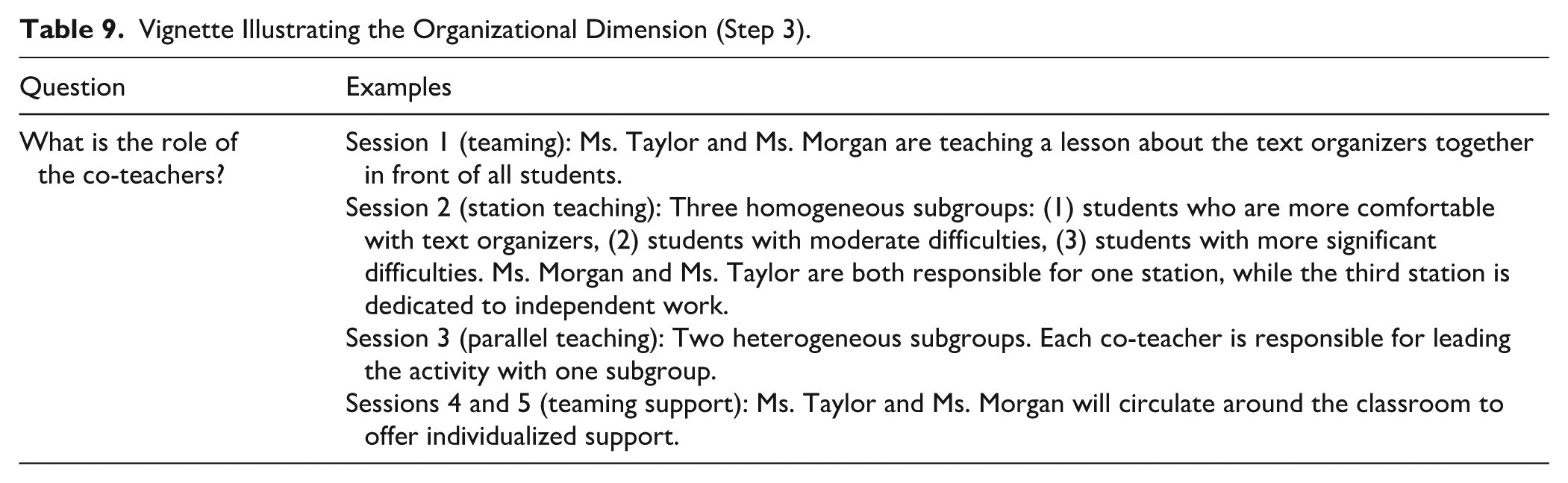
These organizational choices also affect the distribution of roles among co-teachers (see Table 9). In general, the models make it possible to better define the roles and functions of co-teachers as well as the distribution of their leadership during the co-teaching session. However, it is important to take the time to reflect on this issue to ensure that the presence of both co-teachers is truly leveraged based on their expertise. In a co-teaching context, the special education teacher brings specific expertise in supporting students with learning disabilities, while the general education teacher contributes in-depth knowledge of the subject content: Ms. Taylor and Ms. Morgan establish a clear division of their roles during each session.
Vignette Illustrating the Organizational Dimension (Step 3).
Conclusion
Co-teaching is a service-delivery model that enables co-teachers to provide specialized support to a larger number of students at the same time, while improving learning conditions (Nápoles, 2024; Vembye et al., 2024; Zimmerman et al., 2023). This collaborative service delivery model has advantages for school staff and student learning (Scruggs et al., 2007; Vembye et al., 2024). The implementation of co-teaching requires adequate planning between the special education teacher and the general education teacher, but this is a significant challenge due to the lack of time and lack of resources to support the co-planning process (Boily et al., 2024; Ruberto, Beaulieu, et al., 2025; Strogilos et al., 2023). This article aims to contribute to the development of concrete solutions and tools to improve the co-planning process.
Although the schematization illustrating the co-planning process presented in this article is subject to change, it is consistent with previous work on the subject (Ruberto & Boily, 2026). In our opinion, this proposal currently provides a relevant anchor for better articulating the links between the different dimensions of co-planning, making this process more operational, and promoting a more equitable distribution of roles between co-teachers. More broadly, certain benefits are anticipated from the use of this conceptual proposal. The use of this concrete tool, which can guide co-teachers in the co-planning process, can strengthen interprofessional collaborative practices between general education teachers and special education teachers. This collaboration appears to be essential in a context where a growing number of students with diverse needs are present in general education classrooms. Indeed, studies have shown that teachers do not always feel well prepared to work with students having learning disabilities (Van Garderen et al., 2012). Greater collaboration between general education teachers and special education teachers, therefore, helps to facilitate the teachers’ work with these students. However, it should be noted that this collaboration is complex to implement without guidelines. By focusing on an integrated and shared vision, it is possible to hypothesize that general education teachers and special education teachers will be able to cover all dimensions of the co-planning process to ensure consideration of student diversity and true leveraging of collective expertise.
Footnotes
Acknowledgements
The authors thank the staff at the Montreal School Service Center who generously agreed to participate in this collaborative research project.
Author’s Note
The vignette is a fictionalized account drawn from research literature, not based on actual people or events the authors observed.

Funding
The authors received no financial support for the research, authorship, and/or publication of this article.
Declaration of Conflicting Interests
The authors declared no potential conflicts of interest with respect to the research, authorship, and/or publication of this article.