




Abstract
Students’ behavioral and academic needs are interrelated, and educators may maximize the efficiency and effectiveness of their classroom practice by intentionally integrating academic instruction and positive behavior support practices within an integrated multi-tiered system of support (I-MTSS) framework. Integrated classroom practices are particularly important for students with disabilities and those with intensive learning and behavior needs. In this article, we describe a simple four-step plan to support the integrated implementation of foundational reading skills and share a lesson plan designed to support integrated implementation.
Keywords
Integrating Academic and Behavioral Practices in Tier 1
Mr. Rojas teaches in an inclusive first-grade classroom. Mr. Rojas loves teaching. He has high expectations for his students and works hard to foster a warm and caring community. Every morning, he greets each student at the door and takes time to personally connect with and know each student. Although Mr. Rojas feels he has a good relationship with his students, he has struggled to engage them during academic instruction. In particular, he is concerned about their daily whole-class reading lesson. Mr. Rojas is confused, as he is implementing an evidence-based core reading program with fidelity (he’s received positive data-based feedback from his instructional coach), but his students still speak over him, have side conversations, get out of their seats, or put their heads down during reading instruction. Mr. Rojas decides to ask a school psychologist, who supports students in his class with disabilities and with intensive learning and behavior needs, for advice about how to get his students engaged during Tier 1 reading instruction.
Mr. Rojas, like many teachers, understands that one of his most critical jobs is ensuring his students develop the foundational academic (e.g., reading, mathematics) and behavioral (i.e., social, emotional, behavioral) skills needed to succeed. Organizations such as the International Literacy Association have declared literacy and access to high-quality literacy instruction a human right (International Literacy Association, 2019). Students who develop proficient reading skills early on are more likely to perform at grade level across content areas, graduate from high school, and obtain meaningful employment (Connor et al., 2014). Arguably as important as developing students’ academic competencies is supporting students’ behavioral development (Kaspar & Massey, 2023). Students with strong behavioral skills are more likely to engage in academic instruction, experience more favorable life outcomes such as obtaining a high school diploma and/or employment and are less likely to experience mental health challenges (Weeker, 2015).
Given that reading and behavioral skills are intricately tied to positive long-term student outcomes, the most recent data on student reading and behavioral performance are cause for concern. Across the United States, students’ reading scores have declined, with 39% of fourth-grade students below grade-level expectations in reading (U.S. Department of Education et al., 2022). Students are also experiencing high rates of stress and anxiety and are exhibiting challenging behaviors. Child and adolescent mental health has been declared a national emergency (American Academy of Pediatrics, 2021), with schools across the nation reporting increasing rates of challenging behaviors in the classroom. Engaging in challenging behaviors has negative implications for students’ behavioral well-being and results in the loss of critical classroom instruction (Kurtz, 2022; National Center for Education Statistics, 2022).
All students benefit from explicit reading instruction and practices grounded in positive classroom behavior supports. For students with disabilities, however, these practices are critical. The majority of students receiving special education services for a learning disability (LD) participate in their general education classroom for 80% or more of the day, and over half of students with an emotional behavior disorder (EBD) participate in general education for over half of their school day (National Center for Education Statistics, 2023). Students with LD and EBD often present with complex, interconnected needs, with one-third of children with LD also presenting behavioral challenges (Sahoo et al., 2015). It is essential that students with such complex and interconnected needs receive explicit and systematic reading instruction along with positive behavioral supports, both of which have been shown to improve outcomes for students with LD and EBD during Tier 1 instruction to maximize learning and improve outcomes for all students.
Teachers increasingly rely on the growing body of evidence-based practices to support their students’ reading and behavioral needs. Decades of research have shown that students learn to read through explicit instruction with clear modeling and high rates of opportunities to practice word reading skills, reading comprehension, and exposure to rich oral language (Ness, 2011). Even with effective instruction, students are more likely to be engaged when teachers implement empirically supported positive classroom behavior support practices. Specifically, students benefit when classroom communities collaboratively select and define positively stated behavioral expectations; teachers explicitly teach these expectations and other relevant social, emotional, and behavioral skills; and students have many opportunities to practice these skills with immediate feedback (Simonsen et al., 2008).
Teachers know intuitively that academic and behavioral needs are intricately related and that growth in one area can support growth in the other. Yet, support and instruction in these two areas often occur separately. McIntosh and Goodman (2016) assert that teachers cannot expect the crossover effects of one domain on the other—expecting quality foundational reading instruction to reduce unwanted classroom behaviors, for example. An integrated approach is used in one way to see improved outcomes in both academic and behavioral domains. Although effective academic and behavioral instruction shares many common features, instruction is rarely coordinated or integrated. The purpose of this article is to provide classroom teachers and interventionists with a practical approach to integrating evidence-based behavioral support within an explicit academic lesson plan.
Mr. Rojas asks Dr. Cosen, a school psychologist with behavioral expertise, for advice on engaging his students during his Tier 1 whole-group reading instruction. Dr. Cosen considers what she has observed and how Mr. Rojas describes his concerns. She shares that he can enhance a few simple practices to support student engagement during reading. She further explains that these strategies will be helpful for all students but especially important for the students with disabilities and more intensive learning and behavioral needs. Mr. Rojas looks at her skeptically and says he had always assumed that good instruction should be sufficient without any of those behavior tricks. Dr. Cosen shares that she has been learning to integrate academic and behavioral supports within a multi-tiered system of support (MTSS) framework to support students’ academic and behavioral needs. Mr. Rojas was open to learning more.
Integrating Academic and Behavioral Supports
The link between academic and behavioral outcomes has been well documented (Algozzine et al., 2012), illuminating the reciprocal nature between academic and behavioral success. For example, students who struggle with reading may engage in disruptive behaviors during a reading lesson and be removed from instruction or the classroom. Students miss critical reading instruction during this time, which may intensify their reading challenges. Without sufficient academic and behavioral support, this negative feedback loop can have long-term effects, including low academic achievement, depression and anxiety, and increased risk for office discipline referrals (McIntosh & Goodman, 2016).
Many schools organize reading instruction within an MTSS framework (for example, see https://mtss4success.org/blog/mtss-new-rti-depends-where-you-live) and behavior support within a positive behavioral interventions and supports (PBIS) framework (see https://www.pbis.org/pbis/what-is-pbis). Providing students with quality instruction across tiers is a core tenet of both MTSS and PBIS models. However, when these initiatives are conceptualized as separate siloed approaches, they may not be enough to address the needs of students with co-occurring needs (McIntosh & Goodman, 2016). An integrated multi-tiered systems of support (I-MTSS) framework intentionally integrates academic and behavioral support within the same framework (I-MTSS Research Network, 2023; see https://mtss.org/).
Dr. Cosen is encouraged that Mr. Rojas is interested in learning more, and she talks about a small number of high-leverage practices that support students’ academic and behavioral skills. In particular, she talks about the importance of (a) providing prompts (e.g., verbal explanations, modeling, brief reminders); (b) engaging students with high rates of opportunities to respond; and (c) providing specific praise and corrective feedback. She explains that although the explicit core instructional materials he uses include these practices for teaching reading, he can enhance his instruction by leveraging these practices to support students’ behavior. She also mentions that because his classroom is experiencing challenges with engagement, he may consider implementing a group contingency plan to celebrate engagement.
Prioritizing and Integrating Evidence-Based Practices to Support Students’ Learning
Although there is a substantial and growing research base of effective practices for accelerating students’ reading and behavioral skills, there is less practical guidance on how schools and teachers can integrate these evidence-based practices to meet all students’ needs better. The following integrated approach is grounded in the premise that effective reading and behavior supports share common instructional features anchored to the extensive research based on principles of explicit instruction, and integrated instruction should be designed around these principles (for more resources and information on integrating academic and behavioral supports, see https://mtss.org/). Explicit instruction includes organized and focused lessons with the following elements (Archer & Hughes, 2011):
A clear statement of purpose
Εxplicit expectations
Preview of prior knowledge and skills
Step-by-step modeling of new skills
Clear and concise language
Frequent opportunities for students to practice the skill
Progress monitoring
High rates of specific positive and corrective feedback based on student performance
A brisk pace of instruction
Explicit instruction is an effective approach for teaching foundational reading and behavioral skills. Within an explicit instruction approach, teachers can seamlessly integrate empirically supported behavior practices into existing evidence-based reading materials to support students’ learning and behavior. These practices may include prompts, opportunities to respond (OTRs), specific feedback, and strategies to celebrate engagement (e.g., group contingency). Specifically, we recommend that educators implement the following four steps for embedding behavioral practices into academic instruction.
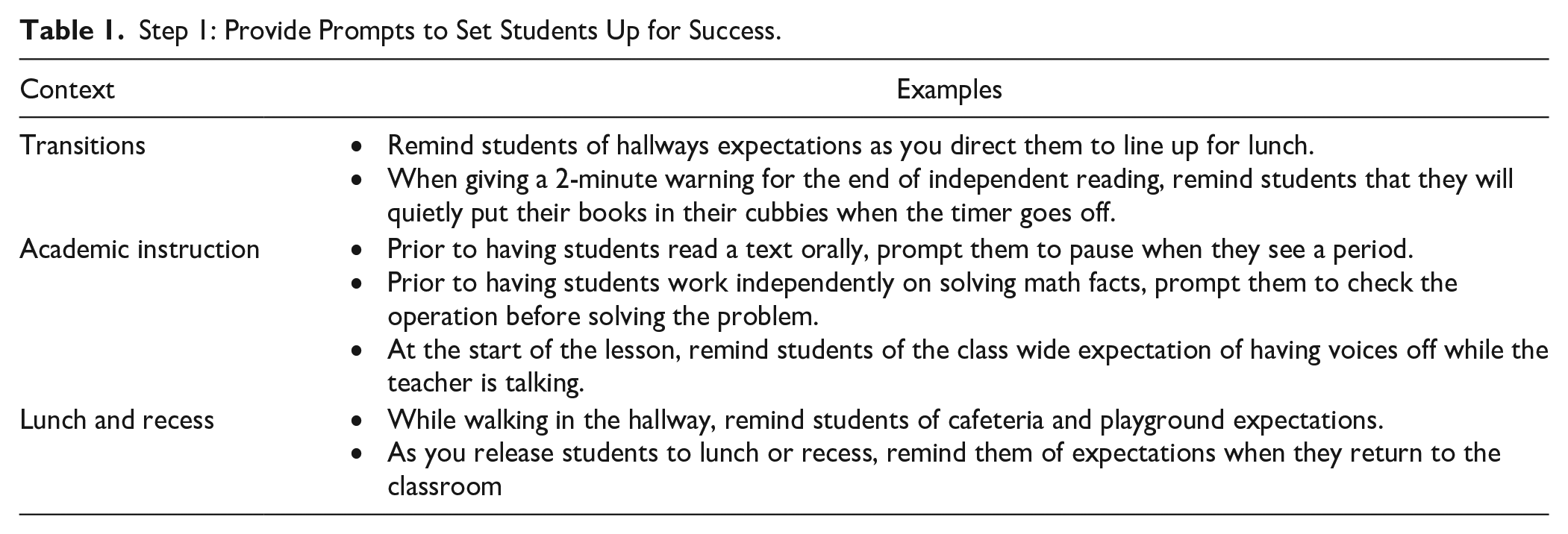
Step 1: Provide Prompts to Set Students Up for Success
Begin each lesson routine with prompts to set students up for success. Prompts are specific explanations, brief reminders, gestures, or other cues that a teacher delivers before an academic or behavioral skill is expected to set students up for academic and behavioral success (Simonsen et al., 2010). Prompts serve as a way for teachers to precorrect before incorrect, unexpected, or contextually inappropriate skills are used. An example prompt could be a quick explanation of the upcoming activities or a reminder to students to “wait for my signal to read the word out loud” before reading words during a whole-group word reading activity. Prompts can also remind students of specific behavior expectations before an activity, such as, “Be respectful listeners when it’s your friend’s turn to read a word,” during individual student responses. Increased use of behavior prompts has decreased inappropriate student behavior across classrooms and other school settings, including hallways and the playground (Evanovich & Kern, 2018).
For new or challenging skills, select prompts that provide the level of information and support students need to experience success. Teacher modeling, a specific type of prompt, provides students with demonstrations of a skill or behavior before being asked to perform it independently (Hughes et al., 2017). Modeling shows students visible, overt examples of how skills and behaviors look and how they are used successfully. Teacher modeling is essential for teaching new skills and may be necessary when students are practicing skills that have already been introduced. For example, teachers can model how to pronounce new letter sounds and blend letter sounds together to read words. These central foundational reading skills are modeled for students in every lesson. Similarly, when teaching new behavioral expectations, plan to model and demonstrate what these behaviors look like across specific settings. See Table 1 for more examples of prompting students for success across environments.
Step 1: Provide Prompts to Set Students Up for Success.
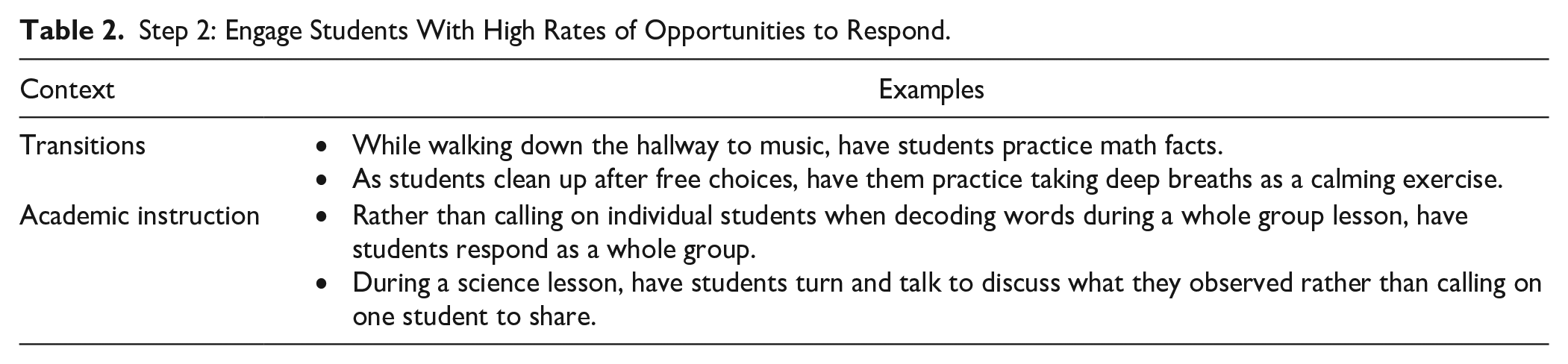
Step 2: Engage Students With High Rates of OTRs
OTRs are teacher behaviors (e.g., verbal statements) that invite an individual or group response from students (Haydon et al., 2012). These opportunities may include verbal (e.g., saying what sound “th” represents or describing how to be respectful), written (e.g., spelling the word “thin” on a whiteboard or writing a sentence about how to enter the classroom responsibly), or other (e.g., pointing to the correct letter, giving thumbs up/down to examples/non-examples of classroom expectations) responses. Increased OTRs promote success for all students (Haydon et al., 2012) and are critical for students with intensive learning and behavioral needs, including students identified with LD or EBD. These students may require significantly higher rates of OTRs than their peers to benefit from Tier 1 instruction (Vaughn et al., 2000).
During reading instruction, group responses are one way to maximize OTRs for all students. For example, if students review the sounds for consonant digraphs (e.g., th, sh, ch), the teacher could point to each letter combination multiple times in random order while all students say the sounds in unison. The teacher could then call on a small number of individual students for additional practice. High numbers of OTRs for all students promotes engagement, maximizes successful experiences with new academic and behavioral skills and strategies, and decreases disruptive and off-task behavior (Cuticelli et al., 2015). See Table 2 for more examples of engaging students with high rates of OTRs across environments.
Step 2: Engage Students With High Rates of Opportunities to Respond.
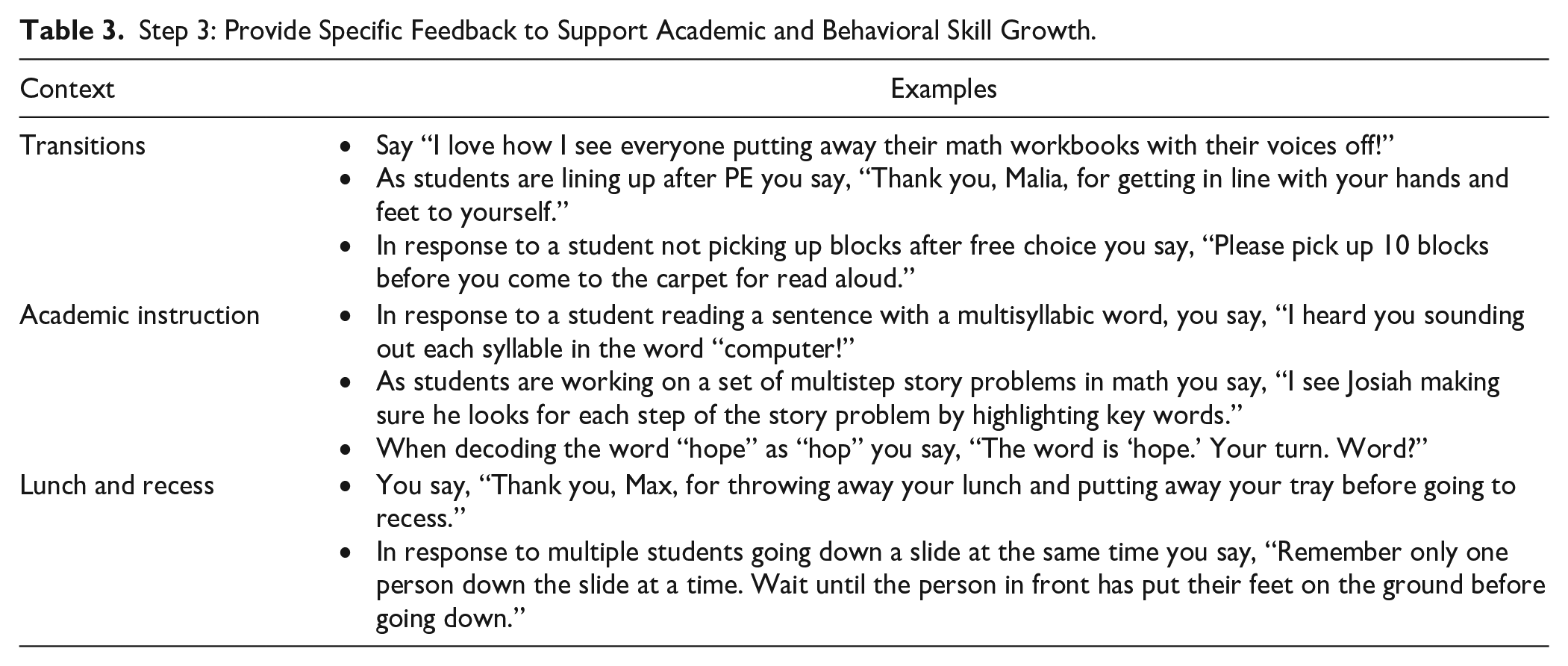
Step 3: Provide Specific Feedback to Support Academic and Behavioral Skill Growth
Encourage skill growth with specific feedback. Specific feedback includes both positive and corrective feedback. Specific praise is a teacher’s behavior delivered as a positive phrase paired with a specific statement related to the student’s behavior on which the praise is contingent. Teachers can provide specific praise immediately after students successfully demonstrate a reading skill, such as “You did a great job blending all the sounds together to read this word” or “Great blending.” Teachers also should provide specific praise when students follow behavioral expectations, for example, “You were all being so respectful by listening while Malia practiced reading the word” or “Nice, respectful listening to Malia.” Specific praise is contrasted with general praise, which is not tied to a specific behavior, such as “Great job!” Although general praise is delivered positively, it provides students with limited feedback on their performance as it is not tied to a specific behavior or skill and is less effective.
Corrective feedback is immediate and specific feedback provided to learners based on their academic and/or behavioral responses. Corrective feedback is concise, provided immediately after the student’s response, delivered calmly, and provides the student with the correct response. Corrective feedback is essential for students to correct errors and practice skills successfully. If an error is made, give students opportunities to practice the skill after receiving corrective feedback. During reading, teachers can provide corrective feedback immediately after a student makes an error. For example, “This word is ‘fresh.’ Remember, the sound for ‘sh’ is /sh/. Your turn. Word?” When providing behavioral corrective feedback, it is important to remain calm, neutral, and instructionally focused—correcting a behavioral error just like an academic error. In response to a student talking without raising a hand, a teacher may say, “Remember to raise your hand when you want to share with the group. I will call on students that have their hands raised.” After this corrective feedback, if this student raised a hand, the teacher would call on the student and provide specific positive praise to reinforce the behavior.
A teacher’s increased ratio of positive praise statements to behavior corrections is correlated with increased on-task student behavior (Caldarella et al., 2020). In general, students benefit from a ratio of at least five specific praise statements for every one corrective statement (Cook et al., 2017; Flora, 2000), and students with more intensive needs (e.g., students with LD or EBD) may require a higher ratio specific positive praise statements for every corrective statement (e.g., 9:1; Caldarella et al., 2019). Therefore, plan and prioritize specific praise for academic and behavioral skills during instruction, provide specific corrections when needed, and monitor the ratio of positive to corrective statements. See Table 3 for more examples of providing specific feedback to support academic and behavioral skills across environments.
Step 3: Provide Specific Feedback to Support Academic and Behavioral Skill Growth.
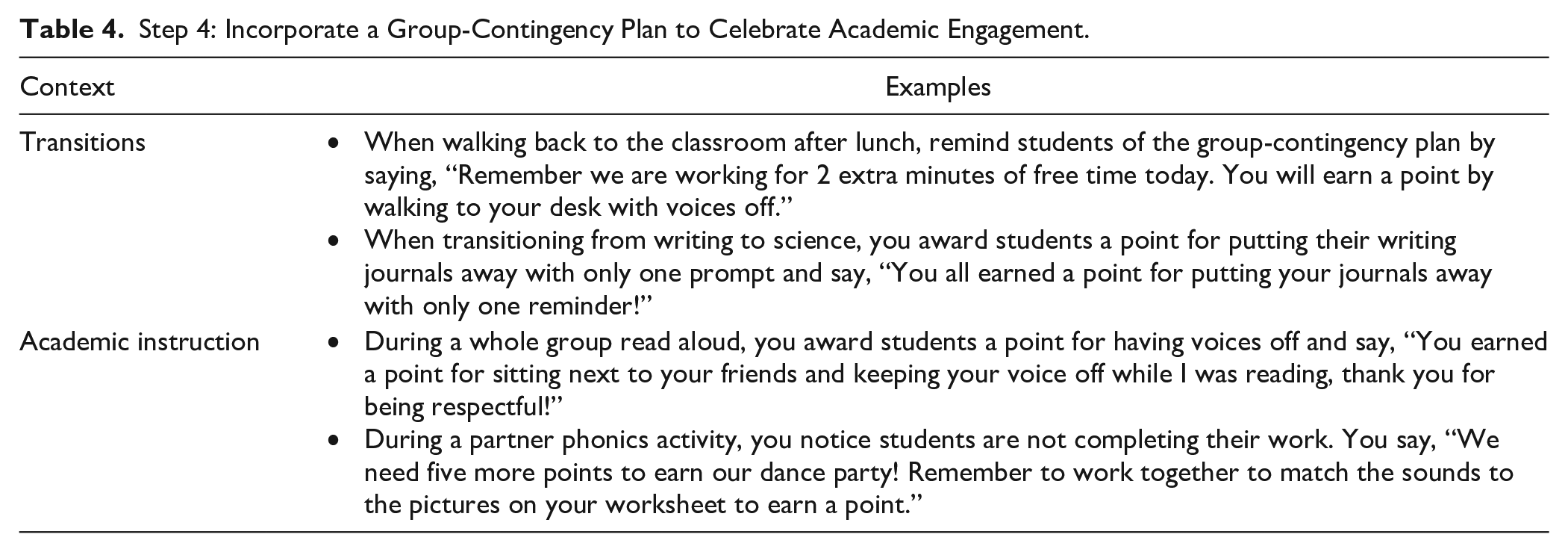
Step 4: Consider a Group Contingency to Celebrate Engagement During Academic Instruction
In addition to specific praise, consider additional strategies to acknowledge skill development and celebrate engagement. For example, a group contingency is an effective way to increase student engagement during academic instruction. When using a group contingency, teachers reinforce expected behaviors by awarding the class points that can be exchanged for a rewarding activity (e.g., a joke of the day, a 2-minute online dance video) or an item (e.g., a sticker). Individual behaviors contribute to the group’s success, and group contingencies are designed to promote the contextually appropriate behaviors of all students in the group (Simonsen et al., 2008). For example, after a teacher sets behavioral expectations for a reading lesson, she works with her students to set a points goal for the class to earn a quick celebration. She awards the class points throughout the reading lesson for following the class-wide behavioral expectations. Each time she awards a point, she pairs this with specific positive praise to let the students know how they earned the point. At the end of the lesson, if the class has met the point goal, they will earn a quick celebration. Teachers can select and implement simple approaches, like a group contingency, to celebrate engagement during instruction. See Table 4 for more examples of implementing a group-contingency plan across environments.
Step 4: Incorporate a Group-Contingency Plan to Celebrate Academic Engagement.
After learning about each practice, Mr. Rojas comments that the practices seem doable, but he’s not sure how to add them to the instructional routines included in his evidence-based core reading program. Mr. Rojas comments that he needs an explicit plan to integrate behavior practices into his reading instruction. He wants to be sure the behavior practices enhance, rather than interrupt, his instruction. Dr. Cosen quickly grabs her laptop and navigates to an integrated lesson plan template she has found on www.masked.org.
Lesson Plan Template for Integrating Reading and Behavioral Supports
The explicit lesson template was developed to support teachers’ implementation of integrated reading and behavioral instruction that included common principles of explicit instruction. This lesson plan template is framed in evidence-based reading routines designed to teach foundational skills (Enhanced Core Reading Instruction: ECRI; Fien et al., 2015) with evidence-based behavior support strategies embedded throughout the explicit reading routines.
This template offers classroom teachers and interventionists a framework for integrating evidence-based behavioral supports seamlessly and intentionally within a foundational academic skills lesson. (You can download an MS Word version of the template for your own use at www.masked.org). This template can provide foundational reading instruction with embedded behavioral supports in Tier 1 whole-group instruction. A similar approach could be used for targeted small group and individual interventions at Tier 2 and Tier 3 and with any scope and sequence. Figure 1 shows how evidence-based behavioral supports are integrated within academic instruction and organized around common features of explicit instruction.
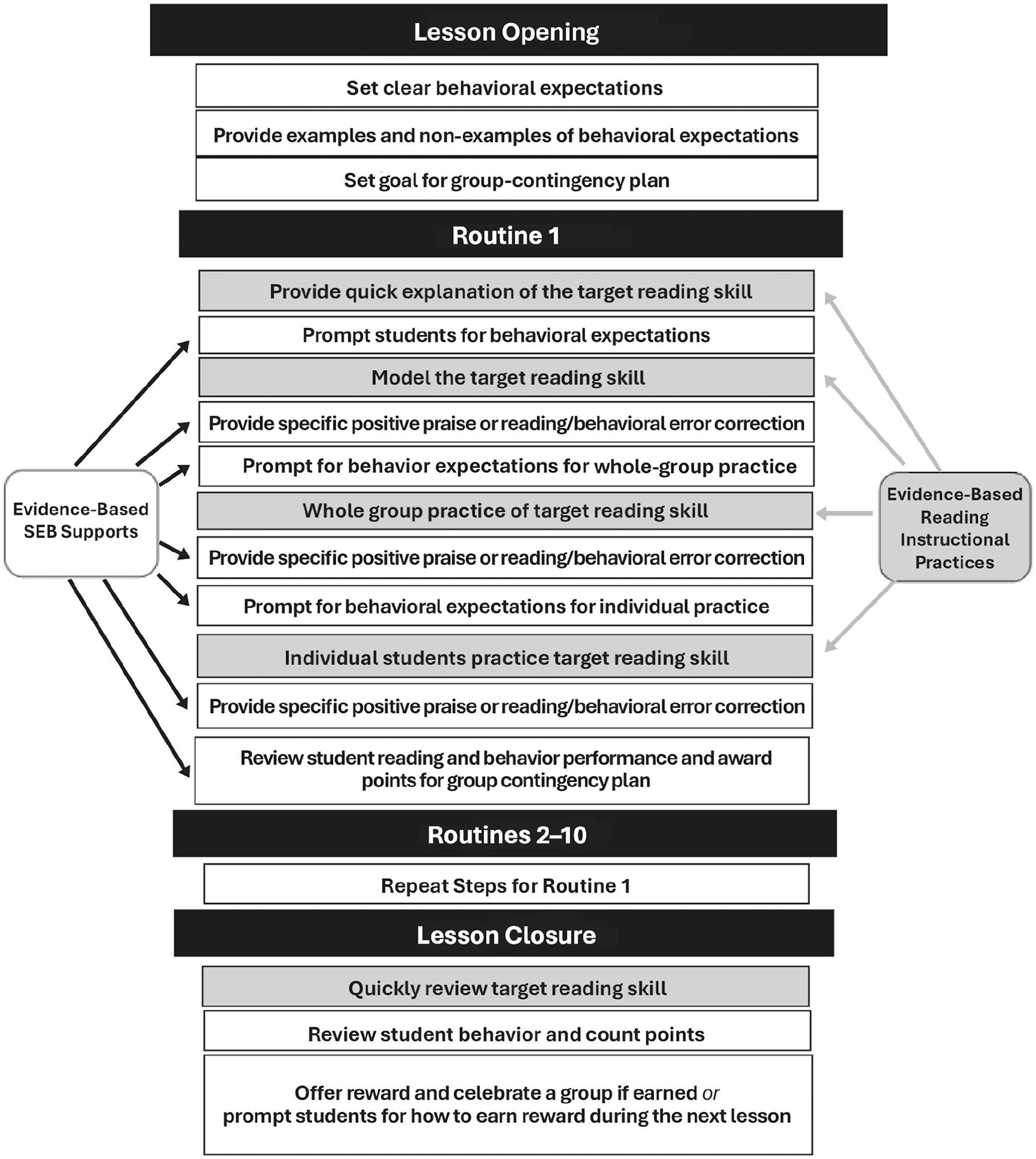
Elements of the Integrated Lesson Plan
Given the flexibility of this template, teachers can easily customize the integrated lesson plan to include the academic routines and target behavioral skills that best meet the needs of their students. For example, Figure 2 illustrates how Mr. Rojas could use the lesson plan to support student behavior while teaching phonemic awareness, the first routine in his Tier 1 integrated reading and behavior lesson. Depending on the grade level and skill of the students and the specific evidence-based program or intervention, the number of routines for each foundational reading lesson may vary. For example, a lesson plan for kindergarten students may include routines focusing on phonemic blending, practicing sound spellings in isolation, blending words, phoneme segmentation, and dictation. A third-grade lesson plan may include routines focusing on blending multisyllabic words, reading affixes, practicing fluency in a decodable text, and dictation. Typically, reading lessons with 8 to 10 routines can be completed within 30 minutes by maintaining a steady pace.
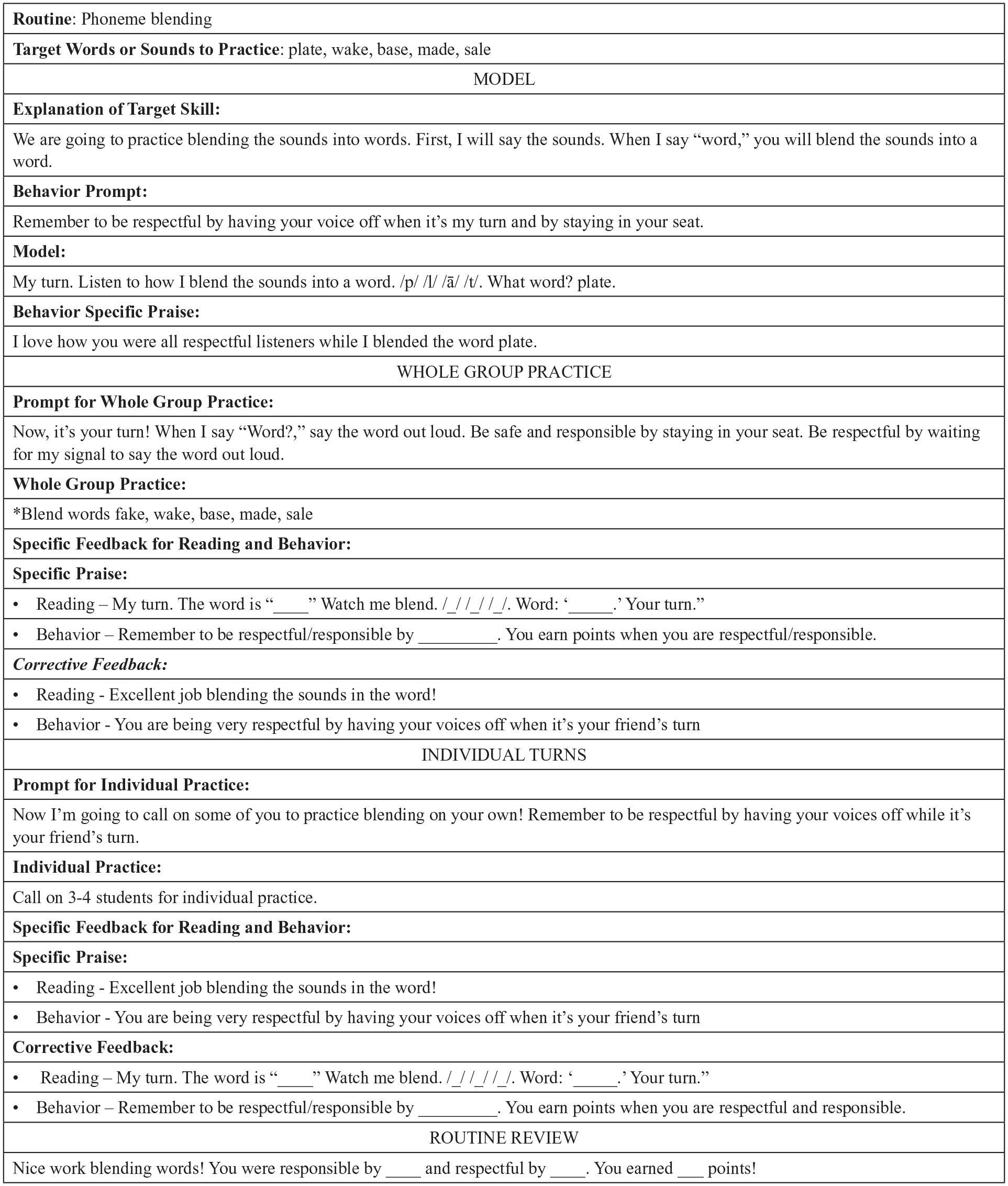
Integrated Template for Mr. Rojas’ Phoneme Blending Routine
The integrated lesson plan supports teachers in implementing the four steps to integrate behavioral practices into academic instruction. Using this lesson plan, a teacher would start with a quick review of previously taught behavioral expectations, provide examples and nonexamples of the behavioral expectations, and set a goal for points to be earned for the group-contingency plan. Then, the lesson plan template provides space for teachers to use the four steps presented in the prior section to intentionally plan and integrate behavior supports within their existing academic lesson.
Step 1: Plan Prompts to Set Students Up for Success
Begin each reading routine with a quick explanation of the target skill, a prompt for the behavioral expectations, and a model of the targeted reading skill.
Step 2: Plan to Engage Students With High Rates of OTRs
Throughout the lesson, plan multiple opportunities for students to practice the skill as a whole group and through individual turns. Include scripted opportunities in the lesson plan and consider how students can practice academic and behavioral skills.
Step 3: Plan Specific Feedback
Throughout the routine, monitor both reading and behavioral performance and plan to provide high rates of specific positive praise and quick, calm, and specific corrective feedback. To make it easier to provide feedback, script a few sample-specific praise and corrective statements and practice delivering them to provide feedback fluently.
Step 4: Plan a Group Contingency to Celebrate Engagement
At the end of each routine, plan to provide specific praise and award a point, if earned, or remind students of the behavioral expectations for the following routines. Repeat this process for each reading routine in the existing lesson. At the end of the lesson, plan to review students’ reading and behavioral performance while tallying the number of points earned. If students achieve their goal, plan to celebrate with a quick reward (e.g., joke of the day or a quick dance party). If students do not meet their goal, plan to quickly re-teach and prompt how they can earn their points during the next lesson, which they start with a more comprehensive review and practice of behavioral expectations.
After consulting with Dr. Cohen, Mr. Rojas uses the integrated lesson plan template to integrate positive classroom behavioral supports into his foundational reading skills instruction. Mr. Rojas filled out a template for each step of the integrated reading routines, using the explicit script from his core reading program to support his initial implementation of this integrated approach. With support from Dr. Cohen, Mr. Rojas plans to prompt and provide specific feedback on students’ reading and behavioral skills, and he writes example statements in his integrated lesson plan. He also discusses how he will further target and intensify his use of evidence-based practices to support learners with more intensive needs (e.g., learners with LD or EBD). For example, he’ll make sure that he considers common errors when developing prompts to set them up for success, provides them with individual turns more often, immediately provides specific feedback, monitors his use of positive to corrective feedback to ensure they experience way more specific praise, and ensures they enjoy the reinforcers connected to the group contingency. Figure 2 shows this template for the first reading routine in his lesson, phoneme blending.
Lesson Opening
To open the lesson, Mr. Rojas first sets behavioral expectations by referencing the class-wide behavior expectations of Safety, Respect, and Responsibility. He then asks students to think of specific examples and nonexamples of being safe, respectful, and responsible during reading instruction, giving students multiple OTRs. Next, Mr. Rojas introduces the group-contingency plan by explaining that every time he catches students being safe, respectful, and responsible, they will earn one point toward a special celebration. Together, Mr. Rojas and the class decide that they will work for 10 points and earn a 2-minute dance party on the carpet.
It’s time for reading! We’re practicing what it looks like to be safe, be respectful, and be responsible. Being safe and responsible looks like staying in our seats during reading. Being respectful sounds like having our voices off when it’s my turn. Being respectful does not look like talking to your friends while it’s my turn. I know you are going to be so safe, respectful, and responsible! Should we work for a dance party or joke of the day? Should we work for 10 or 11 points?
Reading Routine 1
Explanation and Model
Before starting the first routine, phoneme blending, Mr. Rojas sets his class up for success by providing an explanation of the reading skill and prompting the behavioral expectations for this routine: We are going to practice blending the sounds into words. First, I will say the sounds. When I say “word,” you will blend the sounds into a word. Remember to be respectful by having your voice off when it’s my turn and by staying in your seat.
Mr. Rojas then models the skill, followed by providing immediate behavior feedback through specific praise (or a quick behavioral correction) of the class-wide behavior expectations linked to the group-contingency plan: My turn! /p/ /l/ /ā/ /t/. Word . . .plate. I love how you were all respectful while I blended the word plate! You just earned one point toward our dance party!
Guided Group Practice
After modeling the reading skill and giving specific praise for being respectful by having voices off during the model, Mr. Rojas moves to guided practice. Mr. Rojas provides a quick behavioral prompt to set students up for success during this part of the routine before having students blend words as a group. After prompting students to be safe, respectful, and responsible, he guides the whole class by blending five words through choral responding. Throughout the lesson, Mr. Rojas carefully monitors for reading and behavioral errors and provides high rates of specific praise and/or corrections if needed.
Now it’s your turn! When I say “word,” say the word out loud. Be safe and responsible by staying in your seat. Be respectful by waiting for my signal to say the word out loud. Ready? Your turn: /f/ /l/ / ā/ /k/. Word? (Flake) You did a fantastic job being safe by staying in your seats and waiting for my signal to say the word!
Individual Practice
Next, Mr. Rojas calls on four students to practice phoneme blending for individual practice. Based on progress monitoring data, he strategically chooses two students he knows need additional practice in phoneme blending. He also calls on two students who are typically less engaged in whole-group instruction. Before calling on individual students, Mr. Rojas provides another behavior prompt to be safe, respectful, and responsible. As with all other parts of the lesson, Mr. Rojas continues to provide specific positive praise and/or corrective feedback as necessary: Now, I’m going to call on some of you to practice blending on your own! Remember to be respectful by having your voices off while it’s your friend’s turn. Ready? Jasmine, your turn!
This time, Mr. Rojas hears some students having side conversations while Jasmine takes her turn. He provides a quick behavioral correction followed by a behavioral prompt and reminder of the group-contingency plan: I heard some voices while it was Jasmine’s turn. Remember, you’re working towards earning that dance party by being safe, respectful, and responsible. You will earn points by having your voices off when it’s your friends’ turn. Jasmine, let’s try again.
This time, all students keep their voices off while Jasmine takes her turn, so Mr. Rojas praises the group and awards a point: Excellent work being so respectful to Jasmine while she blended her word! You earned another point towards the dance party!
Transition Between Routines
At the end of each routine, Mr. Rojas briefly reflects on student behavior and awards a point if students have demonstrated the behavioral expectations. If students did not earn points, he will revisit the behavioral expectations, review the examples and non-examples, and remind students of what they have chosen to work toward.
You all earned two points during this routine for being safe, respectful, and responsible by staying in your seats and having your voices off! We need eight more points for the dance party.
Reading Routines 2 to 7
Next, Mr. Rojas takes students through the rest of the foundational skills reading routines, including a sound-spelling routine, a blending routine, a regular word reading routine, a fluency routine in a connected text, a phoneme segmentation routine, and finally, a dictation routine. Mr. Rojas follows the same steps as he did in the first routine during each of these routines. He prompts students for expected behaviors while giving a quick explanation of the skill, models the skill, and provides many OTRs through both whole group and individual practice, all while providing high rates of specific positive praise, quick error corrections, and awarding points.
Lesson Closure
At the end of the lesson, Mr. Rojas highlights students’ behavioral successes and has students help count the total number of points. Because they earned 10 points, he puts on their favorite song and sets them up for their earned 2-minute dance party.
You all did a fantastic job practicing the long A vowel sound that’s spelled a consonant e! You were safe, respectful, and responsible by staying in your seats and having your voices off when it was my turn. You also knew how to make it right when some of us were talking when it was Jasmine’s turn. We earned 10 points! Are you ready for your dance party?
Conclusion
Setting students up to succeed during academic instruction is crucial to facilitate learning. Although all students benefit from explicit instruction when learning foundational reading skills, it is critical to ensure that students with LD and EBD gain necessary literacy skills (Vaughn & Fletcher, 2021). Similarly, when teachers explicitly provide students with clear behavioral expectations, concrete examples, and specific praise for academic and behavioral skills, they set students up for success during academic instruction. Without effective supports, students with LD and EBD are at increased risk of lifelong challenges (Connor et al., 2014). The lesson plan format presented in this article offers teachers and interventionists (e.g., special educators and paraprofessionals delivering instruction) a template to plan for high-quality explicit academic instruction with behavioral supports seamlessly integrated throughout the lesson to increase academic engagement and promote academic and behavioral success. Specifically, teachers can use the template to plan how they will prompt, actively engage, specifically praise, and use other systems to reinforce students’ academic and behavioral skills. With this approach, teachers provide all students, including students with LD and EBD, with the supports needed to gain critical literacy and behavioral skills.
Footnotes
Authors’ Note
The vignette presented in this paper is a fictionalized account drawn from the research literature and not based on actual people or events that were observed by the authors.
Declaration of Conflicting Interests
The author(s) declared no potential conflicts of interest with respect to the research, authorship, and/or publication of this article.
Funding
This article is based on research conducted by the Integrated Multitiered Systems of Support Network, funded by IES grant no. R324N190012.
