




Abstract
The Good Behavior Game (GBG) is an interdependent group-oriented contingency management system successfully used in school settings to promote positive student behaviors. As a classroom management intervention, there is a large body of evidence for it increasing desirable classroom behaviors and decreasing problem behaviors across a range of student populations. Recent studies have also demonstrated that a positive reinforcement-focused version of the GBG can be successfully implemented using a software application. The purpose of this article is to provide a brief overview of the GBG and its evidence base and describe the steps for implementing the GBG with a freely available software application for classroom management.
Classroom behavior management is a topic of enduring interest for education professionals and researchers. Consequently, there is a large and growing body of literature documenting the importance of educator use of effective classroom behavior management practices. Studies indicate that effective methods help to promote positive learning environments for students (Darling-Hammond et al., 2018). However, ineffective methods can be harmful and have been linked to increased reports of student problem behavior that interfere with instruction and learning (Sutherland et al., 2020).
As students return to physical classrooms following school closures around the country, there are heightened concerns about student behavior and how teachers can effectively support positive classroom behaviors. According to a press release from the National Center for Education Statistics (2022), 84% of public schools in the United States reported that the pandemic has negatively affected student behavior. “Coupled with staff exhaustion, the behavior challenges are making school environments more tense than educators and students had anticipated—underscoring how much support students need right now” (Belsha, 2021, para. 6). Given these conditions, educators must be equipped with and use evidence-based practices for managing student behavior in the classroom. Thus, this article aims to offer a comprehensive guide for utilizing ClassDojo software to implement a group contingency management system to support positive classroom behavior—a positive reinforcement-focused version of the Good Behavior Game (GBG).
Group Contingency Management Systems
Group contingency management systems are among the most widely researched classroom management interventions, and their use in schools is supported in the research literature. In a meta-analysis of 50 studies published between 1980 and 2010, Little et al. (2015) examined the effects of group contingencies by type (i.e., independent, dependent, and interdependent). They concluded they were practical for a wide range of target behaviors with school-age children. Results of Maggin et al.’s (2017) more recent meta-analysis that included 40 studies of school-based group contingency interventions for students exhibiting challenging behavior corroborated the findings from Little et al.’s study. They indicated that group contingencies effectively address problem behavior in general education environments.
Cooper et al. (2021) note several advantages to using group contingency management systems to promote positive classroom behaviors. First, group contingencies can be economical and can save time as consequences can be applied to groups rather than to each individual student. Second, they can be used under conditions in which individual contingencies are impractical (e.g., when a teacher has limited knowledge of students’ histories of reinforcement) or when a problem must be addressed quickly. Third, they can be used to take advantage of peer-mediated contingencies that promote desirable behavior. Moreover, educators can use group contingencies to facilitate positive social interactions among students.
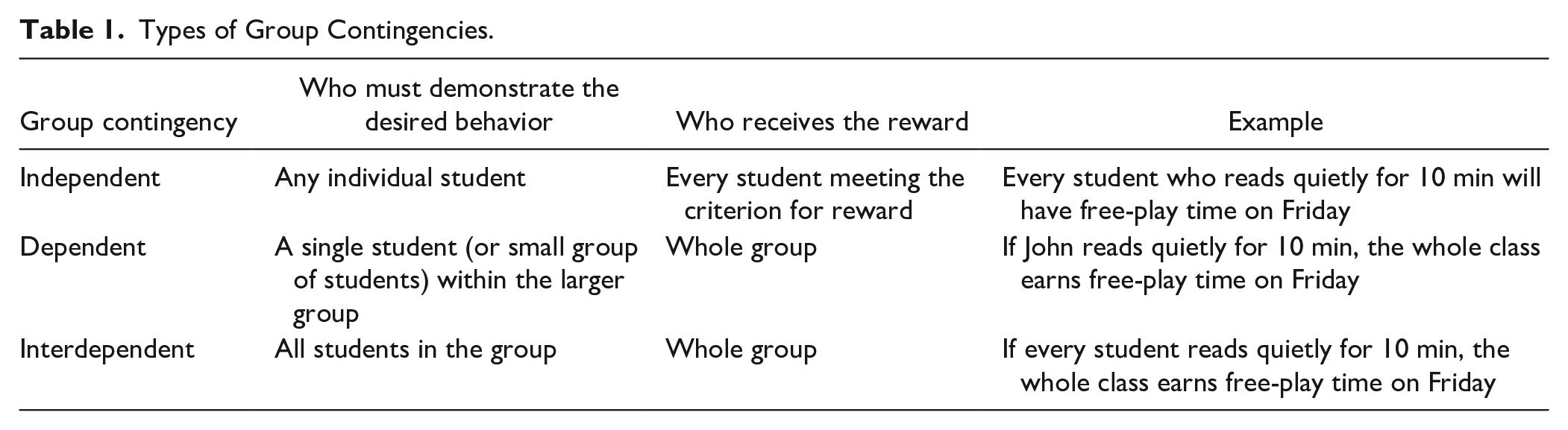
A group contingency establishes the criterion for receiving reinforcement. “The common consequence, typically a reward, is delivered contingent on the behavior of part of the group, or the behavior of everyone in the group” (Cooper et al., 2021, p. 664). There are three main types of contingencies: independent, dependent, and interdependent (see Table 1). In an independent group contingency arrangement, a contingency outlining the criterion for earning a reward (e.g., reading quietly for 10 min) is presented to a group of students. Only those who meet the criterion receive the reward (e.g., free-play time on Friday). In a dependent group contingency arrangement, access to the reward for the entire group is dependent on the behavior of an individual student (or small group of students) within the larger group. Finally, in the interdependent group contingency arrangement, access to the reward requires that all students in the group meet the criterion for earning a reward (Cooper et al., 2021; Litow & Pumroy, 1975). One interdependent group-oriented contingency management system, the GBG, has recently gained renewed prominence in research and applied practice (Bowman-Perrott et al., 2016; Smith et al., 2021).
Types of Group Contingencies.
Good Behavior Game
The GBG is an interdependent group-oriented contingency management system that was first introduced by Barrish et al. (1969) to address the problem behavior of several students in a fourth-grade classroom. In this original study, Barrish and colleagues (1969) split the class into two groups to “play the game” during math time, in which students would earn marks (recorded on a chalkboard) against their team for engaging in out-of-seat or talking-out behavior. The team with the fewest marks at the end of the game would then “win” a reward (i.e., receive positive reinforcement contingent on displaying desired behavior). Results indicated a marked decrease in both targeted problem behaviors. Subsequent empirical studies have found the GBG to be an easy-to-use, economic, and widely applicable intervention that can be used across grade levels from preschool (Foley et al., 2019; Wiskow et al., 2019) to high school (Ford et al., 2020; Kleinman & Saigh, 2011). As cited by the American Institutes for Research (n.d.), findings from repeated randomized trials indicate that the GBG effectively improves multiple student outcomes (self-control, on-task behavior, attention, and social relationships) and reduces problem behavior. Consistent with the findings of studies on the effects of group contingency interventions in schools, recent meta-analyses of GBG studies (e.g., Bowman-Perrott et al., 2016; Smith et al., 2021) reveal it to be an effective intervention for promoting positive behavior and reducing problem behavior in the classroom. Positive findings are not limited to general education classrooms but extend to special education classrooms that serve students with learning disabilities (Flower et al., 2014) and emotional and behavioral disorders (Bowman-Perrott et al., 2016). Currently, it is recognized as an evidence-based intervention by multiple registries that evaluate behavioral interventions, including the Substance Abuse and Mental Health Services Administration (SAMHSA), Evidence-based Intervention Network (EBIN), and Office of Juvenile Justice and Delinquency Prevention (OJJDP). Like many well-established, evidence-based interventions, empirical work with the GBG now focuses on maximizing effectiveness and generalizing to new settings and populations, often through technology or other innovations.
Technology-Supported Implementation of the Good Behavior Game
The use of technology has been recommended as a means for increasing the efficiency of service provision in schools (Bruhn et al., 2017). ClassDojo is a widely used, technology-based mobile application for classroom management and home–school communication, with over 3 million teachers and 35 million students registered on the platform (Manolev et al., 2019). The application is free-to-use, and it is flexible in that it can be used to implement different types of behavioral interventions, including token economies (Robacker et al., 2016), tootling (Lambert et al., 2015), and group contingencies (Dillon et al., 2019). Overall, studies using ClassDojo for implementing group contingencies have reported medium to large effects (Kirkpatrick et al., 2022) and suggest that it is well suited for effective GBG implementation (Lynne et al., 2017).
Lynne et al. (2017) used ClassDojo to deliver a positive reinforcement-focused version of the GBG to target disruptive and academically engaged behavior in three elementary grade-level classrooms. Results were promising as disruptive behaviors decreased, academic engagement increased, and participating teachers reported a desire to continue to use the intervention. Interestingly, the study also evidenced increased teacher use of behavior-specific praise statements. In a more recent study, Ford et al. (2022) used ClassDojo to deliver the GBG to target disruptive and academically engaged behavior in four secondary-level classrooms. Again, results showed decreased disruptive behavior and increased academically engaged behavior across all participating classes.
Additionally, any intervention’s acceptability (e.g., feasible, usable, procedurally straightforward) may be critical to its adoption, implementation, and effectiveness. ClassDojo-supported GBG implementation was rated as socially valid by participating teachers and students. While empirical support for the GBG and GBG using ClassDojo appears strong, guidance for utilizing ClassDojo to implement the GBG needs to be improved.
Implementing the Good Behavior Game With ClassDojo
The original, response-cost-oriented version of the GBG involved the use of demerits (i.e., marks against students for offenses) to determine which group accessed the reinforcer (i.e., the “winning” team had fewer tallies for undesirable behaviors). However, recent studies (e.g., Ford et al., 2022; Lynne et al., 2017; Moore et al., 2022) have focused on instances of desired behavior to inform the distribution of positive reinforcement. This positive behavior-focused version of the GBG, often called the Caught Being Good Game (CBGG), awards points for following expectations rather than violating rules (Wahl et al., 2016). Although differences in effects have not been observed between the original version of the GBG and the CBGG (Joslyn et al., 2019; Wahl et al., 2016), the implementation of a version that is positive reinforcement-focused “aligns more closely with a positive school climate” (Wahl et al., 2016, p. 514) and arguably holds more significant promise for increasing teacher attention to desirable behavior. The focus on distributing reinforcement based on desired, expected behaviors also has been increasingly emphasized in schools (Reinke et al., 2013) and is prioritized by behavioral support staff (e.g., behavior analysts; Behavior Analyst Certification Board [BACB], 2020). Thus, the guidance provided herein conforms with positive reinforcement-focused group contingency management system procedures.
Create a Teacher Account
A user account must be created with ClassDojo before the application can be used. The account can be created on the Web or the ClassDojo application on an iOS or Android device. To create an account on the Web, go to the ClassDojo homepage (http://www.classdojo.com) and follow the on-screen prompts. To create an account on an iOS or Android device, download the application (https://www.classdojo.com/download), open it, and follow the on-screen prompts. The application can also be found in the Apple Store (for iOS) and Mac App Store (for Android).
Select Target Behaviors
An essential first step to implementing the GBG is to identify desirable classroom behaviors to target for increase. The target behaviors selected should be specific and positively stated (Alter & Haydon, 2017). For example, the GBG procedures defined by Rubow et al. (2018) outlined desirable behaviors: raising your hand; staying in your seat; working quietly; and keeping your hands, feet, and materials to yourself. In another example, Ford et al. (2022) targeted academically engaged behavior defined as orienting one’s head and eyes toward the ongoing academic task (e.g., attending to lecture), actively attending to the ongoing academic task (e.g., raising one’s hand during lecture, working on an assigned worksheet), or following teacher instructions (e.g., reading a book upon completing a task). (p. 4)
Users should consider their specific situational or contextual factors when selecting GBG target behaviors. This is to say, if a specific behavioral challenge(s) has arisen in the classroom (e.g., talking out), a replacement behavior could be identified and utilized (i.e., raising a hand before speaking) as part of the GBG.
In contrast, more generic, universally desirable classroom behaviors could be selected without a specific problem behavior. It is also recommended that the target behaviors be publicly displayed in writing to serve as a visual prompt for students (Alter & Haydon, 2017). There is no definitive rule regarding the number of behaviors to target, but the general recommendation, based on a review of the literature, is to keep it to a minimum (Alter & Haydon, 2017). Based on a review of GBG literature, three to five behavior expectations are recommended. Once target behaviors have been selected, add them as “skills” to the ClassDojo application (see Table 2).
Step-by-Step Instructions for Adding “Skills.”
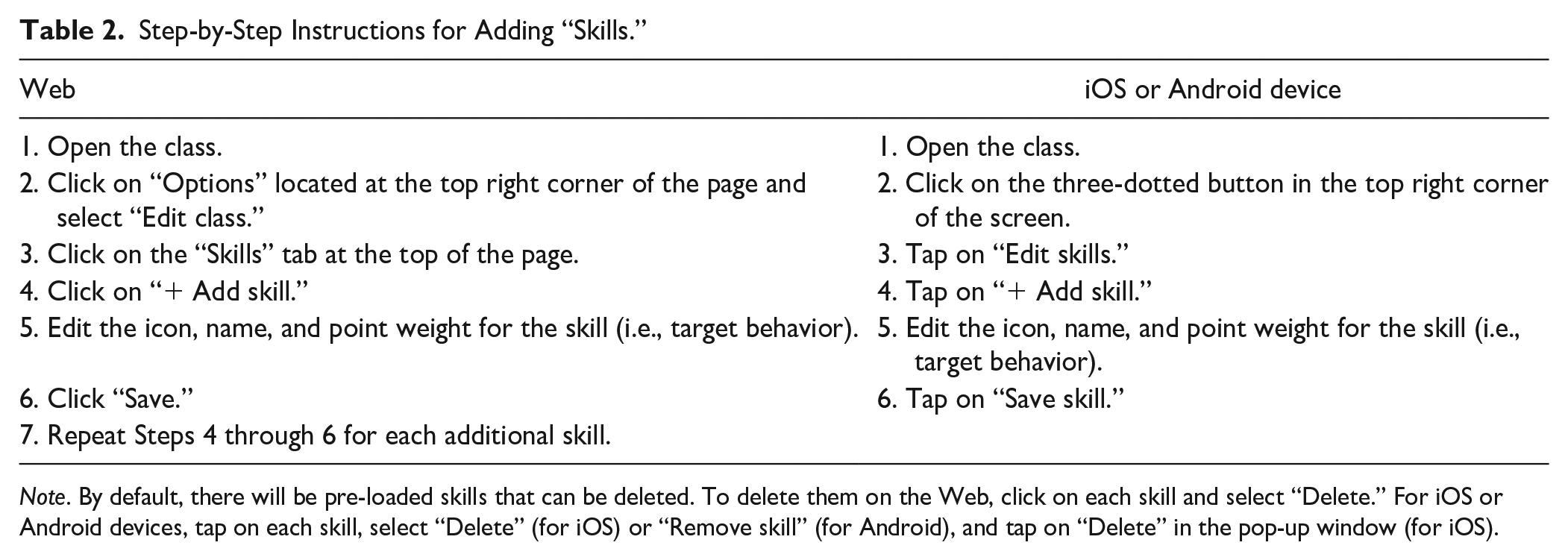
Note. By default, there will be pre-loaded skills that can be deleted. To delete them on the Web, click on each skill and select “Delete.” For iOS or Android devices, tap on each skill, select “Delete” (for iOS) or “Remove skill” (for Android), and tap on “Delete” in the pop-up window (for iOS).
Identify Potential Reinforcers
The positive behavior-focused version of the GBG is a reinforcement-based classroom management intervention. As such, it is imperative that students desired potential rewards be identified for use as reinforcers for the game. Several sources for low- or no-cost rewards that can be delivered in school settings include Riffel and Eggleston’s (2019) compilation of potential reinforcers, Intervention Central’s (n.d.) article on ideas for classroom rewards, and PBIS Rewards’ (2022) list of school-based incentives. Preference assessments in the form of student surveys or questionnaires also can be conducted to learn about students’ interests and inform the selection rewards (Flower et al., 2014; King & Kostewicz, 2014; Kleinman & Saigh, 2011; Lannie & McCurdy, 2007). Mckenna and Flower (2014) describe this as a process consisting of the following steps: (a) developing a questionnaire that lists acceptable rewards believed to be of interest to students, (b) obtaining feedback on actual student interest in each of the reward ideas, and (c) providing an opportunity for students to offer suggestions of rewards that are not listed. Alternatively, the teacher may review a variety of acceptable rewards with the entire class and ask for students to rate each item (e.g., one thumb up to express moderate interest, two thumbs up to express high interest, hands flat on the table to express no interest) and then incorporate only those rewards that students expressed high or moderate interest in earning (Anderson & Rodriguez, n.d.).
Set the Criterion for Earning a Reward
The contingent use of positive reinforcement to improve student engagement in expected behavior, often in conjunction with positive specific praise, has been identified as a critical characteristic of effective classroom management (Alter & Haydon, 2017). Consistent with the positive reinforcement-focused version of the GBG, the team that exhibits the most instances of desired behaviors and, as a result, accumulates the most points (i.e., tallies for instances of desired behavior) receives a reward. Also, it is possible to organize the GBG such that more than one team can win if the criterion for winning is achieved by more than one team (Bowman-Perrott et al., 2016).
The criterion for the GBG should be set based on data collected before the GBG is implemented. This baseline data will provide a reference point for the targeted behavior and allow for setting a realistic and achievable initial criterion. As students meet the criterion consistently, the criterion can be gradually increased as the targeted behavior improves. For example, if students’ baseline data shows that they are on-task 50% of the time, the initial criterion for the GBG might be to increase on-task behavior to 65% of the time. When students consistently meet this criterion, it can be gradually increased, perhaps to 75% or 90% of the time. Gradually increasing the criterion based on data is an essential aspect of the GBG because it helps to ensure that the intervention is challenging enough to promote continued progress but not so difficult that it is unattainable. It also helps to provide a sense of accomplishment and motivation for the students as they meet increasingly higher standards of behavior.
Create Student Teams and Introduce the Good Behavior Game to Students
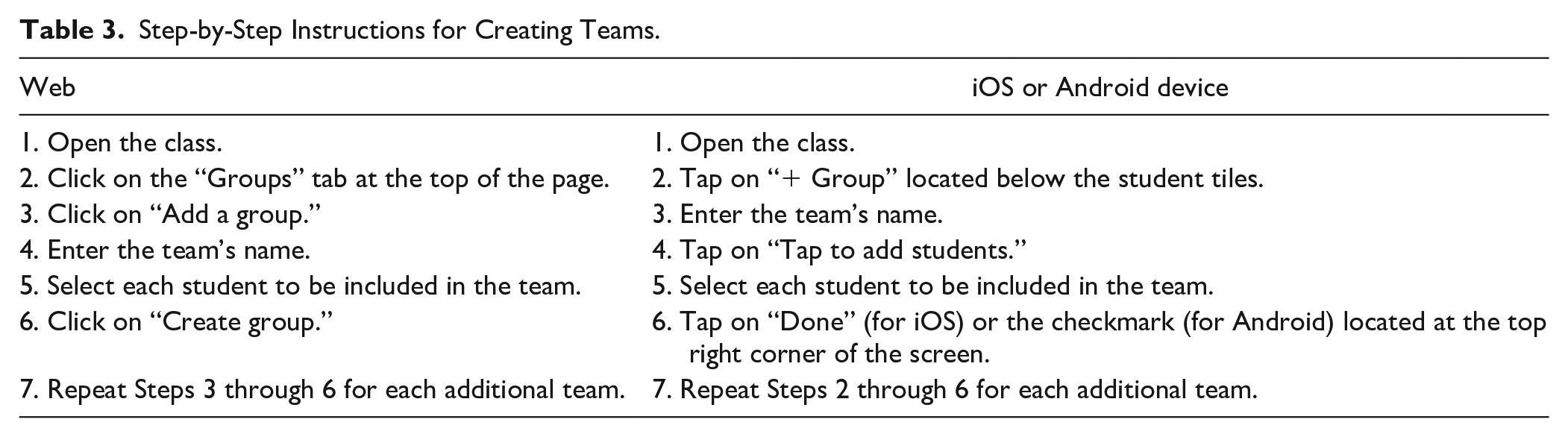
To implement the GBG, the class is to be divided into two or more equal teams. Although an entire class can be placed on a single team, there is evidence to suggest that this is not as effective and dividing the students into more/smaller teams is a better option that “makes each student’s behavior more closely tied to their reward delivery and makes a single student’s disruptive behavior affect reward delivery for fewer students” (Donaldson et al., 2021, p. 2). To the extent possible, create balanced teams (see Table 3) regarding academic and behavioral characteristics.
Step-by-Step Instructions for Creating Teams.
Before implementing the GBG, introduce the game to students with a procedure description. This introduction should explain how points will be earned (e.g., frequency of desired behavior, duration of desired behavior), the reward’s criterion, and provide an opportunity for students to ask questions. Also, teachers are encouraged to discuss with students how the GBG supports other ongoing efforts to promote a positive classroom climate and social-emotional learning (SEL).
Example Script 1: One Group Earns the Reward
Students, I have exciting news. Today, during Social Studies, we will have a very special opportunity to play a fun new game that will help us learn! To play this game, we must split the class into three teams. [Project the ClassDojo screen onto the Smartboard to show students which teams they are assigned to]. The three teams will compete to earn points that are awarded at random times for being on-task. [Describe what on-task behaviors look like. You can include examples and non-examples to clarify what is and is not on-task behavior]. So, to earn points, each member of your team must be on-task when I decide it is time to award points. At the end of Social Studies, the team with the most points will get to choose one of two fabulous prizes! Do you have any questions about how this works?
Example Script 2: Multiple Groups Can Earn the Reward
Today, during Social Studies, we will have a very special opportunity to play a fun new game that will help us learn! To play this game, we must split the class into two teams. [Project the ClassDojo screen onto the Smartboard to show students which teams they are assigned to]. The two teams will compete to earn points that are awarded at random times for being on-task. [Describe what on-task behaviors look like. You can include examples and non-examples to clarify what is and is not on-task behavior]. So, to earn points, each member of your team must be on-task when I decide it is time to award points. At the end of Social Studies, the team with the most points will get to choose one of two fabulous prizes! It is also possible that more than one team earns a prize. If both teams earn at least [minimum number of points to access the reward], then both teams will get a prize; however, the team with the highest number of points will choose which reward each team will get. Do you have any questions about how this works?
Additional Considerations Prior to Implementation
Before implementation, consider when the GBG will be implemented and for what length. “Researchers have typically incorporated the Good Behavior Game into existing classes and had teachers play the game for the duration of the class time” (Tankersley, 1995, p. 21). In the original study by Barrish et al. (1969), the game was played for an hour (the duration of their reading and math classes). Later studies have implemented shorter and longer game sessions, ranging from 10 to 100 min or more (Tankersley, 1995), with positive outcomes. In some cases, researchers initially implemented shorter game sessions but gradually increased their duration. Also, it is possible to introduce the game at varying times of the day (Dolan et al., 1993). According to the American Institutes for Research (n.d.), “the Good Behavior Game is intended to be played three times a week for approximately 10 minutes at a time [at the beginning of the school year]” (para. 3) and “[by] the end of the school year, a teacher may play the game daily for up to 30 or 40 minutes” (para. 3). Again, specific situational or contextual information should be considered. Whenever possible, classroom educators should inform implementation decisions based on data. For example, teachers could collect class-wide on-task behavior data to inform an appropriate on-task duration goal. If data indicates the class typically remains on-task for 2 min on average, a teacher could award a GBG point for each instance a team remains on-task for 2 min (or more). Finally, be mindful of tactics associated with increased GBG effectiveness, specifically verbal and visual feedback when points are earned. Before beginning the GBG with ClassDojo, consider how visual feedback will be handled. Projecting the ClassDojo application screen displaying the points earned by each team onto a board for students to see is recommended to provide visual feedback and additional positive reinforcement.
Implement the Good Behavior Game With ClassDojo
When awarding points, it is recommended that their delivery is accompanied by feedback from the teacher (e.g., behavior-specific praise). Feedback can be visual (e.g., ClassDojo screen displaying points earned by each team projected onto an interactive whiteboard; see Table 4) or verbal (i.e., in the form of a positive statement that acknowledges what the team did to earn points [e.g., “Green team earns a point for Tanika raising her hand”]). In a recent study comparing the methods of feedback used in the delivery of the GBG, Wiskow et al. (2019) found that using verbal feedback alone or in combination with visual feedback was more effective than no feedback or visual feedback alone.
Step-by-Step Instructions for Awarding Points to Groups.

Addressing Sabotage
It is well documented in the literature that sometimes students find sabotaging the game more reinforcing or motivating than the anticipated reward for winning it. Sabotage can come in various forms but generally involves intentional acts performed by the students that interfere with the game’s success. For example, some students may engage in disruptive problem behavior, attempt to provoke others into misbehaving, or refuse to participate by ignoring the rules. Sabotage can reduce the effectiveness of the GBG and hinder its ability to achieve its intended goals. Consequently, implementers are advised to consider how they will address student behaviors that sabotage successful implementation. As reported by Nolan et al. (2014), recent research has favored the use of independent contingencies in which the behavior of the saboteur does not affect the other students on their team. In the original study by Barrish et al. (1969), saboteurs were removed from the game, and the marks against their team were not counted. Other recent studies have addressed sabotage by creating a team solely for saboteurs (e.g., Rubow et al., 2018). Further research is needed to understand this phenomenon better and address it.
Other Potential Barriers to Successful Implementation
Using technology in the classroom can present a variety of challenges for educators. These include technical difficulties like system crashes, network outages, or software compatibility issues. In addition, there may be concerns about student privacy and data security. To address these issues, those who decide to adopt ClassDojo for use in the classroom are advised to: (a) familiarize themselves with the technology; (b) seek out additional training as needed; and (c) establish a protocol for addressing technical issues as they arise, which may include consulting with the ClassDojo Helpdesk (https://classdojo.zendesk.com/hc/en-us). In addition, educators who use technology in the classroom should stay informed about the latest best practices for using technology in the classroom and be prepared to adapt their methods as necessary to ensure a positive and productive learning environment. Despite the possible challenges accompanying the use of technology in the classroom, the extant literature indicates that technology can be effectively used to implement behavior management interventions in classroom settings.
Conclusion
There is a continuing need for practical, evidence-based strategies to promote desirable classroom behaviors. The COVID-19 pandemic has highlighted this need as in-person instruction has been disrupted, leading to students losing social, emotional, and behavioral support. One evidence-based approach for supporting classroom behavior is the GBG. As technology in education grows, it is being increasingly used to implement school-based interventions and supports. ClassDojo is a tool with a track record for improving classroom management and communication between teachers and parents. This article outlines how the GBG can be effectively implemented using ClassDojo.
Footnotes
Declaration of Conflicting Interests
The author(s) declared no potential conflicts of interest with respect to the research, authorship, and/or publication of this article.
Funding
The author(s) received no financial support for the research, authorship, and/or publication of this article.
