




Abstract
Students with disabilities are choosing to engage in remote schooling. Families of children with disabilities may never set foot in a physical school building. Yet, it is important for families to feel connected to their child’s education and the school community. This column discusses strategies based in culturally relevant pedagogy to engage parents of students with disabilities who are learning remotely. Strategies can be applied to families of all students with disabilities, but a focus is placed on families of students with a learning disability. Educators can facilitate culturally relevant practices that (a) establish effective, culturally honoring two-way communication with families online, (b) connect families to necessary resources that are typically provided when children attend a physical school building, and (c) encourage social ties between families to raise critical consciousness.
Although remote schooling has been available for students at all levels of education for over 20 years (Gillett-Swan, 2017), school closures brought on by the COVID-19 pandemic have increased the prevalence of online education (Schwartz et al., 2020). Although not all students with disabilities thrive in this format of instruction, online learning for Grades K–12 students has increased by approximately 6% every year beginning in 2009 (Digital Learning Collaborative, 2019). Molnar et al. (2015) found that students with disabilities have been increasingly choosing remote schooling. Reasons for the switch to this schooling platform for parents of students with disabilities include (a) increased academic support (Beck et al., 2014), (b) no bullying (Beck et al., 2014), (c) parent ability to tailor education to fit the needs of their child (Tonks et al., 2021), (d) having a flexible schedule (Schultz, 2019), and (e) passing on values to their children (Schultz, 2019).
Remote schooling often involves synchronous teacher-led instruction in the form of large group, small group, and individual lessons (Johnson et al., 2022). This type of teaching most closely approximates traditional face to face learning (Johnson et al., 2022). Teachers also assign asynchronous work to be completed by the student on their own without direct instruction (Love & Ewoldt, 2021), a strategy that may require more parent support for students with high-incidence disabilities such as learning disabilities (LD) (Touloupis et al., 2021). This column focuses on students with LD, but similar strategies can be applied to students from other disability groups as well. Students with a learning disability may struggle more in online learning environments than traditional schools (Ziadat, 2021).
Family Engagement
Family engagement has been shown to be key in facilitating student success in remote schooling (Domina et al., 2021), especially for students with disabilities who may need additional support (Rice et al., 2019). Parents of students with LD attending school remotely often use an ineffective, controlling style of working with their children, which may be due to feelings of inadequacy for not being able to assist their child (Touloupis, 2021). Support systems including educational/institutional support have been shown to reduce parental stress (Abbasi, 2017; Cen & Aytac, 2017) and can facilitate beneficial parent–child interactions that lead to healthy child development (Touloupis, 2021). Educators who use culturally relevant pedagogy (CRP) empower parents to be active members of their child’s educational team whose voices are validated and honored.
The Individuals with Disabilities Education Improvement Act (IDEIA, 2004) not only suggests but requires family engagement and participation in the processes associated with special education. The COVID-19 pandemic also highlighted the need for partnership with families as parents took a more direct role in their children’s education. Educational leaders particularly stressed the need to connect with families of students who are more vulnerable such as English learners (EL) and students with disabilities (Johnson et al., 2022). However, parents often feel like middle-managers rather than collaborative partners when helping to facilitate remote learning for their child with a disability (Rice & Ortiz, 2021).
As students with disabilities from diverse backgrounds are increasingly enrolling in remote learning, educators need strategies to engage families in online environments. Educators who work in remote environments dedicate tremendous effort to innovative teaching. While culturally responsive strategies may require some additional time commitment at the beginning and periodically throughout the year, educators will find that using CRP to engage families creates an atmosphere of trust and care that welcomes traditionally marginalized families into productive, collaborative partnerships. Once these practices are established, they are readily incorporated into annual procedures or daily routines. They are useful for parents of students with disabilities of all ages and grade levels and can especially be applied to students with LD, the group that comprises the highest percentage of students with disabilities (World Health Organization, 2015).
Remote schooling has its origins in correspondence education, which gave students who did not have access to attending physical school buildings a way to receive a formal education (Valcarlos et al., 2020). Remote schooling in its current technological iteration has the potential to continue the process of destabilizing privilege by aligning with CRP to provide successful engagement of families of diverse backgrounds. Strategies aligned with CRP leverage the assets of online education to provide successful engagement with families of diverse backgrounds. This column aims to support teachers delivering instruction virtually to engage families using CRP to (a) establish effective two-way communication with families online where more than one way of thinking and being is honored, (b) ensure families are connected to essential resources that would have been provided had the student been enrolled in a traditional school setting, and (c) provide opportunities for social ties between families to encourage critical consciousness through community building.
Culturally Relevant Pedagogy
Ladson-Billings (1992) explains CRP as a “pedagogy of opposition” that “is contrasted with an assimilationist approach to teaching that sees fitting students into the existing social and economic order as its primary responsibility” (p. 314). The background of the student is an asset and not viewed as a deficit. For example, Ladson-Billings (2009) described a culturally responsive teacher who regards the direct, honest expressions of her African American students not as rudeness or disrespect but as facilitating truthful discussion by being authentically themselves (Ladson-Billings, 2009). Although the student’s individual background is important, community is also key, with collective empowerment a goal of CRP (Ladson-Billings, 1995). Culturally relevant educators focus on three areas: academic success, cultural competence, and critical consciousness (Ladson-Billings, 1995). Ladson-Billings (2021) states that all three elements must be implemented to constitute CRP.
Academic success is not merely achievement on standardized tests (Ladson-Billings, 2021). Students need growth in literacy, math, technology, social, and political skills (Ladson-Billings, 1995). Academic success is personal and should be measured by the achievement of each student relative to their own growth and progress (Ladson-Billings, 1995).
Cultural competence is the second component of CRP. Each student should fully understand their culture and also be gaining an understanding of at least one other culture (Ladson-Billings, 2021). Celebrating heroes and holidays is not sufficient to understand a culture. Teachers should leverage the cultural competence of their students to create lessons that are engaging and culturally relevant (Ladson-Billings, 1995).
The third component of CRP is critical consciousness. Students need to be actively involved in analyzing society and challenging social inequities (Ladson-Billings, 1995). Students and their families begin to look critically at racism, structural inequalities, and other forms of oppression (Ladson-Billings, 2009). This brings into play the collective lifting up of traditionally marginalized peoples rather than just the individual’s personal raised consciousness (Ladson-Billings, 2021).
Culturally relevant pedagogy is vital to restructuring education in a post-COVID 19 world (Ladson-Billings, 2021). As Ladson-Billings writes, “we must re-think the purposes of education in a society that is straining from the problems of anti-Black racism, police brutality, mass incarceration, and economic inequality” (Ladson-Billings, 2021, p. 72). Returning to the same institutional and curricular structures that oppressed Black students and other traditionally marginalized populations does not support educational progress for all students (Ladson-Billings, 2021). When applied to parent engagement, CRP provides a framework educators can use to move past status quo views of parents as teacher-helpers (Rice & Ortiz, 2021) toward sincere partnerships where parent knowledge is highly regarded and their criticality encouraged as an instrument for change.
Culturally responsive teaching in remote learning changes the dynamic of the classroom by honoring the cultural capital that all participants in the learning environment, both educators and students, contribute (Woodley et al., 2017). This can be a sharp divergence from traditional forms of remote learning that involve programs designed for students to watch followed by quizzes. Instead, students are active in creating their learning environment (Woodley et al., 2017), not merely passive consumers of information dictated by the teacher (Freire, 1970). Likewise, parents of students in a culturally relevant class should be considered co-collaborators in creating and teaching curriculum. Traditional methods of family engagement such as school conferences and notes in backpacks about homework assignments are not sufficient if educators wish to subvert deficit models of marginalized groups (Brandon et al., 2021; Paris, 2012).
Studies addressing the needs of students and/or families from traditionally marginalized backgrounds often focus on those who are bilingual or multilingual (Cioè-Peña, 2022; Goodman & Hooks, 2016). Language is a vital component of culture (Kiely et al., 2006). However, this column intentionally emphasizes strategies that can be implemented regardless of the language spoken in the home instead of methods that only pertain to families that speak a language other than English.
For cultural responsiveness to be effective, it must be implemented in concrete, practical methods and strategies that are accessible to educators from a variety of backgrounds. Educators can learn from and partner with other culturally relevant educators and leaders in their school districts for support and community. CRP may be used to engage families in remote learning by implementing the following three steps: (a) establishing effective two-way communication with families online, (b) connecting families to resources, and (c) building social ties between families.
Step 1: Establishing Effective Two-Way Communication with Families Online
In a remote learning environment, the educator is “entering” the home environment instead of the student entering the school environment (Cioè-Peña, 2022). This creates a situation wherein families may feel vulnerable. They may value privacy and therefore not want their home to be seen on camera by both the educator and other students in the virtual classroom. Families who are emergent bilinguals may have concerns about navigating an educational system that is designed for English monolinguals. Furthermore, families of students with LD do not feel genuinely included in meetings with school personnel such as Individualized Education Program (IEP) meetings (Cavendish & Connor, 2018). Educators should create a foundation of trust by establishing effective two-way communication that celebrates different ways of thinking and being.
The first thing educators can do is to clearly state their pedagogy in family-friendly language. Families may not understand the word “pedagogy,” so educators can simplify by saying “the way I approach teaching” or “my philosophy on teaching.” As educators explain how they approach teaching and learning, families can engage in critical consciousness by discussing their own philosophy on education. Being truthful and straightforward has been shown to increase family trust of school-related personnel (Ball et al., 2021). Introducing the concepts of CRP to families early on can help build these open, transparent relationships.
In a letter introducing CRP, educators can relay their own personal background and relate the three essential components (i.e., academic success, cultural competence, and critical consciousness) to their subject area or grade level. For example, a special education high school science teacher may bring critical consciousness into play by writing about their efforts in recruiting those from traditionally marginalized backgrounds into science, technology, engineering, and math (STEM) careers and how those seeking STEM degrees were disproportionately negatively affected by COVID-19 school closures (Barber et al., 2021). See Figure 1 for a sample letter to use as a guide for educators to explain CRP.
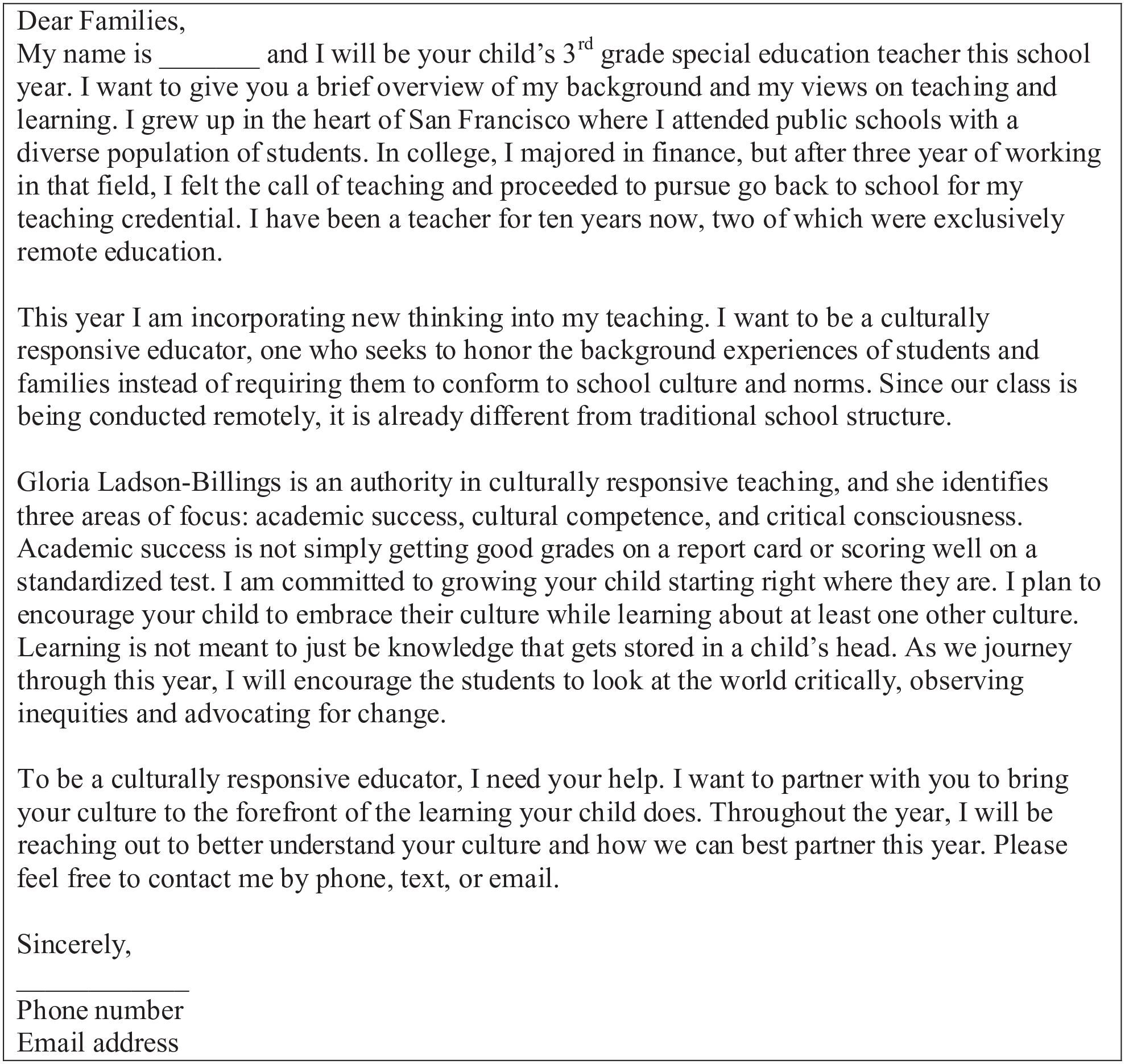
Sample letter to families explaining educator pedagogy.
After sending out the letter introducing CRP, educators can schedule meetings with families to better understand their teaching and learning pedagogies. Recognizing the power differential that may have dictated previous experiences with families and schools and the trauma that has occurred because of the imbalance is an important step in building trust with families (Ball et al., 2021). Listening to how families view teaching and learning shows families that the educator regards them as informed, essential voices.
For families that are emergent bilingual, educators can use their school district’s translation services to present the letter in the family’s home language. Subsequent conversations that take place online can be held with a translator present. Families of children with LD report the preference for professional translators overusing untrained translators such as educational assistants (Cavendish & Connor, 2018). Previously, parents who speak languages not well-represented in the geographical area of their physical school district missed out on information being disseminated (Sayer & Braun, 2020). Online meetings are easier than face to face ones to find translators for because the linguistic professionals can join remotely from anywhere in the world. In addition, real-time translated captioning systems that integrate with videoconferencing platforms are now available for some languages (Arkhangorodsky et al., 2021).
Another way to create a safe, collaborative online environment for families is by scheduling recurring times to meet with families individually. Many families, and especially those from traditionally marginalized backgrounds, feel powerless when it comes to their child’s education (Ball et al., 2021). By scheduling recurring meetings, the educator facilitates building that trust by showing they value the importance of the family as a critical partner in the student’s education. The educator also exhibits that they value the culture of the family rather than coming from a deficit perspective, thereby giving students safety to build cultural competence. These meetings also raise critical consciousness by modeling a shift from the traditional view of the school as the main source of learning to the home, with all its resources, as the primary source of learning.
Step 2: Connecting Families to Resources
When school personnel connect families to resources, families are more likely to be engaged in activities that promote their child’s academic performance and emotional health (Ball et al., 2021). This connects to the culturally relevant practices of academic success and critical consciousness. Connecting families to resources can contribute to more equity for families that may have lacked information or the ability to navigate systems to acquire necessary goods and services. Parents who choose remote education for their child with a disability need access to services that would normally be provided by the school.
The first step in connecting families to resources is to understand their needs. Teachers can use a questionnaire to determine what resources families would benefit from. See Figure 2 for a sample questionnaire to send families that can help gather more information about their specific needs.
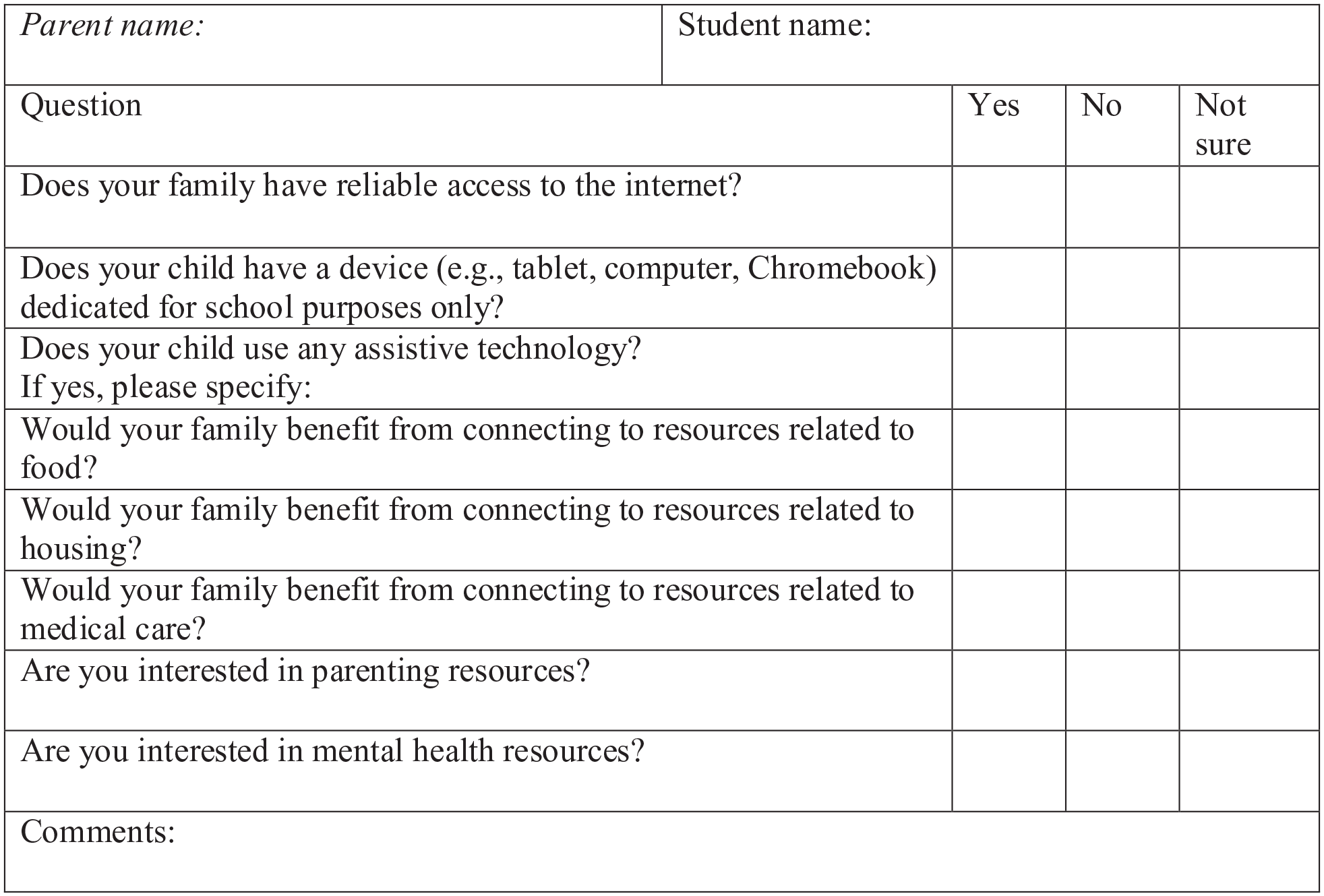
Questionnaire for assessing family need for specific resources.
Food is a necessity that students would normally have access to in the school setting. Many schools provide both breakfast and lunch for students, regardless of their ability to pay. Students who choose remote learning should also have the opportunity to receive food. Teachers can provide families resources on accessing government sponsored food programs as well as community-based resources. Educators may also want to investigate if their school district already has a program in place for pickup of breakfasts and lunches. If a set protocol is not already established, teachers can partner with their district’s food distribution program to create a system.
Technology is another important area where families may need additional resources. The COVID-19 pandemic showed that some families lack the devices for their children to actively engage in remote learning (Pollack et al., 2021; Ziadat, 2021). For others internet access is an issue (Busby & Tanberk, 2020). Many school districts made provisions to help solve these issues during the COVID -19 pandemic, but some of those measures may have been temporary or inadequate. For other families, although they have both internet access and devices, parents lack the technological skills to assist their student with online learning (Pollack et al., 2021). Students with a learning disability may also need help with assistive technology that their families lack the training to access. Some parents cannot name any assistive technology that their student uses in remote education although they state that their student has access to assistive technology (Smith et al., 2017). This indicates that families may need additional assistance in identifying and procuring essential technology to promote the CRP component of academic success for their children with disabilities who are engaged in remote learning.
Educators may need to collaborate with other professionals to provide technology resources and access to training for families of students with disabilities. Many school districts have technology departments and assistive technology specialists who can fill this need. Another valuable resource is state vocational rehabilitation services. Students can begin to access these services as early as 14 years old (Washington State Department of Social and Health Services, n.d.). Educators can invite personnel from these agencies to speak about the resources and services they provide at parent meetings.
Step 3: Building Social Ties Between Families
When children attend a physical school building, families often have organic interactions with each other such as at pickup/drop-off times, at parent–teacher organization meetings, or during schoolwide events. In an online setting, educators must be proactive about intentionally creating opportunities for families to interact. Rice and Ortiz (2021) found that most school communication was one-sided, with schools preparing lectures and trainings to direct rather than collaborate with parents. As families engage with each other, they build on their collective critical consciousness. The culturally relevant educator can facilitate this process by encouraging family reflection on the learning process, initiating modes of communication between families, and facilitating interactions between families and educators.
Reflecting on one’s experiences helps us better understand them, raises critical consciousness, and guides one to chart courses for change. Educators can encourage families to reflect on their culture by providing prompts, purposes, and platforms. Teachers can ask questions in the home language that show an interest in the economic, social, and cultural experience of the family (Moll et al., 1992). Providing specific prompts gives structure to the conversation while also letting families know that that their cultures are honored. As families engage in an ongoing dialogue with educators, they build trust and begin to feel comfortable discussing topics they previously might not have (Lopez et al., 2022). Educators can use preexisting questionnaires that fit their population of students (Brandon et al., 2021; Matute-Chavarria, 2021) or they can create their own prompts based on the needs of their students.
In addition to dialogue with educators, parents also benefit from spending time interacting with other parents (Muddle et al., 2022). In the remote learning environment, educators can encourage ties between families of students in remote schools through asynchronous discussion boards (Valcarlos et al., 2020). Asynchronous options have the benefit of flexibility for families. Families of students with disabilities may work nontraditional shifts or need to adhere to strict schedules for their child. A number of options are available such as asynchronous video messages (e.g., Flipgrid and Discord), written responses (e.g., Google Chat and Discord), or posts in social media groups (e.g., Facebook and Twitter). Teachers can set up asynchronous discussion boards by posting an initial topic or question for families to respond to or by posting student work on culturally stimulating projects and encouraging families to comment or ask questions. One way to encourage dialogue between families is for the educator to post about connections they saw between two families on their respective threads. Using such asynchronous platforms gives families the opportunity to view work that may be displayed in hallways or on bulletin boards in traditional school settings. As families interact with other families, learning about different cultures and enhancing their understanding of their own culture, they build the CRP component cultural competence.
Some families may benefit from synchronous options for interaction in addition to or instead of asynchronous discussions. Muddle et al. (2022) found that parents of children with LD benefited from group discussion in a program designed to build secure attachment to their children. Teachers can create their own topics for monthly discussion based on the expressed needs of their families. This promotes the CRP component of cultural competence by taking the needs of the culture into account when planning engagement activities. Educators can also adopt research-backed programs such as the Circle of Secure Parenting described by Marvin et al. (2002), which give structure and format to group interactions. This is especially helpful for educators who have never facilitated a parent group. Educators may also record conversations between families so that they can be viewed or reviewed at a later time. If live transcription is used, teachers can also translate the transcription into different languages using such platforms as Google translate and post them on a web page for families to access them. See Table 1 for a synthesis of ideas for implementation of CRP and how each action on the part of the educator can support the three components of academic success, cultural competence, and critical consciousness.
Implementation of CRP.
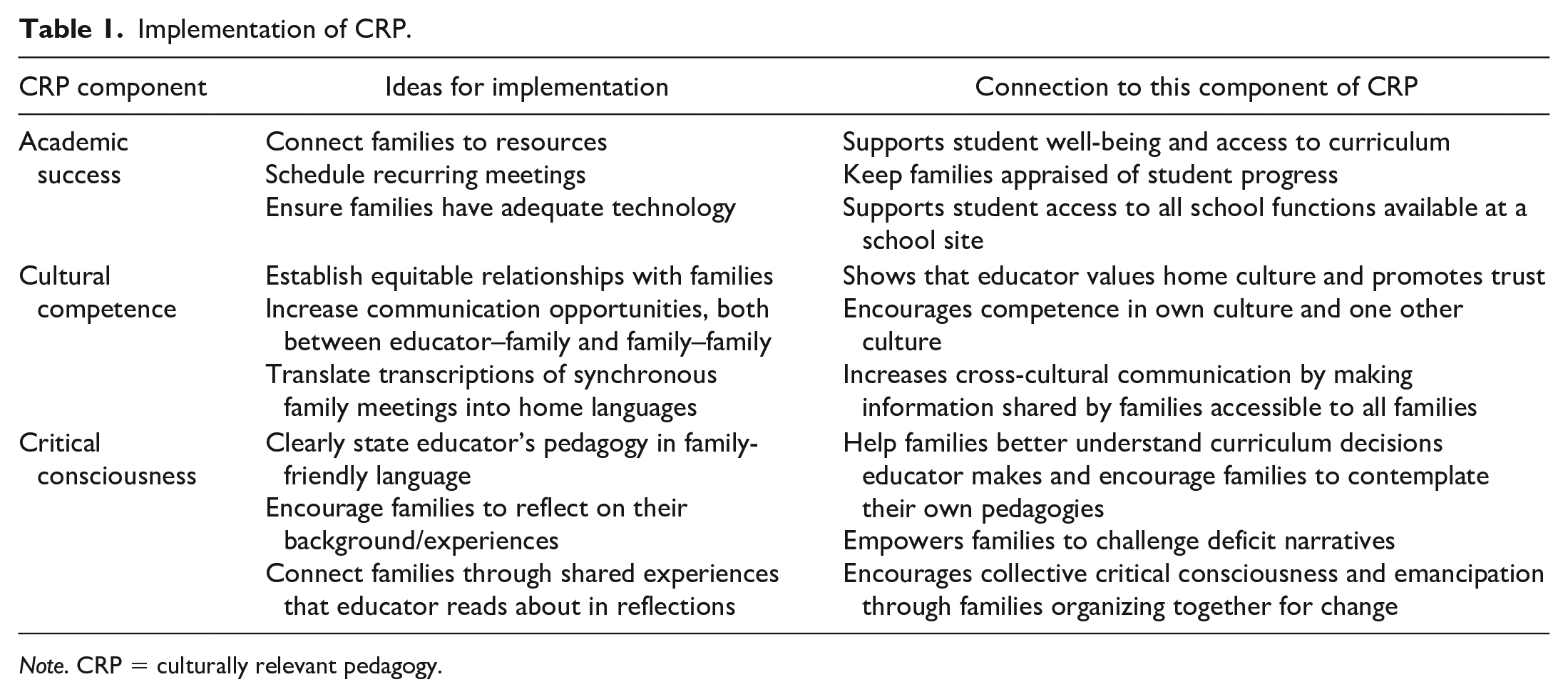
Note. CRP = culturally relevant pedagogy.
Conclusion
Remote learning shifts the power and focus away from the school building, thereby disrupting the traditional structure of education (Rice & Ortiz, 2021). When online learning is implemented with strategies that are culturally relevant, students and families have the opportunity to experience emancipation from oppressive, hegemonic structures and be co-collaborators in their child’s education. To establish effective two-way communication with families online where more than one way of thinking and being is honored, educators can send out a letter explaining CRP and establish monthly recurring meetings.
Educators can send out a questionnaire to gather information about what resources families need to be connected to that would have been provided had the student been enrolled in a traditional school setting. Lastly, the educator can promote critical consciousness through community building as they forge social ties between families of students with disabilities who are learning remotely. As remote education grows in popularity, it will necessitate additional work for those who want to do it well. The payoff of implementing CRP with families of students with disabilities has the potential to be a legacy of collaboration that honors diversity and agency.
Footnotes
Declaration of Conflicting Interests
The author(s) declared no potential conflicts of interest with respect to the research, authorship, and/or publication of this article.
Funding
The author(s) received no financial support for the research, authorship, and/or publication of this article.
