




Abstract
Number lines can benefit students in learning an array of mathematical concepts. An area of mathematics where number lines are visibly underused is in teaching measurement concepts. For students in upper elementary grades, accurate measurements require the use of mathematical precision and coordination, including skills in fractions and decimals, operations, and magnitude. A robust knowledge of measurement holds significant value in students’ development of mathematical proficiency, particularly for students with learning disabilities in mathematics. Using number lines to teach and perform mathematical processes involving measurement can build fluency and conceptual understanding for all learners, including those with learning disabilities. This article demonstrates the versatility of integrating number lines into mathematical interventions involving measurement concepts for students with learning disabilities in mathematics. Measurement content discussed includes distance, time intervals, liquid volume, and mass. Scenarios with examples of how to apply number lines to each measurement form are described.
Measurement is arguably one of the most critical and practical mathematics domains to master because it is necessary for an assortment of everyday situations. For instance, measuring elapsed time and distance are skills required when commuting to work or determining the length of an outdoor run. Measuring liquid volume is required to administer medication in proper dosages, and determining an object’s mass is needed when sending a package to a friend, following a recipe, or assessing if you have lost or gained weight. The Common Core State Standards in Mathematics (CCSS-M) highlight the importance of measurement skills (National Governors Association Center for Best Practices, Council of Chief State School Officers [NGAC & CCSO], 2010). For example, a mathematical expectation for fourth-grade students is to use the four operations to solve word problems involving distances, intervals of time, liquid volume, and the mass of objects; and represent these quantities with number line diagrams using a measurement scale (NGAC & CCSO, 2010, CCSS.MATH.CONTENT.4.MD.A.2). This standard highlights the host of mathematics concepts and skills students must understand to solve measurement problems successfully. For students with learning disabilities (LD) in mathematics, meeting this standard involves explicitly teaching students how to incorporate higher order thinking skills and generalization of knowledge from other mathematical domains to successfully solve measurement problems (Gonsalves & Krawec, 2014). Whereas interventions for solving word problems and fractions have garnered much research attention given their prominent visibility within high-stakes testing, solving equations directly related to their application within various forms of measurement has gained less attention (Rittle-Johnson, & Jordan, 2016). Even though measurement is a critical area of mathematics for students to master, concepts of measurement are often neglected in core mathematics programs and from the spotlight of educational intervention research (Doabler et al., 2021). However, the most recent What Works Clearinghouse (WWC) Practice Guide (2021) sheds light on an evidence-based instructional technique for assisting students with LD in mathematics. Specifically, the guide provides strong evidence for using number lines to support students’ development of mathematical proficiency, including in measurement (Fuchs et al., 2021).
Number lines can serve as a valuable visual representation for solving measurement problems by helping students understand the relative magnitude of a quantity (Vasilyeva et al., 2021). Their frequent use can also allow students to build representations of mental number lines over time (Geary et al., 2008). Moreover, number lines are useful for students with LD in mathematics because they can serve as a scaffold when representing problems and engaging in the problem-solving process (Krawec, 2014).
Number lines also have utility in teaching concepts related to measurement. This is because various forms of number lines are used to make concise measurements every day (Fuchs et al., 2021). For instance, an analog clock serves as a circular number line, including three number lines expressing three distinct quantities: hours, minutes, and seconds. Beyond their everyday use, number lines also hold strong value when working with more complex mathematics. Take, for example, fractions and decimals. As students progress through school, the need to use precision and incorporate fractions and decimals in their measurements becomes more necessary (Rojo et al., 2022). However, these skills may be challenging for students with LD in mathematics because they tend to require more time and need more scaffolded practice opportunities than their typically achieving peers in understanding rational numbers (Mazzocco et al., 2013). One plausible way teachers can support students with LD is to incorporate number lines into their mathematics instruction. Number lines can help provide an underlying structure for representing the magnitude of rational numbers (Rojo et al., 2022), which can increase students’ precision in measurements (Dyson et al., 2020).
Given the recent recommendations from the WWC, this article seeks to demonstrate the versatility of using number lines as visual representations to systematically teach students how to solve problems involving measurements with varying units. Using the CCSS-M (NGAC & CCSO, 2010) as a backdrop, this article focuses on five forms of measurement: distance, time, liquid volume, and mass. Teaching scenarios with examples of how to incorporate number lines into upper elementary mathematical practices are demonstrated.
The teachers at Pinewood Elementary recently received a professional development (PD) workshop based on the WWC practice guide for improving the mathematical outcomes for students with and at risk for LD in mathematics (Fuchs et al., 2021). Mr. Galibier, a special education teacher who teaches mathematics and science in third through fifth grades, attended the training. There, he received an in-depth view of the six key recommendations outlined in the practice guide. These recommendations included (a) the use of systematic instruction, (b) concise mathematical language, (c) multiple representations, (d) number lines, (e) word problems, and (f) timed activities. The teachers at the training were encouraged to consider how they might incorporate these recommendations into their mathematics instruction. Mr. Galibier assists students through inclusion-based supports and in small-group mathematics instruction. He makes a plan for how he can integrate number lines into his daily mathematics instruction (see Note 1).
Measuring Distance With Number Lines
Mr. Galibier starts his day by providing inclusion support for a fifth-grade classroom where students measure distance. Mr. Galibier notices some of his students are having difficulty recognizing the magnitude of large distance units such as miles and kilometers and are unsure how to convert distances from one unit to another. To address these learning difficulties, he decides to apply what he learned from his PD workshop to his small group instruction. His goal is to use number lines to reinforce his students’ conceptual understanding of distance.
Mathematical distance is the space between two objects, points, or lines. In essence, distance is used to calculate length. One way to calculate the distance between two points is using the number line, which assists students in visualizing and comprehending abstract or representational concepts (Gonsalves & Krawec, 2014). The number line is typically introduced in kindergarten and developed over time (Friso-van den Bos et al., 2015). By fourth grade, number lines can help familiarize students with the underlying structures of word problems and the concepts related to rational numbers and measurement (Gonsalves & Krawec, 2014). Understanding the magnitude and spatial representation of quantities, such as miles and kilometers, is essential in developing measurement concepts (Vasilyeva et al., 2021). Typically, when considering units such as 5 yards or 10 feet, the magnitude of these quantities is represented in our heads using a mental number line. Research suggests that many students with LD in mathematics demonstrate difficulty forming and accessing their mental number lines, which impacts their ability to compare magnitudes (Geary et al., 2008; Gersten et al., 2009). Knowing that the number line is an effective way to teach magnitude and comparison (Geary et al., 2008), Mr. Galibier purposefully incorporates a number line into his small-group instruction to solve a measurement word problem (see Figure 1). The subsequent steps demonstrate how Mr. Galibier uses the principles of explicit instruction (Doabler & Fien, 2013) to model how to solve the problem for his students.
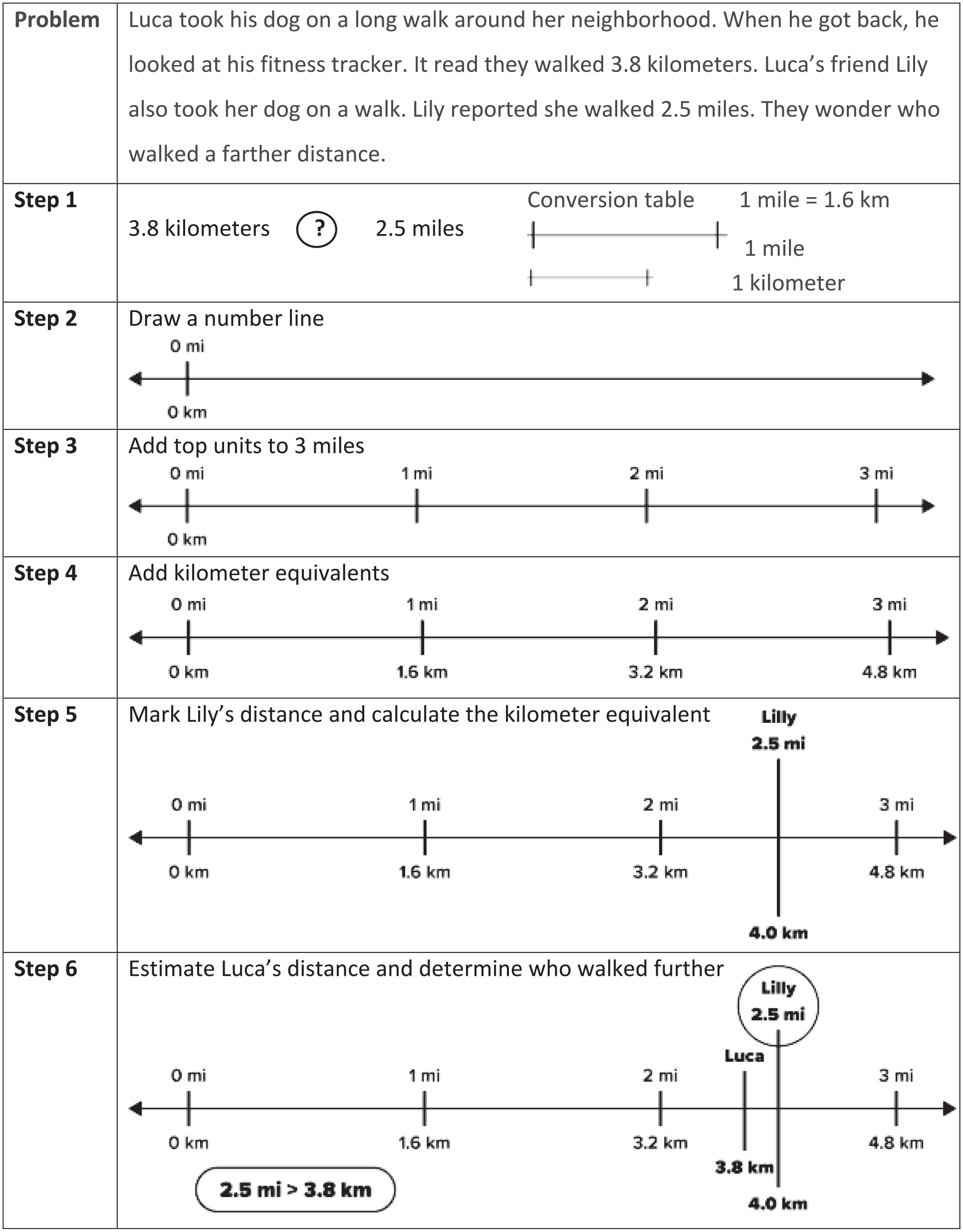
Using a number line to compare distances with different units.
Step 1: Determine the problem. To begin, Mr. Galibier’s students must understand the magnitude of a kilometer and a mile. He uses a conversion table and points out that the length of 1 mile is more than the length of 1 km. Mr. Galibier helps his students infer that even though 3.8 is a larger number than 2.5, it isn’t necessarily the farther distance. His students will have to measure the distances using the same scale to know who walked the farther distance.
Step 2: Draw a number line. To assist his students, Mr. Galibier draws a number line. On the left-hand side, he places a line with 0 miles on top and 0 km below the line.
Step 3: Represent the first unit. Since Mr. Galibier’s conversion table shows that 1 mile, a whole number, is equal to 1.6 km, a rational number, he decides to begin with miles. Lily walked 2.5 miles, so he draws lines from 0 to 3 miles in 1-mile increments to represent the first whole number after 2.5.
Step 4: Represent the second unit. Mr. Galibier shows his students how to calculate the kilometer equivalents on the bottom of the number line. Since he already knows how many kilometers are equal to 1 mile, he adds 1.6 km underneath 1 mile. Then, he adds 1.6 km to each mile marker to find the respective equivalence in kilometers at each unit marker.
Step 5: Determine the first distance. Mr. Galibier models how to find Lily’s distance. Since 2.5 is halfway between 2 and 3 miles, he draws a line to denote Lily’s distance. If 1 mile = 1.6 km, to find out the distance halfway between two points, he needs to divide 1.6 in half and add that to 3.2 km. Mr. Galibier completes the calculations and adds them to his number line, demonstrating that 2.5 miles equal 4.0 km.
Step 6: Estimate the second distance and determine the farther distance. Now that Mr. Galibier has 4 km marked on the timeline, he can estimate Luca’s distance to decide who walked the farther distance; 3.8 km is less than 4 km, so Lily walked the farther distance.
After clearly modeling each step, Mr. Galibier provides his students with multiple opportunities to practice by guiding them through the previously demonstrated steps. He gives his students a similar problem to solve with opportunities to practice their skills and share their thinking. Mr. Galibier uses a scaffold approach to his instruction to build his students’ understanding and boost their confidence in engaging them in successful learning opportunities.
Measuring Elapsed Time With Number Lines
Next, Mr. Galibier provides intervention support for a group of fourth-grade students with LD in mathematics. Today, they are working on word problems involving the concept of elapsed time. Mr. Galibier knows this can be a challenging task for students. Specifically, his students tend to have difficulty with elapsed time problems that include both hours and minutes. To support their needs, he wants to incorporate the number line into his teaching routine.
The concept of elapsed time can be complex for students, especially students with LD in mathematics. Measuring time demands using hierarchical units that can be difficult for students to coordinate (e.g., 60 min in 1 hr, 24 hr in 1 day; Kamii & Russell, 2012). Often, teaching elapsed time involves converting units and keeping track of those conversions (i.e., seconds to minutes, minutes to hours, hours to days). Rather than focusing their attention on unit conversions, it can be helpful for students to approach elapsed time problems by using a number line to count forward or backward from one time point to another (Dixon, 2008). In this way, students can use their knowledge of the number line paired with addition and subtraction methods to find a solution and determine its reasonableness.
Mr. Galibier’s fourth-grade students have been working on using number lines to add and subtract fractions. He uses this background knowledge as a basis to teach elapsed time. Previously, he taught his students how to use benchmark fractions to add and subtract between fractions fluently. He recognizes that his students can apply these same principles to measuring time (e.g., 15 min =
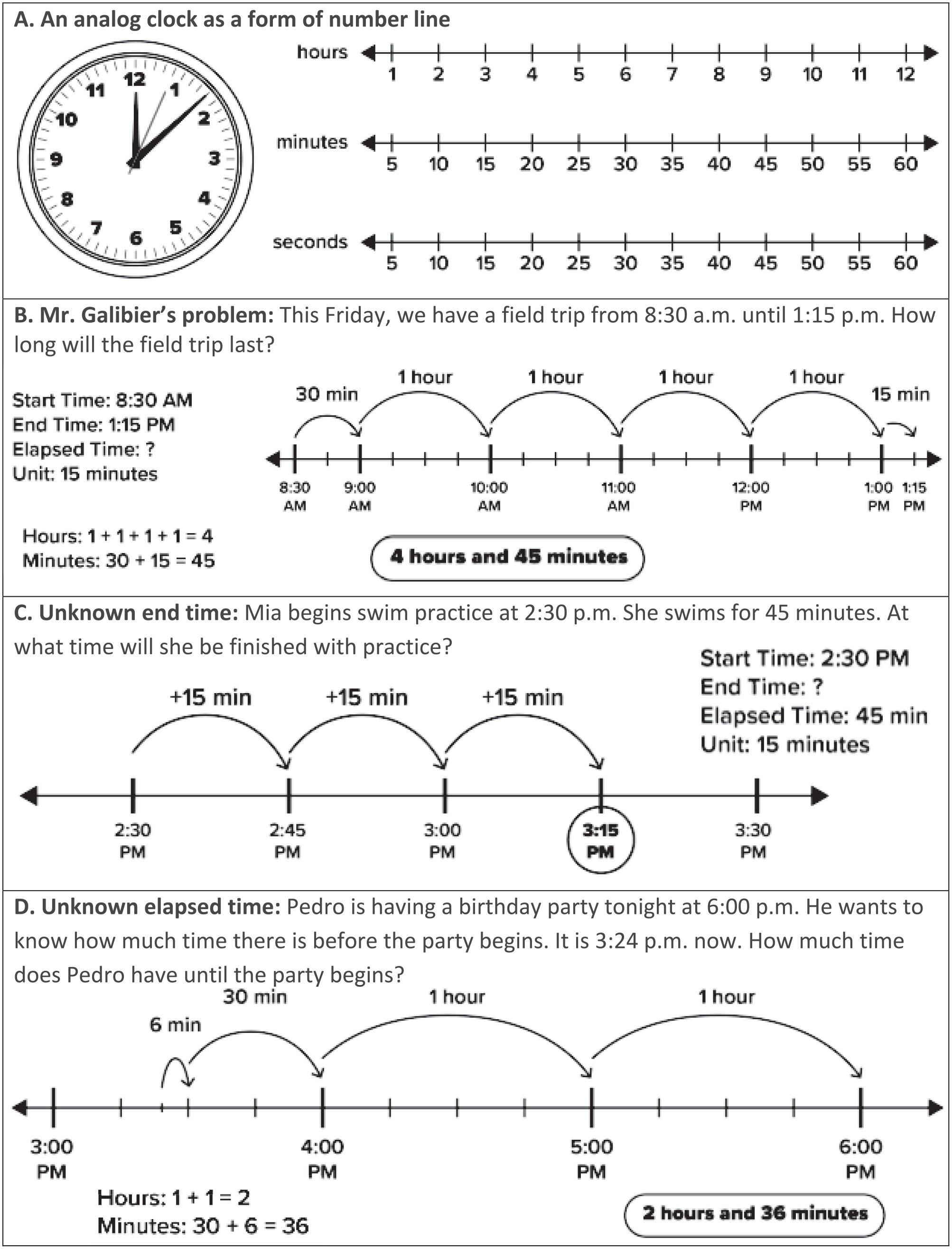
Representing elapsed time using a number line.
Step 1: Label what is known and missing. Mr. Galibier writes the start time: 8:30 a.m. He then writes the end time: 1:15 p.m. Since Mr. Galibier does not know the elapsed time, he puts a question mark next to the elapsed time. The question mark indicates what he is trying to find out.
Step 2: Determine the standard unit to use as iterations. Since the start and end times are several hours apart (but within 1 day), Mr. Galibier decides to count in 15-min increments.
Step 3: Draw a number line, beginning with the start time, and label the iterations until reaching the end time. Mr. Galibier added tic marks on his number line for every 15-min interval from 8:30 a.m. until he reached 1:15 p.m. He only adds labels on the beginning and end times and for every hour marker in between, so it is easier to count.
Step 4: Mark the elapsed time on top of the number line using benchmark units and rays to show the adding strategy. Mr. Galibier first jumped from 8:30 to 9:00 a.m., marking this increment as 30 min. Then, he moved from 1 hr to the next until 1:00 p.m. Finally, he marked 15 min from 1:00 p.m. to 1:15 p.m.
Step 5: Add the hours together and the minutes together. Mr. Galibier jumped 1 hr 4 times, making 4 hr. He added 30 min and 15 min together to get 45 min, totaling 4 hr and 45 min.
Although the steps will vary, Mr. Galibier understands he can use the number line as a basis to teach students how to answer other word problems involving time. He considers these steps and adapts them to his third- and fifth-grade groups. For his students who are less familiar with this skill, Mr. Galibier begins with more fundamental questions requiring smaller increments and missing end times (see Figure 2, Section C). For his students with greater time-based proficiency, he uses the number line to demonstrate how to solve elapsed time problems with numbers outside of benchmark time points (see Figure 2, Section D). Mr. Galibier knows that practicing this skill over time will strengthen his students’ capacity to generate mental number lines and give them a tool for solving problems with distinct units of measurement.
Measuring Liquid Volumes With Number Lines
Mr. Galibier’s fifth-grade students are measuring liquid volume in their science class. He decides to reinforce foundational mathematics skills during their mathematics intervention that directly relates to their science instruction. In this way, his students have an opportunity to integrate prerequisite measurement standards while conducting a scientific experiment.
Liquid volume is defined as the amount of liquid in a container measured in milliliters, liters, cups, pints, quarters, and gallons (NGAC & CCSO, 2010). Students often learn to measure liquid volume in beakers, flasks, or cylinders, and these tools each demonstrate the volume of the liquid in the container using a structure similar to a number line. Explicitly teaching students how the numbers on a container that measures liquid volume work like a number line further expands their flexibility and conceptual understanding of the magnitude of numbers in students’ mental number lines (Woods et al., 2018).
Mr. Galibier first defines the lesson’s targeted concept by explicitly stating that liquid or fluid volume “fills” the interior of three-dimensional shapes such as milk containers, soda cans, and measuring beakers. He then displays an example of each to introduce the three-dimensional shapes. Next, Mr. Galibier shows students how the measurement scale on a measuring beaker works like a vertical number line. To do this, he holds up a metric ruler in a horizontal position and then places it vertically to show its similarity to a flask’s measurement scale (see Figure 3). Next, he fills a flask with 380 mL of water and 90 mL of vegetable oil. Mr. Galibier explains how the class will learn how to use the measurement scale on the flask as one way to determine the total volume of liquid. He also models on the board how to add the two quantities (i.e., water and vegetable oil) as another solution pathway. Following these introductions, Mr. Galibier explicitly demonstrates how to convert the units from milliliters to liters. To conclude the activity, he facilitates opportunities for students to work in pairs to calculate the total volume of four different types of liquids, providing academic feedback as students progressed through the activity.
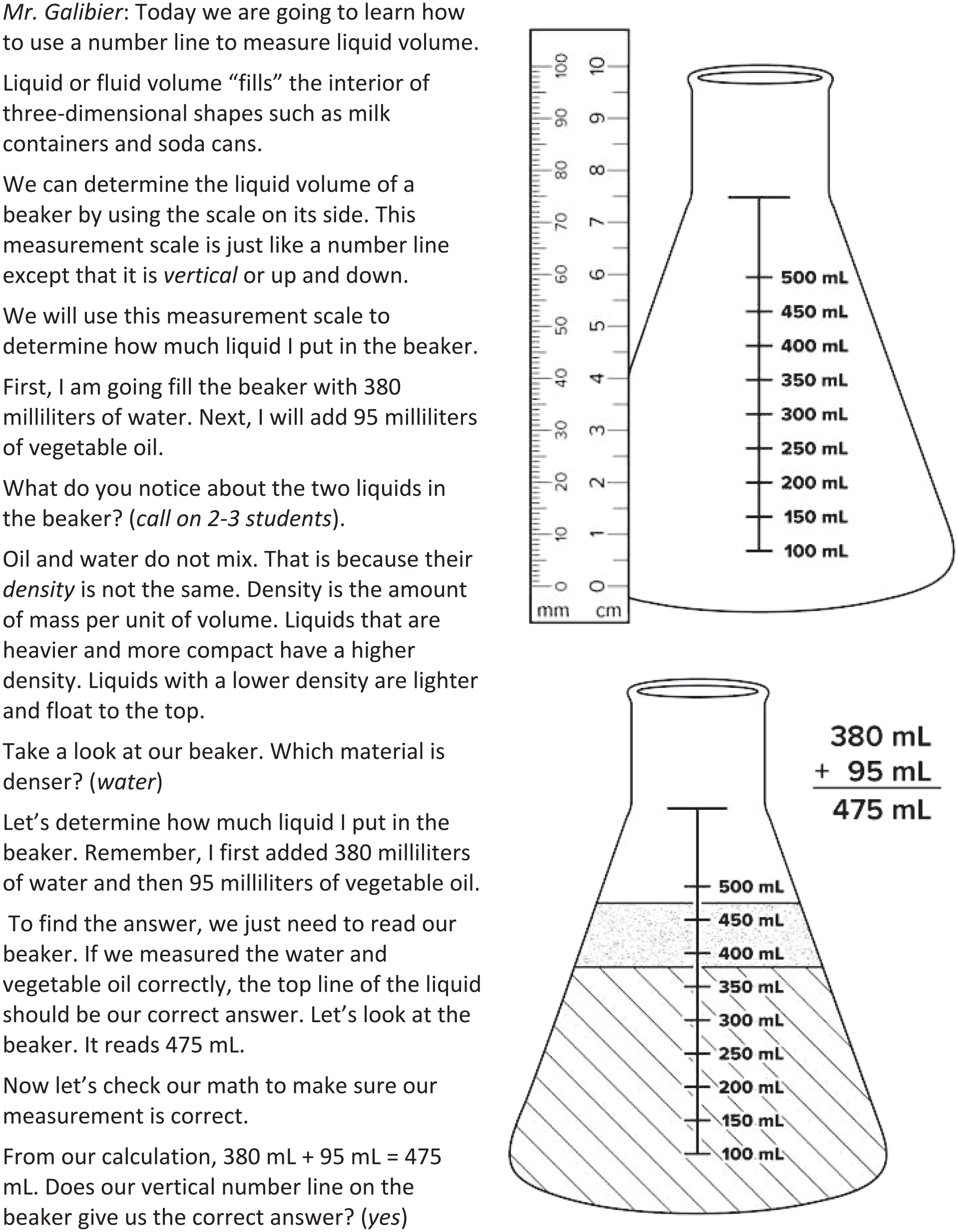
Incorporating a vertical number line to teach the concept of liquid volume.
Figure 3 illustrates the introduction to this activity and shows how Mr. Galibier integrated a core disciplinary idea of science to provide his students with a meaningful context when solving liquid volume problems. He uses the principles of explicit instruction to systematically introduce the new concept of liquid volume to his students. Mr. Galibier includes clear definitions of new vocabulary terms, models his thinking in how to solve the problem, provides ample practice opportunities, and gives concise academic feedback to guide students through the learning process to improve their mathematic success (Doabler et al., 2021).
Comparing the Masses of Objects With Number Lines
After lunch, Mr. Galibier teaches his fourth-grade group how to solve word problems involving mass. Based on his recent PD, he wants to explicitly teach his students how number lines can be used to record mass, including when units are measured in fractions or decimals.
Mass is the amount of matter in an object and is often introduced to students as a measure of how heavy an object is (Next Generation Science Standards Lead State [NGSS], 2013). Although mass is conceptually different from weight (i.e., the pull of gravity needed to keep an object on Earth’s surface), the two are directly proportional, so they are measured the same way in elementary school. For elementary students, the difference between mass and weight does not need to be overly emphasized. Instead, the instructional focus should be comparing masses of real objects using tools (Reys et al., 2015). One tool used to introduce the measurement of mass is a simple balance. A balance can be used to teach students how to compare the masses of two objects directly (e.g., determining what objects move a balance) or to use standardized units for measuring mass (e.g., placing an object on one side and adding gram cubes to the other side until the two sides are balanced). Eventually, students will learn to use more sophisticated measurement tools, such as a digital scale or a triple beam balance. The scales on a triple beam balance are similar to number lines and are used to measure an object’s mass as the distance from zero units. Students must read and compare measurements in whole numbers and fractional or decimal parts with each tool.
The difficulties students with LD face when comparing the magnitude of numbers may impede their ability to complete tasks that require comparing the masses of two or more objects in unstandardized (e.g., teddy bears) or standardized (e.g., grams) units (Gersten et al., 2005). The number line can support students when comparing units of measured objects and can be used to record and represent measurement data. A number line with whole number intervals can be used for recording measurement data to the nearest whole number. Then, when students are required to take more precise measurements, a number line with fractions or decimals can be used. Two examples are provided to demonstrate how students can use the number line to record and compare the masses of different objects.
Mr. Galibier begins by reviewing how to measure the mass of objects to the nearest whole number using a simple balance and gram cubes. He gives his students a number line marked with whole numbers, as demonstrated in Figure 4, Section A, to record their measurements and help them solve the following word problem. By the end of the instructional unit, the students in Mr. Galibier’s class are ready to measure the mass of objects in more precise units.
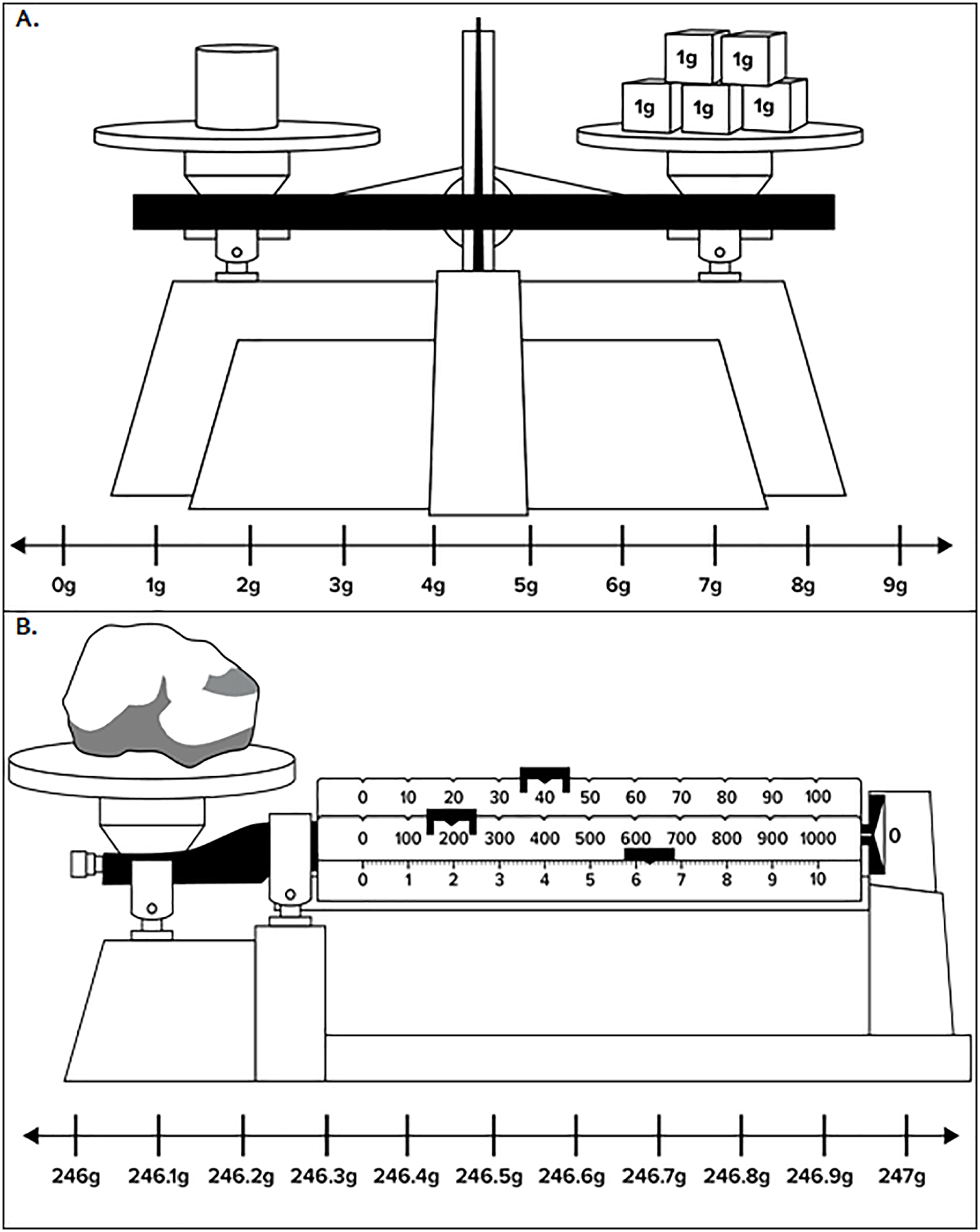
Solving measurement problems involving mass with a number line.
Winnie is measuring a wooden cylinder on one plate. Her plan is to add gram cubes to the other plate until the two sides are balanced. She adds two gram cubes, notices they still are not balanced, and then adds three more until they are balanced. What is the mass of the cylinder in grams?
Prior to the lesson, he taught them how to use a triple beam balance to measure mass and read measurements to the nearest tenth of a gram. As shown in Figure 4, Section B, he provided his students with a number line marked to the tenths place to record precise measurement data. Providing examples relevant to everyday life and practice opportunities that generalize applying number lines to measure mass offers students opportunities for productive success by scaffolding instruction to appropriately guide them through mathematical problem-solving (McLeskey et al., 2017).
Conclusion
Number lines are an effective tool for supporting students with LD in mathematics to develop a robust understanding of the magnitude of whole and rational numbers (Dyson et al., 2020; Fuchs et al., 2021). In measurement, number lines aid students with comparing magnitudes across varying units (e.g., meters and kilometers) and systems of measurement (e.g., kilometers and miles; milliliters and ounces). Systematically modeling how number lines are used to support an array of problem types involving different units can support students’ understanding of measurement concepts. For upper elementary students, building more precise measurements into number lines fosters opportunities to compare magnitudes and perform operations to solve problems involving varying measurement scales accurately.
Footnotes
Declaration of Conflicting Interests
The author(s) declared no potential conflicts of interest with respect to the research, authorship, and/or publication of this article.
Funding
This project is funded by a National Science Foundation grant (2010550) to The Meadows Center for Preventing Educational Risk at The University of Texas at Austin. Any opinions, findings, conclusions, or recommendations expressed in these materials are those of the authors and do not necessarily reflect the views of the National Science Foundation.
