




Abstract
Stuttering is a common disorder addressed by speech-language pathologists in elementary schools. Although students who stutter likely receive specialized services from speech-language pathologists, other school personnel, including special and general educators, play a key role in creating supportive and positive learning environments for these students. Most special education teachers, however, receive little or no information about stuttering. Yet, because special educators collaborate and consult regularly with general educators, they are well positioned to communicate essential information about supports that can be provided. Increased understanding of stuttering and techniques for supporting students can greatly minimize the negative outcomes experienced by many students who stutter. This article provides teachers with (a) information about stuttering to improve understanding of the disorder, (b) guidance on how to provide classroom and student-level supports to create a positive learning environment for students who stutter, and (c) recommendations for collaborating with speech-language pathologists.
Historically, speech-language pathologists have faced large and unmanageable caseloads (Katz et al., 2010), with clinicians working in elementary schools facing the highest caseloads compared with those working in any other setting (American Speech-Language-Hearing Association, 2020). Unfortunately, this causes most speech-language pathologists to feel they have insufficient time to provide quality services for all students on their caseloads (American Speech-Language-Hearing Association, 2020), including students who stutter. Fortunately, students who stutter can benefit greatly from positive experiences outside of the therapy room with their peers and other school personnel.
Despite the fact that from 5% to 11% of students will stutter at some point in their lives (Reilly et al., 2013), many teachers are unfamiliar with what stuttering is or what they can or should do to support students who stutter (Plexico et al., 2013). Furthermore, most special educators do not receive training in speech and language disorders (Plexico et al., 2013). Therefore, the purpose of this article is to provide teachers—both special and general—with basic information about stuttering as well as classroom and student-level support strategies that can be implemented to ensure a positive learning environment for students who stutter and their peers.
What Special Education Teachers Should Know About Stuttering
Special education teachers can help students who stutter by increasing their own knowledge of stuttering related to (a) the general definition of stuttering and types of stuttering, (b) stuttering onset and recovery, and (c) negative effects associated with stuttering.
Stuttering is often characterized as a disruption in the forward flow of speech, classifying stuttering as a disorder with speech fluency and behavioral elements. Instances of stuttering are typically described as either overt or covert behaviors (Bloodstein et al., 2021; Douglass et al., 2019). Overt behaviors include part- or whole-word repetitions (e.g., My name is J-J-Joey.) and prolongations of sounds (e.g., What did you get m—om for her birthday?) as well as inaudible blocks in voicing (e.g., What time does —hockey practice start? [Bloodstein et al., 2021]). Covert stuttering refers to tricks and distractions individuals who stutter may use to hide their stuttering and appear fluent (Constantino et al., 2017). These behaviors include replacing a difficult word with an easier word (e.g., Ordering Pepsi at a restaurant because it is easier to say than Coke), adding a filler word as if the speaker forgot what they were going to say (e.g., I went to the, um, basketball game last night), or pausing due to an anticipation of stuttering and restarting when the speaker feels they can speak fluently (e.g., My favorite color is [pauses and adjusts glasses] blue; Douglass et al., 2019).
Overall, the main difference between overt and covert stuttering is that listeners are typically aware of instances of overt stuttering, whereas they may be unaware of instances of covert stuttering (Douglass et al., 2019). It is important to note, however, that individuals who stutter do not typically do so strictly through overt or covert behaviors. Instead, individuals who stutter may experience overt and covert stuttering behaviors interchangeably. Regardless, overt and covert stuttering affect individuals’ ability to communicate (Langevin et al., 2010).
Onset and Recovery
The exact cause of stuttering remains unknown although most research points to either genetic or environmental factors as the cause of the disorder (Guitar, 2013) as well as structural or functional brain anomalies, or both (Chang & Zhu, 2013; Cykowski et al., 2010; St. Louis et al., 2017). Regardless of the exact cause, stuttering typically emerges when children are between 2 and 5 years in age (Guitar, 2013), which is when children start to produce short phrases (e.g., daddy home; Reilly et al., 2009). Estimates of stuttering frequency suggest that anywhere between 5% and 11% of preschool-age children will begin to stutter (Reilly et al., 2013). However, 65% to 80% of those children naturally recover from stuttering without the need for intervention (Yairi & Ambrose, 2013). The low percentage of children who begin to stutter coupled with the high percentage of those who recover naturally suggests that approximately 1% of the world’s population has childhood-onset stuttering, commonly referred to as persistent developmental stuttering (Craig et al., 2002).
It is important to note, however, that natural recovery does not occur randomly. In fact, certain factors predict which children are likely to recover and which children are not (Yairi et al., 1996). For instance, girls who begin to stutter are more likely to naturally recover than boys (Yairi & Ambrose, 2013). However, the likelihood of natural recovery greatly decreases if stuttering has been present for more than 15 months (Ingham & Cordes, 1998). Thus, the students special education teachers encounter are likely beyond the window of natural recovery, meaning the focus of therapy for elementary-age students will include efforts to modify stuttering as well as promote acceptance and openness toward stuttering, increase self-confidence, and manage the negative effects of stuttering (Yaruss et al., 2012). Special education teachers can help students who stutter by creating a healthy environment that promotes engagement and learning rather than attempting to prevent, reduce, or treat stuttering.
Negative Effects of Stuttering
Unfortunately, stuttering can lead to many negative and unwelcome outcomes. First, stuttering can lead to a fear of social situations and low self-esteem, which restricts individuals’ participation in social opportunities (e.g., introducing oneself to a potential friend; Brignell et al., 2020). In addition, researchers examining the effects of stuttering on daily life suggest a strong link between stuttering and anxiety (Blood et al., 2007). It is important to note, however, that stuttering is not caused by anxiety; rather, anxiety is a product of stuttering (Alm, 2004). This may be because children who stutter experience negative social consequences because of their speech, such as bullying and teasing. In fact, past reports estimate a high instance (i.e., 43%–61%) of being bullied among students who stutter compared with lower instances of experiencing bullying among students who do not stutter (i.e., 11%–22%; Blood & Blood, 2004, 2007). Taken together, these negative effects of stuttering can influence individuals across the life span, as evidenced by the fact that individuals who stutter are viewed as less employable than their fluent peers (Irani et al., 2009). Fortunately, special education teachers can play a key role in preventing and combatting bullying and teasing for all students, including students who stutter (Blood et al., 2010).
Classroom-Level Support Strategies
In terms of supporting students who stutter, the role of the speech-language pathologist is to determine whether the services provided should address stuttering directly or whether indirect treatments are more appropriate, whereas the role of the special educator is to collaborate with general educators to create productive learning environments. Specifically, special educators can foster a pro-social, supportive classroom environment for students who stutter by (a) dispelling common myths associated with stuttering, (b) introducing books and media that include accurate and positive portrayals of stuttering, and (c) integrating teasing and bullying prevention programs within their classes.
Dispelling Stuttering Myths
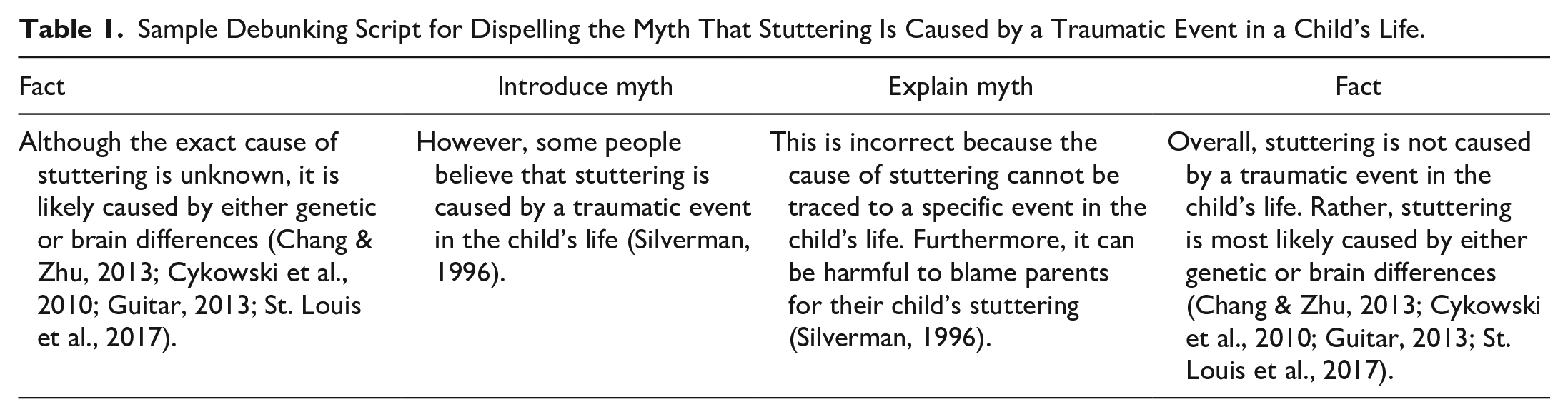
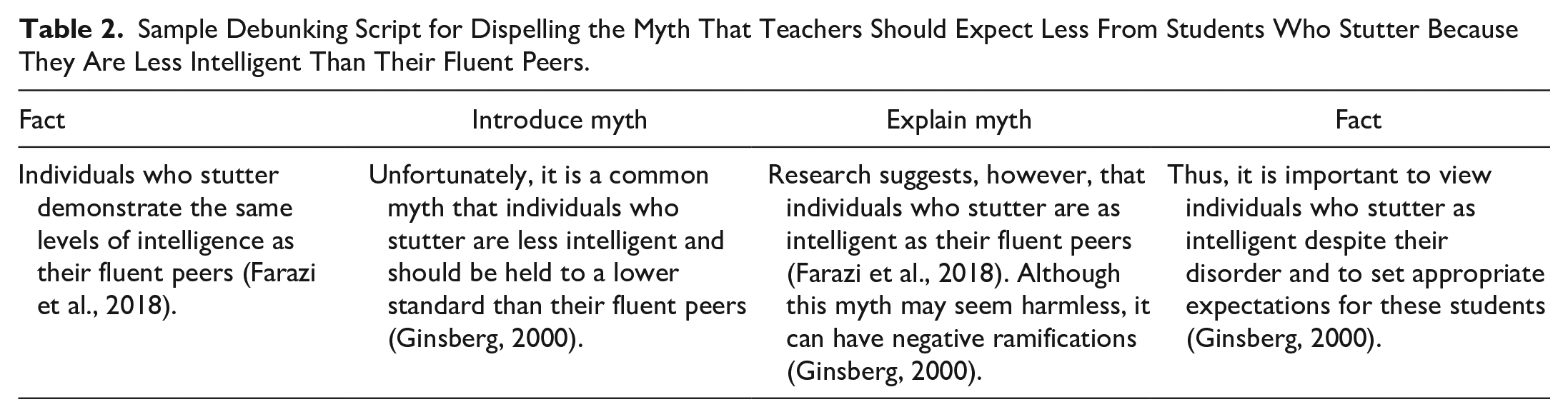
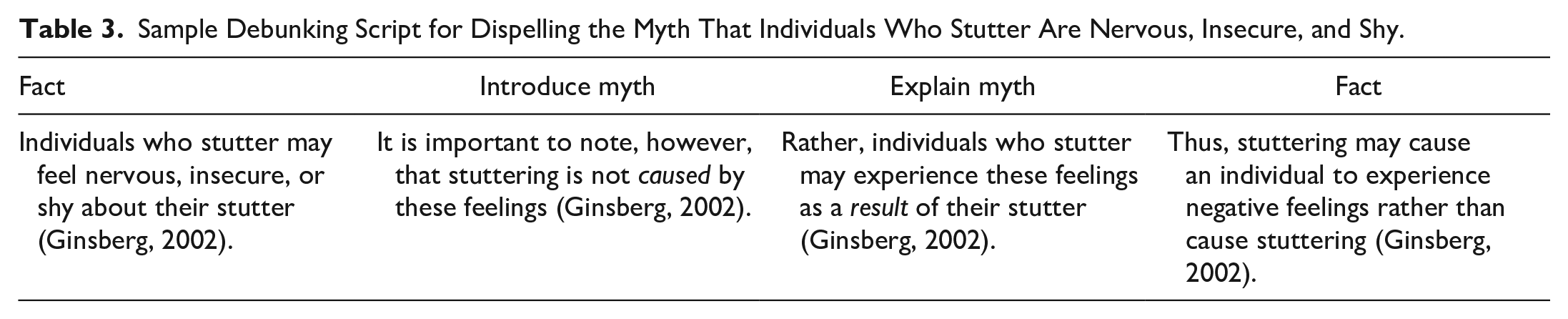
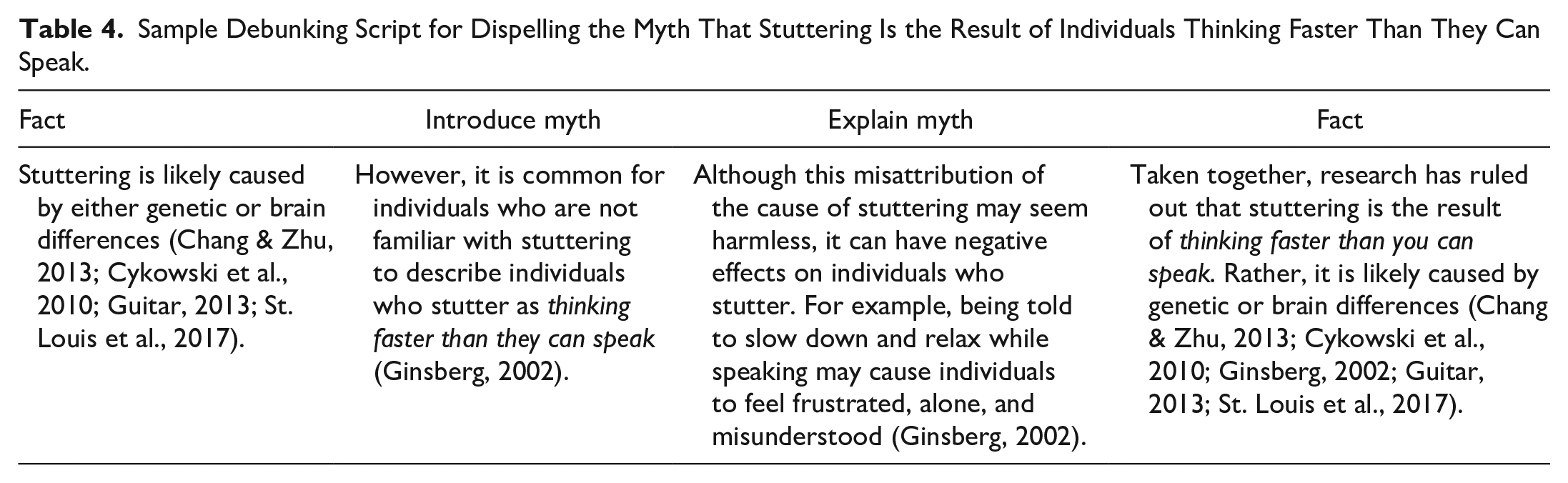
Beliefs that teachers and peers have about stuttering can influence how students who stutter are treated. Dispelling common myths about stuttering is a beneficial first step to increasing understanding of stuttering, which can then lead to a reduction in the negative stereotypes associated with stuttering that may be held by teachers, parents, and students (Boyle et al., 2016). Myths can be dispelled by following four steps: (a) lead with a fact, (b) introduce the myth, (c) explain the myth and why it is misleading, and (d) reintroduce the fact (Lewandowsky et al., 2020). Special education teachers can apply the example scripts found in Tables 1 to 4 while dispelling four common stuttering myths.
Sample Debunking Script for Dispelling the Myth That Stuttering Is Caused by a Traumatic Event in a Child’s Life.
Sample Debunking Script for Dispelling the Myth That Teachers Should Expect Less From Students Who Stutter Because They Are Less Intelligent Than Their Fluent Peers.
Sample Debunking Script for Dispelling the Myth That Individuals Who Stutter Are Nervous, Insecure, and Shy.
Sample Debunking Script for Dispelling the Myth That Stuttering Is the Result of Individuals Thinking Faster Than They Can Speak.
Stuttering in the Media
Special education teachers can further promote a complete understanding of stuttering by introducing books in which the main character accurately represents an individual who stutters. Examples of such books include A Boy and His Jaguar by Alan Rabinowitz, Paperboy by Vance Vawter, Stuttering Stan Takes a Stand by Artie Knapp, and The Zoo at the Edge of the World by Eric Kahn Gale. It is important that books or other materials that are used to represent stuttering do so accurately as many instances of stuttering in the media are used as a source of comedy (e.g., Porky Pig from Looney Toons) or to portray a character who stutters as shy, timid, or nervous (e.g., Professor Quirrell from Harry Potter and the Sorcerer’s Stone). Additional resources can be selected and analyzed using the checklist found in Figure 1. Please note that this checklist is not exhaustive. However, a higher number of “yes” answers suggest that the material is likely appropriate for classroom use.
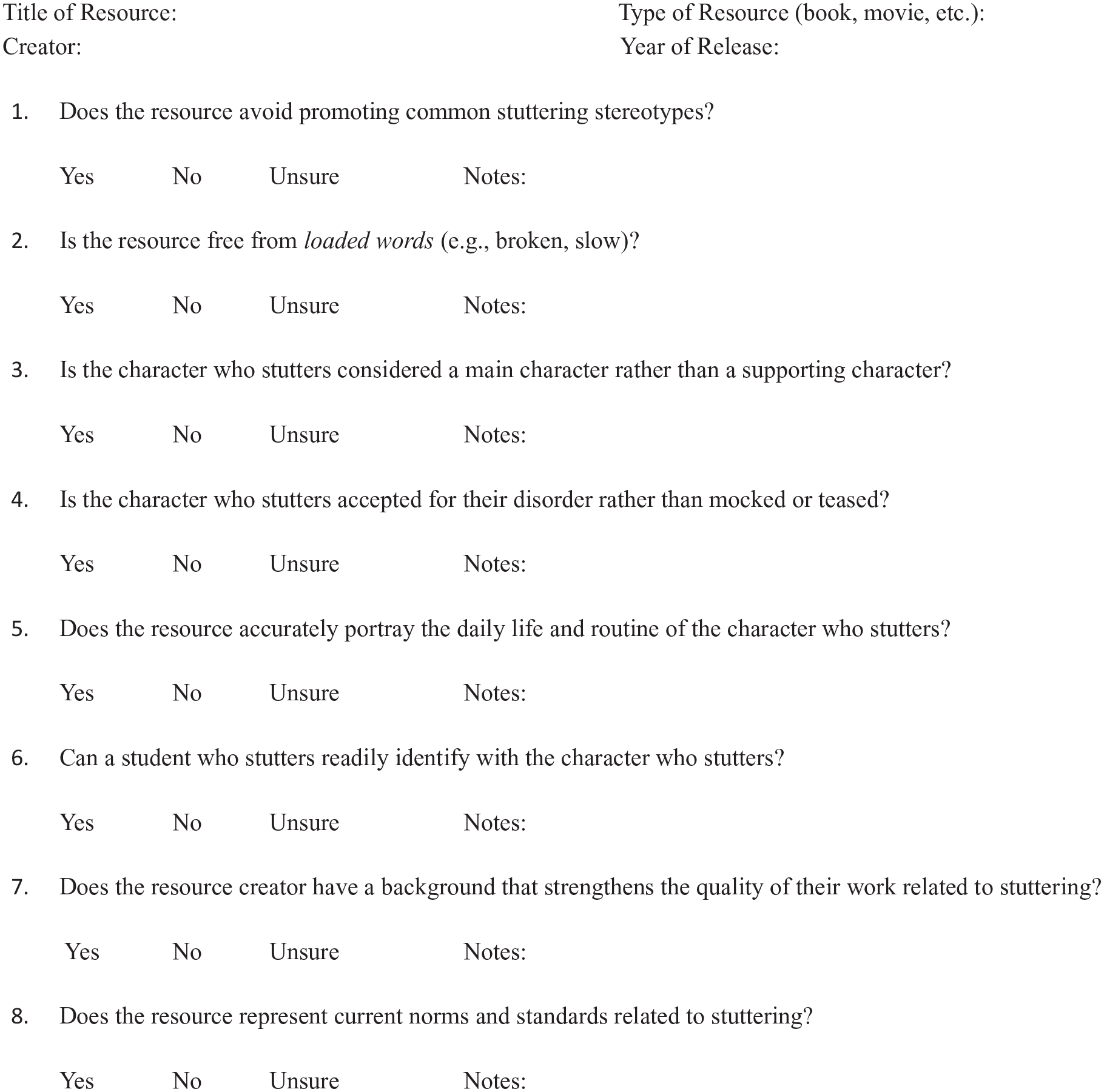
Guiding questions for evaluating classroom materials.
Teasing and Bullying Prevention Programs
Unfortunately, students who stutter are likely to experience teasing or bullying in the classroom (Blood & Blood, 2004, 2007). Therefore, special educators may also wish to implement anti-bullying curriculums designed with an emphasis on stuttering. For example, the Teasing and Bullying: Unacceptable Behavior Program was created specifically for students who stutter and their classmates, and is effective at reducing teasing and bullying while promoting positive attitudes toward stuttering (Langevin & Prasad, 2012). This program consists of eight components: (a) understanding bullying, (b) why bullying may upset others, (c) why a person may bully, (d) how it feels to be bullied, (e) how to help another student stop bullying and what students can do if they are being bullied, (f) conflict resolution strategies, and (g) classroom rules and consequences for bullying. The eighth component of the program relates specifically to individuals who stutter. For example, this section of the program deals with issues such as the cause of stuttering, understanding stuttering, and strategies to help individuals who stutter (Langevin & Prasad, 2012). A major strength of this program is the focus on preventing teasing and bullying from occurring rather than teaching students who stutter how to handle teasing and bullying. This is an important distinction as students who stutter may not feel comfortable providing a verbal response to teasing or bullying aimed at their speech (Erickson & Block, 2013). Figure 2 provides an example lesson plan of one of the lessons included in the program. The full program can be found on the University of Alberta’s website (www.ualberta.ca/stuttering-speech-therapy/programs-treatment/treatment-options/teasing-bullying.html).
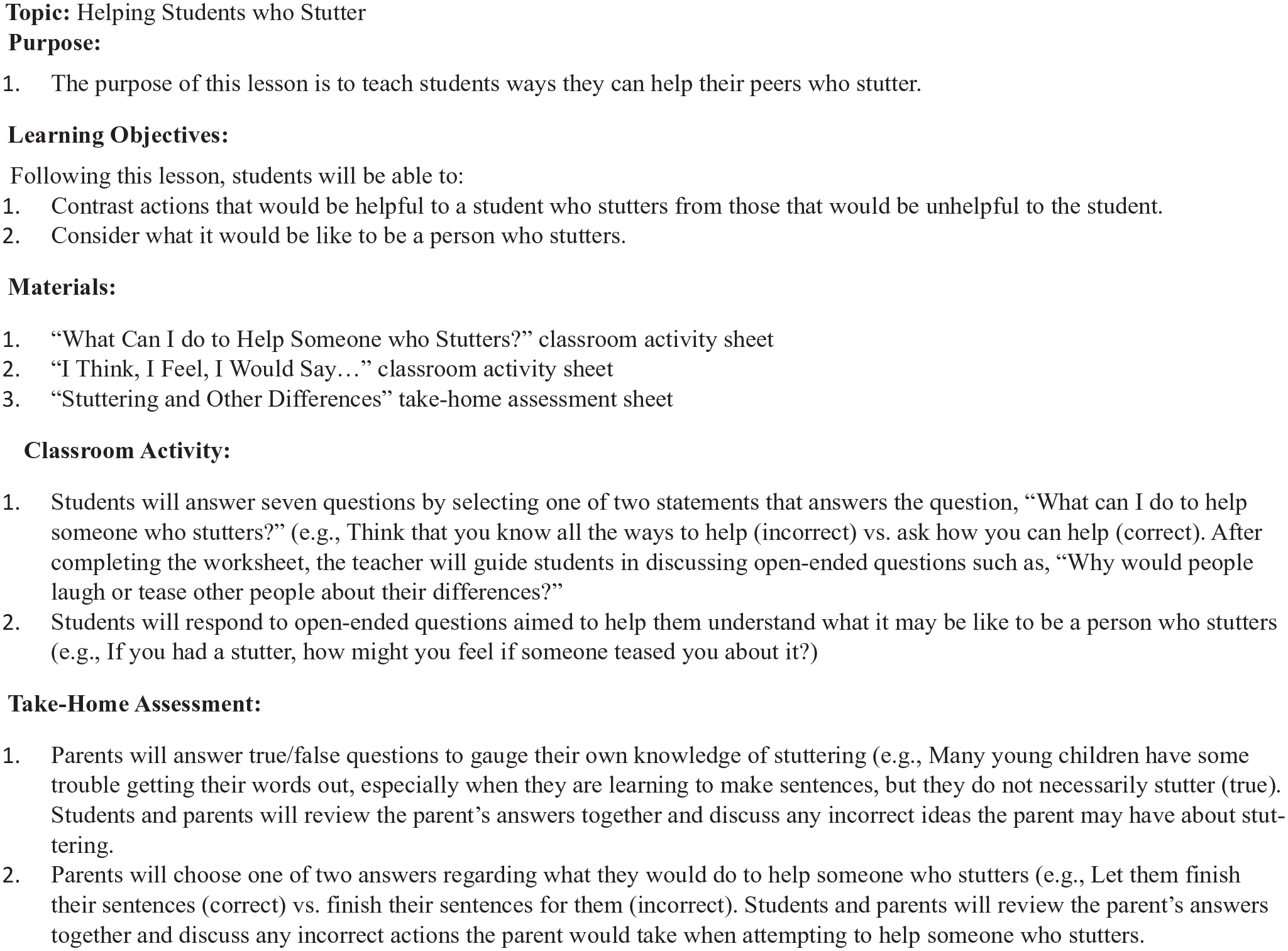
Example lesson plan from teasing and bullying: Unacceptable behavior program.
Student-Level Support Strategies
In addition to using classroom-level tools to promote a positive learning environment, special education teachers can also implement various student-level supports based on students’ needs and preferences. These supports include (a) encouraging students to attend a stuttering support group, and (b) collaborating with students throughout the school year.
Stuttering Support Groups
Teachers can support students who stutter by promoting cognitive and affective changes, such as feeling more confident speaking out in class or joining in conversations (Cooke & Millard, 2018). For example, teachers may help promote these changes by encouraging students who stutter to join support groups for individuals who stutter. Support groups allow the opportunity to discuss unique and shared experiences, seek advice and encouragement, and identify role models (Thoits, 2011). Furthermore, joining support groups has been shown to decrease the negative effects of stuttering by promoting resilience (Gerlach et al., 2019). Stuttering support groups can be found using the chapter locator tool on the National Stuttering Association’s website (https://westutter.org/chapters/).
Student–Teacher Collaboration
Not all students who stutter will have the same needs and preferences. Therefore, it is important for teachers to collaborate with students to determine the best methods for supporting them (Cozart & Wilson, 2021). For example, students who stutter have varying opinions toward speaking out in class. More specifically, some students may prefer being called on randomly, whereas others may prefer to be called on in a prearranged order (Lees, 1999). Furthermore, some students may prefer to be called on early, whereas others may prefer to be called on only when they volunteer to answer a question (Guitar, 2013). Regardless, most accounts urge teachers against the use of quick callout answers, as these may limit students’ ability to answer questions or invoke feelings of anxiety (Cozart & Wilson, 2021). Teachers may wish to gauge student preferences at the beginning of the school year by asking the student to fill out a brief questionnaire regarding their needs and preferences for engaging in classroom instruction. Furthermore, it is important to allow opportunities for students to update this information throughout the school year. Taken together, it is important to collaborate with students to develop strategies to promote positive feelings toward speaking aloud in the classroom.
Collaboration Between Teachers and Speech-Language Pathologists
Although these strategies could be implemented independently by general or special education teachers, it is likely that greater benefits will be achieved if speech-language pathologists and teachers collaborate with one another to support students who stutter. Clearly, both teachers and speech-language pathologists bring unique skill sets to a collaborative relationship. For example, speech-language pathologists likely have advanced knowledge related to tailoring interventions to meet the unique needs of students, specifically students who stutter (Bauer et al., 2010). In contrast, teachers may enter a collaborative relationship with valuable information related to the student’s relationships with their peers (Bauer et al., 2010; Wallace et al., 2022). Despite these differences in knowledge and expertise, it is important for teachers and speech-language pathologists to view one another as capable professionals working toward a common goal (Pena & Quinn, 2003).
There are several factors for teachers and speech-language pathologists to consider when entering a collaborative relationship. First, teachers may identify any feelings of ownership toward their classroom, and therefore may wish to initiate a relationship with the speech-language pathologist rather than waiting for them to request permission to enter their classroom (Pena & Quinn, 2003). Similarly, speech-language pathologists should remain respectful of the teacher’s classroom and teaching practices (Wallace et al., 2022). Teachers and speech-language pathologists may instead wish to begin their collaborative relationship on neutral ground, such as by attending a professional workshop geared toward collaboration in the school setting. Attending a workshop could aid both professionals in learning about common collaborative techniques and may also foster networks with similar collaborative pairs (Bauer et al., 2010; Heisler & Thousand, 2021).
It is also important for the teacher and speech-language pathologist to schedule and maintain meeting times throughout the school year (Bauer et al., 2010). At these meetings, the pair may wish to discuss topics such as goals for the student who stutters, their unique needs, how to measure progress, methods for upholding classroom expectations in speech therapy, and methods for incorporating speech therapy goals into the classroom (Heisler & Thousand, 2021). For example, the pair may discuss ways the teacher can provide students who stutter with additional reminders and cues throughout the school day to apply the strategies learned in speech therapy. This can further allow students who stutter the opportunity to practice newly learned skills with their peers, which can promote generalization and long-term success (Moore-Brown & Montgomery, 2001). As the school year progresses, the teacher and speech-language pathologist may wish to debrief, reflect, and celebrate successes, as well as attempt to resolve any issues in the collaborative relationship (Heisler & Thousand, 2021).
Conclusion
Although individuals who stutter likely receive services from speech-language pathologists, other school personnel, such as general and special education teachers, can also play a key role in the lives of students who stutter. More specifically, school personnel can collaborate with speech-language pathologists to employ a variety of classroom-level support strategies, such as integrating teasing and bullying prevention programs within their classes, as well as student-level support strategies, such as collaborating with students, to promote a positive learning environment for students who stutter.
Footnotes
Acknowledgements
The author would like to thank Dr. Kristen Sayeski and Dr. Patrick Finn for their contributions to this article.
Declaration of Conflicting Interests
The author(s) declared no potential conflicts of interest with respect to the research, authorship, and/or publication of this article.
Funding
The author(s) received no financial support for the research, authorship, and/or publication of this article.
