




Abstract
Children who speak with nonmainstream American English (NMAE) dialects represent a growing population in the U.S. public school system. This article provides recommendations for how teacher educators can support novice teachers in addressing the needs of NMAE speakers with or at risk for learning disabilities. This article focuses on four core recommendations that teacher educators and other practitioners can learn from and apply in teacher preparation coursework to support the learning outcomes and needs of NMAE dialect speakers. These are (a) basic instruction on and descriptions of language variation in reading methods courses, (b) addressing language variation within the core areas of language development, (c) guidance for novice teachers to critically examine reading and literacy theories to plan instruction, and (d) collaboration across disciplines to encourage interdisciplinary partnerships with other school personnel.
Keywords
In 2014, the United States experienced a historical transition when students of color comprised the majority of public school student enrollment in elementary and secondary schools (McFarland et al., 2017). Along with the growth in the number of students of color in schools came an increase in the number of dialects of the English language spoken in the classroom. African American English (AAE) is one of several common dialects of English that are considered to be nonmainstream, or varying systematically from general or mainstream American English (MAE), which is also a dialect of American English. Other nonmainstream American English (NMAE) dialects include Appalachian English, Cajun/Creole English, and Rural Southern White English, for example (Wolfram & Schilling, 2016). Dialects are recognized as systematic, rule-governed, and valid varieties of language. Each dialect has distinct features that may cross all domains of language, including morphology, phonology, syntax, semantics, and pragmatics (American Speech-Language-Hearing Association [ASHA], 2003).
Children who use fewer NMAE dialect features in the classroom tend to demonstrate higher performance on reading fluency, reading comprehension, spelling, vocabulary, and writing tasks (Craig et al., 2009; Puranik et al., 2020), suggesting that the use of MAE features is positively related to language and literacy performance in the classroom. Thus, traditional research has suggested that it may be advantageous for students to use fewer NMAE features. Converging evidence suggests, however, that the use of dialect alone may not be a risk factor (Gatlin & Wanzek, 2015) as previously believed (Labov, 1995; Snow et al., 1998). But rather, metalinguistic awareness, marked by the ability to change frequency of use of nonmainstream dialectal features in various contexts, may be more closely related to performance on measures of reading performance (Charity et al., 2004; Terry & Scarborough, 2011). In other words, in various studies, researchers have given different language tasks to children, such as asking them to verbally tell a story, repeat sentences, or write a story on a given topic. By analyzing individual language samples and counting the use of dialect features within those samples, researchers have found that some children tend to use dialect features more frequently in certain tasks, in particular oral narratives, and less frequently in tasks such as writing, where most would agree that standard English is expected. In turn, those children who do not demonstrate linguistic flexibility (i.e., as evidenced by varying dialect use in different tasks) generally have lower reading and writing outcomes. According to the metalinguistic awareness hypothesis, also known as the linguistic awareness or linguistic flexibility theory, children who demonstrate dense NMAE use in contexts that presuppose MAE (e.g., written language tasks) may also demonstrate a lack of general linguistic awareness that can impede reading and writing achievement.
Children who have or who are at risk for learning disabilities (LD) often perform poorly on language and literacy tasks. In terms of the conceptualization of disabilities, it is important to frame conversation around disabilities among children who speak NMAE as children who have a learning disability within their dialect. This terminology is consistent with the field of speech–language pathology (Oetting et al., 2016), and it promotes the understanding that children are all dialect speakers (inclusive of MAE), and that a language or learning disability occurs within someone’s dialect or language variation. It is also important when teaching students who speak NMAE, that practitioners are aware of dialectical variation and how dialect can inform high quality instruction for students with LD. However, these issues are rarely, if at all, directly addressed in teacher preparation programs. Novice teachers need support in their central reading methods courses not only in reading development, instruction, and intervention, but also in learning key recommendations to meet the needs of NMAE speakers and understanding how language variation overlaps and connects with the content they are learning.
Very few intervention studies exist that explicitly address nonmainstream dialects with literacy skills as outcomes of interest (Gatlin-Nash & Terry, 2022; Johnson et al., 2017). Likewise, it appears that no intervention studies exist on professional development for preservice or inservice teachers on nonmainstream dialects and student literacy outcomes, which would provide evidence for causal relations between teacher knowledge of language variation and student achievement. However, Diehm and Hendricks (2021) found that previous coursework on AAE predicted teachers’ overall linguistic knowledge. In an experimental study (Fogel & Ehri, 2006), various approaches to familiarizing classroom teachers with features of AAE resulted in increased teacher knowledge and positive attitudes toward AAE. Given the power that both teacher knowledge and teacher expectations have on student outcomes (Rubie-Davies, 2015), and further, given the fact that teacher knowledge is a malleable educational factor, it is worthwhile to focus attention on addressing preservice teachers’ knowledge on nonmainstream dialects. Scholars who research AAE in the context of schools generally agree that speaking a nonmainstream dialect is not a risk factor in and of itself, but rather, it becomes one when students’ needs are not recognized or properly addressed (Washington & Seidenberg, 2021). To address these needs, developing teacher knowledge and skills is critical. Accordingly, this article focuses on four core recommendations that teacher educators can use to support novice teachers building their skills to address the learning needs of NMAE speakers with and at risk for LD:
Include basic instruction on and descriptions of language variation in reading methods courses.
Address language variation within each of the core areas of language development.
Provide guidance for novice teachers to critically examine various reading and literacy theories to plan instruction that meets students’ needs more meaningfully.
Implement collaboration across disciplines to encourage interdisciplinary partnerships with other school personnel.
Recommendation 1: Basic Instruction on Language Variation
As described in Gatlin-Nash et al. (2020, p. 26), the following scenario took place in a first-grade classroom during the language arts block of instruction in an elementary school in the Southeastern United States. During whole group instruction, the teacher walks around the classroom and primes the children for background knowledge before reading a story. The teacher asks the class, “Who knows what the word ‘strain’ means?” Malcolm, a Black male student who is seated at a desk by himself in the corner, enthusiastically raises his hand, “Ooh, ooh me, I know.” The teacher nods and tells him to go ahead. Malcolm responds, “It’s like a rope except smaller.” The teacher, with a puzzled look on her face, says, “No, that’s not it. Does anyone else think they know the answer?” The teacher then calls on another student who has raised her hand. That student gives an acceptable definition of “strain” while making a hand gesture that signifies a squeezing motion. The teacher praises the student for her response and then gives the textbook’s definition of “strain” and uses it in a sentence. The teacher walks around the classroom and proceeds to read the story aloud to the class. Malcolm, in the corner by himself, begins playing with pencils inside his desk (see Note 1).
As explained by Gatlin-Nash et al. (2020), two common phonological features of both AAE and Southern American English are g-dropping (e.g., runnin’) and vowel shifting (e.g., think pronounced as thank). When Malcolm hears the teacher say “strain,” his interpretation of the word is likely how he would pronounce “string” (e.g., “I tied my shoestrain.”). Thus, he provides an accurate definition of “string” accordingly—“like a rope except smaller.” However, the teacher does not appear to understand why Malcolm is giving what appears to be a completely incorrect definition.
Although organizations in speech–language pathology provide guidance to professionals in the field regarding provision of services for speakers of various American English dialects and require specific competencies for distinguishing dialectal differences and language disorders (ASHA, 2003; Council for Clinical Certification in Audiology and Speech-Language Pathology of the American Speech-Language-Hearing Association, 2020), teachers may receive little training on AAE and other nonmainstream dialects of English. In a survey of 571 preservice and inservice teachers, Diehm and Hendricks (2021) found that few teachers (14%) reported having received training on AAE. In assessments of teacher knowledge of AAE, overall, teachers demonstrated limited understanding of linguistic terms commonly found in AAE literature (e.g., copula and auxiliary).
Without knowledge of linguistic differences between MAE and other English language dialects, teachers may not be able to effectively address dialect variation in classrooms, both in oral and written language tasks. Furthermore, teachers may oversimplify nonmainstream varieties as indicative of errors. Counting differences in oral and written language tasks that result from dialect as errors suggests to students that their variety of language is less valid than MAE. While it may be necessary for students to learn the rules of multiple dialectal variations used within the classroom, speakers of NMAE should not be penalized in a way that implies there is something wrong with their oral and written language. As such, it is important that teacher educators have the tools to include these topics in their coursework and other areas of preservice training. Content aimed at increasing not only teacher knowledge of features of language varieties such as AAE, but knowledge of the potential consequences of misattributing dialect features for errors during instruction will provide teacher candidates with the necessary foundation to support dialectical variation in the classroom prior to entering the classroom fulltime.
Some teacher educators may not feel comfortable teaching about the features of various dialects, particularly if they themselves have not received sufficient training or exposure to nonmainstream variations of English. However, several sources document authentic examples of language variation (Charity, 2008; Wolfram & Schilling, 2016), particularly among children (Craig & Washington, 2006; Gatlin & Wanzek, 2015; Oetting & McDonald, 2001). In addition, teacher educators may seek opportunities to expand their own knowledge of dialect variation by taking part in professional development aimed at increasing cultural competencies. Because teacher educators must respond to shifts in school systems and the needs of students with LD, it is important for teacher educators to continually develop and refine their own knowledge and practices (Loughran, 2014).
Returning to the first-grade classroom described at the beginning of this section, envision what might have taken place if Malcolm’s teacher had received prior training on the features of AAE and implications for the classroom. The teacher asks, “Who knows what the word ‘strain’ means?” Malcolm says, “Ooh, ooh me, I know.” The teacher tells him to go ahead. Malcolm responds, “It’s like a rope except smaller.” The teacher then replies, “Tell me a little more about your answer, Malcolm.” Malcolm says, “Um like my shoestrain (pointing to his shoe).” Malcolm’s teacher says, “Ahh I see what you mean, Malcolm, you’re spot on when we’re talking about the word string. You’re absolutely right, it is like a rope except smaller. But this word I’m talking about is a little different.” The teacher then takes 2 to 3 min of instruction to explicitly point out the subtle phonological differences between the words strain and string, writing them both on the board if time allows. She might even ask the students to give other examples of words that sound similar when different language varieties are used.
What Teacher Educators Can Do to Support Novice Teachers
1. Describe features and have conversation around language variation so that candidates are equipped with basic knowledge of common nonmainstream dialects.
Example: Give reading assignments from books (e.g., A Teacher’s Introduction to African American English: What a Writing Teacher Should Know; Redd & Webb, 2005) and/or research article(s) that describe examples of features of dialect among children. Have discussion about the features and discuss the implications of reading and general classroom instruction.
2. Take advantage of opportunities to learn about cultural competencies including language variation.
Example: Attend professional development and/or conference sessions centered on language variation so that information can be passed on to teacher candidates through formal coursework and in the context of practicum experiences.
Recommendation 2: Address Language Variation within Language Development
After listening to a text read aloud during literacy instruction, Ms. Myers, a third-grade teacher in the Mid-Atlantic region of the United States, often asks her students to write a summary to retell the events. Ms. Myers notices that Raymond, a Black student, always seems to leave off the “little helping words” in his sentences when he writes. When Ms. Myers first observes this pattern, she begins asking Raymond to say aloud what he is trying to write, in an attempt to encourage Raymond to correct his written errors on his own. While attempting this, she observes that Raymond repeats his sentence exactly the same way that it is written instead of fixing his mistakes. Ms. Myers doesn’t understand why Raymond won’t take his time, check his work, and pay attention to detail. After trying this strategy for weeks, Ms. Myers becomes frustrated and begins circling in red where Raymond has missed “helping words” in his writing. Raymond, not understanding what he is doing wrong, begins putting his head down during independent writing tasks instead of attempting to complete his work.
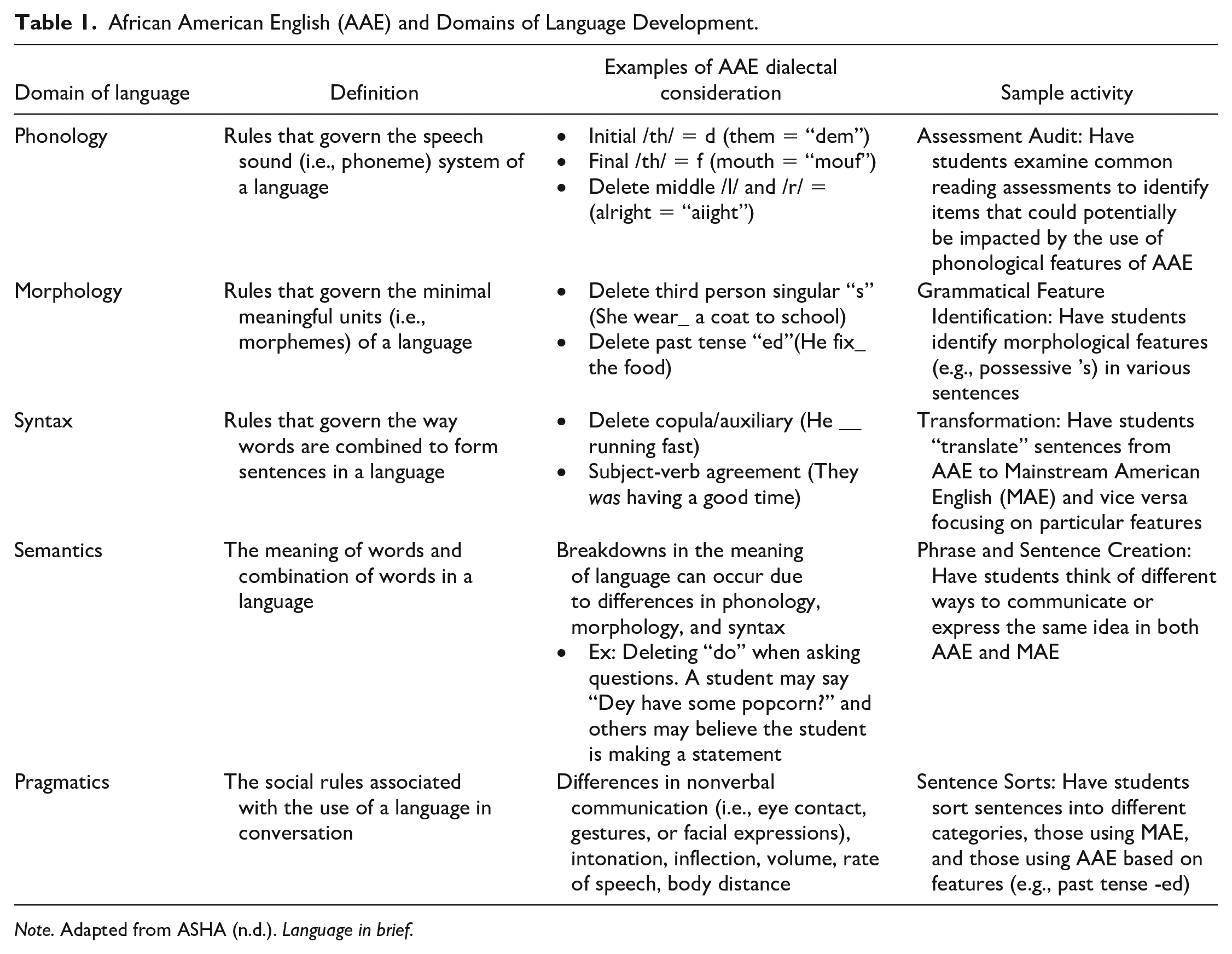
Any language variety that differs substantially from MAE involves variation in the five domains of language, in particular (a) language form (i.e., phonology, morphology, and syntax), (b) language content (i.e., semantics), and/or (c) the social function of language (i.e., pragmatics). This article focuses largely on AAE; it is perhaps the most well-known and, by far, the most studied American English dialect (Rickford et al., 2013). Specific examples of how AAE is related to the domains of language are illustrated in Table 1 (ASHA, n.d.). Teacher educators may provide examples of AAE for each of the domains of language as they are covered in coursework throughout the semester, not just in isolation or during one class period. Integrating this important theme throughout the semester can highlight the specific ways that AAE may impact reading and writing, and also emphasize the overall importance of understanding dialect through repeated exposures. In addition, teacher educators can incorporate activities into instruction throughout the semester using Table 1 to guide activities and objectives related to building novice teachers’ instruction and assessment skills surrounding language development.
African American English (AAE) and Domains of Language Development.
Having overall knowledge of the core features of language development, particularly within the domains of language, helps teachers have a better understanding of how language variation may impact reading and writing outcomes. Being able to focus on language instruction, using appropriate terminology and strategies to teach concepts within the domains of language will assist teachers providing in targeted intervention and intervention for all students who are struggling. In a recent pilot study (Gatlin-Nash & Terry, 2022), second- and third-grade African American students with below average reading scores and high frequency of nonmainstream dialect use participated in 4 weeks of intervention that varied in explicit emphasis on language instruction. The results demonstrated that students who participated in language instruction that included both explicit instruction on dialect-shifting between NMAE and MAE forms and morphological awareness showed growth in both skills. This finding suggests that instruction that includes both principles may produce the greatest language improvements for struggling readers who are dense NMAE speakers. As such, reinforcing explicit and focused language instruction that strengthens metalinguistic awareness, which is imperative for all learners, may be especially beneficial for nonmainstream dialect speakers.
Had Ms. Myers understood the core features of language development and how they are related to metalinguistic awareness, the interaction between her and Raymond over his writing could have ended differently. Imagine that Ms. Myers collected samples of Raymond’s writing over time and reviewed the samples for patterns. Ms. Myers circles the errors she noted in Raymond’s writing, evaluates the frequency of each type of error, and creates a summary of the morphological rules she determined Raymond was struggling with. Her review reveals that Raymond almost always omits “is” from his sentences and never includes “ed” for past tense. She also sees that Raymond leaves off the end of words sometimes, such as “g” in -ing. Ms. Myers is able to bring specific examples, using appropriate terminology, to the school’s speech–language pathologist (SLP), who informs Ms. Myers that these patterns are consistent with NMAE dialectal variation. When Ms. Myers asks Raymond to articulate aloud what he is attempting to write, she realizes that Raymond is simply writing the same way that he speaks. In addition to providing a review of past tense markers, use of auxiliary “is,” and -ing word endings to the entire class, Ms. Myers places visuals around her classroom to re-emphasize and remind students of these concepts. She also provides Raymond with a checklist to use where he can go back and independently scan his written work for the presence of these morphological and syntactic structures. Ms. Myers notices that not only does Raymond’s writing improve, but that he begins to show more awareness of the use of these features when contributing to oral discussions in class.
What Teacher Educators Can Do to Support Novice Teachers
1. Teach about the core features of language development to ensure a strong foundation of typical development.
Example: During class, highlight specific ways that NMAE features may appear across domains of language development. Use authentic examples of children’s language samples to further illustrate.
2. Integrate examples of language variation in instruction on language development throughout the semester.
Example: Incorporate lessons that emphasize overall importance and have students practice differentiating between areas of language development that are influenced by dialect. Facilitate discussion of language and learning disabilities within various language dialects, that is, discuss what is considered typical and atypical within given dialects.
Recommendation 3: Examine Reading and Literacy Theories
Mr. Martin is a kindergarten teacher in the Mid-Atlantic region of the United States. After winter break, Mr. Martin receives a new student in his class, Shauna, a Black female who has already been identified as a speaker of AAE and a student with a learning disability. Mr. Martin’s class is beginning their ocean unit when Shauna joins them. Many of their stories, journal activities, and centers are centered on an ocean theme during Shauna’s first week in Mr. Martin’s class. Although Mr. Martin was able to review Shauna’s Individualized Education Program (IEP) prior to her arrival, he is shocked when Shauna is not able to label any of the unit vocabulary or contribute appropriately to classroom literacy discussions. Mr. Martin immediately becomes concerned, as he feels Shauna’s IEP does not adequately describe her areas of weakness and level of need. He schedules a meeting with the IEP team to discuss revising Shauna’s literacy goals and objectives.
In addition to incorporating evidence-based literacy theories, including the science of reading, into content area instruction, it is important for teachers to integrate culturally responsive teaching into all aspects of the classroom. Teachers need to have knowledge of cultural diversity that goes beyond awareness of, respect for, and general recognition of the fact that ethnic groups have different values or express similar values in different ways (Gay, 2002). Teachers can learn about the students they teach by acquiring detailed information about both general and specific cultural characteristics of diverse students. Using students’ existing knowledge base to leverage instruction both in general and in specific content areas is one of the facets of culturally responsive teaching or pedagogy (Gay, 2018). Importantly, although the goal is to acknowledge culturally and linguistically diverse students’ backgrounds and experiences, the purpose is not to create stereotypes or assumptions about students because they come from a particular culture. The best way to address this is to get to know students and their families individually as best as possible, and prioritize building strong, trusting relationships. Learn about their neighborhoods and communities and what is important and valuable to them. Learn about their experiences and incorporate their backgrounds, familiar things, and their experiences into daily instruction.
To address cultural responsiveness in methods courses, teacher educators may provide opportunities for preservice teachers to audit sample reading lesson plans to identify elements of culturally responsive teaching. In addition, teacher educators may provide opportunities for preservice teachers to edit existing lesson plans to incorporate elements of culturally responsive teaching and design new lesson plans with feedback from peers and the instructor. Providing these experiences can then allow preservice teachers in field placement opportunities to carry out these lesson plans, using video recording for self-evaluation and both peer and instructor-provided feedback.
In the previous scenario, Mr. Martin failed to consider Shauna’s background knowledge and its impact on her comprehension and performance. In this situation, after speaking with Shauna’s parents, Mr. Martin learned that Shauna’s family recently relocated from a low socioeconomic status (SES), urban community in the Midwest. Shauna’s lack of previous knowledge and resulting low participation stemmed from a lack of prior exposure to vocabulary or concepts pertaining to the ocean. Because Shauna was not raised near a body of water and had not traveled far outside of her community, she did not have personal experience with the ocean concepts that most students in Mr. Martin’s class already knew. Shauna also had not yet received instruction on this unit prior to relocation and transferring schools. A more accurate picture of Shauna’s vocabulary and literary skills was gained once she was given the time to learn and apply these newly introduced concepts within the classroom environment. If Mr. Martin had known this information previously, important instructional time may not have been lost.
What Teacher Educators Can Do to Support Novice Teachers
1. Guide and emphasize the importance of incorporating culturally responsive pedagogy in addition to evidence-based literacy theories throughout content area instruction.
Example: Use literature and guides such as the “Online Resources for African American Language” (Kendall et al., 2019) as resources to implement culturally responsive practices within curriculum design.
2. Provide opportunities for preservice teachers to incorporate culturally responsive teaching into lesson planning.
Example: Have students audit sample reading lesson plans to identify elements of culturally responsive teaching, edit existing lesson plans to incorporate elements of culturally responsive teaching, and design and implement new lesson plans with feedback from peers and the instructor.
Recommendation 4: Collaborate for Interdisciplinary Partnerships
There is a wealth of knowledge of dialect and language variation that is more prominent in the field and professional training of speech–language pathology than in teacher education. For example, ASHA, the organization that sets the standards for receiving certification in clinical competence, requires that SLPs demonstrate cultural competence, cultural humility, and culturally responsive practice. The graduate-level training and certification requirements of an SLP include understanding the correlation between cultural and linguistic diversity and other areas of expertise that comprise speech–language pathology (ASHA, 2016). SLPs are trained to integrate and consider culture into their practice of identifying and treating speech, language, and communication disorders. Given this expertise, encouraging collaboration between SLPs and teachers is a logical and efficient use of resources, especially given the interplay between language development and reading (Murphy et al., 2022).
In school settings, teachers may benefit from collaboration with SLPs who receive training in linguistic variation and implications for assessment and instruction (Goodrich et al., 2022). During collaboration, the expertise of SLPs and classroom teachers can each be leveraged to appropriately serve students with learning disabilities, many of whom would likely be on the SLP caseload for speech–language impairment (McArthur et al., 2000), within the context of their dialectal diversity. Whereas classroom teachers possess greater expertise pertaining to academic standards and content, SLPs’ familiarity with linguistic structure and language variability may work to support teachers’ cultural competence and encourage culturally appropriate assessment and intervention practices (Chow, 2022). Naturally, given the promise of teacher–SLP collaboration, there are logical collaborations between teacher educators and SLP educators that are likely to improve the training experiences and outcomes for novice teachers.
Teacher educators may encourage efforts by modeling interdisciplinary and collaborative practices in their own courses. Teaching faculty may consider inviting practicing SLPs for course lectures and discussions. They may also invite guest lecturers from other departments within their university, such as communication disorders or linguistics, or other university professors with expertise in dialects and language variation. With the increasing use of technology and online course offerings, teacher educators may also incorporate virtual presentations and recordings on language variation into their existing classroom formats.
What Teacher Educators Can Do to Support Novice Teachers
1. Teacher educators can reach out to SLP educators in or outside of their institution to start or maintain conversations around leveraging SLP expertise to support novice teachers.
Example: Invite practicing SLPs to guest lecture for one or more courses. If an in-person or online lecture is not feasible, provide opportunities for lectures to be recorded and viewed in class.
2. Promote the practice of interprofessional collaboration between teachers and SLPs, and provide examples for how this can be done successfully to support language variation, students with LD, and students with other disabilities.
Example: Incorporate opportunities for coursework to be facilitated with feedback from practicing or university SLPs. Design assignments that encourage or require collaboration with SLPs.
Key Considerations
It is essential to consider a student’s learning disability within dialect as opposed to previous conceptualizations for disability versus dialect. A student with a language difference as a result of being a NMAE dialect speaker (or a bilingual or multilingual learner) does not constitute a learning disability or language disorder. Educators should explicitly understand the differences between dialect and disability/disorder. For an example, readers can refer to the disorder vs. difference framework (Oetting, 2018) from the field of speech–language pathology. Learning about features of various dialects of American English will help teachers identify typical language production of development within language varieties and be able to distinguish between errors and what is considered “normal” among those who speak the language variety. Although potentially more challenging for identifying a learning disability within a dialect, practitioners should be prepared to use methods and assessments that can identify a disability that is not a function of a dialect biasing the evaluation process.
Supporting children in language and literacy development whose dialect differs from their teachers and, more broadly, the language environment of the classroom, requires an important understanding of context. Educators need to recognize the impact of the experiences children who learn through a dialect other than their own have on their learning. This can be challenging. For example, a bi-dialectal experience can produce interference between dialects, manifest in slower responses, disfluencies, and other types of “errors” (Washington & Seidenberg, 2021) because a student is still learning and developing an awareness of both grammatical systems. It is also important to be aware of the mental and emotional impact students may be experiencing. Because factors such as SES, social emotional development, well-being, confidence, and self-image can be negatively impacted by difficulties with academic success (Rowley et al., 2014), understanding and embracing dialect can provide a more inclusive, nurturing environment for learning and support overall educational and social development.
Conclusion
With schools in the United States becoming increasingly diverse, it is imperative that the education field respond effectively to the needs of culturally and linguistically diverse students in classrooms. Language diversity is often addressed in teacher preparation programs and ongoing professional development. However, guidance and training in language or linguistic diversity is often targeted at addressing English language learning. Given opportunities to learn about dialects within reading methods and language development in general as well as training in cultural competencies, teachers will likely be better equipped to facilitate learning within their classrooms while also respecting students’ home or heritage dialects or languages. This type of training could also potentially eliminate implicit biases that often exist surrounding nonmainstream dialects of English. Through education and collaboration, educators can gain a better understanding and appreciation for the diversity that makes individuals unique yet somehow binds them simultaneously.
Footnotes
Declaration of Conflicting Interests
The author(s) declared no potential conflicts of interest with respect to the research, authorship, and/or publication of this article.
Funding
The author(s) received no financial support for the research, authorship, and/or publication of this article.
