



Abstract
With no standardized approach to sexuality education among Canada’s 13 provinces and territories and the various curricula focusing on neurotypical and non-disabled children, educators have insufficient instruction and lack appropriate training on how to address sexuality education for children and youth with disabilities, particularly children and youth with autism spectrum disorder (ASD). This article provides the current context of sexuality education for children and youth with ASD in Canadian schools and guidance for more inclusive approaches with attention to three important areas: puberty, relationships, and gender and sexual diversity. Recommendations are offered to support more inclusive approaches to sexuality education, acknowledging that a one-size-fits-all approach is insufficient for children and youth with ASD. The recommendations focus on three goals: (a) moving beyond simple knowledge-based approaches to include skill-building; (b) including parents, autistic voices, and advocates in planning and ongoing conversations; and (c) providing supports for educators.
Comprehensive sexuality education describes cognitive, social, emotional, and physical development in a holistic manner that values bodily autonomy, diversity, evidence-based instruction, reproductive health, and respect for differences (Bialystok, 2019). Sexuality education prevents negative health outcomes, creates safe learning environments, and gives children and youth necessary knowledge and skills to nurture healthy relationships that enhance well-being, preparation for adult life, and life expectancy (Action Canada for Sexual Health and Rights, 2020).
Yet, in Canada, sexuality education remains highly contested and unstandardized, with provinces and territories each featuring unique curricula designed by their ministries of education. In addition, curricula focus on neurotypical children and children without disabilities, leaving little to no explicit instruction for educators on how to address sexuality education for children and youth with disabilities or in special education programming (Davies & Kenneally, 2020), particularly children and youth with autism spectrum disorder (ASD) in dedicated school settings. As the experience of ASD is diverse and the range of expressions varies widely between individuals, an individualized approach tailored to the specific needs of children and youth is warranted that also considers the various sociocultural barriers that affect individuals with ASD. Although access to sexuality education for those with disabilities is a human rights issue (Davies & Kenneally, 2020) enshrined in the United Nations Convention on the Rights of Persons with Disabilities (UN General Assembly, 2007), sexuality education for individuals with ASD is often neglected in school settings. Individuals with ASD have been found not to receive any formal sexuality education in school settings due to being in special education placements (Barnett & Maticka-Tyndale, 2015). Deconstructing the stigmatization of children and youth with disabilities related to sexuality education is important for creating more supportive and inclusive environments for addressing sexuality for all children (Davies & Kenneally, 2020; Gougeon, 2009). As such, this column provides the current context of sexuality education for children and youth with ASD in Canadian school settings and guidance toward more inclusive approaches.
Autism Spectrum Disorder in the Canadian Context
The Public Health Agency of Canada (2018) reports that prevalence rates in Canada are about 1 in 66 children with ASD diagnoses (ages 5–17), with boys more often diagnosed than girls (1 in 42 vs. 1 in 165, respectively) and more than half diagnosed either before school entry or by around age 8 (see Note 1). Although there is strong advocacy for the creation of a national autism strategy in Canada (Canadian Autism Spectrum Disorder Alliance, 2021) and a coast-to-coast autism assessment occurring to support its creation (Canadian Academy of Health Sciences, 2021), families of children with ASD must navigate services that differ among the 13 Canadian provinces and territories. Despite generally positive attitudes, full inclusion for all students with exceptionalities is still not guaranteed in Canada (Maich & Sider, 2019). Students with ASD may look to peers to model effective and appropriate skills; however, social isolation can hinder learning essential social skills—including skills related to relationships and sexuality (Gougeon, 2009). Moreover, receiving formal training for students with intellectual disabilities, as well as teachers’ beliefs and attitudes, can affect how sexuality education is addressed in special education settings (Doyle, 2021).
School-Based Sexuality Education in Canada
Although the effectiveness of comprehensive school-based sexuality education is widely recognized (Action Canada for Sexual Health and Rights, 2020), there is no unified approach in Canada, with provinces and territories responsible independently for the formulation of their own formal curricula. Furthermore, although 85% of Canadian parents support teaching sexuality education in schools (Wood et al., 2021), attempts to update the curriculum often receive public pushback (e.g., Bialystok, 2019), with tensions between parents’ desires to control the content and children’s right to access information about sexual health and development (Bialystok, 2018; Davies & Kenneally, 2020).
To contextualize Canadian sexuality education, a review of the 10 provincial and three territorial curricula was completed in January 2021. Some provinces have more recently updated curricula (i.e., British Columbia, 2016; Ontario, 2019; Quebec, 2018) that introduce topics regarding gender and sexual diversity and identities, internet safety, body image, and consent. Other areas lag, with the curriculum for some grades dating to 1995 (i.e., Newfoundland and Labrador, Northwest Territories). Unlike any other content area, instruction is not always mandatory, with parents having the right to exempt their children in Alberta and Ontario up to Grades 9 and 8, respectively. Despite wide variation, correct anatomical names, body characteristics, hygiene, puberty, family structures, and healthy relationships are commonly taught during the elementary grades (K–6). Reproduction, sexual assault, and sexual health are common in Grades 7 to 12. Unfortunately, “there is no single province or territory which covers all of the topics necessary to bring their sex-ed in line with those international standards or the Canadian Guidelines” (Action Canada for Sexual Health and Rights, 2020, p. 14). Finally, children and youth with disabilities are mostly overlooked. The Ontario curriculum is an exception, noting the importance of making appropriate accommodations for students with intellectual and physical disabilities (see Ontario Ministry of Education, 2019, p. 68); yet, practical advice and/or differentiated curriculum expectations for children with various disabilities are not provided. More effort is required to provide information about how to address sexuality education with children and youth with ASD to all educators (Davies, 2020).
Sexuality Education for Children and Youth: What Is Needed?
Children and youth with ASD require the same general sexuality education content as their peers with recognition that distinct attributes of ASD require explicit approaches and instruction (Gougeon, 2009; Hartman, 2014). In addition, individuals with ASD are often seen as asexual—not holding any sexual desires or feelings toward others—or their sexuality is problematized because “the sexual rights of individuals with autism are often curtailed under the guise of protection” (Gougeon, 2010, p. 352), resulting in harmful inaction. The following sections address important focal areas for sexuality education for children and youth with ASD including puberty, relationships, and gender and sexual diversity.
Puberty
Puberty is a critical aspect of sexuality education for individuals with ASD as they experience the same physical changes as all students (Curtiss, 2013). For some individuals with ASD, pubertal changes may prompt increases in certain symptomologies (e.g., seizures, depression, anxiety, irritability, social withdrawal; Hartman, 2014) and decreases in others. Comprehensive education about puberty prior to its onset is important in building knowledge and skills to encourage self-confidence and esteem amid the physical, cognitive, emotional, and social changes that occur. Learning proper terminology for body parts not only gives children and youth a vehicle for accurate reporting of abuse or assault but is also a factor in continuing to develop their sense of self, in turn helping to shift the degree of perceived vulnerability (Sex Information and Education Council of Canada [SIECCAN], 2015). The concrete teaching of public and private behaviors and settings encourages “appropriate sexual expression [and] not repression of sexual desires” helping to prevent engaging in sexual behaviors in public (Beddows & Brooks, 2016, p. 286), which can increase the risk for sexual victimization.
Relationships
Individuals with ASD want social (Travers & Tincani, 2010) and romantic relationships (Hartman, 2014) but commonly experience social barriers due to social isolation and stigmatization (Gougeon, 2009, 2010). Although youth and young adults with ASD desire intimate relationships, many were “frustrated by their lack of knowledge of and skill on how to develop and manage a romantic relationship” (Cheak-Zamora et al., 2019, p. 2611). Although not characteristic of all individuals with ASD (N. Adams & Liang, 2020), unique needs that children and youth with ASD may experience relative to navigating relationships are social reciprocity, sensory issues, and consent. Given that social reciprocity is an important relationship skill, instruction focusing on knowledge and skill-building around interactions with peers and partners is imperative. This approach helps to make the “implicit explicit” (Greiert, 2016, p. 136) and break down how to initiate friendships, reading social cues, how to flirt, initiating and establishing boundaries within relationships, and discussions around sexual consent.
Touch is an important part of many relationships. Some individuals with ASD have increased sensitivity to physical sensations, commonly referred to as sensory issues (Greiert, 2016). Accordingly, sexuality education should “foster . . . an awareness of individual sensory needs and how they may differ from the sensory needs of a partner, and provide strategies for how to communicate and manage sensory differences” (Greiert, 2016, p. 144). In addition, students learn about sexuality and relationships through their social engagements with peers outside of core teaching time, yet children and youth with ASD may have fewer opportunities to interact with peers outside of dedicated instructional settings (Gougeon, 2009). These experiences can contribute to the social othering and exclusion of children and youth with ASD, thereby impacting the development of social and sexual relationships (Davies 2020; Gougeon 2009; Gougeon 2010). Finally, consent is a critical part of sexuality education, particularly for children and youth with ASD who can be more at risk for sexual abuse and assault (SIECCAN, 2015). The concept of consent can be taught as early as the preschool years through age-appropriate lessons and teachable moments such as sharing toys, offering and accepting hugs, and games like tickling. For consent education to be effective, it needs to be integrated throughout the curriculum for all grades as students practice seeking and providing consent. Consent education also includes learning the difference between what types of touch are and are not acceptable. Children and youth with ASD who have experienced abuse or assault may not recognize it as such, instead seeing it as complying with the request of an adult (Kenney et al., 2013). Including instruction and skill-building in sexuality education about social reciprocity, sensory issues, and consent is essential to support children and youth with ASD to develop healthy relationships.
Gender and Sexual Diversity
It is often assumed that children and youth with ASD are asexual, do not have a sexual orientation, and do not experience sexual desire (Gougeon, 2009); yet, like their peers, they develop gender and sexual identities, including some who identify as asexual. Furthermore, assumptions regarding sexual orientation can result in restricted access to important sexual health information regarding HIV transmission and other sexually transmitted diseases (Chappell, 2014). Sala et al. (2020) noted how heterosexual assumptions are often carried forward into work with autistic communities on relationships, leading to serious ramifications and increasing psychosocial distress for LGBTQ+ (i.e., lesbian, gay, bisexual, transgender, queer or questioning) individuals with ASD who identify outside of heterosexual identities and/or binary notions of gender identity. Canadian sexuality education curricula that incorporate non-heterosexual and non-cisgender approaches and identities are still being developed (Bialystok, 2018; Bialystok 2019). Accordingly, the intersections of ASD, gender, and sexuality are almost completely disregarded in current curricula (SIECCAN, 2015). Representation of LGBTQ+ individuals with ASD and discussions of the intersections of gender and sexual identity—particularly related to understandings of social cues and neurodiversity—can mitigate against their erasure and discrimination experiences (McGuire & Zener, 2019).
Sexuality education can be an avenue for both deconstructing cisgender and heterosexual assumptions about gender and sexuality (i.e., that relationships always involve one man and one woman, that individuals must always desire long-term romantic relationships, and that gender identity and expression must align with assigned sex at birth) while also allowing for more space to deconstruct gendered norms and how such norms affect children and youth with ASD. In addition, those who do not fit binary identity criteria might face internalized stigma and miss opportunities for diagnosis and forms of social support (Pearson & Rose, 2021). Confidentiality must be respected for individuals with ASD while providing a safe space to discuss gender and sexual diversity without outing any student to their parents (McGuire & Zener, 2019). Moreover, challenging stereotypes of what it might mean to be visibly LGBTQ+ is important for students with ASD who could identify as non-heterosexual and non-cisgender but not conform to normative ideas of LGBTQ+, heterosexual, or cisgender individuals (McGuire & Zener, 2019). A curriculum that breaks down stereotypes, respects confidentiality, and promotes self-identification can address the needs of all students, not just those with ASD.
Recommendations
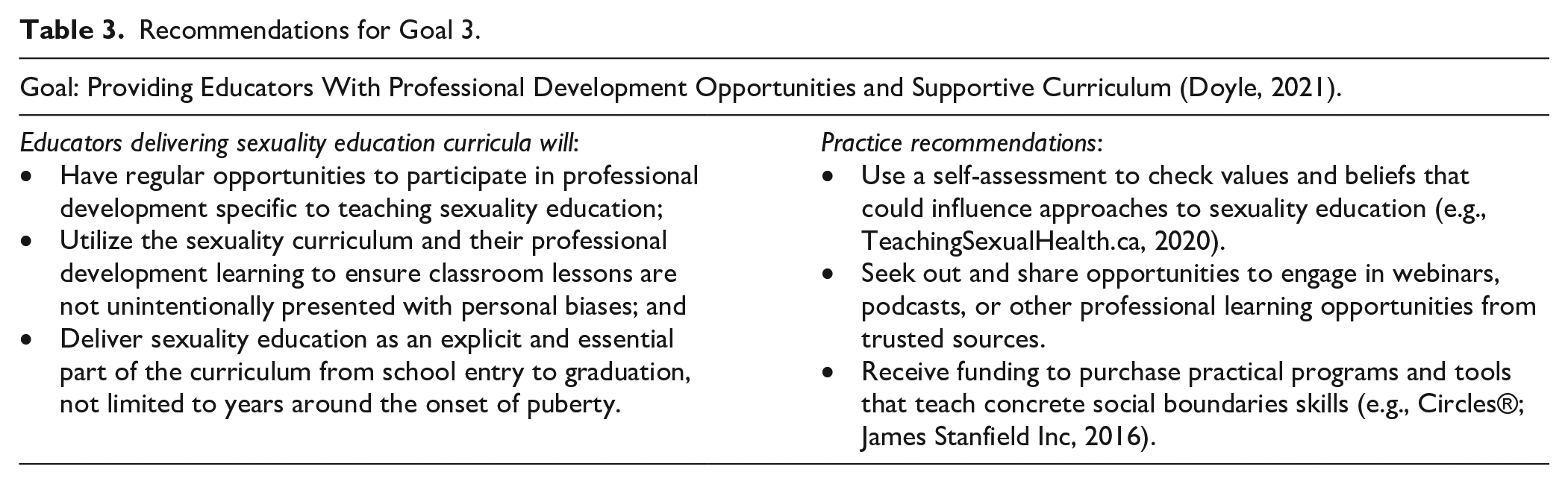
The following recommendations are offered to support the provision of more inclusive approaches to sexuality education for students with ASD. These recommendations acknowledge that a one-size-fits-all approach will never be sufficient for children and youth with ASD and require specific teaching strategies. Therefore, the goals focus on: moving beyond simple approaches that aim to increase knowledge to include skill-building (see Table 1); the need to include parents, autistic voices, and advocates in ongoing conversations (see Table 2); and providing supports for educators (see Table 3). Each table provides learning outcomes and specific strategies to support implementation of these recommendations in practice.
Recommendations for Goal 1.
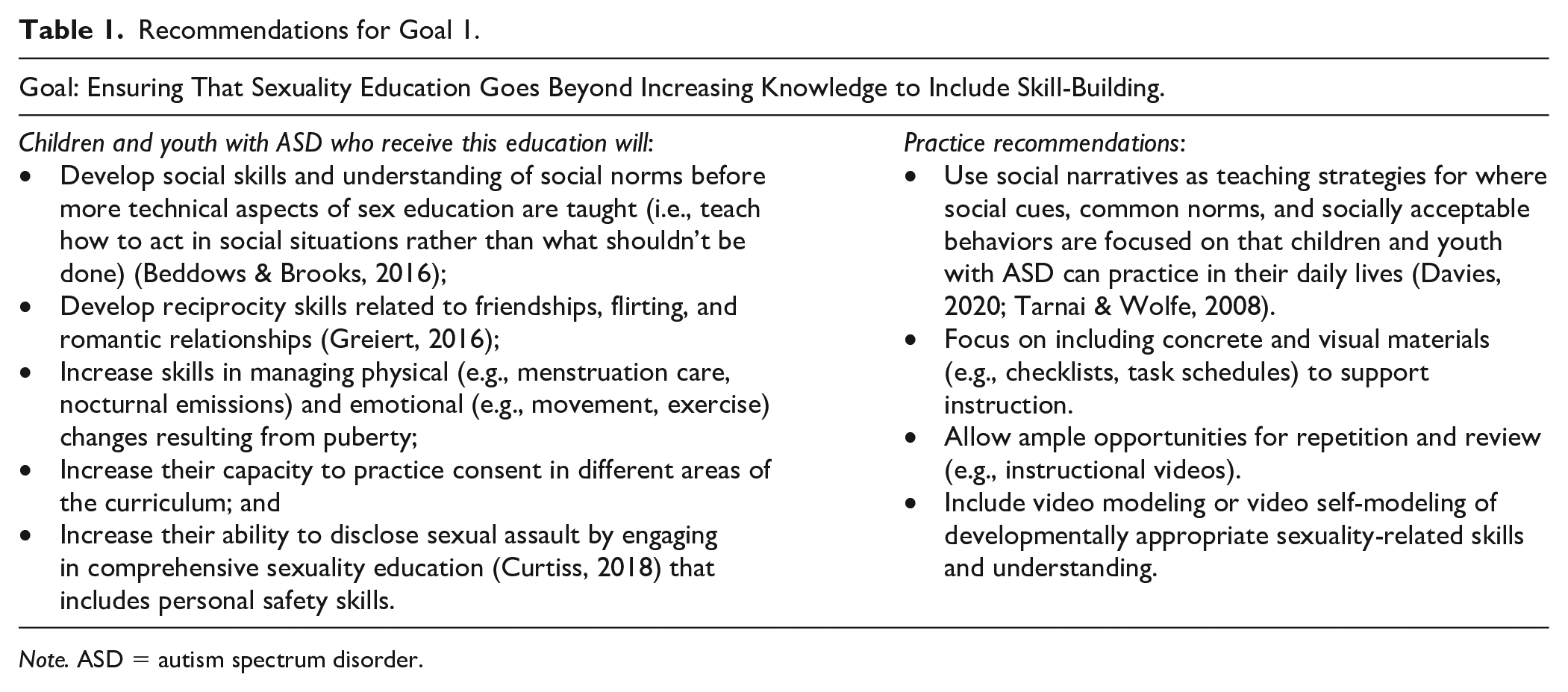
Note. ASD = autism spectrum disorder.
Recommendations for Goal 2.
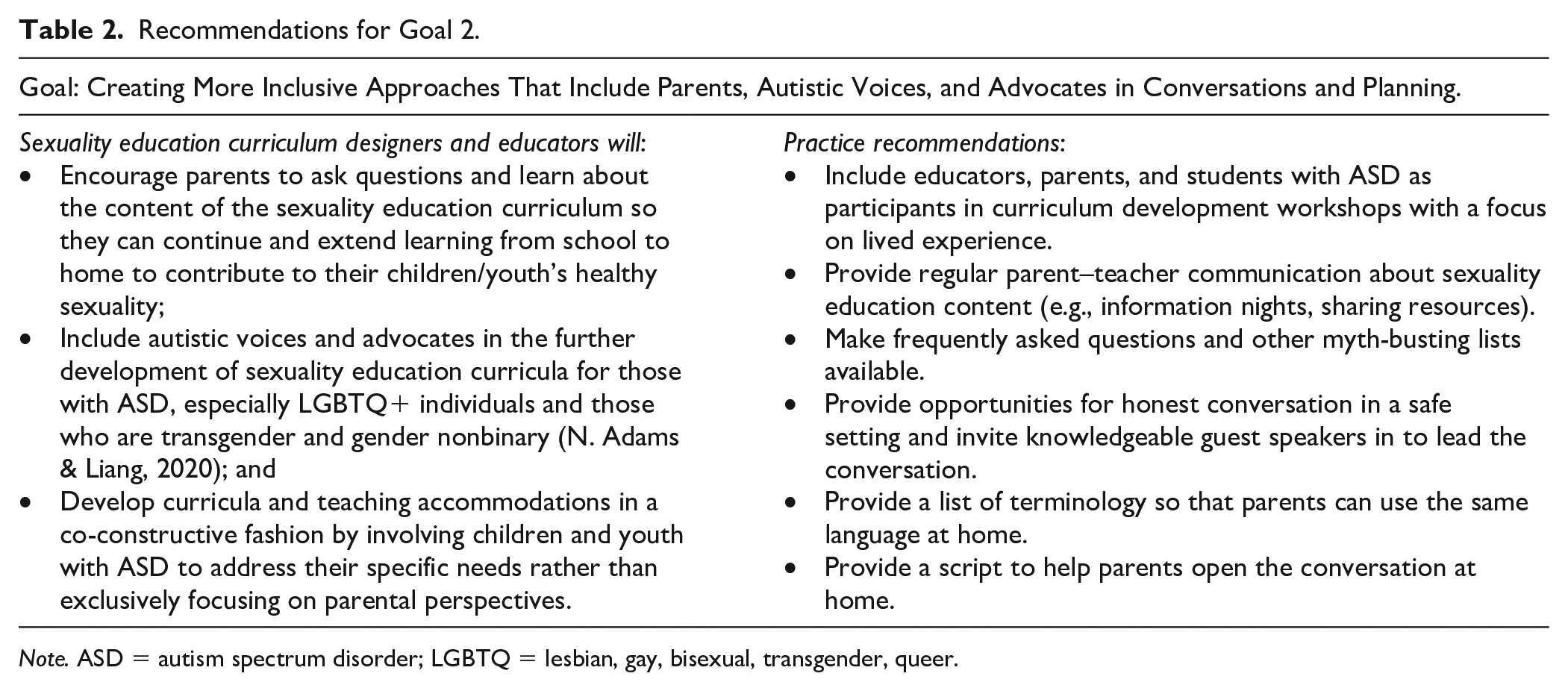
Note. ASD = autism spectrum disorder; LGBTQ = lesbian, gay, bisexual, transgender, queer.
Recommendations for Goal 3.
Conclusion
Despite some recent updates to sexual health curricula, there is still a lack of focus on the sexual health and well-being of children and youth with ASD in Canadian school settings (Davies, 2020). This exclusion perpetuates the societal stigmatization of ASD and the relegation of children and youth with ASD to the margins of society: furthermore, “if these negative attitudes and perceptions are not addressed and transformed, then all strides made in addressing the needs of individuals with autism are meaningless, as they will not result in any meaningful changes within society” (Gougeon, 2010, pp. 354–355). With sexuality education still under debate in Canada (Bialystok et al., 2020), it is important to consider the specific needs of individuals with disabilities and their continued social exclusion from these debates (Davies & Kenneally, 2020). Despite evolving research changing previously believed notions (Cheak-Zamora et al., 2019), it is still widely accepted that individuals with ASD are inherently not sexual. Providing sexuality education for children and youth with ASD can help them to understand their body’s sexual feelings, contributing to their sense of self. Nurturing this sense of self can help ease conflicting messages where they experience sexual feelings, but society implies they are supposed to be non-sexual because of their diagnosis. Sexuality education that is designed to allow children and youth with ASD the opportunity to cultivate their sense of self can help promote a healthy sense of pride in autistic identity and community (N. Adams & Liang, 2020) as well as the continued development of sexuality as a component of holistic well-being (Beddows & Brooks, 2016).
Footnotes
Declaration of Conflicting Interests
The author(s) declared no potential conflicts of interest with respect to the research, authorship, and/or publication of this article.
Funding
The author(s) received no financial support for the research, authorship, and/or publication of this article.
