



Abstract
This study examines the attitudes of school leaders and how their interpretation of the African language policy influences its implementation in practice, as well as how this interpretation hinders the multilingual goal in South African public schools. The qualitative data were collected from semi-structured, audio-recorded interviews lasting between 30 and 40 min, with sixteen school leaders from four public schools in the Johannesburg East District. Participants comprised two principals, six deputy principals, six departmental heads, one Institutional Development and Support Official, and one District African Language facilitator. Data were analysed using a Thematic Analysis supported by Constant Comparative Analysis. Findings reveal an uneven understanding of policy among leaders, resource constraints, overcrowding, inadequate teacher training, and competing community preferences for English. The results were interpreted using Burns’ Transformational Leadership Theory, through the mapping of the leaders’ responses to the theory’s four dimensions: idealised influence, inspirational motivation, intellectual stimulation, and individualized consideration. Recommendations, which are tied to the empirical findings, include targeted leadership development in policy interpretation, a strategic plan to support learners’ transition from home language to English at a school level, and a partnership between the school and district to address resource and teacher training gaps.
Keywords
Introduction and Background
Despite extensive research and collaborative efforts, school leaders remain inconsistent in implementing the African Language Policy (Bostock, 2018; Ntombela, 2017; Nugraha, 2019). This lack of effective implementation stems from a deeply held belief that English is superior to Indigenous languages, a notion that continues to rule the educational system (Madadzhe, 2019; Ntombela, 2017). According to Sigudla et al. (2021), this has led to the marginalization of Indigenous languages in the curriculum, which in turn has prevented the achievement of the policy’s goals of linguistic equity, inclusion, and empowerment of historically disadvantaged languages. This study aims to explore how school leaders perceive their roles and their attitudes toward the implementation of the African language policy in South African schools. The focus is on how their understanding and perceptions influence the success of policy implementation. Additionally, it proposes ways to enhance understanding and improve policy implementation at the school leadership level. Addressing these knowledge gaps is essential to ensure that the African Language Policy reaches its objectives and promotes the growth of Indigenous languages in South African education. In this study, foreign learners are defined as learners from other African countries, whose home language is not one of South Africa’s official languages.
Literature Review
Colonial and Apartheid Language Hierarchies Influence
According to Mda (1997), Jeewa & Bhima (2021), and De Villiers (2021), the colonial legacy strengthened the linguistic hierarchies that promoted English, while marginalising African Indigenous languages. This resulted in an education system that links English proficiency to social status and better employment opportunities. The sustained dominance of English testifies to this colonial legacy, such that the control of the language continues to align with intellectual ability and socioeconomic wealth (Ditsele, 2014; Somlata, 2018; Wildsmith, 2013; Wildsmith-Cromarty & Balfour, 2019). It follows that the African languages are underdeveloped and inadequately utilized in the educational framework of Languages of Learning and Teaching (LoLT) (Madadzhe, 2019; Mayaba et al., 2018; Ntombela, 2017).
Researchers such as Klu et al. (2013) and Gumbi and Ndimande-Hlongwa (2015) argue that the mere symbolic integration of Indigenous languages into the schooling environment is insufficient unless accompanied by genuine incorporation into pedagogical and academic structures. Klu et al. (ibid) argue that integrating African Indigenous languages into the classroom offers learners an opportunity to engage with knowledge in their home language. This view informs debates on linguistic human rights, emphasising that equitable educational access depends critically on dismantling colonial linguistic hierarchy. Despite progressive policies such as the South African Constitution of 1996 and the Language-in-Education Policy of 1997, the implementation of these policies in schools remains inconsistent, and English supremacy remains central to education and society’s opinion.
School Leaders’ Attitudes and Practices in Enacting the African Language Policy
School leadership plays a vital role in translating policy frameworks into practice. Marishane and Botha (2011) highlight that effective language policy implementation depends on principals’ leadership capacity, policy understanding, and commitment to multilingual education. However, research indicates that many school leaders continue to hold negative perceptions of African languages, viewing them as less valuable than English (Fataar, 2018; Ntombela, 2017). Such attitudes result in limited promotion of Indigenous languages within schools and reinforce English as the default LoLT (Madadzhe, 2019).
According to Bayeni and Bhengu (2018), Socio-political challenges, administrative inefficiencies, and limited stakeholder engagement are the main hindrances to language policy implementation in schools. Similarly, Sihlangu and Odeku (2021) attribute these difficulties to persistent political and financial constraints inherited from the apartheid era. Effective policy implementation, therefore, requires not only legislative frameworks but contextually aware leadership practices that mobilise staff, parents, and communities toward multilingual education. In the absence of this leadership commitment, the transformative aims of the African Language Policy (ALP) remain unfulfilled.
Parental Preferences and Community Expectations
Socioeconomic and community dynamics shape ALP implementation. Parents often prefer English due to its perceived status of upward mobility and employment (Ditsele, 2014; Nzimande, 2012). Additionally, some parents fear that Indigenous languages will limit their children’s academic and professional prospects (Madiba, 2013). According to Wa Thiong’o (1986) and Paulson (2008), this, together with economic globalisation, further strengthens the English dominance of English. This, in turn, pressurises the school leaders to balance policy compliance with community expectations, consequently leading to the continued prioritisation of English as the LoLT. Wildsmith-Cromarty and Balfour (2019) argue that community engagement that highlights the cognitive and cultural benefits of multilingualism may assist in shifting societal attitudes. This may be accomplished through parental and community involvement through Indigenous language promotion, to change perceptions and ensure policy sustainability.
Shortage of Resources and Language Teacher Specialists
An ongoing challenge for an effective implementation of the African language policy is the shortage of appropriate teaching materials and qualified teachers (Kangira, 2016; Mayaba et al., 2018). In agreement, Mda (1997) and Klu et al. (2013) add that many schools lack textbooks and learning resources in African languages, and some universities have insufficiently developed African language departments.
The inadequate training of teachers further compounds these challenges, as educators lack the pedagogical and linguistic competencies necessary to teach in multiple languages (Universities South Africa, 2022). Despite the Policy on the Minimum Requirements for Teacher Education Qualifications (MRTEQP) of 2015s mandate, that teacher education programmes include African language proficiency, implementation remains weak. Chetty and Mwepu (2008) and Msila and Gumbo (2016) highlight the need to integrate cultural and linguistic awareness into teacher training curricula. Collaboration between higher education institutions and schools is therefore essential to ensure a sustainable supply of qualified African language educators (Universities South Africa, 2022). Investment in Indigenous language resources, teacher training, mindset shift, and curriculum development would address the structural deficits currently undermining the successful implementation of ALP.
Existing studies have extensively explored policy formulation and macro-level challenges, but few have examined the micro-level ways in which school leaders interpret language policy and how those interpretations shape implementation decisions in linguistically diverse contexts. This study addresses that gap by exploring how school leaders in four Johannesburg East schools understand and enact the African Language Policy (ALP), and what barriers and enablers they identify.
Theoretical Framework
This research is underpinned by Burns’ Transformational Leadership Theory of 1978, which is particularly well-suited to the transformative aims of the African Language Policy (ALP). The ALP seeks not only procedural compliance with the Language of Learning and Teaching (LoLT) requirements but also a deeper cultural and attitudinal shift towards valuing Indigenous languages in education. Burns’ theory provides a lens through which leadership is viewed as a catalyst for sustainable change, emphasising the moral and visionary dimensions of leadership rather than purely bureaucratic control.
Transformational leadership theory highlights the capacity of leaders to articulate a compelling vision, inspire commitment, and foster innovation among followers (Ishida et al., 2023). Within the context of African language policy implementation, this framework underscores the importance of school leaders in communicating an inclusive vision for multilingualism, motivating teachers and stakeholders despite structural challenges such as limited resources, teacher preparedness, and community resistance. Research indicates that integrating Indigenous language knowledge into school curricula enhances language preservation and community engagement (Department of Education, Skills and Employment, 2020), providing a model relevant to the South African context.
Burns’ approach also stresses continuous reflection and empowerment, enabling leaders to adapt their strategies to align with curriculum goals while using technological advancements to support Indigenous language revitalisation (Cele, 2021). Moreover, professional development is considered vital to equipping teachers and leaders with the competencies necessary for effective ALP implementation and for addressing the historical marginalisation of Indigenous languages (McCarty & Lee, 2014; Murray, 2022). Transformational leadership, therefore, advocates for the active participation of all stakeholders, ensuring that language policy implementation is both inclusive and responsive to local community needs.
From this perspective, school leaders are viewed not merely as administrators but as agents of change who motivate, influence, and inspire teachers, parents, and learners towards shared educational goals. The four core dimensions of Burns’ Transformational Leadership Theory, namely, Idealised Influence, Inspirational Motivation, Intellectual Stimulation, and Individualised Consideration, were employed to guide both the research questions and analytical processes in this study. • Research Question 1/Objective 1: The dimension of Intellectual Stimulation was used to explore whether school leaders critically engage with policy interpretation, challenge existing norms, and encourage innovative implementation strategies, or whether they simply comply with prescriptive requirements. • Research Question 2/Objective 2: Inspirational Motivation and Idealised Influence were employed to examine how leaders model commitment, articulate a vision for multilingualism, and motivate staff toward the effective implementation of the ALP. • Research Question 3/Objective 3: Individualised Consideration guided the analysis of how leaders respond to the distinct needs of teachers and learners, and whether they tailor implementation approaches rather than applying uniform solutions.
The study recognizes that policy enactment requires compliance and transformation, as procedural adherence to official language requirements, the cultivation of positive attitudes, and the school cultures that embrace linguistic diversity. Accordingly, Burns’ four dimensions were used as analysis codes: • Idealised Influence: leaders’ role-modelling and visibility in promoting the ALP. • Inspirational Motivation: articulating a motivating vision for multilingualism. • Intellectual Stimulation: encouraging innovative pedagogical practices and reflective dialogue; and • Individualised Consideration: addressing the specific needs of teachers and learners.
These dimensions served as deductive analytical categories, while the research design also remained open to emergent inductive themes, ensuring a balanced and context-sensitive interpretation of school leaders’ practices and perceptions.
Mapping of Burns’ Four Dimensions of Transformational Leadership to the Study’s Analytic Focus and Findings
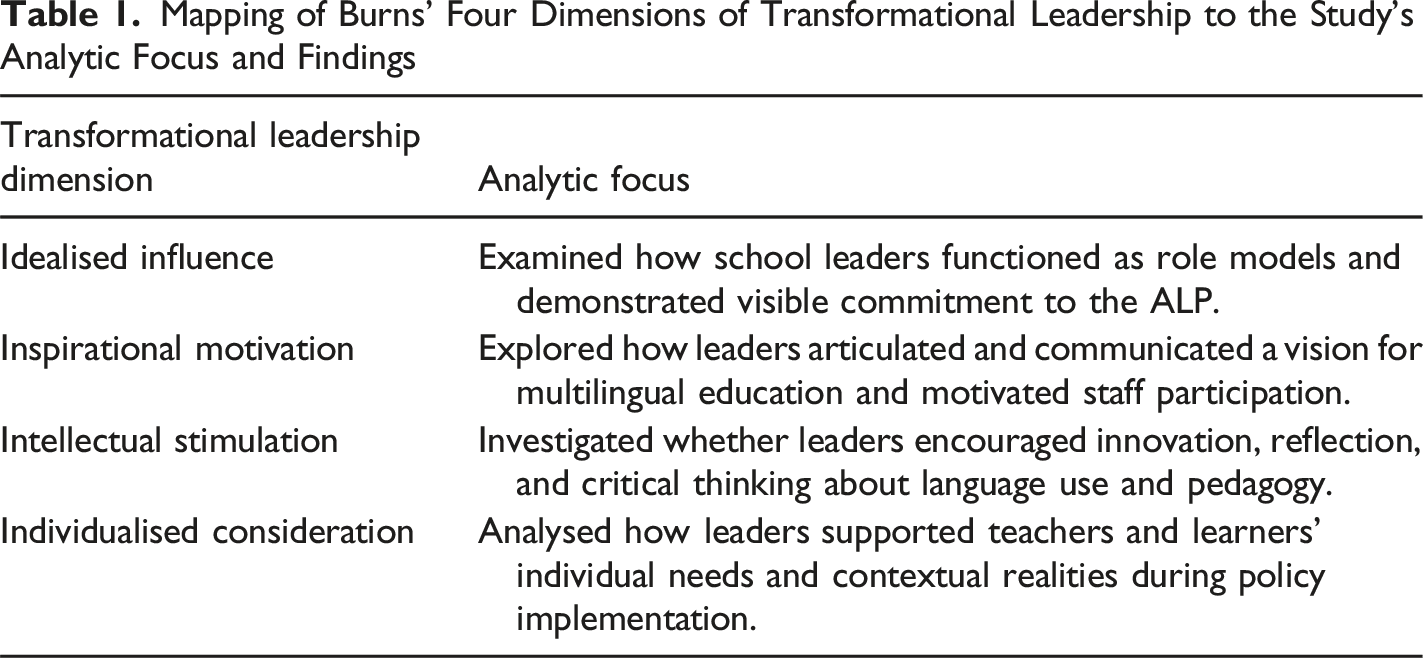
This analytic mapping underscores that transformational leadership extends beyond procedural compliance; it requires cultivating shared vision, critical engagement, and relational support to achieve genuine policy enactment. Burns’ framework thus provided a theoretical and practical scaffold for interpreting the nuanced interplay between leadership practice, institutional culture, and policy reform.
Methodology
This study adopted an interpretive qualitative design to investigate the perceptions and experiences of school leaders regarding the implementation of the African Language Policy (ALP) in four public schools situated in Johannesburg East. The interpretivist paradigm guided the study’s emphasis on understanding participants’ meanings and perspectives within their natural contexts (Ayton & Tsindos, 2023; Kivunja & Kuyini, 2017).
Participants and Context
Purposive sampling was used to select participants who were responsible for or involved in the implementation of the ALP at the school and district levels (Memela & Ramrathan, 2022). Four public schools offering two or more Indigenous African languages were purposefully chosen to enrich the contextual depth of analysis. The final sample comprised sixteen participants: two principals, six deputy principals, six departmental heads, one Institutional Development and Support Official (IDSO), and one District African Language Facilitator. While the small, context-specific sample limits generalisability, it offers rich, situated insights into leadership practice within multilingual educational contexts.
Data Collection
Data were collected through semi-structured interviews conducted in person at each participant’s school (Aspers & Corte, 2019; Maree, 2007). Interviews lasted between 30 and 40 minutes and were conducted in English, although code-switching to any South African Indigenous language was allowed where participants preferred. This allowed for better expression of experiences and feelings. The interview guide (see Appendix A) focused on understanding of African Language Policy, implementation practices, perceptions and attitudes, recommendations for Effective Practice, and reflections. The interview guide was moderated by a researcher colleague and refined to improve clarity and focus. All interviews were audio recorded and transcribed verbatim. Utterances in African languages were translated into English by the researcher and verified by a bilingual research assistant to ensure accuracy and cultural fidelity.
Data Analysis
Data analysis combined deductive and inductive coding approaches to enhance analytical rigour. Deductive codes were drawn from Burns’ four dimensions of Transformational Leadership Theory and the study’s research questions. Inductive codes were developed to capture emergent contextual issues such as challenges posed by multilingual classrooms and the enrolment of foreign learners. Transcriptions were manually coded, and themes were refined using Constant Comparative Analysis (CCA) and Thematic Analysis (Dawadi, 2020; Simister & Scholz, 2017). CCA enabled iterative comparison within and across leadership roles, allowing the identification of contrasts and relationships between participants’ experiences. This approach facilitated the emergence of nuanced subthemes such as resource constraints versus teacher training limitations, thereby ensuring that the final categories reflected authentic lived experiences.
Trustworthiness and Reflexivity
The study adhered to Guba’s (1981) criteria of trustworthiness: credibility, dependability, transferability, and confirmability. Credibility was supported through member checking, where two summary memos of preliminary findings were shared with participants for verification and feedback. Dependability was maintained by keeping an audit trail of coding decisions, analytic memos, and theme development. Transferability was enhanced through thick description of school contexts and leadership dynamics, providing sufficient detail for readers to determine applicability to other settings. Confirmability was strengthened by maintaining a reflexive research journal (Cypress, 2017), in which the researcher documented assumptions, potential biases, and reflections on positionality throughout the data collection and analysis process.
Ethical Approvals and Consent
Ethical clearance for the study was obtained from the relevant institutions and the participating school principals. Participation was voluntary, and written informed consent was obtained from all participants before data collection. Pseudonyms were assigned to all participants and schools to preserve confidentiality. All digital data, including recordings and transcripts, is stored securely on password-protected drives, accessible only to the research team.
This methodological framework ensures that the study meets the qualitative research standards of depth, reflexivity, and credibility. The purposive selection of diverse school contexts, combined with detailed data collection and rigorous analytic procedures, strengthens the validity and trustworthiness of the findings, providing a comprehensive account of how school leaders enact and interpret the African Language Policy in multilingual educational environments.
Limitations
The study draws from sixteen participants in four schools in Johannesburg East District. The findings offer rich context-specific insights but are not statistically generalisable. Data derived from interviews did not include classroom observation or a formal audit of teacher language competencies; future research should combine observational data and school language policy documents to triangulate leader reports.
Findings
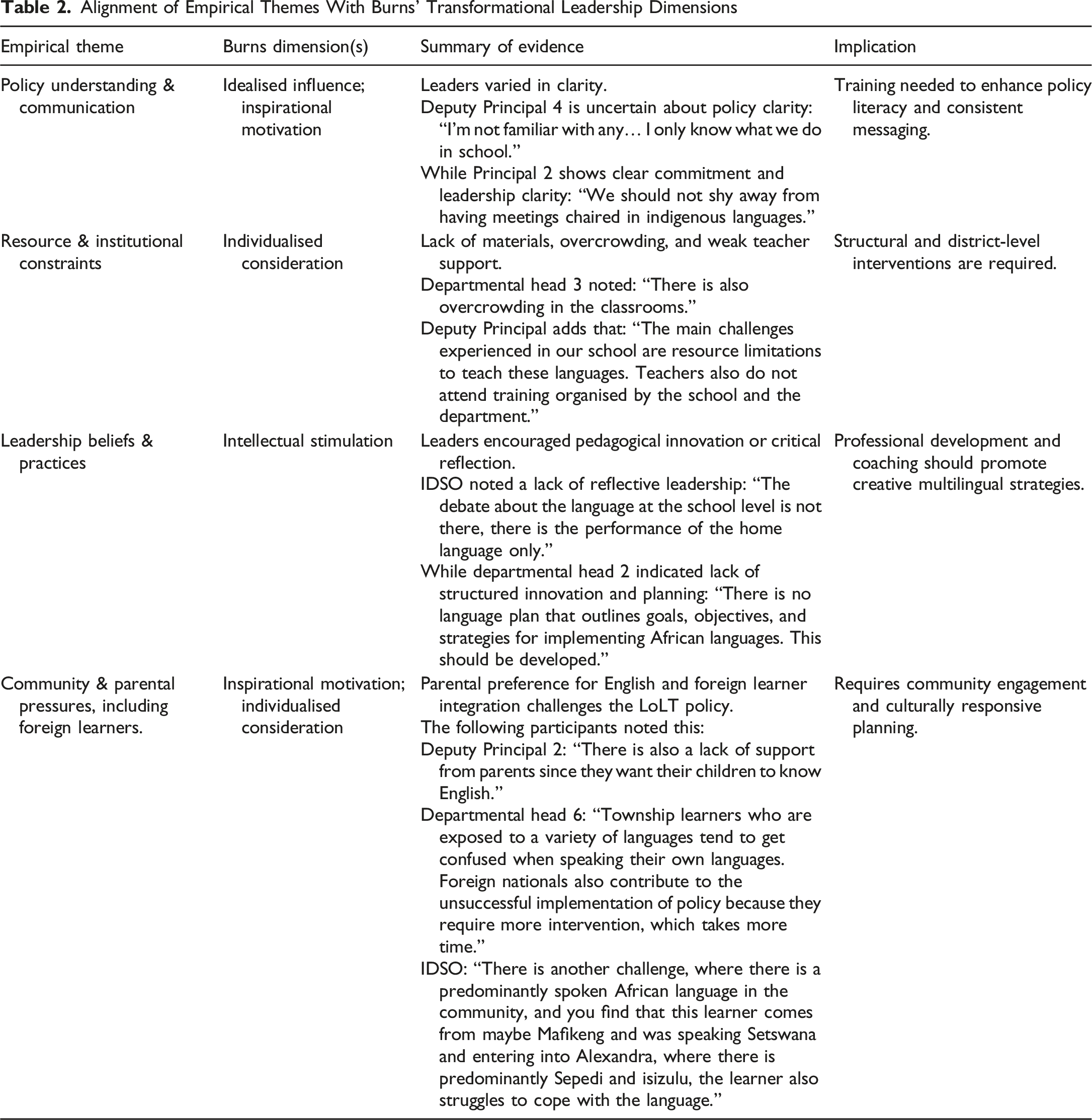
This section presents the empirical results derived from semi-structured interviews with sixteen school leaders across four Johannesburg East schools. The findings are organised under four themes: (1) policy understanding and communication; (2) resource and institutional constraints; (3) leadership beliefs and practices; and (4) community and parental pressures, including foreign learners.
Policy Understanding and Communication
The data reveal varying levels of understanding and communication regarding the African Language Policy (ALP) among school leaders. Several participants demonstrated uncertainty about the policy’s objectives and scope, while others displayed strong awareness of its transformative intent. As Deputy Principal 3 remarked, “I am not sure if that is the policy,” reflecting ambiguity in interpretation and inadequate departmental communication. By contrast, Principal 2 articulated a clearer vision, explaining, “It is the policy that promotes African languages teaching and development… ensuring usage and relevancy across all spheres of learning.”
Some leaders recognised the ALP’s alignment with constitutional equality and cultural preservation. Departmental Head 6 stated, “According to the South African Language Policy and the Constitution, all languages are equal, including African languages.” However, inconsistent dissemination of policy information across leadership levels hindered coherent implementation. This inconsistency contributed to fragmented practices and reinforced misconceptions about the policy’s intent to promote multilingualism rather than replace English.
Deputy Principal 4 publicly endorsed multilingualism and modelled linguistic inclusion by greeting staff and learners in different South African languages: “In our meetings as leaders and managers, we are free to express ourselves in our own languages. If these could be the norm for all stakeholders, that could be the way to go.”
Principal 2: showed limited symbolic leadership due to competing administrative demands: “We should respect and value the languages equally, and also accommodate and recognise them. We should not shy away from having meetings chaired in Indigenous languages, as well as communicating key information through them.”
Leaders who linked the ALP to social justice and identity inspired stronger teacher buy-in, whereas those who viewed it as a compliance requirement struggled to sustain motivation.
IDSO connects language policy to identity and empowerment: “Language is your identity; language is your culture, and language defines who you are. You become proud of who you are as a person.”
Principal 2 emphasises identity and equality, reflecting inspirational leadership: “Self-knowledge is embedded in the Indigenous language and therefore for one to know themselves, they should have their language promoted and recognised, therefore I believe that languages should be treated equally and with due recognition.”
On the contrary, Deputy Principal 5 views policy as compliance with weak teacher motivation: “Unsuccessful: Learners are not proud of their Home languages. Some educators discourage them by saying ‘What kind of a job are you going to apply for using the Home language?”
Leaders who linked the ALP to social justice and identity inspired stronger teacher buy-in, whereas those who viewed it as a compliance requirement struggled to sustain motivation.
IDSO connects language policy to identity and empowerment: “Language is your identity; language is your culture, and language defines who you are. You become proud of who you are as a person.”
Principal 2 emphasises identity and equality, reflecting inspirational leadership: “Self-knowledge is embedded in the Indigenous language and therefore for one to know themselves, they should have their language promoted and recognised, therefore I believe that languages should be treated equally and with due recognition.”
On the contrary, Deputy Principal 5 views policy as compliance with weak teacher motivation: “Unsuccessful: Learners are not proud of their Home languages. Some educators discourage them by saying ‘What kind of a job are you going to apply for using the Home language?”
Resource and Institutional Constraints
Resource scarcity emerged as a pervasive theme. Participants reported inadequate learning materials, limited teacher training, and overcrowded classrooms as major barriers to ALP implementation. Departmental Head 4 lamented, “The school library is a white elephant, and we do not have enough reading materials in African languages.” Similarly, Principal 2 noted, “We have that challenge of textbooks… the department should provide additional funding specifically allocated for African language materials.”
Overcrowded classrooms further compounded these challenges, constraining teacher attention and instructional quality. Departmental Head 1 observed, “You find that a class has over 90 learners, and you cannot expect one teacher to manage such a large group effectively.” Participants also highlighted inadequate support for teacher development. Deputy Principal 3 commented, “Workshops do not really tell you how to teach… teachers also don’t attend those workshops.” These institutional barriers mirror findings by Somlata, 2018), and Wildsmith-Cromarty and Balfour (2019), who emphasise the systemic limitations that undermine language policy implementation in South Africa.
Leaders arranged mentorship and professional development workshops tailored to teachers’ linguistic capacities, while others applied a uniform approach that neglected contextual differences.
Departmental Head 2 shows targeted professional development support: “As the School Management Team, we were trained to train teachers and to develop skills for teaching languages. We were also trained on developing materials that will assist in teaching.”
While Deputy Principal 2 shows structured mentorship and language-specific training: “Teachers are also trained to better teach these languages, to choose relevant books and to monitor and evaluate the effectiveness of this policy.”
On the other hand, Deputy Principal 3 shows a lack of uniform contextual consideration and limited support: “There is a lack of training on strategies to teach diverse learners… Everyone does what is ok for their classes.”
Leadership Beliefs and Practices
Leadership attitudes and practices strongly influenced the enactment of the ALP. Some school leaders demonstrated transformative intent by linking the policy to identity and cultural empowerment. Deputy Principal 2 asserted, “The main objective of this policy is to preserve cultural diversity, to support multilingual language in education, and to decolonise language use.” However, other leaders adopted a more administrative stance, focusing narrowly on compliance.
Resistance to pedagogical change among staff emerged as another challenge. Principal 5 noted, “The old staff are the problem everywhere because they do not want to use technology; it is like a foreign concept to them.” This finding aligns with Makoelle & Makhalemele (2020) and Ditsele (2014), who argue that leadership commitment to transformational practices is essential for overcoming entrenched attitudes and promoting innovation. Leaders who fostered reflective dialogue and modelled commitment to multilingualism were better positioned to influence teacher buy-in and shift institutional culture.
In schools where leaders promoted reflective discussions on language practices, teachers experimented with multilingual strategies; where this was absent, teachers reverted to English-only instruction.
IDSO: “There is no debate at the school level; there is the performance of the Home Language only.” This statement reveals an absence of reflective discussion, which leads to a lack of innovation.
Deputy Principal 4: “There are those discussions at the table where learners will be allowed to do all subjects in their own African Languages. I think that could be a success that will make it easy.” This illustrates reflective engagement and multilingual exploration.
Community, Parental Pressures, and Foreign Learners
Community attitudes and demographic shifts significantly shaped school language practices. Many leaders reported parental preference for English as the language of learning and teaching (LoLT), motivated by perceptions of upward mobility. Deputy Principal 2 explained, “There is also a lack of support from parents since they want their children to know English.” The IDSO echoed this concern: “We think that as South Africans, any person who can speak English is the best person, and it is the mentality that was enforced by the previous government.”
Additionally, the influx of foreign learners in South African schools further complicates the linguistic landscape. Principal 1 noted, “The challenge is there, because the resources are not enough, given that we also have foreign nationals who are not allocated in the budget.” This demographic complexity required adaptive leadership to balance inclusivity, resource constraints, and community expectations. Drawing from this comment, it may be the reason for schools to adopt English to accommodate diverse linguistic backgrounds.
Discussion
Mapping Findings to Burns’ Transformational Leadership Dimensions
Alignment of Empirical Themes With Burns’ Transformational Leadership Dimensions
Interpretation of Findings
The results reveal that while some school leaders express strong symbolic commitment to multilingualism, their practices often remain constrained by resource limitations and entrenched cultural hierarchies that privilege English. Idealised Influence was evident among two principals who modelled enthusiasm for African language inclusion, yet this influence is weakened by inconsistent policy understanding and communication.
Inspirational Motivation was evident when leaders connected the ALP to broader goals of cultural identity and decolonization, aligning with Burns’ concept of visionary leadership (Burns, 1978; Ishida et al., 2023). However, this motivation seldom resulted in sustained institutional transformation due to systemic and resource challenges.
Intellectual Stimulation, which requires encouraging innovation and reflection, is limited. Most leaders managed implementation administratively rather than fostering new pedagogical practices or dialogue on multilingual learning. This reflects Cele's (2021) observation that transformational change in education depends on critical reflection and teacher empowerment.
Individualised Consideration was also constrained. Leaders seldom provided targeted support for teachers facing multilingual challenges, and professional development was sporadic or poorly attended. This gap underscores Murray’s (2022) argument that leadership for linguistic transformation needs to involve ongoing mentorship and differentiated support.
The tension between community expectations and policy goals underscores the cultural dimension of reform. As Nzimande (2012) and Wildsmith-Cromarty and Balfour (2019) argue, effective implementation of language policy requires not only procedural compliance but also a shift in societal attitudes towards African languages. These findings demonstrate that while school leaders recognise the symbolic and cultural importance of the African Language Policy, their capacity to enact transformational change is hindered by limited resources, insufficient training, and conflicting community expectations. Applying Burns’ framework shows that genuine policy implementation demands not only administrative compliance but also the cultivation of a shared vision, innovation, and empathy, which are the trademarks of transformational leadership.
Recommendations
To strengthen policy implementation and leadership effectiveness, participants proposed the following recommendations: 7.1. Integration of transformational leadership principles into school leadership training and professional development programmes, through the emphasis of visionary context, reflective practice, and inclusive decision-making related to language policy (Burns, 1978; Murray, 2022). 7.2. The Department of Basic Education should improve the dissemination and interpretation of the African Language Policy to ensure that school leaders fully grasp its goals, procedural requirements, and cultural objectives. Clear, user-friendly policy briefs could bridge the gap between policy design and implementation. 7.3. Strengthening institutional capacity through targeted funding of African language resources and teacher training. District-level support structures should ensure equitable resource allocation and monitor implementation progress. 7.4. Establish Professional Learning Communities (PLCs) focused on multilingual pedagogy and cross-school collaboration, encouraging leaders and teachers to share strategies for integrating African languages in meaningful and context-sensitive ways. 7.5. Develop sustained parental and community engagement initiatives that address misconceptions about English as the sole language of success, highlighting the academic and cognitive benefits of mother-tongue-based education (Nzimande, 2012; Wildsmith-Cromarty & Balfour, 2019).
Conclusion
This study explored how school leaders in Johannesburg East understand and enact the African Language Policy (ALP) within complex multilingual school environments. Using Burns’ Transformational Leadership Theory, the research demonstrated that effective policy implementation requires both procedural compliance and deeper cultural transformation. While many school leaders value the symbolic importance of promoting African languages, their capacity to translate policy intent into practice is constrained by limited resources, weak professional support, and competing community expectations. The persistence of English dominance, insufficient teacher training, and the challenges posed by diverse learner demographics continue to limit the full realisation of multilingual education objectives in South African schools.
The findings highlight that leadership plays a crucial role in shaping the interpretation, communication, and implementation of policies. However, leadership practices in these schools often remain managerial rather than transformational. Strong Idealised Influence and Inspirational Motivation were evident, where principals modelled commitment to African language development and framed it within a broader vision of cultural and educational equity. Yet, Intellectual Stimulation and Individualised Consideration were underdeveloped, revealing limited support for teacher innovation and contextualized professional development. These gaps reinforce the need for leadership preparation programs that intentionally cultivate transformational skills.
In conclusion, advancing the African Language Policy demands more than compliance; it requires leadership that is visionary, inclusive, and courageous enough to challenge entrenched linguistic hierarchies. By embedding transformational leadership principles in both training and practice, South African schools can move closer to realizing the policy’s decolonial and developmental aspirations, thereby creating learning environments that value all languages and learners.
Footnotes
Acknowledgements
Prof. VT Zengele (Supervisor).

Ethical Considerations
University of South Africa Approval: 2024/07/12/00000090/02/RB on 12/07/2024. Department of Education Approval: 2024/292 on 22/08/2024 Ref: 8/4/4/1/2 and the relevant schools.
Funding
The author received no financial support for the research, authorship, and/or publication of this article.
Declaration of Conflicting Interests
The author declared no potential conflicts of interest with respect to the research, authorship, and/or publication of this article.
Data Availability Statement
Data is available on request.