



Abstract
Using the Teacher Leadership Inventory, a validated instrument, responses from teachers and school administrators were collected from across the state of Georgia (USA) regarding perceived teacher leadership opportunities measured across four sub-scales: Sharing Expertise, Sharing Leadership, Supra-Practitioner, and Principal Selection. As one of the few U.S. states that have formalized teacher leadership with both standards and credentialling, Georgia is an important setting within which to measure opportunities to utilize this domain of practitioner expertise. One-way ANOVAs and non-parametric equivalent tests using response data to the survey revealed statistically significant differences between how teachers and their supervising administrators perceived opportunities for teacher leadership with teachers perceiving significantly less opportunity than did school administrators. Additionally, sub-scale survey responses reveal that school administrators perceive that campus principals are less influential at making room for teacher leadership than the teachers report. Subgroups of teachers created using the attainment of teacher leadership credentials as well as individual and campus demographic variables were also examined but significant differences were largely not present. The exception to these null results concerned the Principal Selection sub-scale with male teachers and those without a master’s or lower degree believing that principals exerted less influence in creating teacher leadership opportunities than their female and more highly educated counterparts.
Introduction
As stated in York-Barr and Duke (2004), teacher leadership is “the process by which teachers, individually or collectively, influence their colleagues, principals, and other members of the school community to improve teaching and learning practices with the aim of increased student learning and achievement” (p. 287–288). Educational researchers and policymakers agree that teacher leadership represents a promising avenue for improving outcomes for schools, school employees such as teachers and administrators, and students (Muijs & Harris, 2003; Nguyen et al., 2020; Wenner & Campbell, 2017). As key stakeholders in school organizational structures, teachers and principals are both critical in enacting and supporting teacher leadership endeavors (Gumus et al., 2018; Hart, 2021; Sebastian et al., 2017). This current project aims to describe and compare the current views on teacher leadership of teachers and their supervising administrators in Georgia using a scale developed to answer similar questions: the Teacher Leadership Inventory (TLI) (Angelle & DeHart, 2010). As one of a small number of U.S. states to have formalized both teacher leadership standards and licensing (Diffey & Aragon, 2018), Georgia represents an important context for investigating how this important concept is being considered by practitioners. This present study is being conducted to investigate the following research questions: 1. How do teachers and school administrators view opportunities for teacher leadership in their schools? 2. How does certification in teacher leadership impact these views? 3. How are teacher demographics influential to these views?
Theoretical Framework: Distributed Leadership
As key stakeholders influencing the educational environment at the school campus level, teachers and principals must negotiate levels of control and exercise their respective leadership in close proximity to each other. Therefore, the theoretical framework of distributed leadership is an important centerpiece to any study examining teacher leadership as teachers themselves work within a hierarchy of authority under the leadership of a principal. Introduced to educational spaces in the late 1990s and early 2000s, the framework of distributed leadership put new labels on practices that had existed in schools for many decades prior. While concepts such as shared or collaborative leadership were not necessarily novel, scholarship on the topic has created formalized models to guide the enaction of policies that promise looser or disrupted hierarchies of power in schools (Gronn, 2010). One of the most influential research projects during this period, The Distributed Leadership Study (Spillane, 1998–2005), featured a longitudinal exploration of leadership structures present in Chicago-area schools. This grant-funded project led to many publications on the topics of school leadership, but one of the most influential was Spillane et al.’s (2001) Education Researcher piece entitled “Investigating School Leadership Practice: A Distributed Perspective.” In this article, the authors used leadership practice as their unit of analysis; instead of individual leaders which was the common foci of the time. This decision proved to be instrumental as it allowed the views on school leadership to widen to include individuals and positions adjacent to the building principal including assistant principals, curriculum specialists, and teachers. This changed approach laid forth a new path of both exploring and improving practices; as stated in the conclusion, “a distributed perspective can help leaders identify dimensions of their practice, articulate relations among these dimensions, and think about changing their practice” (p. 27). With the practices of leadership now being the object of interest, the formal role held by an individual within a school structure would not necessarily preclude them from being seen as a leader.
Responses to the emergence of distributed leadership conceptualizations and the policies devoted to encouraging practices which stretch leadership across existing structures in educational organizations have varied. While the idea of distributing leadership and power across a broader group of educators holds promise with many practitioners and scholars, there have also been criticisms including the important idea that distributed leadership doesn’t seem to actually disrupt the institutional hierarchies of power or decision-making present in schools (Corrigan, 2013; Hargreaves & Fink, 2008; Lumby, 2017). Collections of research literature on the topic of distributed leadership demonstrate the tensions present in the field. A 2022 scoping review of published research literature highlighted that, from very early on, scholars identified that though the concept was being eagerly adopted theoretically, the promises of reorganization of educational leadership were going to be much more difficult to achieve and the way in which leadership was shared would be critical in those endeavors (Harris et al., 2022). Additionally, because of the high dependence on methods of practice, benefits of distributed leadership found using empirical methods were proving difficult to replicate widely. Similar themes were present in a 2016 meta-analysis of published research on the topic of distributed leadership gathered from 2002–2013: the largest body of collected research was focused on how to conceptualize and describe distributed leadership followed by studies devoted to identification of best practices (Tian et al., 2016). While there have also been some empirical studies linking distributed leadership practices to benefits for schools, those that work in them, and the students they serve (i.e., Chang, 2011; Chen, 2018; Harris & DeFlaminis, 2016), the manner with which leadership is distributed remains vital. Within the rigid structures of schools, can teachers and their administrators truly distribute leadership or is work simply being reallocated? Could distributed leadership offer opportunities to develop and exercise teacher leadership with fidelity as a method for expressing adaptive expertise (Timperley & Twyford, 2022) in schools?
Principals and Teacher Leadership
Since the emergence of the distributed approach to conceptualizing campus-level school leadership, research into how principals and teachers negotiate the expression of leadership has promulgated. Adding a formal title to the conceptualization of existing teacher roles, “Teacher Leadership” and “Teacher Leader” are terms that have become commonplace when discussing how classroom teachers exercise their control. In what has become one of the seminal papers on the topic of teacher leadership, York-Barr and Duke (2004) state: “Recognition of teacher leadership stems in part from new understandings about organizational development and leadership that suggest active involvement by individuals at all levels” (p. 255). Research has established that, for teacher leadership practices to flourish, there needs to be a school administration or administrators who actively promote their subordinate teachers taking on leadership tasks and roles (Acker-Hocevar & Touchton, 1999; Mullen & Jones, 2008; Pineda-Báez et al., 2019). To this point, in their recent review of teacher leadership literature, Schott et al. (2020) examined a gathered sample of research published between 2014 and 2019. (Prior projects had examined research on the same topic published from 1980–2004 (York-Barr & Duke, 2004) and 2004–2013 (Wenner & Campbell, 2017).) One of the key findings of this latest systematic review was that the most commonly occurring antecedent of teacher leadership was the campus administrator; appearing in 38 of the 84 empirical studies gathered. Finally, a recent working paper for a study of teacher leaders in New York City schools revealed that formal empowerment of trained teacher leaders by their supervising administrators was critical in unlocking student academic gains (Sands, 2024). Questions similar to those asked of distributed leadership can be levied against the teacher leadership movement, however. Are novel opportunities to practice teacher leadership true disruptions of the established organizational system or are they instead disguised managerialism (Fitzgerald & Gunter, 2006) and a way to saddle teachers with more unpaid work? Could formalizing teacher leadership through credentialing and standards help to create more avenues of compensated practices for non-administrative educational leaders?
Teacher Leadership Practices and Research
One common premise is that teacher leadership refers to the capacity of teachers to influence and contribute to education policy, research-based best practices, and the overall continuous cycle of school improvement beyond their own classrooms (Wixom, 2016). This often requires that teacher leaders take on roles and responsibilities that extend beyond their traditional teaching duties which focused primarily on instruction and learning outcomes of their students. When exercised, teacher leaders can therefore exert a larger circle of influence to improve more broad student learning outcomes, increase teacher efficacy and retention, and school climate initiatives. While research dates back decades on teachers as leaders; formal programing, standards, certification fields, etc. had lagged behind until 2008 when a group of educators created the Teacher Leadership Exploratory Consortium (Cosenza, 2015). This group created and published seven model standards in 2011. The domains target the core competencies around teacher leadership which include Domain I: Fostering a collaborative culture to support educator development and student learning Domain II: Accessing and using research to improve practice and student learning Domain III: Promoting professional learning for continuous improvement Domain IV: Facilitating improvements in instruction and student learning Domain V: Promoting the use of assessments and data for school and district improvement Domain VI: Improving outreach and collaboration with families and community Domain VII: Advocating for student learning and the profession (Teacher Leader Exploratory Consortium, 2008)
These domains have been influential in the creation of state and organizational teacher leadership standards as well as subsequent credentialling (such as that present in Georgia). Additionally, they have helped to center both the formal and informal roles of teacher leaders in the continuing research of the field.
Many studies of teacher leadership have focused on teaching and learning and improving student learning outcomes (Ingersoll et al., 2017; Supovitz & Comstock, 2023). For example, when state teachers of the year were surveyed, they rated teacher leadership opportunities as one of their most significant professional growth experiences (Behrstock-Sherratt et al., 2014). A recent meta-analysis showed a statistically significant and positive relationship (r = .19) between teacher leadership practices and student outcomes in mathematics and ELA and other content areas (Shen et al., 2020). While this focus remains at the core of teacher leader competencies, recent research has expanded to include benefits of increasing teacher efficacy, retention, and recruitment. In a case study of eight school districts’ career advancement programs, teacher leaders reported greater job satisfaction and some districts with teacher leadership programs saw an overall increase in both retention rates and teacher applications (Natale et al., 2016). Recent exploration of how teacher leadership is being practiced in New York City schools has revealed that teacher leaders facilitate a complex array of tasks including communicating across structural levels, supporting colleagues, and informing decisions (Sands et al., 2022). Additionally, studies have found a link between teachers having a voice in their school and staying in the profession (Carver-Thomas & Darling-Hammond, 2017). The benefits of teacher leadership and the programs that support their advancement have been continuously documented in research. However, continued documentation of teacher leadership practices and opportunities remains a need across contexts.
Georgia Teacher Leadership Context
Georgia is one of 17 states in the United States to offer teacher leader certification for demonstrating evidence of effectiveness, and one of 17 states that have adopted teacher leader standards (Diffey & Aragon, 2018). In 2019, the Georgia Professional Standards Commission (GAPSC) convened a statewide group of educators to develop a teacher leadership belief statement to guide its efforts at developing teacher leaders in the state: “Teacher Leadership (TL) is the process by which highly effective and empowered teachers serve as catalysts to facilitate continuous improvement resulting in an enhanced culture of teacher engagement, student learning, and achievement” (GAPSC, 2019, p. 5). With this statement, Georgia is recognizing the crucial role played by teacher leaders in continuous school improvement, without those teachers having to enter administration. Beginning in 2014, Georgia began licensing teachers in teacher leadership following the completion of a training program and a portfolio assessment that consisted of evidence of their abilities to conduct teacher leadership tasks across ten standards. These standards cover topics such as adult learning theory, stakeholder collaboration, conducting and interpreting research, ethical and legal decision-making, instructional coaching and leadership, etc. In the ten-plus years since the licensing was created, over 2300 teachers have obtained their teacher leadership endorsement from the state. Many of these teachers receive this TL licensing as they complete a Specialist degree, which typically entails 30 or more hours of graduate coursework in addition to the attainment of a master’s degree. These TL license holders have continued to work as classroom teachers but have gained both the knowledge and the capacity to exercise their leadership to the benefit of those outside the walls of their classrooms.
Furthermore, Georgia educators believe that teacher leaders are essential because they strengthen the teaching profession and increase teacher retention (Georgia Professional Standards Commission, 2019; Wixom, 2016). Recently, a task force commissioned to investigate teacher burnout in the state released their final report (University of Georgia, 2022). In it, the task force listed five themes that emerged from their extended conversations with stakeholders across the state; one of which was a need for encouraging teacher voice and professional growth. To that end, the report made this recommendation: “Provide teachers who are currently in the classroom with leadership opportunities on advisory councils, task forces, and leadership teams. Foster clear pathways for teacher leadership, promoting a culture of shared governance and dialogue” (p. 17). Teacher leaders in Georgia have long served as educators who promote collaboration among their colleagues and change in schools where improvement is needed. Their presence improves the culture of trust in a school building. They influence others through both formal and informal positions. A teacher leader might be a mentor to a colleague, serve on a school committee, or provide professional learning opportunities to others. Whatever their role, teacher leaders bring positive changes to schools and to colleagues. Many Georgia districts have incentivized the role of a teacher leader through providing pay increases to those who become certified in teacher leadership. Teacher leadership is one avenue through which Georgia is actively working to improve student learning and teaching in the state.
As mentioned previously, this current study is organized around the conceptual framework of distributed leadership and the shared, but unequal, dynamic of campus-level power that exists between principals and classroom teachers in schools. Utilizing survey data collected from these two groups of professionals in schools across the state of Georgia, we will quantitatively represent the current reality of teacher leadership opportunities present in the state as well as investigate the relationships present between perceived opportunities for the expression of teacher leadership and the possession of professional TL certificates and teacher-level demographic variables. The findings of this study will be helpful in understanding the current reality of TL in a state considered to be a bellwether in this field as well as providing context to aid development of future interventions aimed at encouraging growth of effective teacher leadership.
Methods
Data Collection and Instrumentation
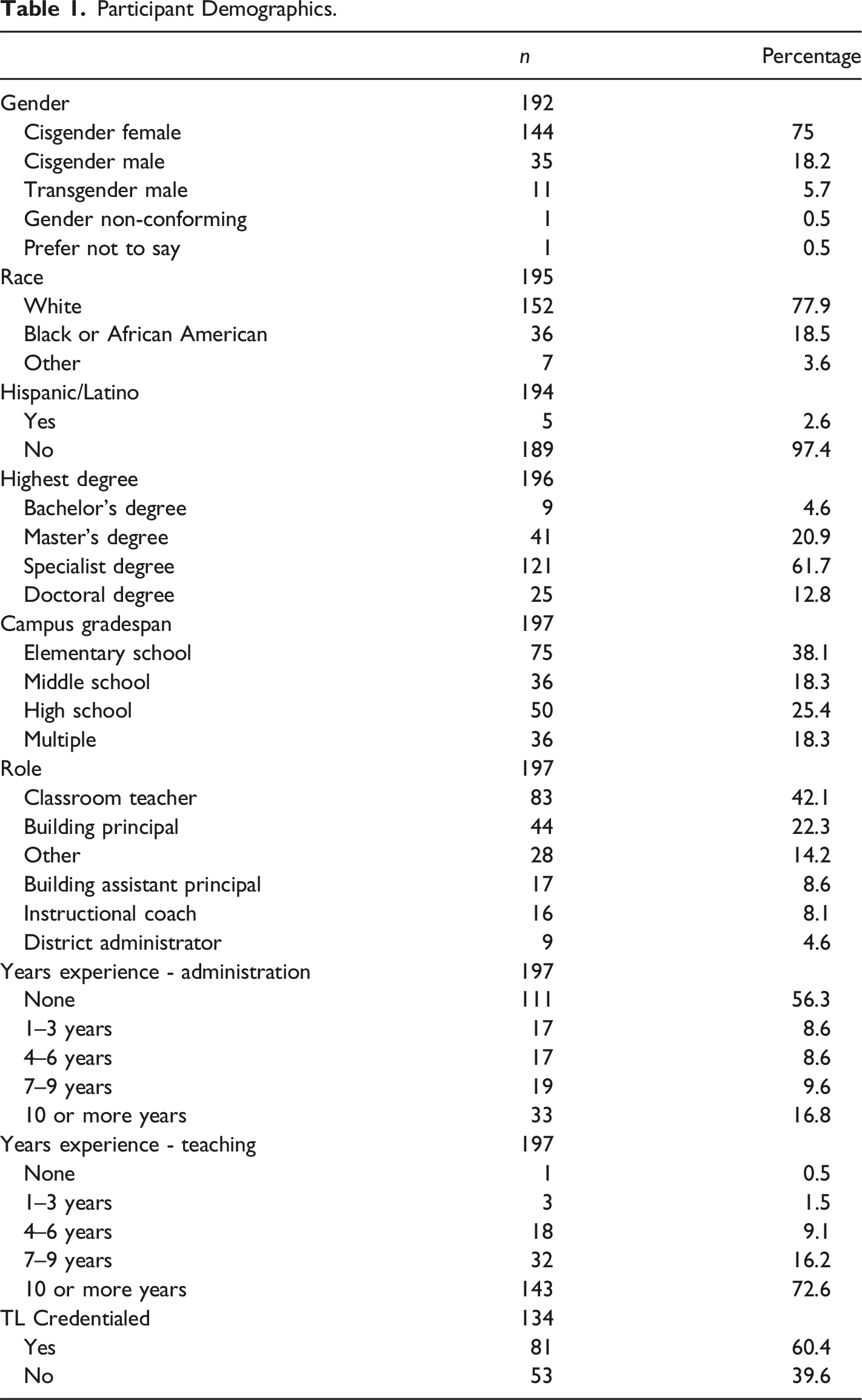
Following IRB approval, researchers solicited responses from Georgia teachers and school administrators by sending emails to at least one district and school leader from every school system in the state, contacting past graduates from teacher preparation programs, sharing information with regional academic service agencies, and making posts on group pages on Facebook that cater to teachers and administrators within the state. The solicitation emails and social media posts contained a link to an online survey hosted by Qualtrics. Recipients of these invitations were encouraged to provide their responses and to pass the invitation on to colleagues and friends to increase the size of the gathered sample. No identifying information was collected via the survey to protect participant anonymity, but participants were asked to report their employing district and their job status to verify they met the study’s inclusion criteria. (Full research instrument is included in this study’s supplemental materials and all of the TLI items are listed in Table 2 below).
Since the TLI was created and validated, it has been utilized by many research teams to examine the existent teacher leadership culture in various settings. Dr Pamela S. Angelle, one of the creators of the instrument, used it to examine the relationship between collective efficacy and teacher leadership and found strong linkages present in the three urban school districts featured in the study (Angelle & Teague, 2014). Another researcher used the TLI with a sample of high school teachers in Canada and found some differences in the full- or sub-scale scores of respondents when grouped using education level, years of experience, or gender. However, no significant differences were found between groups based on teacher leadership status (Dorgan Lee, 2014). More recently, researchers in Qatar established that nationality (in addition to other factors already mentioned) accounted for differences in teacher leadership culture present among teachers and principals (Sawalhi & Sellami, 2021). Finally, Chen (2022) incorporated items from the TLI into a new instrument being developed for use in the context of schools in China. This current project aims to utilize this instrument with a sampling of educators in the United States in a state where TL has been formalized for over a decade.
The survey included some open response and multiple-choice items. Participants were asked to disclose demographic information such as gender, race and ethnicity, education level, years of experience in both teaching and school administration, their current role, their TL credential status, their employing district, and responses to the TLI scale. Developed in the mid-2000s to explore the extent of teacher leadership present in schools using responses from teachers and principals in Tennessee, the current version of the TLI consists of 17 four-point Likert-type questions (1: never, 2: seldom, 3: sometimes, and 4: routinely) that have been grouped into four sub-scales created and verified through multiple factor analyses (Angelle & DeHart, 2011, 2016). Angelle and DeHart (2010) reported a Cronbach’s alpha of .85 for the entire TLI scale and alphas ranging from .56–.85 for the four sub-scales: Sharing Expertise, Sharing Leadership, Supra-Practitioner, and Principal Selection (all individual TLI items are listed in Table 2). As described in Angelle and DeHart (2011), the Sharing Expertise sub-scale includes five items and is focused on teacher leadership in sharing pedagogical or classroom management knowledge. An example of the items in this scale is: “Teachers ask one another for assistance when we have a problem with student behavior in the classroom.” The Sharing Leadership sub-scale consists of six items and addresses the relationship between teachers and administrators in respect to how teacher leadership is empowered such as: “Teachers are actively involved in improving the school as a whole.” The Supra-Practitioner sub-scale includes three items and measures the willingness of teachers to go above and beyond their typical teaching duties and includes items such as: “Teachers willingly stay after school to help other teachers who need assistance.” The final sub-scale, Principal Selection, consists of three items and measures whether teacher leadership opportunities are dependent on the principal to create. An example of an item in this sub-scale is: “The principal consults the same small group of teachers for input on decisions.”
Analyses
Similar to Angelle and DeHart (2011), this project first utilized descriptive statistics to establish the present reality of perceived teacher leadership opportunities across samples of teachers and school administrators in the state of Georgia. Then differences in response by school level, education level, and leadership position were examined. Additionally, this project looked at group comparisons using gender, race, and TL credential status as grouping variables. In Angelle and DeHart (2011), one-way ANOVAs or Mann-Whitney U tests with post-hoc tests (Tukey’s HSD) were the primary analysis utilized to compare survey responses from contrasting groups, and this aligned with common practices (Tamhane, 1977; Tukey, 1949). For the present study with its smaller group sample sizes, when group-level data violated assumptions of equality of variances (evaluated using Levene’s tests) and normality (assessed using Shapiro-Wilk’s test), non-parametric robust tests such as Welch’s ANOVA were employed (Delacre et al., 2019; Siegel, 1988).
Data Sources
Participant Demographics.
Teacher Leadership Inventory Scores.
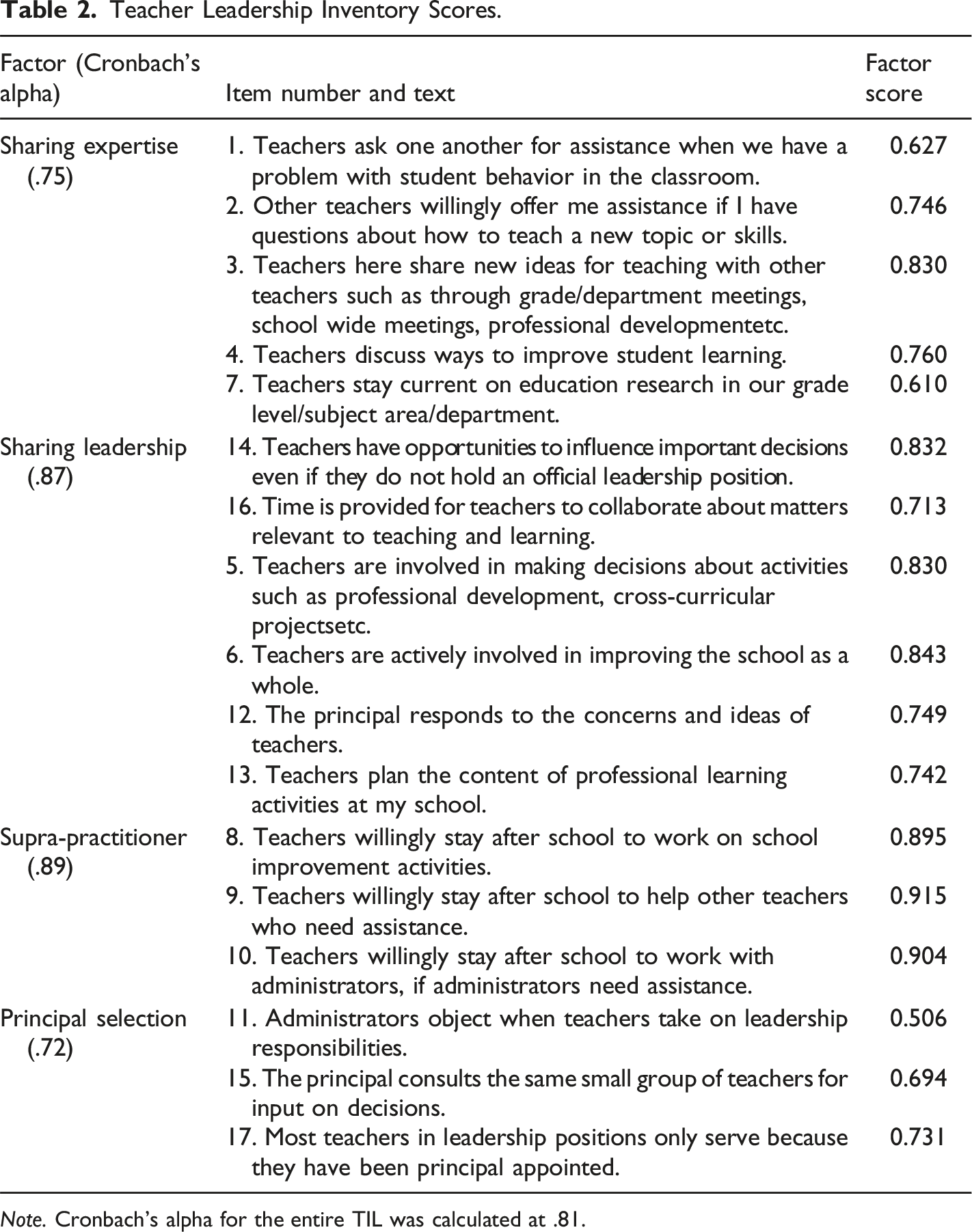
Note. Cronbach’s alpha for the entire TIL was calculated at .81.
Results
Differences by Role.

Note. *indicates a statistically significant difference of p < .05, **p < .01, ***p < .001.
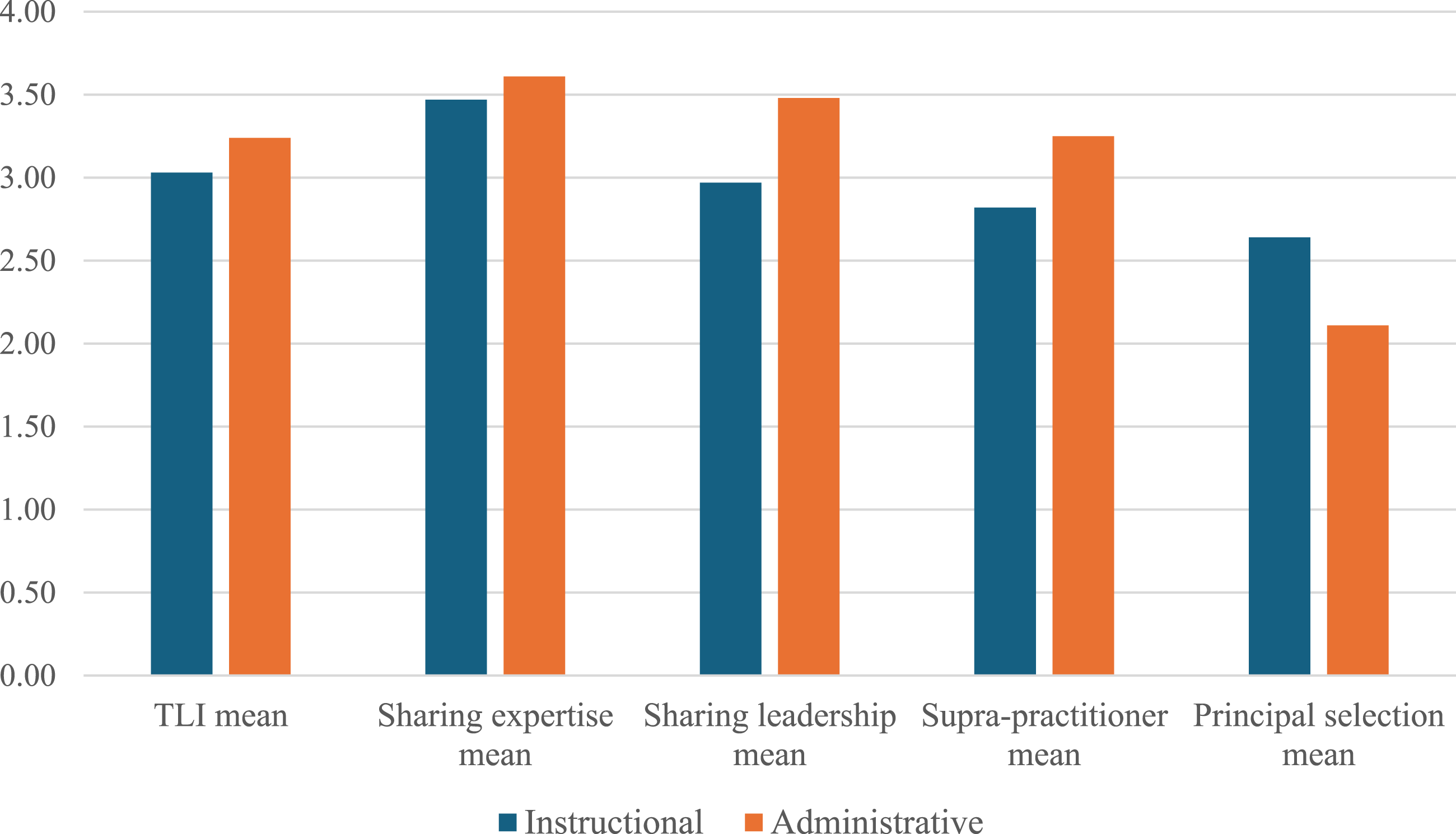
Scale means by role.
For the mean scores of the four TLI sub-scales, significant results for tests for equality of variances and normality again necessitated conducting Welch’s ANOVAs which identified the following differences between groups of Instructors and Administrators: Sharing Expertise: W(1, 157.695) = 4.739, p = .031, ω2 = .019; Sharing Leadership: W(1, 171.61) = 33.174, p < .001, ω2 = .133; Supra-Practitioner: W(1, 153.031) = 16.779, p < .001, ω2 = .078; and Principal Selection: W(1, 167.066) = 29.319, p < .001, ω2 = .123. With these paired differences, the Instructional role reported a significantly lower means than the Administrative role for Sharing Expertise, Sharing Leadership, and Supra-Practitioner sub-scales but a significantly higher mean for Principal Selection sub-scale and estimates of effect size show that role generated a small effect in those differences in mean scores. Group means and standard deviations for each sub-scale are in Table 3 above.
Differences by Teacher Leadership Certification Status.
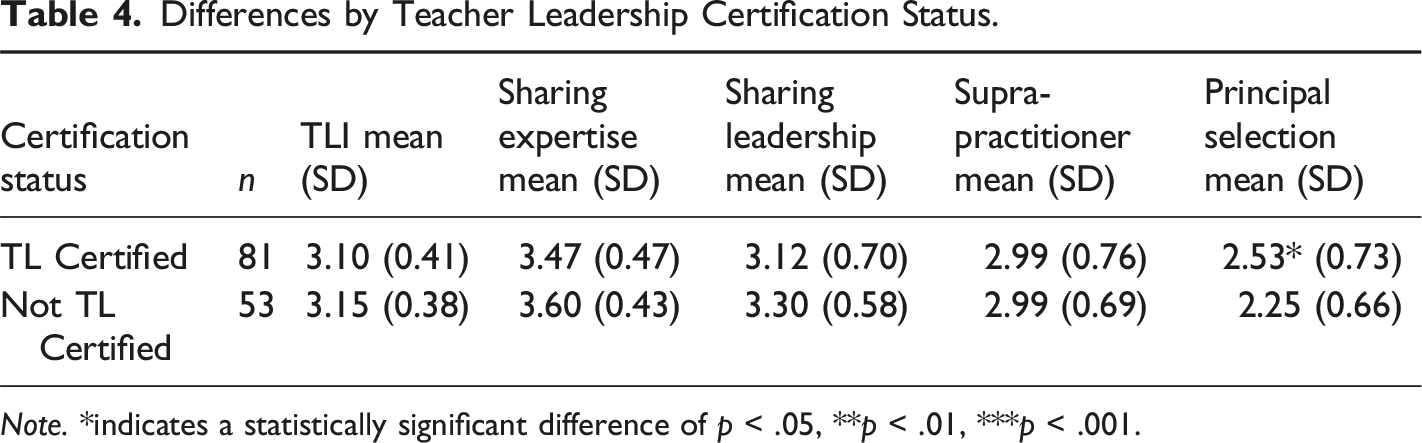
Note. *indicates a statistically significant difference of p < .05, **p < .01, ***p < .001.
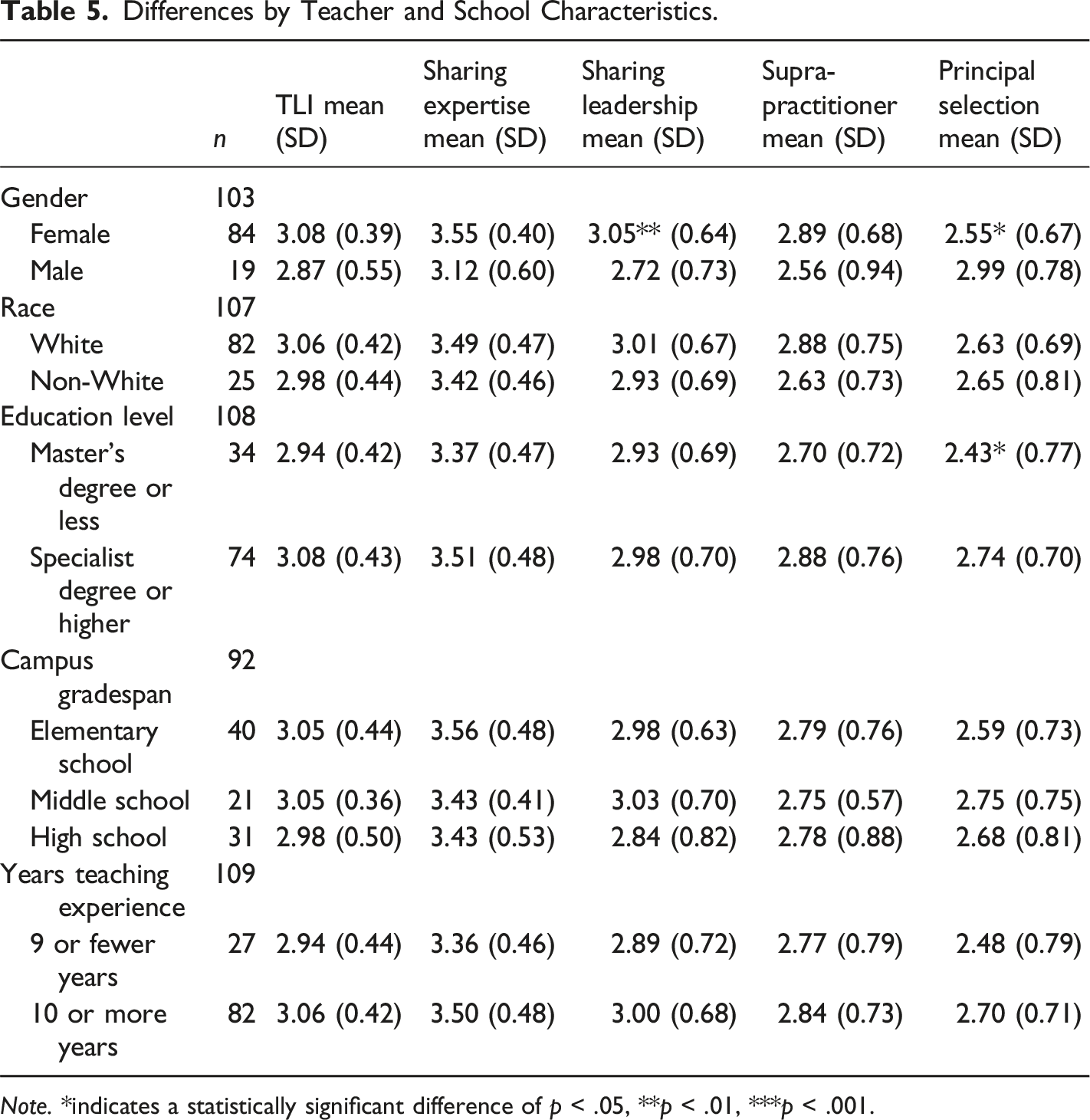
Differences by Teacher and School Characteristics.
Note. *indicates a statistically significant difference of p < .05, **p < .01, ***p < .001.
For race, there were only two sub-categories of those in Instructional roles that held enough respondents to generate valid comparisons: White (N = 82) and Non-White (N = 25). One-way ANOVAs revealed no statistically significant differences between these two racial groups for the mean scores for the full TLI scale (F(1, 105) = 0.596, p = .442) or any of the four sub-scales (p values ranging from .136 (Supra-practitioner) to .888 (Principal Selection). Participant groups by highest education level were split into two groups: Instructors holding (1) a master’s degree or lower (N = 34) or (2) a Specialist degree or higher (N = 74). Groups formed on the basis of campus gradespan included Instructors at elementary, middle, and high school campuses. Finally, two groups were created using the split of having 10 or more years of teaching experience.
Similar to the results for racial groups, there were no significant differences in means of the full TLI found when dividing the sample of teachers using the education level of the teacher (F(1, 106) = 2.377, p = .126), the gradespan of the campus (F(2, 89) = 0.208, p = .813), or years of teaching experience of the teacher (F(1, 107) = 1.619, p = .206). There was however one statistically significant difference between demographic groups found in the comparisons of the sub-scale means: Principal Selection by education level: (F(1, 106) = 2.266, p = .039, η2 = .040) for Instructors with a master’s degree or lower (M = 2.43, SD = 0.77) and those with a Specialist degree or higher (M = 2.74, SD = 0.70).
Discussion
The comparisons made in this study revealed some important findings. Firstly, Instructors had self-reported mean scores significantly different than those of their supervising Administrators for the full TLI and all four of the survey sub-scales. For the full TLI as well as the Sharing Expertise, Sharing Leadership, and Supra-Practitioner sub-scales, Instructors reported significantly lower means than the Administrative group. For the Principal Selection sub-scale, the difference between the Instructors and Administrators was again statistically significant but the directionality of that difference was reversed. Therefore, teachers on average reported lower incidences of teacher leadership opportunities than those supervising them; including significantly lower perceptions of how teacher leadership is empowered (Sharing Leadership), how often teachers support fellow teachers (Sharing Expertise), and how willing teachers are to go above and beyond their normal duties (Supra-Practitioner). Relatedly, Instructors report that their principals have more influence on who is allowed to be a teacher leader than the Administrators themselves do (Principal Selection). This disconnect would seem to point to a mismatch between the intent and the reality of how teacher leadership is being practiced on school campuses and is certainly worthy of deeper investigation. Are principals not soliciting their faculty to fill leadership voids? And do teachers realize that they can volunteer for some of the existing opportunities? If so, training administrators in distributed leadership practices and increased communication of needs to teachers might be of benefit (Pineda-Báez et al., 2019). Additionally, would incentivizing more of the campus-level leadership positions at schools increase teacher awareness of the opportunities and likelihood they would be filled (Curtis, 2013)? Continued exploration on how leadership opportunities for teachers are identified, publicized, and filled is certainly warranted.
Secondly, the presence of a TL credential was only statistically meaningful in the comparison of means from one of the sub-scales: Principal Selection. TL-certified Instructors reported that principals were more influential in determining who could fill teacher leadership roles on their campuses than did their non-credentialed counterparts. This set of items speaks to a phenomenon present within the existing structure of leadership in many schools where principals must “make room” for teachers to exercise more control. Much research has documented the significant extent to which principals can impact teachers being able to utilize their expertise as leaders (Mullen & Jones, 2008; Pineda-Báez et al., 2019; Schott et al., 2020). Importantly, an earlier study using the TLI identified that teachers already in formal leadership roles reported statistically significant and lower scores in that same sub-scale; indicating that they perceived that principals were less influential in making space for TL practices than their counterparts who were not in formal leadership roles (Angelle & DeHart, 2016). More inquiry is required to determine if the identified differences in this present study are due to principals being choosier or if those with TL credentials are more aware of the influence of principals in this key domain of leadership selection, but the finding that teachers recognize the influence of principal leadership on their own opportunities is important.
Thirdly, only a few of the teacher or campus demographic sorting variables revealed statistically significant differences. One significant difference was that female Instructors on average had higher means for the Sharing Leadership sub-scale and lower means on the Principal Selection sub-scale than their male counterparts. These female teachers reported that there were more opportunities for them to influence decisions and occupy positions of leadership on their campuses than their male counterparts but also that they perceived that their Administrators were less influential in who occupied those TL positions. In addition to differences by gender, those teachers with a Specialist degree or higher reported that principals were more influential in choosing who is able to take those roles than did their lesser-educated colleagues. Previous work done using the TLI did reveal statistically significant differences between groups of teachers created using campus gradespans and education levels (Angelle & DeHart, 2016). Elementary school teachers in that study’s sample reported greater perceived opportunities for teacher leadership than their counterparts in middle and high schools on the Sharing Expertise and Supra-Practitioner sub-scales. Teachers with only a bachelor’s degree reported higher opportunities than their higher-educated peers on these same two sub-scales. Further investigation is certainly needed to understand how these differences are manifesting.
Finally, while there are some significant differences between groups across the full TLI survey and its sub-scales present, the behavior of the Principal Selection sub-scale is worthy of closer discussion. From the inception of the TLI, there has been attention paid to how it behaves in relation to the other sub-scales of the survey (Angelle & DeHart, 2010, 2016). Some thought was given to possibly reverse-coding the items in that scale but statistical testing revealed no meaningful differences if these items were reworded and that change seemed to undermine the conceptual framing of TL as represented in the full survey. Of note, the Principal Selection sub-scale was negatively correlated with the other three sub-scales for data collected by the survey designers as well as this present study. While it is tempting to want to assign an ethical or moral value to the influence of administrators on teacher leadership opportunities, that is not the purpose of the instrument or analysis of data collected with it. Education structures are highly formalized in the United States and decisions about who occupy positions of leadership within these structures are still often subject to those hierarchies (Pineda-Báez et al., 2019; Schott et al., 2020). Participants in this study, both Instructors and Administrators, identified that Administrators play a role in making space for TL opportunities. Importantly, the perceptions about how much influence Administrators have varies significantly: Instructors think Administrators have a greater influence than Administrators judge themselves to have. Instructors with TL credentials and those with Specialist degrees or higher think Administrators have greater influence than their non-credentialed and lesser-educated colleagues; and male teachers perceive that Administrators hold greater influence here than do their female colleagues. More and different data could provide insight into why these differences are manifesting, but this current study does reveal that these perceived differences are indeed present.
Implications, Limitations, and Needs for Further Research
As mentioned earlier, Georgia, as one of the handful of states in the U.S. to formalize TL with standards and credentialing, is an important context for measuring the presence of TL opportunities. As this study utilized responses from both teacher leaders and supervising administrators taken from across the state, the findings are useful for describing the present realities of TL and guiding future lines of research in this field. As discussed earlier, TL practices have been linked in research to some positive outcomes that hold promise for improving outcomes for teachers, their schools, and the students and families they serve. Teacher leadership is valued by teachers as an effective form of professional development (Behrstock-Sherratt et al., 2014). Allowing teachers to be more involved in leadership roles can help increase their feelings of satisfaction, self-efficacy, and encourage their retention (Carver-Thomas & Darling-Hammond, 2017; Natale et al., 2016). And importantly, there are some benefits for student learning and achievement to be gained through expansion of teacher leadership practices (Shen et al., 2020; Supovitz & Comstock, 2023). It remains important to acknowledge that how teacher leadership is enacted has importance too. Much like the criticisms of distributed leadership, if theoretical disruptions to the established rigid hierarchies of school organizational structures remain only theoretical or, possibly worse, only serve to redistribute uncompensated labor to teachers without allowing their influence to manifest in decision-making or true leadership, that could further damage the enthusiasm for the profession.
This study relied on self-reported information regarding perceived opportunities for teacher leadership as measured through Likert-type survey items. The perceptions of teachers, school leaders, and other educators may or may not accurately represent the realities of schools across the state where this study was conducted, but perceptions are certainly meaningful in regard to how these professionals feel able to exercise their expertise. While a wide sampling of educators from across the state was sought and gathered and necessary amounts of statistical power were present to perform the study’s analyses, the groups of teacher leaders and administrators formed may not be adequate to create a truly representative look at the state populations of these professions. Relying on snowballed sampling stemming from emails to school representatives as well as educators active on social media platforms or in existing professional networks does create an opportunity for sampling bias. Continued data collection with larger sample sizes would be helpful in ensuring that the findings can be used with great confidence to guide decisions across the state and other similar contexts. Lines of questioning directed at probing some of the differences uncovered here qualitatively would help to uncover why the perceptions of TL opportunity exist or how those differences are contextualized and described. Additionally, collecting similar information from other US states where TL is not supported with licensing or standards could provide a valuable contrast for the data collected by this present study. The purpose of this quantitative descriptive study was to investigate group level differences. Now that those differences have been identified, creating a deeper understanding of why those differences exist through qualitative inquiry is a research priority.
Conclusion
Classroom teachers have been demonstrating leadership attributes and completing leader tasks long before states acknowledged teacher leadership in formal educator preparation programs and subsequent certification fields. Research has shown that teacher leadership does in fact support the improvement of outcomes for many stakeholders in the teaching and learning process but gaps in the research still remain as formal teacher leadership programs are relatively new. With the theoretical framework of distributive leadership as an underpinning of teacher leadership opportunities and effectiveness, this study took a deeper look at both teacher and principal perceptions of the opportunities for practicing this important facet of school leadership. Notably, differences in perceptions of opportunities for teacher leadership and how it is shared among teachers and campus administrators marked a disconnect that warrants further exploration. Importantly, those respondents with a teacher leader credential demonstrated a higher degree of awareness of the influence of shared leadership by their campus administrators.
According to a fall 2021 survey by the Professional Association of Georgia Educators (PAGE), approximately 31% of the 4583 surveyed members stated they were unlikely or highly unlikely to continue working in education sometime past the next five years. Additionally, 22% of responding teachers in their first three years report they do not have a mentor (PAGE, 2022). These new teachers could be at greater risk of leaving the profession than their peers who do have mentors (Keese et al., 2022). These responses should alarm school leaders and communities in parts of Georgia and the US an in already dire teacher shortage but also provide a clear opportunity to better utilize teacher leaders. Currently many schools around the state employ teacher leaders as mentors to their more novice peers. Increasing teacher leadership opportunities has the potential to mitigate these threats to teacher retention. Allowing teacher leaders to serve as mentors for these struggling novice teachers could pay immediate dividends not only for the teachers being mentored but for those veteran teacher leaders now being given an opportunity to lead. Having formalized teacher leadership standards and licensure programs are only a first step. Research points to the premise that teacher leadership opportunities can improve teachers’ job satisfaction and provide them a greater voice in their working environment, potentially improving teacher retention (Wixom, 2016). However, these opportunities should represent meaningful work with compensation, not just additional labor under the guise of distributed leadership. Continued exploration of the ways in which teacher leadership can be encouraged, developed, and exercised and the impacts on important outcomes at the individual and systemic level is warranted and needed.
Supplemental Material
Supplemental Material - Who Can Lead Schools? Differences in Perceived Teacher Leadership Opportunity in Georgia (USA)
Supplemental Material for Who Can Lead Schools? Differences in Perceived Teacher Leadership Opportunity in Georgia (USA) by Jeffrey Keese, Gale Neal, and Karen Terry in Journal of School Leadership
Footnotes
Acknowledgements
The authors thank our participating educators as well as all teachers and school leaders who work tirelessly to lift up the next generation of scholars. Thank you also to the journal reviewers whose feedback was instrumental in refining this manuscript.
Declaration of Conflicting Interests
The authors declared no potential conflicts of interest with respect to the research, authorship, and/or publication of this article.
Funding
The authors received no financial support for the research, authorship, and/or publication of this article.

Data Availability Statement
Study data is available from the first author upon a reasonable request.
Supplemental Material
Supplemental material for this article is available online.
Author Biographies
References
Supplementary Material
Please find the following supplemental material available below.
For Open Access articles published under a Creative Commons License, all supplemental material carries the same license as the article it is associated with.
For non-Open Access articles published, all supplemental material carries a non-exclusive license, and permission requests for re-use of supplemental material or any part of supplemental material shall be sent directly to the copyright owner as specified in the copyright notice associated with the article.
