



Abstract
The paper reports on the school leadership practices for creating the learning space for the 21st century learning in rural secondary schools. Data was generated from semi-structure interviews and documents reviews with nine participants. The theoretical framework underpinning the study is transformational leadership theory. The findings indicated that school leadership inspired and supported innovativeness, inspired and motivated team to enhance a collaborative culture, sourced and ensured efficient and effective use of resources, scaffolded conversations about 21st century learning and supporting self-initiated professional development. Leadership is context driven and is not only the purview of incumbents in formal leadership positions. The study has generated new insights about how school leadership can address the interplay of complex rural contextual factors and leadership practices toward contemporary endeavours of the 21st century learning. It has also explored the strategies used in adverse and turbulent conditions to create the learning spaces that support 21st century learning. The study recommends that these unique leadership practices be explored further on a large-scale study for generalisability.
Introduction and Background
In this paper we report findings of a qualitative, multiple-sites case study that explored the practices of school leaders in creating learning spaces for the 21st century learning. The 21st century learning advocates for the notion of learner’s self-directed and autonomous learning for enabling learning to occur anytime, and anywhere (Fadhlullah & Ahmed, 2017; Zolfaghari et al., 2022). This necessitates a paradigm shift and for the school leaders to re-engineer and reconfigure traditional classrooms and overall school environment into flexible physical learning spaces (Neill & Etheridge, 2008). The learning spaces must be in such a way that they support multiplicity of learner-centric pedagogical practices of the 21st century learning for learners (Zolfaghari et al., 2022).
The notion of creating learning spaces for the 21st century is a global discourse (Roshid & Haider, 2024). We note the plethora of socio-economic challenges to creating learning spaces for the 21st century learning in rural school settings of developing countries like South Africa (Du Plessis & Mestry, 2019; Dube, 2020; Moore et al., 2020). Common challenges among these rural schools are the inadequate architectural elements, building design, access to ICT, flexibility in learning spaces, and learning spaces that can be diverse and inclusive of different pedagogical approaches (Onyango & Mhagama, 2022; Roshid & Haider, 2024). These challenges unwittingly deprive learners’ opportunities to develop the required 21st century critical skills (Roshid & Haider, 2024; Shambare & Simuja, 2024). We argue in this paper that leadership in theses rural schools can plays a critical role in creating the learning spaces that support the 21st century learning and hence produce learners that are equipped to participate meaningfully in the global economies. We support the notion that leadership is neither an exclusive responsibility of incumbents in formal leadership positions (Harris, 2008) nor a position of formal power (Bastardoz & Day, 2022) and authority (Harris, 2004). Inspired followers can take leadership responsibilities at their levels. In this regard, leadership can also be regarded as a shared responsibility (Benade et al., 2014; Gichuhi, 2021).
In the South African context, there are so many schools that are located in rural communities with multiple deprivations (Du Plessis & Mestry, 2019; Dube, 2020). These communities are regarded as previously disadvantaged because of segregation policy of white and blacks during the apartheid regime (Nyahodza & Higgs, 2017). Most parents from these rural communities, owing to their low socio-economic status, find it difficult to provide their children with compatible technological devices and internet connectivity which could be used for online learning (Dube, 2020). The deficiency to these educational resources became significant during COVID-19 pandemic when schools were closed. Many rural learners were prohibited by the above contextual constraints to do online teaching (Dube, 2020).
Despite the existing literature with a plethora of negativities regarding the inability of rural schools to create the learning space for the 21st century learning, there are traces of schools that have made it successfully. In this regard, there is dearth in literature regarding the profound shift towards 21st century learning when rural contextual factors are at play. Specifically, the study explores how school leaders in selected rural secondary schools create learning spaces that support 21st century learning practices. The study is guided by the following research question: How do the school leaders in rural secondary schools, design and implement learning spaces that are conducive to 21st century learning? We begin the report by providing the outline that include leadership practices; the learning space and 21st century learning as well as rurality. This is followed by the presentation of a theoretical framework, the methods, the presentation of findings, and discussion. Conclusions and recommendations bring the paper to a close.
School Leadership Practices
School leadership practices refer to behavioural actions and strategies that school leaders such as principals, deputy-principal and departmental heads employ to make significant, positive, and ethically defensible contributions to progress in achieving the organisation’s vision and goals (Leithwood, 2021). Scholarship indicates that effective school leadership practices are generally associated with a direct impact of teaching and learning in the classroom and learner success (Gogo et al., 2022; Leithwood, 2021; Zulu et al., 2021). Generally, these practices include setting clear goals and direction, fostering teacher growth and student learning, empowering teachers, building relationships, community engagement and building partnerships. These leadership practices are critical in creating a supportive learning environment, improving student outcomes and enhance teacher effectiveness (Mullen et al., 2024).
Learning Space and the 21st Century Learning
Learning space as a concept emanates from two terms, “learning” and “space”. Learning is a cognitive process that can be observed through individual’s change in behaviour, attitude and knowledge that is responsive to contexts (Chuang, 2021). Space on the other hand, is regarded as a generic term that denotes a platform where people can interact (Sköld, 2012). The 21st century learning space is defined as the space that supports multiple and diverse teaching and learning as well as pedagogies. It includes technologies that encourage social participation, providing healthy, comfortable, safe, secure, and stimulating setting for its occupants (OECD, 2006). The 21st century learning is a learner-centric and constructively aligned learning (Frache et al., 2017). The fundamental constructs of the 21st century learning are attributed to rapidly increasing integration of technology that influences how people think, interact and learn (Binkley et al., 2011). The powerful integration of technology into the learning process has developed an environment of learner self-directed learning on the part of learners (Morris, 2019). Similarly, such a learning framework enables teachers to use their knowledge of subject matter, learning and technology in advancing their learners’ learning experiences. The role of the teacher is that of being the facilitator of the learning process (Bruggeman et al., 2022).
The 21st century learning is a multimodal practice characterised by a variety of systematically idealised learning designs that enhance learners to achieve broader learning objectives of the 21st century (Mirra & Garcia, 2021). The designs include blended learning (Liu et al., 2024), hybrid (Ismail & Abdulla, 2019), flipped and online learning (Cevikbas & Kaiser, 2022). The measure of the efficacy of the 21st century learning is characterised by the improvement of quality of capabilities of learners in developing competence in the learning process.
The competences of the 21st century encompasses a broad range of skills for success in today’s fast-paced, interconnected world. The common 21st century competencies highlighted by the scholarship (Chisango & Marongwe, 2021; Dhir, 2021; Foster, 2023) include critical thinking and problem solving, effective communication and collaboration, creativity and innovation, flexibility and adaptability, and digital literacy. These skills are interconnected and essential for personal, academic, and professional success in the 21st century. The integration of these skills into learning enables educators to better prepare learners for success in an increasingly complex, interconnected, and rapidly evolving global social and economic landscape.
Rurality
The definition of rurality is dependent on the number of factors such as distance to city centre, geographic and demographic aspects (Msila, 2021). It is referred to as traditional areas and farms with population density having poor infrastructure and economic activities, relatively underdeveloped with high levels of poverty and unemployment (Du Plessis & Mestry, 2019; Hlalele, 2014; Msila, 2021). Different scholars in South African literature refer to rural areas as generally remote places from city centres (Dube, 2020; Msila, 2021) and relatively, underdeveloped with high levels of poverty and unemployment (Du Plessis & Mestry, 2019; Msila, 2021). Rurality has multiplicity and multifaceted factors that have a direct effect hindering the endeavours of providing effective teaching and learning. In fact, the predominant predicaments are the lack or poor infrastructure, lack of economic and social viability needed for the sustainability of technological emancipation for both teachers and learners, unavailability of or inadequate access to electricity (Dube, 2020). Furthermore, there is also inadequacy of network connectivity with poor parents that are unable to provide their children with technology gadgets for online learning.
Theoretical Framework
This study is underpinned by transformational leadership theory. The transformational leadership constructs include idealised influence, inspirational motivation, individualised consideration and intellectual stimulation (Bass & Riggio, 2006). Notably, the effects of an idealised influence become evident when transformational leaders behave in such a way that followers emulate their footsteps. An individualised consideration has a contributing factor to enhance high level of confidence to accomplish the tasks at hand when transformational leaders give supportive personal attention of needs and feelings (Bass & Riggio, 2006). Notwithstanding the challenges the followers encounter in the process of creativity and innovativeness, intellectual stimulation comes into play when transformational leaders inspire them with problem solving abilities.
The constructs for transformational leadership are the cornerstone for enabling teachers to create learning spaces with success when rural contextual factors are at play. Inspired and motivated teachers will at a larger extent be enabled to take initiatives and be innovative in creating the learning space that best support the 21st century learning in the rural setting. Transformational leaders are proactive in different ways that get people motivated to transform an organisation (Mubarak et al., 2021).
Transformational leaders inspire followers to be committed and innovative in their practices. Innovation is regarded as the process of taking initiatives if introducing new ideas, approaches and infuse technologies to enhance the learning process and student outcomes (Fullan, 2002; Kilag et al., 2024). The main objectives of innovation in education are to enhance the quality of education and to prepare students to develop the critical skills for the challenges of the 21st century and beyond (Mullen et al., 2024; Siddiq et al., 2024). Innovation and creativity in education can take many forms that include infusing advanced technologies, and the development of new pedagogical practices (Adeoye et al., 2024). The achievement of the main objectives is an embodiment of transformational leadership practices that exercise influence on followers to be dedicated to achieving more than they can normally do.
Methods
We adopted a qualitative multiple-site case study located within an interpretive paradigm to generate data (Mertens, 2005). Interpretive paradigm acknowledges multiplicity of realities and different interpretations that different actors bring based on experience (Guba & Lincoln, 1994). This paradigm is relevant because of the nature of an inquiry that seeks an understanding of phenomena from individuals’ perspective, the interaction among individuals and cultural and historical contexts in which people live (Creswell, 2009).
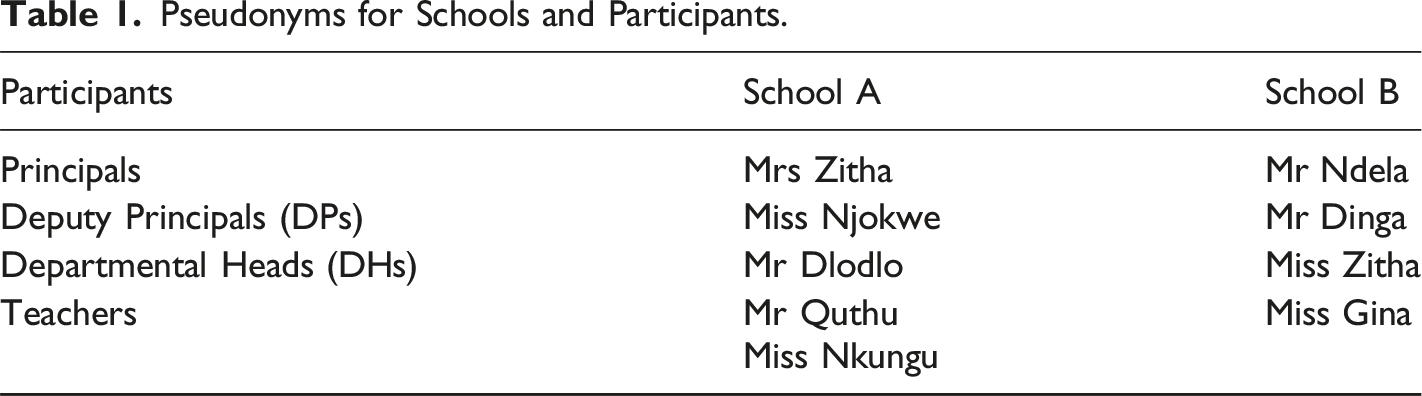
The sample of two schools (School A & School B) was selected through non-random purposive sampling. This type of non-random sampling has much emphasis on in-depth and information-rich sample due to the qualities the participants possess (Patton, 2014). The research sites were two rural secondary schools in disadvantaged communities with multiple deprivations (Maringe et al., 2015). The nine participants included two principals, two deputy-principals, two departmental heads, and two teachers from School A and one from School B.
Data was generated by means of semi-structured interviews (Creswell, 2009) for rich and in-depth understanding of the phenomenon under study. The interviews were conducted at the convenient times to participants and audio recorded. The interview schedule elicited information on their practices in creating the learning space. The data was analysed using a thematic analysis (Braun & Clarke, 2006) which we used to repeatedly read data to organise it into chunks of meanings that form categories (Vears & Gillam, 2022).
Pseudonyms for Schools and Participants.
The strategies that we pursued in order to enhance credibility and trustworthiness while promoting rigor and transparency included audit trail for maintaining records of data collection, analysis, and interpretation. Member checking was done for validating findings with participants in ensuring accuracy and resonance. There was also an engagement of colleagues for reviewing and critiquing the research as a peer review mechanism. Inter-coder reliability was another approach for trustworthiness as multiple coders were used to analyse data and compare results in ensuring consistency.
Findings and Discussions
Our thematic analysis generated five themes, and the first theme is inspiring and supporting innovativeness. The second theme is inspiring and motivating team to enhance a collaborative culture. The third theme is sourcing and ensuring efficient and effective use of resources. The fourth theme is scaffolding conversations about 21st century learning and supporting self-initiated professional development. The last theme is that the principals articulated a clear school vision for transformation
Inspiring and Supporting Innovativeness
Evidence from the interviews suggests that leaders in the two schools inspired and supported teachers’ innovation in creating 21st-century learning spaces tailored to their specific contexts. The data revealed that 21st-century learning is a multimodal practice, characterised by various systematically designed learning approaches that help learners achieve the broader learning objectives of the 21st century. As such, were innovative and came up with systematically idealised learning designs that support learning. In this regard, Mrs Zitha, the principal of School A said: It is important that teachers are inspired to come up with multimodal learning strategies that could be applied in our rural contest. Our context demands innovativeness. It is therefore important for us as leaders to inspire and support teachers in this regard.
The issue of innovativeness was echoed by Mr Dinga, the DP from School B as he explained that rural context possesses a number of challenges which required them to be innovative. He said: At some stage, cell phones were not allowed at school. Now learners are encouraged to bring them and are used in the classrooms for teaching and learning. We support their use and we provide Wi-Fi for learners to access information. We ask the community to donate their broken cell phones. One of the teachers offered to fix them and those that are fixed are used by learners.
It was interesting to note that at School B they go to an extent of asking the community to donate broken cell phones and that the teacher could offer the service to fix them so that they could be used by learners inside and outside classrooms. Miss Gina from School B echoed that cell phones that have been fixed increase the accessibility and they use them to make their lessons interesting for learners. They have also used them to a limited extent for online teaching and learning during Covid-19 pandemic but now for flipped learning. Miss Gina explained that their mathematics department have adopted flipped learning methods where they record video clips and learners use these cell phones outside the normal class time. This is what she said: Our mathematics grades are picking up. Teachers in that department are recording video clips which are used by learners outside the normal class time. In that way, learners have more opportunity to interact with the content because they can replay it again and again until they master the content. That was innovative and the SMT is pushing for this to be adopted by other departments as well.
Echoing Miss Gina’s view that the SMT is supportive, Mr Ndela, the principal of School B indicated the success of supporting innovations by referring to one of the departments that can be expanded across others. He said: Come 2023, we will be number one in the district in mathematics. This thing of recording lessons is taking us far and we are pushing for the other departments in the school to adopt it. We have awarded trophies to our pioneers in the mathematics department.
Views expressed by the participants suggest that the school leaders supported and inspired innovation that enhanced 21st learning in their schools. The adoption of flipped learning and the creativity that goes with it seemed to be working for them. While the role of leadership in supporting creativity may vary depending on contextual factors, it is critical to establish creative, innovative organisations (Zaitouni & Ouakouak, 2018). The perceived open-mindedness of school leadership towards teacher-initiated innovations positively impacts the successful creation of the learning space for twenty first century skills. The kind of leadership practices in both schools seem to have developed a sense of inspirational climate. Apparently, they support highly inspired teachers to take initiatives of introducing new approaches to learning spaces of the 21st century learning. The inspiring climate and the support of innovations that school leaders pursued in their practices was an indication of promoting a positive learning climate.
Inspiring and Motivating Team to Enhance a Collaborative Culture
Our data shows evidence that school leaders in both schools were inspiring and motivating team to work collaboratively for the 21st century learning to be a success. The Principal of School A, Mrs Zitha shared her approach to the impetus from a handful of proactive teachers in the following way: We had a clique of highly inspired technology savvy teachers who took an initiative to infuse technology in teaching and learning. We appreciated what they were doing and trusted them. More and more teachers are now involved. Teachers’ proactiveness is an impetus to the school improvement.
Elaborating further on what Mrs Zitha had mentioned about proactive teachers, Miss Njokwe, the DP at School A said: It becomes critical for a leader to listen attentively to the views and opinions of your colleagues and try to understand what they are up to. What we did when the technology savvy clique, that’s what we called them, approached us with their ambitions, we decided to organise a special meeting for them to share their views. Well, we wer interested in what they presented on the table. We then took a step further to influence other ‘SMT’ members to buy in on this motion. We went all out different relevant source to get more knowledge on how we can ensure the success of this endeavour.
Mr Dlodlo, the DH at School A said: It is our leadership responsibility to seek support and getting more knowledge about this thing. Infusing technology in our teaching and learning is new to us. We cannot just fold our hands.
A similar pattern was observed at School B where the leaders inspired and motivated others to share ideas about the 21st century learning. The former matric learners that were in their first year at an institution of higher learning suggested that the school had to provide computer literacy to learners because of the challenges that they had encountered. The school management team deliberated on this issue and conformed to the idea of providing computer literacy as a subject. The Principal of School B, Mr Ndela made the following utterances: The reality is that I had no idea whatsoever of how we can transform the school for learners to use technological devices in teaching and learning processes. I shared this idea with the rest of SMT members and later with teachers. They seemed to be in favour of this idea because some of the teachers are already ahead in using portable technology devices and laptops in teaching and learning. This became a starting point for integrating technology in our classrooms.
The SMT members at School A went further in ensuring that the infusion of technology in teaching and learning is put into fruition efficaciously. The traditional classroom organisation needed to change into the learning space that could accommodate new approaches to teaching and learning with technology devices in place. The school leaders were to be knowledgeable with technology integration in teaching and learning and show teachers how traditional classrooms can be organised for better use. The SMT members took an advantage of weekly class visits to understand how teachers that had begun infusing technology in teaching and learning did it. Miss Njokwe, a Deputy Principal (DP) from School A shared the following information and said: At least as we are in leadership positions, we now understand the gaps of what teachers are inspired to do and what is actual happening with regard to putting ideas into action. The SMT members agreed on identifying the proactive teachers in infusing technology to attend a developmental workshop with us that our Principal had organised with a private services provider.
At some point, the SMT members find it appropriate to lead from the front by taking a decision of being well acquainted and knowledgeable about infusing technology in teaching and learning. Hence, standardised traditional classroom set-up that teachers are accustomed to will have to be reconfigured as a learning space. For them to direct the creation of the learning space, they must also ensure that instructional practices are procedurally appropriate in order to avoid unintended consequences. Concurrently, it is imperative that the SMT is ensuring effective and efficient us of relevant educational resources for the 21st century learning. Miss Zitha, the Departmental Head (DH) from School B attested to this reality and said: We reached a point as the SMT that we are the ones to understand better and then lead from the process of infusing technology in teaching and learning rather than being coaxed by teacher demands and subsequently respond. We decided as the SMT that we should develop ourselves professionally first regarding the required technology devices, their usage and how to infuse them in classrooms as they were.
It was an imperative step for school leadership to be well abreast with what is required in creating the learning space that best support the 21st century learner-centric pedagogies. According to Spillane (2005), school leadership becomes effective when leaders know effective instructional methodologies or schools to adapt to changing social, economic and technological demands (Manangan, 2022). The involvement of technology savvy teachers in SMT professional development sessions was a measure that was emphasising the value of sharing creativity and innovativeness in creating the learning space and infuse technology in teaching and learning (Manangan, 2022).
Sourcing and Ensuring Efficient and Effective Use of Resources
Our data indicates that the school leaders embarked on ensuring that technology-based resources were available in their schools to enhance 21st century learning. Sourcing and integration of technology-based resources in teaching and learning have become the necessity in the 21st century learning. It becomes imperative that the school leadership provides teachers with relevant technology-based educational resources and encourage their efficient use. Mrs Ndela, the Principal of School B said: It is surprising that the types of teachers and learners we are having in schools are technology literate and addicted to it. In support of innovativeness from five teachers that put on the table their proposals of infusing technology in their lessons, what I normally did was to provide them with all the materials they request such as laptops, data projectors and Wi-Fi facility to connect to internet. Wi-Fi enables teachers and learners to access relevant global information that enhances learners’ self-centred learning.
Similarly, Mrs Zitha, the Principal of School A declared: We felt the need for the school to expose learners to computer skills. We then demonstrated our aspiration by beginning to have a computer application technology (CAT) subject. Subsequently, we also decided to transform our school to be a technology using school so that our learners get equipped and be enabled to get the kind of knowledge that will make them fit in tertiary institution. After our school leadership had been looking for sponsorship, our school received the funds for building a fully equipped smart classroom, which was sponsored by [X] Community Thrust.
Mr Dlodlo, the Departmental Head at School A attested to the sponsorship from the Department of Education. He had the following to share: Our school was donated by a private company with 45 tablets. All teachers had equal access to them. The main objective of the school leadership was to ensure that there are sufficient gadgets when teachers are encouraged to infuse technology in teaching and learning.
The Information Communication Technologies also enhance the 21st century learning among other sectors. Rural schools that were sites for this study on which this report is presenting are providing teachers with Wi-Fi for internet connectivity. In attesting to this provision, Miss Njokwe, a Deputy-Principal from School A said; We also get internet access for various usage such as downloading lessons or videos by using the cell phone for the school. In cases where there is no more data, we request the school to buy data, which they do immediately from Norms and Standards allocation.
On the same vein, Mr Dinga, the Deputy-Principal from School B expressed as follows: Our school has an installed and well-managed Wi-Fi facility. It has been useful when our school once when we had a virtual lesson presentation and interaction with learners in Limpopo Province of South Africa.
The available resources that the schools had provided, although they are insufficient to meet of the needs for the 21st century learning, the school leadership encourages teachers to use them maximally and efficiently. To this effect, Mrs Zitha, the Principal of School A had the following to say: In all the occasions when we have monthly staff meetings and morning briefings, I encourage all teachers to commit and acquaint themselves with how best each of them can integrate technology in teaching and learning. In some instances, I normally put forward an idea that we must be supportive to each other in all other formal or informal engagements at any time.
Teachers as agents of change (Lillo & Aponte-Safe, 2019) are empowered by school leadership to be innovative and actively involved in diverse educational settings. The learning space is created when there is an interaction between the teacher and learners. Meanwhile, different levels of teacher autonomy are important when teachers interact with learners. Teacher autonomy maximises the innovation status and enhanced learner-centric pedagogies (Hashim et al., 2021). To this effect, Miss Nkungu from School A posited: The support from the school leadership was to organise a sponsor from Microsoft company to develop teachers mostly with teaching in the 21st century. The trainer from this company proposed to develop a course in the form of workshops for integrating technology in teaching and learning. To me it is merely a revelation workshop to know that there is something like this involving technology usage in teaching and learning out there.
On the same breadth, Mr Dinga from School B had the following to share: Our school Principal organised a workshop that was conducted by a private service provider and one teacher was invited to attend like other schools. They did show him how one can get information from tablets and there was a workshop for the whole staff when we were shown how to use them.
The leadership of both schools manage to create the learning space successfully by also focusing among others on the issue of providing the technology-based resources. The resources that were accessible in schools serve as a determining benchmark whether or not transformation will be successful (Yusnita, 2022). Notably, technology has become an integral part of the 21st century learning (Nazli & Yahya, 2023). Indeed, there is a plethora of research studies in literature referring to rural education experiencing inadequacy of resources (Du Plessis & Mestry, 2019; Kline & Walker-Gibbs, 2015; Moore et al., 2020). One of the reasons for inadequacy of resources is the shrinking of funding from Norms and standards for Funding (DoE, 2003) due to low enrolment of learners. However, the school leadership use every opportunity to motivate teachers to use the available resources effectively and efficiently.
Scaffolding Conversations About 21st Century Learning and Supporting Self-Initiated Professional Development
The leadership of both schools in this study in one way or the other scaffolded conversations about 21st century learning and supported self-initiated professional development not only for the teachers but also for themselves. Scaffolding conversations about 21st century learning was an impetus for self-initiated professional development. What is remarkable was that the professional development was not only directed at teachers but also to them as leaders. In this regard, Mr Ndela, the principal of School B said: How would I have known about flipped learning and online learning? We developed a step-by-step guide to help us as leaders to understand these things. These things are new for us. We made use of our young teachers who are good with technology.
The strategy from the school leadership to begin developing themselves was critical for them to have a clear idea of the schools’ future direction to be pursued on continuous bases. Furthermore, self-directed professional development was encouraged and supported. Miss Zitha, the DH from School B said: We have these conversations about how we can improve teaching, especially using flipped learning. You know that we are not all good when it comes to infusing technology in our teaching. Deliberate conversations about these things help.
Similarly, Miss Gina said: It is tough. We have to master technology in order for us to use it effectively in our classrooms. There are now a number of self-initiated professional developments in this regard.
Teachers take initiative to develop themselves about integrating technology in teaching and learning. Subsequently, the school leadership support and work collaboratively with proactive teachers in changing the fortunes of the school to make it relevant to the 21st century learning. The kind of leadership practices in both schools seem to display blurring boundaries between a notion of leader-follower disposition. Thus, an inspiring and collaborative working climate that is created provides the school leadership with opportunities to effectively encourage and influence all teachers to play their important roles. The roles include creating the learning space for the 21st century learning and adapting to the 21st century learner-centric pedagogies.
The School Principals Articulated a Clear School Vision for Transformation
The school vision that school principals aspire to serve as a gauge for major areas of foci reflects on the priorities that stakeholders such as teachers, parents and learners must acknowledge (Allen et al., 2018). Of course, the vision that both school principals bore, had to be institutionalised and shared among stakeholders for leadership to be successful. The priority among stakeholders to influence and inspire are the staff members with whom the Principals interact with on continuous basis in a work place. They said to be change agents (Lillo & Aponte, 2019). Hence the implications for the new vision in pursuit demands the provision of a framework for behavioural change that at a larger extent promote collaboration (Indrati et al., 2022; Manley & Hawkins, 2009). To this effect, Mr Ndela, the Principal of School B stated: I made use of my understanding of the outside of the school environment to communicate effectively and began to share and influence other SMT members to adopt the vision. I articulated my visionary ideas of reconfiguring traditional classrooms to be the learning space with intensified infusion of digital technologies and their efficient usage. After these members embraced this vision, we began developing main pillars for the mission statement before influencing other stakeholders such as teachers, parents and learners to have their inputs.
Mr Dinga, The Deputy-Principal at School B, resonates with the overall change from traditional classrooms into their reconfigured usage came into effect and he asserted: It happened that in one of our weekly SMT meetings, our Principal presented an overview of the framework for his vision for the future of this school with the expectation that we ultimately modified and give meaning to it. We were highly inspired to embrace his vision and we dedicated our support with his well-articulated presentation of vision. He was overwhelmed our swift brainstorming of key pillars of the mission statement.
Meanwhile, Mrs Zitha, the Principal of School A shared her initiatives when she said: I always use my assumptions that any individual in this schools has a valuable experience and knowledge for me to have a strategy to tap on them change the status quo of traditional practices. I began organising a special meeting of the SMT and technology-savvy teachers were already using the social media in interacting with learners even beyond school contact times. This was an ample opportunity to get insights of how best I can lead in changing the fortunes of this school and the level of support that I may expect the staff. The positive attitude that played out was overwhelming for me to drive this process of creativity and innovativeness in reconfiguring classrooms to support the 21st century learning.
The views of other staff members regarding the behaviours of both Principals have reference. Miss Nkungu, a teacher from School A shared expressed her observations that led to the success in adapting their pedagogical practices to be relevant to the 21st century learning. She said: In using my own observation of how our school made the drastic shift from traditional practices that we were accustomed to, it was because an undeniable reality that the Principal and some of our colleagues backing the ideas of the new vision were well planned, direct and presented without any share of doubt. I always have in mind this goal post towards which I dedicate myself and energised to reach. I believe my colleagues feel the same by looking at the cooperation and collaborative behaviour in addressing the emerging challenges with success.
On the same breadth, Miss Gina, the teacher from School B, shared her sentiments as follows: Our Principal with the support from the SMT in conjunction with some of our colleagues had articulate the school vision in a manner that there it was clear and to the point. There was little to alter and we were all encouraged and motivated by the spirit they carried behind their presentation. We all pledged ourselves to do more than we possibly can and we as of now we are still committed to accomplish this reality for the paradigm shift.
The approach that both Principals of schools used to persuade and influence the selected few from their staff members permeated to the rest of other teachers. Obviously, they approach other stakeholders such as teachers as change agents with confidence having a group of teachers with multiple voices in support for their shared vision and influence. Meanwhile, the approach of visionary leadership is related to the activities in pursuit by the school leaders in encouraging others to be innovative as they formulate attractive, realistic and credible vision of the future (Anshar, 2017; Robbins & Coulter, 2020).
The approach from both School Principals to begin influencing a small number of teachers with the presumptions that they may have valuable inputs to their visions was in a sense encouraging to successfully cast their vision moving forward. In a way, both Principals initially had multiple perspectives from heterogenous interactions and relations that were escalated to all teachers, learners and parents (Yokus, 2022). Indeed, the ultimate goal for this strategic approach was to seek the support from all other stakeholders. The school leadership activities as explained above resonate with an expression by scholars such as James et al. (2019) that the legitimate engagements and interaction with different key stakeholders enhance the process of achieving the primary task of an organisation such as the school. The result was a profound commitment of teachers to change (Hallinger & Murphy, 1985) that made both secondary schools prominent in that rural setting.
Conclusion
The discussion on this paper focused more on how rural school leadership created the learning spaces that support the 21st century learning for learners in rural schools. Central to the discussion in this paper are the findings of the school leadership practices that were context driven and ultimately made both schools gain their reputation. The resilience that made these two secondary schools to be successful was mainly based on the transformational leadership succeeding in gaining the commitment of teachers. The school leadership was intellectually inspiring when engaging teachers, expanded teachers’ abilities in creating the learning space as they infused technology in teaching and learning (Bass & Riggio, 2006). Meanwhile, teachers showed heightened resilience when the school leadership provided them with the necessary support. This critical undertaking enabled individuals to be proactive and innovative in transforming their schools for the 21st century learning.
The dimensions that leveraged the success included inspiring and supporting innovativeness. This climate was built from the foundation of trust, respect and commitment to change among teachers and school leadership (Thien & Adams, 2021). The expectations included a conducive school climate for innovations, the provision of relevant resources and well-informed teacher professional development. The positive school climate influenced the behaviour of individuals based on their collective perceptions about the school and in the main the shared vision (Taat et al., 2021).
The study has generated new insights about how school leadership can address the interplay of complex rural contextual factors and leadership practices toward contemporary endeavours of the 21st century learning. It has also explored the strategies used by the principals in adverse and turbulent conditions to create the learning space that support the 21st century learning for learners. Overall, what stood out to be the main reason for this profound success from both schools, is mainly a creation of collaborative school climate. The collaborative working climate enabled school leadership and teachers in general to challenge a taken-for-granted different approaches of working together. We recommend that these unique leadership practices be explored further on a large-scale study for generalisability about how other school leaders may create the learning space that supports the 21st century learning in some adverse and turbulent rural contexts. The findings of this study have implications for schools to take initiatives of creativity and innovations in transforming traditional classrooms into learning spaces of the 21st century learning for learners. Furthermore, the implications are for the Department of Basic Education to develop contemporary teacher professional development and provide relevant resources for the 21st century learning.
Limitations of this Study
This study focused on two rural secondary schools in South Africa. Although qualitative studies offer rich and in-depth insights into complex phenomenon, but they also have limitations. Key limitations include: Small sample size which limit generalisability. There is possibilities of subjective interpretations of data analysis as reliance is on researcher’s perspective and biasness. Notably, qualitative studies lack statistical analysis and therefore do not provide numerical data to quantify findings. The results may be context-dependent as with the case of this study which limits the applicability to other settings.
To address these limitations, recommendations for future research include: A mixed methods approaches that combines both qualitative and quantitative methods to increase generalisability and validate findings. It is necessary that larger and more diverse samples are needed in order to capture broader perspectives. Triangulation with regard to using multiple data sources, methods, or researchers will enhance validity. Longitudinal designs for conducting studies over time to capture changes and developments.
Footnotes
Declaration of Conflicting Interests
The authors declared no potential conflicts of interest with respect to the research, authorship, and/or publication of this article.
Funding
The authors received no financial support for the research, authorship, and/or publication of this article.
