



Abstract
In the wake of the events of recent years, most school leaders and educators recognize that taking equity seriously demands new attention to the instructional experiences that occupy most of students’ time in school. In what follows, we bring together key literature on ambitious teaching-learning and equitable classroom practice in an observation framework to support equitable and ambitious teaching and learning. This framework can enable school leaders to analyze classroom practice and cultivate productive instructional coaching conversations with teachers. The framework is not a means to technocratically score teacher performance. Instead, it provides an observer with four lenses to support ‘looking’ at classroom activity including attention to the 1) tasks, 2) tools, 3) talk, and 4) participant structures, while explicitly inviting attention to questions of equity and power related to instructional interactions.
Keywords
Introduction
The events of recent years, including the movement for black lives and the disproportionate impacts of COVID-19 on communities of color in the United States, have left school leaders grappling with ways that equity, diversity, justice, and inclusion are implicated in their schools and classrooms. Many educators recognize that taking these issues seriously demands new attention on instructional experiences that occupy much of students’ time in school. School leaders are also increasingly acknowledging their responsibility – as instructional leaders – to support teachers in equitable teaching practices (Mckenzie et al., 2006). In this essay, we offer instructional leaders a framework for understanding and resources for addressing just these challenges.
Although observational frameworks (e.g., Danielson, 2007) can be helpful in directing improvement in classroom instruction, the result can be a narrowly instrumental focus on particular teaching skills or competencies that miss the complexities of social interactions where inequities are most common (Hill & Grossman, 2013). In many cases, existing frameworks and tools can perpetuate the status quo, valuing participation aligned with dominant historical and cultural norms (Golann, 2021). Addressing equity requires asking questions such as: What speaking and writing practices are valued in my classroom? Who has the power to say those practices are valuable? How can I expand and change the criteria of what is valued to create a more equitable and inclusive learning space for all students? Taking action on these matters requires a close review of what happens in classrooms and even a critical analysis of what is typically considered high-quality instruction in school classrooms.
With an overlapping focus on subject-specific and justice-oriented pedagogies, we look for teachers to engage in ambitious instruction that centers student participation in complex reasoning and teacher’s capacity to respond to students in ways that support inclusive learning environments. Even for school leaders who have long-focused on supporting ambitious and engaging classroom instruction, explicit attention to social inequities may feel daunting and even frightening (Dor-Haim, 2022). In what follows, informed by our review of literature and over a decade of coaching and learning from our work with inservice teachers, we offer the Ambitious Teaching and Learning framework (ATL) for classroom observations. This framework enables instructional support personnel to analyze classroom practice and cultivate instructional coaching conversations with teachers to help them develop more ambitious and equitable instructional practices and responsiveness to students.
The framework’s lenses prompt noticing for equity and conversation about design considerations and redesign possibilities related to participation, access, and identity (Greeno & Gresalfi, 2008; Gutiérrez, 2009; Patterson Williams et al., 2020) while also attending to ambitious instruction across subject areas, including an emphasis on student reasoning in disciplinary activities (Ball & Cohen, 1999; Lampert, 2001; Stein & Smith, 1998). The tool (Figure 1) is not a means to score technocratically teacher performance. Instead, the framework provides an observer with four lenses that draw attention to the 1) tasks, 2) tools, 3) talk, and 4) participant structures in a classroom, while explicitly prompting questions about equity and power relations. As such, the ATL tool provides space for an observer to document aspects they notice related to each of the frames and additional space for wonderings that will serve as a foundation for genuine curiosities the observer wants to explore with the teacher. We find in both the scholarly literature (e.g., Anderson & Dobie, 2022) and our collective sixty-odd years of experience working with teachers on improving instruction that using language like ‘noticing’ and ‘wondering’ can support an analytical stance and help an observer and teacher collaboratively reflect and co-design strategies for improvement. Observation framework to support equitable and ambitious teaching and learning.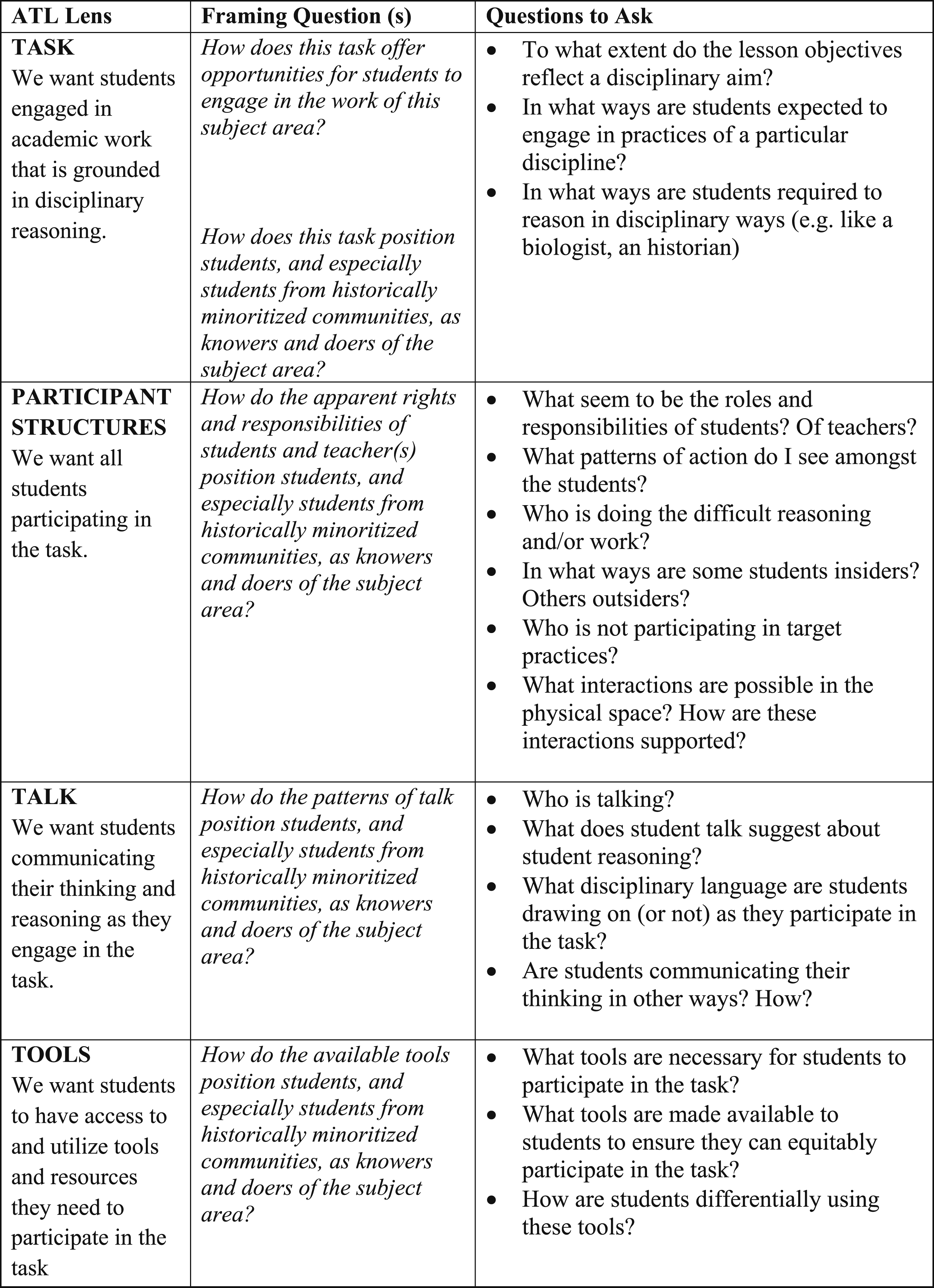
While we isolate each lens in the framework in order to focus on particular aspects of instructional interactions, we do so with the awareness that such isolation is analytical and temporary, given that no single part of an instructional interaction is distinct from the whole. In using the framework to guide our looking through the different lenses, attention shifts away from the teacher as the object of classroom observation and toward students regarding what they are doing, how they are doing what they are doing, and whether the instructional space is designed for ambitious and equitable learning experiences.
Our purpose in presenting these cases is not to report out on an empirical research project but rather to illustrate examples of the conceptual elements of the ATL framework. Below, we unpack these lenses that guide our ‘looking’ and offer examples of what we noticed when we observed in-service teachers in our master’s program through each lens. To do so, we draw on two cases of in-service science teachers who were enrolled in a master’s program in urban education in 2020-21 and 2021-22 school years: one case is representative of teaching that may be considered historically typical (e.g., Cusick, 1973; Graff, 2003) as compared to another case that is “both intellectually and socially ambitious” (Lampert, 2015, p. 1; Cohen, 2011). We follow Lampert’s (2015) lead in using illustrative compilations to make the conceptual elements of the teaching-learning framework come to life and be as explicit as possible for readers who spend their days in classrooms, improving the work of teaching and learning.
In this way, the lessons described below are not a strict reporting of singular lessons but a representative compilation of elements from more than sixty observations of each teacher over a two-year period. The two teachers described in the compilations below were enrolled in a two year master’s degree program at a private south-eastern university, partnered with its large local urban school system. Teachers who completed the program received a tuition-free Master’s degree in Teaching and Learning in Urban Schools in exchange for a commitment to work in the school district for five years. At the time of the study, both teachers were at the same middle school, a school where the student population was one of the most racially, ethically, linguistically, and culturally diverse schools in the district, with students who spoke over 40 different languages. Both teachers described in this manuscript were in their fourth year of teaching in the second year of the project; they were white, native English speakers, and eventually they both went on to finish the program and fulfill their commitment to the school district.
The second author was the primary observer and documented planning documents, instructional observations and follow up meetings with both teachers over the two years. The compilations draw on these weekly documentations from more than 120 observations, which we use to illustrate the key theoretical lenses that comprise the elements of the observation framework offered in this manuscript.
A Lesson on Food Webs: Two Instructional Contexts
To demonstrate how we use the framework to examine classroom practice and prompt meaningful conversation about instruction, we include a description of two fifth grade classrooms. The two teachers – Julia and Ana – taught fifth grade at the same culturally and linguistically-diverse middle school. Their classrooms were located across the hall from each other, and they formally met weekly to co-plan their science lessons, but had informal conversations in the hallway about their lessons multiple times a day. During one formal planning session, Julia and Ana designed a lesson targeting a science standard that required students to, “use information about the roles of organisms (producers, consumers, decomposers), evaluate how those roles in food chains are interconnected in a food web, and communicate how the organisms are continuously able to meet their needs in a stable food web.” By this point in the unit, the students had already encountered food chains, so the teachers’ idea was to design a lesson to support students in creating food webs using organisms from different ecosystems. During the planning session, the teachers discussed the flow of the lesson, starting with a quick bellringer that reviewed academic vocabulary, an activity where students would create their own food webs, and an exit slip to check students’ understanding of the role of an organism in the food web. The only obvious difference was that Julia had pre-made laminated cards that included pictures of organisms on the front, with the organism’s name, what it ate, and where it lived on the back. When we observed these two classrooms, however, differences in enactment were dramatic.
In Julia’s classroom, students worked in pairs to move the pre-made organism cards into food webs. With their partners, students communicated in a mix of Spanish, Arabic, and Somali to negotiate their understanding of what the organisms on the cards were, where they lived, what they ate, and how each should be connected on the food web. While Julia did not understand everything the students said, she interpreted and asked questions about how they arranged the cards as students moved between languages, pointed, and drew lines in the air. The classroom was loud with nearly all students chattering away. Yet, students worked conscientiously over the course of twenty-five minutes moving cards, talking with partners, turning to other groups with questions, and checking in with Julia.
In Ana’s classroom, students were able to draw on an array of science magazines with pictures of organisms that could be used to construct individual food webs. As students looked through the magazines, it was relatively quiet, but they asked Ana questions like, “What is this? What does it eat?” When they found pictures they wanted, they cut them out, and arranged them on their paper before gluing. The activity appeared engaging for the students, and it produced colorful artifacts to display. Ana had difficulty, however, determining what sense students were making of the relationships between organisms as she did not appear to end up with evidence that her students met the learning objective.
In what follows, we will unpack these two lessons in more detail using four lenses of the ATL framework to demonstrate what we noticed about the enactment of Julia and Ana’s common lesson plan and the types of questions that emerged in our conversations with the teachers after the lesson.
What is a Task?
A task is an activity that allows students to engage and deepen their understanding of the subject-area content related to particular learning objectives (Leinhardt et al., 1990; Sandoval & Reiser, 2004). The basic question we ask concerning tasks we observe in a classroom is: How does this task offer opportunities for students to engage in the work of this subject area? More formally, we ask: How does this task position students, and especially students from historically minoritized communities, as knowers and doers of the subject area?
A well-designed task will provide access for all students to participate in activities central to disciplinary goals, while being open enough for students to demonstrate multiple ways of knowing and doing the task (Lampert, 2015; Leinhardt et al., 1990; Warren et al., 2020). A well-designed task requires more than knowing or even applying information about the subject area because tasks necessarily demand disciplinary reasoning, meaningful interaction, and relevant products. Ambitious teaching, then, begins with rich disciplinary tasks that are challenging but doable (Lampert, 2015). This means an equitable task must be accessible and achievable in some form for all students and it elicits critical thinking and problem solving that position students, and especially students from historically minoritized communities, as knowers and doers of the subject area (NASEM, 2021).
When observing a lesson with an eye on tasks, we ask the overarching question, “How does this task position students as knowers and doers of the subject area?” In deconstructing a task, we need to turn our gaze toward the work students are required to do to be successful. It is through student work and talk that their thinking becomes visible to us but that thinking will emerge only if a task is designed in such a way that complex reasoning is elicited. If students are engaging in the subject-specific work in meaningful ways, then we should see and hear students work through complex reasoning in ways that deepen their own and other students’ thinking. If we notice that students are not engaged or they are not engaged in complex reasoning, we need to ask if this has something to do with the design of the task itself or if access to the task needs to be modified for all students to have some form of success. In particular, we can pay attention to the extent to which the task makes space to bring in different perspectives and problem solving strategies to support equitable classroom participation (Haverly et al., 2020; Schwarz et al., 2021).
Looking for Tasks in the Classroom
Students in both Julia and Ana’s classrooms worked to construct food webs. While all students had access to images of organisms, Julia’s lesson provided more opportunities for students to equitably engage in a scientific task. Julia’s task required students to work together to negotiate a meaningful arrangement of organisms in an ecosystem. Students had access to academic terms she introduced in previous lessons, and she made space for them to make sense of these terms in relation to each other by allowing students to use their first language to engage in the task. Even without understanding all languages in the class, she had no difficulty determining that students were engaged in disciplinary reasoning because the task demanded the negotiation and creation of a defensible food web, as we describe in more detail below.
The task of constructing complex food webs from the organisms allowed for student pairs to arrive at different webs that showed how they were taking information about the roles of organisms in an ecosystem to reflect their understanding of the interdependence of organisms in an ecosystem. This cognitively demanding task also made space for more equitable sensemaking (Schwarz et al., 2021), as the students negotiated and reasoned through different arrangements of their organisms in the food webs, relying on their existing funds of knowledge. The task design encouraged students to introduce different perspectives, allowing them to draw on cultural, linguistic, and experiential resources to support their scientific reasoning (Stevenson, 2013).
Ana’s task was engaging, and the students seemed to enjoy it, but the creation of the food web did not require students to think through and articulate their reasoning to anyone else in the class. The hard work in Ana’s task was more focused on finding organisms in the magazines to cut out and paste on their papers, and less on identifying and representing the relationships between the organisms. Furthermore, Ana set this up as an individual task, where each student would produce their own food web, a reality that is not necessarily a problem except that it precludes any negotiation or need to communicate thinking to any other participant in the class.
What are Tools?
Tools include any physical or conceptual resource that mediates student participation in a classroom task such as physical or conceptual resources (Wertsch, 1998). The essential question we ask when it comes to tools and classroom observation is: How do the available tools position students, and especially students from historically minoritized communities, as knowers and doers of the subject area? Such tools will include classroom resources made available in the classroom as well as resources students bring to the classroom themselves (Ball, 1997; Greeno & Gresalfi, 2008). Tools can be straightforward physical artifacts, such as a computational model, a map, math manipulatives, or a text. Tools can also be scaffolds for conceptual reasoning, such as sentence stems for writing or talk frames that allow a student(s) to participate in a particular task or target academic language (e.g., Windschitl et al., 2012).
As noted above, the tools students draw on are not only those provided by the teacher because what students do in a classroom requires the use of historical, cultural, and/or institutional tools, some of which are discrete and visible and some invisible and perhaps taken-for-granted (Cornelius & Herrenkohl, 2004). Paying attention to the tools that mediate participation in the target task, invites us to notice what a student needs to be successful, who seems to have access to necessary tools, and to what extent necessary tools privilege certain students over others.
Looking through the tools lens requires us to pay attention to what tools are required, how and when the tools are introduced in relation to the task, who is using those tools, and the extent to which the requirement to use certain tools is based on assumptions about student experience. Here we may begin to notice the ways that certain tools afford participation for some students, but not others. We may also notice that certain tools required to successfully participate in the task may be more or less aligned with the historical and cultural experiences of some students. While some tools may be visible, explicit, and helpful to all students, many tools that mediate a task may be invisible and unnoticed by teachers and students. The extent to which the teacher is aware of the many cultural, linguistic, conceptual, and physical tools that enable participation, the greater chance of scaffolding to support participation for all students or potentially adapting the task to address inequitable norms or practices.
Looking for Tools in the Classroom
In both Julia and Ana’s classrooms, students had access to a range of practical and conceptual tools that mediated participation in the tasks. What follows is in no way comprehensive but instead intended to recognize some of the key tools we noticed mediating these classroom tasks. Students in both classrooms drew on practical tools that offered an opportunity to demonstrate the scientific relationships targeted in the lessons. All students had access to physical pictures of organisms. In Julia’s classroom, these were predesigned cards; in Ana’s classroom, the students searched for organism pictures in magazines. The difference in how students took up these tools affected the extent to which they engaged in the scientific sensemaking associated with the task. In Julia’s classroom, the students knew that while they were provided with some practical tools to engage in the task, they were able to incorporate other tools - practical or conceptual - if they supported their participation in the task. e.g., no one asked if they had to speak or write in English. This was most obviously a classroom norm that had been established prior to this lesson. Students were able to draw on their own linguistic resources to help build conceptual understanding of the content.
In Julia’s classroom, student pairs had access to a set of cards that included organisms within one ecosystem. Remember that the goal of Julia’s task was to create as many linked food chains (i.e., a food web) as possible with the organisms from their card set. The students quickly launched into the task, moving cards around on their desks, creating multiple representations of food webs and negotiating meaning using conceptual tools such as academic language associated with food webs, ecosystems, and the roles of organisms. In Julia’s classroom, physical tools and conceptual tools necessary for the task were made explicit in both the creation of their food web representation and the talk involved in getting to a consensus representation.
In Ana’s classroom, students spent much of their time hunting for pictures of organisms from a common ecosystem to create their food webs. Because the pictures were not immediately available to support sensemaking about the relationship between organisms in food webs in Ana’s classroom, the student task shifted away from constructing a food web and more toward finding usable pictures. While Ana’s students appeared to begin the task with a clear sense of the conceptual ideas of producers and consumers, their use of these scientific concepts and relationships never really emerged because students prioritized finding any picture of any organism, and chiefly finding pictures that would fit the size of their papers. In Ana’s classroom, then, the conceptual tools and practical tools Ana provided were not directly focused on the web design task that Ana hoped would prompt complex science reasoning. Because the practical tools were not available to be used to support sensemaking about food webs, students did not have a need to bring in the conceptual tools to mediate their participation in the task.
A common occurrence in classrooms is catching up students who are absent from previous lessons that provide the prerequisite knowledge to engage in the task. In both Julia and Ana’s classrooms, there were a couple of students who had missed previous lessons on food chains and the introduction of academic language associated with the various trophic levels (e.g., producers, consumers). And, in both classrooms, the students who had missed previous lessons tried to disengage from the task. In Julia’s classroom, the premade cards helped to provide an embedded scaffold for the task as the students started by asking questions about what the organism was and what it ate before they identified a placement for this in their web. For one student who was absent for multiple days, his prior knowledge about organisms served as a conceptual tool that allowed him to contribute to the conversation and leverage his peers’ academic language to refine his everyday thinking. For example, when he pulled out a card of an organism with sharp teeth and sharp claws, he believed it ate other organisms making it a predator. His peers helped add the additional term, consumer, to this organism.
In Ana’s classroom, she chose to sit next to one student who had been absent the previous day (and had taken several minutes to ask to use the restroom, to sharpen a pencil, and to find a notebook). Ana selected one magazine and flipped through it with the student one-on-one, asking questions about the organism in the picture eliciting her ideas based on prior knowledge and experiences. Like Julia’s previously absent student, Ana’s student provided reasoning for what organisms might eat based on her knowledge outside of class, such as when she thought a caterpillar ate leaves and maybe fruit because of a book she remembered. Ana was able to build on these initial ideas to introduce terms like ‘producer’ and ‘consumer’ while she was talking to her. In both Julia and Ana’s classrooms, the pictures served as physical tools that highlighted features on the organisms that the students could then anchor conceptual tools, in this case their prior knowledge. The meaningful integration of these physical and conceptual tools helped students deepen their thinking about the relationships between organisms to create food webs.
What is Talk?
By talk we refer to what Gee (2005) calls ‘discourse,’ or the ways people negotiate meaning with one another. Gee defines discourse as “stretches of language which ‘hang together’ so as to make sense in some community of people” (p. 115). If we think primarily of classroom talk then the fundamental question we might ask is: How do the patterns of talk position students, and especially students from historically minoritized communities, as knowers and doers of the subject area? Although discourse can be considered a kind of mediating tool as envisioned above, we break talk out into a distinct analytical category for classroom observation. More specifically, we are looking at how participants - both learners and the teacher - communicate with one another as they engage in the task.
Different academic communities (e.g., disciplines) take up particular forms of talk that we may see reflected in classrooms. For example, in a mathematics classroom we might hear language of strategy, modeling, and proofs (Ball & Bass, 2003) while in another math classroom the talk may be dominated by discourse concerning correct and incorrect answers (Chapman et al., 2009; Houssart, 2001). Observing talk in a classroom, therefore, will include attention to the particular language that students are drawing on (or not) as they participate in a task. A focus on classroom talk allows an observer to pay attention to student language that initially may be deemed ‘non-academic’ because it doesn’t fall within certain confines of discipline-specific discourse or typical school discourse. Such a focus helps highlight exclusionary conceptions of academic or classroom talk that commonly privilege students of particular backgrounds or experiences (Philip et al., 2019). Attending to the substance of the discourse can draw attention to the ways that certain language and discourse patterns in a classroom can indicate whether students are more or less central participants in the classroom community (Gholson & Martin, 2014).
Looking for Talk in the Classroom
In both Julia’s and Ana’s classrooms we immediately noticed that the tasks decentered the teacher as the primary voice of authority and made student talk central to the tasks. Furthermore, students in both classrooms drew on academic language associated with the interaction of organisms in an ecosystem. In Julia’s classroom in particular, we noticed students differentially using scientific terms (introduced in prior weeks) such as producer and consumer, as well as syntax associated with the representations of food chains such as specific types of relationships between organisms that showed how energy flowed. Notably, these terms were initially provided by Julia but appeared to have become integrated into the common language of the classroom.
Julia was able to attend to students’ scientific reasoning by listening to the talk of partners who were negotiating definitions and relationships aloud with one another. For example, one partnership engaged in an extended back and forth concerning whether secondary consumers ate just primary consumers or if they could also eat producers. This emergent argument created a productive space for students to use academic language while negotiating meaning. As Julia walked around the room, she did less correcting of student statements and more questioning and offering ideas that prompted student pairs to extend their ideas. Furthermore, the talk in Julia’s classroom included unique cultural, linguistic, and experiential differences when she pressed students about different connections they had in their webs. One group had a bird eating a fish and she asked about this. The student who responded had extensive knowledge about fishing with his dad and uncle. From these experiences, he had watched several birds grab fish out of the water. While the particular bird in the picture had not been identified as one that ate fish, Julia agreed that the student’s reasoning explained the connection he represented.
Listening to student talk in Ana’s classrooms is where we first noticed the difference between the two classrooms in terms of realization of the goals of the tasks. While Ana envisioned a student-driven task, the student talk suggested that the goal was not working through the scientific reasoning required to construct a food web but instead was the location of organism photographs in the magazines. As students looked through the magazines, they often had questions like, “What is this? What does it eat?” When they found pictures they occasionally pointed the organisms out to others, and then they cut out the pictures, and arranged them on their paper. At that point, the student talk became much more focused on completing the arts and crafts activity, and less on the relationships between the organisms: “Where is the glue? I can’t fit this, it is too big for my paper!” While the kind of talk observed in this class was directly related to the limitations of the task Ana designed, paying attention to talk allows the observer to recognize that the talk was not connected to the learning objective, a reality that could have prompted Ana to change tacks by asking questions or prompts that could reengage student thinking in the targeted disciplinary work. In Ana’s classroom, the substance of student talk shifted from identifying relationships between organisms to focusing on finding pictures that would fit on their pages.
What are Participant Structures?
By participant structures we refer to the social and historical norms and practices that (often implicitly) mediate student and teacher participation in classrooms. In this way, we come to see every classroom space as not simply designed by the teacher but as a space co-constructed by students and teachers as well as a space mediated by any number of social and historical patterns relevant to particular groups of students, grade level dynamics, intra-school norms, and society-level practices (Au & Mason, 1981; Cornelius & Herrenkohl, 2004; Erickson, 1982; Phillips, 1972). With this lens we can ask: Is every student intentionally included and positioned as capable in the practice of the task assigned?” More formally, we can ask: How do the apparent rights and responsibilities of students and teacher(s) position students, and especially students from historically minoritized communities, as knowers and doers of the subject area? In attending to this question, we begin to notice structures that afford certain interactions for certain students and enable certain kinds of student participation. For example, classroom research across decades in the US documents a commonly accepted pattern of teachers as the initiator of questions, students as the responders, and teacher, in turn, as the evaluator of student responses (Cazden, 2001). Such a participant structure is rarely articulated or even intended by teachers but because both students and teachers are apprenticed into these rights and responsibilities, the pattern continues to be reified in most K-12 classroom settings. A different grain size of participant structure are social dynamics that come into the classroom from outside, such as Gholson and Martin’s (2014) third grade mathematics students who participated in self-directed math activities according to the social dynamics established on the playground and lunch table.
Macro-level social patterns also become relevant here in the sense that, welcome or not, social and historical patterns race, gender, sexuality, and other attributes of students and teachers can become meaningful as students participate in classroom activities (Boaler, 2002; Shah & Leonardo, 2016; Stengel, 2010). e.g., Boaler’s (2002) work highlights the ways that typical mathematics classrooms in the UK and US function according to implicit norms that reward practices typically cultivated in boys and discouraged in girls in these societies (e.g., competitiveness, assertiveness, confidence). Likewise, research on participation in math and science classrooms increasingly demonstrates race as meaningful in classrooms including students of color’s perception of their competence and relatively limited participation, despite demonstrated capacity (Gutiérrez, 2013; Martin, 2012).
In short, looking with the participant structures lens begins with an expectation that certain interactions are going to happen unless spaces are (re)designed for intentional participation. Children and youth designated as “problem children” in the school will misbehave in ways similar to other classrooms. Girls in STEM spaces may encounter messages that they do not belong (Master et al., 2016). Students of color and non-native speakers of English may be marginalized in intentional and unintentional ways (Cholewa et al., 2014; Shah & Leonardo, 2016; Yosso, 2016; Yosso & García, 2007). Homing in on participant structures begins with an assumption that unless someone intentionally (re)designs a learning space, prevailing social patterns will persist (Leonardo & Porter, 2010; Matias, 2013). In that way, we approach the work of teaching not simply as design work but always as redesigning existing participant structures to support more inclusive and equitable participation.
Looking for Participant Structures in the Classroom
When we attended to participant structures in Julia’s and Ana classrooms, we gained a different perspective on several aspects noted above and we noticed a few new things as well. First, the tasks in both classrooms disrupted typical patterns of classroom participation that position the teacher as the consistent leader and the students as the followers. Especially in Julia’s classroom, students led the questioning, investigating, and arguing while the teacher moved in and out of these interactions with generative questions and prompts, but rarely final conclusions. Positioning students in these ways “made space” (Haverly et al., 2020) for both the kind of scientific reasoning envisioned in Julia’s objectives and also afforded opportunities for the participation of all students, and not just those who mastered typical classroom patterns of participation. Ana’s task too allowed students to take the lead in the central activities of the class, although it never quite got to the place where it required complex student reasoning or substantive collaboration.
Because we spent considerable time in this school and these classrooms, we noticed, in particular, the participation of certain students when we took up the participant structure lens. For example, Jaime – a student in Julia’s class – was introspective and a student who flourished in other contexts such as in art class, music class, and in previous observations in another teacher’s reading class. What was noteworthy during this observation was that Jaime became one of the central participants in the activity, a dimension we had not seen in other contexts. The encouragement to use his first language surely played a role but it was the reasoning he consistently and voluntarily demonstrated throughout the activity that got our attention. Jaime’s participation was remarkable in the sense that it was quite different from the ways he participated in other contexts we observed.
In Julia’s classroom–where nearly all students participated in activities that consistently elicited their scientific reasoning–Jaime’s participation was not particularly remarkable. As noted in the section on tasks above, Julia’s instructional design envisioned ways for students to draw on their own funds of knowledge in order to engage in complex and challenging reasoning. She then responded to student ideas in class in ways that elicited further student reasoning. At one point Julia stood near the center of the room and heard a student say, “I think this consumer eats both plants and animals. Where can we put this card?” Julia asked everyone for silence, and she revoiced the idea before inviting a girl named Leonna, whom she had observed work through this problem with her partner just minutes before, to share how she solved this problem. The effect of revoicing the question and lifting up another student’s response helped to deepen the complexity of the conversations across the rooms by positioning students as resources for each other’s learning.
When we debriefed the lesson with Julia and asked her about Jaime and the broad participation amongst her students, she explained that she had engaged in a video analysis of her own teaching as a part of the prior year’s professional development exercise. Through the analysis, she noticed that eighty-five percent of the time that a question was raised in class, she called on a boy to answer the question. This pattern suggested that although she had not intended it, she was facilitating a common pattern in science classrooms and in macro social discourse: privileging male voices and ideas. This recognition led her not only to more conscious selection of students for answering questions but also to design science tasks in ways that decentered Julia as the arbiter of questions and answers. When we observed the lesson noted above, Julia was several months into a new school year in which she was working explicitly to address these tendencies that evidenced both common pedagogical patterns and macro social patterns.
Introducing an Observation Tool for Equitable and Ambitious Teaching and Learning
We have worked with several administrators who have found a simple tool, like the one included in Figure 1, to help them maintain a focus on the different lenses of equitable and ambitious teaching and learning while they are observing classroom activity. In this table, we have included the high-level question related to the lens and unpacked that into observable questions. Additionally, we have found that reflective conversations around classroom practice are much more productive when they are grounded in specific evidence from the lesson. For this reason, we have included the questions, “What do I notice?” and “What do I wonder?” Noticing is about making factual statements about what is observed, including specific talk that was said by the teacher or students, or details around participant structures or the tools. Noticing is not about making statements that have embedded interpretations, such as “students are off-task.” Wonderings allow for an extension of the observation into a question or connection to a goal the teacher might be working on. We find that genuinely wondering, rather than making suggestions disguised as wondering, can allow curiosity and learning to guide post-observation conversations.
By using these lenses and language around noticing and wondering, we have found that observers are able to preserve an analytical stance that focuses more on teaching practice, and less on evaluating the teacher. This allows the observer and teacher to have more productive reflective conversations after the lesson, opening up space for suggestions to make practice more equitable and ambitious to be co-constructed.
Conclusion
Here we have offered a framework for classroom observation that is intended to support school leaders in analyzing classroom practice and cultivating instructional coaching conversations with teachers that lead to meaningful, equity-oriented design considerations. In using the framework to guide our looking through the different lenses, attention shifts away from the teacher as the primary object of observation and to students, what they are doing, how they are doing what they are doing, and whether the instructional space is designed for ambitious and equitable learning experiences.
Footnotes
Declaration of Conflicting Interests
The author(s) declared no potential conflicts of interest with respect to the research, authorship, and/or publication of this article.
Funding
The author(s) received no financial support for the research, authorship, and/or publication of this article.
Author Biographies
 ), Oasis Center Bike Shop and Studio NPL at the Nashville Public Library.