



Abstract
In Ontario, Canada, principals’ work is guided by competencies outlined in the Ontario Leadership Framework which reflect the leadership skills and behaviours needed to successfully lead schools, improve student achievement and well-being. The problem is that this document largely ignores equity and anti-oppressive leadership behaviours. The Toronto District School Board (TDSB), created an addendum to this document, introducing the notion of equity as a leadership competency. Other documents of this nature have emerged in multiple systems in Ontario in response to the increasing need to provide guidance to principals about how to engage equity work. The challenge is the gap between the competencies on the page and the actions taken in schools. There is little guidance around how to make these competencies actionable. This paper engages a discourse analysis of the TDSB’s equity as a leadership competency document resulting in the creation of a model for equitable action. A focus on action-oriented language used in each competency revealed three overarching themes: development of self, building, connecting, and creating, and accountability. The model is intended to be used as a decision-making tool to help leaders ask the right questions and guide their thinking towards equitable action and the disruption of the status quo. Critical Race Theory and notions of critical hope inform this work to ensure that the model is well positioned to guide leaders towards actionable and transformative change.
Keywords
Introduction
The role of principal and vice principal has undergone numerous changes, particularly in response to the pressures of the COVID-19 pandemic, environmental disasters, as well as horrific incidents of hate such as the murder of George Floyd, the challenges to protections of gender diverse students and a multitude of other racist and hateful events across the US and Canada. During these times, school leaders find themselves faced with challenges they had never imagined and as a result, feel ill equipped to navigate these increasingly complex situations. In fact, research indicates a significant increase in the number and complexity of tasks and decision-making downloaded onto the principal’s desk (Wang et al., 2023) This is concerning, as principals continue to struggle not only to address increasingly complex situations of hate and violence, but are so over-burdened with tasks and responsibilities that they struggle to respond to critical incidents in reliable and effective ways with equity at the centre of their decision making process.
As a former principal, I can attest to the positionality of principals to address inequities they see in their schools and engage equity deserving communities in meaningful and transformative ways (Dolph, 2017; Blaum & Tobin, 2019; Bose & Brauckmann-Sajkiewicz, 2021Böse & Brauckmann-Sajkiewicz, 2021; Gélinas-Proulx & Shields, 2022). As a white, queer, cis-gender male, I also recognize the privileges I held as a principal as I easily pass as straight and effectively hid my queer identity from view. As I reflect on my positionality as a principal and the privileges I held, I am struck by how easy it was to hide behind my white identity, enjoying the privileges afforded my white body through the endearing, oppressive workings of white supremacy. There were times when I could comfortably hide within the structures white supremacy upheld, protecting me from criticism and blame when I made decisions which upheld the dominant and further oppressed equity deserving groups. White supremacy is very much present within our education systems (Genao & Mercedes, 2021). When we take up a white supremacist stance without actively challenging it, we take up an intentional stance which oppresses others. White supremacy is a topic considered too controversial to discuss in leadership circles and school systems and as a result, goes unchallenged (Loza, 2021; Smith, 2016). For white leaders, considering the workings of white supremacy can bring on feelings of guilt, shame, and fear. Some may feel that they need to “apologize for being white” or use phrases such as “reverse racism” to express their discomfort with and resistance to white supremacy and its effects (Gorski, 2019). As white leaders we have a responsibility to actively engage in this work. Otherwise, we make the assumption that this is work to be carried out by equity deserving people which negates and delivers us from this responsibility (Gorski, 2019). This paper is not only about changing attitudes. It is also about actioning equity. While efforts have been made to support principals in this work, often these efforts are presented as words on the page in the form of equity leadership competencies which provide the basis for discussion. These efforts are missing actionable components. While the competencies are entrenched within actionable language, they do not necessarily orient one to action. This paper explores how we might think about actioning equity leadership competencies through the creation of a framework that principals might use to make equity informed decisions.
The word equity in education can be interpreted in different ways. In education, the word equity is often associated with terms such as diversity, justice, and closing the current gaps amongst equity deserving children (Cochran-Smith & Keefe, 2022). For the purposes of this paper, the term equity is positioned as a leadership competency which is closely connected to the actions, decisions, and attitudes school leaders take up in support of efforts to close achievement, opportunity and other gaps experienced by equity deserving children and families in their schools. It is about disrupting the status quo and challenging dominant paradigms which uphold white supremacist and colonial ideals.
Context
The Ontario Leadership Framework (OLF) (See Appendix A for an overview) defines the role of school and system leaders across Ontario. It is a tool designed to highlight competencies which are reflective of exemplary leadership practices. It is organized around 5 core leadership capacities: setting direction, building relationships, and developing people, developing the organization to support desired practices, improving the instructional program, and securing accountability (Ontario Leadership Framework, 2013). Under each core leadership capacity are a series of leadership competencies, indicators of successful school leadership. These competencies are meant to reflect evidence-based practices (Katz et al., 2018). The OLF positions leadership as the degree to which one has influence on staff and various stakeholders as a means of achieving organizational goals (OLF, 2013). This tool has since been used by school boards across the province to guide school improvement, promote leadership development and to measure leadership effectiveness amongst school and system leaders. While it is not a policy document, it does inform leadership practices in schools and is reflective of a great deal of research around effective school leadership. (See Handford & Leithwood, 2013; Katz et al., 2018).
An element which is missing from this framework and the OLF in general, are competencies which reflect the need for leaders to lead with equity in mind and to dismantle inequitable and oppressive practices which limit the ability of students, teachers, and leaders to succeed at school. In fact, there is nothing in the OLF which addresses leadership in relation to equity in any specific way. More recent iterations of frameworks for leadership in British Columbia for example have embedded equity leadership competencies directly into a document outlining the standards of practice for school leadership in the province (See the BCPVPA Leadership Standards). Similarly, the Ontario Principal’s Council has produced programming to support principals and vice principals in their equity work including the creation of affinity groups. Various school boards in Ontario have responded to the need to guide school leaders in equity work and as such, have created addendum documents which address equity leadership competencies. One such school board is the Toronto District School Board (TDSB). The document aligns with the 5 core leadership capacities reflected in the OLF (see Appendix B). Like the OLF, this addendum includes actionable competencies created out of best practices of equity informed and anti-oppressive leadership. It was created by a team of leaders with experience leading schools and systems through reform. This paper intends on unpacking this document to see what might be learned about how to move from words on the page towards action in schools.
While the creation of equity competencies is an important step towards supporting the efforts of principals to ensure equitable outcomes for all students, teachers, and leaders alike, these efforts remain somewhat stuck on the page. As we shall see later in the paper when a discourse analysis is engaged, the competencies are enshrined within actionable language. They are designed to be implemented and utilized by leaders in schools. The question is how. What we have yet to see is any sort of guidance around how to make these competencies actionable even though each is enshrined within actionable language. In their review of literature surrounding leadership competencies, Kin and Kareem (2019) describe how leadership roles in school systems are changing rapidly and because leaders need to be agile and adaptive to respond to these changes if they hope to meet the needs of students and other stakeholders, there is a need to consider what makes effective school leadership. Even if we engage in a process of re-examining and developing new competencies in response to the changing face of education, they remain words on the page, with no understanding of what these competencies might look like, on the ground and in our schools. Weiler and Hinnant-Crawford (2021) identify 7 factors which support the development of equity competencies: a. participating in professional development; b. frustration with the lack of student achievement inspiring participation in greater learning; c. a commitment to equity work; d. experiencing a shift from deficit thinking to asset-based thinking; e. exposure to research evidence; f. exposure to compelling data from other districts; and g. engaging in regular team meetings. These findings were connected to a particular professional learning program ICS for Equity (Capper & Frattura, 2017b) however these findings have implications, as they point to the importance of action. Rather than focusing solely on the development of competencies, these factors reflect actions and attitudes which leaders are required to take up if competencies are to be met. As a former principal, I see the need for leaders to become familiar with these competencies however, more tools are needed to encourage principals to engage in equity work. Words matter; however, they can also be empty. The mere intent to do this work is not sufficient. To create transformative change, we need action.
Discourses of Equity as a Leadership Competency
It is important to understand how school leadership has been conceived in Ontario and beyond so that we might begin to shape a new beginning. Leithwood et al. (2020) revisit their important publication written a decade earlier in which seven claims about successful leadership are revealed. According to the authors, the principal is second only to teachers in terms of their influence on student learning and is particularly significant when it comes to school improvement initiatives. In fact, a brief look at the core pillars of the OLF (See Appendix A) reveals a strong connection between the work of principals, school improvement, and student success. School improvement and student success are important and noble pursuits; however, these competencies do not actively and intentionally address long-standing inequities in our educational systems. We need to pay special attention to the ways in which school improvement plans might build and maintain barriers for our students rather than break them down (Valdez et al., 2020).
Santamaría (2014) calls for the creation of new models of educational leadership in response to increasing diversity in our schools and the need to create inclusive learning environments. Existing leadership practices and frameworks are insufficient to address oppressive and racist practices in our schools. Gooden and Dantley (2012) point to the need for the blending of self-reflection and introspection, particularly in relation to leadership development programs. There is a growing and continual need for educators to reflect upon their attitudes and beliefs and how these ultimately impact the decisions they make around school improvement, student success and well-being.
Theories designed to support transformative leadership practices for equity and social justice are emerging. Shields and Hesbol (2020) conducted a study to determine the socially just practices principals used to ensure that all students feel respected, academically challenged, and affirmed, including those who are minoritized and economically disadvantaged. The tenets of transformative leadership are espoused to set the conditions so that the needs of all students are met. Khalifa et al. (2016) pull on research around culturally relevant schooling and leadership for social justice to develop a comprehensive understanding of culturally relevant school leadership (CRSL). These behaviours were defined as being critically self-aware, developing culturally responsive teachers, promoting the creation of a culturally responsive school environment, and engaging students and parents in Indigenous communities.
Lopez (2020) points out the need to decolonize our notions and practices of educational leadership. The history of educational leadership is couched within a white, male perspective, one in which coloniality thrives. Lopez points to the need to disrupt coloniality so that we may make room for other forms of leadership which are more inclusive of the lived experiences of our students and families. It is important when reimagining how we conceive of leadership, that we understand coloniality as an imposition, as a dominating force in our educational systems (Lopez, 2020). This is important to remember as we consider power relations within leadership where dominant and subordinate working relationships are established and maintained. Many of the decisions we make as principals are informed by this colonial construct and unless we actively disrupt this way of thinking and doing the work, we will continue to uphold these oppressive structures. Equity competencies are an important resource in this work however unless they are actioned, they remain as words on the page.
The underlying motivation for this work emerges out of Freire’s notion of critical consciousness. Freire (1973) encourages educators to engage in thoughtful and deep analysis of problems and issues, being deeply aware of what motivates our actions and thinking, thinking about why problems exist and taking responsibility for them. Critical consciousness is about considering our role in maintaining oppressive practices and ideas and taking steps to create meaningful change which ultimately frees the oppressed from their oppressors. Freire’s philosophy of education is largely informed by and driven by hope (Webb, 2010). In further discussions and imaginings of critical hope, we see it emerging in the literature as a means of seeking justice in the world (Kiwuga, 2017; Zembylas, 2014). When we consider equity as a leadership competency, we must be mindful of the need to approach this work with critical consciousness as well as hope.
How CRT and Critical Hope Informs a Move from Discourse to Action
Amiot et al. (2019) note that Critical Race Theory (CRT) has been used quite extensively in education to expose racist structures within our systems and practices. In recent years, we see an emergence of literature formulating a theory for social justice leadership which embraces the central tenets of CRT (Theoharis, 2008; Furman, 2012; Wang, 2018) as well as culturally responsive leadership (Khaifa et al., 2018; Khalifa, 2018; Lopez, 2016). Capper (2019) presents CRT as a lens through which to view educational leadership and cites the central tenets of CRT as the recognition of the permanence of racism in society, the notion of whiteness as property, counter stories which reveal alternate truths, interest conversion in which the interests of white people match the interests of Black people, critiques of colour-blindness, meritocracy and the neutrality of law, and finally, intersectionality, as race intersects with other forms of identity. It is important to note that this paper is being written at a time when these tenets are being aggressively challenged in North America by those who feel CRT is damaging to their children when engaged within our school systems. CRT is about centering voices which have been silenced (Burnett & Beschomer, 2019). It’s about addressing inequities in our school systems and looks to level the playing field for everyone. It is about challenging systemic racism and examines the incessant racism which exists within our social, political, economic, and legal institutions and systems (Ladson-Billings & Tate, 1995). CRT is about acting against injustices, an important tenet when thinking about how to move from words to action in equity work.
Delgado and Stefancic (2000) note that CRT posits that racism is embedded within our society and as a result, appears as something which is normal to those living and working within that culture. Over the years, policies have been created which aim to equalize the playing field amongst the dominant white narrative however inequities persist in silent and insipid ways. This is why it is so important that principals who identify as white are mindful of these silent and unseen ways in which white supremacy works to maintain the status quo, positioning their view as dominant. This paper is about looking at the current ways in which “business as usual”, racist practices and structures are disrupted through the creation of equity leadership competencies. Are these competencies enough to truly disrupt racist practices in our schools? How do we ensure that school leaders are putting these competencies into action?
Duncan-Andrade and Morrell (2008) position schools as places where inequitable structures can be challenged. They contend there is a need to develop a “counterstrategy” (p. 10) to increasing efforts to standardize curriculum and perpetuate inequities. One such strategy can be found in conceptions of critical hope. Grain (2022) explores the notion of critical hope as a means of paving the way towards transformative social change. Similarly, Zemblyas (2022) positions hope in its capacity to create better outcomes for all even in the face of adversity. Critical hope orients us towards action and not just a passive sense of hope for the future. It inspires questioning which moves us away from creating simplistic solutions to complex problems (Grain, 2022; Kleist & Jansen, 2016). This is why it is so important in terms of creating the conditions for action. Critical hope is learned through continual practice which is rooted in change spurred on by action. Engaging critical hope is uncomfortable, messy, and filled with contradictions. By taking up a stance of critical hope, you are immersing yourself into the discomfort and the messiness of this work and rejecting the comfort and simplicity of an existence which has always served your interests. For this reason, critical hope resides within our bodies which is ultimately the site at which reflection and action take place (Grain, 2022). As we embark on this work, we bear witness to the pain and trauma experienced by those who have been oppressed. Hope becomes a central part of how we challenge neoliberal injustices (Zemblyas, 2022). In bearing witness, we communicate these truths which spur us into action. Leading through this lens means that we must invite others to engage in this process. As leaders, we must spread the hope through interruptions and invitations. At times in this work, we are met with anger and grief. These are important emotions as their presence indicates that change is desperately needed. These emotions are to be embraced so that we might identify the harms which have been committed. It is through this lens of Critical Race Theory and Critical Hope that a discourse analysis of the equity leadership competencies was carried out.
Method – Discourse Analysis
In the creation of equity leadership competencies, the TDSB has represented discourses of equity as a leadership competency using written language. One of the purposes of a discourse analysis is to determine meanings which arise not only from language but also from institutional practices and power relations (Ball, 1990). The creation of leadership competencies has been a part of the institutional practice of education for many years. Leadership competencies have formed a part of the process of evaluating and monitoring leadership capacity and ability amongst principals in Ontario and beyond. The language used is important when considering the role and responsibilities of principals in schools. Gee (2011a) takes the position that we make sense of the world through language. Gee refers to the seven building tasks of language: significance; practice; identities; relationships; politics/distribution of social goods; connections; and signs, systems, and knowledge. For the purposes of this paper, the building tasks of significance, the way language is used to make something significant or not, practice, an institutionally or socially supported endeavour which requires one to behave in a certain manner, and connections, the way we use language to connect different things together, will form the basis for this discourse analysis. (Gee, 2011a). I contend that specific language was chosen to reflect a certain set of skills or practices which are required to lead with an equity stance. The repetition of these words makes them significant as they point towards expected practices. The language used in this document also speaks to the required practices of equity leadership. The very creation of this document positions equity work as foundational to institutional practices and endeavours. The words used point directly to this practice, indicating the expected actions to be taken. Connections can be made between and amongst the language chosen so that together, they reflect and reveal a “picture” of equitable leadership practice. The intent of this discourse analysis is to bring the words to life, to envision a model for action, enabling the words to fly off the page and directly into action.
Gee (2011b) believes that people do things with language and not just say things. One element of the language used in the TDSB’s Equity Leadership Competencies document is that every competency listed begins with an action word. The “Doing and Not Just Saying Tool” asks the researcher to consider not just what is being said, but what the speaker, or in this case, the writer, is doing. Often the writer is trying to do more than one thing (Gee, 2011b). An analysis of the document reveals that there are certain words and phrases used multiple times across categories, suggesting that indeed, the use of these words indicates multiple actions across various leadership categories. These utterances, when put together, create meaning for the reader and point to many connections across different leadership actions. Gee (2011b) also describes the “Topics and Themes Tool” which is used to determine themes across different uses of clauses. This tool helps to determine why word choices are made and to make connections across the document.
One of the common features of competency documents is that competency statements generally begin with action words. During the analysis, the TDSB Equity Leadership Competencies document was scanned five times for the use of action words at the beginning of each competency. Action words such as seeks, demonstrates, or addresses emerged. Commonly used action words were noted, and the context of their use was analysed more closely during more focused readings of the document. Questions such as, What is the leader seeking?; What leadership skills are demonstrated here?; What specifically is being addressed?; What images or “pictures” of equity leadership are emerging here?; were posed during these readings to determine context and relevancy of the competency. After analysing through multiple readings as well as detailed note taking to find connections between these contexts and relevant actions, three connected themes emerged, bringing different actions together. Each of these themes emerged out of analysis questions such as, What is the implied intent here?; Where is the action to take place, internally through reflection or externally through outward action?; In what ways is this action carried out in relation to various stakeholders? The themes were developed out of this analysis and are as follows: development of self; building, connecting, and creating; and accountability. Each competency was then grouped into a chart using these three headings as a guide (See Appendix C). I found that I was able to find a spot for each of the competencies as each was connected in some way to the overarching theme. This decision was based on the extent to which the competencies reflected each theme as noted in the note taking during analysis, and how the actionable words used in the competency connected to each theme.
Findings of Discourse Analysis
As each stage of analysis was conducted, I kept the central principles of CRT and Critical Hope in mind. My overarching purpose was to look for ways in which the status quo was being disrupted within the actionable language used in the competencies. This action was broadly understood to occur both within the leader’s head and embedded within specific action. The overarching themes of self-development, building, connecting, and creating, as well as accountability not only emerged through the analysis of the language used in the competency document, but were also informed by the manner in which this language reflected a commitment to disruption, discomfort and ultimately change. We cannot engage in equitable change without accountability, and this was evident between and amongst the competencies. There were relatively equal numbers of competencies within each category of the chart (See Appendix C). This is interesting to note as the equity leadership competencies appear to reflect not only self-reflection and introspection, but also outward actions surrounding the building, connecting, and creating of systems which disrupt. I was pleased to see so many competencies connected to a notion of accountability for without this, true change will not occur.
As noted above, the formation of each category was based upon the actionable language used within the competencies, revealing the three themes which then enabled me to categorize each competency in the equity leadership competency document. Under the development of self category, competencies which used words surrounding the leader’s awareness, understanding and ability to identify, demonstrate, and communicate specific equitable practices. The competencies under this theme focused on the work individual leaders need to do internally to lead with an equitable stance. The competencies listed under the second theme, building, connecting, and creating focused on the ways leaders actively build capacity amongst stakeholders while creating cultures which honour and respect and make space for difference. These competencies look at how resources are utilized, opportunities are identified, and others are engaged in the work of equity through leadership practice. Finally, many of the competencies reflected a strong sense of accountability centering transparency, the engagement of parents and community, the ability to provide opportunities for development and learning as well as planning for future successes. A common theme of action emerged across each of the categories which inspired the creation of a model to guide and inform this discourse of action (Figure 1). Equity as a leadership competency model.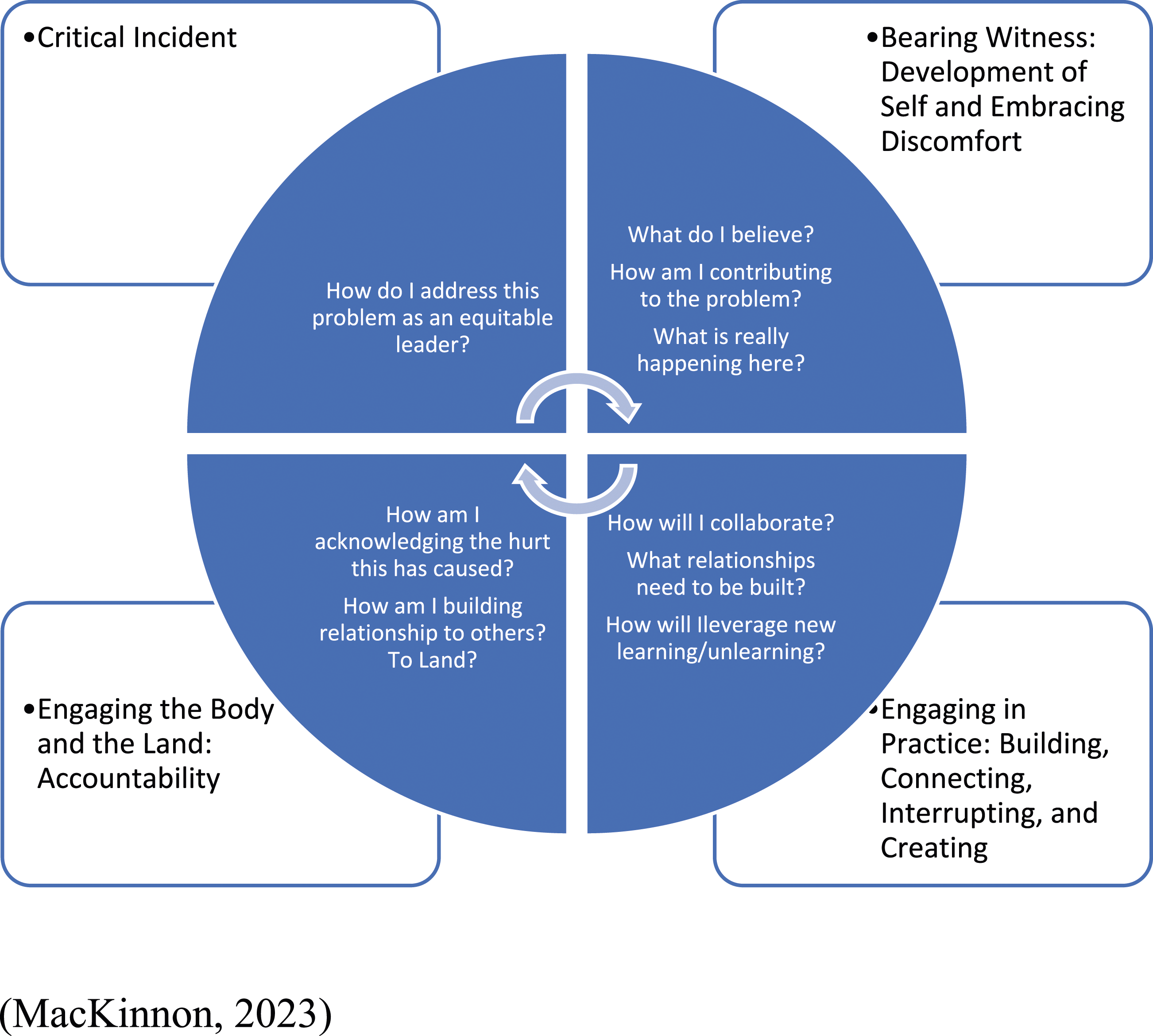
An Emerging Model to Guide Discourse to Action
As noted above, the discourse analysis of action words used at the beginning of each competency resulted in the creation of three themes. Each theme was born out of the action words used and a consideration of the context in which the word was used within each competency. What ultimately emerged was a model of action or “picture” of equitable leadership. This model is composed of each theme and informed by theories of CRT and critical hope. As the significance of words used became clear, an image of equitable leadership practice emerged through the resulting themes and connections made. Each element of the model is discussed below.
Bearing Witness: Development of Self and Embracing Discomfort
The model begins with the need to bear witness to the injustices and inequities which surround us. This is largely internalized work as the leader is asked to contemplate their own biases and potentially their own complicity with respect to the injustices they observe. Truly seeing these injustices requires the leader to recognize and acknowledge different social identities. It is about identifying systemic barriers and understand how they are being upheld. Only then can a leader begin to lead with cultural relevancy. This space in the model is meant to cause discomfort. To be a true change agent, the equitable leader must embrace and own this discomfort, and this is precisely where the point of action lies. For example, under the theme of self development, we see the following competency, identifies and addresses biases and systemic barriers while recognizing and addressing their own emotional responses and guiding others to do the same (TDSB, 2021). The leader is called to sit with their emotional responses in response to the recognition of their biases and the ways they have protected systemic barriers, address them, as well has help others to do the same. In this sense, the leader’s action is to bear witness to their complicity and to manage their response to this realization. This represents the beginning stages of the development of equitable leadership practice, the internal work which is required.
CRT calls upon us to recognize that racism and racist structures are part of the fabric of society as well as our schools. For this reason, it is critical that school leaders recognize the ways in which they are implicated as being a part of these structures. Lopez and Jean-Marie (2021) call upon educators to both name and own the presence of anti-Black racism within their schools. The authors define naming as coming to an understanding of the presence of anti-Black racism and how it manifests itself. By owning anti-Black racism, practitioners are acknowledging their complicity and considering actions which might disrupt its presence. The action is internal, a reflection upon and recognition of anti-Black racism and the commitment to address it. For example, if you are a principal of a school and you note that same Kindergarten children are being sent to the office for behavioural concerns and all these children are Black students, you must stop and wonder what is going on. In this moment the leader has the choice to notice this trend and actively address it with staff or ignore it and allow this moment to feed into existing biases.
An engagement of critical hope in these moments challenges us to embrace the discomfort. We must ask ourselves, what can I learn from this discomfort? Discomfort becomes the emotional signal which points us towards the realization that what we have valued or believed to be true is being challenged (Grain, 2022). In these moments of discomfort, our very identities are brought into question which in turn, provides a pathway for increased understanding and, action. As we bear witness to historical and social trauma, we engage in the first steps towards change.
Engaging in Practice: Building, Connecting, Interrupting, and Creating
The next theme to emerge from the analysis was about building, connecting, and creating. Ezzani (2021) reminds us that principals who engage in social justice leadership actively recognize systemic action and in response to this realization, take action to disrupt systems of oppression. It is about provoking teachers to do this work alongside them, to disrupt practices in their classrooms so that all students can succeed. While the previous theme was about internal recognition, building, connecting, and creating is about taking external action to disrupt and bring others alongside to enact the change. In this space in the model, the leader moves from the internal to the external. It is important to note that the internal work of bearing witness does not end with this stage of the model. This is a continuous process however, if true action is to be achieved, the leader must engage and influence others in this work. Engaging in practice is about bringing others along on this journey of transformation. For example, under this theme we see the following competency, engages in targeted/precise work to build deep relationships with marginalized, underserved and/or under-represented students, staff, and families (TDSB, 2021). Here leaders are called to actively engage in targeted and precise work to build relationships with all members of the school community, and particularly those who have been traditionally underserved. An example of potential action might be first noticing, and then addressing a lack of representation of underserved families on parent council. Drawing attention to this issue to the current parent council and working alongside them to recruit members of the community not represented would be a beginning point.
It is important to note that hope is not something we have, but something we need to practice. This practice is firmly entrenched in action, creating incremental changes, and engaging a willingness to do the work (Grain, 2022). As leaders encounter difficult and challenging truths, they engage in a shift in thinking by considering their experiences and reflecting upon their beliefs. This spurs us into action and is about showing that as leaders we understand through our actions and not just through words (Grain, 2022).
The competencies within this theme focus on working with others to achieve equity goals, building relationships with marginalized communities, students, and staff, as well as leveraging knowledge of social identities to promote the creation of inclusive learning spaces. These competencies are very much about putting the learning which has happened to work. It is about actively creating change to the structures which oppress and moving others along the same continuum. Leaders cannot hope to do this work alone. We know from the OLF that leadership is about influence. We must be able to actively engage others in this work if change is to be truly transformative.
Engaging the Body and the Land: Accountability
It does not take long after perusing the OLF to see that there are many areas around which school leaders are accountable. Many of the competencies which landed in this column were about building relationships with community and aligning strategic directions with system goals. Schnellert et al. (2022) make a strong case for the creation of an Education Change Network (ECN) as a pathway for collaborative approaches to creating change. This space created a place for educators to emerge from “cycles of practice” (p. 2) and begin to reflect on what needs to change. Part of working with others is to be accountable to others and the work that needs to happen to disrupt oppressive practices. This theme of accountability points to the issue that a series of competencies on a page are not going to create the necessary changes. Accountability, which is formed out of community relationships, is key if change is going to become a reality.
For this change to be real, it must grow out of a recognition that true change emerges from the body, the place where reflection and action align. The body emerges from the land and is intimately connected to the land. The land reveals the pain and suffering which occurred in both the past and present and inspires questions about our relationship to and our placement on the land (Grain, 2022). Both the body and the land inspire our vision for the future and hold us accountable to this vision. Understanding how the body and the land are intertwined and engaged is difficult when we are stuck within limiting notions of how knowledge is constructed and, in this case, how we are called to be accountable to the land. Styres (2017) helps us to better understand this connection when she writes, Iethi’nihstenha Ohwentsia’kekha (Land) embodies principles, philosophies, and ontologies that transcend the material construct of place. With this understanding in mind, Land is spiritual, emotional, and relational; Land is experiential; Land is conscious – Land is a fundamental living being. (p. 47)
In this passage, Styres asks us to look beyond the Western notion of land as space and place and to begin to see the land as a living being, as something which is experiential, as a living, conscious being with which we must nurture a relationship. Our physical and spiritual bodies are forever connected to the land, and it is within this relational space, between body and the land, where we find accountability. Understanding this relational space enables the reader to see the connection between what they choose to do in any given situation and the resulting outcome. Our accountability to the children we serve lies within this space. The ways in which we carry ourselves, the decisions we make has an impact on the land, our relationship to the land and our attitude towards this living and breathing entity. This way of thinking lies outside of our western notions of accountability however, if we can bring ourselves to understand that everything we do is in relation to others, we can begin to ensure that we do no harm in our daily work and lives.
To help illustrate how this part of the model works, one might consider the following competency which falls under the accountability category: creates and supports equity goals that focus on adult learning necessary and connect to adult and student identities (TDSB, 2021). This competency calls upon leaders to be accountable to the learning needed to meet the equity goals that have been set out and to act and make decisions in ways which are responsive to the identities of students, staff, and community. When we consider this competency in a relational manner and in connection to Land, the leader is called to understand the ways in which their attitudes, actions, and decisions, which lie within the body, have impact on others and our relationship to Land. When we come to see the Land as being connected to the body, as something experiential, a living being, then we can imagine how beliefs and actions can either be in unison with the Land or in opposition to it. In the case of this competency, the leader is asked to be accountable to this relationship. I recognize that this requires some thinking outside of the typical western conceptions of leadership however there is value in considering these connections and being accountable to them. When we view our actions as leaders in relation to Land and others, we see how they have impact, both positive and negative and as leaders, we are accountable to that impact.
Discussion
The analysis as described above has inspired the creation of a model of equity as a leadership competency. This model is represented as a tool which could be helpful to leaders as they navigate decision making. It has been designed to address situations as they arise and to assist leaders as they contemplate and navigate complex situations.
The model is circular, creating space to move back and forth between stages of the decision-making process. The decision cycle begins with an incident in which the leader needs to make a decision and engage the equity competencies. The outer boxes describe the work that needs to be done while the inner circle defines the actions which connect to the work through questioning. In some instances, the leader may need to begin with bearing witness to fully recognize the inequities at play. In other instances, the leader may need to engage others in discussion of the problem to collaborate around equitable solutions or to address the attitudes and/or dispositions of others. The discomfort leaders may feel in engaging this work often lies with themselves, but it can also be triggered through conversation with others. In this way, the leader moves between engaging in practice (collaborating with others) and bearing witness (welcoming discomfort). It is important that the leader is accountable to the actions and decisions which are made in this process. As leaders, we need to ask ourselves how we have contributed to the hurt that has been caused but also how what we have decided to do as leaders effectively addresses the inequities. This can only be truly understood in relation to others and the impact we have as leaders upon the environment. What are students thinking? Teachers? This is something we need to check on as we move through the decision-making process. This model is designed to enable the leader to move between and amongst these phases as they bear witness to the problem’s existence and engage leadership practice while remaining accountable to students and community.
This model emerged out of a discourse analysis of the TDSB’s Equity as a Leadership Competency document. It represents a “picture” of equitable leadership and is not intended to represent or reflect every aspect of what it means to be a truly equitable leader. The questions posed are meant to guide the leader through the actions to be taken. By no means is the leader limited to these questions as it is hoped that they lead to more questions which further guide the leader in the engagement of equitable leadership practice. The model is simple and straightforward. This is intentional for as a former principal, I know what it means to be mired in paperwork and the multiple demands of principalship. Principals need models which are accessible and clear. They have no time to read lengthy papers or scan competencies when working through challenging situations. Most importantly, the model is meant to inspire transformative change through a lens of equity and anti-oppression. It is built upon the foundations of CRT and inspires the hope necessary to impact real change.
Limitations
It is important to acknowledge the limitations of the model presented in this paper. In no way is it suggested that this model represents the multitude of ways in which principals enact equity in their schools. Nor is it the answer to a current lack of guidance and research in this area. We know that there is a strong need to unlearn leadership practices which are enshrined within colonial, western constructs (Shah, 2022). The creation of these competencies was one of the first important steps towards disrupting oppressive and inequitable leadership practices. The model presented in this paper represents a beginning step towards actioning these competencies. This paper has not explored how effective this model is in terms of addressing issues through a lens of equity however, it presents a potential way forward as principals navigate increasingly complex situations.
Recommendations and Future Research and Concluding Thoughts
While each theme which emerged out of the discourse analysis can stand alone, connections can be made between each. Leaders are not able to build, connect and create without engaging in the process of developing the self. Ultimately, whatever is built will not hold unless there is a strong sense of accountability to students and community. When the TDSB created the equity leadership competencies, they used the OLF as a guide, creating an addendum of sorts to an already massive and comprehensive document. Equity work is not an addendum. It must be central to the role of school leader, and it is hoped that this model provides a more action-oriented framework to use when implementing these competencies. The hope is that this model provides a way to think about how to enact equity competencies as school leaders. While the TDSB’s equity leadership competencies are used here in the creation of the model, the intent is for this model to apply beyond these guidelines and to inform school leadership practices across systems. Listed below are some potential uses for this model: • Assist in leadership training and development. For example, this model can be used to unpack leadership scenarios which are meant to engage equitable and anti-oppressive practices. • A reference tool for leaders when faced with challenging decisions. • A tool for leaders to use with teacher leaders as they make decisions for students in the classroom or within teaching teams. • To unpack a situation, revisit steps taken and revise an approach in future.
The infusion of CRT and critical hope in this model is meant to firmly entrench this work within a framework of true transformative change. It engages the whole leader in meaningful, thoughtful, and intentional action. The triad of development, creation and accountability blends many facets of the principal role and centres the skills and actions which must be taken to ensure equitable outcomes for each student. This model is about putting policy into action, cultivating it with critical hope. It centres the work which needs to be done to make competencies fly off the page and into the day-to-day actions and decisions of school principals. More research is needed to make equity competencies come alive and to measure the degree to which they are actionable. A potential next step could be to study the use of this model by leaders to determine its impact on decision making and equitable outcomes for all. Often schools and systems are reactive in their responses to racism and discrimination in schools whether it be overt or unintentional. Policies and procedures are formed out of such incidents and while it is important that these issues are addressed, reactive responses do not create the kind of change we need. We need enduring change that disrupts oppressive practices rather than placing band aids upon incidents of racism and discriminatory acts, words, and deeds. More research is needed around the impacts of reactive responses on systems and student outcomes. Similarly, more research is needed to explore the benefits that come with deep reflective practice. The model presented in this paper is intended to be used in the process of enacting equity leadership competencies and as noted above, begins with deep reflective practice. Understanding its impact is important to ensure that in its use, discriminatory processes are not upheld and that the model has the intended effect. The research has pointed us towards the inequities in our school systems. The time for reflective action is now.
Supplemental Material
Supplemental Material - Constructing a New Framework for Sport and Development: Investigating the Media Portrayal of Village Basketball Association in China
Supplemental Material for Equity as a Leadership Competency: A Model for Action in Kenneth MacKinnon in Journal of School Leadership
Footnotes
Author’s Note
After accumulating over two decades of experience as a teacher, vice principal and principal in schools in Ontario, Canada, Kenneth has joined the faculty of education at the University of Prince Edward Island. His research pursuits centre around the interwoven themes of gender and educational leadership, anti-oppressive education and leadership and the progression of anti-colonial and equity-focused notions of leadership.
Declaration of Conflicting Interests
The author(s) declared no potential conflicts of interest with respect to the research, authorship, and/or publication of this article.
Funding
The author(s) received no financial support for the research, authorship, and/or publication of this article.

Supplemental Material
Supplemental material for this article is available online.
Author Biography
References
Supplementary Material
Please find the following supplemental material available below.
For Open Access articles published under a Creative Commons License, all supplemental material carries the same license as the article it is associated with.
For non-Open Access articles published, all supplemental material carries a non-exclusive license, and permission requests for re-use of supplemental material or any part of supplemental material shall be sent directly to the copyright owner as specified in the copyright notice associated with the article.
