




Abstract
Purpose
This case study examined the efforts of district and school level leaders related to the public gender transition of one high school teacher over a 2-year period. We employed Theoharis’ (2007) conceptualization of social justice education leadership to guide our analysis.
Research Methods
This qualitative inquiry drew from in-depth, semi-structured interviews with the superintendent, transgender teacher, high school principal and relevant teacher union leaders. Related documents were also collected to triangulate the data sources. Data analysis involved open coding to identify themes and significant features of participants’ actions and experiences.
Findings
The findings are presented in the form of a chronological narrative about district and school leaders’ actions as one teacher underwent a public gender transition. Following this narrative, we explore three critical characteristics of the educational leaders’ actions: Collaborative communication, intentionality and anticipation, and framing.
Implications
This study addresses a significant gap in the literature concerning how educational leaders might work to create safe school environments for LGBTQ educators. While the efforts made by district and school level leaders in this case represent important steps toward creating safe environments for transgender educators, additional professional development and policy making are critical actions that could build on the efforts detailed in this case.
Despite perceived improvements in civil rights for LGBTQ individuals in the U.S. (e.g. passage of the Marriage Equality Act), the current climate worldwide and in the U.S. indicates a more polarized level of acceptance for LGBTQ individuals (Moreau, 2018) and a reduction in comfort in all LGBTQ personal situations for the first time in 4 years as reported by non-LGBTQ Americans in a recent poll (Schneider et al., 2018). Survey data have documented that many LGBTQ educators have felt unsafe in their school environments (Wright, 2010; Wright & Smith, 2015, 2019). Part of this lack of safety for LGBTQ educators can be attributed to the historic policing of teachers’ gender and behavior (Blount, 2000). From the McCarthy era to the backlash to Obama’s 2016 “Dear Colleague” letter of inclusiveness, teachers have experienced discrimination because of their identities. This discrimination has often led LGBTQ educators to feel as though they cannot live in ways that are authentic to their sexual orientation and/or gender identity.
During 2020 and 2021, discriminatory legislation impacting transgender students and staff was filed by 20 states. A total of 82 anti-transgender bills were authored across the U.S. in the 2021 legislative session, exceeding the previous record of 79 introduced during the 2020 legislative session (Ronan, 2021). Meanwhile, a coalition of state governors—led by the Tennessee Attorney General’s office—filed suit against the presidential administration’s “directives allowing transgender workers and students to use bathrooms and locker rooms and to join sports teams that match their gender identity” (Weissner, 2021). This lawsuit serves to juxtapose what plaintiffs say is an improper expansion to schools of the Supreme Court’s ruling in 2020 that employers cannot terminate employees due to gender identify or sexual orientation.
Discrimination against an educator who identifies as LGBTQ damages not only that individual but also the students who witness it (Eckes & McCarthy, 2008) and the entire school’s efforts to create a safe environment. Effective school leaders strive to create and maintain safety within their schools, working to address and eliminate discrimination (Lezotte, 1997). Bucher and Manning (2005) described a safe school as “one in which the total school climate allows students, teachers, administrators, staff and visitors to interact in a positive, non-threatening manner that reflects the educational mission of the school while fostering positive relationships and personal growth” (p. 56). Leithwood and McAdie (2007) found that teachers who felt safe had a higher level of efficacy. Focus in recent years on including more LGBTQ issues within a school’s curriculum (Rottmann, 2006) has assisted some schools in creating safer climates for their diverse populations, including LGBTQ students and staff. Albritton et al. (2017) highlighted how school leaders working in rural settings have demonstrated subtle ways to counteract resistance to supporting LGBTQ people in schools. In addition, having out teachers helps other instructors to be more mindful of their gender language in the classroom and the way in which their curricular decisions contain elements of gender (Shelton, 2018).
While there are evidence-based techniques which improve school climate for LGBTQ teachers and students such as creating and enacting inclusive policies (i.e. Kosciw et al., 2020; Rottmann, 2006; Wright & Smith, 2019), studies (Wright, 2010; Wright & Smith, 2015, 2019) have shown that these techniques are not being widely utilized in schools and school districts. Many administrators still exhibit reluctance to implement professional development related to LGBTQ issues (Payne & Smith, 2017). LGBTQ educators in elementary schools especially have received less support from their administrators in being open and honest about their sexual orientation and/or gender identity (Wright & Smith, 2019). Prior research (Wright, 2010; Wright & Smith, 2015, 2019) has demonstrated improvements in certain areas over the years for gay and lesbian teachers, yet less is known about the unique experiences of transgender educators.
In the study detailed here, the participating transgender teacher defined herself in binary terms, stating that she had always known she was female even though her sex was assigned as male at birth and she had lived for many decades as a man. However, the term “transgender” encompasses more than a binary experience (i.e. changing one’s dress, expression, hormones, and/or body from one gender to another—oft considered opposite—gender). The Human Rights Campaign explains that transgender is “an umbrella term for people whose gender identity and/or expression is different from cultural expectations based on the sex they were assigned at birth. Being transgender does not imply any specific sexual orientation. Therefore, transgender people may identify as straight, gay, lesbian, bisexual, etc.” (HRC, n.d.). Transgender individuals may use terms such as gender non-conforming, queer, and/or non-binary. While some scholarship uses the term transgender in a more encompassing way, this study involves a teacher whose transgender experience was one of transitioning from one gender identity (male) to another (female).
Workplace Climate for Transgender Educators
Transgender educators experience particular challenges and have some of the most difficult experiences in schools to date (Harris & Jones, 2014; Kamenetz, 2018). Halberstam (2011) posited that the wins experienced by some members of the LGBTQ community, with regard to acceptance in educational settings, often have not included those who consider themselves transgender. Although policy makers and educational professionals have made progress in a neoliberal sense in creating safety around issues of sexual orientation, they have done this in ways that have often marginalized transgender students and teachers (Harris & Jones, 2014). For example, many schools began enumerating sexual orientation as a protected status in their harassment policies while neglecting to include gender identity.
In 2018, National Public Radio (NPR) surveyed and interviewed transgender educators across the U.S. to explore their experiences. The participants shared challenges around workplace discrimination with more than half experiencing discrimination from colleagues and/or administrators. These teachers were often misgendered, given more difficult assignments in the hopes that they would resign, or told to present themselves differently. Such experiences demonstrate the subtle ways that a transgender educator can experience a challenging climate despite the most recent Federal case law providing employment protections to individuals identifying as LGBTQ. Alternately, 40% of NPR survey respondents indicated they felt accepted in their workplaces as transgender and believed “they played a vital—even life-saving role—through their visibility” (Kamenetz, 2018, p. 8). Several reported that coming out as transgender, in one case even against the wishes of their administrators, made all the difference in the world to several queer and gender nonconforming youth.
In Dow’s (2020) study, transgender educators shared how important it was to have administrator support of their gender transition in the workplace. Suarez’s (2020b) research revealed that one transgender educator publicly identified as their birth-given gender at one school of employment because of a lack of perceived support from the principal. In a second school, intentional support from the administrator allowed this educator the opportunity to express their true gender at the workplace. Transgender individuals who experience harassment in the workplace can develop depression, anxiety, and other health concerns (Dispenza et al., 2012). Suarez (2020a) discussed the phenomenon of “queer battle fatigue” which can result in intense stress and other health problems.
Over the past 15 years, a small amount of research has sought to reveal solutions to the concerns of LGBTQ educators. Sergiovanni (2009) highlighted the importance of relational trust among faculty and administrators and described a teacher-centered leader as someone who gives each teacher a respectful place to work. Bartolome (2016) documented the support that their participant received from an administrator in her transition from male-to-female and in the display of her female defined gender. In Jackson’s (2007) study, nine LGBTQ participants identified support (especially administrative) within their schools as a major factor that influenced their level of outness in the workplace. Jackson observed, the educational leader’s “attitude about ‘homosexuality’ does much to make the school a welcoming or discouraging workplace for gay and lesbian teachers” (p. 9). Collectively, this body of scholarship indicates the necessity of leaders working from a social justice perspective to create safe schools for all students and staff. Social justice educational leaders must utilize critical consciousness to engage in critical reflection and examine personal biases, privilege, systems of oppression, and discrimination (Lewis & Kern, 2018). Creating safe schools requires disrupting the heteronormative system of schooling (Pennell, 2020), defined by Rubin (in Marchia & Sommer, 2018) as gender and sex being policed through a patriarchal hierarchy of social relations (p. 273).
Additional research is needed to expand our understanding of the actions and approaches educational administrators can take to create safe environments for transgender educators. The inquiry presented here is a case study of the actions that district and school level leaders took as one white, high school teacher underwent a public gender transition in a school context. This project also examines how these actions were experienced by the transgender teacher. This study documents what is possible in the hopes that supportive practices can become more widespread and improved upon.
Theoretical Framework
This case study employed Theoharis’ (2007) conceptualization of social justice educational leadership which focuses on how such leadership is ultimately concerned with situations of marginalization. Social justice leaders are those who “make issues of race, class, gender, disability, sexual orientation, and other historically marginalized conditions in the United States, central to their advocacy, leadership practice, and vision” (p. 223). Social justice leadership is revealed through action, “addressing and eliminating marginalization in schools” and advancing “inherent human rights of equity, equality, and fairness” (p. 223).
Theoharis (2007) formed this conceptualization of social justice leadership through his examination of school principals who relied on proactive strategies to enable them professionally to advance their social justice goals. The experiences of social justice focused school principals revealed a three-pronged framework of resistance. That is, school leaders experienced resistance (1) from within the school/community, (2) from the district and beyond, and (3) through consequences to themselves from this resistance (Theoharis, 2008). The participants’ strategies for sustaining their work in the face of this resistance included communicating purposefully and authentically, developing a supportive administrative network, working together for change, keeping their eyes on the prize, prioritizing their work, engaging in professional learning, and building relationships. These leaders explained that using purposeful and authentic communication created some momentum in the direction of social justice and reaffirmed their beliefs to those around them. As it concerns pursuing social justice for members of the LGBTQ community, a social justice leader will gather data that pertain to their responsibilities to prevent bullying and harassment (Lewis & Kern, 2018).
Albritton et al. (2017) used Theoharis’ (2007) work to explore how rural school leaders, who identified themselves as social justice leaders, reportedly sustained socially-just school climates for LGBTQ students. Their study revealed that while the participating principals expressed “concern for diverse populations they identified, when the questions focused on LGBTQ students in particular, their specific examples and descriptions appeared to be in opposition to their espoused concerns” (p. 30). The participants believed that their faith and instructional leadership made them socially just leaders. At the same time, they demonstrated a reluctance to recognize LGBTQ students in their schools and to address the resistance that community members and even teachers sometimes displayed to including LGBTQ students in the school community. These findings illustrate Theoharis’ assertion that social justice leadership is demonstrated through action to promote inclusion of marginalized groups and cannot be separated from the daily realities of school practice. He called for additional research on superintendents and principals in rural and suburban areas and their ways of enacting social justice leadership.
Shield’s (2017) study of three superintendents and three assistant superintendents illustrated well what social justice leadership looks like at the district leader level. The participants enacted social justice leadership by their active denouncement of racism, bullying, and homophobia. These leaders, collectively, recognized the value of building relationships with constituents in ways that building principals more typically do, which then assisted them in enacting their social justice leadership practices. Shields concluded “it is possible for senior leaders to attend to the technical issues of educational leadership … and, at the same time, to maintain a focus on creating equitable and inclusive learning environments for all students” (p. 17). In other words, even those who lead large and complex systems and who have significant managerial responsibilities can display social justice leadership.
The case study reported on here used the lens of social justice leadership to examine the efforts of both district and school level leaders concerning the gender transition of one teacher and to consider how these efforts may or may not have promoted inclusion and discouraged marginalization.
Research Design
To investigate how district and school level leaders acted as one high school teacher underwent a public gender transition over a 2-year period, we employed a qualitative, case study methodology (Yin, 2008). The opportunity for purposeful sampling arose when the first author, Tiffany, learned—through student discussion in a school leadership course she was teaching—of a teacher who underwent a public gender transition. The student who shared the story in class described it as an example of positive school leadership. As an LGBTQ educator for over 20 years, whose research focuses on LGBTQ issues in education, Tiffany was intrigued by this account. She had a prior relationship with the superintendent involved in the case, as he had served as a guest speaker in her school leadership courses. Tiffany reached out to this superintendent and the transgender teacher via individual emails to gage their willingness to be interviewed about their efforts and experiences. Her invitation explained that the goal of this study was to explore the actions taken by district and school leaders related to a teacher’s gender transition and to understand how these actions were experienced by the teacher.
Participants.
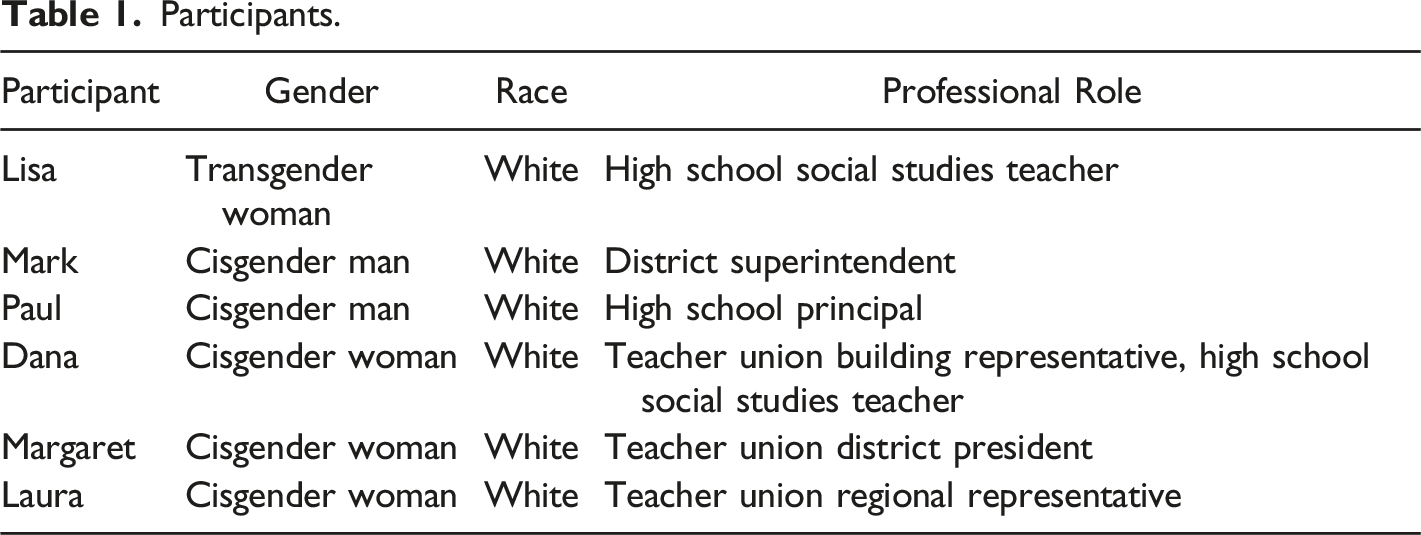
Each interview protocol was uniquely designed for the specific participant being interviewed. However, the protocols typically included approximately twelve, open-ended questions intended to solicit participants’ perspectives and experiences. Our goal was to allow participants to tell the story of the case being examined as they understood it. We posed follow up questions in response to participants’ statements to gain additional insight into their meaning. Interviews were conducted in locations of the interviewees’ choosing, including their offices, our offices, and a coffee shop. All interviews were audio recorded and transcribed. We collected additional data in the form of documents that some of the participants supplied to help us understand the action/experience/process they described (e.g. email correspondence, meeting minutes, slide presentations).
We used the following research questions to guide our data analysis: What actions did district and school level leaders take as one high school teacher underwent a gender transition in the school context? How were these actions experienced by the transgender teacher? We carefully read through the data corpus multiple times, first, to construct a chronological account of the actions taken by relevant district and school leaders as the high school teacher underwent a gender transition in their district. Next, we engaged in open coding to identify the different types of actions or approaches taken (e.g. “prepared statement”) so these might be organized into themes or significant features of participants’ actions (e.g. “communication,” “intentionality”). Finally, we employed Theoharis’ (2007) conceptualization of social justice leadership and resistance to analyze how the documented actions and approaches may or may not have promoted inclusion and discouraged marginalization. We report out our findings in the form of a narrative about district and school leaders’ efforts as one teacher in the district underwent a public gender transition. Following this narrative, we explore individual themes that arose from our data analysis.
Study Context
The case examined in this study took place in a rural school district, located in a large mid Atlantic state. The school district spans 113 square miles and is adjacent to a state university. At the time of this study, the school district served approximately 5,400 students; about 1,700 students attended the district’s only comprehensive high school (School District Website). The student population at the high school was 79% white, 13% Hispanic, 5% African America, 2% multi-racial, and 1% Asian. Over 40% of the student population qualified for free/reduced price lunch, while almost 18% of students received special education services. On average, 70–75% of the high school seniors pursued post-secondary education. The high school did not have a Gender-Sexual Alliance (GSA) club at the time of this study.
The county in which this district is situated is politically conservative. In the presidential election that took place prior to the time of this case, approximately 56% of voters in the county voted Republican, while just 37% voted Democrat (County Board Of Elections Website). The county also has a religiously active population. The most recent data show that 49% of the population regularly attend religious services. Ninety-eight percent of those individuals attend Christian churches (Association of Statisticians of American Religious Bodies, 2010) as opposed to any other type of house of worship.
A Story of School Leaders’ Actions as an Educator Publicly Transitioned
Lisa Mason (formerly known as Len) recalled, “I’ve known that I was trans since I was five, 6 years old, and lived a life, you know, you know, in secret.” Although many transgender individuals experience their gender in less binary ways, Lisa’s experience of being transgender was binary in nature. For almost two and a half decades as a high school social studies teacher in the Poplar School District, Lisa identified as a man and went by the name, Len. A close friend and fellow social studies department member, Dana, explained that Len’s “expression of himself was extremely masculine, and he was a part of a masculine dominated department.” She remembered Len’s persona as “Burly, very macho, very macho in speech and in gestures, very part of the athletic world, which isn’t necessarily just masculine, but very male. He has a military background, you know, which again, isn’t just masculine but it was all part of the persona of being very macho.” Similarly, Len’s high school principal, Paul, recalls that the Len he first met was “very much a military person.”
Initial Actions
Lisa explained her transition from male to female as “gradual” and even “half-knowingly” at times. Having gone through a divorce, Lisa (still known as Len at this point) confided in some friends—and eventually to several women individually across her department and the English department—that she was transgender and found these friends to be supportive. Lisa described how she began “setting markers,” including “some physical features” and “clothing alterations.” Dana recalled that Len “wore more feminine jewelry… some shoes like flats or loafers that were women’s instead of men’s…blurring the lines—and had her nails done at times.” Although Lisa claimed not to want to be seen as an activist, these initial actions and her transition itself can be seen as activism by existence in such a conservative and Christian community.
Mark, the Superintendent of Poplar School District, remembers distinctly how he learned of Lisa’s intention to transition genders. One evening during the 2016–2017 school year, Mark called home to let his wife know that he would be late for dinner due to a personnel issue he had to deal with. Upon hearing this, one of Mark’s three children—a graduate of the Poplar School District—asked his mother, “Oh, is it Mr. Mason? Is he finally transitioning?” Surprised by this question, she posed the question to Mark later that evening. Mark responded, “I have no idea,” but then decided to see what he could find out on the matter. He asked the school district’s union vice president if she had any related knowledge. She in turn asked Dana for related information. Lisa remembers Dana approaching her at this time and saying, “The Superintendent wants to make sure you’re safe and that you feel safe and just wants you to, you know, go about a pace that’s comfortable with you.” Around this time, Len decided that he would like to transition openly. He communicated this intention to the school district union president and vice president and asked for their assistance dealing with any issues that might arise.
Meanwhile, as the Superintendent learned from others that Len intended to transition publicly, Mark quickly called the district lawyer seeking guidance on how to handle this case. This lawyer stressed the importance of engaging in dialogue with Len to establish a “a mutually agreed upon process so that it does not become a legal issue in the school district.” The goal, according to the lawyer, was “to work through it in a very amicable process” and to protect the civil rights of the transgender teacher. Mark explained that his thinking at this stage was also influenced by an event he had attended in the fall of 2016 entitled, “Law Breakfast: Accommodating Student Rights, the Developing Law on Transgender Students.” While this event had primarily focused on the rights of transgender students, one of the presenters was a transgender assistant superintendent from a neighboring school district. By sharing her story, this presenter provided some attention to the experiences of transgender school employees. Mark recalled, I think as a human being I didn’t know much about transgender, so I just kind of immersed myself in learning more about it. It was that seminar that really made me look at it very differently. I think we a lot of times look at things very black and white. Oh, you’re a male or a female. Even if you’re accepting of transgender, you think of kind of that one or the other and it’s not. And that’s one of the things that was emphasized by the presenter.
By attending this event, and through additional one-on-one conversations with the presenter, Mark worked to increase his understanding of the transgender experience. When it became clear to him that Len was going to transition publicly, Mark had the following perspective, Okay this is not going to be easy, was a thought. But, we’re going to have to make it through and, you know, I had a very long relationship with Len, who transitioned to Lisa. So, and I wanted to be very supportive of all my teachers, but of Len transitioning as well. That’s why my initial reaction was this is not going to be easy for anyone.
Mark anticipated the resistance he would face in response to his efforts to support Lisa and her gender transition.
Two Important Meetings
Toward the end of the 2016–2017 school year, Mark arranged a meeting at the Poplar High School principal’s office involving himself, the principal, Len and Dana. When asked why she was there, Dana explained, I was at that meeting as Lisa’s union representative.… We didn’t expect an adversarial meeting in this case, but it’s advisable in situations like this—big important meetings between a staff person and administration—that there be another set of ears to just listen and figure out what’s happening here.
Mark used this meeting to pose a series of questions to Len. “What would you like the timeline to be? What would you like the process to be? How are you going to present yourself?” Lisa remembers Mark telling her, “You don’t go any slower and don’t go any faster than you’re ready.” Lisa decided that she would like to be addressed by students and staff as “Coach Mason,” a name that fit well with her work as a track coach. Coach Mason then decided she would present herself at the opening day faculty meeting the following year just as she would present herself to students. Dana claimed, “It was clear to me that Lisa was being supported in her transition and that there was a plan being kind of laid out.” Mark explained that it was also decided at this meeting to involve the State Education Association. One teacher union regional representative, Laura, was identified as having some expertise on transgender rights and concerns and would serve as Lisa’s representative should there be any conflict with fellow teachers in the district.
In thinking back on this meeting, Dana remarked,
I just think that I was so in awe of this process I was witnessing that I remember clearly at the end of the meeting, Mark asked, “Does anyone else, you know, have anything they want to say?” And they called on me specifically, because I hadn’t said a word. I was busy writing, you know, but I hadn’t said a word. And I just, I just said, “I want to say how proud I am to work here, that this can evolve like this, that this has not been in any way adversarial or fear-based.”
Mark concluded this meeting by saying to Lisa, “I want you to think about some various items and then we will get back together in August.”
Lisa decided that just she and Mark would meet for lunch in August for further discussion and planning for the 2017–2018 school year. She told Mark, “I will come in as Lisa, and I will have lunch with you the way I intend to present myself at the opening [district teacher in-service] day meeting.” At this lunch, Lisa was able to express what she had decided in response to each of the questions that Mark had posed at their earlier meeting. Afterward, Mark crafted a two-page letter to Lisa “to confirm the mutual understandings that we reached at our August 8, 2017 meeting regarding the manner in which the District will address your transgender status.” The letter clearly outlined Lisa’s self-identified plan to make “subtle, slow changes in style.” It further indicated how school district administrators would respond if asked by parents in the district about Lisa’s transgender status, bathroom use, etc. The letter outlined Lisa’s desired plan to obtain a new district ID card, but not to legally change her name—meaning that her email would remain as it had been before her transition.
Interactions With Stakeholders
During that summer Mark also engaged in conversations with the school board about Lisa’s transition. He recounted, “Along the way I kept our board informed in executive session because they, they have different feelings on this too, but I gave them what the advice of the solicitor [lawyer] was, and they were all very respectful of this.” Together they drafted a statement that the school board president would read if anyone chose to raise the issue of Lisa’s transition in a school board meeting. The statement read: Poplar School District respects and values all of its employees and does not judge or evaluate its teachers by their age, race, ethnicity, gender, sexual orientation/identity or disabilities. Our focus is on whether our teachers are effectively serving the district's mission—the education of our children. We judge our teachers on their professionalism, their effectiveness in the classroom, and their commitment to fostering an educational environment that supports all students. We don't jud
Mark and the school board members were well aware that any public comments made on the topic of Lisa’s transition at the school board meeting would likely be reported in the local newspaper. Therefore, they planned in advance how they might present a unified, thoughtful statement if needed.
Mark decided that he would devote part of the teacher inservice day in August 2017 to educating his high school staff about their professional responsibilities toward LGBTQ students and colleagues. He invited a transgender assistant superintendent, whom he had heard speak the previous year, to do a related presentation. He also invited Laura, the teacher union regional representative who had been identified as a representative for Lisa, to participate. Laura explained, “I knew my role was really going to be to talk about it from a perspective that I’m very comfortable with, which is employee professionalism.” In preparation for this meeting, Laura created a pamphlet she titled, Working with Transgender Coworkers: How to Meet Professional Standards. This pamphlet included related terms, a list of website resources, and tips and guidelines for how to engage with colleagues in light of school board policy and the Charlotte Danielson Framework for Teaching.
At the teacher inservice meeting, Lisa sat in the audience with several fellow members of the social studies department. The meeting began with a general presentation of information on the needs of transgender students and teachers. After this, Mark and Laura stood up together, an act that Paul believed was deliberate. “I think it was just kind of the demonstration, a visual that people could see like okay this is, we’re all going down this road.” Mark made a brief, matter-of-fact statement about Lisa’s gender transition. Dana recalled, I remember it was a very brief announcement, very professional, matter-of-fact. This is what, this is happening, like no angst, no judgement, no, you know, worry expressed. It was just kind of a brief, almost like, you know, they announced that so-and-so over the summer got married and so now they will be called Mrs. this.
Laura followed up this statement by explaining firmly that it was an expectation that all district employees treat their colleague, Lisa, with professionalism. She remembered, I laid out the policy guidelines that were going to be in effect, and if you decide to go against these policy violations we [state chapter of NEA] do have to defend your due process...but our ability to defend you is going to be very difficult because the district is making you all aware that this is how we’re going to operate and there’s no question. This is very clear. They’re even educating you to some extent now. You can take or leave that education, but here’s how you act. I don't think it was anything of like protective or punitive or anything like that, that was being implied. I think it was just more of, we're going to work together. And, you know, if somebody had some questions or anything, I think it provided them, to staff at large, provided them with two avenues. Okay, I can go to high school administration or I could go to my association.
Laura’s statement concluded the high school in-service meeting. Mark recounted that just a few district employees responded with some negativity to what had been said at the meeting. These few complaints focused on the “heavy hand approach” that was employed around discussion of Lisa’s gender transition at the meeting. Mark conceded that within his district, “we normally don’t play a heavy hand and obviously we had orchestrated something and we played a heavy hand, which we did.”
As the 2017–2018 school year began, Mark and Paul, the high school principal, interacted with several parents who had concerns related to Lisa’s transition. They had prepared how they would respond to these concerns through conversation with the district lawyer. Of these conversations Paul remarked, “sometimes, it’s just, people want to be heard and you just listen to them and say, thank you, thanks for sharing.” A few parents called Paul to request that their son or daughter be moved out of Lisa’s social studies class. He estimated that there were approximately 10 such requests over a 2-year period. Paul and Mark had agreed in advance that while the district states it does not take teacher requests, if a parent made such a request based on their expressed belief that a gender transition was morally wrong, the school would attempt to make a schedule change for the student. While Paul initially fielded these concerns himself, he also described how the two high school assistant principals gradually grew in their comfort level engaging in these conversations with parents. I did kind of initially say, you know, if you get a phone call or a parent concern allow me to be the one that talks to them. But over time, you know, as we talk more about it because if they would get it, then let me call them, I call them and then they come and ask me, “how’d that conversation go.” So, as we talked more internally, they became more comfortable and better prepared to answer those questions and have those conversations.
Mark and Paul reported that there were fortunately very few instances of student concerns related to Lisa’s transition. One exception to this was an incident in which a student took a picture of Lisa in school without her knowledge and then posted it on a social media account with derogatory comments. The assistant principal who handled the situation told the student that the actions violated school policy about taking pictures in school and gave the student in-school suspension. When the student’s parents were contacted, they were embarrassed by their child’s actions and supportive of the school’s response. Lisa remarked that occurrences such as this were offset by a larger show of support from students. She noted, “I’ve gotten tons of letters and cards from kids. The support is way much more, is greater than a few people [who hold negative views].”
In reflecting on the actions that her school and district administrators took as she underwent a public gender transition, Lisa stated, I want to say that they recognized me but didn’t go out of the way to recognize, you know? I don’t know how else to put it. They treated me as my preferred self and let it go at that, and didn’t treat me any differently, which actually did facilitate because I’m sure others who followed saw she’s being treated the same way she was before. And I told the principal when this all came out, I thanked him and said I’m still the same person and it’s going to take an adjustment and some growth but I’m still the same person. I still have to show up here every day and do my job etc. And I was treated that way, and I believe that was very fair and respectful as well.
Findings
Inductive analysis of the data collected in this case study revealed several important themes. Each of these themes represents a critical characteristic of the efforts of district and school level leaders to support one high school teacher’s gender transition in the school context. The following themes are explored separately below: Collaborative communication, intentionality and anticipation, and framing.
Collaborative Communication
Upon confirming that Lisa was planning to transition, the Superintendent—Mark—promptly connected with the school district lawyer to seek guidance on the role that the district might play. This lawyer advised that “the important thing is to have conversations” and to work out a plan that is acceptable to both the transgender teacher and the school district. Communication was ultimately an important feature of Mark’s efforts to support Lisa through her gender transition at school. In explaining his purpose for his initial meeting with Lisa, the high school principal, and Lisa’s friend and colleague—Dana, Mark stated, “It was just a let’s sit down and let’s talk through this.” Dana said of Mark’s behavior at this meeting: “He was such a listener. ‘What do you need, Lisa?’ is what I heard from him.” In other words, in this first meeting Mark focused on posing questions to Lisa and listening and responding to her needs and preferences rather than dictating terms. Their conversation focused on preferred name, pronouns, anticipated attire, possible use of an email alias, and which school bathroom Lisa would use. By setting up a follow up meeting just a few months after the first, Mark created further opportunity for careful communication with Lisa. While Lisa spoke positively of these meetings, it should be noted that they were called by Mark rather than asked for by Lisa, which may have influenced how she engaged in them.
After agreeing on actions that the district and Lisa would take, Mark asked Lisa to communicate in advance any changes that she might want to make over time to their agreed upon plans. Mark explained that communication about these changes in advance would ensure his ability to personally and professionally support her and that “the district is prepared to receive any questions from parents.” Lisa kept this agreement to communicate desired changes, for example, when she let Mark know part way through the school year she had decided to wear skirts to school instead of the slacks she had been wearing to that point. One potential limitation of this arrangement is that Lisa was put in a position where she was expected to communicate with her administration about decisions that might otherwise be viewed as personal and private. However, Lisa did not convey any misgivings about this agreement.
While Lisa claimed that she is “very lucky” to work in a “great school district,” several incidents of negative parent and student response did occur after she was open about her gender identity at school. For example, a parent complained that Lisa dressed differently for Meet the Parents night than she would on a typical school day and called this hypocritical. In describing how he responded to these incidents, Mark explained, “We shared that with Lisa. We never do anything behind Lisa’s back to disrespect or distrust her, but we always went back and verified and told the parent, ‘You know what? We double-checked and, no, you’re wrong.” Even when dealing with challenging scenarios and situations, Mark sought to keep the lines of communication open with Lisa.
Intentionality and Anticipation
It is evident in the data that, as Lisa engaged in a public gender transition, the school and district leaders’ related actions were marked by intentionality and anticipation. Mark and Paul engaged in thoughtful planning for the various circumstances that might arise after Lisa was open about her gender identity at school. One example of this is the letter that Mark wrote documenting all of the actions that he and Lisa agreed to in their two initial meetings about her gender transition. Lisa reported, “He gave me a letter saying this is what we’re going to do, and he goes, ‘This is in case something happens to me. You have this for whoever replaces me.’” Mark apparently put thought into what Lisa might need if there was a change in leadership in the district. Unfortunately, Mark may have felt that this documentation was needed, because of the absence of broader policies and procedures in the district to protect the rights of transgender educators.
The superintendent and the high school principal also intentionally planned with Lisa how they would respond to parents or community members who might raise questions or objections to Lisa’s gender transition. It was agreed that if a parent asked an administrator directly if Lisa was transgender, the administrator could respond in the affirmative and possibly encourage the person to speak with Lisa directly. Mark thought through how he would respond if a parent asked which bathroom Lisa used at school. He reported, “I talked with our solicitor [lawyer], and he said, ‘Mark, if somebody calls and says to you what restroom does your high school principal use, would you answer?’ And I said ‘no,’ and he said, ‘Well that’s your response.’” This quote reveals that the superintendent sought advice to develop an appropriate response to related parent questions and concerns before they occurred. Similarly, he and the high school principal agreed on how they would reply to parents who might call and request that their child not have Lisa as a teacher. The high school principal also worked with facilities to change the signage at a couple of the faculty restrooms to read “family” instead of male or female.
Mark demonstrated a proactive approach in his conversations with the district school board about Lisa’s gender transition. Individual members of the school board reportedly held varied personal opinions about Lisa’s gender transition, yet Mark got the board to agree to a prepared written statement he wrote about the matter. He explained that “if someone stood up, if a parent came to a board meeting, we wanted to be able to respond.” In other words, if a community member raised the issue of Lisa’s transition at a board meeting, the school board president would have a careful statement prepared. While the statement had not yet been needed at the time of this study, it is another example of the intentionality that school leaders demonstrated in planning how they would facilitate Lisa’s public transition. Some of this planning involved Lisa directly, while some did not. Some of these decisions that were made might not be ones that administration would typically involve a teacher in. However, decisions made without Lisa have the potential to be less in keeping with her needs and preferences.
Framing
A further noteworthy feature of school and district leaders’ actions in this case is the careful and strategic manner in which they framed their response to Lisa’s gender transition for various individuals and audiences. A key example of this framing can be seen in the August 2017 all-high-school-staff professional development that Mark organized. The transgender assistant superintendent from a neighboring district, whom Mark asked to provide some professional development, invited the teachers present to consider how they might support a transgender colleague by first examining research on transgender students. The teachers were encouraged to contemplate why they originally became educators, which was to care for and educate children. By connecting to that desire to serve all children, especially those who might be considered “at risk,” the presenter was able to help the teachers entertain how to support staff members and colleagues as well.
Laura, the teacher union regional representative whom Mark asked to participate in the inservice event, further helped shape the messaging with her comments and the pamphlet she created for the occasion and distributed to the teachers. Laura recognized the need to reinforce the message of the professional development program. She followed it up by standing side-by-side with Mark and stating what the state education association’s stand on professional versus unprofessional behavior would be and how they would not support the latter. As she prepared for this meeting, Laura recalled thinking, How can I talk about this in a way—knowing again Lionel County—the conservatism of Lionel County, and frankly if I as a union rep come in there and say, “You need to accept all transgender people, period, and you must do this and this is the right thing to do. Stop being jerks!” Like if I come in and say that, as much as I may want to, we’re going to drop members. A whole bunch of things are going to happen. And frankly we’re a member-driven organization. I don’t have permission to say that necessarily. What I do have permission to do is to talk about professionalism.
While the language of professionalism was appropriate in discussing a response to Lisa’s transition with school employees, Mark framed the issue differently when dealing with other members of the community. This can be seen in his account of meeting with a parent who was very upset about Lisa’s gender transition and her continued employment at the high school. Mark explained, My technique was just to ask questions in return. She thought it was horrible. “Why would the district do this? And I said, “What do you mean? What’s the district going to do about it? I don’t understand. You need to explain it to me.” “Well you have a transgender teacher.” And I said, “Did that teacher make any violations of law? [Did] they do anything to harm children, or anything I need to report to Children and Youth?” Then the person would get a little angrier and could not really give me a response, and I asked further questions….Then she brought in her religious beliefs, and that’s understandable. “I am also a Christian, and I go to church, and I understand from my reading of the Bible that there are some passages that also see divorce as an issue…. We have a lot of teachers who are divorced. How should I handle that?” And she got angry and did not like that line of questioning and ended up storming out.
Mark’s approach to discussing Lisa’s gender transition with a frustrated parent was to frame the issue in two different ways in response to how the parent expressed her concern. When the parent first hinted that Lisa should no longer be employed in the school district, Mark framed the issue in terms of legal versus illegal actions. He focused on the protection of children and pressed the parent to identify any way in which children had been harmed, which of course they had not. The parent then changed her focus to her own personal, religious beliefs which view gender transitioning as wrong. In response, Mark identified himself as Christian as well and explained that he is well aware of how some Christians view gender transitions and other topics such as divorce. This allowed him to illustrate for the parent how teachers are not and cannot be fired on the basis of their compliance with the religious beliefs of just some members in the community. While framing the issue in these ways did not apparently change the parent’s thinking, it did allow Mark to explain the district’s approach in a way that directly responded to the parent’s stated concerns. Had Mark not held Christian beliefs himself and/or had an understanding of his community’s Christian beliefs, a different approach may have been needed.
Paul too had to deal with some parents’ concerns. One parent asked Paul why he didn’t send a letter notifying parents that a teacher in the high school was gender transitioning. He responded, Let me ask you, think so-and-so got married this summer, do I send home a letter? Well, no, why would you have to do that? So, this is a personal life issue. Like I'm not going to send home a letter and announce that this teacher got married, this teacher had a baby, this teacher got divorced, this teacher went on vacation.
Significance
Kamenetz’ (2018) finding that over half of transgender educators surveyed have experienced harassment due to their gender identity, creates an imperative to examine how school leaders can support this marginalized population in their school communities. Research on transgender educators is limited to a few studies (see McCarthy, 2003 as an early notable example) and reveals challenging circumstances due to the larger community environment and/or the administrators’ lack of attention to this aspect of leadership (Kahn & Gorski, 2016). By providing a close examination of the actions of school and district level leaders related to one high school teacher’s gender transition, this study addresses a significant gap in the literature concerning how school leaders might work to create safe school environments for LGBTQ educators. This project is a much-needed collaborative endeavor between researchers and school district personnel to highlight the practices employed within a district for one transgender educator.
Context mattered immensely to the case detailed in this piece. Lisa’s status as a veteran teacher in the district contributed to the respect she garnered throughout and following her public gender transition. She had long-standing relationships with the superintendent and high school principal. The superintendent’s children had even had Lisa as a teacher and a coach before her gender transition, and the superintendent and Lisa considered each other “friends.” The relational leadership style of the superintendent and his genuine care for Lisa as an individual caused him to reach out to others to learn about the meaning of being transgender in order to understand how to support Lisa best. To some degree, Lisa was “outed” to her superintendent, yet she reported his approach when they met to discuss it the first time as very positive, as she and the superintendent had a long-standing friendship over many years. Furthermore, the positive and communicative relationship between the administrators and union leadership in the district represented another key contextual factor that shaped the actions taken to support Lisa. Dana was the high school union representative but also a long-time friend of Lisa’s.
Within this context, district and school leaders demonstrated the importance of collaborative communication to social justice leadership, specifically the effort of supporting a transgender teacher. This case reveals that when leaders begin by listening to the needs of the educator they are seeking to support, they can then respond in a way that makes that educator feel respected and safe. Like some of the participants in Budge et al.’s (2010) study, Lisa was able to come out gradually, experimenting with women’s clothing subtly at first during her 2-year transition, due in part to the support of her superintendent and principal. Careful communication should not be limited to a single meeting, but rather should be ongoing as related situations arise and needs change. The example of communication provided within this case represents a critical addition to Theoharis’ (2007) examination of the actions taken by social justice leaders to promote equity in their schools. When discussing communication, Theoharis’ participants primarily recounted how they conveyed their vision to their staff and worked mostly through the first of three prongs of resistance (resistance from within the school and community). This case study paints a richer picture of communication as involving listening to those for whom equity is being sought. Additionally, Mark anticipated and prepared for responses from community members who held a connection to the status quo or had concerns about Lisa as a teacher due to their own religious or moral beliefs. He anticipated and prepared for parents who would ask the high school principal to remove students from Lisa’s class. These efforts illuminate how a social justice leader might address resistance from the district and beyond, what Theoharis (2007) identifies as the second of three prongs of resistance.
This study further illustrates the benefits of anticipating the concerns, needs, and situations that might arise once a transgender educator goes public about their gender identity. This proactive intentionality complements Theoharis’ (2007) finding that social justice educational leaders employed a set of proactive strategies as a piece of their overall strategy “for overcoming the resistance they faced to do equity work” (p. 245). The administrators in this case proactively planned for various scenarios that ultimately did occur (e.g. parents requesting for their children not to be placed in Lisa’s class) and did not occur (e.g. public comment about Lisa’s transition at a school board meeting). This intentionality allowed administrators’ response to be cohesive, clear and even educative at times, thereby minimizing any detrimental impact on Lisa.
Finally, this case reveals several ways in which administrators might frame their discussion about gender identity to communicate district/school expectations, norms and values. These ideas require thought, discussion and preparation, and the administrators in this study demonstrated a willingness to engage in this work. In particular, Mark was able to recognize his lack of knowledge about transgender individuals and concerns and to engage in study and conversation to build up his related understanding. This attention to personal bias and knowledge gaps illustrates an essential element of social justice educational leadership (Albritton et al., 2017).
While the actions taken by district and school level leaders in this case represent critical steps toward creating safe environments for transgender educators, there are certainly additional actions that could build on these initial efforts. Next steps for this district would ideally entail codifying the process involved in supporting Lisa through her gender transition. It would be beneficial for the school board and district leadership team to consider policy revision, adding transgender and gender non-conforming individuals to the list of enumerated individuals listed in the non-discrimination policy. Actions of this sort would be key to “disrupting and subverting arrangements that promote marginalization and exclusionary processes” (Theoharis, 2007, p. 223).
Additionally, follow-up professional development sessions related to issues of transgender individuals in schools could be provided to all district staff. We echo here the assertions of McQuillan and Leininger (2020) who argued that “gender-inclusivity training should be seen as a first step towards supporting gender-inclusive schools” (p. 170). Similarly, Theoharis (2007) demonstrated that a key component of social justice educational leadership was increasing “staff capacity by…providing ongoing staff development focused on building equity, developing staff investment in social justice” (p. 235). As Pennell (2020) has asserted, the district and its constituents should examine all aspects of their school district for heteronormativity wherever it exists. Both professional development and policy making are critical methods of support for LGBTQ educators (Wright & Smith, 2015).
Future Research
As a single case study, the findings of this project are in no way generalizable. The unique characteristics of this case raise myriad questions that must be taken up in future studies. This work constitutes one story of a rural/suburban school district, a superintendent and high school leadership team of individuals who identify as white, and a transgender teacher who also identifies as white. The experiences of a transgender teacher of color may be quite different, as well as a transgender teacher who works in an urban school district.
Lisa’s ability and desire to remain “low key” also mattered in this situation. Although her existence as a transgender teacher in a public school setting made her an activist, she stated, “I simply want to live my life as a woman. I don’t want to be an activist.” Her acceptance of the mistakes that people made misgendering her helped to create a non-confrontational atmosphere in the school. This made the job of the administrators in this study easier as only a few challenges arose from parents or students. How might more vocal, outwardly activist-oriented transgender teachers require different types of support from social justice oriented educational leaders?
Finally, Lisa’s senority and generational association contributed to the uniqueness of this case. Mark and the rest of the leadership team within the school district asked Lisa what she needed, and she was frankly happy to be considered and treated as she had always been. Future research should investigate how transgender educators with different generational identities navigate their school contexts, especially those who now identify their gender in less binary ways.
Footnotes
Declaration of Conflicting Interests
The author(s) declared no potential conflicts of interest with respect to the research, authorship, and/or publication of this article.
Funding
The author(s) received no financial support for the research, authorship, and/or publication of this article.
