




Abstract
This counternarrative study positions two distinct bodies of literature in conversation: mid-level district leadership in the literature on educational change and anti-racist approaches to leadership framed through Critical Race Theory and Critical Whiteness Studies. Interviews with twelve, mid-level district leaders committed to anti-racism in Ontario, Canada, reveal fundamental differences in leaders’ knowledges and capacities compared to those identified in the literature on educational change and promoted in the corresponding leadership frameworks in Ontario. In centering power, racialization, and whiteness as a logic of oppression, anti-racist approaches to leadership fundamentally reconstitute conceptions and enactments of leadership. Findings speak to the importance of knowledge(s) about race and racialization, racism and intersecting oppressions, and how whiteness subverts anti-racist efforts. Findings also speak to developing capacities such as: visioning that both owns historical injustices and imagines future possibilities; organizing and collectivizing as a means of power sharing and decentering the individual leader; facilitating difficult learning in the face of racist resistance and multiple frameworks; securing accountability for rights by building informal accountability structures while advocating for formal ones; aligning resources and creating structures in support of students from historically oppressed communities; and, sustaining the self in the face of the impending harm in doing this work. With a focus on whiteness, this study invites scholars and practitioners to turn the gaze upward and consider what might need to be undone and unlearned from multiple and intersecting systems of oppression, what the authors refer to as unleading.
Ontario school boards are facing tremendous challenges in addressing historical and contemporary manifestations of colonialism and racism in K-12 schooling. This is evidenced by various Ontario Ministry of Education school board reviews (Ontario Ministry of Education, 2015; 2017; 2020) and several media reports and social media campaigns about the negative experiences of racialized students, families, and educators in Ontario. The current neoliberal and race-neutral approach to schooling in Ontario inadequately address the history and ongoing manifestations of racial injustice and perpetuate significant racial achievement and opportunity gaps in student outcomes (Shah, 2018a). Apolitical, ahistorical, and one-size-fits-all approaches in Ontario schooling are no more evident than in hiring and promotion practices and leadership development initiatives. These practices and initiatives are often rooted in the Ontario Leadership Framework (Institute for Educational Leadership, 2013) and the corresponding District Effectiveness Framework (Leithwood, 2013), policy frameworks that fail to support leading for social justice (Kowalchuk, 2017), and reproduce whiteness (Logan, 2018). Conceptions, enactments, experiences, and accountabilities of leadership are in/formed by intersecting identities, epistemologies, and structural boundaries that govern the limits, possibilities, and contradictions of leadership. Leadership is not neutral. As Davis et al. (2015) have argued, CRT must review school leadership standards that have largely ignored race and racism.
There is a tremendous need for practicing and aspiring leaders to challenge white supremacy in schools and society to support principals and educators in bettering meet the needs, aspirations and realities of racially oppressed students and holding the system to account. This empirical study explores the intersection of two bodies of literature that are usually separate: the bureaucratic impulse of mid-level school district leadership that is largely absent on conversations of racism and the transformative impulse of anti-racist pedagogies that do not adequately articulate the particularities and practices of district-level leadership. This study does not add race to existing frameworks of mid-level leadership; it rebuilds the very frameworks upon which mid-level leadership is constructed with the goal of racial and intersecting justices. In particular, it explores the knowledges and capacities of twelve, mid-level district leaders committed to anti-racism across several school districts in Ontario, Canada. In Ontario, mid-level district leaders are known as Superintendents of Education and carry significant sway in both school-level and district-level reforms and accountabilities.
Mid-Level District Leadership
While the significance of school districts is often in question, districts can be sites of innovation that inform provincial or national policy, they play an important role in adopting, resisting, and adapting central initiatives to their local contexts, and they serve as important sites of critical democracy in public education (Anderson, 2003; Levin, 2013; Rorrer et al., 2008; Trujillo, 2012). There is also a growing body of literature on the direct and indirect impacts of district leadership on teaching quality and student learning (Burch & Spillane, 2004; Honig, 2008, 2009, 2012; Honig & Copland, 2008; Honig & Rainey, 2012; Leithwood et al., 2010; Lesaux et al., 2014; Marzano & Waters, 2009; Psencik et al., 2014; Waters & Marzano, 2006).
With direct oversight over principals, schools, and school communities, and with accountabilities to senior district staff, mid-level district leaders are well-poised to influence anti-racist learning and practices in both schools and district structures. This study features two important overall roles of mid-level district leaders, the first of which is brokering and buffering. Burch and Spillane’s (2004) important work on leading from the middle is one of the first studies to examine the role of mid-level district staff in improving student achievement as leaders at the intersection of schools and districts. Mid-level district staff were reconceptualized as brokers of resources, knowledge and ideas both within and across the district, and performed roles such as tool designers, data managers, trainers, support providers, and network builders. They played an important role in two-way communication in support of improved instructional practices, the translation of district goals to strategies, and enacting policies and making them relevant at the classroom level. Honig (2009, 2012) similarly describes the important role of brokering among central office staff in fostering change initiatives, which consists of bridging (working to change or develop policy) and buffering (working with policy and reducing the number of initiatives within schools). In this study, we question what brokering and buffering look like in the context of anti-racist reforms. How does racist resistance and structural racism influence buffering? How do mid-level district leaders change or resist racist policies and develop anti-racist policies?
Second, mid-level district leaders play an important role in instructional leadership. Several studies identify the importance of instructional leadership among mid-level district leaders and the important role of professional learning communities in that process. Lesaux et al. (2014) name the importance of mid-level district leaders in facilitating professional learning that is focused on a community of practice, provides deep content knowledge, situates the reform within district practices and goals, and provides a safe environment for participants. Connected to the idea of bridging and buffering described above, mid-level district leaders also build collaborative relationships, broaden overall participation, and facilitate opportunities for district-level and school-based staff to co-construct meaning in professional learning communities (Burch & Spillane, 2004; Ernst & Chrobot-Mason, 2010; Honig, 2008, 2009, 2012, 2013). In this study, we question the race-evasive nature of this learning that fails to account for history, context, and power. How are collaborative relationships and professional learning constituted differently in districts that center marginalized voices and disrupt systems of oppression?
In these learning spaces, support to principals must be differentiated, responsive and locally relevant (Anderson et al., 2012; Honig, 2010; Mania- Singer, 2017), and include intensive differentiated on-the-job mentoring. In examining how mid-level district leaders engage this responsibility, Honig et al. (2014) speak to the prominence of central office administrators working with principals to integrate research-based ideas into their instructional practices, often challenging pedagogies and instructional leadership practices. For this to be possible, Syed (2014) explains the importance of district administrators reallocating and reassigning resources to ensure that principals can focus their time on instructional leadership. These approaches also speak to the role of distributed leadership theory, which Marzano and Waters (2009) explain as a critical aspect of effective leadership that promotes defined autonomy. Here, district-level leaders establish nonnegotiable achievement and instructional goals for school principals while providing them with the autonomy to administer and lead their schools in achieving these goals. In this way, both leadership and power are distributed. Scholars such as Bolden (2011) suggest this is an important departure from many educational systems where leadership is distributed without accompanying power. In this study, we question what research-based ideas are used and what values underlie how resources are spent.
What is largely absent from the research on district and mid-level district leadership is a focus on the ways in which positional power and social capital influence relationships, policies, principal learning, brokering, and all aspects of professional learning and instructional leadership. These absences are also notable in the Ontario Leadership Framework and District Effectiveness Framework. Anti-racist approaches to mid-level district leadership remain largely underexplored. This paper diverges from existing literature on mid-level district leadership in that it examines the knowledges, skills, and beliefs of mid-level, anti-racist district leaders.
Theorizing Anti-Racist Leadership
As scholarship on district leadership and district reform largely ignores issues of race (Trujillo, 2012; Turner, 2020), this study seeks to explore anti-racist mid-level district leadership using Critical Race Theory (CRT) and Critical Whiteness Studies (CWS). CRT scholars seek to understand and transform the relationships between race, racism and power (Delgado & Stefancic, 2001), asserting that racism is a normal, everyday experience for people racialized non-White. CRT posits that racism is a historical and contemporary system of oppression constituted by socially constructed notions of race, differential racializations, and structural mechanisms that perpetuate racial inequality and white domination (Bonilla-Silva, 2001; Ladson-Billings & Tate, 1995). CRT entered the scholarship on educational leadership in the 2000s (Agosto & Roland, 2018). In a review of the literature on educational leadership and CRT, Capper (2015) identifies six key tenets in leading for racial justice: (1) the permanence of racism; (2) whiteness as property; (3) counternarratives and counter-stories; (4) interest convergence; (5) a critique of liberalism; and (6) intersectionality.
While this study explores all of these tenets, we focus on two in particular. First is the critique of liberalism that promotes the myths of neutrality and meritocracy that manifest in color-evasive ideologies and approaches and promotes an incrementalism that privileges White comfort over racial justice. We agree with Allen and Liou (2019) who posit that school leadership should begin with the premise that White supremacy is a hidden curriculum entrenched within schools. Race and intersectional identities remain an under-theorized aspect of educational leadership (Ospina & Foldy, 2009), as do racism and intersectional oppressions. Leaders’ consciousness of racial identities impact conceptions and enactments of leadership for freedom and liberation (Agosto & Roland, 2018; Capper, 2015; Santamaría, 2014; Santamaría et al., 2015; Shah, 2018b). Challenging the neutrality and coloniality of liberal educational leadership also centers other ways of knowing. For example, we might highlight leadership collectives that challenge formal roles and individual notions of leadership (Armstrong et al., 2013; Rodela & Bertrand, 2018; Santamaría, 2014), the importance of engaging community (Khalifa et al., 2016; Lopez, 2016; Santamaría, 2014; Santamaría & Santamaría, 2015; Theoharis & Haddix, 2011) or the role of spirituality and ancestral knowledges (Dantley, 2010; Frick et al., 2019; Khalifa et al., 2019). Several scholars (Galloway & Ishimaru, 2015; Gooden & Dantley, 2012; Khalifa et al., 2016; Lopez, 2016; Santamaría, 2014; Santamaría & Santamaría, 2015; Theoharis & Haddix, 2011) have called for centering race in educational leadership learning and practice. For example, Gooden and Dantley (2012) present a five point framework for leaders to be responsive to the demographics of public schools: prophetic voice, self reflection, critical theory grounding, pragmatic edge, and racial language. The discussion of each of these components connects theory/learning to the practice of transformation for students and schools.
Second, this paper centers whiteness as property (Harris, 2008; Ladson-Billings & Tate, 1995). While initially conceived in a legal context as related to home property, Ladson-Billings and Tate (1995) draw comparisons to schooling, emphasizing examples such as the property as disposition in which students are rewarded for conformity to white norms and cultural practices, reputation as a form of property that identifies whiteness and Blackness with higher and lower status, respectively, and the right to exclude through formal and informal practices such as streaming, access to specialty programs, and white flight. Radd and Grossland (2019) argue that education leaders tend to invest time and energy into making “white spaces” available and accessible to racialized learners without restructuring the system or making whiteness visible, thereby reinforcing white supremacy. Amiot et al. (2020) explored the ways in which educational leadership both perpetuates and interrupts whiteness as property in teacher expectations, classroom instruction, teacher–student and parent interactions, school discipline practices, and teacher perceptions. In their analysis of educational leadership and whiteness, Allen & Liou (2019) assert meritocracy is a form of property and White people have ownership over meritocracy because “the racial contract establishes Whiteness as an opportunity structure” (p. 684). As such, whiteness as property operates through constructions of “achievement” and “smartness” as measured by narrow, one-size-fits-all standardized tests that reinforce notions of White superiority. To disrupt whiteness as property, educational leaders are called to interrogate their own investment in Whiteness and develop the political will to breach the contractual expectations of White supremacy (Allen & Liou, 2019).
Closely connected to CRT is the scholarship of CWS (Nayak, 2007), which explores the ways in which whiteness is invisibilized and normalized in everyday operations and interactions. Gillborn (2015) defines whiteness as “a set of assumptions, beliefs and practices that place the interests and perspectives of white people at the center of what is considered normal and everyday” (p. 278). CWS theorists have examined how whiteness is invisible only to those who inhabit it (Ahmed, 2004; Leonardo, 2002); embodies the racially ideal subject (Ahmed, 2004); is ahistorical and in denial of its own creation (Leonardo, 2004); and is a global signifier of privilege (Leonardo, 2002). Khalifa et al. (2013) speak to the myth of neutrality that privileges a culturally specific form of leadership (white, Eurocentric, patriarchal) as neutral, thereby maintaining the normalized and invisibilized nature of whiteness. Blackmore (2010) similarly names the universality of whiteness and the resistance of white educators in confronting racism.
In speaking about white leaders, Toure and Dorsey (2018) assert that white leaders need to develop a white racial literacy. Similarly, White leaders must engage in critical reflections of white racial identities accompanied by actions (Blackmore, 2010; Diem et al., 2019; Irby et al., 2019). For example, Allen and Liou (2019) speak to understanding the role of racial othering as selfing, which is the political process of Whites defining what and who is White in relation to pathological constructions of Black, Indigenous and racialized peoples as Others. Shah (2018a) describes the ways in which whiteness informs and undermines leading for social justice and calls for social justice leadership to disrupt whiteness at the individual, interpersonal and systemic levels, while not recentering whiteness. Relatedly, in a study with participants in a leadership preparation program, Diem and Carpenter (2013) expose the non-neutrality of silence, noting five different types of white silences and calling for particular forms of learning for White leaders. Swanson & Welton (2019) suggest that professional development can support leaders in confronting complicity in racial inequity and engaging in the emotional labor to deal with the emotive responses and resistance to race/racism/anti-racism as a necessary part of anti-racist learning. Continuing to name and identify the ways in which the logics of whiteness deny, ignore, silence, stall, lie, divert, and subvert anti-racist actions, is necessary for a more fulsome enactment of anti-racist leadership.
Methodology
Given our interest in building a greater understanding of the potential and limitations of mid-level district leadership for anti-racism, we turned our attention to the knowledges and practices of 12 Superintendents of Education, mid-level district leaders engaging in anti-racist leadership in five Ontario public school districts. This is a counternarrative study, which is part of a larger, multiple-case study focused on anti-racist district reforms. The lead author has strong connections with mid-level district leaders throughout Ontario and drew on those connections to inform the sample, and some participants were known by the research team and through media/social media to have initiated and sustained anti-racist reforms aimed at addressing racial and other disparities in student achievement, well-being and experience. The sample of 12 participants intentionally spanned identities, positions, and school districts. We generated a wide pool of mid-level district leaders engaging in anti-racist work, rather than carefully crafting a stratified sample that would limit the breadth of challenges, enactments, and possibilities of this work.
Five of the participants identified as Black, four identified as racialized as Asian or Middle Eastern, and three identified as White. Six identified as male and six as female. To protect the identity of participants, we describe a range of experiences that participants described in both childhood and their professional careers, including racism, anti-Black racism, growing up in a lone-parent household, being a lone-parent, growing up in poverty, struggling financially at present, and experiencing faith discrimination. Importantly, none of the participants identified as Indigenous, as having a disability, or as queer or gender non-conforming, which is a limitation of this study. At some point, eight of the twelve participants held board-wide equity superintendent portfolios and all twelve had direct responsibilities for a cluster of schools over the course of their careers. At the time of the interviews, two of the twelve participants held more senior district-level positions and spoke to the transitions between mid-level and upper-level leadership. Five of the twelve also held various positions with the Ontario Ministry of Education connected to equity in education across multiple domains. The five school districts within which the participants work are in southern Ontario, characterized by superdiversity with regards to race, language, ethnicity, place of birth, abilities, faith, socioeconomic status in both urban, suburban and rural contexts, gender and gender identity, immigration status, sexuality, and family status. With this breadth of contexts in terms of identities, positions, and district, we heard a range of perspectives from mid-level district leaders engaging these complexities towards anti-racist practices and outcomes.
We draw on counternarratives (or counter-storytelling), a theoretical and methodological instrument of CRT to challenge deficit and dominant narratives of both students and communities of color, as well as of anti-racist leaders that are often constructed as troublemakers, narrowly focused, and “radical.” Instead, we explore the expertise and contribution of these leaders to larger discourses of leadership. Solórzano and Yosso (2002) explain counternarratives as “a method of telling the stories of those people whose experiences are not often told” (p. 26). Counternarratives (Bell, 1987; DeCuir & Dixon, 2004; Solórzano & Yosso, 2002) are used as a methodological tool to reveal and interrogate stories of racial privilege and other dominant narratives that circulate discursively as the natural order of things (Solórzano & Yosso, 2002). They insist on a recognition of the experiential knowledge of people of color as a way to counteract the stories of the dominant group (Solórzano & Yosso, 2002). While 9 of the 12 participants are leaders of color, all identify their practice as a form of resistance against racism and other subordinations.
We initially intended to employ oral history methodologies because our goal was to explore how these mid-level leaders initiated and sustained reforms. However, as we began the interviews, we realized that participants wanted to share less about anti-racist reforms and more about their lived experiences in racist institutions, the knowledge and capacities required to subvert the persistence of whiteness, and the struggles they have experienced given their contexts and identities. The semi-structured interviews focused on participants’ lived experiences in racist institutions, the knowledge and capacities required to subvert the persistence of whiteness, and the struggles they have experienced given their contexts and identities. Interviews were between 1.5 and2 hours and were conversational nature, with several questions and probes used flexibly throughout the interview (Merriam, 2009). Interview questions explored identity, understandings of anti-racism, and the knowledges, capacities, and challenges of anti-racist leadership.
We used the constant comparative method, making comparisons between interview data, the theoretical framings of CRT and CWS, and our own experiences, hunches and questions as researchers. Categories were formed and re-formed. Initially, coded data based on identities and experiences, contexts, understandings of anti-racism, and strategies and tools. The analysis deepened over 10 months, with ongoing dialog within the research team, presentations at research conferences, follow-up conversations with participants, and tracking district leadership and activities on Twitter to ensure contemporary relevance. We realized that what was emerging was a spectrum of knowledges and capacities that spoke to differences in the awareness of racial dynamics and racial literacy, how the mechanisms of whiteness enable white supremacy, and abilities to develop and sustain accountability systems for racial justice. The spectrum of responses provided clear distinctions between leaders that were interested in learning and facilitating learning on anti-racism and those that were able to enact their understandings through systemic and structural changes towards anti-racism. We intentionally chose not to present findings as a spectrum for clarity and to support the political and pedagogical will to reorient leadership constructions and enactments. It is important to note that some data was intentionally removed from this analysis in consultation with participants, as their exposure in a public forum would undermine the work of disrupting white supremacy.
Knowledges and Capacities of Anti-Racist Leaders
Findings presented here demonstrate knowledges and capacities that emerged from participant responses of twelve mid-level district leaders committed to subverting whiteness and amplifying anti-racism. Knowledges are all-encompassing orientations to changing anti-racist discourses, which require commitments to both learning and unlearning. Capacities are embodied enactments of anti-racism that are heavily influenced by knowledges and capture the complexities of working within a system. Knowledges and capacities interact iteratively and holistically, and change over time with learning, practice, and accountability.
Knowledge(s)
Knowledge about race and racialization
Participants had a very clear understanding of how their social identities afforded or denied them access and opportunity and how these identities were mediated by time and context. This includes racial self-awareness of how one learns, resists, and responds to feelings of racial discomfort, and what sustains one’s commitment to leading for anti-racism. As one participant shares, “Not a day goes by where I don’t question, well, where I am in this continuum. And if I have done enough to disrupt.” Knowledge of self also includes understanding the promises and limits of their racial literacy. Another participant notes, “I am fully aware that in years to come, people might look and say, that thing I was doing is coated in whiteness. And I’m going to have to, if I’m alive, say, ‘You know what? You’re right. I didn’t catch that.’” Knowledge of self also means engaging a more nuanced and complex experience of self that enters into the shadows and considers the beingness of anti-racist in addition to anti-racist knowledge and action. One participant expressed the importance of noticing the how our egos subvert anti-racist work.
Many participants explained when they first came to know they were raced and demonstrated an understanding of how their racial and intersecting identities are read and responded to in the world. Racialized participants spoke to not seeming “too smart” or “too oppositional” and several Black participants spoke to their White colleagues assuming that their focus on Black students was “advancing their own agendas” or “focusing on pet projects” instead of building system capacity. As one Black female explains, “There are all the other micro-aggressions. ‘You’re so well-spoken.’ You know, ‘You’re so smart’…Someone once asked me what kind of life I had that I would be so successful. Another Black female participant shares: There’s that constant piece that you’re dealing with and always having to try to prove yourself, right? And to articulate and demonstrate your legitimacy in sitting around the senior team table, for instance. I don’t think necessarily my white male colleagues have to even think about it just by virtue of their body. They’re legitimately in the space.
Understanding how they were racialized also helped participants decide when and how to speak and how to collectively strategize for the larger goal of racial justice, as described later on.
Most importantly, participants reflected on how limited conceptions of anti-racism uphold White supremacy for leaders of various racial identities. White participants spoke to White people feeling safer speaking with them about issues of equity. One White participant shares: So, what I’ve noticed is it doesn’t matter how explicit I am about my commitment to be an educator who pushes for anti-oppression and anti-racism. It doesn’t matter how explicit I am. White people still say shit to me that they really shouldn’t say. So, I have this wonderful opportunity to know truth explicitly from White people’s mouths that racialized people doing this work don’t hear. They know and they suspect, and they get it through anything from microaggressions to overt racism. But I hear it.
White participants noted their need to continuously engage in identity-specific learning, such as how White privilege, White saviourism, and whiteness operate in schooling and in relationships with students, families, and communities.
Several participants shared that while it is important for leaders to represent the racial diversity of students and families, it is as, if not more important for leaders to have anti-racist orientations. Several participants noted that districts demand an alliance to whiteness and some participants described the challenges of Black, Indigenous and leaders of color enacting whiteness to protect and be protected by White power. As one participant states: And I would say for most racialized people, probably the easiest way to maneuver yourself is where you live and operate through whiteness and don’t interrupt it. That’s the safest way, it’s the easiest way. People like you don’t get any pushback; you’re not perceived in any way that’s negative. You’re you know, if it’s a guy, “You’re a good guy. I really like working with so and so.” And so, I would say that that’s the easiest way to maneuver and to get to your goal, to get to the whatever the top of the hierarchy is. If that’s your goal, that’s the easiest and probably the most beneficial way to get there as the racialized person.
Another participant shares, “I actually think that racialized bodies who protect white people are the most dangerous people in this work.” This participant makes clear that racial identity does not predict racial literacy or consciousness regarding how power operates in the institution. When racialized bodies become complicit in upholding whiteness they become “dangerous” as their support of whiteness is read as the legitimacy of existing structures, rendering it possible to dismiss those who name and challenge racism as having a ‘personal agenda' or ‘being angry'. Knowledge of race and racialization requires both racial self-reflection and an awareness of how and why we are racialized differently.
Knowledge about structural racism and intersecting oppressions
Several participants shared that they start with the premise that schooling upholds and perpetuates white supremacy, anti-Black racism, anti-Indigenous racism and other racisms. One participant shares how this awareness influences his work: However, you do have to accept that you have a racist system, you have anti-Indigenous racism, anti-black racism in the system, and you have to be an anti-racist if you’re going to work in the system. We have to come to understand that being an anti-racist or working in a racist system is not a personal attack on you, but it’s [the system is] made that way, you know? You may have good intentions around your particular identity, but if you’re working in a system and we know the outcomes are racist, then you have to become an antiracist.
Participants were clear that anti-racist leadership explores every aspect of schooling through the lens of race and racism and no aspect of schooling is race- or racism-neutral. One participant explains the distinction between “saying the right” words and identifying racism structurally: But when you put it to a specific context where a racialized Black administrator is having challenges and resistance within their school, when the story is being relayed, it’s spoken about as, “I acknowledge that racism exists in society.” And then the ‘but’, in the true ‘but’ sense, “But there’s some gaps in her working, in her performance.” And so, my pushback is we are the top leaders here. We’re asking others to be able to name what it is that we see. So, in sharing this story, you need to be able to say definitively racism is at play here.
The role of anti-racist leaders, then, is to identify and counteract policies and structures that result in the differential treatment, well-being, experiences and success of racially oppressed populations of students, staff, and families. This requires laying bare the connections between everyday racist practices, racist ideologies, and racist structures and policies. For example, participants spoke to connections between deficit thinking, low expectations, and educational streaming. One participant shares an example of student suspension data: And I think it’s around the level of conversation. So, when you’re thinking about your suspension data, what kind of lens are you using to look at that, to identify that Black boys, although they make up 11% of the population, they’re thirty 33% of the students suspended?
Knowledge about structural racism includes an awareness of the political landscape (Horsford et al., 2011), a leader’s role and responsibilities within that landscape, and where they might find support and resistance for their anti-racist work. One participant explains: When there is pressure from the trustees, that puts pressure on the Director, who then puts pressure on the Superintendents, which is why the equity conversation is a difficult one to have. You have to be careful of power, because power, as we know, gets nervous when you try to disrupt it. And it has mechanisms of asserting itself and maintaining the status quo.
This knowledge also includes historical and contemporary understandings of how racism operates in structures within and beyond education. One participant drew connections between education and the child welfare system, while another participant drew connections between education and justice and policing.
Participants also made clear distinctions between anti-racism and anti-oppression, noting that while they attend to multiple forms of oppression, special attention must be paid to racism as it is often obscured in conversations about equity and justice. As one participant asserts: Then you need to look at concepts such as colonialism and you need to look at white supremacy and you need to look at misogyny, patriarchy, all of those pieces. I think the equity piece, you know, still comes back to Spec Ed sometimes and funding school boards because it’s safe when we’re talking about ability. But once you get into anti-racism pieces, you’re really getting to structures and policies.
Participants named the significance of understanding the intersections of race and other social identities in experiences of schooling, and, more importantly, how the intersections of racism and other systems of oppression create particular experiences of marginalization for students and staff. For example, one participant spoke to staff affinity groups that are often siloed and pitted against one another, because leaders fail to address the intersectional oppressions that connect them.
Knowledge about how whiteness subverts anti-racist efforts
Several participants stated that it is also important to understand how the logics of whiteness subvert anti-racist efforts. One participant spoke about the ways in which language is resisted and coopted to reproduce whiteness: So, I find that as new terminology comes out and it becomes more and more critical, people get very uncomfortable with the terms. So, when we first started to talk about white privilege, people were like, “What?” Now people wish we were talking about white privilege because white fragility is a harsher term. Then everybody gets used to white fragility and we start talking about anti-oppression and anti-Black racism and Islamophobia and anti-Indigenous racism. Now they’re starting to embrace that terminology, but they don’t know what the hell it means. We can’t use terminology if we don’t know what it means, and we have to have a shared understanding.
Participants noted several ways in which whiteness operates in school districts, including: stalling anti-racist efforts; denying or ignoring racial injustice; using “all lives matter” rhetoric to deracialize systemic approaches and suggesting that race-neutral policies are more inclusive of all students; remaining silent on issues of racial injustice; not responding to requests for accountability; associating “professionalism” with compliance to whiteness; promoting racialized leaders are most aligned to whiteness; and, protecting racist leaders by moving them to a different school, area, or educational institution with no financial or professional repercussions. One participant explains how whiteness permeates the Ontario Leadership Framework: Yeah, the entire leadership framework is disastrous. What do we value? We value consensus-making. We value people who assume positive intentions. We value certain types of leadership and it’s all focused on whiteness. It’s about how you do this work and be nice. So that’s what we value and that’s what we get. And where is anti-oppression sitting in the leadership framework? So, I would say it needs to start from those pieces. And then you have to get rid of people and say, “No, this is the type of people that we’re looking for.”
Participants also identified how trustees and teachers’ unions uphold whiteness in subverting anti-racist practices such as stalling de-streaming efforts and protecting racist educators.
Some participants asserted that claiming hurt emotions in the context of anti-racist work is a political tool that serves to stall or reverse anti-racist actions. A South Asian participant describes her thoughts and response to a White colleague: “I do not know why you are crying about this … I’m like, no, you’re crying because this has really impacted you to the core. Because we’re questioning your power of privilege and that’s why you’re crying.” While we explore this concept thoroughly in another paper, it is important to note that several Black and racialized leaders spoke to the ways in which whiteness regularly harms them and that understanding how these tactics operate helps them navigate the institution of schooling. For example, districts often disguise white solidarity as “being a team player” and use it as a tactic to silence any disruption to whiteness and to isolate racialized leaders. Finally, some participants spoke to the ways in which they respond to various levels of whiteness. As one participant shares: So, I think one of the things we have to think about is how we address our own internalized whiteness and how we address white people when we hold them accountable. I’m not saying not to hold them accountable. I’m not saying not to address whiteness and the impacts of whiteness or not to speak about race and the implications of racism. I’m saying we need to address all those things. How we do it is in ways that allow white people to not feel like everything is their fault, like it’s them as individuals, but to understand systems of whiteness over time as colonial structures and how they have actually continued to impact people. And we will not dismantle whiteness without white people.
Capacities
Capacities speak to lived enactments and embodiments of leadership for anti-racism that emerged across participant responses. Many of the capacities recognize skillsets of anti-racist leaders that are often unacknowledged in traditional leadership models.
Visioning
Participants spoke to recognizing and resisting traditional discourses of schooling that have long harmed racialized and marginalized students, prior to imagining future possibilities for transformative and liberatory education. We call this capacity visioning. Participants’ largely viewed the purpose of schooling as a transformative mechanism to redress historical and contemporary injustices to create spaces in which “all students can learn because they feel safe and a sense of belonging”. As another participant shares: “One of the things I always said to my principals was when I was superintendent, was ‘Yes, I serve you. But I also serve the teachers. I also serve all the staff, office staff, custodial staff, the students and the community. So, I saw myself as the superintendent for all of them.’” Many participants saw leadership as “unavoidable,” a “call” that decenters individual, short-term conceptions of leadership and instead envisions leadership as an intergenerational, collective project. One participant shares the risks and possibilities of responding to this call: Know that you’re walking into a minefield. You will have to take risks. You will get through it. You will make missteps. But keep the vision in your head like, “We’re doing this.” We may not see it in our lifetime, but how do we be the best ancestors we could be for the children that are going to follow us? I didn’t just wake up and have this voice right…This is an intergenerational project for dismantling white supremacy and furthering the work of anti-racism that would allow all children to be successful. I think that’s something that we need to keep emphasizing, that this is not about leaving people out. It’s actually about expanding success.
Several participants saw it as their responsibility to humanize racialized children, acknowledging explicitly that “every child can learn,” “every child has a right to be in school,” and “no child is disposable.” One participant shares an approach in which she models this: It was when I would visit classrooms with principals. I would kneel and talk to the Black students. They perceived I talked to the Black students more frequently than other students and they called me on it. And, a Black boy would be sitting outside of a classroom, and I would kneel and talk with him about why he was outside and how important learning was, how he was feeling, and what he was thinking, and if he was ready to go back in. And I knew what I was doing. I would hold his hand and take him back into the classroom and sit with him to model to the principal and the teacher. And they took affront to that.
The majority of participants spoke to the significance of centering the voices of communities that have been historically oppressed, and engaging in acts of redress, restoration and reconciliation in affirmation of the saying, “nothing about us without us”. In addition to being accountable to themselves, participants spoke about being accountable to students, all communities, ancestors, and future generations. As one participant explains: So, I know I’m never going to be a sellout in terms of who I am because, I mean, I would not be able to sleep at night. I like to say, you know, all those folks who were on the return slave ship and jumped ship, that was a way of resistance. Right? Those are the bones that are holding me up. I can’t then say I’m not going to do the work.
For many of these participants, the work spanned generations, communities, and possibilities.
Organizing and collectivizing
Organizing and collectivizing acknowledges how power is mediated by position/role, social identities, and their intersections, and how leaders use this awareness to build collective networks of power to disrupt racism. Many participants described themselves as “identifying with communities” instead of simply “standing alongside them,” thereby being both of the board and of communities. Several Black participants also spoke to the importance of representation in their relationships with parents. As one Black participant shares: Once, for the parents, once they saw they had an SO that looked like them or similar, then they would then start saying, “We were wondering if we could... We were told we can’t go. Why not? Where is that written?” ... You know what I think it’s about? You know, this whole idea of who’s worthy. Yeah, it’s such big question of who deserves to have a wonderful school where they feel comfortable and have input into how the things run and that works for, you know, all families and students. This whole idea of worthiness.
Participants saw their role as building strong relationships between various communities and the school board, thereby envisioning leadership and responsibilities beyond the walls of the district. Several participants described sharing power with community partners in authentic decision-making processes, actually creating structures for communities to hold the district to account and drawing on community relations to activate outside pressure for the larger goal of racial and intersecting justices. As one participant explains: And I said be the strongest community, be the strongest advocates. Because I do my work with integrity. And if I have a community base that’s saying we do need X, Y and Z, I’m willing to do it. Right? But you guys sometimes need to ask for it. Yeah. Even though I know what is right to do, it’s hard. I still need the request. I still need them pushing it … The community has played a buffer in pushing, like really pushing us. And I remember saying to this community advocate, that’s what I need. I need a very strong community.
Another participant explains the importance of being connected to community as a form of protection to continue engaging in anti-racist work: Yes, I have real support in the community because folks know the work that I am doing. So, I can always call on them about support. And I tell folks you need that connection. And I can call on them when things go wrong. And one of the things that I do is whenever we have any racist incident, I immediately let community members know this has happened. So, I e-mail them that all this has happened … That’s to build trust so that folks know where you stand. And also because of the fact that you’re still are a political organization. Some might say, you are undermining it. But no, you’re working to make sure that [the right] things happen.
Many participants noted that relationships with communities hold them to higher levels of responsibility, integrity, honesty, and purpose, than relationships within the district alone.
Facilitating difficult learning
Facilitating difficult learning involves centering identity, power, difference, and oppression in every aspect of facilitated learning with school principals and staff. Participants shared examples such as sustained professional learning about race and racism, turning to research and/or anti-racist theories to ground their work, and supporting principals and teachers in translating research and theories into everyday practices. Many explained the significance of explicitly naming and differentiating between anti-Indigenous racism, anti-Black racism, Islamophobia, other racisms, and intersecting systems of oppression, and having shared anti-racist terminology among educators in their family of schools. Participants also spoke to expecting racist resistance from educators, principals, colleagues, and superiors and addressing it both directly and indirectly. In describing successful superintendents, one participant explains, “They understand resistance. They have a consciousness of how they’re moving through the resistance that they’re going to face. So, they’re not going into it naively.”
Participants naming use identity-based data and research studies to highlight disparities, share counternarratives of students and families, ask difficult questions, identify myths and inconsistencies, and connect the dots between anti-racist concepts and their manifestations in structures, policies and practices. One participant shares how the data facilitated learning: It caused the educators to think about their role in creating space for racialized students and Black students to participate and to acknowledge how their perceptions created barriers for students … The data shows how we think about these students. Right? People said it’s because they don’t fill-in-the-blank. Don’t do their homework. They don’t come to class. They don’t ... whatever. And when those beliefs were surfaced, then they needed to be dealt with because they probably wouldn’t have said some of that without the data on the table because we’re very, very good at hiding our racist beliefs.
Several participants described organizing anti-racist book clubs as models for principals to later engage with their staff and providing differentiated and responsive learning given the local contexts and the racial un/awareness of school principals and staff. However, several participants expressed difficulty applying their anti-racist learning structurally and shared a desire for examples and resources that deeply embed anti-racist theories in school improvement planning, teacher evaluations, accountability systems, resource allocation, curriculum planning, student programming and placements, and more. As one South Asian participant explains, this difficulty is because of assumptions of neutrality and meritocracy that permeate educational change literature: The work is anchored in whiteness. It’s like, [White male scholar] and others like him, who see equity work as a distraction and they believe that if you just do the right achievement work, instructional work, then all kids will fly. And that absolutely erases and dismisses us. But that has been the white way of doing achievement and well-being, right? And so, one, they don’t even know. And two, I think for a lot of them, they’re scared because it opens them up. And it’s like saying, “Shit! We haven’t actually done right by kids for … forever.”
Another participant asserted that despite how leaders are socialized, they must continuously to engage in their own learning:
I think that they are caught up in meritocracy, caught up in the way in which whiteness has created this perception of success and how you get success. How whiteness has created this notion of neutrality and universality and they’re caught up in that. And I think if you’re in education and in the GTA, you have opportunities to engage in learning to disrupt that, and if you haven’t made a conscious effort to learn how to do that, then you don’t want to. Right? So, at one point I was thinking that people are ignorant, and they just don’t know. I’m switching from that now. I’m thinking that there’s an intentionality around that, that people really don’t want to learn and it’s safer that way.
In follow-up conversations, several participants named that much of their own learning comes from critical educators on social media that call out trends, practices, and ideas that maintain whiteness. As one participant explains, “I learn from and with people in education and community with the least investment in whiteness, who are often the most punished and least protected. So, I learn from them and also actively work to protect them.”
Sustaining accountability for racial justice
Participants described abilities to leverage their positional power to create informal mechanisms for sustaining accountability upward, horizontally and downward, and advocating for formal accountability structures. One participant described moving between the formal and informal as “working the grey” and “being creative with the boundaries.” This capacity also involves knowing how to translate between anti-racist concepts and neoliberal contexts.
Participants used multiple strategies to sustain accountability upward, such as: naming racist practices and inconsistencies at leadership tables, asking difficult questions of superiors, naming the role of politics and positional power in decision-making, shining a light on the performativity of anti-racism work, calling out corruption in the school board or in professional associations, and using external crises (e.g., human rights cases and negative media/social media) as an opportunity to push for change. Several participants spoke to the importance of collectivizing in sustaining accountability upward, as one participant explains: You have to be subversive and strategic. And so, how do you prepare for these meetings? Who’s going to speak if you have people that you are close with? You have to know where you sit. What are we going to do? What are we going to speak to? You know, how are we going to talk to it from different vantage points? It’s all strategy. And then when you work in a space where they do not want to hear that, then it becomes subversive.
Another participant speaks to advocating for processes to ensure that the voices most marginalized in and by the system are centered in decision-making: I said to them, we don’t have any Indigenous superintendents and there’s not any on the horizon as far as we know right now in terms of self-disclosure. Then, we should actually pay a Knowledge Keeper or Wisdom Keeper or an Elder to be present at all the senior team meetings with the goal of providing advice on governance and self-determination.
In sustaining accountability horizontally, participants drew on their personalities and relationships with colleagues, used external supports such as identity-based data and academic research as political and pedagogical tools, and had multiple people “own” the work. A few participants spoke about helping colleagues navigate mistakes responsibly. One participant shares: And I’ll say part of it is encouraging people not to be fearful. There’s a lot of fear, too … So, they’re worried about making mistakes in that regard … I think it’s convincing people to do the right thing. And if you make mistakes along the way, you own the mistakes and you learn from them. And that’s a tough thing. That’s a tough thing at the leadership level to have people be comfortable with.
Participants that were comfortable integrating anti-racist principles into systemic structures, such as developing different criteria for leadership standards, spoke to the tremendous labor of modeling these skills for their colleagues and teaching them how to challenge perceived neutrality.
In sustaining accountability downward with principals, coaches, and teachers, several participants described setting clear expectations for racial literacy and anti-racist work in schools and measures of impact/accountability that are “specific and responsive to the local community.” Several participants spoke to setting clear expectations early on. As one participant describes: We’e going to be collaborative about this work, but we’re not being collaborative about deciding whether or not we’re doing this work. This is a thou shalt. Yeah. You know, understanding that I’m going to hold you accountable. I will with humility. But I’m going to do it. And if you’re if you if you’re not able to demonstrate that you are committed to this work and that you’re a learner in this work, well, then there’s gonna be accountability measures and structures as a result.
Participants described co-creating knowledge with staff and gradually releasing support while increasing accountability over time. Several participants spoke to influencing through dialog and questioning. As one Black female participant explains: Also having those one-on-one conversations with principals when they say I don’t see color and it is viewed as a badge of honor. And, you know, being very frank that if you don’t see color, that you don’t see that I’m a Black female and that Blackness and my race is part of my identity. So, let’s unpack that a little bit to see what your intent is. But what does it really mean? We’re all racialized beings, and that has to be part of everyone’s individual identity. And further, when you say that to students, what are you saying to them? How are they seen? How are you supporting them?
When anti-racist expectations were not met, participants spoke to addressing their concerns directly with staff and revisiting the conversation after some time to assess whether changes had been implemented. When expectations were consistently unmet, some participants spoke to demanding change in human resources and employee services departments, that often protect racist behaviors and punish anti-racist behaviors. As one participant asserts: I think part of it, too, is navigating employee services around responses to actions or thoughts that are not appropriate, in a way that sends the message that these students are valuable. And actions like that can’t be supported. So, I understand the progressive piece around whether you’re working with students or staff. But at times, we need to be more definitive, more angry and upset at what we’re seeing at the hands of educators who are very highly paid. So, I think how we consequence for harm needs to catch up in our system. And so those rules and procedures I think are a bit of a barrier.
Some participants spoke to being firm about their intention and inviting teachers and leaders to transfer families of schools if they were not in agreement.
Aligning resources and creating anti-racist structures
Participants identified examples of aligning human and financial resources towards students from historically oppressed communities as acts of recognition, redress, and resolution. Several participants spoke to building structures as counternarratives to pervasive deficit constructs of students and staff and as mechanisms for reversing racist pipelines. Examples of structures were both formal and informal, such as: programs that create access and opportunity for racialized students; networks/conferences/workshops based on affinity groups for students and staff; early and ongoing supports, coaching, and mentorship for racialized educators; and training for racialized educators interested in leadership opportunities. In speaking to how he mentors educators into leadership positions, one participant notes: Often times with people who have the potential to go further, they don’t necessarily have the skillsets that will help them to navigate and by that, I’m talking about the cultural capital to negotiate white colonial structures. So, how do you build relationships and then leverage them? When are the moments that you speak up and when is the moment to step back? How do you work to pedagogically document because you know that you will be, your work will be torn apart? So how do you start intentionally from the beginning doing that in order to make sure that that doesn’t happen?
Several participants described creating structures that demonstrate Black student excellence, from awards, to small-scale initiatives such as student conferences, to district-wide programs.
Vertical alignment between district structures/policies and the learning and resources provided to school principals was identified as important to enact structural changes. Horizontal alignment of resources and expertise across departments was also identified to break down silos and ensure that anti-racist and anti-oppressive ideologies were built into every aspect and function of the district. Some participants spoke to taking intersectional approaches to avoid essentializing the experiences of entire groups of students and Oppression Olympics. As one participant recalls: A comment was said in our senior team today. “We’re so focused on this one thing.” And the person who said it was a Brown person … But we know that Black youth are the ones who are hit hardest. And the various intersections with that … I think those comments are made more often than not, to be honest. We have the oppression Olympics, right? Why are we only focusing on this group? What about that group? As if we’re all monoliths and siloed.
In follow-up conversations, a few participants spoke to the difficulties in working with more privileged families that resist anti-racist reforms intended to increase access for Black, Indigenous, and racialized students in specialty programs, Gifted classes, or French Immersion. Leadership in sustaining anti-racist cultures in response to processes of the social reproduction of power requires further dialog and analysis.
Sustaining the self, sustaining the collective
Several participants spoke to how personal this work is, blurring lines between professional responsibilities and personal risk, learning and fulfillment. The majority of participants, especially Black and other racialized SOEs, spoke to the tremendous emotional and psychological toll this work takes and named the need for support systems both inside and outside of the district. As one participant shares: It’s very isolating, can be very isolating, very demoralizing. You know, questioning if you’re on the right track. But somehow you have to establish some sort of partnership or allyship with somebody to be able to work that through, so it gives you sort of sustenance, gives you a little bit more of a critical mass. But that is very difficult.
Several explained needing to develop a thick skin, not being afraid of conflict, not being concerned with niceness and “politeness,” being comfortable with not fitting in, and expecting people to sabotage you to uphold white supremacy. As one participant describes: And it’s actually harder to disrupt in those spaces because you also stand out more. Like when I was a principal I could go to the big meetings and then sit there and choose to be silent or choose to be loud or whatever and go back and close the doors of my school and do what I knew needed to be done, right? As a Superintendent, you’re in the room. You’re in the decision-making room and if you choose to disrupt, you better be ready to deal with it.
A third of the participants spoke to developing or strengthening a spiritual practice to stay grounded and manage stress, and one quarter spoke to having an outlet such as writing, speaking, or creating programs/workshops to make sense of the atrocities they were experiencing and build collective momentum for their ideas beyond their school or board. One participant shares the importance of healing as central to anti-racist leadership. The other thing is invest in your healing work. So, how we heal from the impact of racism and institutional racism, as well as all the ways that in the bodies that we’re in, have had to suffer and struggle. Invest in your healing work. Otherwise, when you get in that position, you’re just going to replicate whiteness. Participants also spoke to the power of collective care. One participant shares: What I would say to people moving into these roles is find the people who are doing it so that you can develop a network around you, because you will not survive this by yourself without eroding a whole lot of yourself.
Participants spoke to fostering community among anti-racist educators across various levels and departments of the school board, and between school boards, to provide emotional support in challenging white supremacy and to innovate and strategize for racial justice. Some participants spoke to the importance of surrounding themselves with people with whom they could grow in their vision towards equity. One participant explains: What was helpful is there were a lot of allies in that specific grouping, which I would say were like-minded leaders. And so, we fed off of each other. That grouping was the envy of our board because of the synergy that we had and the laser like focus we had on equity. So, I think we were like minded individuals that we’re always pushing and there might have been a couple on the periphery ... So that kept the momentum going, kept us pushing.
Others spoke of surrounding themselves with people who challenge their thinking and call out their complicities in whiteness, troubling the ways in which whiteness praises and promotes silence, denial, and compliance. One participant explains: … keep your critical friends around you. So, they may not be in the same leadership. They may not. They may be doing similar work. They may not be. But they will keep you true to why you’re there. And I think one of the things that I’ve said to myself first and to the people who know me is in any moment, where you feel like I’m no longer in this role as to serve the bigger vision of the work that we have to do for our communities, then you need to tell me, because I need to step out of it because it’s easy to be sucked into this.
Sustaining the self requires collective care, and collective strength requires self-reflection.
Discussion
With direct oversight of schools and with the ability to influence school board structures and policies, this study makes clear that mid-level leaders have an important role to play in subverting whiteness and amplifying anti-racism. To lead in such a way that disrupts structural inequities and changes disparate outcomes and experiences of Black, Indigenous, and racialized students does not involve simply adding the lens of anti-racism to an existing framework of mid-level district leadership; it requires centering and fostering different knowledges and capacities. We talked to a number of mid-level district leaders trying to lead for anti-racism and draw our recommendations from their experiences. Centering Critical Race Theory, Critical Whiteness Studies and intersectional theories reconstructs mid-level district leadership that accounts for power, identity, and systems of oppression. For example, while research on mid-level leadership involves facilitating instructional learning, we identify the importance of learning about racism, whiteness, and white supremacy, centering difficult knowledge(s), expecting and responding to resistance, and explicitly naming and identifying the relationship between various racisms. While research on mid-level leadership speaks to the importance of buffering and brokering, we name the importance of resistance to expectations of conformity and compliance in a system steeped in whiteness, which challenges the very notion of buffering and brokering that leaves this system intact. Finally, while local responsiveness in mid-level district leadership involves responsiveness to local schools, this study extends responsiveness to include communities most marginalized by schooling and the sociopolitical contexts of schooling.
Comparing the Ontario Leadership Framework and an Anti-Racist Leadership Framework.
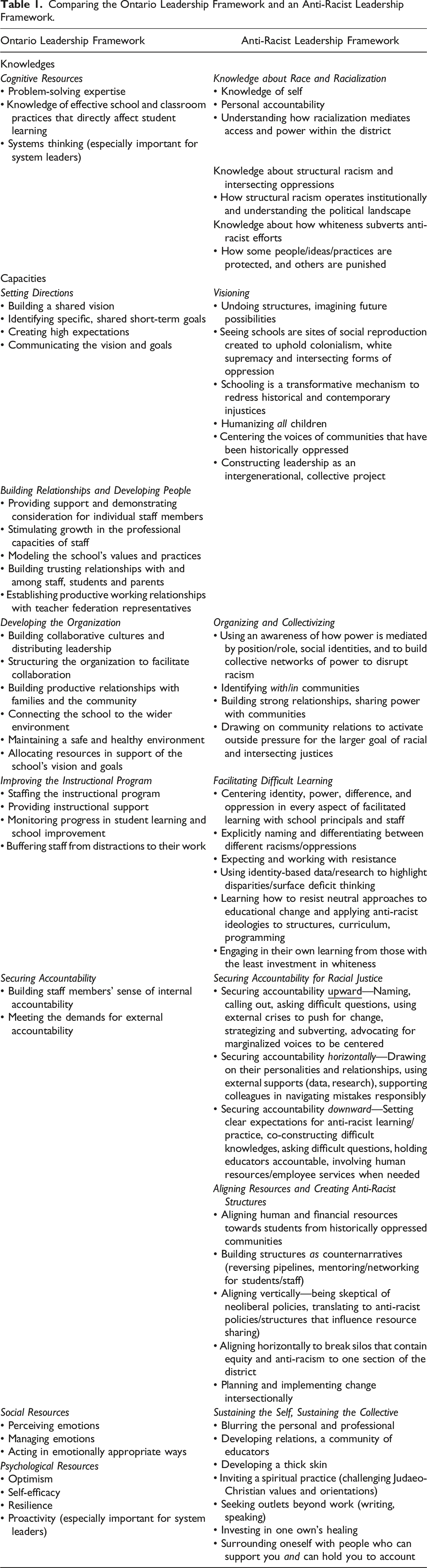
These differences provide a fundamentally different orientation to the knowledges and capacities required to lead for anti-racism that account for power, difference, and resistance. It is also important that we draw attention to a limitation of this study: the paucity of anti-colonial politics and orientations towards racial justice. For example, findings in this study do not name the limits of a liberal framing of recognition (Coulthard, 2014) for Indigenous students, families, and communities, or important differences between equity- and sovereignty-seeking groups. Additional research and theorization are required to explore the connections between CRT, CWS, and anti-colonial approaches to leadership for racial justice that acknowledge connections and intersections and recognize the distinct goals of Indigenous self-determination and sovereignty. These findings also signal concerns about the near complete absence of representation of Indigenous Superintendents of Education in Ontario and the absence of anti-colonial commitments and orientations in educational institutions and in the scholarship on educational leadership.
Conclusion
This study applies a Critical Race Theory and Critical Whiteness Studies frame to understand the knowledges and capacities of mid-level district leaders in disrupting historical and contemporary manifestations of white supremacy in schooling. And, like all frames, including seemingly neutral, positivist frames, they are both true and partial. The significance of studies like these lie not in the creation of a one-size-fits-all approach to leading for anti-racism, but in the undoing and unlearning of traditional approaches to leadership steeped in whiteness that create harmful conditions for Black, Indigenous, racialized, and other marginalized students, communities, and staff. Educational leadership scholarship would benefit from analyzing how leadership skills and capacities through multiple, subjugated frameworks, such as anti-coloniality, disability justice, abolitionist frameworks, and queer theories, support leaders in identifying what needs to be undone and what needs to be unlearned (Genao & Mercedes, 2021).
Perhaps, instead of solely focusing our attention on the scholarship and practice of leading (at any level), we might turn our attention to the scholarship and practice of unleading. What might it mean to construct leadership capacities as undoing and unlearning practices and ideas that uphold systems of oppression? For example, what might it mean to undo and unlearn aspects of whiteness such as hierarchy, individualism, compliance, power over, silence, denial and ignorance? As such, we might question our attachment to knowledge and knowing as “not everything is known or knowable” (Sium et al., 2012, p. XI). In doing so, we might shine a light on the harmful, common-sense assumptions and practices of leadership and invite constructions and enactments of leadership offered by subjugated knowledge systems.
Footnotes
Declaration of Conflicting Interests
The author(s) declared no potential conflicts of interest with respect to the research, authorship, and/or publication of this article.
Funding
The author(s) disclosed receipt of the following financial support for the research, authorship, and/or publication of this article: This work was supported by Social Sciences and Humanities Research Council (SSHRC) Insight Development Grant.
