



Abstract
The contemporary university is charged with producing graduates that are employable and career ready. Yet universities are often criticized for failing to cultivate such attributes in their graduates. Placements and internships arguably best support students’ development of employability knowledge, skills, and behaviours. As the numbers of students opting to, or able to, take internship or placements decline, alternative approaches to supporting students to develop such knowledge, skills and behaviours are vital. In this instructional innovation we outline an authentic experiential learning exercise, Northern Skies Coffee, which offers workplace-equivalent experiences from within the classroom. It positions students as HR consultants to advise on a real-world HR policy and practice challenge. The exercise is highly flexible and adaptable. Evaluation, using a survey recording students’ perceptions of their learning, and instructors’ perceptions of their students’ learning, has shown that through the problem-solving process, students develop creativity, teamworking, negotiation, problem-solving, and critical thinking. Their HR subject-knowledge, and importantly, their learning is transformed as they develop their self-knowledge and understanding and start to craft their identity as an HR professional.
Keywords
Introduction
The contemporary UK university is charged with producing graduates that are “well-equipped for work” (Dearing, 1997, p. 72; see also, e.g., Tholen, 2024; Tight, 2023) and such ambition is mirrored globally (THE, 2024). This focus has brought the concepts of “employability” and “career-readiness” into ascendancy within university curricula. While these concepts and their precepts have been contested (e.g., Stoten, 2018), they have been embedded as key metrics in evaluating the value of a university degree (McCafferty et al., 2024; Office for Students [OfS], 2019; Wallis, 2021), especially within Business Schools.
Employability is about being “career-ready.” It is though, a slippery concept; overly examined, yet under-defined (Artess et al., 2016; Nuis et al., 2023; Römgens et al., 2020). Fundamentally, it comprises students’ development and application of discipline-specific knowledge, of transferable skills, attitudes, and behaviors that will enable them to contribute to the labor market fully capable of addressing the challenges they may face throughout their careers. Universities are often criticized for failing to cultivate such attributes, to develop “career-ready” graduates (Björck, 2021; Orrell, 2021; Powell, 2021; Rose & Moore, 2024; Scandurra et al., 2024).
Students’ future employability is arguably best achieved through them engaging with, and reflecting upon, work, academic and life experiences to develop their career or occupational identity (Black et al., 2024; Hinchliffe & Jolly, 2011; Römgens et al., 2020). While practice-based, work-integrated learning best supports such reflections (Black et al., 2024; CMI, 2018; Martin & Rees, 2019), the numbers of students electing, or able, to take optional placements or internships within UK university courses are declining (Atfield et al., 2021; CMI, 2018; OfS, 2020). Consequently, the opportunities for learning from such experiences, to develop the skills and capabilities for work, are somewhat diminished. Authentic experiential approaches within mainstream curricula that leverage workplace equivalency can provide an invaluable alternative (Martin & Rees, 2019; Pitchford et al., 2021) and cohere with accrediting bodies’ aspirations for graduates that are autonomous learners with “real-world” experience (CMI, 2018; Koch, 2021). In being active learning, and with future relevance, authentic experiential approaches can also engender greater engagement (Stevens, 2021) especially from Business and Management students (hereafter “Business”); students that are reputedly highly instrumental in their learning (Sutherland et al., 2018).
In this article, we present a 12-week curriculum-based authentic experiential instructional exercise based upon an SME, Northern Skies Coffee, to offer workplace-equivalent experiences from within the classroom. It has been used within both physical and remote classrooms.
The key objectives of the Northern Skies Coffee exercise are to provide Human Resource Management (HRM) bachelor students with an opportunity to develop their HR knowledge, skills and capabilities through the process of experiencing an authentic HR challenge. Acting as HR consultants, they advance their knowledge and understanding of HRM policy and practice, developing the associated skills and behaviors that characterize such practice, thus imitating what they will face in their graduate HR careers. Guided reflection ensures that their experiences are converted into learning (Perusso et al., 2020). Providing this opportunity for HRM students is particularly important. Being a relatively new graduate profession and a profession characterized by diverse purposes (Parks-Leduc et al., 2018), students are often uncertain of what to expect from the subject and importantly what an HR practitioner is, or should be (Charlton, 2022; Hallier & Summers, 2011).
The exercise is differentiated from conventional case-study learning by focusing upon skills and subject-knowledge development through the live process of discovery in problem-solving, rather than upon the application of knowledge in puzzle-solving. It is also differentiated from Rude and Branham’s (1994) “living cases” which employ a fellow student’s own workplace challenges through the provision of a client brief. It is, therefore, better suited to bachelors’ students without previous, or current, workplace experience. With these foci, the exercise addresses recent calls for universities educators to support students in developing creativity skills as the “major driving force” for establishing their employability (CABS, 2024, np).
We use this authentic experiential exercise with first-year (EQF-4) bachelor HRM students. The exercise could be simply modified for use with other specialisms (e.g., marketing, retail, logistics, tourism, and events) by adapting the associated tasks to those specialisms. It could also be used at other levels including taught postgraduate courses. While presented as 12-week exercise, it can be compressed or expanded as necessary by reducing the number of HR topic areas examined.
Theoretical Background
This instructional exercise is grounded in the principles of authentic and experiential learning and involves students’ developing understanding of HRM theory as well as the complementary behaviors and skills that characterize HR-practice. The theoretical and conceptual background of these learning approaches is now briefly examined.
The value of experiential approaches for higher education students’ learning and skills development has been well-documented, and for business students especially (e.g., LeClair, 2018; Mantai & Huber, 2021; Miller & Maellaro, 2016; Perusso et al., 2020; Schmidt-Wilk, 2021). Accordingly, we do not dwell upon this literature in depth within this instructional exercise. As a form of social learning, experiential learning helps not only to support the development of key employability skills such as communication and collaboration (Bartels, 2023; Bradberry & De Maio, 2019) but can also promote student connectedness and engagement (Mahatmya et al., 2018). Experiential learning is grounded in both Deweyian and constructivist principles of learning from experience. It may take many forms (e.g., Western University, 2025), but crucially, experiential learning affords the learner with a much higher level of autonomy, agency and control over their learning, moderating the role of the instructor in the learning process to “guide” (Andresen et al., 2000; A. Y. Kolb & Kolb, 2022).
Within the business curriculum experiential learning approaches are not without challenge. For instructors, it may be difficult to establish suitable conditions for experiential learning: securing necessary resources and learning space/s; scaling the learning activities to meet growing class sizes (Lund Dean & Wright, 2017; Mantai & Huber, 2021; O’Connor et al., 2021). Constraints may also be imposed by accrediting bodies’ guidelines. Significantly, experiential learning also necessitates instructors to adopt a very different identity: rather than being fully knowledgeable of the curriculum, experiential learning may take instructors into unchartered territories which may present not only an identity threat but also create uncertainty (Black, 2024). Supporting bachelor students to adapt to a learner-centric and collaborative approach may need considerable adjustment and scaffolding. Many will have been brought up within an education system in which they have expected to learn directly from the instructor and have been in competition with their peers.
Authentic learning is a form of experiential learning that necessarily occurs in a setting that reflects a real-world practice situation that arguably has greater relevance to, and offers greater meaning for, the students concerned. Such pedagogies have seen growing exposure in this journal and the sister journal, Management Teaching Review (e.g., Bodine et al., 2021; Nikolova & Andersen, 2017; North-Samardzic & de Witt, 2019). The interest in these pedagogies is arguably driven by efforts to enhance graduate outcome metrics (James & Casidy, 2018; Romero-Gonzalez, 2024; Scheuring & Thompson, 2025). As with other forms of experiential learning, in authentic learning students are coached and scaffolded to examine alternative perspectives and challenge assumptions and in doing so, develop higher thinking skills such as analysis, synthesis, evaluation, and manipulation of information from multiple sources, within complex real-world contexts (e.g., Ashford-Rowe et al., 2014; Donovan & Townsend, 2018; Guilkers et al., 2004; Lombardi, 2007; Rivers & Kinchin, 2019; Wesner & Smith, 2019). Such skills arguably resemble contemporary employability skills (Lombardi, 2007; see also, Ashford-Rowe et al., 2014; Guilkers et al., 2004). Engaging with the professional world rather than examining static conjectural cases, better supports students to craft their nascent professional identity, better preparing them to face, and creatively address, the unpredictable and ill-defined contexts of their graduate career (NMC, 2021).
Despite recent appeal, there remains a lack of clarity in what authentic learning constitutes (e.g., Barab et al., 2000; Hagvall Svensson et al., 2022; Lombardi, 2007; Nachtigall et al., 2022; Roach et al., 2018). For example, questions are raised as to how authentic the experience need be, with Roach et al. (2018) concluding that, providing the context and task mirror what students perceive to be realistic of their future profession (what Herrington et al., 2003 term, “cognitive realism”), that the learning is validated by their instructor rather than their professional community is of little concern. From this position, several articles within this journal have reported quasi-organizational activities such as using a Classroom-as-Organization model (Hannah & Venkatachary, 2010), video documentaries (Schultz & Quinn, 2014), and board meeting simulations (Bruni-Bossio & Willness, 2016) as surrogates for real-world experiences.
Authentic experiential learning therefore offers a pedagogy that can leverage workplace equivalency and can empower our students to become autonomous, reflective learners, rather than “consumers” of propositional knowledge. Such experiences equip them with necessary capabilities to enhance their employability, their career-readiness (Pitchford et al., 2021), and to contribute to society more widely, while better supporting them in the transition to praxis knowing, and in crafting their professional identity.
Exercise: HRM in Practice—Northern Skies Coffee
Our activity, HRM in Practice: Northern Skies Coffee, is a 12-week (but easily flexible) authentic experiential exercise. It was designed to replace an HRM-101 type course by introducing students to key HRM topics including workforce planning, recruitment, learning and development, and employment. While in what follows, we outline a 3-hr per 12-week schedule, the exercise is highly adaptable to meet the needs of diverse student cohorts and their instructors, and of distinct course learning outcomes. The topics covered may be simply reduced in number by instructors according to the time available, the area/s in which they wish students to develop knowledge and understanding, and the skills that they wish them to primarily develop. It is entirely viable that the activity could be used in just one class to examine just the one aspect of HR policy and practice.
The exercise has been completed by nine occurrences of first-year bachelor (EQF-4) HRM students in a UK Business School. The purpose was to develop these students’ employability skills and their HRM-subject knowledge through workplace-equivalent experiences. The students are predominantly from UK/EU, although some occurrences include international students, typically from South-East Asia. All have very limited, or no, workplace HRM experience. Three further instructors have been involved in these occurrences. It is acknowledged that there may well have been some differences in the way that each facilitated their students’ learning, but, in turn, there would inevitably also have been differences cohort-to-cohort by the same instructor according to students’ learning approaches and support needed.
Learning Objectives
After completing the exercise, students will have:
Developed transferable graduate skills for a future HRM career
Developed their subject knowledge in the field of HRM
Reflected upon their own performance, and that of their team members, transforming their learning.
To achieve these learning objectives, we use D. Kolb et al.’s (1991) reflective learning cycle to support students’ learning from their experience/s.
We now present the case Northern Skies Coffee exercise. We describe the steps that should be taken to implement the exercise and describe the various options that instructors have in this process according to the level of students involved and time available. We then provide a guide for debriefing the exercise based on the key topic areas the students have explored. Finally, we show our evaluation of the exercise drawing upon student feedback and performance to illustrate its value. It should be noted that while our approach usually involves engagement with the firm itself, it is entirely possible to run this activity without this engagement and indeed, we have on two occasions.
The Case and Exercise Design
Our case, Northern Skies Coffee (a pseudonym), is an SME established in 2009. Although based in the North-East of England the company is typical of many other similar small coffee shops inter/nationally. With a portfolio of three coffee shops and employing 30 staff, the company is currently exploring a change in strategy. The leases on the coffee shop units are expiring, and the owner is considering moving from physical shops to a mobile coffee business.
Students work in teams, acting as an HR-consultancy engaged by Northern Skies Coffee. Their objective is to diagnose the HR policy and practice implications arising from the company’s proposed strategic change, and to make practice-focused recommendations for the company. While doing so, they develop their knowledge and understanding of the physical, legal, practical implications for HR policy and practice, also such skills as teamworking, negotiation, creativity, problem-solving, and critical thinking. As discussed below, in a weekly debrief, teams reflect with their instructor-as-coach on what they have learned through engaging in the exercise, about specifically, themselves; the skills involved in the process; about the case; and about HR policy and practice more broadly. As a final output from the guided exercise, teams make a presentation to an audience that typically includes a representative for the company in which they propose their evidence-based and costed recommendations for Northern Skies Coffee. If a representative from the company cannot participate, we invite other local HR practitioners so that students receive feedback from practice experts. This exercise, therefore, offers cognitive realism in being undertaken within a context indicative of their future professional career, but also physical realism as it is a real-world case. The company name and data are fictionalized to protect the owner and employees, and these could of course be changed to better fit the educational context of the activity.
Implementation Plan
Implementing the activity follows three key stages. First, students form consultancy teams of 4 to 6 members. We have used various diagnostic tools to inform the selection of teams but typically use a simplified Belbin’s Team Role diagnostic (e.g., https://www.psychologytoday.com/gb/tests/career/team-roles-test) which enables students to select appropriate team members. Examples of alternative diagnostics can be found online with a simple web search. Second, each student is provided with a briefing document which overviews the company, its mission, values and so on, and details of the business problem (Appendix 1). Students are informed that the capital costs and relevant planning permissions are assumed to have already been covered and thereby need not be considered. With the briefing document, teams are given:
A video created by the business owner overviewing his initial thoughts on the proposed change initiative
Data on the employees (e.g., service, contracted hours, absenteeism, age, gender)
Data on a range of employment costs.
If the company is actively involved in the teaching occurrence, each team may pose up to five questions to the owner via their instructor. Alternatively, teams may pose up to five questions for the instructor to respond to as an HRM advisor. Third, to support students’ learning, broadly defined weekly objectives and deliverables are provided by the instructor, initial discussions are scaffolded, and links to initial resources provided. Each team creates a shared e-folder into which they store their work-in-progress. An e-folder ensures all members can access it, and the tutor can also review work completed as/where so desired. A shared digital notebook or portfolio (e.g., MS One Note) might be used in place of the shared folder to provide for more organized information gathering and associated note-making to support students in making sense of, and use of, the evidence they locate (see, Janson et al., 2020). This is especially useful if you undertake the exercise within a remote classroom. We request that students are scheduled for 3 hr of instructor-supported classroom-based sessions (ideally as 1 × 2 hr + 1 × 1 hr) each week. Where teams make good use of the 3-hr sessions, they tend to rarely need to schedule additional team meetings outside of classes. Table 1 overviews the suggested learning implementation plan.
Implementation Plan.
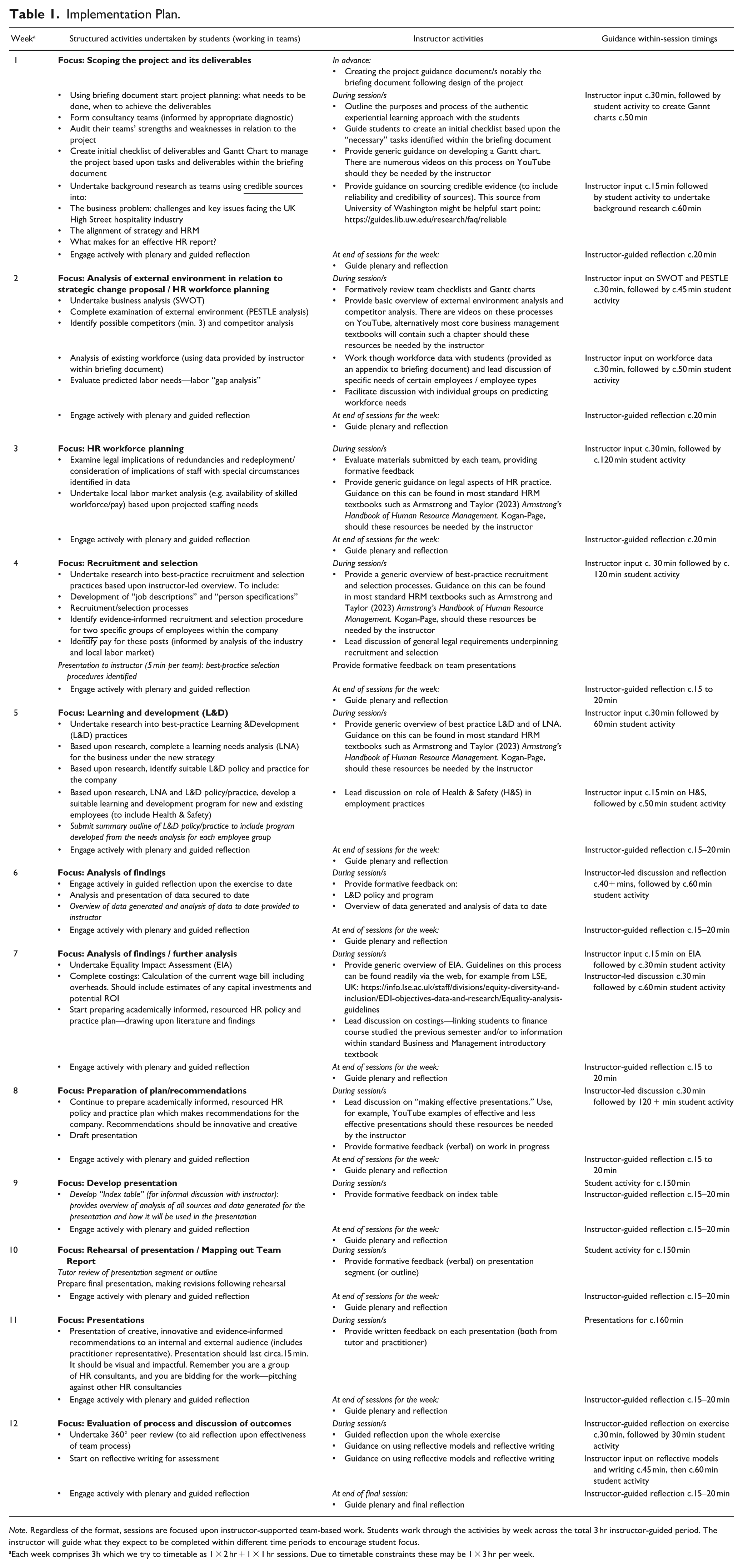
Note. Regardless of the format, sessions are focused upon instructor-supported team-based work. Students work through the activities by week across the total 3 hr instructor-guided period. The instructor will guide what they expect to be completed within different time periods to encourage student focus.
Each week comprises 3h which we try to timetable as 1 × 2 hr + 1 × 1 hr sessions. Due to timetable constraints these may be 1 × 3 hr per week.
Challenges Faced in Implementing the Exercise
Implementing this activity is not without its challenges. While the very large majority of students do react positively, at least with time, to this authentic experiential learning activity, its unfamiliarity can result in initial resistance or uncertainty. Their experiences from high school and college means that students tend to expect their learning to be directed by their instructor and explicitly toward the assessment task (see e.g., Alstete et al., 2024; Doo et al., 2020). They are typically unfamiliar with taking control of their own learning. Scaffolding, so that the instructor support is gradually released is therefore critical and necessitates building a trusting environment in which the students feel safe to try out for themselves. For example, initially providing support and guidance and then slowly shifting responsibility and decision-making to the students gradually builds their confidence and independence. Clark (2014) provides a guiding framework for such “gradual release of responsibility” (p. 28) and this is, in turn, evident within the implementation activities documented in Table 1.
A second challenge lies in engendering real learning. While students typically enjoy the experience, without care their learning can be very superficial in nature. For example, without close observation, students might fail to recognize the multiple steps needed to really develop their understanding and instead take shortcuts in efforts to achieve the same outcome without the knowledge and skills development intended. To overcome this, we encourage instructors to provide clear, and regular, milestones that necessitate all steps to be undertaken, supported by a weekly debrief.
Third, team issues can ensue. Although team diagnostic tools are used to best match the students into their consultancy teams, such diagnostics do not account for students’ personalities, levels of engagement or motivation to learn. As a result, we have seen some teams fragment with members neither engaging with the timetabled sessions nor with team members outside of these. To address this potential challenge, we include a 360° peer assessment which forms a part of the grade for the course. We also request each team writes, and lodges with us, a “Team Agreement” which outlines agreed behaviors and potential penalties for failure to adhere to the agreement.
Debriefing Strategy and Guide
As indicated within the implementation plan (Table 1), the exercise is debriefed weekly using an approach that best fits instructors’ and students’ needs. The purpose of the weekly debrief is to provide students with the opportunity to actively reflect upon their experiences in the immediate term to stimulate learning, but also to give the instructor an opportunity to offer formative feedback for students’ longer-term reflection. Dennehy et al. (1998) provides a range of examples of suitable debrief activity examples based upon D. Kolb et al.’s (1991) reflective learning model. We adapt Dennehy et al. (1998) structured debriefing to encourage students to reflect upon their experiences, as illustrated in Table 2.
Debrief Process Using D. Kolb et al.’s (1991) Model as the Structure (Based Upon Dennehy et al., 1998).
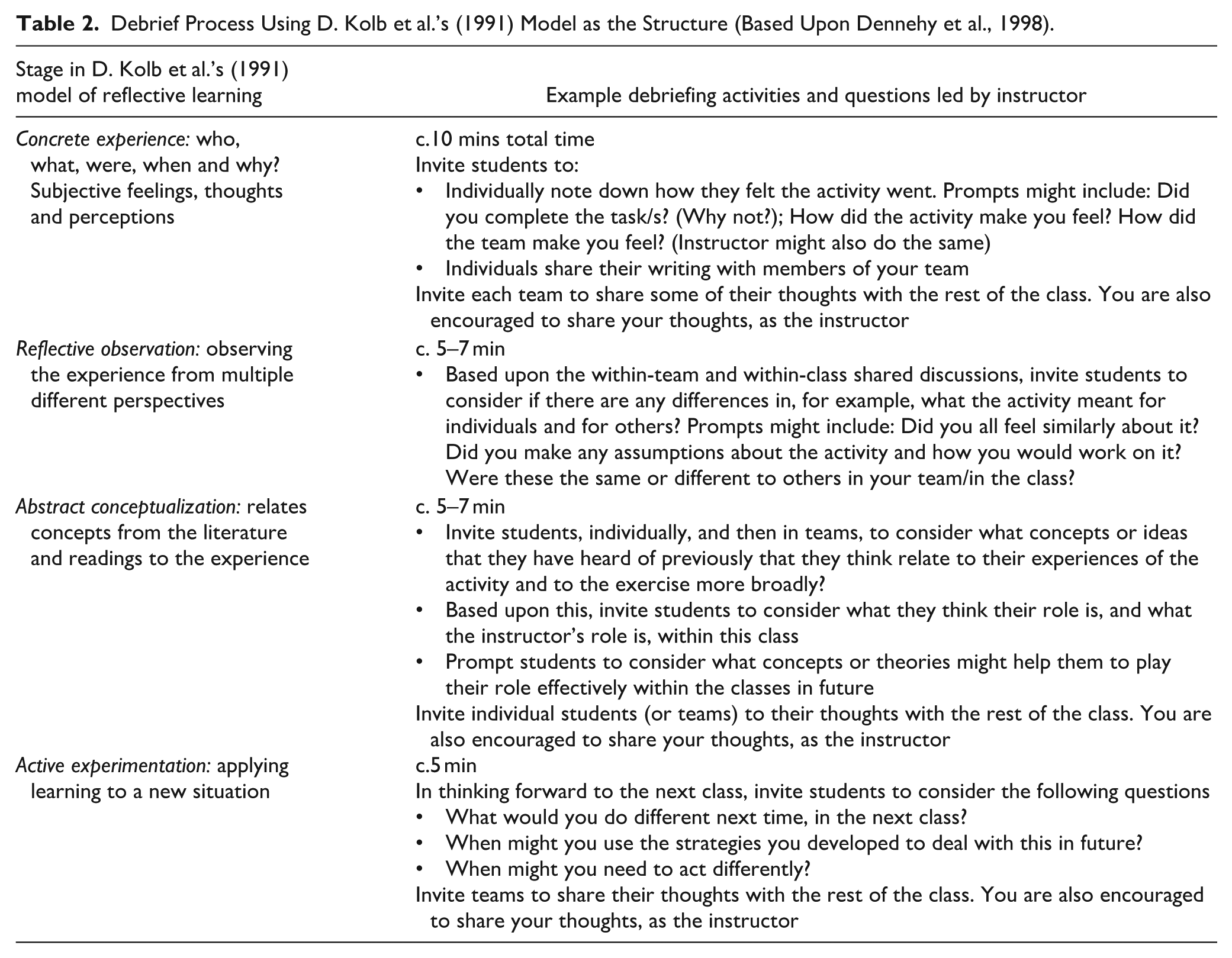
Structure helps to address the challenges that bachelor students can face in reflecting effectively due to a lack of broader life experience upon which to draw in the reflective process (e.g., Fullana et al., 2016; Tight, 2024; Warhurst et al., 2025). We encourage instructors to also share their own reflections with students to both reduce the risk of power inequities within the classroom but to also encourage students’ deeper reflection by “role modeling” their instructor’s deeper reflection. We have found that this structured and supportive approach provides the necessary scaffolding for most students, and they have reported to us how beneficial they find this. Within the debriefing we have found that some students can be loath to either note down their thoughts and/or to share them with others whether privately within their teams or with the wider class. Consequently, the risk is that the same voices are continuously heard. The instructor should, therefore, consider in advance how they will manage this situation should it arise. We tend to inform students that each week we will ask one of them to share with the class. We then, in turn, notify the student concerned at the start of the specific class session. This approach enables them to prepare accordingly. Students are also encouraged to complete an individual reflective diary following each session. This offers them further opportunity to reflect upon their skill development, their team processes, their direct learning of the subject, and upon the initial feedback they received from the instructor. These diaries might be shared with the instructor if so wished. We have found that where activities are not assessed they are rarely completed and therefore, the number of students maintaining a reflective diary can be limited. While this could be addressed by assigning a part of their grade for the course on the provision of this diary, our trial of this approach was challenged by the number of students with validated absences which meant that assessing them became highly problematic.
At the end of the exercise, following the final presentations (Table 1), the debrief focuses firstly upon the students’ teamworking effectiveness, supported by a 360° peer-assessment to evaluate their own and their team members’ performance and secondly, upon their overall learning from the experience. Students are also invited to reflect upon their learning from the process of completing this Northern Skies Coffee exercise. Specifically, they are asked to develop a written report that addresses the following:
What knowledge and skills have you learned? How have you learned each of these? What is your evidence of your learning?
How has this exercise changed your attitudes, beliefs or opinions?
Based upon your identified learning through this exercise, what further areas of learning will help your future professional-personal development?
How, specifically, might you address these learning needs? Develop a SMART action plan for your personal-professional development for the next 3-years. You should indicate how you intend to engage in this learning.
The 360° peer assessment, reflective report and action planning are assessed components for the course, alongside the team presentation grade and the submission of a team report that documents their inquiry findings. Students do, therefore, tend to engage readily, albeit perhaps strategically, with this aspect of their reflective learning.
Challenges Potentially Faced in the Decision-Making to Implement the Exercise
We have indicated above where instructors might face challenges in implementing and then debriefing this exercise. However, instructors may also face challenges in deciding whether, and how, to implement the exercise. We now examine these challenges and consider how they might be addressed.
First, securing sufficient time and resources to implement the exercise. The 12-week duration may be prohibitive, and if students are absent for any notable period, supporting them to catch up may be difficult. This exercise can be adapted in terms of duration, can run remotely or in the physical classroom, and can be used across different subject courses (see Appendix 2). Second, while suitable learning resources are signposted to students within the timetabled sessions (Table 1), there are unlimited additional sources students might access to develop their subject and industry understanding and to inform their decision-making. Students often want to know which is the “right” source to select and the “correct” data to use. Such questions provide opportunity to discuss the importance of evidence-based decisions (Doll, 2022) and the limitations of such evidence.
Evaluation of the Effectiveness of the Exercise
Working on an authentic experiential learning exercise with the purpose of discerning evidence-based policy and practice recommendations for an organization provides students with significant learning opportunities for their graduate future. For each occurrence we have examined the short-term more immediate value but have also been able to make some suggestions on the longer-term value. While pre- and post-data would be ideal, the enrollment-registration processes at the institution means that this is not viable and therefore we are reliant upon data secured post-experience. Yet, we do not consider this problematic due to the extent of data we are able to draw upon.
Procedure and Measures
A more immediate evaluation, undertaken in the final session of the exercise, comprised an online survey (Appendix 3) to which students were linked via both URL and QR codes for simple access via desk/laptop or mobile devices. The survey assesses students’ perceptions of their learning and comprises both closed quantitative questions (using a Likert scale: 1 strongly disagree, to 5 strongly agree) and open, qualitative questions. As an example, one open question asks students to share in their own words what they have learned from the course. Of the just under 350 bachelors students who have completed the course, 41% submitted a fully completed survey. Incomplete data were omitted from analysis. We also draw upon the instructors’ perceptions of students’ learning, as indicated through the assessed reflective learning reports, guided by the grading rubric to evaluate the extent to which students had met (or not met) the expectation of the activity.
We are also able to make some assertions on the longer-term value of the exercise by examining student performance data drawn from other courses as these students progress through their bachelor’s program. This latter data is cumulative in nature so cannot be analyzed in detail at the individual student level. However, it does provide further indication of the value of the exercise for developing students’ knowledge and skills of their future profession.
Data Analysis
We analyzed the data types independently. The quantitative survey data were cleaned and descriptive analysis undertaken, specifically means and associated standard deviation. As the data were only post-experience data, inferential analysis could not be undertaken to offer enhanced insights.
The qualitative data from the survey open questions, amounting to just under 22 pages of text across the nine occurrences of the course, was analyzed using an inductive theme analysis informed by Braun and Clarke (2006). Specifically, we read and re-read the qualitative statements recording the initial themes that emerged from the data. Related themes were collated together into higher level codes which were in turn aggregated to theory. An illustration of the coding process is shown in Figure 1.
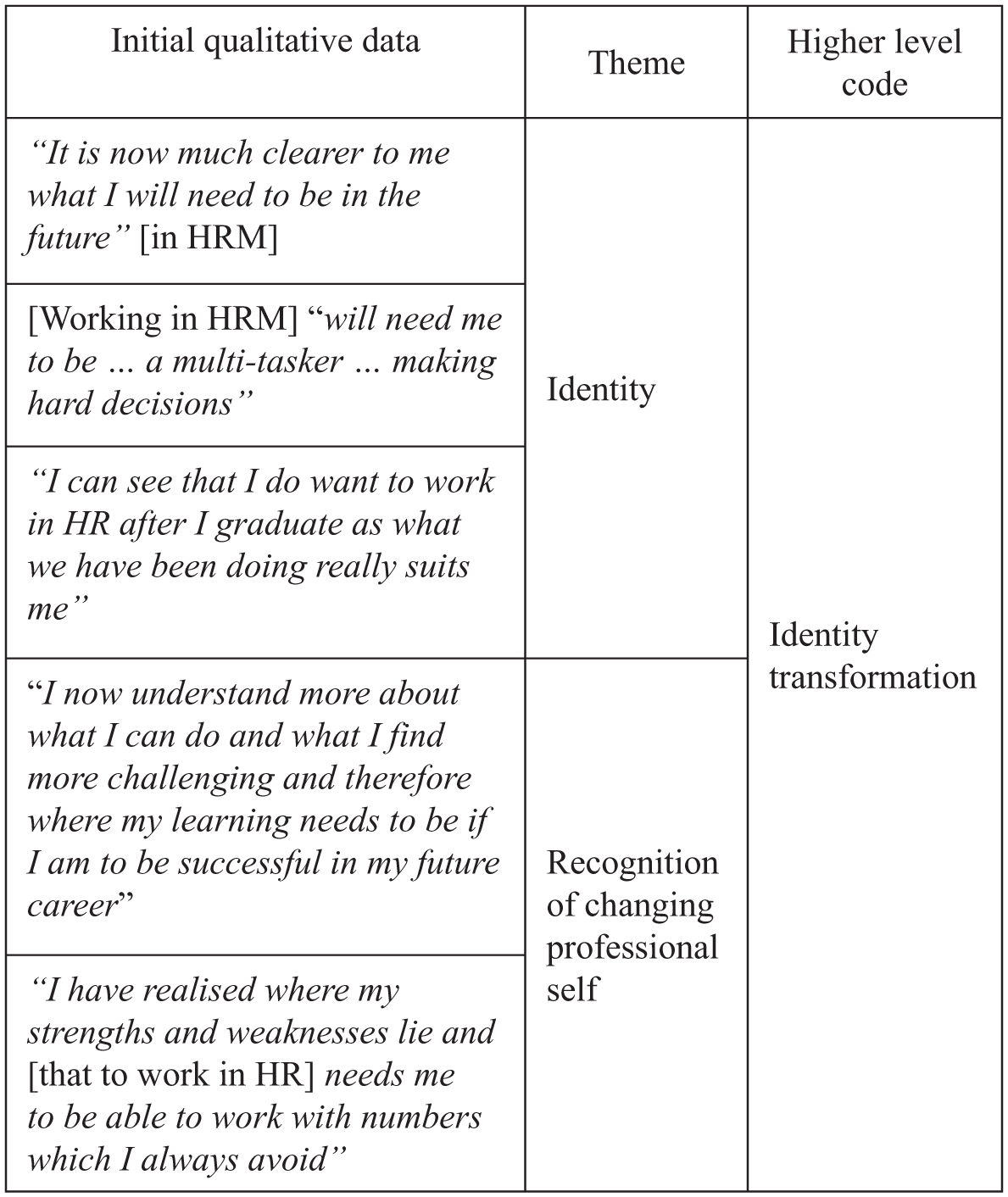
Illustrative coding structure.
Results
The survey data shows the strong levels of student satisfaction and perceived learning throughout the course, with an overall mean of 4.72 (max 5; SD: 1.1). While quantitative data has enabled us to see students’ perceptions of their learning from participation, and their instructors’ perceptions of these students’ learning from the activity, we suggest that it is the qualitative data that best encapsulate students’ genuine learning experiences.
The theme analysis revealed four higher level themes namely, employability skills, subject knowledge, self-knowledge, identity transformation, and these align with the three course learning outcomes. That these themes are pertinent is verified through the final question within the survey which invited students to provide up to five words to describe their learning through the exercise. These words are presented as Figure 2 and shows the occurrence of such words as “future thinking,” “HR career,” and “graduate,” and such employability skills as “team working,” “influencing,” “negotiation,” also “leadership” which may be considered a skill or characteristic of their transforming identity.
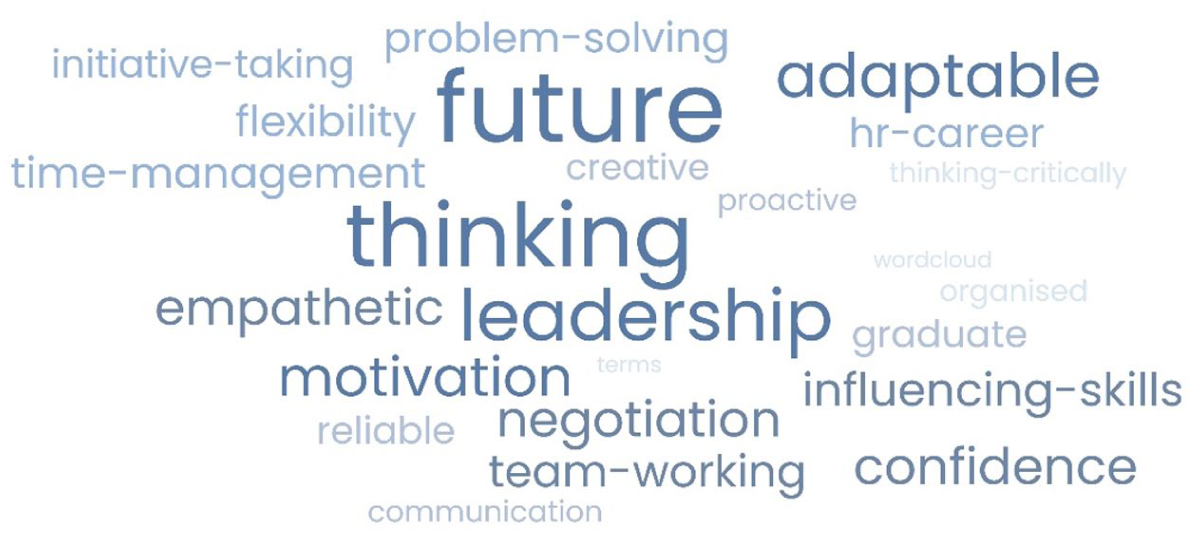
Students’ descriptions of their learning experience.
As typifies articles in this journal (e.g., Joshi et al., 2025; Walker & Larson, 2025), we now examine these findings by each the emergent themes and associated learning outcomes.
Learning Outcome 1: Develop Transferable Graduate Skills for a Future HR (or Management) Career
For the survey questions “I have a better understanding of the skills and competencies needed in the HR profession” and “I have developed my skills and competencies for my future career” the mean response was 4.2 and 4.6 (out of 5) respectively. Concurrently, assessment of students’ reflective reports showed that 87% of students had met (51%) or exceeded (36%) expectations for this criterion. Where students’ reflections did not meet expectations, this was often due to them not submitting their report in an appropriate format for their transferable graduate/HR skills development to be clearly discerned.
The qualitative data showed that students especially focus upon the more explicit transferable employability skills that they have developed especially their leadership, team-working, organization and timely-communication, these skills often being reported in tandem. As an example, one student’s response was indicative of many others in noting,
I feel that I have really had a chance to lead a team. I’ve not done that before really . . .. Important to make sure that I am checking that my team understand what I am suggesting, and that we all agree on what our targets are for the week
Concurrently, students asserted the less tangible skills of creativity, reliability and critical thinking.
Learning Outcome 2: Develop Subject Knowledge in the Field of HRM
To evaluate the effectiveness of the exercise for meeting this LO, we have primarily drawn upon the instructor assessment of students’ reflective reports. The instructor assessments showed that 87% students “exceeded” or “met” this rubric criterion through their reflective assignments, demonstrating their subject knowledge development. Our examination of student performance data for the previous, conventional first year HRM course against student performance data for this course has shown that the number of students that had “exceeded” and “met” was notably higher, suggesting that the course has been valuable for developing students’ knowledge and skills within the field of HRM. We acknowledge that the assessment designs were distinct and therefore direct comparisons need to be judged accordingly. We also acknowledge that a minority of students may possibly have been able to ascertain the specifics of the instructors’ expectations of assessment from their peers in previous cohorts. However, we provide detailed grading rubric to guide all students in writing their assessment, as well as an assessment guidance session and resources to support them to frame their reflections effectively. That students necessarily reflect upon the specifics of their personal learning within their teams, which has been documented for, and by, the instructor through the course, there is limited likelihood of them securing any benefit from their peers to secure a stronger grade. We also note, concurrent, that students’ responses to the survey question “I have developed my HRM subject knowledge” indicated a mean score of 4.7 (of 5). Students may have indicated that they strongly/agreed that they have learned in this area given that this was the focus of the course. Yet, that such scoring is reflective of their genuine learning, and that they had secured a more holistic understanding of, the discipline of HRM was evident in such reports as,
I had thought that HRM was just about recruiting people or making them redundant. I hadn’t thought about all the other areas of HR or that how these all must take account of such things as finances, the law and strategy.
Learning Outcome 3: Reflecting Upon Own Performance and That of Team Members to Transform Their Learning
That from examining a real-world HRM challenge students have been able to not only discern their learning, but significantly, this learning is transformative, is primarily evident in the open question responses. Students’ comments reflect their developing levels of self-knowledge and understanding especially in relation to their future career aspirations, as encapsulated in one student’s comment of,
I now understand more about what I can do and what I find more challenging and therefore where my learning needs to be if I am to be successful in my future career.
Relatedly, and significantly, these students also demonstrate an enhanced sense of their future professional self with many referring to how the activity has helped them to see who they might be in the future as an HR professional and/or to understand the strategic decisions that HR within their future workplace need to make,
It is now much clearer to me what I will need to be in the future. I thought that I knew what HR was . . . I realize that it [HR] is more complex and will need me to be . . . a multi-tasker . . . making hard decisions.
We have suggested that we might observe the longer-term value of this course through observing students’ performance, albeit at a cohort level, on subsequent HRM courses as they have progressed through their bachelor’s program. We cannot assert causation, but students that have undertaken this exercise typically outperform those that have not by an average of 5.2% which may be attributable to, as one student asserted:
Doing this activity really brings HR to life, and then it all makes much more sense to me and that helps me in my other HRM modules [courses].
Experience across the multiple occurrences that we have run this exercise has shown that participation in the scheduled sessions for this course is demonstrably stronger than participation in conventional modules which, in turn, supports students’ heightened learning and course performance. That students are engaged and empowered to take responsibility for their learning through such activities at this early stage of their university career is evidenced by such feedback as:
It is fun working for the company. We are expected to come up with really good ideas, so I want to try really hard . . .. It’s like I’ve learned a whole course in these last few weeks in a much more interesting way . . . and I’ve learned all the challenges of working in a team and how to overcome them too.
Conclusions
The Northern Skies Coffee innovative instructional exercise offers HRM students an authentic experiential learning experience. Taking the role of HR-consultants advising an SME, evaluation has shown that the exercise offers students the opportunity to not only develop their subject understanding, the “HRM 101” syllabus being learned experientially with little formal teaching (Table 1), but through the process of team-based discovery, to also develop key employability skills including team-working, problem-solving, and critical-thinking. In contrast to conventional courses to learning about HRM, this exercise reflects the activities that they will be undertaking professionally. Therefore, it better equips students for their graduate career by offering learning experience with greater meaning, creating opportunities for them to start crafting their future identity as an HR professional. This article contributes to discussions around the value of authentic experiential learning for heightening students’ employability where placement or internship learning are not feasible.
Supplemental Material
sj-docx-1-jme-10.1177_10525629251394311 – Supplemental material for Enhancing Employability Through an Authentic Experiential Learning Exercise
Supplemental material, sj-docx-1-jme-10.1177_10525629251394311 for Enhancing Employability Through an Authentic Experiential Learning Exercise by Kate Black and Russell Warhurst in Journal of Management Education
Footnotes
Acknowledgements
We are grateful for the very helpful review feedback that we have received that has enabled us to develop a stronger instructional innovation exercise
Declaration of Conflicting Interests
The authors declared no potential conflicts of interest with respect to the research, authorship, and/or publication of this article.
Funding
The authors received no financial support for the research, authorship, and/or publication of this article.

Supplemental Material
Supplemental material for this article is available online.
References
Supplementary Material
Please find the following supplemental material available below.
For Open Access articles published under a Creative Commons License, all supplemental material carries the same license as the article it is associated with.
For non-Open Access articles published, all supplemental material carries a non-exclusive license, and permission requests for re-use of supplemental material or any part of supplemental material shall be sent directly to the copyright owner as specified in the copyright notice associated with the article.
