



Abstract
Intersectionality refers to the combined effects of multiple forms of discrimination. Since the 1970s, critical pedagogy and feminist theories on intersectionality have shed light on the intertwinement of domination systems, namely racism, class, sexism, and ableism. They have brought important tools to think about the mechanisms at play within classrooms and liberatory and transformative ways of learning. However, this conversation comes mostly from the margins and is just starting to enter North American business schools. We need to understand how intersectionality plays out when teaching in a dominant context. In this essay, I present five real classroom situations as they unfolded in Canadian universities, and I explore how an intersectionality lens can help in grasping what is sometimes occurring beneath the surface in the classroom. Then, I propose concrete strategies for addressing challenging situations that are likely to arise in most business school courses. I argue that management educators have a duty not only to recognize their privileges and use them to confront systemic oppression but also to avoid propagating knowledge, theories, or ideas rooted in harmful and unquestioned assumptions that lack sensitivity to intersectionality.
The issue of privilege in business schools and management education has increasingly become a topic of debate (see, e.g., JME’s 2023 special issue, “Privilege in Business Schools and Management”). Management scholars have acknowledged that management education often reinforces the privileges of dominant groups, that it mainly conveys White voices, especially those of White men (Ferraro, 2023; Mir, 2003; Prieto & Phipps, 2016; Rabelo et al., 2023), that it relies heavily on theories and frameworks from the Global North, often overlooking the Global South (Alcadipani et al., 2012) and marginalizing or appropriating the contributions of Black and Brown scholars and practitioners (Crenshaw, 2019; Ferraro, 2023; Mir, 2003). Furthermore, since business schools tend to lean more politically conservative, both faculty and students may find it difficult to critically examine their own privileges (Mir, 2003; Nesbitt, 2019; Rabelo et al., 2023).
While discussions about privilege in management education are increasingly welcomed, they often overlook intersectionality (Atkins, 2021; Lo, 2023)—the idea that traditional patterns of oppression within society, such as those based on race/ethnicity, gender, religion, nationality, sexual orientation, class, species, or disability, do not act independently of one another; rather, these forms of oppression are interrelated, creating a system of oppression that reflects the “intersection” of multiple forms of discrimination. . .(Ritzer, 2009, p. 1)
An intersectional perspective calls for addressing privileges in an integrated manner, rather than in isolated categories, and recognizing the simultaneous existence of both privilege and oppression (Amoroso et al., 2010; Lo, 2023). In a teaching and learning context, a siloed approach of privilege and oppression can lead to oversimplify classroom situations (Grant & Sleeter, 1986) and to ineffective pedagogical practices that perpetuate oppression and fail to support all students (Grant & Zwier, 2011; hooks, 1994). Research applying the theoretical framework of intersectionality in management education is limited, with a few notable exceptions (Johansson & Śliwa, 2014; Lo, 2023; Lund Dean & Forray, 2021; Rabelo et al., 2023).
The aim of this essay is twofold: (1) to clarify how an intersectional approach enhances our understanding of the complex dynamics of domination and oppression in the management classroom, and (2) to propose concrete strategies for addressing challenging situations that are likely to arise in most business school courses. The paper is organized into three sections. The first presents the concept of intersectionality and reviews the limited literature on intersectionality in management education. The second forms the core of this essay, where I analyze five real-life classroom situations through an intersectional lens and offer practical strategies for addressing each one. Lastly, I briefly discuss the responsibility of management educators in confronting issues of exclusion and oppression and suggest avenues for further research.
Intersectionality and Management Education
The concept of intersectionality was introduced in 1989 by African American attorney Kimberley Crenshaw to describe the complex realities faced by Black women at the intersection of systemic racism and sexism (Crenshaw, 1989). Crenshaw was influenced by African American feminists and activists, particularly bell hooks (1981). Over time, the concept of intersectionality was expanded to encompass dimensions beyond race and gender. It highlights not only the intersection of identity categories but also the interaction between individual and institutional factors (Dhamoon, 2011; cited in Pugach et al., 2019). The various social identities people hold shape how systems of domination manifest. For instance, racism affects men and women differently, just as sexism is experienced differently by heterosexual women compared to lesbian women (Grant & Zwier, 2011; Jones & Wijeyesinghe, 2011).
An intersectional perspective encourages reflection on privilege and privilege awareness (Lund Dean & Forray, 2021). Privilege refers to unearned advantages tied to social identity group membership, benefiting some groups at the expense of others and often overlooked or dismissed by those who hold it (Black & Stone, 2005). Privilege awareness is defined as “an understanding of how individuals and social groups experience exemption from discrimination as well as access to unearned advantages” (Rabelo et al., 2023, p. 57). An intersectional perspective acknowledges that most people simultaneously experience both privilege and the lack of it, and that privilege itself is intersectional (e.g., being a White man), rather than unidimensional (e.g., being White and being a man). Additionally, while privilege is often viewed at an individual level, an intersectional approach highlights the political and collective dimensions (Crenshaw, 1989; Puar, 2012; Quemener, 2020). In other words, intersectional approach emphasizes the macro and systemic level of domination (e.g., patriarchy and racism).
The literature on teaching and privilege mostly takes a siloed approach, addressing race and social class in isolation. Most of the literature has focused on race in the United States (Atkins, 2021), where faculty are predominantly White (Ndandala, 2016). This body of work not only centers on the experiences of the White faculty but also assumes a White audience (Atkins, 2021). Other studies, such as Moergen and Kish-Gephart’s (2023) work on class privilege in the classroom, focus on social class. However, discussing social class in the U.S. without considering race results in oversimplifications, highlighting the need for an intersectional approach (Lo, 2023). hooks argues that adopting an intersectional perspective in the classroom can help dismantle academic hegemony and foster a deeper reflection of one’s positionalities and biases (hooks, 1994).
In management education, an intersectional perspective remains rare (Lo, 2023). Several studies, such as Balkin et al. (2022) have highlighted gender inequities in United States business school classrooms but fail to account for social class or race. Social class, in particular, tends to be overlooked in American business schools (Moergen & Kish-Gephart, 2023), leading to limited awareness of class privilege and its intersection with other dimensions. However, a few studies have initiated discussions on intersectionality in management education. Johansson and Śliwa (2014) explore how gender and foreignness operate as dynamic, relational constructs in UK business schools. Their research reveals that non-Whiteness significantly influences perceptions of foreignness, with varying experiences depending on the context, such as a predominantly White university committee versus a more diverse department. Recently, Lund Dean and Forray (2021) have argued that privilege is intrinsically intersectional and introduced the concept of “small silences” (Lund Dean & Forray, 2021), emphasizing that by not actively questioning everyday privileges and systemic oppressions, we silently contribute to their reproduction. They stress the need for management educators to be both proactive and vigilant, as those in positions of power hold privileges and bear a moral duty to address these issues (Lund Dean & Forray, 2021).
The responsibility of management educators has also been emphasized by Lo (2023) and Rabelo et al. (2023), who have sought to translate this responsibility into actionable teaching practices. For example, they propose exercises aimed at helping students recognize that they both have and lack privilege in their personal and organizational lives (Lo, 2023; Rabelo et al., 2023). My aim in this paper is to build on these works by highlighting the responsibility of management educators to both understand and teach intersectionality in the classroom. However, the approach taken in this essay differs in one key respect: rather than focusing on designing new exercises and activities, I argue that educators must become skilled at applying an intersectional lens to everyday classroom situations. It’s not just about carving out space in an already packed curriculum to “teach” intersectionality; it’s about cultivating the habit of addressing classroom dynamics with an intersectional perspective, thereby modeling this approach for students.
Five Classroom Situations in Need of an Intersectionality Lens
In this core section, I present five real-life management classroom situations that highlight complex issues of oppression and domination, requiring educators to exercise both analytical and practical finesse. By analyzing these situations through an intersectional lens, my goal is to demonstrate the value of this perspective and to outline concrete principles that management educators can apply to more effectively address privilege and oppression in the classroom. Some of these principles may resemble those typically suggested for inclusive teaching, broadly defined as “ways in which pedagogy, curricula and assessment are designed to engage students in learning that is meaningful, relevant, and accessible to all” (Hockings, 2010, p. 1). This paper highlights the importance of developing the habit of addressing classroom dynamics through an intersectional lens, thereby modeling this approach for students not only in everyday classroom interactions, but also in more challenging situations.
The classroom situations described in the five vignettes took place at two of the four university-based business schools in Montreal (Canada) that participate in the joint Ph.D. program in administration, in which I am enrolled. These vignettes are based on informal testimonials from colleagues gathered over the past 2 years, along with my own experience (vignette #5). These colleagues have given their written consent for me to recount their experience in an anonymized form. The choice to use vignettes—depicting concrete, context-dependent, and unique situations (Knights et al., 2022)—is a deliberate strategy to avoid the tokenism often found in general discussions about diversity and inclusion in management education. This approach embodies my commitment to “situated knowledge,” emphasizing that all knowledge is shaped by the specific material, social, and cultural contexts in which it is produced, thereby challenging the idea of universal and purely objective truths (Haraway, 1988).
Recognizing the importance of “positioning” in cultivating situated knowledge, it is essential to reflect on my own social positioning (how my identity affects the experience I have in society), privileges, and my awareness of them (Lo, 2023). I am a White French citizen and a Canadian temporary resident, a cis-gender woman, straight, able-bodied, and from an upper-middle-class background. I am currently pursuing a PhD at a top-ranked Canadian business school. My feminist journey began 7 years ago and has since expanded into a broader interest in other forms of social inequalities and oppressions.
The five vignettes are presented below. After each vignette, I first analyze the situation through an intersectional lens, then provide recommendations at both the individual and institutional levels to help management educators navigate similar situations in a way that aligns with their specific contexts.
Vignette 1: Inclusive Practices. . . Which Exacerbate Inequity?
Leo, Assistant Professor of finance, teaches a Bachelor’s-level class in which several students receive accommodations based on medical diagnoses that grant them extra time on exams. Initially, Leo viewed this policy as fair. However, over the years, he has noticed that the students benefiting from extra time are predominantly White and from upper-middle-class backgrounds. He suspects that other students—often racialized and from less privileged families—would also benefit from similar accommodations but lack the necessary medical diagnoses to qualify. These students may face cultural barriers to seeking a diagnosis or lack the financial resources to obtain one. This realization has led Leo to question the fairness of providing accommodations solely to those with a formal diagnosis.
Analysis
The vignette highlights the limitations of a silo vision of inclusion and underscores the need for an intersectional perspective to avoid unintentionally deepening exclusion. In many countries, students often receive academic accommodations based on diagnoses related to neurodivergence to ensure equitable access to learning and assessment; however, instructors are not entitled to access or inquire about a student’s specific diagnosis (Bartolo et al., 2023). Neurodivergence is a non-medical umbrella term describing individuals whose brains develop or work differently from most people, including conditions such as autism spectrum disorder (ASD) or other neurological or developmental conditions such as attention-deficit/hyperactivity disorder (ADHD; Gray et al., 2025). This vignette suggests that while accommodations for neurodivergent students are well-intended, they may inadvertently reinforce inequities by favoring those with the resources and cultural capital to obtain a diagnosis. Learning disabilities intersect with socioeconomic, racial, and language inequalities, disproportionately affecting marginalized students because lower socioeconomic or immigrant status create barriers in accessing quality rehabilitative, specialty services, and healthcare (Ben-Moshe & Magaña, 2014; Udonsi, 2022). Both race and disability are socially constructed, interdependent categories (Annamma et al., 2013) that are constantly contested and redefined (Gillborn, 2015; Liasidou, 2014). As a result, the racial and disabled identity of a student cannot be disentangled, and the experience of disability and racism cannot be addressed separately (Guillaume, 2011). It is therefore crucial to adopt an intersectional approach to addressing issues of disability and neurodiversity in management education, acknowledging their complex connections with social class, gender, and ethnicity.
Historically, educational inclusion has often been treated as a technical issue focused on allocating resources, managing, grouping, and designing special education programs that preserve the continued operation of mainstream education and dominant institutions (Mu, 2021). However, “by aiming for the most accessible to all designs, we risk overlooking how intersections of race, ethnicity, gender, and class might impact this access” (Knoll, 2009, p. 128, cited in Liasidou, 2012). The mainstream perspective on inclusion often reinforces a fixed and essentialist understanding of students’ “disabled identities” (Le, 2024; Liasidou, 2012; Mu, 2021). As educators, we often assume that implemented inclusive practices based on accommodating certified “special needs” are enough, leaving other struggles overlooked or misattributed to personal failure, increasing the risk for these students of falling behind (Gobba et al., 2019; Hogan & Sathy, 2022). Stigma leads students to hesitate in disclosing their disability labels, even when they are known, contributing to the common practice of masking or camouflaging neurodivergent traits, especially if they have additional minority identities (Accardo et al., 2024; Kryger & Zimmerman, 2020).
Implications for Management Educators
Rethinking inclusivity beyond formal diagnoses (Koh et al., 2024) requires adopting teaching practices that provide flexibility in a more universal way. At the institutional level, business schools should consider policies that do not require students to disclose their conditions to access inclusive learning activities and assessments. They could also promote research and experimentation with alternative assessment methods while ensuring that mental health and diagnostic services are accessible to students from underprivileged backgrounds.
At the individual level, even within institutions that rely on traditional accommodation systems, educators can mitigate inequities by designing assignments with built-in flexibility, offering multiple assessment formats or flexible deadlines (Kryger & Zimmerman, 2020) or even implementing ungrading practices, which involve removing grades from as many assignments as possible, and focus on giving developmental feedback (Clark & Talbert, 2023). While universal design for learning principles (Tobin & Behling, 2018) provides a strong foundation, an intersectional approach to exclusion reminds us that no single teaching practice can fully address every student’s needs. Instead, adopting an “inclusive mindset” (Hogan & Sathy, 2022) means approaching every pedagogical decision with two key questions: “(1) Who might be left behind as a result of my practice?, (2) How can I invite those students in?” (Hogan & Sathy, 2022, p. 11).
This shift in mindset requires management educators to take responsibility—rather than deferring it to student services—for addressing these questions. It also necessitates collective efforts to understand neurodiversity and its intersections with race and socioeconomic status (Le, 2024).
Vignette 2: Awareness a Blessing?
Indira, a female Associate Professor of International Business from East Africa, teaches an undergraduate course in which students work in teams. Alice, a Black North American woman, was part of a 5-members team with three White North American men, and her Latin American female friend. Throughout their teamwork, the three male students consistently ignored Alice’s contributions. Frustrated, she eventually confronted them, saying, “You can’t keep disrespecting me and ignoring my ideas.” Later, Alice and her friend approached the professor, Indira, to share their frustrations and Alice broke down in tears. Indira responded, “You’re both women and minorities, just like I am. I can tell you that this will happen throughout your life, and you need to find ways to cope with it.” Alice paused, looked at Indira with intent, and began crying again, but this time out of relief. Alice said she realized that it wasn’t just about her and there was something more important at stake. After the meeting, Indira wondered: “Am I, as a teacher, raising their awareness too much and inadvertently causing them harm?”
Analysis
This vignette illustrates the intersection of gender and race—what Hotchkins (2017) refers to as “gendernoir”—and the “racial battle fatigue” and exhaustion (Atkins, 2021) experienced by Black women students as they face repeated racial microaggressions and systemic racism in predominantly White institutions. Alice’s interaction with Indira underscores a key dynamic: students of color, particularly women, often seek emotional guidance from female faculty of color, expecting support that they feel White male faculty may not be able to provide. For Indira, supporting Alice meant validating her experiences by acknowledging the systemic nature of the racism she was facing. However, whether this type of “awareness” is ultimately empowering or disempowering for Alice remains open to question (Wei & Bunjun, 2021).
This situation also reveals the emotional labor placed on women faculty of color (Lin & Kennette, 2022; R. A. Miller et al., 2019; O’Meara et al., 2021). Not only do they face the same institutional barriers as their students, but they are also expected to act as mentors and emotional supporters (T. L. Miller et al., 2021; O’Meara et al., 2021). This type of unacknowledged and uncompensated labor is often an additional burden, exacerbating feelings of isolation and exhaustion (Lin & Kennette, 2022). Faculty of color, particularly women, are often perceived as “tokens” in academic institutions, which subjects them to heightened scrutiny and additional pressures to perform flawlessly (Puar, 2012; Quemener, 2020). This vignette also brings to light the often-unspoken toll that mentoring and supporting students from marginalized backgrounds can have on faculty from similar backgrounds.
Little is known about how marginalized faculty members address privilege and oppression in the classroom, especially when they themselves are navigating these systems of inequity. Research tends to overlook how educators from oppressed groups engage with students who face similar challenges. This vignette opens up important questions about how professors like Indira balance their role as mentors for marginalized students while dealing with their own positionalities and institutional constraints (Fenwick, 2005).
Implications for Management Educators
Teamwork is a key component of management education, and teaching students to approach it with an intersectional lens is essential for promoting inclusive collaboration (Rios et al., 2016; Wei & Bunjun, 2021). Educators can proactively address intersectional dynamics by helping students recognize how power imbalances and unconscious biases shape team interactions (Case, 2017; Rios et al., 2016; Wei & Bunjun, 2021). At the outset, instructors can allocate a few minutes for team members to discuss their similarities and differences using optional prompt questions. This exercise encourages students to anticipate potential challenges, such as language barriers affecting a non-native speaker’s ability to contribute fully, teams can then develop strategies to ensure all voices are heard and valued. To maximize engagement, educators can tailor their language to students’ levels of awareness. For instance, they might frame discussions around teamwork effectiveness rather than emphasizing political responsibility, thereby making the conversation accessible while still addressing structural inequalities.
All management educators have a responsibility to help reduce systemic racism (Edmondson et al., 2020). One way to do this is by adapting course syllabi to incorporate the perspectives and experiences of women of color, helping to create a more inclusive environment and reduce feelings of isolation (Case, 2017). Educators from marginalized groups should be aware of the additional emotional labor involved in mentoring and supporting students who experience similar forms of oppression (Madden & Tarabochia, 2020; R. A. Miller et al., 2019; Ueda et al., 2024). They should also be mindful of how their responses impact students. While validating experiences of systemic oppression can be empowering, it is equally important to provide students with strategies to navigate these challenges constructively (Fenwick, 2005). Without concrete tools (Edmondson et al., 2020), already marginalized students may feel powerless, isolated, and stressed.
At the institutional level, universities should offer targeted resources for women of color facing intersecting racism and sexism, such as dedicated website sections, support networks, mentorship programs, and safe spaces (see, e.g., University of Victoria’s “Black inclusion resources”). Business schools could collaborate with Black, Indigenous, and other Communities of Color (BIPOC) female faculty and allies to develop workshops, training programs, and speaker series. Faculty-wide training on supporting diverse students would help distribute responsibility more equitably, preventing a disproportionate burden on a few token individuals. While recognizing and rewarding the often-invisible labor of minority faculty—especially women faculty of color—formal mentorship programs could help ensure that student support does not rely solely on individual faculty members.
Vignette 3: I Am Calling Them Racists?
The week following the incident in Vignette #2, Alice and her teammates had a meeting with Indira as part of her normal monitoring of teamwork. During the meeting, one of the White male students complained that Alice “was being difficult, (. . .) angry, (. . .) mad.” Indira confronted him directly; “You need to stop saying that, because you’re perpetuating the “angry Black woman” stereotype. You must stop describing women as difficult and find a way to communicate without using those words. You need to move beyond that cliché.” After the meeting, Indira worried that the student might file a complaint with the department head, accusing her of publicly implying that he is a racist. Confronting him in front of his peers had been deliberate so other students could witness the exchange and confirm what was said—and what was not. For days, Indira anxiously anticipated an email from the department head, who had shown little sensitivity to intersectional issues in the past. As a woman from a visible minority, but with the privilege of being a university professor, Indira felt a strong responsibility to fight racism but was constantly fearful of offending students: “it is a very fine line, and I am always worried they’ll think I’m labelling them as racists.”
Analysis
While the previous vignette focused on how women faculty of color might relate to Black women students facing systemic racism—the “oppressed”—this vignette highlights the complexities of addressing students who perpetuate racism, often unknowingly—the “oppressors.” In this case, Indira is navigating the difficult task of confronting harmful behavior without directly labeling the student as a racist. The vignette also highlights a broader issue: how can faculty of color balance the responsibility to address harmful behavior with the constant fear of repercussions, particularly in predominantly White institutions.
The vignette raises critical questions about the role of faculty in confronting biases, particularly when those biases are ingrained in societal norms. Indira’s challenge is in helping students recognize their biases without escalating the situation into a personal attack. This reflects the difficulty of teaching in environments where racism is deeply embedded in social structures. We live in a structurally racist system where biases are pervasive, even when intentions are not malicious (DiAngelo, 2018). The key is to recognize that having racist biases or engaging in racist behaviors is not necessarily a reflection of one’s moral character, but rather a consequence of being part of a society where these dynamics are pervasive. Indira’s intent was to address the harm caused by perpetuating the “angry Black woman” stereotype, not to label the student as a racist. However, the student might perceive the confrontation as a personal attack, reinforcing the defensive reactions that often follow discussions of race and privilege. The notion of “White fragility” illustrates how White people tend to “protect” the idea that they do not have racist patterns, deflecting responsibility and accountability (DiAngelo, 2011, 2018).
Indira’s approach could be to help students understand that everyone—due to living in such a system—carries some form of racial bias. What is important is the willingness to identify, question, and actively work on these biases and behaviors, which is far from a given: “White equilibrium is a cocoon of racial comfort, centrality, superiority, entitlement, racial apathy, and obliviousness, all rooted in an identity of being good people free of racism. Challenging this cocoon throws off our racial balance” (DiAngelo, 2018, p. 113). Acknowledging this does not mean accepting or excusing racist actions but rather fostering a commitment to self-reflection and change. By shifting the focus from personal “accusation” (individual level) to collective responsibility (systemic level, here it can be the team or the classroom), not only it bypasses defensive reactions but also enables challenging and dismantling the systemic racism that shapes our everyday lives. By framing the issue this way, Indira can encourage dialogue that is more constructive, urging students to take responsibility for their actions within the broader context of societal structures, and to work toward undoing the harm caused by these ingrained biases.
Indira, however, cannot hope to do this without the support of her institution. Students evaluate Black professors to be less competent and legitimate than their White and Asian counterparts (Atkins, 2021; Bavishi et al., 2010). Colored female faculty in a predominantly White institution are experiencing gendered racism in their classrooms and are more likely to have their authority, teaching competency, and scholarly expertise challenged, as well as to receive threats to their persons and their careers compared to male faculty (White men and men of color) and White female faculty (Pittman, 2010). In many institutions, including business schools, faculty from visible minorities experience social isolation, unfriendly environment, less institutional support, and unique challenges in pursuit of tenure (Ndandala, 2016).
While a White professor might have felt more at ease arranging a private meeting with the student, Indira’s strategic choice to have witnesses present, in case the student later lodges a complaint, illustrates how these faculty members must protect themselves from potential repercussions. From a position of privilege, it might seem easy to criticize Indira’s decision to address the issue publicly, but it is important to recognize that she faces her own risks and challenges in these situations.
Implications for Management Educators
Educators must learn to address both explicit and unconscious biases without making students feel personally attacked, using clear language and focusing on behaviors rather than labeling individuals. Additionally, White and male faculty who recognize systemic oppression should move beyond passive solidarity and engage in meaningful allyship with BIPOC female faculty. True allyship involves actively challenging structural inequities, advocating for marginalized colleagues, and leveraging one’s privilege to help dismantle oppressive systems.
Allies can take on greater risks when challenging hierarchies because they are typically shielded from many of the repercussions (Rousseau, 2018). However, this advocacy must be thoughtful, not overshadowing or taking control of the leadership and voices of those directly affected (Rousseau, 2018). Allies should amplify the perspectives and experiences of BIPOC faculty while resisting the urge to dominate the conversation. Allyship must extend beyond moral support to include concrete actions—such as shaping institutional policies, serving on faculty promotion committees, supporting research projects, and backing colleagues or students in filing complaints, among others. Allies have a responsibility commensurate with their capacity to act; they should be placed—by those affected or by other allies—in positions where it becomes untenable for them not to act.
At the institutional level, policies must protect faculty from arbitrary or retaliatory student complaints, particularly given that institutional mechanisms can be weaponized in ways that disproportionately harm faculty of color. These protections are especially crucial in tenure-track contexts, where such complaints could negatively impact student evaluations and career progression.
Vignette 4: The Oppressor Might Not Be Who We Think
Anton, a White Northern European male professor, teaches a Master’s-level epistemology class to a diverse group of students, including White North American men, White European women, a black Muslim man from North Africa named Ousmane, and a Muslim woman of color from North Africa, named Katia. During a discussion on feminist epistemology, initiated by a North American male student’s presentation of a book by bell hooks, Anton noticed that Ousmane, who was usually quite vocal and engaged in the group discussions, remained silent. Concerned, Anton asked if the topic interested him. Ousmane responded, “Feminism doesn’t concern me.” While other students were taken aback, Anton chose not to probe further at the time. A few weeks later, during another discussion on feminism in science, Ousmane was again silent. When Anton questioned his lack of participation, Ousmane explained that he saw feminism as a Western movement, adding that he was more concerned with issues of anti-racism and anti-imperialism. Other students quickly challenged his stance, pointing out the significant contributions of African feminists and arguing that his view was overly narrow. One student referenced Zahra Ali’s Islamic Feminisms, prompting Ousmane to assert, “Islam and feminism are incompatible.” At this point, Katia, who had been quiet until then, spoke up: I disagree. I am Muslim, and your interpretation of our religion is not mine. You cannot speak for all Muslims. I am both Muslim and a woman, and I value both religion and feminism in my life. You criticize neo-imperialism, yet you’re imposing your views on Muslim women.
As Anton observed the exchange, he found himself uncertain about how to guide the discussion going forward.
Analysis
This vignette highlights the complexities of applying an intersectional lens to classroom dynamics, specifically the erroneous assumptions that identifying as oppressed automatically precludes someone from being an oppressor (hooks, 1981, p. 47), as well as the difficulty to see oneself as a potential “oppressor.” These assumptions often lead to an incomplete understanding of how multiple forms of oppression—such as racism and sexism, or hegemonic masculinity (Connell, 1995)—can intersect. For example, White feminists have historically struggled to address their own racist or sexist biases toward Black women, even as they denounce patriarchy (hooks, 1994). Addressing different forms of oppression in isolation can cause students to view themselves primarily through the lens of one identity dimension (Jones & Wijeyesinghe, 2011). In this case, Ousmane sees himself largely through his experiences of racism and his involvement in decolonial and anti-imperialist movements, seemingly unaware of the male privilege he holds and how he uses it to dismiss and silence Muslim women like Katia. Ousmane’s dismissal of feminism as “Western” and incompatible with Islam suggests a limited perspective on intersectionality, failing to recognize how both gender and religion can be navigated together by agentive Muslim women. His resistance to feminist discourse reflects the challenge some students face in acknowledging their privileges, especially when they primarily identify with their own experiences of oppression. Male privilege, particularly in non-Western contexts, can often go unrecognized by those who see themselves primarily as victims of racism or colonialism (Atkins, 2021; Lin & Kennette, 2022).
The vignette also invites us to examine Anton’s behavior, particularly his decision to “cold call” Ousmane—an immigrant newly arrived in a different continent, country, and culture—in a way that may come across as unsensitive or overly abrupt. He does this not once, but twice, publicly questioning Ousmane’s lack of participation. Anton’s decision to push Ousmane can be seen as directive, symptomatic of a man unaccustomed to having his worldview challenged. Ousmane most likely would not have spoken up about feminism without Anton’s intervention but felt forced to because of the double cold call. Without saying that Ousmane’s remarks are not problematic, his silence and listening position at the beginning might have reflected his desire to belong to the group and observe interactions. Furthermore, classrooms are social spaces where interactions and friendships are important (Boda et al., 2020; Wilcox et al., 2005). Maybe Ousmane, as a foreign student arriving in a new country and new city, wanted to integrate himself, make friends, and not be brought back to his differences, and culture.
The power dynamic between Anton and Ousmane is multifaceted: it reflects the authority of a professor over a student, and may also exemplify “hegemonic masculinity,” highlighting that not all masculinities are equal (Connell, 1995, 2017; Connell & Messerschmidt, 2005). Although different forms of masculinity exist, they all benefit from and reinforce patriarchy (Connell, 1995, 2017; Messerschmidt, 2012). Integrating this concept with intersectionality (Christensen & Jensen, 2014) helps illuminate the power dynamics at play, as Ousmane, in this particular context, is positioned within the category of marginalized masculinities.
International students like Ousmane may find discussions of privilege and intersectionality particularly challenging, as they may still be navigating cultural stereotypes from their home countries (Lo, 2023). However, attributing higher levels of sexism to “racialized Others” is itself a racist process (Gianettoni & Roux, 2010). In other words, the perceived sexism of immigrants is often framed as an inherent aspect of their culture, assumed to be fundamentally different from Western norms (Gianettoni & Roux, 2010). Anton’s hesitation to intervene in the debate underscores the significance of this paper. Anticipating such situations requires instructors to educate themselves about these complex intersectional issues, allowing them to prepare in advance and more effectively support and educate their students.
Implications for Management Educators
Management educators must value genuine disagreement without allowing the classroom to become a place of oppression. Diverse perspectives should be explored with empathy and understanding, rather than dismissed. Educators play a crucial role in facilitating these conversations, ensuring that discussions remain constructive and focused on learning (Gayles et al., 2015; Rousseau, 2018). The goal is not to determine who is “right,” but to ensure that no one’s experiences are invalidated (hooks, 1994).
In diverse classrooms that rely on discussions and group work, the challenge is to create a “brave space” (Arao & Clemens, 2013)—a space “for students to voice their experiences of discrimination and oppression based on identities that have been socially and historically marginalized, while also acknowledging identities where these individuals benefit from and receive social power” (Jones & Wijeyesinghe, 2011, p. 16). Recognizing a lack of privilege in one aspect of one’s identity can serve as an entry point for understanding other forms of oppression (Jones & Wijeyesinghe, 2011). The key is to frame these discussions at a collective level rather than centering them on a single student.
Anton could model the concept of “situated knowledge” (Haraway, 1988) by acknowledging his own positionality as a White North American male professor, encouraging students to share their experiences while also offering his own insights into oppression and privilege (Lo, 2023). The concept of “asking the other question” (Case, 2017) encourages a deeper examination of intersecting systems of power by prompting us to consider what might be overlooked. For example, when a situation appears to involve racism, one might also ask how patriarchy, heterosexism, or class dynamics are at play. This practice helps uncover the multiple, interwoven forms of oppression that shape experiences and outcomes in complex ways.
It is essential to create space for a diversity of stories, backgrounds, and experiences within the same identity group (Lo, 2023; Puar, 2012), recognizing that no group is monolithic and that significant variations exist even within shared identities (Atkins, 2021). On a practical level, educators should avoid cold-calling students or forcing them to take a stand on issues they may not wish to engage with, as speaking up is always a matter of power. Institutionally, training programs and policies that acknowledge the complex interactions between privilege and marginalization can support classroom discussions like the ones in Anton’s class.
Vignette 5: Is (White) Privilege in the Eye of the Beholder?
As part of a Ph.D. course on social theory, I gave a presentation on “intersectionality,” a topic I’m passionate about. I aimed to help my classmates, future management faculty, reflect on their social positioning and roles as instructors. Before the presentation, I asked them to reflect on their own social positioning and to think of a situation of privilege or discrimination they had experienced. To support them in this task, I told them briefly about my own social positioning and described how I experienced my privilege: “I am not afraid of the police because I am White, I have never been subjected to a random ID check on the street, or verbal or physical abuse. This is one of the privileges of Whiteness in a structurally racist system.” At the start of the presentation, I asked students to take 2 min to reflect on and write about the following questions: In class, what is invisible to me because of my privilege? What might the consequences be? Emile, a North American male student, raised his hand, expressing confusion and annoyance. He stated that he did not see himself as privileged due to his First Nations origins and was annoyed by my assumption that he, along with everyone else in class, was privileged. I was unsure how to respond. Thanks to my interactions with my classmates over these past few months, it was clear to me that we all held important privileges, particularly in pursuing a Ph.D. program at a prestigious business school with full financial security. Furthermore, Emile, while maybe not identifying as a White person, was able to enjoy privilege because he was able to pass as White. I had assumed acknowledging this would be straightforward, but clearly, I was mistaken.
Analysis
This vignette illustrates several key aspects of intersectionality, particularly how individuals’ experiences of privilege and oppression can vary depending on different facets of their identity (Leigh & Rivers, 2023). It illustrates that privilege is not always recognized or accepted, especially when individuals perceive themselves as marginalized in one area but overlook other aspects of their social positioning that afford them privilege. Emile’s reaction reveals how complex intersectionality can be, particularly when an individual focuses on a single aspect of their identity—such as his First Nations origins—while disregarding other dimensions of privilege, like being a man, able-bodied and highly educated in a Western institution, and being able to pass as White. Privilege, however, is not static, but dynamic and relational, a “flowing river” (Louis, 2024). While Whiteness and masculinity confer privilege in our societies, they are also ambivalent; the very norms that uphold male dominance—such as virilistic ideals and rigid expectations of masculinity—can also constrain and harm those who embody them (Louis, 2024).
Passing refers to an individual’s ability—whether conscious or unconscious—to be perceived as belonging to a more privileged or dominant social group, particularly in terms of race, despite their actual background or identity (Ginsberg, 1996). It is a relational and dynamic phenomenon that depends on social and historical contexts (Ginsberg, 1996). Hoskin’s (2022) describes how she passes as an able-bodied person while having invisible disabilities. She benefits from able-bodied privilege while simultaneously struggling to access necessary accommodations. Similarly, as a Jewish individual, she experiences White privilege, but her Whiteness remains contextual and historically contingent, making it both complex and ambivalent (Hoskin, 2022; Silverman, 2020). Those with invisible stigmatized identities may consciously choose not to disclose them, weighing the potential benefits of passing against the risks of exposure, like discrimination and social stigma (DeJordy, 2008).
However, caution is necessary when claims to marginalized identities are instrumentalized to dismiss privilege. A specific form of passing, “White passing,” applies to individuals who have White skin, but BIPOC origins and who identify with the BIPOC community due to their cultural and historical background (Piper, 1992). Whiteness itself is a social construct—a set of assumptions, beliefs, and practices that center White interests and perspectives as the norm (hooks, 1981, p. 278)—and White privilege is an “invisible package of unearned assets” that benefits White individuals in ways they are often encouraged to overlook (such as not being expected to “speak for all the people of my racial group”; McIntosh, 1988). More broadly, the refusal to acknowledge privilege functions as a mechanism that helps maintain existing social hierarchies, reinforcing systemic inequities (Collins, 2000; DiAngelo, 2018; hooks, 1981; McIntosh, 1988).
Engaging in discussions about identity, social groups, and privilege poses considerable challenges for students, pushing them beyond their comfort zone (Atkins, 2021). As I learned myself the hard way, instructors can face a backlash from students who do not think they are privileged (Dunn-Jensen et al., 2021; Lund Dean & Forray, 2021), especially when students have had limited exposure to privilege and social justice issues (Jones & Wijeyesinghe, 2011; Lund Dean & Forray, 2021). Many White males deny racism or avoid discussing it, fail to acknowledge their privilege, and perpetuate gender-blind and color-blind discourses about themselves and their institutions (Melaku et al., 2020). Students’ resistance can take various forms, including defensive reactions, over-reliance on past experiences and attitudes, minimization or denial of privilege, avoidance of conversations, victim-blaming, and even anger (Dunn-Jensen et al., 2021; Rabelo et al., 2023). Such reactions often discourage instructors from addressing privileges and intersectionality issues in the classroom (Céspedes et al., 2021; Lund Dean & Forray, 2021; Rabelo et al., 2023). Our hope in this paper is that by deepening their understanding of privilege and passing, instructors can gain the confidence to engage with these complex issues more effectively.
Implications for Management Educators
Management educators should teach under the assumption that even seemingly privileged students may have experienced exclusion or a lack of privilege in certain aspects of their social identities (Jones & Wijeyesinghe, 2011). It is essential to resist the idea that experiences within specific group identities are homogeneous (Lo, 2023; Puar, 2012).
When discussing privilege with business school students, one approach is to begin with students’ experiences of lack of privilege before gradually shifting the focus to their own forms of privileges (Luft et al., 2009). This allows for a focused exploration of specific issues, such as race or sexism, which can serve as accessible entry points for students with limited exposure to anti-racist, decolonial, or feminist ideas (Rios et al., 2016). As students become more comfortable, educators can introduce a more strategic and nuanced application of intersectionality, tailored to students’ diverse backgrounds (Luft et al., 2009). This approach supports a shift from an oversimplified understanding of intersectionality to a more nuanced, structural analysis of privilege and oppression (Rios et al., 2016). Another strategy is to begin with a discussion of educational privilege—an experience many students likely share—to avoid singling anyone out or reinforcing stigma. Framing the conversation in this way can promote inclusive reflection, whether through anonymous brainstorming or open group dialogue, while reducing the risk of defensiveness or hasty judgment.
Additionally, educators should emphasize the concept of collective responsibility, highlighting that recognizing privilege is a shared endeavor. This encourages students to consider how they can leverage their privileges to advocate for marginalized voices, fostering a more constructive and engaged understanding of their role in promoting inclusivity (Lo, 2023; Rabelo et al., 2023). This work is most effective when management educators operate within institutions that actively acknowledge privilege, promote privilege awareness, and integrate intersectionality into their policies and practices.
Discussion
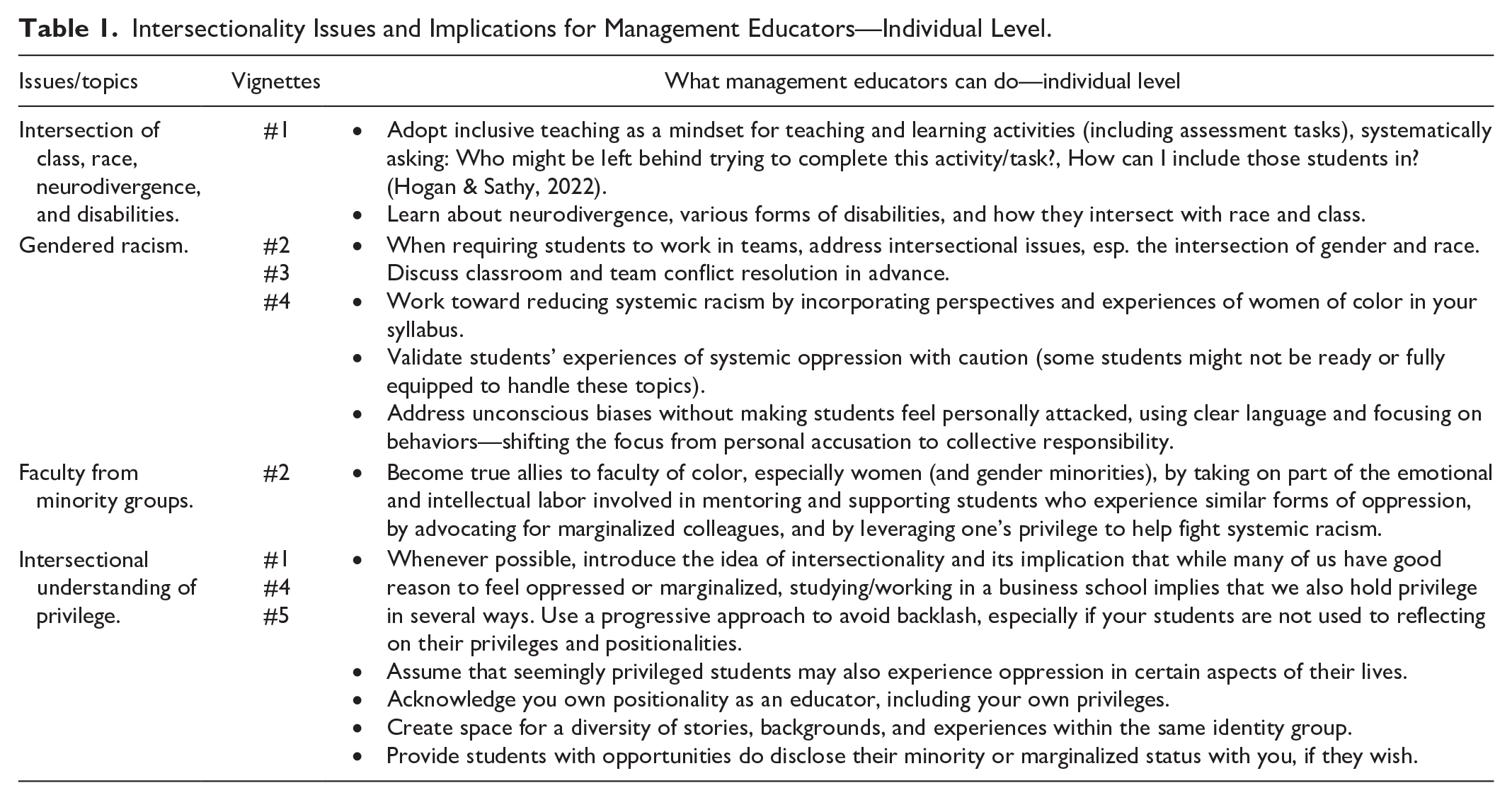
The five vignettes presented above illustrate the complexity and context-dependency of intersectionality issues, as well as emphasize the illusory nature of any attempt to formulate general recommendations that would be applicable in most situations encountered by management educators. The two tables below summarize the recommendations presented above for each of the five situations described in the vignettes, at the individual level on the one hand, and at the institutional level on the other. My aim is to encourage each educator to reflect on appropriate practices within their own context based on key issues related to intersectionality (gendered racism, privilege awareness, intersection of social class, race, neurodivergence, and disabilities), rather than to propose a set of ready-made recommendations (Tables 1 and 2).
Intersectionality Issues and Implications for Management Educators—Individual Level.
Intersectionality Issues and Implications for Business and Management Schools—Institutional level.
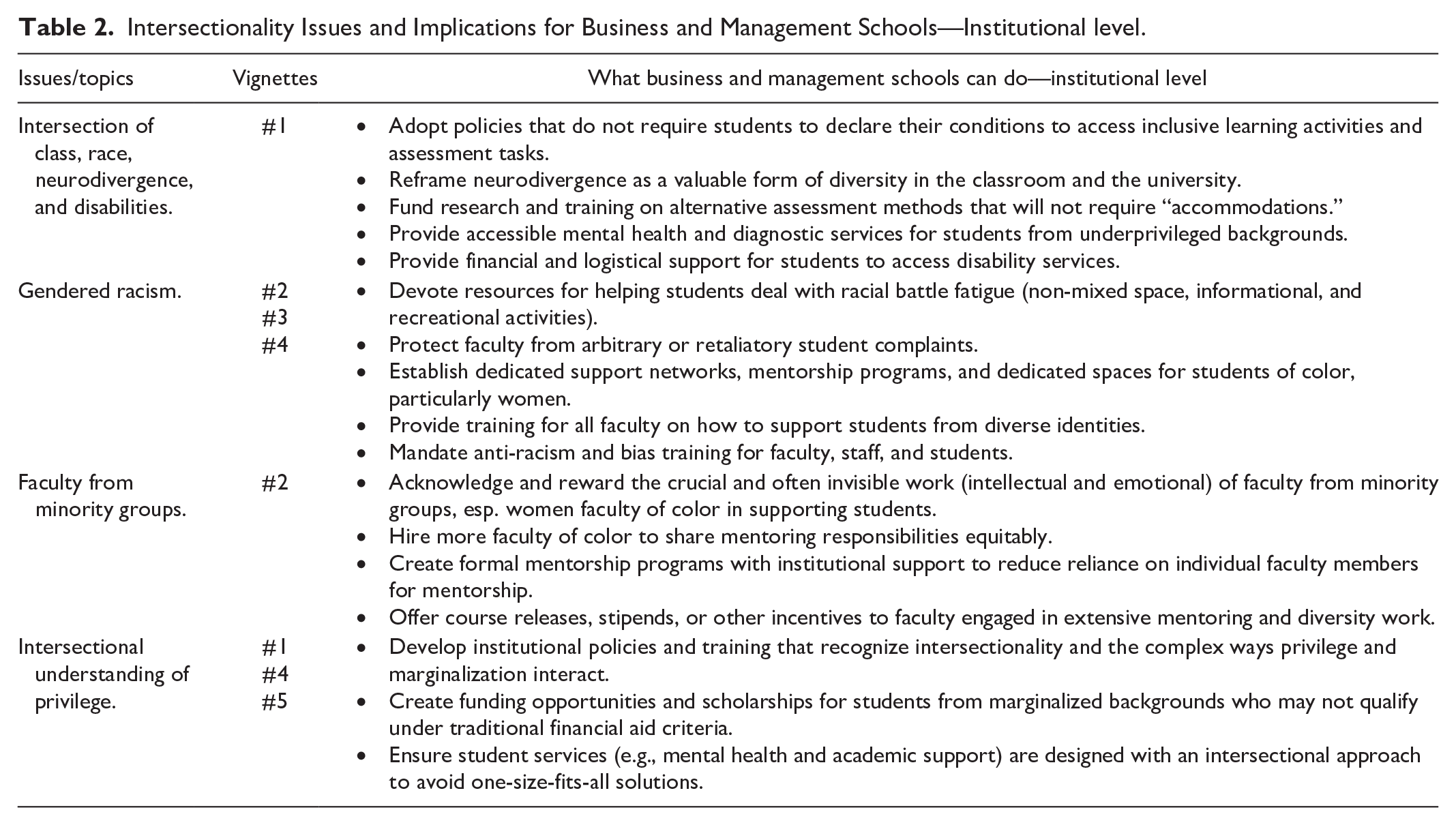
At the individual level, concrete actions begin with self-education on intersectionality—particularly how forms of neurodivergence and disability intersect with race and class. This also involves applying an intersectional lens when managing group work and team dynamics, and adopting a progressive, responsive approach when addressing students’ understandings (and misunderstandings) of privilege and unconscious bias. At the institutional level, business schools can do much to embed intersectionality into their culture and policies. This includes designing student services with an intersectional approach, offering accessible diagnostic resources for underprivileged students, and providing comprehensive training for faculty on the complex ways privilege and marginalization interact.
These recommendations, especially those at the institutional level, depend heavily on each institution’s stance and its openness (or resistance) to the concept of intersectionality itself. Intersectionality and privilege are contested concepts that can provoke significant resistance—from administrators, local authorities, and even state legislatures— especially when viewed as misaligned with the market-driven agenda of business schools (Harley & Fleming, 2021; Parker, 2021; Yarrow & Davies, 2024). In this regard, an inspiring parallel can be made with strategies of resistance in the social movements literature (Della Porta & Steinhilper, 2021; Tarrow, 2005). In very politically conservative spaces, where institutional and community pushbacks can be severe, strategies must account for heightened professional and personal peril. “Low-profile advocacy” implies subtle, indirect, and “behind-the-scenes” efforts to promote change, as opposed to high-profile, public, and confrontational activism (Earl et al., 2022; Tessema, 2015). In the context of intersectional issues in management education, low-profile advocacy can be a way for educators to manage the tension between resistance and survival, balancing more subtle forms of resistance with strategies to protect career trajectories, mental and physical health. For example, in Vignette 3, Indira could present the discussion as a team management issue, framing discussions to align with institutional priorities (e.g., “collaboration” and “civic engagement” rather than “systemic racism” and “activism”). By doing “low-profile advocacy,” Indira could preserve her ability to act and implement underground strategies such as mentoring marginalized students, fostering quiet initiatives between students and allies, reshaping her curriculum, using her voice to advance progressive topics in class without naming them.
Although institutional actions are essential and irreplaceable, and while some responsibilities are rightly delegated to specialists, a key argument of this essay— and one that that emerges clearly from the five vignettes—is that each educator also has a crucial role to play in addressing intersectional issues. Educators possess a distinctive, albeit imperfect, understanding of classroom dynamics. Unlike external experts, their situated position allows them to observe real-time interactions and grasp the nuanced power structures at play. This unique perspective enables them to respond promptly and effectively to situations that demand quick pedagogical intervention. Vignettes 2, 3, 4, and 5 exemplify these instances when educators must step in, using an intersectional lens to illuminate and challenge unfolding dynamics, while Vignette 1 illustrates how the educator’s intersectional lens can unveil inequities of institutional policies aimed at equity and inclusion. This is a “teacher’s territory” that must be embraced in all its complexity and risk (Biesta, 2014).
Management educators have a duty not only to recognize their privileges and use them to confront systemic oppression (Lund Dean & Forray, 2021; Rabelo et al., 2023) but also to avoid propagating knowledge, theories, or ideas rooted in harmful and unquestioned assumptions that lack sensitivity to intersectionality (Fotaki & Prasad, 2015). Explicitly addressing intersectional issues and fostering students’ awareness of these issues and critical reflection of privilege is especially critical in management education, as organizations are key sites for maintaining social inequities (Cobb & Stevens, 2017),
Conclusion
An intersectional perspective implies addressing privileges and discrimination based on race, gender, religion, social class, disability, or sexual orientation in an integrated, “intersected” manner, and recognizing the simultaneous presence of both privilege and oppression in many individuals. There are no universal “intersectional recommendations” due to the complexity of intertwined identities and systems of domination. Each classroom situation is unique, which makes an intersectional lens not just helpful, but essential. The process of reflecting on intersectionality is more valuable than focusing on specific, one-size-fits-all solutions. Without this reflection, efforts toward educational equity risk being oversimplified, potentially leading to misguided approaches (Grant & Sleeter, 1986). While translating intersectionality into teaching practice is challenging (Jones & Wijeyesinghe, 2011), it is crucial for understanding classroom dynamics. The five real-world classroom examples discussed in this essay highlight the necessity of an intersectional perspective in grasping what is sometimes occurring beneath the surface in the classroom. To address these complexities, we must continue to explore classroom power dynamics through the lenses of critical feminist, race, disability, and critical management education. There is also a pressing need for further research on social class, neurodiversity, and disability in management education, particularly from an intersectional standpoint. Although not explicitly explored in this paper, sexual orientation, gender identities, and other axes of “othering”—such as caste, tribe, language fluency, immigration status, age, and religion—remain vital to the broader conversation. Ultimately, the key insight is that faculty must deepen their awareness of positionality and context, use inquiry as a thoughtful pedagogical tool, and create learning environments where engaging with difference feels both possible and safe.
Footnotes
Acknowledgements
I received the support and advice of Professor Anne Mesny, Department of Management, Director of Arpège—Research Hub on Management Education, HEC Montréal. I received a support grant from Arpège (1,000 Canadian dollars).
Declaration of Conflicting Interests
The author declared no potential conflicts of interest with respect to the research, authorship, and/or publication of this article.
Funding
The author received no financial support for the research, authorship, and/or publication of this article.
