




Abstract
The case method remains the signature pedagogy in management education. Teaching case research is a form of qualitative research which has recently gained enhanced recognition by accreditation bodies as scholarly or intellectual contributions. As proponents of the case method, however, we are concerned that in the peer-review process case researchers struggle to publish cases that honor the desired learning outcomes and fully adhere to the standards of research trustworthiness. We believe this happens because several common case writing conventions of mainstream case publishing are impeding the publication of pedagogically valuable cases. The purpose of this essay is to describe and raise awareness about the conflict between accurately representing case data and these established conventions. Accordingly, we describe how the mainstream case publishing process works, including the case conventions researchers must follow, and explain how the strict adherence to these conventions can conflict with the trustworthiness of case data, as well as with pedagogical objectives. We conclude by suggesting that the case publishing community should allow more flexibility in how cases are written in recognition of their scholarly purpose, and we provide concrete suggestions for how to accomplish this cultural shift. Our aim is to keep case research real.
Keywords
As the Journal of Management Education (JME) turns half a century old, the practice of teaching case research and case method instruction has exceeded a full century (Donham, 1922). In the decades since its Harvard launch, the case method has become pervasive across courses, programs, and institutions in management education, and is therefore widely considered its signature pedagogy (Byrne, 2012; Schmidt-Wilk, 2010; Shulman, 2005). In 2023, combined sales at the big three case distributors, Harvard Business Publishing, Ivey Publishing, and the Case Centre, exceeded 20 million cases to over 7,000 organizations around the globe (personal communications with Ivey Publishing, Harvard Business Publishing, and the Case Centre), confirming the on-going widespread use of cases in management education. Based on factual data from real-life scenarios, teaching case research is a unique form of qualitative research that has long struggled to be recognized as such. Recently, peer-reviewed case research has gained broader recognition as legitimate research contributions by accreditation bodies like AACSB and EQUIS (Mills, 2024a, 2024b).
Major birthdays are a time to reflect and take stock; in this essay, we focus specifically on the writing conventions that constitute the publication criteria for peer-reviewed decision-based teaching cases. We contend that these conventions function as decision-making heuristics during the review process but have come to unnecessarily constrain teaching case research. More importantly, however, we believe these conventions have become fixed requirements that can supersede the standards of research trustworthiness and credibility (Merriam & Tisdell, 2016) and outweigh the learning outcomes for which cases are designed, jeopardizing the integrity of case research and the pedagogical value of the case method. We seek to build understanding and raise awareness among management educators of case writing conventions and their impact, and we propose some initial steps that the case publishing community can take to loosen up conventions that are no longer helpful. In an age of misinformation, our aim is to restore the research focus in teaching cases and to keep case research real.
The case method includes case research, publishing, and teaching. Like other forms of scholarly research, pedagogical case research involves the collection and analysis of data and writing a final manuscript; conducting data collection and analysis without writing is an incomplete research project. As such, we use the term case research to encapsulate data collection, data analysis, and case writing. Wood (2019) defines a case as a description of an actual situation [emphasis added], commonly involving a decision, a challenge, an opportunity, a problem, or an issue faced by a person (or persons) in an organization, the analysis of which requires the reader to step figuratively into the position of a particular decision maker. (p. 3)
Other types of cases exist, but our focus here is the dominant decision-based case. Importantly, we exclude fictional cases from this discussion as they are not published by most peer-reviewed outlets, and because they are clearly not research based.
Broadly, the case industry involves many different players, including case researchers, reviewers, editors, publishers, and end users including instructors and learners. There is usually little overlap between the people involved in the production of cases and their end users, so most case users know little about how cases are developed. Similarly, most people involved in the case production process—researchers, reviewers, editors, and publishers—receive little direct feedback from case users. In short, those who produce cases and those who use them are largely separate (although case publishers do attempt to understand what case users want, albeit to a limited degree). Hence, we believe it is fair to say that for users—the vast majority of those involved in the case method—the case production process is a black box in which internal processes are largely hidden.
This is where we come in. We are both active, award-winning case researchers, reviewers, and editors who have been publishing cases for over a decade in peer-reviewed case journals and other outlets. We are also case instructors and former case method students. As such, we are among the relatively few people who participate in every facet of the case industry, except sales and distribution which is controlled by private organizations. Consequently, we understand the case method deeply. We believe that more participants in the case method—researchers, publishers, and users alike—need to better understand the inner workings of the current mainstream case publishing process and its ensuing implications.
While in the last 50 years JME has frequently discussed the topic of case teaching, case production (i.e., research, reviewing, editing, and publishing) has received much less attention despite having a tremendous impact on case pedagogy. We conducted an analysis of articles published in the past 50 years of JME and found 64 articles with the term “case” or “case method” in the title. Of those articles, only four discussed case writing, two of which described case writing assignments for students; the remaining 60 articles focused on case teaching (see Table 1). Given the importance of the case method to management education, the field is overdue for the case research and publishing process to be explained. Our insider perspective allows us to do just that.
Content Analysis of Articles with “Case” or “Case Method” in the Title, Journal of Management Education, 1975 to 2024.
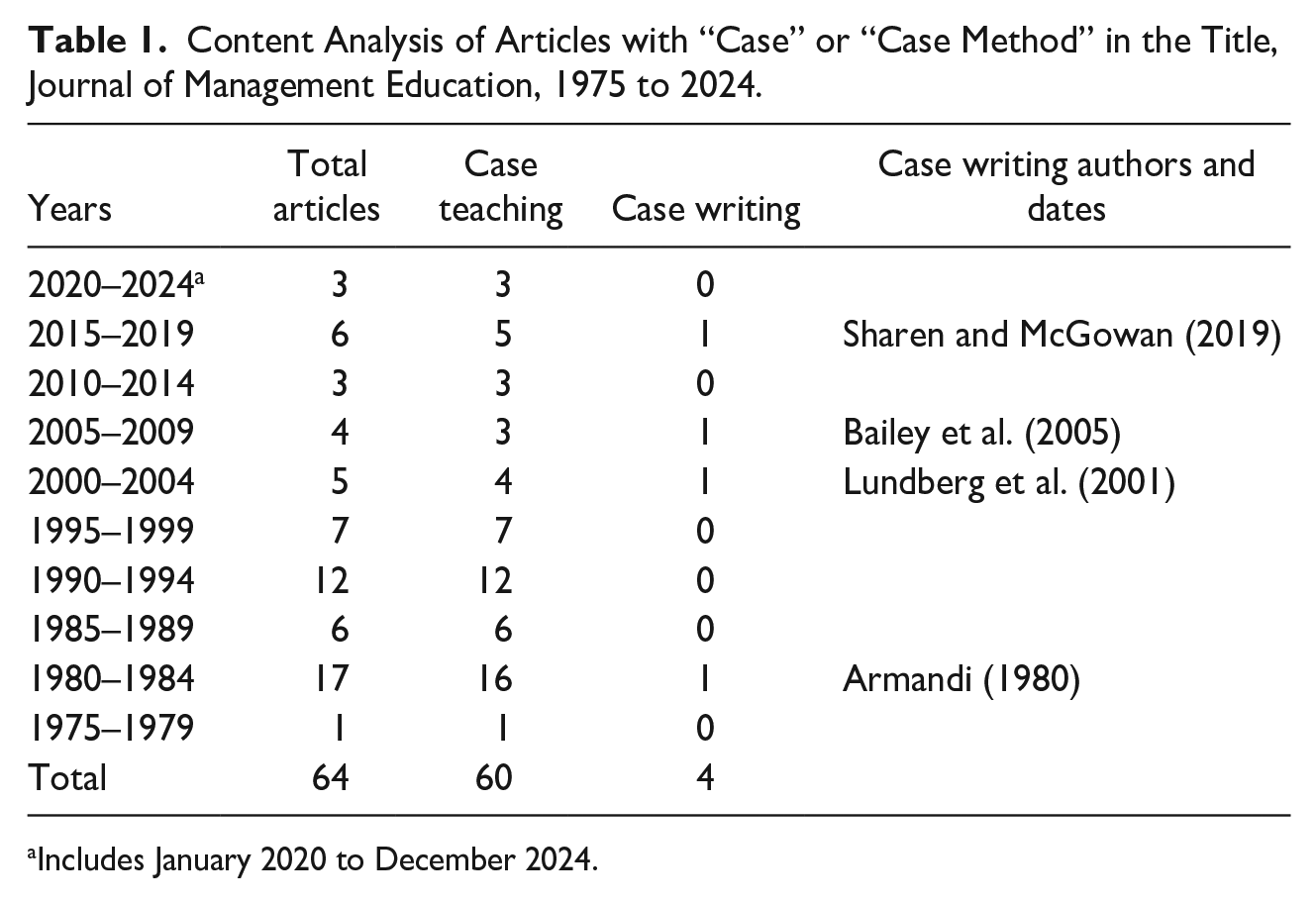
Includes January 2020 to December 2024.
Our purpose in this essay is fourfold. First, we explain why teaching cases should be considered research. Second, we unpack the black box of mainstream case research, publishing, and distribution to reveal how the process works. Third, we discuss the implications of this process, including the rules of case writing, known as case writing conventions, and explain why they need reconsideration. Lastly, we suggest how case publishers can relax case writing conventions. By the end, we trust that we will have increased awareness about this largely unrecognized issue, and that many more players in the case method community will understand why the conventions that currently govern mainstream case research must become more flexible to keep case research real.
Cases as Qualitative Research
Case studies have been a commonly accepted research method in social science research for decades (Yin, 2018). Case study methodology “explores a bounded system . . . over time through detailed, in-depth data collection involving multiple sources of information (e.g., observations, interviews, audiovisual material, and documents and reports) and reports a description and-case based themes” (Creswell, 2013, p. 97). Typically, case study data analysis is inductive, findings are “richly descriptive” (Merriam & Tisdell, 2016, p. 42), and cases can be used to describe a phenomenon or to develop propositions (Schwandt & Gates, 2018).
Teaching cases are a unique form of case study research with a pedagogical purpose. Most published cases consist of two separate documents written by the same researchers: a case for students and instructors, and a teaching note (TN) or instructor’s manual (IM) for instructor access only. Decision-based cases present case data that reflects actual events encountered by real people whose perspectives are adopted by the case researchers. While individuals and/or organizations can be disguised to prevent identification (disguises are disclosed in the TN/IM), the case data is expected to be an accurate portrayal of true events. Some publishers require researchers to clearly outline the research methods they used to collect the case data in the TN/IM, so instructors can evaluate the quality of their sources.
Like other forms of qualitative research, teaching case research has struggled to be perceived as legitimate. Although many accreditation agencies now recognize case research as valuable research contributions (Mills, 2024a, 2024b), teaching case research still struggles to be acknowledged as research at many business schools. We believe that this struggle is in part because teaching cases are perceived by some faculty members to be insufficiently scholarly or scientific and therefore do not support the perception of management studies as a scholarly discipline (Shugan, 2006).
Like traditional qualitative research, a teaching case outlines a specific, bounded situation in rich detail from multiple sources. The TN/IM integrates the case data with the relevant subject literature to establish patterns, apply theories, form general conclusions, and discuss decisions or recommendations. Like other qualitative researchers, teaching case researchers collect data from multiple sources such as interviews, observations or site visits, and secondary data (Merriam & Tisdell, 2016). They must establish the credibility of their work by establishing trustworthiness that is, credibility, confirmability (Creswell & Miller, 2000). Also, like other qualitative researchers, teaching case researchers use techniques such as triangulation of data by combining sources, member checking by requiring sign-off by the protagonist or firm on the case prior to publication, and audit trails by showing readers and reviewers data sources (Creswell & Miller, 2000).
Types of Case Data
Researchers who want to publish a teaching case have many decisions to make, beginning with the source of data. Case data come from either primary (or field) or secondary sources, or a combination thereof, all which are accepted by most major case publishers. Researchers of primary cases collect data from the focal organization and protagonist, and therefore must obtain permission from the focal organization to publish the case, meaning that such cases may take a less critical view of the organization and its leaders. Researchers of cases entirely based on secondary data must provide published sources for all case data but do not collect data directly from the focal organization or the case protagonist. Hence, they do not have to obtain permission to publish the case, meaning that such cases may portray organizations in a less positive light and tend to cover controversies or ethics, provided sufficient secondary sources can be found.
Primary and secondary source cases each make unique and vital contributions to case literature. Notably, both primary and secondary source cases are required to meet the common case writing conventions as they are reviewed using the same reviewers, editors, and evaluation/convention checklists; the only requirement secondary cases avoid is the consent form.
The Case Research Process
The case research process begins with the researcher identifying a focal organization and topic. If using primary data, the researcher obtains agreement from the individuals and firm featured in the case (Mesny, 2012). They then determine what information will be disclosed, and what if anything will be disguised in the case (Mesny, 2012). Researchers work through an iterative process collecting data, determining the type of case, the time frame, possible decision points, and viable alternatives (New Case Planning Worksheet, n.d.) until they feel they have accurately portrayed the situation (Guidelines for Authors, n.d.).
Case data is usually presented in a standard order: opening, organizational background, introduction of protagonist, the issue and decision, alternatives, and conclusion (Author Resources, n.d.; For Authors, n.d.). Like any narrative, however, how the case researchers choose to frame their cases—including selection of the issues, timing, action triggers, and decision makers—influences how instructors and students will understand and analyze it (Greenhalgh, 2007; Wood, 2019). The researchers then write the accompanying TN/IM which includes information that enable instructors to select an appropriate case and teach it effectively.
The Teaching Note and Case Learning Outcomes
The TN/IM is the pedagogical plan that shows how the case can be used to support learning. TN/IMs provide guidance to instructors, enabling them attain learning outcomes, enhance student engagement, and foster personal reflection (Mu & Hatch, 2024). The content of TN/IMs varies by publisher, but most include a synopsis of the case, intended courses, the learning outcomes the case is intended to achieve, the audience for the case (e.g., undergraduate, graduate, or executive education students), a teaching plan, suggested readings and materials, and suggested discussion questions with accompanying answers.
Most publishers require that the TN/IM indicate the expected student learning, expressed in the form of learning outcomes that describe what the student will know, do, feel, or value if they successfully attain the learning outcome (LO; Otter, 1992). Students should be able to demonstrate the attainment of learning outcomes, while instructors should be able to observe and measure student attainment of such outcomes (Melton, 1996; Spady, 1988). Learning outcomes should align with the explicit curriculum of the course in which the case is taught and with the course assessment strategy (Biggs, 1996). Case learning outcomes, along with the case issue, intended course, and intended audience, enable the instructor to select cases appropriate for the course. TN/IMs are also used by editors and reviewers to evaluate a case and TN/IM for publication.
In short, teaching cases are a form of qualitative research intended to achieve specific learning outcomes. All case data must be real and verified by either organizational consent for publication, or by credible secondary sources. The cardinal rule of case research is that data cannot be fabricated. As we later explain, however, researchers frequently find themselves under pressure to make their data conform to common case writing conventions. We believe part of the explanation for this pressure lies in understanding how the case publishing process works.
The Case Publishing Industry
The mainstream case publishing industry consists of business school presses, publishing companies, and case journals. While the written case remains dominant, cases can be produced in a range of formats, including graphic, video, multimedia, and audio cases. Although cases can be accessed directly from the publisher, most cases are accessed via a few distributors (e.g., Harvard, Ivey, and the Case Centre) that publish cases and function as consolidators, distributing cases on behalf of other publishers. Case distributors sell their case collections using customized ecommerce platforms creating easy access so instructors and students can meet their case needs in one place. This also benefits case researchers and publishers because it makes their cases easy to adopt. If researchers want their case widely distributed, they must publish in an outlet that distributes cases through one of the major case distributors.
Many cases published in niche outlets are not distributed by the large consolidators, including case books, case journals without external distribution, case collections with paid membership access models (e.g., Sage), textbooks with cases, specialty collections (e.g., three Dark Side case volumes), and open access cases (e.g., Open Access Teaching Case Journal). Except for the new open access options, however, the use of cases without widespread distribution is limited because access is more difficult.
Publication: Submission and Review
When the case and TN/IM are ready, the researchers submit them to a publisher for review. Some publishers require cases to be test taught prior to being submitted to evaluate whether the learning outcomes have been achieved. Many publishers have a double-anonymized peer review process; other publishers employ a variety of review processes such as editorial review, or single-anonymized review. Reviewers use the publishers’ case review criteria, including common conventions, to determine whether the case should be published. These criteria are documented in case review forms which reviewers must complete. Case review forms codify the publishers’ required criteria and serve as decision-making heuristics for reviewers and editors. Although unquestionably helpful to reviewers in that they serve as heuristics, these review forms are usually inflexible (i.e., users cannot change the form and must provide an answer even when the criterion does not apply), and rarely change. In our opinion, case review forms are the dominant structural reason that common case writing conventions persist as review heuristics. While some of these criteria vary, there are common case writing conventions that are shared by many if not most mainstream publishers.
Common Case Writing Conventions
Each case publisher has an established set of writing conventions with some overlap and variation between outlets. Case writing conventions are taught to new case researchers and reviewers as the correct way to prepare a case for publication. We identified the common case writing conventions by analyzing the websites and case reviewer forms of the three major case distributors (Harvard, Ivey, the Case Centre) and two leading journals (the Case Research Journal and the CASE Journal); our findings are shown in Appendix A.
Conventions can relate to the form of the case or to its content. For example, form conventions include writing in the past tense and structuring a case narrative to follow an expected pattern. Most form conventions have remained stable over time, although case length is trending shorter. Except for length, which can arguably limit the complexity of a case narrative, most form conventions do not constrain researchers’ ability to accurately describe the business decision to be made. Content conventions relate directly to the nature of the case narrative, such as whether there is a decision focus, a clear protagonist, or a timeline (see Appendix A). Like form conventions, most of these requirements allow researchers to remain faithful to their data and to the learning outcomes of the case.
We argue, however, that some common case conventions are detracting from the trustworthiness and pedagogical value of mainstream cases. To that end, we explore the four case writing conventions, which in our experience are most problematic, in the order that they are encountered in a case narrative. First, we describe the specific writing conventions, and then we explain why we believe requiring all cases to conform to them is a threat to the trustworthiness of case data.
Single Protagonist and Decision-maker
By convention, an identified protagonist, who is responsible for making the focal decision in the case, is introduced early in the narrative (see Appendix A). The case data helps us understand who the protagonist is and their role in the firm. Although some books about teaching case research suggest that multiple decision makers are possible, case review forms do not explicitly include multiple protagonists. Hence, many reviewers interpret the criteria as requiring the protagonist in every case to be a single individual. In other words, this case convention precludes cases which involve group decision-making, such as decisions by teams, by committees, by individuals in joint or co-roles, or by boards. As Mintzberg (2005) argues, case protagonists are portrayed as “heroes [where] decisions are made only by individuals acting as individuals” (p. 59).
However, important decisions in real organizations are frequently made by multiple decision-makers. Our case catalogs, therefore, may not accurately reflect—and arguably misrepresent—how many important organizational decisions such as policy or systems changes are made. Yet, the pressure to conform to the single protagonist case convention is strong. When one of us wrote a case where the entire board was the decision maker, reviewers asked for the “protagonist” to be framed as only the board chair despite the board policy that the board made decisions jointly. Such requests to misrepresent organizational reality can result in the author being unable to secure the release to publish the case. Moreover, important secondary source cases can be precluded when the author cannot identify a single decision-maker.
We contend that exclusively representing organizational decision-making as the purview of single individuals does a disservice to learners. Students need to be exposed to the breadth of organizational decision-making methods, so they understand how organizations work. We are inadvertently teaching them that only individuals make decisions in organizations, even on critical issues that have broad impacts such as policy or systems changes.
Decision Urgency
Next in the case narrative, the focal decision is described, including whether the decision is urgent. Typically, this urgency is reflected in a deadline by which a decision must be made, often a set meeting or delivery date. This case characteristic is often referred to as the “action trigger” (Wood, 2019, p. 61). The need for urgency in a case is reflected in case review criteria such as “clear timeline for the decision to be made” and “creates urgency, complexity, or conflict that will generate student interest” (see Appendix A). We believe that the intention behind the urgency criterion is to motivate the classroom discussion. In our experience, during the review process, case researchers are frequently asked by reviewers to increase the urgency in a case to make it publishable.
Adding urgency to a case undermines the trustworthiness of case data. Mainstream cases are not fictionalized, yet researchers are pressured to present the facts in a manner that may not be consistent with reality because some decisions are not urgent. In our experience, urgency sends the message to management students that all decisions must be made quickly—that it is never a valid approach to wait and decide later. We are teaching students to react and succumb to the action bias rather than learn to judge when the appropriate time is to decide (Saggurthi & Thakur, 2016). We are training students to focus on the urgent over the important—to treat management like it is about fighting fires rather than mindful attention to the issues that matter most. The focus on deadlines and timeliness results in short-term thinking for which Western management practice is often criticized. Cases then become an exercise in urgent decision making rather than important decision making. For these reasons, we argue that the urgency convention is not serving the best interests of management students.
The urgency convention may also preclude important but non-urgent topics from being addressed in cases. Case researchers who wish to tackle important but not urgent decisions struggle to convince reviewers and editors that the issues should not be window-dressed as urgent to meet case conventions. Important but not urgent decisions in organizations are valid case topics as much as urgent decisions. For instance, issues relating to addressing fairness and inequity in organizations are hugely important, but barring a legal compliance deadline, they are rarely urgent.
Direct Evidence and Data
Next, researchers present evidence and data that allow learners to analyze the situation and decide on a recommended course of action. Reviewers evaluate the case in part on whether “the case has sufficient data to analyse the issue or challenge and permit the development of thorough recommendations” (see Appendix A). In general, researchers present direct evidence about the focal case issue based on the data collected. Hence, cases are highly objectivist, assuming “an objective truth waiting to be observed and recorded” (Swiercz & Ross, 2003, p. 416). In other words, all assertions in the case must have supporting data.
By convention, acceptable case data is direct and demonstrable. Cases, however, can deal with complex and sensitive issues that may not have direct evidence but only the opinions or experiences of the case characters. The reality is that not all elements of a case will have direct evidence or supporting data. Sometimes there are assumptions or values that must be stated but cannot be proven, easily quantified, or demonstrated. Other times, the evidence for a relevant point is weak or non-existent but the information is nevertheless vital to communicate.
For example, one of us wrote a case about a confidential firing decision and unconscious racial bias which included learning outcomes related to affective and metacognitive knowledge. A case reviewer asked for evidence on how the decision was made. The protagonists were not on the deciding board of directors and did not have access to this information; however, they were actively advocating for the individual who was fired. In this circumstance, the people from whose perspective the case was written did not have access to the evidence, which is often the situation when cases are written from the perspective of employees, stakeholders, or middle managers. Nevertheless, people need to decide and act in the absence of direct evidence. Furthermore, since the case learning outcomes were about decision making, assumptions, and unconscious bias, it was realistic to present only the data available to the protagonists. The need for evidence/data precludes many cases designed to teach affective or metacognitive knowledge and skills.
As reviewers, we relate to wanting to know the full picture, but as case researchers and instructors we believe students need to learn how to act in the absence of information. Our cases need to reflect the real circumstances in which people must make decisions, which means we cannot expect cases to include direct evidence and data if the data was not available to the protagonist(s).
Objective and Balanced Perspectives
Lastly, many publishers require that case data be “presented objectively without bias or editorializing” (see Appendix A). This convention is in keeping with case research being more often viewed as a science rather than an art (Greenhalgh, 2007; Starkey & Tempest, 2008). Modern cases tend to be objective, rational, analytical, fact-based, and solution focused (Liang & Wang, 2004; Swiercz & Ross, 2003). Previous research has shown that cases tend to focus on cognitive knowledge (Liang & Wang, 2004; Swiercz & Ross, 2003) and on application of analytical tools, which are considered “inherently objective and values-free” (Ehrensal, 2016, p. 110).This objectivity is achieved by being silent on common aspects of affective knowledge such as values, beliefs, and ethics (Anteby, 2013, 2016; Bridgman, 2010; Bridgman et al., 2016, 2018).
On the surface, the convention requiring unbiased, objective case data should improve the quality of decision making. Yet, one underlying assumption of this convention is that lived experience is not a valid form of knowledge, “encouraged by an academic culture that distrusts personal truth. Though the academy claims to value multiple modes of knowing, it honors only one—an ‘objective’ way of knowing” (Palmer, 2017, p. 18). Hence, cases have lost the element of art—the affective, subjective reflection on our values, ethics, and beliefs.
In our experience, many topics we seek to discuss in cases are inherently subjective, values-laden, and not subject to a balanced viewpoint. For example, one of us co-authored a case about a protagonist’s disability challenges in the workplace, which had an affective learning outcome to develop empathy for individuals with disabilities. The case featured only the perspective of the protagonist. The reviewers requested a more balanced representation of the situation, including the perspectives of the employer, the board, and colleagues. However, including such perspectives would invalidate or devalue the protagonist’s experiences and dilute the purpose of the stated learning outcome. This convention is a challenge especially with primary cases because if reviewers have required the protagonist’s experience to be debunked, obtaining a release can be awkward, if not impossible, for a researcher.
As we explore next, these four case writing conventions may result in a no-win choice for case researchers: present the data accurately and not be published; or massage the data to meet the conventions and be published.
The Challenges of Case Writing With Fixed Conventions
Researchers who wish to get their case published must ensure their case data conform to the conventions, leading to pressure on them to inaccurately present their data. Alternatively, they can present their data authentically and try to argue that the heuristic should not apply, but in our experience as researchers, reviewers, and editors, such arguments are rarely successful. The conventions have effectively become requirements. Hence, case researchers are often torn between data authenticity and common case writing conventions. Further, cases that get published—and are therefore available to instructors to use—mostly follow those conventions even if the data are not completely accurate. Sometimes it means that researchers cannot get sign-off to publish otherwise good cases even if they would result in valuable learning outcomes to students around the world.
None of these outcomes is in the best interest of learners who are getting an inaccurate view of the so-called real world, nor of case researchers who believe in the importance of research trustworthiness. The bottom line is that real-world case data does not always conform to all case conventions. If the integrity of case research is to be upheld, case conventions need to be flexible enough to allow the authenticity of the data to have precedence over heuristics used for the sake of convenience and decision-making ease. In our experience, there is a wide range of reviewer interpretation of the criteria, but at the end of the day it is case reviewers, editors, and publishers who collectively enforce case writing conventions.
The Future of Teaching Case Research
If teaching case research is to meet qualitative research standards for trustworthiness and be treated as legitimate scholarly contributions, both publishers’ peer review processes and institutional cultures must change.
Our Vision for Case Review
We propose that we think about case writing conventions as a framework, “a provisional design or an outline” (Oxford English Dictionary, 2024) that adapts to the nature of the data, the context, and purpose of each case. We argue that strict adherence to these four common case conventions is limiting rather than enhancing our case literature. While reviewer checklists of conventions make judging a case’s fitness for publication straightforward, the oversimplification of the review process means valuable cases for student learning are rejected. Instead, we would like to see cases evaluated not simply as a convention checklist, but as a pedagogical tool which accurately reflect the case data and delivers on the learning outcomes in the TN/IM. The conventions used to evaluate a case should be appropriate for the case data and its learning outcomes. We need to move away from evaluating cases according to an inflexible list of heuristics with which to comply.
This means that editors and reviewers must evaluate cases relative to the stated learning outcomes in the teaching note, a vital component of the purpose of any case but one that is often overlooked in the case review process. Next, we need to ensure the trustworthiness of case data. Publishers should require a research methods section in the TN/IM to allow readers to assess the trustworthiness of the case data, if they do not already do so. Finally, we need to permit greater flexibility with the conventions cases must follow, based on whether the conventions serve the learning outcomes of the case.
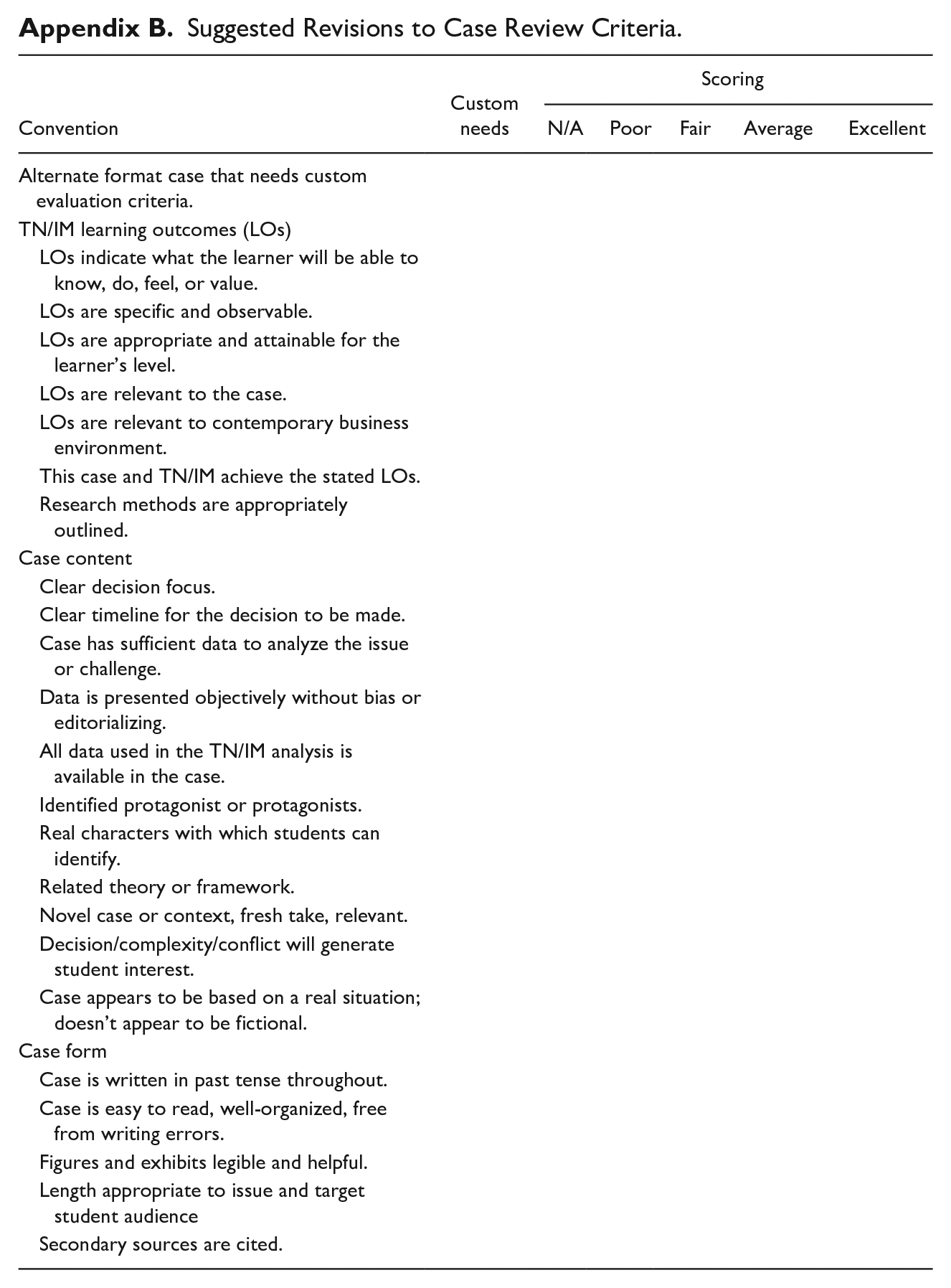
To evaluate cases relative to the researchers’ stated learning outcomes, we propose several new evaluation items. These items would evaluate the relevance, format, and attainment of the author’s stated learning outcomes consistent with the literature on learning outcomes (Melton, 1996; Otter, 1992; Spady, 1988). See Appendix B for a proposed revised reviewer form designed for increased flexibility for reviewer judgement as to the applicability of a criterion to the specific case being evaluated. Next, the evaluation of a case needs to align with the principle that cases are based on events that have occurred in real life. Researchers are responsible for representing the case data authentically to maintain the verisimilitude of the events. Researchers should never be asked by reviewers or editors to massage the case facts to better meet the case writing norms. We must insist that reality always takes precedence; the dog must wag its tail, not the other way around.
Finally, we have explained why some current case conventions are problematic; however, we are not proposing that these conventions are never applicable. Each one of the conventions we have examined are appropriate in some situations. Journals and publishers should allow reviewers and editors to indicate that which conventions do not apply to the case and its learning outcomes by adding a “not applicable” option and with an explanatory text box. Currently, most review forms do not accommodate “not applicable,” so reviewers choose a neutral evaluation like neither agree nor disagree to reflect that judgment.
Implications for Our Vision of Case Review
Changing how we research, write, and review cases will require a culture change for the case publishing community because many case writing conventions are well established. For most of a century, the case conventions have been seen as the sine qua non of case writing; they have been taught to new case researchers and reviewers as the correct way to write cases. It will take time for a learning outcomes-based evaluation of cases with flexible conventions to be adopted.
We want to build a community of like-minded management educators who are similarly devoted to case writing but wanting to see it revised for the 21st century. In time, we hope support to build for more flexible and more accurate case writing, but we know that some in the case writing community will reject such changes and prefer the current model, as is their choice.
Early adopters may find that new publishing outlets or new case series specifically devoted to updating how we research, write, and evaluate cases are needed to ensure such cases are published. Perhaps a case publisher or journal is interested in exploring cases through an updated lens and in supporting the work of the early adopter community. Such a publisher could help establish the new criteria we are advocating for and test how the new approach works. Having a new model that has been shown to work could help other publishing outlets update their own case review criteria. For established case outlets, changing the case review process will require updates to their case review systems including revision of existing items and addition of new criteria. Outlets will also need to update their website information for researchers and reviewers about the expectations for submissions.
Like all change management processes, updating how we research, write, review, edit, and publish cases will require training and commitment to change. Ideally, schools that train their graduate students in the art of case writing can expose the new generation to a broader view of case writing. For established case researchers, we can expose people to an updated approach to the art of case writing at management education conferences such as the North American Case Research Association (NACRA), the Teaching and Learning Conference at the Academy of Management, and regional conferences like the Administrative Sciences Association of Canada (ASAC).
Finally, although accreditation bodies have endorsed teaching case research as a legitimate form of scholarship, many business schools have not yet followed suit. To achieve lasting change, business schools must recognize teaching case research as a scholarly contribution for the purpose of tenure, promotion, and performance evaluation. If teaching case research is to be legitimized, the broader business and management education community must incorporate teaching case research journals into the quality lists, scholarly databases, and journal rankings used to evaluate scholarly contribution (Currie & Pandher, 2013; Young et al., 2024). It may also necessitate schools and publishers clarifying whether case research is subject to institutional research ethics reviews, either full or expedited processes. Currently, most publishers do not require case researchers to obtain institutional ethics approval prior to publication. For a full discussion of case research and ethics approvals, see Schnarr and Woodwark (2023). For the management education community to fully endorse teaching case research, it may also be necessary to enhance the research methods sections of TN/IMs, to demonstrate the methods used to ensure the trustworthiness of the case data. Furthermore, the community will need to rethink the concept of scholarly impact because citations are not a useful measure of impact for teaching cases. Currently, the impact of case research is difficult to assess because the data are only available by asking individual publishers to volunteer it. We hope accreditation bodies will continue to guide the field to more appropriate measures such as case adoptions or sales and develop processes for how such data are collected. Ideally, case publishers will provide transparent reports of case sales data in a form that allows for comparison across outlets so that accreditors, schools, and researchers understand what is going on in case publishing and usage around the world.
Keeping Case Research Real
Our review of the past 50 years of JME revealed many articles about case teaching but few about case research, writing, or publishing. The purpose of this essay is to motivate more discussions in management education about how we research, write, review, and publish cases. We have argued that some of these case research conventions have resulted in divergence from the original purpose of a teaching case, which was to present “a real problem or dilemma faced by one or more practicing managers” (Mu & Hatch, 2024, p. 2). Consequently, like Swiercz and Ross (2003), we found ourselves asking “How real are the real-world case studies?” (p. 427).
We propose that we adopt a provisional, flexible set of case writing conventions that support accurate representation of case data and effective delivery of learning outcomes. Our success will come when case researchers are no longer asked to massage case facts, when the accuracy of data is paramount, and when case research is respected for being just that: research. The case method was always intended to bring the real world into the classroom, and we need to start doing a better job of letting case researchers do that. At a time when misinformation is thriving, the research aspect of case research needs to be a priority. As a case method community, let’s work together to keep case research real.
Footnotes
Appendix
Suggested Revisions to Case Review Criteria.
| Convention | Custom needs | Scoring | ||||
|---|---|---|---|---|---|---|
| N/A | Poor | Fair | Average | Excellent | ||
| Alternate format case that needs custom evaluation criteria. | ||||||
| TN/IM learning outcomes (LOs) | ||||||
| LOs indicate what the learner will be able to know, do, feel, or value. | ||||||
| LOs are specific and observable. | ||||||
| LOs are appropriate and attainable for the learner’s level. | ||||||
| LOs are relevant to the case. | ||||||
| LOs are relevant to contemporary business environment. | ||||||
| This case and TN/IM achieve the stated LOs. | ||||||
| Research methods are appropriately outlined. | ||||||
| Case content | ||||||
| Clear decision focus. | ||||||
| Clear timeline for the decision to be made. | ||||||
| Case has sufficient data to analyze the issue or challenge. | ||||||
| Data is presented objectively without bias or editorializing. | ||||||
| All data used in the TN/IM analysis is available in the case. | ||||||
| Identified protagonist or protagonists. | ||||||
| Real characters with which students can identify. | ||||||
| Related theory or framework. | ||||||
| Novel case or context, fresh take, relevant. | ||||||
| Decision/complexity/conflict will generate student interest. | ||||||
| Case appears to be based on a real situation; doesn’t appear to be fictional. | ||||||
| Case form | ||||||
| Case is written in past tense throughout. | ||||||
| Case is easy to read, well-organized, free from writing errors. | ||||||
| Figures and exhibits legible and helpful. | ||||||
| Length appropriate to issue and target student audience | ||||||
| Secondary sources are cited. | ||||||
Acknowledgements
The authors wish to thank the three excellent anonymous reviewers whose feedback greatly enhanced this paper.
Declaration of Conflicting Interests
The author(s) declared no potential conflicts of interest with respect to the research, authorship, and/or publication of this article.
Funding
The author(s) received no financial support for the research, authorship, and/or publication of this article.
