




Abstract
Management educators have developed a wide variety of approaches to ensure students develop job-ready skills, resilience, and other forms of career capital to gain and retain employment in an ever-changing, competitive job market. Yet, concerns about the employability agenda’s consequences for students’ self-concept and wellbeing have gained urgency amid a crisis of confidence in capitalism. Humanistic approaches to management education map an alternative path, starting from students’ unique values, voices, and experiences, and leading to the pursuit of a personal purpose. In this essay, we explore the tensions and potential synergies of the career capital and personal purpose approaches to career preparation and support. Building on our experiences at the University of Melbourne’s Faculty of Business and Economics, we discuss how integrative learning experiences can combine these two approaches to (1) encourage students to recognize the mutual influence of career capital and personal purpose; and (2) provide rich opportunities for external stakeholder involvement to contribute to students’ career capital and personal purpose development efforts. We believe that our proposals for embracing both career capital and personal purpose considerations can help management educators recalibrate their efforts to help students develop personally meaningful and sustainable careers.
Introduction
In their book Why We Are Restless: On the Modern Quest for Contentment, Benjamin and Jenna Silber Storey describe a star student—let’s call her Anne—who has amassed every conceivable academic and extra-curricular accomplishment, who is well positioned to pursue her career ambitions, but who falters as she considers her options:
The tightness of her face, the finger picking at the plastic tabletop, the skittish darting of her eyes, make her look less like a very fortunate person choosing from the bountiful banquet she has earned the right to enjoy than a terminally ill patient choosing from a grim variety of palliatives. [. . .] her very success has left her at a loss. Years of steady progress have culminated in a strange and restless paralysis. We would like to help her but are not at first sure how (Storey & Storey, 2021, p. ix).
Anne’s predicament invites reflection about our responsibilities—as management educators at the University of Melbourne who are not formally involved in career-focused courses or services—for preparing our students for their careers. Much of our teaching aims to equip our students with expert knowledge and skills that will enable them to competently perform whatever jobs they choose. And we hope to foster attitudes that support their professional growth along whatever path they pursue. We trust that our students will find ways—perhaps unexpected and creative ways—to make sense and good use of the intellectual impulses we provide in our courses. During office hours we might be pressed for more explicit advice by students who face quandaries similar to Anne’s. And we might tentatively offer some considerations but would hasten to add that they should really approach career services or the alumni network to better inform their choices.
Is that enough? Or should we strive for a more active, vigorous involvement in our students’ career deliberations and preparations? And against what moral standard should we calibrate and judge our contribution to our students’ careers?
These questions are not frequently found on the agenda of our department meetings or our Faculty’s teaching symposia and workshops. They should be. After all, our current students’ management careers will unfold in a highly turbulent context—one characterized by automation that threatens to render skills and whole professions obsolete, and by anthropogenic climate change and biodiversity loss that puts the planet and future generations in peril. No doubt, our students grapple with the deteriorating public trust in corporations, and with public sentiment that regards managers and business schools as complicit in pervasive economic inequality, and socially and environmentally harmful business practices (Colombo, 2023; Gioia, 2002). These are daunting times for management students to form a positive professional ethos. Indeed, their struggle with these tensions can lead students to experience an identity crisis and suffer from poor mental health and wellbeing.
High-level initiatives like the United Nation’s Principles for Responsible Management Education promote a reorientation in management education and a professional ethos closely tied to humanistic values and global citizenship (Alcaraz & Thiruvattal, 2010; Amann et al., 2011). History suggests, however, that such change can be slow to take effect systemically. In the meantime, what can and should we do individually and jointly with our colleagues to help students build meaningful careers in this challenging context?
In this essay we contrast two approaches to career guidance that can inform our day-to-day actions: the career capital approach, which aims to equip students with the means to fashion successful career paths themselves; and the personal purpose approach which encourages students to clarify and commit to worthy ultimate ends for their career pursuits. These two approaches relate fundamentally to different orientations in education, and their respective roles for the future of education have been critically examined (Deresiewicz, 2015; Duraiappah et al., 2022; Jacoby, 1994; OECD, 2019; Schreiner & Hulme, 2021). We build on this work to highlight key merits and concerns associated with these two approaches for the management education context. We argue that the career capital and personal purpose approaches, despite their differences and tensions, can be fruitfully combined in our teaching practice. We illustrate how this can be done in the context of integrative learning experiences.
Career Capital Approach
Career guidance based on the capital approach encourages and supports students to develop the means to “seek and retain useful employment and prosper in the work environment” (Yorke, 2006). Concepts of career capital have evolved from an initially narrow focus on generic, transferable skills to a broader set of factors, incorporating for example relationships, contextual knowledge, and personal attributes and attitudes (Arthur et al., 1999; Clarke, 2018, Williams et al., 2016).
The Graduate Capital Model (Tomlinson et al., 2017, 2022) provides an example of contemporary, multi-faceted conceptions of what constitutes “the right stuff,” what determines fitness for employment and a thriving career (for a review of similar other multidimensional frameworks, see Römgens et al., 2020). The model includes human, social, cultural, identity and psychological capitals (see definitions in Table 1). All capitals are conceived as potentially valuable, contingent on context, and as “key resources that confer benefits and advantages onto individuals” (Tomlinson et al., 2017, p. 338). Some forms of capital are regarded as more versatile and future proof, and thus particularly desirable in a dynamic job market.
Types of Career Capital and Associated Key Resources.
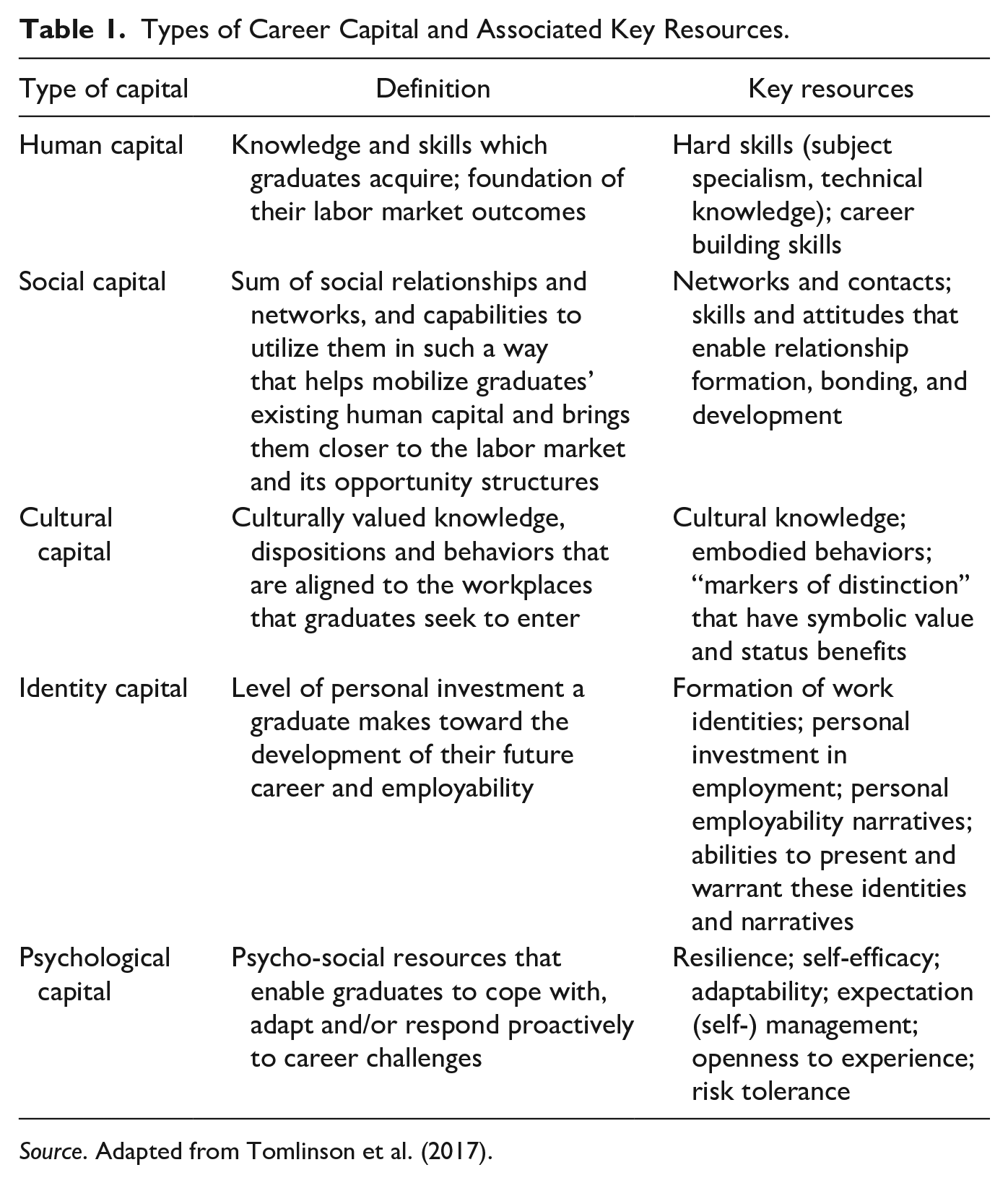
Source. Adapted from Tomlinson et al. (2017).
The very notion of “capital” nudges students to become career capitalists. It encourages students to acquire and accumulate resources of various types during their higher education and beyond, to turn these resources into personal property, and to seek opportunities to swiftly extract profits from them in a challenging and ever-changing labor market.
Business schools and management educators shape students’ career capital orientation. Programs and courses are frequently marketed as career boosters or as a key to access new career paths. Increasingly, curriculum design, subject delivery, and assessment incorporate development opportunities for capabilities that industry and employer groups consider critical for employability (Allen & Simpson, 2019; Blackmore et al., 2016; Hill & Houghton, 2001). Authentic assessments, experiential learning activities, and work-integrated learning challenge our students to hone their mastery of career-relevant capabilities in realistic work settings, so that they can “hit the ground running” in their next job (Jackson, 2015; Jackson & Collings, 2018; Kisfalvi & Oliver, 2015; Villarroel et al., 2018). And co-curricular programming, too, supports the career capital mindset: a quick scan of our institution’s events calendar and noticeboards for students suggests that career-readiness workshops, career fairs, networking functions, and various other offerings with similar tenor do their part in keeping students focused on building the career capital that they believe to be instrumental for their competitive advantage on the job market.
Merits of the Career Capital Approach
Facing Market Realities
The capital approach encourages our students to gain deeper understanding of the varied and complex occupational requirements that exist now or might exist in the future for their targeted job market(s) and career paths. This can be supported, for example, by dedicated future of work courses, or by targeted within-course discussions of economic, social, technological, and ecological trends and their impact on business and management. An assessment of these trends might inform students what investments in knowledge, skills, and other forms of capital are most likely to be profitable and least likely to become commoditized or eliminated by the Fourth Industrial Revolution. It might prompt students to hold faculty accountable for providing the “right” kind of service. They may demand, for example, that advanced analytics or sustainability be incorporated in the curriculum. Educators, too, might conclude from their own assessments of key trends, that a shift in what they teach and how they teach is needed. They might recognize, for example, that during a period of high uncertainty induced by rapid technological change and the climate crisis, business students need to develop social skills to activity manage employees’ stress and wellbeing. Such reasoning has led to proposals for future-proof or “robot-proof” (Aoun, 2017) general educational priorities.
Well-rounded Graduates
The recognition that varied forms of career capital are instrumental for career success can also galvanize the development of innovative, targeted interventions that help our students utilize and develop diverse forms of capital (cf. Ladson-Billings, 2021; Pierre & Oughton, 2007). Such innovations would help balance the traditional cognitive focus in management education, for example, by including more learning designs for socioemotional and behavioral learning outcomes. This, in turn, affords students more diverse opportunities to discover personal strengths and potential, builds students’ confidence in what they have to offer to employers, and allows them to make smart career choices based on a multi-dimensional understanding of person-job fit.
Focus on Utility
The career capital approach also has moral value. It resonates with our desire to see our students succeed, and our need to be helpful and useful in ways that our students and society recognize. There is evidence of the instrumental value of career capital, particularly its social skills component (Deming, 2017). By guiding and supporting the development of career capital that allows our students to optimize their earning power, employment security, and occupational status, etc. we fulfill, to some degree, the mission of higher education to enable students to transform themselves, and to pursue careers and build lives that they otherwise would not have deemed possible.
Further, the career capital approach can help students diagnose and navigate some of the challenges they encounter on the job, ease their learning curve, and reduce anxiety, frustration, and risk of derailment. In this way, we can strive to reduce graduates’ dependence on the level of career support provided by an employer, and thus equalize graduates’ opportunity for a positive career start.
Concerns About the Career Capital Approach
Lack of Capacity for Sound “Investment Advice.”
Business school educators may not always be well-placed to gain direct insight into current and emerging labor market demands. Structurally, the interface between faculty on the one hand, and career and student services on the other is often underdeveloped and characterized by division of labor, rather than collaboration and reciprocal knowledge exchange (Crisp et al., 2019, p. 225). As a result, few faculty members, outside of subject matter specialists, would have an in-depth understanding of how current transformations in business—from digitization to sustainability—concretely affect demand for specific skill profiles, or the value of other career capital. In short, we may feel unprepared to provide evidence-based advice on how our students should direct their career capital development to maximize employment outcomes, and we might feel uncomfortable offering advice based purely on personal opinion. These role conflicts also arise when we are asked to add, in an already crowded curriculum, employability skills development for which we feel we have insufficient time, resources, and expertise (Bennett, 2019; Cotronei-Baird, 2020)
Instrumentalizing Higher Education
Concentrating substantive efforts in business schools on boosting graduate employability frequently prompts deep seated concerns about “instrumentalizing higher education” (Sin & Neave, 2016, p. 1454): such efforts shift business schools further toward vocational training that serves industry and other stakeholders, but crowd out from the curriculum learning experiences and personal development opportunities that don’t have an evident employability relevance.
Drawing attention to the connection between business schools’ curricular (and co-curricular) offerings and employability—a focus intensified by broadly disseminated and prominently advertised graduate employment outcome rankings—can have a substantial impact on our students’ academic pursuits and well-being. It can breed a learning culture that discourages open-ended inquiry and exploration (McCowan, 2015); a culture in which “almost any ‘accomplishment’—no matter how trivial its purpose—[is] applauded if it boosted a résumé, and [. . .] many heartfelt endeavors with no clear self-promotional payoff [are] devalued, neglected, even mocked and ridiculed.” (Shell, 2018, p. 5).
Social media-triggered comparisons with peers may lead students to feel anxious (Pisarik et al., 2017) that they are constantly falling behind in multiple (rat) races for accumulating various career capitals. In short: students may be discouraged from “running their own race.”
Promoting a Myopic Professional Ethos
Business schools shape students’ professional identity (Petriglieri & Petriglieri, 2010). As students learn how to conform and subordinate their career development efforts to market demands, and as they draw on their career capital to craft creative narratives of how they might fit into a desirable job, they may develop a severely constrained sense of agency, and a self-perception as a (perhaps) well-remunerated, but ultimately fungible worker in a long series of low-trust, transactional employment relationships, constantly under threat of being terminated by unforeseen economic change or technological disruption (Chertkovskaya et al., 2013). With such an outlook, we can understand why Anne has difficulty whole-heartedly committing to any of the career paths before her.
Further, the more we support our students to “play the game” and achieve personal wins in a competitive job market, the more we neglect to cultivate their capacities to ‘change the game’, to critique the status quo, and to collaborate to mobilize for change. The more we focus students’ concern on employability, the more we may suppress their (moral) imagination for better, more humane managerial practice, employment, and business.
A recent study of Dutch business school students’ moral ethos substantiates this concern. It finds that a majority of students believe that “the task inherent in the managerial position [. . .] is to realize goals and these goals are mostly given. The fundamental underlying value is that of the search for efficiency” (van Baardewijk & de Graaf, 2021, p. 196). If management education indeed fosters such a myopic conception of the scope of managerial responsibilities, if it does not kindle in our students a sense of opportunity to evolve models and morals of management and contribute to societal goals (beyond mere efficiency), we are doing our students and society a disservice.
Personal Purpose Approach
The purpose approach to career guidance and support gives primary attention to ends, rather than means. Of particular importance is the notion of telos, of valued, ultimate ends that serve as foundational principles for organizing one’s life and work. The practice of focalizing personal values or principles to guide career decisions is not new (Douglas, 1994; Krumboltz & Worthington, 1999; Schein, 1978), but recently there has been a resurgence of interest in the specific significance of purpose that is rooted in pro-social, beyond-the-self or self-transcendent concerns for personal development, motivation, and wellbeing.
Most definitions agree that a personal purpose is a far-reaching goal, or ultimate concern, that people endow with meaning and ethical merit (see definitions in Table 2). The meaning attached to one’s long-term goals, are based on a sense of personal relevance, significance, and intrinsic value rather than the goals’ alignment with labor market demands or social norms.
Personal Purpose and Related Concepts.
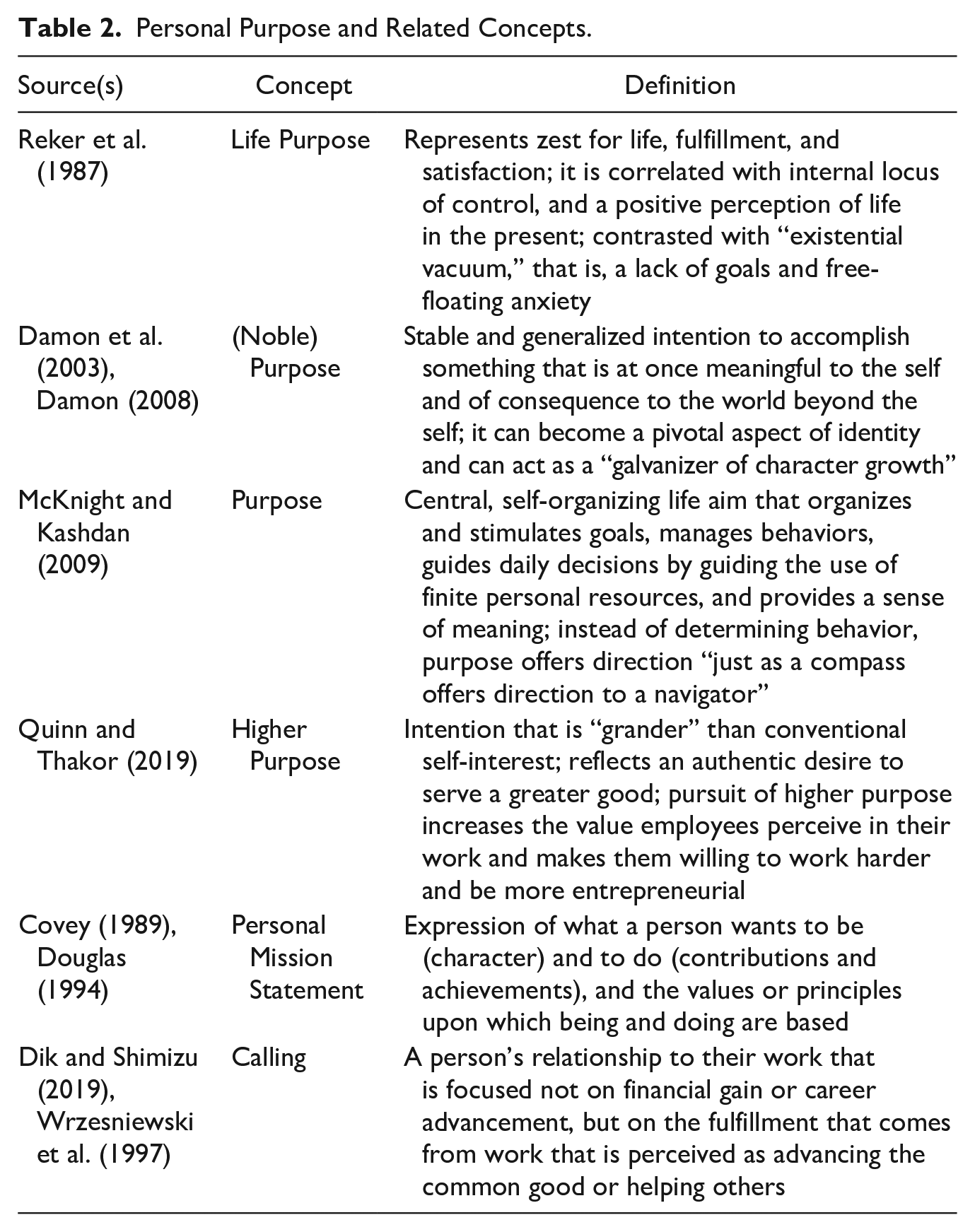
While purpose is founded on personal values, it does not require a deliberate working through or conscious awareness of values. It can emerge from instinctive value judgment and moral intuition that are activated in social interactions (Damon, 2008). However, for many children and young adults—including Anne, whose struggle we considered at the beginning of this essay—purpose does not naturally emerge during their formative years. Damon (2008) and Storey and Storey (2021) diagnose as causes for this malaise popular culture’s preoccupation with short-term achievements and glamorization of wealth, and a systematic neglect in parenting and in education systems to cultivate contemplation and discussion of personal and civic values that would help students develop enduring pro-social aspirations.
The purpose approach to career guidance rekindles the German idea of Bildung as articulated by Schiller, Hegel, and von Humboldt, which conceives of education’s primary task as developing students understanding of themselves and their relationship to society (cf. Løvlie & Standish, 2002). Accordingly, as management educators we can help our students develop and strengthen their sense of social responsibility and agency as professionals by pointing out what a person can and should do with academic knowledge and technical skills in the world, and how they can contribute to the common good (Colombo, 2023). Positive psychology interventions, like the “best possible selves” activity, can help center themes of virtue, wellbeing, and authentic happiness in our students’ career deliberations (Loveday et al., 2018). And we can create opportunities for our students to gain first-hand experience of pressing social needs and environmental problems (e.g., through service-learning interventions, see Kenworthy-U’Ren, 2008; Pless et al., 2011), and to connect with potential mentors or role models who share their own sense of purpose and the meaning they derive from work (Damon, 2008, p. 176).
Systematically implementing these purpose-oriented impulses often entails a recalibration of our ethos and practices—a shift toward more dialog and less instruction, toward a model of educare (i.e., higher education with strong emphasis on “pastoral care,” see Schmidt-Wilk, 2010).
Merits of the Purpose Approach
Supporting Learning and Wellbeing
Focusing students on purpose during their studies can generate learning benefits. It can improve student self-regulation and thus enables sustained effort even for unstimulating aspects of a course (Yeager & Bundick, 2009). It can have a positive impact on grades and career ambitions and can help students better grasp why they learn and how their coursework can help them pursue their aspirations (Harackiewicz & Priniski, 2018).
In addition, purpose has been associated with numerous long-term health and wellbeing benefits—from lower likelihood of anxiety or depression, better sleep, higher sexual enjoyment, and lower risk of heart attack, stroke, Alzheimer’s disease—and with the capacity to navigate with confidence periods of uncertainty, adversity, and stress (Reker et al., 1987; Strecher, 2016).
Finding and Crafting Good Jobs and Good Careers
Purposed-focus career guidance considers career choices in light of long-term aspirations and value commitments. This encourages students to formulate personal, subjective success criteria (Hall et al., 2013) and consider more deeply the features of a particular career path—not just its expedience, accessibility, or immediate financial and status rewards, but the opportunities it presents for meaningful impact in line with their non-instrumental aspirations (Dik et al., 2020; Douglas, 1994). Students can therefore better screen “bullshit jobs” that scaffold careers mainly with promises of promotions and high income, but offer little intrinsic sense of accomplishment or growth.
Students who cultivate these job- and career-crafting abilities can also apply them post-graduation to help others (e.g., peers or direct reports) gain satisfaction and meaning from their work.
Embracing Principle and Virtue
The purpose approach holds particular moral appeal to educators who believe that an important function of higher education is to “[distract students] from their struggle to get into high-paying professions,” to encourage them to question their upbringing and prevailing social institutions, and to ask themselves the Socratic question of “how should I live?” (Rorty, 1999, p. 116). For management educators, purpose-related interventions provide opportunities for more expansive discussions about the role of business and managers in society—not just in the context of a dedicated business ethics, or a business & society course, but as an integral feature of a wide variety of curricular and co-curricular offerings (Gioia, 2002). It also appeals to educators who believe that management as a profession has “higher aims,” that it should be based on civic virtues and a sense of service (Colombo, 2023; Khurana, 2007).
Concerns About the Purpose Approach
Performative Deployment
While the language of purpose and passion is becoming more common in the marketing of business school programs, and some schools offer specialized courses, some students report a lack of substance in the offerings:
There are courses about a purpose-driven life, and I’m taking a course now about strategic pivoting, but these are not asking you to think about your role in society. It’s more like ‘designing your life,’ and the curriculum still sits within a traditional business skill set. (quoted in Worthen, 2022).
Purpose-oriented initiatives that fail to substantively engage social concerns or students’ values, risk instrumentalizing purpose as merely another element of competitive career capital. They may compel students to strategically choose employer-compatible rather than intrinsically meaningful virtues.
The False Promise of “Follow your Passion.”
While current scholarship on purpose is discerning about passions—seeking to screen out, for example, short-lived and purely hedonic desires—some general concerns about the passion principle providing poor guidance for career decisions may still apply. Indeed, those who follow their purpose may find over time that its pursuit is more arduous or less meaningful than they expected. Pursuit of purpose can turn out to be a costly disappointment (see career capital advocate Newport, 2016).
Worse, pursuit of a self-transcendent purpose may be a trap. Cultural norms that encourage career aspirants to seek fulfillment and self-expression in their work may make them vulnerable to exploitation. They may feel compelled to provide un- or poorly compensated labor, and to give a high level of commitment to employers that may remain unreciprocated (Cech, 2021; Jaffe, 2021). In addition, some employees with a strong sense of purpose adopt unsustainable career practices that can lead to burnout (Duffy et al., 2018; Schabram & Maitlis, 2017).
The Specter of Normativity
Purpose-oriented interventions generally refrain from exerting normative pressure regarding what purpose to pursue, and instead aim to help students how to think through the ultimate ends of their lives and work. Sometimes, however, the line between what and how is blurry: should we encourage our students to seek purpose within mainstream management career paths? Or should we actively steer them to look more broadly for meaningful work where they can fruitfully employ their managerial competencies in other sectors or industries?
No guidance or prompt for reflection we provide for our students to find a path to purpose is value neutral. Even when we embrace value pluralism and inclusion, when we encourage students to examine closely their own values and those of others, we risk unwittingly imposing our own. We risk being perceived as the “purpose police,” as arbiters of worthiness. Hence, well-intentioned efforts can be criticized for inappropriately politicizing or ideologically inclining students’ careers and can become mired in the controversies that often befall character education initiatives (Reuben, 2022). Some faculty members may feel ill-prepared to navigate these tensions, and may feel uncomfortable sharing personal, overtly value-laden perspectives, or inviting them from students.
Connecting Career Capital and Personal Purpose
Career capital and personal purpose approaches differ ideologically in important respects. The former foregrounds educators’ role in aiding students’ capital development and does little to question prevailing career norms and assumptions; it tends to focus on how to cope with disruption and pivot in response to market trends, rather than stimulate imaginaries related to the future of work. The latter sees educators’ main task as helping students find and sustain (and periodically re-examine) personally meaningful long-term goals; it tends to advocate for a notion of vocation that is emancipated from market dictates and career templates.
The two approaches also hint at complementarities and interdependencies (see Figure 1). Purpose is an aspect of a person’s identity and their character strengths, and hence relates to psychological and identity capital. Career capital interventions that aim to cultivate or activate students’ social and cultural capital, mirror aspects of the purpose approach that encourage educators to facilitate students’ engagement with their community, deliberation of civic values, and exchange with mentors and role models. The psychological benefits of pursuing a noble purpose depend on a realistic awareness of one’s own abilities (Malin, 2023), and a career capital focus can raise that awareness. In turn, purpose can help connect a student’s accumulated educational experiences and learning outcomes into a coherent, robust, and empowering sense of self (Lagemann, 2003), and can guide meaningful investment of the various types of career capital they have built up (for an overview of investment domains, see Arthur et al., 1999, p. 145).
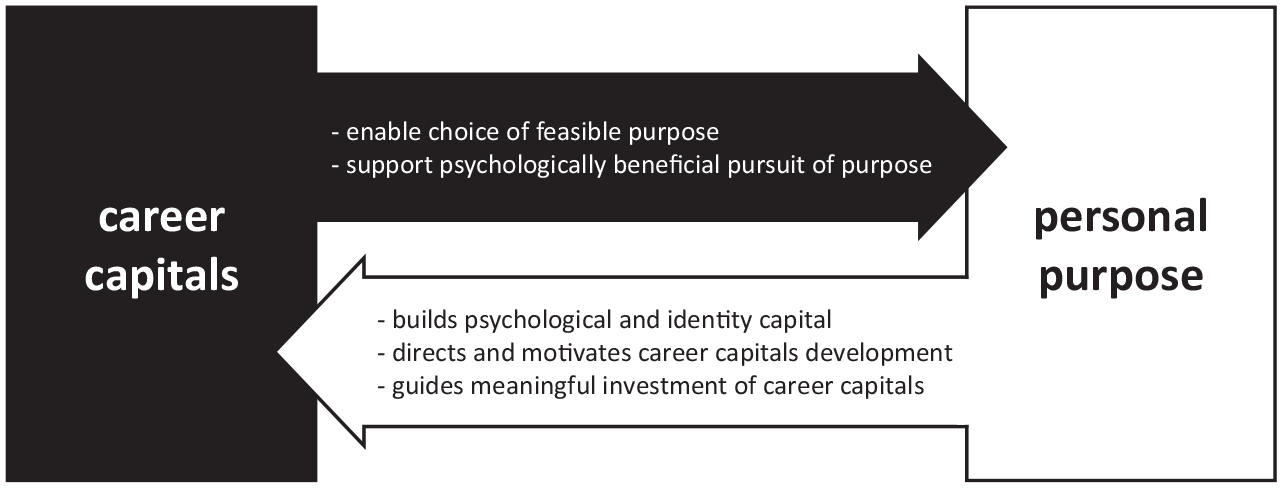
Complementarities of career capital and personal purpose approaches to career guidance.
Hence, combining aspects of the two approaches could yield “best-of-both-worlds” benefits for students: guidance for development of practically relevant capabilities and other personal resources during their studies and beyond, and encouragement to commit to a personally meaningful pursuit that directs and sustains their career and enables them to flourish.
Using Integrative Learning Experiences to Foster Capital-purpose Connections
Integrative learning experiences aim to cultivate students’ ability to draw connections among ideas and experiences, to synthesize and transfer learning to new, complex situations within and beyond the campus (Kinzie, 2013). When these experiences invite students to invest their whole selves, and when educators encourage and support students to carefully evaluate and reflect on their learning experience, they can enable students to gain a holistic perspective on career capital and personal purpose. We illustrate two strategies—one relying on introspection and one on stakeholder interaction—for management educators to nurture this holistic perspective.
Encourage Students to Recognize the Mutual Influence of Career Capital and Personal Purpose
Integrative learning experiences allow students to take stock of their career capital, to develop a sense of self-efficacy, and to get a glimpse of the positive impact their accumulated career capital enables. As significant episodes of capability development they provide exceptionally fertile ground for reflection. With careful intervention design, a reflection prompt after the successful completion of an internship or work-integrated learning project can reassure students about their personal strengths and thus encourage convergence on a nascent career trajectory. It can also nudge students toward deeper introspection, and to focus attention on what surprised, challenged, or aggravated them, what shook up and threw into doubt their existing self-concept and worldviews. This can invite re-assessment and revision of how they want to be and act as a professional, but also what change they want to enact in the world.
At the University of Melbourne’s Faculty of Business and Economics, the introspection approach helped transform the project-based, work-integrated learning course “Global Management Consulting” from a purely capability-focused capstone experience, into a more holistic examination of the interplay between capabilities and values in the professional service contexts. Early in the course, students articulate their personal conception of the social purpose of consulting (personal purpose), and how their personal capabilities and life experiences will inform how they will contribute to their project team. Throughout the duration of the project, students periodically revisit and reassess how they invest themselves in the project and what ambition for impact unpins their more concrete project deliverables. After the completion of the project, students reflect on project inflection points and conflicts and what they revealed about their own capabilities and values; they re-articulate their consulting purpose statement, and outline purpose-aligned personal development steps.
Provide Rich Opportunities for Engagement With External Stakeholders
Instilling in our students an integrative view of career capital and personal purpose requires diverse voices. When we invite guest speaker and mentors to share with students what purpose animates their work, and how they identified, assessed, and pursued meaningful career opportunities over the course of their work lives, we may well approach stakeholders from a broad set of backgrounds (e.g., activist, public servants, artists) to stimulate students’ engagement with these issues.
Community-engaged learning (CEL) provides an even richer opportunity for interaction with diverse stakeholders. It connects students directly with the local community in which their university is embedded, and that community’s pressing civic, social, and economic issues. CEL interventions have been applied in numerous disciplines, including management (Kreber et al., 2021), environmental studies (Cachelin & Nicolosi, 2022), and health (Comeau et al., 2019). They seek to avoid the paternalism and cultural invasiveness that sometimes characterize service-learning projects, and instead promote community centeredness, inclusivity and empathy, and knowledge co-production (Mitchell, 2008). For these reasons, CEL is particularly suited to help students gain a fresh perspective on their personal purpose and career capital.
The University of Melbourne’s “Street Finance” course takes this community engagement approach to connect career capital and personal purpose. In the course, students design and deliver three lessons on finance topics of interest and relevance to young people in Melbournian high schools. By centering the needs of and interacting with their young audience, university students learn how to translate and utilize expert knowledge to engage and empower non-experts—and thus develop their own career capital. But they also gain an appreciation for the importance of financial literacy with an immediacy that can help transform their thinking about the wider role and impact of finance in society (personal purpose). The potential for financial professionals to contribute to the common good becomes clear as students interact with high schoolers and experience how they apply the concepts and themes of financial literacy for their own decision making and share what they learned with their family and friends. The course gives university students an opportunity to reflect on how and how much they involved the community members, and how their own career capital enabled and constrained their service to the community.
Implications for Practice
What business schools deliberately and inadvertently, through their formal and their “hidden curriculum,” teach their students about careers is critical, not least because management graduates’ career conceptions and ambitions effect not only their own life course, but can have an outsize impact on countless other lives (Colombo, 2023; Ghoshal, 2005; Khurana, 2007). Hence, responsible career guidance should take a holistic approach that stimulates students to develop career capital and personal purpose.
We encourage management educators to reflect on their own teaching practices and experiences, particular with regards to the following questions:
• What approach do you currently take to provide career guidance for your students? Do you focus on career capitals, on personal purpose, or take a blended approach?
• How well-developed is your students’ sense of their own career capitals, their personal purpose, and how these are connected?
• What opportunities do you have to invite students to reflect on the moral responsibilities and moral agency that come with the knowledge, skills, and other career capitals they develop during their course of study? Can you integrate these reflections in learning objectives and assessment tasks?
• How can you encourage your students to think through the ultimate ends of their work as they plan and navigate their career?
• What can you do to strengthen your students’ self-efficacy for social impact in their careers?
We are optimistic that, as management educators, we can provide responsible career guidance that neither devolves into a reactive “service station” model of higher education, nor suffers from merely academic debates about the moral foundations of the management profession. We hope that creative practices that deliberately relate career capital and personal purpose approaches, and future research on effective learning design practices can give focus and clarity to our own purpose and our own capacity as a community of educators to help our students make active and wise career choices that result in personal fulfillment and contribute to the common good.
Storey and Storey (2021, p. 181) affirm the central importance of higher education in this regard:
With a firmer grasp on their own purpose, [universities] would cease to stamp the elites who emerge from them with the vices that come with not knowing how to sit still: distraction, anxiety, and the merely reactive pragmatism that consists of swaying with the rhythm of prevailing opinion. They would instead offer genuine liberal education, which is ultimately an education in the art of choosing. The art of choosing cannot bring our restless hearts to a stand-still. But it may help us turn our pointless busyness into a pointed quest.
Footnotes
Acknowledgements
We appreciate Aarushi Golchha’s research assistance and thoughtful comments on early versions of the manuscript, and are indebted to simulating debates with Vanessa Pouthier and Ranjay Gulati about higher purpose in business education. We also thank Maury Peiperl and Jennifer Leigh for their excellent editorial guidance throughout the review process.
Declaration of Conflicting Interests
The author(s) declared no potential conflicts of interest with respect to the research, authorship, and/or publication of this article.
Funding
The author(s) received no financial support for the research, authorship, and/or publication of this article.
