




Abstract
Although combining case study teaching with group learning is a popular approach for teaching business courses, pedagogical challenges arise, particularly in undergraduate classes. To address these challenges, we developed an instructional innovation called the Team-Based Learning and Evaluation (TaBLE) Case Method, which increased student engagement and deepened learning in an undergraduate introductory management course. The TaBLE Case Method is built upon specific principles of team-based learning, and comprises phases that meld together individual preparation and group participation before, during and after class. Our evaluation of the TaBLE Case Method highlights how it enhances group learning by: increasing student motivation to prepare, attend and engage; creating individual accountability for group goals; fostering critical thinking and creative debate; and making theory-practice links more visible. We also discuss the method’s “shadowsides” and limitations, and provide guidance on how the method can be adapted for a variety of class sizes and delivery modes.
Keywords
Case studies are well established for teaching a business way of thinking (Bridgman et al., 2018; Reynolds, 1978) and are widely used in undergraduate and postgraduate business education around the world (Becheikh et al., 2022; Lundberg et al., 2001). The traditional approach for teaching case studies is the Socratic method pioneered by Harvard Business School (Desiraju & Gopinath, 2001; Dooley & Skinner, 1977), which has been criticized for limiting student learning by being overly instructor-centric (Argyris, 1980; Siciliano & McAleer, 1997). This criticism is most prevalent in undergraduate teaching compared to MBA and executive teaching, where an instructor may be able to facilitate vigorous discussion among managers and executives in the context of a focal case (Garvin, 2007). In comparison, undergraduate students, who tend to lack confidence and business experience especially early in their degree programs (Hendry et al., 2017), and students from non-Western cultures (Becheikh et al., 2022) often struggle to make connections between management theory and practice when cases are taught using instructor-centric Socratic methods (Lundberg & Winn, 2005). This has prompted calls for the use of theory in the case method to be rejuvenated (Bridgman et al., 2018) and for the development of student-centric instructional innovations for teaching cases (Desiraju & Gopinath, 2001; Lebron et al., 2020).
A popular pedagogical solution is to combine case teaching with group learning, which is also described as collaborative learning or team learning in the management education literature. It should be noted that, in this article, we use the term “group learning” to distinguish the general process of group learning in student teams from “team-based learning” as a specific model of group learning pioneered by Michaelsen et al. (2004). Within this literature, “group learning” is defined as three or more students working interdependently on a task to accomplish a shared learning goal for assessment purposes (Huang et al., 2022; Rafferty, 2013). Examples of instructional approaches that seek to incorporate group learning in case teaching include students working in teams to write case analyses and give presentations (Garvin, 2007; Pessoa et al., 2022), lead case discussions in class (Siciliano & McAleer, 1997), compete in live case competitions (Lebron et al., 2020), and act out role plays of cases (Lund Dean & Fornaciari, 2002).
Yet despite these advances, a recent review of the extensive research conducted on teams in management education concluded that instructional approaches for group learning, including in case teaching, are not as effective in encouraging student learning outcomes as educators would like (Morgan & Stewart, 2019). This is because the instructional innovations in case teaching fail to ensure two necessary conditions that enable student learning in groups: (1) group goals and (2) individual accountability for team outputs (Slavin, 1988). These conditions help to foster cooperation in tasks to accomplish mutual goals (Rafferty, 2013) and to counter social loafing (Schippers, 2014). Thus, there continues to be a pressing need for new instructional approaches that improve learning in teams (Bacon & Stewart, 2019) and which are anchored in teams applying management theory to analyze business cases (Bridgman et al., 2018).
Responding to this need, we present an instructional innovation that embeds group learning in case study teaching in a way that fulfills the two necessary conditions and, as a result, motivates students to work together to connect management theory and practice in the context of a focal case. Our instructional innovation is the Team-Based Learning and Evaluation (TaBLE) Case Method, which we developed by adapting Michaelsen et al.’s (2004) principles of “team-based learning” to case study teaching. In contrast to the general concept of group learning that we use in this paper, we distinguish “team-based learning” as a more precise term that describes a specific model of group learning processes in student teams, which involves repeating phases of pre-class preparation, readiness assurance tests, and application of course concepts (Michaelsen et al., 2004).
The paper is structured in four sections. First, we provide the theoretical background to embedding group learning within case teaching. Second, we present our instructional innovation of the TaBLE Case Method and describe its distinctive features for solving the various pedagogical challenges associated with combining case teaching with group learning. Founded on student teams discussing theory-practice connections in the context of a focal case study, the TaBLE Case Method melds together five phases of individual preparation and group participation before, during and after class. Third, we report an evaluation of the TaBLE Case Method’s effectiveness as an instructional innovation to give management educators confidence to adapt it for use in their own classrooms. Specifically, the TaBLE Case Method is evaluated for how it improved student learning following implementation in an introductory management course in an Australian university. Fourth, we offer conclusions on the TaBLE Case Method and how it might be used by educators to embed group learning in case teaching in other courses.
Theoretical Background
The literature on the case study method is dominated by the Socratic approach to learning wherein an instructor (1) raises issues, (2) challenges students to apply theory to resolve the case issues, and (3) prompts “the advancement of discussion . . . in the service of thinking” (Lundberg & Winn, 2005, p. 275). Emphasis is placed on students recognizing different concepts in the case and selecting theories and models appropriate to the situation (Becheikh et al., 2022; Lundberg et al., 2001). Specific learning objectives for case teaching range from familiarization with knowledge and techniques, building skills in analysis and synthesis, and developing values and attitudes (Dooley & Skinner, 1977; Pessoa et al., 2022).
The literature is divided on the effectiveness of case discussion in promoting student learning. Some scholars argue that learning is deepened if students compete during class discussion to unravel the managerial dilemma (Berger, 1983) and the instructor establishes a mindset of improvisation and multiple interpretations (Aylesworth, 2008; Greenhalgh, 2007). Others contend that instructor control of classroom interactions may discourage double-loop learning which hinges on students re-examining past learning and personal experience in the context of the case (Argyris, 1980; Whetten & Campbell Clark, 1996). Moreover, learning is stifled when the instructor adheres rigidly to prepared case notes and/or engages in minimal questioning and drawing out of student responses (Lundberg & Winn, 2005).
To resolve these problems, refinements to the Socratic method have sought to incorporate group learning as a means of encouraging greater student participation in case learning processes (Bacon & Stewart, 2019). Group learning offers many potential benefits, including more creative problem solving (Goltz et al., 2008), deeper application of management concepts to practice (Irving et al., 2019; Wright & Gilmore, 2012), more insightful evaluation and critique (Borredon et al., 2011; Kalliath & Laiken, 2006), and greater synthesis of content knowledge (Hansen, 2006). Achieving these types of positive learning outcomes from group tasks associated with case study analysis hinges on two essential conditions (Slavin, 1988). First, the assigned task is perceived as a shared goal that benefits all members (Bacon, 2005). Second, each student feels individual accountability for team outputs (Slavin, 1988). If these two conditions are unmet, learning is inhibited. Teams can divide up the work, which reduces each individual student’s exposure to all aspects of the task (Ashraf, 2004), and less conscientious students may practice social loafing (Schippers, 2014).
Instructional approaches for incorporating group learning into case teaching accommodate for these two conditions to varying degrees. The most popular approach is to assemble students into instructor-assigned or self-selected teams (Bacon & Stewart, 2019; Chapman et al., 2006; Pearlstein, 2021) and ask team members to jointly analyze a business case study, with their findings reported in a group oral presentation and/or group written report (Garvin, 2007; Pessoa et al., 2022). Several obstacles can hinder the impact on group learning of this approach. Formal individual accountability is often absent. Although peer evaluation of team members may help to deter social loafing (Brutus et al., 2013; Ferrante et al., 2006; Johnston & Miles, 2004; Ohland et al., 2012), peer evaluation methods are not always well received by students and may be time-consuming and resource-intensive for instructors to administer. Moreover, the case presentation or report is typically designed as group project that allows a high degree of specialization of labor (Bacon, 2005). That is, each team member can specialize by applying only a few concepts to the case and/or by focusing on narrow aspects of the case company’s management and operations. While this allows students to complete the task efficiently by parceling the workload, individual learning suffers because students narrowly fragment, rather than comprehensively synthesize, theory and practice in the context of the case (Bacon et al., 1998).
Other instructional approaches have tried to facilitate group learning by refining the in-class discussion aspects of the Socratic case method. A key example of this is the McAleer Interactive Case Analysis (MICA) Method. This method involves student teams administering and leading the discussion of the case study while the instructor evaluates individual participation (Siciliano & McAleer, 1997). However, research shows this method offers marginal improvement in encouraging active participation compared to the traditional Socratic method (Desiraju & Gopinath, 2001). Management educators have suggested various improvements, including requiring student teams to argue contrary positions following a devil’s advocate process (Pearce, 2002), combine analysis and synthesis in experiential exercises (Maranville, 2011), act out cases as role plays (Lund Dean & Fornaciari, 2002), compete in live case competitions (Lebron et al., 2020), and write their own cases (Ashamalla & Crocitto, 2001; Vega, 2010). Yet these approaches, while very creative, have yet to resolve the challenge of embedding group learning in case teaching in a way that effectively combines group goals and individual accountability.
We propose that the principles of team-based learning developed by Larry Michaelsen offer a way forward for developing an instructional approach for teaching case studies that engages group learning processes (Michaelsen et al., 2004). This set of principles has become very popular for designing group learning activities and assessment tasks (Michaelsen et al., 2004) and empirical studies support the effectiveness of team-based learning in business courses (Hernandez, 2002). Michaelsen’s team-based learning principles addresses the two essential conditions of group goals and individual accountability through repeating phases of pre-class preparation, readiness assurance tests, and application of course concepts. Students are made accountable for both individual and group work and receive frequent and timely feedback. Group tasks promote both learning and team development by not requiring complex outputs which groups can divide up and complete as individuals outside of class. According to Michaelsen et al. (2004), learning is best achieved when individuals and groups work on the same task; when individuals and groups are required to make a specific choice; and when groups report choices simultaneously. In the next section, we describe how we drew upon Michaelsen’s team-based learning principles to develop the TaBLE Case Method that moves beyond the instructor-centric Socratic case method to embed group learning in case teaching.
Team-Based Learning and Evaluation (Table) Case Method
The TaBLE Case Method is an instructional innovation that applies Michaelsen’s team-based learning principles to case study teaching. Team-based learning models are typically built upon “readiness-assurance tests” in the form of a multiple-choice quiz (Michaelsen et al., 2004). The TaBLE Case Method adapts this model by designing the readiness-assurance tests around case study applications and theory-practice statements. More specifically, students engage in individual pre-class preparation and in-class group tasks which are integrated around (1) a focal business case study of relatively short length (five pages) and (2) a set of four statements that connect different theoretical concepts to the case. These statements are written by the instructor to capture the relevant concepts and theories from the week’s syllabus and lectures that students need to understand and apply.
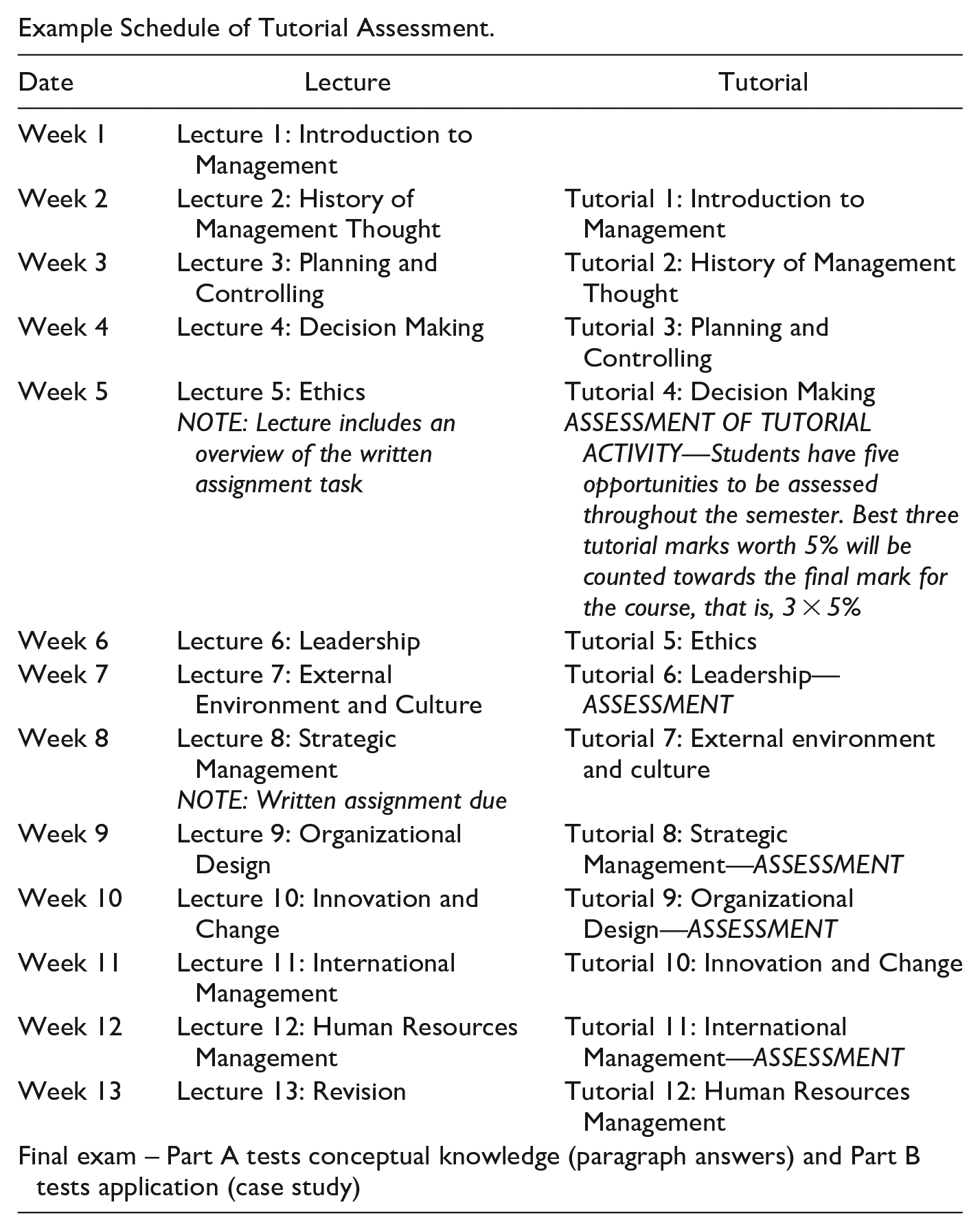
We developed the TaBLE Case Method as an instructional innovation to teach the tutorial program in a very large introductory management course at a university in Australia. The method was originally developed by the first author when course enrolments were in excess of 1000 students and the course was delivered in a typical lecture and face-to-face tutorial model. Each week, students were expected to attend (1) a large lecture in which the instructor introduced relevant management theory (multiple lectures delivered each week) and (2) a one-hour tutorial class of 24 students facilitated by a Teaching Assistant (hereafter TA), who worked with the TaBLE Case Method to consolidate and deepen student learning by connecting theory to practice. The TaBLE Case Method was introduced in Weeks 1 and 2 of the 12-week tutorial program (refer to Appendix A), with students divided into six permanent teams of four students per tutorial class. A trial of the full TaBLE Case Method occurred in Week 3. The TaBLE model was used in every tutorial for the remainder of the semester, with assessable and nonassessable weeks staggered to support a repeating cycle of progressive learning and formative and summative feedback. Students had five opportunities to be formally assessed on their individual preparation for, and group participation in, the TaBLE Case Method during a tutorial class (week 4, week 6, week 8, week 10, week 11). A student’s best three marks counted towards their final course mark (3 × 5% = 15%). A comprehensive description and detailed example of the use of the TaBLE Case Method in this course is provided in the Appendices (B–H).
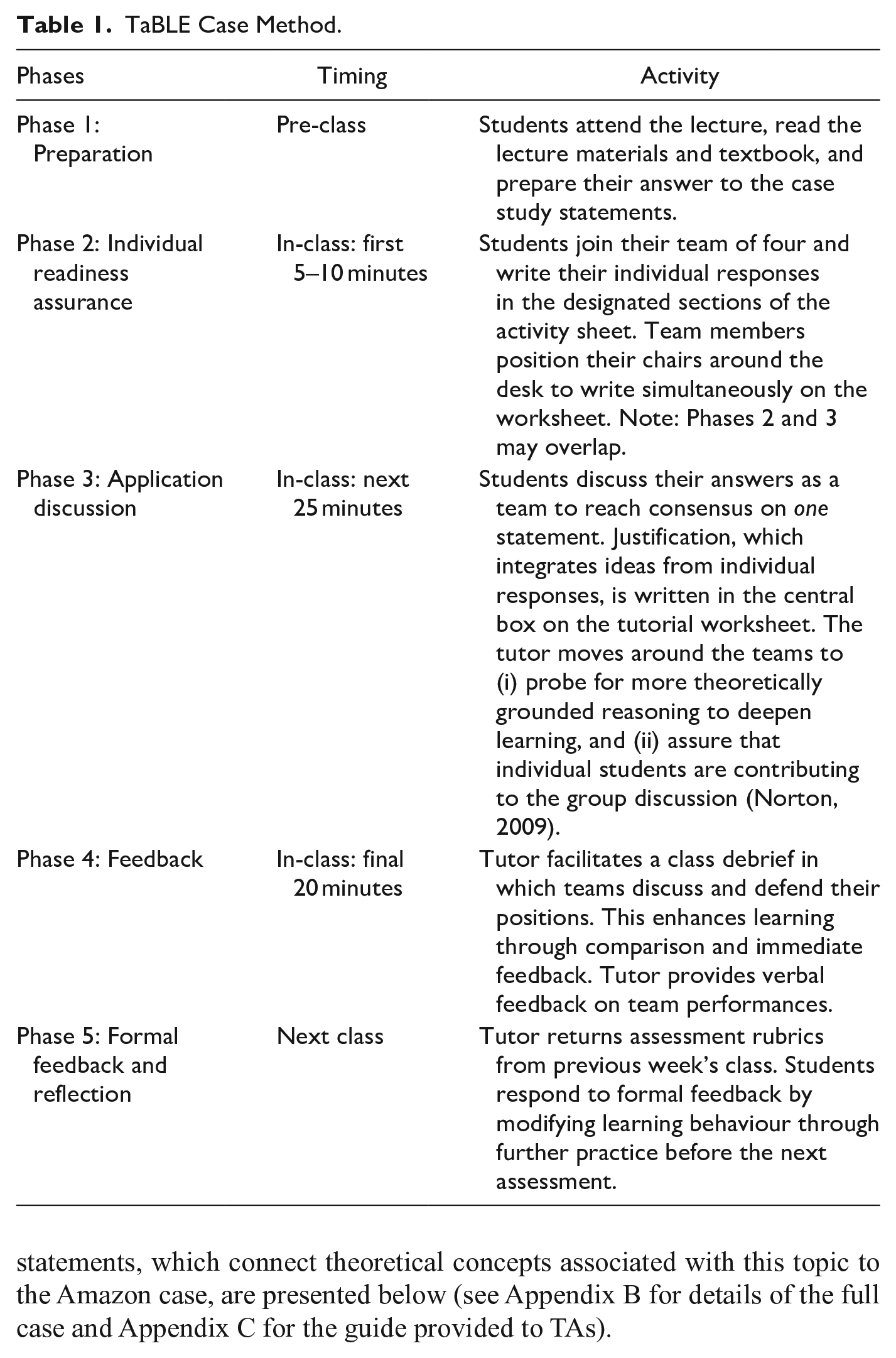
The distinctive team-based learning elements of the TaBLE Case Method unfold across five phases before, during, and after class. A summary of the five phases of the TaBLE Case Method is presented in Table 1. Below, we describe these phases in more detail.
TaBLE Case Method.
Phase 1: Individual Preparation (Pre-Class)
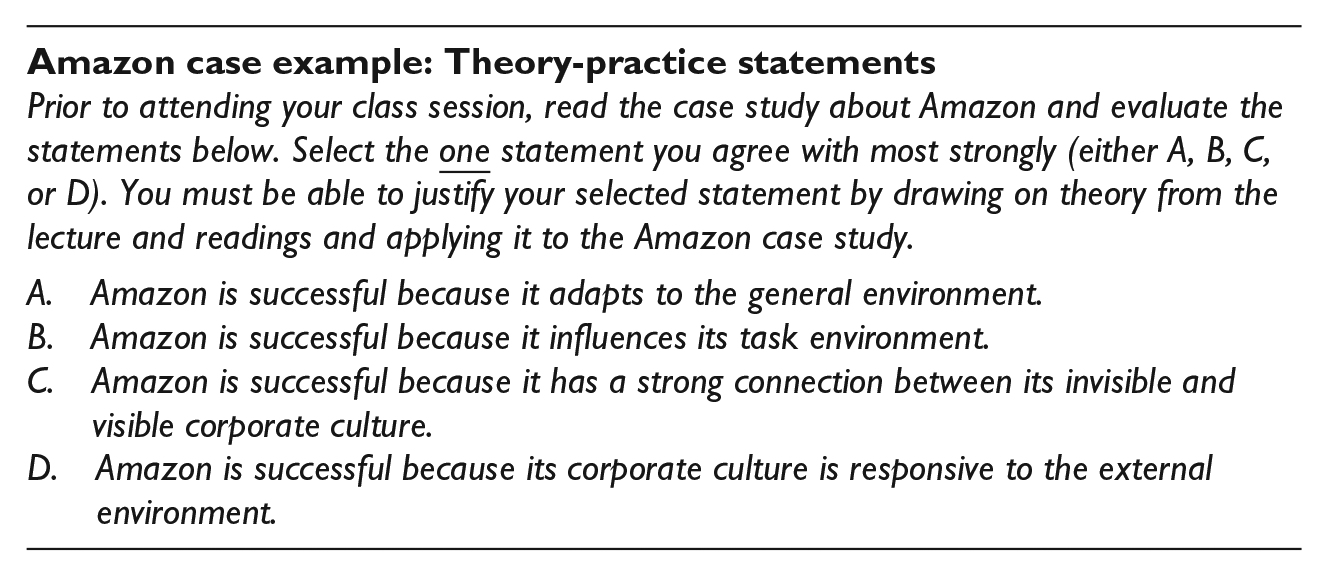
The aim of the first stage of the TaBLE Case Method is to encourage individual students to prepare for class by beginning to make some initial connections between management theory and practice. This aim is accomplished by students undertaking three individual preparation tasks: (1) reading the focal case study, (2) analyzing four statements applying theoretical concepts to the case, and (3) choosing the statement that they judge to be the best fit. Forcing students to make a choice among four statements, all of which could be correct, pushes them to think more deeply and critically about how aspects of theory connect to the focal case study.
When selecting the case study or writing their own case narrative, the instructor should ensure the case description is sufficiently rich and informative to allow the possibility for students to apply all of the concepts included in the statements in meaningful ways. To illustrate, we use the case example of the Amazon corporation and the weekly syllabus topic of “external and internal environment” in an introductory management course. A set of four statements, which connect theoretical concepts associated with this topic to the Amazon case, are presented below (see Appendix B for details of the full case and Appendix C for the guide provided to TAs).
Phase 2: Individual Readiness Assurance (in-Class)
The second phase of the TaBLE Case Method occurs in class. The aim of this phase is individual readiness assurance, in which each student demonstrates their understanding of the statements in the context of the focal case study. Being able to compare the theory-practice connections underpinning each statement evidences preparation and shows a student’s readiness to move on to the next in-class phase of engaging in group discussion.
Before the start of the class session, the teaching assistant sets up the classroom with tables and chairs to sit students in teams. Based on our experience, the optimal class size overseen by one TA is a class of 24 students and the optimal team size is 4 students (i.e. a class of 24 students is divided into six groups of four team members). The TA also prepares one worksheet per team (A4 or US Letter Size), which has ruled lines marking a center box (for recording the team consensus after discussion) surrounded by four corner sections (for recording individual readiness assurance) (see Appendix D for a template of the blank worksheet).
Students arrive in class and join their assigned team, positioning their chairs around the table in a way that allows each person to write simultaneously in their designated “readiness assurance” corner of the worksheet. The TA introduces the session and invites students to begin the individual readiness assurance test by writing their name in their corner along with a short response on every statement. In our Amazon example, students connect theory to the Amazon case by writing bullet points indicating their opinion and justification of statements A, B, C, and D and noting the statement they agree with most strongly.
In a 1-hour class session, the TA takes up to 5 minutes to settle the class and then allocates 5 minutes to the individual readiness assurance phase. This is sufficient time for students to concisely summarize what they perceive to be their “best” argument for or against each statement using relevant concepts and terminology applied to the specifics of the case, which justifies their “forced choice” among the statements. The TA can quickly judge whether or not a student has prepared some points of justification in advance of class. They can accommodate for this in grading if students are being assessed.
Phase 3: Team Application Discussion (in-Class)
The aim of the third phase of the TaBLE Case Method is to deepen learning of theory-practice connections in the context of the focal case study through small group discussion to reach consensus on the team’s forced choice. Students come to see that their individual pre-class preparation generates only a partial understanding of the application of theory to the case. By discussing, comparing, and being forced to choose among the statements with their team members, students are able to clarify, enrich, and nuance their understanding of course theory.
The TA announces the start of the team application discussion phase, directing teams to discuss and agree their consensus position before recording their written justifications in the rectangle marked at the center of the worksheet. Students begin by sharing their individual starting positions on the four statements with their team members. In our Amazon example, the members of a team might indicate two preferences for statement B, one for statement C, and one for statement D. Team members then discuss and debate these starting positions in order to reach a well-reasoned consensus position on the one statement that team members agree is the “best fit” of management theory to the practical context of the focal case company. The TA moves around different teams, asking questions to probe team member’s understanding of the theory and how it links to the focal case. The TA can also play devil’s advocate by challenging teams to consider different perspectives and avoid premature settlement that stifles critical debate within and among the full set of statements. Continuing our Amazon example, this might involve the TA advocating for the rejected statement A and urging team members not to mindlessly shift their support to the more popular statement B.
The TA observes how the teams manage their own interactions and can model the team discussion behaviors they would like the team to emulate. This can involve asking quiet team members to express their opinion on the statement and encouraging dominant members to give others an opportunity to speak. The TA can also remind students the discussion is an opportunity for students to actively listen, learn from each other, and to be open to insights that may differ from an individual student’s viewpoint.
In a one-hour class session, the TA allocates 25 minutes to the team application discussion phase. This is sufficient time for teams to discuss and agree their position and record their team justifications on the worksheet (see Appendix E for a completed worksheet).
Phase 4: Position Defense and Formative Feedback (in Class)
The aim of the fourth phase of the TaBLE Case Method is to synthesize learning of theory-practice connections through teams defending their chosen position on the four statements in a whole-class debrief. At the end of the team application discussion phase, the TA leads the class through a discussion of all four statements. In the example of the Amazon case, the TA could have noticed that statement B is very popular among multiple teams. As such, the TA might initially call on these teams to defend their choice of statement B before inviting teams with opposing views to offer critique and mount an argument for an alternative statement. The TA allows for back-and-forth exchange between teams that have taken opposing positions on a statement. The TA will also synthesize different themes across the teams regarding chosen statements and justifications but does not suggest there is one correct answer. In this way, the class debrief provides an opportunity for the TA to give generalized whole-class feedback on the theory-practice connections illuminated by the focal case study. In a one-hour class session, the TA allocates the final twenty minutes to the debrief and defense of team positions, collecting worksheets at the end of class.
Phase 5: Feedback and Reflection (After Class)
The aim of the fifth and final phase of the TaBLE Case Method is to encourage students to reflect on the ways they have engaged with course theory and made connections between theory and practice when working with the focal case study by receiving target team-specific feedback on their performance. Michaelsen et al.’s (2004) team-based learning model recommends holding students accountable for individual and team outputs. The worksheet used for the TaBLE Case Method provides the TA with a written record of student’s individual preparation (corners for individual readiness assurance) and the team outputs (center rectangle for consensus). In addition, the group dynamics and contributions of individual students to their team are observable to the TA as they move around the classroom and speak with different teams (see Appendix F for an example summary marking sheet used by a TA to record their observations of team discussions). After class, the TA can combine the worksheet with their own observations to assess individual contributions and team performance, thereby providing students with important feedback for self-reflection and modification of learning behaviours. An example of a marking rubric that can be used to assess individual contributions and team outputs is provided in Appendix G.
Evaluation of Effectiveness of Table Case Method
The TaBLE Case Method has been implemented successfully for almost a decade in the undergraduate introductory management course in which it was first developed. Following its initial introduction, average student ratings of TA performance improved to above 4.5 on a 5-point scale. Course results also improved. By motivating students to engage actively, critically, and thoughtfully with management theory throughout the semester, students were better prepared for the final exam and demonstrated a deeper understanding of essential concepts and theories. The proportion of high-achieving students increased from 9% pre-TaBLE to 15.5% post-TaBLE, based on the same course instructor and same exam format and level of difficulty. The improved student performance has been maintained across seventeen semesters of course delivery with six different course instructors.
Given the TaBLE Case Method has been used to teach the course tutorial program for such a long time period, there have been opportunities to evaluate its adaptability to different class sizes. We have successfully adapted the method for class sizes from 10 to 30 students according to enrolment, space and timetabling demands, which requires adjusting team sizes so that some students work in team of three members. We have occasionally used the TaBLE method in class sizes of up to 72 students when scheduling make-up classes to accommodate for timetabling problems. We have found scaling up to larger class sizes can be done effectively if there are additional TAs to ensure sufficient oversight of the discussion phase (one TA per 24 students is optimal in our experience) and provided the room is sufficiently large with good acoustics for teams to work effectively and for TAs to roam, probe, and assess. We have also experimented with processes of team formation. We have found that students are most satisfied with the TaBLE method when they are able to “trial” working with different people in the first 2 weeks of classes before permanent teams are formed in the third week.
In addition, we have explored the method’s adaptability to online delivery modes. During the pandemic, we taught the TaBLE Case Method via Zoom using breakout rooms for team discussion and a Google document for the worksheet. In experimenting with online delivery over several semesters, we found that smaller class sizes of less than 20 students per TA are more effective for online teaching as the TA needs to take a more active role in facilitating team discussion. Moreover, when using the method in a synchronous hybrid classroom, our experience indicates the TaBLE Case Method works best when team composition distinguishes between delivery modes. Forming separate teams among students working online overseen by at least one TA, and teams of students working in the physical classroom facilitated by another TA, tends to be more effective than mixing delivery modes. More details about how to adapt the TaBLE Case Method for various class sizes, timings, and online delivery mode are provided in Appendix H.
To formally evaluate the effectiveness of the TaBLE Case Method, we collected empirical data after the second iteration of its inclusion in the course. Two focus groups were conducted with students at the completion of the course tutorial program. Each focus group involved seven student participants and lasted 90 minutes. Participation was voluntary and students were assured their participation would not affect their course grade. Student focus group participants comprised nine females and five males and included both domestic (10) and international (4) students. A third focus group lasting two hours was held with five TAs, while an additional three TAs were interviewed individually. To assure participant confidentiality, an independent research assistant was employed to conduct all focus groups and interviews. We undertook data analysis by engaging in thematic coding (Corbin & Strauss, 2014), which entailed reading through the focus group and interview transcripts to identify themes that related to the effectiveness of the TaBLE Case Method. Our analysis generated four key insights into the effectiveness of the TaBLE Case Method as an instructional innovation for group learning and case teaching.
First, the evaluation data indicates that TaBLE increases student’s motivation to actively engage in group learning during assessment weeks but is less impactful in non-assessment weeks. TAs noted how “adding the carrot” of summative assessment motivated students to invest time and effort in reading the case study and making notes prior to class. The student focus groups confirmed high levels of motivation to prepare for and attend class during assessable weeks. One student described how they did “a lot more preparation going into this tutorial than I’ve ever done for another tutorial but the marks pay off for that.” Another remarked “I usually don’t prepare for tutes but I did this time because it was counted.” Engaging students in non-assessable weeks was more difficult. For most students and groups, motivation to prepare and attend dropped significantly when they weren’t being formally assessed. As one student explained, “Because there’s so much preparation that goes into the tutorials for the assessable weeks, we just couldn’t be bothered going to the non-assessable weeks.” Only conscientious students remained fully engaged in TaBLE-administered tutorials in the absence of immediate summative assessment: “I went to all of the tutes even if it wasn’t an assessable week just because we could see what happened and how we could use it in future weeks for assessment.”
Second, the evaluation data supports that the TaBLE Case Method lays a foundation for group learning by arousing student’s feelings of individual accountability for group goals. TAs noted that students “come to class motivated” to contribute to the shared task of analyzing the case study, even though “at the start, they can’t really get away from just reciting theory.” The student focus groups also expressed how the TaBLE Method encourages students to hold themselves individually accountable to other group members, as this quote illustrates:
My group always came with at least something written down and a reason why, which was good because it pressured me to keep doing it after the first couple of weeks when you’ve got assignments due and you just don’t want to. You still do it anyway because you don’t want to let them down. (Student focus group)
At the same time, the data indicates that feeling pressured by TaBLE’s individual accountability has a shadow-side. Anxious students often “over prepared” when they first began working with the TaBLE Method. In one focus group, a student evocatively described how, at the beginning of the semester, some team members “were over-killing” by investing excessive hours in preparation because “we weren’t sure how much our group members were going to do, so we tried to ensure we’d have enough to compensate.” Assessment-feedback cycles and TA guidance were vital in helping students to clarify and manage course workload expectations and prevent feeling overwhelmed. A student recalled, “As the tutes went on I did less work as I learned how to answer the questions. By the last few, I was doing half an hour preparation and getting better results than the beginning when I spent hours.”
Third, the evaluation data shows the TaBLE Method deepens student learning by inspiring more critical thinking and creative debate among group members about different ways of applying management theory to the case study. As a student explained, “This tutorial forced you to think a lot. It forced you to really explore what you knew, what you didn’t know, what you kind of knew but didn’t really know. Pushed your boundaries essentially.” Other students similarly described how the application discussion phase of the TaBLE Case Method sharpened their thinking and tested their comprehension of course concepts:
The [TaBLE] structure, compared to other subjects, made me want to have an opinion because people, especially the teaching assistant, would always have a different opinion. It made me want to have my opinion and exactly know how to back it up. (Focus group) I generally treat tutorials as a [passive] learning exercise where TAs go through the answers, I write them down and figure it out afterwards. Whereas this [TaBLE case method] sort of forced me to think, apply, work as a group, to figure out the answers. So it forced us to work as a group, forced us to pick up on bits of knowledge that we didn’t really know we were having trouble with. So, as a result, we definitely started doing a lot more learning during the semester as opposed to later on. (Student focus group)
While these quotes highlight the potentially powerful group learning benefits of the application discussion phase of the TaBLE Method, the evaluation data also pointed to several limitations that could undercut them. One key limitation is behavioural. Students admitted in the focus groups that sometimes teams rushed to reach and record their consensus position rather than prioritising exploration and debate of alternative perspectives: “it was more rush, rush, rush . . . just write” (student focus group). While TAs were provided with detailed tutorial guides with suggested discussion points for each statement as well as probing questions to play devil’s advocate, the data shows that TAs were not always able to prevent rushing behaviour. Another limitation is cultural. The focus groups suggested international students tended to feel less comfortable with TaBLE’s application discussion phase than domestic students because of language difficulties. Notably, though, TAs reported that international students exhibited a greater margin for learning improvement over the semester, especially when paired with domestic students. A final limitation is student learning styles. TAs described how some students struggled to accept that a case study has no single correct answer and resisted creatively inferring theoretical insights when information in the case was limited. One tutor said, “[Some students] took a bit of getting used to the tutorial design—that they had to actually talk and had to actually write something.”
Fourth, the evaluation data highlights how by combining group learning with case study analysis, the TaBLE Case Method helps to integrate and progress student learning by making the connection between management theory and practice more visible. Students start the course unfamiliar with the concept of the business case study and cope by holding theory separate and distinct from the case. As they attend tutorials each week and repetitively apply the steps in the TaBLE Case Method to new business cases, students respond to formative and summative feedback by changing how they approach the case study. Student focus groups described how “TaBLE assessments are much better way to learn, focus on case studies and how to apply and discuss theory makes it stick a lot more” and “TaBLE learning tasks help cement/revise and build knowledge and interlink ideas.” TAs noticed how students demonstrated more integrated and sophisticated understanding of management theory over time as they learned to use course theory to explain situations and actions in the case and to connect management theory and practice in a meaningful way:
Previously students understood the course [as] twelve disconnected lumps of material. . . . What I find with this [TaBLE case] structure is that there is that bringing it together. . . . They have a more integrated understanding. It’s not just twelve separate chapters [in a textbook]. It’s By using case studies, it allows them to see the theories in practice because the majority of them have never worked in a formal organisation and so they’ve never had exposure to it. So they read the course theory . . . and then they read the case and they can see the application and the light bulb comes on. (TA focus group)
Overall, the results of our evaluation of the student and TA focus group and interview data provides evidence of the effectiveness of the TaBLE Case Method in improving student motivation and engagement in learning management theory. Applied discussion among student teams in the context of a case also supports more integrated understanding of theory.
Conclusions
In this paper, we presented the TaBLE Case Method as an instructional innovation to assist management educators who use case studies and/or group activities in their teaching. Several problems plague the traditional instructor-centric Socratic case method, especially in undergraduate teaching, and the common pedagogical solution of combining case teaching with group learning can also fall short because of challenges in creating group goals and individual accountability for team outputs (Slavin, 1988). The TaBLE Case Method helps to overcome these pedagogical challenges through a team-based learning process founded on student teams discussing theory-practice connections in the context of a focal case study, which melds together five phases of individual preparation and group participation before, during and after class. Our evidence shows the TaBLE Case Method motivates undergraduate students to prepare for and attend class (especially when the case activity is assessable), fosters their engagement in critical thinking and creative debate (if students can avoid rushing to consensus, overcome language barriers and become comfortable with the concept that multiple answers can be “correct”) and deepens their understanding of the connection between management theory and practice.
We have seen dramatic and sustained improvements in student learning since adopting the TaBLE Case Method in our undergraduate teaching context. However, our evaluation data shows that implementation is not without challenges. We recommend that management educators carefully consider the characteristics of their student cohort when assessing the suitability of the TaBLE method for their own teaching context. If the cohort consists of many students with language difficulties or from disciplinary backgrounds that assume “correct” answers, the method will likely require additional scaffolding to nurture group learning processes (Pessoa et al., 2022). Before applying the TaBLE Case Method, we also encourage management educators to reflect on its implications for the role of instructors and TAs as a “guide on the side” rather than a “sage on the stage” (King, 1993). For instructors who enjoy demonstrating their deep expertise of theory and knowledge of the case through Socratic case teaching (Lundberg & Winn, 2005), this may be an uncomfortable role shift. For instructors who oversee large teaching teams of TAs such as doctoral students who lack confidence and teaching experience (Bonner et al., 2020), the TaBLE Case Method can be a very effective instructional approach when time and resources are invested in (1) training, mentoring and peer-coaching TAs in the different phases of the method, and (2) sharing communication channels and moderation practices within the teaching team to maintain consistency in classroom practices and grading standards.
The TaBLE Case Method can be incorporated into courses in a variety of ways. In the introductory management course that we describe here, students learn about course theory in a lecture, read a case study and then apply theory to the case via the TaBLE Case Method in tutorials. The method could also be used in a flipped classroom context where students engage with a textbook reading or online content before attending class to discuss a case in their teams. We can also imagine the method working well in postgraduate and MBA settings, especially at the beginning of their studies when MBA students are first introduced to management theory and may be questioning the relevance of abstract concepts for decision making and problem solving in their real world of practice (Bridgman et al., 2018). There is also potential to use the TaBLE Case Method as a stepping stone to prepare advanced students to undertake more complex case analyses and/or independent projects later in their studies (Desiraju & Gopinath, 2001). The method is likely to be especially generative in specialist courses like ethics or sustainable management, where students are required to critically engage with diverse perspectives on business.
Overall, we believe the TaBLE Case Method offers an important advance on traditional methods for case study teaching by resolving common pedagogical challenges associated with combining learning with cases and group learning. As an instructional innovation that guides and motivates students to connect theory and practice in critical, creative and meaningful ways, the TaBLE Case Method responds to calls for the rejuvenation of the case method (Bridgman et al., 2018). We invite management educators to adapt our method for use in their own courses and classrooms.
Footnotes
Appendix A
Example Schedule of Tutorial Assessment.
| Date | Lecture | Tutorial |
|---|---|---|
| Week 1 | Lecture 1: Introduction to Management | |
| Week 2 | Lecture 2: History of Management Thought | Tutorial 1: Introduction to Management |
| Week 3 | Lecture 3: Planning and Controlling | Tutorial 2: History of Management Thought |
| Week 4 | Lecture 4: Decision Making | Tutorial 3: Planning and Controlling |
| Week 5 | Lecture 5: Ethics |
Tutorial 4: Decision Making |
| Week 6 | Lecture 6: Leadership | Tutorial 5: Ethics |
| Week 7 | Lecture 7: External Environment and Culture | Tutorial 6: Leadership—ASSESSMENT |
| Week 8 | Lecture 8: Strategic Management |
Tutorial 7: External environment and culture |
| Week 9 | Lecture 9: Organizational Design | Tutorial 8: Strategic Management—ASSESSMENT |
| Week 10 | Lecture 10: Innovation and Change | Tutorial 9: Organizational Design—ASSESSMENT |
| Week 11 | Lecture 11: International Management | Tutorial 10: Innovation and Change |
| Week 12 | Lecture 12: Human Resources Management | Tutorial 11: International Management—ASSESSMENT |
| Week 13 | Lecture 13: Revision | Tutorial 12: Human Resources Management |
| Final exam – Part A tests conceptual knowledge (paragraph answers) and Part B tests application (case study) | ||
Appendix B: Example Tutorial Case (Provided to Students Before Class)
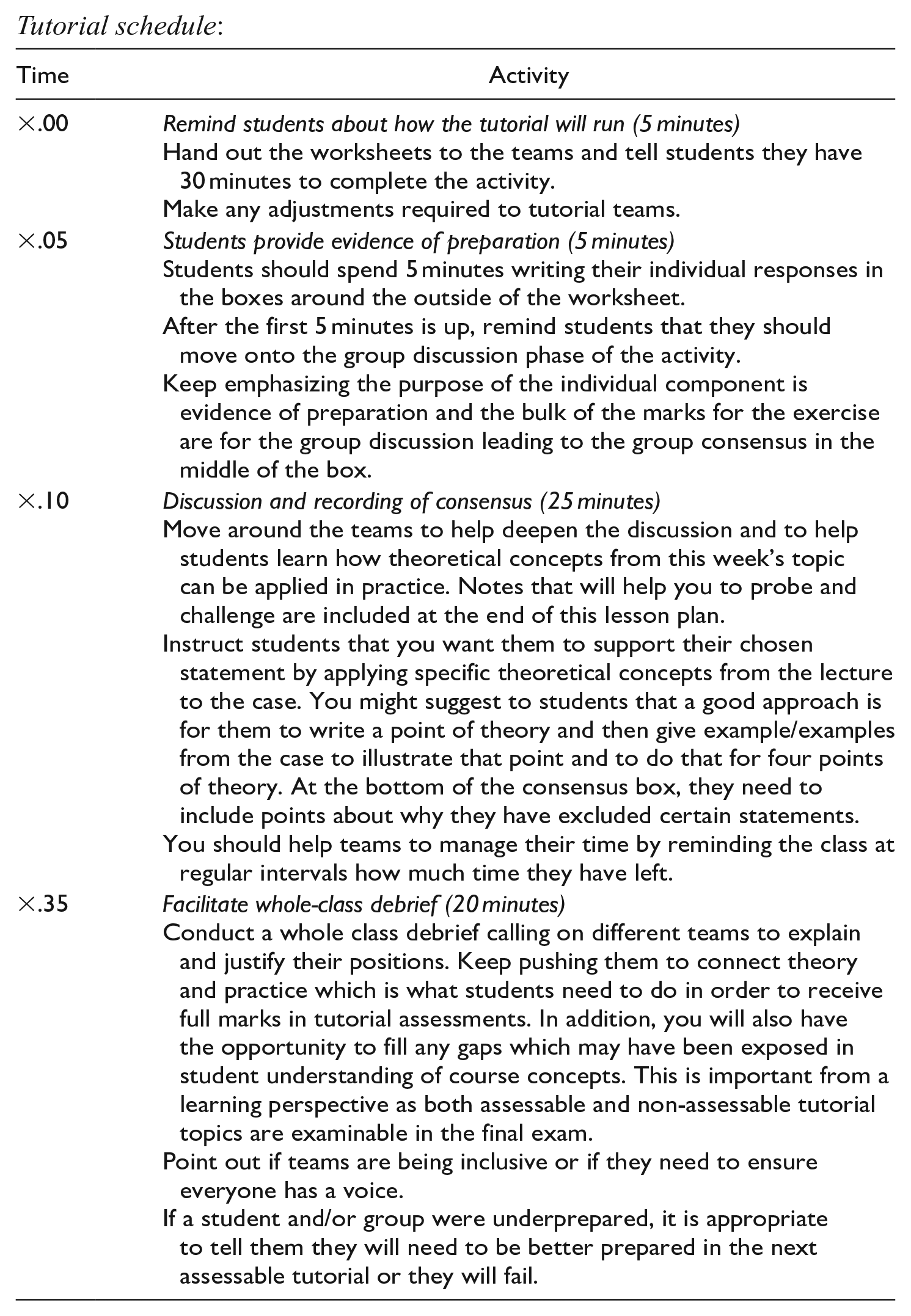
Appendix C: Example Tutorial Guide (Provided to Teaching Assistants Before Class)
Tutorial schedule:
| Time | Activity |
|---|---|
| ×.00 | Remind students about how the tutorial will run (5 minutes)
Hand out the worksheets to the teams and tell students they have 30 minutes to complete the activity. Make any adjustments required to tutorial teams. |
| ×.05 | Students provide evidence of preparation (5 minutes)
Students should spend 5 minutes writing their individual responses in the boxes around the outside of the worksheet. After the first 5 minutes is up, remind students that they should move onto the group discussion phase of the activity. Keep emphasizing the purpose of the individual component is evidence of preparation and the bulk of the marks for the exercise are for the group discussion leading to the group consensus in the middle of the box. |
| ×.10 | Discussion and recording of consensus (25 minutes)
Move around the teams to help deepen the discussion and to help students learn how theoretical concepts from this week’s topic can be applied in practice. Notes that will help you to probe and challenge are included at the end of this lesson plan. Instruct students that you want them to support their chosen statement by applying specific theoretical concepts from the lecture to the case. You might suggest to students that a good approach is for them to write a point of theory and then give example/examples from the case to illustrate that point and to do that for four points of theory. At the bottom of the consensus box, they need to include points about why they have excluded certain statements. You should help teams to manage their time by reminding the class at regular intervals how much time they have left. |
| ×.35 | Facilitate whole-class debrief (20 minutes)
Conduct a whole class debrief calling on different teams to explain and justify their positions. Keep pushing them to connect theory and practice which is what students need to do in order to receive full marks in tutorial assessments. In addition, you will also have the opportunity to fill any gaps which may have been exposed in student understanding of course concepts. This is important from a learning perspective as both assessable and non-assessable tutorial topics are examinable in the final exam. Point out if teams are being inclusive or if they need to ensure everyone has a voice. If a student and/or group were underprepared, it is appropriate to tell them they will need to be better prepared in the next assessable tutorial or they will fail. |
Appendix D: Example Blank Tutorial Worksheet (Provided to Students in Class)
Appendix E: Example Completed Tutorial Worksheet (Completed by Students in Class)
Appendix F: Example Tutorial Summary Marking Sheet (Optional: For Use by Teaching Assistants to Help With in-Class Marking)
Appendix G: Example Marking Rubric
Each week students receive formative in-class feedback in the form of the instructor/TA’s engagement in the team discussion and during the whole class debrief. After assessable tutorials students are provided with summative feedback in the form of the above rubric, written comments on their worksheet and a verbal discussion with the instructor/TA in the following class.
Appendix H: Details for Implementing the TaBLE Case Method
Declaration of Conflicting Interests
The author(s) declared no potential conflicts of interest with respect to the research, authorship, and/or publication of this article.
Funding
The author(s) received no financial support for the research, authorship, and/or publication of this article.
