




Abstract
At a time when emerging technologies increasingly transform the workplace and society overall, management educators seem reluctant to fully embrace emerging transformative technologies in their teaching. In this conceptual essay, we argue that this reluctance stems from paradoxical tensions of identity of management educators and students. The case is made that, currently, management educators tend to display their expertise to meet students’ reductionist curiosity. We recommend that management educators move beyond an initial reductionist curriculum to harness the opposing forces created by the paradoxical tensions of identity, which means embracing vulnerability at the same time as stimulating students’ expansionist curiosity. Our pedagogic recommendations are based on our experience of integrating generative and non-generative artificial intelligence, as well as esports and virtual reality as a preparation for the metaverse, into our curriculum. The essay concludes by proposing a sequence of three steps that might guide management educators in their preparation to integrate emerging technologies in the classroom in a way that empowers students to envision shaping the unknown future in an innovative and responsible way.
Keywords
Introduction
This conceptual essay aims to advance thinking on paradoxical tensions that might inhibit the responsiveness of management educators to prepare students for the fourth industrial revolution (4IR). A revolution that is “characterized by a fusion of technologies that is blurring the lines between the physical, digital, and biological spheres,” it heralds a transformation that “will be unlike anything humankind has experienced before” (Schwab, 2016, para.1). As a revolution in progress, the exact impacts on society and the planet are still unknown (Penprase, 2018); however, scholars agree that extreme and rapid societal and environmental changes will result (Fomunyam, 2019; Penprase, 2018; Xu et al., 2018). Consequently, higher education must respond as a matter of urgency to devise curricula that will enable students “both to comprehend the individual technologies in detail and to be able to thoughtfully analyze and predict the evolution of networked systems of technology, the environment and sociopolitical systems” (Penprase, 2018, p. 224). In relation to management education, D. B. Allen et al. (2022) highlight that disruption to and turbulence within the workplace will become the primary concern for future managers. These leaders will need to make decisions about which technologies to adopt, understand the implications for individual jobs and the nature of work in general, and coordinate evolving mixtures of human and automated work.
It is the implications for management leaders that led to S. J. Allen (2020, p. 365) sounding “an alarm” that management educators are not informed enough about disruptive or transformative technologies to prepare young people for their future careers in business. S. J. Allen (2020) recommended that management educators embrace a digital mindset and develop their tech literacy to design relevant curricula and learning experiences that will prepare students to successfully “navigate the path ahead” (S. J. Allen, 2020, p. 365). In their paper in response to S. J. Allen (2020), D. B. Allen et al. (2022) share their experiences of developing an elective course that aims to support students in navigating the uncertain future of technology and work, and help them develop a viewpoint about their role as prospective leaders. They recommend, among other suggestions, for management educators to become “guides and facilitators, rather than seasoned experts in an area of inquiry” (D. B. Allen et al., 2022, p. 200).
Our essay builds on S. J. Allen (2020) and D. B. Allen et al.’s (2022) contributions by exploring some of the tensions that management educators may experience in embracing (and advocating) a digital mindset in their educational environment. We do this by examining the tensions emerging within the contexts of two key stakeholder groups, the students and the management educators. When investigating the implications of these tensions for management education, we pay particular attention to the timing and sequence of aspects of the curriculum and propose a sequence of how to effectively harness the paradoxical tensions of identity. Our recommendations are also valid for courses that may ostensibly focus on non-digital aspects of management education.
Many factors, such as the perceived usefulness and ease of use influence the adoption and use of specific technology applications (Davis, 1989). Similarly, many factors such as “psychological, technological, resource, risk perception, and value factors” (Park et al., 2022, p. 579) influence users’ decisions toward adoption of emergent technologies generally. As part of this conceptual essay we focus holistically on the adoption of emergent technologies into management educators’ curricula. Figure 1 illustrates how paradoxical tensions of identity are interconnected to other factors that influence the decision of professors whether to adopt emergent technologies into their curricula.
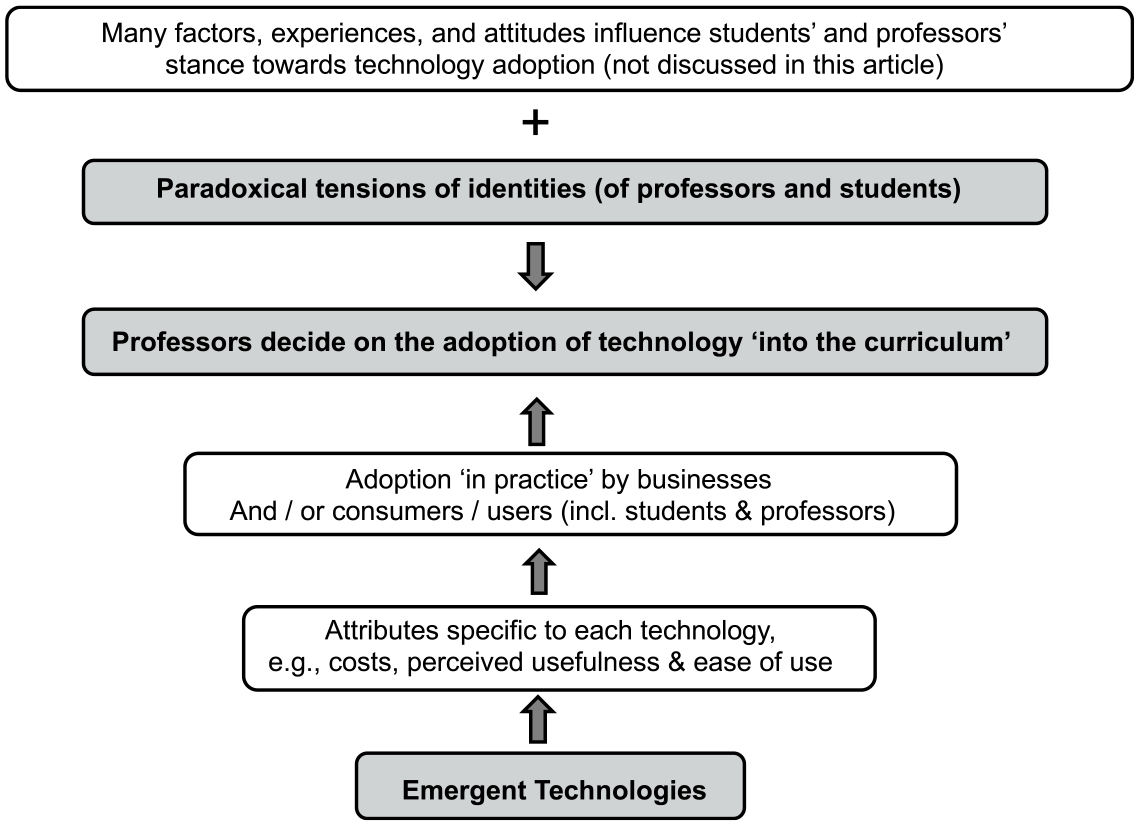
A multitude of factors influence the adoption of technology into the curriculum.
As a conceptual essay, this paper builds on the Journal of Management Education’s tradition of exploring contemporary issues through experiential experiences to extend or critique existing ideas and theories (e.g., S. J. Allen, 2020; Cunliffe, 2004; Eury & Treviño, 2019; Lebrón et al., 2020). We align most closely to the “theory adaptation” type of conceptual papers, as defined by Jaakkola (2020), in that we are using a new frame of reference (i.e., paradoxical tensions of identity) to problematize and propose a novel perspective on existing theory and literature. In relation to the call for this special issue, this essay contributes to the aim of surveying curricula that focus on the intersection of technologies enabling disruption and management education.
In this essay we examine an illustrative case from a UK business school as part of an inductive approach to building theory (Eisenhardt, 1989); however, as this is a single case, we acknowledge that our findings and conclusions are formed primarily through an adductive process (Timmermans & Tavory, 2012). We build on innovative curriculum examples from a UK business school’s courses that introduced esports and Virtual Reality (VR) for metaverse readiness, as well as two distinct types of large language models and transformer architectures for Artificial Intelligence (AI). These were integrated during the Spring and Summer terms of 2022 and 2023 to aid student learning and offer formative assessment feedback. This essay explores the tensions emerging within these examples from two different stakeholder perspectives: students and professors. While these stakeholder groups are intrinsically linked we see different paradoxical tensions arising: professors face a tension of questioning if time constraints are “worth it” independent of, or despite, student satisfaction, questioning the impact it has on their role as experts. Students might also question if the actual learning is “worth it,” measuring the worth from a different angle than professors. Is the teaching meeting their expectations of what they aimed to learn when joining university and is it assessed fairly so that they can achieve the best possible grade to enhance the chances of gaining their desired employment? By investigating the tensions across these two stakeholder groups, this essay goes beyond surveying curricula to illuminate undercurrents and consider the implications for management education.
The remainder of the essay is structured as follows. In the first part we review key literature on paradoxical tensions before discussing paradoxical tensions of identity initially from the student and then from the professor’s perspective. The second part of this essay consists of an illustrative case: after contextualizing the setting of the teaching underpinning this study, we review how the opposing forces of the tensions of identity outlined in the literature manifest themselves in the teaching environment, with a particular emphasis on curricular timing and sequence. We finish the essay by reflecting on the consequences and outline further considerations as well as concluding comments.
For simplification purposes we use management educators and professors interchangeably in this article. Moreover, even though not all emerging technologies are transformative, for the purpose of this essay we also use the terms emerging and transformative technologies interchangeably.
Part 1: Paradoxical Tensions
Paradoxes can be seen as “contradictory yet interrelated elements that exist simultaneously and persist over time. [They have] two components: (1) underlying tensions—that is, elements that seem logical individually but inconsistent and even absurd when juxtaposed—and (2) responses that embrace tensions simultaneously” (Smith & Lewis, 2011, p. 382). Smith and Lewis (2011) identified four dimensions: (1) Identity and Belonging, (2) Learning, (3) Organizing, and (4) Performing. Here we focus solely on the first dimension, identity and belonging, with an emphasis on tensions of identity of management educators and students. We also consider how to respond to the tensions identified. Smith and Lewis (2011, p. 385) highlight that responses to paradoxical tensions often “diverge between acceptance and resolution strategies.” They propose instead a more holistic theoretical model that recognizes the persistency, rather than resolvability, of conflicting forces. Embracing the permanence of opposing forces means that we may be better positioned to “harness the constant tension between them, enabling [a] system to not only survive but continuously improve” (Smith & Lewis, 2011, p. 386). In effect, systems and organizations should seek a dynamic equilibrium in which they are constantly adapting to the tensions pulling them in opposite directions. It is this state that ultimately “enables sustainability by fostering creativity and learning, enabling flexibility and resilience, and unleashing human potential” (Smith & Lewis, 2011, p. 394).
In line with Smith and Lewis (2011), we do not seek to resolve the tensions of identity experienced by management educators and students in this essay. Instead, we endeavor to better understand them, particularly in relation to a digital revolution that appears to accentuate the tensions further. Through this exploration, we may discover meaning that helps us to further navigate the intersections of technologies enabling disruption and management education.
Tensions of Identity I: Management Students—Dominance of Reductionist Over Expansionist Curiosity
We begin by exploring some of the paradoxical tensions of identity for management students. Particularly useful here is Huang et al.’s (2022) concept of expansionist versus reductionist curiosity, which we expand upon within our explorations. The need for students to develop and sustain an expansionist curiosity is implicit within calls for higher education strategies that respond to the implications of the 4IR. Huang et al. (2022) developed their curiosity concept in relation to the nature of management students’ problem-solving behaviors. They relate expansionist curiosity to behaviors in which students are solving problems by continually re-configuring ideas, creating and following tangent and emergent thoughts, changing ideas as they go along. In contrast, reductionist curiosity is demonstrated when students follow fixed lines of thought, becoming constrained and restricted by an established idea and rarely deviating to explore emergent possibilities. Whilst still a revolution in progress (Penprase, 2018), a central characteristic of the 4IR is uncertainty about its impacts on and implications for society, the environment, and the world of work. As such, working within established ideas and patterns may not fit the solutions to problems that management leaders will face as the revolution progresses. Indeed, there may rarely be “a solution” to find and apply, but instead a need to continually analyze, predict, consider, alternate, and so on, to navigate the entanglements and blurred physical and digital lines that this revolution brings. We may argue then that student preparedness for the 4IR depends on them developing an expansionist curiosity.
A justifiable question here relates to the extent to which an expansionist mindset can sit comfortably within a consumerist identity that has been attributed to students in higher education (Naidoo et al., 2011; B. Wong & Chiu, 2019). We might in fact see these as two opposing forces pulling the student identity, and responses from management educators, in different directions. This clash of identity and mindset may be even more troublesome in business and management contexts. Business school’s may be viewed as the “cash cows” of an institution; they are often one of the biggest schools in an institution and are typically “large income generating units” (Sutherland et al., 2018, p. 621). A victim of their own success means that they must continue to attract large numbers of students and sustain high levels of enrolment and progression. Gross and Hogler (2005) argue that this situation may drive a consumerist agenda in which professors, in essence, chase student satisfaction, placing them as the “privileged stakeholder” (p. 11) whose desires shape curricula content. There is evidence that students evaluate harder courses more harshly (Denson et al., 2010; Stroebe 2020), which may suggest some resistance to learning that challenges them, makes them feel uncomfortable or disrupts their notions of “certainty.” With income so enmeshed with student satisfaction (and so with the student-as-consumer identity), professors might be hesitant about engaging in a pedagogy that students may initially “punish” in their evaluation scores.
The higher education context itself then may be a powerful shaper of consumerist identities. Evidence also suggests that this identity is more prevalent in business school students. Sutherland et al.’s (2018) research confirms prior commentary suggesting that business school or management students are more inclined toward extrinsic motivations for studying and following instrumental learning behaviors (Coates & Koemer, 1996; Ottewill, 2003). Instrumental learning is defined as learning to achieve an extrinsic goal or objective, with lesser importance attached to enjoyment of or enthusiasm for the content being studied (Ottewill, 2003). Sutherland et al. (2018) synthesize a range of research indicating business school students’ preference toward studying for extrinsic reasons, such as gaining marketable qualifications and improving starting salary prospects. As such, their priority is to achieve good grades rather than master the subject. This characteristic appears to be confirmed in Sutherland et al.’s (2018) own research comparing National Student Survey (NSS) data, which indicates the greater importance attached to fair assessments by business school students as opposed to non-business school students. A preoccupation with fair assessments may be seen as a feature of instrumental learning in that assessments that, from the students’ perspectives, are clear, transparent and aligned to curriculum content will ensure them greater opportunities to achieve the best external outcomes (i.e., grades, degree classification, etc.). Whilst these student motivations may not be surprising given the “increasingly expensive personal investments in their university courses” (Sutherland et al., 2018, p. 642), they do imply a mindset that may prefer reductionist rather than expansionist learning. In confirmation are Sutherland et al.’s (2018, p. 643) own conclusions: “Our results imply . . . that teaching styles which reward instrumental learning approaches are more strongly rewarded in the [business school] context.”
There are, of course, opportunities that come from recognition of the personal investment that students increasingly have to make to their higher education. Co-creation and students-as-partners are concepts being increasingly promoted and embedded within institutional strategies. These go beyond simply responding to the consumerist agenda to recognizing the value of meaningfully collaborating with students to enhance access, inclusivity, wellbeing, belonging, community, and so on. A tension, however, within the 4IR is that co-creation with current students, or in consumerist terms, curricula being driven by the desires of current intakes may be limited in terms of preparing them for the uncertainty of the future. How can we expect students to know what they need to learn to equip them for an unfolding revolution? That is not to say that we do not work with our students, but instead that we may need to expand our notion of the “privileged” student stakeholder group to include alumni. A meaningful and longitudinal relationship with previous students who are working at the forefront of the 4IR, and potentially as disruptors themselves, will inform institutions and professors of the extent to which the integration of technologies enabling disruption is being responsive and students are being equipped to take their own part. It is not our place to propose the specific mechanism(s) by which these longitudinal links should be formed and maintained, beyond suggesting that the digital world offers great and varied opportunities for connections. Instead, institutions may want to consider how they center a more privileged relationship with their alumni and recognize the essential intelligence that this stakeholder group can provide.
Tensions of Identity II: Professors—A Relentless Pursuit of Expertise
In anticipation of the 4IR, business management educators might be both unfamiliar with emerging transformative technologies and underprepared (S. J. Allen, 2020). This dilemma is exacerbated through the professor’s predicament of a constant need to display expertise, with expertise being an internally-driven quest to excel professionally; professors showing off what they know and how well they are able to teach what they know (Will, 2022). This quest to demonstrate expertise might lead to maintaining the status quo rather than thriving toward the unknown.
Building on Kegan’s (1983) work, Will (2022) sees two main underlying reasons why professors rely on expertise. Depending on which of the two reasons is predominant for each professor in their own quest of expertise, Will (2022) labeled the two types of professor “socialised” versus “self-authoring” professor. On the one hand, “socialised” professors, by having learned to behave in such a way, perceive as an existential threat to be seen by others, colleagues and students, “as less than fully competent, as not knowing exactly what to do, as being unworthy of high regard” (p. 676). On the other hand, “self-authoring” professors might see themselves as the authors of the system that relies on expertise. For them, disruption to the functioning of the self-system is seen as an existential threat. For “self-authoring” professors, this can be expressed through the following types of logics: “’not only do I want to be right, but I can never be not right’; ‘not only do I want to be brilliant, but I can never be not the most brilliant’; ‘not only do I want to be distinct, but I can never be not entirely unique’” (p. 679).
When extrapolating from the general population, “socialised” and “self-authoring” professors together represent approximately over 90% of professors. For both types of professors, the need to be an expert or to be seen as an expert, reduces the range of behavioral options that they consider acceptable. Both types of professors are drawn toward traditional and standardized teaching approaches to reduce risks, especially as the current way of doing things pleases the customers, that is, the students, which in turn comforts professors (Will, 2022). Therefore, “despite the knowledge explosion, many of us continue to teach the way we always have: covering the content” (DiCarlo, 2009, p. 257). Teaching the same content that we know well has a further advantage: lesson preparation is less time-consuming, especially important considering a perceived lack of time by academics (Baker et al., 2009), with teaching of novel content more time-consuming, demanding, and complex than anticipated (Cuddapah & Stanford, 2015). Finally, a further classroom constraint that has been identified is the variable skill level among students (Cuddapah & Stanford, 2015), which will enlarge with technology. For example, for Fintech or coding, unlike for modern foreign languages, it is uncommon for management education to offer different levels of proficiency, often leading to discontent among students. For professors to prepare differentiated input for different skill levels within the same classroom is time-consuming and difficult (Maulana, 2020). Differentiation by student output in their summative assessments seems the easier and more common option, an option that does not seem to influence the professors’ position as experts.
While there are exceptions, and we discuss these in our further considerations section toward the end of this essay, our message so far is that of a balance, an equilibrium, between students and professors. Students opt for an instrumental approach, displaying reductionist curiosity, rewarding with positive student evaluations professors who want to be, and be seen as experts, delivering a reductionist curriculum tailored to their expertise. Figure 2 summarizes the main identity-related paradoxical tensions that we have explained so far. At the current equilibrium, management educators are able to display their expertise to meet students’ reductionist curiosity and mindsets. In this essay we suggest that management educators now need to move into the domain characterized by expansionist curiosity and mindsets, illustrated in Figure 2 through the use of dashed lines.
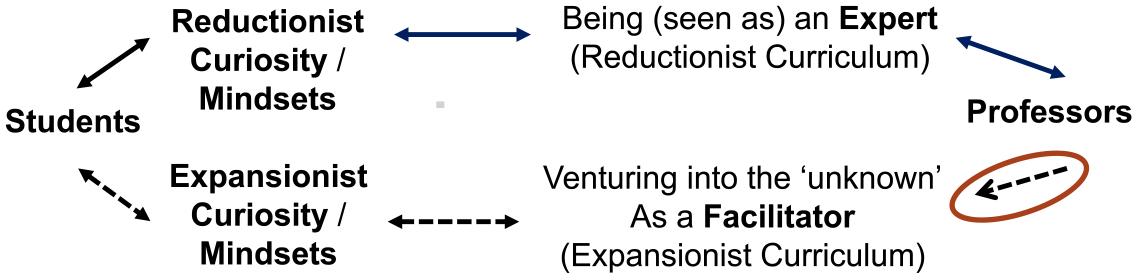
Tensions of identity in management education.
So how to solve the tension between the goal of wanting to be seen as an expert who belongs to the community of expert academics, when facing time constraints to acquire novel and differentiated content in the area of new cutting-edge technologies? Expanding on Kegan (1983), Will (2022) suggests for professors to embrace vulnerability and competing perspectives, to consider oneself as having multiple identities rather than a single identity, to identify problems rather than providing solutions, to forge deep social connections with other academics as well as non-academics, and to adopt a double-loop approach that asks professors not solely to consider what they do and what they get, but also query why they do what they do. Other literature on curricula points out that while knowledge transmission currently still plays the predominant part, praxis-oriented skills, linked to action and self, should be increased (e.g., Barnett et al., 2001). This would result in a balanced curriculum (see Barnett et al., 2001, and DiCarlo, 2009) that allows the space to create innovative ideas. The latter is particularly important, considering that “the scarcest and most valuable resource in an era driven by digital technologies will be [. . .] people who can create new ideas and innovations” (Xu et al., 2018, p. 93). This is in line with Lyotard’s (1984) prediction that computerization contributes to an exteriorization of knowledge from knowers, with knowledge itself being less important than what knowledge can do.
Part 2: Illustrative Case
The Setting: Contextualizing Our Attempt to Include Transformative Technologies for Teaching and Learning
This conceptual essay presents insights gained from including emergent technologies in the curriculum of four courses at a leading UK business school between January and May 2022 and again between January and May 2023. The emergent technologies were AI, specifically BERT (Bidirectional Encoder Representations from Transformers) and GPT (Generative Pre-trained Transformer) large language models, as well as esports and VR to illustrate potential blueprints of a metaverse. While including our insights as an illustrative example of a conceptual essay, research ethics approval was in place to draw on student and staff surveys, focus group discussions, and student evaluation feedback. Students participated voluntarily and gave informed consent. Data were anonymized.
The four courses covered a range of topics and year groups. All courses had the word “digital” included in their course title and at least in one of their learning outcomes. Broadly, the courses aimed to prepare management students to make informed and ethical decisions, and to take an active role in building the future AI-enabled and/or metaverse ecosystem. Students were encouraged to experiment with and to reflect on digital innovations and to find solutions to problems. By focusing on the metaverse and esports, for example, students were also able to learn about tangential technological aspects, such as blockchain and NFTs (Non-fungible tokens). In addition to technologies, students learned about business models and marketing avenues related to the metaverse, esports, and related aspects, such as avatars and their skins. Students were also encouraged to reflect on the convergence of technology, ethics, science, psychology, digital wellbeing, and the impact on environmental and social sustainability.
Authentic assessments were used, allowing students to follow their particular interests by choosing their own topic within a broadly pre-defined work-related field. These novel assessments were introduced in the previous year, in 2021, which allowed for comparison with prior cohorts. For the assessments in 2022, and maintained in 2023, students across all four courses were able to submit their draft assignments to receive AI-generated formative feedback. We developed the “formative feedback on demand” tool in-house, using among other components BERT. In 2023, with the introduction of generative AI, we experimented with Bard and ChatGPT in the classroom, encouraging students to embrace generative AI. Also in 2023, we added to the previous assessment a critical reflection on how (generative) AI supports students’ learning, how they fine-tune prompts, and which wider ethical questions they consider important. Figure 3 summarizes the timeline of the introduction of innovative course components.
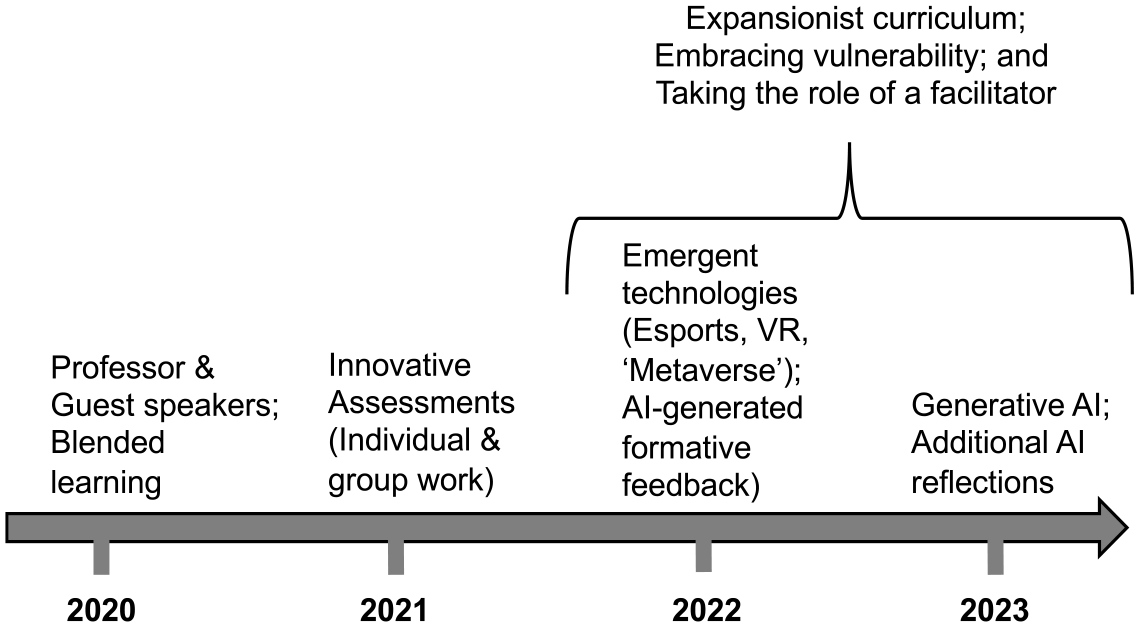
Introduction of new course components (maintained subsequently).
In line with the suggestions made earlier in this essay by Will (2022), when introducing emergent technologies, we embraced vulnerability and acknowledged our limitations. For example, we emphasized that the metaverse is not yet defined, that we were not esports experts, that generative AI was new for all, and that the AI-generated formative feedback tool was a minimum viable product. To compensate we maintained connections inside and outside higher education (a further suggestion by Will, 2022) which enabled us to invite guest lecturers who faced these technologies in their work, and encouraged students to apply praxis-oriented skills (Barnett et al., 2001) to experiment with technologies. We saw ourselves as moving from discipline expert of a reductionist curriculum to facilitator of an expansionist curriculum (D. B. Allen et al., 2022).
Throughout, our aim was for these actions to contribute to a more balanced curriculum (Barnett et al., 2001, and DiCarlo, 2009) that encourages students to embrace expansionist curiosity (Huang et al., 2022) to be able to use emergent technologies innovatively and responsibly.
Findings and Reflections From Our Teaching
Applying the double-loop approach outlined earlier in the conceptual part of this essay (Will, 2022), we reflected on why we do what we do. We concluded that we are driven by a post-course consciousness: aware of the many unknowns, we genuinely believe that our courses offer students what they need to learn to take an active role in ideating and designing a fast-moving future that is ethically, socially, and environmentally responsible and sustainable. While we did not want to be seen as experts in the field, we did want to be recognized as innovative by peers and students. We believe that these goals align with the definition of being (seen as) a “socialised” professor.
So—having invested a substantial amount of time to develop and deliver novel teaching and innovative AI-generated formative assessment feedback—did we feel “adequately” recognized by peers and did it lead to higher student satisfaction? The short answer is “No, probably not on both accounts.”
When asking peers in a formal committee meeting if they thought, in principle, that the provision of AI-generated formative feedback such as the one we developed is a good idea, colleagues did not endorse the idea but rather asked for more longitudinal findings as well as endorsements from other institutions first. Colleagues were worried about the quality and the risk of student complaints. They queried whether in-house developed AI could actually provide the same level of expertise as them, the experts, and whether at a lower, less complex level, the output is indeed desirable. When shown the actual AI-generated output, colleagues responded with comments demonstrating a relief that they, as “expert assessors,” were not about to be replaced. Comments included “Interesting. For now, I would still draw the conclusion that humans are the better feedback writers” and “It is interesting, but I don’t think it is close enough to start replacing human feedback.”
As for students, the majority of students endorsed the AI-generated formative feedback tool. In a survey of 115 student responses, the majority of students thought that the AI-generated formative feedback they received prior to submitting their summative assignments was very helpful and an excellent idea. Over one third of students even considered the AI-generated feedback as more effective than human-generated feedback.
While students endorsed the AI-generated feedback tool and displayed assessment outputs that seemed more creative and better written than in previous years, in 2022, compared to 2021, the student evaluation scores did not increase as we had expected but remained at the same (good) levels as the previous year. In 2023, with the introduction of generative AI, and us experimenting with Bard and ChatGPT in the classroom, and students for their assessments, compared to all previous 3 years, student satisfaction decreased.
Qualitative course feedback showed that the inclusion of technology made students much more critical of non-technology content: the same guest speakers that were seen in the previous year by many students as a positive feature received recurrent negative comments. Similarly, while previous students were happy with carton-based headsets using their own mobile phones to experience VR, now students would have appreciated sophisticated VR headsets. In 2023, the same course outline with additional “generative AI interventions” suddenly became for some students “unstructured” and in parts “redundant.” Absent in 2023 was any mention of technology (positive or negative). This is in contrast to 2022 where several students (successfully) nominated one of us for a business-school-internal teaching award by emphasizing the approach to technology, as the following comment illustrates.
The professor truly puts a lot of effort into making her lectures and seminars as engaging as possible. She has also introduced us to many new and interesting concepts that may help us in the future. Additionally, she has provided us with many interesting tools to work with within her classes, an AI (machine learning) tool that can give us feedback on our assignments, a tool that trains AI, and so much more.
A focus group discussion asking students explicitly why they thought that the student feedback had not increased in 2022 despite the increased innovative use of technology and even decreased in 2023, revealed a potential “Goldilock principle” mismatch. “Goldilocks and the three bears” is based on an old English fairy tale, which was/is reused by various education authors as “Goldilock principle” of “neither too hot, nor too cold, just right” (e.g., D. M. Kagan, 1990). From the management students’ perspective, we did not get it pedagogically right, that is, it was either too easy or too difficult for students.
To illustrate too easy, students commented on a “generational dichotomy” (Prensky, 2001) with an emphasis on them, the students, being “digital natives,” unlike us, the professors, being “digital immigrants.” A student voiced: “It is impossible for you to create a ‘wow’ moment with technology. We are digital natives born with technology and growing up with it. If we are interested in learning about how any technology works we can do it for ourselves.” An aspect that this student possibly ignored is the affordability aspect of trying new technologies that are VR or AI based: when asking students on the day following the launch of the new plugins from the payable ChatGPT version who had already tried the new plugins, only approximately 10% of students raised their hands.
As for too difficult, students said that in places technology seemed too difficult, as this student comment illustrates: “students may feel overwhelmed. For example, if you hear about artificial intelligence, you may think of complicated algorithms and stuff like that.” Other students explained that while they “really admire [our] tenacity and passion for digital transformation,” many students are actually worried about their professional future and want to hear more about “AI’s limitations, to make them realize the unique value humans can bring, reducing concerns about AI replacing them.” Noticeable was that throughout the student feedback, when students provided feedback on “difficulties,” they talked in the third and second person, using the words ”students” and “you,” while for the “too easy” discussion they positioned themselves in the first person, both singular and plural, that is, using either “I” or “we.”
To reach a “just right” level there also seemed to be an expectation misalignment with students, despite the intervention, maintaining solely reductionist curiosity (Huang et al., 2022), which this quote shows: Our expectation of the course objectives was vastly different from deep diving into technology. The majority of students that are studying management just want to become aware that these technologies exist and how companies can use them with the benefits and disadvantages of that particular technology in the business world. The use cases on the metaverse were the most interesting. For example, when we learned how Louis Vuitton is using the Metaverse.
This was mirrored also for generative AI, where a student representative told us that instead of encouraging students to explore (generative and non-generative) AI tools, they would have wanted “to hear how companies effectively use the tools as this is much more transferable for our future careers.”
Reflecting back on our aim to harness paradoxical tensions of identity to deliver an expansionist curriculum that raises expansionist curiosity (Huang et al., 2022), by following suggestions such as vulnerability and outlining problems rather than solutions (Will, 2022), we felt that we did not achieve our aim. Many students did neither embrace the expansionist curriculum nor did they display expansionist curiosity. Instead, students voiced that rather than experimenting with transformative technologies, they were interested in just hearing about further examples of how businesses deploy technologies.
As the following recommendation section will outline, this made us understand that to embrace paradoxical tensions of identity, management educators should not become “guides and facilitators,
Recommendations for Management Educators: The Power of Harnessing Paradoxical Tensions Effectively
As explained in the theoretical section of this essay, to harness paradoxical tensions, Smith and Lewis (2011) suggest finding a dynamic equilibrium between the opposing forces of the tensions to unleash human potential. When combining this with the findings of the illustrative case, our recommendation for management educators, to teach and influence students effectively in preparation for the 4IR, is to support students’ reductionist curiosity first.
Within reductionist curiosity we recommend discussing first different approaches to everyday use of technology and attitudes toward different types of technology. Students, as “digital natives,” seem to want to be acknowledged for what they already know and are good at. It is also important to empathize with students’ likes and concerns to ensure they embark with the management educator on a journey of discovery.
As a second step, and still within reductionist curiosity, before embracing any vulnerability, it seems important for professors to get “esteem” by displaying discipline expertise with valuable transferable insights from theory and practice.
Only once the thirst for reductionist information is quenched, do we recommend for management educators to become guides and facilitators (D. B. Allen et al., 2022) and to move toward the “unknown,” that is, move onto topics, technologies, or technology applications that require expansionist curiosity from the management students and vulnerability from the professor. We expand on D. B. Allen et al. (2022) by emphasizing that timing and sequence matter substantially: The change from discipline expert of a reductionist curriculum to facilitator of an expansionist curriculum needs to take place at “just the right moment.” This then allows professors to harness the full power of paradoxical tensions to explore technologies and topics still in development that are not yet fully understood by neither students nor professors.
Figure 4 illustrates our recommendation. Similar to Herzberg’s (1968) claim that hygiene factors need to be fulfilled before employees can be motivated, we recommend that the students’ reductionist curiosity has to be met before taking them on an expansionist journey that allows the future leaders of tomorrow to envisage deploying transformative technologies in innovative and ethically responsible ways.
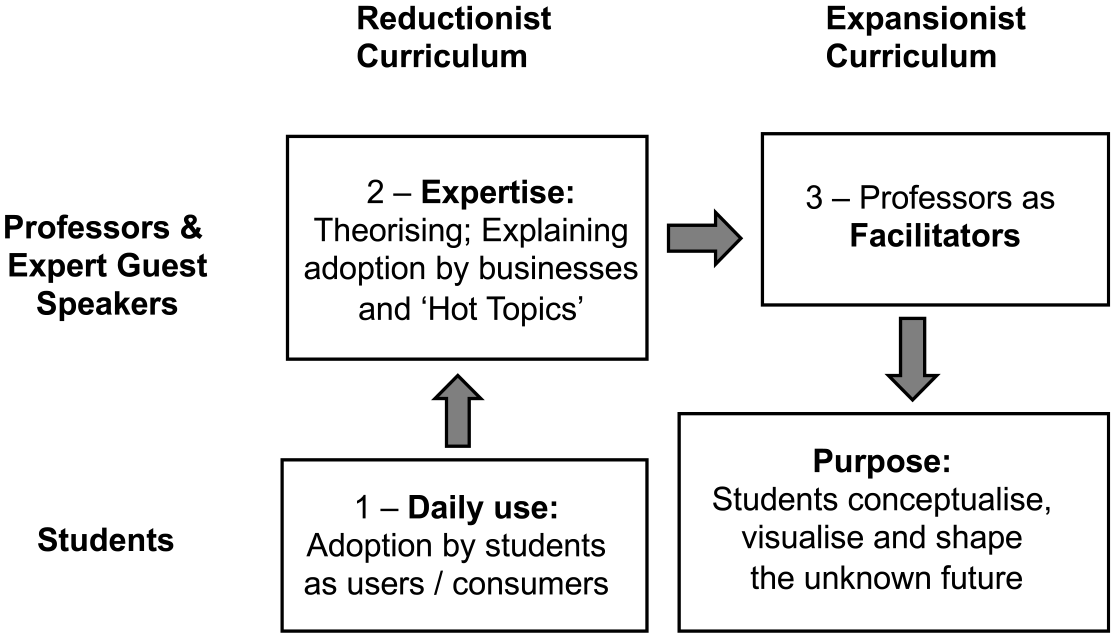
Recommended pedagogic approach in preparation for the 4IR.
Further Considerations
The recommendations outlined in this article are, of course, to a certain degree subject-specific. Similarly, the class size and the approach fellow management educators take, matter: the transition from subject matter expert to guide and facilitator might be easier for small class sizes and if students have already experienced a similar approach in other courses.
While our findings stem from four different courses from different year groups, in our opinion our findings are particularly insightful for pre-experience Masters students who only study for their masters in the UK for one single year. Compared to Undergraduate students, time is of the essence, and compared to executive MBA students, most pre-experience Masters students do not have work experiences. Both of these factors are possibly exacerbating the Masters students’ preference to fulfill their reductionist curiosity “fast.”
Of course, pre-experience Masters students are not one coherent group either, and we do not want to convey the impression that our view is not more nuanced. Indeed, as part of our research, we did collect demographic characteristics across gender and race, however, due to the word constraints of this essay, we do not explore this area in any detail. Also, because of word constraints we do not explore further stakeholder groups. University leaders, accreditation bodies, or government regulators, for example, might face different paradoxical tensions to those of professors and students. Finally, further research into the role that Technology (Tech) and Educational Technology (EdTech) firms play in influencing the universities’ stance toward deployment of transformative technology, might also produce insightful findings.
Concluding Thoughts
As per the call for contributions to this special issue, technology has the potential to be used as a tool, topic, and differentiator in management education. Yet, there is still some way to go for management educators to embrace the revision of their role from discipline expert to facilitators (D. B. Allen et al., 2022). Our conceptual essay has provided further insights into what might explain this gap and how to narrow or even close it. We extended the view of S. J. Allen (2020) and D. B. Allen et al. (2022) and explained that even more important than functional knowledge and innovative content, is the embedding of these with a pedagogy that harnesses the dynamism of opposing forces of paradoxical tensions of identity at the right time.
In the title of our conceptual essay we asked the question “Is it worth it?.” We do hope that readers, independent of whether they are “socialised” or “self-authoring” experts, find it worth exposing their own vulnerability at the right time in their course’s learning journey, by acknowledging the uncertainties of the impact of current and future emerging technologies. Moreover, we hope that readers find it worth to encourage students who seem proud “digital natives” to get unstuck and evolve from reductionist thinking to expansionist thinking. Finally, we also hope that readers find it worth trialing our recommended pedagogy when including transformative technologies in their classrooms and thus preparing students as effectively as possible for our joint future.
Footnotes
Acknowledgements
We would like to thank colleagues at Warwick Business School for their input and conversations that helped to develop this work, in particular April Wright. We would also like to thank reviewers and editors at JME for their constructive feedback.
Declaration of Conflicting Interests
The author(s) declared no potential conflicts of interest with respect to the research, authorship, and/or publication of this article.
Funding
The author(s) received no financial support for the research, authorship, and/or publication of this article.
