




Abstract
The extant literature indicates that blended learning leads to better outcomes compared to traditional lectures in management education. However, the working memory, which processes all incoming information, can be assumed to already work at capacity in traditional lectures. As blended environments cannot extend this capacity, they can only improve learning effectiveness if they can influence the mechanics underlying the working memory. Drawing on cognitive load theory from educational psychology, we posit that blended learning, by using technology as a differentiator, provides instructional designers with additional options and tools. When utilized effectively, these choices can reduce learners’ cognitive load related to the design and increase cognitive load related to learning. Our assumptions are based on a case study with two different learning formats, including a blended environment that actively integrates technologies into the curriculum. Empirical evidence supports our hypotheses. We contribute to educational technology research in management education by explicitly considering the mechanics of the cognitive system and the effects of instructional design, curriculum choice, and related technology use. Our results suggest that blended environments can improve learning effectiveness if technologies are well integrated into curricula. Educational technologies, thus, provide entirely new opportunities for management educators but also require faculty development.
Keywords
Introduction
Technology-based learning environments, that is, learning environments that consider technology as a differentiator, have become increasingly important for researchers and instructors of management education (Arbaugh et al., 2009; Redpath, 2012). Blended learning refers to a specific technology-based learning environment that combines classroom teaching with online learning through the use of learning technologies (Wu et al., 2010). Despite some inconsistent findings on the effects of blended learning environments and the employed technologies on learning effectiveness (Arbaugh et al., 2009), the majority of studies indicate that instructional strategies and curricula that take advantage of a blended learning approach lead to better learning outcomes (Snowball, 2014; Walker et al., 2013).
Educational psychology research investigates cognitive mechanisms across learning environments and has found that processes in the human cognitive system, especially in the working memory, influence learning effectiveness (Mayer & Moreno, 2003). Since the capacity of the working memory is highly limited at one point in time, it can be assumed that the working memory is always almost fully used, regardless of the format of instruction (Sweller et al., 1998). As blended learning environments and the respective learning technologies cannot extend this limited capacity, they can only positively affect learning outcomes if their instructional designs trigger a more efficient use of the working memory’s capacity by influencing its underlying mechanics.
Sweller (1988) developed the cognitive load theory, which assumes that learning effectiveness is higher when the corresponding learning conditions are aligned with the mechanics of the working memory. He suggests that the limited capacity of the working memory is distributed among three types of cognitive load, which depend on the type of the learning content and the design of the learning materials, and which differ in their relevance for learning (Sweller et al., 1998). Intrinsic cognitive load depends on the type of the learning content, that is, the number of underlying information elements and their interactivity, and can hardly be changed for a given learning objective (Ayres, 2006; Paas et al., 2003). Extraneous cognitive load results from the design of the learning materials and involves cognitive processes that are irrelevant for making sense of information (Mayer & Moreno, 2003; Sweller, 1994). The remaining capacity of the working memory can be invested in germane cognitive load, which is relevant for the organization and integration of new information elements with prior knowledge and, herewith, influences learning (Mayer, 2002).
Based on the cognitive load theory, a higher level of learning in a blended environment requires a positive effect on germane cognitive load. Since a blended learning environment and respective technologies cannot increase the total capacity of the working memory, such an additional amount of germane cognitive load can only be achieved through savings in extraneous cognitive load, given fixed learning objectives that come with similar content difficulty and, thus, a constant level of intrinsic cognitive load.
As such, for any given instructional strategy, learning objectives should be set in a way that a desirable level of intrinsic cognitive load is established. The designer can then select and configure blended learning options to reduce extraneous load and increase germane load. In our paper, we provide a theoretical argumentation for why these effects exist and offer empirical evidence that supports our theory.
As a baseline hypothesis, we posit that blended learning environments increase learning effectiveness if executed effectively, as the inherent technologies provide additional design options and tools. We continue to argue that blended learning environments and related technology choices do not affect the level of intrinsic cognitive load, as intrinsic cognitive load depends on the learning objectives as well as the type of the learning content and not on the format of instruction. We further posit that the broader range of available design options and tools in blended learning environments allows the designer to configure options that can reduce the degree of extraneous cognitive load through technology and material designs. While the blended learning approach does not exclude any of the design options from traditional lectures, it offers a variety of additional tools to choose from in order to accomplish the learning objectives. Moreover, we hypothesize that blended learning environments—due to the broader range of available design options and tools—allow the designer to configure options that increase the level of germane cognitive load through, for example, a more effective presentation of the learning content and a higher learner exposure to different perspectives, which are both beneficial for organizing and integrating new information. Empirical evidence from a case study involving 115 graduate management students, who attended either a traditional lecture or a blended learning environment, confirms our hypotheses.
Our paper contributes to educational technology research in management education through the explicit consideration of the operating principles of the human cognitive system in blended learning environments. Compared to specific cognitive mechanisms, such as motivation, which have already been studied in management learning environments (López-Pérez et al., 2011; Selim, 2007), cognitive load represents the psychological basis of all learning activities and can explain how and why blended learning environments and respective technology usage impacts learning effectiveness. This also affects the designs of empirical studies on blended learning environments in management education research, which should specifically pay attention to and evaluate the different types of cognitive load and their influences on learning effectiveness. We provide theory and evidence that instructional design options and tools that foster germane cognitive load should be encouraged, and designers should attempt to reduce extraneous cognitive load, regardless of the technology employed. However, the use of learning technologies in blended learning environments, if executed effectively, can affect cognitive processes and facilitate learning in a preferred way. Hence, our findings not only concern management education scholars, but also instructors who design blended learning environments for business schools or corporate learning programs as well as the faculty developers. Here we provide some tangible design recommendations that management educators and faculty developers can implement to benefit from the greater variety of options in blended learning environments and increase learning effectiveness.
Theory and Hypotheses
Learning Effectiveness of Blended Management Education
Technology-based learning environments have gained in importance for both management education scholars and instructors (Arbaugh et al., 2009; Redpath, 2012). A special type of technology-based learning environments are blended learning environments that combine classroom learning with the use of technologies, which can particularly support phases of distance learning (Wu et al., 2010). The term blended learning is often broadly used to refer to any form of technology-based learning, ranging from traditional classroom teaching with little technology support (e.g., online quizzes, videos) to complete online curricula with little or no in-person elements (López-Pérez et al., 2011). Nevertheless, the most common form of blended learning is a combination of classroom sessions and distance learning phases (López-Pérez et al., 2011).
Although findings on the effectiveness of blended learning environments in management education are partially inconsistent (Arbaugh et al., 2009), the majority of research indicates that they can improve learning effectiveness (Arbaugh, 2014). Snowball (2014), for example, finds that replacing one lecture per week with online elements (e.g., videos, podcasts, discussion forum, and quizzes) supports different learning styles, enables scaffolding, and offers both peer and system feedback, which has a positive effect on exam performance. Lancellotti et al. (2016) confirm that the introduction of short online videos to the traditional lecture improves actual learning, as they enable learners to watch the explanation of concepts multiple times and, thus, reinforce them. Asarta and Schmidt (2017) employ a flipped format in which slides with audio narrations are provided online while subsequent classes are optional and cover only discussions and application exercises. They show that learners’ prior knowledge moderates learning performance and that a flipped environment can be particularly beneficial for stronger students. Deschacht and Goeman (2015) also find that blended learning environments—consisting of supported self-study, online cooperation, and classroom teaching—lead to higher exam performance, but argue that results might be biased by higher dropouts of typically weaker students. López-Pérez et al. (2011) contradict this position and show that a combination of traditional classes with online exercises for reviewing and deepening contents can reduce dropout rates and improve exam performance. They find that outcomes primarily depend on learner motivation, prior experiences, and class attendance for both face-to-face and online environments.
Based on these findings, we assume that blended learning environments positively influence learning effectiveness. Hence, as a baseline hypothesis, we posit:
Hypothesis 1: The use of blended learning environments can have a positive effect on learning effectiveness.
Cognitive Processes Behind Learning Effectiveness
Educational psychology research also examines learning in different environments and has shown that processes in the human cognitive system, particularly in the working memory, influence learning effectiveness (Mayer & Moreno, 2003). These processes include the selection of information processed through auditory and visual channels (i.e., ears and eyes), its organization into coherent mental structures, and eventually their integration with prior knowledge from the long-term memory (Mayer, 2002). Although the working memory is limited, it temporarily processes all incoming information (Sweller et al., 1998). Thus, the simultaneous presentation of too much information can cause cognitive overload, that is, the required processing volume exceeds the cognitive capacity of the working memory (Mayer & Moreno, 2003).
The long-term memory, on the contrary, is practically unlimited and stores information elements as schemata, which can be retrieved at any time (Sweller, 1994). This allows the working memory to operate at a schema level and similar information elements do not need to be processed individually again, which saves its limited capacity (Sweller et al., 1998). Nevertheless, given that the working memory temporarily processes all incoming information (Sweller et al., 1998), it can be assumed that “the learner’s capacity for cognitive processing is severely limited” (Mayer & Moreno, 2003, p. 43). Since blended learning environments cannot extend the capacity of the working memory, the question arises how they can still lead to higher learning effectiveness compared to traditional lectures.
Sweller (1988) developed the cognitive load theory, which might be able to explain why and how different formats of instruction can lead to different levels of learning effectiveness, despite an unchanged and limited working memory capacity. The cognitive load theory suggests that learning effectiveness is higher when the learning conditions take into account the operating principles of the working memory. Sweller (1988) proposes that the limited capacity of the working memory is allocated to three types of cognitive load: intrinsic, extraneous, and germane. Their proportions depend on the type of the learning content and the instructional design of the learning materials, and differ in their relevance for learning effectiveness (Sweller et al., 1998). As such, blended learning environments might lead to a higher learning effectiveness compared to traditional lectures if they can make a more efficient use of the limited capacity of the working memory and its underlying processes.
Intrinsic Cognitive Load
Intrinsic cognitive load is defined as the cognitive load placed on the working memory by the intrinsic nature of the learning materials (Ayres, 2006). It depends on the number of information elements underlying the learning content and their interactivity, and can hardly be changed for a given learning objective (Sweller et al., 1998). The higher the number of information elements and their interactivity, the more intrinsic cognitive load is required (Jong, 2010).
Learning a language can be used to illustrate intrinsic cognitive load: While vocabulary can be considered as single information elements with low interactivity and can therefore be learned in isolation, grammar consists of several information elements with high interactivity and must thus be learned in context (Jong, 2010).
Relevant prior knowledge stored in the long-term memory can moderate the effect of new information on intrinsic cognitive load (Jong, 2010). Prior knowledge allows the cognitive system to work at a schema level rather than processing each information element individually, which reduces the working memory’s capacity dedicated to intrinsic cognitive load (Sweller et al., 1998).
Although the extant literature suggests that the format of instruction is relevant for learning effectiveness, it does not influence the intrinsic nature of the learning content for a given learning objective—neither the number of the underlying information elements nor their interactivity—or the degree of relevant prior knowledge of a learner. Therefore, we assume that the level of a learner’s required intrinsic cognitive load is only determined by the choice of learning objectives that should be selected to establish a desirable level of intrinsic cognitive load. It is not influenced by the format of instruction. Hence, we posit:
Hypothesis 2: The use of a blended learning environment for a certain learning objective does not affect the level of intrinsic cognitive load.
Extraneous Cognitive Load
Extraneous cognitive load is defined as the cognitive load placed on the working memory by the instructional design of the learning materials (Ayres, 2006). It is related to cognitive processes that are irrelevant for making sense of information and should, therefore, be minimized (Mayer & Moreno, 2003; Sweller, 1994).
Mayer (2002) identifies a number of design principles that support the reduction of extraneous cognitive load. For example, the “redundancy effect” states that the use of both spoken and written text for the same information leads to double processing, which unnecessarily increases extraneous cognitive load (Mayer, 2002; Moreno, 2006b). The “modality effect” suggests that verbal information should be presented not visually but audibly (Mayer, 2002; Mayer et al., 2003; Moreno & Mayer, 1999), leaving the visual channel for graphics as needed and avoiding visual overload (Mayer & Moreno, 2003; Moreno, 2006a; Moreno & Mayer, 2007). According to the “signaling effect,” materials should comprise cues that guide learners in their information processing and, thus, reduce extraneous cognitive load; however, irrelevant words, images, and sounds should be excluded (Mayer, 2002, 2003; Mayer & Moreno, 2003).
Classroom elements of blended learning environments are characteristically based on interactive partner and group assignments (Asarta & Schmidt, 2017). Such active learning environments require an adaptation of the instructional design of the learning materials to additionally include “scaffolds” (Xu & Jaggars, 2014). These are desirable difficulties intended to guide the learners’ thinking into a preferred direction. Typical scaffolds are question interventions that appear in the form of procedural, elaboration, or reflection prompts used to guide the learning process and offer both cognitive and metacognitive support (Demetriadis et al., 2008). Such scaffolds trigger the “signaling effect” described above, which makes learners focus on the right contents and challenges (Mayer & Moreno, 2003).
Distance elements of blended learning environments require materials and technologies that are easily accessible and easy to navigate (Volery & Lord, 2000; Wang, 2003). These requirements are met by an instructional design that reduces redundancy and supports coherence. While the “redundancy effect,” that is, double-processing, is avoided by presenting identical information either auditorily or visually, the “coherence effect” is ensured through an omission of irrelevant information that might distract learners from the relevant contents (Mayer & Moreno, 2003).
All three effects—signaling, redundancy, and coherence—influence the objective usability, that is, the perception of easy adoption, both in the classroom and in distance learning environments (Arbaugh, 2000; Davis, 1989; Sun et al., 2008). As a result, learners perceive the materials as more self-explanatory and easier to use (Venkatesh & Davis, 1996). Hence, they spend less of their cognitive capacity on interpreting and understanding the instructional design of the learning environment, which reduces their extraneous cognitive load (Mayer & Moreno, 2003; Sweller, 1994). Based on these findings, we expect a negative impact of blended learning environments on extraneous cognitive load. Thus, we posit:
Hypothesis 3: Blended learning environments can reduce extraneous cognitive load.
Germane Cognitive Load
Germane cognitive load is defined as the cognitive load placed on the working memory during the organization and integration of information elements into schemata (Ayres, 2006). It represents the remaining capacity of the working memory and is directly related to learning effectiveness (Mayer, 2002).
Mayer (2002) identifies a number of design principles that facilitate germane cognitive load. For example, the “spatial contiguity effect” states that texts should be printed close to related graphics, which fosters deeper cognitive engagement instead of superficial visual scanning (Mayer, 2002, 2003; Moreno & Mayer, 1999). Such spatial proximity makes multiple representations appear integrated rather than detached, which benefits the creation of mental connections between them, and, herewith, the development of schemata (Moreno, 2006b). Similarly, the “temporal contiguity effect” suggests that related words and graphics should be displayed simultaneously and not sequentially to reduce the need for holding information in the working memory over time, thus avoiding the redundancy effect (Mayer, 2002; Mayer & Moreno, 2003). Again, simultaneous processing benefits the construction of mental models (Moreno, 2006b).
As such, blended learning environments—both active elements in the classroom and phases of distance learning—require adaptations of the learning materials which are directly related to germane cognitive load. Blended learning environments trigger materials in which corresponding texts, graphics, and words are printed spatially close and presented simultaneously (Mayer, 2002), which fosters deeper cognitive engagement (Mayer, 2003; Moreno & Mayer, 1999). Such deeper engagement leads to more effective organization and integration of information elements in the cognitive system (Mayer, 2002) and, thus, the construction of schemata (Moreno, 2006b). This reflects germane cognitive load.
Furthermore, both classroom and distance elements of blended learning environments promote interaction, which can take place in class but also during discussions, chats, and networking online (Eid & Al-Jabri, 2016; Walker et al., 2013). Interaction is concerned with the structuring and exchange of information, which leads to a higher learner exposure to different perspectives (Alavi, 1994). This requires learners to devote more of their cognitive capacity to the learning content rather than to the instructional design, and herewith already promotes germane cognitive load (Webster et al., 1993). In addition, a higher learner exposure to different perspectives triggers an internalization of explanations from more knowledgeable peers and the instructor, as well as self-explanation effects from explaining knowledge to others (Arbaugh & Benbunan-Fich, 2006; Garrison & Kanuka, 2004; Hazari et al., 2013). Furthermore, the confrontation with opposing opinions triggers reflection on prior and new information (Volery & Lord, 2000). Both self-explanation and reflection lead to a more active organization and integration of new information within the cognitive system, which promotes germane cognitive load (Kreijns et al., 2013; Moreno & Mayer, 2007). Based on these findings, we expect a positive impact of blended learning environments on germane cognitive load. Thus, we posit:
Hypothesis 4: Blended learning environments can increase germane cognitive load.
Methodology
Design and Procedure of Our Instructional Case Study
To test our hypotheses, we used a case study design with two different formats of instruction: a traditional lecture and a blended learning environment. We randomly assigned 115 graduate management students from a German university to two strategy courses that were highly similar in terms of content and difficulty, but differed in the learning format. This served the purpose of achieving a comparable level of intrinsic cognitive load across both formats of instruction. Both courses were delivered by the same instructor, who had more than 20 years of experience in the field of higher education with both traditional and blended learning environments, and both courses were guided by the same objectives, namely understanding fundamental concepts of strategic management and applying these concepts to case examples. At the end of the course, we collected survey data on the participants’ demographics (i.e., gender, age, and prior knowledge) and the use of their cognitive capacity with respect to the different types of cognitive load. One week afterwards, we conducted a knowledge test to assess the learning effectiveness of the two formats.
Traditional Lecture
The traditional lecture was delivered over four lecture hours per week in a traditional auditorium-style classroom. In each lecture, the instructor outlined the goal of the session and then spent about half of the lecture time introducing specific theories and concepts of strategic management, using PowerPoint presentations and drawing on literature that students had been asked to read before class. While presenting the theories and concepts, the instructor asked questions to ensure that the participants had understood the content and encouraged student interaction by relating the theories and concepts to real-world examples. The instructor devoted the second half of each session to the application of the presented theories and concepts to case studies, which students had been asked to prepare before class. Learners were encouraged to briefly interact with the learners sitting next to them on the questions that they had received with the case study. Afterwards, the questions were jointly discussed in the classroom with the instructor facilitating and leading the discussion. At the end of the lecture, the instructor conducted a short oral quiz to determine if learners had understood the lecture content. The use of technology in this format was limited to PowerPoint presentations in the classroom. Students had the opportunity to reach out to and interact with the instructor inside and outside the classroom as needed. Peer interaction, however, was limited.
Blended Learning Environment
Following O’Flaherty and Phillips (2015), the blended learning environment comprised two elements: (1) individual self-study of relevant theories and concepts of strategic management on the basis of vidcasts, case examples, and readings provided through a learning management system, and (2) a weekly in-person, interactive session that fostered the application of theories and concepts to case studies. Each week started with a flexible asynchronous learning phase that allowed learners to acquire and reinforce selected theories and concepts of strategic management individually and at their preferred pace. Following Arbaugh and Duray (2002), we set up a learning management system that included vidcasts that presented the respective theories and concepts of strategic management which were also covered in the traditional lecture. Additionally, the learning management system provided one to two readings and a case study which learners were asked to prepare before the weekly in-person session. A textbook as well as further references were available as supplementary material. However, we clearly indicated that this material only served as complementary readings for interested participants. In addition, learners had access to a chat function for synchronous online interaction, a messenger function, and a discussion forum for asynchronous online interaction, which allowed them to reach out to both their peers and the instructor. Finally, learners were given access to a weekly online quiz to self-assess their understanding of the theories and concepts prior to the in-person session. For the weekly interactive, in-person sessions we reduced face-time to two lecture hours with only half the group size to compensate learners for the additional efforts before class. These sessions were held in smaller seminar rooms with students sitting in groups of five or six around table islands. The sessions started with a brief review of core theories and concepts, followed by an application to case studies. For the case discussions, learners were encouraged to break out in groups and to prepare short presentations addressing the questions that they had received with the case study. During these breakout sessions, the instructor was present and offered support as needed. At the end of each session, one group presented their results and engaged with the other groups in a plenary discussions (Asarta & Schmidt, 2017).
Measures
We used actual learning—the participant’s outcome of the knowledge test—as a measure of learning effectiveness. Knowledge tests are a commonly used approach to assess learning effectiveness across different learning environments (Alavi, 1994; Hwang & Arbaugh, 2006; Piccoli et al., 2001). We asked our participants to answer three paper-based questions worth 30 credit points within thirty minutes. The detailed questions can be found in Appendix 1.
The three types of cognitive load are generally assessed as self-report measures. We measured intrinsic cognitive load—the learners’ cognitive capacity claimed by the difficulty of the learning content—as a self-reported variable, which is a common approach in educational psychology research (Chandler & Sweller, 1991). Following Woo (2014) and Cierniak et al. (2009), we asked our participants “How difficult was the learning content for you?”. Learners answered on a 7-point Likert scale (1 = extremely easy).
Similarly, we measured extraneous cognitive load—the learners’ cognitive capacity related to understanding the instructional design of the learning materials—as a self-reported variable which is commonly used in educational psychology research (Kalyuga et al., 2000). We asked our respondents the question “How easy or difficult was the course material to understand?” based on Um et al. (2012). Learners responded on a 7-point Likert scale (1 = extremely easy).
We furthermore measured germane cognitive load—the learners’ cognitive capacity dedicated to the organization and integration of new information—as a self-reported variable, which is common practice in educational psychology research (Paas, 1992; Um et al., 2012). Following Um et al. (2012), we asked our respondents the question “How much mental effort did you invest in studying the course material?”. Learners indicated their degree of mental effort on a 7-point Likert scale (1 = very low mental effort).
Results
Qualitative Findings
The qualitative findings are based on instructor observations and participant feedback. In both instructional designs, that is, the traditional lecture and the blended learning environment, we used the same theories and concepts of strategic management as well as the same case studies to ensure similar levels of intrinsic cognitive load. We also provided the same readings to both groups.
With regard to extraneous and germane cognitive load, however, we observed differences in the two instructional designs. Students in the blended learning environment found the vidcasts particularly helpful as they provided short, concise explanations of relevant theories and concepts and could be watched multiple times and at individual pace. The vidcasts, which we carefully designed based on scripts, allowed us to explain concepts without irrelevant information and with clear cues to important elements. This option made the lecture contents more easily accessible and understandable for the learners, and it reduced redundancy, increased coherence, and improved signaling. Participants in the traditional lecture, in contrast, reported that they were sometimes distracted which prevented them from understanding all cues to important elements. They also complained that they did not have the option of hearing explanations repeatedly. Overall, this indicates higher levels of extraneous cognitive load in the traditional lecture compared to the blended learning environment.
Participants in the blended learning environment also reported a stronger engagement with the material, particularly the case studies, which mainly resulted from the interaction with peers. This engagement even increased over time as the participants experienced the benefits of peer interaction which fostered more holistic and comprehensive learning. However, participants in the blended learning environment also reported a high workload resulting from their more careful preparation of classes. Participants in the traditional lecture voiced benefits of the case discussions. However, the results of their case discussions seemed less creative and holistic. Additionally, the number of students who actively participated in discussions, was lower. Overall, this indicates a higher level of germane cognitive load in the blended learning environment compared to the traditional lecture.
Quantitative Findings
To complement and support the qualitative observations from our two instructional designs, we also conducted quantitative analyses. The traditional lecture was attended by 51 students, the blended learning environment by 64 students. To ensure randomization of our sample, we compared the two sub-samples regarding gender, age, and subject-specific prior knowledge of the participants. Independent-samples t-tests showed no significant differences between the two sub-groups. Thus, our sample seems successfully randomized. Furthermore, histograms and normal p–p plots showed that our dependent variables are normally distributed.
We tested all hypotheses using analyses of variance (ANOVAs) in which we compared the two sub-samples (Tables 1–4). This is a common approach for analyzing inter-group differences in the levels of cognitive load (Chen & Epps, 2014; Cierniak et al., 2009; Park et al., 2011). Levene tests revealed that homogeneity of variances can be assumed for all analyses (p > .05; Kennedy, 1998).
Results for Hypothesis 1—Analysis of Variance in Knowledge Test Result Differences between the Traditional and the Blended Learning Environment.
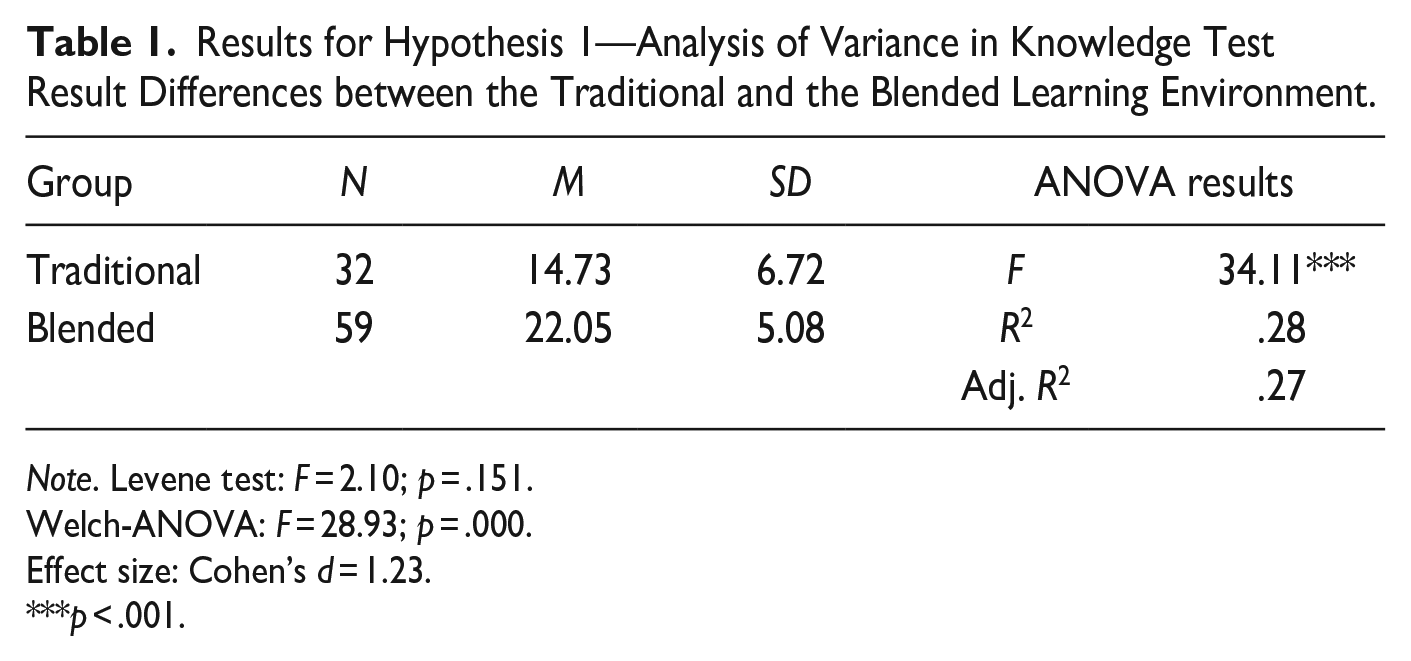
Note. Levene test: F = 2.10; p = .151.
Welch-ANOVA: F = 28.93; p = .000.
Effect size: Cohen’s d = 1.23.
p < .001.
Results for Hypothesis 2—Analysis of Variance in Intrinsic Cognitive Load Differences between the Traditional and the Blended Learning Environment.
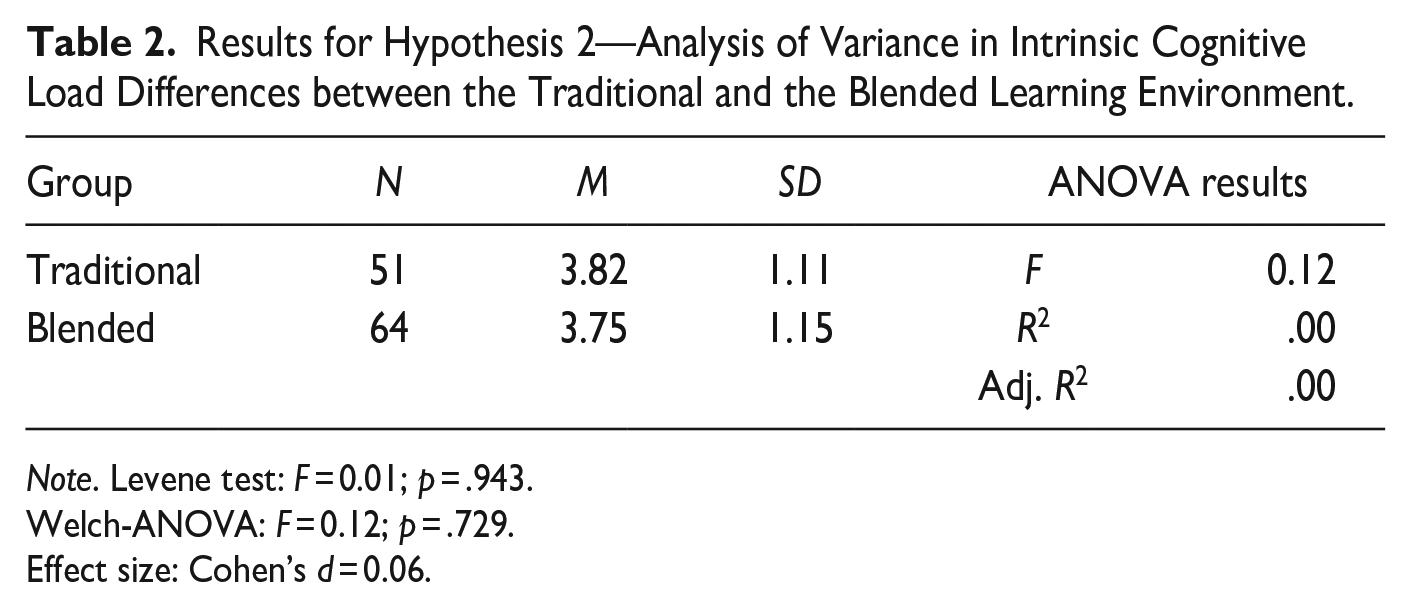
Note. Levene test: F = 0.01; p = .943.
Welch-ANOVA: F = 0.12; p = .729.
Effect size: Cohen’s d = 0.06.
Results for Hypothesis 3—Analysis of Variance in Extraneous Cognitive Load Differences between the Traditional and the Blended Learning Environment.
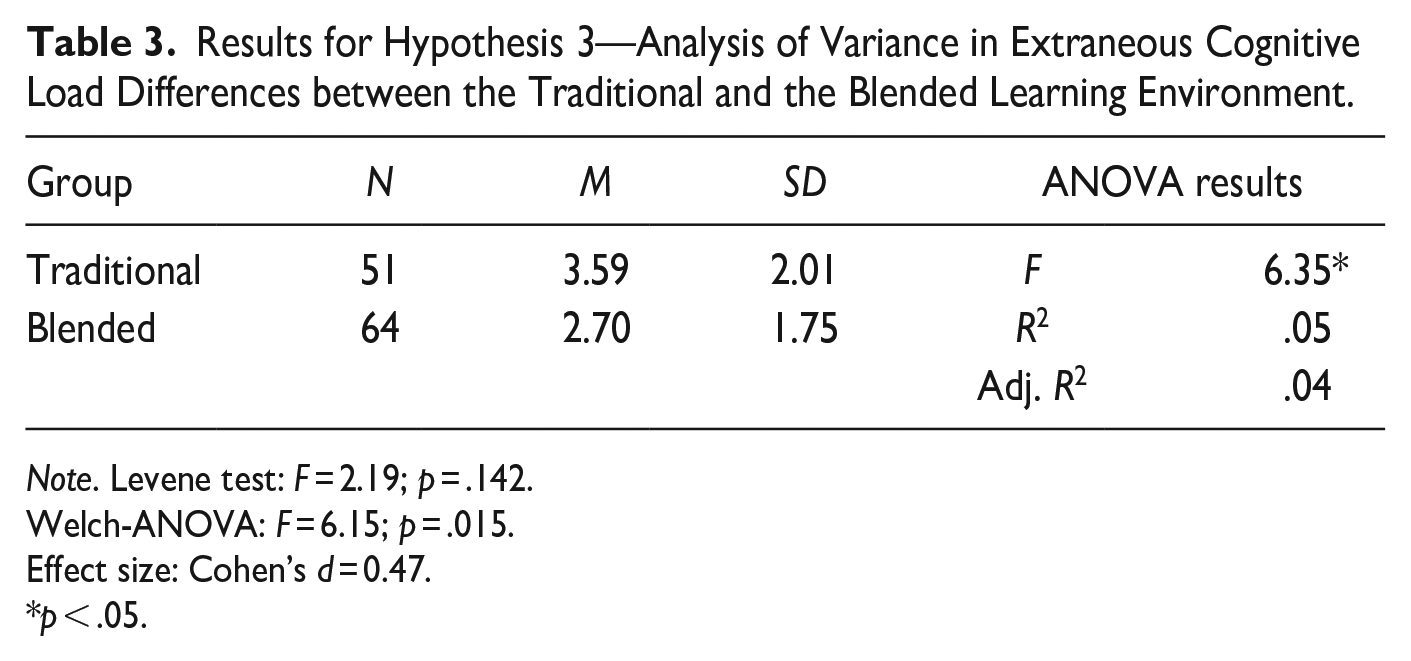
Note. Levene test: F = 2.19; p = .142.
Welch-ANOVA: F = 6.15; p = .015.
Effect size: Cohen’s d = 0.47.
p < .05.
Results for Hypothesis 4—Analysis of Variance in Germane Cognitive Load Differences between the Traditional and the Blended Learning Environment.
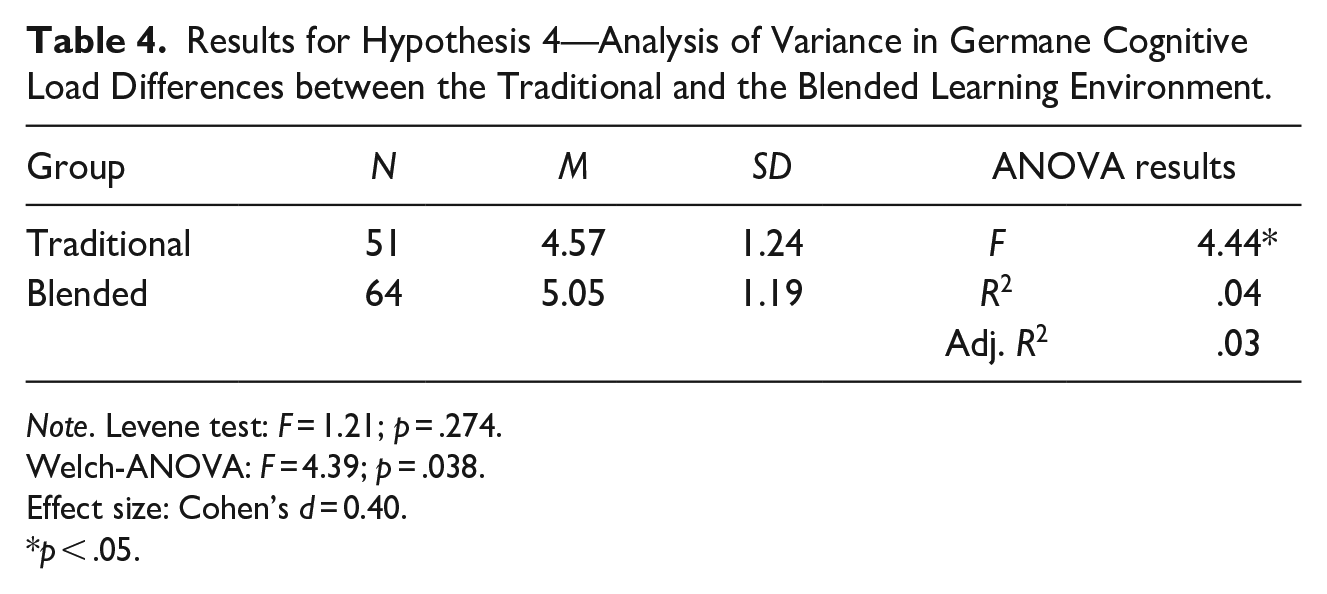
Note. Levene test: F = 1.21; p = .274.
Welch-ANOVA: F = 4.39; p = .038.
Effect size: Cohen’s d = 0.40.
p < .05.
In support of Hypothesis 1, the ANOVA comparing learners’ knowledge test results between the two formats reveals a highly significant difference (F = 34.11, p < .001). The value of Cohen’s measure of effect size (d = 1.23) suggests a very large effect (Cohen, 1988). Thus, the format of instruction—specifically the blended learning environment—seems to have a positive effect on learning effectiveness.
In line with our Hypothesis 2, the ANOVA does not reveal a significant difference in intrinsic cognitive load between the two formats (F = 0.12, p = .730). Thus, participants in the blended environment exhibit a similar degree of intrinsic cognitive load compared to learners in the traditional lecture, meaning that the level of content difficulty is similar across courses.
In support of Hypothesis 3, the ANOVA comparing the mean ratings of the learners’ level of extraneous cognitive load between the two formats reveals a significant difference (F = 6.35, p = .013). Thus, the format of instruction—specifically the blended learning environment—seems to have a negative effect on participants’ extraneous cognitive load.
Finally, supporting Hypothesis 4, we find a significant inter-group difference for the degree of germane cognitive load (F = 4.44, p = .037). It suggests a significant difference in participants’ germane cognitive load between the two formats of instruction, specifically that the blended learning environment has a positive impact on learners’ germane cognitive load (Figure 1).
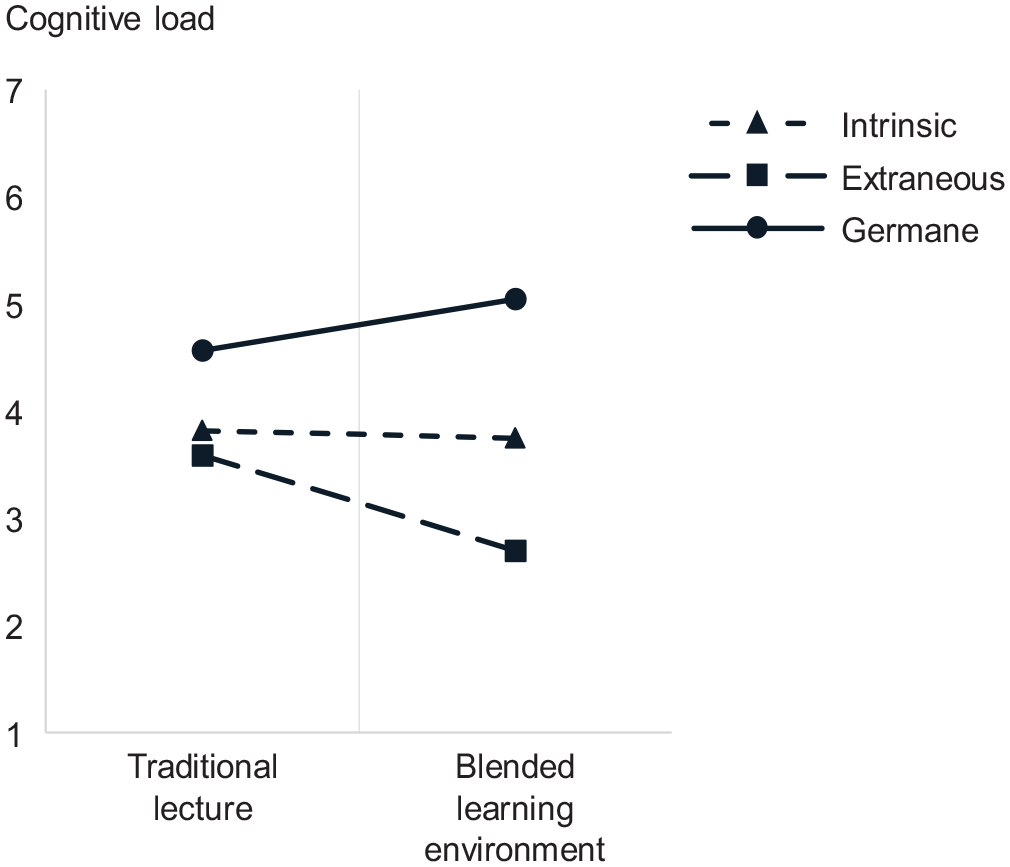
Differences in the levels of the types of cognitive load between the treatment groups.
Robustness Tests
We conducted additional tests to examine the robustness of our results. First, we re-tested our hypotheses using Welch’s ANOVA, since some of the Levene tests for the conducted ANOVAs were only marginally insignificant. The results remained unchanged (see Tables 1–4 notes). Second, we re-ran our analyses with respect to the formats’ learning effectiveness (Hypothesis 1) using an alternative variable specification. As blended learning research suggests that subjective and objective assessments of learning effectiveness are highly correlated (Owston et al., 2013; Solimeno et al., 2008), we included three frequently used items for “perceived learning” based on Alavi (1994) in our questionnaire. An ANOVA for this measure of self-reported learning instead of the actual learning results from the knowledge test confirmed the positive effect of blended learning environments on learning effectiveness. Third, to test whether other variables might influence the formats’ learning effectiveness (Hypothesis 1), we estimated OLS regression models with actual learning as the dependent variable. In the first model, we only entered gender, age, and subject-specific prior knowledge as control variables. In the second model, we added the format of instruction. None of the control variables shows a significant effect on the dependent variable, while the blended learning format is positively and highly significantly related to actual learning. Finally, to test whether our measures of extraneous, intrinsic, and germane cognitive load are sufficiently distinct, we performed correlation analyses for these variables. Correlation coefficients far below 0.3 indicate sufficient discriminant validity between the variables (Hinkle et al., 2003). Therefore, our results appear robust to alternative analyses and variable specifications and they empirically support our findings from the preceding case study.
Discussion
Contribution to Management Education Research
The use of educational technologies through blended learning environments has recently received increasing attention from management education scholars and instructors (Arbaugh et al., 2009; Redpath, 2012). Furthermore, the COVID-19 pandemic has massively accelerated the interest in and adoption of technology-based distance learning (Aji et al., 2020; Singh et al., 2021). Specifically, researchers have investigated the effectiveness of blended learning environments and respective technologies compared to traditional lectures, and their results indicate that a technology-based instructional design increases learning effectiveness (Lancellotti et al., 2016; Snowball, 2014). This contradicts the limited capacity of the working memory, which temporarily processes all incoming information and can be assumed to already run at capacity in a traditional environment (Sweller et al., 1998).
Our research is based on the cognitive load theory developed by Sweller (1988) and shows that blended learning environments can lead to significantly higher learning effectiveness if their design enables a more efficient use of the mechanics underlying the working memory (differences in knowledge test results between the traditional and the blended learning environment: M(traditional) = 14.73, M(blended) = 22.05, p < .001). We develop a theoretical rationale, conduct a case study, and provide empirical support that blended learning environments, when well designed and implemented, can reduce extraneous cognitive load, which is irrelevant for learning, and increase germane cognitive load, which determines learning effectiveness. As such, our contribution to management education research is twofold.
Our first contribution refers to the explicit consideration of the cognitive dimension, especially the operating principles of the working memory, in blended management education. These operating principles relate to the distribution of the limited capacity of cognitive load among (i) dealing with content difficulty, (ii) understanding the instructional design, and (iii) integrating new information with the long-term memory (Sweller, 1988). Our paper provides theory and evidence of how this limited capacity of the working memory can be used more efficiently and effectively.
While few researchers of educational technologies in management education have already considered selected cognitive mechanisms, such as motivation (López-Pérez et al., 2011; Selim, 2007), cognitive load is not just any cognitive mechanism but the psychological basis of all learning activities. Therefore, studying the operating principles of the working memory can explain not only whether any learning environments contribute to higher learning results, but also how and why they do so. A consideration of the cognitive load theory could extend the management education research on blended learning environments conducted by Asarta and Schmidt (2017) and López-Pérez et al. (2011), which has already taken into account the role of learners’ prior academic experiences for the effectiveness of blended learning environments. As prior subject-specific knowledge can negatively moderate the learners’ intrinsic cognitive load (Jong, 2010; Sweller et al., 1998), future research could, for example, examine the differences in learning outcomes (i.e., germane cognitive load) for learners with different prior subject-specific knowledge and, herewith, different levels of required intrinsic cognitive load. Furthermore, it might be interesting to investigate how an adjustment of the ambitiousness of the learning objectives might reduce intrinsic cognitive load in order to free up cognitive capacity for additional germane cognitive load. As such, future research could also examine differences between reducing intrinsic versus extraneous cognitive load on learning outcomes, and if germane cognitive load—and, thus, learning effectiveness—can be further increased if both intrinsic and extraneous cognitive load are reduced simultaneously.
Second, our paper contributes to the design of empirical studies on the effectiveness of blended learning environments in management education research. The extant literature shows that the corresponding research has mainly conducted studies comparing traditional with blended learning environments or selected education technologies (Arbaugh, 2014; Redpath, 2012; Whitaker et al., 2016). Since this literature largely agrees that blended learning environments have the potential to increase learning effectiveness compared to traditional lectures, future research might focus more on the conditions under which blended learning can be beneficial, that is when, where, and how a blended approach makes the most sense.
Our results show that blended learning environments and respective technology use can have a significant impact on the cognitive processes of the working memory, when they are designed and utilized effectively. We herewith build on and extend the extant research on blended learning environments in the field of management education summarized and synthesized by Arbaugh et al. (2009), who have criticized the previous focus on comparison studies of blended and traditional learning environments and the limited investigation of the underlying determinants of learning effectiveness. Future designs of empirical studies on blended learning environments in management education research should, therefore, specifically pay attention to and evaluate the different types of cognitive load and their influences on learning effectiveness. Furthermore, scholars should investigate the effects of specific characteristics of blended learning environments, such as flexibility or interaction, on the distribution of cognitive load and, thus, on the utilization of the working memory. A consideration of the cognitive load theory could furthermore extend the management education research on blended learning environments conducted by Arbaugh and Benbunan-Fich (2006), Concannon et al. (2005), and Sun et al. (2008), who have already examined the role of flexibility and interaction in the effectiveness of blended learning environments.
Practical Contribution for Management Educators
Our research also makes an important practical contribution for management educators by providing theoretical arguments and empirical evidence that a more effective instructional design uses technology choices to reduce extraneous cognitive load and to promote germane cognitive load. Therefore, management educators from both business schools and corporate learning departments should not aim at digitizing their learning environments per se. Instead, they should attempt to design curricula and instructional strategies in a way that uses technology to create a beneficial effect on the distribution of cognitive loads and, therefore, the utilization of the limited working memory capacity. Blended learning can support such instructional strategies as it offers design options and tools that are beneficial for the distribution of cognitive loads and, thus, for learning outcomes.
Based on our case study and following O’Flaherty and Phillips (2015), management educators should use flipped formats that can provide learners with a range of technology-supported materials in advance and allow them to familiarize with the most relevant theories and concepts at their individual pace before meeting in person. We recommend the use of short, well-scripted vidcasts to introduce relevant theories and concepts during the asynchronous learning phase. They offer the benefits of providing concise explanations that learners can study repeatedly as needed, omitting irrelevant information, and including clear cues to the most important information elements.
Furthermore, we suggest that management educators include multiple interaction elements both in the asynchronous learning phase and during the classroom session, as they can trigger a stronger engagement with both materials and peers and, herewith, pave the way for a more holistic and comprehensive learning. For the asynchronous learning phase, simply uploading materials to a learning management system is not sufficient. It is important that the different functionalities of a learning management system are actively used (e.g., regular posting of reflection questions in a discussion forum, short quizzes to allow learners to self-assess their understanding), and that learners are encouraged to exchange with each other (Hazari et al., 2013). Our case study showed that once learners have experienced the benefits of interaction, their engagement will even increase over time. Similarly, it is important that management educators signal approachability and invite learners to interact with them if they need more guidance. Following Arbaugh and Benbunan-Fich (2006), such guidance and feedback can reduce learners’ extraneous cognitive load, while they leave the discovery of the concepts to the learners, thereby increasing germane cognitive load. For in-person sessions, it is important that management educators account for interaction elements also beyond the content, such as class size or room layout. Based on our case study, we recommend splitting the group into smaller cohorts and reducing the number of face-to-face hours for each cohort. Based on our case study, smaller cohorts foster individual responsibility to contribute to the group and allow more interactions between instructor and individual learners. The lower number of contact hours compensates learners for the additional efforts before class, and will also be beneficial for their motivation. Regarding room layout, we encourage instructors to use smaller seminar rooms with students sitting around table islands as opposed to large auditorium-style classrooms.
Besides offering design suggestions to individual management educators, the use of technology in management education and the potential effects resulting from different design choices should also be part of any faculty development program in general. Business schools and corporate learning departments need to educate their program designers and facilitators in different design and tool choices and related implications (Arbaugh, 2000). Management educators need to be provided with transparency on the diverse functionalities of a learning management system. At the same time, they also need to be open to shift their mindsets from being the “sage on the stage” to becoming a “guide on the side” (Markel, 1999, p. 214).
Eventually, business schools and corporate learning departments should use technologies consistently across programs and courses. Learners who are familiar with a technology from one course will experience a lower level of extraneous cognitive load in subsequent courses, as they do not need to spend cognitive capacity on understanding how to use a new technology again. Furthermore, technology consistency also enables cost savings in procurement as well as efficiency in maintenance (Venkatesh & Davis, 1996).
Limitations
As with any research, our study has some limitations due to time and resource constraints. First, we assessed the three types of cognitive load on the basis self-report measures using one-item scales, which may raise concerns about their reliability. While the concept of cognitive load is commonly assessed with self-report questionnaires and our items have been frequently applied in extant research (Kalyuga et al., 2000; Paas, 1992; Um et al., 2012), future research should build on multi-item constructs to ensure a more robust measurement of cognitive load or rely on more objective measures, such as eye-tracking (e.g., pupil diameter, blink rate), to examine cognitive load (Chen & Epps, 2014).
Second, we investigated the influence of the format of instruction—specifically of a blended learning environment—on the different types of cognitive load and learning effectiveness, but not the relationship between cognitive load and learning outcomes. On the one hand, previous research already considers germane cognitive load as representative for learning effectiveness (Sweller et al., 1998). On the other hand, future research could pay more attention to the assessment of learning effectiveness and particularly examine the relationships between the different types of cognitive load and learning outcomes.
Third, we investigated the impact of a blended learning environment overall but did not examine the effects of its central characteristics, such as flexibility or interaction, on the different types of cognitive load and learning effectiveness. Although prior research has also examined blended learning environments overall (Buttner & Black, 2014; Deschacht & Goeman, 2015), further research could benefit from using specific format characteristics and design elements as independent variables and investigating their effects on the different types of cognitive load and learning outcomes. Additionally, future research would benefit from analyzing the effect of blended learning on the cognitive loads of different learner types and participants with different learning styles.
Fourth, our sample was limited to 115 graduate management students from a German university. While Germany is a relevant context for research on management education, future research should replicate our analysis in more diverse contexts, including different fields of study as well as different cultural contexts.
Fifth, in our study we relied on one instructor who delivered two courses with different learning formats. While the focus of our paper is on comparing effects of traditional and blended learning formats, extant research has shown that characteristics of the instructor may affect learning outcomes (Wittmann & Wulf, 2023). Thus, future research should examine how differences in instructor characteristics, such as experience with blended learning environments or maturity, affect cognitive loads and learning outcomes.
Conclusion
The COVID-19 pandemic has triggered significant interest in the use of technologies, blended learning, and distance learning and has accelerated their penetration of management education. Given the current importance of research into and application of educational technologies in management education, our case study draws on the mechanics underlying the human cognitive system—in particular on the cognitive load theory from educational psychology research—to provide an explanation for the often higher learning effectiveness of blended learning environments despite a limited working memory capacity. Our results show that blended learning environments which lead to better learning outcomes are designed and implemented in a way that reduces a learner’s extraneous cognitive load and promotes germane cognitive load. Effective blended learning environments, therefore, cause a shift in the use of the limited cognitive capacity and, herewith, a more efficient application of it. As such, blended learning is not a panacea, but an often desirable option when utilized effectively. While our findings contribute to research on blended learning environments in management education by specifically addressing the mechanics of the working memory through the use of educational technology, we also show that empirical studies should consider the design principles for multimedia learning. We encourage scholars and practitioners to investigate and apply instructional designs that reduce extraneous cognitive load and increase germane cognitive load, which can be facilitated by the use of learning technologies. Furthermore, the use of technology in management education and potential effects resulting from different design choices should be part of any faculty development program.
Footnotes
Appendix 1
Declaration of Conflicting Interests
The author(s) declared no potential conflicts of interest with respect to the research, authorship, and/or publication of this article.
Funding
The author(s) received no financial support for the research, authorship, and/or publication of this article.
