




Abstract
Self-awareness is often seen as a critical component in leadership and career success, and has therefore become a feature in MBAs, leadership development, and management education. It has become a popular “buzzword” in management literature, yet when reviewing this literature, there appears to be no consistent definition of the construct. This article reports a systematic literature review, covering how the construct of self-awareness is defined and how it differs from self-consciousness and self-knowledge within the context of management education. After screening, 31 articles were included in the review, analysis of which identified there is an overlap with how self-awareness, self-consciousness, and self-knowledge are defined. Other themes from our analysis include the identification of the components of self-awareness, how to be self-aware, and the purpose of self-awareness. The contribution of our article is the provision of clarity on the construct of self-awareness and a working definition, which can be used in the fields of leadership and management development by practitioners in education and organizations, and for future research within the context of adult development and the workplace.
Keywords
Self-awareness is a popular management “buzzword” (Eurich, 2018), and is frequently a feature of MBA and leadership development programs (Lawrence et al., 2018; Mirvis, 2008; Svalgaard, 2018). High self-awareness is claimed to lead to better decision making, is linked to team performance (Dierdorff & Rubin, 2015) and authentic leadership (Eriksen, 2009). It is also claimed that those who have greater levels of self-awareness are more likely to be promoted and are more effective leaders (Axelrod, 2012; Collins, 2001; Fletcher & Baldry, 2000). Showry and Manasa (2014) argue that self-awareness predicts leadership performance and success, and in a survey of the Stanford Business School Business Advisory Council it was rated as the most important trait that leaders require (Toegel & Barsoux, 2012). However, it is unclear as to what exactly the term self-awareness means and what the construct comprises.
The literature on self-awareness is characterized by multiple definitions (Sutton, 2016; Williams, 2008), and rarely does the literature recognize the complexity of the construct (Sutton et al., 2015). Self-awareness is frequently confused with concepts such as self-consciousness and self-knowledge, both of which are regularly discussed and explored interchangeably alongside self-awareness (Morin, 2017; Sutton, 2016). Williams (2008) and Morin (2017) argue that self-awareness is a difficult term to define and highlight that there is much confusion. Furthermore, the definition offered appears to depend on the research focus and context (Sutton, 2016). The absence of construct clarity is problematic as it is hindering theorizing on how self-awareness should be taught and assessed in management education, how it influences workplace outcomes, the development of an accurate measure of self-awareness, and consequently the progression of research in this area (Fletcher & Bailey, 2003). The key contribution of our systematic literature review is to provide clarity on the construct of self-awareness, resulting in the development of a definition of self-awareness. To do this, in our systematic literature review, we address the questions: What is self-awareness and how does self-awareness differ from the related concepts of self-consciousness and self-knowledge?
The interchangeable nature of the constructs of the self, mean that misinterpretations may lead to construct validity issues in measures of self-awareness (Howard & Crayne, 2019), and in order to advance theory it is essential that we have construct clarity with well-defined constructs (Kozlowski & Klein, 2000; Suddaby, 2010). Alongside this, without fully understanding the construct of self-awareness, the development and operationalization of a theory of how leaders can be taught and develop self-awareness for effective and authentic leadership will be problematic. Furthermore, the presence of self-awareness in leadership development activities (Harvard Business School, 2019), management education, and MBAs (Eriksen, 2009; Mirvis, 2008; Sutton et al., 2015) means that the teaching and practice of enhancing self-awareness is based on, at best, a vague understanding of the construct (Howard & Crayne, 2019). In this article, we seek to address the issue of a lack of clarity of the construct of self-awareness by conducting a systematic literature review of the definitions of self-awareness in the context of adult education and development. By synthesizing the existing definitions and identifying themes and inconsistencies across the definitions, we offer a comprehensive conceptualization of self-awareness, grounded in the literature, which can guide future theory development, empirical research, and practice.
An Introduction to Self-Awareness
Self-awareness is characterized by a multiplicity of views and thinking (Sutton, 2016; Williams, 2008) and this is perhaps unsurprising when we look at the aspect of self, which is also typified by a confused picture, compiled by diverse views from many philosophical perspectives (Bachkirova, 2011; S. N. Taylor, 2006); and that of awareness which is often confused with consciousness and psychological mindedness (Beitel et al., 2005; Fromm, 1965; Vaneechoutte, 2000). While the constructs of self and awareness both merit lengthy discussion, each will be discussed briefly with the objective of clarifying how we have anchored our thinking with regards to considering the construct of self-awareness as a whole.
The Self
The literature on “self” can be organized into two distinct perspectives. First, there is the social behaviorism view that the self is considered in relation to social processes and communication (Cooley, 1922; James, 1890; Mead, 1934), and is informed by observing others (Baumeister, 2005). Second, there is the view that there are a number of layers and dimensions to the self (Harter, 1999; S. N. Taylor, 2006) which are both conscious and unconscious (Bachkirova, 2011; Freud, 1995). Therefore, the difference between these two perspectives to the self can be summarized as whether the self is perceived in relation to others as in the social behaviorism view (an interpersonal perspective) or on oneself as in the multidimensional layered view (an intrapersonal perspective). In our article, we adopt a combination of both the perspectives outlined earlier. We therefore argue that the self is multidimensional in nature, made up of both conscious and unconscious layers, and is informed by observations of others.
Awareness
As with the concept of the self, definitions of awareness also offer a somewhat confusing picture. The term awareness is often used interchangeably with consciousness (Fromm, 1965; Vaneechoutte, 2000) and psychological mindedness (Beitel et al., 2005). The literature on awareness can be organized around three core concepts. First, that of cognitive awareness (Papaleontiou-Louca, 2003), which emphasizes an individual’s understanding of one’s own perception, and thinking, where awareness is the capacity to gain an accurate and deep understanding of this. Second, there is the perspective that argues that awareness is multilevel (Fromm, 1965) which takes into account the conscious and unconscious (as illustrated by the Johari window model; Luft & Ingham, 1955), with an end stage of awareness which results from an individual processing all that is going on in one’s body and mind (Vaneechoutte, 2000). The third conceptualization considers awareness in relation to the recognition of the feelings of others (Beck et al., 2004), to take into account one’s impact on others.
As with self, for the purpose of our article, we adopt a perspective combining these concepts taking into account cognitive awareness (Papaleontiou-Louca, 2003), that awareness is multilayered (Fromm, 1965) and that it should also encompass the recognition of others’ feelings and one’s impact on others (Beck et al., 2004). This combined perspective of awareness is most closely aligned to our adopted position of the self.
Self-Awareness
Based on the inconclusive nature of self and awareness, it is not surprising that when looking at the construct as whole, there is confusion and a lack of clarity (Sutton et al., 2015). As our research aim is to synthesize the current literature, this section aims to provide a brief background of the construct.
Initially the concept of self-awareness was perceived to have two dimensions (S. Duval & Wicklund, 1972); first, subjective self-awareness, which is a state of consciousness where attention is focused on events external to the person, and second, objective self-awareness, which is focused exclusively upon the self. This two-dimensional approach also proposes that self-awareness is attained through focusing attention on oneself, which initiates a comparison against self-developed standards. Linked to this is the proposition that self-awareness could be an aversive state, because if a discrepancy arises between self-perception and the self-developed standards, a negative state of mind would be likely to occur (Silvia & Duval, 2001). This idea of self-awareness as an aversive state is linked to the ruminative elements of self-consciousness (Fenigstein et al., 1975; Trapnell & Campbell, 1999) and was perceived to be negative in nature, because rumination tends to be focused on negative thoughts (e.g., past mistakes; “not good enough”), which individuals may “repeat play” and this can lead to mental health problems (Winterman, 2013). However, there is an alternative viewpoint which distinguishes between rumination and reflection (Trapnell & Campbell, 1999), where reflection is perceived as positive and providing a road to self-consciousness and a route to learning (Kolb, 1984). The assumption that self-awareness is a positive state (Silvia & Duval, 2001) is one that was adopted for this research.
The Role of Self-Awareness in Management Education
Self-awareness is frequently included in management programmes, such as MBAs (Lawrence et al., 2018), in leadership development programs (Mirvis, 2008; Svalgaard, 2018) and in courses aimed at initiating and developing authentic leadership (Eriksen, 2009). Indeed, it is perceived as central to improving management skills (Whetten & Cameron, 2016). In management education, self-awareness is often measured, with tools such as 360-degree assessment, to identify its relationship to other management outcomes and competencies (e.g., goal setting; Johnson et al., 2012). Self-awareness has also been discussed in relation to self-efficacy (Caldwell & Hayes, 2016) and emotional intelligence (Goleman, 1995), both of which are viewed as a route to increased leadership effectiveness (Caldwell & Hayes, 2016; Whetten & Cameron, 2016). Research has indicated that teaching self-awareness on a MBA program leads to enhancing students’ reflection about their leadership potential, with students demonstrating how increased self-awareness led to more effective teamwork (Lawrence et al., 2018).
As self-awareness is included on MBAs and leadership programs, one naturally assumes that it is a construct that can be taught and developed (Lawrence et al., 2018; Mirvis, 2008; Sutton et al., 2015). This is based on the proposition that self-awareness and authentic leadership can be developed through “practical reflexivity,” which is described as a questioning of one’s self in the moment of action or retrospectively (Eriksen, 2009). It has been argued that this form of reflexivity actually creates self-awareness, based on the view that the first stage to gaining self-awareness is through structured introspection. Subsequent development is through self-observation (Wilson & Dunn, 2004), and through working with others in groups (Whetten & Cameron, 2016). An alternative proposition is that self-awareness might be developed through the completion of conscious raising experiences, which entail a set of activities that stimulate introspection (Mirvis, 2008). It has been suggested that these exercises incorporate a mix of emotional, cognitive, and sensory stimuli and that there is built in time for reflection.
Other authors draw a link between self-awareness and adult development (Jung, 1996; Kegan, 1982; Laske, 1999), which is portrayed as a life-long process of individuation, involving the integration of the different parts of self, including awareness of the conscious and unconscious (Jung, 1996). Therefore, we propose that self-awareness does evolve and develop over a life-time (Kegan, 1982; Laske, 1999).
Therefore, it would appear that the fields of management and leadership education perceive self-awareness to be of importance and value. This can likely be attributed to the claims that self-awareness enhances leader effectiveness (Axelrod, 2005; Collins, 2001; Fletcher & Baldry, 2000; Showry & Manasa, 2014). However, while self-awareness appears to be gaining traction in some circles, we argue that the current lack of construct clarity makes it difficult to develop a reliable and valid measure of self-awareness. Without construct clarity and a valid measure of the construct, the claims that self-awareness is critical to developing authentic leadership, emotional intelligence, leadership effectiveness, and performance are impossible to substantiate. In addition, a working definition will provide a common understanding for how the construct is interpreted for teaching and education, future assessment and development work of leaders, managers, and other professions.
Method
In conducting the review, the approach we adopted was drawn from Boland et al. (2017) and Nolan and Garavan (2016). As the terms under review have multiple definitions and contexts it was important to follow a systematic process that could be replicated (Briner & Denyer, 2012). A summary of the process utilized is outlined in Figure 1.
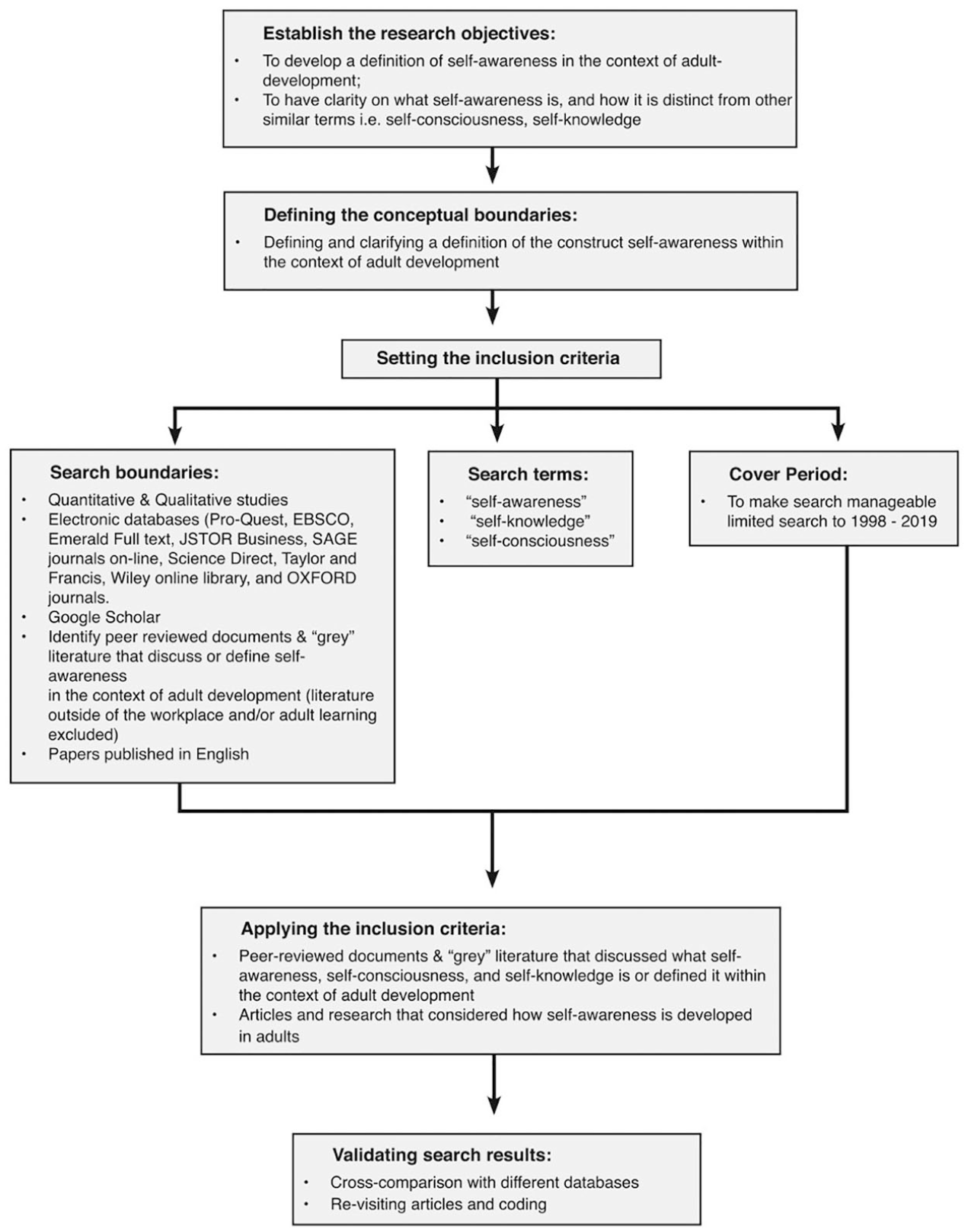
Summary of the systematic literature review process.
Literature Search
Databases were chosen to provide a comprehensive review of the field, adopting an approach in line with similar research (Bozer & Jones, 2018; Jones et al., 2016). The search period was limited from 1998 to 2019 as we wished to focus on how self-awareness is currently being discussed and defined and review current thinking rather than explore the history of self-awareness (Daniels, 2019). The following search terms were used: self-awareness, self-knowledge, and self-consciousness.
Inclusion Criteria
To be included in the review the articles had to meet three criteria. First, the articles had to discuss the constructs under consideration in relation to adults (older than 18 years). The articles had to include a definition of the constructs under review, those without definitions and discussion on what the constructs are were excluded. Many of the articles identified in the review drew on and cited definitions from earlier work by other authors rather than developing their own definitions. As the definitions were included in articles which met all other inclusion criteria, these definitions were included for analysis, and this secondary citation was used for the review (the original sources, outside the date range, were not consulted), see Table 1 for a full list of the articles included in the final review. Where original sources were within the date range and met the inclusion criteria, they were included in the analysis (Challoner & Papayianni, 2018; Xiao & Watson, 2019). Second, the articles had to be published in English due to the linguistic capabilities of the researchers (Daniels, 2019). Finally, peer-reviewed and “gray literature” available on the databases listed above were included. By gray literature, we mean research that is unpublished (e.g., conference proceedings), however, this was limited to literature that was retrievable on the databases searched (Adams et al., 2017). We propose that the inclusion of gray literature was appropriate to ensure that the review included relevant contemporary material and also to help avoid publication bias (Adams et al., 2017).
Summary of the Definitions Extracted From the Literature.
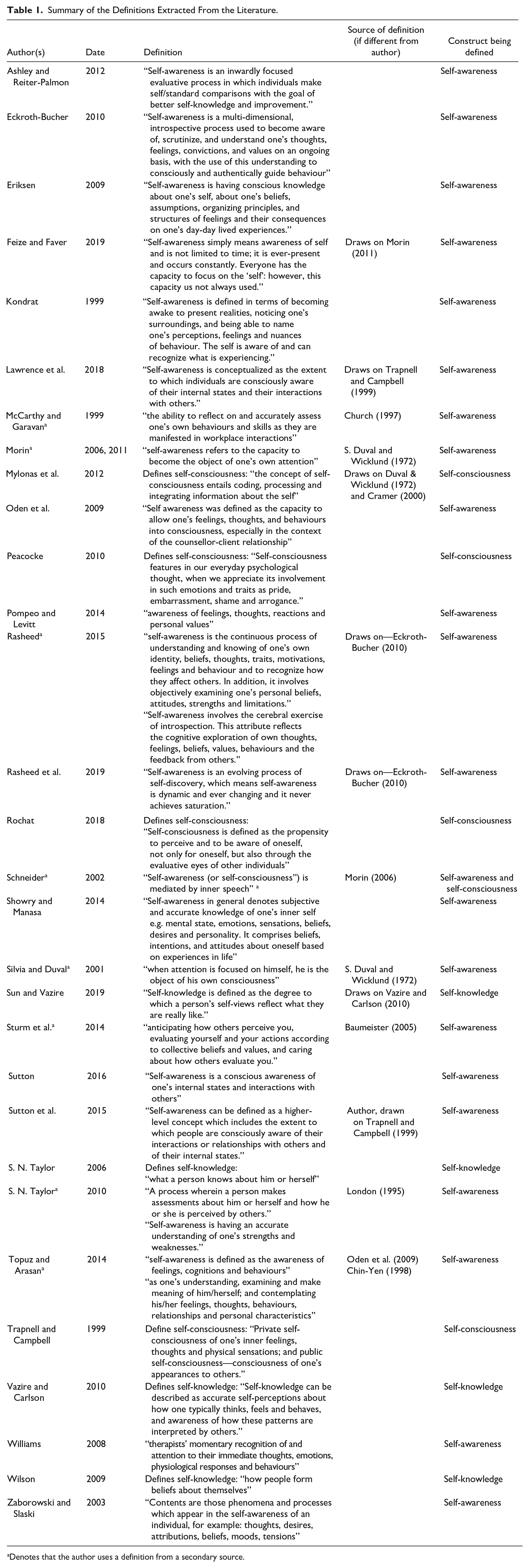
Denotes that the author uses a definition from a secondary source.
The Data Set
The screening approach was adapted from the PRISMA methodology (Boland et al., 2017), and Figure 2 summarizes the approach to screening and details the findings generated at each stage. The initial search generated 442,290 articles, which were first sifted by the title and abstract to include only those that discussed the constructs within the contexts of adults and adult development. Where it was unclear in the abstract if the article met the criteria, the full article was read. This excluded 442,146 articles, as they were discussing the constructs in other contexts (i.e., mental health, child development, drug abuse, etc.), or did not discuss the constructs specifically, instead referring to them briefly. This left 144 articles. After duplicates were excluded, 86 articles remained for the full-article sift stage, which was completed against the inclusion criteria. Surprisingly, while many articles mentioned the constructs, only 29 articles included a definition and discussion of the construct. All of the other articles used the terms with no definition or explanation as to how these terms should be defined.
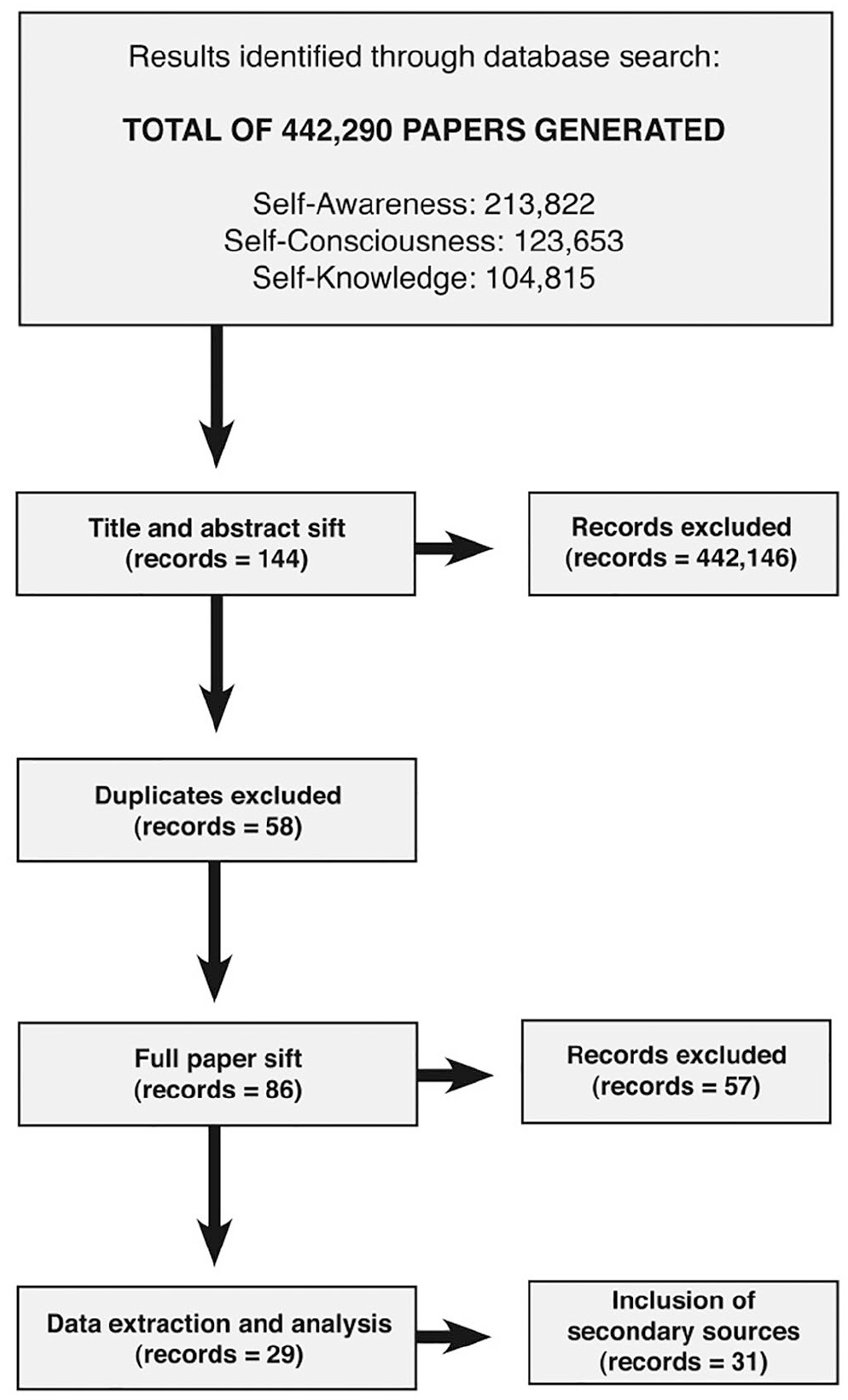
Summary of screening process.
This illustrates that while self-awareness is so widely used in management, it appears that many authors did not feel it is necessary to define it. This is despite our initial review having identified a huge amount of discrepancy around how these terms could be defined. We believe that this reinforces the importance of gaining clarity and defining the construct within the management education and adult development context. Therefore, only 29 articles were left for data analysis and extraction. As outlined above, some sources cited secondary sources, and after screening these secondary sources against the inclusion criteria, two additional articles were added for data analysis.
The definitions of the constructs were extracted from the 31 articles and are shown in Table 1 (the table shows 30 definitions, because there were two articles authored by Morin [2006, 2011] who used the same definition).
Data Coding
Each of the 31 documents were read in detail and definitions of all the constructs were extracted from the documents to be coded. While we had engaged with the literature before analysis and therefore were aware that the intra- and interpersonal perspectives existed, we chose not to use this to code the data as we were interested to see if new concepts and themes emerged. With this in mind, we used an inductive coding process, as the data were coded without attempting to fit it into a preexisting coding frame or the researchers’ analytical preconceptions (Braun & Clarke, 2006). The primary author completed the initial coding and in order to confirm interrater agreement the third author independently checked 15% of the 31 articles which met the inclusion criteria. Any discrepancies were discussed until an agreement was reached. The aim of the coding was to identify how the construct of self-awareness is defined. All definitions were coded simultaneously and after analyses they were re-visited and re-sorted to assess if there were any different codes for self-consciousness and self-knowledge.
Using an iterative approach of reviewing and re-visiting the codes, the codes were first reviewed and scrutinized and then compared to collapse similar codes together into clusters (Godfrey et al., 2014). Clusters were then grouped into larger themes (Saldana, 2013). The themes identified, indicated a broader category which incorporated several codes which appeared to relate to one another (Saunders et al., 2016). The themes were then sorted into a hierarchical structure, mirroring the format used by Jones et al. (2019), as shown in Figure 3.
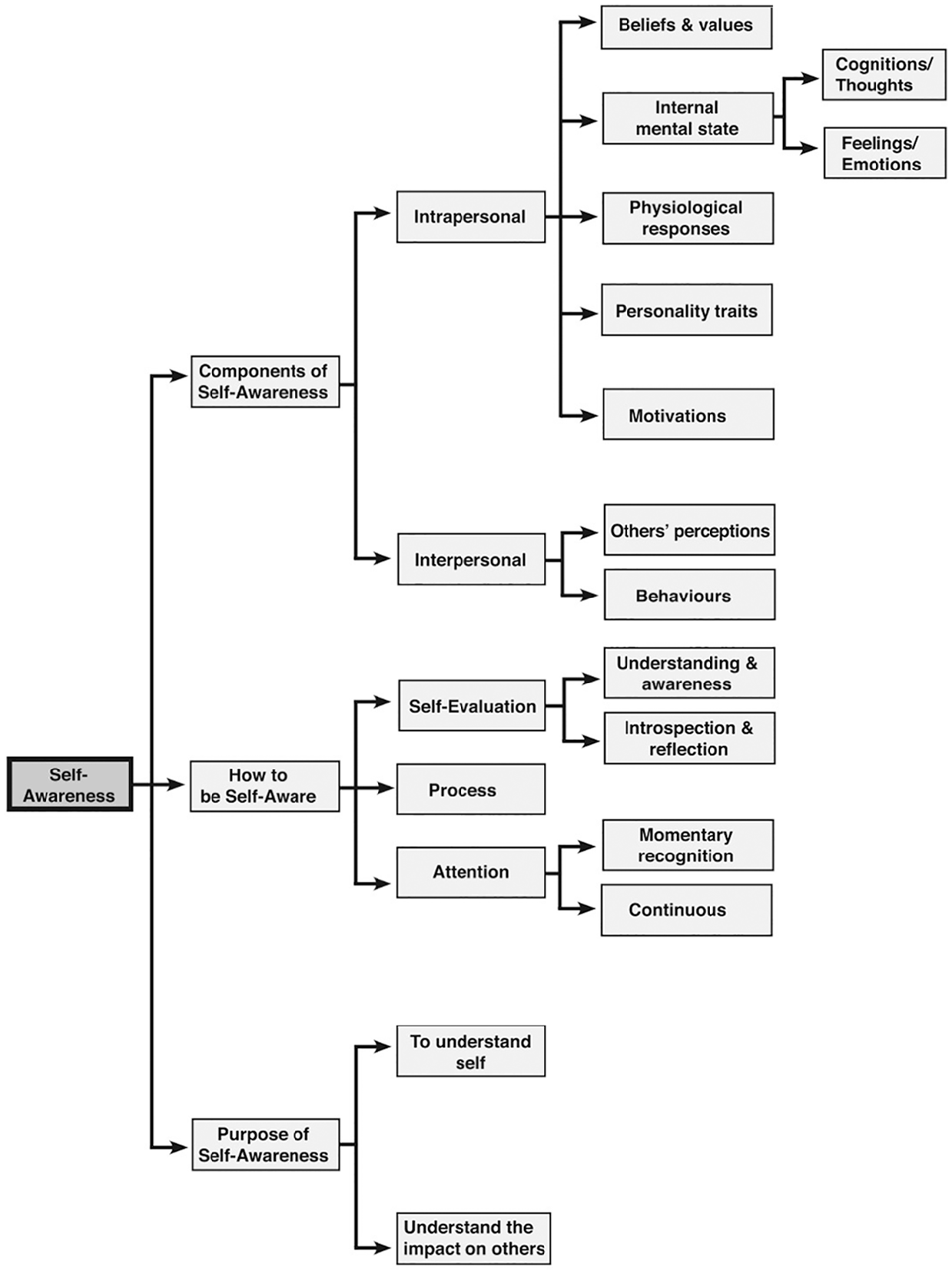
Hierarchical structure to themes from analysis of definitions of self-awareness.
While only the definitions were used in the data analysis and coding, the original articles were consulted and re-read when exploring the components identified by the coding in order to ensure that each definition was appropriately understood within the intended context.
Findings
Our findings show three meta-themes identified by the analysis, which may provide a useful framework to guide the way in which self-awareness is explored in management education. The three meta-themes, displayed in Figure 3 are the components of self-awareness, how to be self-aware, and the purpose of self-awareness. Each will be summarized next.
The Components of Self-Awareness
The components of self-awareness were the dominant theme across the definitions. In our analysis, it was noted that components are frequently included in the definition of the construct only as suggestions to be aware of (e.g., Showry & Manasa, 2014). Therefore, these components appear to be included as a checklist of what one needs to have knowledge of in order to develop self-awareness. Consequently, we propose that it is important to identify the specific components an individual requires understanding and knowing of in order to enable the development of self-awareness. Figure 3 identifies the components to focus on, derived from the analysis.
As highlighted in Figure 3, our coding indicated that the components of self-awareness could be classified further as being either an intra- or interpersonal component (see Table 2). The intrapersonal aspect centers on an awareness of one’s own resources and internal frame of mind, whereas the interpersonal aspect focuses on an awareness of one’s impact on others. This classification is in line with the wider literature, which suggests that self-awareness is not only defined within the context it is being discussed (Eriksen, 2009; Williams, 2008; Sutton, 2016) but also from three different perspectives of either an interpersonal perspective, intrapersonal perspective, or a combination of both (Fenigstein et al., 1975; S. N. Taylor, 2010; Trapnell & Campbell, 1999).
Classification of Definitions According to Perspective.
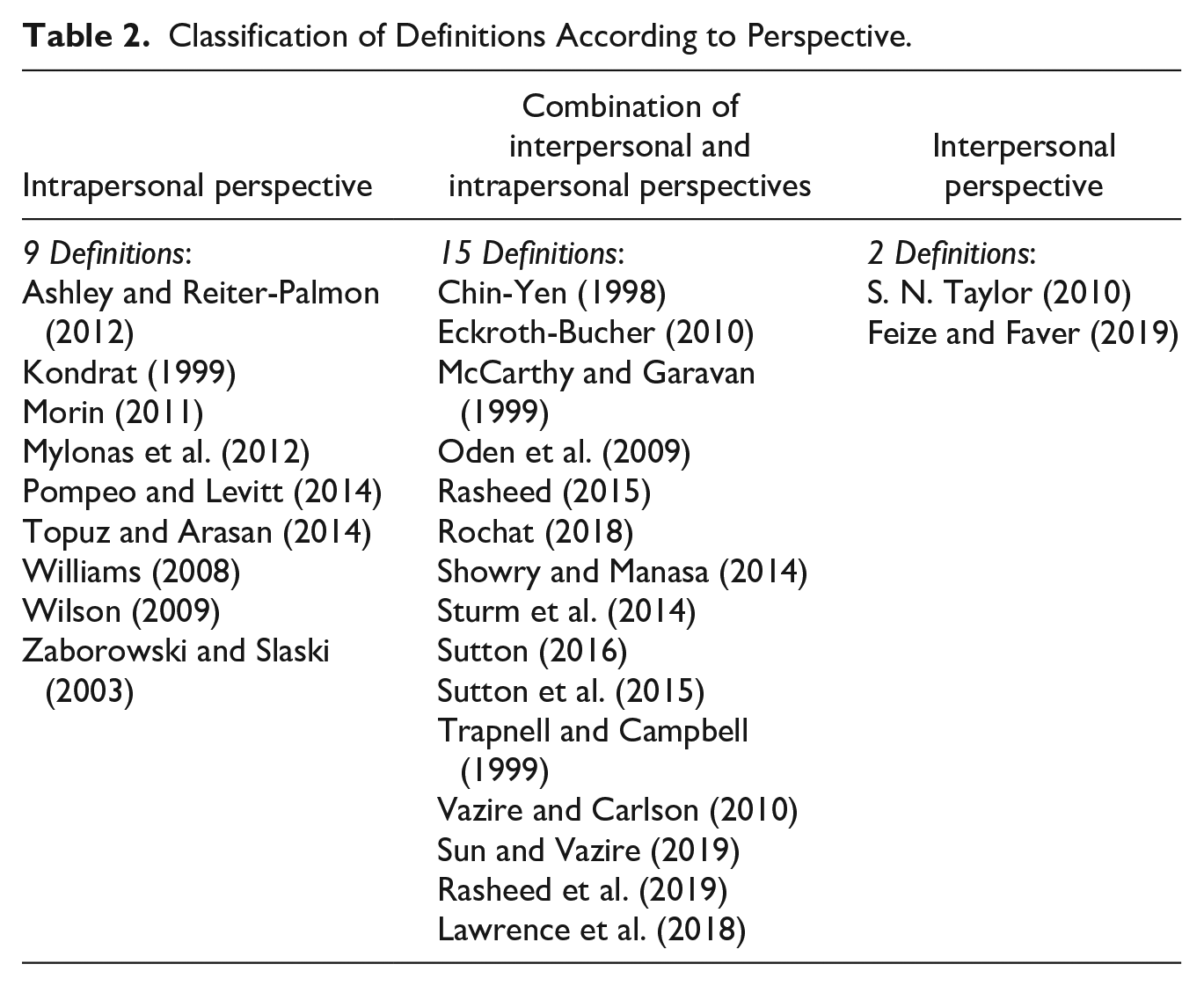
A criticism of the early definitions of self-awareness is that the interpersonal components of the construct were neglected. While early theories of self-awareness (i.e., S. Duval & Wicklund, 1972) were largely limited to the intraperspective, these theories do outline that for one to become self-aware, one needs to use the reflections from self-focus and evaluate this against standards which are extrinsic to the individual; this is perhaps the interpersonal aspect. Later definitions make the distinction between focusing on external and internal aspects of self, which has been defined as public and private self-consciousness (Fenigstein et al., 1975), with public consciousness focusing on how we might appear to others and the private consciousness being centered on one’s internal state.
Across both the intra- and interpersonal aspects of self-awareness a total of seven separate components were identified. While these seven components of self-awareness were mentioned in the definitions, very few of the articles explored the components in depth. This perhaps, along with the discussion about the many perspectives of self, provides an explanation as to why there has been a lack of consistency in how the construct of self-awareness is defined. Despite the absence of clarification on the definitions of these components, they were identified or listed separately within the definitions (see Figure 3). With each of the components of self-awareness identified, it is suggested that an individual is required to attain an understanding of each to develop self-awareness.
The seven components and how each component relates to self-awareness will be discussed. First, beliefs and values. Beliefs refer to personal attitudes about oneself and the surrounding world, they are generalizations and are deeply personal (Pajares, 1992), whereas values refer to the things an individual attaches importance to (Akin, 2000), and are usually hierarchical, dynamic, and abstract concepts which individuals tend to desire to attain. Beliefs and values are components which individuals are required to explore introspectively (Eckroth-Bucher, 2010) in order to understand drivers for behavior and personal reactions (Pompeo & Levitt, 2014). Rasheed (2015) also highlights that an awareness and knowledge of values and beliefs provides understanding of how personal attitudes are developed.
Second, internal mental state, which was perceived to include the subcomponents of feelings and emotions and thoughts and cognitions. Internal mental state was used in the articles in our review to refer to thoughts, as well as emotions, and it appears to be an amalgam of an individual’s mental representations (Piccinini, 2004; Weintraub, 1987). Three authors identify internal mental state as a component (Lawrence et al., 2018; Showry & Manasa, 2014; Sutton, 2016).
Feelings and emotions were grouped together as one subcomponent as emotion is an internal mental state from which feelings are generated, with feelings providing the description of an emotional mental state (Scherer, 2005). Mood was identified as a component by Zaborowski and Slaski (2003) and was included in this subcomponent. The analysis indicated that for individuals to be self-aware there is the need to become consciously aware of their feelings and emotions (Oden et al., 2009) that are present at any one time, with the awareness to be able to name them (Kondrat, 1999). This is perhaps the first step to explore introspectively, before then reflecting on why the emotions arose (Pompeo & Levitt, 2014).
Turning to the subcomponent of thoughts and cognitions, several authors referred to thoughts (e.g., Eckroth-Bucher, 2010; Oden et al., 2009) as a component of self-awareness, and only one (Topuz & Arasan, 2014) referred to cognitions. Interestingly, Topuz and Arasan (2014) reference both cognitions and thoughts as separate components, although the rationale for this distinction is not covered in their article. We combined thoughts and cognitions into one component as cognitions were viewed as the mental action of thinking and thoughts (Wessinger & Clapham, 2009). Our analysis indicated that the individual must have conscious awareness of their thoughts in order to be self-aware (Rasheed et al., 2019; Trapnell & Campbell, 1999). This suggests that not only does an individual need an overall awareness of their thoughts to be self-aware, they also need an “in the moment” awareness (Rasheed et al., 2019; Williams, 2008).
Third, physical sensations (Trapnell & Campbell, 1999), which was referred to as sensations (Showry & Manasa, 2014) or physiological responses (Williams, 2008). Williams (2008) identifies these physiological responses as a reaction in the body, for example “a fluttering of the heart” (p. 140), while Trapnell and Campbell’s definition of the construct is limited to naming the component of “physical sensations” rather than any discussion of the properties of this component.
Fourth, personality traits, which was simply defined as “awareness of self” (Feize & Faver, 2019, p. 162) with no further clarification as to what is meant by personality or awareness. However, as Feize and Faver’s definition is somewhat limited (see Table 1) the terms “personality” and “awareness” maybe being used as a “catch-all” term for all the components the analysis identified. Rasheed (2015), in line with the components discussed earlier, highlights that self-awareness is about “understanding and knowing” (p. 212) one’s personality traits. Therefore, in this context, the personality traits component refers to what S. N. Taylor (2010) identifies as personal self-resources, and this would refer to an awareness of character traits, along with an “assessment of strengths and weaknesses” (p. 58).
Fifth, motivations were identified as a separate component (Rasheed, 2015), and desires (Showry & Manasa, 2014; Zaborowski & Slaski, 2003) were also categorized in the component of motivations. The motivations component can be described for the purpose of this research as the personal drivers or reasons for behaving in a particular way (J. Taylor, 2012). Zaborowski and Slaski refer to the components of self-awareness (in this case desires) as contents, which they describe as “those phenomena and processes which appear in the self-awareness of an individual” (p. 100).
The remaining two components, those of behaviors and others’ perceptions were classified as interpersonal components as they referred to one’s influence on others (Lawrence et al., 2018; McCarthy & Garavan, 1999; Oden et al., 2009; Vazire & Carlson, 2010).
The sixth component, behaviors, refers to the actions that others see or hear individuals displaying, and they were therefore categorized as an interpersonal component as they are externally visible, and indeed might affect others in terms of how they might be interpreted by others (Vazire & Carlson, 2010). Rochat (2018) identifies that it is these components which are seen “through the evaluative eyes of other individuals” (p. 1).
The seventh component, an awareness of how one is perceived by others (McCarthy & Garavan, 1999; Oden et al., 2009). Some authors specifically included the requirement for “feedback from others” (Rasheed, 2015) and Rochat (2018) highlights the requirement to have awareness of oneself through the evaluative eyes of others in order to develop self-awareness. This external perspective to self-awareness was grouped into the component of others’ perceptions.
Most of the components of self-awareness were presented as components that an individual is required to be consciously aware of and understand, in order to appreciate how they impact their behavior and choices (Eckroth-Bucher, 2010; Oden et al., 2009; Rasheed, 2015), and therefore develop self-awareness (Pompeo & Levitt, 2014). Eckroth-Bucher (2010) identifies that the components of self-awareness need to be scrutinized and Rasheed (2015) states that that there is a need to “objectively examine one’s personal beliefs” (p. 212), in order to not only understand how any given component is impacting one’s behavior but also to enable the awareness to “consciously and authentically guide behaviour” (p. 213). Therefore, the components highlighted in Figure 3 are those components which an individual must have conscious awareness of, through introspective exploration, to develop self-awareness.
Examining the components goes some way to answering, “what is self-awareness?” However, in terms of our second research question: “How does self-awareness differ from the related concepts of self-consciousness and self-knowledge?” these same components occurred in the coding of the definitions for self-consciousness and self-knowledge, suggesting that there is no clear distinction between self-awareness, self-consciousness, and self-knowledge.
How to Be Self-Aware
The second theme identified, revolves around “how to be self-aware” and consists of three components: self-evaluation, process, and attention. The analysis relating to this theme was derived from the coding of self-awareness only, as the coding of self-knowledge and self-consciousness did not provide any data relating to how to be self-aware, with the exception of Rochat (2018) who identifies the need to be aware of how one is perceived by others and Sun and Vazire (2019) who perceive that self-knowledge is based on knowing what one “is really like” (p. 405).
Self-Evaluation
The analysis indicated that there is a requirement for an element of self-evaluation or assessment (Showry & Manasa, 2014; S. N. Taylor, 2010) to develop self-awareness. Our analysis identified that for self-evaluation, one needs to be aware of other’s perceptions (McCarthy & Garavan, 1999), however, this can be a major challenge as it involves seeking feedback from others. S. N. Taylor (2010) pinpoints the challenges in gaining feedback due to the influence of individuals’ tendency for self-serving bias (T. S. Duval & Silvia, 2002): the possibility that many see themselves better to how they come across to others (Showry & Manasa, 2014) and the propensity for individuals to be “unintentionally guilty of self-deception” (Caldwell, 2009, p. 393). Therefore, while in theory, individuals can attain a level of self-awareness by considering the interpersonal dimension (i.e., their impact on others, how their behaviors impact others), these challenges mean that achieving awareness based on feedback can be problematic.
The self-evaluation process also requires introspection and reflection (Eckroth-Bucher, 2010), which involves “the practice of reflecting on experiences and precisely assessing one’s own behaviors” (Showry & Manasa, 2014, p. 16). Pompeo and Levitt (2014) are in agreement and propose that self-reflection is at the heart of development. Sutton et al. (2015) also support the role of self-reflection in developing self-awareness and highlight being able to name thoughts, feelings, and understanding motives and actions, which is aligned to the theme of the components of self-awareness.
Overall, our analysis indicates that while self-awareness may involve some external assessment, it is largely developed through self-evaluation and an “inwardly-focussed evaluative process” (Ashley & Reiter-Palmon, 2012, p. 2). This perhaps explains why it is such a challenge to know if one’s self-awareness is accurate.
A Process
Fenigstein et al. (1975), Rasheed (2015), Ashley and Reiter-Palmon (2012), and Rasheed et al. (2019) all refer to self-awareness as a process. If self-awareness is a process then theoretically it would be possible to create a step-by-step guide on how to develop self-awareness; however, more recent work by Rasheed et al. (2019) highlight the dynamic nature of developing self-awareness and see it as an ongoing developmental process. Similarly, Dulewicz and Higgs (2000) identify self-awareness as a major part of the emotional intelligence competency which can be developed. Ashley and Reiter-Palmon (2012) draw on this, suggesting that self-awareness is trainable, and this is supported by other authors (McCarthy & Garavan, 1999; Rasheed et al., 2019; Showry & Manasa, 2014).
Attention
The final component in the theme of how to be self-aware is attention. Williams (2008) discussed self-awareness as a “momentary recognition of immediate thoughts, emotions, physiological responses and behaviors” (p. 141). This suggests that self-awareness is fleeting, occurring only for a moment. Therefore, making self-awareness a point of attention is part of that effort. Indeed, S. Duval and Wicklund (1972) would argue that the first stage of gaining self-awareness is to initiate self-focus, and this is supported by Laske (2006) who points out that we cannot develop self-awareness without initiating some personal self-questioning. McCarthy and Garavan (1999) are in agreement and suggest that a starting point to developing self-awareness is “realising one’s potential for continuous growth and individual development” (McCarthy & Garavan, 1999, p. 438). This leads us to propose that to be “self-aware” one must first focus on it with attention, and then the development of it occurs through an ongoing process (Feize & Faver, 2019; Rasheed, 2015).
Purpose of Self-Awareness
The final theme identified in our analysis focuses on the purpose of self-awareness. As suggested in our introduction, it can be argued that the purpose of self-awareness in the context of adult development is to enhance leadership, performance, and effectiveness at work, however, only one of the definitions referred to this as the purpose of self-awareness (McCarthy & Garavan, 1999). Alongside this, there was mention of the purpose of self-awareness “to enable individuals to best serve others and to take care of themselves” (Pompeo & Levitt, 2014, p. 86), along with an appreciation of how one is likely to affect others (Rasheed, 2015). Our analysis highlighted that a goal of self-awareness is that of developing self-knowledge and understanding to assist in personal development (Ashley & Reiter-Palmon, 2012). However, this theme only occurred in two of the 31 definitions and was not explicitly referenced to in the definitions for self-knowledge and self-consciousness. This is particularly noteworthy given the focus in the popular literature on the outcomes of self-awareness.
Discussion
The aim of this systematic literature review was to address the questions: What is self-awareness and how does self-awareness differ from related concepts such as self-consciousness and self-knowledge? Our analysis highlights the components of self-awareness, and therefore, provides clarity on what comprises the construct of self-awareness. However, our analysis also demonstrated the lack of clarity on how the construct of self-awareness differs from self-consciousness and self-knowledge, with no clear distinction between the codes generated for the different constructs. In particular, it appears that when defining self-awareness from the intrapersonal perspective the greatest confusion with self-consciousness can occur. Examining the definitions generated from the review, self-consciousness is largely defined from an intrapersonal perspective. Sutton et al. (2015) draw on Fenigstein et al.’s (1975) work as follows, “Dispositional self-awareness, also known as self-consciousness, refers to the tendency for an individual to focus and reflect on the self” (p. 611). Therefore, it might be argued that if the construct of self-awareness is only defined from an intrapersonal perspective and inwardly focused on the self then it is the same as self-consciousness.
However, there are other definitions of self-consciousness generated from our review that suggest that it too had the same two elements as self-awareness (i.e., an intra- and interpersonal element). Fenigstein et al. (1975), Rochat (2018), and Trapnell and Campbell (1999) draw on both the intra- and interpersonal aspects to self-consciousness in their differentiation between private and public self-consciousness whereby “private self-consciousnesses is concerned with attending to one’s inner thoughts and feelings” and “public self-consciousness is defined as general awareness of the self as a social object that has an effect on others” (Mylonas et al., 2012, p. 235). However, Fenigstein does differentiate between the two constructs as follows: “The consistent tendency of persons to direct attention inward or outward is the trait of self-consciousness. Self-awareness refers to a state: the existence of self-directed attention” (Fenigstein et al., 1975, p. 522). This separates out the constructs with a trait and state differentiation.
Williams (2008) takes a more holistic approach and integrates the two constructs by highlighting that self-consciousness is about directing attention toward self; and that self-consciousness is an element of self-awareness as it focuses on the internal state. Therefore, it could be argued that self-consciousness is the intrapersonal dimension of self-awareness, and self-awareness is the whole picture, incorporating both inter- and intrapersonal dimensions, although we do acknowledge that this perspective is not aligned to the work of Trapnell and Campbell (1999) and Fenigstein et al. (1975).
When taking into account both the inter- and intrapersonal dimensions of self-awareness there is a striking similarity to self-knowledge, which is defined as “accurate self-perceptions about how one typically thinks, feels and behaves, and awareness of how these patterns are interpreted by others” (Vazire & Carlson, 2010, p. 606). The term self-knowledge occurred far less frequently, with only one definition of this construct identified. However, as highlighted earlier, self-knowledge is also perceived to be an output of self-awareness, in that self-awareness provides one with greater self-knowledge (Ashley & Reiter-Palmon, 2012).
Overall, while there are “grey” areas and unclear boundaries when exploring the constructs of self-awareness, self-consciousness, and self-knowledge and how they differ, we propose that setting some parameters to differentiate these terms is important for construct clarity and to consequently benefit theory development, research, and practice. Therefore, we propose that private self-consciousness is a component of self-awareness (the intrapersonal perspective) and that self-knowledge is an output of self-awareness, as enhanced self-knowledge and understanding of the self is an aim of self-awareness (Ashley & Reiter-Palmon, 2012). Consequently, this suggests that an individual would need to develop self-consciousness as a pathway to self-awareness. With this in mind, we offer the following definition:
Self-awareness consists of a range of components, which can be developed through focus, evaluation and feedback, and provides an individual with an awareness of their internal state (emotions, cognitions, physiological responses), that drives their behaviors (beliefs, values and motivations) and an awareness of how this impacts and influences others.
This definition incorporates both the intra- and interpersonal dimensions of the construct and draws attention to the purpose of self-awareness. Following our analysis, our definition also refers to how the construct might be developed, in line with other definitions (Ashley & Reiter-Palmon, 2012; McCarthy & Garavan, 1999; Morin, 2006). However, we argue that fully understanding how to develop self-awareness is a separate step to defining the construct and therefore, this is an area for further research. In particular, in relation to enhancing our understanding of the most effective ways of developing the “focus, evaluation and feedback” needed to achieve self-awareness most effectively. Our definition adopts the stance that self-awareness is a trait which can be developed (Ashley & Reiter-Palmon, 2012). We propose that by synthesizing the literature on self-awareness, our definition offers clarity on how self-awareness should be defined in the context of management education.
Implications for Management Education
Based on our own experiences, we are aware that self-awareness is often taught in a limited way, generally focusing on only one or two components of the construct (e.g., MBTI [Myers-Briggs Type Indicator] is often used to raise awareness of personality). While this is an appropriate method for thinking about personality and possibly the strengths components of self-awareness, our research highlights the breadth of focus we need when teaching and raising self-awareness. Our findings demonstrate that there are many components to the construct, and while it may be perceived that a definition such as the one we offer narrows the focus, we would wish to emphasize that our research shows the complexity of self-awareness. Consequently, management educators could dedicate an entire module or even program to the topic of self-awareness. Therefore, educators wishing to facilitate the raising of student self-awareness would be advised to design programs that address both the inter- and intrapersonal components, or each of the individual components in turn, with activities and exercises designed around these. It is recognized that many will not have the time to teach the whole construct in depth, however, our proposed framework will give both the instructors and students greater clarity of the construct of self-awareness and an appreciation of how all the components fit together. Therefore, we would encourage the whole model to be presented to students before honing in on the relevant aspects to the module being taught (e.g., a module on teams and team dynamics might choose to focus on the intrapersonal aspects of self-awareness).
At undergraduate level when self-awareness is perhaps being explored for the first time, there would be merit in ensuring students have a clear understanding of how the construct is defined and how it differs from self-consciousness and self-knowledge, so that individuals can understand what it is they are attempting to develop. An activity to explore the definitions of the construction could involve asking students to generate ideas on the similarities and differences of these constructs before the tutor shares the perspectives described in this article, and then facilitating a plenary discussion.
For graduate students, executive education, or leadership development programs where the development of self-awareness is a major learning outcome, we propose that it is essential that a range of cognitive, emotional, and sensory exercises are used (Mirvis, 2008) to explore a wide range of the components of self-awareness and that there is time for reflection on completion of these exercises to maximize the learning experience. For example, a range of profiling tools could be used to explore personality and motivations, including MBTI, strengths profiles, or motivational assessments. Mindfulness practice might be used to develop awareness of internal mental state, thoughts/cognitions, physiological responses, and feelings/emotions (Brown & Ryan, 2003). Students could complete a self-reflective exercise where they consider their values and beliefs; they could then share these in small groups and discuss how these values and beliefs shape their identity. For those on executive education programs, one-to-one coaching would also provide the space for individuals to reflect on all the components of self-awareness, and “shine a light” on those which need further work.
For those on leadership development programs and executive education programs, where the interpersonal components are important, there is a need to include input from others (Whetten & Cameron, 2016), as these components are all about raising awareness of how one’s behaviors impact others. Therefore, using a 360-degree feedback profiling tool or a profiling tool exploring emotional intelligence (Young & Dulewicz, 2007) might be of benefit. This may need to be supported by one-to-one coaching when there are discrepancies between self-evaluations and the evaluations of others, so that the student can process and accept this information. This is important because the “discrepancies” can provide useful data (Brutus et al., 1999) into the interpersonal components of self-awareness.
In addition, there is the potential to use experiential learning as a basis for developing the interpersonal elements of self-awareness, because the concrete experience that experiential learning provides can be the basis for observation, self-evaluation, and reflection (Baker, 1989), and as highlighted in the discussion, self-evaluation is a core component in developing self-awareness. Experiential learning could be carried out in a variety of ways, for example with a team task for undergraduates, or an “outdoor activity” like high ropes for graduates. Experiential activities used in combination with 360-degree feedback could provide a breadth of rich data for personal reflection for those on executive education or leadership programs, especially where an actor’s feedback and ratings from a 360-degree perspective are aligned. It would be essential that Kolb’s (1984) learning cycle is applied so that students are able to reflect on what they have learnt about themselves and what this tells them about their self-awareness.
We propose that the development of self-awareness and experiential learning, as defined by Kolb (1984), are linked in that experiential learning provides a vehicle for developing self-awareness, but also that self-awareness is required to effectively engage in experiential learning, by understanding one’s own learning style and preferences. Therefore, we propose that self-awareness is also a pillar for effective learning at all education levels (undergraduate, graduate, and executive education), as it can assist an individual in understanding their preferred learning style (White, 1992), and therefore, access professional development most aligned to their own learning style and preferences. This is important because when individuals learn using their preferred learning style they tend to be more engaged in the learning intervention and it has been suggested that the more emotionally engaged an individual is the more effective is the learning (S. S. Taylor & Statler, 2014).
Engaging with self-awareness is difficult because of self-serving bias (T. S. Duval & Silvia, 2002) and self-deception (Showry & Manasa, 2014), along with the challenge of managing discrepancies between self-evaluation and feedback from others (Whetten & Cameron, 2016). Therefore, the challenge for educators is whether they will be truly motivated to engage in an exploration of self-awareness, as they too will be potentially called upon to reflect on their own levels of self-awareness when teaching their students. Personally, we will reflect on how best self-awareness can be developed while avoiding self-delusion, which is undoubtedly a challenge for all of us! This will be done in a psychologically safe environment with people we trust, so, using coaching supervisors, coaching clients, and peers might be an option. For example, we find that it is increasingly important to work with a trusted coaching supervisor, to process feedback where a strong reaction is experienced, so that this can be used to enhance self-awareness. This highlights the significance of creating a psychologically safe place, where students feel safe to share vulnerabilities, with people they trust so that the interpersonal aspects of self-awareness, in particular, can be developed. Once construct clarity has been achieved the extent and impact of these barriers on developing self-awareness is an area for future research.
What is becoming clear is that to take the development of self-awareness seriously and incorporate development that taps into all the components and the many layers of the construct, a significant amount of time is required. In designing a program when the full construct of self-awareness is in focus as a learning outcome, we recommend that all three routes to developing self-awareness as outlined by Wilson and Dunn (2004) are taken into account, with the inclusion of introspective activities and reflection, gaining the observations and perspectives of others, and then allowing time for self-observation (perhaps by playing back video recordings of activities).
Before completing this research we personally, in our roles as educators, talked very generally about self-awareness without focusing on what exactly the construct is; now we have gained a deeper understanding of the construct we will ensure that our students understand the full nature of the construct and how it links to self-consciousness and self-knowledge. We will achieve this by utilizing, for example, a combination of psychometric profiling, 360-degree feedback, and experiential learning. In addition, we will use this greater understanding in our practitioner work focusing on coach development to ensure that all aspects of self-awareness are addressed in the coach development process. As a result of our findings from this research, we are undertaking further research to understand how coaches can most effectively develop self-awareness, including considering what role formal training has to play, alongside personal reflection and feedback from others.
Overall, while we were comfortable with the term self-awareness in management education, we did not really understand all the dimensions or the complexity of the construct. This systematic literature review has revealed that even though it is a “buzzword” in popular management literature, there has been very little academic exploration into the construct itself. When the literature did define the construct, the components of it were often just listed akin to a checklist rather than discussing what was meant by each of these components. It is hoped that our definition will enable consistency in terms of defining self-awareness in a variety of contexts, for example, for use in management education, in competency frameworks for interviews, assessment centers, and job roles, and provide the basis for teaching and talking about self-awareness, particularly, when self-awareness is included as a learning outcome.
Implications for Research
Having clarity on the construct of self-awareness will assist future research by ensuring that the same questions are not “repeatedly tested with different labels” (Howard & Crayne, 2019, p. 77). Therefore, we propose that our analysis and subsequent definition can provide the construct clarity needed as a starting point for the development of a reliable and valid measure of self-awareness. This will ensure that a measure developed will accurately measure self-awareness, rather than self-consciousness or self-knowledge (Suddaby, 2010). Additionally, further research defining the properties of each of the components of the construct (Kozlowski & Klein, 2000) will enhance our understanding of self-awareness and will assist the development of reliable and valid measures. An accurate measure will enable the claims that self-awareness is linked to job performance and leadership effectiveness to be assessed (Showry & Manasa, 2014). This would provide greater understanding on the importance and relevance of the construct.
We find that the purpose of self-awareness is ill defined, and that more research is needed to understand the benefits of self-awareness. Alongside this there is a need to build a theory of how self-awareness develops to inform the management education sector. As discussed in our analysis, the development of self-awareness appears to be partially based on a process of self-evaluation, and therefore, it is recommended that research is conducted to clarify how individuals can use self-evaluation to develop self-awareness. To develop the work of S. Duval and Wicklund (1972), research to establish standards or measures to be used in the process of self-evaluation is also required.
Once there is a research-led understanding of how self-awareness is developed, further work is required to explore the effectiveness of how it is taught and what are the different methods of teaching it. This could be supported by the systematic investigation into how many of the components need to be taught for the effective teaching of self-awareness. It would also be valuable to conduct a cross-cultural research, investigating how self-awareness is developed in different cultures and whether our definition of self-awareness is equally valid across different cultural contexts.
Limitations
We limited our search to the terms self-awareness, self-knowledge, and self-consciousness and consequently did not explore wider literature which looked at the unconscious elements of self. Furthermore, we focused on the context of adult development and management education. When looking at psychoanalytic literature, Axelrod (2012) discusses self-awareness, but does not define it, and therefore, by not consulting this literature there are potentially some limitations in the perspective of our analysis, and possibly a risk of bias (Daly & Lumley, 2002). This therefore limits the definition of self-awareness to the conscious elements of self, which may be viewed as limited and this might impact the potential fields of adult development this work might be used in. To address this limitation, future research could explore the psychoanalytic literature in order to provide a comparison with the definition of self-awareness presented here.
Conclusion
With the increasing usage of the term self-awareness in management literature and the claims that self-awareness is critical to job performance and leadership effectiveness, it is a construct worthy of exploration. However, self-awareness is a construct that has many connotations, is defined differently in different contexts, and is frequently confused with other terms, such as self-knowledge and self-consciousness. This means that the lack of construct clarity is creating opportunities for misinterpretation and measurement error in research and practice and furthermore is hindering theory development.
Our analysis identified that within the field of management education, self-awareness can be viewed from two perspectives: intrapersonal and interpersonal, we propose that self-awareness combines both these perspectives. There are a number of components which comprise the construct, and our findings suggest that to develop self-awareness will take conscious effort. We suggest that self-consciousness is an aspect of self-awareness which focuses on the intrapersonal elements, and that self-knowledge is an outcome of developing self-awareness. In terms of adult development, we propose that the construct can be developed over time, and that self-awareness provides individuals with greater understanding of their impact on others. The contribution of our article is clarity on the construct of self-awareness with a working definition, which can be used by educators, practitioners, and for future research and theory development within the context of adult development and the workplace.
Footnotes
Declaration of Conflicting Interests
The author(s) declared no potential conflicts of interest with respect to the research, authorship, and/or publication of this article.
Funding
The author(s) received no financial support for the research, authorship, and/or publication of this article.
