




Abstract
Graduates of international business (IB) programs are facing a complex dynamic world in which they need both specific and generalist knowledge they can activate in socially negotiated situations. Their competencies must go beyond narrowly applying knowledge, which requires open minds, transferable social competencies, and skills for crossing multiple boundaries to serve their organizations to deal with global challenges. In order to facilitate the development of such professional and personal competencies, we established a learning laboratory, a space providing simulated opportunities in real multinational organizational structures, where students experiment with intercultural encounters while solving business challenges and reflect on their experiences to develop their managerial practices. This article introduces our instructional innovation by discussing the underlying learning framework and providing an illustration of the approach. The lab has three main learning outcomes: building conceptual knowledge, developing sociocultural practices in multinational organizations, and enhancing self-awareness and reflective competencies. At the core of the lab are a series of IB strategy challenges which students solve by organizing, managing, and leading global virtual teams (GVTs) that are formed with members from five overseas universities. We detail the alignment of our framework, review the actions and interactions that facilitate learning, and discuss learning effectiveness and implementation of the lab.
Keywords
Introduction
Critical debates on the effectiveness of business schools’ educational products have a long tradition in scholarly discourse in general (Corley & Gioia, 2011; Ghoshal, 2005; Glen et al., 2014; Kuechler & Stedham, 2018; Pfeffer & Fong, 2002; Waddock & Lozano, 2013) and in the discipline of international business (IB) in particular (e.g., Collinson, 2017; Delios, 2017). Graduates of IB programs are facing a complex dynamic world in which they need both specific and generalist knowledge they can activate in socially negotiated situations. Their competencies must go beyond narrowly applying knowledge, thus requiring open minds, transferable social competencies (Ritter et al., 2018), and skills for crossing multiple boundaries to serve their organizations to deal with global challenges.
Recent turbulences from over-globalization (Stiglitz, 2017) to migrant crises (Barlai et al., 2017), climate change (Buckley et al., 2017), and the COVID-19 pandemic (Donthu & Gustafsson, 2020) are illustrative of the complexities and dynamics involved in international business. Therefore, in addition to acquiring knowledge, students should develop their professional practices to address problems holistically with empathy while considering multiple perspectives. This requires a level of competency development that encompasses a wide knowledge base, a capacity for application (Buckley et al., 2017), and the ability to develop future-oriented solutions considering multiple levels and through various stakeholders’ viewpoints (Zettinig & Nummela, 2021). It entails preparedness for working across sociocultural environments, through which multinational organizations coordinate worldwide activities (Zander et al., 2012). Thus, business school graduates must possess the leadership and management abilities needed for these very demanding work contexts (Welsh & Dehler, 2013) in order to recognize stress factors and to establish a positive and enabling work climate for themselves and others.
Considerations regarding the above requirements led us to develop a learning laboratory for our MSc programs in IB at the University of Turku in Finland. An integrative learning design at the program level challenges students to solve IB problems in highly diverse multicultural teams (Stahl et al., 2010), simulating conditions that can become conflict-laden and stressful and producing situations they need to cope with and manage (Jehn & Mannix, 2001). We link three courses to the learning laboratory: International Business Strategy, Project Management, and Intercultural Communications. These draw on students’ activities and experienced events to realize an integrative learning concept at a higher level (Hrivnak, 2019). Strategy-as-practice (Vaara & Whittington, 2012) inspired the integrative design, consolidating disaggregated learning in course silos (Ritter et al., 2018), and guided us to focus on solving IB problems through social organizing and by considering well-being.
We adopted global virtual teams (GVTs), an organizational form increasingly deployed by multinational organizations (Zander et al., 2012, 2013), to operationalize these demanding learning outcomes. Team members, located in different countries and embedded in diverse sociocultural and organizational contexts, collaborate virtually in a series of IB strategy projects. Thus, they can overcome the lack of co-located actions and resolve time zone differences under time pressure. GVTs are suitable social entities for experiential learning because they provide an authentic organizational context to work on real-world problems, which requires rich interactions during the strategizing processes (Randall et al., 2011). As a result, their work generates self-awareness of learning (Eurich, 2018) and enables reflective practices (Berdrow & Evers, 2011).
In this article, we introduce a three-dimensional (3D) learning model on which the learning laboratory operates. Following that, we describe the most recent iteration of the laboratory and discuss how to establish and run it. Subsequently, we evaluate its effect on student learning and conclude with implications of the laboratory for the program, the students, and the faculty.
The Learning Framework
The laboratory in its current form has been a process that involves active experimentation by the teaching team since its inception in 2014. The design of the laboratory as a learning environment demanded that we understand how a variety of learning objectives relate to different learning theories (Ertmer & Newby, 2013), accepting that each iteration of the laboratory is another work-in-progress step advancing our integrative learning concept. In the introduction, we elaborated briefly on why integrative learning in an MSc program in the IB discipline is desirable. Our students are advanced learners who have typically graduated from bachelor programs and have work experience. They enter the two-year full-time program to develop their knowledge and professional and personal competencies as managers. This section introduces the theoretical rationales for why students learn what they learn through the experiences at the lab based on a 3D learning concept.
The learning lab addresses the program’s graduate learning outcomes in terms of three essential factors:
– Conceptual knowledge, its application and further development,
– Development of sociocultural practices in multinational organizations, and
– Enhancement of self-awareness and reflective competencies.
Learners’ activities at the lab generate reference events over time (Van de Ven & Engleman, 2004), which create new personal insights that support accomplishing learning outcomes of three courses, which are International Business Strategy, Project Management, and Intercultural Communication. To illustrate the rationale of why we integrate these three courses’ learning activities in the laboratory, we use the analogy of learning to play competitive tennis.
A professional tennis player improves different skills and strengths by practicing them together and only partially in isolation. Competencies such as legwork, handling the racket, running, ball techniques, tactical play, mental training, and fitness are practiced at the same time. Competitors enhance their competencies in situational contexts and by interacting with another player. Coaches provide feedback not only on each skill category separately but also on the skills’ interplay and overall situational effectiveness, with the goal of improving the practices over time to reach the individual players’ next level of performance.
This approach requires flexible knowledge across multiple domains to be fluently retrieved and applied in various situations and appropriate circumstances (Bransford et al., 1990; Hmelo-Silver, 2004). It is a competence that improves through practice and when applied repeatedly to a variety of problem situations (Kolodner, 1993). In the same way, the learning laboratory creates opportunities for flexible application of knowledge within the team. We expose participants to challenges in unfamiliar business contexts. As part of highly diverse teams, members bring different foundational knowledge, understanding, and often differing perspectives to their multinational teams. Team interactions trigger learners to identify what they need to learn to solve a task and opens them up to learn from others’ knowledge, experiences, and access to information, and integrate this into their own understanding (Siemens, 2004). Social interactions by diverse team members are complex and often challenging (Jehn & Mannix, 2001). Intercultural team encounters sometimes create expected and unexpected complications, which sometimes challenge individuals’ self-confidence or feeling of trust in their own judgments, qualities, or abilities.
The three objectives of learning in the lab context, listed above, are enacted in a learner-centric way (Hmelo-Silver, 2004). Individuals recognize various types and degrees of competencies they have and strive to advance them. Learning experiences are personal, and they shape how new content and activities connect to extant knowledge, which constitutes learning (Phillips, 1995).
Figure 1 summarizes the learning framework currently applied in the laboratory. It consists of three dimensions, which cater to program learning objectives and outlines a simplified illustration of the interrelationships among dimensions.
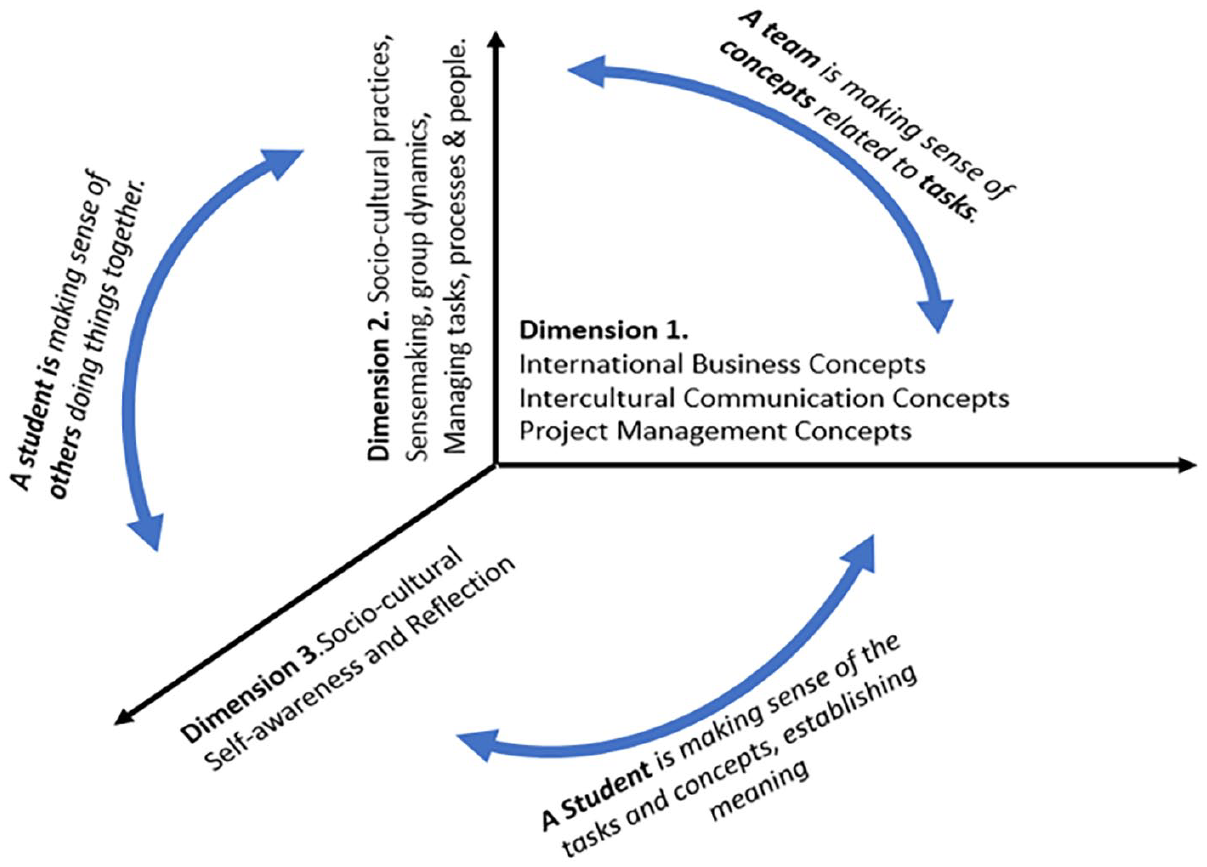
The learning laboratory’s conceptual framework.
Dimension 1 caters to subject-related knowledge in the three program courses. We structure learning objectives according to Bloom’s revised taxonomy of cognitive domains (Anderson et al., 2001). Advanced learners have already internalized foundational knowledge structures in the discipline. Therefore, they are more aware of how prior knowledge and ongoing experiences in the lab affect their personal development (Bednar et al., 1992). As a result, rather than knowing and understanding basic subject knowledge (e.g., IB conceptual frameworks; see Zettinig & Nummela, 2021), they can use and progress their understanding in situational applications (Anderson et al., 2001). They move forward by solving problem-based assignments (Hmelo-Silver, 2004) and by evaluating alternative solution approaches (Brownell & Jameson, 2004) in their contexts.
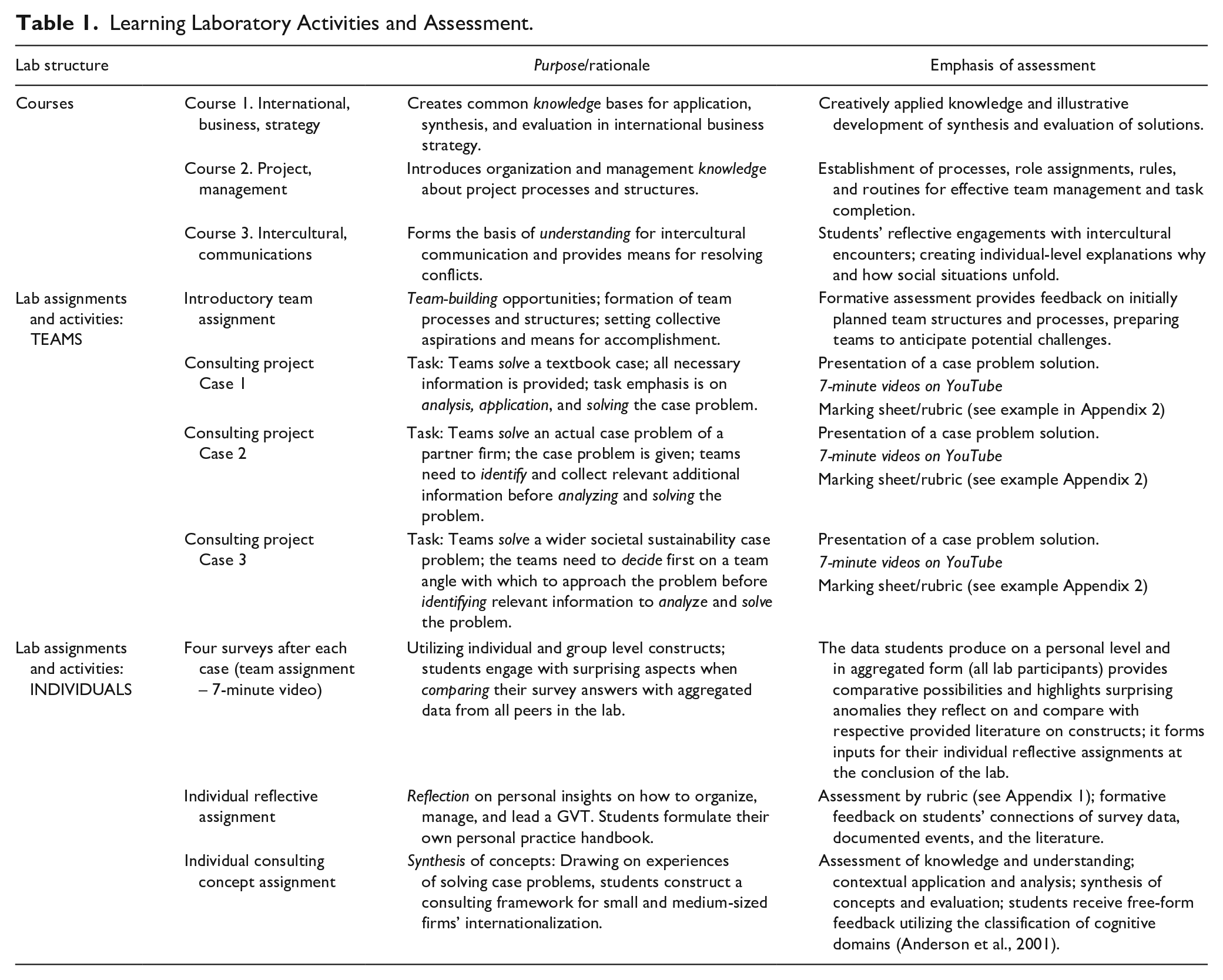
However, each of the three courses is important as they provide knowledge and facilitation for cognitive processing to further learning advancements from their particular subject’s perspective. The International Business Strategy course offers disciplinary knowledge containing key frameworks and concepts to structure students’ knowledge, form a basis for their contextual application, and provide input for solving laboratory cases in teams. The Project Management course emphasizes knowledge on the organizational and processual aspects of project management. In addition, it provides frameworks to decide on teams’ roles, rules, and routines and offers trajectories for effective project management. The course in Intercultural Communications creates an understanding of what complications emerge in multinational encounters, and it introduces means to analyze intercultural situations. The strength of the laboratory approach for integrated learning creates connections among the different disciplinary knowledge resources. They establish anchors for experiences and serve as reference points for knowledge to be useful and for communication to be effective. The next section provides an overview of the lab components (Table 1).
Learning Laboratory Activities and Assessment.
In Dimension 2, we promote learning outcomes that concern social and human interactions, which are important managerial practices in any business school program. Learning to collaborate with others is a critical competence that enables knowledge application and development in real-life settings (Connolly & Spiller, 2017). For instance, project management is not only about managing activities, allocating resources, or reaching objectives, but deals to a great extent with leadership, management, and organization of individuals in teams (Artto et al., 2011). Therefore, the lab has a strong emphasis on interactions among members in teams, focused on collaboratively solving IB challenges in a series of projects. Students learn that the application of knowledge is not only task contextual, but also group situational. We ask teams to develop social sensemaking (Maitlis & Christianson, 2014) processes in which a team enacts the problem environments as outcomes of their organizing (Weick, 1995). It promotes organizational practices in which strategizing takes place (Vaara & Whittington, 2012). The multinational nature of GVTs complicates these practices. Students learn how their own and others’ sociocultural backgrounds and prior experiences shape intercultural communications (Bjerregaard et al., 2009) that affect the organization of work, management, and leadership. The interplay between Dimensions 1 and 2 forms experiences that allow lab participants to experiment with different approaches to management and different roles and forms of leadership (Zander et al., 2012) to accomplish their tasks. Students learn to apply the three courses’ knowledge in situational contexts (e.g., how to negotiate solving a case in their teams, to use IB strategy frameworks as solution trajectories, to utilize project management processes, and to engage with potential conflicts through application of an understanding of intercultural communication).
Dimension 3 supports the practice of self-awareness and reflection (Eurich, 2018). Students learn about unfolding social processes in teams, and they learn to reflect on usually uncontested assumptions about themselves and others (e.g., Auer-Rizzi & Berry, 2000; Köhler & Berry, 2009; Kuechler & Stedham, 2018). Work at the lab is challenging in terms of tasks, has the potential for conflict due to intercultural encounters in groups, and can be very stressful as participants work under a high stress load. Work is complicated by working across time zones, tight project deadlines, competing demands and priorities from studies, and job- and family-related responsibilities. After the first iteration of the lab in 2014, we learned that task-focused support and facilitation of social team processes are not sufficient to capitalize on learning more widely. We saw that even apparently well-performing individuals and teams often experience failures in managing diversity and social interactions (Xiaowei & Pilcher, 2019), preventing them from becoming well-functioning social units. Thus, the Intercultural Communications course utilizes the activities, experiences, and events at the lab as reference points for creating meaning about what is happening in the interactions with others and how that relates to one’s self.
Students learn not to simply accept conflicts and complications deriving from intercultural and social encounters. Instead, they question their assumed normal as it generates situations with conflicting values, beliefs, attitudes, worldviews, and behaviors. These are generally referred to as cognitive dissonant situations (cf. Festinger, 1957), where individuals’ responses to a perceived dissonance often worsen situations in teams. Coping with psychological aspects has therefore become a way to advance our lab concept by including self-awareness and reflection activities.
For instance, we discuss concepts related to self-efficacy, “beliefs in one’s capabilities to organize and execute the courses of action required to produce given attainments” (Bandura, 1997, p. 3), because self-efficacy has been found to affect intercultural competencies (Leung et al., 2014) and to determine well-being (Judge et al., 2002) and leadership ability (Dunbar et al., 2018). Students device tools to question their own roles in disharmonized situations, they practice asking how others’ behavior might contribute to difficult situations, and they reflect on how modes of communication and interactions affect them emotionally, limiting or enabling their own and the teams’ performance and well-being. Self-efficacy is an important aspect that is essential due to the multinational nature of work and how communication cues are greatly reduced and often difficult to interpret in the virtual environment.
Between Dimensions 3 and 1, students become aware that meanings in tasks are influenced by their previous understanding, which might be subjective and filtered through their own sociocultural assumptions, their everyday contexts, and extant experiences. Between Dimensions 3 and 2, students develop awareness that their interpretations of tasks, relationships, and processes are formed through their own and others’ preconceptions that gradually converge through collaborative actions and retrospective sensemaking (Weick, 1995). They also learn to reflect on how their mood and the team’s climate might be influenced when providing a safe space for team members to express themselves without fear of negative repercussions, which has been identified as a major contributor to team learning outcomes, among other effects (Edmondson, 1999).
Our model provides a means for integrating disciplinary knowledge from different courses. The instructional design creates the context for students’ personal and professional development and provides room for experimenting with their own organizational, managerial, and leadership competencies in a supportive learning environment. The next section describes the latest iteration of the lab.
Illustrative Example: The 2020 Learning Laboratory
In the 2020 lab, we organized 150 participants in 30 GVTs. Besides our own students, participants from partner universities populate the teams, which form the nucleus for learning actions. GVTs (Zander et al., 2012, 2013; Zettinig et al., 2015) are generally challenged by virtual coordination processes and structures, which serve as a foundation to overcome geographical and temporal distances among highly diverse multinational members. These core characteristics are simulated in the lab.
The Participants at the Learning Laboratory
Participants are from two universities in Estonia (39 students), one university each in Finland (47 students, some located in Asia), Ireland (30), Latvia (8), and Mexico (26). The considerable time zone differences among members create practical complications constituting a natural feature of GVTs, in addition to high team member diversity (see Table 2).
Demographic Overview of Participants at the Laboratory (Numbers Rounded).
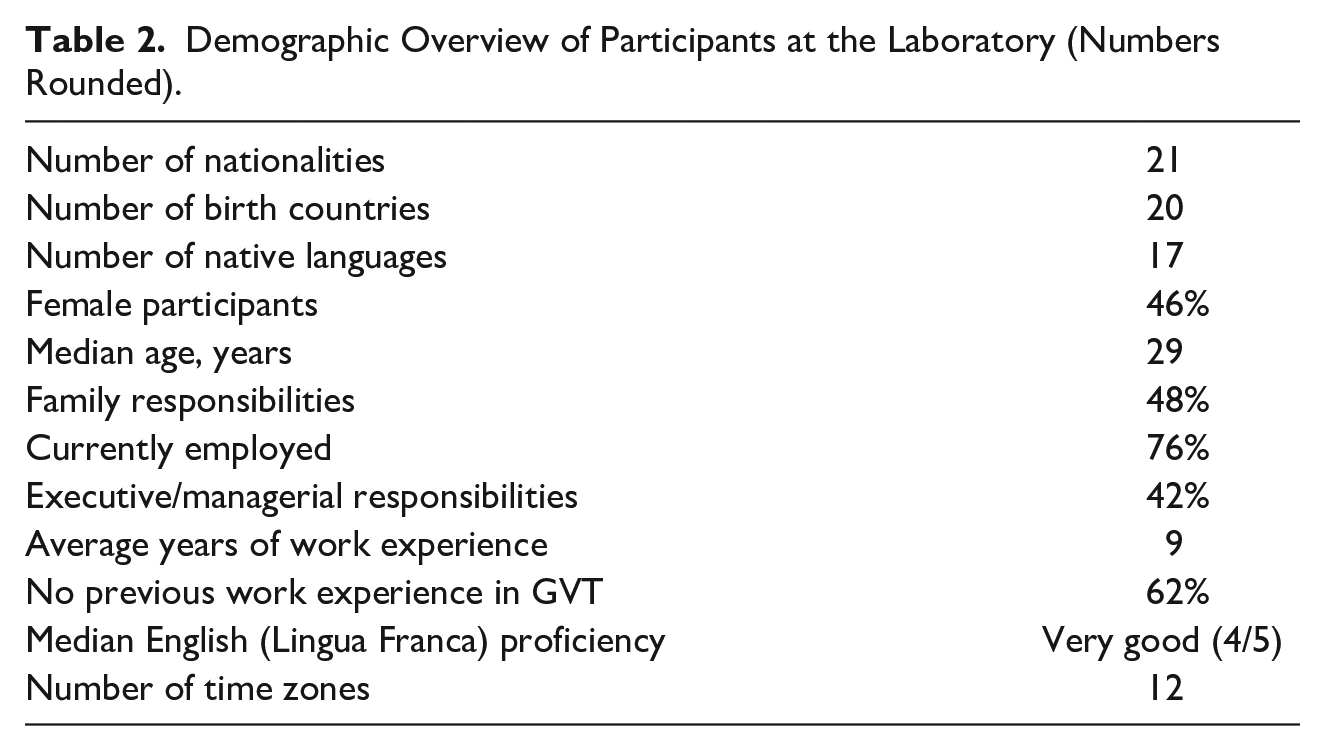
A typical team consists of five different nationalities, composed of women and men with literally no face-to-face interactions (also due to pandemic restrictions at the time). Additional diversity is generated because our MSc students, typically in their 20s with 2 to 5 years of professional experience, are joined by 3 to 4 international colleagues from executive MBA programs, with considerable professional experience (average 9.7 and median 7 years) in middle and upper management positions. The design is intended to bring together younger professionals with typically high virtual/technological proficiency and experienced managers, complementing each other’s competencies and perspectives. We provide team members with a safe space to engage in playful experimentation, which they usually do not want to attempt in their regular work and organizational contexts.
Overview of the Learning Laboratory
We divide the learning activities at the laboratory into team and individual assignments, each bearing a 50% weight on the grade. The team assignments consist of an introductory assignment and three 2-week-long consulting cases.
The introductory task provides team-building opportunities. We ask teams to engage in organizational planning, specifying how the team should function, what processes they put in place to enable effective coordination, which rules they want to apply, what roles individuals want to take, and what routines they see fit to accomplish tasks effectively. Members discuss and document their agreements and formulate a common vision of what their teams should become. We provide an example, described in Rerup and Feldman (2011, p. 577), encouraging them to express how their envisioned team will generate collective accomplishments (Dionysiou & Tsoukas, 2013). Part of this team assignment is an individual component added by each team member. They introduce themselves by describing their backgrounds, professional experiences, competencies, personalities, personal circumstances, and future aspirations. This introduction supports the social group forming processes and gives every member voice by default. In our review of the assessment, we emphasize reassuring and constructive feedback. We comment on their assignments in terms of teams’ potential as social organizations, and we reflect on individuals’ resources, perspectives, and capacities that they can contribute as team members. The purpose of the assignment and the feedback is to produce a basis for their subsequent actions and is an initial anchor point for later reflective learning.
The three consulting cases are challenging. Teams need to analyze a given organizational problem setting related to IB and suggest elaborate strategy solutions, which they present in 7-minute-long video presentations, which we compile on a YouTube channel for all lab participants to view. The first is a typical textbook case on a multinational corporation, followed by a current case developed together with an industry partner, for which teams develop internationalization strategies. The third case requires the development of strategic solutions for public-private partnerships, which address one of the global problems of our time. All the cases resemble typical problem settings for strategy consulting, with clients and their stakeholders as recipients of solution proposals. The three cases are different in nature because we want teams not only to engage in solving the problems presented by the cases but also to acknowledge that differently structured problems require adaptive organizational responses. Variation is important to avoid fast routinizing effects, where team coordination is a simple division of tasks. Altering the underlying challenges requires teams to revisit their organizational approaches and forces them to engage in collective sensemaking of tasks. The first case is from a textbook (Bartlett & Beamish, 2018), which essentially provides all necessary information. Teams discuss the case and develop a common solution trajectory before assigning each member a share of the work. The case is suitable for directly applying strategy concepts, analyzing the challenges, and then collectively developing solutions before producing a video presentation.
The second case differs from the first in that our industry partner clearly espouses a problem but provides insufficient information to solve it. This requires teams to search for suitable information, evaluate their sources’ legitimacy, and engage deeply in understanding the problem (see Bhardwaj et al., 2018) before deploying analysis and solution development. The second case is more difficult in terms of assignment structure, and it poses considerably higher requirements for the teams’ organizational enactment and sensemaking (Maitlis & Christianson, 2014). Consequently, the potential for team conflicts (task, relationship, or process conflicts; see Jehn & Mannix, 2001) increases, creating opportunities to develop situational leadership skills.
The third case describes a global challenge related to urbanization and asks teams to develop strategic proposals for localized public-private partnerships. The task structure in this case requires teams to go beyond solving problems, which were the main tasks in cases one and two, based on information they have searched and collectively enacted, and it necessitates a shared agreement on what constitutes the problem. Although this sounds simple enough, it is complicated by the fact that team members live their analog lives in the highly diverse daily life contexts of Mexico, Ireland, and northeast Europe, which adds complexity to social sensemaking and collaboration needed to derive a solution to the problem presented by the case.
The procedure for assessment of the case video presentations consists of standardized criteria for summative assessment and free text formative feedback that emphasizes the potential for improvement (for an example, see Appendix 2).
At the end of the lab, students complete an individual reflective assignment. They have to write a personal practice handbook on “organizing, managing, and leading in global virtual teams.” To do that, they draw on four surveys students take immediately after each team case. The first survey collects general demographic data and uses constructs to establish individual orientations including individualism/collectivism (Triandis & Gelfand, 1998), self-construal (D’Amico & Scrima, 2016), psychosocial stress and well-being constructs (Pejtersen et al., 2010), decision-making styles (Scott & Bruce, 1995), and individual initiative measures (Bolino & Turnley, 2005). The subsequent three surveys deploy repetitive measures on selected team constructs, including psychological safety, team learning behavior, team learning outcomes (Edmondson, 1999), team-level mindfulness (Yu & Zellmer-Bruhn, 2018), and team conflicts (Gamero et al., 2008). To detect changes in psychosocial stress and well-being, we employ Pejtersen et al.’s (2010) measures throughout all four surveys. Students receive their personal survey data together with aggregate descriptive statistics and a compendium of articles explaining each construct. These data serve as inputs for students’ individual reflective essays at the end of the course, connecting their individual experiences and accounts of events with comparative scenarios. The objective of the assignment is to develop individuals’ own practices through writing a reflective handbook on organizing, managing, and leading in GVTs. The teaching team applies standardized evaluation criteria for summative assessment (30% of course grade) and adds formative feedback commenting on individuals’ professional development. The second individual synthesis assignment requests students to develop their own consulting concept based on their understanding of solving IB strategy problems. Focusing on small and medium-sized enterprises, students are asked to synthesize concepts and apply them to firms in a selected industry. A member of the teaching team assesses the work summatively (20% of the course grade) using Bloom’s revised taxonomy (Anderson et al., 2001) to identify the level of understanding and assign a grade accordingly.
Students’ learning is facilitated by problem-based challenges that require them to become a team. The learning approach supports self-awareness and reflection practices regarding unfolding events in order to cope with the task, time, and socially induced stress generated by the assignments and the intercultural team encounters. Students learn to gain awareness about social processes in teams and reflect on usually uncontested assumptions about themselves and others (e.g., Auer-Rizzi & Berry, 2000; Köhler & Berry, 2009; Kuechler & Stedham, 2018). An elaborate system of feedback provision supports personal and professional development along the three dimensions of our conceptual learning framework at the lab.
Development and Implementation of the Laboratory
What are the organizational and managerial implications of putting this instructional design into practice? Since their inception in 2014, the guiding purpose of the GVT activities was to provide our students with realistic experiential and experimental opportunities to apply knowledge, engage in intercultural collaboration, and propose solutions for IB challenges in a virtual team environment.
We started the first implementation of the lab through personal contacts established with collaboration partners we had worked together with in an international development project in northern Europe. Then, all participants were studying in MSc programs at four universities, providing the contextual, lingual, and cultural diversity to simulate the main characteristic challenges in GVTs, except for severe time zone differences.
As the initiators, forming the central teaching team in Finland, we drafted an operational manual to define the timelines, processes, rules, roles, and routines of the teaching team, as well as centrally deciding on the case contents, structures, and learning objectives. Applying the model of transnational organizations and management, we established the standardized central activities and delegated the local responsibilities required from our international partners.
We structured the central functions for running the GVT lab with the sense-giving narrative of organizing an international consulting company, liaising with clients, and controlling teams’ progress. The central teaching team took care of the dissemination of team tasks (consulting assignments), reporting systems that collected team deliverables, and individuals’ progress reports that documented their personal experiences and reflections. They were also responsible for giving feedback on task completion, relational aspects among team members, and the organizational and managerial dimensions of teamwork. We centrally assigned marks for all team-related and individual assignments. In addition, we provided support through multiple communication channels, such as email newsletters, social media channels, and an online repository of useful literature and materials related to all aspects of the lab. We used these various channels to support teams and individuals’ progress by highlighting insights made by some teams through newsletters, to problematize frequently occurring challenges through social media channels experienced by some (e.g., psychological safety; Edmondson, 1999), and to safeguard overall coordination. The central teaching team initially consisted of an academic and two to three doctoral candidates. Their doctoral research projects dealt with various aspects related to GVTs. This created synergies justifying a relatively intensive workload, which included instructing a course, providing instrumental motivation, promising to learn much more about the nature of GVTs, and generating partial data for their doctoral theses. During the first iteration of the lab, we required the teams to solve six cases within a ten-week period, but we gradually reduced this to four and finally settled with three case assignments to optimize marginal learning effects.
During the first lab in 2014, 125 participants organized into 25 teams produced six video presentations, which we assessed and commented on, and we provided feedback to six individual reflections after each case. In addition, we conducted a final reflective synthesis on individuals’ learning and a final exam on the contents of the International Business Strategy course, thus amassing a considerable workload. The teaching team’s challenge was to provide quality feedback on 150 team and some 1,000 individual assignments within a short time. Significant learning occurred in this extremely demanding setting for both the students and staff; however, the stress levels and cognitive loads were high as well. Thus, to reduce these, we gradually lowered the workload by changing the mode of individual reflections. We substituted qualitative reflections of students with online surveys, as described in the previous section, which proved to be more time efficient and improved relative quality. Upon completion of the course, we provided the assessment matrix of students and teams to our partners overseas.
The decentralized parts of the course involved our colleagues at partner universities. Their role was to integrate the central lab activities into their own courses and provide local support for students. They typically integrated the lab into a related course similar to our International Business Strategy course. They adapted our lectures and seminar contents to suit their own institutional needs and utilized our activities to align with their own grading requirements. This adaption assured balance between central and partner activities as institutional requirements and practices vary considerably across different countries and universities.
The most notable difference between how our students in Finland and their overseas peers benefitted from the lab emerged from the insights we gained over time on the value of using the lab at the program level. Our objective has been to gradually align and integrate the lab experiences with several courses, while our overseas partners typically contained these learning activities within a single course. The rich experiences created reference points, which could leverage learning from different courses’ perspectives. A clear division of labor between the centralized activities organized in Finland and our partners’ local utilization, however, ensured the reduction of time-consuming coordination efforts and avoided institutional complications that can be difficult to overcome otherwise. This organizational model has proven to be very adaptive across highly diverse institutional contexts. Over time, we developed several aspects of the lab without undermining the basic functioning structure.
The latest iteration of the course differs from the earlier versions in significant ways. The major revisions or changes we made over six iterations relate to the geographical scope, including an Irish and a Mexican university, and to the inclusion of participants from executive programs with their specific objectives to enhance professional leadership competencies. In addition, as we worked to respond to the COVID-19-related restrictions, we learned how to share core conceptual contents in an effective way, providing auxiliary videos that would support teams’ collective sensemaking for solving the problems presented in the cases. These innovations made the GVT design more realistic, increased diversity, and widened the operational time zones in which teams learned to function.
The model works well and is resilient, even if partner universities change over time or take a break from the program. For our partners, the lab has proven to be rather easy to implement in extant courses. However, for the central instructional team, it is paramount to retain full control over processes once a new lab iteration commences. In addition, it requires a high level of commitment from the core instructors, who must have expertise regarding GVTs and the capacity to deal with a complex dynamic setting under stressful circumstances. Including capable and willing researchers from our doctoral program has been essential in creating the synergy required. The hands-on experiences with GVTs and various means of collecting data have enhanced the participants’ commitment.
In conclusion, we believe the implementation of this learning design is feasible when synergies exist and when good working relations with instructors at partner universities form a non-bureaucratic and pragmatic foundation.
Evaluation of Student Learning
To evaluate student learning at the lab, we sought answers to three questions, along the dimensions of our learning framework: (a) Do students advance their level of understanding of international business strategy concepts? (b) Do they develop their sociocultural competencies to work in global virtual teams? and (c) Are students increasing their self-awareness and reflective skills that aid coping with the many pressures generated in these challenging multinational undertakings?
Figure 2 provides an overview, showing which assessed individual and team activities provide sources of evidence that learning occurs within the three dimensions emphasized in the lab.
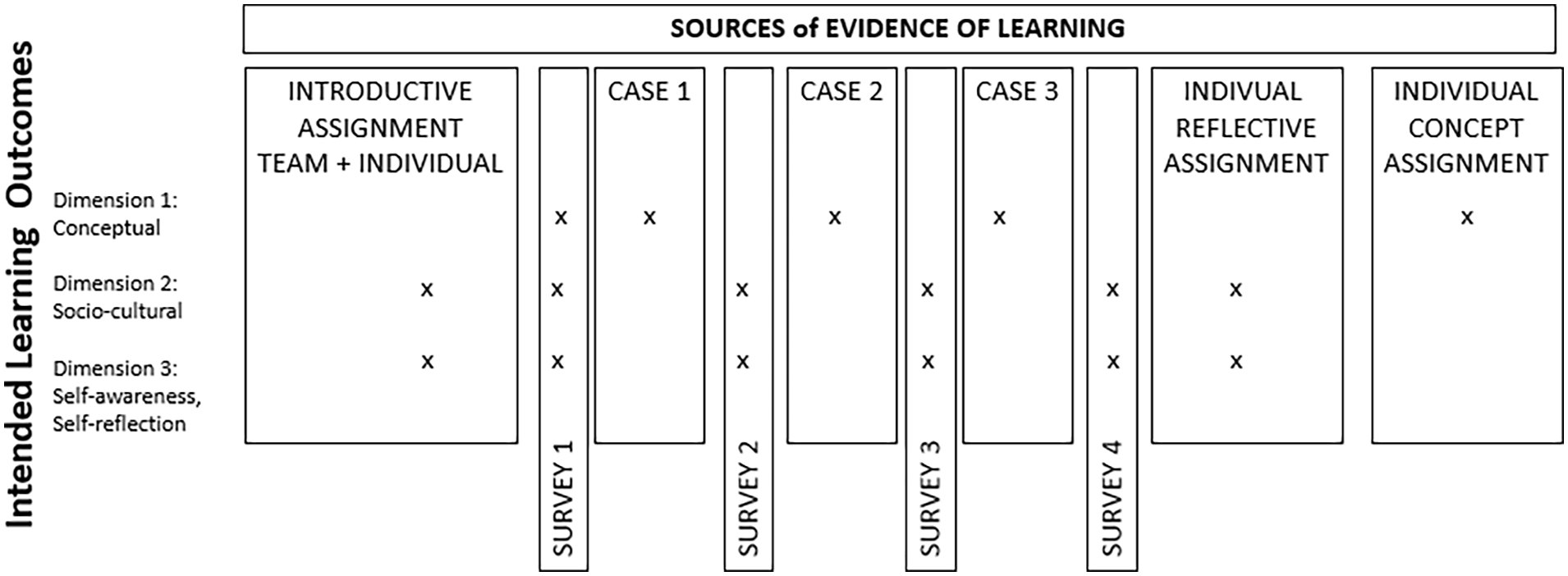
Framework for evaluation of learning in three dimensions.
For Dimension 1, which involves conceptual learning, analysis, and problem-solving, we can evaluate learning based on self-assessed learning progression and teachers’ assessments of teamwork and the individual final concept assignment. Applying a 5-point scale (1 = poor; 5 = excellent), 70% of students rated their teams’ performance as very much (4) or excellently (5) improved for cases 2 and 3, each comparing them with the preceding case. Interestingly, respondents who rated team outcomes initially more negatively or neutrally (30%) were less likely to report performance improvements in successive case solutions. This can be interpreted in many ways, but we know from team climate research (Glikson & Erez, 2020) that an anchoring effect might moderate these assessments, which are not always consistent with teachers’ evaluations of their work. A typical student (pseudonym) response to a semi-structured question reflected on conceptual learning as follows:
Jane (Team 18): [My] overall feeling about the teamwork, based on previous thoughts, is also quite positive, because we have managed to do [a] great job with most [consulting assignments], if not all, [our work on] cases has been really effective in the last two [cases].
The performance evaluation, based on teachers’ assessments, showed an average of 3.8 (on a 5-point scale), with more than half of the teams improving their grades for each subsequent case and only 6% retaining a lower level assessment (<3). The congruence of internal and external assessments of teamwork was consistent with the average grade of 3.8/5 for the individual final concept assignment. Thus, we can affirm that overall, students accomplished the conceptual learning objectives.
Regarding Dimension 2, learning about sociocultural practices in a GVT, we drew our conclusions based on the surveys administered after each group assignment. For instance, we documented, using items measuring psychological safety (Edmondson, 1999), that 94% of participants rated “cooperation/communication,” “getting along with others,” and “sharing of information” as very well (≥4). About 85% rated their own contributions to the team to be positive (>3). Participants (60%) surveyed on “collaborative task completion” rated their team performance to be very positive (≥4), with 27% rating it as neutral and the remaining 13% as worse. As we repeated the measure after each consulting assignment, we could identify among the most satisfied majority an initial increase in collaboration, which was altered slightly after the last case. We interpreted this as respondents becoming more critical upon completion of team assignments. Beyond the numbers, we saw acknowledgment of social sensemaking in answers to semi-structured questions, for instance, describing the effects of team learning:
Kathrin (Team 6): If I look back, it is really true that a group can create better results than one single person, and it is also more than just adding all the aspects together. Long discussions and conversations make single ideas into a holistic concept. . . . Our decision making process still was democratic and transparent.
In sum, we can conclude that sociocultural competencies at the laboratory are increasing through students’ interactions with their multicultural team members.
Regarding Dimension 3, which pertains to individual self-awareness and reflection learning, among an array of measures, we applied Jordan and Lawrence’s (2009) “team emotional intelligence” to measure awareness of one’s emotions, management of one’s emotions, and management of the emotions of others. For example, when we asked if “members are able to overcome their frustrations related to other members,” we found that around two-thirds of respondents agreed with the statement and retained that judgment throughout all three cases. Similarly, when asked about being “able to respect others’ opinions even when thinking others are wrong,” the students’ overall response was confirmative (close to 80%) throughout surveys 2, 3, and 4. However, the level of agreement dropped from strongly agree in survey 2 (51%) to 37% in survey 3, before recovering at 46% in survey 4. We feel this change indicates that, halfway through the eight-week period, frictions emerged that could be repaired by the end of the teamwork sessions. Students pondered their experiences in a self-aware and reflective manner, describing intercultural complications in the following way:
Casper (Team 1): I often assume people understand everything similarly as I do. This became clear on multiple occasions, that there are several different ways to interpret the same thing, a case description for example. I have learned that people from different cultural backgrounds can look at the same issue from very different perspectives. I would say that one thing hindering our communication is the common language [English], which none of us speaks as their [native] language.
In the final reflective essay, we asked students to individually review their own responses to four surveys, compare them with aggregate response results from the whole population of respondents (N = 146), and seek interpretations by drawing on the academic literature. Overall, this produced very strong indications for self-awareness and reflection learning. The median grade (see Appendix 1 for the main grading criteria) on this assignment was a 4 (very good), suggesting that the students put considerable effort and thought into it. However, grading was not really the best way to understand if learning occurred in this case; qualitative examples of students’ reflections were more revealing. The following example is from an individual reflective assignment: Elena (Team 25): Of course, what happens in personal life affects the results of one’s work. For me personally, November has been a busy month with work and a lot of schoolwork. Assignments tend to build up towards the end of the year, and those can be seen in my survey answers as well. I often [responded that] I was feeling tired and had troubles with concentrating. Luckily, I was still able to complete my responsibilities, but the workload definitely affected my personal life. In the research made by Bolino and Turnley (2005), they stated that higher levels of individual initiative are associated with higher levels of employee role overload, job stress, and work-family conflict. I do not know if it is the Finnish mentality I have, but I usually end up taking a lot on my plate and still think that I should cope with my issues alone. I did not really share my thoughts about my tiredness with my team, because I thought that everyone has their own problems, and I would not want to cause any harm or worry. Since I am good at separating “work me” and “private me,” I was able to maintain our team relationships professionally and, most importantly, get the job done. Someone could argue that we did not have a safe environment because I did not want to share my personal concern, but I would not put it that way. I definitely felt safe and was really happy about our open communication. It was just my private choice not to mix up work and private life.
Assessment of learning is more direct when looking at learning outcomes in Dimension 1 (concepts), and rather indirect for Dimensions 2 (sociocultural interactions) and 3 (self-awareness). Overall, we have established an elaborate evaluation and assessment framework (Figure 2) that allows us to make such assertions.
Discussion and Implications for International Business Education
The implementation of our lab design has important implications. For a master’s level program, the alignment of courses’ intended learning outcomes is an important objective, which is difficult to accomplish when courses operate in thematic silos. The lab creates learning opportunities from students’ actions, supported by the courses’ particular perspectives. Its structure generates authentic experiences and events at the lab, enabling progress in the students’ application of course contents, and it facilitates personal and professional development in a realistic setting.
For students, the opportunities are vast as they engage in holistic learning by integrating the conceptual contents and their applications from the International Business Strategy course into an actual social setting that requires them to strategize while having intercultural encounters, which often reveal students’ strengths and weaknesses. Practicing facilitated self-awareness and reflection supports students’ development toward becoming capable and balanced managers. However, the lab is very intensive and requires considerable cognitive, time-related, and emotional investments, which translate into high levels of satisfaction when perceived learning is substantial. In the most recent course evaluation, our students rated “learning” and “methods for learning” as very effective (72%) or mostly effective (14%). In our ongoing research, we found indications that students’ experiences at the lab affect their overall preconceptions for working in a GVT. Their preparedness for taking responsibilities increases because their capacity to operate in multicultural virtual environments is enhanced, their commitment to take initiative is elevated, and their expectations about succeeding are higher.
Program managers and teaching staff need to consider two aspects: the positive effects of the laboratory on overall program objectives’ attainment, vis-à-vis the very substantial efforts required to develop and run a laboratory. The way we justified the costs for developing this instructional innovation was by emphasizing synergies. We involve doctoral candidates with related research interests and gear department research projects toward GVTs. We use the lab to keep action-oriented collaboration with colleagues and collaborate universities abroad active, not only in terms of teaching but also through joint research. The indirect effects are also important. For example, three of the doctoral candidates involved so far have completed their PhDs, and we have received frequent inquiries from international executive programs that want to join this meaningful endeavor to enable students to become solution-oriented contributors in the complex dynamic world of international business.
Footnotes
Appendix
Marking Sheet Example (Case 1).
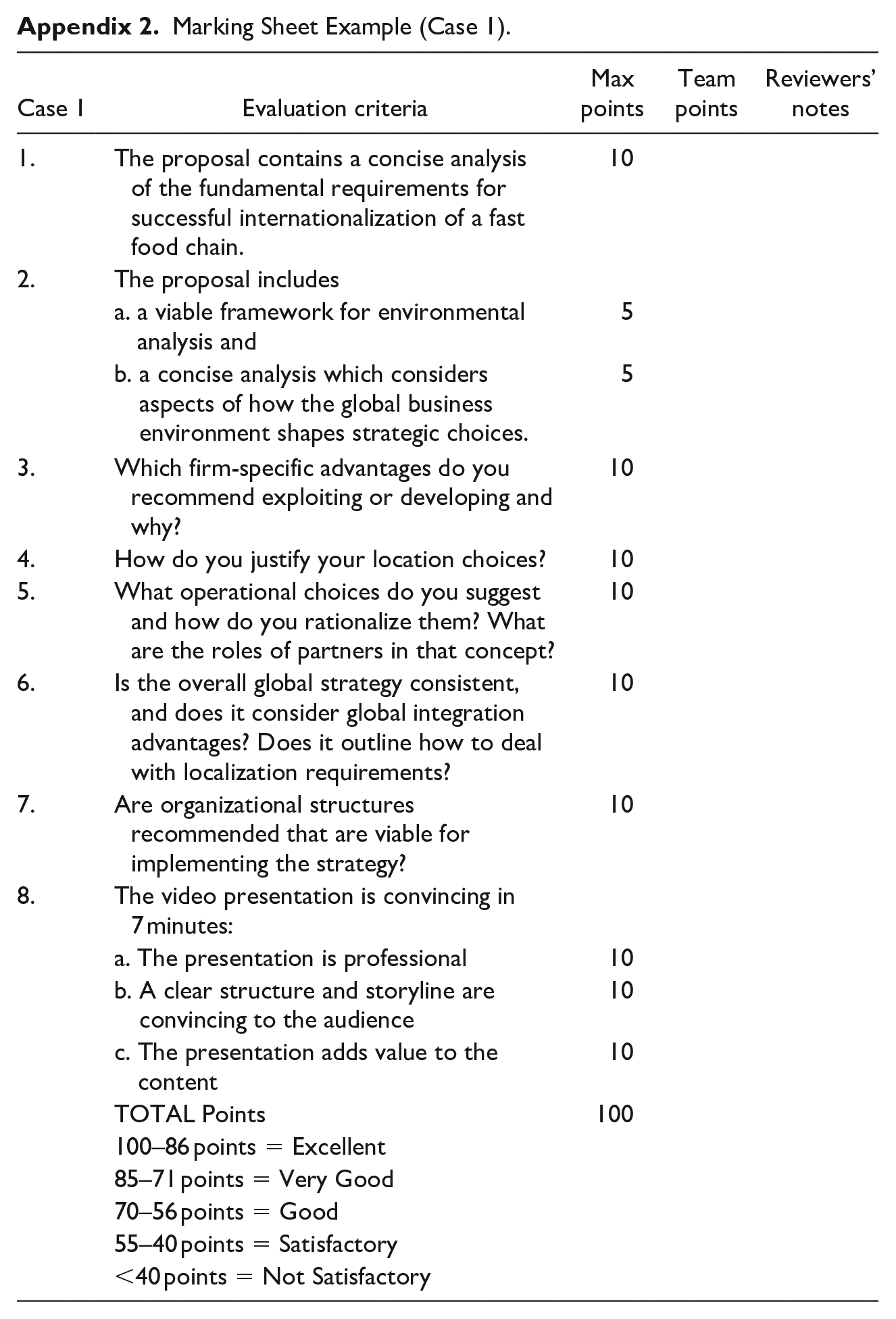
| Case 1 | Evaluation criteria | Max points | Team points | Reviewers’ notes |
|---|---|---|---|---|
| 1. | The proposal contains a concise analysis of the fundamental requirements for successful internationalization of a fast food chain. | 10 | ||
| 2. | The proposal includes | |||
| a. a viable framework for environmental analysis and | 5 | |||
| b. a concise analysis which considers aspects of how the global business environment shapes strategic choices. | 5 | |||
| 3. | Which firm-specific advantages do you recommend exploiting or developing and why? | 10 | ||
| 4. | How do you justify your location choices? | 10 | ||
| 5. | What operational choices do you suggest and how do you rationalize them? What are the roles of partners in that concept? | 10 | ||
| 6. | Is the overall global strategy consistent, and does it consider global integration advantages? Does it outline how to deal with localization requirements? | 10 | ||
| 7. | Are organizational structures recommended that are viable for implementing the strategy? | 10 | ||
| 8. | The video presentation is convincing in 7 minutes: | |||
| a. The presentation is professional | 10 | |||
| b. A clear structure and storyline are convincing to the audience | 10 | |||
| c. The presentation adds value to the content | 10 | |||
| TOTAL Points | 100 | |||
| 100–86 points = Excellent | ||||
| 85–71 points = Very Good | ||||
| 70–56 points = Good | ||||
| 55–40 points = Satisfactory | ||||
| <40 points = Not Satisfactory |
Acknowledgements
We acknowledge the contributions of Associate Editor Dr. Joy Beatty, Editor Dr. Kathy Lund Dean, and three anonymous reviewers. We found their engagements in the review process extraordinarily helpful and their excellent suggestions made the development of this article an enjoyable journey.
Declaration of Conflicting Interests
The author(s) declared no potential conflicts of interest with respect to the research, authorship, and/or publication of this article.
Funding
The author(s) received no financial support for the research, authorship, and/or publication of this article.
