




Abstract
Background
Competitive Integrated Employment (CIE) is recognized as a crucial factor for improving economic, psychological, and physical well-being. However, limited research exists on the predictors of CIE outcomes for veterans with disabilities.
Objective
This study aims to identify demographic and service-related factors influencing CIE outcomes for veterans who received state-federal vocational rehabilitation (VR) services.
Methods
Data were sourced from the U.S. Department of Education's Rehabilitation Services Administration Case Service Report (RSA-911) for Fiscal Year 2021 (FY21). Multivariate logistic regression was used to examine demographic characteristics and VR service patterns associated with CIE outcomes.
Results
Nearly 45% of participants achieved CIE. Receipt of services such as rehabilitation technology, job search assistance, and maintenance services significantly increased the odds of CIE, while receipt of supported employment services and Supplemental Security Income (SSI) or Social Security Disability Insurance (SSDI) at program exit were associated with reduced odd.
Conclusion
CIE outcomes for veterans in VR programs are influenced by demographic factors, service patterns, and financial support. Policymakers and practitioners should prioritize targeted interventions, including tailored VR services and support for younger veterans, to enhance CIE success.
Keywords
Introduction
Employment plays a crucial role in enhancing various aspects of an individual's well-being, including mental health (Chan et al., 2016; Umucu et al., 2022, 2025 Umucu & Lee, 2024). More than one in four adults in the U.S. have some type of disability (Centers for Disease Control and Prevention, 2024). People with disabilities may experience more employment-related disparities compared to those without disabilities (Umucu, 2021). As of June 2025, the employment-to-population ratio for working-age individuals (16–64 years) with disabilities was 38.0%, compared to 75.1% for those without disabilities (U.S. Bureau of Labor Statistics, 2025). To address these disparities, public-sector vocational rehabilitation (VR) services invest over $4 billion annually in employment-related services (Taylor et al., 2021).
Veterans with disabilities represent a distinct subpopulation with unique demographic, psychosocial, and health characteristics that influence both their engagement in VR programs and their ability to obtain Competitive Integrated Employment (CIE) (Umucu, 2023). CIE is defined as work, including self-employment, performed on a full-time or part-time basis where individuals with disabilities earn at least the minimum wage and receive compensation comparable to non-disabled employees in similar roles while being integrated with non-disabled coworkers and having equal opportunities for advancement (Workforce Innovation and Opportunity Act [WIOA], 2014). Attaining CIE is associated with improved economic security, physical and psychological health, community integration, and independence (Taylor et al., 2022).
A substantial proportion of veterans live with service-connected disabilities. According to the U.S. Bureau of Labor Statistics (2023), about 30% of veterans report such disabilities. Conditions like posttraumatic stress disorder (PTSD), TBI, and major depression are considered the signature injuries of recent military conflicts, with these conditions creating significant challenges to CIE that often require coordinated VR services (Johnson et al., 2022). Mental health and substance use concerns are often worsened as Veterans reporting these issues also report higher rates of homelessness, lack of connection to support systems, and high unemployment rates (Sprong et al., 2024). These factors contribute to reduced labor force participation. Notably, the unemployment rate among veterans with service-connected disabilities rose from 3% in 2022 to 6% in 2023 (U.S. Department of Labor, 2023).
Although the U.S. Department of Veterans Affairs (VA) offers programs such as Vocational Rehabilitation and Employment (VR&E) and Compensated Work Therapy (CWT), only a small proportion of eligible veterans access these services (Umucu, 2023; VA, 2023, 2025). Barriers include limited awareness, stigma, and complex eligibility criteria that vary across federal and state systems. Veterans also face systemic fragmentation, as VA-specific programs, state–federal VR services, and community-based providers often operate independently with limited coordination. Differences in service structure and eligibility further complicate navigation for veterans seeking support (Umucu, 2023).
CIE is essential for a smooth and optimal transition from military to civilian life, yet many veterans face persistent barriers. Each year, many service members transition out of military service, and most report difficulty adjusting to civilian life. These difficulties are frequently compounded by health concerns, with 53% of transitioning service members reporting chronic physical conditions and 33% reporting chronic mental health conditions (Bond et al., 2022).
Although prior research has examined VR outcomes across various populations, there is limited evidence on which factors most strongly predict CIE success among veterans with disabilities. This knowledge gap delays efforts to design effective employment and rehabilitation interventions. To address these gaps, this study uses a large, national dataset (RSA-911) to examine demographic and service-related predictors of CIE outcomes among veterans. We focus on demographic factors (e.g., sex, age, education level, race), receipt of SSI and/or SSDI at program exit, and patterns of service use (e.g., job search assistance, job placement assistance, educational/academic programs). This study addresses the following research questions, which examine both individual-level predictors and service-related factors that influence employment outcomes across VR delivery systems:
To what extent do demographic variables (e.g., sex, age, education level, race) predict CIE outcomes for veterans across VR service delivery systems? How do service patterns and SSI/SSDI receipt at program exit influence CIE outcomes? What factors most strongly predict successful CIE outcomes?
The results have implications for multiple stakeholders. For policymakers, the findings offer insight into program effectiveness and opportunities to improve interagency coordination. For researchers, the study helps address gaps in literature related to employment outcomes for veterans with disabilities. The national scope and timeliness of the data offer valuable insights into current VR service delivery and opportunities for enhancing employment equity.
Methods
Data Source
This study used data from the U.S. Department of Education's Rehabilitation Services Administration Case Service Report (RSA-911) for Fiscal Year 2021 (FY21). This data includes information on client demographics, disability type, educational attainment, VR services received, and employment status at various program stages (Cornell University, 2022). The RSA-911 is used by the Rehabilitation Services Administration to evaluate VR and supported employment programs (U.S. Department of Education, 2019).
In FY21, 367,810 VR clients exited the VR system. Employment outcomes were categorized as “CIE,” “self-employment,” “Randolph-Sheppard Business Enterprise Program (BEP),” “supported employment,” or “no employment.” For this study, a binary variable was created: individuals achieving CIE were coded as “1,” and all other outcomes were coded as “0.” The initial sample was restricted to veterans of the U.S. Armed Forces (N = 12,172).
Participants
The dataset's demographics and VR services were analyzed according to the RSA-911 policy directive (United States Department of Education, 2019). For the purpose of this study, participants who met the following criteria were excluded from the dataset:
Non-veteran individuals who receive state-federal VR services, Those who did not receive at least one VR service, Individuals under age 16 at the time of application, Cases missing employment status at program exit.
After applying these criteria, the final analytic sample included 6,075 veterans. Of these, 5,798 received services from state/federal VR programs, 48 received services solely through the VA VR&E program, and 229 received services from both systems. The mean age at application was 44.35 years (median: 47; SD: 17.18).
Variables
Independent Variables
This study used two sets of explanatory variables: demographic characteristics and the receipt of VR services. The analyzed demographic characteristics included sex (male/female), age at application (categorized per U.S. Bureau of Labor Statistics: 16–24, 25–34, 35–44, 45–54, 55–64, 65+), race (White vs. Non-White), and highest education level. Education was categorized as: “Less than high school,” “At least high school,” and “Bachelor's degree or above,” based on graduation dates reported in the RSA-911. Individuals were classified by the agency as having a significant or most significant disability.
Receipt of SSI and/or SSDI at program exit was included as a concurrent (not causal) factor associated with CIE outcomes. RSA-911 reports binary indicators of each service provided during the fiscal year. Services analyzed included (but were not limited to): job readiness training, job placement assistance, short-term job support, interpreter services, four-year college training, occupational training, and rehabilitation technology. A full list is provided in Policy Directive RSA-PD-19-03 (U.S. Department of Education, 2019).
Outcome Variable
The primary outcome was attainment of Competitive Integrated Employment (CIE) at program exit. As defined by WIOA (2014), CIE involves work performed in integrated settings (full- or part-time), with wages and benefits comparable to those received by non-disabled peers, and opportunities for advancement (U.S. Department of Labor, 2016).
Data Analysis
Multivariate logistic regression was used to assess the relationship between the explanatory variables and the likelihood of achieving CIE. Correlation analysis indicated that all variables had pairwise correlations below 0.80, with the highest correlation (0.77) between SSI/SSDI receipt at application and at exit. A Wald test confirmed that only SSI/SSDI status at exit was significant and thus included in the final model. Variance Inflation Factor (VIF) was calculated. Most variables had VIF values below 5. The highest, for “Job Search Assistance,” was 4.23. One variable, a collapsed categorical measure, had a VIF of 33.05 and was excluded due to high collinearity (Salmeron et al., 2018). A combination of stepwise variable selection (backward and forward) and purposeful selection was employed. Selection criteria included variable significance, residual deviance, and the Akaike Information Criterion (AIC) (Agresti, 2007). Purposeful selection followed Hosmer et al.'s (2013) approach using Chi-square tests, Wald statistics, and relative weight analysis. Several models were compared. The final selected logistic regression model included 11 explanatory variables. It achieved an Area Under the Curve (AUC) of 0.7066, an accuracy of 0.6996, sensitivity of 0.5458, and specificity of 0.8079 on the test subset. Frequencies, means, medians, and standard deviations were calculated to characterize the sample and assess service use patterns.
Results
Descriptive Statistics
Exploratory data analysis revealed that 44.94% of veterans with disabilities attained Competitive Integrated Employment (CIE). On average, veterans received 2.41 VR services during Fiscal Year 2021 (FY21), with a median of two services (SD = 1.61, range: 1–11). Veterans remained in the VR system for an average of 23.6 months (median: 17, SD = 21.89, range: 0–256 months). Those who achieved CIE received more services (mean = 2.7, SD = 1.68) than those who did not (mean = 2.18, SD = 1.50). This difference was statistically significant (t(5545.1) = 12.71, p < .001), indicating a meaningful association between service utilization and employment outcomes.
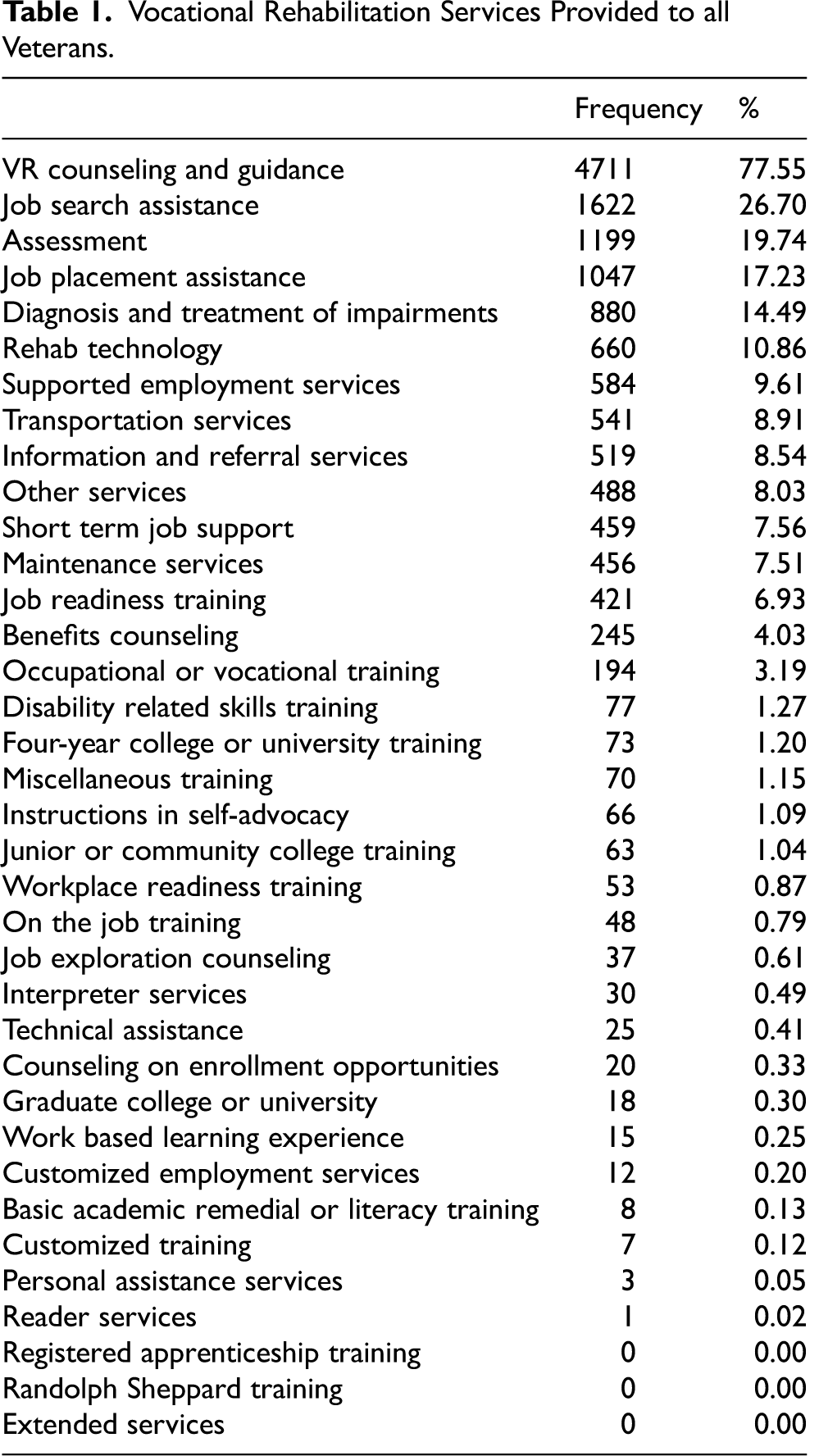
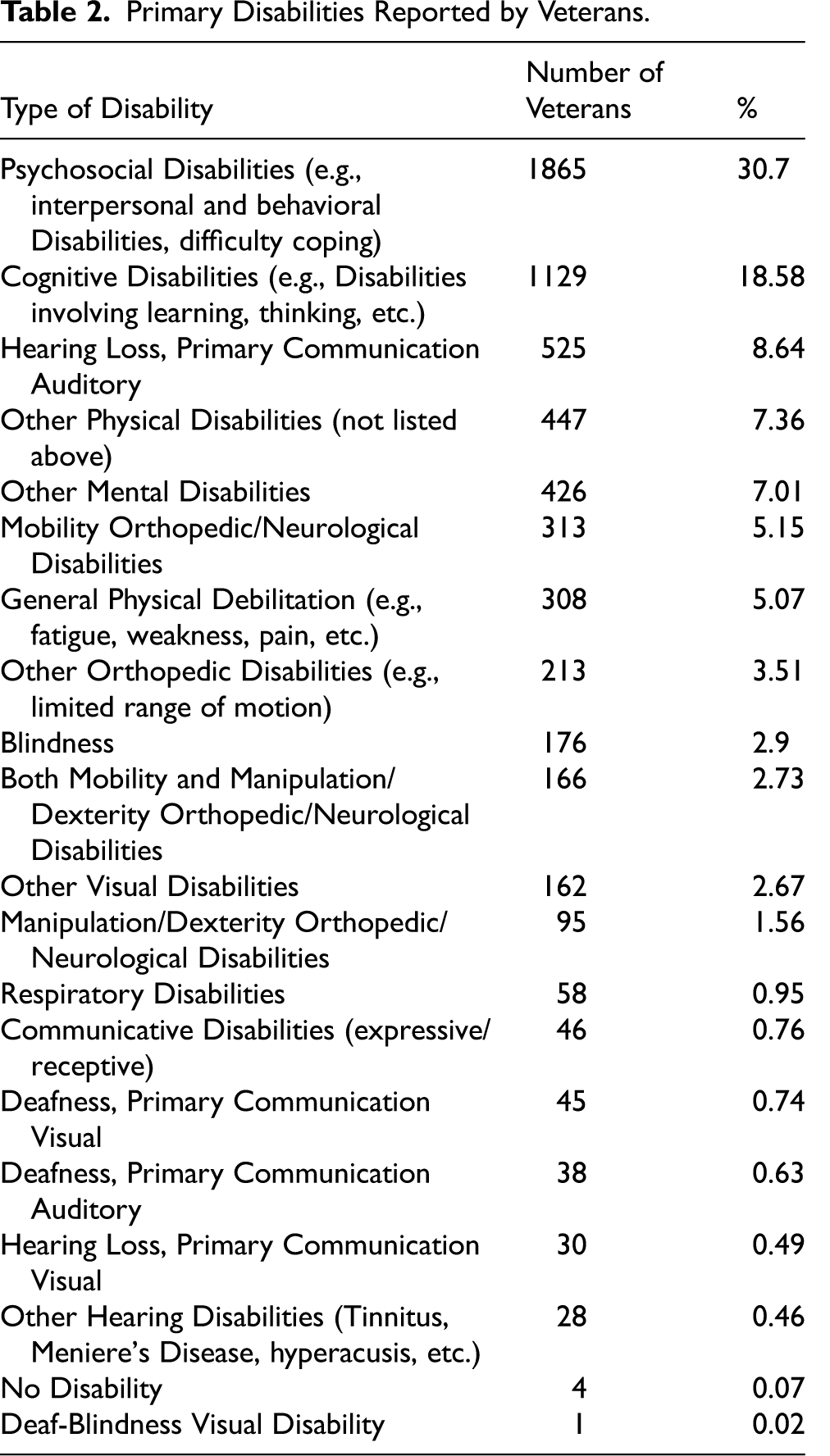
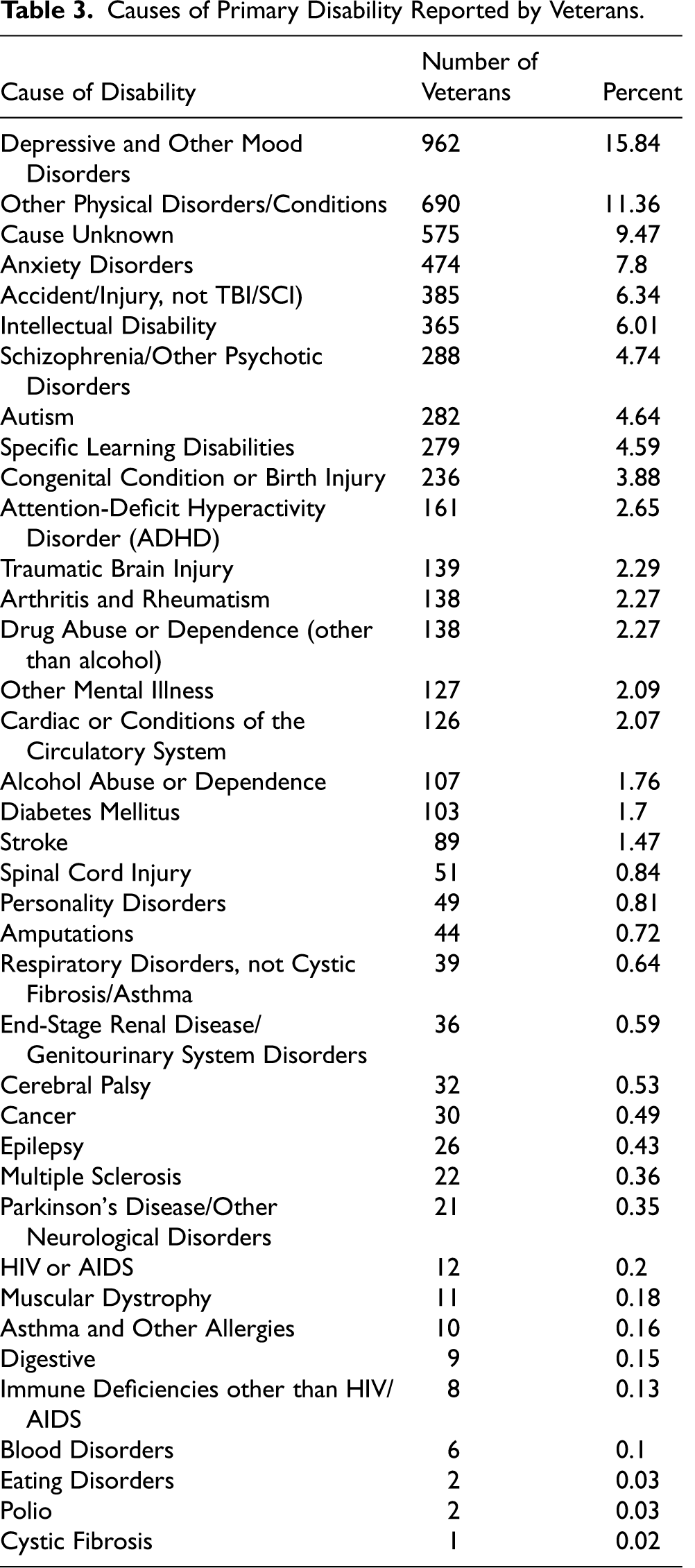
The most frequently provided services were VR counseling and guidance (77.55), job search assistance (26.7%), assessment (19.74%), job placement assistance (17.23%), diagnosis and treatment of impairments (14.49%), and rehabilitation technology (10.86%). Regarding disability type, 1,865 participants (30.7%) had a primary psychosocial disability, and 1,129 (18.6%) had cognitive disabilities. The most commonly reported causes of disability were depressive and other mood disorders (n = 962), followed by other physical disorders or conditions (n = 690) (Tables 1, 2 and 3).
Model-Based Results
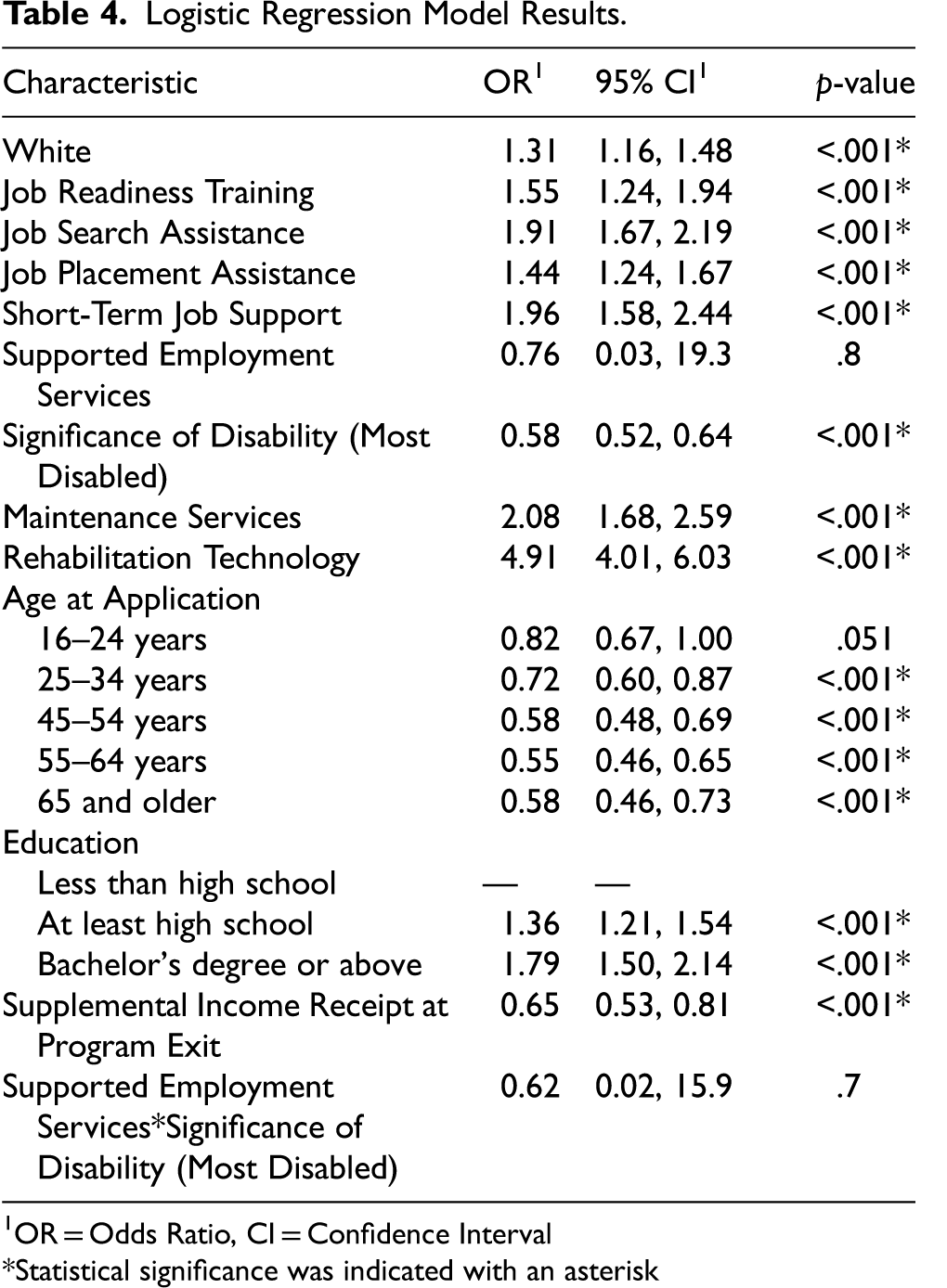
Within the population of our study, we first focused on non-mutable factors. Participants who self-identified as ‘White’ had 31% higher odds to obtain CIE than their counterparts (OR: 1.31, CI: (1.16, 1.48)). Compared to those from the participant group of 16 to 24 years of age at the time of application, every other age category at the time of application had reduced odds of achieving CIE. The odds ratio (OR) and 95 percent confidence interval (CI) per age category were: 25–34 years (OR: 0.82, CI: 0.67–1.00), 35–44 years (OR: 0.72, CI: 0.60–0.87), 45–54 years (OR: 0.58, CI: 0.48–0.69), 55–64 years (OR: 0.55, CI: 0.46–0.65), and 65 and older (OR: 0.58, CI: 0.46–0.73). Those veterans with a high school diploma or equivalent had 36% higher odds (OR: 1.36, CI:(1.21, 1.54)) of attaining CIE than those without a diploma. While those who had a bachelor's degree or higher had a 79% higher odds of CIE than those with no diploma (OR: 1.79, CI: (1.50, 2.14). Finally, veterans with the highest level of disability were 42% less likely to obtain CIE than those with less severe disability (OR: 0.58, CI: (0.52, 0.64)) (Table 4).
Participants who received supplemental income payments at the time of exit from the VR program had reduced odds by 35% of attaining CIE when compared to those who did not receive payments at exit (OR: 0.65, CI: (0.53, 0.81)). Those veterans receiving the VR service ‘maintenance services’ had two times the odds of CIE (OR: 2.08, 95 percent CI: 1.68–2.59) than those who did not receive that VR service. This service entails receiving “monetary support provided for living expenses such as food, shelter and clothing that are in excess of the normal expenses of the individual.” (United States Department of Education, 2019). Those participating in job readiness training (OR: 1.55, CI: (1.24, 1.94)), job search assistance (OR: 1.91, CI: (1.67, 2.19)), job placement assistance (OR: 1.44, CI: (1.24, 1.67)), or short term job support (OR: 1.96, CI: (1.58, 2.44)) all had higher odds of CIE than non-participants. Finally, veterans receiving rehabilitation technology support had much higher odds of CIE participation than those not receiving this support (OR: 4.91, CI: (4.01, 6.03)). The VR service provided and identified as ‘rehabilitation technology’ is defined as “Systematic application of technologies, engineering methodologies, or scientific principles to meet the needs of, and address the barriers confronted by, individuals with disabilities.” (United States Department of Education, 2019).
The only VR service to have no statistically significant impact on obtaining CIE was supported employment services, with reduced odds of attaining CIE (OR = 0.76; 95% CI: 0.03, 19.3) among veterans who received these services compared to those who did not. Supported employment services are designed to assist individuals with the most significant disabilities in maintaining employment (United States Department of Education, 2019). This variable was also modeled as interacting with disability severity, given that eligibility for supported employment is contingent on the presence of a most significant disability.
Discussion
The findings of this study offer important insights into the factors influencing CIE outcomes for veterans accessing state-federal VR services. Using nationally representative RSA-911 data from fiscal year 2021, this analysis identifies both demographic and service-related predictors of CIE, extending prior research by leveraging current, comprehensive data. In contrast to earlier studies relying on outdated or geographically limited samples, this study provides a timely national perspective, with implications for rehabilitation practitioners, policymakers, and researchers aiming to improve disparities related to employment outcomes for veterans with disabilities.
Demographic Predictors of CIE
Demographic variables, including age, race, and education, emerged as significant predictors of CIE outcomes for veterans with disabilities, consistent with previous research (Bah et al., 2023; Gould et al., 2021; Ipsen et al., 2023). Younger veterans, particularly those aged 18–24, demonstrated higher CIE success rates. This group may be in earlier stages of their civilian transition, often still engaged in education or job training, and thus better positioned to benefit from VR services. Conversely, veterans aged 45 and older experienced significantly lower odds of achieving CIE, reflecting known challenges such as age-related bias, health limitations, and difficulty adapting to new occupational roles (Umucu, 2023; Whitley & Apaydin, 2024).
Racial disparities also played a prominent role, with White participants more likely to achieve CIE compared to their non-White counterparts. This pattern aligns with previous research indicating that White VR recipients experience the most favorable CIE outcomes across racial groups (Gould et al., 2021). One contributing factor to these disparities may be historical discrepancies in resource allocation, as research suggests that VR expenditure rates have been significantly higher for White recipients than for their non-White peers (Patterson et al., 2000). These trends mirror broader systemic inequities prevalent across labor markets and reflect deeply embedded structural barriers, implicit biases, and culturally insensitive practices within VR service delivery systems.
Another key finding was that receipt of SSI or SSDI at program exit was negatively associated with CIE attainment. This aligns with prior research indicating that reliance on public benefits supports can discourage employment due to concerns about losing benefits, navigating complex rules, and fears about long-term financial stability (Government Accountability Office, 2024; Wehman et al., 1997). However, given that SSI/SSDI status was measured at exit—not baseline—these payments may also reflect failed employment attempts or increased financial need due to lack of CIE success, rather than serving as causal deterrents. Thus, while income support is essential, it may inadvertently create disincentives that require policy-level solutions, including benefit counseling, simplified eligibility structures, and tailored employment supports.
Service-Related Predictors of CIE
This study identified several VR services that were significantly associated with improved CIE outcomes. Based on odds ratios, rehabilitation technology and maintenance services were the strongest predictors, followed by job readiness training, job search assistance, short-term job support, and job placement assistance. These listed services may be effective in mitigating employment barriers by addressing specific functional, logistical, and motivational needs of veterans with disabilities. Specifically, the impact of rehabilitation technology underlines the value of technological interventions that enhance veterans’ autonomy, productivity, and engagement in employment settings (Alshamrani et al., 2024).
Interestingly, supported employment services were not statistically associated with higher CIE rates. While this may appear counterintuitive, it likely reflects the substantial employment barriers faced by the subset of veterans with the most significant disabilities for whom these services are typically reserved. This result may also indicate variability in service fidelity or implementation across agencies. Notably, supported employment, especially the Individual Placement and Support, has demonstrated strong efficacy in VHA settings (Davis et al., 2018). Future research should explore the fidelity and coordination of supported employment across VR delivery systems.
Implications for Policy and Practice
These findings have several implications. First, demographic disparities, specifically those related to age, race, and educational attainment, underline the need tailored job training programs, lifelong learning initiatives, and anti-bias interventions within VR systems that are essential to ensure inclusive service delivery (Lee et al., 2023). Second, findings related to SSI/SSDI reinforce the importance of integrated and coordinated benefit counseling. Veterans receiving income support often face systemic disincentives to pursue employment. Policymakers should prioritize reforms that simplify benefit structures, clarify work incentives, and offer individualized financial guidance to help veterans transition off public benefits without risking income insecurity. Third, findings offer clear direction for prioritizing effective support for CIE. Rehabilitation technology, maintenance services, and job-focused supports should be consistently funded and made accessible across VR systems. Based on results, these interventions not only increase the likelihood of CIE but also align with veterans’ functional needs and employment goals.
As noted earlier, future longitudinal studies are needed to clarify how benefit receipt interacts with service engagement and employment outcomes. Additionally, while this study did not formally compare outcomes across delivery systems due to small sample sizes, descriptive differences suggest opportunities for stronger interagency collaboration. For example, combining the VA's strengths in rehabilitation technology and maintenance support with the state VR system's employment networks could yield synergistic benefits. Shared training, data integration, and cross-system service models may support more seamless and effective transitions for veterans.
Limitations and Future Research
Several limitations should be acknowledged for this study. First, the cross-sectional nature of the data precludes causal conclusions. Longitudinal analyses are necessary to assess the temporal relationships between services and employment outcomes. Second, although RSA-911 provides valuable data, it does not have access to veterans receiving solely VA VR&E services, potentially limiting generalizability. The dataset also lacks contextual details relevant to veteran reintegration, such as stigma, cultural competence, and military-to-civilian transition factors (Umucu, 2023). Third, reliance on administrative data may present reporting inaccuracies and does not capture qualitative aspects of veteran experiences regarding CIE. This limitation is especially relevant in interpreting the finding regarding supported employment, which appears to contradict earlier evidence of effectiveness. Another limitation is the potential underestimation of service use. RSA-911 captures only those services delivered in the reported fiscal year. Veterans who began receiving services in earlier years may have unrecorded activity, which could bias estimates of service impact. Lastly, the small sample of VA-only participants (n = 48) precluded system-level comparisons. Future studies using linked RSA and VA datasets, with larger balanced samples, are needed to compare delivery systems and explore how service combinations influence long-term employment.
Conclusion
Vocational Rehabilitation Services Provided to all Veterans.
Primary Disabilities Reported by Veterans.
Causes of Primary Disability Reported by Veterans.
Logistic Regression Model Results.
OR = Odds Ratio, CI = Confidence Interval
*Statistical significance was indicated with an asterisk
Footnotes
Acknowledgements
N/A

Ethics Considerations
This study was reviewed the UTEP IRB and was found to be qualified as exempt from review.
Informed Consent
N/A
Funding
The authors disclosed receipt of the following financial support for the research, authorship, and/or publication of this article: The contents of this article were developed with support from the Vocational Rehabilitation Technical Assistance Center for Quality Employment, H264K200003, from the U.S. Department of Education. However, the contents do not necessarily represent the policy of this agency and you should not assume endorsement by the Federal government.
Declaration of Conflicting Interests
The authors declared no potential conflicts of interest with respect to the research, authorship, and/or publication of this article.