



Abstract
Background
The move to working from home necessitated by COVID-19 gave way to debate among employers and employees over return-to-office mandates and the merits of remote work. Amidst these discussions, employee narratives emerged centering on the improved work experience at home, including minimized mistreatment, stress, and emotional exhaustion.
Objective
We investigate whether working from home presents an unacknowledged benefit by buffering employees from experiencing incivility and microaggressions, thus affecting their sense of inclusion and well-being.
Methods
The sample comprised 428 Canadian hybrid workers, who completed an online survey. Data were analyzed through qualitative and quantitative techniques.
Results
Our findings demonstrate that circumstances for hybrid workers tend to be better the more they work from home and worse the more they work in the office. The extent to which employees worked in the office was associated with higher rates of mistreatment, lower inclusion, and higher stress and emotional exhaustion. The primary pathways for these effects were through incivility for the general hybrid workforce, and through microaggressions for equity-deserving employees. Employees from equity-deserving groups thus might benefit from reduced exposure to both incivility and microaggressions while working from home.
Conclusions
We demonstrate how being ‘out of sight’ may present an erstwhile unacknowledged benefit of hybrid work and offer a nuanced discussion of the common perception that remote work prompts feelings of isolation. Organizations seeking to support employee well-being might consider offering flexible remote work opportunities alongside meaningful initiatives to promote inclusion and career progression among all, regardless of one's preferred work location.
Keywords
Introduction
The benefits and consequences of working from home (working remotely, or teleworking) for both employees and employers have been well researched. There is some ambivalence among the findings, as remote work has been associated with advantages such as greater organizational flexibility and improved work-life balance for employees, 1 while disadvantages include social isolation. 2 Meta-analytic findings, however, demonstrate that for employees, the advantages of working from home (WFH) tend to outweigh the disadvantages. 3
Despite its potential, WFH remained relatively rare prior to the COVID-19 pandemic. 4 The widespread move to WFH forced many people to experience remote work for the first time, allowing them to assess whether they could function regularly in a work arrangement that had often previously been reserved for exceptional circumstances. Having experienced – positively, in many cases – the reality and possibility of WFH as the norm, many people were interested in continuing to work in this arrangement. 5
It is no surprise that the public narrative post-pandemic has reflected an ongoing struggle between employers and employees over return-to-office mandates, 5 with many employers and leaders insisting that employees must “get back to work.” 6 (para.2) Employers remain untrusting and skeptical of the productivity of remote workers, 7 and remote employees may well be the last to be promoted and the first to be cut when downsizing is necessary. 8 Meanwhile, employees insist they are working just as well from home and are much more satisfied while doing so. 9
Moreover, there is speculation that the advantages and disadvantages of WFH may be amplified for equity-deserving group members – those who “because of systemic discrimination, face barriers that prevent them from having the same access to the resources and opportunities that are available to other members of society, and that are necessary for them to attain just outcomes” 10 (para.7) – such that WFH may provide greater flexibility and work-life balance, while also reinforcing feelings of exclusion and isolation. 5 Yet there is limited research regarding the WFH experiences of equity-deserving group members, such as women and gender diverse individuals, people of colour, 2SLGBQIA + individuals, and employees with disabilities. What evidence currently exists suggests that WFH may be beneficial for these individuals. For example, the widespread adoption of WFH has been associated with rising labour force participation rates for individuals with disabilities, 11 as it alleviates some of the barriers and challenges of commuting to and working in a traditional workplace. 12 In turn, Black individuals experiencing WFH for the first time during and after the pandemic reported fewer instances of racism. 13 During the post-pandemic return to office-based work, Subramanian 14 reported that only 3% of Black employees wanted to work in the office full-time, compared to an average of 21% among those surveyed overall. At the same time, some scholars posit that isolation and exclusion – oft-cited drawbacks of WFH – may be exacerbated among those who are more often overlooked or marginalized.5,15
Now that hybrid work is the way of the present – and, potentially, the way of the future – it is essential to update our understanding of working in the office versus at home. 1 Our goal was to investigate whether being ‘out of sight’ of others in the office may present an unacknowledged benefit of hybrid work arrangements. To this end, we address the questions: Does WFH to some extent protect employees from experiencing specific harms related to workplace mistreatment? And might this change in mistreatment exposure be reflected in employees’ workplace inclusion and well-being? We surveyed 428 hybrid workers, 340 of whom self-identified as belonging to equity-deserving groups, to investigate the influence of hybrid work on their experiences of mistreatment and inclusion at work, as well as their well-being.
Literature review & hypothesis development
Hybrid work
Although the definition of hybrid work remains nebulous, the work arrangement has gained significant popularity since the global COVID-19 pandemic struck,5,11 with more employees splitting their work time between the office and home. Indeed, the necessary move to WFH during the pandemic led to the widespread adoption of hybrid work policies and practices across North America. The literature outlines the benefits of hybrid and remote work for organizations and employees alike, including greater flexibility, autonomy, job satisfaction, improved performance, and reduced stress and exhaustion. 15 WFH has also been detrimentally associated with feelings of social exclusion and isolation from colleagues and supervisors, 2 fear of negative effects on one's career advancement prospects, work intensification, concerns about separating work and personal life, 16 as well as employer skepticism of at-home productivity despite the heightened recognition that productivity is “not necessarily tied to the physical office space.” 4 (p.2) Nonetheless, the effects of the move towards hybrid work and WFH are predicted to have a long-lasting impact on the future of work. 5
The effects of the shift toward hybrid work may be particularly strong amongst individuals who do not match the characteristics of the stereotypical ‘ideal worker’: “a white man who is totally dedicated to the work and who has no responsibilities for children or family demands other than earning a living.”17(p.448) Structural racism, sexism, heterosexism, and ableism have been built into the core operating logics within many organizations7,17–19; these logics lionize those workers who conform more closely to the ideal worker norm. Deviation from this ‘ideal’ norm is thus a structural vulnerability arguably shared among many – indeed, most – current employees. In a diverse modern workforce, the normative group upon whom the ideal worker norm has been built (i.e., men like those described in the quotation above), is a group that has, paradoxically, become a statistical minority over time. Nevertheless, this group of ‘ideal’ workers continue to hold social capital and power within organizations – capital and power that often allow them to reinforce and perpetuate outdated operating logics, such as enforcing requirements for in-office work. 20 To the extent that this relatively small number of individuals with outsized power continue to set the norms of conduct in organizations, in-office work itself may serve to accentuate these ingrained modes of operation, 7 and being present in the office (i.e., face time) 21 may (or may already have) become part of the ideal worker norm.
There has been much discussion about the claim that employees who WFH (either fully remotely or in a hybrid model) risk being ‘out of sight, out of mind’ in their social networks and in recognition of their performance and contributions.2,22 While the threat of being ‘out of sight, out of mind’ could be rectified by training workplace managers to expand their conception of what constitutes job performance, 23 it is nevertheless important to acknowledge that being ‘out of sight’ might carry certain benefits for employees, especially those who cannot conform to the image of the ideal worker due to their social location. 7 For example, research indicates that neurodivergent individuals stand to benefit from hybrid and remote work because controlling one's environment is generally more manageable at home than in a traditional office, where sensory overload, expectations of small talk, and distractions such as loud noises can be challenging to mitigate.11,24 For those living with physical disabilities, remote work is advantageous in terms of reducing fatigue, barriers, and the navigation of poorly designed office spaces. 12 At the same time, those who conform more closely to the ideal worker norm in terms of their demographics (e.g., gender, ethnicity, sexual orientation, disability status) may still benefit from WFH for other reasons, such as introversion. 25 Thus, WFH may carry advantages for all employees. We contend that one such shared advantage may be a reduced exposure to workplace mistreatment.
Incivility, microaggressions, and inclusion
Incivility is a common form of mistreatment, describing “rude, condescending, and ostracizing acts that violate workplace norms of respect, but otherwise appear mundane,” 26(p.299) and includes behaviours such as being ignored or excluded, having one's judgment questioned, and being interrupted. All employees are at high risk of experiencing incivility at work, with meta-analytic estimates suggesting a prevalence rate of approximately 75%. 27 Moreover, even though these are low-intensity behaviours and even if the intent behind them may not be odious, incivility is still detrimentally associated with important outcomes such as task performance, empowerment, self-esteem, job satisfaction, withdrawal, turnover intentions, and mental health. 26
To date, however, there has been little exploration of employees’ experiences of incivility while WFH or in hybrid work arrangements. This is a hazardous omission, given not only the prevalence and risks of incivility but also because it has been long established that certain groups of employees are at higher risk of incivility than others. 28 Incivility, due to its often subtle and unattributable nature, can be a covert means of enacting discrimination, particularly in work environments where overt racism, sexism, and heterosexism are being increasingly sanctioned. 28 Importantly, these forms of selective incivility can be directed towards all those who deviate from the ideal worker norm – whether to a greater or lesser extent – due to their social location. 28 The experience of workplace incivility grounded in one's social identity is thus a common thread shared by individuals from a variety of different social identity backgrounds – including those who are ostensibly relatively more privileged (e.g., non-disabled white women; queer white men) – and not just those who are most marginalized in society. Despite the inherent subtlety of incivility, this form of mistreatment has been shown to hinder career progression among women, employees of colour, employees with disabilities, and other marginalized individuals in the workforce, particularly when these individuals work in male-dominated occupations.29–31
Microaggressions are another insidious form of mistreatment, perpetrated via “environmental, verbal, or behavioral occurrences that denigrate individuals for belonging to certain stigmatized social-identity groups.” 32(p.738) Masunaga 13(para.3) captured an employee's experience of microaggressions when they wrote: “Patients at the hospital sometimes gave him funny looks when he came to check their room's Wi-Fi, recalled Barton, who is Black, and staff members questioned his competence.” Though some argue that microaggressions and incivility are highly related and perhaps conceptually indistinguishable forms of subtle slights, others assert that microaggressions differ from more generic forms of incivility, given that their content calls direct attention to the ‘otherness’ of an equity-deserving group member within the work environment. 33 Indeed, microaggressions corroborate harmful stereotypes and remind targets of the structural inequalities that have cemented their unjustly subordinated position(s) within the social hierarchy. 32 Through their negative impact on targets’ physiological and psychological responses, microaggressions are detrimental to sleep, physical health, mental health, cognitive functioning, work performance, and career progression.29–32,34 Microaggressions, in particular, are individual-level behaviours that reinforce structural barriers and persistent patterns of inequality, such as the glass ceiling and the underrepresentation of employees of colour and employees with disabilities in knowledge-based occupations.34–37 These outcomes are not minor; incivility and microaggressions can have deep and lasting effects on targets, organizations, and institutions.34,35,38 It makes sense, therefore, that individuals will be motivated to take an adaptive, self-protective stance against experiencing such mistreatment.
We argue that working on-site, from the office (rather than remotely, either at home or a third location), increases employees’ likelihood of experiencing mistreatment (e.g., incivility, microaggressions), and that this can shape their feelings of inclusion in their work environment. Primarily, being present in the office – as part of the ideal worker norm – arguably renders other ideal worker norms more salient, thereby enhancing any existing contrast between a given worker and the ‘ideal’ against which they may be compared. 7 For example, working in-office might highlight accessibility difficulties an employee with disability faces, as compared to WFH, where assistive devices or specialized computer programs might be more readily available and less obvious. Alternatively, office self-presentation guidance designed around white, cisgender, and straight-sized bodies in terms of outfit and hairstyling norms might call attention to the bodies of people of colour, genderqueer people, or people in larger bodies.
Much has been written about how communication and interaction frequency among employees are often higher when individuals are co-located, as compared to when they WFH. 39 This increased interaction frequency when in-office is perhaps also likely to increase the rate of exposure to interpersonal slights. In their meta-analysis of remote work research before and during the pandemic, Gajendran et al. 15 asserted the importance of considering the extent to which employees work remotely (i.e., remote work intensity), suggesting that someone who works a half-day at home each week may not have the same outcomes as someone who works remotely full time.
For these reasons, we predict that the more time hybrid workers spend in the office (or, conversely, the less time they spend WFH), the more mistreatment they will endure, in terms of general incivility among employees and both incivility and microaggressions for those in certain subordinated social-identity groups.
Hypothesis 1a: Time spent working remotely will be inversely associated with hybrid workers’ experiences of workplace incivility.
Hypothesis 1b: Among equity-deserving hybrid workers, time spent working remotely will be inversely associated with hybrid workers’ experiences of workplace microaggressions.
Moreover, it is expected that experiencing mistreatment is likely to undermine a mistreatment target's sense of inclusion within the organization. Within an organization, inclusion occurs when “people of all identities and many styles can be fully themselves while also contributing to the larger collective, as valued and full members.” 40 (p. 235) Both incivility and microaggressions are mistreatment acts that signal to the target that they are not welcome26,32; they are acts of exclusion. 33 Within the office environment, the greater the extent to which an individual deviates from the norms of the ‘ideal worker’, the more likely they are to experience slights that call attention to this deviation,26,41 and the less likely they are to feel like they belong. 42 Accordingly, we predict that the more mistreatment a hybrid worker endures, the less they will feel included in their workplace.
Hypothesis 2a: Hybrid workers’ exposure to workplace incivility will be inversely associated with their feelings of inclusion at work.
Hypothesis 2b: Among equity-deserving hybrid workers, exposure to workplace microaggressions will be inversely associated with their feelings of inclusion at work.
Employee well-being and stress
Fan and Moen 7 found that employees subject to return-to-office mandates, who are required to work in-office full-time (even when effective completion of their work tasks did not require in-office presence) tend to experience higher stress than those with hybrid work opportunities. They hypothesized that social identities and socialized responsibilities – such as gender, caregiving, ethnicity, and socioeconomic status – would be key aspects in shaping the stress process and found evidence to support this claim. Furthermore, a UK study found that 70% of workers living with disabilities reported that their physical and mental health would be compromised if their employer did not offer hybrid work opportunities. 11 Research also suggests that across social groups, hybrid and remote work arrangements are associated with lower stress, 15 more positive mental health experiences, 43 and inclusion and belongingness among employees. 22
We posit that workplace mistreatment experiences and their consequences for hybrid workers’ sense of inclusion are key mediators of the associations between work arrangements and employee well-being – in particular, employee emotional exhaustion and job stress. Social identity theory and need-based motivation theories highlight the importance of social connection and the harms of social rejection,44,45 and further support that individuals who feel excluded at work are more likely to experience negative outcomes, including worsened well-being. 42 Accordingly, we draw together our previous arguments to propose that hybrid workers who spend more time working in the office will be exposed to higher levels of workplace mistreatment, feel less inclusion, and experience greater emotional exhaustion and job stress as a result (see Figure 1 and Figure 2).
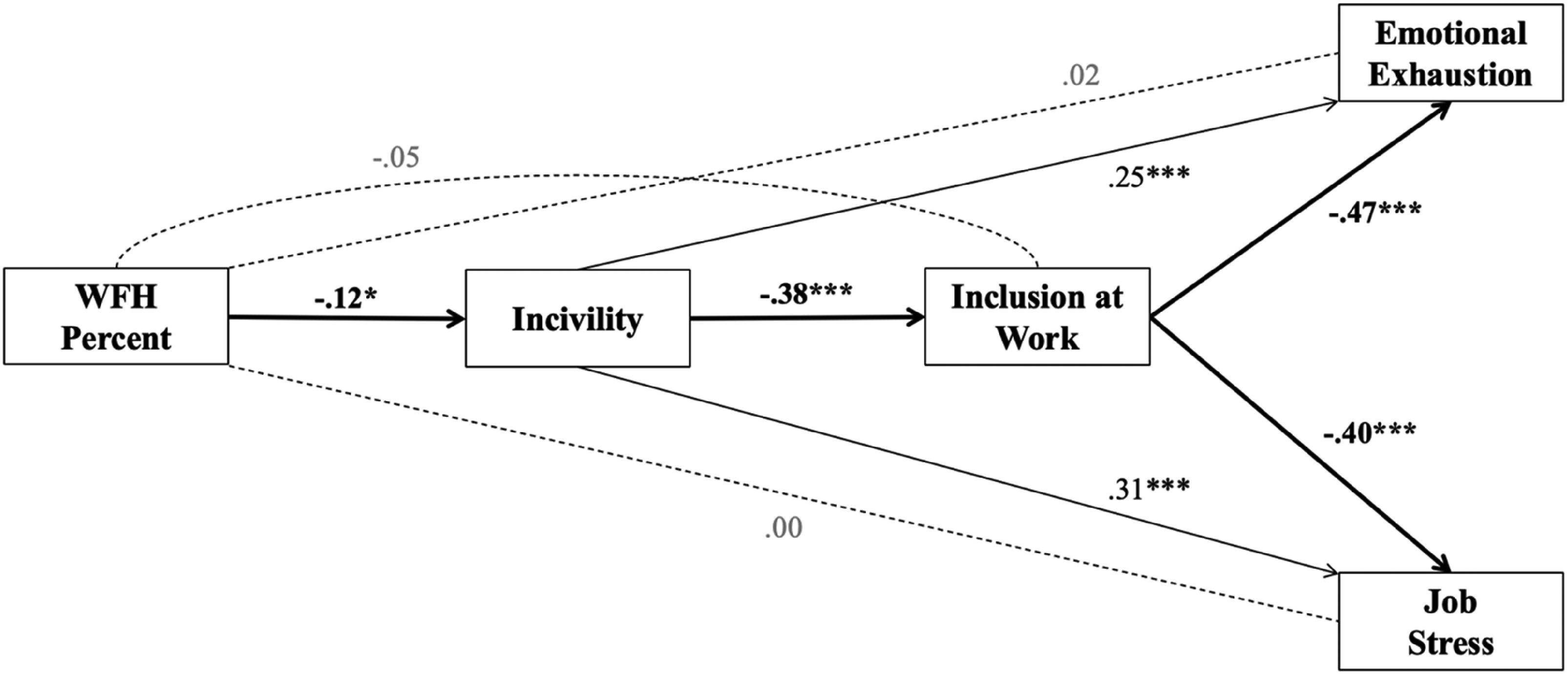
Direct and indirect effects between WFH percentage, incivility and inclusion experiences, and emotional exhaustion and job stress.
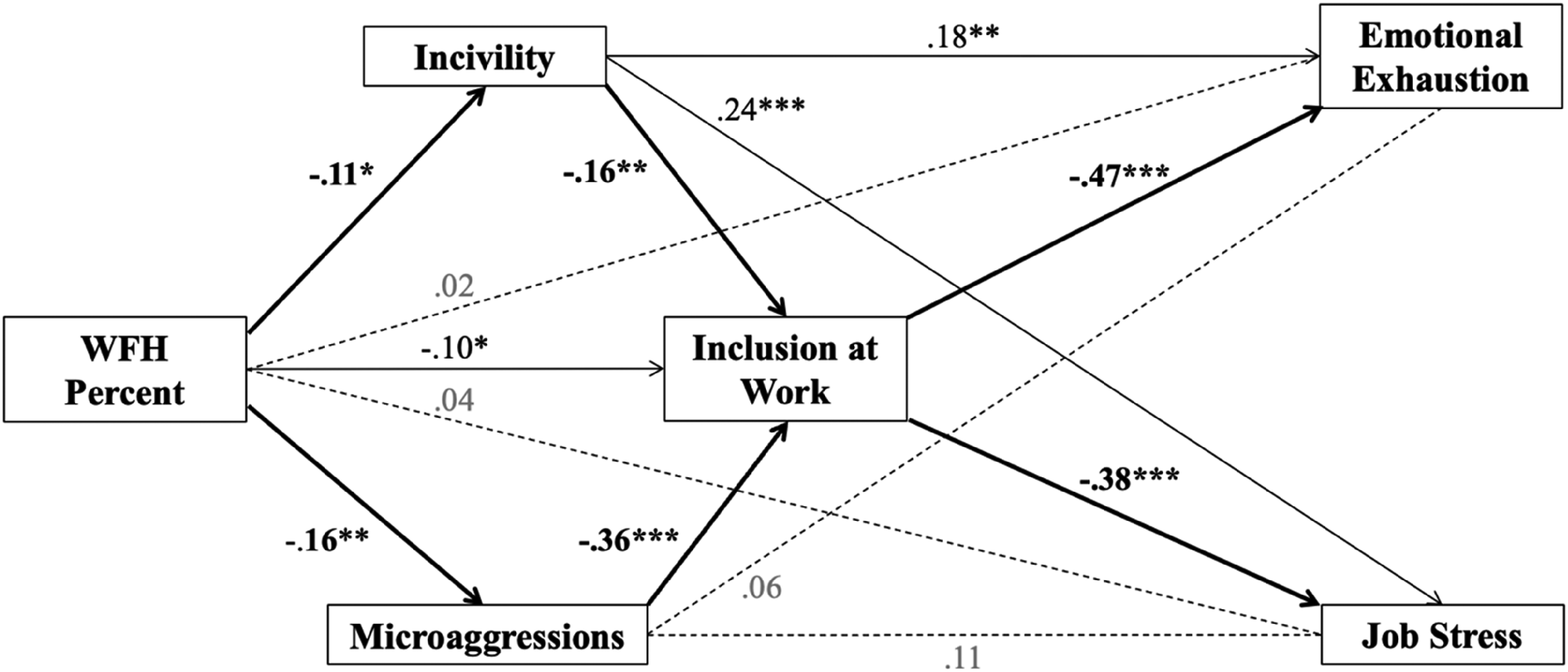
Direct and indirect effects between WFH percentage, incivility, microaggression and inclusion experiences, and emotional exhaustion and job stress.
Hypothesis 3: Hybrid workers’ sense of inclusion at work will be inversely associated with their a) emotional exhaustion and b) job stress.
Hypothesis 4: Hybrid workers’ mistreatment experiences (incivility and microaggressions) and sense of inclusion at work will serially mediate the positive associations between time spent working in the office and a) emotional exhaustion and b) job stress.
Methods
Participants and procedure
After obtaining clearance from the ethics boards of two Canadian universities, all participants were recruited via crowdsourcing on Prolific, an online platform known for its data quality and ethical treatment of participants (https://prolific.com). 46 We recruited adults who were working more than 20 hours per week in a hybrid work arrangement. We released the survey in two parts, separated by one week, which allowed temporal separation between the collection of predictor and criterion variables, with participants providing informed consent before each session. The surveys were hosted and completed online via Qualtrics.
Of the 511 participants who completed the first part of the survey, 459 also completed the second half (89.8% retention rate). We removed the responses of twenty-four who did not meet the attention-check criteria and seven who indicated that their work arrangement had changed since they completed the first half of the survey, leaving a final sample of 428 participants. The demographics of the final sample are presented in Table 1.
Sample profile (N = 428).
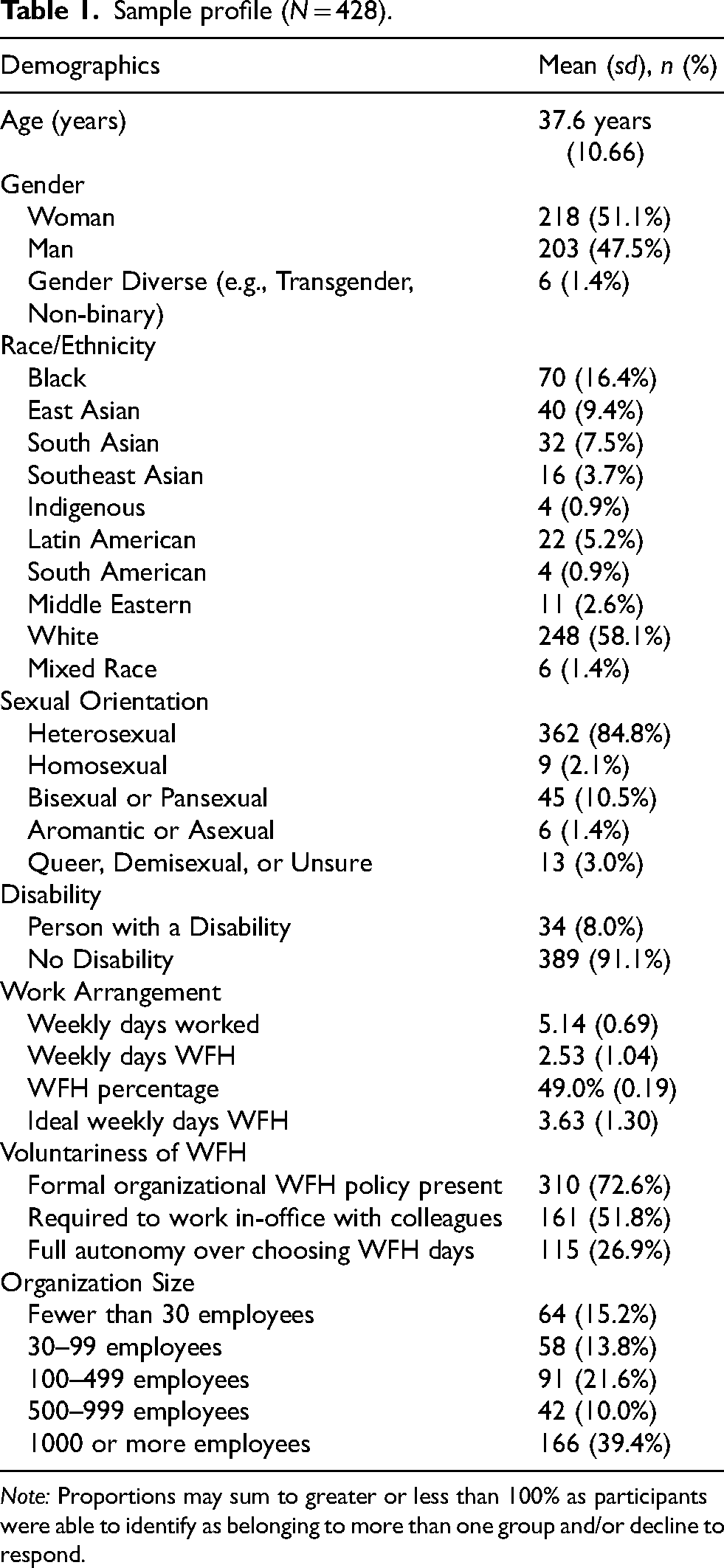
Note: Proportions may sum to greater or less than 100% as participants were able to identify as belonging to more than one group and/or decline to respond.
Measures
Our variables of interest were captured as follows. Unless otherwise mentioned, five-point Likert scales were employed (1 = Strongly disagree to 5 = Strongly agree). We purposely designed our survey questionnaire with parsimony as a goal to mitigate negative impacts of long online questionnaires, such as respondent drop-off and careless responding. 47 We therefore selected items from established measures, as described below, rather than including the full measures, which would have significantly increased the response burden. We performed confirmatory factor analyses to ensure our modified scales performed as required.
WFH percentage
We computed the percentage of work time spent WFH each week as the average number of days WFH weekly divided by the total number of weekly workdays. Accordingly, higher proportions indicate more relative time spent WFH each week.
Incivility
Incivility was measured via the six (of seven) highest-loading items reported by Cortina et al. 48 on their scale (e.g., “[Someone at work] put you down or was condescending to you.”), which assesses direct exposure to incivility at work over the past year along a five-point scale (1 = Never to 5 = Always). The measure performed reliably (α = .914).
Microaggressions
We examined Nadal's49,50 Racial and Ethnic Microaggressions Scale (REMS; 45 items), Sexual Orientation Microaggressions Scale (SOMS; 24 items), and Gender Identity Microaggressions Scale (GIMS; 14 items), ultimately selecting seven items (e.g., “People have made negative comments or jokes related to aspects of my identity.”) which best fit the work context. These items were modified slightly to be made more general (e.g., changing “because of my race” in the original scale to “because of my identity” in our survey), with participants being instructed that in reflecting on their experiences in relation to their identity, they should consider “attributes related to how they perceive and define” themselves, including but not limited to their gender, ethnicity, disability status, and sexual orientation. We specifically chose items that were more applicable to the workplace and tended to be more generic, rather than items that were distinctly related to specific forms of identity-based microaggressions (e.g., “Someone told me that all people in my racial group are all the same.”). 49 We aver that the potential threat to construct validity because of these framing changes is low.
Due to the social stratification–based ‘othering’ nature of microaggressions, only the 340 participants belonging to equity-deserving groups (i.e., women, gender diverse individuals, people of colour, sexual minorities, and people with disabilities) were asked to respond to this scale. Although this does pose challenges for analyses and interpretation, asking respondents who do not belong to equity-deserving groups (n = 85, 41.9% of men in our sample, 19.9% of the overall sample) to report on microaggressions due to their identity poses additional challenges. The scale performed reliably among this sample subset (α = .914).
Inclusion
Inclusion at work was measured among all participants via the five highest-loading items from Jansen et al.'s 51 16-item inclusion scale, which allowed us to include items from both the authenticity (e.g., “I am encouraged to be authentic.”) and belonging (e.g., “I feel that I belong.”) sub-scales, as well as to include one reverse-coded item (i.e., “I feel pressure to hide personal aspects of my life.”) while still being concise (α = .852).
Emotional exhaustion
Emotional exhaustion was captured via all nine items of the Maslach Burnout Inventory 52 sub-scale (e.g., “I feel used up at the end of the workday.”; α = .937).
Job stress
Job stress was measured via all nine items (e.g., “The effect of my job on me is too high.”; α = .873) from Shukla and Srivastava's 53 job stress sub-scale.
Comparisons
We also asked participants to compare a typical workday at the office versus WFH, related to identity (“I feel I can be myself.”), feelings of inclusion (“I feel that I belong.”), feeling valued (“Aspects of my identity are valued.”), and experiences of mistreatment (e.g., “I experience uncivil behaviour.”). A five-point scale was employed (1 = Much more when I work in the office to 5 = Much more when I work at home).
Open-Ended questions
Participants also responded to two open-ended prompts. First, a request to “Please describe” following the prompt “My work arrangement accommodates my needs (e.g., disability, family, etc.).”, and second, “Workplaces have changed since the pandemic and the increase in hybrid work. How would you describe the experience of working in the office/workplace now compared to five years ago?”
Results
Descriptive results
When asked to compare the experiences of working in the office versus WFH, the majority of participants reported no differences in terms of belongingness (57.0%), feeling as though their identity is valued (69.5%), experiencing uncivil behaviour (54.4%), or – among participants from equity-deserving groups – experiencing microaggressions (60.5%; see Table 2). However, the majority of the entire sample (52.9%) indicated that they feel more able to be themselves when working at home. Further, 38.9% of participants reported that WFH was better than the office with respect to experiencing uncivil behaviour, and 35.1% of equity-deserving participants indicated that WFH allowed for reduced exposure to microaggressions.
Comparisons of home and office experiences.
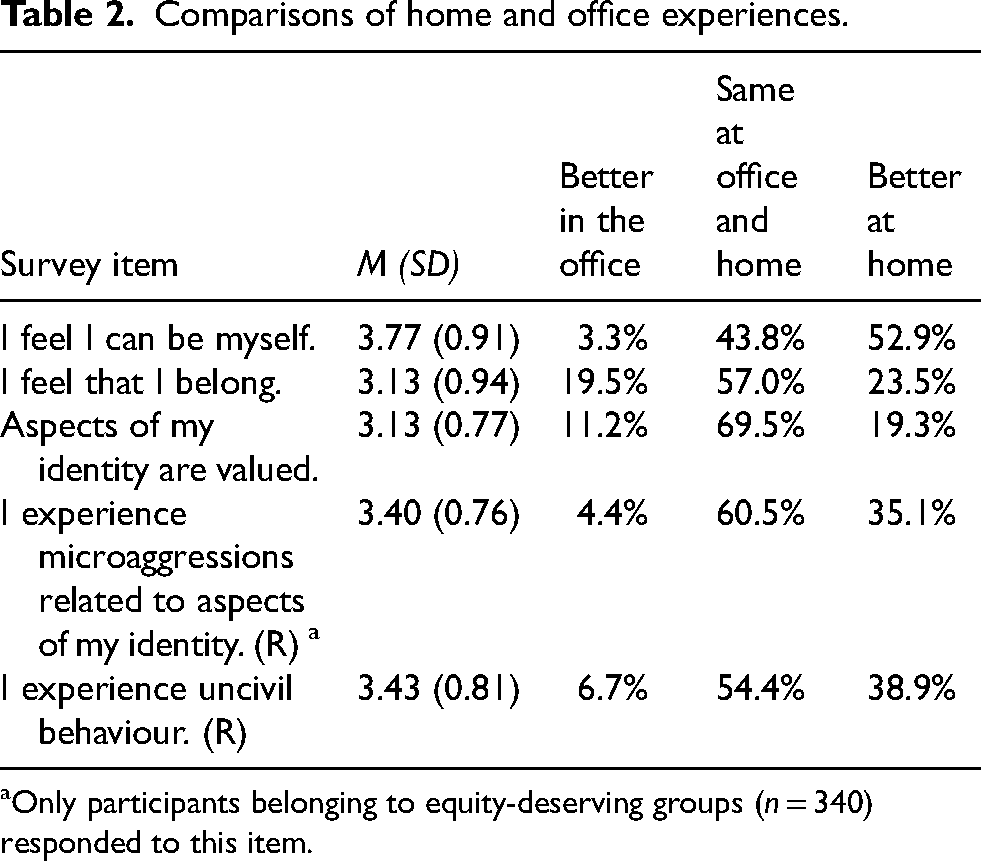
Only participants belonging to equity-deserving groups (n = 340) responded to this item.
When asked how their work experiences accommodate their needs and how their work had changed in the office as compared to five years prior, a content analysis of participants’ responses indicated limited negative appraisals (e.g., “We are surveilled more, we are not given the benefit of the doubt. It is assumed we need to be policed more to do our work and we are treated as disposable.”) and neutral appraisals (e.g., “It's time for jobs to modernize and allow people to be the grown adults they are and make their own choices as long as their work is being completed effectively.”). Positive appraisals of WFH and hybrid work were the most common – exemplified in the quotes below. Together, these quotes support the descriptive findings and our hypotheses: hybrid work has the potential to improve the interpersonal work experiences and well-being of hybrid workers, particularly with regard to identity and life experiences that may violate ‘ideal worker’ norms. “I am diagnosed with ADHD and have mild degenerative disc disease. Working from home helps a lot when I have flares of pain. Or in terms of my ADHD, it helps me focus when I work from home.” “It assists with my disability by allowing me a place to work by myself.” “I feel like now I am just more relaxed knowing upper management can’t pop in on us when we’re at home.” “I love being able to work from home. It has taken the pressure off. […] WFH has made a huge impact on my work-life balance.” “I have noticed people dress much more casually in office now. I think we all got comfortable not having to dress up to work from home, and while we do adhere to a dress code, it is very relaxed.” “If we were forced to be in the office full-time, I think people would be unhappier and less productive.”
Inferential statistics
Overall, our modified scales exhibited very good reliability (α > 0.85) and validity. We performed confirmatory factor analyses to better ensure that our modified scales performed adequately. We employed structural equation modeling programmed in SmartPLS 4 54 with the five study scale variables (incivility, microaggressions, inclusion, emotional exhaustion, and job stress). All of the items representing our five study variables loaded well onto their respective factors (λ > .49), with the model exhibiting good fit (χ2 = 1341.39, df = 582, CFI = .935, RMSEA = .052, SRMR = .061), 55 and all three of the modified scales having good convergent validity (incivility: AVE = .65; inclusion: AVE = .57; microaggressions: AVE = .60). 56 The unmodified scales for emotional exhaustion and job stress also demonstrated good and adequate convergent validity, respectively (emotional exhaustion: AVE = .62; job stress: AVE = .47). 57 We compared our measurement model with the one-factor model (χ2 = 6397.18, df = 702, CFI = .532, RMSEA = .129, SRMR = .149), and the five-factor uncorrelated model (χ2 = 2537.52, df = 594, CFI = .833, RMSEA = .082, SRMR = .271), both of which exhibited poor fit, suggesting that further analyses employing our study scales could proceed.
After confirming that Harman's single-factor test58,59 and a marker variable analysis 60 mitigated concerns about common method variance – a potential issue, given that all variables are self-reported and from the same source – we examined correlations between the focal variables in our study, which are presented in Table 3. As predicted in H1, participants’ WFH percentage was negatively associated with experience rates of incivility (r = −.12, p = .016) and microaggressions (r = −.15, p = .006), indicating that, on average, the more time participants spent in the office, the more frequently they were subjected to workplace mistreatment. Participants’ experiences of incivility (r = −.38, p < .001) and microaggressions (r = −.46, p < .001) were similarly negatively associated with their feelings of inclusion at work, supporting H2. Participants’ feelings of inclusion were also significantly negatively associated with their reported levels of emotional exhaustion (r = −.58, p < .001) and job stress (r = −.52, p < .001), in line with H3. Emotional exhaustion was significantly positively associated with incivility (r = .42, p < .001) and microaggressions (r = .38, p < .001), as was job stress (incivility: r = .45, p < .001; microaggressions: r = .41, p < .001). Emotional exhaustion and job stress were also significantly positively related to one another (r = .82, p < .001).
Means, standard deviations, reliabilities, and inter-correlations of study variables.
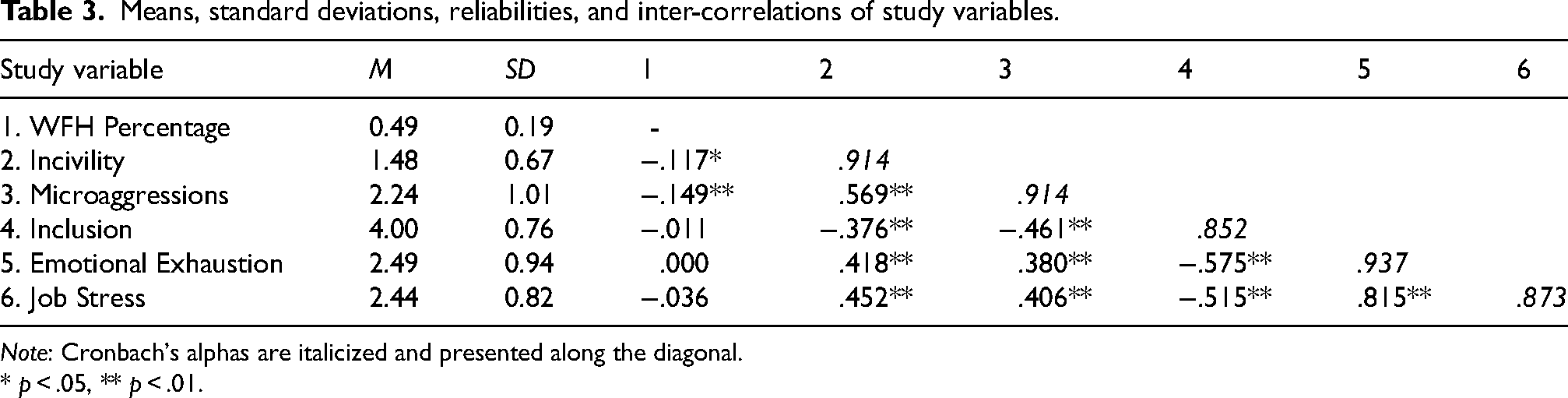
Note: Cronbach's alphas are italicized and presented along the diagonal.
* p < .05, ** p < .01.
Using Hayes’ 61 PROCESS (v. 5.0) macro in IBM SPSS (v. 29), we further explored the relationships in our theoretical model. Significance was assessed using confidence intervals based on 5000 bootstrapped resamples. Gender, race/ethnicity, sexual orientation, and disability status were entered as control variables.
As demonstrated in Figure 1 and in support of H1a, across the entire sample, participants’ WFH percentage was negatively related to workplace experiences of incivility (B = -0.43, SE = 0.17, p = .012). Thus, the more relative time that participants spent in the office each week on average, the greater their exposure to incivility. In turn, exposure to incivility was negatively related to a sense of inclusion at work (B = -0.42, SE = 0.05, p < .001), thereby supporting H2a. In support of H3, participants’ sense of inclusion at work was significantly negatively related to both emotional exhaustion (B = -0.59, SE = 0.05, p < .001) and job stress (B = -0.44, SE = 0.05, p < .001). The indirect pathways from WFH percentage via only the incivility mediator to the two outcomes, and the indirect pathways from WFH percentage via incivility and inclusion (modelled in serial) were significant and negative in all instances, supporting H4. However, the total effects and the indirect pathways from WFH percentage through only the inclusion mediator to each outcome variable (bypassing incivility), were all found to be non-significant (see Table 4). These results suggest that it is specifically the increased exposure to incivility among participants who spend more time in the office that contributes to the observed relationships between WFH percentage, incivility, inclusion, and well-being.
Mediation analyses assessing the indirect influence of WFH percentage on participants’ emotional exhaustion and job stress via their workplace incivility and inclusion experiences (full sample, N = 428).
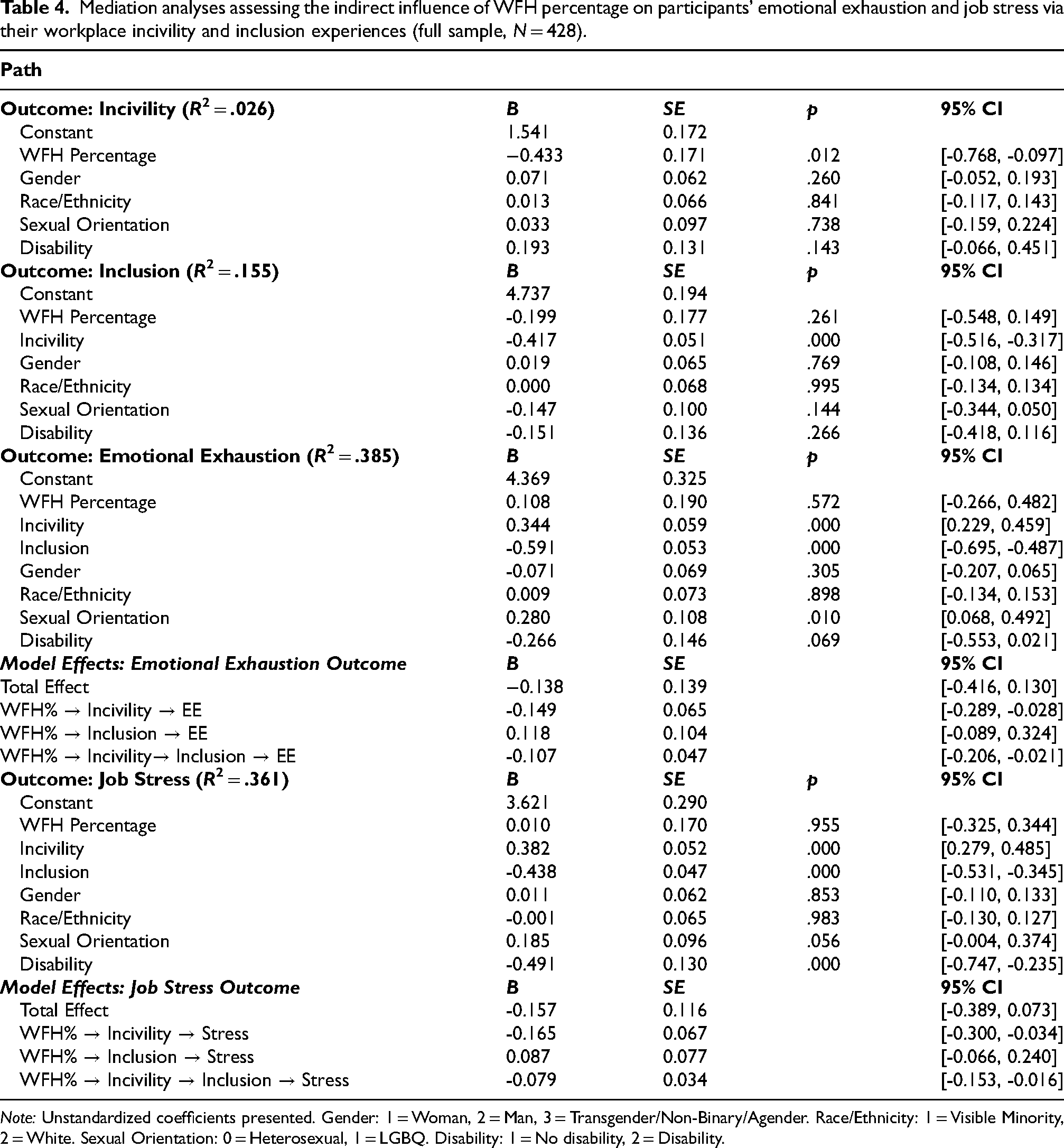
Note: Unstandardized coefficients presented. Gender: 1 = Woman, 2 = Man, 3 = Transgender/Non-Binary/Agender. Race/Ethnicity: 1 = Visible Minority, 2 = White. Sexual Orientation: 0 = Heterosexual, 1 = LGBQ. Disability: 1 = No disability, 2 = Disability.
As depicted in Figure 2, when examining the sample subset identified as belonging to an equity-deserving group (n = 340), we found evidence in support of H1a and H1b, as WFH percentage was negatively related to workplace experiences of incivility (B = -0.39, SE = 0.19, p = .043) and microaggressions (B = -0.84, SE = 0.29, p = .004). In turn, exposure to incivility and microaggressions were both negatively related to participants’ sense of inclusion at work (incivility: B = -0.19, SE = 0.07, p = .007; microaggressions: B = -0.27, SE = 0.05, p < .001), thereby supporting H2. In support of H3, participants’ sense of inclusion at work was negatively related to both emotional exhaustion (B = -0.60, SE = 0.06, p < .001) and job stress (B = -0.42, SE = 0.06, p < .001).
Partially supporting H4, the indirect pathways from WFH percentage, through microaggressions and inclusion (modelled as serial mediators), to both emotional exhaustion and job stress were significant. Moreover, the indirect pathways from WFH percentage through inclusion to both emotional exhaustion and job stress were significant. However, in contrast to the models presented above, the indirect pathways between WFH percentage through only the mistreatment mediators (incivility and microaggressions) to the outcomes, while bypassing inclusion, were all non-significant, as were the serial mediation pathways from WFH percentage through incivility and inclusion to the two well-being outcomes (see Table 5). These findings suggest that among equity-deserving employee groups, experiencing microaggressions at work may be a stronger determinant of their sense of inclusion (compared to experiencing incivility), and perceived inclusion may more strongly contribute to their emotional exhaustion and job stress than mistreatment experiences alone.
Mediation analyses assessing the indirect influence of WFH percentage on participants’ emotional exhaustion and job stress via their workplace mistreatment and inclusion experiences (equity-deserving groups sub-sample, n = 340).
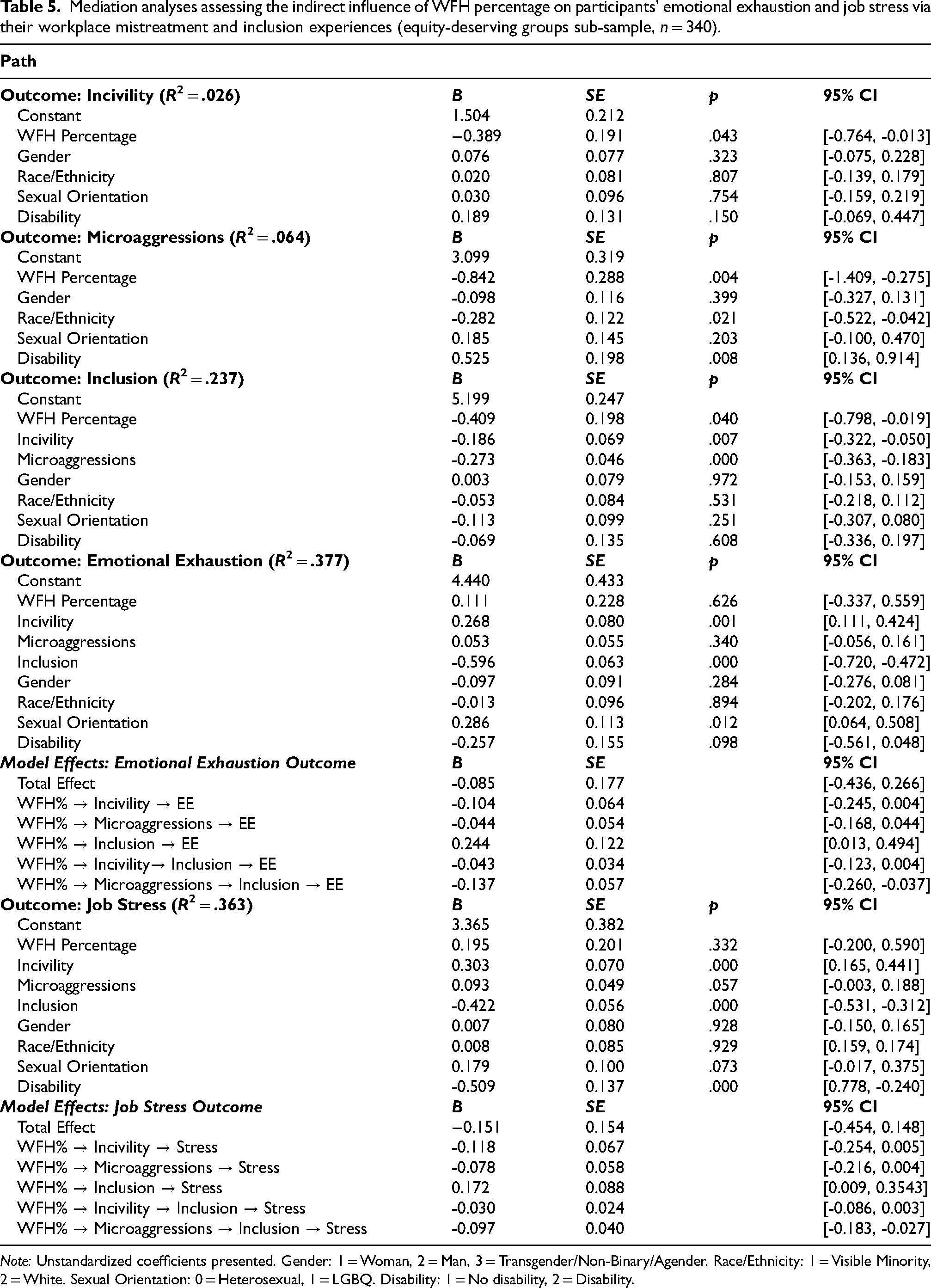
Note: Unstandardized coefficients presented. Gender: 1 = Woman, 2 = Man, 3 = Transgender/Non-Binary/Agender. Race/Ethnicity: 1 = Visible Minority, 2 = White. Sexual Orientation: 0 = Heterosexual, 1 = LGBQ. Disability: 1 = No disability, 2 = Disability.
Although not included in our hypotheses, a potentially notable finding from the mediation analysis is that among equity-deserving participants, WFH percentage was negatively associated with inclusion. This finding implies that, within this sample, when controlling for exposure to both incivility and microaggressions, as well as participant demographics (i.e., gender, race/ethnicity, sexual orientation, and disability), the more participants worked in the office, the higher they rated their inclusion (see Table 5).
Finally, to address potential concerns of reverse causality – whereby individuals who are already experiencing high levels of stress or emotional exhaustion, even in the absence of mistreatment, are opting to WFH more often than their peers – we conducted several analyses. First, we observed a strong but not perfect correlation between the number of days participants actually WFH and the ideal number of days they WFH each week (r = .467, p < .001). This suggests that policies and mandates governing WFH are responsible for much (but not all) of employees’ work location decisions. Second, we re-ran the statistical tests of our theoretical model while including participants’ ideal WFH arrangement as a covariate and found no changes in the results. Together, these findings reinforce the notion that WFH, whether chosen or mandated, may provide some reprieve from mistreatment experiences and consequent outcomes.
Discussion
Our findings support the notion that hybrid work arrangements may present a previously unacknowledged benefit for employees – namely, WFH could potentially act as a refuge from certain forms of workplace mistreatment. When asked to compare their in-office and at-home work experiences, many of the participants reported that WFH was better than the office with respect to experiencing uncivil behaviour (41% vs. 7%) and microaggressions (38% vs. 5%), as well as their ability to express their identity (54% vs. 4%). The overall positive valence of participants’ appraisals of their hybrid work arrangements, reflected in their open-ended comments, supports these findings. Our further analyses indicated that working relatively less often in the office was associated with fewer experiences of incivility (across the entire sample) and microaggressions (among equity-deserving group members, in particular). When employees WFH, they are more ‘out of sight’ from their colleagues and supervisors, and this lack of proximity may mitigate their exposure to the situations and interactions that make both incivility and microaggressions more common. Thus, while all employees may potentially benefit from reduced exposure to incivility while WFH, equity-deserving employees might further escape microaggressions. Among individuals who find microaggressions particularly harmful,32,62 this is a notable potential advantage of WFH.
Interestingly, when asked to compare their in-office and at-home work experiences, 80% of the participants reported that their feelings of inclusion were either better at home or the same regardless of work location. This insight is particularly notable given that one of the most oft-cited disadvantages of remote work is lack of belonging or isolation, and there has been an assumption that this could be amplified for marginalized workers. 5 Our mediation analyses may illuminate this apparent contradiction and suggest reason to question this assumption. Namely, when controlling for demographics and mistreatment exposure, we found that more time spent WFH was associated with lower inclusion ratings, consistent with isolation as a frequently cited disadvantage of WFH. 15 However, in line with the theory and hypotheses we presented above, these findings suggest that WFH and inclusion may be inversely correlated, specifically among those who are not routinely exposed to workplace mistreatment and/or who more closely to conform to norms of the ideal worker. Exposure to mistreatment and social location (e.g., gender, race/ethnicity, sexual orientation, disability) thus may complicate the relationship between WFH and inclusion in nuanced ways.
As statistical power constraints throughout our analyses necessitated categorizing all equity-seeking individuals into a single aggregated group, it was not possible to tease apart these nuances in the current study. Analyses grounded in intersectionality are inherently complex,63,64 as they require modeling interaction effects across multiple aspects of social identity (e.g., gender x race x ability status x sexual orientation), and would necessitate numerous two-, three-, and four-way interactions that call for a sample substantially larger than was feasible in the current study. Consequently, we were unable to determine whether individuals whose identities place them relatively closer to the ideal worker norm (e.g., childfree white women; queer white men) experience different in-office and WFH interactions and outcomes than those positioned farther from that norm (e.g., disabled and/or queer employees of colour). Equity-deserving employees are not a monolith; rather, they represent a spectrum of experiences across which power and social capital vary considerably. Future research should examine whether proximity to the ideal worker norm moderates the associations outlined above.
Despite these nuances, our results point to the potential of a shared structural reprieve for those positioned outside the ideal worker norm. Specifically, lower levels of mistreatment experienced when WFH were associated with a greater sense of inclusion among these employees, as we predicted. Alongside a relative absence of interpersonal slights as reminders of their ‘outsider’ status, 33 hybrid workers – and especially those belonging to equity-deserving groups – who WFH more often may feel more included within the organization and freer to be themselves. Lower levels of mistreatment and greater feelings of inclusion were also associated with reduced emotional exhaustion and job stress. This suggests that remote work may be less draining on one's well-being, as it might support a lower-stress and less emotionally exhausting work experience.
Practical implications
Our practical implications concern two distinct groups of individuals: the employees themselves and the organizational leaders who employ them. For employees, we must highlight that a hybrid work arrangement may provide opportunities to avoid and recharge from instances of incivility and microaggressions to a certain extent, while also providing some time in the office to obtain some of the benefits that can be associated with co-located work (e.g., creating or enhancing social networks). 15 Our findings reinforce this proposition, as controlling for participants’ ideal WFH arrangement had no bearing on the results, suggesting that whether mandated or self-selected, WFH is still associated with reduced mistreatment, stress, and emotional exhaustion. That said, finding the correct balance between in-office and out-of-office work will depend on each individual's work context (e.g., organizational culture, supervisor support for WFH, workplace mistreatment climate) and their well-being and mental health circumstances (e.g., existing anxiety disorders, psychological resilience). As such, to the extent possible, employees could try different hybrid work schedules to assess which works best for their own situation. For those with less control over their work arrangements, seeking to maximize benefits and minimize harms within each environment might be most beneficial.
It is similarly important to note that being ‘out of sight’ while WFH could be a double-edged sword for hybrid workers, including those from equity-deserving groups, given that proximity bias (i.e., the tendency for those in positions of power “to treat workers who are physically closer to them more favorably”) 65 (para.1) still informs employee performance appraisals among managers and other organizational leaders. Proximity bias persists even though it is based on “the antiquated assumption that those who work remotely are less productive than those who work from the office.” 65(para.1) Being ‘out of sight’ could therefore hinder the career progress of equity-deserving employees, in particular, if they find themselves in work climates driven by both preference via proximity and wherein ideal worker norms pervade. 21 In these cases, employees would need to weigh the benefits of protecting themselves from mistreatment and its consequent harms against protecting their career progression – a difficult decision that one should not need to make, but which must be made all too often. 66
If WFH comes to be seen as a refuge from workplace mistreatment and the consequent ill effects of such experiences, it may inadvertently deepen structural inequalities. Indeed, if equity-deserving group members are disproportionately exposed to workplace mistreatment, they may opt to WFH disproportionately more often (as compared to their dominant-group peers) to protect themselves from harm – potentially at the risk of their long-term career prospects. At the organizational and industry levels, self-selection into WFH among equity-deserving employees disproportionately exposed to workplace mistreatment might hinder the development and maintenance of diverse talent pipelines – thereby perpetuating systemic inequalities such as the glass ceiling and the relative absence of employees of colour and employees with disabilities in knowledge-based occupations. In light of these possibilities, it is imperative that hybrid work organizations meaningfully design and cultivate practices that support employee inclusion, network development, and career advancement among all employees – not only those who are in the office and/or who adhere most closely to the norms of the ideal worker. This paradox of WFH inclusion – whereby mitigating mistreatment via WFH improves belongingness, but in the absence of mistreatment WFH might hinder belongingness – is not to be taken lightly.
Further to this, organizational leaders should understand that while workplace mistreatment persists, hybrid work arrangements may benefit employee well-being. Allowing employees the flexibility to craft a hybrid work arrangement that best meets their personal needs (including both short-term benefits to their well-being and long-term benefits to their career progression) could be an important way to support them, though this may not always be possible. Organizational leaders should also be aware of the detrimental effects of ideal worker norms and proximity bias (e.g., underutilization and mismanagement of human resources), 65 so that the potential benefits of workplace inclusion and well-being in the context of hybrid work arrangements are not placed in competition with employees’ career advancement.
Though our results support that equity-deserving employees may benefit from hybrid work, this is nevertheless a complex and nuanced issue. Mounting evidence supports the inherent value that equity-deserving employees bring to organizations, 67 and the benefits of inclusive practices for employees and organizations alike.11,68 Thus, there may be a real threat to both individuals and organizations by having equity-deserving employees WFH and being ‘out of sight and out of mind’. However, if hybrid work can buffer negative workplace interactions and outcomes and relate to greater inclusion and well-being, then hybrid work arrangements are an organizational policy that may be particularly effective in supporting equity-deserving employees’ career sustainability. 24 Moreover, shifting hybrid work from an accommodation to a standard work arrangement may further reduce the burden and stigma on equity-deserving employees. 69 Just as organizations have begun to recognize the value of promoting equity, diversity, and inclusion, we argue that it is important to enrich inclusive practices by normalizing hybrid work.
Limitations and future directions
The primary limitation of our study is its cross-sectional methodology, which speaks to general patterns among participants’ experiences but is not specific in its focus regarding whether the mistreatment individuals are experiencing indeed occurs when they are (primarily) working in the office or at home, nor whether their perceptions of inclusion and levels of stress and emotional exhaustion vary along with their work location. Furthermore, it is possible that those experiencing workplace mistreatment might request to WFH more often, suggesting that our model could be the beginning of a positive feedback loop. Although we briefly addressed concerns about reverse causation above, we further recommend that future researchers use longitudinal methods, such as experience sampling or daily diary studies, to measure variability in these experiences over time and across work contexts.
It is also important to acknowledge other possible confounds that we did not assess, including the quality of participants’ home office environments, the extent of their caregiving responsibilities, the presence and extent of various organizational WFH supports and policies, as well as participants’ level of job autonomy and the nature of their job role requirements. Organization size and the autonomy one has over their ability to choose their work arrangement on any given workday are other potential moderators that we did not fully explore. Moreover, as our sample was restricted to Canadian employees, our findings may not fully replicate in other cultural environments. We would encourage others to investigate these potential boundary conditions in the future.
Furthermore, among the equity-deserving employee sub-sample, we did not thoroughly investigate the extent to which each form of marginalization differentially affects the findings or the extent to which multiple marginalizations alter the observed effects. Throughout this paper, we have discussed equity-deserving employees as a monolith, when in reality, non-disabled white women and disabled employees of colour (for example) face very different structural challenges in their daily lives. Intersectionality theory maintains that individuals belonging to more than one equity-deserving group will differ in their experiences, as compared to those belonging to only one marginalized group. 70 However, whether belonging to multiple equity-deserving groups exacerbates or attenuates the patterns presented herein remains to be seen, as prior research suggests that either outcome is plausible. 41 Post-hoc analyses conducted on our data, although underpowered, support that the relationships between WFH, microaggressions, inclusion, emotional exhaustion, and job stress hold across several participant subgroups, including people of colour (n = 194) and individuals with more than one marginalized identity (n = 236; e.g., a disabled white woman, a non-binary person of colour). Nevertheless, given this limitation to our study, future research applying an intersectional lens while investigating hybrid work experiences would be particularly beneficial.
We did not design this study to provide a direct comparison of WFH benefits between equity-deserving employees and their dominant-group peers. For example, we did not measure exposure to microaggressions among participants who do not belong to any socially marginalized groups, and as a result, could not compare participants on this basis nor test for differences in the pattern of effects between these groups. Rather, our study reinforces that all individuals, regardless of their social identity, could potentially benefit from WFH if it serves to reduce their exposure to mistreatment (e.g., incivility), and as such, implies that WFH (or work arrangements more broadly) should be integrated and investigated as an important covariate and boundary condition in future workplace mistreatment research.
Finally, our research was conducted in the early years of hybrid work being common, albeit after a surge of return-to-office mandates post-pandemic. As such, the patterns we have revealed may change over time, as hybrid work becomes either more common and accepted or more maligned among senior leaders, depending on how social perceptions and labour market forces evolve in the coming years. Although we believe in the benefits of hybrid work for individual and organizational well-being, and that hybrid work is the way of the future, it would nevertheless be valuable to monitor these patterns over time as social norms shift.
Conclusion
Existing research and the popular narrative on remote and hybrid work often overlook common workplace experiences, such as incivility. Moreover, we found very little prior research on the experiences of hybrid work among equity-deserving groups. In this paper, we investigated the influence of hybrid work arrangements on employees’ experiences of mistreatment and inclusion, as well as their well-being.
Our results support the idea that more frequent WFH is associated with fewer experiences of incivility among all employees and with fewer experiences of incivility and microaggressions among equity-deserving employees. Contrary to the common perception that remote work leads to feelings of isolation, we found that this was true only after accounting for participants’ exposure to mistreatment and demographics, suggesting that this assumption has important boundary conditions. Indeed, the lower levels of mistreatment experienced when WFH were instead related to higher levels of inclusion, all of which were associated with better outcomes with respect to job stress and emotional exhaustion. Our findings regarding these under-researched aspects of remote work suggest that hybrid work arrangements may reduce exposure to mistreatment and enhance well-being among employees, who therefore may fare better the more they work from home and may fare worse the more they work in the office.
Footnotes
Ethical approval
Ethics clearance was granted for this project by the Carleton University Research Ethics Board (CUREB-A #112786) and the University of Guelph Research Ethics Board (REB # 20-04-017).
Informed consent
Informed consent was collected virtually from all participants before taking part in the research.
Funding
The authors received no financial support for the research, authorship, and/or publication of this article.
Declaration of conflicting interests
The authors declared no potential conflicts of interest with respect to the research, authorship, and/or publication of this article.
Disclosures
Ethics clearance was granted for this project by the Carleton University Research Ethics Board (CUREB-A #112786) and the University of Guelph Research Ethics Board (REB # 20-04-017).
Adherence to ethical standards and informed consent precludes publicly posting the data.
