



Abstract
Background
Little is known about confirming that an employment environment is truly inclusive and accessible for people with visual impairments (low vision and blindness). Advocacy, policy development, and decades-long calls for inclusive practice have aimed to address the high unemployment rates among those with visual impairments. A one-size-fits-all, inclusive approach that focuses on preparing people with visual impairment (PVI) for employment has been the practice. Yet, job acquisition (54% employment rate) and retention remain challenging.
Objective
This study explored the aspect([s) of the employment environment readiness to support the inclusion of people with visual impairment.
Methods
We employed a co-creation approach to gather insights from employees with visual impairment and employment domain experts through twelve virtual interviews and four focus groups (Zoom). The transcripts from the recorded sessions were analyzed using thematic analysis.
Results
The findings highlight three main themes critical to workplace preparedness: willingness, education and experience, and collaboration. Sub-themes include support, leadership, and resource allocation, among others. Effective preparedness depends on addressing knowledge and practice gaps, fostering collaboration, being vulnerable in seeking necessary help, and clear communication. Generally, intangible factors (non-physical) were deemed more important than tangible ones (e.g., assistive devices).
Conclusion
Assessing and prioritizing workplace readiness is crucial for creating sustainable employment opportunities for individuals with vision impairment. The factors described in this study can inform the development of assessment tools that support both organizations and policymakers. Enhancing data collection for evidence-based policymaking and enforcing compliance checks to promote workplace inclusivity for people with vision impairment.
***This manuscript is based in part, on one of the author's dissertations.
Introduction
The contribution of the environment to employment is as vital as that of people with visual impairment [PVI] in facilitating sustainable employment success. There have been various controversies about employers and their hiring behaviour for people with disability. Most employer surveys paint a picture of workers who are successfully accommodated in a more or less welcoming environment. This includes flexible work policies and schedules, telecommuting, ergonomic redesign of workstations, and the provision of necessary accommodations. However, other studies on specific types of disability do not support this claim. 1
The unemployment rate of people with visual impairment remains high.2,3 The COVID-19 pandemic significantly affected the work environment and brought technological, social, environmental, and economic changes in ways that were not initially thought possible. This workplace restructuring and global labour shortage offer a leverage point for including PVI.4,5 Implementing inclusion, accessibility, and diversity across organizations is gaining popularity. The Americans with Disabilities Act [ADA], Canada's Employment Equity Act [EEA, 1995], and Canadian Human Rights Act [CHRA] promote employment for PVI, forbidding disability-based discrimination when duties are feasible with accommodation. Compared to the United States, the development and implementation of Disability and accessibility legislation in Canada is relatively new. The most notable is the Accessible Canada Act [ACA, 2019], enacted in 2019, which aims to advance equitable, barrier-free workplaces for PVI.
Despite slight changes from 2008 to 2017, the employment rate of PVI in the U.S. remained at 44.2%, compared to the rate of those without disability at 79.4%. 6 In 2019, 46.2% of PVI were employed compared to 78.6% of people without disabilities. 7 In Canada, working-age adults with visual disabilities had a 54% employment rate, 6% were unemployed, and 40% were not in the labor force. 2 A study conducted in the US found a poor retention rate, with only 17.3% of PVI maintaining continuous employment over four years. 8 Access to specific data on retention rates for Canadians with vision impairment is limited.
Research has identified several key challenges faced by PVI across various regions worldwide. These include limited social support, disability rights and service systems, transition challenges, career development difficulties, employment integration and employment environment challenges, constrained adaptive potential and issues with employment sustainability. 9 These factors are consistent with those identified for the general disability group. The nature of the disability, disability disclosure, personal motivation, employer attitudes, job characteristics, corporate culture and climate, government support, and societal attitudes were found to be necessary for employment success. 10
Generally, these barriers and facilitators to employment success11,12 provided direction for interventions for PVI, employers, and their environments. The interventions aim to reduce discrimination and address obstacles to workplace success.13–15 Most studies and implemented intervention plans have focused on making PVI workplace-ready and employable, 16 neglecting that employment success is multifactorial. 17 Employers seeking qualified working professionals and talent pools overlook persons with disabilities. Hence, many PVI who are well prepared for employment are either underemployed or underpaid.4,18
Despite the implementation of legislative acts and recommendations for inclusive practices, the persistently high unemployment rate raises questions. Why is only a smaller proportion of PVI successful in attaining success? What accounts for this lower employment success? Why do other factors influencing employment, such as workplace participation and inclusion, not receive substantial attention 19 ? In contrast, others experience accessibility challenges despite employment policies and increased claims of inclusion, diversity, and accessibility. 20 PVI often face physical, psychological, informational, communicative, and technological obstacles at work. Even among those who secure employment, job retention and satisfaction persist, 21 contributing to ongoing employment instability and, ultimately, an increase rather than a reduction in unemployment rate among this population.
As companies make the recruitment process inclusive and accessible, it does not end there. Other accommodative and attitudinal practices that make the workplace more welcoming are still lacking. Assessing employment environment readiness is crucial to employment success. 16 The effectiveness of preparation was demonstrated using a Tool for the Assessment of Preparedness for Employment for PVI (TAPE measure) developed by Shaw and Gold. 15 This tool consists of a list of questions for prospective employees, developed based on research findings. It includes comparison scores that reflect goal performance among employed individuals. An individual's score guides PVI in identifying their strengths and potential areas for improvement to meet job-market demands better. 15 While the TAPE measure offers a systematic way for PVI to assess their strengths and weaknesses regarding employment readiness, no such tool exists for employers. Therefore, it is crucial to have an evidence-based solution that evaluates the preparedness of the employment environment to attain an equilibrium of effort and eventual employment success.
Research question/aim of study
How can employers/organizations determine whether their workplace is prepared to welcome people with vision impairment?
Aim of the study
To determine the most important aspects of preparedness for an employer or organization that wants to successfully integrate a person with visual impairment into their employment environment. We synthesize the perspectives of Canadian employees with visual impairment and Canadian employment domain experts to understand what is required to prepare an inclusive workplace.
Method
Ethics approval was obtained through the Centre Intégré Universitaire de santé et de services sociaux du Centre-Sud-de-l’Île-de-Montréal, Comité d’éthique de la recherche en réadaptation et en déficience physique MP-50-2023-1654, and the Université de Montréal #2022-1832.
The study methods and findings follow the COnsolidated criteria for REporting Qualitative research (COREQ) checklist. 22
Study design
We used a phenomenological perspective to explore and gain insight into the study area. This was accomplished using a co-creation approach. Co-creation is the collective creativity shared by two or more people. 23 It centers on the principle that the users know about their needs, daily lives, and creative abilities. 24 The decision to adopt a co-creation approach facilitated alignment between PVI and the perspectives of individuals representing the work environment.
Participants
Participants in this study were employment domain experts and employees with visual impairment in Canada, recruited for either an interview or a focus group session. The employees with visual impairment were individuals who self-identified as having low vision or blindness, were currently employed, had prior work experience within the last ten years, or had successfully held at least one job since age 18 + . The age [18+] was used because it is generally expected that at this age, an individual has completed basic education and has the legal rights and responsibilities of an adult. Their past or present employment was either part-time or full-time, remote or in-person, and in a professional environment with a minimum of six months of work experience. This period was chosen given the development and adaptation of accessibility features in mainstream technology used in the employment context today. 25
The employment domain experts were individuals with experience successfully engaging people with visual impairment in the workforce, regardless of sector or age. They consisted of employers, human resource professionals, workplace design, accessibility, and inclusion professionals, and employment policymakers. This approach offered a wide range of views and experiences. Employment domain experts were recruited through the Canadian National Institute for the Blind [CNIB] network, the employment program of the Centre de réadaptation Lethbridge-Layton-Mackay du CIUSSS du Centre-Ouest-de-l’Île-de-Montréal, and through the snowballing technique. Employees with visual impairment were recruited from the CNIB client databases and the co-authors’ professional networks using the snowballing technique. Following recruitment, all follow-ups were conducted via email to provide more details, inform all eligible participants of the research, and obtain informed consent electronically or on paper. A demographic questionnaire and an interview question guide were sent to prepare participants for the interview or focus group session.
Data were collected remotely via the Zoom platform (Zoom Video Communications Inc., 2011). The focus groups were conducted with employees with visual impairments based on participants’ availability, and individual interviews were an option in cases with no scheduled match. For the employment domain experts, the interview session was the preferred option. All meetings were conducted in English and facilitated by the first author. This began with an introduction of the study participant(s), followed by an overview of the research, the purpose, and the direction of the discussion. Ground rules were set to promote effective communication, and participants were informed that the sessions would be recorded for transcription and data analysis. Each focus group or interview session lasted up to 90 min and followed a semi-structured interview guide comprising both general and specific open-ended questions. The questions cut across individual experiences, workplace design and accessibility, technology, communication, access and support, recruitment, policy, and accommodation, following the priority domains that emerged from a scoping review on employment and visual impairment. 9 Participants were encouraged to further the discussion and share their opinions on all topics and questions. Recruitment continued until data saturation was reached. Each participant was offered a CAD 50 gift card as compensation for their time.
Data analysis and storage
Thematic analysis was done following the procedure proposed by Braun and Clarke. 26 Analysis began with reading the field notes and automated speech-to-text transcripts extracted from the Zoom recording to revise transcription errors and gain familiarity with the data. Following this stage, Coding was done independently by one researcher (first author), who assigned short labels to phrases and sentences that described specific contexts. This framework was consistent across the entire dataset. An inductive approach was adopted, which involved allowing codes and themes to emerge from participants’ narratives through the coding process rather than pre-set codes. A code book detailing the coding decisions process was developed and refined as the analysis progressed. Ambiguities were also resolved through peer debriefing sessions with other co-authors to refine interpretations and ensure analytical rigor. Subsequently, themes were generated and described as a broader representation of all codes with similar patterns.
To minimize personal bias and follow the concept of reflexivity, factors that could impact analysis were noted and managed through self-critique and peer review. Themes and codes were reviewed by a co-author [WW] to ensure alignment and accuracy in the meanings of associated quotes. Themes were revised as needed following discussion with co-authors and team members. Two co-authors (MS and WW) reviewed the detailed findings and agreed on the emerging themes and related quotes. Emerging themes were identified, and those generated from the two groups (employees with visual impairments and employment domain experts) were compared to identify areas of overlap and distinction. 27
All consent forms, recordings, and data files were stored on a secure, password-protected OneDrive server managed by the Université de Montréal, with access restricted to the research team for seven years.
Reflexivity
The possible implications of the researchers’ prior experience and knowledge on the research process were noted and checked across the entire research process. The research question and interview guide were developed from insight obtained from previous studies and personal experience, given that one of the co-authors is a person living with a visual impairment. The laid-down rules and criteria for recruiting participants were maintained to ensure reflexivity. There was also constant communication of research findings among the research team members to clarify assumptions and ensure accuracy. The researchers’ knowledge of specific terms guided the semi-structured interview process of data collection from the participants. Presenting preliminary findings at a local conference helped better understand the perspective from which the study data were interpreted. While it might not be entirely achievable to separate personal experience and knowledge from the research process, data collection and analysis were conducted objectively without preconceived expectations.
Findings
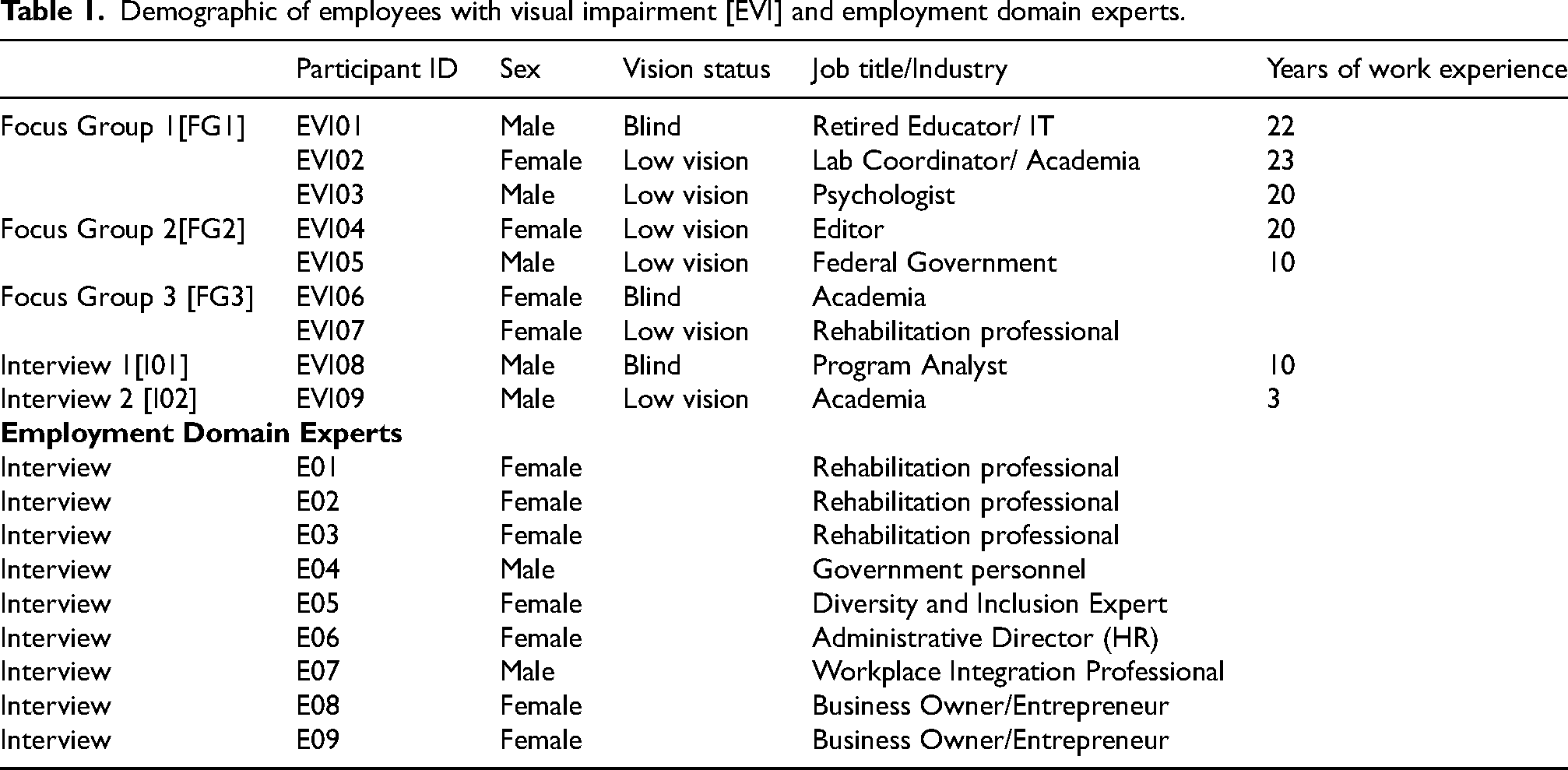
Nine Employees with visual impairment (six with low vision and three with blindness) and nine employment domain experts participated in the study. The experts included four directors, two diversity and inclusion consultants, one human resource manager, one workplace design professional, and one business owner, representing the rehabilitation, academic, health, policy, and inclusion sectors. Six employment domain experts were employed by large-scale organizations (government), and three operated in small-scale enterprises (private). The demographic details of the employees with visual impairment and employment domain experts are presented in Table 1.
Demographic of employees with visual impairment [EVI] and employment domain experts.
This section presents the identified themes related to organizational preparedness for the successful integration of PVI into the workplace. The themes reflect the perspectives of both employment domain experts and employees with visual impairment. They are grouped into three overarching categories: Support, Willingness, and Collaboration (see Figure 1) and supported by representative quotes to provide context.
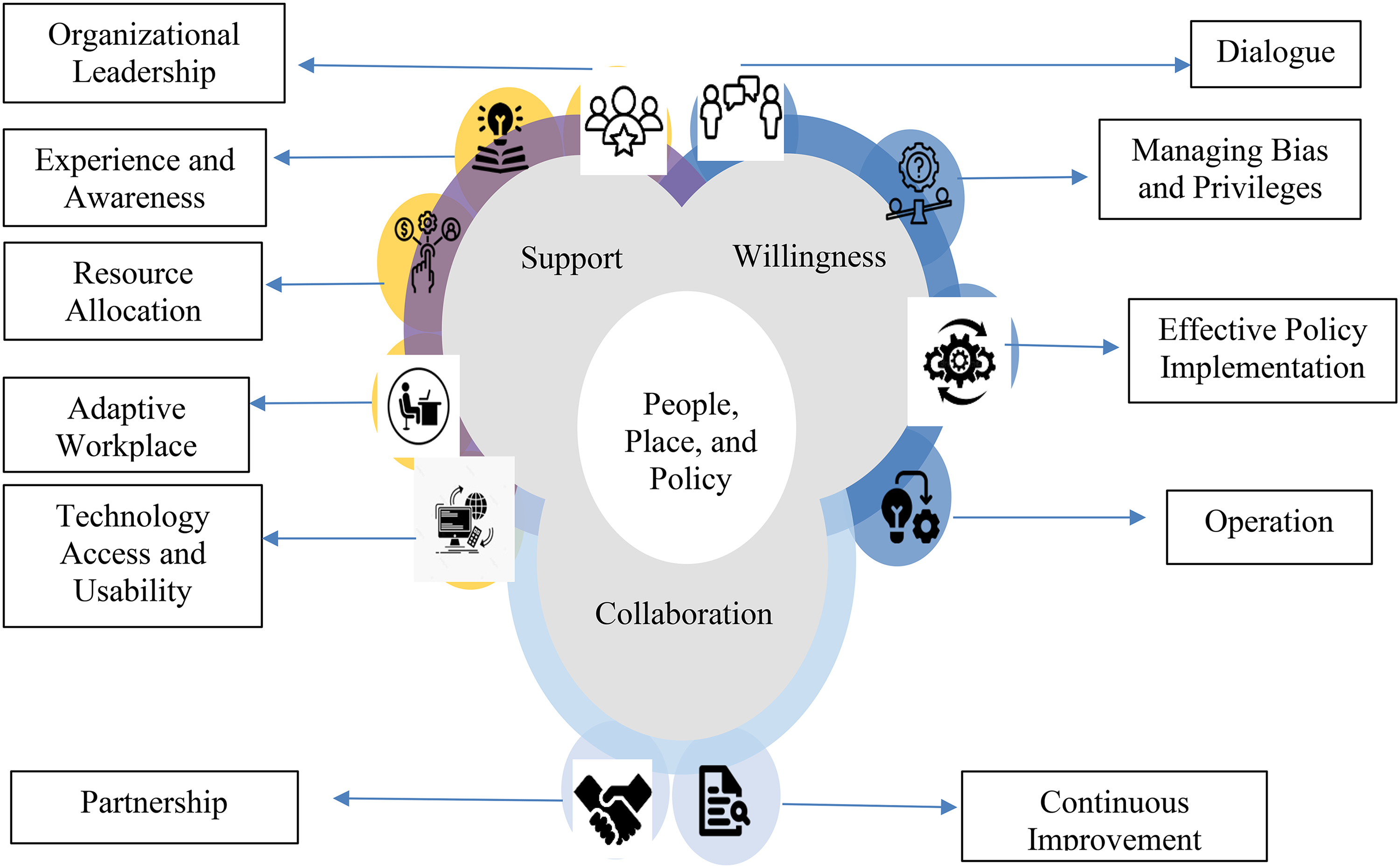
Conceptual representation of the themes emerging from our qualitative study on equitable employment environments for people with visual impairments. The model integrates perspectives from employees with visual impairments and employment-domain experts, highlighting key dimensions of employment environment preparedness, including organizational willingness, availability of support, and collaborative practices that enable equitable participation in the workplace..
Support
In this context, support refers to both tangible (e.g., assistive devices) and intangible (e.g., emotional support) forms of social support. The subthemes associated with support include organizational leadership, experience and awareness, resource allocation, an adaptive workplace design, and access to and usability of technology. These subthemes describe how various forms of support can be leveraged to enhance the preparedness of the employment environment for PVI.
Organizational leadership
Organizational leadership refers to the company's leaders, decision-makers, trustees, or employers with decision-making responsibilities. Employment domain experts (EDEs) highlighted that including a person with visual impairment in a workplace depends largely on organizational leadership commitment and actions. The involvement of top management was considered essential to an inclusive organization, regardless of hiring managers’ references.
In addition, EDE further stated the need for champions to drive the implementation of inclusive practices within the organization. A champion is a person committed to promoting inclusion practices for PVI. Hence, champions across leadership and the workforce are crucial to successfully including PVI.
For instance, consider a unit manager seeking to hire an individual with a visual impairment. During discussions, it becomes clear that assistive technology, training staff in inclusive communication, or modification of specific practices are needed. Although some of these actions may be carried out independently, the manager may also require approval from top management, whose decisions could either facilitate or hinder execution. “You know, if you're like a multi-layered company, and you are one of your First Level managers, who's trying to be a champion, and if the big boss isn't behind, it won't work.” “It's really important to have champions and leaders, and you need a champion that believes in it. So that they will cause the change you can't, you know, as the owner of the business or the manager of the business, you can't do it all yourself, you need to have a champion, preferably champions, to be a positive force in the journey” [E02]. “The piece to help with all of this, setting aside policies, is that we need to be working with universities that train the people who become future leaders and employers; so, in different fields like business management, as well as the programs where you know people trained to work in leadership positions, they need to include disability and accessibility and inclusion in their courses so that they learn general guidelines around accessibility. But these conversations need to start early on when people are still at the training stage, so it's something they're thinking about going forward.” [FG3]
Experience and awareness
According to Hohr, 28 experience is the interaction between the human being and the world, encompassing feeling, action, and conceiving. He further termed the concept of experience as a holistic approach to education.
Data from employment domain experts and employees with a visual impairment revealed that, in general, employers and organizational leaders possess a limited understanding of the capabilities of PVIs and their potential contributions to the workplace. The findings show that previous experience working with a PVI was a critical factor in successfully including this population. Employers lacking such experience reported that the initial process was challenging and often lacked guidance on integrating this population. This was identified as a significant obstacle to hiring PVIs rather than a deliberate act of discrimination. “Sometimes we think, Oh, well, they don’t want to hire because they just have prejudices; it comes from lack of information rather than not wanting to do it.” [E07]
From the employment domain experts' viewpoint, more experienced organizations engaged in an active learning process, such as providing accessible documents and fostering inclusive communication at both individual and organizational levels to effectively connect with PVI. “What works well is that it is our core business. So, we know how to help them, and we know how to deal with colleagues and people with vision impairment. That's the easy part because the whole environment is ready for someone with visual impairment, and we have several employees with visual impairment, low vision, or who are blind.” [E01]
Resource allocation
Resource allocation involves assigning and managing assets to align with an organization's strategic goals. Employment domain experts and employees with visual impairment identified financial resources as key components in fostering an inclusive work environment. While accessibility is often perceived as costly, this is frequently a misconception, especially when inclusive practices are integrated into the organization's operational strategy from the onset. “I think in a lot of cases, it's not necessarily that they don’t want to be human and hire somebody with vision impairment. It's just that they may not be able to. They may not have the funds to make those accommodations if they have to cover the cost themselves.” [FG1] “Of course, there's lots of subsidies, and you know you can go and get subsidies for hiring people that are hard to employ. I didn’t learn this until recently in my job. It's amazing what they will give.” [E02]
Adaptive workplace
An adaptive workplace is an accessible and inclusive work environment purposefully designed and equipped to enable PVI to function and engage fully in the workplace. Both perspectives emphasized that creating an adaptive workspace is the crucial first step towards inclusivity and a welcoming environment for PVI to enhance productivity. “So, I think the first thing is to be able to ask the person what makes your life easier. What do you need to do your job? What are the experiences you've had that worked and those that were not successful, so that we don't repeat everything? Also, from what we know, we have to reflect and say, what are the options for adopting a job and workspace?” [E08]
Nevertheless, it is essential to incorporate flexibility into workplace design to address individuals’ specific needs adequately. “I was given a closed-door office because we have the open space office system, which is ideal. Then I’m distracting others around me as my computers talk out loud, and I’m talking out loud. And it's also hard for me to concentrate if others are doing their work around me while I’m trying to listen to my computer.” [I01: EVI_08]
An employee with visual impairment raised safety or emergency plans as a concern, stating that they are often excluded or inadequately considered during the adaptation and training process. Hence, proactive strategies for adaptive workplace design should go beyond physical accommodation and include inclusive emergency plans. “It was a disappointment that there was no attempt to accommodate me. You know, notifying me when something was moved, and then I couldn't find it again—things like that and also on Emergency in the building. I think more should have been done to prepare me. I shouldn't have been on my own to deal with emergencies. It was hit and miss at the time, whether you got the information at the right time.” [FG2]
Technology access and usability
According to the ICF, access to technology is the availability of adapted or specially designed equipment, products, and technology used for employment to facilitate work activities. 29 Here, we discuss technology under adaptive devices, information technology, accessibility, and usability.
Both the employment domain experts and employees with visual impairment acknowledge that the provision of assistive devices is crucial for integration and job performance of PVI. However, one employees with visual impairment noted concerns about the condition of some devices provided, highlighting that some were obsolete and did not meet specific visual needs. Employees with visual impairment still depend on their sighted colleagues to function and are reluctant to complain about these challenges to preserve their jobs. Thus, the priority should not be to provide adaptive technology but to ensure compatibility with the level of vision, work software, and job requirements. “When I started in a new place, I needed a computer monitor on an arm. They gave me a monitor that was so old it had almost no contrast left on it, and when I said to them look you know I appreciate it, but I can't use this monitor because the contrast is so low that I can't see the image well enough. He basically turned around and said, well, look, you can't be picky.” [FG1] “Everything is not accessible anyway, and there are a couple of things that surprised me. As for the hiring process, all the documents I had to fill in were not accessible. So, of course, that was an extra job of course because of my visual impairments, but what is positive in the end is that I can have my job anyway, so I was hired.” [FG2]
Willingness
In this context, willingness refers to the readiness to act, as opposed to mere openness to ideas. This study explores the theme of willingness in terms of engaging in dialogue, managing disability bias and privilege, operations, and the effective implementation of policies.
Dialogue
Dialogue describes participating in a conversation or discussion to resolve a problem. The assumption about the abilities and experience of living with visual impairment often creates more challenges in workplace adaptation. An employee with visual impairment has noted that not disclosing their impairment can open doors to employment rather than closing them. Thus, employers should be encouraged to listen to this population and follow up at every step of their involvement in the organization. “Most of the time, I did not even mention that I had a vision impairment, and I generally get away with them, even not realizing. Once I have the job, if necessary, I would mention it, but a lot of the times, I didn't again […] So, I think a good idea would be for employers to be more comfortable with having a dialogue. The minute an interviewer perceives the lack of vision, that becomes the end of the interview” [FG1] “So, I think it's really important for them to have dialogue, and for that dialogue to stay open because a person may not have a very good idea of the adjustments that need to be made until they're actually in the environment and maybe have been working in it for a while.” [FG1]
Managing disability bias and privileges
Managing bias and privileges defines the controlling tendency to believe that some people and ideas are better than others. According to employees with a visual impairment, organizations often operate under preconceived or unconscious bias that individuals with vision disabilities are less productive and often fail to implement an equity strategy to counter these assumptions. There is a lack of equity, and the sighted population tends to have an unfair advantage. “They want employees that can work just as fast as anybody else. Suppose you have somebody who's visually impaired versus sighted and has the same capabilities and skills. In that case, they're likely to go with somebody who sighted because they don't have to make the accommodations.” [FG1]
In addition, the employee domain expert pointed out that individuals with visual disabilities are frequently overlooked in diversity plans. The employee with a visual impairment argued that an organization's commitment to inclusiveness and diversity often stems more from regulatory obligations than genuine practice. It noted that organizations tend to use self-disclosure during hiring to gather statistics that support disability inclusion legislation, sometimes offering tokenistic roles to people with disabilities. “When people are hired, there is training on values, ethics, diversity, and equity, one of the public service values. There was no training or talk about people with vision impairment or how to incorporate them into the workplace.” [E04]. “My experience has been that organizations claim to be inclusive are for legislative reasons. They have to make these statements, but not how they are acted upon. In recent times, I have noticed that some websites encourage people to self-identify because of legislative requirements. And they say you can do it on your resume, or by a separate email, or mention it in an online application. So, I think it's a lot easier now to self-identify. What happens is that it's very much tied to statistics because organizations are, as I mentioned, governed by legislation.” [FG2] “Manage expectations both of your current staff and of your new employees. Maybe you know, in the first six months, this new person with vision loss might not be as fast as a sighted person coming into the same job.” [E02] “The big problem is reconciling performance with statistics. Because in some organizations, the policies say that if you have the equipment that allows you to do the job. For instance, if you have text-to-speech, your performance should be the same as somebody who does not have impairment. But it doesn't consider training, slowness, and other aspects of performance”. [FG2]
Operation
Operation refers to the context of how an organization functions. Employees with vision impairment highlighted that most establishments were reactive in creating an inclusive environment. This practice is closely associated with the lack of an established or executed adaptation and inclusion strategy. “The problem always comes when organizations try to address those accessibility problems, like retroactively, rather than ensuring that all documents and job post applications are accessible from the start. And not trying to address barriers that arise when an applicant/employee raises them.” [I02] “Do you want to actually have a diverse group of people who work with you? Or do you want just to check a box? So, the challenges are part of the cost of being in operation."[E09] “And along in this plan, you have to adapt the work processes. You have to be creative in terms of work processes, and sometimes, it's bigger than that person's job. How can you reorganize the work process? So that the person you're hiring becomes an asset to the company and helps the company. It has to be a two-way street, companies helping the person with the impairment, and they also help the company.” [E02]
Effective policy implementation
The series of activities undertaken by an organization to achieve the goals and objectives articulated in policy statements is as important as having the statement itself. The employment domain experts indicated that the challenge was not necessarily the existence of the policy within the organization but an understanding of what it means and how it is to be practiced. This is because there is often no commensurate action plan to confirm the existence of the inclusion policy within the organization. “I don't think the workplaces are really ready to include diverse people of all kinds. They have the discussion-like everybody wants their diverse workplace. Everybody wants to hire more diverse people, but I don't think they really know what that looks like, what kind of change do you really want to go on with?” [E02].
Collaboration
This category pertains to two or more individuals or organizations collaborating to attain a shared objective. It encompasses the themes of partnership and Continuous Improvement.
Partnership
A partnership can bridge the competency gap in dealing with employees with a visual impairment or provide necessary accommodations by leveraging stakeholders with a common interest. An employment domain expert describes this as the expert utilization of a person or organization with comprehensive and authoritative knowledge or skills in this area, or the case of an organization offering financial provision [e.g., the government] to promote inclusion. “Well, we have partners. So, we go out and say, ‘How can we do the best for that person? Is that possible? Is that not possible?’ So, looking at the different alternatives to do the work, looking at the assistive technology that could be put in place for that person from individual experience and also from the professional experience.” [E08] “You need the organizations that would be hiring, the government that has the money, and the rehab that has the expertise. You need to get these three players sitting down at the table, and it's easy to find the champion in the rehab center.” [E02]
Continuous improvement
This process involves collecting and analyzing data or events to assess progress toward attaining specific goals and objectives. A suitable Plan-Do-Check-Act framework has been identified as essential for evaluating various aspects of the workplace, including technology, such as assistive devices and software, strategies and policies, among other factors. “I think you have to constantly keep in mind the specific needs of these people. Try to imagine how to make life easier both in terms of accessibility to the workplace and in terms of the work tools” [E06] “I think as we become more creative, we miss information. Sometimes, returning to the basis–black and white or something like that makes sense for accessibility. We have more possibilities to lose the accessibility, as we tend to be creative.” [E02]
Discussion
The present study aimed to gain insight into aspects of employment environment preparedness needed to welcome a person with visual impairment. Previous studies have identified some barriers and facilitators to successful employment; this study offers a comprehensive view of how organizations can sustainably achieve inclusive employment through assessing workplace readiness. This is the only study that has explored employment environment preparedness by adopting a co-creation approach to include the perspective of both employees with vision impairment and employment domain experts. Our findings reveal that the core aspects of employment expert preparedness are not solely tangible things like physical location or assistive devices. Likewise, the intangible qualities, such as support, willingness, and collaboration, predict the availability or provision of a prepared environment to welcome PVI.
Previous studies on visual disabilities have highlighted employers’ negative hiring behaviour as a hindrance to employment success.30,31 Michele et al. 32 conducted a study to determine the predictors of employers’ attitudes toward PVI. Like the present data, they associated employers’ attitudes with previous experience employing PVI, communication with the vocational rehabilitation agency, and knowledge of this population. However, our findings showed that employers may face challenges in advancing inclusivity when senior management fails to actively prioritize inclusive practices, even when relevant experience is present. Golub 13 identified the fundamental steps employers should take for successful work experience for visually impaired employees. They include establishing core values, providing required tools, ensuring accessibility and accommodation, demonstrating transparency, fostering the right attitude, and expecting equal performance. Our findings acknowledge that support from top management is crucial in driving core values and attitudes and providing necessary accommodations. This is also consistent with another study that identified internal and external partnerships and organizational top-down management diversity support as effective employer practices for integrating people with disabilities into the workplace. 33
Organizations need to cultivate an inclusive workplace culture that actively embraces diversity, equity, and accessibility. This involves promoting inclusive values and implementing clearly defined strategies, such as executive training on disability inclusion, measurable accountability frameworks, accessible recruitment practices, and leadership advocacy to remove systemic barriers and support the sustainable employment of individuals with vision impairment.
Our study shows that experience and knowledge about visual impairment influence how sighted colleagues interact with and include this population at work. This observation is similar to previous findings, indicating that most sighted colleagues do not understand what it takes to work next to PVI. This ignorance leads to agitation and unconscious discrimination,34,35 which could translate into an uncomfortable work environment. Practical employee training and educational modules can compensate for this agitation, lack of knowledge, and experience.
Wu et al. also highlighted the ineffectiveness of policy without encouraging disability awareness education in the workplace. 33 A way to compensate for this inexperience and knowledge gap is the organization's preparedness to imbibe and offer education and training on inclusive communication. This intervention corresponds to the findings from a previous study 36 on the impact of a brief meeting between a vocational rehabilitation professional and an employer. The result of that study indicated that employers’ attitudes toward and intent to hire people who are blind or visually impaired increased. However, increases in hiring intent were not retained at the 4-month follow-up, indicating that ongoing contact is needed. This reinforces our finding on the need for organizations to develop operational strategies and collaborative partnerships that focus on workplace readiness, like improving accessibility, offering targeted training, and engaging disability employment services, to effectively support the hiring and retention of individuals with vision impairment.
A previous study identified employer safety and mobility concerns 37 as barriers to employing PVI. According to this current study, employers can tackle this issue by partnering with rehabilitation professionals to provide workplace mobility training, conducting safety and evacuation training, installing security systems that are accessible to people with various disabilities, and appointing sighted guides for emergencies. To address safety and mobility concerns when employing PVI, organizations can begin by proactively conducting health and safety, as well as accessibility audits, to identify potential hazards and mobility barriers. Implementing safe navigation systems, such as tactile signage, having consistent layouts, incorporating auditory cues, and navigation tools, can enhance independence and safety. Employers can further support inclusion through the use of assistive technologies, disability awareness training for staff, and tailored emergency preparedness plans. Collaborating with orientation and mobility professionals or vision loss organizations for workplace assessments and ongoing guidance will help organizations ensure that adaptations are effective, practical, and aligned with accessibility standards.
A study 20 conducted to assess the assumptions and gaps in reasonable accommodation requirements for PVI revealed that modifying the working environment and facilities, making information accessible, modifying job procedures, restructuring work systems, and providing job training are effective accommodation plans. Yet, such practices are almost nonexistent, and a significant gap still exists in the implementation. From our study, factors such as the indiscriminate acquisition of inaccessible software, lack of early inclusion strategy, a one-size-fits-all approach to providing assistive technology, and cost implications were limitations to practical accommodation. To address these limitations, employers can adopt a personalized, needs-based strategy. This involves conducting individual assessments to understand specific job tasks and the needs of PVI to correctly select tools that best support their tasks, such as screen readers, magnifiers, and braille displays. Involve PVI in the decision-making process, with options for testing different tools and providing feedback.
Additionally, looking for tools/software that integrate seamlessly with existing systems through accessibility testing can offer more procurement advantages. The adoption of CAN/ASC – EN 301 549 as a National Standard of Canada on accessibility requirements for Information and Communication Technologies [ICT] provides a consistent framework that guides organizations in designing, procuring, and implementing accessible digital tools and services. Thereby facilitating a more inclusive employment environment preparedness. 38 It is also crucial to regularly review the effectiveness of the tools to accommodate evolving needs. Adopting the Plan-Do-Check-Act framework is a strong recommendation for continuous improvement and sustainability. With this framework, an organization's inclusivity goals can be clearly stated, leading to the identification of the necessary implementation initiatives and monitoring of the results to assess impact. Based on the findings and feedback, essential adjustments can be made to enhance continuous inclusivity.
The study highlights that partnering with experts in creating an inclusive workplace is vital for enhancing workplace readiness and supporting the employment of PVI. This finding aligns with earlier research.36,39 Building partnerships for human and financial resources is essential for a sustainable approach to inclusion. Additionally, organizations can engage employees with firsthand experience with vision loss to provide valuable insights into this process. Furthermore, it is important to involve all employees and members during the monitoring and evaluation of inclusion strategies to determine their effectiveness and identify necessary adjustment procedures.
Limitations & future direction
Most participants in this study came from the government sector, with minimal representation of the private sector. Although this study sought equal representation of both groups of participants across different sectors to gain insight into the specificity of challenges in Canada, it mainly represents the Quebec context and the rehabilitation sector. In addition, the participants were limited across key demographic dimensions, including race [mostly from white middle-class backgrounds], age [older age groups], and education [educated]. This homogenous sample may affect the generalization and transferability of the findings to more diverse populations or cases of intersecting marginalized identities. Therefore, future studies should expand recruitment to improve the diversity of participants and work environments. Future studies can enhance rigor by having two researchers independently code the data and then reconcile their findings through comparison and consensus.
These research findings provide the content for an eventual Tool to Assess Employment Environment Preparedness. While a tool exists to assess an employer's hiring behaviour, 40 it does not consider the preparedness of the work environment. This new measurement tool can facilitate changes and adaptations to prepare the employer to welcome PVI. Future research will need to validate more evidence-based solutions, as utilized in a previous study, 14 to facilitate a translational problem-solving approach to address unemployment concerns among PVI. Future research should explore the peculiarities of preparedness needed across specific sectors and locations to better understand what resources (human, financial, technological, or mental) favour preparedness plans. Particular attention should also be given to the use of artificial intelligence (AI) and other emerging digital assistants, evaluating their potential in reducing functional barriers and supporting workplace readiness. This study provides direction on the lack of awareness about implementation practices as a barrier to inclusiveness. Hence, developing training modules or an information guide for employers regarding including PVI should be explored to bridge this knowledge gap.
Conclusion
Assessing workplace readiness for employees with vision loss leads to safer, more inclusive environments, unlocking access to underutilized talent, and boosting innovation. It strengthens employee engagement and retention, ensures legislative compliance, and enhances an organization's reputation. These actions also support broader social inclusion and benefit all staff through universally accessible design.
To foster an inclusive and prepared workplace, organizations need well-developed strategies focused on participation, retention, accessibility, safety, mobility, productivity, and personalized tools for employees with vision loss. This includes conducting accessibility audits, offering a range of assistive technologies tailored to individual needs, collaborating, and providing ongoing training and support. Employers also need to actively involve employees in the decision-making process and regularly review the effectiveness of tools and the impact of accessibility strategies to ensure continuous improvement.
Policymakers need to strengthen regulations requiring workplaces to go beyond employment to meet accessibility standards for employees with vision impairments. Organizational accountability can be improved by establishing clear guidelines, mandating compliance checks of workplace adherence to these standards, and regular assessments of their preparedness to accommodate diverse needs, guided by the factors outlined in this study. Regular assessments can also serve as a framework for policymakers to collect data and monitor progress, which could inform evidence-based policy formulation that improves workplace inclusivity for PVI.
Collaboration between employers, disability organizations/professionals, and technology providers is essential to create holistic solutions, while stronger disability legislation can enforce consistent workplace inclusion. Both employers and policymakers must prioritize inclusive hiring practices, support accessible technology, and strengthen legislation to ensure equal employment preparedness for PVI in the workplace
Footnotes
Acknowledgements
We acknowledge the support of our participants and the members of the Wittich Vision Impairment Research lab and the Canadian National Institute of the Blind (CNIB) Research team for their support in the execution of this study.

Ethical consideration
Ethics approval was obtained through the Centre Intégré Universitaire de santé et de services sociaux du Centre-Sud-de-l’lle-de-Montréal, Comité d’éthique de la recherche en réadaptation et en déficience physique MP-50-2023-1654, and the Université de Montréal #2022-1832.
Informed consent
Informed consent was obtained from all study participants electronically or on paper before each session.
Funding
The authors disclosed receipt of the following financial support for the research, authorship, and/or publication of this article: This work was supported by the funding obtained from the Mitacs Accelerate fellowship (IT25811) in partnership with the Canadian National Institute for the Blind (CNIB). Ogedengbe was supported by a Bourse d’exemption and a Bourses Audace et innovation –Ben Marc Diendéré from the Université de Montréal, and a Bourses étudiantes du Centre de recherche interdisciplinaire en réadaptation du Montréal métropolitain 2022 Student Award.
Declaration of conflicting interests
The authors declared no potential conflicts of interest with respect to the research, authorship, and/or publication of this article.