



Abstract
Background
Workplace accidents, particularly those resulting in fatalities, are critical public health and labor issues with profound human and societal consequences. Beyond immediate impacts, such incidents often attract extensive media coverage, which can shape public perception and emotional responses. Understanding how emotions evolve in media narratives is essential for effective crisis communication and public engagement. The Amasra mining disaster in Türkiye, which caused the death of 41 miners in 2022, provided a significant case to explore emotional dynamics in news reporting.
Objective
This study aimed to analyze how emotional tone and sentiment in print media shift over time in response to a major workplace accident. The goal was to develop and apply a novel sentiment analysis framework to evaluate public discourse during the accident, post-accident, and trial periods.
Methods
A lexicon-based sentiment analysis approach was used, incorporating word frequency analysis, expert classification of emotions, and Levenshtein distance to normalize word variations. News articles from ten major Turkish media outlets were collected and processed. Sentiment polarity (positive, neutral, negative) and Plutchik's eight-emotion model (e.g., sadness, anger, fear) were applied across three defined timeframes: the accident period (October 14–16, 2022), post-accident period (until December 13, 2024), and trial period (December 13–15, 2024).
Results
The analysis showed a decrease in neutral sentiment and a steady increase in negative sentiment over time. Emotionally, sadness was most prevalent immediately after the accident but declined in the following periods, while anger increased, especially during the trial. These results indicate a shift from grief to frustration and demands for accountability. Fear and surprise remained consistently present across all periods.
Conclusions
The study demonstrates that emotional dynamics in media coverage of workplace disasters evolve predictably, offering critical insights for media professionals, policymakers, and safety regulators. Monitoring such emotional shifts can enhance crisis communication strategies, improve public trust, and inform policy interventions. However, the study is limited by its reliance on a lexicon-based approach and the exclusion of social media data, which may have offered a broader perspective on public sentiment. To understand societal responses to occupational accidents through media narratives, the proposed sentiment analysis approach provides a valuable tool.
Introduction
An occupational accident can be defined as an event that results in physical or psychological harm to an employee while performing work-related tasks on the employer's premises or in another place where the employee is assigned to perform work-related tasks. 1 These events are usually caused by various factors such as poor working conditions, management errors, inadequate or delayed maintenance, neglect of human factors, lack of adequate and appropriate training and lack of supervision. In many cases, occupational accidents arise from the interaction of multiple contributing factors rather than a single cause. 2
Such accidents can result in injuries or fatalities, with substantial human and economic consequences. 3 In Türkiye, both the frequency of occupational accidents and the number of fatal incidents are significantly higher than in developed nations. Although Türkiye has comprehensive legislation in place regarding occupational health and safety, challenges persist in the enforcement of these regulations by both employers and employees, as well as in the effectiveness of inspections and compliance monitoring. 4
Several studies have emphasized that despite the existence of detailed regulations, enforcement mechanisms in Türkiye often suffer from fragmented institutional responsibilities, insufficient inspections, and a lack of preventive safety culture especially in high-risk sectors such as construction and mining.3,4 Bayram et al. 5 examines how employees’ perceptions of safety priority, rules, and training affect safety participation and behavior, with safety training acting as a mediator in Türkiye. Işık's 6 study examines the historical evolution of OSH regulations in Türkiye and investigates how socioeconomic changes, international norms and local dynamics shape a modern framework compatible with global labor standards.
To underscore the severity and prevalence of fatal occupational accidents in Türkiye, comparative data with industrialized G8 countries is presented in Figure 1. This data reveals that, with the exception of Russia, Türkiye consistently reports a higher number of fatal occupational accidents than other G8 countries. Over a 22-year period, Türkiye recorded fewer fatal incidents than Russia in only two years, while in all other years, Türkiye's fatal accident numbers exceeded those of Russia.
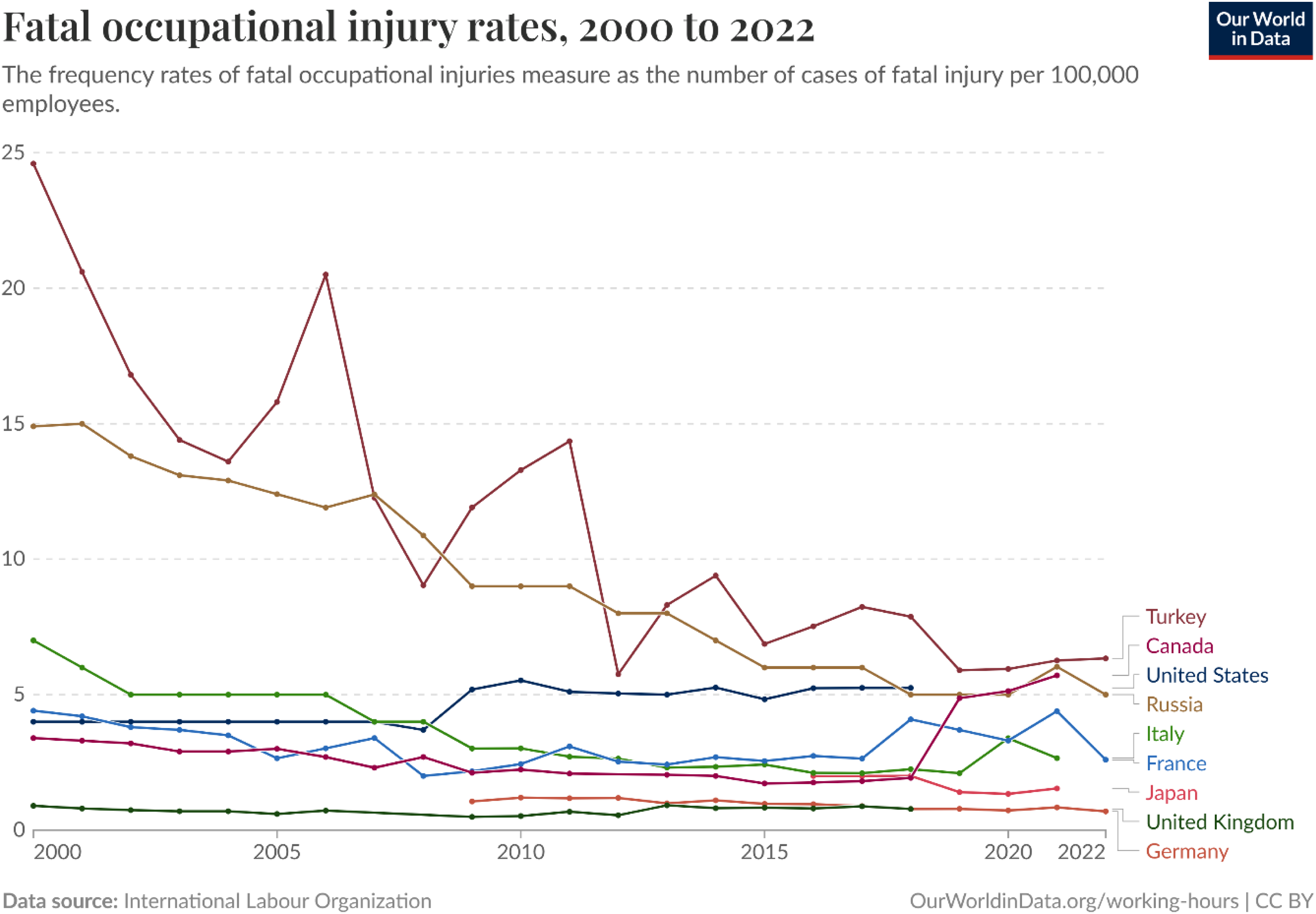
Number of fatal occupational accidents (Source: Our world in data. Based on ILOSTAT data, https://ourworldindata.org/grapher/fatal-occupational-injuries-among-employees?tab=chart, accessed March 14, 2025).
Occupational safety is especially critical in high-risk industries such as coal mining, oil, and gas. These sectors face substantial challenges in ensuring that every worker can perform their duties safely, without facing undue risk of injury or death. The potential for significant individual and organizational losses due to accidents necessitates robust human resource management and stringent safety measures. 7
A case in point is the Amasra mining disaster, which occurred on October 14, 2022, at a mine operated by the Amasra Enterprise Directorate of the Turkish Hard Coal Authority (TTK). At the time of the incident, 110 miners were working underground. A powerful explosion occurred at 18:15, followed by a fire a few hours later. The disaster claimed the lives of 41 miners, making it one of the deadliest occupational and mining accidents in Turkish history. Authorities reported that approximately half of the miners were located at a depth of 300 meters during the explosion, with 5 trapped below 350 meters and 44 below 300 meters. While 58 miners managed to escape on their own, 11 others were rescued by emergency response teams.
In this study, media coverage related to the Amasra mining disaster was analyzed across three defined periods: the
Literature review
Studies of sentiment analysis
Sentiment analysis is often preferred as it allows for the evaluation of existing data without the need for direct interaction with individuals for data collection. Typically, sentiment analysis is conducted by processing ready-made data, particularly from social media platforms, and has been applied across various fields such as education, health, security, and marketing.
Cui et al. 8 focused on the evolution of research methods and topics in sentiment analysis. Similarly, Tan et al. 9 presented a comprehensive review of recent developments in sentiment analysis covering approaches, datasets and future research directions. Other works have aimed to provide valuable information for researchers and educators by providing a broad perspective on sentiment analysis in the field of education 10 or to provide data for the advertising industry to deliver relevant adverts. 11
Several studies have discussed levels of sentiment analysis, different emotion models, and the processes of emotion detection and analysis from text, 12 while others have evaluated and compared various approaches to develop a comprehensive understanding of their advantages and disadvantages. 13
Bordoloi and Biswas 14 extensively analyzed the design frameworks, applications, and future research areas in sentiment analysis. Their work offers systematic and in-depth information on techniques, algorithms, and other relevant factors used to design effective sentiment analysis models. Hartmann et al. 15 conducted a comprehensive meta-analysis evaluating the accuracy and application areas of sentiment analysis methods. Their study examined 217 publications, over 1100 experimental results, and 272 unique datasets containing approximately 12 million sentiment-labeled text documents. It was found that transfer learning models demonstrated the highest performance.
In another study, the applications of sentiment analysis and opinion mining in the context of public security on social media platforms were extensively examined, aiming to identify research gaps and track current progress. 16
In their study of sentiment analysis related to COVID-19 on social media, Nemes and Kiss focused on emotional shifts and fluctuations, identifying that a superficial positive outlook was overshadowed by dominant negativity, although positivity gradually increased over time. 17
Fatouros et al., 18 explored the potential of large language models, particularly ChatGPT 3.5, for improving sentiment analysis in financial texts. Their findings revealed that ChatGPT achieved approximately 35% better sentiment classification accuracy and showed a 36% higher correlation with market returns compared to the well-known FinBERT model.
Studies in social media
Rodríguez-Ibáñez et al., 19 comprehensively examined the multifaceted nature of sentiment analysis on social media platforms. In addition to evaluating current sentiment analysis methods from an academic perspective, they addressed new dimensions such as temporal dynamics, causal relationships, and applications in industry, also discussing the practical applicability of emerging artificial intelligence techniques. Another study analyzing the effectiveness of AI in sentiment analysis was conducted by Taherdoost and Madanchian. 20
Czarnek and Stillwell 21 used two popular emotion lexicons, LIWC (Linguistic Inquiry and Word Count) and NRC (Word-Emotion Association Lexicon), to examine whether people express more positive emotions as they age. By analysing around 5 million tweets, both lexicons showed that positive emotions increase up to the age of 50. However, after the age of 50, positive emotions showed a sharp decline according to the LIWC, while the increase continued until the age of 65 and then stabilized according to the NRC.
The purpose of Yu et al. 22 study is to investigate the effects of social media and traditional media on companies’ short-term stock market performance. The study utilizes a new and large-scale dataset that includes daily media content across various traditional media and social media outlets for 824 publicly traded companies in 6 industries. Our findings show that, in general, social media has a stronger relationship with company stock performance than traditional media, and social and traditional media have a strong interaction effect on stock performance.
Ren et al. 23 examined how social media plays an attention driver role for traditional media. Social media attracts and directs attention to a topic. It is stated that the results obtained in the study provide evidence that social media platforms act as attention drivers different from the information channel functions discussed in the literature.
Dafallah and Hashim 24 used sentiment analysis techniques to analyze Health Safety & Environment situational awareness in oil and gas platform using machine learning algorithms.
Methodology
Sentiment analysis
The main goal of sentiment analysis is to understand people's feelings, perspectives and attitudes in written texts about products, services, organizations, events, news, political ideologies and other topics. Sentiment analysis has developed as a branch of study within Natural Language Processing (NLP) since the 2000s and has become popular in academic studies. 25
In 2003, Nasukawa and Yi introduced the concept of sentiment analysis. In their work, they focused on characterizing emotions related to specific themes and associate them with positive or negative tendencies, rather than simply categorizing the analyzed text as positive or negative emotion. 26
The comprehensive examination of beliefs, feelings and attitudes conveyed in textual data about specific topics is commonly known as sentiment analysis. 27 According to a different definition, it is the process of recognizing, separating, and categorizing the feelings, opinions, and actions expressed in opinions or statements about a range of topics. 12 The primary goal of sentiment analysis is to identify the views of people or communities on a given topic by examining textual documents produced by those people or communities.
In summary, the main purpose of sentiment analysis is to access unstructured information in written texts and process these texts to identify the emotions expressed. The methodologies used in sentiment analysis can be broadly classified into two main categories: machine learning-based methods and dictionary-based (word-based) methods. 28
Machine learning-based sentiment analysis involves using algorithms to detect and classify emotional content in textual data and usually requires large labeled datasets for training. In contrast, lexicon-based sentiment analysis relies on predefined semantic dictionaries or lexicons in which words are associated with specific emotional labels or intensities. This method involves analysing text by matching words to the lexicon to determine the sentiment of the content. 29
In this study, a lexicon-based sentiment analysis approach was employed. The frequency of specific words in the news articles was first determined. These identified words were then presented to domain experts to classify each word into predefined emotion categories according to their emotional connotations. This approach enabled a structured and systematic analysis of emotional expressions in the media coverage related to the mining disaster.
A total of 5 experts were consulted in the study. Two of these experts are academicians working on machine learning, sentiment analysis and NLP, two are academicians in the field of occupational safety and one expert is an occupational safety controller. The experts determined the sentiment categories of the words together with the Delphi technique. After each expert independently assigned emotional labels to the selected words, the group convened to review and discuss any differences. Through a structured Delphi process, consensus was reached on the final emotion category for each word. This collaborative approach ensured consistency and minimized subjectivity in the classification process by emphasizing collective agreement rather than individual judgment.
Classification of emotions
There are many methods for classifying emotions. In this study, both the tripartite Positive / Neutral / Negative emotion classification and Plutchik's 30 eight-emotion classification approach were used.
Classifying emotions as Positive, Neutral, and Negative is a widely used method. 31
In Plutchik's
30
eight-emotion classification, emotions are categorized as Anger: It is our way of reacting to an act of aggression, especially when done intentionally. Sadness: Primarily a state of hopelessness; it requires social support. Fear: A feeling of uncertainty we experience when we anticipate something we believe will harm us. Surprise: Our way of reacting when something unexpected happens; it is a fundamentally neutral emotion. Disgust: This emotion expresses our desire to reject or avoid something or someone. Trust: The subjective stance we adopt when we believe that no harm or damage occurred in a situation following an action. Joy: The satisfaction and well-being we feel from ourselves and the things we have to live through. Anticipation: Expectations we create for ourselves about a specific event or situation, based on our experiences and knowledge.
Text similarity algorithms
Depending on the nature of operations, text similarity algorithms can be categorized into three main groups. 32
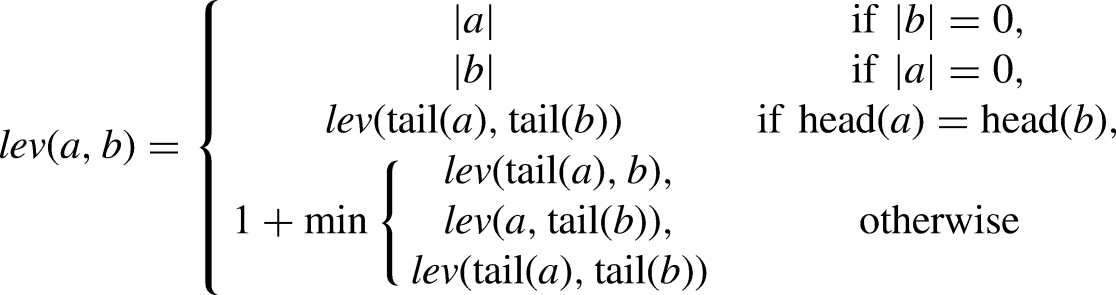
In this study, the Levenshtein Distance algorithm was used. Levenshtein distance is a measure of similarity between two strings. It is defined as the minimum number of changes required to transform string a into string b. These changes can include insertion, deletion, or substitution of characters. The smaller the Levenshtein distance, the more similar the strings are.
33
Equation 1 presents the calculation of Levenshtein distance.
Application
Text preprocessing
In order to perform analysis on text, the text must undergo a series of preprocessing steps prior to analysis. These steps include tokenization, lemmatization, removal of stop words (frequently used words that do not carry significant meaning), conversion of all characters to lowercase, and the removal of all punctuation marks and special characters. 34
Social media platforms were excluded due to challenges related to data accessibility, ethical concerns regarding user privacy, and the informal and noisy nature of the language used, which complicates reliable sentiment detection. By focusing on mainstream news sources, the study aims to ensure consistency, credibility, and traceability in the analyzed content.
In this study, public reactions to major occupational accidents and their reflection in the media were examined, with the mining disaster in Amasra, which occurred on October 14, 2022, selected as a case study.
News articles were downloaded and saved in PDF format. The files were analyzed using Python, and the words appearing in the texts were identified. All characters in the words were converted to lowercase. Stop words, as well as all punctuation and special characters, were removed from the word list. Similarities between words were determined by calculating the Levenshtein distance. Words with a similarity level above 66% were manually reviewed, and synonymous or semantically equivalent words were merged into a single representative word. Subsequently, the frequencies of these consolidated words were calculated. For each news source, the 20 most frequent words in the articles were identified.
When the words from all news sources were aggregated, 42 unique words were identified for the accident period, 53 for the post-accident period, and 52 for the trial period. When the words from all three periods were combined, a total of 99 unique words were selected for analysis. The frequencies of these identified words were normalized based on the texts from their respective periods. Normalization was performed by dividing the number of each of the 99 identified words by the total number of these words.

In the study, news articles related to the accident were compiled from media outlets (newspapers and news agencies) with wide reach in Türkiye. Through research, only those media organizations whose news content was publicly accessible were selected. Effort was made to include media outlets with differing editorial perspectives. The news sources used in the study include Anadolu Agency, Anka Agency, Birgün, Duvar, Hürriyet, Independent_TR, Milliyet, Oksijen, Posta, and Vatan. The number of articles published by each news source in each period is resented in Table 1. The selection of the ten news outlets was based on their high circulation, online visibility, and ideological diversity to capture a balanced cross-section of Turkish media. Efforts were made to include sources with varying political orientations (e.g., pro-government, opposition-leaning, centrist) and regional coverage to ensure representativeness.
News sources and number of news items.
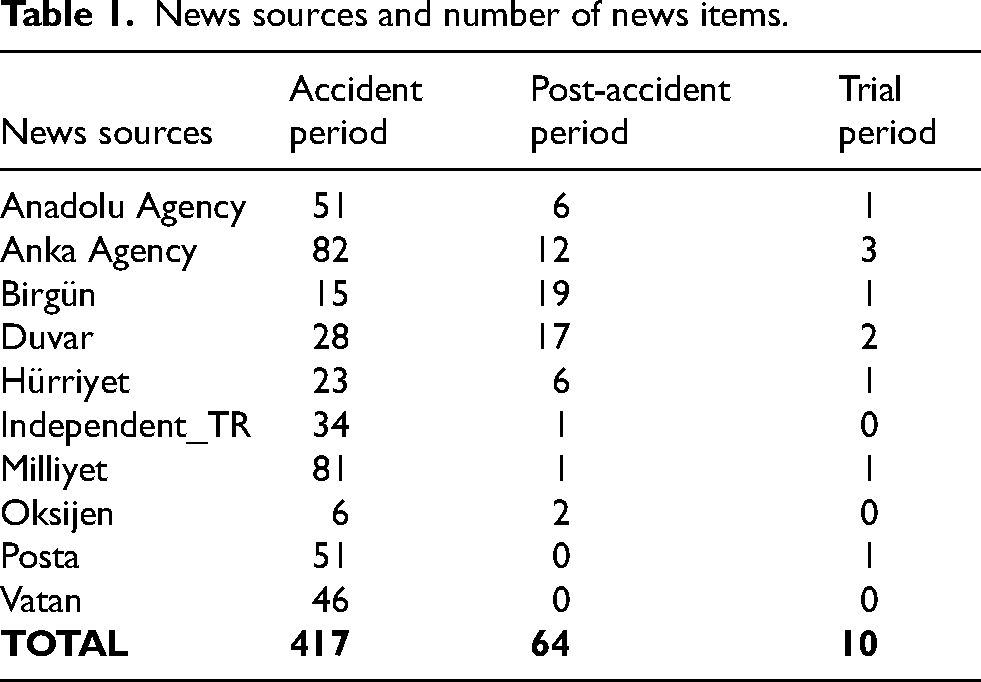
The imbalance in the sample observed in Table 1 is due to the natural decline in media attention over time. While the accident received extensive coverage immediately after the incident, the number of relevant articles diminished significantly during the post-accident and trial periods.
Sentiment analysis
Sentiment analysis is performed using algorithms that employ text analysis and NLP to classify words as positive, negative, or neutral. The words extracted from the analyzed news articles were labeled as
Sentiment analysis.

When Table 2 is examined, it is observed that the level of Neutral sentiment decreases, while the level of Negative sentiment increases over time. This indicates that the emotional tone in the news articles has become increasingly negative as time progresses.
Emotion analysis
The words contained in the text were labeled according to
Emotion analysis.
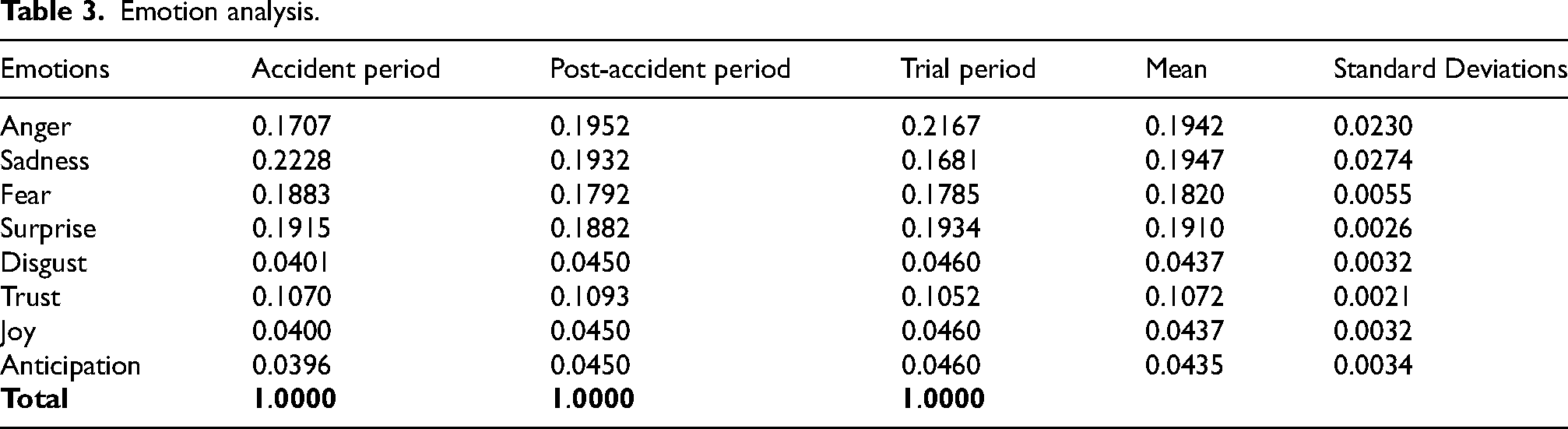
When Table 3 is analysed, it is seen that the most prominent emotions in the news texts are Sadness, Surprise, Fear and Anger. In addition, since the standard deviation values are larger than the other emotions, it is clearly seen that the change in the emotions of Anger and Sadness is larger and more significant. While Sadness shows a decreasing trend over time, Anger increases. This indicates an emotional change in which sadness is gradually replaced by anger.
Conclusion
Occupational safety is a critical issue, particularly in high-risk industries such as coal, oil, and gas. These sectors face substantial challenges in ensuring that every employee can perform their duties safely, with a high potential for both individual and organizational losses in the event of occupational accidents.
This study focused on the media coverage of the mining accident that occurred on October 14, 2022, in Amasra, Türkiye, which resulted in the death of 41 miners. The news articles about the accident were analyzed across three distinct time periods: the incident period (October 14–16, 2022), the post-accident period (until December 13, 2024), and the trial period (December 13–15, 2024). The study aimed to examine how emotional content in the media evolved over time, proposing a novel sentiment analysis approach that utilized word frequency and expert-based emotional classification.
The sentiment analysis revealed a clear trend of increasing negativity in the news texts as time passes. While neutral sentiment was dominant in the period just after the accident, the dominance of this sentiment gradually decreased and negative sentiment became more apparent in the post-accident and trial periods. On the other hand, positive emotions remained low across all periods examined, but increased slightly during the trial period, potentially reflecting hopes for justice or completion.
In respect of emotional categorization based on Plutchik's eight basic emotions, Sadness, Fear, Confusion and Anger were found to be the most frequently identified emotions in news texts. More importantly, the level of Sadness decreased over time, while the level of Anger increased. This indicates that the public and media reaction has evolved from grief to disappointment and demand for accountability.
These findings show the dynamic character of emotional reactions in media coverage and emphasize the importance of considering emotional dispositions in the context of occupational accidents. Understanding how public sentiment changes can provide valuable insights for policymakers, media companies and other organizations aiming to improve occupational safety and crisis communication strategies.
Discussion
Using the mining accident in Amasra as a case study, this study aims to analyze the emotional dynamics of the coverage of occupational accidents in media news texts. By applying a novel lexicon-based sentiment and emotion analysis approach to news texts from three different time periods (accident, post-accident and trial), the research provides insights into how public discourse and emotional characterization develop in response to a large-scale work accident.
In the study, sensitivity analysis shows that there is a significant change in emotions over time. Neutral emotions in media coverage of the accident decreased over time, while negative emotions (especially during the trial period) increased. This trend suggests that media coverage of the event became more critical and emotionally charged as time passed. Possible factors include increased public disappointment, perceived lack of accountability or dissatisfaction with official responses and judicial proceedings.
The analysis of emotion further clarified this evolution. At the beginning, Sadness was the predominant emotion, reflecting immediate sadness and sympathy following the loss of life. Over time, Sadness decreased, while Anger increased, especially during the trial period. This emotional transition is consistent with the psychological and social processes that typically follow traumatic events: usually replacing the mourning in the initial phase of the event with calls for justice, accountability and reform. The presence of feelings of Fear and Confusion throughout all periods indicates a enduring sense of insecurity and unpredictability in the public perception of occupational safety.
These findings are consistent with previous studies highlighting the role of media in forming public sentiment and empowering emotional responses through time. They also support the view that media coverage not only reflects public sentiment but can also influence public opinion, potentially affecting policy debates and corporate trust.
The observed increase in anger following the Amasra mining disaster aligns with findings from previous studies analyzing emotional responses in crisis contexts. For instance, Jin 35 found that intense anger elicited by crisis situations led to a preference for defensive crisis responses, such as scapegoating, over accommodative responses. Similarly, Wahl-Jorgensen 36 demonstrated that anger in protest coverage is not only an individual emotion but also a collective, politicized expression shaped by media narratives. These comparisons reinforce the view that post-disaster public anger, particularly during trials or investigative phases, is a recurrent emotional pattern shaped by expectations of justice.
One important yet underexplored driver of the rising anger in media narratives is the sociopolitical context surrounding occupational accidents in Türkiye. Public sentiment is often shaped not only by the tragedy itself but also by the perceived inefficacy or inaction of state institutions in enforcing accountability. In high-profile disasters like Amasra, media coverage tends to amplify public calls for justice by emphasizing systemic negligence, delayed rescue operations, or shortcomings in safety regulations. This framing intensifies public frustration and fosters a collective expectation for legal and moral accountability.
Additionally, the political polarization in Turkish media can influence how anger is portrayed and distributed across audiences. Pro-government outlets may downplay institutional fault and focus on externalizing blame, while opposition-aligned media often highlight failures in oversight, regulation, or governance. This duality may reinforce anger among different segments of the public—either due to a perceived lack of justice or perceived media manipulation. Ultimately, anger in this context serves not just as an emotional reaction but as a political and moral demand for systemic change.
From a methodological perspective, this study demonstrates the effectiveness of combining sentiment polarity and multidimensional sentiment classification (Plutchik's model) to capture subtle emotional changes. The integration of Levenshtein distance to refine lexical inputs further increases the robustness of the analysis, ensuring consistency of word usage and meaning within texts.
In conclusion, this study highlights the importance of tracking emotional trends in media coverage of occupational accidents. Understanding these dynamics can not only inform communication strategies, but also guide policymakers, employers and safety regulators in addressing public concerns, increasing transparency and promoting trust. Future research could extend this approach to different types of disasters or media platforms, including social media, to gain a more comprehensive understanding of public emotional reactions in crisis contexts.
Understanding emotional evaluation in media coverage can inform not only academic discourse but also practical decision-making. For media organizations, incorporating sentiment analysis into their editorial processes can help assess the tone and potential impact of news stories, especially during crises. Similarly, public institutions and policymakers can use such emotional insights to design more effective crisis communication strategies, ensuring transparency, empathy and responsiveness in public messaging. Moreover, occupational safety regulators can monitor media sentiment as an indirect indicator of public concern and ensure proactive engagement and on-time interventions in high-risk sectors.
Limitations
This study has a limitation in that it uses a lexicon-based sentiment analysis approach that does not fully capture the contextual and hidden emotions in the texts. Additionally, the analysis was confined to a selected set of mainstream media outlets, excluding other sources such as social media, which may reflect broader public sentiment. The manual classification of words by experts, while ensuring accuracy, may also introduce subjective bias.
It can also benefit from integrating advanced NLP techniques such as transducer-based models (e.g., BERT, RoBERTa, XLNet, ELECTRA) to improve the accuracy and contextual understanding of sentiment analysis. Additionally, integrating topic modeling techniques (e.g., BERTopic) could reveal latent themes in media coverage that evolve alongside public sentiment.
Footnotes
Funding
The authors received no financial support for the research, authorship, and/or publication of this article.

Declaration of conflicting interests
The authors declared no potential conflicts of interest with respect to the research, authorship, and/or publication of this article.