



Abstract
Background
Every job has its own unique working conditions. When these conditions do not meet the expectations of individuals, they do not see themselves as part of their organization. This situation can cause a feeling of organizational ostracism, which can minimize production and efficiency.
Objective
This study examines the relationships between teacher-school fit, job satisfaction, participation in decision-making, psychological ownership, and organizational ostracism levels.
Methods
Correlational model was used to examine the relationships between variables. The study population consists of teachers working in public primary schools in Şanlıurfa. The study used a disproportionate cluster sampling method to obtain data. The research sample consisted of 259 primary school teachers randomly selected from 35 primary schools in Şanlıurfa. Descriptive statistics, correlation, and structural equation modeling analyses were conducted.
Results
Upon examination of the structural model that produces the best-fit values, it is evident that teacher-school fit has a positive impact on both teachers’ job satisfaction and psychological ownership levels. Furthermore, job satisfaction has a positive effect on teachers’ participation in decision-making and psychological ownership. Finally, it is worth noting that both psychological ownership and participation in decision-making have a negative impact on organizational exclusion. The negative impact of organizational ostracism is mediated by job satisfaction and psychological ownership, which are both affected by teacher-school fit. Specifically, the teacher-school fit has a negative effect on organizational ostracism through the full mediating effect of job satisfaction and participation in decision-making.
Conclusion
Teachers’ fit to their schools increases their job satisfaction, participation decision-making, psychological ownership, and decreases their ostracism.
Keywords
Introduction
Organizations are institutions that bring together material, social, and intellectual capital to achieve a common goal. The success of an organization is highly dependent on its employees working together towards a common goal and supporting each other. However, social and emotional distance between employees can negatively impact the organization's purpose. The fact that the working conditions of institutions are not suitable for individuals also brings problems in terms of receiving social support and establishing social relationships. This situation causes individuals to feel excluded from their institutions. Individuals who feel excluded do not feel like a member of their institutions and are unproductive. 1 Organizational ostracism is the conscious or unconscious exclusion of individuals from their workplace and social environments within an organization.2,3 It involves the exclusion of individuals from social relations, important job-related information, and decision-making processes. 2
The concept of organizational ostracism was introduced in academic literature in the 1990s as a means of understanding social relations in the workplace. 4 Recent studies have linked organizational ostracism to decreased job satisfaction, high-stress levels, low levels of work engagement, and a decrease in job performance.5–7 In addition to the organizational dimension, the negative effects of organizational ostracism also have an individual dimension. Organizational ostracism can have long-term negative effects on individuals’ psychological and emotional health in all areas of their lives, particularly in their work environments. 8 In this research, the relationships between organizational ostracism in educational institutions and teacher-school fit, job satisfaction, psychological ownership, and participation in decision-making were examined.
Employees need to adapt to their organization, both for the benefit of the organization and the individual. In educational organizations, the fit between teachers and schools is also crucial. Teacher-school harmony has numerous positive effects, including a sense of ownership and identification with the school, improved performance, and increased commitment.9–12 Conversely, these variables occur at low levels in employees. A teacher who is in harmony with the school can make a significant contribution to the organization with his or her work, and be personally satisfied with his or her job.
Job satisfaction is a concept used to describe an individual's perception of their job and their level of satisfaction with it.13–16 Factors such as future anxiety, administrator behavior, and low wages have a negative impact on teachers’ job satisfaction.17–19 Additionally, organizational ostracism is believed to have a negative correlation with teachers’ job satisfaction. This research also considers psychological ownership as a variable.
It is important to examine the relationship between teachers’ organizational ostracism and their psychological ownership of the school. One way for teachers to take ownership of the school is through volunteering. 20 Volunteering is defined as teachers spending extra hours and effort for the school, apart from their official duties. Organizational ostracism may negatively impact volunteering and organizational ownership.
This research examines the relationship between organizational ostracism and participation in decision-making. Collaborating with employees to make decisions can increase the likelihood of employee acceptance and implementation of the decision. 21 Joint decision-making has been shown to enhance employees’ organizational commitment and productivity.22,23 Organizations that do not ensure or have low levels of teacher participation in decision-making may experience decreased commitment and productivity. According to this research, teachers who experience organizational ostracism are less likely to participate in decisions and work extra hours voluntarily for the organization. This research aims to examine the relationship between organizational ostracism, teacher-school fit, job satisfaction, psychological ownership, and participation in decision-making variables. The hypotheses were developed based on literature reviews.
Humans are social beings, and as such, the need to live together and communicate is vital. Social psychology theories explain that positive communication between individuals is necessary for personal development and growth.24,25 It is crucial for both the organization and the individuals involved that members who come together for a common purpose are accepted by others and establish positive communication. Excluding employees or managers by rejecting them, not communicating with them, or ignoring them can have negative effects on the team. It is considered important to investigate how and to what extent organizational ostracism may affect teachers’ school adaptation, job satisfaction, psychological ownership, and participation in decision-making.
Purpose of the research and formation of hypotheses (the present study)
The purpose of this research is to investigate the intricate connections among variables such as teacher-school fit, job satisfaction, participation in decision-making, psychological ownership, and organizational ostracism. The study presents a structural model that integrates these five constructs, considering previous research findings. Examining the predictors of organizational ostracism in educational organizations is critical for increasing the well-being of primary school teachers and preventing them from becoming psychologically distant from their schools. The loss of qualified teachers due to feeling excluded from school is a significant loss in terms of human resources. Examining these five structures together not only provides a better understanding of them individually but also contributes to a better understanding of the structures that affect organizational ostracism. It is believed that teachers can be assisted in developing foresight, feeling valued, and increasing productivity by reducing their perception of exclusion in their schools. It is believed that teachers, who are considered the most important element of education systems, would reduce their perception of exclusion. This reduction in perception may cause many negative attitudes in their schools. As a result, there would be a significant increase in the quality of education and training.
This research presents a model on organizational ostracism and its predictors, including teacher-school fit, job satisfaction, participation in decision-making, and psychological ownership. The study tests the following hypotheses in line with the theoretical framework and research purpose.
H1: Teachers’ fit with their organizations positively affects their job satisfaction. In the literature, previous studies26–28 showed positive effects of person-organization fit on job satisfaction. Similarly, this study predicts a positive effect of person-organization fit on job satisfaction.
H2: Job satisfaction positively affects participation in decision-making. Research shows that high job satisfaction among employees positively affects their participation in organizational decisions.29,30
H3: A teacher's satisfaction with the school he/she works in and the work he/she does positively affects his/her psychological ownership of his/her school, organization, and job. Research in the field also shows that employees who are satisfied with their jobs have psychological ownership of their organizations.31–34
H4: Previous research has found that job satisfaction is positively related to employees’ positive attitudes and negatively related to their negative attitudes. 35 It is known that organizational ostracism is an undesirable attitude that reduces the quality of teachers’ work life. 36 While most studies have focused on the effect of organizational ostracism on job satisfaction, some research has explored the emotional dimensions of both factors. Specifically, individuals with high job satisfaction tend to perceive lower levels of organizational ostracism. 37 As a matter of fact, these people feel satisfaction in their work environment. It is known that individuals with high job satisfaction have very satisfying and healthy relationships in their work lives. 38 Based on this the present study suggests that job satisfaction among teachers has a negative impact on their perception of organizational ostracism.
H5: Person-organization fit has a positive impact on participation in decision-making. Research has shown that when an individual's values align with the values and culture of the organization, they are more likely to participate willingly in decisions that are being made.39,40 When teachers are a good fit with their schools, it can have a positive impact on their involvement in decision-making processes related to school development and operations.
H6: Studies have shown that a participatory decision-making culture in schools positively affects psychological ownership among teachers. Employees tend to have a higher level of ownership in organizations where they are given more autonomy and have a say in decision-making.41,42 According to studies in the field, teacher participation in decision-making may lead to psychological ownership of the school.
H7: Participation in decision-making can have a positive impact on reducing organizational exclusion. Collaborating with employees to make decisions regarding their roles and responsibilities can strengthen their connection to the organization. Research suggests that this approach may help to reduce organizational ostracism among employees.43,44 Collaborative decision-making with teachers may be negatively associated with feelings of organizational ostracism. It is important to involve teachers in school decisions to avoid this potential issue.
H8: Person-organization fit has a positive effect on psychological ownership. When individuals’ character traits and values align with the cultural characteristics of the organization, they are more likely to identify with their organization.45,46 This identification can lead to a stronger sense of belonging and commitment to the organization.
H9: It is believed that individuals who are in sync with their organization and receive support from it tend to develop a psychological attachment to it. They also have high levels of commitment to their jobs 47 and low intentions to leave their jobs. 48 Under these perceived positive conditions, psychological ownership is predicted to have a negative effect on the feeling of organizational ostracism experienced by teachers who have a strong psychological attachment to their organization.
H10: Person-organization fit negatively affects organizational ostracism. Research shows that when the fit between the person and the organization increases, the feelings of organizational ostracism and alienation in individuals decrease. 49 Considering that the situation may be similar in schools and teachers, it comes to mind that teacher-school fit may negatively affect organizational ostracism.
H11: Person-organization fit has a negative impact on organizational ostracism through the mediating effect of job satisfaction and psychological ownership. Previous research has shown that person-organization fit has a positive effect on teachers’ job satisfaction and psychological ownership.45,46 Additionally, studies have found that person-organization fit, job satisfaction, and psychological ownership have a negative impact on organizational ostracism.43,44,49 Thus, it is predicted that the fit between an individual and an organization has a negative impact on organizational ostracism. This effect is mediated by job satisfaction and psychological ownership.
H12: Person-organization fit has a negative impact on organizational ostracism through the mediating effect of job satisfaction and participation in decision-making. Previous research has shown that person-organization fit has a positive effect on teachers’ job satisfaction and participation in decision-making.39,27,40 Research has shown that person-organization fit, job satisfaction, and psychological ownership have a negative impact on organizational ostracism.43,44,49 Therefore, it is suggested that person-organization fit has a negative effect on organizational ostracism through the mediating effect of job satisfaction and participation in decision-making.
Method
Research design
The study utilized a correlational design, which examines the relationships between multiple variables and their degree and direction using participant responses on scales. 50 This approach is a form of survey research. Scales were used to determine teachers’ perceptions of teacher-school fit, job satisfaction, participation in decision-making, psychological ownership, and organizational ostracism levels. The existence of relationships between variables was examined, as well as their level and direction. To provide stronger evidence for the research findings, a model was proposed based on the theoretical background. The model included teacher-school fit as an exogenous variable and job satisfaction, psychological ownership, participation in decision-making, and organizational ostracism as endogenous variables. These variables were analyzed using path analysis.
Population and sample
The study's population comprises of teachers employed in public primary schools in Şanlıurfa in Turkey during the 2023–2024 academic year. The disproportionate cluster sampling method, 51 which involves randomly selecting schools for the sample, was used. 35 primary schools in Şanlıurfa were randomly selected, and scales were distributed to all teachers in these schools. The research sample consists of 259 primary school teachers selected impartially from these schools.
35.5% of the participants were female (n = 92) and 64.5% (n = 167) were male teachers. 59.8% of the teachers participating in the research were married (n = 155) and 40.2% were single (n = 104). 15.8% of the participants were between the ages of 21–27 (n = 41), 44.4% were between the ages of 28–34 (n = 115), and 39.8% were aged 35 and over (n = 103).
Data collection tools
Some information about the scales used to obtain research data is presented briefly below.
Person-organization (teacher-school) fit scale. In this study, the 4-item person-organization fit scale developed by Netemeyer et al. 27 was used to examine teachers’ adaptation to school. The adaptation of this one-dimensional scale to Turkish culture was carried out by Turunç and Çelik. 52 The fit values found by confirmatory factor analysis showed that the scale structure was at good levels (GFI = .99, IFI = .99, TLI = .99, CFI = .99) and acceptable levels (x2 = 2.34, df = 1, x2/df = 2.34, RMSEA = .07). In the context of this research, Cronbach's Alpha Reliability value is .92. The rating of the scale is a 5-point Likert scale between 1 (I completely disagree) and 5 (I completely agree).
Job satisfaction scale. In measuring the satisfaction levels of teachers with their jobs, the scale developed by Chen et al. 53 in the form of 5 items was used. Turunç and Çelik 52 adapted the scale into Turkish. The 5-point Likert scale is scored from 1 (I completely disagree) to 5 (I completely agree). CFA showed that the fit of the single-factor job satisfaction scale with the research data was good (GFI = .98, IFI = .98, TLI = .96, CFI = .98) and acceptable (x2 = 10.05, df = 4, x2/df = 2.51, RMSEA = .07) levels. Cronbach's Alpha Reliability value was found to be .83.
Participation in decision-making scale. In this study, the Participation in Decision-Making Scale developed by Allen 54 was used. The scale's adaptation into Turkish was made by Karabağ Köse. 55 Participants’ perceptions of participation in the decision are determined by 6 items. CFA revealed that the single-factor structure of the scale was found to be at good (GFI = .98, IFI = .99, TLI = .98, CFI = .99) and acceptable (x2 = 8.77, df = 4, x2/df = 2.19, RMSEA = . 06) levels. The scale is a 5-point Likert scale and its scoring varies between 1 (not at all) and 5 (complete). In this study, Cronbach's Alpha Reliability value of the scale was found to be .88.
Psychological ownership scale. It was developed by Avey et al. 31 with 16 items. It was adapted into Turkish by Ekinci 56 with 16 items. As a result of CFA, the factor structure of the scale was found to be in good fit with the research data (GFI = .95, IFI = .97, TLI = .96, CFI = .97) and acceptable (x2 = 57.98, df = 23, x2/df = 2.52, RMSEA = .07) levels were revealed. In this study, Cronbach's Alpha Reliability values were calculated as .91 for the subscale of self-efficacy, .81 for the subscale of accountability, .91 for the subscale of self-identity, and .89 for the overall scale. The scale is a 5-point Likert scale and is rated between 1 (I completely disagree) and 5 (I completely agree).
Organizational ostracism scale. In examining the organizational ostracism variable, the organizational ostracism scale, developed by Abaslı and Özdemir 57 with two factors: isolation and slight, was used. Isolation was measured with 5 items, and slight was measured with 9 items. The scale is a 5-point Likert scale and its scoring ranges from 1 (I completely disagree) to 5 (I completely agree). The CFA of the two-factor organizational ostracism scale presented that the scale had a good (GFI = .91, IFI = .97, TLI = .96, CFI = .97) and acceptable (x2 = 177.92, df = 71, x2/df = 2.50, RMSEA = .07) fit with the research data. In this study, Cronbach's Alpha Reliability value of the scale was found to be .88.
Data collection process
In the 2023–2024 academic year, a form containing scales was distributed online to teachers in randomly selected primary schools. Participation in the research was voluntary. The participants were informed about the purpose of the study, the subject matter, the variables, and the confidentiality of the information obtained.
Data analysis
The data of this research were transferred to the SPSS software program. In predictive analyses, research data should show normal distribution. For this purpose, the skewness-kurtosis coefficients of the data were examined. It is known that skewness-kurtosis values between ±1.5 are sufficient to prove that the data exhibit a normal distribution. 58 The skewness coefficient was obtained as −.50 on the person-organization fit scale, −.26 on the job satisfaction scale, −.67 on the participation in decision-making scale, −.61 on the psychological ownership scale, and .91 on the organizational ostracism scale. It was observed that the kurtosis coefficient was .04 on the person-organization fit scale, −.14 on the job satisfaction scale, .51 on the participation in decision-making scale, .88 on the psychological ownership scale, and .10 on the organizational ostracism scale. These coefficient values revealed that the data was normally distributed. It was clarified by correlation analysis that the correlation values between the variables were statistically significant. Subsequently, stronger evidence for the relationships between variables was presented in the measurement model in which measurement errors were also included.
Descriptive, correlation, and reliability analyses were performed using the SPSS program. Confirmatory factor analysis was applied to each research variable. Thus, the fit between the scale and the research data was examined in terms of fit indices that are frequently reported in research. AMOS software program was used in structural equation modeling analysis because it produces powerful solutions.59,60
Findings
Descriptive statistics and correlations
Descriptive statistics and correlation values of the variables whose relationships were examined in the study are presented in Table 1.
Descriptive statistics and correlation values for variables.
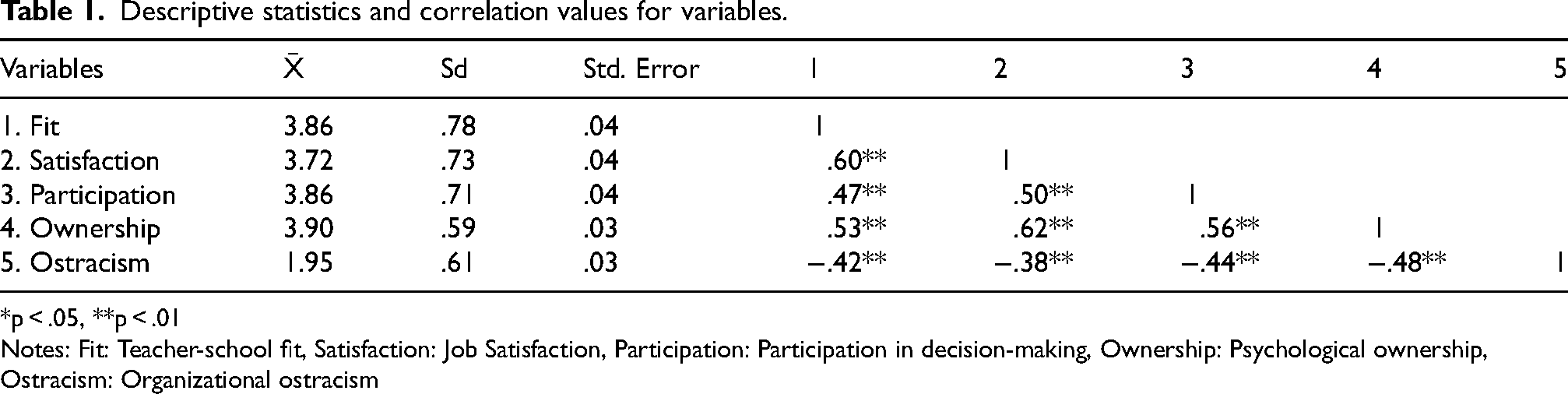
*p < .05, **p < .01
Notes: Fit: Teacher-school fit, Satisfaction: Job Satisfaction, Participation: Participation in decision-making, Ownership: Psychological ownership, Ostracism: Organizational ostracism
When Table 1 is examined, teachers’ perceptions of teacher-school fit, job satisfaction, and psychological ownership are relatively high (I agree: 4). Similarly, teachers’ perceptions of participation in decision-making are above the medium level (Very: 4). Teachers’ perception towards the organizational ostracism variable (disagree: 2) is below the medium level.
By looking at the relationships in the correlation matrix (Table 1), It is seen that the correlations between the variables of teacher-school fit and job satisfaction (r = .60, p < .01), participation in decision-making (r = .47, p < .01), and psychological ownership (r = .53, p < .01) are moderate, positive, and statistically significant. There is a moderate, negative, and statistically significant correlation between the variables of teacher-school fit and organizational ostracism (r = −.42, p < .01). Job satisfaction is moderately, positively, and statistically significantly correlated with participation in decision-making (r = .50, p < .01) and psychological ownership (r = .62, p < .01). The correlation between job satisfaction and organizational ostracism is moderate, negative, and significant (r = −.38, p < .01). There is a moderate, positive, and significant correlation between participation in decision-making and psychological ownership (r = .56, p < .01). The correlation between the variables of organizational ostracism and participation in decision-making is moderate, negative, and significant (r = −.44, p < .01). There is a moderate, negative, and significant correlation between psychological ownership and organizational ostracism (r = −.48, p < .01). Correlation analysis reveals that all the variables subject to this research have significant relationships with each other. This result contributes to our prediction that the relationships between the research variables in the measurement model may be meaningful.
Measurement model
Confirmatory factor analysis was applied to each of the scales in the study separately. Afterwards, the measurement model was created (Figure 1). In this model, error covariances were added between items K5 and K6, D13 and D14, and D7 and D12, respectively. This is because the errors of the items are related to each other. The measurement model below (Figure 2) shows statistically significant relationships between latent variables.
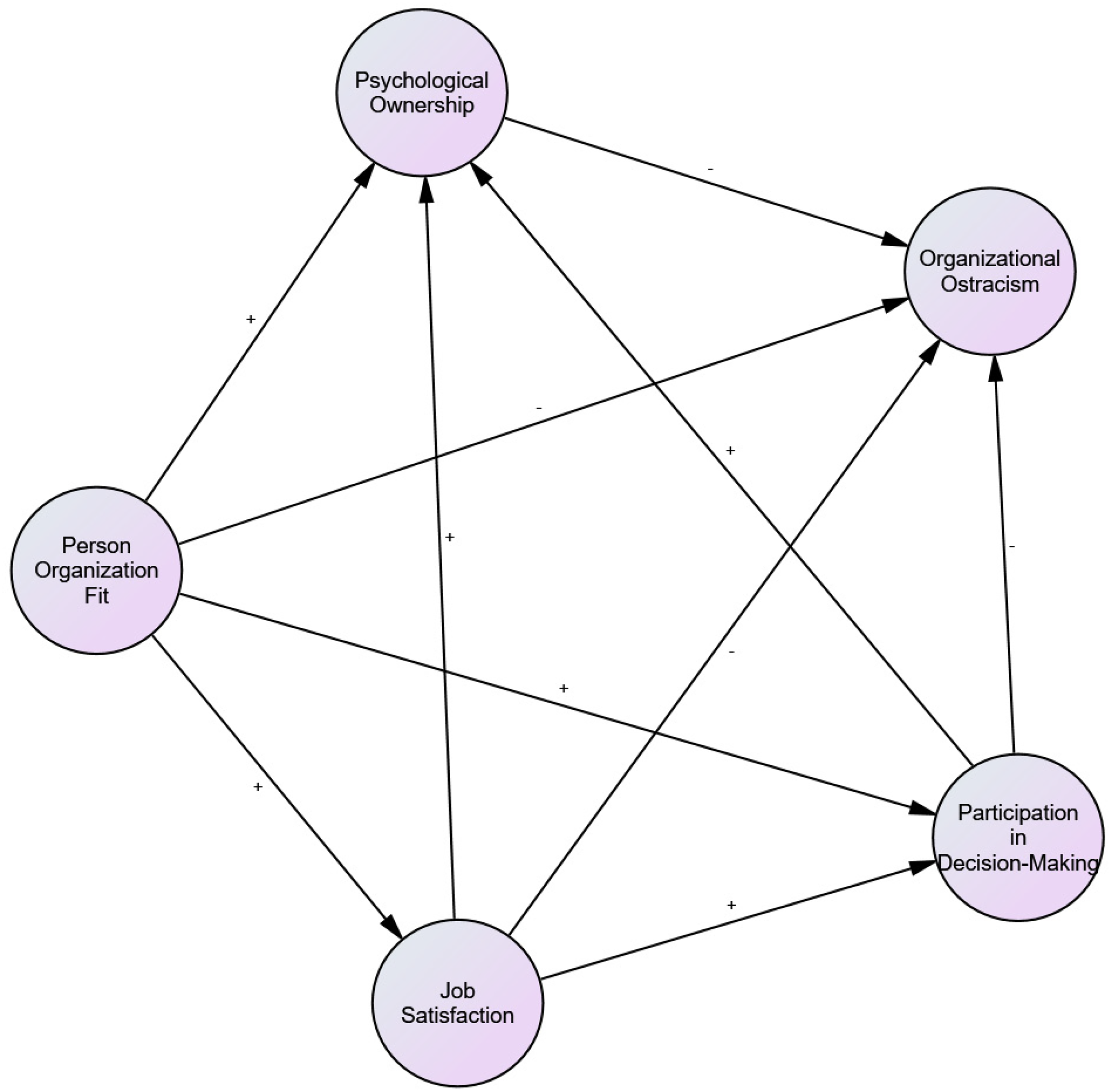
Hypothesis model.
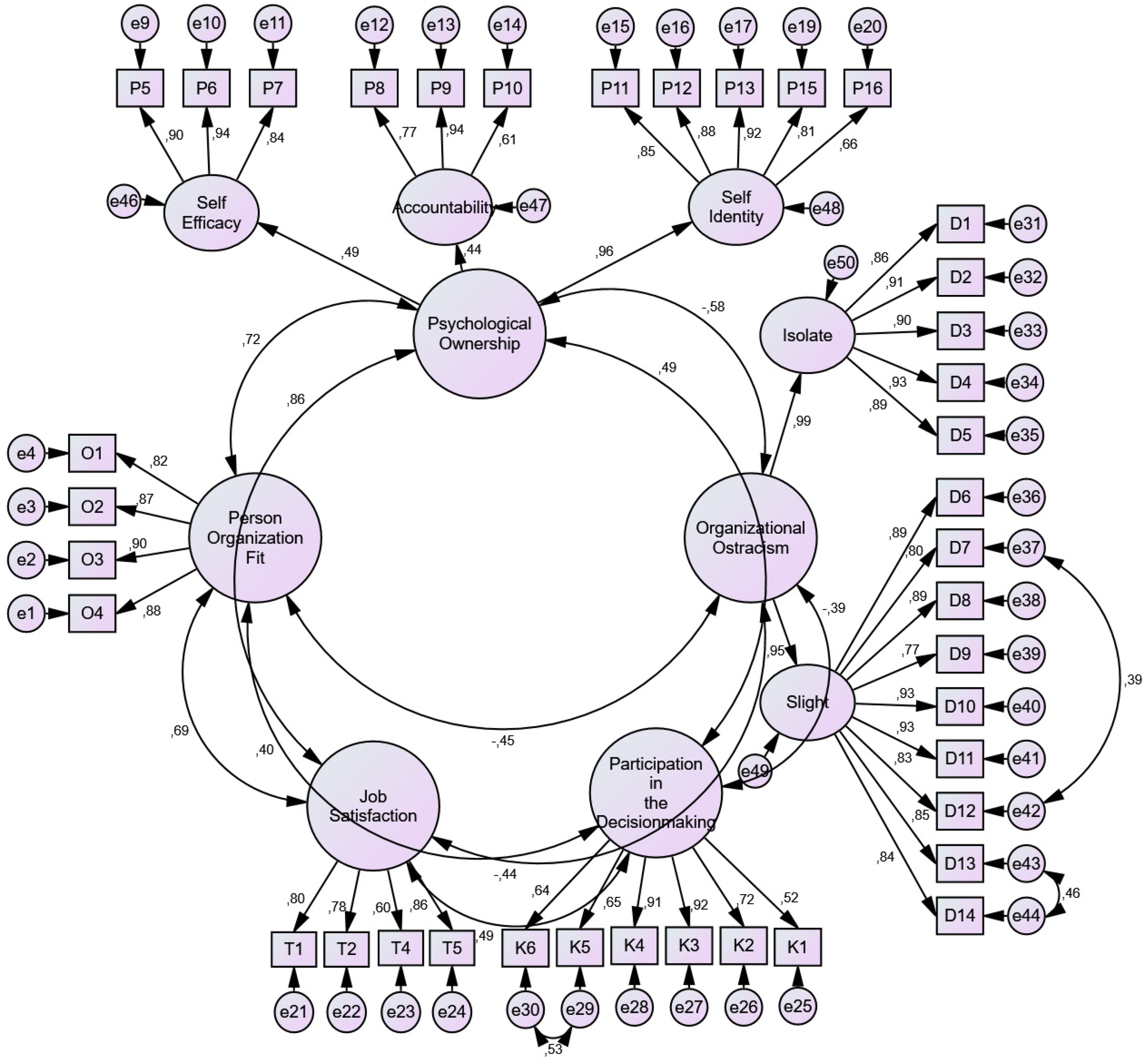
Measurement model (With standardized coefficients).
The measurement model (Figure 2) showed that the scales in the study were at good levels (IFI = .93, TLI = .92, CFI = .93) and acceptable levels with the data (x2 = 1386.40, df = 684, x2/df = 2.02, p = .00, GFI = .85, RMSEA = .06). Goodness of fit indices produced in this model provide information about the existence and magnitude of the effects of variables on organizational ostracism. In path analysis, paths are added among the variables in light of the theoretical infrastructure and hypotheses.
Structural equation modeling
Since the path coefficients are statistically insignificant, teacher-school fit → ostracism (B = −.05, ß = −.08, t = −.90, p = .36), teacher-school fit → participation in decision-making (B = . 07, ß = .12, t = 1.38, p = .16), participation in decision-making → psychological ownership (B = .05, ß = .07, t = 1.34, p = .18), and job satisfaction → organizational ostracism (B = .21, ß = .27, t = 1.33, p = .18) paths were eliminated from the model. The change in fit values when insignificant paths are removed from the structural model is presented in Table 2.
Deletion of the meaningless paths in the structural equation modeling.

In this research, the structural equation modeling that produces the best-fit values with path coefficients (standardized) after the meaningless paths are eliminated from the structural equation modeling is presented in Figure 3.
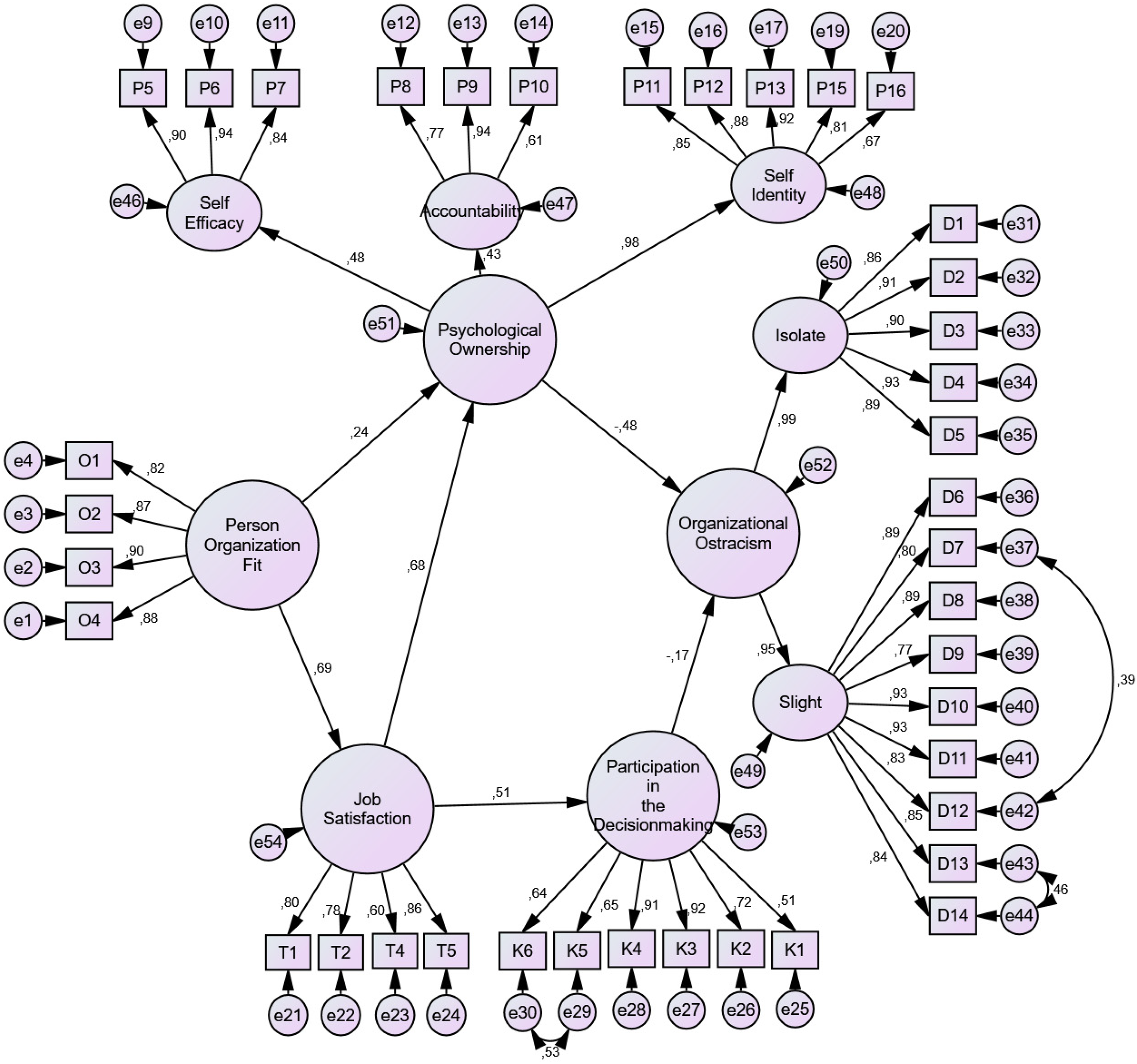
Structural equation modeling.
When the structural model is examined (Figure 3), teacher-school fit positively affects teachers’ job satisfaction (ß = .69, p < .01) and psychological ownership (ß = .24, p < .01) levels. The tested hypotheses H1 and H8 are confirmed. Teachers’ job satisfaction positively affects their participation in decision-making (ß = .51, p < .01) and their psychological ownership (ß = .68, p < .01). It seems that the hypotheses H2 and H3 are confirmed. Psychological ownership (ß = −.48, p < .01) and participation in decision-making (ß = −.17, p < .01) negatively affect organizational ostracism. It becomes clear that the H7 and H9 hypotheses tested in the research are also accepted. Teacher-school fit has a negative effect on organizational ostracism through the full mediation effect of job satisfaction and psychological ownership (ß = −.23, p < .01). The proposed H11 hypothesis is accepted. Teacher-school fit negatively affects organizational ostracism through the full mediation effect of job satisfaction and participation in decision-making (ß = −.07, p < .01). It seems that the tested hypothesis H11 was also confirmed. Therefore, the hypotheses H1, H2, H3, H7, H8, H9 and H11 put forward in the research are accepted.
Conclusion and discussion
Organizational ostracism is a significant issue that can have adverse effects on institutions.36,61 This research examines the relationship between organizational ostracism and teacher-school fit, job satisfaction, participation in decision-making, and psychological ownership. The study proposes and tests a structural model for these relationships.
This study found that teachers’ job satisfaction and psychological ownership levels increased when they had harmony with their schools. Previous studies have shown that person-organization fit has a positive effect on employees’ job satisfaction27,28 and psychological ownership45,46 levels. Therefore, these findings are consistent with previous research. Teachers whose individual values align with those of their institution tend to experience greater job satisfaction and a sense of belonging.
Previous research has shown that employees’ job satisfaction is positively correlated with their level of participation in organizational decision-making29,30 and their sense of psychological ownership.33,34 The present study confirms these findings, demonstrating that an increase in teachers’ job satisfaction is associated with a higher level of participation in decision-making and a greater sense of psychological ownership. These results are consistent with previous research. Teachers who feel happy and content in their jobs are more likely to perceive that their opinions are valued by their institutions and that they have a say in school practices. Additionally, maintaining positive attitudes at school helps teachers feel a sense of belonging to their institution. 21
Research has shown that when teachers have a greater sense of psychological ownership and are more involved in decision-making, they perceive less organizational ostracism. This is consistent with previous studies that have found a correlation between these attitudes and reduced feelings of ostracism.43,44 When teachers feel a sense of belonging to their institutions and have autonomy in their work, it can reduce their feelings of being excluded. Therefore, teachers believe that they are supported by their institutions and have healthy communication with their colleagues. This situation may play a crucial role in the effectiveness and efficiency of teachers. 62
The fit of individuals with their institutions contributes to job satisfaction 28 and the development of psychological ownership attitudes. 46 Teachers’ satisfaction with their jobs and positive feelings towards their schools may reduce their sense of exclusion. 36 In this study, it was found that teacher-school harmony negatively affects organizational ostracism through the full mediating effect of job satisfaction and psychological ownership. Therefore, teachers who cooperate and are in harmony with their institution and belong to it do not feel isolated from their environment.
This study found that teacher-school fit has a negative impact on organizational ostracism, with job satisfaction and participation in decision-making fully mediating this effect. Previous research has shown that teachers who align with their school's goals and values tend to have higher levels of job satisfaction. 39 Therefore, increasing job satisfaction among teachers can lead to more positive attitudes and higher productivity in schools.35,38 Teachers who feel satisfied with their work environment and believe that their opinions are valued tend to take more initiative in their duties and assume greater responsibilities. These positive circumstances lead to teachers feeling less excluded within their institutions.
School principals should be knowledgeable about organizational ostracism, teacher-school harmony, job satisfaction, participation in decision-making, and psychological ownership. To prevent teachers from feeling isolated, efforts should be made to enhance their attachment to their schools, job satisfaction, participation in decision-making, and psychological ownership. The needs and expectations of teachers should align with the expectations of the schools where they work. This can potentially enhance teacher-school fit, leading to more positive attitudes and fewer negative attitudes among teachers.
This study aims to identify the predictors of organizational ostracism using a quantitative method. To gain a better understanding of the variables examined in accordance with the theoretical background, a qualitative study can be designed. It is important to examine this attitude with a qualitative design due to the negative effects of organizational ostracism on both individuals and organizations.
In this study, complex relationships between the variables examined were revealed. It forms the basis for future studies in many aspects. This study offers insights into how to reduce the organizational ostracism attitude that correlates to individual-organization fit, employees’ job participation in decision-making, satisfaction, ownership of their organizations, and productivity. It is known that when individuals do not perceive themselves as members of their institutions, it can have devastating effects on institutions. These individuals may have problems developing healthy and satisfying relationships in their institutions. As a natural result of the organizational ostracism attitude, the quality of their work life decreases. Considering that work life makes up a large part of life, it is inevitable that their non-work life will also be negatively affected.
Footnotes

Ethical Considerations
The ethics committee approval of this study was obtained with the decision of the Şırnak University Ethics Committee dated 21.09.2022 and numbered 2022/101. (Date and Number of Documents: 28.09.2022-E.47270).
Funding
The authors received no financial support for the research, authorship, and/or publication of this article.
Declaration of conflicting interests
The authors declared no potential conflicts of interest with respect to the research, authorship, and/or publication of this article.