



Abstract
Background
Vocational rehabilitation is a well-established field that attracts constant interest. The law provides incentives for beneficiaries and employers. A distinct population group is emerging in the context of current demographic changes: older workers with chronic conditions and impaired functional capacity which are prone to less working years.
Objective
This study aimed to assess possible impact factors on maintaining a long-term professional activity in aged people with mild functional impairments.
Methods
Two hundred and seventy-one patients admitted to The National Institute for Medical Assessment and Work Capacity Rehabilitation Bucharest for work capacity evaluation were included in the survey. An observational study was designed to describe their vocational skills and to integrate interests and abilities to work counselling using a person-centred approach.
Results
Gender (p = 0.003), marital status (p < 0.001), residence (p < 0.001), level of education (p < 0.001), type of occupation (p < 0.001), and multiple qualifications (p = 0.001) were related to longer working experience. Multiskilling, job fit, and residence were favourable features for a shorter interruption of the activity (p < 0.001, p = 0.031, p = 0.016, respectively). An investigative profile was found for higher education (p = 0.002) and intellectual jobs (p = 0.002), while a social profile was associated with a lower level of education (p = 0.012) and unskilled jobs (p = 0.031). Men had a significantly greater percentage of realistic (p = 0.002) and investigative profiles (p = 0.010). Women had significantly greater artistic (p < 0.001) and conventional (p = 0.047) profiles.
Conclusions
Various factors were associated with work participation. Occupational gender segregation was found, and differences in vocational interest were identified for different levels of education and occupational groups.
Keywords
Background
The dominant demographic challenge of the twenty-first century is the aging of society. The simultaneous increase in life expectancy and decline in fertility in most countries around the world is currently producing large proportions of the over 65 population and a significant worldwide decline in the number of working people to support these aging cohorts. This leads to radical changes in the needs and resources of the population, with significant consequences for employment, consumption, economic growth and financial policy. 1
The economic impact consists of increased public spending due to the costs of pensions and healthcare. 2 In this context, urgent action is needed to preserve the labor force, both in terms of the number of years worked and the increase in the retirement age compared to what was foreseen until now. Higher work participation among older people is expected in all EU member states. 3
In addition to increasing the retirement age, another resource is harnessing the remaining potential of people with various health conditions but who still have fully or partially preserved working ability. However, breaking down barriers for people with medical problems and hiring them seems more difficult to put into practice.
Although the law has clear provisions regarding the application of equal treatment to all those looking for a job and discourages potentially discriminatory requests from employers, in practice, there are frequent contradictions with these provisions, and these attitudinal barriers still occur. Age or illness are the most common types of discrimination in the labor market frequently invoked by people who apply for social insurance benefits. Age and health are important selection criteria because employers are primarily looking for young and healthy employees, without problems that could create absenteeism from the workplace. 4
Chronic diseases place a considerable burden on healthcare resources and are a significant cause of long-term sick leave and disability. In recent years, research on vocational rehabilitation (VR) to enhance return to work (RTW) has led to advances in understanding this process and its significant determinants. Low levels of education, unskilled work, female gender and advanced age are related to low RTW in most studies. Work-related factors, such as negative attitudes towards work, lower job satisfaction and adverse psychosocial working conditions, also influence employees’ decisions regarding RTW or early retirement. 5
VR diversity refers to medical, psychological, social and occupational activities aimed at optimising the working capacity required to stay or return to the labor market for people with a previous work history and health-related impairments6,7
VR is designed to maximise the work ability of people with activity limitations and participation restrictions caused by various health conditions. Promoting the return of people with mild functional impairments to work is an important goal of the actual Romanian approach. There are several reasons for this: they represent a vulnerable group in the labor market, and there are gaps in the existing legislation. Detailed analysis of this problem and presenting an approach model would be the first step in outlining a strategy.
In Romania the number of VR programs is reduced, developed and supported by the government, especially for people recognized as disabled, according to Law no. 448/2006 on the protection and promotion of the rights of persons with disabilities, with subsequent amendments and additions. There are also private or public institutions for the unemployed, but they work well for those with little or no health problems. Information and career guidance are among the measures aimed at increasing employment opportunities for job seekers. These services have several purposes: provide information about the labor market and the evolution of professions; develop skills in making satisfying career decisions or training in job search methods. In addition to the standard steps, a profile is created for each of the beneficiaries and classified into several functional categories: easily employable, medium employable, difficult to employ, and very difficult to employ. 8 In many cases, people who have received extended sick leave up to the maximum duration provided by law of 9 months or more in case of special diseases (tuberculosis, cardiovascular diseases, AIDS and cancers) 9 or temporary work disability benefits due to health problems have a difficult to very difficult profile and reduced chances of employment on the labor market.
Several research papers have shown that employers are reluctant to hire people with chronic diseases, especially due to insufficient information and often from non-professionals.10,11 Obstacles to employment / return to work were identified in the case of cancer, 12 mental health problems 13 or cardiovascular diseases. 14 Therefore, there is a perception in the society that if the condition of a person with a health problem reaches a level that requires long-term care or hospital treatment, the chance of regaining health is reduced. These individuals are considered vulnerable, in a situation of inferiority compared to other employees, who cannot cope with certain work tasks, and therefore require additional protection. Workplace integration strategies are evaluated in terms of additional costs and of the specifics of the activity and the fluctuation of the workload. There is a perception among employers that the disadvantages of employing people with health problems are more significant than the benefits they will bring to the company. An employee's health problem is considered a risk that may lead to financial and productivity losses.
Vocational interests and skills are important for career decisions, job matches, and good performance and health at work. Current evidence has shown that their assessment as a part of a tailored rehabilitation plan can enhance employment opportunities.15–18 The RIASEC (Holland) test refers to six personality types: Realistic (R), Investigative (I), Artistic (A), Social (S), Enterprising (E) and Conventional (C). The RIASEC test will show a mixed score on six dimensions; higher scores are obtained for the best defined interests. According to Holland's theory, a person's personality is determined by the degree of compatibility with each of the six dimensions. Thus, the personality pattern is given by a dominant profile, for which the person meets the highest similarity level, followed by secondary profiles, ordered in descending order of the degree of similarity. In practice, the first two or three dimensions are taken into account to pick out suitable work areas. Realistic personalities tend to work with tools or machines; investigative people enjoy studying and solving mathematical or scientific problems; artistic types like creative activities such as art, drama, crafts, dance, music or fiction writing; social types tend to do things that help people, such as teaching, nursing, counselling, or providing information; enterprising persons like to manage and persuade people, sell things and ideas; conventional persons like to work in a systematic way with numbers, documents or machines. Choosing a job or an educational program that matches one's personality creates the conditions for a satisfying and successful working life. 19
The return to work or work (re)integration of people with activity limitations is part of the change in approach and new eligibility criteria for social insurance benefits in Romania, as assessed based on The International Classification of Functioning, Disability and Health (ICF) concepts and definitions. 20 Other studies have evaluated the effectiveness of adapted and multidisciplinary interventions for vulnerable groups at risk of not resuming professional activities.21,22 According to the new criteria, health conditions are grouped together on a functional basis, and activity limitations and participation restrictions are introduced. They are more RTW oriented, and the evaluation of skills and interests is included in the development of an individualised approach to achieve effective vocational rehabilitation. 23
The aim of this study was to assess the impact factors on maintaining a long-term professional activity and to develop a counselling model to support aged people with mild functional impairments in keeping or resuming a professional activity. Several factors associated with employability have been investigated. To achieve this goal, our research followed several steps: 1) investigate the potential key factors for work participation—sociodemographic, medical, vocational skills and interests—and identify a vulnerable population for disengagement from the labor market; 2) search evidence to outline a personalised vocational rehabilitation program based on vocational skills and interests in the context of the current workforce.
Methods
A cross-sectional study was performed to describe vocational skills and to integrate interests and abilities to work counselling using a person-centred approach. Between 2022 and 2023, 271 consecutive patients admitted to The National Institute for Medical Assessment and Work Capacity Rehabilitation Bucharest (INEMRCM, the Romanian abbreviation) for work capacity evaluation were included in the survey. The inclusion criteria for the study were agreement to complete the questionnaire in addition to the usual psychological assessment and total or partial preservation of work capacity according to Romanian legislation. The participation rate was 27.93%.
The International Standard Classification of Education (ISCED) was used as the reference for the level of education. Considering the level of education generally required for the various occupations, three main domains were analysed: low, medium and high. ISCEDs 1 and 2 (primary and lower secondary education) were aggregated, as were ISCEDs 3 and 4 (upper secondary and postsecondary education). Tertiary education was considered a separate group (ISCED 6 or higher).
Occupations were classified according to the Romanian version of the International Standard Classification of Occupations – ISCO/Classification of Occupations from Romania – COR, referring to the major groups. Depending on the similarity of the nature of the work and the level of training, they were grouped into 3 large categories: a) Groups 1 and 2 – intellectual occupations; b) Groups 3, 4 and 5 – specialised jobs that generally require an average level of training; and c) Groups 6, 7, 8 and 9 – manual work, with a predominantly physical demand.
Job match and its type, total or partial (with at least one of the jobs practiced previously), were also analysed. The concordance between the previous training and the one proposed was tested with a shorter version of the RIASEC in Romania. The Romanian scale was adapted to the Romanian language, consists of 60 questions and was scientifically validated and benchmarked on the population of Romania. Each personality type, Realistic (R), Investigative (I), Artistic (A), Social (S), Enterprising (E) and Conventional (C), is represented with 10 items, and each question requires a yes, I like it/no, I dislike it or an indifferent answer. For each dimension, the subject can obtain a maximum score of 20 and a minimum score of 0. 24
Preserved work capacity was considered according to current medical criteria, depending on remaining function: fully preserved or half-lost. 23 In the latter case, the person is still able to perform a part-time professional activity but at the same time is entitled to a partial work disability pension. In Romania, work disability is classified in relation to the loss of working capacity, according to the law 263/2010 on the unitary system of public pensions: 1st degree, characterized by total loss of working capacity and self-care, persons requiring daily assistance for basic activities; 2nd degree (full work disability pension), characterized by the total loss of working capacity while maintaining the ability to take care of oneself, and 3rd degree, characterized by the loss of at least half of working capacity, people are able to work on a part-time basis (partial work disability pension) 25 ;
Clinical diagnosis was coded according to the International Classification of Diseases (ICD-10), the 10th revision of the International Statistical Classification of Diseases and Related Health Problems.
The counties of residence were grouped into eight regional units, nonadministrative units, which are responsible for collecting regional statistics. They are named according to their geographical position in the country: (1) Northeast, (2) Southeast, (3) South, (4) Southwest, (5) West, (6) Northwest, (7) Centre, and (8) Bucharest-Ilfov. The last 2021 analysis of the GDP in each development region in Romania highlighted that the Northeast, Southeast, South and Southwest Regions have the lowest levels of economic development, with a GDP below 60% of the EU average. On the other hand, the western, northwestern and central regions have greater economic and social development, with a GDP above 60%. In contrast, Bucharest-Ilfov is the most developed region, with a GDP of 166% compared to the EU average. 26
The chi-square test was used for nominal and categorical variables (gender, marital status, residence, diagnosis, level of education, type of occupation, job match, preferred occupational categories according to the Holland model) and independent-sample t-test for numerical variables (e.g., age, length of service duration, number of years of disengagement from the labor force). Two variables were used to describe people's participation in productive activities: work experience (years of employment) or interruption of the activity (years of leaving the workforce). Multiple linear regression was used to assess the estimated effect (regression coefficient) of each variable as a potential predictor of work participation using PSPP.4 software. P < 0.05 was the cut-off for statistical significance with a 95% confidence interval.
Results
Investigation of the factors important for work participation: Sociodemographic, medical and vocational
The majority of the subjects 151 (56.13%) had full work ability preserved, and 118 (43.87%) had half of their work ability preserved and were able to perform a part-time job. There were 168 (62%) female responders. The average age of the participants was 50.74 years (standard deviation – SD = 5.83). Of the responders, 202 (74.54%) were couples, and 120 (44.28%) were from urban areas. The average length of service duration was 16.70 years (SD = 10.10).
A total of 123 (45.38%) had a low level of education, ISCED 1 or 2, 135 (49.81%) had a medium level of education, ISCED 3 or 4, and 13 (4.79%) had a high level of education, ISCED above 6. A total of 172 (64.90%) had manual jobs, 81 (30.57%) had specialised jobs (technicians, clerks, service workers), and 12 (4.43%) had intellectual occupations.
A total of 115 (42.75%) had a psychiatric disorder (F01-F99), 57 (21.19%) had a cardiovascular disease (I00-I99), and 97 (36.06%) had other types of disease. These patients were grouped and analysed together because the number of patients with fewer than 50 cases/category varied between 1 patient with a blood disease (D50-D89) or a skin disease (L00-L99), and 21 patients with diseases of the musculoskeletal system (M00-M99).
The study of influencing parameters of the two outcomes that characterize labor force participation: work experience (years spent in the labor market) and interruption of the activity (years of disengagement from the labor market).
Factors associated with longer working experience
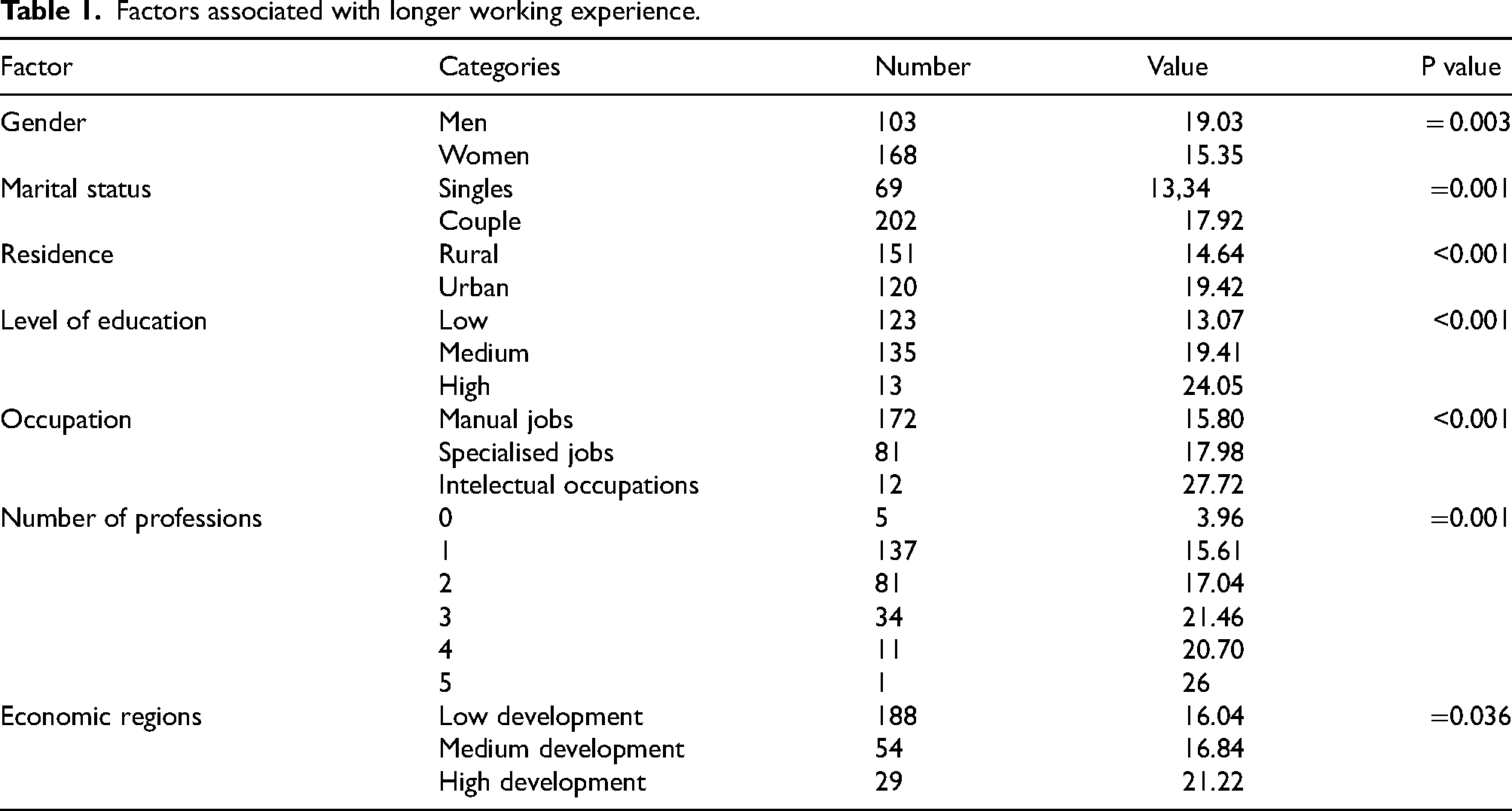
Several variables were significantly associated with longer working experience: gender (p = 0.003), marital status (p = 0.001), residence (p < 0.001), level of education (p < 0.001), occupation (p < 0.001), number of professions (p = 0.001), and regional development (p = 0.036) (Table 1). Some variables did not affect the length of working experience (fitted job, diagnosis).
Factors associated with longer working experience.
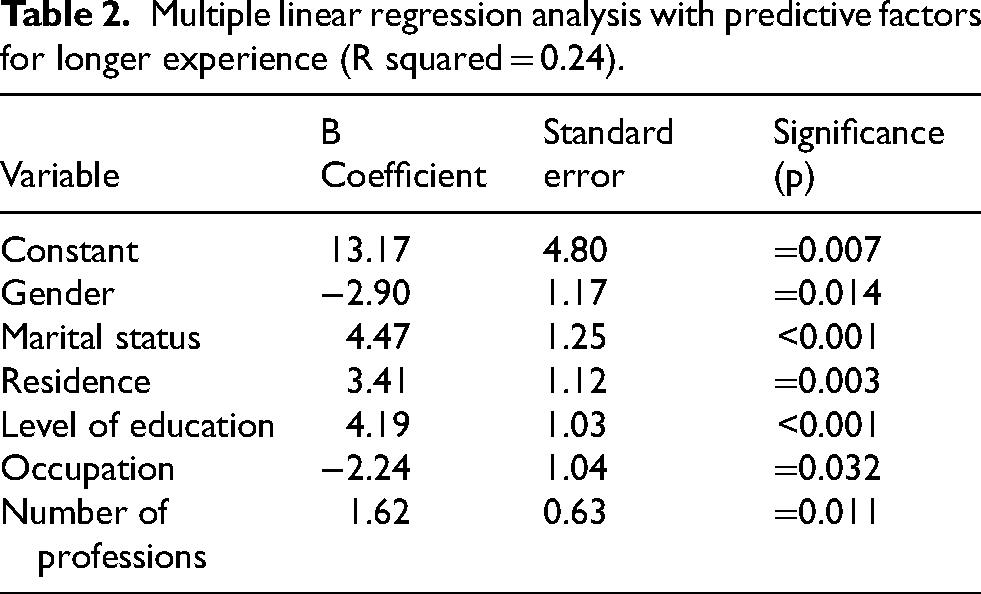
Using multiple linear regression, we investigated the influence of each socio-demographic factor on work experience. We initially introduced all variables that were significantly correlated with longer work experience – specifically gender, marital status, residence, level of education, number of professions and regional development) and through backward selection process, we eliminated regional development, as it lost statistical significance in the multivariate model. The R-squared value indicated that the model was reasonably effective in predicting factors associated with longer work experience (Table 2). In conclusion, men who have a partner from an urban area, particularly from Bucharest-Ilfov, with higher education, professionals or managers, and multiple qualifications seem to stay employed longer.
Factors associated with shorter interruption of the activity
Multiple linear regression analysis with predictive factors for longer experience (R squared = 0.24).
The same factors were investigated for their relationship with the interruption of the activity (gender, marital status, residence, level of education, previous job, number of professions, job match before and after counselling, diagnosis and development region).
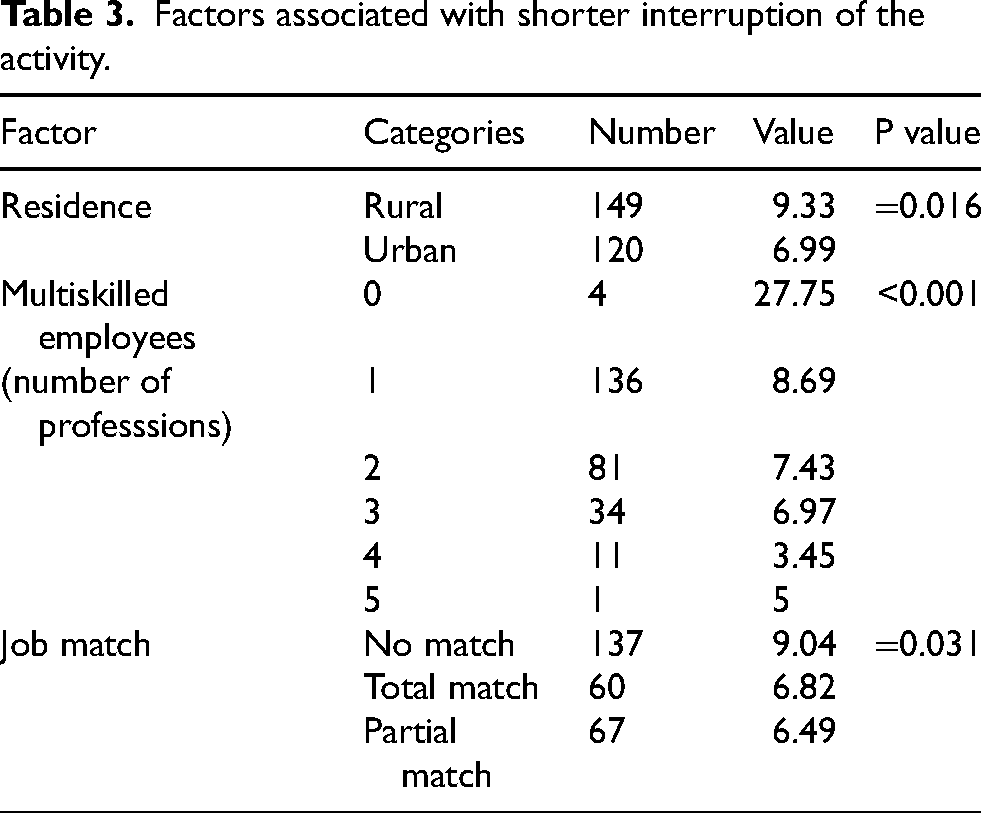
Several variables were significantly associated with the interruption of the activity: residence (p = 0.016), number of professions (p < 0.001) and adequate job (p = 0.031); (Table 3). Some variables did not affect the continuity of activity (gender, marital status, previous job, diagnosis and development region), while the level of education was at the limit of significance (p = 0.054).
Factors associated with shorter interruption of the activity.
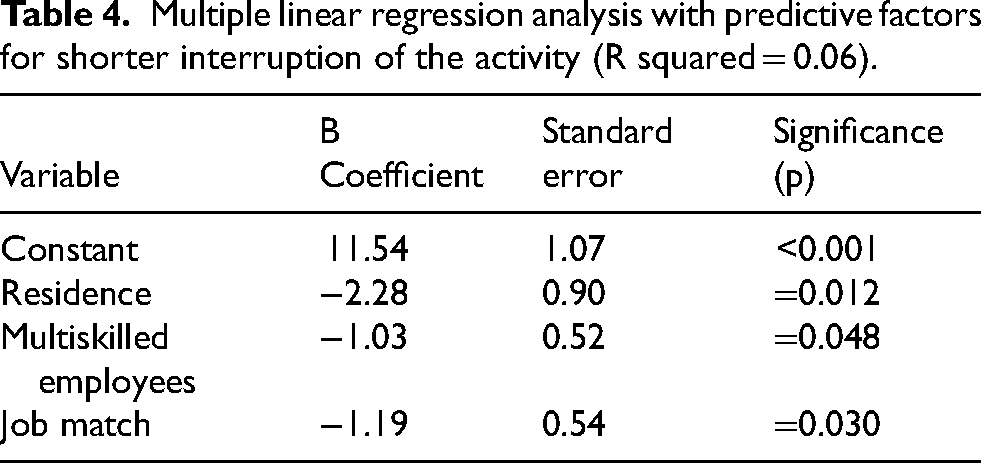
All three sociodemographic variables that were significantly linked to shorter interruption of the activity were tested and remained statistically significant in the multiple linear regression analysis. Although the low R squared value suggests that important variables may be missing from the model, the highly significant p-values indicate that it is still acceptable for predicting interruption of the activity (Table 4). In conclusion, people from urban areas who have multiple qualifications and who have jobs matching their personal interests seem to be less out of work.
Multiple linear regression analysis with predictive factors for shorter interruption of the activity (R squared = 0.06).
Evaluation of vocation skills and interests for a multidisciplinary rehabilitation program
Using the Romanian validated RIASEC test, realistic profiles were identified for 220 (81.18%) persons, investigative profiles were identified for 114 (42.07%), artistic profiles were identified for 42 (15.50%), social profiles were identified for 204 (75.28%), enterprising profiles were identified for 31 (11.44%) and conventional profiles were identified for 201 (74.17%) persons (Figure 1). Taking into account the numerous cases of realistic, social and conventional profiles, we look forward to the percentage when they are found together in any possible combination: RSC (23), RCS (15), SCR (23), SRC (22), CRS (17) or CSR (6). A dominant three-letter code was identified in this study: a combination of R/S/C in 106 (39.11%) patients.
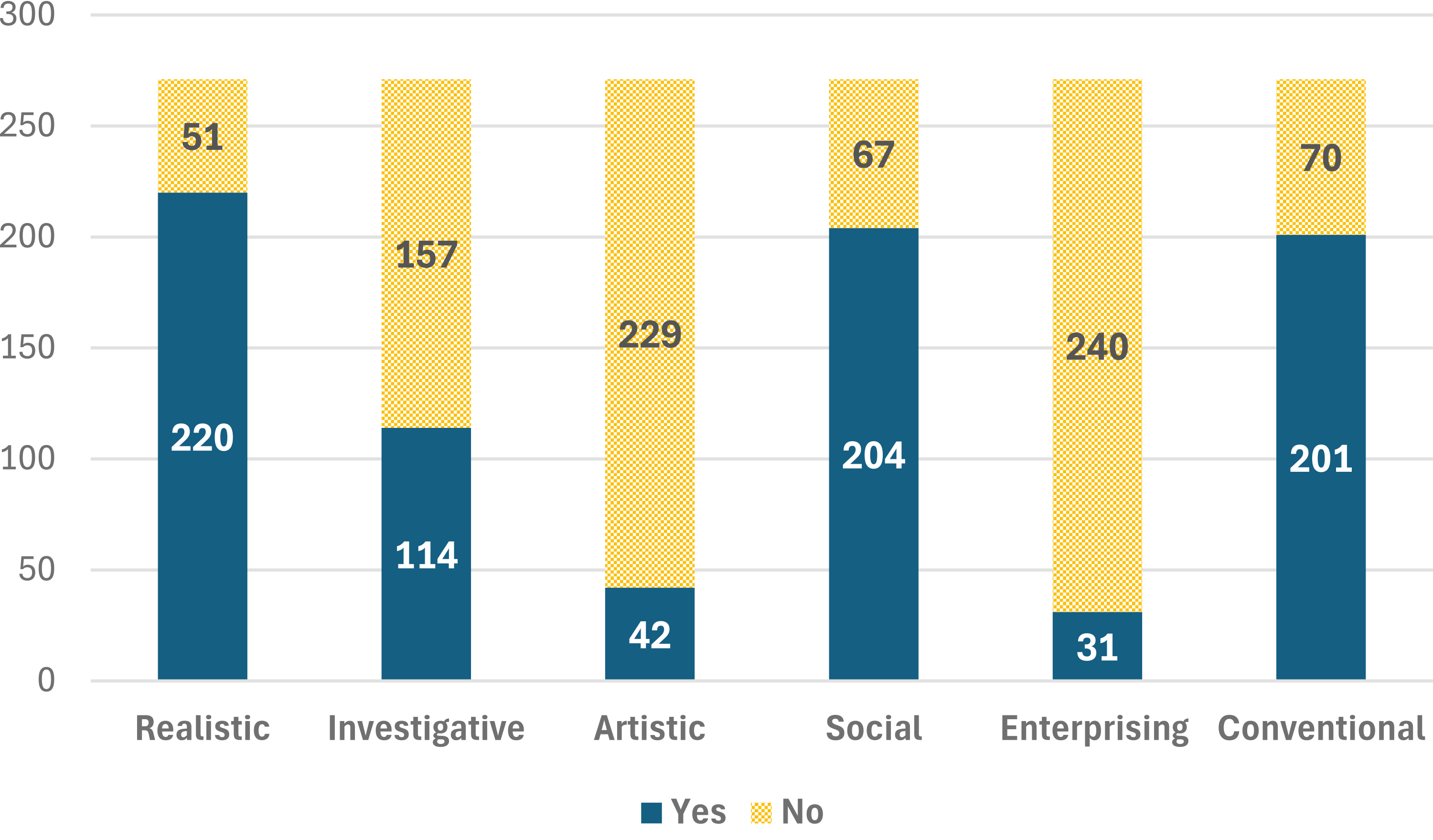
Domain of interest in the study population according to the RIASEC test.
Differences according to gender were found: realistic and investigative interest were dominant for men, and artistic and conventional interest were dominant for women. Profiles for men vs. women: realistic: 90.29% vs. 75.60% (p = 0.002); investigative: 51.46% vs. 36.31% (p = 0.010); artistic: 5.83% vs. 21.43% (p < 0.001); and conventional: 67.96% vs. 77.98% (p = 0.047).
Differences in vocational interest were identified for different levels of education and occupational groups. The investigative domain was related to higher education (76.92%; p = 0.002) and intellectual jobs (91.67%; p = 0.002), while the social domain was related to lower education (81.30%; p = 0.012) and unskilled jobs (79.07%; p = 0.031).
When we look at the generation structure, we see that our group consists mainly of three generations. The participants were represented as follows: 31 persons ≤ 44 years old (Generation Y), 237 persons between 45 and 59 years old (Generation X) and 3 persons ≥ 60 years old (Baby Boomers).
Discussion
A vulnerable population for poor work participation emerged from our study, associated with either shorter working experience or longer interruption of the activity. Gender, marital status, residence area, level of education, type of job, and number of professions were revealed to be prognostic factors for sustaining productive status.
Sociodemographic characteristics and work
Other studies examined the relationships between demographic characteristics and working status, in certain disorders. Lehmann et al. reported that working persons with multiple sclerosis were mainly men, were younger, had higher levels of education or achieved job positions, were more likely to be married or were in a partnership. 27
In a nationwide cohort study in patients with heart failure, Rørth et al. found that male sex and a higher level of education were predictors of return to work. 28 Employed persons were more frequently in a partnership and had higher education levels in a study conducted by Jordakieva in patients with kidney transplantation. 29 Another study that investigated the influence of sociodemographic factors on work disability in patients with ankylosing spondylitis revealed that those who were older, who lived in rural areas, who had less education or who performed manual work were more likely to no longer be active. Among these factors, age and occupation were identified as the strongest predictors of employee absenteeism. 30
Employment rates were also related to socioeconomic group. In a study by Bartley et al., men in professional and managerial occupations had the highest employment rates, and those in semiskilled and unskilled occupations had the lowest. 31 The socioeconomic impact on the resumption of active work was indicated in another study by the use of a longer period of sick leave by those from poor socioeconomic regions. 32
Several longitudinal studies showed how educational level affects employment. Exit from paid employment was most prevalent among workers with a low educational level in a study by Robroek. 33 According to an analysis of employment status by Devine et al. in Australia, the most frequently reported vocational barrier to work was not having qualifications or skills. 34 Wahrendorf revealed that adverse employment histories were associated with low occupational position. 35 The highest risk of premature exit from the labor market was identified among low-income male manual workers by Lallukka in a nationally representative sample of Finnish people. 36
In our study, residence area, number of professions and job match with personal interest seemed to be good parameters for predicting the time spent at work. Residence and number of professions correlated well with both working experience and interruption of the activity.
Our results were in line with those communicated by Danacica and Mazilescu, who analysed long-term unemployed spells in Romania.37,38
In one study, gender, level of education, work experience, residence, and regional development were the most important factors influencing long-term unemployment. Women were much more affected by long-term unemployment than men were. Rural unemployed individuals are more exposed to long-term unemployment than are urban individuals. Mid- to low-educated women from rural areas were the most vulnerable group. Individuals with a higher education from Bucharest-Ilfov, the most developed region in Romania, had the highest chances of reemployment. 37
In another paper, they examined the long-term unemployment spells and exit states of Romanian and Hungarian men. In both countries, the most affected individuals were young men and older men. Age and education had highly significant effects on unemployment duration and (re)employment probability in both countries. With increasing age, the probability of (re)employment decreases. Urban area, higher education and work experience had a highly significant effect on (re)employment probability. 38
Work-related values
Personality and work
Using RIASEC test, we analysed vocational skills and interests in adulthood and some arguments emerged for a personalised occupational rehabilitation program. Having a job unfit for one's own personal interest was an important factor for not searching for a new job and staying longer out of work.
The specialised literature suggests that a tailored approach creates premises for a successful return to work (RTW) program. RTW is not only a problem of the individual but also a problem of the social environment, especially of the workplace. The concept of RTW has changed in line with the biopsychosocial model, taking into account all relevant determinants of a chronic health condition and integrating biological, psychological and social factors in interdisciplinary assessments. From this perspective, a holistic, person-centred and multidisciplinary approach is needed, which must take into account all the factors and actors involved in the RTW process. 39
The evaluation of vocational skills and interests and job matches are part of this individualised approach. According to Holland's theory, a fitted job between individuals and their occupations is related to better performance and longer engagement and is expected to be beneficial for both the employee and the company. 40
Effective VR programs should focus on vocational interests. The inclusion of relevant aspects of training and work experience as well as vocational rehabilitation experts and specialists may play a key role in the return-to-work plan.41,42
The RIASEC test helps individuals understand their strengths and preferences in relation to potential career paths, guiding them in making informed decisions about education and employment. It was primarily designed for young people to aid in career counselling and vocational training. However, it can also be useful for adults seeking career changes, as it provides insights into their vocational preferences at any stage of life. 43 According to the Holland Codes, a dominant three-letter code was identified in this study, with an RSC in 39.11% of cases. Several publications have shown that interests are also an expression of the environments in which people can carry out their activities. 44 Three-letter RIASEC codes can also describe occupational profiles. 40
A person's personality is manifested in their preferences for work, and the work environment is described in terms of the people who work there and the activities they perform. This allows the environment to be evaluated in the same categories in which individuals are evaluated.44,45
RIASEC helps to link identified skill levels with required skill levels for different occupations, as described in O*NET, thereby comparing learning outcomes with labor market requirements. Therefore, it is possible to better monitor educational outcomes and assess the employability of groups beyond achievement outcomes and levels of social-emotional skills. These elements can be of great interest in assessing how well education meets the demands of society and the labor market at a given time. 44
O*NET, an occupation finder database (the Occupational Information Network), was developed in the U.S. It contains hundreds of standards and occupation lists for nearly 1000 occupations covering the entire U.S. economy and is constantly updated. O*NET information is used by millions of individuals every year and helps people find the training and jobs they need, and employers find skilled workers they need to be competitive in the marketplace. 46
Gender interests
Occupational gender segregation was found. Men were significantly more interested in realistic and investigative domains, while women looked mainly for artistic and conventional domains.
According to a meta-analysis from 2009, Su, Rounds, & Armstrong showed that men tend to prefer careers involving working with things and data and that women tend to prefer people-oriented careers and working with ideas.45,47 Similar sex differences were reported by other authors. In a study conducted by Ambiel R.A.M., men scored higher on realistic, investigative and enterprising interests, whereas women obtained higher scores on artistic and social interests. 44 Ehrtmann L. et al. communicated a high male-stereotypical interest profile (RIE) and a female-stereotypical interest profile (ASC) for students. 48
Interests and career field
Differences related to the level of education and occupation emerged from our research: investigative interest was associated with higher education, and social interest was associated with lower education. According to Holland theory, the investigative profile is characteristic of interest in science and data and is correlated with higher education. 19 These findings are also in line with Holland and Gottfredson's descriptions of occupations. Complex data tasks require a higher level of intelligence, resulting in highly ranked occupations. 49
Generations and work
Generational structure
In terms of age distribution, our group consists primarily of Generation X, followed to a lesser extent by Generation Y and Baby Boomers. Generation Y was poorly represented; these individuals are the youngest, have recently entered the labor market and have fewer health problems. Millennials are characterised as the most educated of the generations. They introduced the job-hopping trend; they stay with one employer for a shorter period than any other age demographic. They emerged in a completely different era than the Xers, Boomers and builders who came before them. 50
While some researchers increasingly challenge the concept of generational cohorts, arguing that theoretical knowledge and empirical evidence supporting the existence of generations is limited,51,52 others have characterized the current generations present in the labor market, so as to help managers and those in the HR departments of the companies, to know how to better interact with them.53,54,55 Globally, the workforce is described as multigenerational, mainly represented by Baby Boomers, Generation X and Generation Y. According to labor force statistics in the US, in 2020, 72.1 million (39.4%) Millennials (Generation Y) were working or looking for work. This number is more than the 65.2 million members of Generation X, who made up 35.5% of the workforce. This number far exceeds the 20% of Baby Boomers. Millennials overtook Generation X in 2016. The large size of this generational group in the US can be attributed in part to the increase in young immigrants.56,57
In the literature, generations are represented not only by a certain age interval, so-called chronological age, measured in units of time but also by the whiteness of a common historical period and social and cultural events.58,59 The presence of several generations increases the supply of highly qualified employees and enriches the workforce. Many employers have placed significant emphasis on this and have taken advantage of each generation's worldview to build an effective multigenerational work team. Younger employees are accustomed to quickly accessing technology and adapting to the changes it brings. In contrast, more mature employees have knowledge from their experience and can have a role in decision-making. The collaboration of young innovators with experienced wise men leads to increased productivity.
The constant shortage of the skilled labor force is a key and ongoing problem in Romania, as we face increasing labor demand in a growing economy and decreasing labor supply with an aging population and massive emigration.
Career choice and generations
The dominant RSC interest profile of the active population aged 45–60 years in Romania may have several explanations. They were born in the communist era in large numbers called “the decrees”, as a result of decree no. 770/1966, which strictly limited abortion. The way they were raised may explain their work value. The educational system prepared them mainly for technical professions, which is necessary for the planned process of building socialism, women received traditional education focused on altruism and sacrifice. In the absence of formal vocational guidance/counselling at the level of the education system, the guidance of individual careers was done within the family at the age of the first professional choices, through the knowledge and experiences of relatives. Moreover, personal skills and interests were not taken into account by the family either, but only the salary requirements and offers of the companies in the neighbouring area of the residence. There was a reserved attitude towards territorial mobility, far from the region of origin.
Job preferences and generations
We used O*NET to find a list of occupations for the dominant three-letter interest code RSC. Developed by the U.S. Department of Labor/Employment and Training Administration, the O*NET database was used by national and private companies or educational and research institutions around the world for career-related studies. 60
An advantage of this program is that it provides characteristics for each occupation and the required level of education (lower, medium-high school/vocational school, or higher education—Bachelor's degree or more).
A list of occupations for the RSC three-letter interest code found according to the O*NET program could be piloted in vocational (re)training centers: cafeteria attendants and bartender helpers, fast food and counter workers, animal control workers, personal care aides, library assistants, telephone operators, radiologic/RMI technologists and technicians, radiation therapists, dental hygienists, dental assistants, medical assistants, nursing assistants, ophthalmic medical technicians, librarians and media collection specialists. 46
The list of occupations is the result of this observational study on a limited sample of people. Therefore, the proposed occupations are far from exhaustive. Starting from these, additional suggestions can be made. It is intended to be a proposal of approach to operationalise this process, rather than a definitive solution.
Moreover, the statistical analysis revealed that the highest percentage of people were blue-collar workers who belong to the most disadvantaged social categories and who do not have as much experience or education. Improving access to and quality of education and vocational training must take into account many factors and be considered in accordance with the needs of beneficiaries as well as those of the labor market and societal changes.
Our research provided valuable data. First, our study is nationally representative, analyzing individuals admitted to INEMRCM from across the country, providing us with a comprehensive overview and allowing for the analysis of the phenomenon in different regions. Another strength is that we included multiple parameters, both objective and subjective, obtained through interviews, which enabled us to conduct more complex analyses. Unlike many studies that focus on specific pathologies, our research examined individuals with a range of health conditions, thereby broadening the scope of our findings. Finally, unlike most research, which often targets younger populations under 35 years old at the beginning of their careers, we applied the RIASEC test to an adult population over 35, many of whom have established careers and families. This demographic is particularly relevant as they often experience a decline in professional trajectory and face periods of long-term unemployment.
Our study is subject to several limitations. The low number of participants limits the accuracy of the statistical power. These results should be validated by further research on larger population groups and updated by different generations. This cross-sectional study made a single assessment and did not allow the establishment of causal relationships. These links can be achieved through longitudinal studies, designed to track changes over time and offer deeper insights into how various factors influence employability and job retention.
Some factors were found to be at the limit level of significance, e.g., development region for length of service duration and level of education for interruption of the activity. These findings should be considered, and their significance should be verified in further studies on larger groups. Social status and local opportunities are important influencing factors that can impact various aspects, such as education, access to different resources and overall performance.
Other additional factors might not have been considered in this study due to missing relevant variables, e.g., personal satisfaction, aspirations, personality traits for successful training and job retention. Including a wider range of variables will lead to a more holistic understanding of the factors that contribute to successful training and work engagement.
Most interest scales, such as the RIASEC, were developed specifically for the purpose of career counselling and not for employee selection and training. More research is needed to determine the generalizability of interest measures primarily used for career counselling to operational employment settings. Although these scales can nicely describe interests, they were created at a time when employees remained in a job or at a company throughout their careers but may be less useful for understanding the current workforce, which is characterised by frequent job/occupation changes and generally increased mobility. In some cases, people may apply for jobs for many reasons other than pursuing their real interests, such as availability, location, social pressure, short-term family needs or lack of alternatives. 61
Conclusions
A vulnerable population for disengagement from the labor market emerged from this study: women, singles, and the population from rural areas. Some job-related factors were identified for a lower rate of labor force participation: lower education, less skilled or unskilled occupations, and inadequate qualifications.
VR programs must primarily address vulnerable groups and target risk factors. Effective customised VR programs should focus on professional interests. The adult population must face the dynamics of professions and the labor market through their willingness to acquire new knowledge, skills and attitudes. Vocational guidance is necessary not only at young ages, after education but also throughout working life due to technological and professional changes. The development of (re)training programs that take into account a dominant interest in three areas, realistic, social, and conventional, identified by this study can be a first step toward making training centers more efficient. Documenting a list of occupations would allow targeted provision of funds to increase goals, to form well-trained future employees, so to take up adequate jobs and in line with their own interests and the needs of the labor market. In the development of training programs, differences according to gender (interest domains – realistic/investigative for men, artistic/conventional for women) and level of education and occupation (interest domains – investigative in higher education, social in lower education) should be considered.
Focused measures should also be explored to improve employability for this specific vulnerable group, particularly women, individuals from rural areas and those with lower levels of education. Flexible work arrangements and childcare services can alleviate caregiving burdens for women and help them to re-join the labor force. Additionally, online learning and educational programs that enhance basic education and align training with local business needs would be beneficial. Finally, transportation solutions such as community shuttles to better job accessibility, as well as incentives for businesses that hire from vulnerable populations could be effective strategies.
These findings may add some knowledge for good practice. High-quality evidence allows the targeted allocation of funds to develop effective training and education programs. Financing policies focus primarily on staff training, such as “employment assistants”, “labor experts”, the diversification of job offers and job coaching methods, labor market accessibility, and employers’ interest in supporting vocational rehabilitation programs at work. An increased employment rate will positively influence both individuals – increased qualification levels and job satisfaction – as well as society as a whole – increased productivity and higher GDP.
Future research needs to consider the effects of external factors such as economic conditions, technological changes, and shifts in labor market demands on employability and career trajectories. Encouraging interdisciplinary research, that links medicine with fields like psychology, sociology, and economics will allow a more comprehensive understanding of employability.
Footnotes

Ethics approval
The study was approved by the Ethics Committee of The National Institute for Medical Assessment and Work Capacity Rehabilitation Bucharest Nr. 3/13 January 2023. This study complied with the World Medical Association's Declaration of Helsinki. Participation in this survey was voluntary. All the data were deidentified.
Consent to participate
Informed consent was obtained from all the subjects involved in the study.
Consent for publication
All authors approved the manuscript and this submission.
Author contributions
C.O. – conceptualisation, methodology, software, validation, formal analysis, resources, writing – draft preparation.
A.C. – conceptualisation, methodology, validation, investigation, resources, writing – draft preparation.
R.S.C. - methodology, data curation, visualisation, supervision.
F.G.P. – resources, data curation, writing – review and editing, visualisation.
S.MA – methodology, resources, writing – review and editing, visualisation.
D.M.G. – conceptualisation, data curation, visualisation, project coordination.
Corina Oancea (C.O.), Anicuta Cernamoriti (A.C.), Rodica Simona Capraru (R.S.C.), Florina Georgeta Popescu (F.G.P.), Sorina Maria Aurelian (S.MA), Despina Mihaela Gherman (D.M.G.).
All authors read and approved the final manuscript.
Funding
The authors received no financial support for the research, authorship, and/or publication of this article.
Declaration of conflicting interests
The authors declared no potential conflicts of interest with respect to the research, authorship, and/or publication of this article.
Availability of data and materials
The raw data supporting the conclusions of this article will be made available by the authors upon request.