



Abstract
Background
With an aging workforce becoming increasingly prevalent in the United States, the intersection of older age and disability presents significant challenges for employment, particularly in the context of workplace accommodations.
Objective
This study aimed to elucidate the psychosocial factors influencing older workers’ requests and receipts of job accommodations, focusing on the pivotal role of disability acceptance.
Methods
Employing a quantitative approach, we included 217 older workers (50 years and older) across various employment sectors, analyzing their experiences with accommodation requests, workplace support, knowledge of the Americans with Disabilities Act (ADA), and levels of disability acceptance.
Results
Logistic regression models revealed that perceived workplace support significantly predicted the likelihood of requesting and receiving accommodations, whereas disability acceptance, despite its hypothesized importance, did not emerge as a significant predictor in our models. Results highlight the critical role of workplace support in facilitating accommodation processes for older workers and suggest that interventions to increase ADA awareness and foster supportive work environments may enhance accommodation outcomes.
Conclusion
This study contributes to a nuanced understanding of the dynamics surrounding accommodation requests among the aging workforce, emphasizing the need for inclusive workplace practices and policies.
Keywords
Introduction
An aging workforce will become a trend in the United States. By 2024, approximately 25% of the American workforce will be over 55. 1 Research has also indicated that more people will continue to work at older ages and delay retirement due to the need for income, healthcare benefits, and financial stability.2,3 In addition to monetary enhancement, accumulated evidence shows that employment positively affects the physical and mental health, life satisfaction, personal autonomy, and overall well-being of older adults.4–6 Older individuals working longer provide the additional benefit of allowing for the retention of experienced and mature workers who have had many years to strengthen the time-acquired skills that make them such an asset to the workforce. 7
The aging workforce, however, may also mean an increased presence of older workers who may experience functional limitations due to normal aging processes and disabilities.8,9 Aging often results in typical health issues such as arthritis, diabetes, hypertension, and heart disease.10,11 Additionally, one in four Americans will become disabled in some way before reaching the age of 67. 9 Older workers’ common functional limitations include decreased motor and cognitive functioning, communication, working memory, sensation and perception, and other declining physiological functions.12,13
These functioning limitations attributed to the aging process cause individuals to experience more significant workplace activity limitations, job disruption, and loss of productivity, among other perceived implications. 14 The reality of aging is not whether an individual will acquire a disability but rather when they will become disabled somehow. 15 As a result, a significantly high percentage of older workers will likely qualify for reasonable accommodations protected under Title I of the Americans with Disabilities Act (ADA). 16
According to the ADA, accommodations are defined as “any change or adjustment to a job, work environment, or the way things are usually done that would allow an individual with a disability to apply for a job, perform job functions, or enjoy equal access to benefits available to other employees”. 17 Advances in medicine, technology, and rehabilitation have made working longer with a disability a greater possibility. 18 Various types of accommodations are available for a wide array of disabilities. However, some of the most common involve flexible work hours, work-from-home options, extra break opportunities, assistive technology, Braille formatted material, hearing aids, modified workstations and modified job duties, and retraining for a job or training for new skills and getting someone to help with some of the job.12,14,19,20 According to the Job Accommodation Network (JAN), around 56% of accommodations cost nothing, while the remainder typically cost around $260, with an average maximum of $500. 21 In general, accommodations are low-cost and easy to implement.
Workplace accommodations can help older workers cope with pain and provide multiple psychological, cognitive, and health benefits. 22 Workplace accommodations can greatly enhance work performance and contribute to job retention for individuals with disabilities.23,24 Older workers can be as productive with adequate accommodations as their younger colleagues. 25 However, participants with unmet accommodation needs often have significantly poorer employment outcomes,26,27 more significant job stress, and less job control. 14 Besides the benefits to older workers, employers also benefit from accommodation provisions through retention of qualified employes, increased worker productivity, elimination of the cost of training new employes, increased company morale, and improved overall company productivity.21,28
According to the Americans with Disabilities Act (ADA), employers are required to provide qualified employes with accommodations; however, it is the employe's responsibility to request these accommodations. 29 This issue has become even more prevalent since a 2008 amendment to the ADA caused employers even greater reluctance to initiate conversations about accommodation requirements and employees’ medical conditions. 30 So, while the Bureau of Labor Statistics reports that nearly 80% of workers are covered by the ADA, a significant obstacle in the application of this law to help working individuals with disabilities is their hesitation or inability to disclose their conditions and engage in communication with their employer about how the disability may be affecting performance and what accommodations might be instrumental.27,31
According to Smalligan and Boyens, 27 there appears to be substantial unmet needs for workplace accommodations, especially among older workers. Approximately 47 to 58 percent of individuals with disabilities are not receiving accommodations in the workplace. 9 Some studies have investigated the psychosocial factors affecting the request and receipt of workplace accommodations. For example, Dong 16 found that perceived workplace supports, employe self-perceived knowledge of the ADA and accommodations, and the procession of work goals were significantly associated with a greater likelihood of requesting and/or receiving accommodations among older workers. However, in another study, 32 the procession of workplace goals was not significantly associated with receiving workplace accommodations among 596 people with disabilities, with about 35% of individuals 55 years and older.
Recent studies32,33 find that providing workplace accommodations influences supervisors’ perceived job strain and demand, which may negatively impact their willingness to provide accommodations. The unmet needs for workplace accommodations can also be attributed to the fact that only 12.7 percent of workers with a disability requested accommodations from their employers, despite over 78% reporting that they would benefit from the provision of some accommodations.9,34 In general, there is an underutilization of job accommodations among individuals with disabilities, 26 especially among older workers.16,35
Although older workers had more positive attitudes toward help-seeking in comparison with younger workers (e.g., due to more concerns about the personal costs of seeking help and their social roles of being solid and self-reliant),31,36,37 they were less likely to acknowledge their needs and limitations to request work accommodations compared to younger workers.16,35
According to Gignac et al., 38 the need for support and accommodations is associated with disability disclosure; however, concerns about stigma and productivity lead to less willingness to disclose disability among older workers. This can partly be attributed to the intersectionality of aging and disabilities. 39 For example, employers face challenges in providing reasonable accommodations for older workers with age-related physical challenges, such as flexible work arrangements, because the ADA's stringent definition of "disability" and the complexities of addressing intersectional discrimination between age and disability under separate laws limit their ability to offer adequate protection. 40
Aging may come with disabilities, but aging is not considered a disability and is not a primary concern for reasonable accommodations. 41 Thus, older workers who assign their functional limitations to age rather than disability may be less likely to request needed accommodations. Therefore, understanding the degree to which an older worker accepts their disability and requesting workplace accommodation among older workers is warranted.
Disability acceptance
Disability acceptance has been identified as an important factor in predicting psychosocial and employment outcomes in recent rehabilitation literature.42,43 Somatopsychologists initially introduced the concept of disability acceptance. From their perspective, the presence or onset of disability was commonly considered a misfortune or a significant loss in value; hence, disability acceptance aligned with acceptance of loss. 44 Evolutionally, acceptance refers to incorporating disability into one's self-concept, empowering the individual to perceive disability as non-devaluating to their remaining capabilities. 45 According to Wright, 45 four significant changes in one's value system can serve as indicators of disability acceptance: (a) recognizing and embracing values beyond those related to disability and loss; (b) deemphasizing the importance placed on physical appearance and physical ability; (c) confining the impacts of disability to the impairment itself, and (d) avoiding the tendency to generalize the limitations of disability in one domain to other aspects of the individual's life. Through these changes, individuals can participate in various activities based on their characteristics rather than social norms.
In the process of psychosocial adaptation to disability, disability acceptance is a significant direct predictor of positive psychosocial outcomes across various disability populations. For example, a higher level of disability acceptance was associated with increased life satisfaction and improved health-related quality of life (QOL) among individuals with spinal cord injuries.46,47 Similar positive relationships between disability acceptance and QOL have also been observed in studies on individuals with severe mental illnesses and traumatic brain injuries.48,49 Besides serving as a direct predictor of positive psychosocial outcomes, disability acceptance also plays the role of a mediator or a moderator in the relationship between various psychosocial factors. Zhou 42 demonstrated that physical status (i.e., pain, physical functioning, general health) and psychological difficulties (e.g., anxiety, depression, stress, loneliness) partially affected QOL through disability acceptance, indicating that disability acceptance might mitigate the adverse effects of biopsychosocial factors on QOL. Additionally, Kim 43 found the moderating role of disability acceptance. Specifically, individuals with higher levels of disability acceptance exhibit greater susceptibility to the impact of perceived disability stigma on job satisfaction compared to those with lower levels, leading to proactive efforts to address negative attitudes in the workplace.
Disability acceptance has also been identified as a significant factor influencing accommodation requests. In Barnard-Brak et al.'s 50 qualitative study among college students with disabilities, four themes emerged regarding students’ attitudes toward requesting accommodations, including academic integrity, disability disclosure, disability acceptance, and the accommodations process. In this case, disability acceptance refers to attitudes associated with an individual accepting their disability and requesting accommodations. Timmerman and Mulvihill 51 found that students with higher levels of disability acceptance demonstrated better adaptation to their disabilities and were more willing to request accommodations actively. Many studies have suggested that self-disclosure plays a crucial role in elucidating how disability acceptance affects the process of requesting accommodations. For instance, Cole and Cawthon 52 argued that students with learning disabilities who have lower levels of disability acceptance tend to disclose less about their disabilities and view them as personal and negative, consequently leading to a decreased inclination to request accommodations. Similarly, Barnard-Brak et al. 50 conclude that self-disclosure was a matter of self-acceptance of disability and interpersonal skills. They proposed that faculty and staff discuss disability acceptance when assisting students struggling with disclosure and requesting accommodations.
While researchers have recognized the significant relationship between disability acceptance and accommodation requests, it is important to note that most studies have focused on college students with disabilities. Whether relevant research findings apply to aging and older populations remains uncertain and warrants further investigation. In addition, due to the qualitative nature of previous studies, our understanding of the intricate interaction between disability acceptance, accommodation requests, and other relevant factors is limited. Therefore, employing a quantitative approach to develop statistical models is imperative to gain deeper insights into the relationships among target variables.
Thus, the study aimed to examine the role of selected psychosocial variables in predicting whether to request and receive job accommodation. The research questions included the following:
Method
Participants
The definition of an older worker remains elusive and inconsistent. The 1967 Age Discrimination in Employment Act protects individuals 40 years of age or older in terms of training and development opportunities at the workplace. Although no standard numerical criteria exist, the United Nations agreed on a cutoff for the older population of 60+ years. The U.S. Bureau of Labor Statistics 1 characterized older individuals as those 55 or above and reported that in 2014, 40% of this age group were actively seeking employment. For this study, an older worker is defined as an individual 50 years and older. The inclusion criteria for participants in this study include 1) they are 50 years and older and 2) they need accommodations in the workplace within three months prior to taking the survey.
The initial sample included 231 participants. After preliminary screening, 14 participants were excluded because they had over 80% missing values. Thus, data from a total of 217 participants were entered into the final analysis. They reported different age ranges: 50 to 54 (29.5%), 55 to 60 (51.2%), 61 to 64 (11.5%), 65 and higher (6.9%), and 2 (.9%) did not report their age. One hundred nineteen participants self-reported as female (54.8%), 95 as male (43.8%), 1 as transgender (0.5%), and 2 (.9%) did not report their gender. Forty-two participants had a high school degree or lower (19.3%), 212 had associate's, bachelor's, master's, or doctoral/professional degrees (79.3%), and 3 did not report their highest educational level completed (1.4%). The participants reported various job categories they held: technical (83.4%) or non-technical (14.8%) positions. In terms of their ethnicity, 151 participants self-reported as Caucasian (69.6%), 17 as African American (7.8%), 10 as Asian American (4.6%), 21 as Latino (9.7%), 13 as Native American (6.0%), 3 as others (1.4%), and 2 participants did not report their ethnic identity (.9%). Participants self-reported different types of disabilities: 86 (39.6%) with sensory disability, 32 (14.7%) with psychiatric disability, 26 (12%) with cognitive disability, 131 (60.4%) with physical disabilities, and 30 (13.8%) with other disabilities. The levels of disability severity include not at all (10.1%), moderate (41.5%), a good deal (31.8%), and extremely (16.6%). 67.3% of the participants held full-time jobs, and the rest worked part-time. Participants also reported different job tenures: less than one year (9.7%), equal to or higher than one year to less than three years (15.2%), similar to or higher than three years to less than five years (20.3%), and more than five years (53.9%).
Procedures
We recruited the participants through national consumer organizations and large rehabilitation agencies across the United States, such as the National Council on Disability, State Independent Living Centers, the State Division of Vocational Rehabilitation Services, the National Empowerment Center, the American Foundation for the Blind, the Hearing Loss Association of America, the Association of Assistive Technology Act Programs. We contacted the directors of the organizations with a recruitment letter. We provided them a link to an online Qualtrics survey, requesting they distribute it to their constituents. If an organization did not respond to the initial survey request within two weeks, one reminder email was sent to the organization. If the organization did not respond, one final reminder email was sent two weeks after the first reminder email. Because survey recruitments were conducted through online announcements and websites in multiple branches of these organizations, a response rate was not estimated.
The participants were asked to fill out the online survey, in which they answered a few demographic questions and were asked if they needed accommodations on their job within three months before completing the survey. We only included responses indicating needing accommodations within three months to try to increase the accuracy and objectives of their responses. Then, they were asked about the costs and types of accommodations they requested or considered but did not request. Should they have asked for accommodations, they would report whether they received them. Three options were offered: receiving the requested accommodations, request denied/ignored, or request pending. We excluded the pending responses from the analysis.
Furthermore, participants answered questions about their disability identity, perceived workplace supports, their knowledge of the ADA and accommodations, and whether they had work goals. The survey was pilot-tested among six individuals with cognitive, physical, and visual disabilities before its administration. The pilot test indicated no survey accessibility issues. However, we revised the wording for several survey items to enhance clarity. The online survey took about 20 to 25 min to complete. The institutional review board approved the study of the first author's institution.
Measures
Participants answered a questionnaire that included demographics such as gender, age, disability types and severity, education levels, employment status (part-time or full-time), years of work experience, and job categories. In addition, participants answered questions related to the accommodation types and costs. Participants indicated accommodations they requested/received from the following list: flexible schedule, telework, assistive technology, equipment purchase, job restructuring, re-assignment to another job, physical alteration to building/office space, assistance by another person, and others. The range of accommodation cost includes no cost involved (32.2%), less than US$100 (10.6%), less than US$300 (22.9%), less than US$500 (12.3%), more than US$500 (11%), or have no idea (25%).
The accommodation request and receipt statuses encompass the following: Non-requesters referred to individuals who did not request accommodations though they needed them; requesters refer to individuals who requested accommodations they needed; non-receivers referred to individuals who asked, but their requests were denied and ignored; receivers referred to individuals who received the requested accommodations or alternatives. In addition, participants completed the following measures:
Perceived workplace supports
The workplace supports were measured by six items in assessing their perceived relationships with and support from their employers/supervisors and co-workers. Participants rated the scale items (e.g., How do you rate your relationship with your coworkers?
How do you rate the supportiveness from your employers/supervisors?) on a 5-point Likert-type scale from very bad/not at all supportive (1) to very good/very supportive (5). The scale indicated a good alpha level (.84) in a previous study (53). The alpha level in the current study was .811.
Perceived knowledge of the ADA and accommodations
Participants self-reported their perceived knowledge of the ADA and workplace accommodations in answering the following two questions: “Please rate your level of knowledge of the Americans with Disabilities Act when you considered or requested the accommodations?” and “Please rate your level of knowledge of job accommodation procedures and processes in the organization where you considered or asked for the accommodations?” Participants reported on a 5-point Likert-type scale ranging from not at all knowledgeable (1) to very knowledgeable (5).
Work goal
Participants reported if they had a work goal or not at the workplace where they requested or considered accommodations. A work goal is defined as something they
aspire to achieve in their job. Examples of sample work goals were provided to assist participants in understanding the meaning of a work goal, such as “improving my work skills” and “getting acceptance at the workplace.”
Disability acceptance
Disability acceptance was measured by a 16-item short form Acceptance of Disability developed by Roessler 54 based upon the full version of Acceptance of Disability. 55 The short form of Acceptance of Disability was used considering the practicality of data collection. The items reflect the four conceptual dimensions of the full scale with the same proportion of items in each of the four dimensions. Items with the highest factor loadings on the principal factor were selected. 54 Participants reported on a 4-point Likert-type scale ranging from disagree very much (1) to agree very much (4). A sample scale item includes “My disability prevents me from doing just about everything I really want to do and from becoming the kind of person I want to be.” The alpha level of the short form of Acceptance of Disability in the current study was .853.
Data analysis
All statistical analyses in this study were conducted using the Statistical Package for the Social Sciences (SPSS, version 28.0). Initially, descriptive and bivariate statistics stratified by whether job accommodation was requested (Table 1) and received (Table 2) were examined. Pearson chi-square test was performed to investigate the bivariate association between selected categorical variables (i.e., gender, race/ethnicity, work status, job level, disability severity, accommodation costs, work goal, knowledge of ADA, knowledge of RA) and outcome variables (i.e., whether requested accommodation, whether received accommodation). For one continuous variable, workplace support, the independent t-test was used to examine its bivariate association with outcome variables. For the other continuous variable, disability acceptance, the Mann–Whitney U test was employed due to violations of normality to examine its bivariate association with outcome variables.
Descriptive statistics of explanatory variables by whether requested job accommodations.
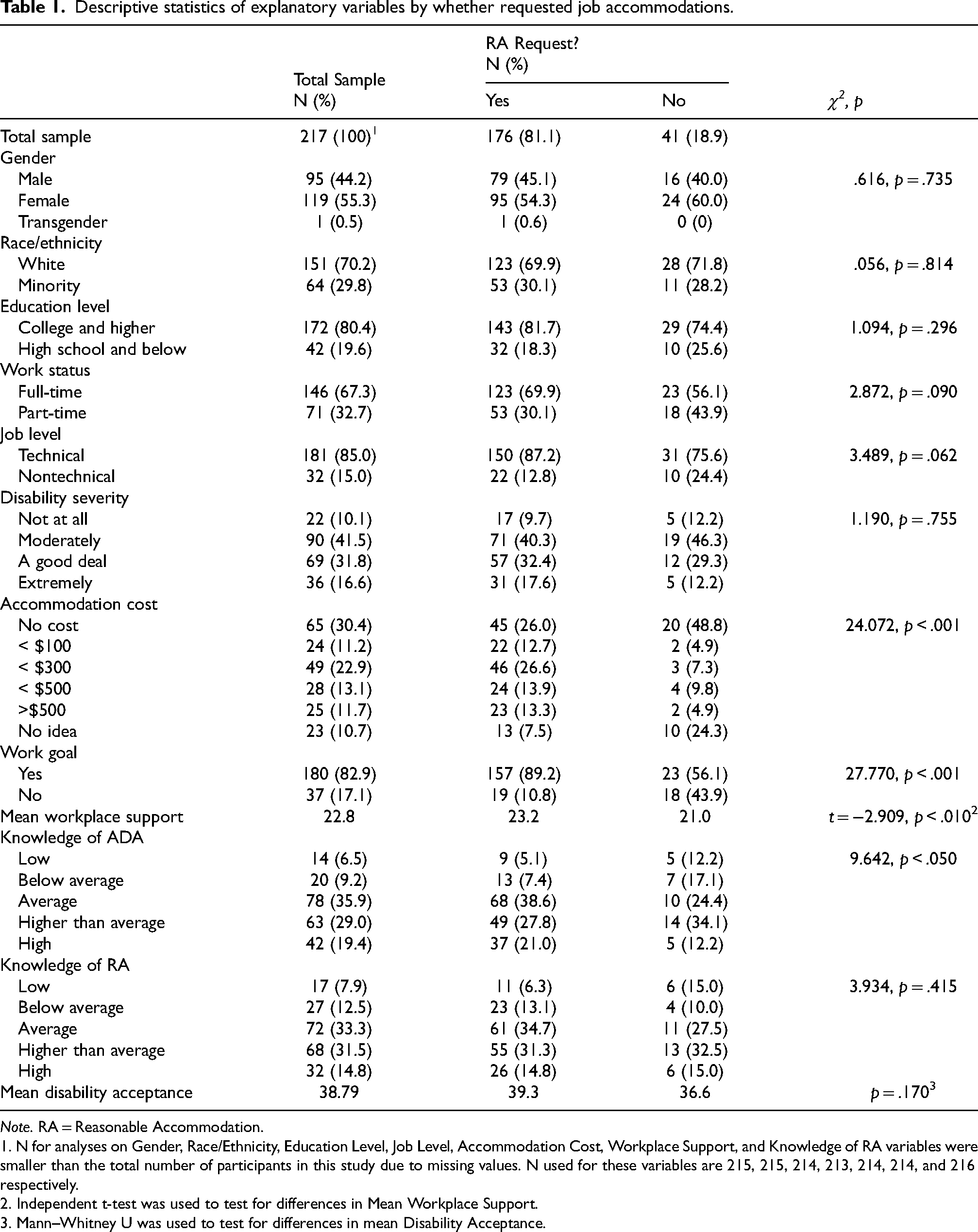
Note. RA = Reasonable Accommodation.
1. N for analyses on Gender, Race/Ethnicity, Education Level, Job Level, Accommodation Cost, Workplace Support, and Knowledge of RA variables were smaller than the total number of participants in this study due to missing values. N used for these variables are 215, 215, 214, 213, 214, 214, and 216 respectively.
2. Independent t-test was used to test for differences in Mean Workplace Support.
3. Mann–Whitney U was used to test for differences in mean Disability Acceptance.
Descriptive statistics of explanatory variables by whether received job accommodations.
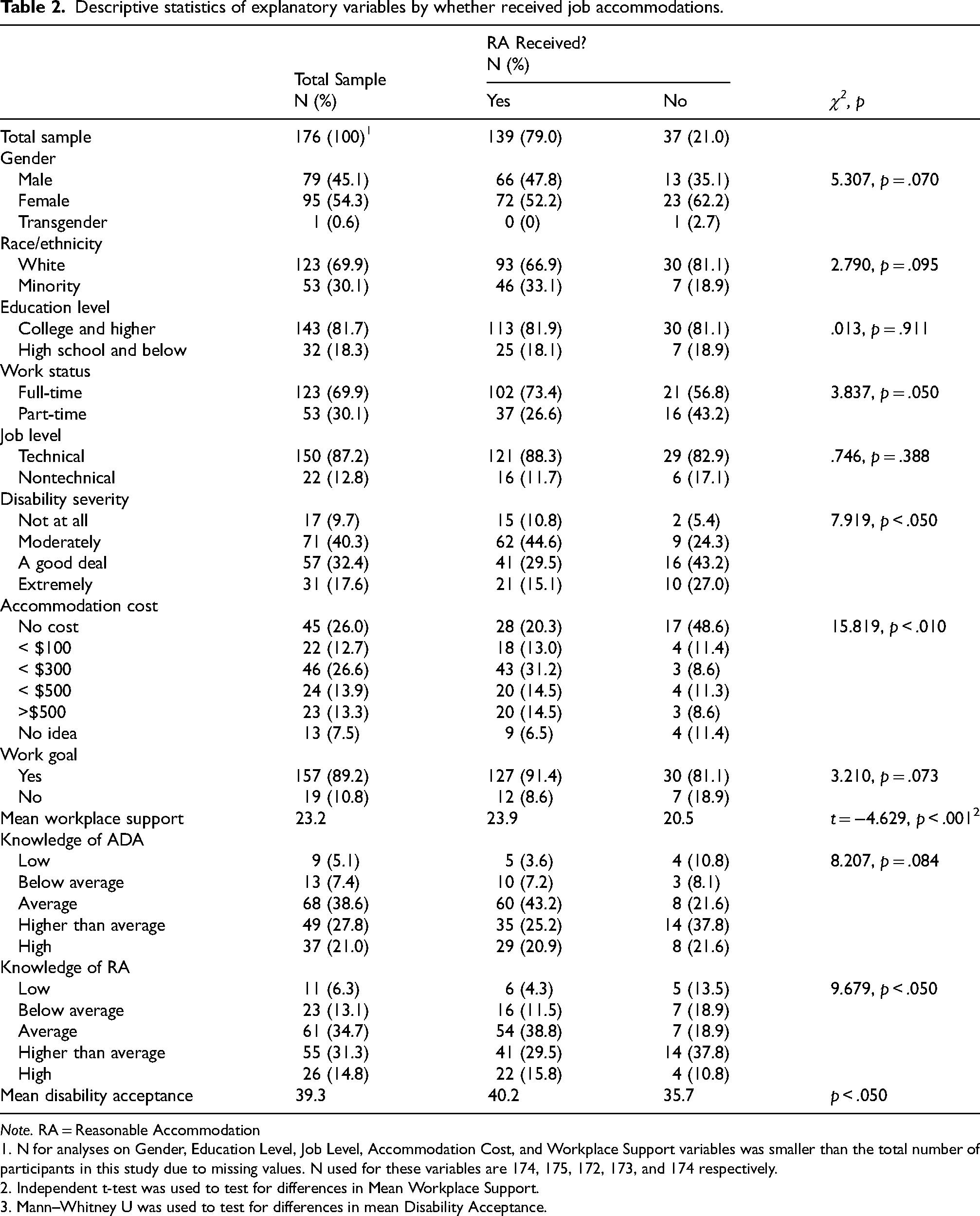
Note. RA = Reasonable Accommodation
1. N for analyses on Gender, Education Level, Job Level, Accommodation Cost, and Workplace Support variables was smaller than the total number of participants in this study due to missing values. N used for these variables are 174, 175, 172, 173, and 174 respectively.
2. Independent t-test was used to test for differences in Mean Workplace Support.
3. Mann–Whitney U was used to test for differences in mean Disability Acceptance.
Next, two binary logistic regression models were estimated to examine whether selected psychosocial variables could predict whether participants requested and received job accommodation. Model fit was examined using the likelihood ratio chi-square test results and the Homer and Lemeshow (HL) test. Model parameter estimates were calculated and converted to an odds ratio (OR) to determine the predicted outcome based on the changes in explanatory variables.
Results
Descriptive findings
Table 1 displays descriptive and bivariate statistics of selected variables by whether job accommodation was requested (N = 217). Eighty-one percent of the total sample requested job accommodations. The majority of participants are White (69.9%), hold college and higher educational degrees (81.7%), work full-time (69.9%), are employed in technical jobs (87.2%), and have a work goal (82.9%). A fair amount reported moderate (41.5%) and a good deal (31.8%) in terms of disability severity. Over fifty percent requested accommodation with no cost or below $300. The majority have average or above-average knowledge of ADA and job accommodation.
In Table 1, the chi-square test and independent t-test results showed significant distribution differences in whether requesting job accommodation based on accommodation costs (χ2 = 24.072, p < .001), work goal (χ2 = 27.770, p < .001), workplace support (t = −2.909, p < .010), and knowledge level of ADA (χ2 = 9.642, p < .050). The reported accommodation cost for those who requested accommodation tended to be under $300, while participants who did not request tended to respond with no cost or had no idea of the cost. Compared with those who did not request, participants who requested accommodation tended to have a work goal, higher workplace support, and average or high knowledge of ADA. Thus, these four variables were included in the logistic regression as explanatory variables analysis for requesting accommodation.
For participants who requested accommodations (N = 176), Table 2 presents descriptive and bivariate statistics of variables by whether they received job accommodation. Seventy-nine percent of them received the requested accommodation. Most of the sample are White, have a college level or higher, and work full-time at technical jobs with a work goal. Most of them reported a moderate level of disability severity. Over half of them requested accommodations below $300. Their self-reported knowledge of ADA and job accommodation is mostly above average. According to the chi-square test results in Table 2, significant distribution differences were observed in whether accommodation was received by work status (χ2 = 3.837, p = .050), disability severity (χ2 = 7.919, p < .050), accommodation cost (χ2 = 15.819, p < .010), and knowledge of reasonable accommodation (χ2 = 9.679, p < .050). Additionally, considerable distribution differences were identified at different levels of workplace support (t = −4.629, p < .0012) and disability acceptance (p < .050) in terms of receiving accommodation or not. Specifically, compared with those who did not, participants who received accommodation are more likely to work full-time, have no or a moderate severity level of disability, request an accommodation less than $300, have average or high knowledge of reasonable accommodation, and have a higher level of workplace support and disability acceptance. Thus, these six variables were included in the logistic regression as explanatory variables analysis for receiving accommodation.
Logistic regression
Request accommodation
The logistic regression model of requesting accommodation with the four explanatory variables (i.e., accommodation cost, work goal, workplace support, and knowledge of ADA) shows a significant improvement from the baseline model as evidenced by a significant likelihood ratio chi-square (χ2 = 49.737, p < .001). The Homer and Lemeshow (HL) test supports the model as a good fit, indicated by a non-significant chi-square of 7.956 with p = .438. Of all four explanatory variables, accommodation costs below $100 and $300, having a work goal, and workplace support significantly contributed to the model. Specifically, compared with not knowing accommodation costs, the odds of requesting accommodation within this sample are 9.66 times and 13.48 times higher for accommodation costs below $100 and $300, respectively. Compared with participants who do not have a work goal, the odds of requesting accommodation in this sample are 4.61 times higher for those with a work goal. Lastly, the odds of requesting accommodation are 1.13 times higher for every one-unit increase in workplace support score after adjusting the other estimate for other parameters in the model. Other variables are not significantly related to requesting accommodation. See Table 3 for details.
Logistic regression of requesting accommodation by explanatory variables (N = 212).
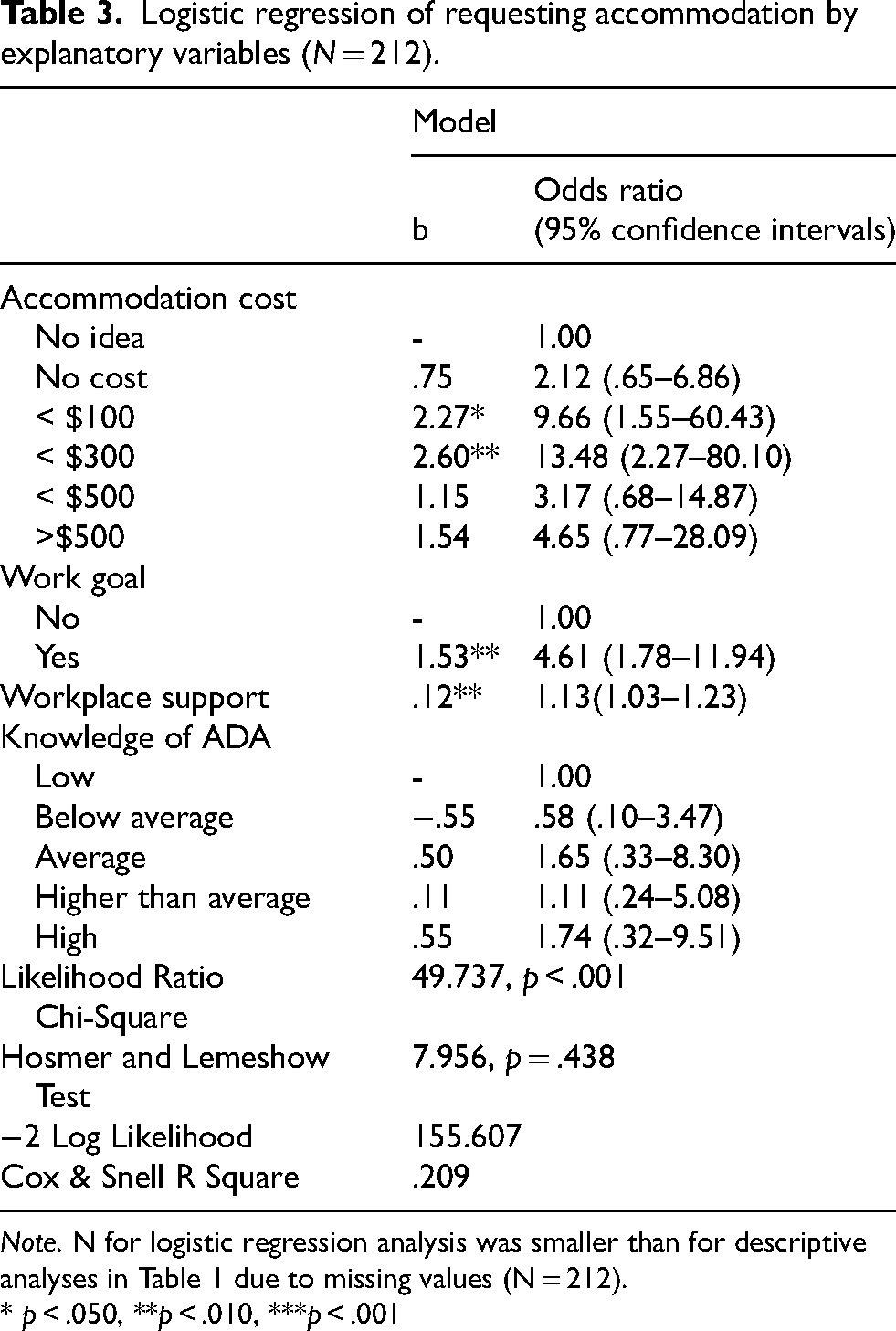
Note. N for logistic regression analysis was smaller than for descriptive analyses in Table 1 due to missing values (N = 212).
* p < .050, **p < .010, ***p < .001
Receive accommodation
The logistic regression model of receiving accommodation with the six explanatory variables (i.e., work status, disability severity, accommodation cost, workplace support, knowledge of reasonable accommodation, and disability acceptance) showed significant improvement from the baseline model, as indicated by the likelihood ratio chi-square test (χ2 = 50.067, p < .001). The HL test suggests a good model fit (χ2 = 4.273, p = .832). Only workplace support significantly contributed to the model. The odds of receiving accommodation within this sample are 1.26 times higher for every one-unit increase in workplace support score after adjusting the estimate for other parameters in the model. Other variables are not significantly related to receiving accommodation. See Table 4 for details.
Logistic regression of receiving accommodation by explanatory variables (N = 174).
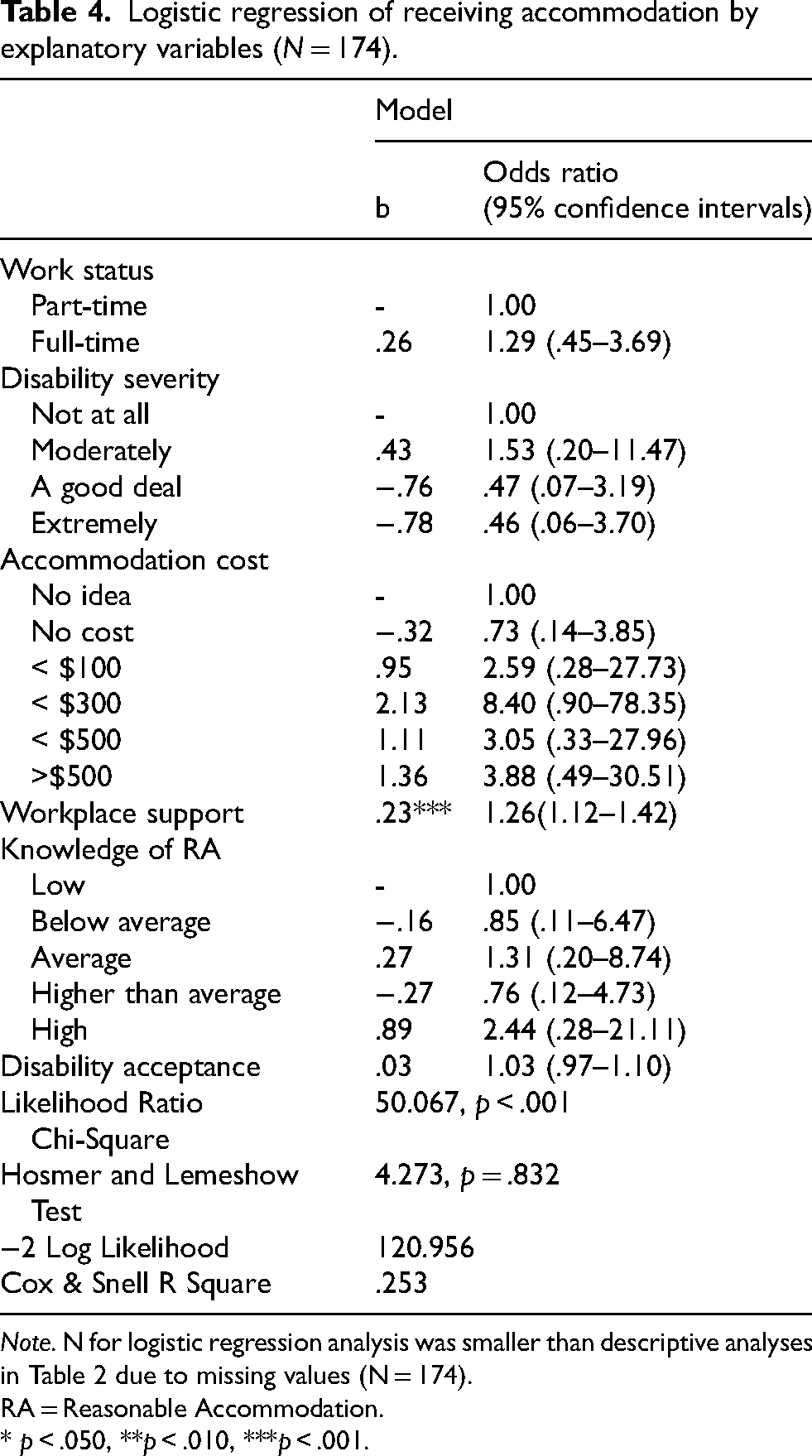
Note. N for logistic regression analysis was smaller than descriptive analyses in Table 2 due to missing values (N = 174).
RA = Reasonable Accommodation.
* p < .050, **p < .010, ***p < .001.
Discussion
This study sought to unravel the complexity of psychosocial factors influencing the request and receipt of job accommodations among older workers. The findings are pivotal in understanding what drives accommodation requests and their fulfillment, which is particularly relevant given the aging workforce and the imperative of sustaining employment for older workers. The results suggest no significant differences in disability acceptance between participants who requested accommodations and those who did not. In our sample, the average level of disability acceptance is relatively low, scoring an average of 38.79 out of 64 on the disability acceptance measure. This finding is inconsistent with previous literature on college students with disabilities, where disability acceptance emerged as a significant predictor of accommodation requests.51,52 The characteristics of the sample may shed light on the explanation for the inconsistency. According to Gibbons, 56 the contemporary concepts of aging, which prioritize a youthful appearance, often view growing older with disabilities as a failure. Elders with disabilities frequently perceive themselves as vulnerable and as not meeting the able-body standards inherent in today's society. Consequently, many elders often disregard their experiences of disability and do not identify themselves as people with disabilities. Given this population's tendency to not attribute their functional needs to disability, it is reasonable to observe relatively low scores on disability acceptance in general and a lack of differences in disability acceptance between those who requested accommodations and those who did not.
The findings of this study indicate that participants who received accommodations show a significantly higher level of disability acceptance than those who did not. However, disability acceptance was not found to be a significant predictor of receiving accommodations in the logistic regression model. To the best of our knowledge, no prior research has explored the relationship between disability acceptance and receiving accommodations. One potential explanation for this finding is that the effect of disability acceptance on receiving accommodations may be mediated by perceived workplace support. Drawing on Wright's “coping vs. succumbing” framework, 43 individuals with higher levels of acceptance are more likely to cope effectively with disabling conditions and achieve psychological stability. Many studies have found positive correlations between disability acceptance and adaptive coping strategies.57–59 In this study, participants with higher levels of disability acceptance may employ problem-solving and engagement coping strategies when interacting with employers and coworkers. These strategies can facilitate the development of positive work relationships and workplace support, ultimately allowing the provision of accommodations.
Our results demonstrate that employes who perceive high support from their workplace are more likely to request and receive accommodations. The findings are consistent with the results of the previous work,16,53 substantiating the significant role of perceived workplace support in requesting and receiving accommodations. Our research underscores the assertion that a supportive work environment encourages requests for accommodations and is also predictive of whether such requests are granted, especially among older workers. Interestingly, even after adjusting for various parameters, workplace support remained a robust predictor. This is consistent with the notion that perceived organizational support can bolster employe confidence in engaging with management about their needs, ultimately fostering a more inclusive workplace. 16 This is of particular importance given the demographic shift towards an aging workforce. It is also crucial to reflect on the potential barriers in workplaces with lower perceived support. Older workers in such environments may be less inclined to seek accommodations due to fear of stigmatization or a belief that their requests will not be taken seriously. 33 This may lead to underreporting of needs and, as a result, a workforce that is not as well-equipped as it could be to perform optimally.
Our results also indicate that participants with defined work goals are significantly more likely to request accommodations than those without such goals. The odds being 4.61 times higher for such individuals signals a robust link between goal orientation and accommodation-seeking behavior. This can be interpreted within the self-regulatory theories, which posit that goal setting is a critical driver of behavior. This leads individuals to identify and engage in actions perceived as necessary to achieve their goals, including seeking workplace accommodations. However, our analysis also reveals that the presence of a work goal does not significantly predict the receipt of accommodations, which is consistent with the results of a previous study. 32 This discrepancy raises questions about the possible disconnect between employe initiative and employer response. While employes may recognize the need for accommodations as a means to attain their goals and thus make requests, the decision-making process on the employer's side may be influenced by factors unrelated to the employe's goal orientation, such as resource availability, legal considerations, or biases for older workers. 60 This divergence also highlights potential areas for further investigation and intervention.
The findings of our study draw attention to the association between employes’ knowledge of the Americans with Disabilities Act (ADA) and their behaviors and outcomes regarding workplace accommodations. Chi-square analyses suggest a compelling trend: Individuals requesting and receiving accommodations are likely to possess above-average knowledge of the ADA and a better understanding of reasonable accommodation provisions, respectively. The results of the current study are consistent with those of past studies such as those of Dong. 16 This apparent relationship underscores the potential impact of ADA awareness and familiarity with accommodation policies/procedures on employes’ proactive request behaviors in securing workplace support. It resonates with the idea that knowledge is power; employes informed about their rights are more prepared to advocate for themselves, initiating requests for reasonable accommodations to facilitate their work performance and inclusion. Despite these positive correlational results, the knowledge was not found to significantly predict the actual request and/or receipt of accommodations. One possible interpretation is that while ADA knowledge is necessary, it may not be sufficient in isolation. Other factors, such as organizational culture, management attitudes, and the nature of the disability or need for accommodation, may play more substantial roles in determining whether requests are made and granted.
This study observed a trend that suggests participants who received accommodations are more likely to be full-time employes. This implies that full-time workers may be more visible or considered more integral to operations, making it more likely for them to receive support in the form of accommodations. However, when subjecting these associations to regression analysis, working full-time did not significantly predict the likelihood of requesting or receiving workplace accommodations. This non-significance in the regression analysis could imply that full-time employment status alone does not influence the accommodation process once other factors are controlled for. Additionally, the lack of significance for full-time work status in the regression analysis may indicate that employers apply accommodation policies uniformly, without bias towards the number of hours an employe works. This would be in keeping with the spirit of the ADA, which stipulates that accommodations should be provided based on need rather than on an employe's work status.
Our analysis delineated that older workers who request and receive accommodations are more likely to incur minimal financial burden, with costs not exceeding $300 and, in many cases, no cost at all. The findings are consistent with the results of past studies.16,32 This challenges preconceived notions about the cost-prohibitive nature of accommodations. They could indicate either a workplace environment that readily facilitates accommodations or a need for more awareness among workers about more costly but necessary modifications.
Implications
The findings of this study provide implications for rehabilitation practice. In this study, workplace support is a significant predictor for requesting and receiving accommodations. To fully realize the benefits of workplace accommodation, it is essential to recognize that individuals with disabilities should not be solely responsible for driving the process. Instead, active involvement and support from employers, coworkers, and other relevant stakeholders are crucial for ensuring the successful implementation of accommodations. Rehabilitation professionals play a vital role in this process by collaborating with human resources staff to provide training sessions to employers and employes regarding disability and workplace accommodations. These training sessions should rectify misconceptions about disability and increase awareness of fostering a disability-friendly work environment. Moreover, rehabilitation professionals should offer psychoeducation training to older workers with disabilities to enhance interpersonal and communication skills. By improving these skills, they can increase the opportunities to cultivate positive work relationships and obtain workplace support.
In addition to increasing perceived workplace support, rehabilitation professionals must assist older workers with disabilities in setting clear work goals and acquiring knowledge about ADA and accommodations. Older workers with disabilities are at a unique stage of their career development. Age and disability-related factors, such as declining health and career plateaus, can significantly impact their motivation to work. 61 Therefore, rehabilitation professionals must help this population explore and establish specific and individualized work goals. By facilitating the development of these work goals, rehabilitation professionals can empower this population to become more engaged in work-related activities, fostering a deeper understanding of their professional aspirations. Simultaneously, rehabilitation professionals should educate older workers with disabilities about their rights under the ADA and workplace accommodations. By elucidating the connections between their work goals and necessary accommodations, older workers with disabilities can adopt a more holistic perspective on accommodations and feel more inclined to request them when needed.
This study also has implications for future research. First, the majority of the sample in this study are White workers with postsecondary educational degrees, predominantly employed in technical or professional jobs. To improve the generalizability of findings, future research needs to expand the sampling pool and recruit more diverse and representative samples from different sources. Second, this study relied on quantitative data to examine the relationship between various psychosocial factors and accommodation requests among older workers with disabilities. There is a need for future research to utilize more qualitative research methods, which can offer insights into the subjective experiences of this population regarding requesting and receiving accommodations, thereby informing the development of relevant services. Lastly, this study sheds light on how disability acceptance predicts the receipt of accommodations. Given the limited existing literature on this topic, future research should further investigate the role of disability acceptance and disability identity in the process of requesting and receiving accommodations. Such investigations can inform psychosocial interventions aimed at helping older workers manage aging and disability.
Limitations
Several limitations of this study need to be considered when interpreting and generalizing its findings. First, despite efforts to recruit participants from multiple national-level organizations, our sample may not be representative based on its demographic characteristics, which may affect the generalizability of the results. Second, our study observed a relatively high rate of accommodation requests in the sample. This may be attributed to the self-selection nature of the online survey approach, introducing potential biases into the sampling process. Third, the research design of our study is cross-sectional and exploratory, limiting the ability to examine causal relationships between various psychosocial factors and accommodation requests and receipts. Last, most of the measures utilized in this study were quantitative and self-reported. These measures may be susceptible to response biases and may not fully capture participants’ live experiences of accommodation requests and receipts.
Conclusion
In conclusion, our study highlights the intricate interplay of disability acceptance, workplace support, work goals, and other related psychosocial factors in shaping older workers’ accommodation request and receipt processes. By addressing these factors, we can create more inclusive workplaces that support the well-being and productivity of older workers, ultimately contributing to a more diverse and dynamic workforce.
Footnotes
Ethical approval
This manuscript follows the standards on ethical consideration, informed consent, and reporting guidelines. The study was approved by the Institutional Review Board of Florida State University (HSC # 2013.10830).
Informed consent
This manuscript follows the standards on ethical consideration, informed consent, and reporting guidelines. The study was approved by the Institutional Review Board of Florida State University (HSC # 2013.10830).
Funding
The author(s) received no financial support for the research, authorship, and/or publication of this article.
Declaration of conflicting interests
The authors declared no potential conflicts of interest with respect to the research, authorship, and/or publication of this article.